Do local ethnic configurations affect peacekeepers’ ability to protect civilians? If so, under what conditions are peacekeepers more effective at saving civilian lives? Existing studies show that variations in the distribution of ethnic groups shape the dynamics of civil conflict and explain who are the targets of violence. In particular, local-level differences in armed groups’ number and size result in specific dynamics of conflict because each configuration corresponds to distinct capacities and incentives to use violence. Given that conflict dynamics are very sensitive to variations in the balance of power between ethnic groups, peacekeepers’ capacity to reduce violence should be conditional on local ethno-demographic factors. However, existing studies on peacekeeping neglect these factors and point toward a seemingly homogenous curbing effect of peacekeeping on civilian killings. But how do peacekeeping interventions interact with ethnicity, and which deployment strategies are more likely to be successful at protecting civilians?
This article bridges theories on the role of ethnicity and territorial control for the production of violence in civil war with the literature on peacekeeping effectiveness. Both strands of literature focus on factors that are usually studied separately but that clearly interact and produce joint effects on the ground. Peacekeepers are successful at containing violence against civilians; however, they may also inadvertently create incentives for escalation by signalling insufficient commitment and changing the balance of power between fighting parties. This signalling argument finds empirical support when commitment is measured in terms of mission size; larger and nationally heterogeneous missions have been found to be more effective at protecting civilians (Bove and Ruggeri Reference Bove and Ruggeri2015; Hultman, Kathman and Shannon Reference Hultman, Kathman and Shannon2013). However, it is unclear how peacekeeping itself changes the balance of power and, in turn, shapes armed groups’ preferences of one type of violence over another. My argument is that the capacity of peacekeepers to reduce violence against civilians is conditional on the local balance of power and territorial control held by warring parties. Curbing violence in some locations may be more difficult than in others, and increasing the number of blue helmets on the ground does not automatically reduce violence. To put it differently, certain features of the conflict can interact with peace missions and affect their success or failure. Hence, in order to outline the mechanisms driving some interventions to succeed, the domestic environment has to be explicitly considered in the theoretical framework as the locus where local sources of hostility and the local capacity interact to impact UN peace strategies (Doyle and Sambanis Reference Doyle and Sambanis2000; Lyon Reference Lyon2005). If the objective of peacekeeping is to increase the cost of violence, its effect is necessarily conditional on what incentivizes violence among combatants (Regan Reference Regan2002a; Regan Reference Regan2002b). Since the dynamics of violence are related to territorial control and the ethno-demographic composition of locations, ethnic configurations are expected to influence the success and failure of peace operations.
The contribution of this study is twofold. First, the article combines information on the ethnic composition of deployment locations with features of the mission, hence bridging the gap between research on local sources of violence in civil war and peacekeeping effectiveness. In doing so, this article also provides evidence of a crucial dilemma policy makers face when designing missions, namely intervening to restore peace without provoking an escalation of violence, especially against unarmed civilians. Secondly, it conceptualizes territorial control in relation to ethnic patterns. Moving from Tilly’s (Reference Tilly1985) definition of territorial control as the capacity to extract resources, including support and recruit, from the local population, a larger share of co-ethnic population is associated with a larger pool of resources and, consequently, more solid territorial control. When armed groups recruit and mobilize along ethnic lines, variations in ethnic geography change how combatants use violence against civilians and adapt to a UN deployment. Fine-grained subnational data on ethnic polarization serve as a proxy for armed groups’ local strength if these recruit from an ethnic-based pool of individuals. By putting more emphasis on the armed actors’ relative capacity, the empirical analysis of this study investigates how one-sided violence dynamics change where peacekeepers are deployed. This approach fits well with recent advancements in disaggregating peace missions (Ruggeri, Dorussen and Gizelis Reference Ruggeri, Dorussen and Gizelis2016). Indeed, the contributions highlighted above are mostly a response to the call for ‘going micro’ (Autesserre Reference Autesserre2014) in peacekeeping studies by focusing more on how peacekeepers face varying local conditions. Disaggregation is not always necessary, but given the aim of this article it is useful to test mechanisms of effectiveness more explicitly and to explore interactions that take place locally and for which aggregation would add too much ‘noise’.
This article is structured as follows. First, I review the main theories explaining how territorial control and ethnic geography affect the dynamics of one-sided violence. Then I present state-of-the-art studies on peacekeeping effectiveness and link this research strand on mission features to the literature on how ethnicity explains patterns and types of violence. In the theoretical section, I formulate hypotheses on how UN missions affect violence, conditional on the local distribution of power among combatants. I argue that the capacity of peacekeepers to forestall the targeting of civilians is conditional on the pre-deployment balance of power and territorial control. These are central elements in the literature on civilian victimization, but are largely missing from studies of peacekeeping effectiveness. The proposed mechanism is that under large asymmetries of power (mirrored by low ethnic polarization), peacekeepers are expected to be less effective at curbing one-sided violence because their deployment (1) creates incentives for quick escalation in the short term and (2) makes them less effective at monitoring and separating armed actors because the frontlines are more blurred and fluid. In the empirical analysis, I propose ethnic polarization as an appropriate measure of the balance of power and test the theoretical expectation with data from the UN mission in Sierra Leone in the period 1997–2001. The main model used to test the hypotheses is a negative binomial performed on a matched sample, which reduces model dependency and alleviates selection bias.
Dynamics of One-Sided Violence in Civil Wars
The literature on civil war has shown that the territorial distribution of ethnic groups is related to conflict dynamics (Toft Reference Toft2002). Thus it represents one of the sources of violence that peacekeepers have to tackle. Various ethnic configurations result in different targets of violence. Also, opponents resort to different types of violence (one-sided, two-sided, selective, indiscriminate, etc.) depending on the power distribution in a location. In particular, violence against civilians has a clear strategic dimension and is argued to be a function of territorial control (Kalyvas Reference Kalyvas2006; Kalyvas and Kocher Reference Kalyvas and Kocher2009; Wood Reference Wood2010). If two actors are fighting against each other in irregular conflict, civilian co-operation becomes vital, and violence is used as a means of coercion to achieve collaboration. According to Kalyvas (Reference Kalyvas2006), combatants will refrain from victimizing civilians when violence is unnecessary or counterproductive. When territorial control is perfectly divided between factions, victimizing civilians indiscriminately will push them to balancing, that is, to seek protection from the least violent party. Similarly, in locations where one party enjoys complete dominance, indiscriminate violence is off equilibrium. Conversely, there is a higher likelihood of civilian victimization when territorial control is relatively solid but incomplete (hegemonic). As Zhukov (Reference Zhukov2013) notes, however, this expectation hinges on the assumption that civilians will choose balancing instead of bandwagoning when deciding to co-operate with one faction or another. The idea is that if two groups have similar territorial control, neither has enough intelligence to identify opponents and pursue selective violence. Indiscriminate violence against civilians would backfire, as civilians would then support the group that uses less violence to seek protection. By relaxing this assumption about civilians’ balancing against violent perpetrators, Zhukov (Reference Zhukov2013, 45) shows that one-sided violence is also likely in areas that are fully controlled and that even opponents in very weak positions may have incentives to target civilians.
The relevance of territorial control and power asymmetries among fighting groups in explaining one-sided violence is hardly deniable. A similar argument is made by scholars who posit that the geographical patterns of ethnic groups, as a proxy for group power, serve as a determinant of violence (Costalli and Moro Reference Costalli and Moro2012; Di Salvatore Reference Di2016; Klasnja and Novta Reference Klasnja and Novta2016; Montalvo and Reynal-Querol Reference Montalvo and Reynal-Querol2005a; Weidmann Reference Weidmann2011). If territorial control shapes a group’s capacity to extract resources (Tilly Reference Tilly1985), including recruits, then the greater a group’s own relative ethnic share, the larger its pool of potential resources. Therefore the index of ethnic polarization has been proposed as a measurement of groups’ power based on their relative size. Furthermore, as I will argue, we lack information on balance of power that varies geographically. Information on warring parties’ size is inappropriate for testing theories on local dynamics of competition; ethnic polarization is an important proxy for this purpose.
Polarization is highest when there is perfect parity between groups, resembling bipolarity of control over a territory. The assumption is that two similarly large and strong groups will fight more intensely and on a larger scale. Even when civil wars are not fought primarily along ethnic lines, the salience of ethnicity may increase during the conflict. Selective civilian targeting requires significant information to identify opponents. One way to solve the identification problem is to rely on features that are easier to detect which can be used to infer loyalty. Hence ethnicity can become a salient trait as a result of endogenous conflict dynamics that may further reinforce its use. Indeed, when civilians realize that their profile, rather than their behaviour, makes them targets of violence, the cost of joining rebels to obtain protection is lower than freeriding (Kalyvas and Kocher Reference Kalyvas and Kocher2007). In line with this logic, while ethnic composition is not a good predictor of conflict onset, it explains variation in conflict intensity (Esteban and Ray Reference Esteban and Ray2008). Overall, highly polarized societies tend to have more violent conflicts (Costalli and Moro Reference Costalli and Moro2012; Montalvo and Reynal-Querol Reference Montalvo and Reynal-Querol2005a). Civilian victimization as a specific type of violence, however, increases under conditions of either high polarization (two large groups) or low polarization, since the asymmetry of power makes the smaller group more reliant on coerced civilian support (Esteban, Morelli and Rohner Reference Esteban, Morelli and Rohner2010; Montalvo and Reynal-Querol Reference Montalvo and Reynal-Querol2008). The latter point is in accordance with research suggesting that strategic environments with large asymmetries increase the use of violence against civilians by the weaker opponent (Hultman Reference Hultman2007; Wood Reference Wood2010).
The arrival of peacekeepers has the potential to change the balance of power between groups, even when missions are impartial. The mere presence of peacekeepers in some locations alters the opportunity structure for armed actors that perpetrate one-sided violence strategically. The next section focuses on the main findings concerning peacekeeping missions and their impact on civilian killings.
Peacekeepers and Protection of Civilians
Military intervention in the context of ethnic conflict and civilian killings poses a dilemma. The scholarship on peacekeeping has produced, overall, optimistic evidence on the effect of peacekeeping on violence against civilians, but some results are still concerning (Di Salvatore and Ruggeri Reference Di and Ruggeri2017). Several studies show that civilian victimization can be prevented only if the peace mission intervenes by explicitly targeting the perpetrators (Hultman Reference Hultman2010; Krain Reference Krain2005). However, other scholars argue that changing the balance of power in a civil war by intervening in support of one side creates an incentive for the ‘loser’ to escalate one-sided violence (Kathman and Wood Reference Kathman and Wood2011; Kathman and Wood Reference Kathman and Wood2014). More recent studies find that UN armed personnel reduce civilian killings, but that unarmed observers are associated with increased targeting of civilians during and after the conflict (Hultman, Kathman and Shannon Reference Hultman, Kathman and Shannon2013; Kathman and Wood Reference Kathman and Wood2011). The deployment of UN personnel who cannot provide protection to civilians may generate short-term motivations for victimizing civilians. Hultman (Reference Hultman2010, 42) highlights these worrying dynamics, concluding that ‘missions with clear mandates can help reduce violence and enhance the prospects for peace, simply sending troops without the mandate to interfere when necessary can be devastating’. With the possibility of acting proactively, large deployments under robust mandates are expected to reduce violence, both against civilians and on the battlefield. Thus interventions to protect civilians pose a crucial dilemma: missions that do not signal commitment may inadvertently unleash more civilian victimization (Hultman Reference Hultman2010; Kreps Reference Kreps2010; Kuperman Reference Kuperman2008).
Under what conditions is UN peacekeeping less effective at reducing one-sided violence? Based on the existing literature, there are at least two possible mechanisms at work. Civilian victimization is more intense if peacekeeping (1) changes the existing balance of power among armed groups while (2) signalling insufficient commitment and resolve. However, there are countervailing factors that enable peacekeeper capacity to successfully prevent civilian killings. These conditions allow blue helmets to (3) separate combatants, thereby reducing battle-related civilian deaths and (4) enforce civilian protection behind frontlines. With separation, enforcement and commitment being a function of the contingent’s size and mandate, researchers have mostly focused on these mission-specific factors; however, the importance of the existing balance of power at the local level is largely neglected. If the mechanisms that produce incentives for more one-sided violence can be moderated by imposing constraints on opportunities, a conditional relationship should exist between successful missions and the local capabilities of combatants.
Consistent with this expectation, I argue that the capacity of peacekeepers to deter civilian targeting is moderated by the conditions on the ground, in particular the balance of power and territorial control. So far, the question of how territorial control influences peacekeeping effectiveness has been overlooked in peacekeeping research. To measure territorial control, ethnic polarization may provide information not only about distribution and power at the local level but also about which alternative strategies are available to the conflict parties. If peacekeepers create obstacles for direct confrontation, warring parties may have incentives to switch from two-sided to one-sided violence if local conditions give them the opportunity to do so.
Peacekeeping and ethnicity: bridging the gap
Given the limited resources available for missions, peacekeepers cannot intervene everywhere; more violent locations have a higher priority. This violence is not evenly distributed within countries and sometimes clusters in specific regions. Peacekeepers are sent to conflicts with more casualties and, subnationally, to more violent areas (Costalli Reference Costalli2014; Fortna Reference Fortna2004; Fortna Reference Fortna2008; Gilligan and Stedman Reference Gilligan and Stedman2003; Hultman Reference Hultman2010; Ruggeri, Dorussen and Gizelis Reference Ruggeri, Dorussen and Gizelis2016). The dynamics of violence in ethnic conflict, as shown in the literature, are a function of the groups’ territorial control (Kalyvas Reference Kalyvas2006) and capacity (Wood Reference Wood2010). As I discussed in the previous section, in the context of ethnic strife, the geographic distribution of ethnic groups, their number and size capture different relevant dimensions of control and capacity. Building on the strand of literature on ethnicity and one-sided violence, I expect that ethnic geography affects the success of external interventions. If violence against civilians is used strategically and is related to the ethnic configurations of groups, then this factor also influences the decision to abandon violence. Intervention by external actors enters this calculation and alters the groups’ expectations regarding the outcome of the conflict and the ‘attractiveness’ of violence as a tool to achieve their goals. If the local conditions that shape the incentives and opportunity costs associated with one-sided violence are ignored, peacekeeping may even inadvertently backfire and result in comparatively more civilian deaths. This is particularly problematic because decisions about whether to confront the opponent on the battlefield or kill his civilian supporters are interlinked (Hultman Reference Hultman2007; Wood Reference Wood2014) but may require different countering strategies. When trying to address one type of violence, peacekeepers may be neglecting the other with horrifying consequences. In sum, the effect of peacekeeping, as Regan notes, ‘plays out through the strategic calculation between the combatants’ (Regan Reference Regan2002a, 74). I proceed by discussing how peacekeepers change the strategic environment for combatants’ actions, thereby rendering some ethnic configurations more challenging for peacekeepers mandated to protect civilians.
The logic of one-sided violence for belligerents is thus also shaped by the demography of ethnic groups. If a region is ethnically perfectly homogeneous, it is less likely to experience intense conflict. In contrast, where two different groups of similar size live close to each other, expected violence should be more intense. In this latter example, high ethnic polarization (or parity) forces groups to fight harder in order to defeat their opponents. When ethnic groups are strong enough and the balance of power is even (in other words, ethnic polarization is high), all-out ethnic conflict and two-sided violence is more likely (Morelli and Rohner Reference Morelli and Rohner2014; Zhukov Reference Zhukov2013). While tne-sided violence is not completely absent in such scenarios, it is mostly used as a complementary tactic (Esteban, Morelli and Rohner Reference Esteban, Morelli and Rohner2010). Hence, in highly polarized areas peacekeepers would mostly be concerned with reducing open military confrontation and the resulting civilian casualties. Highly polarized locations require a significant deployment of armed troops, signalling a threat for transgression. The deployment of large numbers of armed personnel is crucial to deter groups, but deterrence only works if the peacekeepers’ commitment is credible. This aspect is even more important if the size of the mission is used to signal the salience of the conflict for the intervener (Carment and Rowlands Reference Carment and Rowlands1998). Large military deployments should then successfully reduce battle-related violence, but do they also deter civilian killings? Peacekeepers must also consider constraining groups from turning on civilians as an alternative way to damage their opponents. I expect that large military deployments in highly polarized areas are less likely to bring about a shift toward civilian victimization for two reasons. First, it is easier to separate two similarly sized groups than those living in ethnically intermingled locations. Where battlefield clashes are more frequent, the frontlines are clearer, and peacekeepers can more easily identify where to interpose between factions. In other words, highly polarized locations present conditions that enable peacekeepers to easily detect violations and completely separate combatants. Secondly, the credible commitment signalled by the presence of large numbers of armed personnel increases the cost of targeting civilians (Hultman, Kathman and Shannon Reference Hultman, Kathman and Shannon2013; Pushkina Reference Pushkina2006; Thyne Reference Thyne2009). Weak missions with few troops, however, might still effectively deter groups from large-scale military clashes but are less able to constrain strategic shifts to civilian targeting (Hultman Reference Hultman2010), especially behind the frontlines.
In contrast, when ethnic groups differ in size, such as when ethnic polarization is low, asymmetry characterizes the distribution of power. Here, the dynamics of violence look different. The difference in strength makes it unfeasible for the weakest party to directly face its opponent on the battlefield. Such action would be doomed to failure, or at least would be perceived as such by the disadvantaged group. Indeed, weak rebel groups are associated with a greater intensity of violence against civilians (Wood Reference Wood2010). This is the result of two concurring dynamics. First, majority groups are more likely to attack minorities if they are vulnerable and isolated from their co-ethnics in enclaves (Di Salvatore Reference Di2016). Indeed, scenarios of low ethnic polarization are commonly characterized by the presence of a majority group that will likely resort to large-scale killings of civilians to achieve ethnic homogeneity and remove threats to territorial hegemony. The majority group has another incentive to escalate one-sided violence during a peacekeeping deployment. Such a deployment usually takes time to complete, thus the most powerful armed group will try to achieve solid control by killing potential opponents before all peacekeepers arrive and are able to intervene.Footnote 1 Two-sided violence is less common, since enclaved minorities are isolated and difficult to protect militarily. Although polarization does not capture the extent to which minorities are enclaved and isolated, Appendix A3 illustrates that chiefdoms in Sierra Leone exhibit a high correlation between polarization and segregation. In polarized locations, groups are highly segregated and separated into two or three large and homogenous regions; in less polarized areas groups are less segregated, so minorities are more likely to end up in enclaved territories. According to the second mechanism, sufficiently organized minorities resort to guerrilla tactics, terrorism and targeting unprotected civilians as alternative warfare. In particular, one-sided violence is crucial for weaker groups to secure civilian support, since they cannot compel it by providing other benefits such as security (Wood Reference Wood2010).
How can UN peacekeepers prevent both strong and weak groups from resorting to one-sided violence? It is clear that blue helmets face more than one challenge when groups have asymmetric territorial control. Groups have different incentives and opportunities to kill civilians, thus it is more difficult for peacekeepers to tackle both. Compared to a scenario with equally powerful groups, separating combatants is less feasible, especially in the context of irregular warfare. In addition, even if vulnerable civilians are identified and protected areas established, this can further deteriorate civilian safety by making them easy targets, as occurred during the Bosnian conflict (McQueen Reference McQueen2005). This discussion leads to the conclusion that if the balance of power and territorial control do not favour one side, the deployment of UN blue helmets can reduce the incentives for one-sided violence. Yet it is significantly more difficult for peacekeepers to reduce one-sided violence where there is pronounced asymmetry of power and control between the warring parties. Thus, the hypotheses are formulated as follows:
Hypothesis 1: When ethnic polarization is high, more UN troops decrease violence against civilians.
As a corollary, we would expect UN troops to be less effective at decreasing violence against civilians at low levels of ethnic polarization. It should be clear at this point that ethnic polarization shapes conflict dynamics in different ways, depending on whether peacekeepers are deployed in the country. Most of what we know about the relationship between ethnic configurations and violence against civilians is limited to cases where UN missions are not present. Conversely, the focus here is on the conditional relationship between polarization and peacekeeping, because the decision to target civilians in a given location is a combination of both factors. This is the result of polarization and peacekeeping simultaneously producing incentives for – but also constraints on – one-sided violence. While I present a pre-deployment model with ethnic polarization, I do not explicitly formulate a hypothesis on how polarization alone affects civilian deaths because UN deployment itself will influence this relationship.
Empirical Analysis
I use Sierra Leone as case study for two reasons. First, the case selection strategy is a least-likely case, for which I should be less likely to find evidence in support of the proposed argument (Gerring Reference Gerring2007). However, I argue that the role ethnicity played in the Sierra Leonean civil war is commonly underestimated in the section describing how I measure the balance of power. Secondly, and relatedly, the UN Mission in Sierra Leone (UNAMSIL) was one of the most effective missions in achieving its Protection of Civilians (PoC) mandate. This makes the empirical test on this case more conservative and less likely to show inefficiencies and pitfalls of the mission.
Sierra Leone represents an interesting case of UN peacekeeping because it hosted two different UN missions during the civil war. The UN Observer Mission in Sierra Leone (UNOMSIL) was deployed in 1998 with a weak observer mandate, while UNAMSIL deployed in 1999 and was the first to explicitly include a PoC mandate. Sierra Leone’s population suffered severe large-scale massacres, even after the UNAMSIL deployment. The transition from UNOMSIL to UNAMSIL was particularly critical, with personnel lacking ‘commonly shared understanding of the mandate and rules of engagement’, along with other problems at the command and control level (UNSG 2000, §54). When the transition was complete and the UNAMSIL force fully deployed, peacekeepers were sent to previously inaccessible areas, significantly increasing the geographic coverage of the mission. Overall, UNAMSIL has been labelled as an example of an effective mission, and the complete withdrawal of UN personnel in 2014 was greeted as ‘the successful conclusion of over 15 years of successive United Nations peace operations in Sierra Leone’ (UNSG 2014, §51). Finally, the secretary-general’s frequent reporting on UNAMSIL provides more precise information on UN peacekeeping personnel.
The hypothesized mechanisms hinge on local-level power dynamics among warring parties, thus they call for subnational data on ethnicity and peacekeeping deployment. While data on peace operations are available for countries other than Sierra Leone, the lack of census data that could be georeferenced to calculate local polarization does not allow the inclusion of all sub-Saharan African countries experiencing civil wars. Also, aggregating information at the country level would be inappropriate, as peacekeepers are sent only to some areas and, more importantly, spatial variation in territorial control would be lost. Whereas the subnational design described above is better suited as a test of the conditional effect of ethnic polarization on successful civilian protection, in Appendix A1 I present two cross-national models to address concerns about external validity.
I test the hypotheses of the conditional effect of ethnic polarization on peacekeeping effectiveness using a time-series cross-sectional dataset with administrative division-month as the unit of analysis. Geographically, the level of disaggregation depends on the availability of data on the subnational distribution of ethnic groups before the conflict started. For Sierra Leone, data are available for the third-order administrative unit, the chiefdom. The sample includes monthly observations on 153 chiefdoms from 1997 to 2001 – one year prior to the first UNAMSIL deployment and five years into the mission.
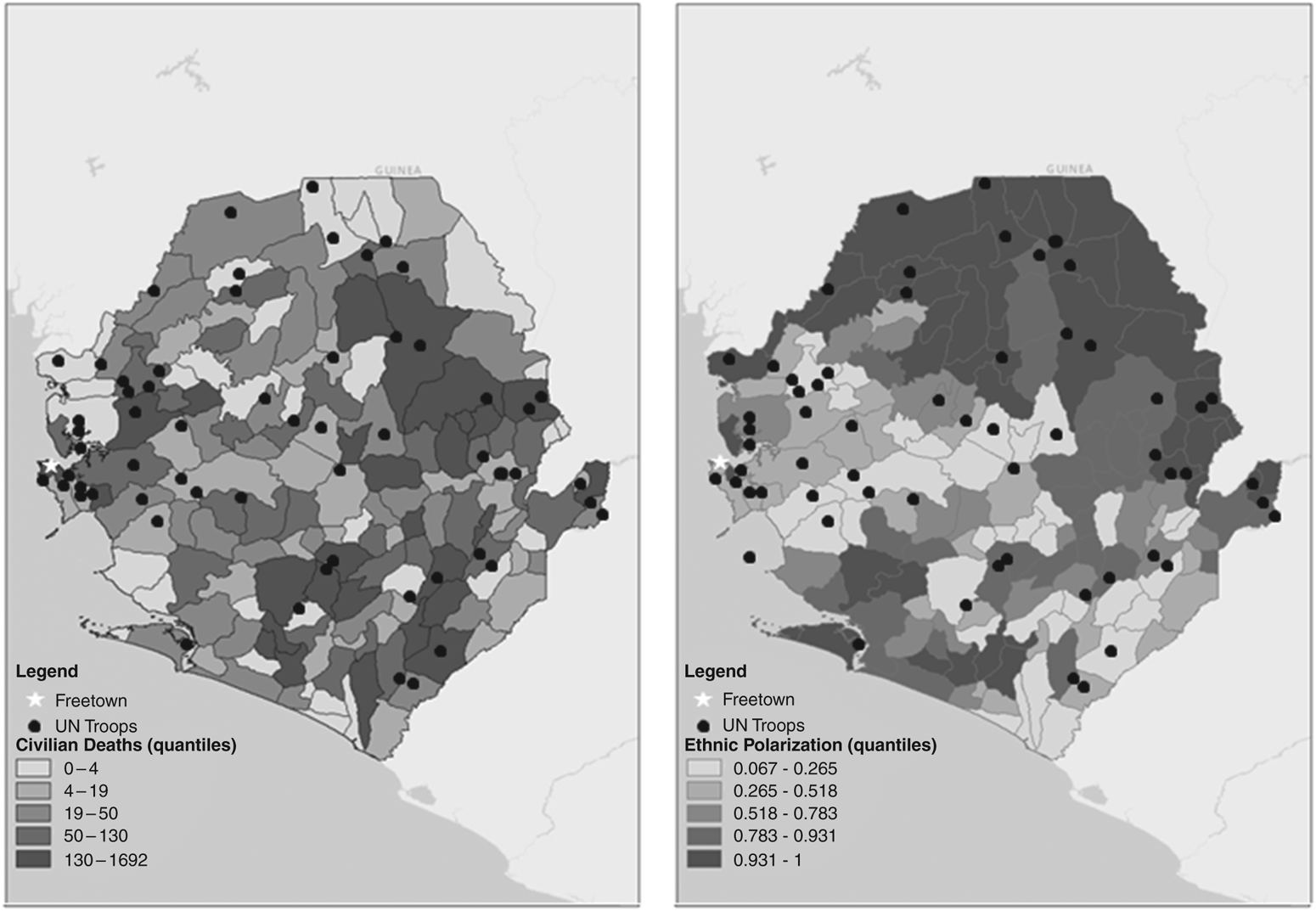
The dependent variable is the number of monthly civilian killings in each administrative unit (Figure 1, left panel), as derived from the UCDP-GED dataset (Sundberg and Melander Reference Sundberg and Melander2013). The main independent variables are ethnic polarization and the logged number of armed personnel deployed by the UN in each month.
(left): civilian killings in Sierra Leone aggregated by chiefdom, 1997–2001; (right): ethnic polarization levels from pre-war census.

I explain my choice to use ethnic polarization rather than other candidate measures in the next section, and then describe how the index is constructed. With regard to the size of UN contingents, I rely on UN Secretary-General (UNSG) reports, which often include a map indicating the position of peacekeepers and the contributing countries. Unfortunately, these maps do not give information on the size of the contingent in each location. Luckily, the UN Department for Peacekeeping Operations records each country’s monthly contributions to peacekeeping by mission and personnel type. This allows me to estimate the size of the mission in the locations indicated by the maps. For example, suppose India contributed 100 troops to UNAMSIL in a given month. If the deployment map in the UNSG report indicates Indian troops in two different chiefdoms, I divide the country’s contribution by two and assign the mean to both chiefdoms. If the map indicates that India is contributing in two chiefdoms but only providing troops to one, then only the latter is assigned all 100 soldiers. I interact the number of UN troops with ethnic polarization in order to test my hypotheses.Footnote 2 Since I hypothesize that peacekeeping moderates the effect of polarization, the interaction coefficients should be negative.
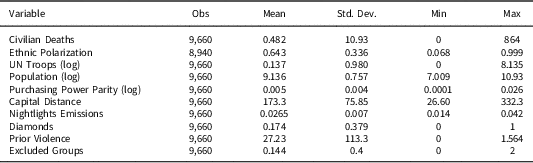
Several control variables from the PRIO grid version 2.0 are included in the specification, namely population (log), purchasing power parity (log), night-time light emissions, the number of excluded ethnic groups, distance from the capital, and a dummy for the presence of primary diamond mining sites (Tollefsen, Strand and Buhaug Reference Tollefsen, Strand and Buhaug2012). More violence should be associated with more people living far from the capital (Raleigh and Hegre Reference Raleigh and Hegre2009) and with the presence of aggrieved excluded groups (Cederman, Gleditsch and Buhaug Reference Cederman, Gleditsch and Buhaug2013). Night-time light emissions also capture some degree of economic exclusion. But more generally they are a good proxy for economic condition (Cederman, Weidmann and Bormann Reference Cederman, Weidmann and Bormann2015). In addition, proximity to mining sites is likely to result in more confrontation if groups compete over resources to fund their operations (Ross Reference Ross2004). Unfortunately, these variables do not vary much as they are reported at yearly intervals. To account for spatial interdependence, the spatial lag of civilian deaths and the number of peacekeeping personnel are incorporated into all models.Footnote 3 Finally, I include a variable measuring the aggregated number of civilian deaths before blue helmets were deployed in each of the chiefdoms. All covariates are lagged in the previous month in all models. The descriptive statistics of all variables are presented in Table 1.
Descriptive statistics

I start with a negative binomial model with clustered standard errors, with the number of civilians killed as the dependent variable. The main shortcoming of this model is that it does not control for selection bias. Peacekeeper deployment locations are not randomly selected at either the country or local level (Gilligan and Stedman Reference Gilligan and Stedman2003; Ruggeri, Dorussen and Gizelis Reference Ruggeri, Dorussen and Gizelis2016). In order to attenuate selection bias, I also show results after using Coarsened Exact Matching (CEM) to compare units with and without peacekeeping that are similar with regard to violence before deployment and ethnic polarization (Iacus, King and Porro Reference Iacus, King and Porro2012). Therefore, I run a negative binomial model on the matched sample. The CEM procedure assigns different weights to observations to balance substantial differences between the treatment and non-treatment groups. In addition, to rule out the possibility that unobservable factors are driving the selection bias, I also estimated a Conditional Mixed Process model (CMP). The CMP model allows me to relax the assumption that conflict intensity and the presence of peacekeepers are independent, uncorrelated processes. Thus both one-sided violence intensity and peacekeeper presence are used as outcome variables in two separate models with correlated disturbances.
Measuring balance of power
Ethnic diversity and groups’ relations are acknowledged as important factors in explaining conflict onset and intensity. Diversity is measured in several ways; the most prominent measures are ethnic fractionalization, ethnic dominance and ethnic polarization.Footnote 4 Ethnic polarization was used by Montalvo and Reynal-Querol (Montalvo and Reynal-Querol Reference Montalvo and Reynal-Querol2005a; Montalvo and Reynal-Querol Reference Montalvo and Reynal-Querol2005b), among others, as an alternative to the traditional ethno-linguistic fractionalization index (ELF). A society is considered polarized if there are a few significantly sized groups with high intra-group ethnic homogeneity and high inter-group ethnic heterogeneity (Esteban and Schneider Reference Esteban and Schneider2008). With π i representing the size of the ethnic group as a share of the total population, the following formula of polarization index was applied:
 $$4\mathop \sum\limits_{{\rm i}{\equals}0}^{\rm n} {\rm \pi }_{{\rm i}}^{2} \left( {1{\minus}{\rm \pi }_{{\rm i}} } \right)$$
This formula is a special case of the polarization measure originally proposed by Esteban and Ray (Reference Esteban and Ray1994). With bipolarity indicating the highest level of polarization, the index attempts to measure how distant a distribution is from a perfect bipolar setting. The measure ranges from 0 to 1, where 1 signifies two equally sized groups. In such a bipolar setting, ethnic groups represent opposite and comparable poles. The interpretation of the polarization index is comparable to the power parity index used by Balcells (Reference Balcells2011) and Balcells, Daniels and Escriba-Folch (Reference Balcells, Daniels and Escriba-Folch2016) to measure political competition. Indeed, the two measures exhibit a correlation of almost 0.9 (Appendix Figure A2.1), and switching to power parity produces very similar results (see Appendix Table A2 and Figure A2.2). One important aspect of the power parity index and the argument proposed by Balcells, however, is that it identifies strong competition when the difference between groups’ share is low; that is, small margins indicate that groups will compete over this pool with the aim of improving their position. The fluidity of political support enables groups to follow this strategy, but this is less likely to be successful when support is (at least partly) based on ethnicity.
Esteban and Ray (Reference Esteban and Ray2008) have explored the relationship between ethnic polarization and ethnic fractionalization and their effect on conflict onset and intensity. These two aspects of conflict are very distinct and related to ethnicity in strikingly different ways. As the authors show, the risk of conflict outbreak is higher at intermediate levels of polarization. In extremely polarized societies, conflict is too costly for both groups, whereas in societies with low degrees of polarization there might be little to fight for. However, conditional on conflict onset, high levels of polarization are associated with very intense violence, while the opposite occurs when groups are less polarized.
Polarization captures two very important dimensions of interest for this study. First, it proxies for a group’s local-level extraction capacity, that is, its territorial control compared to opponents. Hence, polarization summarizes the local balance of power among groups. In order to more clearly connect armed groups to their support base, I calculate polarization only for ethnic groups that can be linked to armed groups, for example, based on recruitment strategies, claims or support (Wucherpfennig et al. Reference Wucherpfennig2012). Secondly, high polarization also entails strong intra-group cohesion, which in turn makes groups more structured and better able to coordinate large-scale military fights. Indeed, while ethnic fractionalization hampers coordination, polarization significantly decreases the cost of coordination (Collier and Hoeffler Reference Collier and Hoeffler1998; Montalvo and Reynal-Querol Reference Montalvo and Reynal-Querol2005a; Montalvo and Reynal-Querol Reference Montalvo and Reynal-Querol2005b). The distinction between polarized and fractionalized ethnic groups has pivotal relevance for the proposed argument. It is interesting to note, for example, that Humphreys and Weinstein’s study of abuses during the Sierra Leone civil war finds that civilian victimization is not explained by co-ethnicity, but rather is mostly the product of the groups’ internal discipline (Humphreys and Weinstein Reference Humphreys and Weinstein2006). It is clear that the authors do not intend to completely dismiss the role of ethnicity; by measuring internal discipline as ethnic fragmentation, the underlying argument seems to be that it is not ethnicity per se that matters (0/1 for kinship). Rather, it is important to look at what ethnic diversity entails and how it shapes organizational features and the strategic use of violence by armed groups.
I argue that the index of ethnic polarization is well suited to measure the balance of power. A better measure of the balance of power, of course, would be a polarization index based on armed groups’ size instead of the size of the population from which the groups potentially recruit. Data on armed groups’ size has only been collected at the group level; without a geographic dimension, total armed groups’ size cannot be used to capture the balance of power at the local level. Alternatively, I could focus on armed groups’ tactics. Moving from Kalyvas (Reference Kalyvas2006) and Kalyvas and Balcells (Reference Kalyvas and Balcells2010), conventional and symmetric non-conventional tactics are dominant in regions where groups’ control is balanced; irregular warfare, however, prevails where groups’ territorial control is unbalanced. However, the distinction between conventional, non-conventional and symmetric non-conventional warfare is ultimately a typology of civil wars, so it is problematic to apply it to local-level violence. This is not just a theoretical problem, but also an empirical one. For example, Sierra Leone is coded as a symmetric non-conventional conflict by Kalyvas and Balcells (Reference Kalyvas and Balcells2010). How to identify areas where conflict is fought conventionally in the context of an overall non-conventional civil war? One possibility is to measure the ratio of battle violence and terrorist attacks in a given location, with the assumption that the two types of events mirror conventional and non-conventional tactics, respectively. In practice, however, there are numerous determinants of terrorist violence in conflict; thus the measure would rely on more assumptions than those needed by the ethnic polarization measure (as proposed here). On a more practical note, the Global Terrorism Database only records thirty-three terrorist attacks for the years 1999 and 2000, and thus only covers one year of the UNAMSIL mission. Lastly, one could use selective and indiscriminate violence against civilians to identify zones of control, as defined in Kalyvas (Reference Kalyvas2006). Unfortunately, it is not possible to distinguish between the two forms of civilian killings with the available data. Furthermore, it is a tautology to use violence against civilians (whether indiscriminate or selective) to code the balance of power and then use it to explain, again, the intensity of violence against civilians. Ultimately, ethnic polarization is well suited to measure the balance of power among armed groups at the local level. Other measures are proxies themselves, and are less appropriate for the current study.
Ethnic polarization in Sierra Leone
Figure 1 (right panel) maps the geographic variation in ethnic polarization in Sierra Leone. In order to calculate the polarization index, I georeferenced the 1963 national census. Using census data prior to the conflict ensures that ethnic patterns are not endogenous to conflict dynamics.Footnote 5 The census data are from the Integrated Public Use Microdata Series (IPUMS) international database of the Minnesota Population Center (2015). This database provides a representative sample from the original national census. In some cases, information is missing for some small units because these have been aggregated in the publicly available version of the dataset. To determine levels of polarization, I georeferenced the sampled census at the smallest administrative unit available and calculated the share of the population for each listed ethnic group. Using these shares, ethnic polarization is easily computed with the formula indicated above. The census lists eighteen ethnic groups, including the two majority groups, Mende and Temne, each of which represents more than 30 per cent of the total population. I do not compute ethnic polarization among all ethnic groups in the country – only among those that were actively involved in the conflict and can be linked to armed groups (Temne, Mende and Limba). This approach produces an ethnic demographic balance that is a better approximation of the power balance among groups. Although the conflict in Sierra Leone was not predominantly centred around ethnic issues (Bangura Reference Bangura2004), ethnic identities were significantly politicized during the process of state formation and continued to play a role in the conflict (Kandeh Reference Kandeh1992). As Horowitz (Reference Horowitz1985, 474) noted, ‘ethnicity has not been everything in Sierra Leone politics […] yet ethnicity has been so prominent in military and civilian politics that an analysis that sorts out ethnic variables is warranted’. In particular, Mende dominance has been an important political issue since independence. There is evidence that the Kamajors armed group enjoyed Mende support and made claims on behalf of this ethnic group.Footnote 6 Similarly, Rosen (Reference Rosen2015, 153) points out that ‘The Mende based Kamajors were the dominant militia group and the CDF [Civilian Defense Forces] leadership was largely drawn from the Mende’.
In addition, the opposing Revolutionary United Front (RUF) was Temne dominated and claimed to fight against Mende rule, with support from the Armed Forces Revolutionary Council (AFRC), headed by Limba leaders.Footnote 7 The instrumental use of ethnic identities and the subsequent mobilization along ethnic lines did occur to some extent in Sierra Leone, and the civil war should not be reduced to mere competition over diamonds (Kalyvas Reference Kalyvas2001; Schraml Reference Schraml2012). Both the CDF and RUF necessitated the co-optation of local elites. In the case of the CDF this was largely due to the nature of their community-based armed group that emerged as counter-insurgent pro-government militia. The RUF needed to co-opt elites due to their rapid expansion and need to control diamond sites (Johnston Reference Johnston2008). In both cases, recruiting members in areas that fell under each militia’s control meant that having a larger pool of potential recruits was particularly important in explaining conflict dynamics.
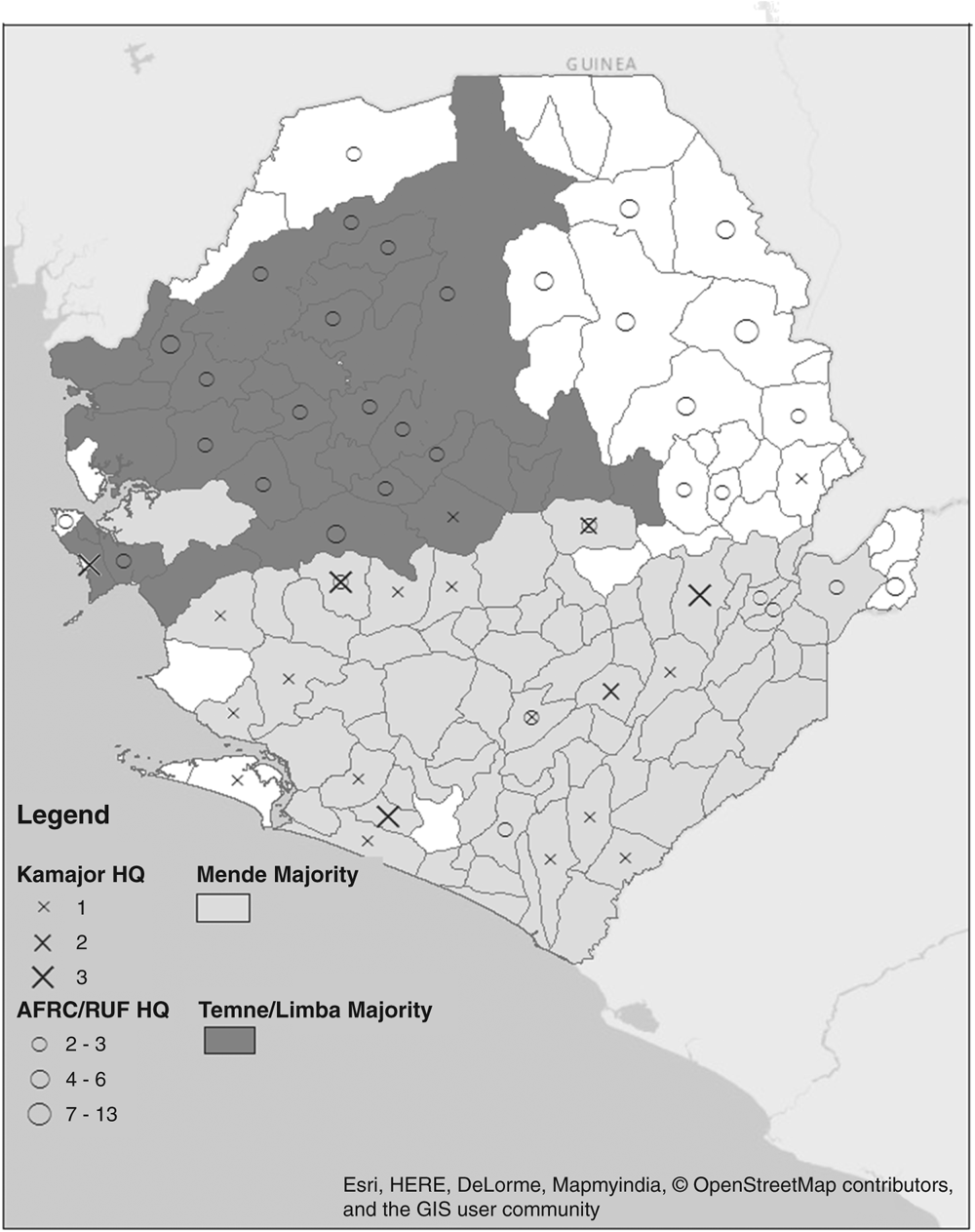
Consistently, the map in Figure 2 further corroborates the link between major ethnic groups and armed factions. The map shows chiefdoms in which the three ethnic groups linked to armed groups represented the majority. Mende people were the majority group in most southern chiefdoms, while Temne and Limba people were majority groups in several northern chiefdoms. In order to assess, to some extent, the degree of military control, I geocoded the establishment of headquarters by Kamajors, AFRC and RUF using ACLED (Raleigh et al. Reference Raleigh2010). Headquarters are established based on a variety of strategic and tactical choices of armed groups, and some are just temporary bases. Nonetheless, the map in Figure 2 illustrates how armed groups in Sierra Leone tended to establish headquarters in areas where the ethnic group they are linked to is demographically dominant. I do not argue that headquarters measure territorial control unambiguously, but rather that if armed groups are linked to ethnic groups, they will more likely base their key activities in areas where more ethnic support is expected.
Ethnic majorities and armed groups’ headquarters.

Results and Discussion
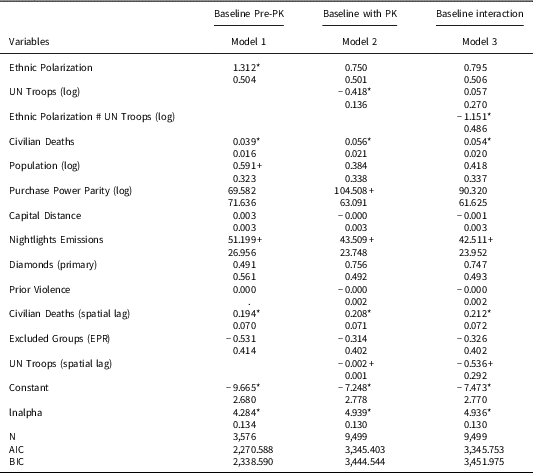
The negative binomial models are presented in Table 2. Model 1 uses only the sample of chiefdoms-months before the deployment to look at the dynamics of one-sided violence when no UN mission was present. In this model, I include all variables except those measuring peacekeeping. This baseline model indicates that one-sided violence is severe where polarization is high. It also seems that there is some degree of contagion across neighbouring chiefdoms, as the positive coefficient of the spatial lag suggests. More populated areas and locations with higher night-time light emissions are also associated with more violence, though at a lower significance level (p<0.1). In Model 2, the entire sample is used and peacekeeping-related variables are added.
Negative binomial models

Note: clustered standard errors in parentheses. * p<0.05, + p<0.1
The estimated coefficients show that peacekeeping has a negative effect on civilian victimization. The number of military personnel deployed by the UN is associated with a reduction in civilian deaths in the following month, in line with most recent findings from Hultman, Kathman and Shannon (Reference Hultman, Kathman and Shannon2013). Ethnic polarization has a positive coefficient, suggesting that civilians are targeted in areas where the balance of power among factions approaches parity; however, the coefficient is not statistically significant. Among the control variables, significant estimates are reported for the number of civilians killed in the previous month in the chiefdom and its surroundings. Interestingly, UN troops might reduce one-sided violence not only in the area where they are deployed, but also in the surrounding area (as suggested by the negative coefficient of the spatial lag for UN military, although it is only significant at the 10 per cent level). In Model 3, I interact ethnic polarization with UN troop size. None of the component terms of this interaction is significant, but the interaction term has the expected negative and statistically significant coefficient.
This provides initial support for the idea that peacekeepers are better able to protect civilians in locations where combatants can be separated effectively, and where the symmetry of power is not significantly altered by the presence of UN personnel. Conversely, when polarization is low and one group tends to be the hegemon, it is difficult to separate it from the minority group (especially if the latter is scattered), and civilians can be victimized by both the weaker and dominant groups.Footnote 8
As discussed before, the main limitation of the negative binomial models is that they do not account for selection bias. It is important to recognize that neither the CMP models nor the CEM technique fully addresses the problem of endogeneity, but they do attenuate it under certain conditions. CEM alleviates selection bias under the assumption that it accounts for observable factors responsible for the selection. Because peacekeepers are usually sent to more violent areas, I perform matching based on distance from capital, level of violence prior to the deployment, and the measure of ethnic polarization. The imbalance of the sample dropped from 0.97 to 0.55, and as expected, the size of the sample also shrank from more than 9,000 observations to 7,790.Footnote 9
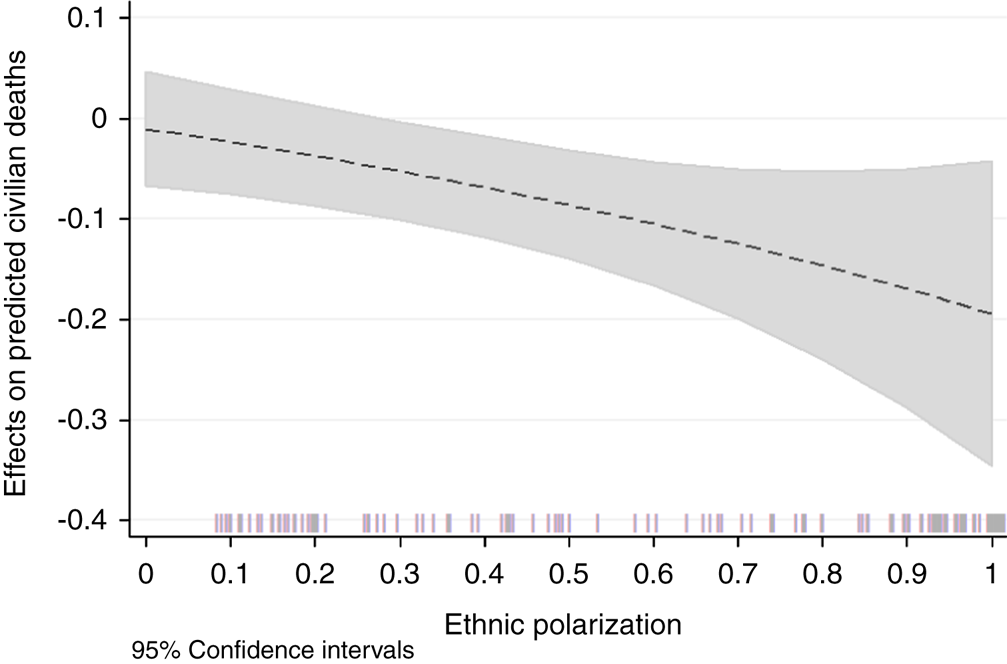
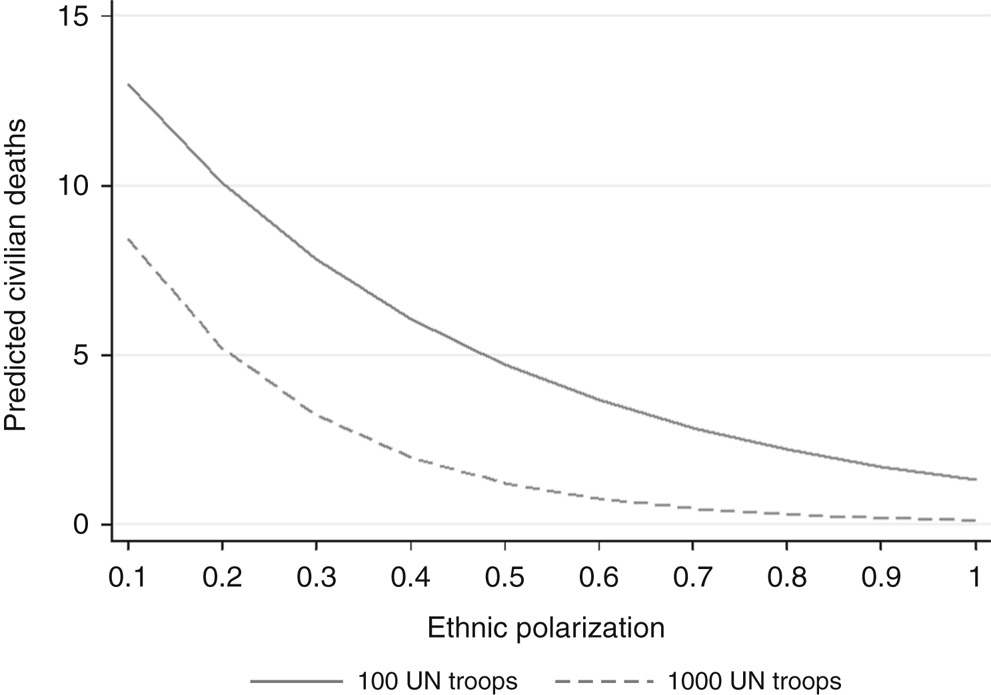
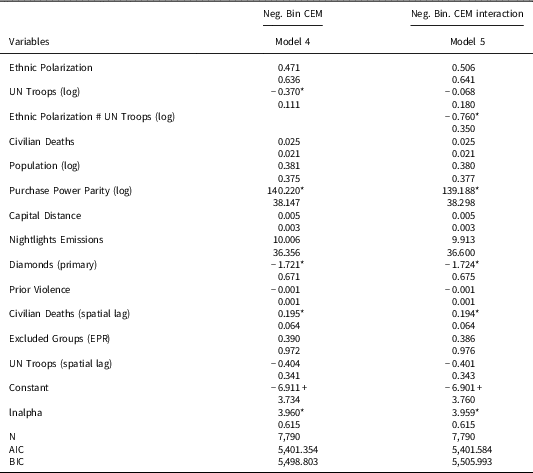
The results of the post-CEM negative binomial estimation are presented in Table 3. The empirical findings for the main variables of interest are similar to those reported in the non-matched models (Models 2 and 3). In Model 4, the log of UN Troops has a negative coefficient as expected, while polarization does not reach statistical significance. When interacted in Model 5, neither Polarization nor UN Troops seems to have an independent effect on civilian killings, as inferred from the estimated coefficients. Consistent with theoretical expectations, there is an inverse conditional relationship between the two. Figure 3 plots the marginal effect of average UN troop size on civilian deaths, conditional on different levels of ethnic polarization. For extremely low levels of ethnic polarization, UN troops do not have a significant curbing effect on one-sided violence, although their deterrent capacity improves at higher degrees of polarization. In more substantive terms, Figure 4 plots the predicted number of civilian killings in chiefdoms that experienced significant levels of violence. Across levels of polarizations, more troops always result in less civilian deaths, but the drop in civilian killings is more pronounced in chiefdoms with high polarization. In chiefdoms where ethnic polarization is in the first quartile (0.3), 100 (1,000) troops result in 8 (3) civilian victims, but the same amount of troops produces only 2 (≈ 0) victims in highly polarized areas (0.9, which corresponds to the third quartile).
Marginal effect of UN troops by level of ethnic polarization (Model 5); density rug plot along x-axis

Predicted one-sided violence (based on Model 5); confidence intervals not shown

Negative binomial models and matched sample

Note: clustered standard errors in parentheses. * p<0.05, + p<0.1
This analysis is in line with previous findings that more UN troops can create a buffer between combatants and reduce civilian targeting on a monthly basis. However, the results shown so far qualify this claim. Peacekeepers are clearly more successful when there are local power symmetries and factions can be kept apart. As these favourable conditions change and power asymmetries prevail, however, peacekeeping is a less effective instrument to protect civilians.
As mentioned, the estimations of the negative binomial model after matching are less sensitive to specification and model dependence. Furthermore, the smaller imbalance among observations alleviates the selection bias. It is important to note, though, that this statement holds true under the assumption that selection occurs on observable variables used to weight observations. To rule out the possibility that unobservable factors are responsible for the non-random deployment of troops, I use CMP estimation to address the endogeneity problem by simultaneously estimating two equations with correlated disturbances. If there are unobservable factors that influence peacekeepers’ deployment and one-sided violence, the model should report a significant correlation between the error terms of the two equations.
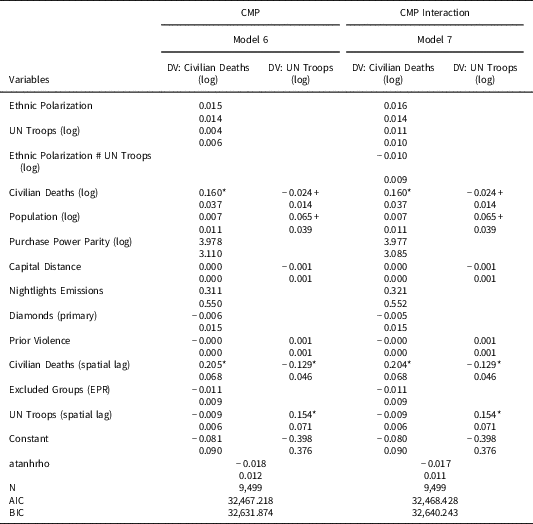
As for the specification of the equation with peacekeeping personnel size as a dependent variable, I include polarization, civilian deaths (time and spatial lag), population and distance from the capital as covariates. This is based on research showing that peacekeepers are deployed to the most violent locations, usually in proximity to urban centres (Ruggeri, Dorussen and Gizelis Reference Ruggeri, Dorussen and Gizelis2016). The results of the CMP models are reported in Table 4. The most relevant result is that the correlation parameter atanrho is not significant in either Model 6 or 7. In other words, there are no unobservable omitted variables correlated with both mission size and civilian casualties. This does not suggest that there is no selection bias at work, but rather that it was most likely captured by observable covariates used in the analysis.Footnote 10 Consequently, the estimates presented in Table 3 are further validated.
Conditional mixed processes models

Note: clustered standard errors in parentheses. * p<0.05, + p<0.10
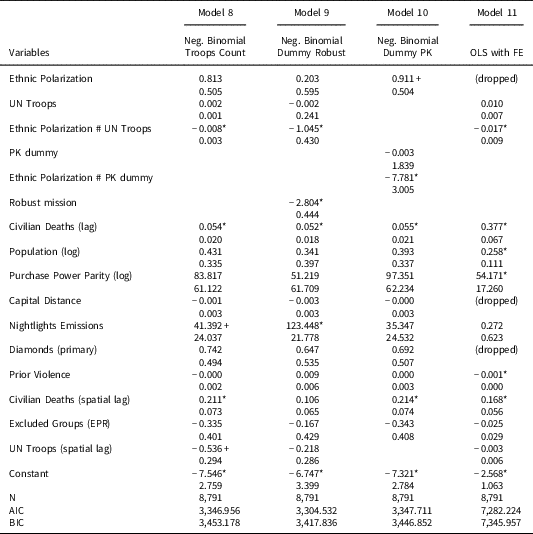
Table 5 presents additional models to check the robustness of the results. In Model 8, the actual count of troops is used as a covariate instead of its logged transformed version. Model 9 includes a dummy that equals 1 when a robust mandate was deployed. In Model 10, the presence of peacekeepers is coded as 1 instead of being measured in terms of troop size. Finally, in Model 11 I estimate an OLS model with chiefdom fixed effects. Across all models, the conditional effect of peacekeeping on polarization is significant. When using fixed effects, however, polarization drops out because of its time invariance. Finally, it is worth noting that measuring peacekeeping as 0/1 confirms that peacekeepers are more effective at decreasing violence where polarization is high. However, when plotted, the conditional effect of the dummy variable is much less precise compared to the conditional effect of deployment size, suggesting that we do need to account for the actual number of troops on the ground.
Models for robustness check

Note: clustered standard errors in parentheses. * p<0.05, + p<0.10
Conclusions
This article shows how the local distribution of power among ethnic groups affects the ability of UN peacekeepers to protect civilians. The reduction of conflict intensity supported in the existing literature does not uniformly affect all conflict-torn locations; rather, it is mediated by local groups’ capacity and incentives for one-sided violence. The deployment of a UN mission alters these conditions that produce violence in ways that can be unexpected and tragic. Existing research finds that some external peace initiatives may even spur more civilian victimization instead of deterring it. The empirical findings related to the UN missions in Sierra Leone provide support for the general hypothesis that the effectiveness of peacekeeping is conditional on power distribution, as measured by the ethnic polarization score. In accordance with recent studies, missions with large contingents are found to effectively reduce violence against civilians, but this effect is conditional on ethnic power configurations. When there is asymmetry among warring parties, protecting civilians is significantly more difficult. Ethnic groups are intertwined and cannot be separated easily, as is the case when polarization among groups is low. So it is harder for external actors to monitor the use of violence, especially behind blurry frontlines. In these settings, the significant power asymmetry may even push weak groups against civilian targets, to either coerce them into supporting them or to inflict losses on adversaries. Similarly, the dominant group may be motivated to escalate violence against civilians to secure its position before a full-scale mission is deployed. In the case of UNAMSIL, this meant that in chiefdoms with low polarization, peacekeepers had either a very small curbing effect or no effect at all. We can imagine, however, that civil wars with deeper ethnic cleavages may spiral and potentially result in UN missions inadvertently backfiring and provoking an escalation of one-sided violence.
These findings shed light on the local dynamics of the targeting and protection of civilians. By adopting a spatially and temporally disaggregated approach, it provides evidence of how a blue helmet presence in a location may reduce civilian casualties with varying levels of effectiveness. Violence against civilians exhibits fluctuating patterns that, as noted by Heldt (Reference Heldt2010), point toward the triggering role of local circumstances. Some circumstances are pre-existing (such as territorial control), while others are the result of the intervention itself, but both require local-level perspectives to be explained. Furthermore, the policy implications are not trivial. As mass killings plaguing Africa and the Balkans made clear in the early 1990s, deployment coupled with ethnic cleavages can have unintended consequences – particularly if the geography of ethnicity and territorial control that shape the strategic use of violence are not taken into account when interventions are planned. Indeed, perpetrators react to interventions differently; if they are prevented from directly engaging their opponents, some belligerents will target civilians when the opportunity costs are low. Peace missions need to consider the extent to which interventions may increase civilian exposure to brutal attacks. At the core of this concern lies an information gap about local conditions and group capacity. The last High-level Independent Panel on Peace Operations (United Nations 2015) defined the protection of civilians as a moral responsibility for UN members. Addressing the safety needs of civilians at risk, however, entails a grounded and thorough assessment of the threat, which also involves considerations on armed forces and ‘local sources of resilience’ (United Nations 2015, 39). The more field-focused approach outlined and repeatedly recommended in the report has the potential to fill the information gap and help peacekeepers accomplish their protection mandate.
Supplementary Material
Data replication sets are available in Harvard Dataverse at: https://doi.org/10.7910/DVN/HSELCA and online appendices at https://doi.org/10.1017/S0007123418000200