Argentinian writer, director, performer, filmmaker, and musician Lola Arias wrote and directed her first play, La Escuálida Familia,Footnote 1 at the Centro Cultural Rector Ricardo Rojas, a public venue at Buenos Aires University, in October 2001, just a few months before Argentina’s economic collapse.Footnote 2 Sociologist and cultural journalist Cecilia Sosa recounts that, on her way to the performance, the city center was flooded with cartoneros, people struggling to survive by collecting trash after a decade of extreme neoliberal policies (2011:46).
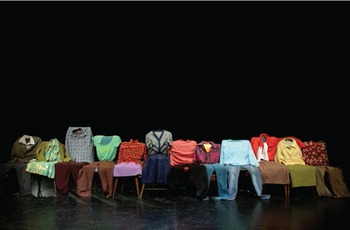
In the last scene of Lola Arias’s My Life After the performers carefully place clothes in the empty chairs representing the lost lives of their parents. Teatro Sarmiento, Buenos Aires, 2009. (Photo by Lorena Fernandez; courtesy of Lola Arias Company)

In the wake of revelations about the systematic state terrorism of the “dirty war” (1976–1983) that sullied its reputation (see Taylor Reference Taylor1997:11), Argentina faced growing social inequality, widespread poverty among the working- and middle class, and disastrous debt resulting from the huge sums borrowed from the International Monetary Fund (IMF) in the 1990s. By 2001, official statistics showed that 44% of Argentinians were impoverished, though the actual poverty level was likely substantially higher.
On 19 and 20 December 2001, millions took to the streets of Argentina despite the declared state of emergency and the harsh repression that awaited them. Footnote 3 This popular rebellion manifested a break from the fear and silence that were the legacy of the brutal dictatorship. New movements sparked by the revolt aspired to egalitarian social relationships and direct democracy (Sitrin Reference Sitrin2006:2–19).
Since her debut with La Escuálida Familia, Arias has created an extensive body of performances, site-specific projects, films, and installations in collaboration with major cultural venues and international festivals. The projects I discuss here are specifically related to the economic, social, cultural, and psychological consequences of the Argentinian and Chilean military juntas, the transitional postdictatorship democracies of the two countries, and the ongoing struggle for social justice in South America. Footnote 4 Arias expands notions of documentary theatre using discursive methods of research, production, and participation that encompass both aesthetics and civic practice.
The artistic language that Arias developed from 2009 to 2018 demonstrates her deep engagement with the recent history and memory politics of the postdictatorship generation in Argentina and Chile. These works include the trilogy Mi Vida Después (My Life After, 2009), El Año en que Nací (The Year I Was Born, 2012), and Melancolía y Manifestaciones (Melancholy and Demonstrations, 2012); and her multifaceted project on the 1982 Malvinas/Falklands War, including Veteranos (Veterans, 2014), Campo Minado (Minefield, 2016), and Teatro de Guerra (Theatre of War, 2018). Arias’s aesthetics developed from her process of problematizing the relation between the there-and-then and the here-and-now in order to highlight the failure of binaries such as past and present, fictional and factual, and theoretical and empirical. By focusing our attention on both personal and mediated material and immaterial memory, Arias exposes the persistence of the past in the present and its implications for the future. Performers function as witnesses and narrators who question how we perceive history, construct identities, and build collective and individual memories.
The Threshold of the Real
My Life After, Arias’s first production to tour internationally, marks a shift in subject matter by bringing together personal and collective histories without cause-and-effect linearity. My Life After is a portrait of Arias’s generation of Argentinians, people mostly born during or after the military junta (1976–1983) who felt the private and public consequences of the country’s dictatorial past. Her generation did not directly witness the trauma of this past, so their connection to it has been, as cultural theorist Marianne Hirsch argues, “mediated not by recall, but by imaginative investment, projection, and creation” (2012:5). The politics of postmemory and the unmaking of recent history furtively deny demands for the political revision of the nation’s past proposed by the Néstor Kirchner and Cristina Kirchner administrations (Sosa Reference Sosa2014:107).Footnote 5 Arias claims the role of a writer and director of fictional stories based on truth, not that of a political activist.
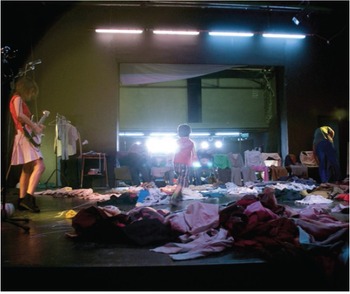
Liza Casullo (left) amidst a pile of clothes in the last scene of My Life After. Teatro Sarmiento, Buenos Aires, 2009. (Photo by Lorena Fernandez; courtesy of Lola Arias Company)

My Life After was commissioned by Vivi Tellas for her Biodrama project.Footnote 6 As artistic director of the Sarmiento Theatre in Buenos Aires between 2002 and 2008, Tellas commissioned works focused on the lives of living persons.Footnote 7 Pamela Brownell notes:
Despite the simplicity of the assignment, Biodrama’s aesthetic, ethic, and political quest was — and is still today — profound and complex. Conceived in a global context of spectacularization and mediatization of experience and in a local context impacted by Argentina’s social, economic, and cultural crisis of 2001, Biodrama sought to use theatre and its power to bring people together as the means for an inquiry into the lives of human beings. (2012)
Tellas explicitly called Biodrama “documentary theatre”: “all of my work has revolved around a single idea: to search for theatricality outside the theatre” (in Pauls Reference Pauls and Martin2010:246). As Carol Martin argues, Tellas was interested in the threshold between the real and the theatrical as she staged both the quotidian and the extraordinary of daily life:
In careful compositions, people united by family, by profession, and by employment are brought to the stage as themselves. Tellas is not focused on whether or not being onstage as one’s self is even possible but on the whole process of bringing those she invites to the stage. Regular people and the real worlds to which they belong are her subject. (2010:11–12)
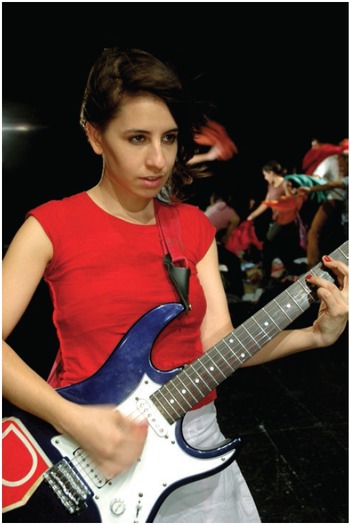
Liza Casullo faces the audience and plays an electric guitar in Lola Arias’s My Life After. Teatro Sarmiento, Buenos Aires, 2009. (Photo by Lorena Fernandez; courtesy of Lola Arias Company)

My Life After presents the stories of six professional actors with very different social, political, and cultural backgrounds born during the Argentine dictatorship. Alongside descendants of guerrilla activists, exiled intellectuals, and a police officer working for the military, the production includes testimonies from those not usually considered victims, such as the son of a bank employee and the offspring of a former priest (Sosa Reference Sosa2014:105–06).
In My Life After, the scenography is functional. A drum kit is placed upstage. At stage right, various objects (photos, maps, toy cars, and a statue of a black saint) are placed on a long table. The stage-right projector, set on a tripod, is used by the performers to show pictures, letters, and objects on a large screen. On stage left is a row of chairs in different styles, and an electric guitar and amplifier.
The protagonists are Liza Casullo, the daughter of intellectuals who went into exile in Mexico after participating in the left-wing Peronist guerrilla organization Montoneros; Blas Arrese Igor, the son of a priest trained during the dictatorship who later left the clergy and fathered six children; Carla Crespo, the daughter of a member of the ERP (People’s Revolutionary Party) killed by the military; Vanina Falco, the daughter of a policeman-torturer who abducted a boy born to a woman in detention and raised him as his own; Pablo Lugones, the son of a bank employee uninterested in politics; and Mariano Speratti, the son of a disappeared journalist and member of the Peronist Youth (Arias Reference Arias and Graham-Jones2019a:42).
Arias’s concept recalls the labor of the militant HIJOS (Hijos e Hijas por la Identidad y la Justicia contra el Olvido y el Silencio [Sons and Daughters for Equality and Justice, against Forgetting and Silence]), a movement of young people who grew up in a society that did not blame or punish the people who tortured and killed their parents. Footnote 8 HIJOS sought to recover and critically examine their parents’ militancy as a way of consciously breaking the silence around what took place (Sitrin Reference Sitrin2012:19). Footnote 9 Arias shares some of the main concerns of HIJOS, but contests the essentialized image of the children of the desaparecidos, the disappeared, questioning the societal expectations placed on them. In her role as a writer and director of fiction rooted in truth, rather than as a political activist, her distance from identity politics is meant to avoid transmitting traumatic memory from one generation to the next through the creation of hybrid spaces that interweave fact and fiction. Arias wants to instigate critical investigations of a new potential for citizens to be together — but not reconciled — through the collective experience of a performance.
By interweaving first-person narratives, archives, autobiography, film, and live music, Arias creates a hybrid space that questions the content, form, method, and impact of documentary theatre. In this way, her work is different from the ethical approach of HIJOS, the children of the disappeared, the exiled, and political prisoners. Arias declares:
I sought out a group of actors whose stories contrasted with one another and together would create an album of an era. I didn’t want to make a play only about children of leftist militants, nor did I want actors onstage telling the audience what they already knew. Finally, I chose a group of six actors whose fathers and mothers represented the period’s archetypical figures. (2019a:41–42)
My Life After begins with a cascade of clothes falling onto the stage. Performer Liza Casullo stands amidst this mountain of clothes, picks out a pair of jeans, and walks to the front of the stage with her hands in her pockets. She says:
When I was seven, I used to get dressed up in my mum’s clothes and parade around the house, tromping on her dress like a miniature queen. Twenty years later I find a pair of my mum’s Lees from the seventies, and they fit me just right. I put the jeans on and start to walk towards the past. (Arias 2019d:47)
As most of the performers will do when they speak, Casullo faces the audience; she plays an electric guitar. This and other instruments onstage will be used throughout the performance to create a musical common ground among the performers and with the audience.
Meanwhile, the other performers enter the stage and start to rummage through the clothes, trying them on, casting them off, and throwing them up into the air. Blas Arrese Igor draws a chalk timeline on the floor downstage, marking the years 1972, 1974, 1975, 1976, 1981, and 1983. All the performers come forward to stand behind their respective birth year. They introduce themselves by linking the day they were born with a historical incident. Mariano Speratti and Vanina Falco begin:
MARIANO: 1972. A plane crashes in the Andes with Uruguayan rugby players on board; to survive they eat the other dead passengers. Three days later I am born. My dad loves cars and politics.
VANINA: 1974. Perón dies and I am born after a fourteen-hour labor.Footnote 10 I am a tiny baby with enormous eyes. My granddad was Perón’s bodyguard and my dad was in the secret police. (Arias 2019d:47)
Arias maps the performers’ pasts while establishing equilibrium between identification and Brechtian estrangement: the performers are both invested in and critically distant from their parents’ stories. The staging includes individual and collective reenactments of imagined episodes that Arias introduced early in the rehearsal process to help the performers distance themselves from their parents’ pasts. Rehearsal instructions included: “Put on some piece of your father’s clothing and reconstruct his death using your fellow performers”; or, “Film your parents’ exile as if it were some genre picture, a melodrama, a crime story, a sci-fi movie” (2019a:42). This process of “experimental therapy” displaces the emotional weight of the performers’ mediated memories onto the creation of a stage action. By writing elements of this process down in her script, Arias transforms painful (post)memories into performance material. Arias explains the contrast with the emotive process of fictional theatre:
When you’re working with a documentary project you have to tell the performers not to cry, because they will talk over and over about how their mother was killed and her corpse was exposed to the press. They are going to tell very hardcore stories. If they cry every time they perform they will suffer a lot and that wouldn’t be good for the piece, and it wouldn’t be good for them. They have to find a distance from their own story to make it possible to repeat over and over and to have the feeling that they are part of history. (in Lauer Reference Lauer2014)
Arias needs them to tell their stories because they are relevant, not because she or they want to expose themselves in a painful way. She wants to create both emotional intensity and Brechtian distance.
Music contributes to Arias’s process of de-dramatization and releases energy onstage. Produced live by the performers themselves, it’s an integral part of the dramaturgy in My Life After and in all of Arias’s work. Footnote 11 In one of the most intimate scenes in My Life After, when all the performers share with the audience imaginary moments with their fathers, they sit in the row of chairs and perform a concert on melodicas. In the scene that follows, Pablo Lugones appears onstage with the boots that his grandfather left to his father and that have now passed to him to wear as he continues the family tradition of dancing the malambo. My Life After also ends, as it began, with music composed by Ulises Conti with the collaboration of Liza Casullo and Lola Arias: Liza Casullo plays the electric guitar, Pablo Lugones plays the drums, and Vanina Falco shouts into a megaphone some of the lines spoken earlier in the performance, alternating words with screams.
In a continued dialectic throughout the performance, reality informs the stage and vice versa. Vanina Falco, the most tragic character in My Life After according to Arias, was 28 when she found out that her supposed brother was the son of an activist couple. Her father, who was in fact an intelligence officer working for the military, had abducted him from the former Escuela Superior de Mecánica de la Armada (ESMA, or Higher Naval Mechanics School), the most infamous of the detention camps. “My whole life became fiction. My mother isn’t my brother’s mother, my brother isn’t my brother, and my dad has many faces,” says Vanina Falco onstage while sharing with the audience real court transcripts of her father’s trial for the abduction (Arias 2019d:63).
When the trial began, Argentina’s justice system did not allow a daughter to testify against her father, but because Falco was already giving testimony in Arias’s performance, the prosecuting attorney got the court to allow her to testify. The trial advanced parallel to the performance, which continued to incorporate developments in the case until Falco’s father was sentenced in 2012 to 18 years in jail for the kidnapping. “The play had produced an effect that extended beyond itself to the law” (Arias Reference Arias and Graham-Jones2019a:42).
My Life After is part of the ongoing discourse about truth and authenticity in contemporary documentary theatre. As Martin observes, “Much of today’s dramaturgy of the real uses the frame of the stage not as a separation, but as a communion of the real and simulated; not as a distancing of fiction from nonfiction, but as a melding of the two” (2010:2). Arias uses the affective potential of fiction to reexperience the past. She constructs the stage as a porous membrane of unexpected encounters and unimaginable discoveries, where countless interactions with everyday life can potentially arise.
Arias shares with Tellas a commitment to create work around the living archive, utilizing personal materials and documents. However, whereas Tellas searches for worlds that have some coefficient of theatricality, “where reality itself begins to make theatre” (what Tellas calls the “minimal threshold of fiction”) (in Pauls Reference Pauls and Martin2010:249), Arias reinvents reality through primary materials and the intermingling of official and unofficial narratives. She uses stories to expose the mechanisms of state violence and power that trapped so many “ordinary” people in fear and repression during and after the dictatorship. Her narratives are built from self-awareness, which leads to reflections on questions of active citizenship and social justice, not only in Argentina but in any transitional civil society. Arias keeps a critical distance from literally representing reality while mirroring its methods of inquiry. By doing so, she manages to transcend the conceptual and geopolitical borders of South America, addressing audiences who have experienced totalitarian regimes anywhere.
A Stage Dissensus
The Year I Was Born, the second work in Arias’s trilogy on the postdictatorship generation, is not unlike My Life After: children born during the dictatorship attempt to revisit the lives of their parents through photos, letters, tapes, used clothes, stories, and sometimes dim memories. The performance was born from a January 2011 workshop that Arias conducted at the annual Santiago a Mil Festival in Chile, where she presented My Life After. The stories she heard in Santiago led her to create this Chilean version of My Life After.
The Year I Was Born appropriates many of the methods of My Life After, such as the juxtaposition of personal and national histories and the imaginary reconstruction of episodes from the lives of the protagonists’ parents. Arias adds several new ideas: the reconstruction of major historic events (the Augusto Pinochet coup d’état in 1973 in ChileFootnote 12 and the Pope’s visit to Argentina in 1982 during the Malvinas/Falklands War) and the inclusion of the internal conflicts that marked the process of the play’s creation. Describing the rehearsal process, Arias explains:
The actors collaborated in the reconstruction of each of their castmate’s stories, and at the same time they argued constantly about what happened. It’s the confrontation between narratives from the Left and the Right that makes the play a controversial object. Who’s more Left: the assassinated militant MIRFootnote 13 mother or the lower-class Allende supporter mother risking her life to protest in the poorest neighborhoods? Who was more responsible for the repression: the intelligence officer or the military policeman? Who were the greater victims: the Chileans who went into exile or the ones who stayed in Chile? Their children do not come to any agreement. (2019a:44)
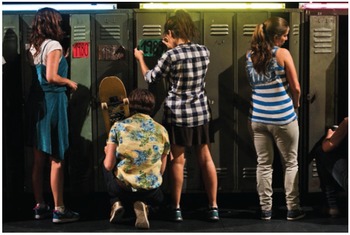
Twenty lockers are placed upstage in Lola Arias’s The Year I Was Born in a direct reference to the Chilean student movement for free education in 2011. Centro Cultural Gabriela Mistral, Santiago de Chile, 2012. (Photo by David Alarcón; courtesy of Lola Arias Company)

The Year I Was Born generally follows the same staging as My Life After albeit with a different setting, that of a university campus, home to the student movement for free education that Arias witnessed when she visited Chile in January 2011 (Lauer Reference Lauer2014). Twenty lockers are placed upstage beside two ladders, with two wooden desks stage right. One supports a tripod with a projector, and the other holds video and sound equipment and a shelf where the performers find all the documents (maps, photos, and letters) used during the performance. A guitar and amplifier are located downstage right, with two standing microphones upstage left. All 11 performers are seated at a row of school desks at stage left. One of the performers, Alejandro Gómez Sepúlveda, gets up and plays the guitar, signaling the opening of the performance, much like in My Life After. At the same time, Leopoldo Courbis picks up a megaphone and starts a countdown from 1989 to 1973 — the year leftist Salvador Allende was overthrown. When they hear their birth years, the performers begin to run in a circle in the middle of the stage, as if in military training, with the years of their birth written on their backs. When Sepúlveda stops playing the music, they line up according to their birth years, their backs to the audience. Fernanda González is the youngest (born 1989), on stage left, and Alejandro Gómez Sepúlveda is the oldest (born 1971), on stage right. Sepúlveda speaks first, then one by one they turn and introduce themselves to the audience.
Short scenes ensue, during which the 11 performers reconstruct incidents from their parents’ pasts as if they were “stunt doubles.” They put on their parents’ clothes and try to represent their lives, while publicly acknowledging the impossibility of single narratives and representations. Because of the length of the Chilean dictatorship (1973–1990), those who were children at the beginning of the dictatorship have clear memories of life under Pinochet. The second generation of Chilean activists organized against the regime and suffered repression, just as their parents had done immediately after the coup (Ros Reference Ros2012:107).
Unlike My Life After, few among the 11 Chilean performers in The Year I Was Born are actors. The protagonists are Viviana Hernández, the daughter of a national policeman who murdered two leftist militants; Alexandra Benado, the daughter of an MIR militant murdered by the police; Ítalo Gallardo, the son of a marine trained during the dictatorship; Soledad Gaspar, the daughter of Popular Unitary Action Movement (MAPU) militants exiled in Mexico; Leopoldo Courbis, the son of a police intelligence officer who was part of the Allende government but later helped “cleanse the institution of Marxists”; Ana Laura Racz, the daughter of an MIR militant mother exiled to the United States; Pablo Díaz, whose father was in the Far-Right nationalist Fatherland and Freedom movement; Jorge Rivero, the son of a Pinochet supporter who was unemployed for 10 years of the dictatorship; Fernanda González, the daughter of a militant father in the armed Manuel Rodríguez Patriotic Front; Alejandro Gómez Sepúlveda, the son of a journalist who supported Allende and spent years in jail; and Nicole Senerman, the daughter of a young upper-middle-class couple who spent the dictatorship defying the curfew by going from party to party (Arias Reference Arias and Graham-Jones2019a:43–44).
Ana Laura Racz shares one of the letters that her mother, a Revolutionary Left Movement militant, was receiving from her “boss” in the organization during her exile in the United States. In Lola Arias’s The Year I Was Born. Centro Cultural Gabriela Mistral, Santiago de Chile, 2012. (Photo by David Alarcón; courtesy of Lola Arias Company)

Following the prologue, Arias dedicates a key scene in the first minutes of the performance to “The Day of the Coup.” The performers narrate where their parents were on 11 September 1973, while over speakers we hear the original transmission announcing the incident from Radio Cooperativa — the Santiago-based radio station that became notable for opposing the Pinochet dictatorship. The complexity of the legacy of the dictatorship in Chile, including the excision of Allende’s political projects from public discourse, is one of the main debates that Arias wants to reopen. As literary scholar Ana Ros argues:
Collective memory formation in post-dictatorship Chile was marked by the Concertación’s strategy of limited truth and justice in the tension between the human rights associations and the armed forces’ threats. In addition, as the Concertación avoided evoking the Unidad Popular, Allende’s political project became a taboo. Political debate and mobilization was centered on the figure of Pinochet, which united those opposed to dictatorship and repression but prevented a critical discussion of Allende’s legacy. (2012:116)Footnote 14
In an antididactic and often playful style of storytelling, Arias stages the lack of a public discourse of memory in Chile.Footnote 15 Her direction is transparent, exposing its ingredients and methods with an unmistakable sense of rhythm and energy. From the first minutes of the performance, direct addresses to the audience, live reenactments, and the use of documents highlight the distance from a fictional theatre, while establishing an unpretentious mode of communication with the audience. Nonactors contribute further to this audience communication, while bringing to the stage a sense of authenticity. As Arias said, she believes that the most political act may be to have ordinary people rather than actors onstage because this allows the performers to process their own experiences while also giving the audience an exceptional encounter with people they may not have otherwise met (in Bither Reference Bither2019).
The final scene in The Year I Was Born, just before all the performers move upstage and take electric guitars out of their lockers, features a 10-centavos coin. Soledad Gaspar hands the coin to Nicole Senerman, who shows both sides of the coin to the camera, as everyone watches it on the screen. The coin, still in circulation, bears on one side an image of a woman breaking free from her chains, accompanied by the date of the coup and the word “libertad” (Ros Reference Ros2012:108). This controversial reference to 11 September 1973 makes a strong statement when juxtaposed with a media image of Riggs Bank, where, in 2004, news broke that Pinochet had amassed over $17 million from fraudulent activities. History makes its presence felt in The Year I Was Born with specific references to events such as the 1976 murder of Orlando Letelier, Allende’s ambassador to the United States; Operation Albania; Footnote 16 and the junta’s media propaganda reminding us that Chile had more torture survivors as a proportion of the population than any other country in the Southern Hemisphere (Ros Reference Ros2012:114).
Arias directly yet playfully addresses postdictatorship political and social turbulence resulting from, for example, the continuation of the dictatorship’s neoliberal economic model, postdictatorship political apathy, ongoing social inequalities and injustice, and human rights violations. In one of the most disturbing and controversial scenes, Ítalo Gallardo asks the other performers to stand in a line facing the audience, changing their order according to their parents’ political stance, their economic situation, or the color of their skin. This scene reenacts the tensions that emerged when Arias asked the performers to do similar exercises in rehearsals, in order to dredge up the group’s personal histories and make them confront one another.
I would set up the exercise and then record it and all the discussions and arguments we had, and then I would transcribe and edit and transform it all into a text. A text that was very difficult for them to deliver, because sometimes in the discussions they had said things that subsequently they were ashamed of having said. On the other hand, they understood why it was important to show the tensions and make the frictions visible, not to hide them. But of course, it wasn’t easy to share and to accept all positions, and during the process of making the piece, and during the life of the production, some people left. (in Arias and Gough Reference Arias, Gough and Graham-Jones2019:315)
Arias increases the tension and political opposition among the performers by juxtaposing stories of the police with stories of the militants. Viviana Hernández shares the story of her father, who has been imprisoned in the Temuco jail since 2009 for the murder of two MAPU militants in 1973. Her story is followed by Alexandra Benado reading her mother’s last letter, dated 11 May 1983, the day Benado turned seven and a few months before her mother was murdered by the police. By having the performers repeatedly tell these uncomfortable stories, ones that they would not have ordinarily shared in public, Arias transforms the stage into an inclusive space for previously unthinkable encounters.
Testimonial Objects
My Life After and The Year I Was Born both include diverse styles of acting, live music, dance, and recorded narrative. The works use megaphones, maps, musical instruments, projectors, and tape recorders, as well as objects from the performers’ family archives such as books, Super 8 films, letters, items of clothing, photos, and reel-to-reel recorders. Animate items also appear such as Blas Arrese Igor’s father’s old tortoise Pancho, which, in My Life After, predicts whether or not there is going to be a revolution in Argentina by “choosing” to walk towards the words “Yes” or “No” drawn on the stage floor with a piece of chalk. These inanimate and animate objects spatialize memory by temporarily making missing bodies appear. The objects reembody physical absence by illuminating imaginary or factual snapshots of the lives of the missing. Through their incompleteness and their commonalities, the objects testify to the violence of disappearance and the impossibility of reconstructing an (individual or collective) history as long as the trauma is ongoing, and return is impossible. Such testimonial objects, Hirsch notes, embody memory and thus “trigger affect shared across generations” (2012:206). Arias, however, does not use the objects as “symbols of dispossession and over-determined sites of contestation” (206), but rather desacralizes them by activating them in collective performative moments of high theatricality. The multiple reenactments in My Life After of the death of Carla Crespo’s father, a member of the ERP killed in 1975 in a clash with the military, is one example. During the run of the show, the police called on Carla Crespo to identify her father’s remains in a communal grave, a fact that Arias incorporates into the production. In My Life After, the story of Carla Crespo identifying her father’s remains and Vanina Falco’s account of her father going to prison resonate inside the theatre and have real-world implications outside its walls.
For all the truth-telling in both My Life After and The Year I Was Born, Arias develops scenes that are not based on facts, but on often contradictory public information and the mediated memories of the second generation. For example, many of the objects and clothes are not original because using authentic objects is not Arias’s main concern. This fiction-as-reality accurately reflects the political environments of Argentina and Chile where the media broadcast the military regimes’ propaganda as “real.” The props and clothes are stunt doubles of the parents’ objects lost, destroyed, or disappeared, just as the children on stage can be seen as stunt doubles of their parents. The children inherit objects either physically or conceptually from their parents and now, in front of the audience, they display tangible representations. Arias populates the stage with original objects alongside stuff that is like the originals. Regardless of their authenticity, these objects are testimony, witnesses of the process of transformation and deterioration with which time affects objects and people. Arias implicitly asks: How does the materiality of the stage objects affect the fiction of the stage? She believes that documentary theatre can “bring these documents back to life” by having the performers interact with them, which amounts to much more than merely showing them (in Bither Reference Bither2019). This dramaturgical choice does not separate Arias’s work from documentary theatre. Quite the contrary, it pushes the limits of documentary theatre by problematizing the “true,” the “authentic.”
In My Life After and The Year I Was Born, the rehearsal process was built around performers interacting with the documents and objects they brought from their homes, but also around the resuscitation of seminal lost objects from their childhood. For these objects, remembered but not physically present, the performers found stand-in items. They used both authentic and fabricated items as catalysts for the stories they narrated. The performers’ interactions with the original and constructed items constituted a dynamic living archive that helped them distance themselves from their own stories, making it possible to repeat them onstage, to become narrators and observers of their own lives. This distance created space for emotion, imagination, craziness, and humor (in Lauer Reference Lauer2014).
Items of clothing are emblematic of this affective materiality of the stage. Many scenes open by sharing with the audience the origins of each item, as well as the reasons why the original piece may no longer be in the performer’s possession. For example, in the “Remakes” scene, Vanina Falco puts on a blue suit like the one her father wore when he said he sold medications but was actually working as an undercover policeman; Carla Crespo puts on a military jacket; Pablo Lugones wears a brown suit; Blas Arrese Igor dons a cassock; and Mariano Speratti puts on his father’s overalls.
CARLA: My dad and his comrades in the People’s Revolutionary Army didn’t have a uniform. They wore green trousers, green shirts, and instead of boots they wore espadrilles or Adidas trainers because they were less likely to slip.
VANINA: My dad didn’t wear a police uniform either, but he had a wardrobe full of blue suits.
[…]
MARIANO: These are the original overalls that my dad wore for racing his cars. His name is stitched onto the pocket: Horacio Speratti. My dad was shorter than me, so they’re a bit small.
BLAS: My dad’s cassock got lost, so the theatre gave me this one, which is a bit big for me.
PABLO: My dad wore a suit like this every day to go to work in the bank. I suppose the original must have got so worn out it’s no longer around. (Arias 2019d:57–58)
When preparing for My Life After, Arias envisioned a flea market (Lauer Reference Lauer2014). Clothing and used chairs and other furniture are always present. In the opening scene, clothes fall from the ceiling, and in the last scene, which is emblematic of the play’s visual language, the performers carefully place clothes in the empty chairs that are in a line at the front of the stage throughout the play, representing the lost lives of their parents. The objects, both the originals and their stunt doubles, are more than archival; they have an agency as living organisms that evoke an uncanny world. They act as agitators that connect previous “lives” with their current representation. Hirsch points out that repetition and reenactment constitute a specifically postmemorial response to an inherited trauma:
Cognizant that our memory consists not of events but of representations and re-enactments, we do not experience repetition as desensitizing us to horror, or shielding us from shock, thus demanding an endless escalation of disturbing imagery, as survivors might fear. On the contrary, repetition connects the second generation to the first, in its capacity to produce rather than screen the effect of trauma that was lived so much more directly as compulsive repetition by survivors and contemporary witnesses. (2012:108)
The materiality of the items of clothing and the personal objects of the disappeared, whether original or not, give substance to their names and pictures. The children of the disappeared become the activators of their parents’ biographies through the manipulation of the objects in relation to their stories and memories. But the objects themselves are not what count; what matters are the lives that become manifest through these objects. As sociologist Gabriel Gatti explains, forced disappearance tears apart the things that constitute modern identity. After the individual passes through the disappearance machinery, very little is left — (rarely) a body without an identity; (most often) an identity without a body (2014:64).
Without data or complete biographies, Arias and her performers act as forensic anthropologists (which is also how Gatti refers to human rights activists) struggling to restore meaning where meaning has been erased. They reconnect the things with the words, the bodies with the names, the subjects with their multiple selves, both real and imagined. The objects and the visual or oral documents transcend the individualization of memory. The inner biographies of the objects, whether a letter, a photo, a microfilm, a pair of jeans, or even a tortoise transcend the limits of a single human life, resisting nostalgia and any museum-like containment. Standing in for the missing bodies, the objects contribute to the reembodiment of the desaparecidos, reclaiming their right to representation, while manifesting the impossibility of this effort. The bodies of the performers become a palimpsest where objects coexist and intersect with visual and oral sources, drawing incomplete portraits of the performers through the remains — real and reconstituted — of their parents.
In My Life After and The Year I Was Born, Arias layers viewpoints and social backgrounds. Nonlinear dramaturgical thinking is the precondition for the introduction of many spatial and temporal worlds that alternate, intertwine, and permeate one another. Arias populates the stage with an ephemeral, material, and immaterial archive that claims a right to discontinuities, cracks, and inconsistencies. Contrary to the claim to truth that generally characterizes the archive, Arias questions the status of any archive. Furthermore, by devising snapshots or close-ups with titles such as “My Father’s Tortoise” or “The Last Letter,” Arias demonstrates the impossibility of substituting the theatre for the concrete actuality of any missing, destroyed, or access-restricted archive.
Arias rejects any state attempt to take possession of the past; she defends the right of the disappeared to representation, even if that representation is incomplete, fragmentary, or even imaginary. In My Life After, Arias has the performers share their dreams and speculate about how their own deaths will transpire. Towards the end of the performance, in “The Day I Die,” which mirrors the opening scene “The Day I Was Born,” the performers narrate the specific dates and circumstances of their deaths, but also future historic events that would ostensibly occur by that time. They dream about the potential for another world, while blurring truth and fiction:
PABLO: I die on 3 October 2030, hanging from an Ombú tree like some melancholy gaucho. The plains will be destroyed by soybean monoculture, cows will be born sick, and horses one-legged. The only ones left will be a few drugged-up gauchos dancing malambo.
MARIANO: I die on 17 May 2056, I die laughing at something, I’m not sure what. Through my window at home, I see Buenos Aires as if in a dream. I see horses crossing the avenues, robots speeding around in cars and thousands of TVs that shine in the windows like stars in the night. (Arias 2019d:75)
With this combination of real and imaginary, the private becomes part of the public, exceeding the spatiotemporal limits of a single biography.
Without taking refuge in allegory, Arias expands the living archive of individual human lives into the imaginary. Her protagonists narrate their own life trajectories in a concrete and fact-based yet fictional way that questions the rigidity of essentialist collective identities; audience members are not sure if the first-person narrative is true, but they know that it is real because it happens in the here-and-now (see Montez Reference Montez, Robert and Freeman2012:120–30). Arias relates to Argentina’s turbulent past and traumatized present by elaborating a multilayered dramaturgy that emphasizes relationality over linearity, focusing on both the real and imagined future biographies of her performers, who are invited to participate in reenactments of one another’s lives. Arias considers writing a tool for understanding reality:
People sometimes think that a writer in a documentary piece has nothing to do, or that it’s just based in editing, but I completely transform images and phrases to be able to tell it in sharp and strong ways. […The performers] have their own opinion and they have to say text that they feel represents them. […] But on the other hand, they know that every line they say, it was written by me. (in Bither Reference Bither2019)
With their roles constantly shifting from protagonist to stagehand, the performers manipulate themselves and the documents, objects, and pieces of equipment to create a sense of community that distances the performance from any history lesson that claims sole possession of the truth.
Performing the Document
In My Life After and The Year I Was Born, the objects that populate Arias’s stage, together with words in letters and newspapers, are the only fragments that remain of a lost past that sits in the limen between fiction and reality, remembering and forgetting. Echoing HIJOS’s performative activation of ID photos of oppressors (real and fabricated), Arias creates her own relational map of her diasporic generation, affirming her right to investigate what happened to her community even if no one in her family was disappeared. She expands the public discourse of HIJOS, while individualizing the notion of the archive and avoiding any retraumatization that could occur by bringing IDs and family photographs to the theatre stage.
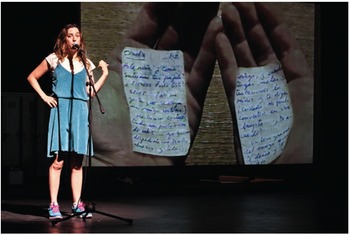
Although Arias uses photographs as evidence and often projects them onto large screens that the performers draw or make notes on, she does not reconstruct the past in order to reveal its lost, hidden, or forgotten truth; rather, she assumes the impossibility of doing so. The stage serves as a dynamic common ground that allows for the appearance of a “new” past that is at once personal and collective. It belongs to the borderless fictional world that resists fixed or unidimensional interpretations. One of the most disturbing moments in The Year I Was Born is the projection of a press photo from the killing of Alexandra Benado’s mother on Fuenteovejuna Street by the security forces on 7 September 1983. She and other members of the Revolutionary Left Movement (MIR) were murdered despite an agreement to surrender. The projected photograph of Alexandra Benado’s mother comes from the newspaper La Epoca, where it was part of a 14 March 1991 article on the National Commission for Truth and Reconciliation investigation into the extrajudicial executions of armed insurrectionist groups that the junta designated “deaths in combat.” Footnote 17 This press image is juxtaposed onstage with pictures of Benado’s mother’s graduation from high school, her wedding to a fellow MIR member, the letter that her mother and father left for Benado explaining their decision to fight for a better world, and the “life journal” they prepared for whoever would look after her and her brother during their military training in Cuba. The moment asserts the function of photographs as political tools that transcend the life of the person depicted. By juxtaposing the junta’s media propaganda with IDs and family photographs, Arias asserts the function of the photograph as a political tool.
Whether drawn from family albums or public archives, the photographs are reframed and recontextualized in My Life After and The Year I Was Born in order to direct viewers’ attention to the social potential of the photographs in the present. They transform the traumatic events and hegemonic discourse on victimhood into stories told and shared in the public forum of a theatre, stories with which the audience is invited to engage; hearing such personal stories creates not only a sense of intimacy, but also a sense of responsibility that often brought spectators backstage after the performances to share their own stories with the performers.
A characteristic example of this interaction with the audience is Viviana Hernández’s story in The Year I Was Born. When she first shared it in January 2011 during a public workshop presentation in Santiago, she asked spectators to contact her if they knew something about the man in a picture she showed. The picture with a name written on the back was the only thing she had left of her father. This inspired her, with the help of a journalist, to investigate her father’s identity; as she said at the premiere of the piece in January 2012, she discovered that “S. Hernández” was in the national police and that he had been a prisoner in southern Chile since 2009 (Arias Reference Arias and Graham-Jones2019a:44). As Hernández revealed to the audience, her mother stopped speaking to her because of the play. She hopes that she will be brave enough to meet with her father when he is released from prison.
The Body as a Living Archive
Melancholy and Demonstrations, the third part of the trilogy, is Arias’s most personal piece, an autobiographical work about her own family, completing the portrait of her generation and filling in what’s missing from My Life After. Melancholy and Demonstrations tells of Arias’s mother, an intellectual who was not politically involved during the dictatorship. Arias was born in 1976 into a well-educated middle-class family. None of Arias’s relatives were among the disappeared. Being outside the common narrative, having an “illegitimate” background, haunts Arias:
Most journalists kept on asking “why you?” as if one must have a sort of inherited right to talk about this issue, as if only the children of the victims were allowed to talk. I may not have had any tragic story in my family, but I am also touched because I was born in 1976, and all my childhood was marked by the dictatorship. (in Sosa Reference Sosa2014:110)
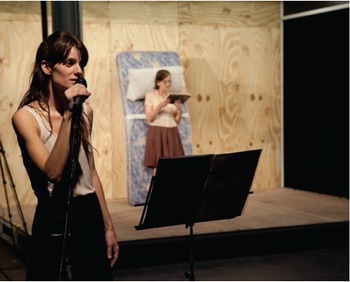
In Melancholy and Demonstrations, the Daughter (Lola Arias, left) stands in front of a microphone and addresses the audience while Elvira Onetto (right), who plays the Mother, acts out her mother’s story in a wooden box. Teatro General San Martín, Buenos Aires, 2013. (Photo by Lorena Fernandez; courtesy of Lola Arias Company)

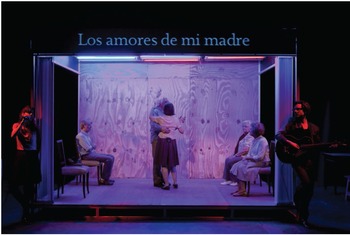
In Melancholy and Demonstrations, the Daughter (played by Arias) stands in front of a microphone and addresses the audience while her Mother (played by Elvira Onetto) and four other performers act out the Mother’s story. Onetto and the other four act out their scenes in a room-sized wooden box set placed onstage beside Arias. The Mother’s prerecorded voice lends a haunting note to the performance. As in the other parts of the trilogy, the disconnection of the body and the voice splits the speaker’s identity literally and conceptually. In this episode, however, Arias presents the story of a person who is still alive.
Working on the border between biography and autobiography, Arias uses multiple levels of mediation to layer time. Arias’s mother does not appear; her character is played by Onetto. However, the audience hears Arias’s mother’s actual voice as Onetto lip-synchs with the recording, embodying the Mother’s voice. The Daughter speaks into a microphone, addressing the audience:
DAUGHTER: […] It was 1976 and the country had also exploded after a military coup. Luckily, my mother and I survived the explosion. But days later, my mother became very sad. She went to a doctor and they told her that this sadness was called depression and that she needed to take some pills to get better. As the years passed, my mother began to live between two extremes: she would go for months without wanting to leave her home, barely eating or speaking, but other months she’d run around the city in a state of euphoria, talking about everything nobody else dared to say, like a radio station in a country where censorship does not exist. […]
MOTHER’S VOICE: Melancholia has to do with emptiness, with the feeling you don’t know what you’re doing in this world. You can’t enjoy any kind of love, you can’t enjoy art or reading or anything because it’s a very big emptiness and the only thing you feel all the time is suffering […]. (Arias Reference Arias, Tunnard, Graham-Jones and Graham-Jones2019b:131–32)
In Melancholy and Demonstrations, the Daughter (Lola Arias, left) narrates moments from her Mother’s life while Elvira Onetto, the Mother, and four other performers act out the stories in a wooden box to the sound of a guitar. Teatro General San Martín, Buenos Aires, 2013. (Photo by Lorena Fernandez; courtesy of Lola Arias Company)

Inside the box, Onetto and four older actors reenact everyday scenes from the Mother’s domestic and social life. The Daughter weaves her memories and images into the Mother’s narrative. In so doing, Arias questions what is happening now to all those who, like her mother, were invisible in Argentina during the dictatorship, those who have only grown older and more marginalized.
Melancholy and Demonstrations directly engages with the other parts of the trilogy. In the opening scene, the following lines are projected on a screen:
This is a play about a daughter who wants to understand her mother’s depression. The daughter doesn’t know how to make a play about a psychiatric illness. So the daughter goes to see her mother’s psychiatrist. The psychiatrist says the play is dangerous for her mother. So the daughter no longer wants to do the play. But then she thinks that there must be a way. The daughter asks her mother to do the play with her. The mother says she will help her but she can’t perform in her daughter’s play. The daughter follows her mother around with a notebook and a camera. […] The daughter writes down all the things she remembers about her mother’s illness. The play is called Melancholy and Demonstrations. (Arias Reference Arias, Tunnard, Graham-Jones and Graham-Jones2019b:131)
The story portrays the Mother’s relationships with her bed, her guard dog, her psychoanalyst, her exercise classes, her writings, her loves, her suicidal fantasies, and the women’s choir that the Mother joined on the advice of her psychologist. Music plays an important role here, as in the other parts of the trilogy: the performance opens with the sound of a guitar and closes with the voice of the (physically absent) Mother singing while Onetto lip-synchs onstage. For Arias, music is always the perfect medium to create togetherness and intimacy in the theatre while building trust between the performers and the audience.
This onstage intimacy is related to the intimacy of the writing process:
Of course, this is real because it is an experience […] I wrote this text based on the experience of a woman who is the daughter of a woman who was a literature teacher, but she has this disease of melancholia or depression […] it’s my own version of her disease. So in a way it is a fiction also because it’s my own perception of her life or of our life together. Every time you write something you decide to put some things in and to leave some others out, so you are in a way building a fiction. (Arias Reference Arias2013)
This approach enables Arias to openly speak about one of the less-discussed side effects of the military junta by connecting the origins of her mother’s depression to the coup and to the ideological persecution that silenced many nonmilitant intellectuals. More than an attempt at expanding the category of “victims of state terrorism,” writes Ana Longoni, “this is a question about the ways in which terror inscribes itself irremediably in every single body and concretely affects all of us from that point on” (2019:152). In Melancholy and Demonstrations, Arias as the Daughter asks, “I wonder if my mother’s illness might also have a political origin. If we made a list of all those who became depressed because of the dictatorship, how many names would there be on it? Thirty thousand, fifty thousand, a million?” (2019b:144).
Social Experiments
Arias continued her investigation of contemporary history and the critical politicization of biography in Minefield, about the Malvinas/Falklands War. The project originated in 2013 when the London International Festival of Theatre (LIFT) invited Arias to participate in “After a War,” for which artists developed projects about the consequences of armed conflicts. Minefield, which evolved from her LIFT project Veterans, was staged for the first time in May 2016 at the Brighton Festival. It was followed by Arias’s film Theatre of War, which premiered in 2018 at the Berlin International Film Festival.
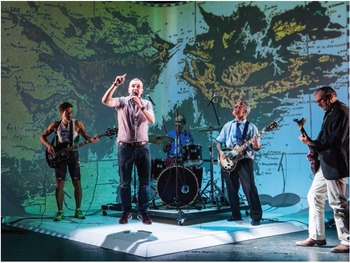
Minefield combines film, acting, testimonies, music, and dialogue in Spanish and English. Both Minefield and Theatre of War deal with the Malvinas/Falklands War, and Arias puts the same protagonists onstage and on the screen. Minefield is performed against a V-shaped white backdrop that stands in the middle of a stage resembling a film or photo studio. Upstage right there is a guitar and some amplifiers, and downstage right a projector on a table. Behind the table are three chairs and a shelf with maps, photos from family and public archives, notebooks, and a globe. Upstage left is a drum kit, a bass, and a clothing rack; downstage left there is a table with a small mirror (like in a dressing room), some objects, and three chairs.
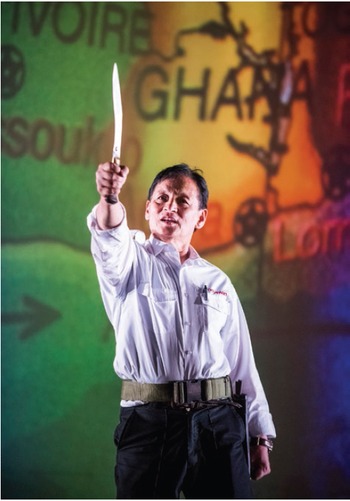
The piece focuses on former Argentinian and British soldiers who were chosen by audition (except for Lou Armour); they worked together for several months in Buenos Aires and London. They are: Marcelo Vallejo, a former member of a mortar team, now a champion triathlete; Rubén Otero, a survivor of the sinking of the Argentine light cruiser ARA General Belgrano by the British, Footnote 18 now a member of the Get Back Trio, a Beatles tribute band; Gabriel Sagastume, a criminal attorney; Lou Armour, a former member of the Royal Marines, now a special-needs teacher; David Jackson, an intelligence officer during the war, now a psychologist; and Sukrim Rai, a Nepalese Gurkha who joined the British Army at age 18 like his father and grandfather before him. Rai was among the 598 Gurkhas who settled in the UK at the end of the war. Footnote 19 Minefield, the second part of the war project, is structured around a series of chapters (“Becoming a Soldier,” Going to War,” “Waiting,” “Last Day of War,” “Return Home,” and “The War Show”), in which the personal testimonies of the six veterans are interspersed with live music, a video stream, multiple projections, and reenactments of personal stories from the war.
Arias explains that she wanted people “with different attachment to the war experience — people who manage to deal with these memories with family and psychological support, and some people who are very traumatized even to this day.” It was important for her “not to repeat the positive or the negative stereotypes, like of seeing veterans as crazy people or super humans” (in Arias and Gough Reference Arias, Gough and Graham-Jones2019:314).
Sukrim Rai, a Nepalese Ghurka who joined the British Army at age 18, demonstrates his kukri, a Gurkha knife, in Lola Arias’s Minefield. Royal Court Theatre, London, 2016. (Photo by Tristram Kenton; courtesy of Lola Arias Company)

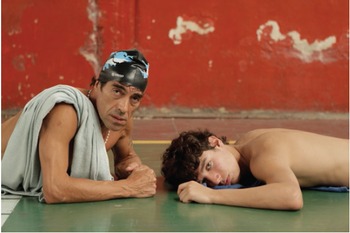
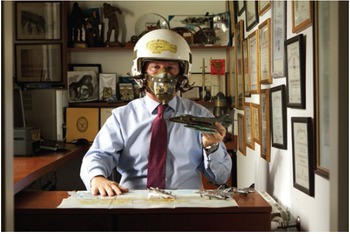
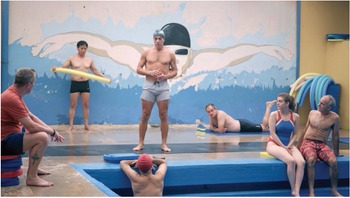
The starting point for the project is Arias’s 2014 video installation Veterans, comprising five films showing five veterans reconstructing episodes from the war in their current living or working spaces: an Olympic pool, a hospital, a trophy-filled office, a theatre, and a family space. The films are: The Swimmer with Marcelo Vallejo, a former metal worker, now a triathlon champion; The Voice with Daniel Terzano, a psychologist employed at a psychiatric clinic; The Sinking of the Belgrano with Dario Volonté, a naval petty officer, now a professional tenor; Last Day of War with Guillermo Dellepiane, a retired Argentine brigadier Air Force pilot; and The Diary of a Soldier with Fabián Volonté, a car mechanic reading from his tattered diary about his experiences prior to the start of the war as a soldier in Port Stanley, the capital of the Falklands. Veterans was first presented at London’s Battersea Arts Center. Two years later it was shown in Buenos Aires as part of Arias’s 2016 exhibition Doble de Riesgo (Stunt Double),Footnote 20 which explores, in different aesthetic forms, the issues that shaped the Argentinian collective imagination, beginning with 1976, the year of the right-wing coup d’état that overthrew President Isabel Péron, and the year of Arias’s birth.
Arias’s multifaceted Malvinas/Falklands project arose from a specific sociopolitical situation. During the Néstor and Cristina Kirchner administrations (2003–2015), the Museo Malvinas e Islas del Atlántico Sur was inaugurated in 2005 in the former Escuela Superior de Mecánica de la Armada, on the Day of the Veterans and the Fallen in the Malvinas War. The museum introduced visitors to the geography, flora, and fauna of the Malvinas Islands, as well as their political and cultural history within the framework of Argentina’s 200-year-old claim to the British-controlled islands. The museum participated in promoting the return of the Malvinas to the Argentinian political agenda after having been compromised for decades by their association with the military dictatorship. Around the same time, several former detention centers were converted into commemorative spaces as part of a controversial transitional justice policy. The Malvinas/Falklands project followed this period of reflection on the war, prompted by the London International Festival of Theatre call.
Marcelo Vallejo, a former metal worker now a triathlon champion, in The Swimmer, one of the films in Lola Arias’s 2014 video installation Veterans. First presented at London’s Battersea Arts Centre, 2014. (Film still by Manuel Abramovich; courtesy of Lola Arias Company)

Arias said that the project started with one question: “What is the memory that stayed in your mind until today?” (in Bither Reference Bither2019). Through a collaborative writing process with the veterans, which lasted longer than the 74-day war, she drew out their stories, ones that were deeper than the comfortable anecdotes they usually told. The writing process marks a shift from Arias’s work in My Life After and The Year I Was Born. Here she deals directly with the veterans’ unmediated memories and unhealed traumas.
Guillermo Dellepiane, a retired Argentine brigadier Air Force pilot, in Last Day of War, one of the films in Lola Arias’s 2014 video installation Veterans. First presented at London’s Battersea Arts Centre, 2014. (Film still by Manuel Abramovich; courtesy of Lola Arias Company)

Arias says, “I create text from what they tell me and then I give it back to them and they decide whether it will or won’t go in and they can always change their minds at any point even once we are performing it. They have the power. In the end the authorship of all my pieces is a shared responsibility, because all of us are involved in the process” (in Gardner Reference Gardner2016). She wanted to find their most painful memories, then build the stories from there. She found the process very special, because “they started to remember things that they had forgotten, just because they had the others there” (in Bither Reference Bither2019). Arias recalled that, during a rehearsal, the British veterans talking about giving back their weapons reminded Marcelo Vallejo of the sadness he felt when he turned in his own helmet and weapons. Arias said that “the voices of the others, of the enemies, in a language that most of them don’t even understand, was bringing back real memories that were somehow hidden. On one hand it was very beautiful, but it was also often very complicated because some memories were traumatic for them” (in Bither Reference Bither2019). These unearthed memories give Minefield added emotional power. At the same time, the collaborative writing process that Arias privileged in Minefield built relationships among a heterogeneous group of performers, creating a sense of community that seems unimaginable outside of the theatre.
Marcelo Vallejo in Theatre of War, first presented at Berlinale, Berlin’s International Film Festival, 2018. (Film still by Manuel Abramovich; courtesy of Lola Arias Company)

Minefield is performed in both English and Spanish, continuously reminding the audience of the two sides of the war. This duality is also reflected in Mariana Tirantte’s set. At the back is a screen that folds in half, allowing two projections of different people to face one another. The opening scene shows Vallejo, notebook in hand, sitting in front of this V-shaped screen:
MARCELO: (Reading in Spanish) 26 February 2016. I am there with the enemy, swapping stories. I don’t understand much, but I get what they’re saying from their expressions, their looks. I imagine us all together in a trench, chatting about the war.
MARCELO: (To the audience in Spanish) During rehearsals we had to keep a diary. This is mine. The Malvinas War lasted seventy-four days, from 2 April to 14 June 1982. The rehearsals for this play took a little longer. For several months, three British and three Argentine veterans worked together in Buenos Aires and London. The Brits don’t speak Spanish; we Argentines don’t speak English. But somehow, we understood each other. (Arias 2019c:257)
Interestingly, neither the British nor the Argentinian veterans denounce their country’s official political agendas or directly address the unresolved sovereignty issues. The T-shirt with the Argentine propaganda map of the Malvinas that Vallejo wears, patriotic songs, and other memorabilia that the performers bring onstage are part of the material culture that the Kirchner administrations created in order to construct narratives grounded in the Argentinian claim to sovereignty over the islands.
The film Theatre of War opens with a claustrophobic white space during a reenactment of the audition process and then moves into real-world locations, including a military barracks, a swimming pool, and a construction site. In a key film sequence that takes place on-site in a school, Arias invites British veterans to speak to students along with their Argentinian ex-adversaries. Arias takes a risk by placing her performers in this awkward position. In that way, she offers a sophisticated critique of her own country’s educational system, in which “children take special history classes on the Argentina-Malvinas relationship and devote the weeks surrounding the war’s anniversary to learning lessons structured around the islands in classes ranging from art to literature to physical education” (Montez Reference Montez2018:149).
The coexistence of Argentine and British veterans, together with their interwoven personal narratives, reveal the similarities between the war’s devastating legacy in both countries: Margaret Thatcher’s resounding victory and the Argentinian junta’s humiliating defeat. In retrospect, the British triumph turned into a somewhat shameful one, while Argentina’s defeat was ambiguous, because it led to the end of the military dictatorship, paving the way for the transition to parliamentary democracy (Hemer Reference Hemer, Bystrom and Joseph2017:145–46).
These two versions of history are enacted in a key scene staged in front of a Malvinas/Falklands map that appears in both Minefield and Theatre of War. The map and the discussion it generates show the impossibility of consensus between the old adversaries even within their own countries:
(LOU and GABRIEL stand in front of the map.)
LOU: (Speaking in English) We call these the Falkland Islands.
GABRIEL: (Speaking in Spanish) We call them Islas Malvinas.
LOU: (Speaking in English) The original inhabitants of the Falkland Islands were the birds.
GABRIEL: (Speaking in Spanish) The original inhabitants of the Malvinas Islands were the Patagonian wolves.
LOU: (Speaking in English) In 1592, the islands were discovered by John Davis.
GABRIEL: (Speaking in Spanish) In 1520, the Portuguese explorer Ferdinand Magellan, working for the Spanish Crown, discovered the islands. (Arias 2019c:289)
Arias’s Minefield reframes the public discourse surrounding veterans who suffered mental disorders and domestic tragedies when they tried to reintegrate into Argentinian life.Footnote 21 Posttraumatic stress deeply affected the characters in Arias’s project, especially Vallejo. In the lead-up to the war, the Argentine soldiers were hailed as heroes carrying forward the legacy of the country’s founding fathers and independence fighters, but upon return, they were dismissed as the “chicos de la Guerra (boys of the War) […] who found themselves re-assimilated into society as victims” (Werth Reference Werth2013:85). In similar scenes in both Minefield and Theatre of War, Vallejo reveals that when starving Argentine soldiers returned from the islands, their superiors hid them on military bases and the former Campo de Mayo barracks in Buenos Aires for three days and fed them so they looked as if they had been taken care of on the islands; they were forced to sign a nondisclosure document preventing them from saying anything about what happened. Vallejo felt so abandoned and betrayed that he began drinking and doing drugs. Vallejo’s story exposes the chasm separating the public images of the Malvinas soldiers from their actual experiences. How these soldiers were treated — how their war experience was duplicitously presented publicly — was an important part of the national discourse in the postdictatorship period.
In a key scene in Minefield, entitled “Therapy” (performed in English and Spanish, with the performers speaking their native languages), we follow a special session in which Vallejo meets with a British therapist played by Jackson, who is himself a psychologist, but was also diagnosed with PTSD, anxiety, depression, and social isolation after leaving the Royal Marines at the age of 36. On an empty stage the two performers sit facing one another, as video close-ups of their faces are projected onto the white V-shaped screen behind them. One of the key questions that Jackson asks Vallejo concerns his decision to be part of the project, despite the fact that, not so long ago, he couldn’t even bear listening to English music. Vallejo answers, “I wanted to know how I felt, being face to face again. […] Now I have even learnt some words: Good morning, tomorrow, one minute, Royal Marine…” (Arias 2019c:286). By revealing the veterans’ postwar vulnerabilities, Arias desacralizes the myth of the righteous, stoic warrior, not only of the Argentinian and British soldiers, but of all soldiers, and creates a common space where war-scarred victims meet and attempt to heal one another as part of the community created by this long-rehearsed and toured performance.
Critical Reenactments
Reenactment is a key performative device in Minefield and Theatre of War. It has a therapeutic effect: the veterans reconstruct specific incidents, acting out the events and even making the required sound effects. Moments when they faced death or traumatic situations during or after the war were brought to the surface through long and painful rehearsals. The reenactment of the minefield incident at Moody Brook, which gave the performance its title, is characteristic of Arias’s way of creating a sense of community. While Armour operates the camera so that the audience can see the live feed on the white screen, Vallejo moves toy soldiers and miniature objects in a model of the landscape around the Royal Marine quarters at Moody Brook, while Gabriel Sagastume tells one of his own stories: he and his fellow soldiers were verging on starvation after days without food. Several of his compatriots decided to look for food in an abandoned house near Moody Brook, but on their way back, after crossing the river in a small wooden boat with the provisions, they entered a minefield and were all killed. Sagastume and a superior officer were asked to pick up their remains in the only blanket that he had. He used the same blanket until the end of the war. He tells the story as the audience follows the reenactment of the incident on the big screen. It was only later in his life that he learned that the mines had been placed not by the British army, but by Argentine forces at the beginning of the war.
Using toy figures and miniature houses and trees, animated by the veterans’ episodic memories, the reenactment is a critical and reflective practice precisely because it combines personal narrative with a Brechtian distancing. It functions as an effective way to foster compassion among the heterogeneous cast onstage who are called together to reenact, as a group, incidents from both the British and the Argentinian sides.
Reenactment also reveals haunting moments of sadness and regret. For example, the reenactment of an incident on Mount Harriet, central to Minefield and Theatre of War, depicts an Argentinian officer dying in Armour’s arms. Here, Armour is part of the action, playing himself as he narrates the scene, and the veterans reenact his recollections of what happened that night:
LOU: (Speaking in English) The night of the 11th to 12th of June. We’re on the outskirts of Mount Harriet. And to get there, we’ve got to run through an Argentine minefield while being shelled by artillery fire. […] Once there, we go bunker to bunker firing at anything that moves. I’ve got Ritchie with me because he’s the youngest. I see a shelter in front of me and open fire. (Gabriel and Rubén hit the dirt.) I don’t know if Ritchie threw a grenade or not, but there’s a loud explosion, and when I looked up, there are Argentines standing with their hands in the air. (Marcelo walks forward with his hands in the air.) And I remember looking at the shelter and thinking: have I just killed some guys who were trying to surrender? I remember the quiet, and the snow falling. […] One of my guys calls me over to a fallen Argentine. And when I get there, I realized that he was speaking English. (Kneeling over Rubén.) He’s got a belly wound, and I remember as I was trying to console him, he began to talk to me about having once visited England. And something about Oxford. And then he died. (Arias 2019c:279)
In the performance of Minefield, Armour’s story is told twice, first as a reenactment by the six veterans, then as a projection of a clip from Peter Kosminsky’s film, The Falklands War: The Untold Story (1987), shot when Armour was 27. Armour’s tears on camera have a powerful effect. This is the reason Arias invited him to be in the performance without an audition. Arias chooses to show the clip from the documentary to juxtapose the younger Armour’s emotional, filmed self with the more emotionally distanced presence of the 59-year-old Armour onstage. Through the estrangement caused by this juxtaposition of past and present selves, the traumatized subject overcomes victimization, is empowered, and acquires agency.
In Theatre of War, Arias further radicalizes the reconstruction of this specific incident by expanding its performative potential to an intergenerational “social experiment,” which is what she calls bringing people with common experiences yet different viewpoints together onstage. In Arias’s film, Armour’s narration of the Mount Harriet incident is reenacted twice. In the opening sequence, the scene is played by the entire cast of veterans wearing their street clothes; at the film’s end, the scene is performed again by young actors in military gear who replace the veterans. By passing their stories to younger actors, Armour and the other veterans become spectators of their own memories. Arias dedicates the last 20 minutes of the film to the interaction between the veterans and the young actors. The young actors view photos from the veterans’ personal archives of the war, then spend time with the veterans one-on-one to ask about their personalities and their roles during the war, while wearing uniforms that are identical to the ones the veterans wore. Next, the actors get into makeup so they resemble the British and Argentinian soldiers involved in the incident as Armour remembers it. In a disturbing scene, Armour gives instructions to the makeup artist, describing how to re-create the wound on the dying Argentinian, explaining that the whole body, and not just the face, of the wounded soldier often appears to him in his everyday life. In the last part of this emblematic reenactment of the Mount Harriet incident, the veterans perform the whole scene one more time, like in the beginning of the film, while the young actors enter one by one into their tableau vivant and replace them, taking their exact positions. The very last image shows the veterans sitting to the side and watching the young actors play them. During the end credits, we hear the young actor playing Armour saying to his companions that he found a family photograph in the dead Argentinian soldier’s wallet, but that it was too dangerous to bury him and they needed to move on.
This device of “the veterans and their doubles” was briefly explored in Arias’s installation Veterans, but in the film, it is treated at length, giving equal importance to the preparation for the reenactment and the reenactment itself. “The film ends where the fiction starts,” Arias says, “and these fictional young people, these actors, begin to perform the war. And so, it’s like what is filmed is the whole preparation for a realistic war film” (in Arias and Gough Reference Arias, Gough and Graham-Jones2019:320). This intergenerational transmission of a wartime incident — from older veterans to young actors — recalls how young the veterans were when they were soldiers going to war. When the actors take over the scene and, consequently, Armour’s story, they create a distance for the veterans, separating them from their own pasts to allow them to apprehend the traumatic experiences with a cathartic effect.
Unlike in Minefield, in Theatre of War the audience witnesses how the whole project came together; they see material gathered during the research and rehearsal processes. Several film scenes reveal tension among the veterans, their doubts and uncertainties, and even their mistrust of Arias as an Argentinian. In an evocative scene in a bar, we see Jackson complaining to Lou Armour about the rehearsal process, insisting that he hasn’t been an actor, so he doesn’t know what an actor does; he’s just a psychologist and a veteran who’s trying to do his best. In an interesting response, Armour says that the whole thing is “an Argentine project, let’s face it” (Arias Reference Arias2018:40:36–41:58).
Agonistic Theatre
In Minefield and Theatre of War, Arias resists the politicization of mourning that is associated with human rights organizations and political agendas. The memories, stories, and beliefs of the Argentinian and British veterans are validated through performance and recognized for what they are — incomplete. By emphasizing the impossibility of completing these unfinished narratives, Arias escapes the essentialism of one-sided history and identity politics. In this process, Arias adopts Chantal Mouffe’s “agonistic perspective”:
For the agonistic perspective, the central category of democratic politics is the category of the “adversary.” The opponent with whom one shares a common allegiance to the democratic principles of “liberty and equality for all,” while disagreeing about their interpretation. Adversaries fight against each other because they want their interpretation of the principles to become hegemonic, but they do not put into question the legitimacy of their opponent’s right to fight for the victory of their position. This confrontation between adversaries is what constitutes the “agonistic struggle” that is the very condition of a vibrant democracy. (2013:7)
Reenactments of the traumatic past lie at the threshold of agonistic struggle and underline the discursive nature of reenactments that require yet resist representation. Reenactments do not eradicate empathy among the audience, the performers, and the historical subjects, but they can inject some distance. Arias preserves a critical distance between the memory of events and their narration; she presents material without claiming ownership of or control over that material. Rather, she distributes agency horizontally by side-stepping conventional applications of the power relationship between the director, the performers, and the audience. At the same time, she questions her position as the director and writer of her pieces. In a highly complex dramaturgy, Arias juxtaposes and superimposes everyday behavior, oral testimonies, and audial and visual facts and fictions. By breaking away from fact versus fiction, authentic versus fake, Arias bravely expands the narrow definition of documentary theatre. She acknowledges that consensus without exclusion would be an impossibility for both “sides.”
Music as Common Ground
In the opening scene of Minefield, Argentinian Rubén Otero introduces himself to the audience by singing in English “With a Little Help from My Friends” and sharing that he has a Beatles tribute band and he sings Ringo’s songs. Later on, the cast sings another Beatles song together: “Get Back.” In another key scene in Minefield, the three Argentinians — Sagastume, Vallejo, and Otero — come onstage dressed in the uniforms of their former enemies, as the Royal Marines Band. Together with British veterans Armour and Jackson, they reenact one of the songs that was used to raise British morale as they headed into the war:
We’re all going on a summer holiday.
We’re all gonna kill a spic or two,
We’re all going on a Falklands holiday.
Maybe for a month or two, or three or four. (Arias 2019c:267)
On a stage over-populated with testimonial objects from the war, Arias invites the Argentinians to play Beatles songs and wear the Royal Marines’ uniforms when singing the song that inspired their former enemies. As in her previous works, Arias uses music and reenactment as a way to actively involve each side in the other’s stories and memories. By doing so, she invites everyone to rethink subjectivity in terms of relationality and vulnerability.
In Minefield, music functions inside of the performance, “not just as a soundtrack or incidental music that creates an atmosphere, but you never know from where, or why, this music got here” (in Arias and Gough Reference Arias, Gough and Graham-Jones2019:309); here, all of Arias’s performers (except for Sukrim Rai) sing and play together as a live band. The final song of Minefield, sung by Armour, creates a common space that remains open to an always unfulfilled process of negotiation and an unreconciled claim for justice. Comprised of questions that the veterans are still struggling to answer, the final punk song is written mainly by Armour in collaboration with the whole group:
Would you vote to go to war?
Would you send your sons and daughters to war?
What would you fight for: The queen? La patria? Oil?
Would you go to war? Would you? (Arias 2019c:290)
The energy released in this frenetic sequence echoes the musical endings of both My Life After and The Year I Was Born, in which the performers create cacophonies of sound with instruments and voices. In all the works examined here, music has a cathartic effect as it summarizes, in an unpretentious and affective way, Arias’s unending search for a new social contract. Always produced by the performers themselves, music is, for Arias, the ideal way to create a sense of cohesion among the performers and between the performers and the audience. It contributes effectively to the building of trust, as does her transparent and often unexpected integration of the rehearsal process into her mise-en-scène.
“Would you go to war? Would you?” (From left) Marcelo Vallejo, Lou Armour, Rubén Otero, Gabriel Sagastume, and David Jackson, the dynamic band of Minefield, in their final song. Royal Court Theatre, London, 2016. (Photo by Tristram Kenton; courtesy of Lola Arias Company)

The epilogue in Minefield is characteristic of her stage ethics: following the loud punk song, she asks Sukrim Rai to read a Nepalese poem from his notebook, which is projected onto the backdrop screen but is not translated into either Spanish or English. In ending the film with a quiet scene featuring words that presumably very few, if any, members of the audience understand, Arias employs some of her key staging strategies: intimacy, the uncanny, and the opposite of spectacle. At the same time, the melancholic untranslated Nepalese poem exemplifies the impossibility of truly sharing memories and the impact of physical wounds.
Dispossessed Pasts
In her My Life After, The Year I Was Born, and Melancholy and Demonstrations trilogy, as well as in her Malvinas/Falklands War project, Arias stages more than a radical, metaphorical reappropriation of dispossessed pasts. She renegotiates dominant truths and beliefs by trying to identify and unsettle the mechanisms of fear, propaganda, and nationalism. She stages the political manipulation of collective memory and identity politics as they operate in the neoliberal world. In these works, her desire to rethink the recent history of Argentina and Chile, if not all South America, transcends national and territorial boundaries. Her works defend the right to remain unfinished and fragmented, allowing the ghosts of history to appear on stage and in film. Struggling against sovereign state control over individual and public memory, Arias claims the right of her postdictatorship generation to make a new artistic language that both demands and defies representation. In her complex theatrical environments, Arias reclaims the right to recover the past. She uses the transformative potential of music as a powerful way to release suppressed emotions and latent feelings.
Defying the need to convey a message or unilateral perspective, Arias engages the transformative power of dissensus, such that the stage becomes a catalyst for social conscience. Because Arias does not make theatre to remember or to forget, her work exists on a thin line separating chaos from order, presence from absence, appearance from disappearance. In this subversive field of spectrality that lies in between times and spaces, the undead — the disappeared — reappear and ghosts occupy the stage. In the transitional societies of South America, where justice for the victims and punishment for the perpetrators has been suspended, where the undead have been repressed or museified, Lola Arias, as a theatre director and writer, keeps the public debate active and urgent.