We know that learning to perceive and process spoken language is no small undertaking. From detecting, perceiving, segmenting, processing, and encoding the valuable linguistic information of the speech signal, young language users must achieve a number of cognitive tasks that appear automatic in sophisticated language users. Another crucial step in becoming a refined language user is an individual's ability to accommodate information in the speech signal contributed by the talker (Swingley & Aslin, Reference Swingley and Aslin2000). Many theoretical approaches to understanding spoken language processingFootnote 1 have historically focused on the linguistic/phonetic information (e.g., native language magnet theory expanded; Kuhl et al., Reference Kuhl, Conboy, Coffey-Corina, Padden, Rivera-Gaxiola and Nelson2008) or the perceptual assimilation model (Best & McRoberts, Reference Best and McRoberts2003), whereas the indexical information in the speech signal, such as the talker's accent, gender, and emotional state, is often unaccounted for or “normalized” out of the problem space. Over the past decades, however, research demonstrated that this indexical, talker-specific information is neurologically coupled with its linguistic information (Chandrasekaran, Chan, & Wong, Reference Chandrasekaran, Chan and Wong2011) and often affects the perception and processing of this linguistic information across a variety of listeners and a number of laboratory tasks (e.g., Barker & Newman, Reference Barker and Newman2004; Goh, Reference Goh2005; Houston & Jusczyk, Reference Houston and Jusczyk2000; Markham & Hazan, Reference Markham and Hazan2004; Mullennix, Pisoni, & Martin, Reference Mullennix, Pisoni and Martin1989; Nygaard & Pisoni, Reference Nygaard and Pisoni1998). Moreover, depending on the developmental level of the listeners and the experimental task, the talker-specific information can serve a facilitative (e.g., Singh, Reference Singh2008) or a detrimental (e.g., Creel, Aslin, & Tanenhaus, Reference Creel, Aslin and Tanenhaus2008) role in spoken language processing.
Despite this growing body of literature showing that the indexical information (such as a talker's accent) affects listeners’ perception and processing of phonetic information (e.g., Adank, Evans, Stuart-Smith, & Scott, Reference Adank, Evans, Stuart-Smith and Scott2009; Bradlow & Bent, Reference Bradlow and Bent2008; Cristia et al., Reference Cristia, Seidl, Vaughn, Schmale, Bradlow and Floccia2012; Levi, Winters, & Pisoni, Reference Levi, Winters and Pisoni2007; Seitz et al., Reference Seitz, Protopapas, Tsushima, Vlahou, Gori and Grossberg2010), more research is needed. For children, more information is needed to determine if and when talker-specific information is mandatory or supplemental and when it is facilitative or detrimental, especially in complex spoken language tasks utilizing real-time, fluent speech (Aslin & Smith, Reference Aslin and Smith1988). Understanding the role of talker-specific information in linguistic processing is important not only for refining and/or supporting predictions of theoretical models of spoken language acquisition and processing (e.g., PRIMIR; Werker & Curtin, Reference Werker and Curtin2005) but also may be useful for thinking about the types of added barriers (or benefits) children in a multicultural society face when their spoken language input does not match that of their home listening environment.
We argue that two of the limits to fully understanding the role of the talker-specific information are the developmental and experimental confines of the current body of literature. Talker-specific research is typically limited to infancy and young adulthood, leaving us with little understanding of its utility across development. Furthermore, the literature is restricted in the tasks employed to explore talker-specific speech processing. Often the listening tasks focus on little contextual support (e.g., isolated word recognition), without considering talker-specific processing in complex, real-life listening environments. Our study aimed to finesse these restrictions by examining a foreign accent's effect on the spoken language processing of typically developing preschoolers in two different listening tasks: word recognition and story comprehension.
FOREIGN ACCENT'S EFFECTS ON SPEECH PROCESSING
Studies that documented effects of accent-specific information on spoken language processing are most often restricted to the developmental endpoints of adulthood (e.g., Bradlow & Bent, Reference Bradlow and Bent2008) and infancy (e.g., Schmale & Seidl, Reference Schmale and Seidl2009). These data repeatedly show that adults and infants perceive and process spoken language in different manners. Nonetheless, different experimental manipulations of the accent information affect both types of listeners.Footnote 2
Adult listeners
In adults, foreign accent seems to most significantly affect processing speed. When a talker has a foreign accent, the listener's response latency is greater than compared to when the talker shares the listener's accent. For example, Adank et al. (Reference Adank, Evans, Stuart-Smith and Scott2009) tested the effect of regional accent on adults’ sentence recognition skills in noise. In their study, adults from the United Kingdom were presented with sentences spoken in a Southern Standard British English accent or a Glaswegian accent while speech-shaped noise played in the background. The researchers manipulated a number of variables, such as listeners’ familiarity with the regional accent, but ultimately came to the conclusion that as the speech-shaped noise decreased, listeners were slower to give accurate responses. Other researchers documented similar slowed processing speeds when examining adult listeners’ intelligibility (Rogers, Dalby, & Nishi, Reference Rogers, Dalby and Nishi2004), comprehension (Munro & Derwing, Reference Munro and Derwing1995), and word recognition (Floccia, Butler, Girard, et al., Reference Floccia, Butler, Goslin and Ellis2009). Thus, adults’ speech recognition accuracy does not seem to be affected by the variability in the speech signal contributed by the talker's accent. Rather, the consistent increase in response latency across adult listeners suggests that a talker's accent is encoded in conjunction with the speech signal's linguistic information. These data suggest that adults are able to use top-down knowledge to accommodate the accent, direct their attention to the linguistic information in the speech signal, and successfully complete the speech perception tasks at hand, despite a generalized slowing resulting from the presence of an accent.
Pediatric listeners
For infant listeners, foreign accent significantly affects spoken language processing. For example, Schmale and Seidl (Reference Schmale and Seidl2009) examined 9-month-olds’ abilities to recognize target words in a fluent speech stream, spoken with a foreign accent. The infants were familiarized with isolated words produced by either native talkers or foreign talkers. The researchers demonstrated that 9-month-old listeners had difficulty recognizing words produced by the foreign-accented talker, suggesting the young infants were not experienced enough to accommodate the talker's foreign accent in the context of a segmentation task. Best, Tyler, Gooding, Orlando, and Quann (Reference Best, Tyler, Gooding, Orlando and Quann2009) showed similar listener challenges with accent information when they found that 15-month-olds recognized only the familiar words spoken in their native accent. This finding was echoed in similar work by Mulak, Best, Tyler, Kitamur, and Irwin (Reference Mulak, Best, Tyler, Kitamura and Irwin2013) when they employed an eye-tracking paradigm and showed that 15-month-olds we able to pair images with their auditory labels when the labels were spoken in the infants’ native accent but not when spoken in a nonnative regional accent.
Furthermore, there is a group of researchers who examined talker-specific accent processing in young listeners beyond infancy. Not only did these researchers demonstrate that 5-year-olds face challenges perceiving and discriminating both regional and foreign accents (Floccia, Butler, Goslin, et al., Reference Floccia, Butler, Girard and Goslin2009), but they also showed that regional accents significantly affect children's spoken language processing. Nathan, Wells, and Donlan (Reference Nathan, Wells and Donlan1998) examined 4- and 7-year-olds’ ability to define and repeat words spoken in a native or nonnative regional accent. Results showed that the 7-year-olds outperformed the 4-year-olds, and a talker's regional accent negatively affected the children's word comprehension accuracy. It is worthy to note, however, that these findings are contrary to the data gathered when researchers examined the effect of “accent” (i.e., upward or downward vowel shift) on word recognition (Creel, Reference Creel2012). Creel's eye-tracking data consistently showed that 3.5- to 6-year-olds were highly accurate at word recognition, regardless of the talker's atypical pronunciations. However, the vowel shift significantly slowed her participants’ processing of the accented speech. Together these data from young listeners suggest that, as noted in adults, the talker's accent is processed in conjunction with the speech signal's linguistic information, but the nature of the accent effect seems to rely on the developmental level of the child and the requirements of the specific experimental task.
FOREIGN ACCENT'S EFFECTS ON STORY COMPREHENSION
Over the past decades, there was a notable accumulation of data suggesting that linguistic and talker-specific accent information interact, yet much of this data was gathered in the confines of strict laboratory paradigms employing context-free syllables or words as stimuli in relatively low-level, auditory perception tasks (e.g., Best et al., Reference Best, Tyler, Gooding, Orlando and Quann2009; Floccia, Butler, Girard, et al., Reference Floccia, Butler, Goslin and Ellis2009). Although these data are informative, the tasks’ demands are considerably different from those the listener is likely to face in natural listening environments. Thus, if we are to ultimately determine whether talker-specific information is crucial for the analysis of spoken language, we need to understand the relationship between this talker-specific and linguistic information in complex, natural spoken language tasks that ultimately rival real-life requirements for successful spoken language acquisition.
There is currently little existing data available examining the role of talker-specific accent information in experimental paradigms that employ verbal tasks extending beyond word or sentence recognition. Only one study has employed a high-level spoken language processing task with adult listeners. This was the work of Anderson-Hsieh and Kohler (Reference Anderson-Hsieh and Koehler1988), which showed adults’ auditory story comprehension was significantly affected when the narrator had a foreign accent. In their study, they assessed native American listeners’ comprehension of passages either narrated by a talker with a native accent or by a Chinese foreign accent speaking at slow, medium, and fast rates. The adults’ mean accuracy on the comprehension questions for foreign-accented passages (M = 3.52) was significantly lower than for the native-accented passages (M = 4.82), as was the mean accuracy for the foreign-accented talkers speaking at a fast rate (M = 2.56) compared to a medium rate (M = 3.52). These data suggest that regardless of the contextual cues provided by the stories themselves and the top-down knowledge available to the adult listeners, the saliency of the narrator's foreign accent seemed to negatively affect story comprehension accuracy.
To date, no one has examined the effect of foreign accent on story comprehension in children. However, there is research suggesting that young children do employ talker accent information beyond low-level speech perception tasks in more complex social learning tasks (Kinzler, Dupoux, & Spelke, Reference Kinzler, Dupoux and Spelke2012). Specifically, in Kinzler et al.'s research, 10-month-old infants (expt. 1) consistently chose the toy animal introduced by a native speaker as opposed to that introduced by a speaker with a foreign accent. In Experiment 2, 2.5-year-old children reliably offered a ball to a native speaker as opposed to a speaker with a foreign accent. Although the task was not directly related to speech perception, Kinzler et al.'s data showed that when children were presented with a talker accent that was not the same as their native accent, the children's sociolinguistic interactions were significantly affected and shaped by the talker-specific accent information. Thus, the data suggest that the contextual cues of the experimental task interacted with the talker-specific accent and linguistic information of the speech signal to differentially direct the children's attention to the speaker “perceived as having particularly relevant, culturally specific knowledge to share” (Kinzler et al., Reference Kinzler, Dupoux and Spelke2012, p. 69).
The overriding goal of the current studies was to determine if talker-specific foreign accent information influences spoken language processing in preschool-aged listeners in two different listening tasks. We chose preschoolers as participants because a better understanding of their abilities to accommodate accent information will aid in understanding spoken language processing at a time in development that appears to be crucial to language learning. Although children, aged 0–5 years, typically learn one new word a day on average, the growth rate of learning is greatly accelerated during year 3 (Fenson et al., Reference Fenson, Dale, Reznick, Thal, Bates and Hartung1994). The accelerated rate of word learning seems to be especially evident around 30 months of age because “as children learn more language the utterances they hear include more familiar words, and so it is easier for them to identify new words in the speech stream and also to identify the words’ communicative function in the utterances as a whole” (Tomasello, Reference Tomasello2003, p. 51). Finally, this acceleration in language learning is occurring at a time in development that many children in the United States are entering preschool and Head Start settings, thus spending more time out of the home-language environment. The number and variety of talkers these young children interact with on a daily basis significantly increases, and in order to be successful language learners and users, these children need to be able to manage the accent information in a way that it does not hinder their linguistic processing.
In Experiment 1, we were interested in whether a foreign accent would affect preschoolers’ abilities to accurately recognize words spoken in quiet, a developmentally appropriate task, assessing a relatively low-level of auditory development (Aslin & Smith, Reference Aslin and Smith1988; Carney, Reference Carney, Bess, Gravel and Tharpe1996). This provided us with an opportunity to replicate the findings of the aforementioned studies (e.g., Adank et al., Reference Adank, Evans, Stuart-Smith and Scott2009; Best et al., Reference Best, Tyler, Gooding, Orlando and Quann2009; Floccia, Butler, Girard, et al., Reference Floccia, Butler, Girard and Goslin2009) that showed foreign accents seem to negatively affect listeners’ speech perception. In Experiment 2, we examined the effect of a talker's foreign accent on preschoolers’ story comprehension, a high-level complex listening task. We chose story comprehension because if we are to ultimately determine whether talker-specific information is crucial for the analysis of spoken language, we need to understand the relationship between this accent and linguistic information in complex, natural spoken language tasks that parallel the real-life requirements. For both experiments, we predicted the preschoolers would be negatively affected by the presence of a foreign accent.
EXPERIMENT 1: THE EFFECT OF A TALKER'S FOREIGN ACCENT ON PRESCHOOLERS’ WORD RECOGNITION
Experiment 1 aimed to test for the effects of a foreign accent on auditory word recognition task in typically developing preschoolers using a four-alternative forced-choice (4AFC) paradigm. We predicted children listening to words spoken by a talker with a native, American English accent would show more accurate recognition compared to children listening to words spoken by a talker with a foreign, Malayalam (language of Southern India) accent. Preschoolers’ performance on word recognition is likely to be vulnerable to the presence of a foreign accent, similarly to the aforementioned vulnerability of young children's performances across a variety of listening tasks (e.g., Nathan et al., Reference Nathan, Wells and Donlan1998; Schmale, Hollich, & Seidl, Reference Schmale, Hollich and Seidl2011).
Methods
Experimental design
This study employed a between-subjects design. Talker accent (native American English or foreign Malayalam) served as the independent variable. Participants were age matched across the levels of the independent variable.
Participants
Twenty-four full-term children (14 females), aged 30 to 42 months (M = 37.75 months, SD = 3.38 months), participated in this study. The preschoolers (n = 12) in the native accent condition ranged from 30 to 42 months old (M = 38.40 months, SD = 3.27 months), and the preschoolers (n = 12) in the foreign accent condition ranged from 33 to 41 months old (M = 38.89 months, SD = 2.67 months), t (22) = 0.48, p >.05. All of the parents reported that their children had no prior exposure to a foreign language; however, we did not ask about previous exposure to a foreign accent.Footnote 3
Preschoolers were screened for typically developing speech, language, and hearing. The preschoolers in the native accent condition averaged 41.25 (SD = 7.03) on the expressive language subscale of the Minnesota Child Development Inventory (Ireton, Reference Ireton1992), and the preschoolers in the foreign accent condition averaged 41.83 (SD = 5.94), t (22) = 0.22, p > .05; the preschoolers in the native accent condition averaged 38.58 (SD = 8.25) on the “language comprehension” subscale, and the preschoolers in the foreign accent condition averaged 40.67 (SD = 6.92), t (22) = 0.07, p > .05. Each child's hearing was screened across the spectrum at 30 dB HL using a GSI-17 portable audiometer. Middle ear integrity was measured using standard tympanometry procedures. All participants were determined to be within normal limits on all measures. In addition, the preschoolers had no known, uncorrected visual abnormalities. Data from 3 additional preschoolers were excluded from the final analysis for the following reasons: below normal limits scores on the Minnesota Child Development Inventory (n = 1) and experimenter/apparatus error (n = 2). All children received their choice of a book, a toy, or a T-shirt in compensation for their participation.
Apparatus
The word recognition test employed a novel, touchscreen 4AFC task. We used the 2005 version of E-Prime experiment building software on a Dell Optiplex 745 personal computer equipped with a Keytec Magic Touch touchscreen to execute the task. The experimental setup was located in a double-walled sound booth equipped with a child-sized table and chairs setup. The monitor was located on the table, ~36 cm in front of the child. The computer's loudspeakers were located on each side of the monitor, ~41 cm in front of the child at 45° azimuth.
Stimuli
The words used in this study were age appropriate and selected from the 40 target images used in Experiments 2's story comprehension 4AFC task. See Appendix A for a list of stimuli. We chose two additional age-appropriate test items from the Peabody Picture Vocabulary Test (PPVT; Dunn and Dunn, Reference Dunn and Dunn1997) to serve as practice items.
AUDIO STIMULI
Two female talkers recorded the word recognition audio stimuli. In addition to receiving a copy of the words before recording, the talkers were instructed to read the words as if they were talking with a young child. All recordings were edited using the Adobe Audition 2.0 (2004) sound editing software on a Dell Optiplex 740 computer with a Delta 101LT PCI sound card. All final recordings were edited and equated for average root mean square then converted to 16-bit resolution at a 44.1-kHz sampling rate.
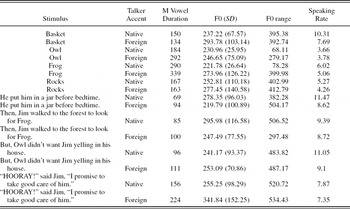
A 29-year-old female native American-English talker from the local community recorded the words spoken in a native accent. A 29-year-old female native Malayalam talker from India recorded the words spoken in a foreign accent. The foreign talker moved to the United States 4 years prior to making the recordings; she reported that she began speaking English as a child. Malayalam is a Dravidian language typically spoken in Kerala, India. Striking acoustic differences from English include vowel shortening and lowering, final obstruent devoicing, and nonaspiration. Additional common characteristics of Malayalam-accented English include the substitution of /w/ with a labial fricative and substitution of interdental fricatives with a stop (Krishnamurti, Reference Krishnamurti2003). See Table 1 for acoustic details of the talkers’ speech.
Select individual words (Experiment 1) and sentences’ (Experiment 2) acoustic analysis data for the native-accented American English talker and the foreign-accented Malayalam talker used in both experiments

Note: The stimulus is the stimulus analyzed, the talker is the type of talker accent, the M vowel duration is the mean duration (ms) of the vowels in stimulus, the F0 (SD) is the mean (SD) F0, the F0 range is the maximum F0 – minimum F0, and the speaking rate is the number of phonemes/s.
Finally, an additional native talker, a 23-year-old female from the area, recorded the audio stimuli for the word recognition task's practice items using child-directed speech. She is referred to as the teacher. Each recording was edited using the same specifications as the word lists. The acoustic details for her recording “Touch the picture of the person who found Frog, and then lost him” are as follows (Hz): F0 = 275.10 (SD = 99.41), F0 range = 402.28, and speaking rate (phonemes/s) = 8.09.
VISUAL STIMULI
Again, the word recognition test employed a novel, touchscreen 4AFC task. Images from various books of Mayer (Reference Mayer1967, Reference Mayer1969, Reference Mayer1973, Reference Mayer1974, Reference Mayer1978, Reference Mayer1985) served as the visual target and foil stimuli. Eight images for the practice questions were selected from the PPVT (one target and three foils for each practice item). The visual stimuli were 275 × 200 pixels set on a white background with a red border (see Figure 1). Although the four-image groupings were the same across test items and preschoolers, each image quadrant location was counterbalanced across participants to control for location bias (e.g., a child prefers to touch the bottom, right image over the top-left image) and yielded four experimental conditions.
A screen shot from four-alternative forced-choice (4AFC) tasks in Experiments 1 and 2 using edited images from Mayer's many works (Reference Mayer1967, Reference Mayer1969, Reference Mayer1973, Reference Mayer1974, Reference Mayer1978, Reference Mayer1985).

Procedure
Preschoolers were pseudorandomly assigned to either the native or the foreign accent condition. None of the children were familiarized with the test stimuli beforehand. The preschoolers were tested individually using the 4AFC paradigm. Caregiver informed consent was obtained prior to the experiment. Then each child's speech, language, and hearing were screened.
To begin, each preschooler sat at the table in front of the touchscreen monitor with the experimenter. Audio stimuli were presented via the computer's loudspeakers at a comfortable listening level. The experimenter provided the instructions prior to the beginning of the task: “You will hear a lady say a word. You will also see pictures on the screen. Please touch the picture that matches the word you hear with the magic wand. Are you ready to play the game?”
Each child then completed 2 practice items (consisting of age-appropriate items from the PPVT) prior to the 40 test items. During practice, a four-image quadrant (Figure 1) was displayed on the monitor for 3 s before the audio stimulus was presented over the loudspeakers. After the child heard the audio stimulus (e.g., spoon), she was instructed to select the corresponding picture from the quadrant by touching the touchscreen with her finger or a stylus (i.e., the “magic wand”). Feedback was provided during the practice task, including guidance from the experimenter regarding how to appropriately touch the screen. If the child responded to the practice items successfully (i.e., correctly touching the screening manually or with a stylus), regardless of accuracy, the program proceeded to the word recognition task.
The word recognition task immediately followed the practice items. Again, a four-image quadrant was displayed on the monitor for 3 s before the audio stimulus was presented over the loudspeakers. The procedure was the same as the practice task: the child heard the target word (e.g., frog) and, ideally, the child would respond to each word by touching the answer's corresponding image in one of the four quadrants displayed on the computer monitor. If the child paused for more than 10 s, the experimenter verbally encouraged the behavioral response (e.g., “touch the answer on the screen” or “it's okay if you don't know, just guess”). No feedback was provided during the word recognition task. E-Prime software (2005) recorded the child's responses via the touchscreen.
Results
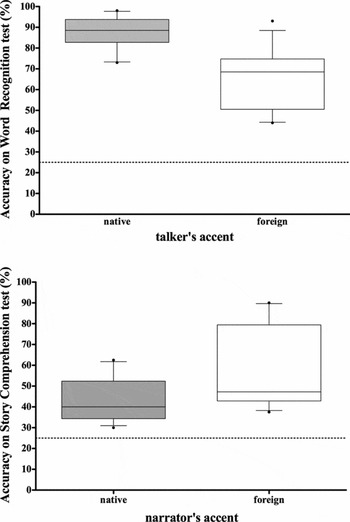
The average percentage correct on the word recognition test was calculated for each preschooler and served as the dependent variable. A between-subjects t test comparing mean accuracy between preschoolers listening to the native English talker (M = 87.33%, SD = 7.98%) and the foreign Malayalam talker (M = 64.92%, SD = 14.82%) showed a significant difference in performance between the groups, t (22) = 4.61, p < .0001 (see Figure 2), with a large effect size (Cohen d = 1.88). Each group's mean was also significantly higher than chance: preschoolers listening to the native English talker, t (11) = 27.06, p < .0001, and the foreign Malayalam talker, t (11) = 9.33, p < .0001. Foreign accent appeared to lower the preschoolers’ word recognition performance despite both groups performing significantly above chance on the task.
Box and whiskers plots of the group data for Experiments 1 and 2; the line represents the median, and the dots represent individual outliers. Group data showing preschoolers’ performance on the word recognition test as measured by average percentage correct (whiskers = 10th–90th percentile) is displayed on the top. Group data showing preschoolers’ performance on the story comprehension test as measured by average percentage correct (whiskers = 10th–90th percentile) is displayed on the bottom. The gray boxes display the mean accuracy of the preschoolers listening to the native English talker and the white boxes display the mean accuracy of the preschoolers listening to the foreign Malayalam talker.

To confirm the absence of perceptual adaptation and/or practice effects in the present experiment, we conducted a mixed analysis of variance with quartile (1, 2, 3, or 4) as the within-subjects factor and talker accent (native or foreign) as the between-subjects factor. The main effect of talker accent was significant, F (1, 22) = 22.20, p < .0001, while the main effect of quartile (n = 10 questions) was not significant, F (3, 22) = 1.86, p > .05. The interaction between quartile and talker accent was also not significant, F (3, 22) = 1.55, p > .05. The lack of significant difference in mean performance across the quartiles suggests that perceptual adaptation and/or practice effects did not contribute to the effect of talker accent.
Discussion
Similar to 2-year-old children's word recognition accuracy (Schmale et al., Reference Schmale, Hollich and Seidl2011), the presence of a foreign accent was detrimental to the preschoolers’ word recognition accuracy. The 3.5-year-olds listening to words spoken by a talker with a foreign accent performed significantly poorer compared to the children listening to words spoken by a talker with a native English accent. These data suggest that the developmental confines of the preschool listeners’ limited linguistic experience made it difficult for them to accommodate the talker-specific accent information in the speech signal. A talker's foreign accent may add a barrier to the already multifaceted task of spoken language learning in young children. However, it is possible that complex, real-life listening tasks provide valuable context information that can help compensate for the preschooler's limited linguistic experience, and thus the talker's foreign accent may not be detrimental to her spoken language processing. The following experiment tested this alternative perspective.
EXPERIMENT 2: THE EFFECT OF A NARRATOR'S FOREIGN ACCENT ON PRESCHOOLERS’ STORY COMPREHENSION
The aim of Experiment 2 was to test for the effects of a foreign accent on an auditory story comprehension task in typically developing preschoolers. We predicted children listening to a story narrated by a talker with a native American English accent would show more accurate story comprehension compared to children listening to a story narrated by a talker with a foreign Malayalam (language of Southern India) accent. Preschoolers’ performance on story comprehension was likely to be vulnerable to the presence of a foreign accent, similarly to the vulnerability of preschoolers’ word recognition skills (Experiment 1) and adults’ auditory story comprehension performance (Anderson-Hsieh & Kohler, Reference Anderson-Hsieh and Koehler1988).
Methods
Experimental design
This study also employed a between-subjects design. Again, talker accent (native American English or foreign Malayalam) served as the independent variable. Children were age matched across the levels of the independent variable.
Participants
A new sample of 24 full-term children (12 females), 31 to 42 months old (M = 36.21 months, SD = 3.99 months), participated in this study. The preschoolers were pseudorandomly assigned to one of the two conditions. Half of the children listened to the narrator with the native English accent; half of the children listened to the narrator with the foreign Malayalam accent. The preschoolers in the native accent condition ranged from 31 to 42 months old (M = 36.42 months, SD = 3.37 months), and the preschoolers in the foreign accent condition also ranged from 31 to 42 months old (M = 36 months, SD = 4.67 months), t (22) = 0.25, p > .05. All children met the same inclusion criteria employed in Experiment 1.
The preschoolers in the native accent condition averaged 41.17 (SD = 8.52) on the expressive language subscale of the Minnesota Child Development Inventory, and the preschoolers in the foreign accent condition averaged 43.25 (SD = 6.17), t (22) = 0.69, p > .05; the preschoolers in the native accent condition averaged 40.75 (SD = 7.10) on the language comprehension subscale, and the preschoolers in the foreign accent condition averaged 40.25 (SD = 6.68), t (22) = 0.18, p > .05. Data from 11 additional preschoolers were excluded from the final analysis for the following reasons: abnormal tympanometry/hearing screening (n = 2), scores below normal limits on the Minnesota Child Development Inventory (n = 2), apparatus error (n = 2), failure to properly interact with and operate the touchscreen (n = 2), and general task noncompliance (n = 3; 2 of whom were in the foreign accent condition).
Apparatus
We used the same equipment and software from Experiment 1 to test the children individually. The experimenter used the E-Prime (2005) software, the computer's keyboard, and the touchscreen to record the preschoolers’ responses.
Stimuli
AUDIO STORY NARRATION
We wrote a story to correspond to the illustrations of the picture book Frog, Where Are You? (Mayer, Reference Mayer1969). This book is often used to elicit language samples from young children and adults (e.g., Berman & Slobin, Reference Berman and Slobin1994; Pearce, McCormack, & James, Reference Pearce, McCormack and James2003). The same native and foreign talkers from Experiment 1 recorded the “frog story” narration using a Marantz PMD670 solid-state recorder and a Shure SM81 condenser microphone in a double-walled sound booth. In addition to receiving the story days prior to recording for preview, the narrators were instructed to read the story as if reading to a young child. See Appendix B for the narration's text. The story narrated by the native talker lasted 2 min 42 s; the story narrated by the foreign talker lasted 2 min 52 s. All recordings were edited using the Adobe Audition 2.0 (2004) sound editing software on a Dell Optiplex 740 computer with a Delta 101LT PCI sound card. All final recordings were edited and equated for average root mean square, and then converted to 16-bit resolution and a 44.1-kHz sampling rate. Acoustic analyses of the narrators’ story excerpts can be found in Table 1.
The teacher from Experiment 1 also recorded audio stimuli for the story comprehension test using child-directed speech; this included the instructions, practice items, and comprehension test items. Each recording was edited using the same specifications as the story narratives.
STORY COMPREHENSION TEST ITEMS
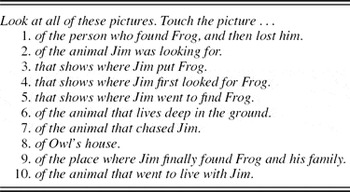
As in Kouri and Telander (Reference Kouri and Telander2008), we wrote 10 age-appropriate, story comprehension test items that followed a story grammar order. These items assessed whether participants understood the character, setting, and plot elements of the story (Table 2). Story comprehension items were the same for all preschoolers.
The 10 comprehension items asked of each participant in Experiment 2

Forty images from various books of Mayer (Reference Mayer1967, Reference Mayer1969, Reference Mayer1973, Reference Mayer1974, Reference Mayer1978, Reference Mayer1985) served as the visual foils and test stimuli used in the 4AFC story comprehension task. The same PPVT practice items from Experiment 1 were used as practice items in Experiment 2. As in Experiment 1, the visual test stimuli were 275 × 200 pixels, set on a white background with a red border. Each image quadrant location was counterbalanced across participants, yielding four experimental conditions.
Procedure
Again, the preschoolers were pseudorandomly assigned to one of the two conditions. Half of the children listened to the narrator with the native American English accent; half of the children listened to the narrator with the foreign Malayalam accent. All preschoolers heard the instructions, practice items, and comprehension test items presented by the native English teacher. All audio stimuli were presented via the computer's loudspeakers at a comfortable listening level. Caregiver informed consent was obtained prior to the experiment. Then each child's speech, language, and hearing were screened.
To begin, each preschooler sat at the table in front of the monitor with the experimenter to participate in the task. An image of a yellow smiley face centered on a black background was displayed on the computer's monitor. The story's audio played over the computer's loudspeakers. The smiley face remained on the screen from 1 s prior to the narration's start and terminated with the narration's end. The image was intended to help capture and maintain the preschooler's attention during the listening-only task. The experimenter encouraged all children to look at the screen and “listen to our story about the frog.”
Following the short story, testing began with the two PPVT practice items from Experiment 1. These items were included to orient the child to the touchscreen task before beginning the story comprehension items. The practice items followed the same procedure as in Experiment 1. If the child responded to both practice items, the program proceeded to the comprehension test items.
All children heard instructions for the test via the computer's loudspeakers in the teacher's voice; “Now I'm going to ask you some questions about the story. Are you ready to begin?” The experimenter took note of the child's behavior. When the child appeared attentive, she initiated the comprehension items on the computer. A four-image quadrant of foils and target stimuli (Figure 1) was displayed on the monitor for 3 s before the story comprehension item was presented over the loudspeakers. The following carrier phrase, spoken by the teacher, preceded each test item: Look at all of these pictures. Touch the picture __________. An example of a test item is, Look at all of these pictures. Touch the picture of the animal that went to live with Jim. (See Table 2 for the complete set of test items.) Ideally, the child would respond to each item by touching the answer's corresponding image on the computer monitor. If the child paused for more than 10 s, the experimenter restated the item previously presented via the computer and verbally encouraged the behavioral response (e.g., “Touch the answer on the screen” or “It's okay if you don't know, just guess”). No feedback was provided during the 10 story comprehension test items.
Results
Average percentage correct on the story comprehension test was calculated for each preschooler and served as the dependent variable. We conducted a between-subjects t test to compare the mean accuracy of the two groups: preschoolers listening to a native accented story (M = 42.95%, SD = 10.71%), and preschoolers listening to a foreign-accented story (M = 58.65%, SD = 20.46%). The analysis revealed a significant difference in performance between the groups, t (22) = –2.36, p < .05 (see Figure 2), with a large effect size (Cohen d = –0.97). Each group's mean was also significantly higher than chance: preschoolers listening to the native English talker, t (11) = 5.81, p < .001, and the foreign Malayalam talker, t (11) = 5.70, p < .001. The preschoolers listening to the story presented by the narrator with the native accent responded to the story comprehension items less accurately compared to the preschoolers listening to the story presented by the narrator with the foreign accent. Nonetheless, both groups’ accuracy was relatively low when compared to the preschoolers’ accuracy in Experiment 1.
Discussion
Our hypothesis was not supported. Unlike adults’ vulnerability to the presence of a foreign accent in a story comprehension task (Anderson-Hsieh & Kohler, Reference Anderson-Hsieh and Koehler1988), preschoolers’ performance was not hindered. Rather, the opposite was demonstrated: preschoolers listening to the story presented by the narrator with the foreign accent responded to the story comprehension questions more accurately compared to the preschoolers listening to the story presented by the narrator with the native accent. These results suggest that a complex, real-life listening task of story comprehension may have provided valuable context information that helped compensate for the preschooler's limited linguistic experience, so much so that the talker's foreign accent actually seemed to facilitate their spoken language processing in this high-level listening task. Specifically, it is possible that the story comprehension task provided the listeners with a more complex listening environment that brought with it the added benefit of extended exposure to the foreign accent. Then the raw saliency of the foreign accent helped maintain attention to the linguistic components of the auditory story, and ~3 min of exposure to the foreign accent paired with generally heightened arousal ultimately facilitated comprehension accuracy. Taken together, Experiments 1 and 2 suggest that the experimental task and the raw saliency of the foreign accent affect preschoolers’ spoken language processing in remarkably different ways.
GENERAL DISCUSSION
The overriding goal of the current studies was to determine if talker-specific, foreign accent information influences spoken language processing in typically developing preschool-aged listeners in different listening tasks. Results from Experiment 1 showed that American English preschoolers listening to words produced by a talker with a native American-English accent accurately recognized significantly more words compared to children listening to a talker with a foreign Malayalam accent. These results echoed previous findings from pediatric listeners showing that talker-specific accent information has detrimental effects on young listeners’ speech perception (e.g., Best & McRoberts, Reference Best and McRoberts2003; Nathan et al., Reference Nathan, Wells and Donlan1998; Schmale et al., Reference Schmale, Hollich and Seidl2011; Schmale & Seidl, Reference Schmale and Seidl2009). The results of Experiment 2 were contrary to the results of the aforementioned studies with adults (Anderson-Hsieh & Koehler, Reference Anderson-Hsieh and Koehler1988), showing that contrasting talker-specific information negatively affected story comprehension accuracy. In Experiment 2, foreign accent did not negatively affect the preschoolers’ performance; rather the foreign accent seemed to have a facilitative effect on performance because the preschoolers listening to the foreign accent scored significantly higher on this naturalistic story comprehension test compared to the native accent group.
Different tasks . . . different outcomes
Foreign accent hinders word recognition
Again, in Experiment 1 we showed that a talker's foreign accent negatively affected word recognition accuracy in preschoolers. Others have shown foreign accent affects word recognition from infancy (Schmale & Skeidl, Reference Schmale and Seidl2009) to adulthood (Adank et al., Reference Adank, Evans, Stuart-Smith and Scott2009); however, the magnitude of the effect of foreign accent varies. It has been argued (e.g., Cristia et al., Reference Cristia, Seidl, Vaughn, Schmale, Bradlow and Floccia2012; Jusczyk, Reference Jusczyk1993; Werker & Curtin, Reference Werker and Curtin2005) that the listener's point in development contributes to these varying outcomes. Specifically, much data suggest that early in the lifespan listeners are able to easily accommodate phonetic information in the speech signal (e.g., Saffran, Aslin, & Newport, Reference Saffran, Aslin and Newport1996; Swingley & Aslin, Reference Swingley and Aslin2000; Werker & Desjardins, Reference Werker and Desjardin1995). However, very young listeners face challenges when they are required to accommodate variable, incongruent information contributed by the talker such as foreign accent (e.g., Barker & Newman, Reference Barker and Newman2004; Houston & Jusczyk, Reference Houston and Jusczyk2000; Schmale & Seidl, Reference Schmale and Seidl2009; Werker & Curtin, Reference Werker and Curtin2005). Our results support this notion. Without the assistance from context clues provided by sentences or story plots, isolated words presented by a foreign-accented talker (as in Experiment 1) may not map onto the relatively inexperienced preschooler's existing lexical representations with ease, thus significantly hindering word recognition accuracy when listening to a foreign Malayalam talker.
Foreign accent facilitates story comprehension
In Experiment 2 we showed a significant difference in the groups’ performance in the opposite direction during the story comprehension test: the preschoolers listening to the foreign-accented narrator performed significantly better on the test items when compared to the preschoolers listening to the native narrator. Taken together with the results of Experiment 1, our data suggest that talker-specific information contributed by a foreign accent can hinder or facilitate spoken language processing in preschoolers depending on the requirements of the listening task.
One explanation for the differences noted in the performance of the preschoolers in the foreign accent conditions across experimental tasks is that a narrated story provides listeners with a more complex listening environment that brings with it the added benefit of extended exposure to the foreign accent. This increased exposure (compared to the limited exposure of isolated words) provides the preschoolers with the opportunity to adjust to the variability and incongruency of the foreign accent relative to the native accent of their home language environment. Bradlow and Bent's (Reference Bradlow, Bent, Sole, Recasens and Romero2003) work with adults supports this notion of listeners’ adaptation to a talker's accent, along with more recent work with toddlers (Schmale, Cristia, & Seidl, Reference Schmale, Cristia and Seidl2012). Schmale et al. used a preferential looking paradigm and showed that when 24-month-old listeners had extended exposure (i.e., less than 2 min) to a foreign accent during a rapid word-learning task, the toddlers were ultimately able to accommodate the novel talker information contributed by the accent and accurately recognized the newly learned word during testing. In the current study, the preschoolers in the foreign-accented condition received just less than 3 min of exposure to the foreign accent during the narration, so it seems likely that they too received benefits from extended exposure to the foreign-accented talker. However, a similar argument can be made for the preschoolers listening to the native narrator: increased exposure yielded improved overall task accuracy (as compared to the word recognition results of Experiment 1; Figure 2). Thus increased exposure to spoken language input in the story comprehension task only explains improved processing for both groups of listeners. It does not explain the facilitatory effect of the foreign accent during the story comprehension task alone.
A second explanation for the differences in the preschoolers’ performance on the story comprehension task echoes notions of Werker and Curtin's PRIMIR framework (2005) and focuses on heighted arousal. Specifically, the facilitated performance with the foreign accent may be attributed to variation in the allocation of attentional resources between the groups of listeners. The preschoolers’ listening to the foreign-accented narrator may have been drawn to the raw saliency and/or novelty of the accent, which in turn inadvertently drew and maintained their attention to the interdependent linguistic components of the story. (See Parmentier, Elsley, & Ljungberg, Reference Parmentier, Elsley and Ljungberg2010, for a similar argument about auditory novelty in the adult literature.) The preschoolers in the native narrator group may have faced challenges, which were due to their familiarity/habituation with the narrator's native accent and overall low arousal (i.e., boredom) when they were required to allot their attentional resources to the auditory-only task (Nosofsky, Clark, & Shin, Reference Nosofsky, Clark and Shin1989). Thus, heightened arousal and the resulting maintained attention to spoken language input during the story comprehension task explains improved processing for the children listening to the narrator with the foreign accent. We propose that it is likely a combination of both of the aforementioned explanations (extended foreign accent exposure and heightened arousal) that accounts for the difference in performance across the preschoolers in Experiments 1 and 2.
Finally, despite our viable explanations and the fact that the present studies underscore the importance of the developmental level of the listener and experimental task when interpreting talker-specific research, questions remain about why the effects of foreign accent differed across the two experiments. It is possible that the differences in the experimental tasks did not drive the outcomes. One alternative hypothesis regarding the difference across the experiments centers on our Malayalam talker's accent. It might be something distinct about our specific talker's foreign accent or voice that improves preschoolers’ story comprehension accuracy and does not generalize to other foreign-accented talkers. The acoustic analyses in Table 1 comparing our foreign- and native-accented talkers suggest that across the present experiments the native talker was acoustically distinct from the foreign talker. The differences noted in mean vowel duration and F0 range are particularly remarkable and echo acoustic differences across talkers noted in previous work comparing Malayalam and English speech (Krishnamurti, Reference Krishnamurti2003). However, without additional empirical evidence, it remains unclear whether our results generalize to all foreign accents and all complex spoken language processing tasks. In future studies, it will be important to keep the talker as a fixed-effect fallacy (Clark, Reference Clark1973) in mind and examine the effects of other sources of talker-specific information (e.g., dialect, age, or gender) from a number of different talkers in a variety of listening tasks.
A second alternative explanation for the difference in results between the two experiments focuses on the preschoolers’ previous exposure to Malayalam-accented speech. Recent research (Schmale et al., Reference Schmale, Cristia and Seidl2012) with toddlers showed they were able to successfully accommodate a Spanish foreign accent in a rapid word-learning task with less than 2 min of exposure. Recall, 2 min of exposure is more foreign accent exposure than the children received in Experiment 1 but less than the exposure the children received in Experiment 2. Thus, Schmale et al.'s data suggest that the brief exposure to the foreign-accented speech in Experiment 1's word recognition task was not enough to not allow the listeners to accommodate the talker-specific accent information. It is possible, however, that with increased accent exposure, prior to the word recognition task, the preschoolers’ performance in Experiment 1 may have mirrored that of the children in Experiment 2, showing a facilitative effect of foreign accent. Thus, an additional question for further research is: how does the listener's degree of familiarity with talker-specific information (such as foreign accent) affect the role of said information on spoken language processing?
Conclusions
The two experiments described within are the first to examine foreign accent's effect on spoken language processing in different experimental tasks with preschool-aged listeners. In Experiment 1, we showed that the preschoolers’ word recognition was less accurate in the presence of a foreign accent. Preschoolers listening to words presented by a native talker recognized more words than preschoolers listening to the foreign-accented talker. By contrast, in Experiment 2, we showed that the preschoolers seemed to benefit from the talker's foreign accent during the high-level, spoken language processing task of story comprehension. Preschoolers listening to the story narrated by a foreign-accented talker accurately answered more comprehension items compared to preschoolers listening to the native narrator. These data suggest that increased exposure to variable, salient talker information (such as foreign accent) may actually help young language learners accommodate talker-specific information during spoken language processing that occurs during the valuable early years of acquisition, particularly in real-world listening scenarios, like a preschool classroom.
Overall, our findings indicate that information contributed by a foreign accent influences preschoolers’ spoken language processing in different ways, in different experimental tasks. Our present results corroborate past work highlighting the listeners’ vulnerability to talker effects. Our results simultaneously bring to light an additional perspective shared with the PRIMIR framework (Werker & Curtin, Reference Werker and Curtin2005) that emphasizes the importance of looking across development and experimental tasks to better understand talker-specific information's pattern and influence on spoken language processing.
APPENDIX A
The following is a list of the word recognition task stimuli:

APPENDIX B
The following is a written narrative to accompany Frog Where Are You? (Meyer, Reference Mayer1969):
One day, Jim caught a frog. He put him in a jar before bedtime. While Jim was sleeping, Frog jumped out of the jar. In the morning, Jim woke up and said, “Uh-oh, Frog is gone! I need to find him.” First, Jim looked in his big, black boots. But, no Frog. Next, he looked outside. “Frog, where are you?” yelled Jim from the window. But, no Frog. Then, Jim walked to the forest to look for Frog. “Frog, where are you?” But, no Frog. Next, Jim went to Mole's house deep, deep in the ground. “Frog, where are you?” But, Mole didn't want Jim yelling in his house. Next, Jim went to Owl's house high, high in the tree. “Frog, where are you?” But, Owl didn't want Jim yelling in his house. So Owl got angry and chased Jim away. Then, Jim saw a big log in the lake. “Sh, I think I hear something,” Jim said. So, Jim tiptoed up and climbed quietly over the log. On the other side of the log were Frog, his wife, and all of his children. “Frog, there you are!” said Jim. “Jim,” Frog said, “My son, Baby Frog, would like to go and live with you.” “HOORAY!” said Jim, “I promise to take good care of him.” So, Jim and Baby Frog went home to get ready for bed.
ACKNOWLEDGMENTS
We thank Ashley Bourque Meaux, Mini Radhakrishnan, and Ashley Marino for recording stimuli for the present studies. We are grateful to Christina Gary, Camille Landry, Mary Elizabeth Dilday, and Kaylah Lalonde for helping collect data. We thank Annie Schubert for conducting acoustic analyses, Tessa Bent for her informal input on data analysis during an ASHA convention, and Elizabeth Walker for feedback and many helpful discussions during manuscript development. We are also grateful to two anonymous reviewers for their feedback on prior versions of this manuscript. Finally, we extend a big thank you to all of the preschoolers and their families who volunteered their time for these studies.