Implications
There is a scarcity of knowledge regarding the ontogenetic patterns of expression for folate transporters in poultry species. Results generated in the study showed that the mRNA expression pattern of Slc19a1 and Slc46a1 genes, which encode the reduced folate carrier and the proton-coupled folate transporter proteins, respectively, appears to be differentially regulated with age in the broiler chicken. In addition, such results indicate the possible importance of cecal folate absorption to folate homeostasis in chickens. Future studies will investigate the contribution of bacterially synthesized folate to folate requirements and the regulation of folate transporters in the hind gut in chickens.
Introduction
Folate is an essential micronutrient that acts as a key one-carbon donor required for de novo nucleotide and methionine biosynthesis (Lucock, Reference Lucock2000). Humans and other animals do not have the capability to synthesize folate, and thus must obtain the vitamin from exogenous sources via intestinal absorption. The intestine is exposed to two sources of folate: a dietary source, where the vitamin is mainly absorbed in the jejunum (Said et al., Reference Said, Ghishan and Redha1987; Said, Reference Said2004) and a bacterial source, where the vitamin is synthesized by the normal microflora in the large intestine and distal part of the small intestine (Crittenden et al., Reference Crittenden, Martinez and Playne2003; Kim et al., Reference Kim, Yang, Darling and O'Connor2004; Asrar and O'Connor, Reference Asrar and O'Connor2005). Owing to the hydrophilic nature of folate, its passive diffusion across biological membranes is negligible. Therefore, the mechanisms for folate transport in the intestine are subject to considerable interest. Two facilitative transporters, the reduced folate carrier (RFC; also called solute carrier family 19, member 1) and a newly identified proton-coupled folate transporter (PCFT; also called solute carrier family 46, member 1), encoded by Slc19a1 and Slc46a1 genes, respectively, have been reported to be expressed on the apical brush border membrane of intestinal epithelial cells and involved in intestinal folate transport in mammals (Matherly and Goldman, Reference Matherly and Goldman2003; Qiu et al., Reference Qiu, Jansen, Sakaris, Min, Chattopadhyay, Tsai, Sandoval, Zhao, Akabas and Goldman2006). Before the discovery of PCFT, RFC had long been regarded as the primary carrier-mediated intestinal folate transport protein (Chiao et al., Reference Chiao, Roy, Tolner, Yang and Sirotnak1997). However, RFC-mediated transport has been characterized to be optimal at near-neutral pH, whereas intestinal folate transport activity functions optimally at acidic pH (Wang et al., Reference Wang, Rajgopal, Goldman and Zhao2005; Said and Seetharam, Reference Said and Seetharam2006). PCFT has high affinity for folates and operates optimally at low pH, and has recently been identified as the major molecular entity of the intestinal folate transport system (Qiu et al., Reference Qiu, Jansen, Sakaris, Min, Chattopadhyay, Tsai, Sandoval, Zhao, Akabas and Goldman2006 and Reference Qiu, Min, Jansen, Malhotra, Tsai, Cabelof, Matherly, Zhao, Akabas and Goldman2007; Inoue et al., Reference Inoue, Nakai, Ueda, Kamigaso, Ohta, Hatakeyama, Hayashi, Otagiri and Yuasa2008). Members of our group recently found that the transport of folic acid in the intestine of laying hens demonstrated maximal activity at an acidic pH of 6.0, but was significantly reduced when H+ gradients were eliminated, indicating PCFT may be the primary functional protein in the transport process of folate in chickens (Tactacan et al., Reference Tactacan, Rodriguez-Lecompte, Karmin and House2011).
Research in mammals has shown that the overall intestinal transport process of folate is regulated ontogenetically, which is associated with changes at the transcriptional level of RFC and/or PCFT. Previous studies in rats have demonstrated that the transport system for folate was fully developed at suckling; however the activity and/or the number, but not the affinity, of the transport carriers decreased with maturation (Said et al., Reference Said, Ghishan and Murrell1985). Balamurugan and Said (Reference Balamurugan and Said2003) found that folate uptake was significantly higher in suckling compared with weanling rats, which was, in turn, significantly higher than that observed in adult rats. The observed reductions in folate uptake with maturation were associated with a decrease in both the mRNA and protein abundance of RFC, possibly mediated through transcriptional mechanisms. Recently, Subramanian et al. (Reference Subramanian, Reidling and Said2008) reported that the differentiation of enterocytes was associated with an upregulation in carrier-mediated folate uptake, which was associated with an increase in the abundance of mRNA and protein for both the RFC and PCFT in the intestine.
We have previously reported that both Slc19a1 and Slc46a1 transcripts were expressed in a variety of tissues in hens including small intestine and ceca (Jing et al., Reference Jing, Tactacan, Rodriguez-Lecompte, Kroeker and House2009 and Reference Jing, Tactacan, Rodriguez-Lecompte, Kroeker and House2010), indicating the likely importance of these two transporters for folate absorption in chickens. Little is currently known about the developmental pattern of expression of folate transporters in chickens. We hypothesize that the expression of genes encoding folate transporter proteins in the jejunum and cecum of broiler chickens decreases with age. Therefore, the objective of the present study was to investigate the post-hatching ontogeny of jejunal and cecal mRNA abundance of genes Slc19a1 and Slc46a1 in male broiler chickens.
Material and methods
Animals
Male day-of-hatch chicks (Ross × Ross; Granny's Poultry Co-operative) were randomly assigned to brooder batteries equipped with heated floor pens with wood shavings. All pens had 24-h lighting and chicks were maintained in brooder batteries until 2 weeks of age and then transferred to grower batteries without heating but maintained at room temperature. Birds had free access to water and a soybean/wheat-based diet that was formulated to contain 3040 kcal/kg metabolizable energy, 20.0% CP, 1.15% total Lys, 0.47% total Met, 0.87% total Met and Cys, 0.77% total Thr, 1.22% total Arg, 0.28% total Trp, 0.98% calcium, 0.49% available phosphorus and 0.21% sodium. The diet was additionally supplemented with 4.0 mg/kg synthetic folic acid (96%). The birds were managed in accordance with recommendations established by the Canadian Council on Animal Care (1993) following an animal care protocol approved from the University of Manitoba's Animal Care Protocol Management and Review Committee.
Tissue sampling
Birds were sacrificed by cervical dislocation at the following time points post-hatch: D0 (within 9 h after hatch but before feeding), D2, D7, D14, D21 and D35 after feeding. For all time points, the proximal part of jejunum and middle part of cecum were collected from eight birds that had similar BW and rinsed with ice-cold PBS solution (pH 7.4), and then stored in RNAlater ® Tissue Collection solution (Applied Biosystems Inc., Foster, CA, USA). Blood samples were collected into heparinized tubes, and the resultant plasma was used for subsequent folate and homocysteine (Hcy) analysis.
Analysis of plasma folate and Hcy
Plasma folate concentrations were determined using a competitive binding assay, SimuITRAC-S Radioassay Kit Vitamin B12 [57Co]/Folate [125I] (MP Biomedicals, Orangeburg, NY, USA) according to the manufacturer's protocol. Plasma Hcy was measured by reverse-phase HPLC with fluorescence detection, using the method of Araki and Sako (Reference Araki and Sako1987), as modified by Gilfix et al. (Reference Gilfix, Blank and Rosenblatt1997).
RNA isolation and quantitative real-time PCR (qRT-PCR)
Approximately 15 mg of intestinal tissue was used for total RNA isolation using RNeasy Mini kit (QIAGEN Canada Inc., Mississauga, ON, Canada) following the manufacturer's instructions, and RNA quality and quantity were assessed on a DU800 Spectrophotometer (Beckman Coulter Canada Inc., Mississauga, ON, Canada). The absorbance ratio at wavelength 260/280 nm was within 1.8 to 2.1. The prepared RNA was treated, in order to eliminate the possibility of genomic DNA contamination, through the use of a TURBO DNA-free™ kit (Applied Biosystems Inc.). The cDNA for respective tissues was synthesized via reverse transcription (RT) using 1 μg of total RNA and the SuperScript® VILO™ cDNA Synthesis Kit (Invitrogen Canada Inc., Burlington, ON, Canada). The RT conditions for each cDNA synthesis were 25°C for 10 min, 42°C for 90 min and 85°C for 5 min. Gene expression was quantified by SYBR green real time PCR as described previously (Jing et al., Reference Jing, Tactacan, Rodriguez-Lecompte, Kroeker and House2009). The primer sequences for Slc19a1, Slc46a1 and Actb encoding beta-actin and their specificity have been reported previously (Jing et al., Reference Jing, Tactacan, Rodriguez-Lecompte, Kroeker and House2009 and Reference Jing, Tactacan, Rodriguez-Lecompte, Kroeker and House2010). Conditions for the qRT-PCR were 95°C for 20 s and 40 cycles of denaturation at 95°C for 3 s, and combined annealing and extension at respective annealing temperature (60°C for both Slc19a1 and Slc46a1; 62°C for Actb) for 30 s, then followed by one three-segment cycle of product melting (95°C/15 s, 60°C/1 min, 95°C/15 s). Dissociation curves confirmed the specific amplification of the Slc19a1, Slc46a1 and Actb cDNA and the absence of non-specific products. Real-time PCR was performed in duplicate in 20-μl reactions using a StepOne™ Real-Time PCR System (Applied Biosystems Inc.). Corresponding mean values were used for further analysis. The relative level of target gene expression was analyzed using the ΔΔCt method (User Bulletin #2: Relative Quantitation of Gene Expression; Applied Biosystems). Changes in the mRNA abundance were calculated after normalization to Actb. The stability of Actb as an internal control was validated by the data that showed that the absolute values of ΔCt among intestinal samples at different developmental ages were less than 1 (Figure 1). The formulas used in the ΔΔCt calculation are provided below:
 $$\rDelta {\rm{Ct}}\,{\rm{ = }}\,{\rm{Ct\_target}}\,{\rm{ - }}\,{\rm{Ct\_}}Actb$$
 $$\rDelta \rDelta {\rm{Ct}}\,{\rm{ = }}\,\rDelta {\rm{Ct\_treatment}}\,{\rm{ - }}\,\rDelta {\rm{Ct\_control}}$$
 $${\rm{Gene}}\,{\rm{expression}}\,{\rm{level}}\,{\rm{ = }}\,{{{\rm{2}}}^{{\rm{ - }}\rDelta \rDelta {\rm{Ct}}}} $$
For both genes, the control values used in the calculation of relative mRNA abundance were the respective values derived from day 0 for both the cecum and the jejunum.
mRNA abundance of Actb gene in both the jejunum and cecum of male broiler chickens at different ages, with day 0 representing day of hatch (DOH). Data are presented as means plus standard deviation (n = 4).

Statistical analysis
The statistical analysis is for plasma concentrations of folate and Hcy, and for relative mRNA abundance of genes. Means were analyzed by one-way ANOVA using the statistical software package SPSS 13.0 for Windows (SPSS, Chicago, IL, USA). A single-factor model was used and sampling time was the only factor. Differences among means were assessed by least significant difference analysis. Level of significance was set at an α-level of P < 0.05 (Steel and Torrie, Reference Steel and Torrie1980).
Results
BW of broiler chickens
The BWs of birds were recorded before sacrificing at each time point. The values (mean ± s.e.m.) were 40 ± 1, 61 ± 2, 164 ± 8, 443 ± 27, 1005 ± 34 and 2230 ± 35 g on D0 (day of hatch (DOH) but before feeding), D2, D7, D14, D21 and D35 post-hatch, respectively, which were in agreement with growth curves reported in the commercial management guide for these broiler chickens (Aviagen, 2007).
Plasma folate and Hcy concentrations
Plasma folate and Hcy concentrations for broiler chickens at different ages are given in Table 1. In general, plasma folate concentrations were lowest on the DOH and then increased with age up to day 7, with no significant differences observed between time points post-day 7. The plasma concentrations for Hcy were highest on day-of-hatch and decreased thereafter (P < 0.05).
Plasma folate and homocysteine concentrations in male broiler chickens at different ages

a,b,c,dValues (mean ± s.e.m.) not sharing a common superscript within a row differ significantly (P < 0.05) between age groups (n = 4 to 8).
1D0, D2, D7, D14, D21 and D35: day of hatch and days 2, 7, 14, 21 and 35 after hatch of male broilers.
**P < 0.01.
Jejunal and cecal RFC and PCFT mRNA abundance
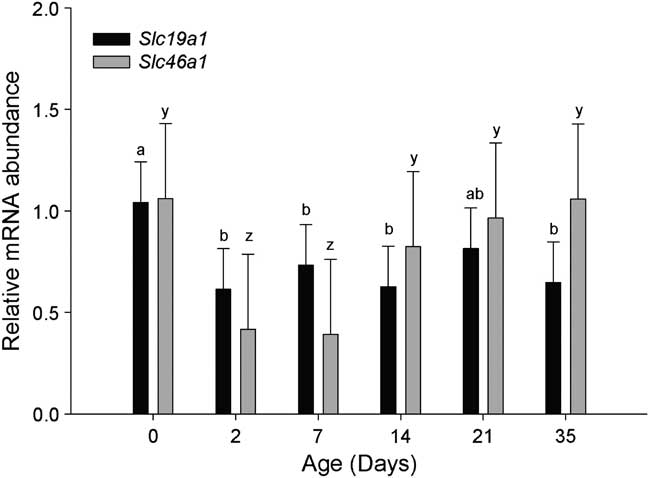
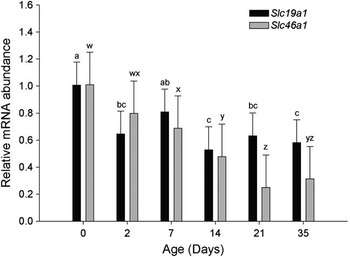
The ΔΔCt method was used to determine the mRNA abundance of genes examined in this study. The fold changes in the expression of Slc19a1 and Slc46a1 during development are presented in Figure 2 for the jejunum, and in Figure 3 for the cecum, respectively. Overall, Slc19a1 mRNA in the jejunum and cecum, while not directly compared, revealed similar expression patterns with age, namely, its mRNA abundance was highest on DOH and then declined (P < 0.05). The expression of Slc46a1 in the jejunum decreased (P < 0.05) in the first week and then gradually increased back to the level of DOH at D35 post-hatch. However, Slc46a1 expression in the cecum progressively decreased (P < 0.05) with advancing age.
Relative mRNA abundance of Slc19a1 (n = 4; s.e.m. = 0.20) and Slc46a1 (n = 4; s.e.m. = 0.37) in the jejunum of male broiler chickens at different ages, with day 0 representing day of hatch (DOH). For each tissue, means not sharing a common letter differ between age groups (P < 0.05). For both genes, the ΔCt value at day 0 was used as the control in calculating relative mRNA abundance.
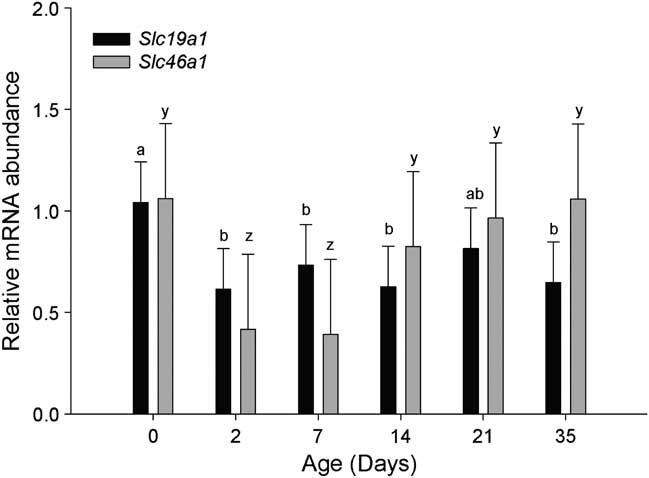
Relative mRNA abundance of Slc19a1 (n = 4; s.e.m. = 0.17) and Slc46a1 (n = 4; s.e.m. = 0.24) in the cecum of male broiler chickens at different ages, with day 0 representing day of hatch (DOH). Means not sharing a common letter differ between age groups (P < 0.05). For both genes, the ΔCt value at day 0 was used as the control in calculating relative mRNA abundance.

Discussion
Intestinal development is likely to be associated with changes in the levels of expression of various genes related to the transport of nutrients. Existing research in mammals has shown that the process of folate transport undergoes physiological development-dependent regulation accompanied with the changes in the expression of folate carriers RFC and PCFT in the intestine. However, relevant studies in poultry have not yet been reported. Thus, the present study was designed to investigate whether the expression of folate transporters in the intestine is regulated by ontogeny in chickens, which will offset the relative scarcity of knowledge on the folate transport system in avian species, and also contribute to how these might differ from mammalian expression patterns.
The ontogeny of folate transporters has been determined in mammals, in which there is a downregulation in their expression with development. Higher expression of Slc19a1 transcripts was detected in suckling rats compared with weanling or adult animals (Balamurugan and Said, Reference Balamurugan and Said2003). Shafizadeh and Halsted (Reference Shafizadeh and Halsted2009) recently showed that Slc19a1 mRNA transcripts were present in the small intestine at birth and declined significantly throughout development to 6 months in pig. Balamurugan et al. (Reference Balamurugan, Ashokkumar, Moussaif, Sze and Said2007) also found that there was a gradual decrease with development in the abundance of mRNA and protein of a specific folate transporter (encoded by folt-1 gene) in the intestine of nematodes. There is little data available on the ontogeny of PCFT expression because of its new identification as a major transport system for folate.
Studies in chickens have provided evidence that nutrient transporters were highly expressed in the immediate post-hatch period in response to increasing needs for the assimilation of numerous nutrients in support of growth, metabolism and development (Gilbert et al., Reference Gilbert, Li, Emmerson, Webb and Wong2007). In the current study, we found that the expression of Slc19a1 and Slc46a1 in the intestine was affected during post-hatching development. The mRNA abundance of Slc19a1 in jejunum and cecum, while not directly compared, exhibited similar expression patterns, and the overall trend was a decrease in expression with maturation. Although Slc46a1 mRNA in the cecum decreased gradually with age, its abundance in the jejunum was reduced in the first week and then progressively restored to post-hatching levels. In accordance with previous research in mammals, our current findings support the possibility that the ontogeny-dependent regulation of intestinal folate transporters was mediated, at least in part, via a transcriptional mechanism(s) in chickens. However, additional studies are needed to identify the exact mechanisms that regulate the expression of these gene products during development, and whether alterations in mRNA stability, post-transcription or translation are also involved in this ontogenic regulation of folate transport in the intestine. The ontogenic downregulation of Slc19a1 expression was in agreement with the findings of Li et al. (Reference Li, Gilbert, Zhang, Crasta, Emmerson, Webb and Wong2008) who reported that intestinal Slc19a1 mRNA abundance at D14 post-hatch was lower than that at DOH in broiler chickens analyzed by DNA microarrays, however data regarding PCFT was not presented. Taken together, the available evidence from both avian and mammalian species support the existence of mechanisms to prepare the developing animal for folate uptake post-hatch or post-natally. The higher expression of RFC and/or PCFT during the early post-natal or post-hatching period is consistent with the fact that folate is very important for early growth and development because of its critical role in DNA, RNA and protein synthesis. Determining the precise expression patterns of folate transporters may lead to the development of better folate supplementation in the formulations that more closely match folate availability with its uptake capacity. Moreover, information gained from this study will be useful in improving our understanding of the processes associated with folate assimilation in the chicken intestine during post-hatching development.
In order to provide additional insights into the potential biological relevance of the observed ontogenic changes in the expression patterns of the folate transporters, we measured plasma folate and Hcy as markers of folate availability. Plasma folate was low at initial hatch and then increased to a plateau by day 7 post-hatch. In general, plasma Hcy concentrations mirrored observed changes in folate status, being highest at DOH and decreasing thereafter, with the exception of an elevation at day 14. Folate plays an important role in lowering Hcy (van der Put et al., Reference van der Put, van Straaten, Trijbels and Blom2001; House et al., Reference House, O'Connor and Guenter2003), and is a major determinant of plasma Hcy concentrations. Other nutrients including vitamins B6 and B12 and non-nutritional factors may influence Hcy metabolism (House et al., Reference House, Jacobs, Stead, Brosnan and Brosnan1999). With respect to plasma folate, the dramatic increase observed immediately post-hatch likely reflects the transition from maternal (i.e. yolk sac) to dietary sources of folate, as the diets contain sufficient amounts of both natural and synthetic folate. Changes in plasma folate did not parallel the ontogenic patterns of mRNA abundance of the folate transporters. Mammalian studies have demonstrated that the expression of intestinal folate transporters is downregulated by folate oversupplementation (Ashokkumar et al., Reference Ashokkumar, Mohammed, Vaziri and Said2007; Dev et al., Reference Dev, Ahmad Wani and Kaur2011) and upregulated under conditions of folate deficiency (Said et al., Reference Said, Chatterjee, Haq, Subramanian, Ortiz, Matherly, Sirotnak, Halsted and Rubin2000; Liu et al., Reference Liu, Ge, Cabelof, Aboukameel, Heydari, Mohammad and Matherly2005). The authors suggest the existence of homeostatic and adaptable responses to intestinal folate uptake processes via the transport system in response to levels of dietary folate intake. When faced with folate oversupplementation, the animal tries to minimize net uptake of dietary folates from the intestinal lumen and into the bloodstream via decreasing folate transporter(s) expression; in contrast, when faced with the challenge of folate deficiency, the increase in the expression of the transport protein(s) should serve to maximize its uptake of dietary folates. On the basis of these suggestions, it is proposed in the present study that the reduced expression of key folate transporters immediately after hatch may respond to abundant folate, in other words, high folate may downregulate the expression of the genes. Such a change probably works to ensure that folate absorption does not occur at a rate that exceeds the capacity of the chick to metabolize excess folate at a critical transition period between limited maternal folate supply and the new and abundant sources of folate available from diet.
Our previous studies have shown that both Slc19a1 and Slc46a1 transcripts were expressed in the ceca of laying hens (Jing et al., Reference Jing, Tactacan, Rodriguez-Lecompte, Kroeker and House2009 and Reference Jing, Tactacan, Rodriguez-Lecompte, Kroeker and House2010). As expected, their expression was also found in the ceca of broiler chickens, and the mRNA abundance of both Slc19a1 and Slc46a1 decreased with maturation. These data may serve to highlight the potential importance of the ceca in folate metabolism and homeostasis, given the fact that folates derived from commensal microorganisms may serve as potential complementary sources of bioavailable folate (Kim et al., Reference Kim, Yang, Darling and O'Connor2004; Asrar and O'Connor, Reference Asrar and O'Connor2005).
In conclusion, the results obtained in this study demonstrate that the expression of jejunal and cecal folate transporters decreased as the chicks aged. The exact mechanisms regulating the reduction in expression are not known, but may relate to factors in play during the critical transition period from maternal to dietary sources of folate. Adequate folate absorption is critical to ensure its sufficient supply for critical biological functions, including DNA and RNA synthesis, and the regulation of one carbon metabolism. In addition, the current data regarding the expression of folate transporters in the ceca serve to provide evidence that the endogenous production of folates from commensal microorganisms may contribute to the folate status of the developing chick.
Acknowledgments
We acknowledge funding received from the Natural Sciences and Engineering Research Council of Canada Discovery Grant Program for this research. We also express our sincere thanks to Harry Muc (Department of Animal Science, University of Manitoba) for his technical assistance and animal care, and Granny's Hatchery Division, Granny's Poultry Co-operative (Manitoba) Ltd for free day-old chicks used in the current study.