Introduction
Research into the cross-language relationship between cognitive-linguistic skills in second language (L2) learners is driven by the long-standing premise that cognitive-linguistic development in L2 is partially founded on well-developed first language (L1) skills (Chung et al., Reference Chung, Chen and Geva2019; Durgunoğlu, Reference Durgunoğlu, Segers and van den Broek2017; Oller & Eilers, Reference Oller and Eilers2002). That not all aspects of L1 facilitate L2 development equally was a criticism raised early on at the 1981 Language Proficiency Assessment Symposium (see contributions by Genesee et al. in Rivera, Reference Rivera1984; see also Genesee et al., Reference Genesee, Geva, Dressler, Kamil, August and Shanahan2006). Indeed, Cummins’s (Reference Cummins1979, Reference Cummins1981, Reference Cummins2000) linguistic interdependence hypothesis implies that cross-linguistic interdependence/interactionFootnote 1 varies according to the type of cognitive-linguistic skill. Namely, positive transfer/cross-linguistic influence (CLI) of cognitively and conceptually demanding higher order, literacy-related skills can be expected, whereas for less demanding lower order, communicative skills positive transfer/CLI is less likely to occur.
Regarding literacy-related, meta-linguistic, and (meta-)cognitive skills, reviews of the empirical literature have revealed extensive correlational evidence for positive cross-language relations (Chung et al., Reference Chung, Chen and Geva2019; Durgunoğlu, Reference Durgunoğlu, Segers and van den Broek2017; Genesee et al., Reference Genesee, Geva, Dressler, Kamil, August and Shanahan2006; Melby-Lervåg & Lervåg, Reference Melby-Lervåg and Lervåg2011). At the same time, reviews of oral language proficiency among (pre)school-aged bilingual children showed L1-L2 correlations of divergent directions and sizes—as documented for oral vocabulary skills in particular (Branum-Martin et al., Reference Branum-Martin, Mehta, Francis, Foorman, Cirino, Miller and Iglesias2009; Melby-Lervåg & Lervåg, Reference Melby-Lervåg and Lervåg2011; Prevoo et al., Reference Prevoo, Malda, Mesman and van IJzendoorn2016; Sierens et al., Reference Sierens, Slembrouck, Van Gorp, Agirdag and Van Avermaet2019; Snow & Kim, Reference Snow, Kim, Wagner, Muse and Tannenbaum2007). In this respect, Melby-Lervåg and Lervåg (Reference Melby-Lervåg and Lervåg2011) asserted that there had been little discussion about how important differences between oral language skills (e.g., vocabulary, listening comprehension) may lead to different degrees of transfer/CLI. Indeed, some studies have examined the differential relationship between the size of the L1-L2 relationship and specific contrasted oral language constructs, such as picture versus narrative vocabulary (Branum-Martin et al., Reference Branum-Martin, Mehta, Francis, Foorman, Cirino, Miller and Iglesias2009); vocabulary versus syntax (Proctor et al., Reference Proctor, Harring and Silverman2017); general proficiency versus vocabulary/early literacy (Prevoo et al., Reference Prevoo, Malda, Mesman and van IJzendoorn2016); receptive vocabulary versus storytelling (Scheele et al., Reference Scheele, Leseman and Mayo2010); phonological awareness versus vocabulary (Goodrich & Lonigan, Reference Goodrich and Lonigan2017); and literal versus inferential listening comprehension (Vandergrift, Reference Vandergrift2006).
Research over time has made clear that existing explanatory interdependence/interaction frameworks need to be refined by considering factors that may influence the nature and magnitude of the cross-language relationship (Chung et al., Reference Chung, Chen and Geva2019; Prevoo et al., Reference Prevoo, Malda, Emmen, Yeniad and Mesman2015; Sierens et al., Reference Sierens, Slembrouck, Van Gorp, Agirdag and Van Avermaet2019). Durgunoğlu (Reference Durgunoğlu, Segers and van den Broek2017) argued that stronger support for CLI could be provided by investigating “third variables,” which can affect both L1 and L2 measures. Such confounds can be addressed with correlational and regression-based studies including mediating and moderating variables (Genesee et al., Reference Genesee, Geva, Dressler, Kamil, August and Shanahan2006). A possible intervening factor is task, which is constructed and operationalized in variable ways (Prevoo et al., Reference Prevoo, Malda, Mesman and van IJzendoorn2016; Proctor et al., Reference Proctor, Harring and Silverman2017). We opted in this study to explore the task-related factor of difficulty for a single language skill: listening comprehension (LC). LC is known to be challenging for L2/bilingual learners. It has been characterized as a large “problem space” (Snow & Kim, Reference Snow, Kim, Wagner, Muse and Tannenbaum2007), which, pursuant to the interdependence continuum hypothesis (Proctor et al., Reference Proctor, August, Snow and Barr2010), would be inherently less prone to CLI (Kim & Pilcher, Reference Kim, Pilcher, Schiff and Joshi2016). However, for the cross-language relationship between discourse-level LC proficiency, the correlational evidence in the literature shows a wide variety in effect sizes ranging between negative-small and positive-large. Moreover, a consistent link between LC task type and effect size could not be observed across studies reviewed in a prior literature study (Sierens et al., Reference Sierens, Van Gorp, Slembrouck and Van Avermaet2021).
Given the apparently inconsistent evidence, an exploration of the link between task-related factors and cross-linguistic interaction would be an expedient contribution to the existing knowledge. We posit a novel specification of existing task-dependent cross-linguistic interaction hypotheses that allows for the difficulty of task input modulating the L1-L2 relationship. To the best of our knowledge, this factor has not been empirically investigated before. In the investigation reported here, academic LC proficiency was measured in a set of first-grade Turkish–Dutch emergent bilinguals. “Emergent bilingualism” is a language-learning situation in which the L1 is built up in the largely L1-speaking homes, and the L2 only later comes into play through L2-speaking playmates and the school (Verhoeven, Reference Verhoeven2007).
Literature Review
Cross-Linguistic Interdependence/Interaction
According to Chung et al. (Reference Chung, Chen and Geva2019), there is as yet no single theory that provides a consistent and comprehensive account of the empirical evidence supporting facilitative cross-linguistic interaction. Cummins’s (Reference Cummins1979) interdependence hypothesis claims that the level of L2 competence that bilingual children attain is partially a function of the type of L1 competence that children have developed at the time when intensive exposure to L2 begins. Cognitive-linguistic skills, developed in L1, are thought to facilitate development of L2 skills through a common underlying proficiency, or CUP (Cummins, Reference Cummins1981). This shared processing system implies that L1 and L2 are intrinsically connected on a cognitive level, although each language may have distinct surface features (Goodrich & Lonigan, Reference Goodrich and Lonigan2017). The CUP comprises cognitive abilities (memory, auditory discrimination, abstract reasoning), (meta-)linguistic skills, and specific conceptual and linguistic knowledge derived from experience and learning (Cummins, Reference Cummins2000). However, the notion of CUP has been criticized for its lack of specification of the nature of the underlying cognitive-psychological mechanisms (Chung et al., Reference Chung, Chen and Geva2019). The interdependence hypothesis lacks the capacity to make specific predictions of the direction and extent of the transfer/CLI of any given construct. In short, little is known about how skills, shaped in L1, become functional in L2 (Genesee et al., Reference Genesee, Geva, Dressler, Kamil, August and Shanahan2006).
Geva and Ryan (Reference Geva and Ryan1993) underscored the role that common underlying cognitive processes play in explaining relations between parallel tasks in L1 and L2. Rather than CLI, basic cognitive processes (e.g., working memory) and higher level executive function and cognitive processes (e.g., self-regulation) can explain cross-linguistic correlations between similar language/literacy skills. The central processing hypothesis (Geva & Siegel, Reference Geva and Siegel2000) highlights that certain aspects of linguistic knowledge are language-independent and function in similar ways across languages. Hence, language-independent CLI is more likely to occur for language skills such as decoding and comprehension-related skills such as syntactic awareness and higher order semantic knowledge (Edele & Stanat, Reference Edele and Stanat2016). Chung et al. (Reference Chung, Chen and Geva2019) proposed an interactive framework, being an attempt to integrate the different existing theories. It claims that transfer/CLI is determined jointly by multiple cognitive and linguistic factors, including the relatively language-general or language-specific nature of the construct, L1-L2 distance, L1-L2 proficiency, and language complexity.
To explain skill-dependent variation in cross-linguistic interaction, Proctor and colleagues (Reference Proctor, August, Snow and Barr2010) postulated an interdependence continuum, hypothesizing that the learning challenge that different language skills pose mediates the magnitude of the cross-language relationship between parallel skills. Put differently, cross-linguistic interaction manifests itself more strongly for language and literacy skills that involve a small learning challenge (e.g., decoding) than for skills that require a broader range of knowledge and an intensive, prolonged learning effort for their mastery (e.g., vocabulary). Therefore, the construct and operationalization of a task may constitute factors that mediate cross-linguistic interaction (Prevoo et al., Reference Prevoo, Malda, Mesman and van IJzendoorn2016; Proctor et al., Reference Proctor, Harring and Silverman2017). Proctor et al. (Reference Proctor, Harring and Silverman2017) found indeed that the used syntax measure, more than the vocabulary measure, increased the likelihood of a positive cross-linguistic relationship. In this respect, Pae (Reference Pae2018) raised a need to integrate task-type effects, specifically those of cognitive load, into the current research base on L1-L2 relationships. This raised the question whether differences in difficulty between various listening subtasks affect the nature and magnitude of the cross-language relationship.
Listening Comprehension
Listening: Factors and Processes
Listening is to understand and extract meaning from spoken language. From the perspective of cognitive psychology, it is first and foremost conceptualized as an act of information processing (Imhof, Reference Imhof and Wolvin2010). The processing is conceived as a bundle of related processes, rather than a single process (Lynch & Mendelsohn, Reference Lynch, Mendelsohn, Schmitt and Rodgers2020). Listening requires processing information from various internal and external sources, as the verbal information may be complemented and modified by prior knowledge, context information, situational variables, body language, and nonverbal paralinguistic messages (Imhof, Reference Imhof and Wolvin2010, p. 98). Accordingly, LC is described as a complex, multifaceted skill comprising different components that allow processing of continuous incoming information at word, sentence, and discourse levels (Florit et al., Reference Florit, Roch and Levorato2013; Vandergrift & Goh, Reference Vandergrift and Goh2012).
The information processing in listening is presumably conditioned by two main factors (Rukthong & Brunfaut, Reference Rukthong and Brunfaut2020). The first factor is the listener’s linguistic and nonlinguistic knowledge (Field, Reference Field, Geranpayeh and Taylor2013). Linguistic knowledge concerns language-related information stored in the listener’s memory and used during comprehension processing to create and interpret discourse, including phonological, lexical, syntactic, semantic, and pragmatic knowledge (Field, Reference Field, Geranpayeh and Taylor2013). Nonlinguistic knowledge refers to the world/cultural knowledge that assists language users in interpreting the meaning of words, sentences, and discourse (Vandergrift, Reference Vandergrift2007). The second factor that likely contributes to successful listening is the automaticity of language processing (Hui & Godfroid, Reference Hui and Godfroid2021; Segalowitz, Reference Segalowitz2010). Although a detailed description of L1 listening cognition is outside the scope of this article, we point to various existing explanatory models (e.g., Field, Reference Field, Geranpayeh and Taylor2013; Imhof, Reference Imhof and Wolvin2010; Rost, Reference Rost2016). As an illustration, Imhof’s (Reference Imhof and Wolvin2010) three-step model of information processing looks at listening as the intentional selection, organization, and integration of verbal and nonverbal aspects of acoustic information. The first step in information processing is selecting information that consists of a rapid sequence of analyses, resulting in the identification and categorization of the stimuli and that represent the “raw material” for further processing. The second step is organizing information, which requires that meaningful units are identified, meaning is assigned to the identified units, and that the meaningful units are organized into a representation of the discourse/text base. The second step breaks down into five substeps: word recognition, access to the mental lexicon, sentence processing, monitoring understanding, and building a discourse/text representation. The third step involves integration, meaning that the listener creates a representation of the message expressed in the discourse/text. The listener constructs a situational model by using semantic, bridging, and elaborative inferences to supplement the discourse/text and fill gaps inherent in the message (Imhof, Reference Imhof and Wolvin2010).
Likewise, the literature offers several relatively congruent models for LC processing in L2 (e.g., Field, Reference Field, Geranpayeh and Taylor2013, Rost, Reference Rost2016; Vandergrift & Goh, Reference Vandergrift and Goh2012; see Rukthong & Brunfaut, Reference Rukthong and Brunfaut2020). As an example, Field’s (Reference Field, Geranpayeh and Taylor2013) framework classifies cognitive listening processes into lower level and higher level processes. The lower level processes of input decoding, lexical search, and parsing are activated to understand the literal meaning of verbal discourse. Meaning representation and discourse construction are the higher level processes that produce a mental representation of discourse. Altogether however, empirical validation of current models of listening cognition remains scarce, so that little is known about how automaticity in listening is achieved (Hui & Godfroid, Reference Hui and Godfroid2021).
Academic Listening
Being a good listener to spoken classroom language is a critical academic ability (Goh & Aryadoust, Reference Goh and Aryadoust2016). Without understanding speech at the right level, learning school-related skills, including language/literacy skills, will be impeded (Andringa et al., Reference Andringa, Olsthoorn, van Beuningen, Schoonden and Hulstijn2012; Rost, Reference Rost2016). Most importantly, LC can serve as an index for children’s development on different integrated aspects of oral language (Hagen et al., Reference Hagen, Knoph, Hjetland, Rogde, Lawrence, Lervåg and Melby-Lervåg2021; Hogan et al., Reference Hogan, Adlof and Alonzo2014). There is also evidence that LC in L1 and L2 predicts school outcomes of immigrant/minority children (Hoff, Reference Hoff2013, Prevoo et al., Reference Prevoo, Malda, Mesman and van IJzendoorn2016). Nevertheless, LC has been overlooked because many educators consider it a skill that is simply “picked up” in a passive and unintentional manner (Gilman & Moody, Reference Gilman and Moody1984; Lynch & Mendelsohn, Reference Lynch, Mendelsohn, Schmitt and Rodgers2020). By contrast, cognitive-psychological theorizing today conceives listening as a predominantly active, goal-directed, and controlled process (Imhof, Reference Imhof and Wolvin2010; Rost, Reference Rost2016). Goh and Aryadoust (Reference Goh and Aryadoust2016) have termed academic listening as “learner listening.” It involves one-way, transactional listening (e.g., lectures, instructions), the main purpose of which is the conveyance of information (Gu, Reference Gu and Hu2018). Additionally, it entails understanding academic/pedagogical discourse, which has certain well-defined lexical, syntactic, and discursive features making it distinct from everyday speech; for instance, lexical density, complex sentences, impersonal expressions, monological forms, and context-reduced communication (Marx et al., Reference Marx, Heppt and Henschel2017).
L1 and L2 Listening
Although many similarities exist between L1 and L2 listening, the acquisition of LC requires greater effort in L2 than in L1. Richards (Reference Richards2005) noted that L2 learners use listening for a double purpose: to comprehend an incoming message similar to L1 listeners and to assist their L2 acquisition. Compared to other language skills, current insights into the nature of L2 listening and what makes listening difficult for L2 learners remain limited. Little is known about how the success of L2 listening is influenced by the characteristics of the listening task and the listener (Brunfaut & Révész, Reference Brunfaut and Révész2015). Recent research into L2 listening has identified a range of linguistic and cognitive variables that affect LC in L2, including speech perception, grammar, vocabulary, working memory, and meta-cognitive ability (e.g., Andringa et al., Reference Andringa, Olsthoorn, van Beuningen, Schoonden and Hulstijn2012; Florit et al., Reference Florit, Roch and Levorato2013; Vandergrift & Baker, Reference Vandergrift and Baker2015; Wallace, Reference Wallace2020).
Summarizing existing knowledge, it can be said that L2 learners struggle with LC for essentially three reasons (Field, Reference Field, Geranpayeh and Taylor2013; Vandergrift & Goh, Reference Vandergrift and Goh2012). The first reason is related to the processing of aural/oral information input (Goh, Reference Goh2000). A second reason is that in L2 listeners linguistic knowledge can be limited, depending on their L2 proficiency level (Field, Reference Field, Geranpayeh and Taylor2013). A third reason lies in differences in nonlinguistic knowledge: a bilingual listener’s social-cultural background and experience may differ between the L1 and L2 contexts (Imhof & Janusik, Reference Imhof and Janusik2006; Rukthong & Brunfaut, Reference Rukthong and Brunfaut2020). The aural/oral modality of listening in particular presents specific attentional and memory challenges to L2 learners, such as real-time processing pressures or the lack of opportunity to review the message, if comprehension fails (Bloomfield et al., Reference Bloomfield, Wayland, Rhoades, Blodgett, Linck and Ross2011). Usually, listeners do not have control over the incoming speech stream (Kim & Godfroid, Reference Kim and Godfroid2019). In addition, in the comprehension of spoken language, word boundaries must be inferred from a variety of lexical and phonological cues (Cutler et al., Reference Cutler, Oahan and van Donselaar1997). Because listening involves real-time processing, the amount of information offered is considered another specific factor that predicts LC difficulty in L2. Passage length, for example, is one aspect of passage difficulty. Nevertheless, the evidence for its role in LC difficulty was found not to be strong (Bloomfield et al., Reference Bloomfield, Wayland, Rhoades, Blodgett, Linck and Ross2011).
Empirical research on the degree to which LC abilities are related across languages is scarce (Pae, Reference Pae2018; Sierens et al., Reference Sierens, Van Gorp, Slembrouck and Van Avermaet2021; Vandergrift, Reference Vandergrift2007). To our knowledge, 18 studies to date have documented L1-L2 relations between LC proficiency in (pre)school-age children. The effect sizes (correlations, standardized regressions coefficients) across these studies varied between –.10 and .65. For an overview and discussion of this literature, we refer to Appendix S1 in the Supporting Information Online. Drawing on the data presented in Table S1, there is no clear-cut answer yet to the question whether the test construct and its means of operationalization link with effect size.
Task Difficulty
L2 Difficulty
Following Pallotti (Reference Pallotti2019), we prefer the term “difficulty” to “complexity.” The term complexity is problematic mainly because of its polysemy and ambiguity. Complexity can mean both an object’s structural properties (how many parts and of the relations among them) and the cognitive demands faced by human beings when interacting with that object. Housen and Simoens (Reference Housen and Simoens2016) pointed out that L2 difficulty has rarely been thoroughly theorized in second language acquisition (SLA). There is no consensus on what the difficult aspects of L2 are, and what it is that makes these aspects difficult. A more explicit characterization of difficulty as a theoretical construct is needed, if only to establish the construct validity of the difficulty criteria and metrics employed in empirical research. What is clear is that L2 difficulty is a multifaceted, dynamic construct that results from a number of factors that interact in determining L2 difficulty, including feature-related factors such as task input besides learner-related and context-related factors (Housen & Simoens, Reference Housen and Simoens2016, pp. 166–167).
Pallotti (Reference Pallotti2019, p. 58) defined linguistic difficulty as “the linguistic features involved in performing a communicative task that may make it more or less challenging for language learners.” Linguistic features may be difficult because they contain many different elements (e.g., a high variety of lexical items or morphological processes) or because their relationships are intricate (e.g., long syntactic structures with deeply embedded constituents). Housen and Simoens (Reference Housen and Simoens2016) proclaimed that the cognitive difficulty of a task is related to how costly or demanding a given task feature is, particularly in terms of the mental resources allocated and cognitive mechanisms deployed in processing and internalizing the feature. In short, a task feature is more difficult in cognitive-linguistic terms than another if its processing and learning requires more time and/or more mental activity.
Task Difficulty and Information Processing
Kohnert (Reference Kohnert and Goldstein2004) contended that the general underlying idea to an interactive information-processing theory is that cognition and language are linked at some very basic level, and that specific language functions (including listening) are acquired and maintained through the application of more general cognitive processes. Basic cognitive mechanisms (perception, memory, attention, emotion) are integral to language learning and underlie the speed and efficiency with which language is learned and used. Within a general cognitive-linguistic processing framework, bilingualism is considered to be a dynamic system in which there is a constant interplay between the languages (positive and negative CLI, as well as some competition for resources).
For understanding task difficulty in task-based assessment, Skehan (Reference Skehan1998) offered a framework based on the information-processing model of comprehension (Anderson, Reference Anderson2010). It distinguishes task characteristics in terms of the cognitive/conceptual demands made on attentional resources. The act of listening in performing a task is consciously controlled, uses mental resources, and consumes the limited pool of attentional capacity (Radvansky & Ashcraft, Reference Radvansky and Ashcraft2016). As listeners cannot attend to everything equally, there will be a trade-off between dimensions of performance. A complementary cognitive-psychological perspective outlined by Cummins (Reference Cummins1981) claims that communicative proficiency in formal learning settings can be conceptualized along a continuum that is related to the degree of cognitive involvement. Cognitive involvement is “conceptualized in terms of the amount of information that must be processed simultaneously or in close succession by the individual in order to carry out the activity” (pp. 12–13). On one end of the continuum, there are cognitively undemanding tasks that have become automatized and require less active cognitive involvement. The opposite end involves demanding tasks in which the communicative tools have not become automatized and, therefore, require active cognitive involvement in task performance until mastery of utilized skills has been achieved. Demanding tasks require stretching one’s cognitive-linguistic resources to the limit to achieve one’s communicative goals. Thus, for CLI between skills to occur, they must be developed to the level that the execution of the learning task is automatized and requires less intensive cognitive effort (Cummins, Reference Cummins1981).
Sources of Task Difficulty
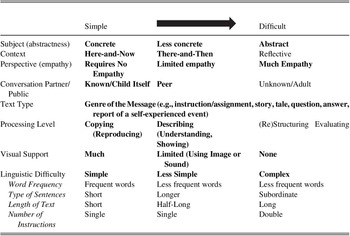
Scant attention has been paid to the investigation of listening task characteristics (Révész & Brunfaut, Reference Révész and Brunfaut2013). Reviews have identified features that may influence the quality of listening task performance, including features associated with the nature of task input (Bloomfield et al., Reference Bloomfield, Wayland, Rhoades, Blodgett, Linck and Ross2011; Rubin, Reference Rubin1994; Vandergrift, Reference Vandergrift2007). Following the SLA and task-based language teaching literature on task complexity (Robinson, Reference Robinson2001; Skehan, Reference Skehan1998), and building on earlier work in task-based language test development at the Centre for Language and Education (for an overview, see Colpin & Gysen, Reference Colpin, Gysen and Van den Branden2006), Ramaut et al. (Reference Ramaut, Roppe, Verhelst and Heymans2007) refined a scheme for determining task difficulty through the design of SALTO (Screening Start Primary Education Language Proficiency). SALTO is a validated instrument that assesses standards-based Dutch LC proficiency at first-grade entry in a direct and integrated way. Table 1 displays the underlying scheme of eight sources of item difficulty for the determination of task difficulty. Seven sources of item difficulty refer to cognitive difficulty: Abstractness, Context, Perspective, Conversation Partner/Public, Text Type, Processing Level, and Visual Support. The eighth source involves linguistic complexity, a multidimensional construct based on criteria related to lexical, morpho-syntactic, and discourse-level characteristics. A table showing the connections between task items and sources of item difficulty is displayed in Appendix S2 in Supporting Information Online. This scheme is mainly grounded in Skehan’s (Reference Skehan1998) limited attentional capacity model. An earlier version containing nine sources of item difficulty relating to the world represented in the task (three sources of item difficulty), processing demands (two), and linguistic input features (four) was operationalized and validated in the development of listening, reading, and writing tasks for TASAN, a task-based language proficiency test for newcomers (Ramaut et al., Reference Ramaut, Gysen and Sterckx2003; for an overview of the findings, see Duran & Ramaut, Reference Duran, Ramaut and Van den Branden2006). In developing the LC tasks for SALTO, the three sources of item difficulty referring to the complexity of the world represented in the task (Abstractness, Context, Visual Support), the source of item difficulty Processing Level, and a new multidimensional source of item difficulty Linguistic Complexity (integrating the four separate linguistic sources of item difficulty in TASAN) were used to describe task item difficulty. The second source of item difficulty relating to processing demands (Modality) was considered to be not relevant for the test and its targeted test-taker audience. Instead, three new sources (Perspective, Conversation Partner/Public, Text Type) were introduced, enabling the test developers to clearly link the assessment tasks to the test construct, that is, the official language proficiency standards by the Ministry of the Flemish Community (1997) and the Dutch Language Union (Van den Branden et al., Reference Van den Branden, Van den Nulft, Verhallen and Verhelst2001). The official standards together with the eight sources of item difficulty allowed for clear test specifications that helped test developers develop a range of tasks and items representative of the standards (construct validity) and varying in difficulty. The final difficulty level was established in a large calibration study with a sample representative for the Flemish school population (n = 1,530), using many-facet Rasch (MFRM) analysis to create one logit scale of test takers’ language proficiency and task item difficulty. For a detailed description of the validation of SALTO and its underlying model of task item difficulty, we refer to Ramaut et al.’s (Reference Ramaut, Roppe, Verhelst and Heymans2007) technical report.
Sources of task item difficulty in SALTO

Note: Source: Ramaut et al., Reference Ramaut, Roppe, Verhelst and Heymans2007, p. 7, translated from the Dutch. Sources of item difficulty in bold are addressed in SALTO.
The Present Study
The present study addressed a single research question: To what extent is there a relation between cognitive-linguistic difficulty of different item sets, based on various sources of item difficulty, and the size of the cross-language relationship for academic LC proficiency?
Based on a novel specification in terms of the task difficulty of task-dependent cross-language interaction frameworks, we advanced the following hypothesis: LC items that show a higher level of cognitive-linguistic difficulty indicate a lower strength of the L1-L2 relationship than items that show a lower difficulty level. The L1-L2 relationship between LC proficiency was examined in a set of 75 Turkish–Dutch bilinguals at first-grade entry in Flanders (Dutch-speaking Belgium). This investigation built on a prior study that examined the same data set yet with a different aim: to test three competing skill-dependent interdependence/interaction hypotheses concerning the strength of the cross-language relationship between LC proficiencies (Sierens et al., Reference Sierens, Van Gorp, Slembrouck and Van Avermaet2021).
Our study has added to the body of research in two ways. First, it represents a unique contribution by linking the magnitude of the L1-L2 relationship between academic LC proficiency to the level of cognitive-linguistic difficulty characterizing various sets of task items. This was expected to shed more light on internal, cognitive-linguistic factors affecting the size of cross-linguistic interaction. Second, while most past studies have focused on the typologically similar Spanish–English language pair, we examined the relationship between Turkish and Dutch, two dissimilar languages—which, consistent with the typological/contrastive perspective (Chung et al., Reference Chung, Chen and Geva2019), lessens the likelihood of language-dependent CLI. There is no generally accepted measure to determine linguistic similarity between languages. One indicator is the genealogical language group (Edele & Stanat, Reference Edele and Stanat2016). Dutch belongs to the Indo-European language group, whereas Turkish is a Turkic language. These two language groups show fundamental structural dissimilarities. Indo-European languages are fusional languages that use a single affix to the word stem to indicate the structural function of a word. Turkic languages, by contrast, are agglutinative by stringing several morphemes to a word stem to express a word’s grammatical function.
Method
Setting
The study was conducted in Ghent, Belgium’s fourth most populous city. Nearly one third of the city’s school-age children speaks non-Dutch home languages, of which Turkish is the most spoken one. The participants in this study were part of a larger baseline group (n = 337) that was recruited from 10 schools catering primarily to immigrant-background children with a low socioeconomic status (SES). The schools participated in a local quasiexperimental study called Home Language in Education (2008–2012) that offered two experimental conditions. Condition A, implemented in four intervention schools, entailed the functional use of minority-background pupils’ L1s as a learning resource in mainstream classes. Condition B involved Turkish preliteracy instruction (4 hours/week) in third preschool class and Turkish literacy instruction in first grade (6 hours/week) to Turkish children in two of the four intervention schools. Condition C in six comparison schools involved L2 submersion.
Participants
Seventy-five Turkish first-grade children were tested in four intervention schools and one comparison school. The dataset consisted of the 62 participants from the main test administration. The data from 13 children who were in the pilot subset were added, resulting in a total n of 75 (see Sierens et al., Reference Sierens, Van Gorp, Slembrouck and Van Avermaet2021). Nine pilot children about which background data were missing were included only for the measurement of test properties (reliability, item facility = IF).
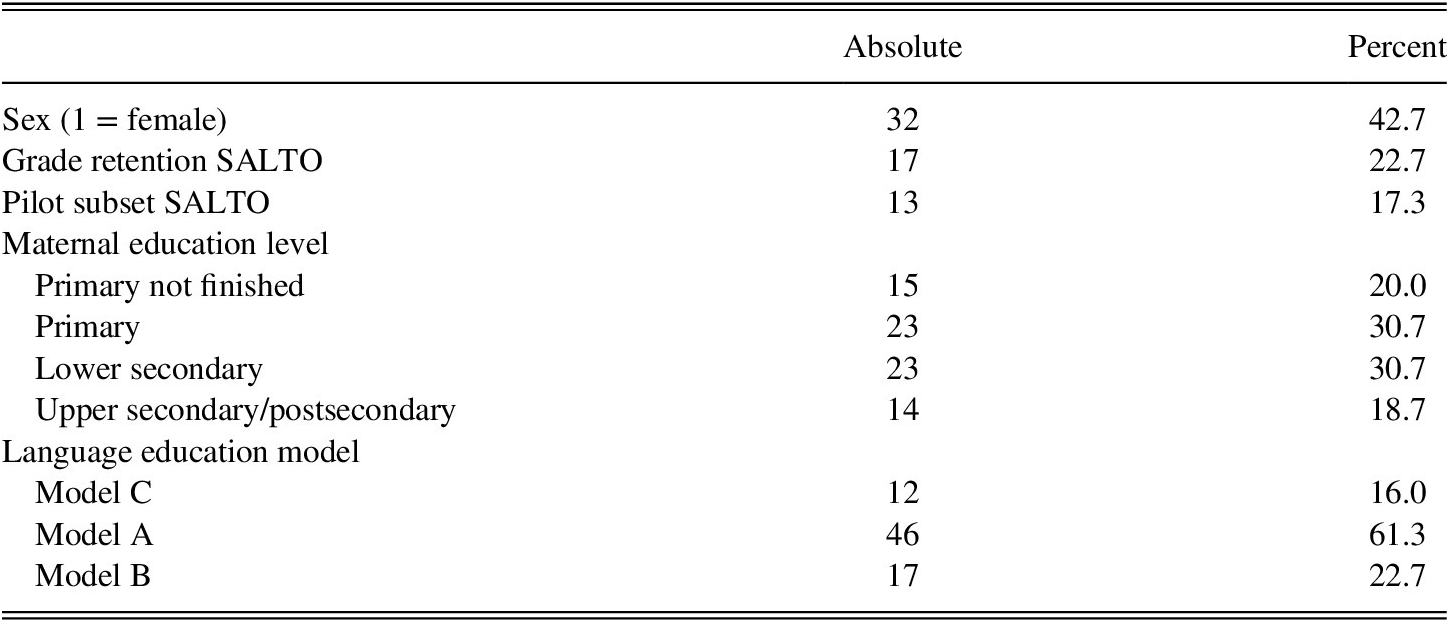
Descriptive statistics of child and context variables are presented in Tables 2a and 2b. The 75 participants (of which 32 females, 69 Belgian-born) had a mean age of 6;7 years, months, SD = 0;6, at the time of the Dutch-language testing. Nine in ten children were growing up in a home where L1 Turkish was mostly or exclusively spoken. Because practically all children started attending preschool as soon as they had reached the required age (2;6 years), their age of acquisition of L2 Dutch was fairly similar.
Descriptive statistics: Categorical variables (n = 75)

Note: SALTO = Screening Start Primary Education Language Proficiency.
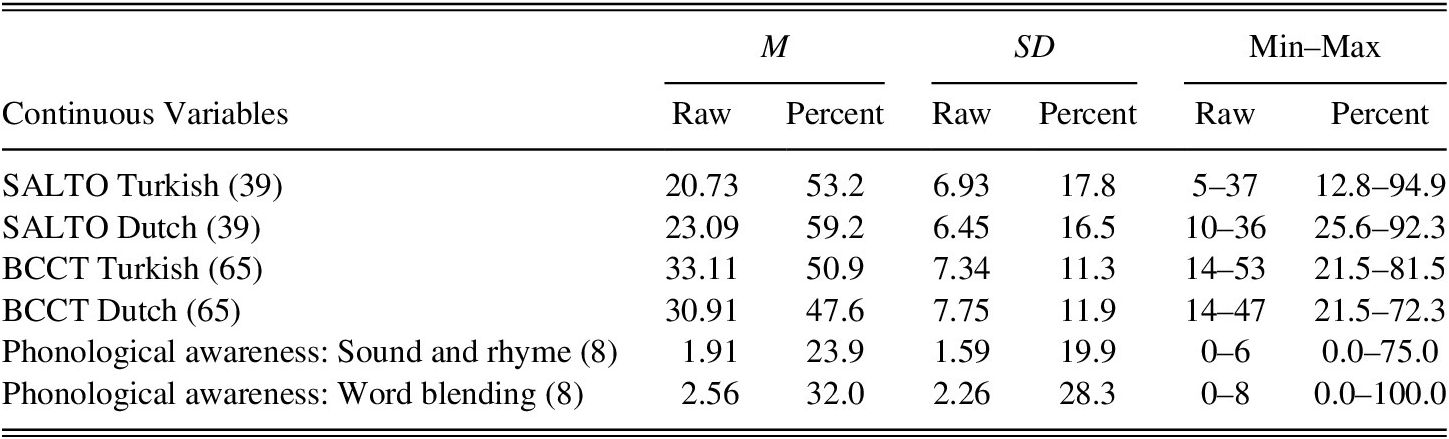
Descriptive statistics: Continuous variables (n = 75)

Note: SALTO = Screening Start Primary Education Language Proficiency.
Measures
Listening Comprehension
The selected SALTO test assesses LC proficiency. Through its focus on “learner listening” (Goh & Aryadoust, Reference Goh and Aryadoust2016), SALTO reflects the realities of pedagogical discourse typically associated with classroom teaching and testing in Flemish education. SALTO taps into the higher level LC processes of meaning representation and discourse construction (Field, Reference Field, Geranpayeh and Taylor2013). We note, though, that in SALTO the auditory cues are frequently based on lexis, so that listeners need to rely on lower level processes, too. Edele and Stanat (Reference Edele and Stanat2016) pointed out that models of LC define vocabulary as a core component of meaning assignment. Vocabulary knowledge also explains large proportions of variability in LC (Andringa et al., Reference Andringa, Olsthoorn, van Beuningen, Schoonden and Hulstijn2012; Florit et al., Reference Florit, Roch and Levorato2013; Wallace, Reference Wallace2020).
SALTO contains 39 items distributed over eight subtasks, varying in subject, objectives, degree of difficulty, and language proficiency demands. In six of the eight subtasks, the response format is picture identification. Following an introduction, the children are presented a series of four pictures along with stimulus sentences with each question; next, they are instructed to tick the picture in their individual testing booklet that matches best with the oral information. In the two remaining subtasks, the children receive directives to perform concrete physical actions. SALTO comprises four text types:
-
1. Comprehending and reacting adequately to an oral instruction or assignment (complete a drawing; connect objects in a drawing);
-
2. Comprehending and reacting to an oral question (about intentions, interests, or preferences; feelings of pupils or partners in the immediate environment, situations, actions, objects);
-
3. Comprehending a spoken story; and
-
4. Comprehending an informative notice (about concrete events, facts, here-and-now or there-and-then; rules and regulations).
A Turkish-translated equivalent was piloted a year before. The internal consistency of the tests was good, Cronbach’s α Turkish = .85, Dutch = .82. Examples of items are displayed in Appendix S3 (Supporting Information Online).
Cognitive Concept Comprehension
Receptive vocabulary in preschool was chosen as baseline measure in the previously mentioned intervention study, using the Bilingual Concept Comprehension Test (BCCT; Verhoeven et al., Reference Verhoeven, Narain, Extra, Konak and Zerrouk1995). The BCCT assesses receptive knowledge of cognitive concepts (e.g., “all,” “in,” “equal”). These are linguistic features that are common to all languages and reflect innate predispositions for perception and cognition (Verhoeven, Reference Verhoeven2007). The BCCT is designed as an individual picture-identification task. It covers five conceptual categories: color (15 items), shape (15), quantity (15), space (10), and relations (10). The child is presented three or four pictures and a stimulus sentence and is instructed to point to the picture that visually depicts the oral information. The internal consistency between the five categories was acceptable for Turkish and Dutch, Cronbach’s α = .72 and .77, respectively. For examples of BCCT items, see Appendix S3 (Supporting Information Online).
Phonological Awareness
Auditory discrimination is an indicator of lower level processing in comprehension of concatenated speech (Verhoeven, Reference Verhoeven2007). It is the ability to recognize differences in phonemes, including the ability to identify words and sounds that are similar or different (Kuczynski & Kolakowsky-Hayner, Reference Kuczynski, Kolakowsky-Hayner, Kreutzer, DeLuca and Caplan2011). We did not measure auditory discrimination, but we used instead phonological awareness subtests as proxies. Phonological awareness, a general cognitive processing skill that underlies L1 and L2 processes, is the ability to recognize and manipulate subsyllabic units in spoken words (National Early Literacy Panel, 2008). Two subtests, which were taken from the Language for Preschoolers Test (van Kuyck, Reference van Kuyck2003), measured sound and rhyme detection and word blending subskills, respectively. For the subtests (administered at two earlier points of time), the internal consistency was mixed: Cronbach’s α sound and rhyme = .56/.56; word blending = .84/.68.
Procedure
Test Administration
The main subset of children (n = 62) was tested in weeks 4–8 of the 2010–2011 school year. Two researchers and three Turkish-speaking assistants administered the Dutch and Turkish SALTO, respectively. SALTO entails a group testing in classroom, taking up to 60 minutes. Instructions were provided in the language of testing and were usually repeated once. The Dutch test was administered 2 to 3 weeks after the Turkish test. The pilot children (n = 13) were tested in weeks 10–15 of the 2009–2010 school year, using counterbalancing of the languages to control for test-retest effects (no significant effects were found). The BCCT was administered near the beginning of the school year 2008–2009. The phonological awareness subtests (n = 70) took place in small groups at two earlier points of time: baseline (cohort 2) and spring 2010 (cohort 1). The descriptive statistics of the test scores are presented in Table 3.
Descriptive statistics: Raw scores for tests of comprehension (n = 75) and phonological awareness (n = 70)

Note: BCCT = Bilingual Concept Comprehension Test; SALTO = Screening Start Primary Education Language Proficiency.
Data Analysis
We used SPSS (Version 26) to analyse the data. A preliminary analysis was conducted to identify possible significant covariates to be included in the main correlation analysis. Pearson correlations between SALTO, BCCT, and phonological awareness scores were computed. An initial .05 alpha level was set for the statistical tests, with adjustment for the multiple testing of correlations, using Benjamini and Hochberg’s (Reference Benjamini and Hochberg1995) procedure. Following Plonsky and Oswald (Reference Plonsky and Oswald2014), the effect size levels were evaluated as small/weak (.25 to .39), medium/moderate (.40 to .59), or large/strong (> .60).
To examine our hypothesis, we operationalized an analytic framework stipulating the degree of cognitive-linguistic difficulty of test item sets (see Table S2 in Appendix S2, Supporting Information Online). To this end, we adopted Ramaut et al.’s (Reference Ramaut, Roppe, Verhelst and Heymans2007) scheme. Yet, we added three cognitive sources of item difficulty. The source of item difficulty, Number of Skills, was not included in the original scheme. The underlying hypothesis is that a combination of skills makes a task more difficult compared to one in which a single skill is addressed. We also included two sources of item difficulty called Item Facility (Turkish and Dutch), which were operationalized by constructing three categories of difficulty (low/medium/high) representing the means of IF value for each category. The two IF variables are considered composite values because the degree of IF of individual items is likely determined by a variable combination of individual sources of item difficulty.
Subsequently, partial L1-L2 correlations were estimated to examine the results of the sources of item difficulty across their categories, controlling for baseline differences (cognitive concept comprehension) in Turkish and Dutch. The main analysis can be broken down into five steps:
-
1. IFs were calculated for all the items on the Turkish and Dutch test versions.
-
2. The items were grouped into two or three bins of hypothesized difficulty arising from several factors (e.g., concreteness) and the average IFs were calculated for each test form (Turkish and Dutch). For each source of item difficulty, the categories are arranged in hypothesized ascending order of difficulty from top to bottom in Table 5.
-
3. The average IFs for those bins were correlated.
-
4. Cohen’s q effect sizes were calculated to compare the correlations between the bins. The assessment values used are: < .10 = no effect; .10 to .29 = small; .30 to .49 = medium; ≥ .50 = large effect (Cohen, Reference Cohen1988).
-
5. We established whether there was a consistent pattern across the categories in line with our hypothesis, namely, a pattern in which the correlation size decreases with increasing level of cognitive-linguistic difficulty.
Results
Preliminary Analysis
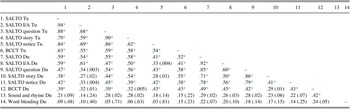
The results of the preliminary analysis are presented in Table 4, which displays the Pearson correlations between the test outcomes. Notably, the analysis showed weak to strong and significant within- and cross-language correlations between the BCCT and the SALTO outcomes. Regarding the phonological awareness measures, we only noted a significant and small correlation between the sound and rhyme measure and BCCT Dutch, r = .42, 95% CI = [.21, .60], p < .001. For reasons of parsimony, we decided to include only the two BCCT measures as covariates in the partial correlations between the Turkish and Dutch SALTO measures computed in the main analysis.
Pearson correlations between measures of SALTO, BCCT (n = 75) and phonological awareness (n = 70)

Note: BCCT = Bilingual Concept Comprehension Test, Du = Dutch, Tu = Turkish, I/A = instruction/assignment, SALTO = Screening Start Primary Education Language Proficiency.
* p < .001 (Benjamini/Hochberg-adjusted); p > .001: exact values in brackets (2-tailed).
Main Analysis
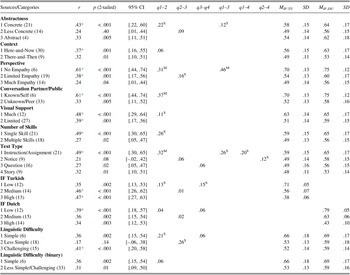
The estimated partial correlation coefficients are displayed in Table 5. The comparison between IF mean scores and levels of difficulty indicated a similar trend for most sources of item difficulty: higher difficulty was reflected in relatively lower IF values, and vice versa. However, Abstractness yielded a different pattern: the Abstract category showed a slightly higher IF mean than the Less Concrete category.
Cross-language partial correlations according to sources of item difficulty in listening comprehension, controlled for initial cognitive concept comprehension (n = 75)

Note: q = Cohen’s q, IF = item facility, DU = Dutch, TU = Turkish.
* p < .001 (Benjamini/Hochberg-adjusted); qS = small effect: .10 to .29; qM = medium effect: .30 to .49.
The following cognitive sources of item difficulty displayed a pattern in which the correlation size decreased with increasing cognitive difficulty: Perspective (small/medium effect sizes), Conversation Partner/Public (medium), Visual Support (small), and Number of Skills (small). For both Context and Item Difficulty Dutch, the Cohen’s q values showed no differences. Abstractness exhibited a less unequivocal pattern, yet this was no surprise given the previously noted divergence in IF scores. The Text Type source of item difficulty indicated a significant and medium-sized cross-language correlation for the Instruction/Assignment category. The remaining correlations for Question, Story, and Notice showed small magnitudes. These three categories demonstrated each small effect sizes in their relation to Instruction/Assignment. The Item Facility Turkish stood out, as it indicated an inverse pattern, with the Medium and High categories showing stronger correlations than the Low category. The difference between the Low and the Medium/High categories indicated small effect sizes.
Linguistic Difficulty is listed at the bottom of Table 5. The comparison between mean IF scores and degrees of difficulty showed a divergent pattern. The Less Simple and Challenging categories yielded virtually equal scores. The Less Simple category showed a small correlation size. Cohen’s q indicated a small difference between the Less Simple and Challenging categories. To further investigate the relationship, a binary variable was constructed but the q value revealed no difference between the two variables.
Discussion
The present study aimed to document the role of the level of cognitive-linguistic difficulty of sets of task items in modulating the strength of the relationship between LC proficiency in first-grade, Turkish–Dutch emergent bilinguals. We hypothesized that item sets showing a higher level of difficulty would indicate a weaker L1-L2 association than sets showing a lower level.
Cognitive-Linguistic Difficulty and Cross-Linguistic Interaction
As for cognitive difficulty, the correlation analysis indicated for five out of nine sources of item difficulty a pattern of decreasing correlation size with increasing level of cognitive difficulty (Perspective, Conversation Partner/Public, Visual Support, Number of Skills, Text Type), which is consistent with our hypothesis. For the remaining four sources of item difficulty, the tendency turned out to be nonexistent (Context, Item Facility Dutch), less unequivocal (Abstractness), or reversed (Item Facility Turkish).
Concerning Context, only two categories (Here-and-Now, There-and-Then) are addressed in the test items, showing a small decrease in cognitive difficulty and no significant difference between correlation sizes. We hypothesize that adding a third category referring to the more challenging Reflective context would presumably show a lower correlation size, corroborating our hypothesis more conclusively.
Why the results of Abstractness seemed to diverge from the predicted pattern may be a result of how the various subtasks referring to this dimension of cognitive difficulty were designed. The lower IF of the Abstract category can probably be explained by the fact that it refers to one subtask only (Making a Finger Puppet). At the same time, the Less Concrete category includes a subtask that raised its overall difficulty; it represents the more challenging task of comprehending a fantasy story (Pig and Caterpillar), which was manifested in lower IF levels (Turkish: .44, SD = .09; Dutch: .47, SD = .12).
The Item Facility Dutch demonstrated no difference between the correlation sizes of the categories. The reasons for this finding remain unclear for now. Why children experienced some items as more difficult than others is likely to be determined by a combination of multiple task characteristics—linguistic and other—that can vary from item to item (Brunfaut & Révész, Reference Brunfaut and Révész2015). An item-level analysis would probably unravel more intricate interrelations between the sources of item difficulty that remained hidden in the current study design.
The results regarding Text Type clearly showed that the Instruction/Assignment category stood out for its somewhat higher IF levels in Turkish and Dutch, and a stronger L1-L2 correlation size, whereas the Question, Story, and Notice categories indicated practically equal IFs and equal L1-L2 correlation levels. Notably, the participating children experienced all four text types as relatively easier to answer in Dutch than in Turkish. This should not surprise as such tasks are a proximate measurement of objectives of curriculum-based classroom activities, predominantly taking place in Dutch.
The nearly reversed pattern of Turkish Item Facility is the single finding that contradicted our hypothesis. Contrary to prediction, Turkish items of medium and high IF levels coincided with stronger correlations of virtually equal size. A possible interpretation may be that the children experienced the Turkish items as more difficult because of their higher linguistic difficulty. An item-level analysis is probably required to uncover possible underlying interrelations. However, this finding might also suggest CLI from L2 to L1, showing a positive effect on items in L1 requiring more cognitive-linguistic effort. Such L2-to-L1 CLI is consistent with the incipient shift toward L2 dominance observed in the participants.
Regarding the relationship between linguistic difficulty and cross-linguistic interaction, the results were difficult to interpret, indicating an inconclusive finding. As expected, mean IF values ran relatively parallel across the categories, although there was no distinction in IF between the Less Simple and Challenging categories. The binary variable did not confirm our hypothesis. A possible interpretation is that linguistic difficulty in our study is operationalized as a unitary construct, and that its subcomponents—lexicon, morpho-syntax, discourse—vary independently (Pallotti, Reference Pallotti2019). Furthermore, Chung et al. (Reference Chung, Chen and Geva2019) pointed out that the effect of linguistic difficulty is modulated by the effects of other factors (language proficiency, educational setting, research design).
A Trade-Off Effect?
Summarized, our findings for cognitive difficulty demonstrated some support for our hypothesis in that cognitively challenging LC items, in part, coincided with a decreased size of the cross-language relation. The result for linguistic difficulty was too inconsistent to draw any substantiated conclusion.
A tentative explanation for these—admittedly mixed—findings is that, following the information-processing model of cognition in L2 learning (Skehan, Reference Skehan1998), some competition takes place between cognitive-linguistic processing of task input and cross-linguistic interaction manifesting itself in a trade-off effect. More specifically, cognitively more demanding tasks may inhibit positive cross-linguistic interaction between LC skills while cognitively less demanding tasks may facilitate cross-linguistic interaction. Relying on Cummins (Reference Cummins1981), we suggest that, because a greater amount of information must be processed simultaneously in tasks showing higher cognitive-linguistic difficulty, more cognitive effort is required, and information processing is less automatized. With higher cognitive-linguistic demands, the processing of input is hampered. The cognitive effort made by a child stretches its cognitive-linguistic resources in one language to the point where attention is drawn away from activating these resources in the other language. When mastery of a skill such as LC has been achieved to the point of automaticity and, hence, draws less or not from the conscious resource pool, cognitive resources in one language will be available to a larger extent for CLI to occur because there is less competition for attentional resources.
We conclude this subsection with a speculative reflection. Assuming that listeners assign less “bandwidth” to L1-related attentional resources in comprehending the L2 input while performing cognitively more difficult tasks, and that more difficult tasks rely on higher level processing of LC (e.g., meaning representation, discourse construction, integrating information), the suggested explanation of a trade-off effect provides an indirect indication for an underlying cognitive-linguistic mechanism that operates across languages on a deeper cognitive level in the processing of oral information.
Possible Confounding Factors
Four factors that possibly confounded the observed pattern in the relationship between cognitive-linguistic task difficulty and cross-linguistic interaction are discussed in the following text.
Lower Level Skills
The overall weak estimates of the two phonological awareness variables (sound and rhyme, word blending) may be the result of the fact that the subtests were administered earlier (6 or 18 months) than the SALTO test, threatening their predictive value. However, there are reasons to assume that the average first-grade child did not seriously struggle with literal understanding of what was being said in L2. All children had a minimum of 2 years of preschool experience behind them, and they all had been intensively exposed to cognitively challenging L2 classroom activities. This seems sufficient time-on-task to develop the lower level abilities that are required for an at least adequate level of literal comprehension of the SALTO test tasks.
Working Memory Capacity
Another possible confound is working memory capacity, which is a critical listener characteristic in LC (Vandergrift & Baker, Reference Vandergrift and Baker2015), and a predictor of individual differences in language comprehension (e.g., Andringa et al., Reference Andringa, Olsthoorn, van Beuningen, Schoonden and Hulstijn2012). Children who are more efficient at attending to, temporarily storing, and processing incoming information understand more of what they hear in L2 (Bloomfield et al., Reference Bloomfield, Wayland, Rhoades, Blodgett, Linck and Ross2011). Studies indicated that in young L1 and L2 children successful discourse comprehension depends on working memory (e.g., Florit et al., Reference Florit, Roch and Levorato2013; Wallace, Reference Wallace2020). Research also suggested that the impact of working memory on LC in L2 is particularly strong in conditions that impose additional demands on working memory capacity (Bloomfield et al., Reference Bloomfield, Wayland, Rhoades, Blodgett, Linck and Ross2011). Thus, part of the variance of the positive L1-L2 associations between LC subtask results may be explained by the listener’s working memory capacity.
Distributed Knowledge
This factor refers to the “distributed characteristic” of language knowledge in bilinguals (Oller & Eilers, Reference Oller and Eilers2002). This means that bilingual children have knowledge in L1 that they do not have in L2, and vice versa. This characteristic is predictable based on the different life circumstances that commonly require emergent bilinguals to learn the two languages. There is empirical evidence for this characteristic regarding vocabulary knowledge (e.g., Marchman et al., Reference Marchman, Fernald and Hurtado2010; Oller et al., Reference Oller, Pearson and Cobo-Lewis2007). Some words are learned in one language but not in the other because they tend to be used in situations in which one language but not the other is the medium of exchange (Oller & Eilers, Reference Oller and Eilers2002). Indeed, the children in our study acquired listening skills in Turkish through everyday speech in the home, whereas in the school context they learned such skills in Dutch through mostly pedagogical discourse. This difference in language experience may have differential effects on the SALTO outcomes, as it draws upon pedagogical registers commonly used in classroom. Nonetheless, Marx et al. (Reference Marx, Heppt and Henschel2017) noted that, although everyday speech and academic language may be associated with distinct facets of LC, both registers might exhibit a range of overlaps, especially in the early school years. So, the distinction between L1 LC acquired in an informal home context and L2 LC acquired in a formal school context may be less marked than assumed. However, we cannot exclude the impact of cultural differences on how listening is perceived in the home versus the school environment (Imhof & Janusik, Reference Imhof and Janusik2006). At home, listening may be more closely embedded in the interactive situation that focuses on the person and on relationship building. At school, listening has an explicit pedagogical function by its being more strongly conceptualized as a sustaining activity, which emphasizes the dimensions of learning, integrating and organizing information, and critical listening.
Grammatical Encoding
This factor involves notions that are grammatically encoded in similar or dissimilar ways in the two languages. Especially the agglutinative nature of the Turkish language renders it different from the Dutch, being a fusional language (see “Present Study” section). This entails that certain expressions or phrases are morpho-syntactically encoded in such a language-dependent way that notions acquired in Turkish are not useful in Dutch, and a facilitative CLI effect is not to be expected. However, to examine the modulating effect of this factor a more fine-grained future analysis of the data is necessary.
Limitations and Future Research
This study has several limitations. First, the findings are not applicable to the development of listening skills practiced in real-life situations (e.g., authentic conversations), for this study focused on LC of one-way academic discourse. Second, general cognitive abilities (e.g., nonverbal intelligence) that can affect the cross-language relationship were not adjusted for. Third, the phonological awareness measures used as proxies for domain-general auditory processing skills were only in Dutch; the subtests were administered at two earlier points in time, which might have impacted their predictive value. Fourth, the potentially constraining factor of participants’ hearing ability was not measured. Fifth, the Turkish SALTO has psychometric limitations due to its being a nonvalidated translation. Sixth, there is some concern in that the same test material in the two languages was presented to participants in a noncounterbalanced arrangement, so test-retest effects cannot be ruled out. Lastly, the assessment of relative home language use was based on a parent-report method, resulting in subjective estimates (Sierens et al., Reference Sierens, Slembrouck, Van Gorp, Agirdag and Van Avermaet2019).
Future research is evidently needed to cover further ground in exploring the linkage between task characteristics and cross-linguistic interaction. Whether the findings of our study can hold up should be tested in further studies that include all three broadly defined types of knowledge or skills important to L2 listening in future studies: (a) speech perception and general cognitive skills (e.g., auditory discrimination skills, working memory), (b) linguistic knowledge (e.g., vocabulary, grammar), and (c) metacognition (Hui & Godfroid, Reference Hui and Godfroid2021). Furthermore, the assumption of a relationship between cognitive-linguistic task difficulty and strength of cross-linguistic interaction in bilingual children may gain in validity by extending analogous research to other language domains (speaking, reading, writing) and skills (phonology, vocabulary, grammar). Finally, a correlational study as this one has well-known limits because it cannot allow for cause-effect explanations. Despite these limits, we believe that our findings can serve as a starting point for experimental task-manipulation investigations which can reveal causal relations in CLI (Brunfaut & Révész, Reference Brunfaut and Révész2015). These would consolidate our incipient empirical evidence for effects of task input characteristics on cross-linguistic interaction.
Conclusion
The present study has added to the knowledge base about cross-linguistic interaction between parallel language skills in young emergent bilinguals learning two typologically dissimilar languages. It documented in a unique way the role of the level of cognitive-linguistic difficulty of task items in modulating the strength of the relationship between listening comprehension proficiency. The finding of a negative tendency in the relationship between level of difficulty of item sets and level of cross-linguistic interaction was partially consistent for cognitive difficulty, yet it turned out inconclusive for linguistic difficulty. This suggested that the degree to which cross-linguistic interaction manifests itself may be, in part, contingent on the degree of cognitive-linguistic difficulty of the task at hand. We tentatively discussed an explanation in terms of a trade-off effect occurring between cross-linguistic interaction and cognitive-linguistic task demands.
Supplementary Materials
To view supplementary material for this article, please visit http://doi.org/10.1017/S0272263121000826.