



Both psychedelic therapy and assisted suicide are gaining support in the UK. Recent focus around psychedelic therapy has been on generating evidence of safety and efficacy but, despite the growing body of promising evidence, regulatory barriers remain, restricting further research.
On the other hand, current debates around assisted suicide have predominantly focused on ethics and eligibility with little focus on the drugs that would be used or the lack of high-quality evidence internationally on their safety and efficacy. Under recently proposed legislation, regulatory hurdles applied to psychedelic therapy would be side-stepped for assisted suicide.
UK’s drug regulatory framework
In the UK, the Medicines and Healthcare products Regulatory Agency (MHRA) is responsible for ensuring that drugs entering the UK market are safe and effective. The licensing process involves a rigorous review of evidence submitted by the pharmaceutical company seeking market authorisation. If an application involves a substance scheduled under the Misuse of Drugs Regulations 2001, the company must also obtain a domestic licence from the Home Office.
For off-patent medicines, where there may be few financial incentives for pharmaceutical companies, the UK government can offer research support through the National Institute for Health and Care Research (NIHR).
Once market authorisation is granted, the National Institute for Health and Care Excellence (NICE) conducts a health technology assessment (HTA) to evaluate the clinical efficacy and cost-effectiveness of the substance.
If a pharmaceutical company wants to repurpose a drug that’s already licensed in the UK for use in assisted suicide the company will need to apply for a new market authorisation. This is because assisted suicide would constitute a novel indication in which death is the primary intended outcome. It would also involve doses far exceeding established therapeutic ranges, thereby requiring new risk-benefit evaluation.
Since the drugs for use in assisted suicide are likely to be off-patent, there would be little incentive for pharmaceutical companies to pursue this, so government support through NIHR funding would be required. Following MHRA approval, the drug would be subject to an HTA by NICE.
What is being proposed under the Terminally Ill Adults (End of Life) Bill
Under the recently proposed legislation, the authority to determine the most appropriate substance for assisted suicide would rest with the Secretary of State. This approach effectively bypasses the regulatory oversight process described above, thus raising significant patient safety concerns.
A wide range of drugs are used globally for assisted suicide including barbiturates, benzodiazepines, opioids and cardiotoxic agents. There is a notable absence of good-quality research evaluating their efficacy and safety. Reported complications range from the relatively minor such as nausea and vomiting to more serious including seizures, prolonged time to death and even instances of regaining consciousness. The time to death remains unpredictable and, rarely, the dying process may extend over several days. Intravenous back-up is sometimes required in cases of failed death. Reference Worthington, Finlay and Regnard1
Unlike other areas of medicine, where standardised treatment protocols exist, no evidence-based protocols have been published for assisted suicide. However, oral barbiturates, particularly pentobarbital and, to a lesser extent, secobarbital, are often used in high doses. Reference Worthington, Finlay and Regnard1 A key concern is that neither pentobarbital nor secobarbital is licensed for human use in the UK, and neither is available in an oral formulation. Reference Zinchenko, Taylor and Hollins2
The government’s impact assessment acknowledges the international lack of evidence and the occurrence of complications. It mentions two assisted suicide combinations used in the USA: diazepam, digoxin, morphine with amitriptyline or propranolol, 3 that have not been approved by the Food and Drug Administration and are used ‘off-label’. These substances were selected primarily due to export restrictions on barbiturates, reflecting a decision driven by necessity rather than empirical evidence. The inclusion of these drug combinations in the impact assessment raises ethical concerns, as the development of these drug combinations may be construed as a form of human experimentation. More recently, phenobarbital has been incorporated into these regimens in response to the limited efficacy and unpredictability of these earlier protocols. 4
There remains a clear lack of evidence to inform prescribing decisions in the context of assisted suicide. Existing protocols are predominantly based on toxicology or retrospective data rather than prospective trials, which are the standard required by pharmaceutical regulatory authorities. Consequently, even the use of an already licensed drug proposed for assisted suicide in the UK would necessitate a new licensing application. There is a pressing need for rigorous, methodologically sound studies that align with contemporary regulatory standards.
Current attitudes to psychedelic therapy
The Misuse of Drugs Act 1971 forms the cornerstone of the UK’s legal framework for controlling potentially dangerous substances. At its conception it was shaped more by sociopolitical concerns than scientific evidence. Through secondary legislation, the Misuse of Drugs Regulations 2001 categorises controlled substances based on their therapeutic value, potential for misuse and need for regulatory control. Psychedelics are placed in Schedule 1, indicating no recognised medicinal use and subjecting them to restrictions that significantly limit research. Reference Crome, Nutt and Stevens5
A growing body of scientific evidence demonstrates that psychedelic therapy has potential therapeutic applications for several psychiatric conditions, including randomised, placebo-controlled trials, systematic reviews and meta-analyses. Notably, these studies report a low incidence of serious adverse events, and the substances used are generally characterised by low toxicity and a low potential for addiction.
In 2008, the Advisory Council on the Misuse of Drugs (ACMD) recommended that 3,4-methylenedioxymethamphetamine (MDMA) should be reclassified as a Class B substance following a comprehensive risk assessment. In 2023, the Home Affairs Committee recommended rescheduling psychedelic drugs to enable larger clinical trials. MDMA remains a Class A drug, and the government responded to the Home Affairs Committee by commissioning the ACMD to evaluate barriers to psychedelic therapy research.
The government has not commissioned any research for assisted suicide drugs but has allowed a private members Bill, that completely side-steps the UK’s drug regulatory framework, to progress.
Apart from ketamine, psychedelics remain designated Class A/Schedule 1 drugs. The research is criticised for small sample sizes, poor study designs and limited long-term follow-up data as well as potential risks of addiction and adverse events. Although larger trials may be advisable, the existing evidence for psychedelic therapy is considerably more robust and comprehensive than that supporting the use of drugs in assisted suicide. It is also worth noting that some of the assisted suicide drugs used internationally are scheduled in the UK and have significant risk of misuse.
Psychedelic therapy has shown promise in reducing end-of-life distress, by helping address the complex array of physical, psychological and existential suffering. Importantly, psychedelic therapy has been shown to reduce suicidal ideation and loss of meaning, which often contribute to assisted suicide decisions. The clinical trials to date are small-scale and much larger trials are needed; however, the quality of available evidence is clearly better than that for assisted suicide drugs.
Comparing barbiturates and ketamine
Despite widespread global use in assisted suicide, barbiturates have not been evaluated in controlled trials. The two most used barbiturates globally for assisted suicide, pentobarbital and secobarbital, are not licensed in the UK for human use. However, both are available for veterinary euthanasia and are regulated by the Veterinary Medicine Directorate. Reference Zinchenko, Taylor and Hollins2
Phenobarbital is licensed for epilepsy in the UK and is available as a tablet, liquid or intravenously (i.v.). However, phenobarbital is not licensed for or used in veterinary euthanasia due to its relatively poor efficacy compared with the aforementioned barbiturates. Furthermore, current dosing of oral formulations is far too low to practically achieve the required lethal dose used in assisted suicide. Reference Zinchenko, Taylor and Hollins2
Ketamine is a psychedelic-like compound that has been used as an anaesthetic for several decades and is widely available in the UK. Compared with barbiturates, it has a more favourable safety profile, with a wider therapeutic index, lower risk of fatal overdose and significantly reduced potential for dependence and withdrawal.
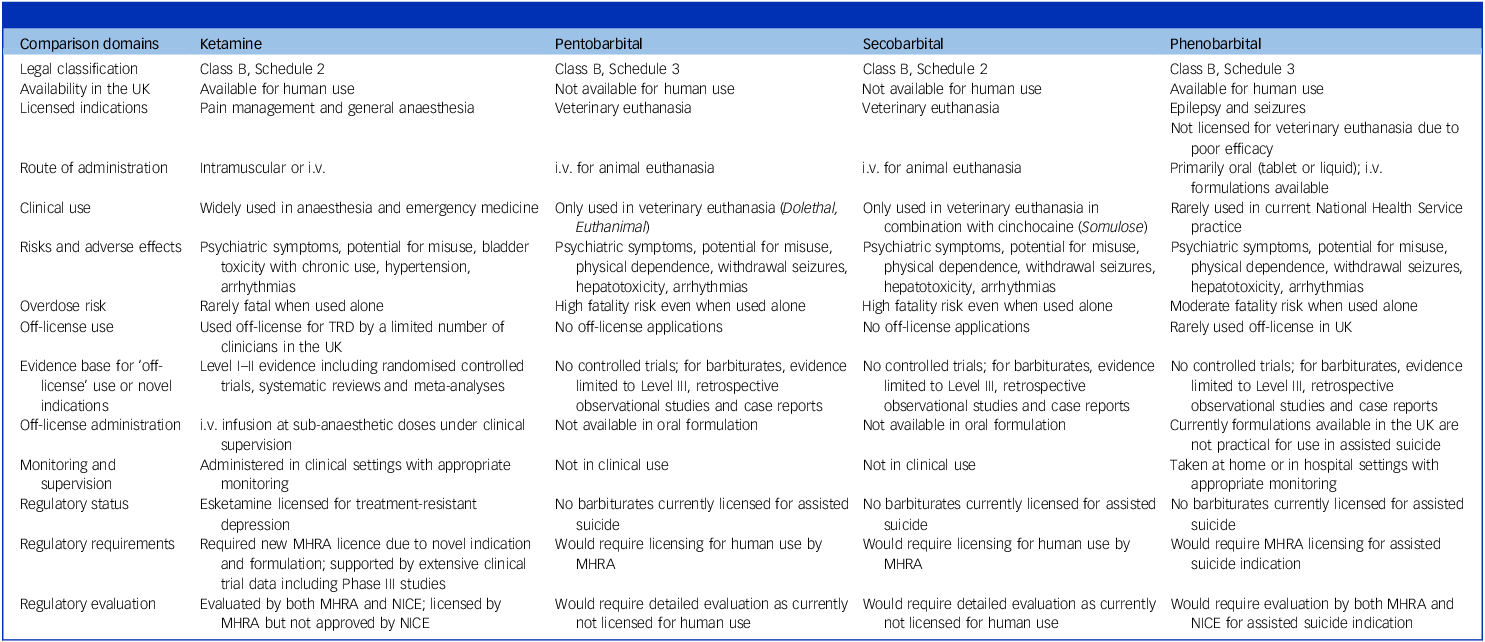
From a regulatory standpoint, barbiturates and ketamine are quite similar (see Table 1). However, under the provisions of the Terminally Ill Adults (End of Life) Bill, there is a possibility that these substances may be subject to differential treatment. This introduces an inconsistency into regulatory and legislative frameworks, raising concerns about double standards in the government’s approach to drug regulation.
Comparison between ketamine and barbiturates (pentobarbital, secobarbital and phenobarbital)

i.v., intravenous; MHRA, Medicines and Healthcare products Regulatory Agency; NICE, National Institute for Health and Care Excellence.
Ketamine, in use since the 1970s for anaesthesia and pain management, has recently been repurposed for treatment-resistant depression (TRD), necessitating new licensing and regulatory evaluation. Barbiturates are likely candidates for assisted suicide due to their pharmacological profile and international precedent for barbiturate use in this context. The table outlines their respective legal classifications, licensed and off-license uses, routes of administration, safety profiles, evidence and regulatory requirements for approval in new indications. Phenobarbital is included for completion, but is not the preferred option for the purposes of assisted suicide and is not licensed for the purpose of veterinary euthanasia in the UK due to poor efficacy.
Esketamine, (SPRAVATO®), the S-enantiomer of ketamine, is licensed in the UK for treatment-resistant depression. It underwent a comprehensive clinical development programme, including randomised controlled trials, demonstrating its efficacy and safety in treating depression. Janssen, the pharmaceutical company, was required to submit extensive evidence which included TRANSFORM and SUSTAIN trials that showed both its short- and long-term benefits. Since esketamine was a controlled substance, the evidence also included additional considerations for potential misuse. 6
NICE did not approve esketamine, citing concerns that the company assumed its clinical trial data were generalisable to the National Health Service (NHS) despite recruiting no participants from the UK. Other concerns included the exclusion of certain patient groups from trials, failure to present a dose–response curve, lack of clarity on the implementation of a flexible dosing strategy and it being unclear whether tolerance developed over time, potentially requiring increased doses to maintain therapeutic effect. NICE also noted that the adverse events were not fully explored. One trial reported that 6.9% of participants had serious adverse events, which is still lower than in available data for assisted suicide (14.8%). Reference Worthington, Finlay and Regnard1,7
It is important that any drug proposed for use in assisted suicide in the UK must undergo a formal evaluation process consistent with what was expected of ketamine and of any other drug for that matter.
Looking ahead
Assisted suicide is a final and irreversible act that is chosen when all other options have been exhausted. Other unexplored options, such as psychedelic therapy, should be considered prior to widespread introduction of assisted suicide. As of April 2026, no UK-based end-of-life psychedelic therapy trials have been completed or published, because current drug scheduling makes this research difficult. Re-scheduling certain psychedelics would allow this to happen and should be prioritised ahead of widespread adoption of assisted suicide.
In Canada, the Special Access Program (SAP) permits the therapeutic use of psilocybin for serious or life-threatening conditions where conventional treatments have proven ineffective. Therefore, within this framework, psychedelic therapy is available for managing end-of-life distress. Reference Richard, Garcia-Romeu and Henningfield8
In Oregon, USA, legislation now authorises therapeutic psilocybin use for adults aged 21 and over. Since 2023, licensed treatment centres and practitioners have operated under the oversight of the Oregon Psilocybin Advisory Board. 9
The UK Government has looked to Oregon for guidance on the drugs used in assisted suicide, despite these protocols being largely experimental and lacking sufficient evidence. 3 In light of this, it would be reasonable to consider other emerging therapeutic options that may offer relief for end-of-life distress that are available in that jurisdiction.
Implementing a statutory, fast-track compassionate access framework would provide an appropriate initial mechanism for patients to access psychedelic therapy under clinical supervision. This could subsequently be complemented by rescheduling these substances from Schedule 1 to Schedule 2 or 3, to further enable research and specialist use, particularly for managing end-of-life distress in patients considering assisted suicide. Denying access to potentially beneficial therapies for patients who have exhausted conventional treatment options and are considering assisted suicide violates core medical ethics principles.
Although the intended purpose of assisted suicide drugs is to end life, this alone should not justify exemption from the regulatory approval processes applied to other medicines entering the UK healthcare system. The MHRA remains the appropriate authority for the regulation of such drugs. If its current framework is considered unsuitable, it should be tasked with developing a specific regulatory pathway within its existing structures, rather than attempting to establish a separate process.
Widespread introduction of assisted suicide without proper evaluation of the drugs used raises significant ethical and patient safety concerns. If prospective clinical trials are considered unethical by the appropriate regulators, such as the MHRA, then a real-world, prospective evidence generation programme must be established in a small number of centres before being introduced nationally.
This would allow the UK to establish itself as a global leader in the responsible regulation of drugs for assisted suicide, setting a new international standard and clearly distinguishing itself from countries where current practices proceed without adequate regulatory oversight or ethical standards.
Acknowledgements
I thank Professor Baroness Sheila Hollins for her contributions to the sections concerning assisted suicide, particularly in relation to relevant UK legislative proposals.
Funding
This research received no specific grant from any funding agency, commercial or not-for-profit sectors.
Declaration of interest
R.Z. is a member of the Royal College of Psychiatrists and the British Medical Association. He is an ST8 in General Psychiatry and Medical Psychotherapy in the National Health Service (NHS). He is participating in the Royal College of Psychiatrists’ Parliamentary Scholars Scheme. This is an unpaid role undertaken within protected special interest time, in accordance with NHS England guidance for higher psychiatric specialty training. For the duration of the scheme, he is attached to the parliamentary team of Baroness Hollins in the House of Lords. He has co-authored a number of articles with Baroness Hollins raising concerns about the recent Terminally Ill Adults (End of Life) Bill. He does not belong to any organisations that support or oppose the introduction of assisted suicide in the UK and does not receive any funding, honoraria or payment in addition to his NHS role as a specialty trainee in general psychiatry and medical psychotherapy.



eLetters
No eLetters have been published for this article.