Introduction
It has often been assumed that dementia occurs more commonly in the intellectual disability (ID) population than in the general population (Torr, Reference Torr, Burns, O'Brien and Ames2005). Although it is now accepted that those with Down syndrome (DS) have a genetic predisposition for dementia related to the APP gene on chromosome 21, dementia may also be more common in the ID population who do not have DS (Cooper, Reference Cooper1997). Furthermore, it has been proposed that dementia in the ID population should occur at a younger age than is usual. Tredgold, a London physician during the first half of the previous century, asserted that ‘as would be expected, in most cases of primary amentia, [the] senile form of dementia sets in at an earlier age than the normal. It often begins to show itself in the fourth decade […], and the majority of aments who live much after this usually show definite and progressive mental deterioration’ (Tredgold, Reference Tredgold and Tredgold1952). Thompson (Reference Thompson1951) believed the earlier age of decline to be related to arrested brain development.
More recently, the cognitive reserve hypothesis has been proposed to explain how adults with similar brain insults may present with differing clinical pictures. It proposes that intelligence, education and occupational level can influence the occurrence and course of many central nervous system disorders (Whalley et al. Reference Whalley, Deary, Appleton and Starr2004). Stern (Reference Stern2002) proposed two components to cognitive reserve. The first comprises passive components such as brain size and synapse count or ‘hardware’ of the brain, which differs between individuals. Proxies for it include measurements such as brain volume and pre-morbid intelligence (Staff et al. Reference Staff, Murray, Deary and Whalley2004). Active components or ‘software’ of the brain are developed through educational, leisure and occupational activities that develop the use of different neuronal pathways (Stern, Reference Stern2003). The hypothesis assumes that there is a critical threshold of reserve capacity that needs to be breached by pathological processes before clinical or functional symptoms will develop. Those with more reserve have been found to be less likely to develop dementia or cognitive decline (Whalley et al. Reference Whalley, Starr, Athawes, Hunter, Pattie and Deary2000; Verghese et al. Reference Verghese, Lipton, Katz, Hall, Derby, Kuslansky, Ambrose, Sliwinski and Buschke2003; Valenzuela & Sachdev, Reference Valenzuela and Sachdev2006). Although these studies are consistent with the theory of cognitive reserve, none specifically studied participants in the ID (mental retardation) range of ability.
Adults with ID have, by definition, brain reserve limitations. In addition, many older adults with ID in developed countries have been excluded from education (Randall Smith, Reference Randall2005) and have for long periods resided in large, environmentally impoverished institutions. The cognitive reserve hypothesis predicts that older adults with ID should be particularly at risk for dementia and that the age-associated risk should be shifted to a younger group because, theoretically, those with dementia pathology will quickly reach a functional cut-off with early emergence of symptoms; it also indicates that dementia risk should differ according to the severity of disability.
Despite the long-held assumption that dementia is more common in older adults with ID without DS, there have been only a few small community surveys of dementia prevalence in this group of adults and we have not been able to find any studies that have investigated their age-associated risk or the potential effect of ID severity on dementia rates.
We aimed to examine the following:
(1) Prevalence of dementia in older adults with ID compared to general population prevalence.
(2) The differences, if any, of dementia prevalence rates between ID severity groups.
(3) We also hypothesized that the excess risk for dementia [standardized morbidity ratios (SMRs) based on prevalence rates] would be greatest in ‘younger’ older adults with ID.
Method
We undertook a two-stage epidemiological survey of dementia in adults with ID without DS aged ⩾60 years living in five inner-city and suburban London boroughs: Camden, Islington, Enfield, Harrow and Greenwich. Adults with DS were excluded because of their known genetic risk for Alzheimer's disease. The protocol received approval from the Thames Valley Multi-centre Research Ethics Committee and was agreed with the R&D offices of all participating National Health Service organizations.
Definition of participants
ID was defined according to ICD-10 criteria for mental retardation (WHO, 1993) as global developmental delay, IQ <70 and impairment of social functioning. Those in whom the ID status was uncertain at screening underwent an assessment and were excluded if they did not meet these ICD-10 criteria. Each participant's severity of ID was rated to be mild, moderate or more severe, according to their early life abilities (including IQ if available) and current skills.
Adults with DS were identified from chromosomal analysis in their records or by their characteristic features, and were excluded from the study.
Identification of participants
All adults with ID aged ⩾60 years, who were currently resident in any of the five boroughs, were identified from:
(1) Social services electronic databases (current and past recipients of social care who have been recorded at any time to have ID).
(2) Any past or present users of the local ID health-care teams.
(3) All local residential and day services providers (voluntary or government sector) for adults with ID.
(4) In two of the boroughs we also made contact with all geriatricians, old age psychiatrists, mental health teams for older people, and all non-ID residential and nursing homes. This extension of the sampling frame did not result in significant numbers of additional participants, and was not used in the other boroughs.
Contact with participants and consent procedures
An information sheet that used simple words, short sentences, large text and pictures was sent to the potential participants and their carers. Potential participants decided on their own participation if they were able. For those that did not have capacity to consent, we sought agreement from carers and willingness by participants to engage with procedures. We also gained consent from informants for their own participation in the survey. Informants were family members, social workers or care staff who had regular contact with the participants. They must have known the participant for at least 3 months to complete the Dementia Questionnaire for Persons with Mental Retardation (DMR) and at least 2 years to provide information on longitudinal change; if necessary, further informants or historical records were sought.
Screening stage
All participants were screened for symptoms of dementia or cognitive decline with:
(1) The DMR (Evenhuis, Reference Evenhuis1996), a validated informant-completed screening tool for dementia in this population. The tool has two scales: a cognitive scale, based on short- and long-term memory and orientation; and a social scale, based on functional and behavioural items. Each scale has different threshold scores for different ID severity groups. We used the cognitive scale and its published thresholds for severe, high moderate or mild ID for the three ID severity groups in our study.
(2) Informants also completed a brief activities of daily living schedule (ADLs), based on the Adaptive Behaviour Scale (Nihira et al. Reference Nihira, Leland and Lambert1992) and Activities for Daily Living Schedule (Lawton & Brody, Reference Lawton and Brody1969), and any decline in ADLs over the past 2 years was determined. Information about level of functioning in early life was also collected from informants.
(3) Participants with ID with sufficient communication skills completed a three-item object memory task based on a modified object memory task (Shoe Box Test; Burt & Aylward, Reference Burt and Aylward2000).
Screen-positive criteria were inclusive so that no dementia cases would be missed. Therefore, screen positives were those who scored at or above the cognitive score thresholds on the DMR; or had unexplained decline in ADLs; or had a delayed recall of less than two out of three items in the Shoe Box Test task. Participants who screened negative on these criteria were deemed not to have dementia.
Assessment of screen positives
Participants who screened positive completed a full assessment to elicit symptoms of dementia and to identify disorders pertinent to a differential diagnosis. The assessment included:
(1) Cognitive functioning and symptoms of dementia:
(a) A neuropsychological assessment, consisting of the Test for Severe Impairment (Albert & Cohen, Reference Albert and Cohen1992), additional memory items from the Severe Impairment Battery (Saxton & Swihart, Reference Saxton and Swihart1989), the Tower of London (Shallice, Reference Shallice1982), Supermarket Fluency task (Troyer, Reference Troyer2000), British Picture Vocabulary Scale (Dunn et al. Reference Dunn, Dunn, Whetton and Burley1997) and Luria three-stage command.
(b) Informants completed an additional questionnaire based on a modification of the CAMDEX informant questionnaire (Ball et al. Reference Ball, Holland, Huppert, Treppner, Watson and Hon2004) to elicit a history of changes in memory, personality, general cognitive function and confusion.
(2) Physical health
(a) A structured physical examination identified neurological signs associated with dementia and also signs of any other relevant physical condition, such as thyroid disorders, neurological conditions and cardiovascular disorders. This was based on the procedures for such assessments used previously (Hassiotis et al. Reference Hassiotis, Strydom, Allen and Walker2003), and a vision and hearing screen.
(b) Informants provided information about current physical health and medications. In addition, we reviewed available medical records to record information on previous health status and recent investigations.
(3) Psychiatric disorders other than dementia were determined by:
(a) A brief mental state examination with the participants.
(b) Informants completed the mini-PASADD (Psychiatric Assessment Schedule for Adults with a Developmental Disability), a specific tool for adults with ID (Moss, Reference Moss2002).
Diagnosis
We collated all information in anonymized summaries for independent diagnostic review by two of three psychiatrists (A.H., G.L. or A.S.), two of whom (A.H. and A.S.) are specialists in the psychiatry of ID and the other (G.L.) a specialist in old age psychiatry. An instrument developed to produce a hierarchical differential diagnosis of dementia in this population was used to determine whether the participants met any criteria for dementia [ICD-10 (WHO, 1993) or DSM-IV (APA, 2000), dementia with Lewy bodies (DLB; McKeith et al. Reference McKeith, Galasko, Kosaka, Perry, Dickson, Hansen, Salmon, Lowe, Mirra, Byrne, Lennox, Quinn, Edwardson, Ince, Bergeron, Burns, Miller, Lovestone, Collerton, Jansen, Ballard, Devos, Wilcock, Jellinger and Perry1996) or fronto-temporal dementia (FTD; McKhann et al. Reference McKhann, Albert, Grossman, Miller, Dickson and Trojanowski2001)]. This took account of the person's level of ability, the presence of autistic spectrum disorders, physical and mental disorders or sensory deficits as well as changes in the environment. The diagnostic process and how disagreements were resolved are described elsewhere (Strydom et al. Reference Strydom, Livingston, King and Hassiotis2007). The participants were then divided into three groups: those with criteria-defined dementia (if they met any of the above diagnostic criteria), potential cases (if there was insufficient information to decide either way), or those who definitely did not have dementia (no dementia).
Analysis
Data was entered into SPSS version 11 (SPSS Inc., Chicago, IL, USA). The χ2 statistic was used to analyse categorical variables (e.g. sex and ID level by participation or not) unless any cell had an expected count of <5, in which case Fisher's exact test was undertaken. We used t tests to analyse differences in mean age by screen-positive or dementia status. Prevalence rates are presented as percentages. We calculated 95% symmetrical exact binomial confidence intervals (CIs) with a calculator available at http://statpages.org/confint.html.
The indirect method was used to make comparisons with general population rates in 5-year bands. The most recent Western European general population consensus prevalence rates (Ferri et al. Reference Ferri, Prince, Brayne, Brodaty, Fratiglioni, Ganguli, Hall, Hasegawa, Hendrie, Huang, Jorm, Mathers, Menezes, Rimmer and Scazufca2005) were used to calculate expected counts for dementia for this study because it provided the only available estimate of dementia prevalence in adults aged ⩾60 years. Further comparison was made for adults aged ⩾65 years using actual prevalence rates obtained from the MRC Alpha study (Saunders et al. Reference Saunders, Copeland, Dewey, Gilmore, Larkin, Phaterpekar and Scott1993). This study is the one of the largest and most recent UK dementia prevalence studies in urban populations for which data are readily available, and forms part of the well-known European studies of dementia prevalence (EURODEM). The observed count divided by the expected count provided SMRs for all these comparisons (Page et al. Reference Page, Cole and Timmreck1995). CIs for SMRs were calculated with a calculator providing exact 95% Poisson CIs, available at http://home.clara.net/sisa/smr.htm.
We next examined age as a risk factor for dementia by estimating its unadjusted odds ratio (OR), as well as unadjusted ORs for gender and ID level. A logistic regression analysis was then undertaken to determine the independent effect of age by entering these risk factors and their interactions simultaneously.
Results
Participants
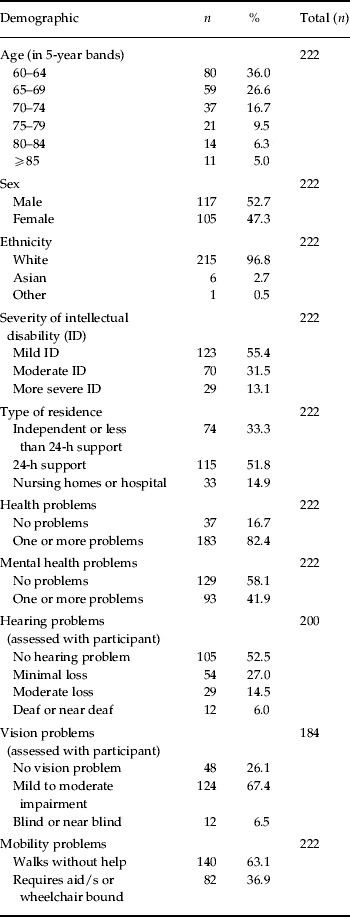
After removing the names of all adults known to have died, moved away, or who were known to have DS, 281 potential participants were identified. Of these, 24 (8.5%) were ineligible for the study because of unrecorded DS status, being too young, having died recently, not having an ID, or were not contactable at the given address. Of the remaining 257 individuals, 222 (86.4%) participated in the survey. Participants did not differ significantly from non-participants in terms of age or sex. The age range of participants was 60–94 years, with a mean of 68.8 years (s.d.=7.45). Further demographic details of participants are given in Table 1.
Demographic details of participants

Sixty (27%) participants screened positive for symptoms of dementia or cognitive decline and participated in the full assessment stage of the study. Women were more likely to screen positive (37.1% v. 17.9%, Pearson's χ2 statistic 10.38, p=0.001). Those screening negative were significantly younger than the screen positives [67.1 years (s.d.=6.2) v. 73.6 years (s.d.=8.5); t=–6.24, p<0.001].
Dementia cases and potential cases
The participants were divided into three groups, depending on their dementia status:
(1) Those who definitely did not have dementia: 174 participants (78.4%) were in this category.
(2) Criteria-defined dementia cases: 29 participants (13.1%) met any dementia criteria.
(3) Potential cases: 19 (8.6%) participants who did not have sufficient information to decide either way.
We combined criteria-defined and potential cases in some analyses.
Dementia prevalence
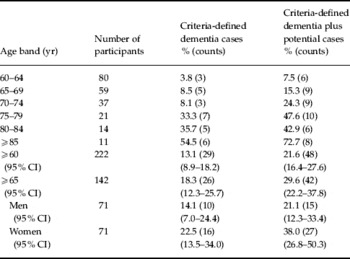
The overall prevalence for criteria-defined dementia cases was 13.1% (95% CI 8.9–18.2) in those aged 60 and older and 18.3% (95% CI 12.3–25.7) in those aged ⩾65 years. Five-year prevalence rates for both criteria-defined cases and criteria-defined combined with potential cases are given in Table 2. Criteria-defined dementia cases were older than other participants [mean age 76.4 years (s.d.=8.8) v. 67.7 years (s.d.=6.5); t=6.41, p<0.001] whereas sex differences in prevalence were not statistically significant (men 9.4%, women 17.1%, Pearson's χ2=2.92, p=0.087).
Prevalence rates in 5-year bands for criteria-defined dementia cases, and criteria-defined plus potential cases

CI, Confidence interval.
Dementia prevalence by ID severity
The prevalence of criteria-defined dementia did not differ according to severity of ID (prevalence rate of those with mild, moderate and severe ID was 14.6, 14.3 and 3.4% respectively; Pearson's χ2=2.72, p=0.26). The median ages for these three groups were similar, at 67, 67 and 66 respectively. However, potential cases were more common in those with severe ID compared to the rest (5.2% in those with mild or moderate ID v. 31.0% in those with severe ID; Fisher's exact test p<0.001) (Table 1).
Comparison with general population rates
The observed prevalence for dementia in adults with ID aged ⩾60 years was compared to the expected rate from a recent consensus study (Ferri et al. Reference Ferri, Prince, Brayne, Brodaty, Fratiglioni, Ganguli, Hall, Hasegawa, Hendrie, Huang, Jorm, Mathers, Menezes, Rimmer and Scazufca2005), which resulted in an SMR of 2.4 (95% CI 1.6–3.5). The prevalence rate for adults with ID aged ⩾65 years was compared with the expected rate from a large UK urban population study (Saunders et al. Reference Saunders, Copeland, Dewey, Gilmore, Larkin, Phaterpekar and Scott1993). The SMR for this comparison was 3.9 (95% CI 2.5–5.7).
Age-associated dementia risk
Age, adjusted for ID level dichotomized as mild and moderate to profound, was significantly associated with dementia (OR 1.15 per year, 95% CI 1.09–1.22, p<0.001) and did not change when sex was added to the model (OR 1.15 per year, 95% CI 1.09–1.22, p<0.001). Results were similar when potential cases were included. The interaction terms age by sex and age by ID level were explored and neither revealed a significant association with dementia. In a final model, age, sex, ID level and both interaction terms were entered together. Age remained a significant predictor for dementia (OR 1.15 per year, 95% CI 1.05–1.25, p=0.003).
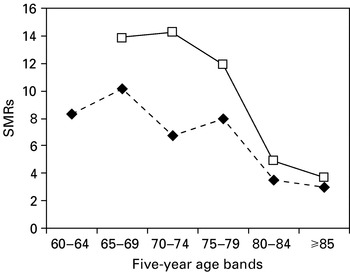
We combined criteria-defined dementia cases with potential cases to remove the potential bias due to diagnostic uncertainty and compared these in 5-year age bands with expected counts calculated from the consensus rates for Western Europe (Ferri et al. Reference Ferri, Prince, Brayne, Brodaty, Fratiglioni, Ganguli, Hall, Hasegawa, Hendrie, Huang, Jorm, Mathers, Menezes, Rimmer and Scazufca2005) and the MRC Alpha study (Saunders et al. Reference Saunders, Copeland, Dewey, Gilmore, Larkin, Phaterpekar and Scott1993). SMRs were calculated and are plotted in Fig. 1. The resulting SMRs increased with decreasing age for both comparisons, so that the SMRs in the 60–65 and 65–70 years age groups were approximately three times that of the ⩾85 years age group (Fig. 1). This difference remained if the prevalence of criteria-diagnosed dementia cases (without possible cases) was compared to actual community rates from the MRC Alpha study (Saunders et al. Reference Saunders, Copeland, Dewey, Gilmore, Larkin, Phaterpekar and Scott1993) (SMR of 7.7 for those aged 65–69 years, compared to an SMR of 2.7 for those aged ⩾85 years).
Standardized morbidity ratios (SMRs) for criteria-diagnosed dementia plus potential cases in 5-year bands. Comparison rates are from the MRC-Alpha study (—□—; Saunders et al. Reference Saunders, Copeland, Dewey, Gilmore, Larkin, Phaterpekar and Scott1993) and the Delphi consensus study (- -◆- -; Western Europe rates) (Ferri et al. Reference Ferri, Prince, Brayne, Brodaty, Fratiglioni, Ganguli, Hall, Hasegawa, Hendrie, Huang, Jorm, Mathers, Menezes, Rimmer and Scazufca2005).

Discussion
Findings
We have confirmed that older adults with ID (without DS) have a higher prevalence rate of dementia than other older adults. The dementia prevalence did not differ between those with mild, moderate and severe ID. We also confirmed our hypothesis of a downward shift in age-associated risk when compared with the general population. The association of age with dementia was not affected by ID severity or sex.
Strengths and limitations
To our knowledge, this is the largest epidemiological study of dementia in people with ID. By including participants from age 60, we were able for the first time to investigate the possibility of a downward shift in age-associated risk for dementia in this population. We identified all potential participants with recognized ID within a defined geographical area, included adults with severe disability, and achieved high participation rates. We have also demonstrated that a more aggressive recruitment strategy would not have resulted in significantly more participants. We collected neuropsychological data, informant histories and data from medical records and completed physical examinations with participants to make diagnoses according to international diagnostic classifications. Our study was powered to estimate the overall prevalence of dementia in this population but may not have sufficient power to make within-group comparisons of prevalence rates. A post-hoc sample size calculation with a power of 80% and a type 1 error of 0.05 suggests that, to compare the observed dementia prevalence rate in the severe ID group (n=29) with an expected rate in the mild ID group of 14.6%, the sample size required would have needed to be 34.
It is possible that we have missed some older adults with ID who are unknown to social or health services. However, we believe this number to be small because older adults with ID are likely to need assistance with the functional problems associated with ageing, and this is more likely for older than younger adults to be provided by agencies outside of the family because informal support networks decrease as people grow older. Furthermore, the care system for people with ID in the UK promotes formal assistance and appropriate use of the ID label. Consequently, nearly 90% of those aged ⩾80 years receive some form of out-of-home support (Emerson & Hatton, Reference Emerson and Hatton2004). It can also be argued that older adults who have managed to live independently of service input throughout their lives are highly unlikely to meet the criteria for mental retardation as defined by the ICD-10 or DSM-IV.
Cross-sectional assessments are less reliable than sequential assessments. We have overcome this limitation by supplementing our assessments with historical information from informants or medical records, but for a proportion of participants we were not able to decide whether they had dementia or not. The extremely limited cognitive and communication abilities of participants with severe ID was associated with diagnostic uncertainty. Furthermore, dementia criteria may have limitations in the ID population and the reliability and predictive validity has not yet been demonstrated. ICD-10 dementia criteria missed dementia cases of moderate severity in this population (Strydom et al. Reference Strydom, Livingston, King and Hassiotis2007). Our study may therefore have underestimated the true prevalence of dementia. A more definitive estimation will only be possible with a cohort design that includes post-mortem examination. Finally, the sample was drawn from London boroughs in the UK and may not be representative of all older adults with ID because of the tendency to place adults with higher needs outside of cities in areas where suitable housing and care settings are more readily available. This could have further reduced the prevalence of dementia as the study population may be healthier and more functionally able than the ID population in other areas of the UK.
Prevalence of dementia in people with ID
The prevalence of criteria-defined dementia in this survey was 13.1% in those aged ⩾60 years and 18.3% in those aged ⩾65 years. The prevalence of dementia was not influenced by ID level but diagnostic uncertainty (possible cases) increased with increasing severity of ID, and this may have masked underlying differences.
There have been two previous community estimates of the prevalence of dementia in this population in Europe. Both reported rates comparable to ours. Patel et al. (Reference Patel, Goldberg and Moss1993) reported a prevalence of 8.3% in 96 adults with moderate and more severe ID aged ⩾50 years in Oldham, UK and Cooper (Reference Cooper1997) found a prevalence of 20.2% in a sample of 129 adults aged ⩾65 years in Leicester, also in the UK. Both these studies had smaller numbers of participants and were less representative of those with mild ID than the present study. There has only been one North American study to date, which found no difference in SMR for dementia in adults with ID than that of the general population (Zigman et al. Reference Zigman, Schupf, Devenny, Miezejeski, Ryan, Urv, Schubert and Silverman2004). However, their sample was small (n=126) and the sampling method was potentially biased in that it consisted of a sample drawn from known service users combined with a sample of convenience, and only included Alzheimer's dementia. Because of the methodological variation between previous surveys it is difficult to make comparisons with the present study, but additional support for our finding of an increased prevalence of dementia in this population is from a study that demonstrated that adults with low IQ (borderline intelligence) had an elevated incidence of dementia when compared to others with normal intelligence (Schmand et al. Reference Schmand, Smit, Geerlings and Lindeboom1997).
Severity of ID and mortality
Adults with ID have high levels of health morbidity and consequently often die at younger ages than their peers; increased mortality is especially pronounced in the groups with severe ID and in those with additional problems such as epilepsy (Patja et al. Reference Patja, Iivanainen, Vesala, Oksanen and Ruoppila2000; Gustavson et al. Reference Gustavson, Umb-Carlsson and Sonnander2005). As age is the strongest aetiological factor associated with dementia and has an exponential effect, this may influence the proportion of adults affected in the oldest old, or those with severe disability. These differential mortality rates may result in a cohort of healthy survivors, who may be less susceptible to dementia. Indeed, once an adult with ID without DS has reached age 65, their life expectancy is comparable to that of the general population (Haveman, Reference Haveman2004). The healthy cohort effect may be another reason for the relatively low rates of dementia in the severe ID group.
Age as risk factor for dementia in ID
This is, to our knowledge, the first study that has investigated the theoretical shift in age-associated risk in adults with ID. Dementia in this population of adults with ID appears to begin at an earlier age than expected. This is in keeping with the cognitive reserve theory, which predicted a younger age of onset in this group. It is further supported by the finding that smaller brain size has been associated with earlier onset of symptoms (Schofield et al. Reference Schofield, Mosesson, Stern and Mayeux1995). An accelerated decline (Scarmeas et al. Reference Scarmeas, Albert, Manly and Stern2006) and higher mortality (Geerlings et al. Reference Geerlings, Deeg, Penninx, Schmand, Jonker, Bouter and van Tilburg1999) have been noted when dementia occurs in adults with high ability or educational attainment, giving support to the idea that, in contrast to the present participants, they can tolerate some degree of pathology before developing the clinical syndrome associated with it, which then progresses faster because the pathology is more advanced. However, this has not been demonstrated in all such studies (Del Ser et al. Reference Del Ser, Hachinski, Merskey and Munoz1999). Whether adults with ID and dementia will have a faster rate of progression, or higher mortality, needs to be studied further.
An alternative hypothesis is that some of the underlying causes of ID might also confer increased vulnerability to dementia in later life. It is also possible that the lower SMRs for dementia in the oldest group compared to the younger groups might be explained by increased mortality in adults with ID and dementia.
Policy implications and future research
Our findings indicate that adults with non-DS ID are more likely than the general population to develop cognitive decline and dementia. Like adults with DS, those with symptoms suggestive of dementia need to be offered assessment to enable early identification and intervention. Other areas for policy and service provision include the provision of accommodation and community facilities that is suitable for frail and vulnerable older people.
Our study needs to be confirmed with incidence studies of sufficient sample size, which is especially important because prevalence studies may underestimate the underlying incidence due to the elevated mortality rate in this population. Incidence studies can also help to reduce diagnostic uncertainty, which could underestimate the true risk for dementia in prevalence studies. Older adults with ID are a high-risk population for dementia, and further studies may help us to better understand the factors associated with the disorder. This is also an important population in which to test the efficacy of non-drug interventions to reduce the risk of dementia.
Acknowledgements
This study was funded by the Medical Research Council (UK) with a Training Fellowship Grant to A.S. (G106/1160). Additional support was provided by the Penrose Society in the form of a Jancar Travelling Fellowship to A.S. We thank all the participants and their carers, and local area clinicians and social services staff involved in this study. Our protocol benefited from discussions with Professor Tony Holland, and training to A.S. by Mr Paul Patti, Dr Arthur Dalton and others at the New York State Institute for Basic Research in Developmental Disabilities. The research was supported by the R&D departments of Oxleas NHS Trust, Harrow Primary Care Trust (PCT), Enfield PCT, Islington PCT and Camden PCT, who all receive a proportion of funding from the NHS Executive; the views expressed in this publication are those of the authors and not necessarily those of the funders or the NHS Executive.
Declaration of Interest
None.