1 Introduction
There are several modern methods that can be used to study the processes taking place inside the oral cavity during the articulation of speech sounds. One of them is electropalatography (Hardcastle, Gibbon & Jones Reference Hardcastle, Gibbon and William1991, Loakes Reference Loakes and Keith2013). But what methods and techniques were the methodological precursors of electropalatography?
Palatography is a 150-year-old method for studying the contact between the tongue and the palate inside the mouth during articulation. This paper will present some interesting information on the history of this revolutionary experimental technique, introduced in the last quarter of the 19th century, in which tongue-palate contact patterns are recorded, analysed, and interpreted without a complicated technological environment (e.g. Moses Reference Moses1940; Marchal Reference Marchal1988; Gósy Reference Gósy2000; Ashby Reference Ashby2015, Reference Ashby2016). The history of Hungarian palatography, the main theme of this paper deserves attention for several reasons. As early as the 19th century, Hungarian phoneticians called for objective research methods in phonetics (see Laziczius Reference Laziczius1944, Gósy Reference Gósy2000). Hungarian scholars were among the very first to use the new method of palatography to investigate some movements inside the oral cavity. Their results would have deserved the attention of the international research community, but unfortunately, they were published mainly in Hungarian journals, which prevented them from reaching a wider readership. I think that we owe them some belated recognition: they deserve to have their early achievements recorded, so that their names and their work can be integrated into the international scientific heritage.
In the following, I will introduce four Hungarian researchers, who using palatography, obtained significant results in describing some of the articulation gestures taking place during the production of the Hungarian speech sounds. It was József Balassa (1864–1945), a leading linguist-phonetician of the time, who first embraced the idea that the use of objective methods in the study of articulation may usefully complement simple observation by ear and eye, which he considered unreliable and uncontrolled (Balassa Reference Balassa1900: 121–122). Reading the international literature and via personal meetings with various experts he learned about the new technique of palatography. In his writings (Balassa Reference Balassa1887, Reference Balassa1908), he made references to the papers of both Kingsley and Techmer. Linguist and phonetician Zoltán Gombocz (1877–1935) also emphasized the importance of objective criteria in analysing speech sound articulation (Gombocz Reference Gombocz1900: 180). He studied Hungarian and French at Budapest University (present-day Eötvös Loránd University) and experimental phonetics in Paris and carried out phonetic research in Finland and Sweden at the beginning of the 20th century. Bálint Csűry (1886–1941) was not a phonetician, but a dedicated linguist, committed to dialectology. He obtained some important results concerning the articulation of particular speech sounds of the dialect spoken in north-eastern Hungary (Csűry Reference Csűry1936). Lajos Hegedűs (1908–1958) was an excellent scholar who died too early to accomplish his mission. He worked – among others – in the Phonetics Laboratory of Panconcelli Galzia in Hamburg in 1939. Hegedűs (Reference Hegedűs1941–43: 64) claimed that despite the various new instruments and methods that have come into use in experimental phonetics, palatography was still a good procedure, suitable for exploring tongue movements during articulation.
Although some researchers might question the relevance of past research endeavours, I believe that we may benefit from studying the way in which researchers in the past tried to solve problems in order to obtain new knowledge. Looking back is not purely for those with an interest in history. By making us aware of the path that we have covered it may help clear the path ahead. Later generations can learn from their predecessors’ efforts, research methods, their mistakes and achievements. Tracing the history of methodology and studying how successfully or unsuccessfully past researchers solved problems using the methods available to them may provide important information for future methodological improvements.
2 First use of the procedure
It is not surprising that experimental methods in phonetics were imported from other scientific fields, such as physiology, medicine, physics, acoustics, brain research, etc. (Moses Reference Moses1940, Gósy Reference Gósy, Wai Sum and Eric2011, Ashby Reference Ashby2016). The question posed in the 1880s was how tongue and palate, tongue and teeth participate in the very complex gestures that characterize a speech sound. The answer given to this question at that time was palatography, also known as stomatoscopy. This technique was invented by James Oakley Coles, an English dentist. Trying to help patients with defects of the palate, he experienced a need to observe the exact movements of the articulators and recognized the difficulty of teaching correct articulation to his patients without a suitable method. The method he invented was so-called direct palatography, published in the British Medical Journal in 1872. Another expert on dentistry, orthodontics and cleft palate therapy, the American Norman W. Kingsley used the indirect form of palatography, which means that he used an artificial palate in his experiments (Kingsley Reference Kingsley1879).
Palatography got soon around, famous linguists, phoneticians began to use the method, among others Grützner, Hagelin, Techmer, Rousselot, Sievers (see Abercrombie Reference Abercrombie1957, Tillmann Reference Tillmann, Koerner and Asher1995, Ashby Reference Ashby2016). According to Ashby (Reference Ashby2016), the palatographic method entered the linguistic-phonetic mainstream following Sievers’s (Reference Sievers1881) work. Studying the references and the subjective notes of the early papers of various European scholars does not provide sufficient information on the impacts and mutual influences that researchers exerted on one another. For example, Grützner (Reference Grützner and Ludimar1879) claimed that his method was independent of that of Coles (Reference Coles1872); however, he makes a reference to Coles’ paper, while Techmer (Reference Techmer1880) makes a reference to a third party (Gavarret Reference Gavarret1877), claiming that he had learnt Coles’ method from that source (see the details in Ashby Reference Ashby2016: 58–59). Rousselot (Reference Rousselot1897–1908) does not mention Coles’s name in his book, either.
As mentioned above, József Balassa was the first Hungarian phonetician who used palatography. He called the method ‘stomatoscopy’. Although Balassa was aware of the two types of the new methodology, he followed Kingsley’s procedure, using an artificial palate. His opinion was that Techmer’s ‘natural mode’ was more accurate but also more difficult than using the artificial palate. In Balassa’s (1887: 132) own words, in this method the tongue itself makes a drawing of its own movements. The results of his first investigations were published in a Hungarian journal entitled Nyelvtudományi Közlemények [Linguistic Papers] in 1887, and also in the journal Internationale Zeitschrift für allgemeine Sprachwissenschaft in 1889.
3 Methodology of palatography
The new technique of palatography spread relatively quickly among those interested in speech. There are two types of the method, direct (static or natural), proposed by Coles, and indirect palatography, proposed by Kingsley (e.g. Abercrombie Reference Abercrombie1957, Anderson Reference Anderson2008, Ashby Reference Ashby2016). Direct palatography was designed to make visible the contacts between the speaker’s tongue and the palate. In this method, various marking materials are painted on either the palate or on the tongue. Following articulation, the points of contact can be observed and recorded. In the case of indirect palatography, which soon followed the previous type, the researcher uses an artificial, custom-made palate, which is removed from the speaker’s mouth after the articulation of a particular sound. The artificial palate will preserve the contact points between the speech organs under study. There was only a seven-year difference (in terms of publication date) between the two types of palatography (Coles Reference Coles1872 vs. Kingsley Reference Kingsley1879). In Hungary, however, the chronological order of using the palatographic technique took the opposite path: first it was the artificial palate that began to be used and then came the application of the natural mode. Irrespective of the type of palatography, there have been substantial changes over time in the materials used, the procedure, and the participants in the experiments.
3.1 Mixture
Researchers using palatography experimented with various mixtures, trying to find the ingredients that would produce the most visible contact marks on the palate. Coles used a mixture of flour and gum applied to the roof of the mouth (see Coles Reference Coles1872). Grützner (Reference Grützner and Ludimar1879) painted the tongue with red or black ink (Chinese ink or carmine water color). Techmer (Reference Techmer1880) painted the tongue with a flour-gum paste, which was coloured with ink. Carruthers was not satisfied with the flour and gum mixture used by Coles, thus he used charcoal mixed with water, with glycerin, or with gum, and later on he switched to finely powdered charcoal and gum (Carruthers Reference Carruthers1900). In Kingsley’s practice, the artificial palate was painted with chalk powder, wet up with alcohol so that it would dry quickly (Kingsley Reference Kingsley1879). Rousselot used powder of chalk for his artificial palates (Rousselot Reference Rousselot1897–1908).
In general, Hungarian scholars, relying on information available in the literature, tried to use the same ingredients in their mixtures. Balassa’s mixture, which he used to paint the artificial palate, was liquid chalk, i.e. pulverized chalk saturated with alcohol, providing a kind of pulp that was suitable for painting the concave surface of the palate (Balassa Reference Balassa1887: 133). Balassa mentioned Techmer’s natural mode of palatography and the mixture the German scholar used (black ink, baked starch and gum Arabic). Although Balassa did not refer to Kingsley’s mixture, he used the same material. He claimed that the alcohol evaporated quickly, and a fine layer of chalk remained. Gombocz (Reference Gombocz1908) did not follow Balassa’s method in making up his mixture. He used rice powder instead of liquid chalk. His explanation for this change was that rice powder coated the dry surface of the palate, made of rubber, with an extremely thin whitishe-grey layer, and this layer was rubbed off by the smallest touch of the tongue. In addition, he claimed that rice powder was more suitable, since the boundary lines were more visible than in the case of chalk powder. Csűry (Reference Csűry1936) borrowed the whole methodology from Gombocz’s description, including the mixture used for painting. The mixture used by Hegedűs (1940–43) contained Indian ink, baked starch and gum Arabic. He proposed to paint the palate black because with this method the gently sprinkled white powder would provide a sharp contrast. He did not think rice powder suitable: he used magnesium powder instead.
In the 1970s and 1980s new ingredients came to be used in the mixture for painting in Hungary: medical carbon and cocoa powder (Bolla Reference Bolla1982). Even later, close to the turn of the century, Ladefoged (Reference Ladefoged, Hardcastle and John1997) recommended a mixture of olive oil and powdered charcoal.
3.2 Artificial palate
A number of different pseudo-palates were applied in indirect palatography and described by different authors (e.g. Bremer Reference Bremer1893, Howe Reference Howe1903, Meyer Reference Meyer1910). Kingsley (Reference Kingsley1879) used a very thin plaster cast of black vulcanite, covering the entire roof within the teeth and the palate (he did not mention the exact thickness of the palate). His artificial palate was relatively long and had a sort of tail which extended far back on the soft palate. The Hungarian Balassa included the picture of Kingsley’s artificial palate (Kingsley Reference Kingsley1887: 245) in his paper (Balassa Reference Balassa1887: 142).
Since an artificial palate might cause some difficulty in articulation, the use of a very thin palate (approximately 1 mm thick) was recommended. Rousselot (Reference Rousselot1897–1908: 52–60) devoted a whole chapter to analysing the methods that can be used in creating an artificial palate (materials, procedures). He claimed that the best palate was a palate that he made by himself, from gypsum cast into a special mould and then provided with a metal coating.
For his artificial palate, Balassa first used melted wax, then he shifted to the use of a gypsum cast, making a precise replica of his own palate. Using the gypsum cast he made the artificial palate from black vulcanized rubber. The only difference from Kingsley’s method was that he made the palate longer at the back to observe the articulation movements there. Balassa’s artificial palate was made of a thickness slightly exceeding 1 mm (Balassa Reference Balassa1887). Gombocz made changes in the method compared to Balassa’s original description, and published his own palatograms in 1908, more than two decades after Balassa’s pictures. His artificial palate was thinner than that of Balassa, with a thickness of ¼ –½ mm. Gombocz (Reference Gombocz1908) criticized Balassa’s (Reference Balassa1887) method and results. He considered that the artificial palate used by Balassa was too thick and too long, resulting in rather different palatogram pictures from those that he obtained. He held the absence of a palatogram for the Hungarian trill against Balassa. Balassa (Reference Balassa1908) quickly reacted to this criticism and explained the reasons for the differences between their palatograms: the difference in thickness of the artificial palate was due to the development of technology, the different dialects of the speakers, the different procedure (since Balassa produced the speech sounds in isolation, while Gombocz in words), and the possible difference of individual pronunciations. However, Balassa did not respond to the criticism concerning the lack of a palatogram for the trill. In his 1887 paper, he admitted (without further explanation) that ‘he was unable to provide a stomatoscopic drawing of r’; however, he showed a palatogram for the trill made by Kingsley claiming that it was only a little different from that of the Hungarian consonant (Balassa Reference Balassa1887: 142). (The present author’s assumption is that Balassa could not articulate the trill properly and being an excellent phonetician, he did not want to show an inaccurate palatogram.)
An artificial palate of vulcanised (dark red) rubber sheet was used by Csűry (Reference Csűry1936: 64), who emphasized that his method imitated that of Gombocz and this made possible for him to compare their results. Hegedűs (Reference Hegedűs1941–43) used an artificial palate and he suggested that it should be varnished black before use, so that the white powder lightly sprinkled on it will give a sharp contrast.
3.3 Procedure
In the case of direct palatography the palate was painted and then the speaker was asked to articulate a speech sound to be analysed either in isolation, between two [aː] vowels or in short syllables or words. After articulation, some of the mixture was wiped off from the palate. Grützner and Techmer made also linguograms, that is, they painted the tongue before the production of speech sounds (see Grützner Reference Grützner and Ludimar1879, Techmer Reference Techmer1880). Carruther (Reference Carruthers1900) applied his mixture either to the palate or to the tongue. In Hungary, it was only after 1970 that researchers began to make linguograms (Figure 1), and even Hegedűs (Reference Hegedűs1941–43), an outstanding phonetician, made only palatograms.
Palatogram (left) and linguogram (right) of the Hungarian consonant [s] produced between two [aː] vowels by a young female speaker (Gósy Reference Gósy1981).

The artificial palate was placed into the oral cavity, and when the speaker articulated the desired speech sound, it was immediately removed. At the place where the speaker’s moist tongue touched the material of the artificial palate (e.g. vulcanized rubber) the layer of chalk (or any other material) disappeared (wipe-off areas), and the original (black) surface became visible, showing the contacts of the articulators, characteristic of the speech sound in question between the articulators.
With direct palatography it proved difficult to draw (record) the visible contacts of the various speech organs. The authors – like Coles – used a small mirror to observe and draw the patterns on a paper sheet, on stone, or on plaster models. Coles produced both palatograms and linguograms of the ‘letters’ (as speech sounds were called by Coles). He admitted that he himself had no idea about ‘the way’ certain sounds are produced (see Coles Reference Coles1872: 181). Carruther asked his father to draw the contacts looking at his palate; see Ashby (Reference Ashby2016: 62). Grützner (Reference Grützner and Ludimar1879) recorded the contact patterns transferred to the palate, using mirrors to look at the patterns. With indirect palatography it proved easy to record the visible contacts of the speech organs. After the removal of the artificial palate, the researcher had time to observe and analyze the patterns. Thus, the indirect method provided a simple way to make visible the contacts of the speech organs following articulation and ensured enough time for the researcher to observe the results. Balassa (Reference Balassa1887) reported that he had made drawings based on the patterns the artificial palate showed in the case of each speech sound. Hegedűs (Reference Hegedűs1941–43) refined the indirect method of palatography in order to obtain more accurate drawings and more objective values for the contacts on the palatogram. He drilled small holes into the surface of the palate (10 mm from each other), which provided reference points for further analysis.
Hagelin (Reference Hagelin1889) was the first who used photography in indirect palatography. The Czech phonetician, Josef Chlumský (Reference Chlumský1914), a disciple and follower of Abbé Rousselot and the founder of the Czech experimental phonetic laboratory (see Šturm Reference Šturm2019), refers to Hagelin’s photography, whom he followed in his own work. He emphasized, however, that he did not follow the common practice of retouch on his photos and called attention to the importance of drying the powder before applying it to the artificial palate. Although Rousselot (Reference Rousselot1897–1908) made a reference to Hagelin’s use of photography in palatography, he claimed that taking pictures of the patterns had no benefit since the contours were not sharp enough to allow exact measurement. Hegedűs (Reference Hegedűs1941–43) used the artificial palate in combination with photography. For various reasons (including practical difficulties), however, photography was not often used until the 1950s, while subsequently it became common practice in direct palatography.
3.4 Subjects
In general, the speaker was identical with the researcher. As early as in 1889 (publication date) Hagelin used different speakers. It was Abbé Rousselot who first made palatograms with various speakers that had diverse first languages (Rousselot Reference Rousselot1897–1908). Kingsley (Reference Kingsley1879) emphasized that the same sounds at different times and on different days had to be repeated until the exact position of the tongue was ascertained. He recognized that there were variations in articulation both within and across speakers.
4 Consonant and vowel findings by Hungarian researchers
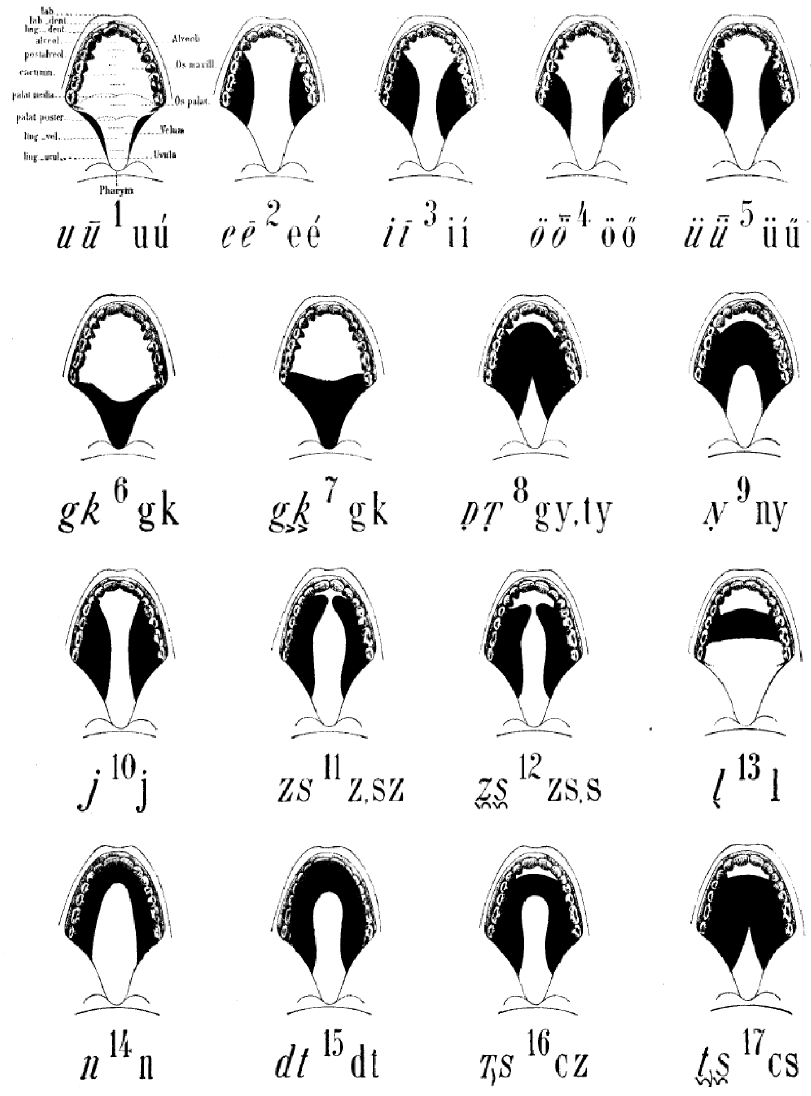
Balassa’s (Reference Balassa1887) research had some understandable shortcomings that were due to the fact that he was a pioneer in Hungarian experimental phonetics, and these were the first steps in using palatography in this country. Figure 2 below shows 17 original palatogram pictures from one of Balassa’s papers (Reference Balassa1887: 135). The letters on the left side under the palatograms represent Techmer’s phonetic symbols, while those on the right side represent the equivalent Hungarian letters (these letters practically correspond to Hungarian phonemes).
Balassa’s palatograms (1887: 135). (Original title translated into English: Stomatoscopic pictures of Hungarian sounds.)

Beside using a modern technique to explore the exact articulation gestures performed in producing speech sounds, Balassa has to be credited for the fact that in studying speech sounds he freed himself from the effects of spelling. For example, it was not only [k] and [ɡ] that he listed as velar consonants, but also the velar nasal [ŋ], which is not a phoneme in Hungarian but a variant of the alveolar nasal consonant when it precedes and is coarticulated with velar stops. Balassa did not tackle the issue of context-dependency systematically. However, he provided some palatograms to illustrate velar consonants in back vowel contexts (Figure 2: picture 6) and in front vowel contexts (Figure 2: picture 7).
Although short and long vowels are both phonetically and phonologically different in Hungarian, Balassa found that the palatograms for these vowels were the same. Similarly, the consonants differing only in voicing patterns (which are phonologically relevant) were represented by the same palatogram. Figure 2 contains (short) front vowels and only one back. The explanation is that the open vowels ([ɔ aː ɛ]) do not show visible contacts on the palate, and they can easily be examined by looking into the oral cavity (1887: 131, 136).
Balassa (Reference Balassa1886) defined various regions on the palate that correspond to the places of articulation of Hungarian consonants. The places of the tongue, contacting the palate, were marked by Roman numerals while Arabic numerals referred to regions corresponding to the places of articulation of the consonants on the palate. He examined the places of articulation of the consonants by looking at the marks of contacts on the palatograms and identified them according to predefined regions. After analysing the palatograms, he realized that in his book on phonetics he misidentified the fricatives [ʃ ʒ] as palatals, while in fact they are post-alveolars.
Although this paper is designed to focus on the work of Hungarian scholars who used palatography from the end of the 19th century, it is impossible not to mention in this connection Abbé Rousselot, the acknowledged founder of experimental phonetics. In 1897 he published four palatograms based on Hungarian speech sound articulation (see pictures on pages 609, 611, 652 and 653 of Rousselot Reference Rousselot1897–1908). Two of them were known at the beginning of the 20th century (Gombocz Reference Gombocz1908: 193) while the other two were found more than 70 years later (Gósy & Olaszy Reference Gósy and Gábor1985). One of Rousselot’s pictures shows the Hungarian voiceless velar consonant ([k]) in various contexts (Figure 3), indicating the importance of context-dependency at that early date. Abbé Rousselot intended to demonstrate that the modifications in articulation gestures were due to the effects of the velar stop consonant on the vowels in question. (The speaker is unknown.)
Palatograms of consonant [l] (No. 3, on the left) and patterns of various front vowels coarticulated with [k] (No. 4, on the right) produced by a Hungarian speaker, shown in Rousselot’s book (1897–1908: 611, 652).

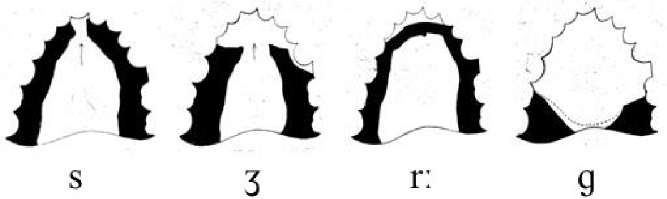
Gombocz (Reference Gombocz1908) analysed all short Hungarian consonants, all short vowels (without their long counterparts) and two long vowels ([aː] and [eː]) that have no short counterparts in standard Hungarian. He made a palatogram of the velar nasal [ŋ], like Balassa, he pronounced it in the word engem [ɛŋɡɛm] ‘me’ (Gombocz Reference Gombocz1908: 198). In his paper he presented the picture of only one long consonant, the trill, without any explanation. He used existing monosyllabic and disyllabic words, consisting of one or two of the following consonants: [p b m v f] and the vowels [ɛ ɔ aː]). He analysed the vowels and the consonants in two different phonetic positions, in word initial and in word medial positions (e.g. nyak [ɲɔk] ‘neck’ vs. anya [ɔɲɔ] ‘mother’) as well as in various phonetic environments. Figure 4 shows some of his palatograms.
Gombocz’s palatograms (IPA symbol is shown under the picture).

Gombocz noted the differences between the voiced and voiceless members of consonant pairs. Although the voiced and voiceless pairs shared the same palatogram picture, only one member of the pair is shown in the pictures, while the other one is indicated either by a dotted or a white line (see the palatogram for [ɡ] and the dotted line indicating [k] in Figure 4). Gombocz made some comparisons concerning the contact areas between palatal and velar vowels. He realized that phonetic position changes the size of the contact areas in the palatograms, but he did not make measurements.
As mentioned earlier, Csűry was not a phonetician but a dialectologist who decided to use palatography in analysing dialectal speech sounds. He came from north-eastern Hungary, the region called Szamoshát, and thus he studied his own, dialectal articulation. The goal of his investigations was to shed light on some controversial or unknown speech sounds in that dialect. Csűry copied Gombocz’s method so that their findings could be compared. Based on the palatograms, he determined the exact articulation for a controversial front vowel of this dialect, which is slightly more close than [eː] but more open than [iː], a sound that is closer to the former than to the latter. Csűry demonstrated that the environment influenced and modified the articulation of the consonant [n] in the vicinity of some fricatives. In addition, he ascertained that the [n] and [t] consonants were postalveolars in this dialect.
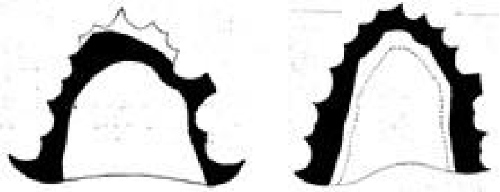
Csűry found some specific differences in articulation between his dialect and Gombocz’s, who came from West Hungary. Figure 5 shows the palatograms of the consonant [t] pronounced by two speakers speaking two (geographically) distant dialects. The place of articulation for [t] is nearer to postalveolar in north-east Hungary while it is dentialveolar in West Hungary (Gombocz Reference Gombocz1908, Csűry Reference Csűry1936).
Palatograms for the consonant [t] made by Csűry (left) and Gombocz (right), representing different dialects. The dotted line indicates here the contacts of [t] in word-initial position.

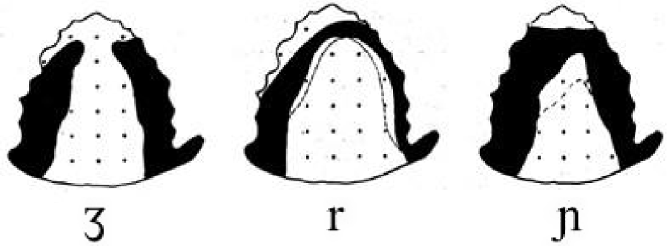
Hegedűs was the first to make exact measurements on the palatograms using a planimeter. (A planimeter is an instrument to determine the area of an arbitrary two-dimensional shape, like the artificial palate in this case.) In his early work, Hegedűs (Reference Hegedűs1941–43: 69) provided a detailed description on how to use the planimeter. Figure 6 shows some of Hegedűs’s palatograms made in the Phonetics Laboratory of Panconcelli Galzia in Hamburg in 1939. The small black points in the palatograms show the small holes Hegedűs (Reference Hegedűs1941–43) drilled into the surface of the palate 10 mm from each other, which provided reference points for measurements. His paper, reporting the results of his experiments was published some years later.
Palatograms made by Lajos Hegedűs (Reference Hegedűs1941–43). The consonants are shown in IPA symbols. The dotted lines indicate the contacts of (phonologically) long [r] and (phonologically) long [ɲ], respectively.

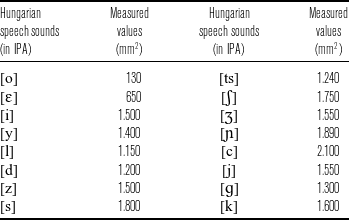
Hegedűs summarizes his measurements (expressed in mm2) in a table containing the contact areas visible on the palate, representing the author’s pronunciation (he noted that his pronunciation corresponded to standard Hungarian, i.e. he did not speak a dialect). The whole area of his artificial palate was 3.350 mm2. Here I will cite some of the values he obtained in his measurements (Table 1).
The contact areas visible on the palate in the case of some Hungarian speech sounds, measured by Hegedűs (Reference Hegedűs1941–43: 69).

Based on the analysis of the measured values Hegedűs drew some important conclusions. He discovered that with stops and fricatives the area of contact between the palate and the tongue was larger in word initial than in word medial positions. The larger contacts could be observed if the stop or fricative was followed by a palatal vowel, particularly [i]. Contact patterns were found to be larger in the case of (phonologically) long vowels and consonants compared to (phonologically) short ones. Finally, based on the measured values, Hegedűs confirmed that the contact areas were larger with voiced stops and fricatives than with their voiceless counterparts.
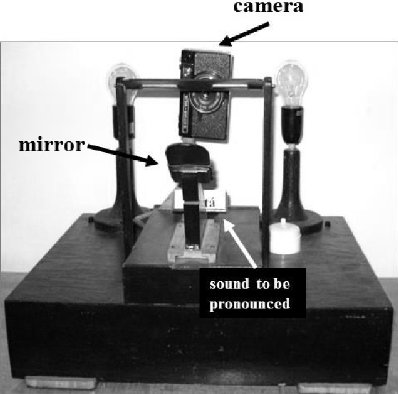
The natural method of palatography received a boost when the so-called palatograph was introduced in the 1950s in Hungary. This is an instrument containing a special mirror of a suitable size and design which would fit into the oral cavity without hurting the mouth or the tongue, a camera, lightbulbs and a sort of holder showing the letter (and the context) corresponding to the articulated speech sound (Figure 7). It is possible that Lajos Hegedűs started using this palatograph when he worked for the Hungarian Linguistics Institute (in the 1950s).
Palatograph from the 1950s.

After another 30 years the use of palatography was employed again by some of the researchers at the Linguistics Institute. The instrument was used in several research projects, including one designed to study disordered articulation of some fricatives using both palatograms and linguograms. This research was carried out in the 1970s and 1980s at the Phonetics Laboratory of the Institute, which owned the instrument. A conspectus containing palatograms and linguograms for each Hungarian speech sound was compiled by Bolla (Reference Bolla1982), using the institute’s palatograph. However, he did not make any measurements.
5 Conclusions
This paper was designed to call attention to the significant results of Hungarian experimental phonetics, starting from the year 1887, and the important contributions of some researchers. Borrowing a metaphor, at the end of the 19th century the cradle of electropalatography was rocked in several European countries – including Hungary. Subsequently, it took about a hundred years to develop the technology that can provide objective answers to our predecessors’ questions: How do the palate and the tongue contact during articulation?
New generations take it for granted that there are suitable instruments and methods that enable them to find answers to their research questions. Past methodological ideas are frequently forgotten and neglected. However, new advances depend on the intellectual performance of those who make the first steps to learn more and to try new methods.
Sometimes, by going back to an earlier methodological application, one can realize that simple methods can still be used under specific circumstances. Palatography is excellently applicable to the field work situation. The method is ‘portable’, not expensive, and does not require extra instruments (Ladefoged Reference Ladefoged, Hardcastle and John1997, Reference Ladefoged2003; Anderson Reference Anderson2008). Photography has given way to videotape and mobile video recording, but the traditional natural-type procedure has remained.
Studying the history of a research field affords a two-fold advantage. Firstly, we can make a correct assessment of our achievements if we know about the work of our professional predecessors. Secondly, sometimes we may re-discover a method that is excellently suited for complementing research carried out using modern equipment and methodologies. The old tools were perhaps primitive but effective, as Gunnar Fant, one of the greatest phoneticians claimed (Fant Reference Fant2000).
In conclusion, let me express my earnest belief that Hungarian phonetics has reason to be proud of its early representatives, who responded quickly to new trends in their field and were among the first to adopt experimental phonetics. Palatography has a one-hundred-year history in Hungarian phonetics, and in spite of some relapses, it has made important advances in this area. And it is being used even today, as a viable methodological tool for the study of some research issues.