Introduction
Alliances, defined as cooperative agreements of any form aimed at the development, manufacture, and/or distribution of products or services, are important strategic resources for firms. They can be leveraged to implement operation strategies for competitive advantage in volatile business environments (Holloway & Parmigiani, Reference Holloway and Parmigiani2016; Tang & Rai, Reference Tang and Rai2012). Although earlier studies mainly focus on the value of dyadic alliances, recent studies tend to explore how multiple concurrent alliances can benefit firms (Hoehn-Weiss, Karim, & Lee, Reference Hoehn-Weiss, Karim and Lee2017; Kavusan & Frankfort, Reference Kavusan and Frankfort2019; Wassmer, Reference Wassmer2010). This stream of studies argues that benefits generated by the multiple alliances can help firms exploit synergies inherent in their multiple alliances in a way that goes above and beyond the benefit of any single alliance (Asgari, Singh, & Mitchell, Reference Asgari, Singh and Mitchell2017; Hoehn-Weiss et al., Reference Hoehn-Weiss, Karim and Lee2017; Kavusan & Frankfort, Reference Kavusan and Frankfort2019; Lavie, Reference Lavie2007; Wassmer & Dussauge, Reference Wassmer and Dussauge2012).
While earlier studies often view firms' multiple alliances as a static arrangement (Koka & Prescott, Reference Koka and Prescott2022; Lichtenthaler & Lichtenthaler, Reference Lichtenthaler and Lichtenthaler2004; Parise & Casher, Reference Parise and Casher2003; Sytch & Tatarynowicz, Reference Sytch and Tatarynowicz2014), more recent studies argue that firms' multiple alliances evolve over time (He, Meadows, Angwin, Gomes, & Child, Reference He, Meadows, Angwin, Gomes and Child2020; Oh, Chen, Nakamoto, & Liu, Reference Oh, Chen, Nakamoto and Liu2024; Ozcan, Reference Ozcan2018; Velu, Reference Velu2015). These studies consider how the evolution of alliance is driven by endogenous path-dependent alliance formation decisions (Asgari, Tandon, Singh, & Mitchell, Reference Asgari, Tandon, Singh and Mitchell2018; Howard, Lyles, & Yoon, Reference Howard, Lyles and Yoon2023; Keller, Konlechner, Güttel, & Reischauer, Reference Keller, Konlechner, Güttel and Reischauer2022). While this evolutionary perspective has contributed significantly to the alliance literature, it has also been criticized for failing to adequately explain and predict situations where firms break free of inertia to proactively change their alliance network (Asgari et al., Reference Asgari, Singh and Mitchell2017). The literature is limited in its ability to explain why firms might change their alliance configuration, as well as what strategies they have at their disposal to do so (Kavusan & Frankfort, Reference Kavusan and Frankfort2019). Consequently, Kavusan and Frankfort (Reference Kavusan and Frankfort2019: 1669) highlight a significant gap in the research on multiple alliance strategies, pointing to limited investigation into the reasons behind firms' decisions to alter the composition of their alliance strategies over time, and the methods they employ to execute these decisions.
Taking a resource reconfiguration perspective can shed light on why and how firms adjust their alliance partners. According to Karim and Capron (Reference Karim and Capron2016), resource reconfiguration is the addition, subtraction, redeployment, and recombination of firm resources for competitive advantage. Because alliances are key resources for firms (Russo & Cesarani, Reference Russo and Cesarani2017), firms may adjust alliances to gain benefits, although the likely benefits need to be weighed against potential costs. Taking a resource reconfiguration perspective, we consider partner repeatedness as an important trigger for alliance reconfiguration. Partner repeatedness is an approach adopted by firms to reduce the uncertainty and risks associated with initiating alliances with new partners; instead firms form alliances with partners with which they share alliance history (Chung, Singh, & Lee, Reference Chung, Singh and Lee2000; Gulati, Lavie, & Singh, Reference Gulati, Lavie and Singh2009; Holloway & Parmigiani, Reference Holloway and Parmigiani2016). Partner repeatedness results in less frequent alliance formation with new partners and lower rates of withdrawal from alliances with existing partners (Greve, Mitsuhashi, & Baum, Reference Greve, Mitsuhashi and Baum2013; Polidoro, Ahuja, & Mitchell, Reference Polidoro, Ahuja and Mitchell2011). However, the negative effects of partner repeatedness may outweigh its positive effects after a certain point (Uzzi, Reference Uzzi1997; Zheng & Yang, Reference Zheng and Yang2015). As a higher level of partner repeatedness can lead to worse performance, firms may proactively reconfigure their alliance to alleviate performance concerns.
Thus, this study seeks to understand whether and how firms reconfigure their alliance partners when they have a high degree of partner repeatedness. We develop a nuanced typology of alliance reconfiguration strategies that goes beyond the two primary options considered by extant research – namely, dropping active partners and introducing new partners (Bakker, Reference Bakker2016; Zhang & Guler, Reference Zhang and Guler2020). By further differentiating whether firms have previous collaboration experience with newly selected partners, we specify three strategic options: (1) active partner outflow; (2) new partner inflow; and (3) previous partner inflow. These three strategies have differing capacities to preserve the benefits, and address the weaknesses, of partner repeatedness. Firms' preferences for one or other of these strategies may be contingent on contextual factors. In particular, when current partners possess rich resources, focal firms may be more focused on maintaining the existing alliance. However, if firms can offset the disadvantages associated with alliance reconfiguration because of their central position in their particular industry, these firms may prefer a strategic option that address the weaknesses associated with partner repeatedness. We thus recognize partners' resource richness and firms' industrial centrality as two possible moderators.
We test our hypotheses in the context of open-ended fund product distribution alliances between fund firms and banks in China and find broad support for our logic. To sell their products, fund firms collaborate with multiple banks, which have rich access to individual and institutional investors. After the distribution of a fund product, fund firms often reconfigure their current alliances before starting to distribute new fund products. These task-based alliances present an ideal empirical context for the study. First, they enable us to observe partner repeatedness and subsequent reconfiguration activities. Second, forming distribution alliances is a strategic decision, which not only determines the distribution performance of fund products issued by the fund firms, but also becomes a critical source of market information. Fund firms need to interact closely with bank distributors to improve their offerings in marketplaces. These kind of marketing alliances have been widely used in the literature as an empirical context to explore strategy related issues, like alliance performance (Singh & Mitchell, Reference Singh and Mitchell2005; Sorenson & Waguespack, Reference Sorenson and Waguespack2006), partner selection (Shah & Swaminathan, Reference Shah and Swaminathan2008), and firms' overseas expansion (Yu, Gilbert, & Oviatt, Reference Yu, Gilbert and Oviatt2011).
Four contributions emerge from our study. First, taking a resource reconfiguration perspective helps to understand the operational mechanisms underlying firms' reconfiguration of alliances. It provides insights into how the forces of inertia that lead to higher levels of partner repeatedness may give rise to adverse performance, triggering firm agency and managerial discretion to break free of inertia and proactively reconfigure the alliance. Second, we provide a more nuanced and comprehensive examination of firms' alliance reconfiguration strategies by answering calls for research that simultaneously considers both alliance partner inflow and outflow (Kavusan & Frankfort, Reference Kavusan and Frankfort2019), as well as considering a reconfiguration strategy largely overlooked in the literature – previous partner inflow. Third, our study analyzes and tests the role of contingency factors on firms' choice of reconfiguration strategy. Specifically, we consider how the current partners' resource richness and the focal firm's industry centrality will influence firms' perceptions about the risks and potential of options at their disposal when reconfiguring their alliance. Finally, our study answers the call for more quantitative evidence on alliance reconfiguration and its antecedents (Kavusan & Frankfort, Reference Kavusan and Frankfort2019), complementing the case-based and qualitative approaches that have been common in prior research (Wassmer, Reference Wassmer2010).
Background Literature
Partner Repeatedness in Alliance
A firm's set of alliances with external partners enables it to access resources otherwise unavailable to the firm, but can also lead to opportunistic risks and coordination costs (Bakker & Knoben, Reference Bakker and Knoben2015; Cao & Lumineau, Reference Cao and Lumineau2015; Elfenbein & Zenger, Reference Elfenbein and Zenger2014; Hoehn-Weiss et al., Reference Hoehn-Weiss, Karim and Lee2017; Tang & Rai, Reference Tang and Rai2012; Wassmer, Reference Wassmer2010). To reap the expected benefits of multiple alliances but mitigate their downsides, the embeddedness perspective suggests that firms can repeatedly collaborate with known partners (Dyer, Singh, & Hesterly, Reference Dyer, Singh, Hesterly, Mesquita, Ragozzino and Reuer2017; Greve et al., Reference Greve, Mitsuhashi and Baum2013; Gulati, Reference Gulati1995; Lin, Yang, & Demirkan, Reference Lin, Yang and Demirkan2007; Polidoro et al., Reference Polidoro, Ahuja and Mitchell2011; Rogan, Reference Rogan2014; Villena, Revilla, & Choi, Reference Villena, Revilla and Choi2011; Weber, Reference Weber2017; Zhang & Guler, Reference Zhang and Guler2020). As a result, extant research finds that partner repeatedness – the degree to which a firm allies with a set of partners repeatedly over time – is an important factor for explaining and predicting alliance performance (Goerzen, Reference Goerzen2007; Gulati et al., Reference Gulati, Lavie and Singh2009; Hoang & Rothaermel, Reference Hoang and Rothaermel2005; Holloway & Parmigiani, Reference Holloway and Parmigiani2016; Poppo, Zhou, & Zenger, Reference Poppo, Zhou and Zenger2008; Sorenson & Waguespack, Reference Sorenson and Waguespack2006; Wang & Rajagopalan, Reference Wang and Rajagopalan2015). Partner repeatedness has important performance implications, which we discuss in the following and summarize in Table 1.
Positive and negative effects of partner repeatedness

On the positive side, repeated exchanges can generate relational benefits and cultivate trust between the focal firm and its allying partners, reducing the threat of opportunism (Goerzen, Reference Goerzen2007; Gulati, Reference Gulati1995). Repeated exchanges can also enhance coordination efficiency between firms and their partners (Tang & Rai, Reference Tang and Rai2012). A long history of working together encourages partners to develop routines, a common language, and timely information exchange, which can increase output and reduce inefficiencies (Davis, Reference Davis2016; Holloway & Parmigiani, Reference Holloway and Parmigiani2016; Li & Rowley, Reference Li and Rowley2002; Li, Xie, Teo, & Peng, Reference Li, Xie, Teo and Peng2010; Zheng & Yang, Reference Zheng and Yang2015). Partner repeatedness also makes collaborations more adaptable to uncertain environments. Because longstanding collaborations motivate partners to look beyond their current interests and instead recognize the long-term benefits of alliances, these partners may be willing to withstand some uncertainty-induced costs (Gulati & Sytch, Reference Gulati and Sytch2007; Holloway & Parmigiani, Reference Holloway and Parmigiani2016). Consequently, firms face fewer renegotiation costs when they request partners to make adjustments in response to unforeseen changes (Elfenbein & Zenger, Reference Elfenbein and Zenger2017).
Despite the potential benefits of partner repeatedness, studies find that as the level of repeatedness increases, negative effects may also emerge. First, the relational benefits of repeatedness may become disadvantages, as repeated exchanges with known partners can eventually lose their effectiveness in deterring opportunistic behaviors (Holloway & Parmigiani, Reference Holloway and Parmigiani2016; Wuyts & Geyskens, Reference Wuyts and Geyskens2005). Trust depresses partners' opportunism, but it can also reduce firms' motivations to monitor their partners. Over the course of partners' interactions, they gain knowledge about each other's capabilities and weaknesses that they can exploit for their own gain (Gulati et al., Reference Gulati, Lavie and Singh2009; Li, Eden, Hitt, & Ireland, Reference Li, Eden, Hitt and Ireland2008). The combination of the potential for increased gains from cheating but lowered chances of being caught can drive partners to act opportunistically.
Second, a high level of partner repeatedness diminishes the coordination advantages and value creation potential of firms' multiple alliances, as locked-in routines and relationships mean that maintaining the partnership can become an end in itself (Holloway & Parmigiani, Reference Holloway and Parmigiani2016; Jiang, Xia, Cannella, & Xiao, Reference Jiang, Xia, Cannella and Xiao2018; Rogan, Reference Rogan2014). That is, when longstanding collaborations become socially embedded, firms have social obligations to partners that drive them to dedicate precious resources and time to help partners (Maurer & Ebers, Reference Maurer and Ebers2006). They may even act as ‘relief organizations’ and become distracted from the pursuit of their own economic value (Uzzi, Reference Uzzi1997; Weber, Reference Weber2017). Partners may rely on existing relationships to sustain their business and hence become less motivated to seek technically superior options (Wuyts & Geyskens, Reference Wuyts and Geyskens2005). Indeed, Poppo et al. (Reference Poppo, Zhou and Zenger2008) found that firms collaborating with repeated partners over a longer period tend to experience less satisfaction regarding cost, quality, and responsiveness.
Third, relying on repeated ties creates collective blindness to new solutions to unforeseen challenges or opportunities (Lee, Reference Lee2013; Zhang & Guler, Reference Zhang and Guler2020). Embeddedness associated with repeated exchanges may also cause firms to be overly optimistic in relation to the resources and competences of their existing partners (Tang & Rai, Reference Tang and Rai2012; Zhang, Wan, Jia, & Gu, Reference Zhang, Wan, Jia and Gu2009). This is problematic, as repeated interactions with the same partners may reach the point where no more novel information or knowledge is gained, so further exchanges of information become redundant (Goerzen, Reference Goerzen2007; Nahapiet & Ghoshal, Reference Nahapiet and Ghoshal1998). However, a high level of partner repeatedness may also lessen firms' capacity to initiate collaborations with new partners (Lee, Reference Lee2013). To leverage repeated ties for better performance, managers need to devote time and resources to interacting with their counterparts from partner firms (Rogan, Reference Rogan2014). Firms can rarely afford to maintain many such close relationships. Instead, they tend to focus on a smaller number of trusted partners, at the cost of failing to give promising new partners adequate consideration. This leaves firms less motivated to expand their search horizons, and less able to innovate and pursue new relationships (Zheng & Yang, Reference Zheng and Yang2015).
Inertia versus Agency in Alliance with High Partner Repeatedness
As alliance performance decreases due to increasing partner repeatedness, managers should be compelled to make changes to the firm's alliance. However, extant research suggests that a high level of partner repeatedness instead stabilizes firms' existing multiple alliances because firms tend to select known partners to avoid the uncertainty inherent in forming new alliances (Chung et al., Reference Chung, Singh and Lee2000; Ghosh, Ranganathan, & Rosenkopf, Reference Ghosh, Ranganathan and Rosenkopf2016; Polyviou, Rungtusanatham, Recezek, & Knemeyer, Reference Polyviou, Rungtusanatham, Recezek and Knemeyer2018). This is consistent with research highlighting the role of inertia as a primary driver of alliance reconfiguration (Ahuja, Soda, & Zaheer, Reference Ahuja, Soda and Zaheer2012), where the evolution of a firm's alliance configuration is conceptualized as a function of endogenous path-dependent alliance formation decisions, a process which may be swayed by stimuli including market uncertainty (Beckman, Haunschild, & Phillips, Reference Beckman, Haunschild and Phillips2004; Podolny, Reference Podolny1994) and technological discontinuities (Asgari et al., Reference Asgari, Singh and Mitchell2017) that are exogenous to the alliance.
However, a burgeoning body of literature recognizes that active agency and managerial discretion is also an important trigger for alliance reconfiguration (Ahuja et al., Reference Ahuja, Soda and Zaheer2012; Maurer & Ebers, Reference Maurer and Ebers2006), noting that firms can deliberately establish or dissolve their alliances that favor them in some way. A primary theoretical foundation of the view is resource reconfiguration perspective, which suggests that firms can overcome inertia to reconfigure their resource profiles to achieve efficiency (Karim & Capron, Reference Karim and Capron2016). Some recent studies that consider this perspective have revealed that firms use alliance reconfiguration proactively as a response to strategic changes (Lavie & Singh, Reference Lavie and Singh2012) or to bridge the gap between target and actual performance (Clough & Piezunka, Reference Clough and Piezunka2020; Kavusan & Frankfort, Reference Kavusan and Frankfort2019). Given that partner repeatedness may eventually adversely influence the firm's alliance performance, we follow this approach in which firms exercise their agency, arguing that issues within the alliance – specifically, declining alliance performance brought about by higher levels of partner repeatedness – will impel managers to proactively reconfigure the alliance in ways designed to preserve the positive aspects of partner repeatedness while mitigating the negative aspects.
Hypotheses Development
Main Effect of Partner Repeatedness on Alliance Reconfiguration
The literature on alliance reconfiguration has focused on two primary ways that firms may change the configuration of their alliance: by dropping active partners or by introducing new partners to offset the negative effects of repeatedness (Asgari et al., Reference Asgari, Singh and Mitchell2017; Jiang et al., Reference Jiang, Xia, Cannella and Xiao2018; Kavusan & Frankfort, Reference Kavusan and Frankfort2019; Tang & Rai, Reference Tang and Rai2012). However, this overlooks the fact that firms also may form alliances with firms with which they have previously partnered but are not active partners in their current alliances. Thus, in this study we focus on these three reconfiguration strategies: active partner outflow, new partner inflow, and previous partner inflow because we argue these three strategies have different implications for firms' attempts to preserve the benefits, or mitigate the negative effects, of partner repeatedness (summarized in Table 2), which in turn will affect the likelihood with which firms will include them in reconfigured alliances.
The three reconfiguration strategies' efficacies in preserving the positive and mitigating the negative effects of partner repeatedness

Active partner outflow has significant trade-offs, which we expect to neutralize its attractiveness as a reconfiguration strategy at higher levels of partner repeatedness. On the one hand, active partner outflow mitigates several negative effects of partner repeatedness by removing partners that: have become ‘too close’, causing a blind spot that opens up the firm to opportunism due to inadequate monitoring; may have pushed the firm to prioritize social obligations and relationship-maintenance over economic efficiency: no longer have novel knowledge or capabilities to contribute (Clough & Piezunka, Reference Clough and Piezunka2020).
On the other hand, active partner outflow can be detrimental to a firm's attempt to maintain the positive effects of partner repeatedness. By removing an active partner, the firm may lose the relational benefits of working with a trusted ally. This may reduce the coordination benefits inherent in established routines, communication patterns, and information sharing activities that are part of working with an established partner, and the adaptability benefits inherent in working with an alliance partner willing to collaborate and respond flexibly to changes in the external environment may be lost. Moreover, active partner outflow may also have a ripple effect across the entire alliance. Remaining partners may question the longevity of their own collaborations with the focal firm, leading to an erosion of trust and an increase in opportunism (Kavusan & Frankfort, Reference Kavusan and Frankfort2019). Active partner outflow may disturb cooperation between a firm and its remaining partners, impairing the coordination benefits from an alliance not just within individual alliances but across the alliance network as a whole (Bakker, Reference Bakker2016). Due to the complex interdependency between the focal firm and its partners (Hoehn-Weiss et al., Reference Hoehn-Weiss, Karim and Lee2017), dropping active partners may change these dependence relations and disrupt coordination regimes within the alliance (Asgari et al., Reference Asgari, Singh and Mitchell2017). This may result in the reduced capacity of the focal firm and its partners to jointly develop and execute solutions to deal with unanticipated changes.Footnote 1
Although the trade-offs involved with new partner inflow are different from those inherent in active partner outflow, we expect them also to neutralize this strategy's attractiveness when there are higher levels of partner repeatedness. New partner inflow mitigates several negative aspects of partner repeatedness, as the addition of new partners enables the focal firm to prioritize economic efficiency, new relationships are not likely to be oversocialized, and the introduction of ‘new blood’ increases access to new sources of knowledge and fosters innovation.
However, new partner inflow can make preserving the positive aspects of partner repeatedness considerably more difficult. First, the focal firm lacks trust, coordination routines, and the ability to be adaptable with the new partner itself (Baum, Rowley, Shipilov, & Chuang, Reference Baum, Rowley, Shipilov and Chuang2005; Li et al., Reference Li, Eden, Hitt and Ireland2008), because it lacks a history of collaboration. Moreover, existing partners may lose trust in the focal firm if they believe that it has introduced new partners to compete with them to extract a greater proportion of value generated by the alliance (Kavusan & Frankfort, Reference Kavusan and Frankfort2019; Wassmer & Dussauge, Reference Wassmer and Dussauge2012). Efficiency may be also impaired, because the smooth running of the new alliances requires not only the new partners' adjustment to fit into existing collaboration routines, but also the existing partners' effort to adapt to the new status quo (Hashai, Kafouros, & Buckley, Reference Hashai, Kafouros and Buckley2018). As agreed-upon ways of working together are often well-established in alliance, these realignment efforts may create complexity and conflicts (Bakker, Reference Bakker2016). New partner inflow may also change established coordination regimes in alliances, leading to the reduced capacity of firms and their partners to jointly develop and execute solutions to deal with unforeseen circumstances.
In contrast, we expect that previous partner inflow will be particularly attractive as a reconfiguration strategy, due to its moderate upside but relatively small downside. The primary disadvantage of previous partner inflow is that previous partners are likely not quite as effective as active partners in preserving the positive aspects of partner repeatedness, as they are not active participants in the focal firm's current alliance. Likewise, previous partners are likely not quite as effective as new partners at mitigating the negative aspects of partner repeatedness, as they are not ‘new blood’ in the same way as a new partner. However, the downside risk of previous partner inflow is also much lower than the disruptions that the other two strategies may entail. Previous partners' familiarity with the local firm gives them many advantages similar to those of active partners but without the ‘baggage’ of active partners; their time away from the focal firm gives them some of the advantages inherent in a new partner, but in the form of a familiar face (Levin, Walter, & Murnighan, Reference Levin, Walter and Murnighan2011).
First, compared with introducing new partners, we expect that adding previous partners will be less disruptive to overall levels of trust in an alliance. Given previous collaboration experience, the firm and its former allies would not have to start from scratch with respect to building a trusted relationship. Moreover, previous partner inflow may trigger less opportunistic behavior by existing partners, as re-forming ties with previous partners signals, for the focal firm, ‘once a partner, always a partner’. Thus, existing partners' doubts about the longevity of their own collaborations with the focal firm would be reduced, potentially short-circuiting the opportunistic tendencies that may arise when new partners are added, or active partners are dropped. Second, cooperation efficiency likely may be re-established relatively easily, as previous collaboration history means firms have knowledge about the previous partners' behavioral patterns, so coordination is easier (Lioukas & Reuer, Reference Lioukas and Reuer2015). Finally, with experience working both inside and outside the focal firm's alliance network, previous partners may possess information that is novel to the focal firm, and also have a greater ability to reflect on current practices and solutions adopted by the focal firm (Levin et al., Reference Levin, Walter and Murnighan2011). Pre-existing norms and routines about how to work together enable focal firms to better assimilate and adopt the novel information offered by previous partners (Lane & Lubatkin, Reference Lane and Lubatkin1998).
In summary, we expect that where this is high partner repeatedness, a focal firm's alliance reconfiguration strategy is focused on preserving the benefits of repeatedness while mitigating the negative aspects. The outflow of active partners and inflow of new partners both entail significant trade-offs that we expect means the focal firm is neither more nor less likely to adopt these strategies as partner repeatedness increases. However, previous partner inflow presents an attractive compromise: it preserves many of the advantages of partner repeatedness while allowing the firm to mitigate some of the disadvantages. Therefore, we argue that having an alliance with higher levels of partner repeatedness will result in a firm being more likely to undertake previous partner inflow as a reconfiguration strategy, but not affect its likelihood of using active partner outflow or new partner inflow.
Hypothesis 1 (H1): A high level of partner repeatedness in firms' alliances increases previous partner inflow rather than active partner outflow or new partner inflow.
Moderating Effect of Partner Resources and Firm Centrality
Although the three alliance reconfiguration strategies have different advantages and disadvantages, we expect this to change depending on contextual factors. Specifically, we expect that moderating factors may lead firms to emphasize the downside risks of reconfiguration strategies in certain situations and the upside opportunities in other situations. To illustrate this point, we first consider how a context that would lead firms to focus on downside risk moderates the relationship between partner repeatedness and the alliance reconfiguration strategies hypothesized above. Specifically, we consider alliance partners' resource richness as a factor that may focus a firm's attention on the downside risks related to a failure to preserve the positive benefits of partner repeatedness when choosing between alliance reconfiguration strategies.
If a firm's current multiple alliances are characterized by partners with abundant resources, dropping active partners is a lost opportunity to exploit these firms' resources. Moreover, active partner outflow may reduce other longstanding partners' confidence in their own exchange continuity with the focal firm, leading to a reduced willingness to share resources with the firm. When these partners possess valuable resources, the loss caused by this reduced willingness to interact and cooperate could be costly. Put simply, when existing partners are resource-rich and the focal firm has an extensive history of interacting with these firms, any upside from dropping them as active partners is greatly outweighed by the downsides. This decreases the attractiveness of active partner outflow as an alliance reconfiguration strategy in this context.
As argued earlier, introducing new partners to alliances featuring a high degree of partner repeatedness may cause existing partners to be concerned about the longevity of collaborations with focal firms, reducing their willingness to share resources with them. If these partners had only limited resources, any losses caused by a reduced willingness to share them could be compensated by introducing new partners. However, if existing partners are resource-rich, introducing new partners may not compensate for the loss of these resources. Even if a firm can find resource-rich new partners, tapping into these partners' resource base before establishing a close relationship is likely to be difficult (Asgari et al., Reference Asgari, Singh and Mitchell2017). Therefore, when existing partners possess rich resources, firms become less motivated to use new partner inflow to reconfigure alliances featuring a high level of partner repeatedness.
In contrast, we predict that resource richness will strengthen the association between partner repeatedness and previous partner inflow. The ample resources of current partners should drive the focal firm to prioritize its capacity to access and exploit these resources while still achieving alliance reconfiguration. With this goal in mind, adding familiar partners gives the firm the greatest ability to maintain the benefits of a strong alliance partner resource base, as previous partners can be re-added with minimal disruption to the dynamics of the alliance. When the benefits of the current alliance are particularly high, as in the case where current partners have abundant resources, the focal firm will be particularly interested in effecting change without causing disruption. As a result, we expect that focal firms to be even more inclined to choose previous partner inflow when their alliance features a high level of partner repeatedness and high partner resource richness.
Hypothesis 2 (H2): As the resource richness of current partners increases, a higher level of partner repeatedness (a) decreases the likelihood of active partner outflow, (b) decreases the likelihood of new partner inflow, and (c) increases the likelihood of previous partner inflow.
Next, we consider how a context in which firms focus on reconfiguration strategies' upside opportunities may moderate the relationship between partner repeatedness and alliance reconfiguration strategies. Specifically, we consider a focal firm's industry centrality as a factor in firms shifting their focus from the downside risks to the upside opportunities associated with preserving the positive benefits, or mitigating the negative effects, of partner repeatedness through their alliance reconfiguration strategies.Footnote 2
If a firm occupies a more central position in its industry, we expect that a high level of partner repeatedness will trigger less active partner outflow. Firms that are central in their industry possess a vast repository of first-hand information about many potential partners, so they can identify qualified partners and whether these potential partners are compatible with their current alliance (Gulati, Reference Gulati1995). A central position also indicates more social capital or status, so alliance partners may infer that a central firm wields power and influence (Swaminathan & Moorman, Reference Swaminathan and Moorman2009), prompting them to avoid acting opportunistically even when they are not being monitored as closely, and to comply with requests from these central firms. When central firms repeatedly work with a group of partners, they likely have selected capable partners and have designed their relationships with these partners with the aim of achieving superior performance (Lin et al., Reference Lin, Yang and Demirkan2007). Dropping such active partners would be costly, so partner repeatedness should result in less active partner outflow for firms situated centrally in their industry.
For more central firms, a high level of partner repeatedness may result in increased use of new partner inflow. Recall that new partner inflow helps firms alleviate the negative effects of repeated ties by decreasing the risks of collective blindness and driving firms and their partners to engage in more innovation and economic value creation; however, it disrupts the positive effects of repeatedness by weakening trust, lowering coordination efficiency, and impairing adaptation advantages. Central firms are less susceptible to these disadvantages. Their broad connections drive partners to assume their superior quality, so central firms tend to gain and preserve partners' trust. Moreover, the power and status offered by central positions enables these firms to align their partners' behaviors. Even if new partners are introduced, coordination efficiency and adaption advantages can be better preserved. With less disruption due to new partner inflow, firms with higher centrality are more likely to use this strategy to reconfigure their alliance.
However, previous partner inflow would be less appealing for firms in central positions in their industries. As discussed previously, previous partner inflow generally has less upside but also less downside than the other reconfiguration strategies, which makes it attractive as a ‘compromise position’ under certain conditions. However, when a firm's industry centrality leads it to be less concerned with the downside risks of alliance reconfiguration, previous partner inflow becomes a suboptimal strategy. This is because previous partners do not offer the upside associated with maintaining the positive effects of repeatedness from active partners, and previous partners lack the upside of new partners with respect to possessing new knowledge and stimulating economic value creation.
Hypothesis 3 (H3): As the focal firm's industry centrality increases, a higher level of partner repeatedness (a) decreases the likelihood of active partner outflow, (b) increases the likelihood of new partner inflow, and (c) decreases the likelihood of previous partner inflow.
Methods
Empirical Setting
Our empirical setting is Chinese fund firms' distributions of fund products. Open-ended fund products in China are analogous to mutual funds in the United States, and include monetary, equity, bond, and balanced funds. Due to the salience of strategic alliances in the context of fund firms, they have been used in a number of prior studies examining issues such as alliance performance (Singh & Mitchell, Reference Singh and Mitchell2005; Sorenson & Waguespack, Reference Sorenson and Waguespack2006) and partner selection (Shah & Swaminathan, Reference Shah and Swaminathan2008), and they represent an ideal empirical context for our study. First, fund firms tend to have extensive alliances of partners, both active and non-active, allowing us to observe issues relating to partner repeatedness and subsequent reconfiguration activities. Second, because strategic alliances are necessary for fund firms to succeed, these firms have incentives to reconfigure their alliances if there are performance-related reasons for doing so. Finally, because there is heterogeneity with respect to the attributes of firms and their alliances, we have a rich context in which to explore contingency variables that would moderate any direct relationship between partner repeatedness in fund firms' alliances and these firms' subsequent alliance reconfiguration activities.
The first open-ended fund in China launched in 2001; by 2015, the net value of open-ended fund products exceeded 1.35 trillion dollars (about 8.4 trillion Chinese Yuan), and open-ended funds took up about 97.6% of the total fund product shares. Launching open-ended fund thus is an important business avenue for Chinese fund firms. Potential investors include both individuals and financial institution. When fund firms launch a new fund, a minimum threshold of fund shares (200 million shares) must be reached by the new product within three months, or it cannot be established legally.Footnote 3 The wide connection to potential investors makes commercial banks the primary distributor of these products. Indeed, commercial banks are responsible for the distribution of over 60% of open-ended fund products; to make sure that new funds meet establishing thresholds, fund firms need to select banks as distributors. Selected banks not only take responsibility for selling a fund product, but also provide subsequent services like redemption and purchase. In addition, bank partners are a primary source of market information for fund firms. Thus, fund firms and their bank partners interact and collaborate intensively. Fund firms may also face opportunism from bank partners. For example, banks can leverage their size advantage to request high commissions in both fund distribution and custody stages, otherwise they will use their resources to support other fund firms. After the fund product is distributed, fund firms have the choice of whether and how to adjust the configuration of their current alliance before initiating the distribution for their next new fund. This reconfiguration decision serves as the primary observation unit for this study.
Our study considers a five-year period between 2007 and 2011. We choose this period because the substantial rate of return yielded for the investor during the security market boom in 2006 meant that open-ended funds instantly gained popularity in China in 2007. From 2006 to 2007, the total shared of open-ended fund products rose from 700 billion shares to 3 trillion. After 2007, the scale of the open-ended fund market stabilized, leaving the market size fluctuating around 2 to 3 trillion shares for the next four years until 2011. After 2011, some innovative categories of funds were launched, like the ‘listed open-ended fund’, leading to significant changes in distribution patterns. Moreover, although banks are still important fund distributors in China, after 2011 their importance diminished as internet distribution platforms gained momentum. For instance, in 2011, more than 70% of open-ended funds distribution was handled by banks, which decreased to 55% in 2012 and then 45% in 2013. Due to the diminished role of banks as fund distributors, we did not collect data after 2011.
We collected our data from multiple sources. First, to collector partner selection information, we viewed the official websites of the fund firms and carefully read each new fund's prospectus or selling announcement in order to identify selected distributing banks in each specific fund launch. Second, we obtained fund firms' demographic information, including age, size, type (equity, bond, etc.), alliance performance, and fund management teams from the database of GTA Information Technology Co. Limited, which is a professional data provider firm in China (Sun & Tong, Reference Sun and Tong2003; Wang & Qian, Reference Wang and Qian2011). We also collected data on the banks' size and age from their official websites. After excluding missing data, our data contain 571 fund products of 58 fund firms. Notably, many studies identify a multiple alliance as a set of alliances formed by focal firms during a period of 3 or 5 years (e.g., Bakker & Knoben, Reference Bakker and Knoben2015; Reuer & Ragozzino, Reference Reuer and Ragozzino2006; Zheng & Yang, Reference Zheng and Yang2015). Our study adopts an event-based approach to identify alliances for analysis. Explicitly, we identify as a multiple alliance a set of alliances formed by a specific fund firm to sell one of its fund products. This approach has also been widely used by scholars in related studies (Bi, Xie, & Jin, Reference Bi, Xie and Jin2020; Bi, Xie, & Sheng, Reference Bi, Xie and Sheng2022; Xie, Zou, & Liang, Reference Xie, Zou and Liang2023).
Measures
Dependent variables
We measured the three configuration strategies of alliance based on how the fund firm selects its allied distributing bank for a new fund product (i.e., the fund t issued by the fund firm n) relative to the distributors it used for the prior fund product (i.e., the fund t–1 issued by the fund firm n). New partner inflow indicates that the fund firm n selects a partner having no previous collaboration experience as a distributor prior to the new fund t. Previous partner inflow occurs if a partner chosen as a distributor of the new fund t has collaborated with the fund firm n in the past but was not a distributor of the prior new fund t–1. Active partner outflow indicates that a partner is a distributor of prior fund t–1 but not re-selected as a distributor for the new fund t issued. These measures can be further illustrated by the following example: a fund t–1 issued by fund firm n had four bank distributors, A, B, C, and F. When fund firm n issues a new fund t, it chooses six bank distributors, A, B, C, D, E, and G. Banks D and G have not collaborated with the fund firm n in the past, while Bank E had collaborated with the fund firm n previously but terminated the collaboration some time before t–1. In this case, for fund t we identified two instances of new partner inflow (D and G), one count of previous partner inflow (E), and one count of active partner outflow (F).
Independent variable
Partner repeatedness was measured by the average times the fund firm collaborated with the partners selected to distribute the prior fund product t–1 (McFadyen, Semadeni, & Cannella, Reference McFadyen, Semadeni and Cannella2009). To create this measure, we first identified all commercial bank distributors of fund product t–1. Second, we counted the total number of times that the fund firm had allied with each identified bank from the period between 2001 and the distribution of fund product t–1.Footnote 4 Third, we computed partner repeatedness by averaging number of times a focal firm has partnered with each of the banks selected as distributors for fund product t–1. Imagine a fund t–1 issued by fund firm n. We first identified all bank distributors in the alliance. Suppose there are five partners, A, B, C, D, and E; we then counted how many times the fund firm has allied with each partner up to the distribution of fund t–1. Say we found that the fund firm had previously partnered with A three times, B two times, C one time, D four times, and E five times. Then we calculated partner repeatedness as the averaged value of times that the fund firm had collaborated with each distributor in the alliance, that is, (3 + 2 + 1 + 4 + 5)/5 = 3.
Moderating variables
We captured the richness of partner resources by calculating the average assets of all bank distributors of the fund product t–1 (Ahuja, Reference Ahuja2000a). For each bank, we measured its resources as its total assets in the prior year (Beckman et al., Reference Beckman, Haunschild and Phillips2004), then averaged the total assets for all current bank distributors and logged the value. We measured firm centrality as the ratio of the number of banks that the fund firm once worked with prior to the launch of fund product t–1 to the maximum possible number of bank distributor partner linkages in the prior year (Ahuja, Reference Ahuja2000b; Wong & Boh, Reference Wong and Boh2014).
Control variables
Factors about market environment, fund firms, banks, and their collaborations are selected as controls in the empirical tests. Firms tend to persist in alliance that generate satisfactory performance, therefore we controlled for prior collaboration performance, measured as the logged value of distributed fund shares in the last new fund product (Li & Rowley, Reference Li and Rowley2002). We also controlled for attributes of the fund management team (FMT). The average FMT education level is measured using a four-point scale, in which the highest level of educational attainment of manager is categorized as (1 = high school, 2 = bachelor, 3 = master, 4 = doctorate). We also noted FMT international experience, measured as the percentage of FMT members with study or professional experience outside of China. We controlled for FMT working experience, measured by averaging the time each FMT member spent working as a fund manager. Additionally, we controlled for fund issuance interval, which is calculated as the time span in months from fund t–1 to fund t, and then divided by 12. Finally, three dummies were added to absorb the time-invariant effect of four fund types, including equity fund, bond fund, monetary fund, and balanced fund.
Bank age is calculated as the average age (i.e., years since incorporation) of the bank distributors of the fund product t–1. The fund firm's age is the number of years between its incorporation and the time of the fund launch. The fund firm's size is the logged value of total assets in the quarter prior to the launch of fund product t (Beckman et al., Reference Beckman, Haunschild and Phillips2004). Partner selection may reflect cultural influences (Hitt, Ahlstrom, Dacin, Levitas, & Svobodina, Reference Hitt, Ahlstrom, Dacin, Levitas and Svobodina2004), so we considered the ratio of foreign equity of fund firms prior to the launch of fund product t. Because prior research has linked temporal effects to alliance reconfiguration (Lunnan & Haugland, Reference Lunnan and Haugland2008), dummy variables corresponding to the quarter of fund t's launch were included as well. Additionally, we included the number of partners as a count of the number of bank partners of each new open-ended fund (Lahiri & Narayanan, Reference Lahiri and Narayanan2013).
It has been suggested that market size prompts firms' strategic choices (Rothaermel, Reference Rothaermel2006), so we controlled for the effects of market size. To capture the size of the fund firms in the market, we operationalized market size as the logged value of the sum of assets of all fund firms in the quarter prior to fund t's launch. Beckman et al. (Reference Beckman, Haunschild and Phillips2004) suggest that market uncertainty strongly influences partner selection decisions, so we assessed the mean value of monthly volatility for all funds' net value in the previous quarter. The volatility is captured by the coefficient for all funds' net value per month in the previous quarter. Moreover, because a new fund launch is the primary means used by fund firms to acquire resources from the marketplace, we controlled for the effect of the number of new fund launches in that quarter of fund t, which signals competition in the market. In addition, because the three reconfiguration strategies are likely not chosen independently, we added the other two strategies as control variables when we tested how partner repeatedness influences a specific reconfiguration strategy, to reduce concerns of endogeneity.
Table 3 summarizes the descriptive statistics. With respect to our dependent variables, we found that on average, a fund product t was characterized by 1.7 active partner outflows, 1.3 new partner inflows, and 1.3 previous partner inflows (the average fund product had 10.9 partners). The average level of partner repeatedness of alliances was 4.87.
Descriptive statistics and correlations

Notes: n (firms) = 58; n (observations) = 571; All correlations greater than |0.083| are significant at p < 0.05. All correlations greater than |0.109| are significant at p < 0.01.
Analytic Methods
We used hierarchical models to analyze our models, which are suitable for a nested data structure with different levels like our data, which contain information about the new funds embedded in different fund firms. Because distribution alliances formed by a specific fund firm are more similar to each other than to alliances formed by a different fund firm, the violation of independence of observations assumption – a key premise of ordinary pooled cross-sectional modeling that treats each fund product as independent – may result in biased estimates of the coefficients. Instead, we used multilevel modeling techniques, which have been widely promoted for estimating models with nested data structures (Gaur, Malhotra, & Zhu, Reference Gaur, Malhotra and Zhu2013; Luo, Chung, & Sobczak, Reference Luo, Chung and Sobczak2009). We chose HLM 6.08 for its flexibility in modeling two-level nested data and nonnormal outcomes in multilevel models. The measures of the various reconfiguration approaches reflect the number of bank partners' inflows or outflows; these variables are low-base-rate count variables. Their distributions contain excessive presence zero values and generally follow a Poisson distribution, violating the assumptions imposed by linear regression models (Gardner, Mulvey, & Shaw, Reference Gardner, Mulvey and Shaw1995). Therefore, we choose nonlinear multilevel regression analyses, using a Poisson sampling model with a log-link function. The three reconfiguration strategies also show mean-variance overdispersion, so we used a Poisson model with overdispersion.
In the two-level hierarchical Poisson modeling with random intercepts and fixed coefficients (Raudenbush, Reference Raudenbush2007), the first level pertains to observations of new funds from 2007 to 2011. In the level 1 equation, we included time-varying predictors at both fund and firm levels. The coefficients are estimated as fixed effects (i.e., assumed to be the same across firms and groups). The intercept of the level 1 equation is allowed to vary randomly at the second level, which pertains to individual funds. Such specification takes into consideration the potential for unobserved heterogeneity among funds and fund firms (Liao, Reference Liao2002).
Level 1 Model:

Level 2 Model:

where
μ 0 ~ N (0, $\sigma _0^2$ )
Results
All predictor variables were mean-centered before interaction terms were generated. The values of variance inflation factor (VIF) are well below 10 (the maximum VIF value is 3.22 of firm centrality), implying few multicollinearity issues in our model. In addition to the main results, a series of robustness checks were performed by changing variable measures and using a panel model in STATA. We also performed an additional test to investigate whether the performance effects of the three alliance reconfiguration strategies align with our theoretical arguments. The results are detailed below.
Main Results
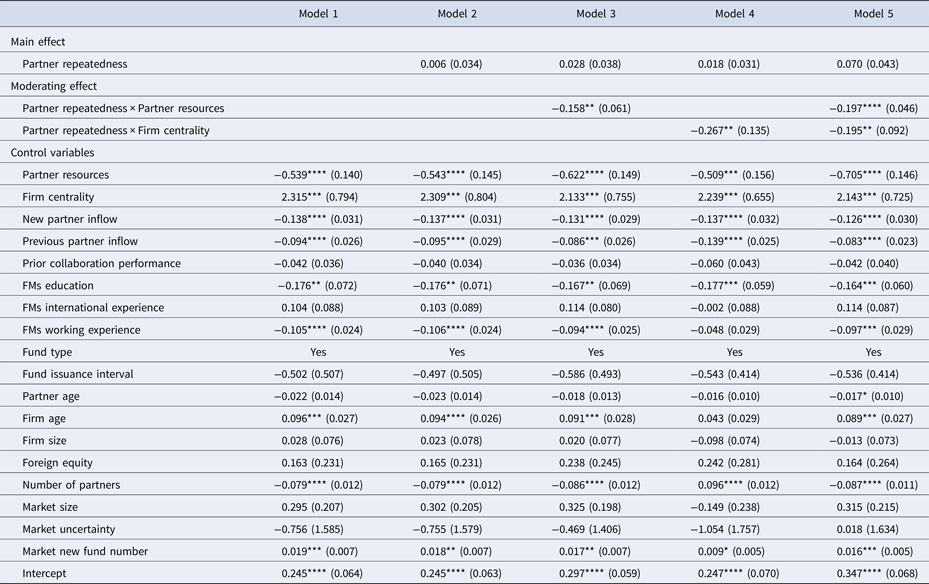
The results of the hierarchical Poisson models with robust standard errors are presented in three tables: Table 4 provides the active partner outflow models, Table 5 contains the new partner inflow models, and Table 6 refers to the previous partner inflow models. In each table, Model 1 is a baseline and contains only control variables; Model 2 adds the main effect of partner repeatedness; Model 3 adds the moderating effect of partner resources; Model 4 adds the moderating effect of firm centrality; finally, Model 5 features all predictors. Following Peterson and Brown (Reference Peterson and Brown2005), below we also report the effect sizes of our hypothesized relationships by using standardized coefficients to calculate Cohen's r. Footnote 6
Hierarchical Poisson models with robust standard errors predicting active partner outflow

Notes: n (firms) = 58; n (observations) = 571; numbers in parentheses are standard errors; *p < 0.1, **p < 0.05, ***p < 0.01, ****p < 0.001; one-tailed tests for hypothesized and two-tailed tests for control variables.
Hierarchical Poisson models with robust standard errors predicting new partner inflow

Notes: n (firms) = 58; n (observations) = 571; numbers in parentheses are standard errors. *p < 0.1, **p < 0.05, ***p < 0.01, ****p < 0.001; one-tailed tests for hypothesized and two-tailed tests for control variables.
Hierarchical Poisson models with robust standard errors predicting previous partner inflow

Notes: n (firms) = 58; n (observations) = 571; numbers in parentheses are standard errors. *p < 0.1, **p < 0.05, ***p < 0.01, ****p < 0.001; one-tailed tests for hypothesized and two-tailed tests for control variables.
In H1, we predicted that a higher level of partner repeatedness in firms' alliances results in more previous partner inflow but has no effect on active partner outflow or new partner inflow. Table 6 indicates a significantly positive impact on previous partner inflow (Table 6, Model 2, β = 0.110, p < 0.001; Model 5, β = 0.085, p < 0.01; Cohen's r = 0.359), whereas the influence of partner repeatedness on both active partner outflow (Table 4, Model 2, β = 0.006, p > 0.1; Model 5, β = 0.070, p > 0.1; Cohen's r = 0.090) and new partner inflow (Table 5, Model 2, β = 0.018, p > 0.1; Model 5, β = −0.006, p > 0.1; Cohen's r = 0.089) is insignificant. Thus, our tests of statistical significance as well as our effect sizes support H1.
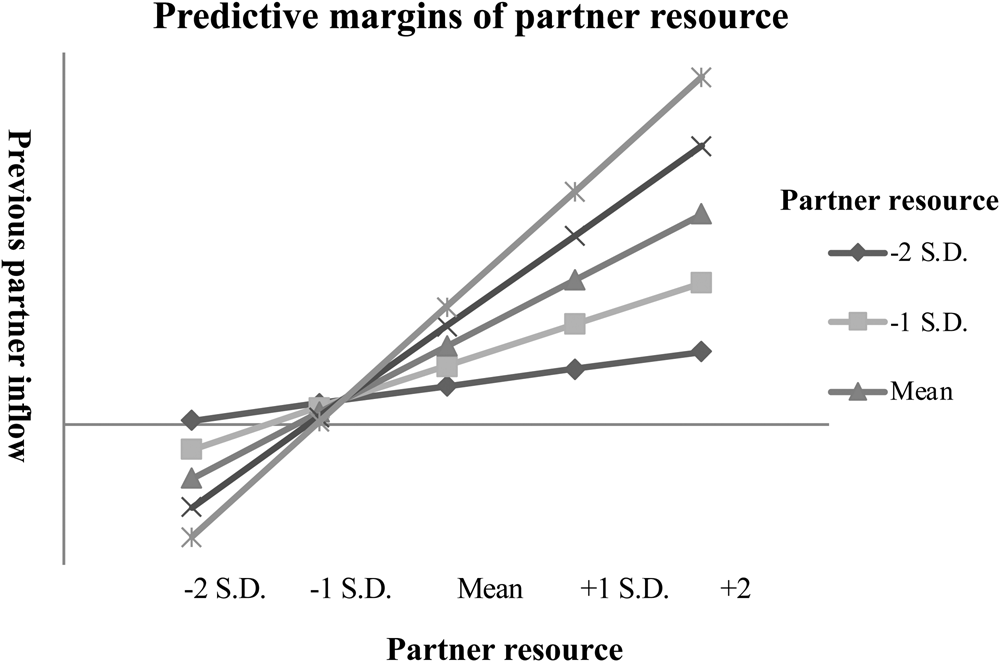
We find negative and significant moderating effects of partner resources on the relationship between partner repeatedness and active partner outflow (Table 4, Model 3, β = −0.158, p < 0.05; Model 5, β = −0.197, p < 0.01; Cohen's r = −0.25). We plot the interaction effect in Figure 1. Partner resources have a positive and significant moderating effect on the relationship between partner repeatedness and previous partner inflow (Table 6, Model 3, β = 0.105, p < 0.05; Model 5, β = 0.098, p < 0.05; Cohen's r = 0.171). We plot the interaction effect in Figure 2. However, we find partner resource have an insignificant moderating effect on the relationship between partner repeatedness and new partner inflow (Table 5, Model 3, β = −0.091, p > 0.1; Model 5, β = −0.052, p > 0.1; Cohen's r = −0.074). Thus, we find statistical significance and meaningful effect sizes in support of H2a and H2c, but not H2b.
The moderating role of partner resource on the relationship between partner repeatedness and active partner outflow

The moderating role of partner resource on the relationship between partner repeatedness and previous partner inflow

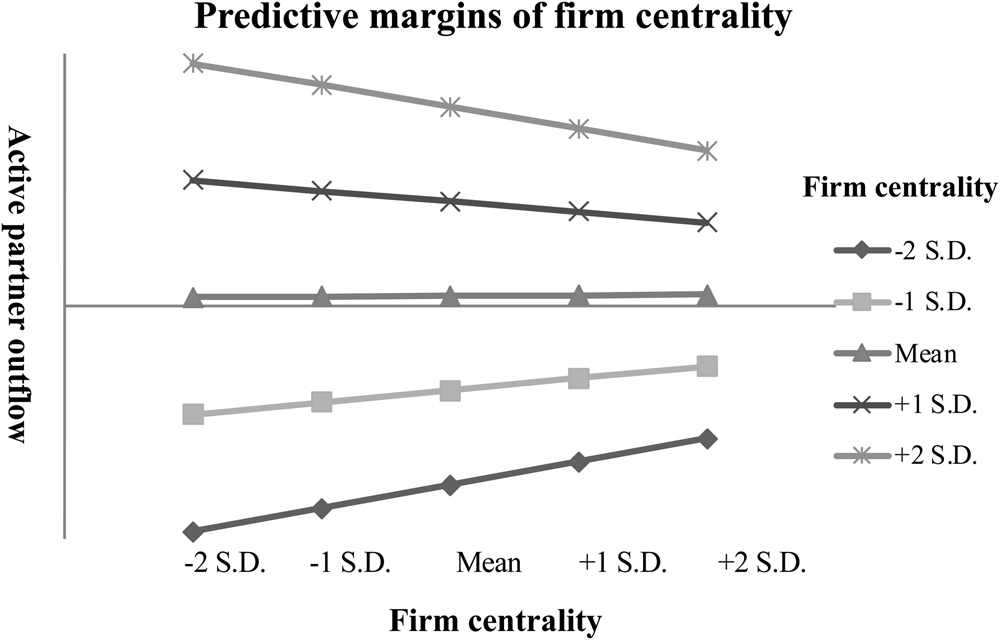
Related to the moderating effects of firms' centrality in their industries, the results show that firm centrality negatively and significantly moderates the relationship between partner repeatedness and active partner outflow (Table 4, Model 4, β = −0.267, p < 0.05; Model 5, β = −0.195, p < 0.05; Cohen's r = −0.105). We plot the interaction effect in Figure 3. Firms' centrality positively and significantly moderates the relationship between partner repeatedness and new partner inflow (Table 5, Model 4, β = 0.301, p < 0.01; Model 5, β = 0.275 p < 0.01; Cohen's r = 0.227). We plot the interaction effect in Figure 4. However, we find firms' centrality produces an insignificant moderating effect on the relationship between partner repeatedness and previous partner inflow (Table 6, Model 4, β = −0.118, p > 0.1; Model 5, β = −0.049, p > 0.1; Cohen's r = 0.069). Thus, we find statistical significance and meaningful effect sizes in support of H3a and H3b but not H3c.
The moderating role of firm centrality on the relationship between partner repeatedness and active partner outflow

The moderating role of firm centrality on the relationship between partner repeatedness and new partner inflow

In China's fund product market, there is no upper limit on the number of bank partners when a fund firm issues a fund product. As such, there is not a strong crowding-out effect that may lead to negative correlation between reconfiguration strategies (of course a fund firm cannot select infinite partners due to limited resources). Because we added other two reconfiguration strategies as controls when we examined how partner repeatedness affects a specific reconfiguration strategy, our results also shed some light on how the three strategies are correlated. First, our results show new or previous partner inflow has a negative effect on active partner outflow. Firms tend to reconfigure alliances with a high level of partner repeatedness to mitigate negative effects, but reserve benefits related to a high level of partner repeatedness. Thus, if the firm introduce new partners (regardless of previous collaboration experience), the negative effect of partner repeatedness is alleviated. Therefore, dropping active partners is not necessary when reconfiguring current alliances, as new partners can offset the negative consequence of partner repeatedness.
We also found a positive effect of previous partner inflow on new partner inflow. We argue that if the fund firm introduces more previous partners, existing partners believe that the fund firm prefers previous collaboration experience. Then, the negative impact of new partner inflow on the confidence of current partners in the continuity of their collaborations with the fund firm is partially buffered. At that time, the fund firm is more able to use new partner inflow to reconfigure their alliances. This may also explain the positive effect of new partner inflow on previous partner inflow, as the latter can buffer the negative impact of the former in preserving the benefits of partner repeatedness. Thus, focal firms may use new partner inflow and previous partner inflow as complements in alliance reconfiguration.
Our empirical results also reveal a negative effect of active partner outflow on previous partner inflow. An explanation might be that an increased number of partner outflow implies that the fund firms are engaging in increased efforts to adjust their existing alliances. In the scenario, it is less necessary for firms to take a conservative approach (in a term of preserving the benefits of current alliances) to selecting previous partners, leading to previous partner inflow being less important in alliance reconfiguration. Similarly, if focal firms can directly drop active partners, the downside of repeatedness is significantly alleviated, meaning that firms are less likely to need to introduce new and unfamiliar partners to attenuate their alliance, which means the remaining partners more likely to worry about whether their collaboration can be maintained (Zhelyazkov & Gulati, Reference Zhelyazkov and Gulati2016). This attitude may reduce trust and reciprocity between the remaining partners toward the fund firms, leading to a reduction in the benefits associated with repeatedness.
Robustness Checks
Three sets of analyses are performed to verify the robustness of the main findings. First, we measured the independent variable and several of our controls alternatively. We included quarter dummy variables to capture temporal variations affecting the industry in place of the variables that only vary with time but remain identical across fund firms (e.g., market size, market uncertainty, market new fund number). The results of this hierarchical Poisson model were the same. Results were also the same when we used the number of existing partner linkages as an alternative measure of firm centrality. To eliminate the influence of crisis years, we excluded the global financial crisis in 2008 from all samples and conducted model regression. The results remained consistent and unchanged. Given that memory fades, earlier collaboration experience may produce weaker effects than recent past partnerships on current collaborations. We used 3-, 4-, 5-, and 6-year time windows dating up to the issuance of fund product t–1 to create alternate measures of partner repeatedness that consider only more recent prior collaborations and re-tested the hypotheses. The results were consistent with our main findings, indicating the robustness of our findings. To further alleviate the concern that lasting alliances may affect how fund firms reconfigure their alliances to distribute new fund products, we re-tested our predictions by excluding the alliance built for fund t–1. In other words, we test how partner repeatedness in the alliance of fund t–2 affects firms' reconfiguration for fund t. By expanding the time lag of two alliances, we hope the influence of lasting alliance on current reconfiguration strategies is reduced. The results are consistent.
Second, we alternatively measure alliance reconfiguration strategies as a ratio value to test our hypotheses. Noting the skewed distribution, we recoded the ratio of partner selection into six categories (1 = no outflow or inflow, 2 = between 0% (excluded) to 20% (included), 3 = between 20% (excluded) to 40% (included), 4 = between 40% (excluded) to 60% (included), 5 = between 60% (excluded) to 80% (included), 6 = between 80% (excluded) to 100% (included)). Then we tested the hypothesis with these alternative measures for the dependent variable using two-level hierarchical Poisson models and found empirical results that match those we obtained with count measures. We also recoded the ratio of partner selection into four categories (1 = no outflow or inflow, 2 = between 0% (excluded) and 25% (included) of total shares, 3 = between 25% (excluded) and 50% (included), 4 = greater than 50% (excluded)). The results of this hierarchical Poisson model remain mostly unchanged, except that the moderating effect of firm centrality on partner repeatedness and previous partner inflow became significantly negative.
Third, we tested our model by taking advantage of the time-series structure of our observations. Consistent with econometric theory, with panel data, either a fixed- or random-effects specification may alleviate the concerns brought about by unobservable heterogeneity (Greene, Reference Greene2000). Because a Hausman test cannot identify the appropriate specification of models that cluster standard errors, we alternatively used the xtoverid command in Stata (Schaffer & Stillman, Reference Schaffer and Stillman2016), which can cluster standard errors properly. The Sargan-Hansen statistics recommends a fixed effect specification because the extra restrictions imposed by random effects are rejected. When we applied the fixed effects Poisson with robust bootstrapped panel clustered standard errors, we obtained results similar to those generated by hierarchical Poisson models. Additionally, we also estimate our model using a fixed effects negative binomial model to control for serial correlation and overdispersion. The result remains unchanged from the estimations from hierarchical Poisson models.
Fourth, we changed the measure of previous partner inflow. We excluded prior partners in fund t–2 from the alliance, and the result remains unchanged, further demonstrating that firms may deliberately rotate their previous partners when forming future alliances to mitigate their reliance on specific distributors.
Additional Analysis
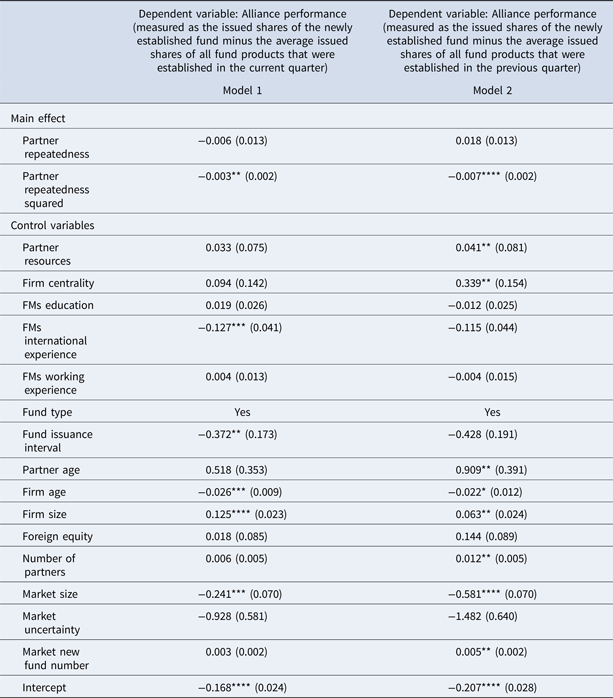
The logic of our hypotheses assumes that as the level of partner repeatedness goes up, the negative effect of partner repeatedness outweighs its positive effect. To verify this assumption, we also tested the influence of partner repeatedness on the performance of the overall alliance. The amount of distributed shares is a salient measure of alliance performance, as new open-ended fund products are always distributed at a price of 1 Chinese yuan per share. Thus, the financial value of issued shares is equal to the number of shares issued. We used two adjusted measurements of alliance performance. First, the alliance performance was measured as the issued shares by the newly established fund minus the average issued shares of all fund products that were established in the current quarter (Table 7, Model 1). Second, we captured alliance performance by the issuance of shares of the newly established fund minus the average issuance of shares of the fund products that were established in the previous quarter (Table 7, Model 2). We also visualize the relationship between partner repeatedness and alliance performance in the following Figure 5.
Hierarchical models with robust standard errors of partner repeatedness and alliance performance

Notes: n (firms) = 58; n (observations) = 571; numbers in parentheses are standard errors. *p < 0.1, **p < 0.05, ***p < 0.01, ****p < 0.001; One-tailed tests for hypothesized and two-tailed tests for control variables.
The relationship between partner repeatedness and alliance performance (a) Alliance performance measured as the issued shares of the newly established fund minus the average issued shares of all fund products that were established in the current quarter (b) Alliance performance measured as the issued shares of the newly established fund minus the average issued shares of all fund products that were established in the previous quarter

Discussion
Contributions
To further our understanding of firms' strategies to reconfigure their alliances, we leveraged the resource reconfiguration perspective, specifically examining how partner repeatedness affects three distinct alliance reconfiguration strategies. We found that higher levels of partner repeatedness makes firms more likely to reconfigure their alliances by re-introducing previous partners rather than adding new partners or dropping active partners, all else being equal. However, if current partners possess rich resources, a high level of partner repeatedness triggers more previous partner inflow but less active partner outflow, as firms seek to maximize the positive aspects of partner repeatedness. We also found that if firms occupy a more central position in their industry, they tend to reconfigure alliances featuring a high degree of partner repeatedness, not by dropping active partners, but instead by adding new partners, as such firms are less concerned about the downsides of new partners and can focus instead on the positive upsides they may add to the alliance.
Our findings made four contributions. First, we challenge the view that repeated ties between firms and their alliance partners will inherently become self-reinforcing and persistent due to the forces of inertia, reducing the likelihood of firms reconfiguring alliances (Gulati & Gargiulo, Reference Gulati and Gargiulo1999). With insights from the resource reconfiguration perspective (Karim & Capron, Reference Karim and Capron2016), we found that firms, in fact, have more agency than the extant literature has generally acknowledged, as performance pressures may reach a point where firms are triggered to proactively reconfigure their alliances rather than allow them to become static. These findings differ from the research conceptualizing alliance reconfiguration as an endogenous, path-dependent process in which firms tend to repeatedly collaborate with existing partners and not withdraw from active alliances (Ghosh et al., Reference Ghosh, Ranganathan and Rosenkopf2016; Gulati, Reference Gulati1995; Gulati & Gargiulo, Reference Gulati and Gargiulo1999). Instead, our study contributes insights into the drivers behind firms' decision to actively change the configuration of alliances, an under-studied area within the literature about firms' strategies in alliance management (Kavusan & Frankfort, Reference Kavusan and Frankfort2019; Tang & Rai, Reference Tang and Rai2012).
Second, our study adds further insights into how firms implement reconfiguration decisions where alliances feature a high degree of partner repeatedness. Going beyond studies undertaken at a dyadic alliance level that focus on whether partner repeatedness leads to the continuity or termination of individual existing alliances (Ghosh et al., Reference Ghosh, Ranganathan and Rosenkopf2016; Gulati & Gargiulo, Reference Gulati and Gargiulo1999; Hoetker, Reference Hoetker2005; Xia, Reference Xia2011), researchers have argued for the need to examine strategies that are more salient at the alliance level of analysis, such as, adding new partners or new resources (Asgari et al., Reference Asgari, Singh and Mitchell2017; Kavusan & Frankfort, Reference Kavusan and Frankfort2019). Responding to this call allows us to take a broader perspective and consider that firms may establish alliances with previous partners, an option that has not been adequately explored in the literature. Considering previous partner inflow is an important contribution to research in this area, as our analysis reveals that establishing alliances with previous partners appears to be firms' preferred alliance reconfiguration strategy under high levels of partner repeatedness, more so than introducing new partners or terminating alliance relationships with existing partners.
We reason that this preference stems from the trade-off that firms face between preserving the positive effects, and mitigating the negative effects, of partner repeatedness: while new partner inflow and active partner outflow can effectively mitigate the negative effects of partner repeatedness, they are less effective at preserving its positive effects. In contrast, re-adding previous partners entails moderate efficacies in both aspects, with relatively small downside risk. The alliance literature debates whether firms become less motivated to create economic value in embedded ties that come into being through repeated collaborations, or whether they are flexible enough to escape from the forces of embeddedness to optimize the value of alliances (Ghosh et al., Reference Ghosh, Ranganathan and Rosenkopf2016; Greve et al., Reference Greve, Mitsuhashi and Baum2013; Gulati & Gargiulo, Reference Gulati and Gargiulo1999; Jiang et al., Reference Jiang, Xia, Cannella and Xiao2018). Our logic and results imply that in the context of alliances, firms take a holistic view to maximizing the economic efficiency of their alliances (Kavusan & Frankfort, Reference Kavusan and Frankfort2019; Ozcan & Eisenhardt, Reference Ozcan and Eisenhardt2009; Wassmer, Reference Wassmer2010), and attempt to balance the positive and negative effects of partner repeatedness.
Third, this study contributes deeper understanding of the influence of partner repeatedness on alliance reconfiguration by examining contingency factors that affect how firms perceive the strengths and weaknesses of the strategies at their disposal. We first consider how attempts to reconfigure alliances are influenced by the resource richness of existing partners from the alliance. Extant research suggests that ample partner resources should strengthen firms' persistence in repeated alliances, so that these resources can be better exploited (Asgari et al., Reference Asgari, Singh and Mitchell2017; Ozcan & Eisenhardt, Reference Ozcan and Eisenhardt2009). The current research supports this view, showing that firms are less likely to drop active partners in such a context. However, we also argue that firms still need to engage in alliance reconfiguration, even if current partners have abundant resources. Consistent with our logic, we find that rich partner resources also amplify the positive relationship between partner repeatedness and previous partner inflow, as this allows firms to achieve alliance reconfiguration while preserving the positive aspects of partner repeatedness within this context.
Our research also investigates the moderating role of firms' industry centrality. Some scholars have suggested that firms holding a central position in their industry are less constrained by repeated ties as centrality means they are more able to look beyond their current alliances, while others contend that central firms become overly entrenched in repeated alliances because they can better exploit existing ties (Ahuja, Reference Ahuja2000a; Gilsing, Nooteboom, Vanhaverbeke, Duysters, & Van Den Oord, Reference Gilsing, Nooteboom, Vanhaverbeke, Duysters and Van Den Oord2008; Lin et al., Reference Lin, Yang and Demirkan2007). By simultaneously examining how centrality alters the effect of partner repeatedness on the inflow and outflow of various categories of partners, our study addresses this tension in the literature and provides nuanced empirical evidence that supports aspects of both views. Among central firms, a high degree of partner repeatedness might encourage firms to renew existing ties with active partners. However, it may also trigger firms to build collaborations with new partners due to the potential of these firms to enhance innovation, reduce oversocialization, and address other negative effects of repeatedness. These findings contribute to debates on whether a high level of partner repeatedness constrains or promotes alliance reconfiguration by showing the effect may be contingent on how firms are embedded in the broader context of their industries.
Finally, this study adds much needed empirical evidence to the alliance reconfiguration literature. Many studies in this research stream take a qualitative and case study approach, so researchers have called for more large-scale empirical research to examine the theories originated from these case-based studies (Lavie & Singh, Reference Lavie and Singh2012; Maurer & Ebers, Reference Maurer and Ebers2006; Ozcan & Eisenhardt, Reference Ozcan and Eisenhardt2009; Wassmer, Reference Wassmer2010). Several recent works have started to empirically explore drivers behind alliance reconfigurations, while focusing on either formation of new alliances (Jiang et al., Reference Jiang, Xia, Cannella and Xiao2018; Kavusan & Frankfort, Reference Kavusan and Frankfort2019) or dissolution of existing alliances (Cui, Reference Cui2013). While noting the contributions that these studies have made, researchers have argued that studies should simultaneously consider both inflow and outflow of partners to gain a complete picture of firms' strategic options (Kavusan & Frankfort, Reference Kavusan and Frankfort2019; Wassmer, Reference Wassmer2010). Yet, the challenges in doing this have led Wassmer (Reference Wassmer2010: 157) to note that ‘studies that take an alliance perspective and consider both [inflow and outflow] simultaneously are scant’.
Leveraging the context of alliances for fund product distribution, we respond to these calls and examine how partner repeatedness influences both partner inflow and active partner outflow of alliances. In addition, our empirical setting enables us to grasp the alliance history of focal firms, so we can distinguish between newly formed alliances and those with firms having previous collaboration experience. Our empirical results show the importance of making this distinction, as firms do appear to differentiate between active, previous, and new partners, and some types of partners may be more attractive in certain circumstances than in others. These findings contribute to the literature by highlighting the importance of capturing a comprehensive and nuanced picture of firms' distinct approaches with respect to their alliance reconfiguration strategies.
Limitations and Future Research Directions
This study has several limitations, which suggest possible future research directions. First, we argue for different effects of partner repeatedness on three alliance reconfiguration strategies, with the rationale that these strategies have different implications for preserving the positive effects and mitigating the negative effects of partner repeatedness. However, we cannot directly test these mechanisms or directly compare the influences of various reconfiguration strategies on different positive and negative effects vis-à-vis repeatedness. The empirical results offer indirect support for our theoretical predictions, but further research may better understand the micro-foundations underlying the observed effects of partner repeatedness on alliance reconfiguration behaviors, such as by explicitly establishing and testing the mechanisms that influence alliance reconfigurations in the context of partner repeatedness.
Second, we focused on open-ended fund distribution alliances in China as our empirical setting. While the context offers multiple advantages, it may suffer a potential issue of temporal overlap. As a fund firm is often managing multiple fund products at one time, the alliance configuration of a given fund product may be thought of as nested within an alliance of multiple funds managed by the firm. Although the banks in a fund firm's alliance also manage responsibilities like redemption in the post-distribution stage, their most important purpose is distributing new fund products. Thus, in this study, we simplified the temporal overlap issue by focusing only on the initial setup of the alliance (i.e., the distribution phase), as it is rare for a fund firm in China to distribute multiple funds on the same day. However, in the future, scholars should identify other empirical settings to validate our findings in settings where temporal overlap is a larger consideration. In addition, China is undergoing significant institutional transitions, making relational norms and rules especially important for Chinese firms' alliance management practices (Haveman, Jia, Shi, & Wang, Reference Haveman, Jia, Shi and Wang2017; Peng, Reference Peng2003; Poppo et al., Reference Poppo, Zhou and Zenger2008). Future study may turn to other institutional environments to validate the generalizability of our findings.
Third, this study is subject to potential endogeneity issues caused by omitted variables and simultaneity. Hill, Johnson, Greco, and O'Boyle (Reference Hill, Johnson, Greco and O'Boyle2021) suggest four possible causes of endogeneity: (1) omitted variable; (2) simultaneity; (3) measurement error; and (4) selection (of treatment and/or into sample). After reviewing related studies (Bi et al., Reference Bi, Xie and Jin2020, Reference Bi, Xie and Sheng2022; Xie et al., Reference Xie, Zou and Liang2023), we added number of partners, funds launched in that quarter of fund t, fund issuance interval, and amount of fund distributed as controls in our regression to reduce the endogeneity problem caused by omitted variables. In addition, based on the work of Lee, Lee, and Nagarajan (Reference Lee, Lee and Nagarajan2014), we introduced a two-period lag to re-test the predicted relationship between the independent (partner repeatedness) and dependent variables (new partner inflow, previous partner inflow, and active partner outflow) to reduce the endogeneity problem caused by simultaneity. However, due to the limitations of our data, we did not address endogeneity caused by measurement error or selection. Therefore, endogeneity is still a major limitation of this study.
Fourth, even though Chinese funds' customers are small in number compared to the overall number of bank customers, our research conclusions cannot entirely rule out the possibility that fund firms adjust their bank distribution partners to reach different customer groups or to avoid competition between bank partners. Future research should further explore possible alternative explanations and, in doing so, extend our research conclusions.
Conclusion
This research aims to fill a gap in the alliance literature by examining whether and how partner repeatedness triggers alliance reconfiguration. We find that partner repeatedness drives firms to reconfigure their alliances through a preference for previous partner inflow over new partner inflow or active partner outflow, but that these relationships are moderated by the resource richness of current partners and the centrality of focal firms in their industry. In contrast to extant literature, which focuses on an alliance's evolution as being shaped by inertia and path dependence, we find evidence that firms can proactively reconfigure their alliances, overcoming inertia to address concerns that high levels of partner repeatedness are hampering alliance performance.
Data availability statement
The data that support the findings of this study are available from the corresponding author, Jingyu Bi, upon reasonable request.
Acknowledgment
This study was supported by the National Natural Science Foundation of China [Project No.72372117], awarded to the first author, and by another grant from the National Natural Science Foundation of China [Project No. 72202173], awarded to the corresponding authors.
En Xie (xieen@tongji.edu.cn) is a professor at the Advanced Institute of Business at Tongji University, China. His research interests include international business (IB) in emerging markets, strategy alliance, and innovation. His publications appear in high quality academic journals, such as Strategic Management Journal, Journal of the Academy of Marketing Science, Journal of World Business, and others.
Xuehao Gao (chrisgao@tongji.edu.cn) is a PhD candidate at the Advanced Institute of Business at Tongji University, China. His research interests include international business (IB) in emerging markets and institutional theory. He also studies the strategy alliance, state owned firms, and performance. He has published in the high quality academic journal Technovation.
Huahua Li (lhh121@tongji.edu.cn) is a PhD candidate at the School of Business Management at Tongji University, China. His research interests include international business (IB) in emerging markets, non-market strategy and digital innovation. He has published his articles in Academy of Management Proceedings.
Jingyu Bi (bijingyu@xjtu.edu.cn) is an assistant professor of School of Public Policy and Administration at Xi'an Jiaotong University, China. Her research interests include strategy alliance in emerging markets, and institutional theory. She also studies the driving factors and performance results of green innovation. Her publications appear in high quality academic journals such as British Journal of Management, Industrial Marketing Management, and others.
Charlie Stevens (charles.stevens@rutgers.edu) is an associate professor and vice chair of the Department of Management and Global Business Department at Rutgers Business School. His research focuses on how institutions and social evaluations influence multinational enterprises' strategy and performance. He has published in top journals, including Strategic Management Journal, Journal of International Business Studies, Journal of Operations Management, and Journal of Management, and serves on the editorial boards of several journals, such as Academy of Management Journal.