Introduction
An important question in understanding the origins of pathological human violence is to clarify the nature, origins and magnitude of familial–environmental contributions to individual differences. Genetic epidemiological research has addressed this issue through an examination of criminality using a variety of methodological designs (Lange, Reference Lange1929; Rosanoff et al. Reference Rosanoff, Handy and Plesset1934). Twin and adoption studies have suggested that genetic factors contribute substantially to the etiology of a range of antisocial behaviors (Rhee & Waldman, Reference Rhee and Waldman2002) and particularly criminal offending (Lange, Reference Lange1929; Rosanoff et al. Reference Rosanoff, Handy and Plesset1934; Crowe, Reference Crowe1972; Christiansen, Reference Christiansen and Hood1974; Dalgard & Kringlen, Reference Dalgard and Kringlen1976; Bohman, Reference Bohman1978; Gabrielli & Mednick, Reference Gabrielli and Mednick1984; Mednick et al. Reference Mednick, Gabrielli and Hutchings1984). In their meta-analysis, Rhee & Waldman (Reference Rhee and Waldman2002) estimated that 16% of the variance in liability to antisocial behaviors resulted from environmental influences shared by siblings. In a recent national Swedish adoption study of violent criminal behavior (VCB), we found that genetic risk, indexed by VCB and other externalizing disorders in biological parents, and familial environmental risk, indexed by divorce, death and low educational status of the adoptive parents, both contributed meaningfully to risk for VCB in the adoptee (Kendler et al. Reference Kendler, Lönn, Morris, Sundquist, Långström and Sundquist2013a ).
Studies using self-report survey data from the general population (Rowe & Britt, Reference Rowe and Britt1991; Rowe & Gulley, Reference Rowe and Gulley1992; Rowe et al. Reference Rowe, Rodgers and Meseck-Bushey1992; Lauritsen, Reference Lauritsen1993; Takahashi & Miczek, Reference Takahashi and Miczek2013) have reported similarity in criminal offending among siblings. Lauritsen (Reference Lauritsen1993) notes that most of these studies report correlations of delinquency involvement among sibling pairs between 0.20 and 0.40. Slomkowski et al. (Reference Slomkowski, Rende, Conger, Simons and Conger2001) examined similarity in sibling self-reported delinquency across four time points. Using data from 164 male and female same-sex sibling pairs, they found significant similarity in self-reported delinquency for both male and female sibling pairs. They also examined the impact of the older sibling's delinquency on the probability of the younger sibling's delinquency and found, for both males and females, evidence that older sibling delinquency predicted delinquency in the younger sibling. They did not examine if this finding held for mixed-sex sibling pairs. Sibling similarity in delinquency and criminal offending has also been found in studies using official measures of criminal offending, such as criminal convictions (Rowe & Farrington, Reference Rowe and Farrington1997). Using data from the Cambridge Study in Delinquency Development, a prospective longitudinal study of approximately 411 boys from London, Rowe & Farrington (Reference Rowe and Farrington1997) found significant similarity in convictions among sibling pairs. In particular, among 344 families, they found that same-sex sibling relationships exhibited stronger similarity than opposite-sex sibling pairs. Research is less consistent regarding sibling similarity across different ages and birth order.
Rowe et al. (Reference Rowe, Rodgers and Meseck-Bushey1992) used nationally representative data on approximately 5863 respondents from the National Longitudinal Survey of Youth (NLSY) to examine similarity with involvement in delinquency across siblings separated by different ages. They found that birth order had no impact on similarity for female–female sibships and mixed-sex sibships; however, for male–male sibships, brothers closer in age were more similar in delinquency involvement than brothers in non-adjacent birth orders. Similarly, Rowe & Gulley (Reference Rowe and Gulley1992) found greater sibling similarity in delinquency among brothers who spent more time together compared to brothers who spent less time together. A related issue is the extent to which there is symmetry in sibling transmission of criminal behavior. Research using data from the Cambridge Study also indicates that the criminal convictions of older siblings have a more influential effect on male criminal offending than those of younger siblings (Farrington et al. Reference Farrington, Barnes and Lambert1996).
In the current study we aimed to further quantify and characterize environmental contribution to sibling resemblance for risk for VCB by examining similarity in criminal convictions among the most common of human relationships, sibling pairs. Using a series of national registries from Sweden linking sibling and criminal conviction data, we examined similarity in criminal offending for all sibling relationships in the entire Swedish population. Our first approach relied on the fact that siblings vary widely in their age differences. Given that peer environment is an important influence on risk for criminal and other externalizing behaviors (Dishion et al. Reference Dishion, Patterson, Griesler and Huesmann1994; Hawkins et al. Reference Hawkins, Herrenkohl, Farrington, Brewer, Catalano, Harachi, Loeber and Farrington1998; Harris, Reference Harris2002; Gordon et al. Reference Gordon, Lahey, Kawai, Loeber, Stouthamer-Loeber and Farrington2004), we hypothesized that the closer siblings are in age, the more likely they are to share their social environment. Our prediction was that, in sibships containing an individual (the proband) with VCB, the risk for VCB in the other siblings would be higher in those closer in age to the proband.
Second, we examined the role of birth order in sibling similarity in criminal convictions. The relationship between older and younger siblings may not be symmetrical as older siblings typically have considerably more influence over their younger siblings than vice versa (Lamb & Sutton-Smith, Reference Lamb and Sutton-Smith1982; Brook et al. Reference Brook, Whiteman, Gordon and Brenden1983; Newman, Reference Newman1991; Brody, Reference Brody1998; Slomkowski et al. Reference Slomkowski, Rende, Conger, Simons and Conger2001). We therefore predicted that, in sibships with a proband who eventually commits a violent criminal act, the risk for VCB would be higher in the younger than older siblings. We also extended this area of research by conducting both analyses examining male and female same-sex and mixed-sex sibling pairs.
Our intention was that these analyses would contribute to a better understanding of the social transmission of violent behaviors and eventually facilitate the development of more effective prevention strategies.
Method
As outlined in detail elsewhere (Kendler et al. Reference Kendler, Lönn, Morris, Sundquist, Långström and Sundquist2013a ), we linked comprehensive register and health-care data from multiple nationwide Swedish sources to form a research dataset using the unique individual Swedish 10-digit personal ID number assigned at birth for all residents for their lifetime. Our dataset contained three sources:
-
(1) The Multi-Generation Register provided information on family relationships for individuals born in Sweden after 1932 and corresponding information for immigrants who became citizens of Sweden before age 18 years together with one or both parents.
-
(2) The Total Population Register contained annual data on family and geographical status in 1985–2009.
-
(3) The Swedish Crime Register included complete national data on all convictions in lower courts, from 1973 to 2011.
Following Frisell et al. (Reference Frisell, Lichtenstein and Långström2011), VCB was identified from the Crime Register using the following criminal convictions (numbers within parentheses are law chapter and paragraph): (aggravated) assault (3:5, 3:6); illegal threat (4:5); threats and violence against an officer (17:1, 17:2); intimidation (4:7); (aggravated) robbery (8:5, 8:6); illegal coercion (4:4); kidnapping (4:1); illegal confinement (4:2); gross violation (4:4A); (aggravated) arson (13:1, 13:2); murder, manslaughter or filicide (3:1, 3:2, 3:3); and sexual crimes (excluding prostitution and the buying of sexual services but including child pornography: 6:1–6:10, 6:12, 16:10A).
Sample
Full sibling pairs were identified from the Multi-Generation Register. Twins and individuals born before 1950 and after 1991 were excluded, and the study population was further constrained to individuals alive at least 5 years during the time period covered by the Crime Register.
Statistical analyses
We conducted two analyses. In the first, looking at age differences in siblings, proband cases were defined as individuals registered for VCB from 1973 to 2011, who had at least one non-twin full sibling. Five control probands were chosen randomly among sibling pairs, and were not registered for VCB. Controls were matched to cases based on year of birth, gender, region of birth, and educational attainment at the year of the crime. If educational attainment was not assessed that year then it was not part of the matching.
Analyses were conducted using conditional logistic regression with risk for VCB in the siblings of the case versus control probands as the dependent variable, and the age difference between the sibling and the proband as the main predictor variable. In such a matched design it is only possible to estimate the difference in effect of the matching variables comparing cases to controls. We examined linear and quadratic effects for this age difference, whether the sibling was older or younger than the proband, sex of proband, and sex of sibling; and we also allowed the effect of age difference to depend on sex composition of the pair.
Our second set of analyses examined the difference in risk in being a younger versus older sibling of a proband with VCB. From these analyses, we selected all pairs where at least one individual, defined as our proband, had VCB and had a date of when the first registered violent crime was committed. For sibling pairs where both had VCB, the individual who had committed a crime first was selected as the proband and the second as the sibling.
Because of right censoring, we used a Cox proportional hazard regression with VCB in the sibling as the outcome. The key predictor was a dummy variable that defined whether the proband was younger or older than the sibling. Control variables included: linear and quadratic effects of age difference between the sibling and the proband; the gender of the proband and of the sibling; birth cohort and relevant interactions.
Results
Risk for VCB in siblings as a function of their age difference
We identified 273 615 proband full sibling pairs where the case was registered with VCB (mean age 42.2 years, s.d. = 11.2, 88.6% male) and 1 368 075 matched control proband sibling pairs. As expected, VCB was substantially more common in the siblings of the case versus control probands [16.1% v. 4.8%; odds ratio (OR) 2.75, 95% confidence interval (CI) 2.70–2.79]. We fitted a conditional logistic regression model predicting the risk for VCB in the siblings of case versus control probands as a function of the proband–sibling age difference.
The best-fit model examined for effects of age differences between sib pairs when the proband had VCB compared to when the proband did not, along with the effects of the older versus younger relationship among the sib pair and the resemblance of VCB within female–female, male–female and female–male pairs (compared to male–male pairs). This model contained a significant linear effect of age differences (0.974, 95% CI 0.970–0.978); that is, for each year of age difference, the risk for VCB in the sibling of a case versus control proband declined by 2.6%. This figure is exponentiated so a difference in sibling age of 10 years would equal a decrease in VCB risk of 1–0.97410 = 23.2%. No significant quadratic effect of the age difference was seen.
Risk for VCB in older versus younger siblings of a proband with VCB
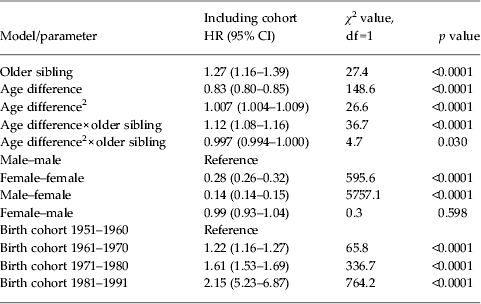
We identified 247 058 full sibling pairs with at least one proband sibling registered for VCB. Our Cox model predicted the hazard ratio (HR) for VCB in siblings of the registered proband. We fitted an increasingly complex series of models and focused on the model that controlled for the linear and quadratic effects of age difference, the interaction between age difference and older versus younger status, the gender composition of the sibling pair, and birth cohort (Table 1). Controlling for all these parameters, the risk for VCB was significantly greater when the proband was older than when the proband was younger. In addition, there were significant positive linear and negative quadratic interaction effects with the age difference and older versus younger sibling affection status. Thus, the effect of having an older versus younger affected sibling on the proband's risk for VCB became stronger with increasing age difference (HR 1.4, 2.1 and 2.9 for a 1-, 5- and 10-year age difference respectively in siblings).
Results from our Cox proportional hazards model for risk for violent criminal behavior (VCB) as a function of whether the sibling with VCB was older versus younger

HR, Hazard ratio; CI, confidence interval; df, degrees of freedom.
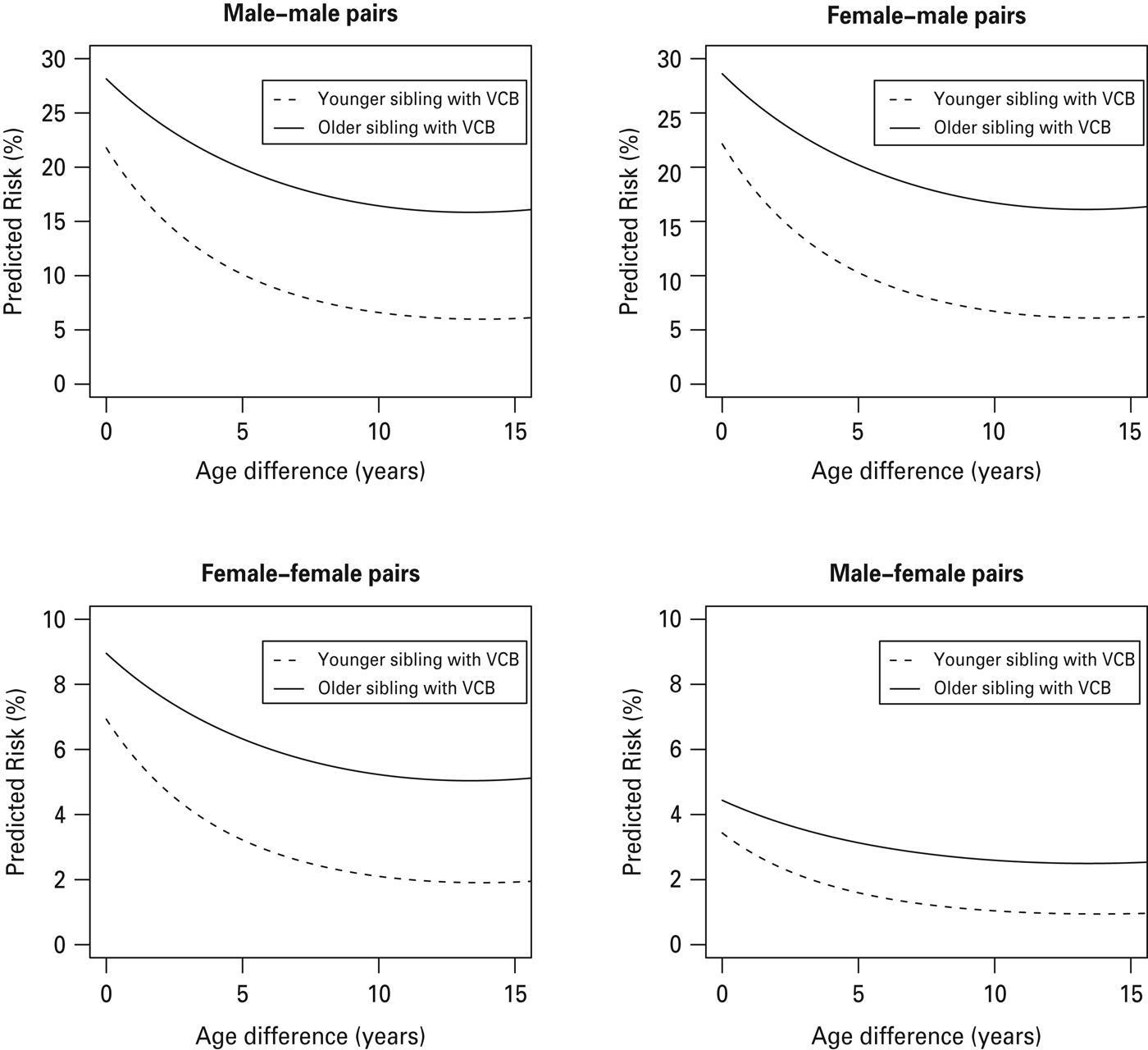
We tested for an interaction on risk for VCB of having an older versus a younger affected sibling on our four sibling-pair sex combinations and these effects were not significant. However, because the base rates for VCB differed so dramatically between the sexes, it was considered better to present our results by gender status of the pairs (Fig. 1).
The cumulative probability of being registered for violent criminal behavior (VCB) over a 20-year follow-up period for siblings where the older versus younger sibling was registered for VCB as predicted from the full Cox model.

Discussion
The aim of this study was to clarify the nature of shared environmental influences on VCB in siblings. Thus, we sought to examine possible psychological mechanisms that might underlie the latent variable ‘shared environment’ that has been shown to have a significant impact on risk for antisocial behavior (Rhee & Waldman, Reference Rhee and Waldman2002). The underlying logic of our approach was to control for genetic resemblance by examining only full sibling pairs. Consistent with prior evidence (Lauritsen, Reference Lauritsen1993; Rhee & Waldman, Reference Rhee and Waldman2002), we found substantial familial aggregation of VCB in sibling pairs with an OR of 2.75. We then examined, as instrumental variables, two fixed features of the sibling relationship: the years of age difference and the older–younger relationship. We found in both cases a systematic effect on sibling resemblance for VCB. Starting with a proband with VCB, the probability that their sibling would also have VCB was greater if the two siblings were closer versus more distant in age to one another. The overall effects were modest, with a reduction in risk of 2.6% for each increasing year of age difference. Furthermore, controlling for a range of relevant background factors, including age differences, a sibling's risk for VCB was greater if their older sibling had VCB than if their younger sibling had VCB. Here the effect was larger, with an OR of 1.4, 2.1 and 2.9 for a 1-, 5- and 10-year difference respectively. Of note, despite the large gender differences in rates of VCB, we found no difference in the older–younger sibling effect as a function of sex-combination of siblings. However, follow-up analyses showed that, compared to male–male pairs, there was a slightly more rapid decline as a function of age difference in female–female and female–male, but not male–female, sib pairs. Both of these results provide potential insight into the social mechanisms that underlie the shared environment previously found for criminal and other antisocial behaviors (Rhee & Waldman, Reference Rhee and Waldman2002; Ferguson, Reference Ferguson2010).
Social learning theory (Bandura & Huston, Reference Bandura and Huston1961) may be a potentially suitable theory to situate these findings. Social learning predicts that the potency of a role model depends on the strength of the identification of the subject with the model. Thus, sibling effects should be greater when sibling pairs are closer in age and more likely to interact with one another. Because older siblings tend to exert more influence on younger siblings than vice versa, the risk for VCB should be greater when the older sibling has VCB compared to the younger sibling. However, it is not just mere closeness in age but rather the nature of the sibling relationship that often occurs when siblings are closer in age. This approach is also referred to as ‘the partners in crime’ theory (Rowe & Gulley, Reference Rowe and Gulley1992; Slomkowski et al. Reference Slomkowski, Rende, Conger, Simons and Conger2001). Increased social learning and association with deviant peers, along with increased feelings of attachment, are more likely to occur among sibling pairs closer in age. Indeed, Rowe & Gulley (Reference Rowe and Gulley1992) found that qualities of the sibling relationship influenced the extent to which siblings were similar. Siblings who reported feeling warm and positive towards one another and having mutual friends were more similar. Similar to our results, West & Farrow (Reference West and Farrow1977) found that between-sibling similarity in delinquency was most pronounced among siblings who were close in age. Slomkowski et al. (Reference Slomkowski, Rende, Novak, Lloyd-Richardson and Niaura2005) found that self-reported ‘social connectedness’ between adolescent sibling pairs predicted sibling similarity in self-reported smoking over time. Siblings closer in age are more likely to interact and thus stronger modeling and attachment may occur between siblings closer in age. However, it is also important to note that the risk for transmission from sibling to sibling varies by age difference. The risk of VCB declines for every 1-year age difference until siblings are separated by approximately 10 years, at which point there is no benefit of increasing age differences.
We have conducted similar analyses for drug abuse in Sweden ascertained from medical, legal and pharmacy records (Kendler et al. Reference Kendler, Ohlsson, Sundquist and Sundquist2013b ) and it is therefore of interest to compare the findings. The best-fit model for age differences in sibling resemblance for drug abuse was much more complex than that found in the current study, with a linear, quadratic and cubic function (Kendler et al. Reference Kendler, Ohlsson, Sundquist and Sundquist2013b ). The model predicted a stronger decline in sib resemblance for drug abuse than we saw for VCB for age differences of 5 years or less. For larger age differences in sibling pairs, resemblance was more strongly impacted for drug abuse than for VCB but the magnitude of this difference was modest. The results were broadly similar for the impact of having an affected older versus younger sibling. Although the best-fit Cox models were not identical for the two phenotypes, the overall impact was broadly similar for the two phenotypes (Kendler et al. Reference Kendler, Ohlsson, Sundquist and Sundquist2013b ).
Limitations
These results should be interpreted in the context of five potentially important methodological limitations. First, this study was confined to one Scandinavian country and only further research can determine whether the findings would generalize to other cultural and ethnic groups. However, our findings generally mirror previously reported findings from studies using samples from other countries, including the USA.
Second, the Swedish Crime Register contains only data on criminal convictions. As elsewhere, in Sweden, a majority of crimes are not officially reported or do not result in a conviction. In the 2008 National Swedish Crime Victim Survey, the proportion of crimes reported to the police ranged from 14% for sexual offenses to 55% for serious assaults (Swedish National Council for Crime Prevention, 2008). Bias might arise if the probability that a committed crime is reported, or that a reported crime leads to a conviction, differs across social strata or families.
Third, these analyses focused on within-sibling comparisons and did not consider other environmental influences such as neighborhood effects. These will be considered in future publications.
Fourth, we examined only VCB. A meta-analysis by Burt (Reference Burt2009) suggested that shared environmental influences were likely to be greater for ‘rule-breaking’ than for violent antisocial behavior. By studying only VCB, we may have underestimated the effects of the environmental transmission of criminal behavior among siblings.
Fifth, our data did not allow us to examine the exact causal mechanisms that underlie the process in which older siblings transmit VCB to younger siblings, as in previous studies examining the quality of the sibling relationship. Nonetheless, our findings contribute to the literature by examining sibling similarity in serious VCB and the risk of transmission of VCB between siblings among both same-sex and mixed-sex siblings.
Conclusions
Controlling for genetic effects by examining only full siblings, we have shown, using two different methods, the importance of familial–environmental influences on VCB. First, sibling resemblance for risk for VCB was significantly greater in pairs closer versus more distant in age. Second, older siblings more strongly transmitted risk for VCB to their younger siblings than vice versa. These results confirm prior latent variable analyses showing an important impact of family environment on VCB (Rhee & Waldman, Reference Rhee and Waldman2002). More importantly, our results begin to demonstrate specific mechanisms of familial transmission, information that might be of help in planning for prevention and treatment programs.
Acknowledgments
This project was supported by the Ellison Medical Foundation, the Swedish Research Council (K2012-70X-15428-08-3 to K.S. and 2012-2378 to J.S.), the Swedish Research Council for Health, Working Life and Welfare (Reg. no: 2013-1836 to K.S.), and ALF funding from Region Skåne (to J.S. and K.S).
Declaration of Interest
None.