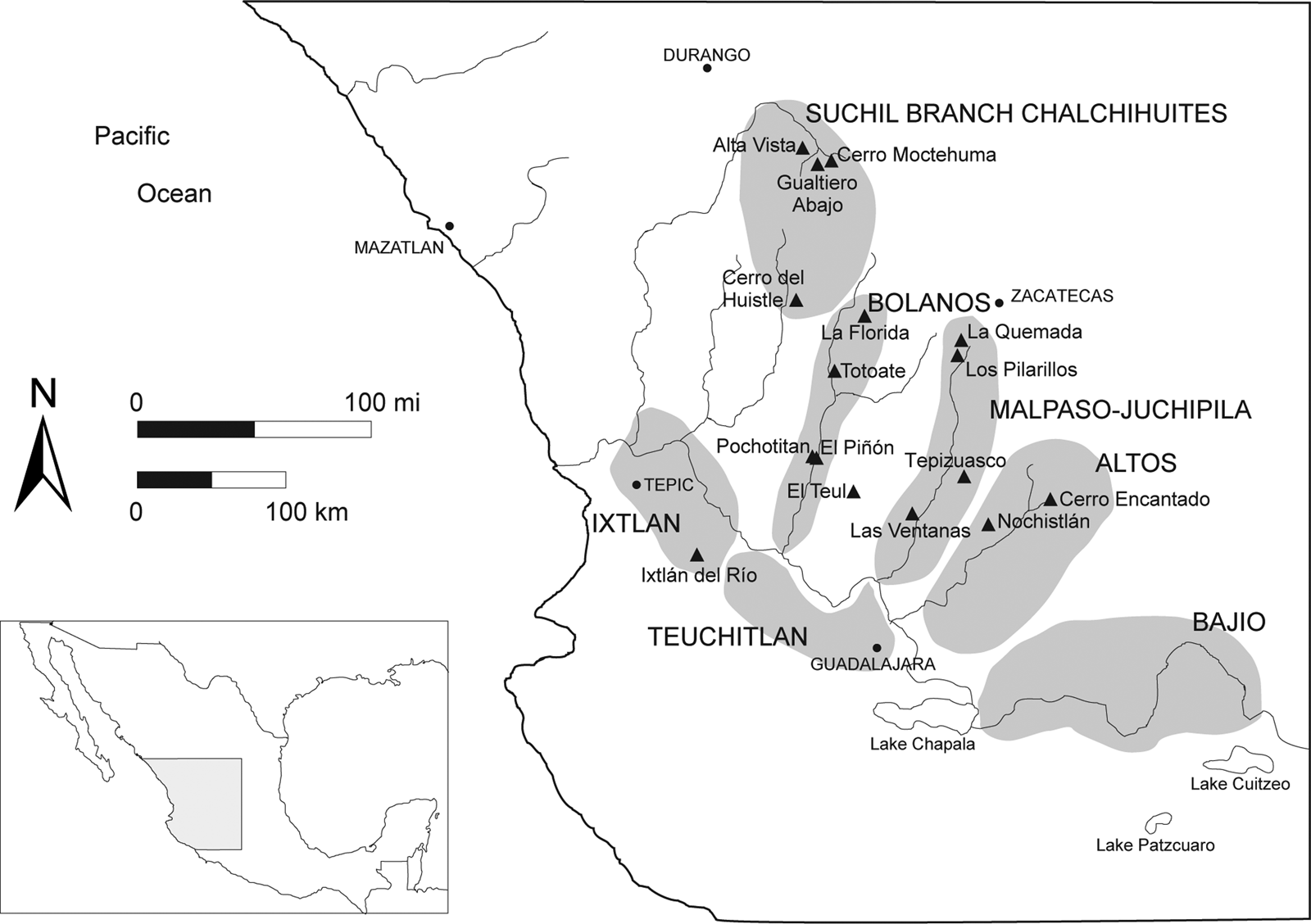
The Epiclassic (AD 600–900) northern frontier of Mesoamerica—corresponding roughly to the modern Mexican states of Zacatecas, Jalisco, Durango, Sinaloa, Nayarit, and Aguascalientes—consisted of a series of polities distributed along river valleys that feed southward into the Lerma-Santiago drainage and westward to the Pacific Coast (Figure 1). Many scholars have emphasized the northward extension of Mesoamerican styles and symbols as defining characteristics of a frontier that developed in reaction to processes originating in the Mesoamerican core (e.g., Aveni et al. Reference Aveni, Hartung and Charles Kelley1982; Braniff Reference Braniff1989; Jiménez Moreno Reference Jiménez Moreno1959; Kelley Reference Kelley and Willey1956; Weigand Reference Weigand1978a, Reference Weigand1978b). In fact, early explanations of the sociopolitical development of the northern frontier region focused on colonization by Central Mexican polities, such as Teotihuacan or Tula (e.g., Hers Reference Hers1989; Kelley Reference Kelley, Ekholm and Bernal1971, Reference Kelley and Bell1974; Weigand et al. Reference Weigand, Harbottle, Sayre, Earle and Ericson1977), or improved climate conditions that allowed agricultural societies to migrate northward (Armillas Reference Armillas1964, Reference Armillas1969).
Northern frontier polities and major sites dating to the Epiclassic period (AD 600–900). Adapted from Nelson (Reference Nelson and Hegmon2001).

As such interregional perspectives continue to develop theoretically and empirically (e.g., Braniff and Hers Reference Braniff and Hers1998; Jimenez Reference Jimenez2018), archaeological research has also revealed a complicated picture of social dynamics among the frontier polities themselves (Foster and Gorenstein Reference Foster and Gorenstein2000; Jimenez and Darling Reference Jimenez, Andrew Darling, Foster and Gorenstein2000). Such interactions involved the intersite exchange of obsidian (Darling Reference Darling1993, Reference Darling1998; Millhauser Reference Millhauser1999) and worked shell (Jimenez Reference Jimenez, Dahlgren and Soto de Archaveleta1995), violence or ancestor veneration in the form of differentially arranged displays of human remains (Cabrero García Reference Cabrero García1995; Nelson and Martin Reference Nelson and Martin2015; Pijoan and Mansilla Reference Pijoan, Mansilla and Sodi Miranda1990), and built spaces for processions, for large gatherings, and in recognition of astronomical alignments (Aveni et al. Reference Aveni, Hartung and Charles Kelley1982; Lelgemann Reference Lelgemann1992, Reference Lelgemann1997; Medina González Reference Medina González2000; Nelson Reference Nelson2015). Although situated on the periphery of the Mesoamerican core, the northern frontier is a distinct social setting that requires diachronic investigation at both the interregional and intraregional scales to form a comprehensive understanding of regional sociopolitical dynamics.
Beginning in the 1980s, research conducted by the La Quemada-Malpaso Valley Archaeological Project (LQ-MVAP) has sought to understand the processes involved in the rise, maintenance, and demise of the centers that made up the northern frontier region, focusing particularly on the monumental site of La Quemada in Zacatecas, Mexico. For example, its radiocarbon dating program (Nelson Reference Nelson1997) placed La Quemada primarily within the Epiclassic period. These new dates confirmed what earlier researchers had suspected (Hers Reference Hers1989; Trombold Reference Trombold1990): La Quemada was an Epiclassic settlement and was not driven by Toltec expansion as originally proposed by Weigand (Reference Weigand1978a, Reference Weigand1978b, Reference Weigand1982; Weigand et al. Reference Weigand, Harbottle, Sayre, Earle and Ericson1977). As part of an Epiclassic florescence in the northern frontier region, La Quemada was not simply a byproduct of imperial expansion or resource extraction; instead, northern frontier polities developed through in situ social processes at both localized and intraregional scales.
Although recent research has documented intraregional social dynamics using a variety of material proxies (e.g., Beekman Reference Beekman2010; Darling Reference Darling1998; Jimenez Reference Jimenez, de Lameiras and Weigand1992, Reference Jimenez, Dahlgren and Soto de Archaveleta1995, Reference Jimenez2018; Jimenez and Darling Reference Jimenez, Andrew Darling, Foster and Gorenstein2000; Pomedio et al. Reference Pomedio, Pereira and Fernández-Villanuea2013; Vidal-Aldana Reference Vidal-Aldana2017), questions regarding the timing of and changes in the intensity or directionality of such interactions require greater chronological control for individual sites and across the region. For example, Jimenez's (Reference Jimenez1989, Reference Jimenez, de Lameiras and Weigand1992; Jimenez and Darling Reference Jimenez, Andrew Darling, Foster and Gorenstein2000) peer-polity model infers strong ties between the Malpaso and Chalchihuites polities during the early phase of frontier polity development based on stylistic similarities subjectively observed in the ceramic traditions of these two areas (Kelley Reference Kelley, Ekholm and Bernal1971; Kelley and Kelley Reference Kelley and Kelley1971; Trombold Reference Trombold, Foster and Weigand1985; Weigand Reference Weigand1978a). During a later phase, polities in the Malpaso, Juchipila, and Bolaños Valleys began interacting more intensively, as evidenced by shared architecture, iconography, and overlapping ceramic complexes (Jimenez and Darling Reference Jimenez, Andrew Darling, Foster and Gorenstein2000), as well as interregional exchange networks that involved down-the-line exchange of exotic goods, such as obsidian (Darling Reference Darling1993, Reference Darling1998; Millhauser Reference Millhauser1999). This “pivot to the south” (our term) in the interactions between La Quemada and neighboring polities may have been significant in terms of regional dynamics and the occupational history of the site, but it requires strong chronological anchors for quantitative evaluation.
In this article, we improve the foundation for such research by presenting recent advances in chronology building at the site of La Quemada and discussing the implications of such research on our understanding of social dynamics within this Epiclassic hilltop center. The motivations for the present analysis are twofold: (1) to establish the chronological control necessary to characterize social processes that took place within La Quemada diachronically and (2) to ensure that the occupational history of La Quemada is accurately integrated into the regional chronology of the northern frontier. Ultimately, this research will make it possible to document the social mechanisms through which northern frontier polities interacted with one another, as well as the material manifestations of such processes. It is clear people who resided in different northern frontier centers shared a common ideology, as evidenced by the use of common symbol sets and styles in architecture, pottery, and other material culture, but questions remain. How did the timing of the growth and decline of La Quemada compare to that of other polities within the frontier? To what extent did they interact directly? Who in particular interacted? Did the directionality and intensity of that interaction change during the period of frontier occupation?
We refine the La Quemada chronology by integrating spatially discontinuous excavation units—middens—from across the site with a well-understood stratigraphic sequence of continuous deposits in a residential complex. Using frequency seriation, correspondence analysis, k-means hierarchical clustering, and discriminant analysis, we identify three phases in the occupational history of La Quemada. With the addition of new radiocarbon dates from areas of the site excavated by other researchers, we also use Bayesian modeling to reassess the growth trajectory of La Quemada and to discuss the timing of the occupation of the site within the northern frontier.
La Quemada: Sampling, Excavation, and Stratigraphy
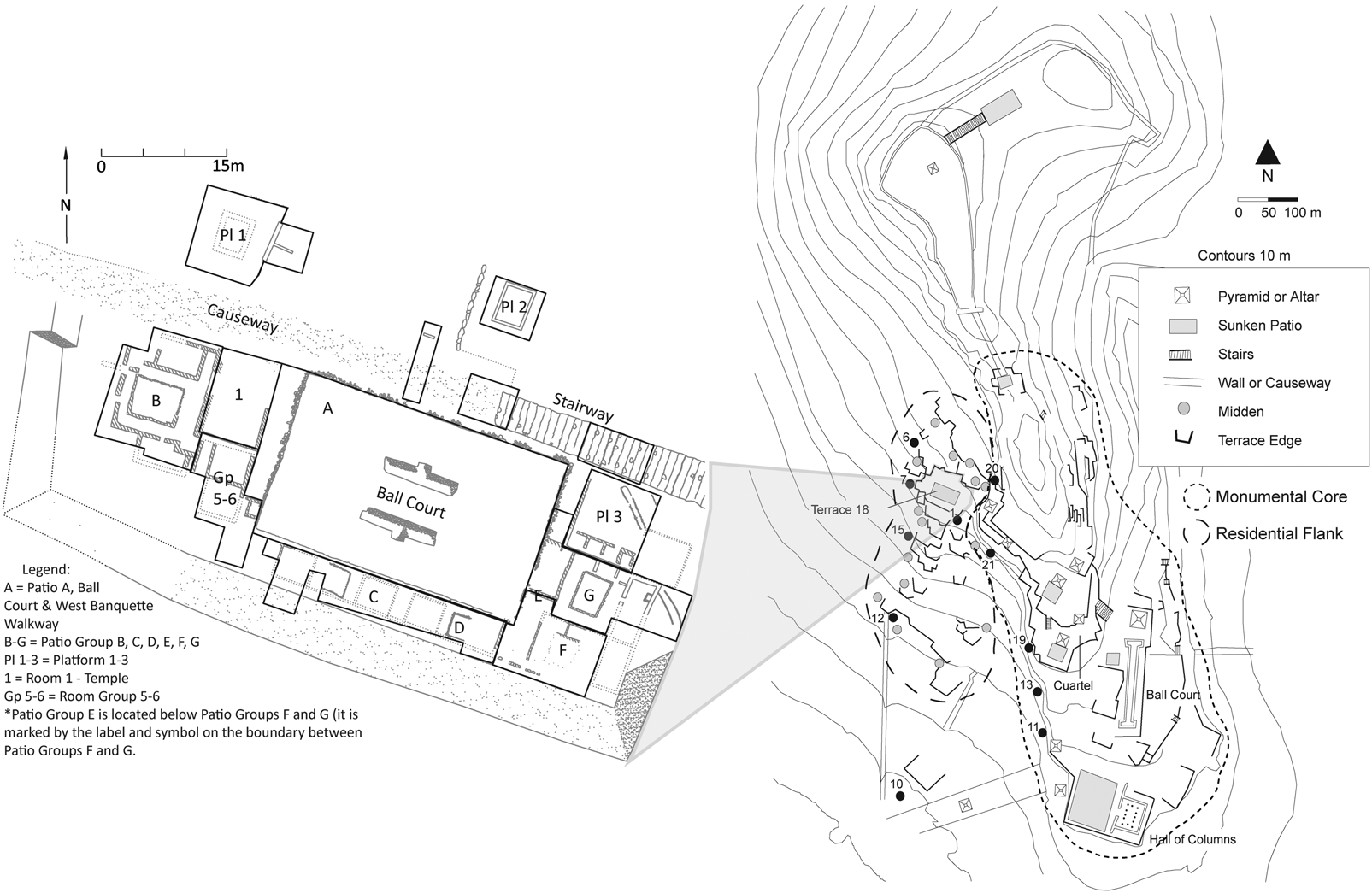
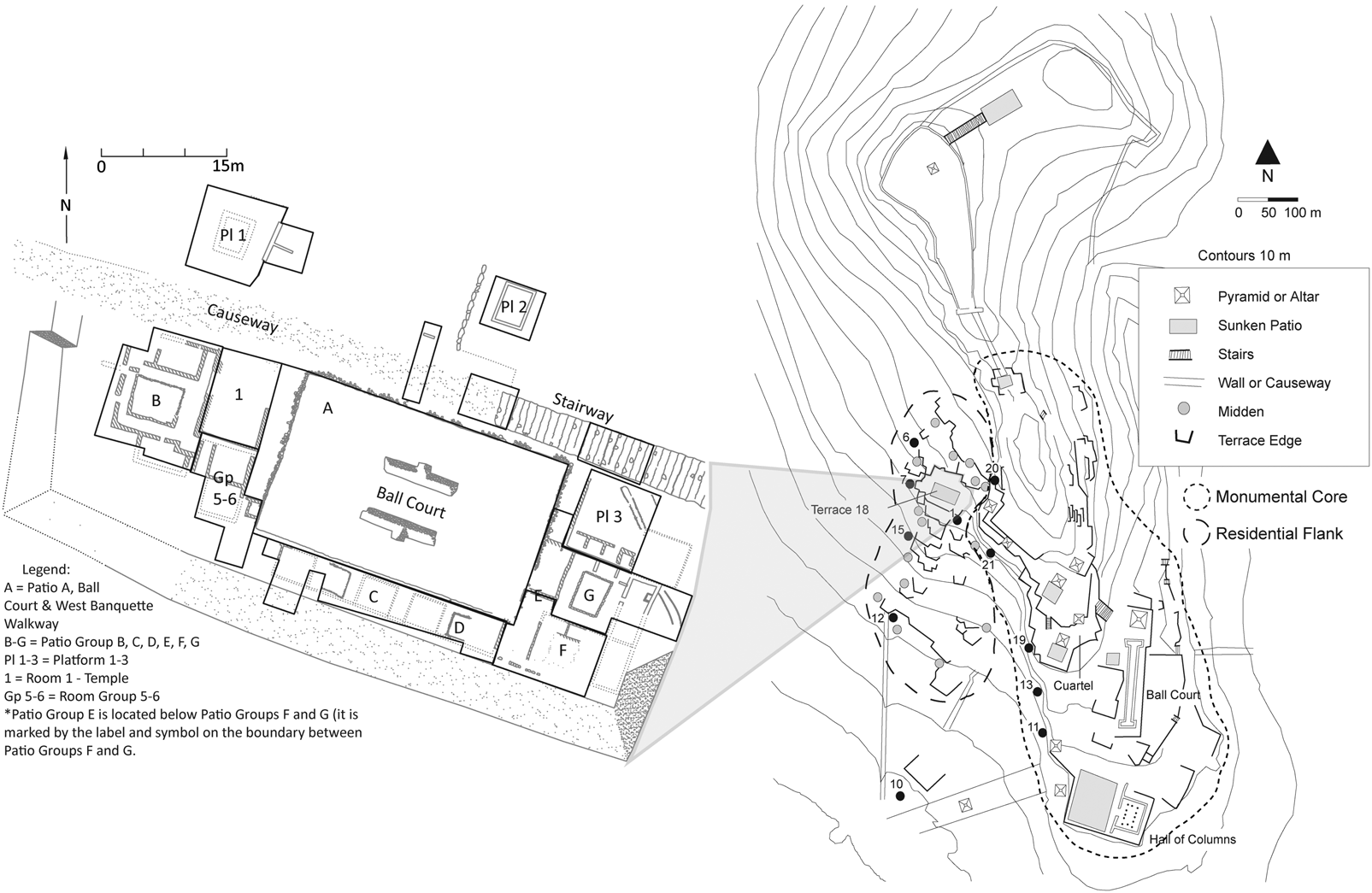
La Quemada is located on a rhyolitic dome in the floodplain of the Malpaso Valley and served as the civic-ceremonial hub of a polity comprising approximately 200 villages and hamlets (Trombold Reference Trombold and Trombold1991). The hilltop site consists of two major architectural spaces—the monumental core and its flanking areas—both of which are composed of terraces that provide level living surfaces (Nelson Reference Nelson1997; see Figure 2). The monumental core is located along the central and eastern portions of the site, whereas the residential terraces are concentrated on the western flank. Many of the terraces had patio-banquette complexes or arrays of buildings and walkways around a sunken patio. Middens are located downslope where artifactual debris from residences and ritual activities accumulated over time. The unique layout of terraces in relation to the middens allows us to assume that people deposited trash in the midden closest to them, similar to the concept of a catchment zone. Ethnoarchaeological research conducted in the Philippines supports the assumption that middens can be systematically associated with living spaces if the residence patterns of the site are well understood (Beck and Hill Reference Beck and Hill2004), as is the case for La Quemada.
Location of middens excavated by LQ-MVAP (black dots) and the two architectural spaces with which they are associated, as well as the architectural areas of Terrace 18 (inset). The labeling of middens in this figure and in Figure 8 differs from the maps included in Torvinen (Reference Torvinen2018). A recent review of LQ-MVAP preliminary reports revealed inaccuracies in how middens were labeled, which is resolved here; the mislabeling of the middens in Torvinen (Reference Torvinen2018) did not affect the results of that research.
Under Nelson's direction, the LQ-MVAP team conducted fieldwork at La Quemada from 1986 to 2001. The areas chosen for excavation represent a wide range of activity areas, including site sectors, temples, ball courts, altars, pyramids, residences, plazas and patios, middens, and connecting features (e.g., causeways and staircases; see Nelson Reference Nelson1997 for detailed descriptions of site structure). Nelson chose one residential terrace (Terrace 18) for excavation and a sample of 11 of the 25 middens identified across the site (Nelson Reference Nelson1997:90) in an attempt to capture both social and chronological variation.
The patio-banquette complex on Terrace 18 consisted of a large sunken patio surrounded by a raised platform (banquette) on which rested a series of smaller patio groups, platforms, and other structures (Figure 2). A causeway marking one of the cardinal entrances into the monumental core and a small-scale ball court in its main patio signify the potential importance of this residential unit within La Quemada. Terrace 18 was dug intensively in contiguous excavation units, providing a clear understanding of the stratigraphic relations among its excavated areas. The construction and maintenance of Terrace 18 are described in detail by Nelson (Reference Nelson1997:92–97). In addition to its architectural areas, we associate Midden 7, located along and beneath the western edge of the terrace, with the activities that took place in this ritual-residential complex. Unlike the units of Terrace 18, the analytic units of the excavated middens were dug noncontiguously. Therefore, the stratigraphic relationship among middens, and between them and other parts of the site, is not as well understood. Our objective in this article is to combine the Terrace 18 stratigraphic data with the physically unconnected midden data to establish and apply a chronology for the LQ-MVAP material record. It is important to note that our excavations were concentrated in the western flank of the site, as well as in some midden deposits associated with the monumental core. This means that important areas, such as the Hall of Columns, Cuartel, and Ciudadela, are not represented in our ceramic sample.
Our stratigraphic anchors are Terrace 18 and Midden 11. As one of the largest and deepest middens excavated at La Quemada, Midden 11 is thought to represent the full occupation of the site. Using a probability distribution method (Kintigh Reference Kintigh1994) that has subsequently been much elaborated, Nelson (Reference Nelson1997:103–104, Figure 9) found a striking similarity in the radiocarbon dates from Midden 11 and Terrace 18, which suggested that the growth trajectories of these two areas were coeval and that Terrace 18 was inhabited for almost the entirety of the occupational history of La Quemada. Nevertheless, these radiocarbon-based inferences need to be reevaluated for three reasons. First, Nelson used uncalibrated dates in his analysis as per the standard at that time. Second, new dates have since been published from excavations in the Cuartel (Jimenez and Darling Reference Jimenez, Andrew Darling, Foster and Gorenstein2000; Santos Ramírez Reference Ramírez and Antonio2014) and Ciudadela (Lelgemann Reference Lelgemann2000) areas of the site. Third, recent efforts to build a dendrochronological sequence for the northern frontier involve a reexamination of the La Quemada radiocarbon dates and propose a considerable shortening of the site's occupation (Turkon et al. Reference Turkon, Manning, Griggs, Santos Ramírez, Nelson, Padilla and Wild2018). Nelson (Reference Nelson1997) concluded that the main occupation of La Quemada was between 500 and 900 CE. In the present analysis we reevaluate Nelson's (Reference Nelson1997) proposed chronological inferences through the development of a new seriation model and Bayesian modeling of the radiocarbon dates from different portions of the site.
We intensively studied the stratigraphy in different parts of the site to combine more than 2,900 excavation subunits into more concise analytic units and to create Harris (Reference Harris1989) matrices that illustrate the relationships among the excavated areas. The analytic units bring together excavated spaces that belong to the same depositional events; for example, the fill above the latest floor of Room 1, which was dug in quarters, is consolidated in a single unit for purposes of this analysis. Based on stratigraphy alone, it was possible to characterize the order of deposits in Terrace 18 and within individual middens—but not among middens or between Terrace 18 and any midden, except Midden 7, which was partially covered by a late addition to the terrace.
Our efforts at seriation depend heavily on the stratigraphic order of analytic units within certain excavated areas. For example, Midden 11, located near the base of the cliff on which the monumental core is situated, consists of three analytic units labeled as Early, Middle, and Late with respect to that context (Midden 11). In contrast, in the various parts of Terrace 18, only two analytic units can be discerned. These are labeled Early and Late (no Middle); for example, Early Patio B and Late Patio B. These orders are certain, and the orders across diverse patios, structures, and other features within Terrace 18 are reasonably certain.
“Early” and “Late” are thus terms of convenience for initially discussing intra-contextual stratigraphic ordering; they may not transfer from one excavated area to another. Importantly, however, a detailed understanding of these isolated depositional sequences permits assumptions about the temporal order of some sets of analytic units with a high degree of confidence, allowing us to study changes in ceramic collections. Because we cannot connect all the analytic units using stratigraphy alone, we use frequency seriation of pottery to approximate the temporal order of analytic units from different parts of the site.
Previous Chronological Assessments
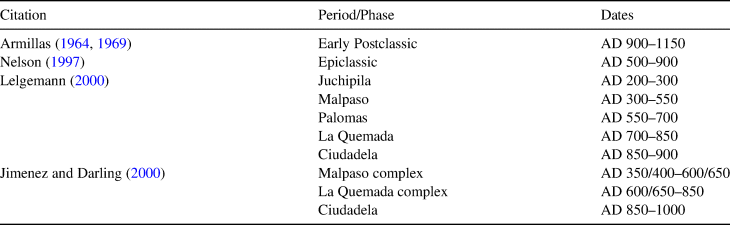
The task of placing La Quemada within an absolute regional chronology began in the 1960s when, based on the first set of radiocarbon dates from the site, Armillas (Reference Armillas1964, Reference Armillas1969) interpreted La Quemada as an Early Postclassic (AD 900–1150) fortress of the expansive Chalchihuites culture (Lister and Howard Reference Lister and Howard1955; Mason Reference Mason1937). Because these dates were acquired soon after the advent of radiocarbon dating, they had margins of error of 200 years, which makes it difficult to place any confidence in these results (Trombold Reference Trombold1990). Since then, the chronological placement of the site has slowly crept backward in time following improvements in both relative and absolute dating techniques (Table 1).
Previous Chronologies Proposed for La Quemada.

In the 1970s and 1980s, archaeologists noted similarities involving the incised-engraved and red-on-buff ceramic traditions of the Chalchihuites and Malpaso areas (Kelley Reference Kelley, Ekholm and Bernal1971; Trombold Reference Trombold, Foster and Weigand1985; Weigand Reference Weigand1978a), which resulted in relative cross-dating between the centers of Alta Vista and La Quemada. These cross-ties are supported by Kelley's (Reference Kelley, Foster and Weigand1985) adjustments to the Chalchihuites chronology and Trombold's (Reference Trombold1990) reevaluation of Armillas's (Reference Armillas1964, Reference Armillas1969) radiocarbon dates.
Furthermore, Nelson's (Reference Nelson1997:101, Figure 7) probability distribution model of the full set of (uncalibrated) radiocarbon dates collected from La Quemada—39 from LQ-MVAP excavations (Nelson Reference Nelson1997:92–93, Table 2) and 14 from other projects (Nelson Reference Nelson1997:101, Table 3)—centers on AD 650, with 75% of the probabilistic dates falling within AD 550–800 (Nelson Reference Nelson1997:103). Although it was expected that the growth trajectory of La Quemada would have pushed out from the core into the residential terraces and then retracted back to the core before site abandonment, a comparison of the probability distributions for Terrace 18 and Midden 11 revealed a striking similarity, suggesting the occupation of these two areas was contemporary. These results led Nelson (Reference Nelson1997:105–107) to conclude that La Quemada was founded in the early 500s, reached an apogee from 600–750, contracted into the core by the late 800s, and was close to being fully abandoned by the early 900s. La Quemada, therefore, was not an Early Postclassic outpost of the Toltec Empire (Weigand Reference Weigand1978a, Reference Weigand1978b; Weigand et al. Reference Weigand, Harbottle, Sayre, Earle and Ericson1977), and yet the site also postdates the height of Teotihuacan's regional influence, circa AD 400–500 (Cowgill Reference Cowgill1997; Millon Reference Millon, Yoffee and Cowgill1988:114–136).
More recently, ceramic data and new radiocarbon dates from La Quemada have been used to develop other chronologies for the site. Lelgemann (Reference Lelgemann2000:243), for example, proposes a four-phase chronology that essentially falls in line with the three phases of the Classic period and a transitional phase into the Early Postclassic period. The sequence includes the Malpaso phase (ca. AD 300–550), the Palomas phase (ca. AD 550–700), the La Quemada phase (ca. AD 700–850), and the Ciudadela phase (ca. AD 850–900). He also mentions the possibility of a Terminal Formative occupation that he terms the Juchipila phase (ca. AD 200–300) and the high likelihood of a discontinuous occupation into the Postclassic period.
Alternatively, Jimenez and Darling (Reference Jimenez, Andrew Darling, Foster and Gorenstein2000:160–167) describe two ceramic complexes and their relation to occupational phases at La Quemada. The Malpaso complex (ca. AD 350/400–600/650) represents the earliest phase of construction and occupation at the site and is marked by Huizache Incised-engraved tripod bowls with simple, single-line geometric motifs that appear to be an imitation of the Canutillo Incised-engraved style from the Chalchihuites area (Jimenez Reference Jimenez1989:17–20; Strazicich Reference Strazicich1995:103–107; Trombold Reference Trombold, Foster and Weigand1985:247–248). The La Quemada complex (ca. AD 600/650–850) marks the height of La Quemada's construction and intraregional interaction as evidenced by the presence of rare decorated types: San Luis Polychrome, Sierra Brown-on-white, Jerezano White-on-red, and Morones Black-on-purple. Diagnostic ceramic types of this phase include Tepozan Resist Polychrome and Tuitlán and Murguía Incised-engraved, which are similar to Vesuvio and Michilía Incised-engraved in Chalchihuites. Jimenez and Darling (Reference Jimenez, Andrew Darling, Foster and Gorenstein2000:166) also acknowledge the Ciudadela phase (ca. AD 850–1000) proposed by Lelgemann (Reference Lelgemann1992, Reference Lelgemann2000). The final phase of La Quemada likely represents a remnant population that continued to occupy the site after its abandonment and fiery destruction (Jimenez and Darling Reference Jimenez, Andrew Darling, Foster and Gorenstein2000:166).
For the purposes of chronology building, our expectations regarding ceramic change are based on independent evidence from the extensive work conducted by Kelley and Kelley (Reference Kelley and Kelley1971) on Suchil-Branch Chalchihuites pottery and the two ceramic complexes derived from Jimenez and Darling's (Reference Jimenez, Andrew Darling, Foster and Gorenstein2000) shared knowledge of the regional ceramic traditions. Some of the La Quemada wares have close parallels in the Chalchihuites assemblage, especially the incised-engraved wares. Moreover, types can be formed within the La Quemada Incised-engraved ware by making essentially the same distinctions that Kelley and Kelley (Reference Kelley and Kelley1971) propose. Jimenez and Darling (Reference Jimenez, Andrew Darling, Foster and Gorenstein2000) and Lelgemann (Reference Lelgemann2000) note the same parallels between Malpaso and Chalchihuites incised-engraved pottery when distinguishing their ceramic complexes. Simple, geometric designs in earlier vessels are later complemented by more elaborate incision techniques including cross-hatching and champlevé. The latter complex is also characterized by the introduction of resist vessels and rare decorated types. These temporal trends in ceramic styles play a vital role in the frequency seriation described later.
Recent research on the development of a dendrochronological sequence for the northern frontier region has found sufficient samples for the creation of a 305-year tree-ring sequence for the Malpaso Valley (Turkon et al. Reference Turkon, Manning, Griggs, Santos Ramírez, Nelson, Padilla and Wild2018). A sample of 25 wood and charcoal fragments, recovered primarily from the Cuartel area of La Quemada and the monumental architecture at Los Pilarillos, a secondary center located in the Malpaso Valley, was subjected to established methods of tree-ring measurement and cross-dating within cultural contexts and across the two sites to create “floating chronologies” based on a relative dating scale (Turkon et al. Reference Turkon, Manning, Griggs, Santos Ramírez, Nelson, Padilla and Wild2018:108–109, Table 1). A series of radiocarbon-dated tree-ring samples selected from the chronologies provided absolute date anchors (using a “wiggle-matching” technique; Bronk Ramsey et al. Reference Bronk Ramsey, van der Plicht and Weninger2001) for the entire sequence, which resulted in a calibrated date range of AD 466–770 ± 4 for tree harvesting in the Malpaso Valley sites.
Although Turkon and colleagues’ (Reference Turkon, Manning, Griggs, Santos Ramírez, Nelson, Padilla and Wild2018) results are preliminary, they provide information relevant to our discussion of the seriation results presented in the next section. A set of three roof beam supports was analyzed from the Cuartel area of La Quemada's monumental core, suggesting a series of two felling episodes that date after AD 639 ± 4 and AD 726 ± 4 based on the calibration of established cutting dates (Turkon et al. Reference Turkon, Manning, Griggs, Santos Ramírez, Nelson, Padilla and Wild2018:117). An additional sample was analyzed from the Temple on Terrace 18, placing the initial construction of this feature at AD 661 ± 4 (calibrated), which suggests that the Cuartel and Terrace 18 were built around the same time (Turkon et al. Reference Turkon, Manning, Griggs, Santos Ramírez, Nelson, Padilla and Wild2018:117). Their analysis also involved a reevaluation of Nelson's (Reference Nelson1997:107, Figure 3) radiocarbon dates using a corn cob recovered from a hearth below Terrace 18 (Sample no. B-77239; AD 660-723) to set the terminus post quem (TPQ) date for the beginning of Terrace 18 construction in their Bayesian model. This decision resulted in similar calibrated date ranges for Terrace 18 (AD 711–825) and Midden 11 (AD 707–808). We find the dendrochronology results convincing as to felling dates and note that this research seems on its face to compress the chronological sequence previously proposed for La Quemada of AD 550–800 (Nelson Reference Nelson1997:103–105).
Refining the La Quemada Chronology
According to this summary of earlier research, the available chronological information suggests several discernible periods of activity at La Quemada during the Epiclassic period, which are likely associated with varying ceramic styles that should allow us to order deposits from discontinuous areas of excavation. Therefore, we use frequency seriation to group analytic units by their ceramic type composition into phases of occupation.
Pottery Classification
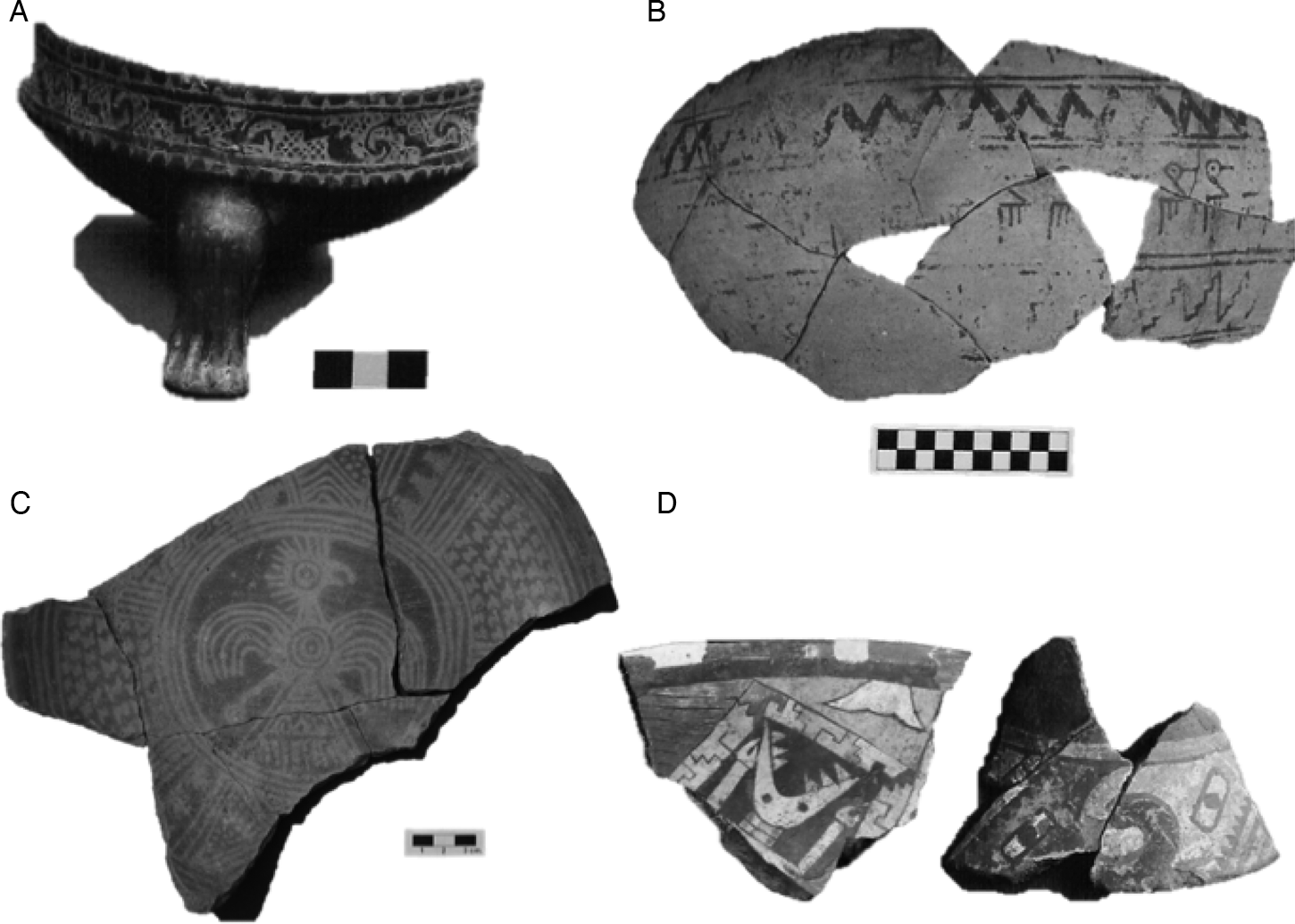
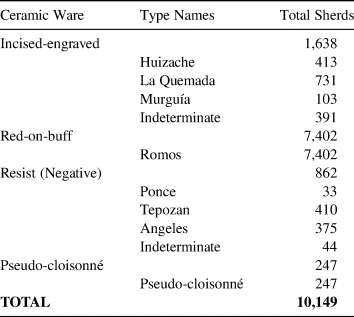
The La Quemada pottery classification takes the form of a hierarchical, type-variety system (Rice Reference Rice1987:282–288; Sinopoli Reference Sinopoli1991:52–53), meaning that attributes observed in combination are used to define types and varieties among ceramic wares. Conventionally, paste composition is part of the definition of a ware, but as Torvinen (Reference Torvinen2018:101, Table 12) shows, the La Quemada potters produced different styles of pottery using the same paste. To accommodate this diversity, we sometimes refer to these sets of styles as wares. In order of relative frequency, the most important wares at La Quemada are the incised-engraved, red-on-buff, resist (mostly negative polychrome), pseudo-cloisonné, brushed, and several rare painted wares (Figure 3). Currently, we can divide only the incised-engraved and resist wares into types, and we can further subdivide the incised-engraved types into varieties based on design motifs. For example, zigzags, scrolls, and stepped frets occur across types but are executed in accordance with the incision style of the type (i.e., single-line; blocked, hatched background; or champlevé).
Most common ceramic wares in the LQ-MVAP ceramic classification: (a) incised-engraved, (b) red-on-buff, (c) resist, and (d) pseudo-cloisonné.

Our classification of the La Quemada ceramic collection (Schiavitti et al. Reference Schiavitti, Nelson, Betts and Andrew Darling1996) borrows greatly from Kelley and Kelley's (Reference Kelley and Kelley1971) Introduction to Chalchihuites Ceramics, because the pottery of the Chalchihuites and Malpaso areas appear to exhibit many parallels. For example, we divide the La Quemada Incised-engraved ware into three types based on associations between vessel form, design execution, and motif. The Huizache type includes tripod bowls with simple, direct legs that lack feet, incurving vessel walls with direct rims, and geometric motifs executed in single lines rather than being blocked or hatched. In the La Quemada type, the portion of the vessel wall containing the design panel is concave, the tripod supports have a more exaggerated “knee,” and cross-hatching is used to fill the background of the motifs. Finally, the design panel of the Murguía type is yet more strongly inflected, the exaggerated “knee” tripods sometimes have clear feet, and the design of its scroll and lifeform motifs involves much heavier cross-hatching and sometimes the use of full excision or champlevé technique.
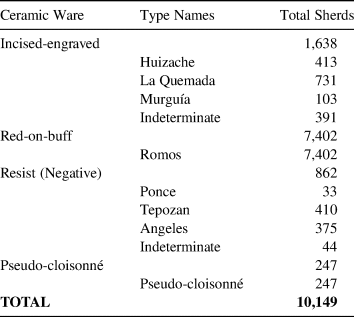
The LQ-MVAP ceramic collection comprises approximately 200,000 sherds classified into 18 types, which can be grouped into nine wares. Only 48.5% of the collection can be assigned to unmixed analytic units using our Harris matrices, and this is the portion of the collection from which data are drawn for the analyses described later (Table 2). Because of the ubiquity of plainware pottery across the site and our inability to discern chronologically significant changes within this ware, our analysis involves only decorated ceramic types. Supplemental Table 1 shows the frequencies of ceramic types recovered from each analytic unit belonging to the four most common wares found at the site: incised-engraved, red-on-buff, resist, and pseudo-cloisonné. These data are used in the following analyses.
Ceramic Type Frequencies by Ware.
Frequency Seriation
Archaeologists commonly use frequency seriation to order proveniences based on stylistic attributes observed in different forms of material culture, typically pottery (e.g., Dunnell Reference Dunnell1970; Hare and Smith Reference Hare and Smith1996; Smith and Neiman Reference Smith and Neiman2007; Taladoire et al. Reference Taladoire, Sara Dzul and Forné2013). The underlying assumption is that ceramic styles change over time and that discontinuous strata from the same occupational phase contain relatively similar proportions of ceramic styles and thus can be grouped together. If an ordering of strata can be recognized, then it is assumed to represent time, and Ford diagrams (“battleship curves”) illustrate trends in the popularity of different ceramic styles through time.
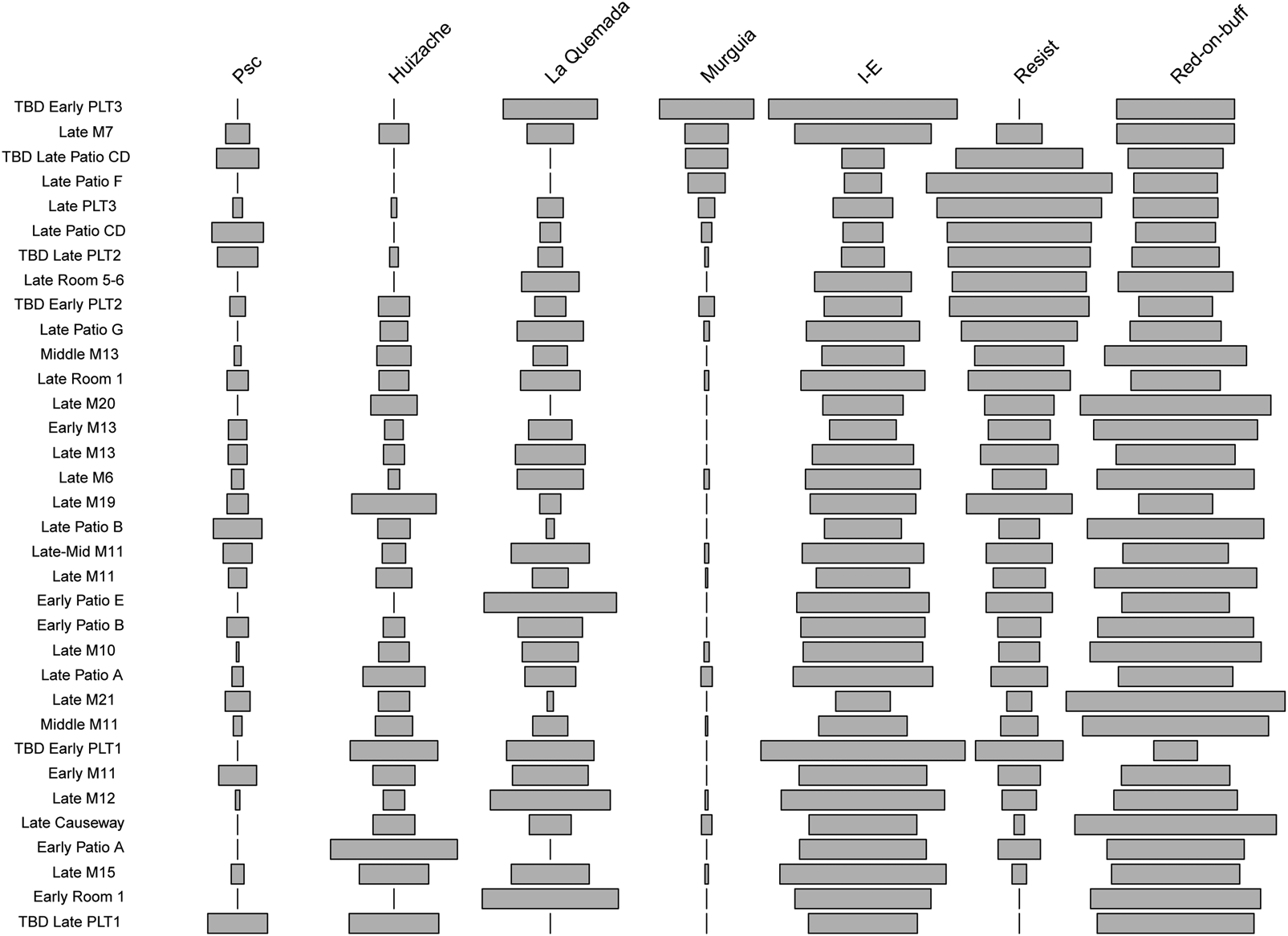
Our analysis begins with the most prevalent ceramic wares found at La Quemada (i.e., incised-engraved, red-on-buff, resist, and pseudo-cloisonné; Table 2) to assess the temporal trends outlined earlier and to begin narrowing in on the most chronologically sensitive types. A series of multivariate analyses illustrate the statistical strength of different approaches involving subsets of ceramic wares and types, specifically the incised-engraved types (Huizache, La Quemada, and Murguía) and the resist ware. Correspondence analysis (Peeples and Schachner Reference Peeples and Schachner2012) of this set of four ceramic categories results in a strong ordering of intra-context analytic units and rough battleship curves among the site's four major wares (Figure 4). For example, the intra-context analytic units of Midden 11, Patio Groups A and B, Room 1, and Platform 2 are all correctly ordered. Furthermore, Patio Group E precedes Patio Groups F and G, which we know, due to superposition, to be an accurate representation of the remodeling of Terrace 18 (Nelson Reference Nelson1997). Although Midden 13 and Platforms 1 and 3 do not meet the expectation of intra-context ordering, these discrepancies are acceptable because each of these contexts is problematic: the midden was intruded by a surface feature, and the platforms were severely eroded before excavation. Such site formation processes may have created biases in the cultural material available for analytical interpretation.
Ford diagram of the four major wares recovered from La Quemada based on correspondence analysis of the incised-engraved types (Huizache, La Quemada, and Murguía) and the resist ware. Red-on-buff counts are divided by four to better display patterning in less prevalent ceramic categories.

Figure 4 also reveals patterns in the relative frequencies of the ceramic wares recovered from each stratigraphic context. First, the pseudo-cloisonné ware appears to have no clear patterning in its stratigraphic distribution; instead, it is observed in low frequency throughout the occupation of the site. Second, with a few exceptions, the incised-engraved ware tends to lessen in frequency late in the occupation, but this trend can be explored in more detail using its types and varieties. Third, the resist ware does increase in frequency toward the end of the occupational sequence in association with a slight decline in the frequency of the red-on-buff ware. Finally, the relative frequency of the red-on-buff ware does not vary systematically in time as one might expect, but it remains to be seen whether we can identify types or varieties in this ware that do vary temporally. Because the incised-engraved and red-on-buff wares share many motifs, and the frequencies of the incised-engraved types and varieties have been shown to vary with stratigraphic position, there is potential for similar patterning in the red-on-buff ware. We have recorded the decorative motifs of more than 3,000 red-on-buff sherds to investigate their behavior between units. The results of that investigation are forthcoming.
Using the incised-engraved types defined by Schiavitti and colleagues (Reference Schiavitti, Nelson, Betts and Andrew Darling1996), the Ford diagram in Figure 4 also illustrates that the stratigraphic tendencies observed in the incised-engraved types at La Quemada are consistent with the chronological sequence proposed by Kelley and Kelley (Reference Kelley and Kelley1971) regarding changes in the decorative technique used in this ware, as described in detail earlier. Huizache Incised-engraved has a high frequency early on that declines through time, Murguía becomes more frequent late in the occupation, and the La Quemada type is common throughout. This confirmation of anticipated temporal trends in the most common ceramic wares and across the three incised-engraved types suggests that our frequency seriation is capturing variation over time.
Defining Occupational Phases
As with any exploratory analysis, the goal is to narrow the sample down to the most chronologically sensitive variables (Cowgill Reference Cowgill and Clarke1972). In other words, one attempts to identify variables that correctly order contexts in a manner consistent with the observed stratigraphy.
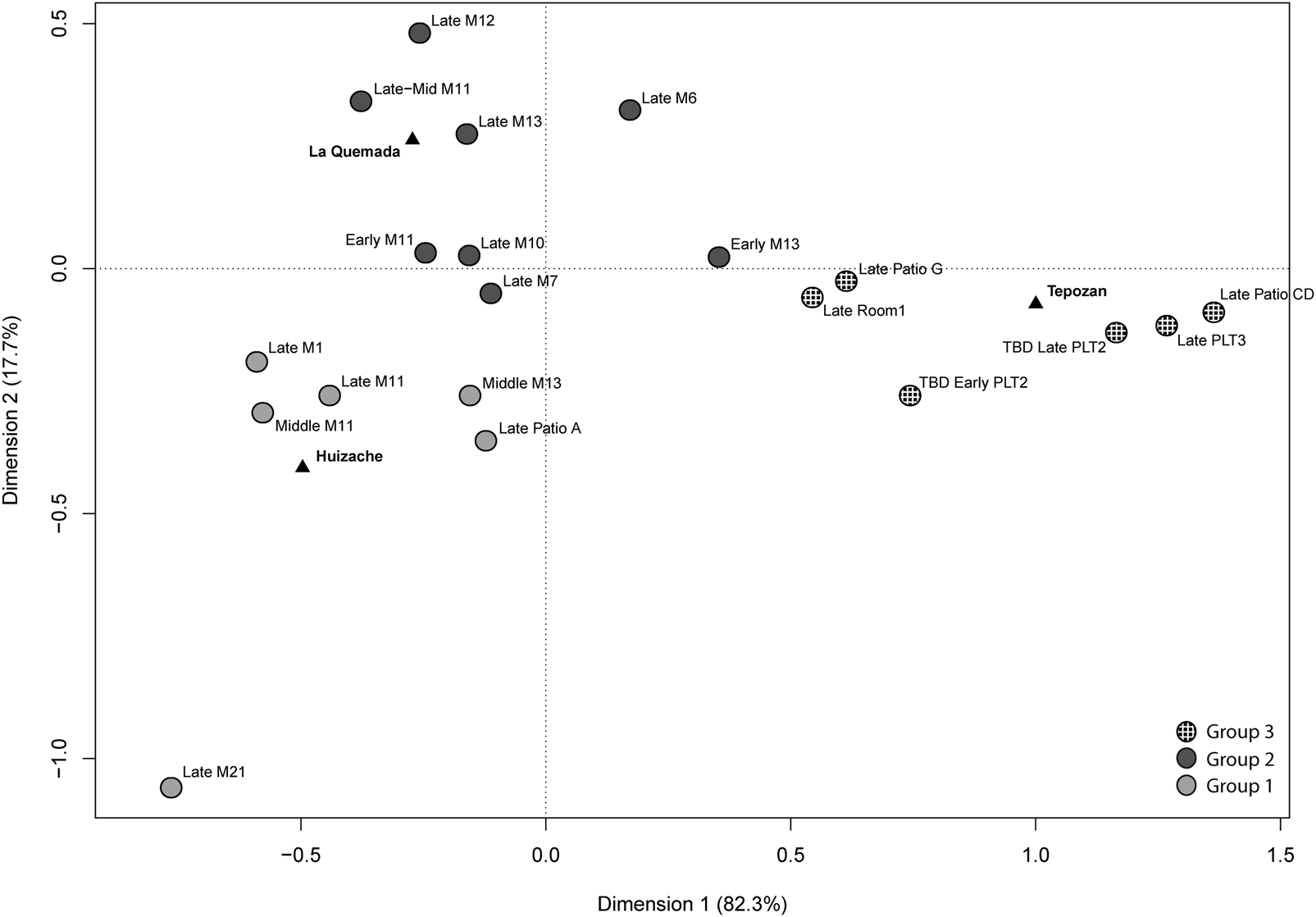
Statistical methods are capable of automatically selecting the variables that best explain the patterning. Several iterations of multivariate analyses—correspondence analysis, k-means hierarchical clustering, and discriminant analysis—reveal statistically significant results of the chronological sensitivity of three ceramic types: Huizache and La Quemada Incised-engraved, which represent ceramic cross-ties with the early and middle phases of the Chalchihuites chronology (Kelley and Kelley Reference Kelley and Kelley1971), and Tepozan Resist Polychrome, the most prevalent resist type found at La Quemada. Setting a minimum sherd threshold (n = 10) of the selected types when running a correspondence analysis (Peeples and Schachner Reference Peeples and Schachner2012) creates a two-dimensional plot with a nice curve from Huizache to La Quemada to Tepozan consisting of three clusters around each of these types (Figure 5).
Correspondence plot of analytic units (circles) with fewer than 10 total sherds of Huizache Incised-engraved, La Quemada Incised-engraved, and Tepozan Resist Polychrome (black triangles). Different colored or patterned circles represent groups identified using k-means hierarchical clustering and discriminant function analysis.

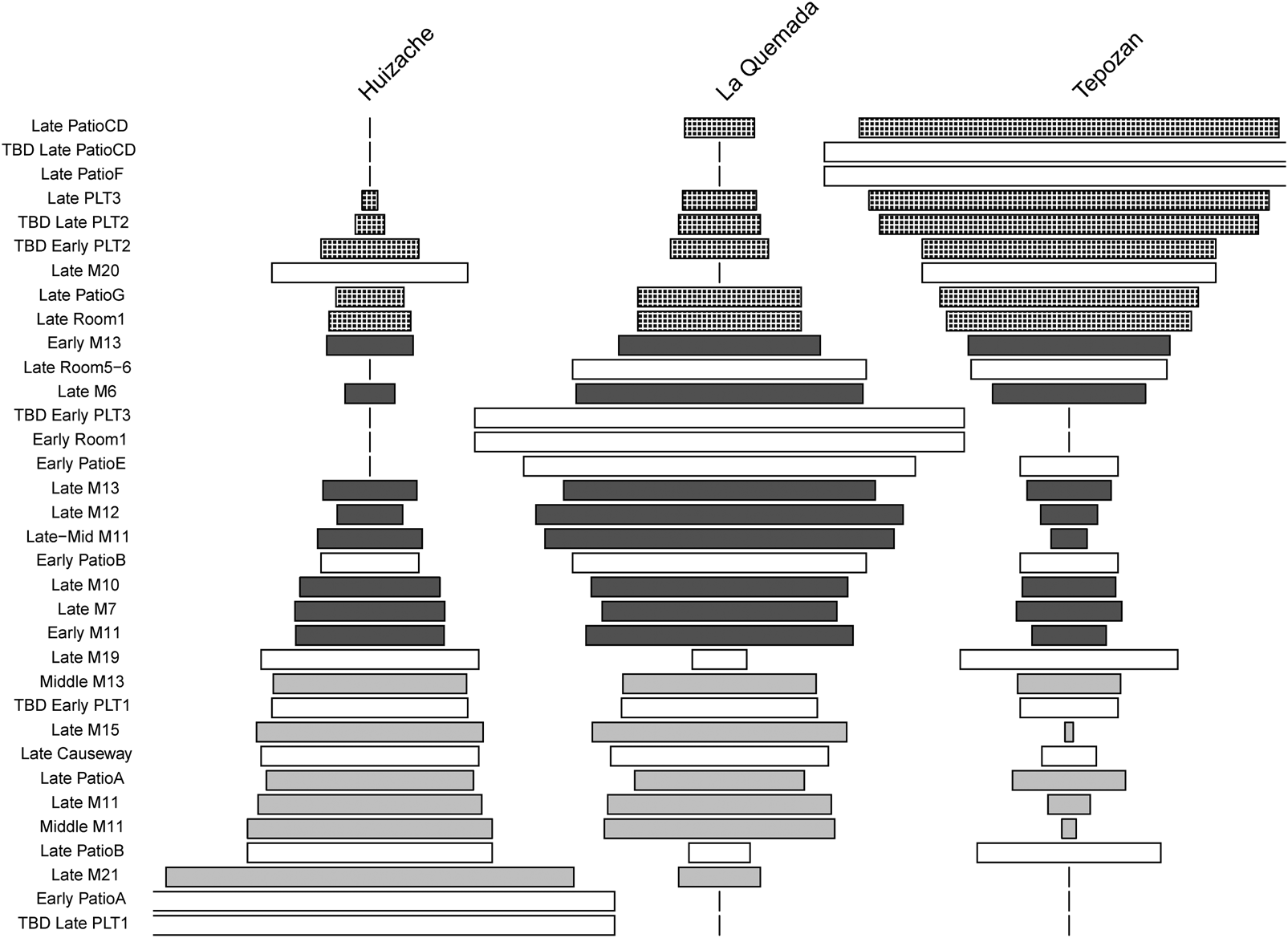
K-means hierarchical clustering (Kintigh Reference Kintigh and Voorrips1990; Kintigh and Ammerman Reference Kintigh and Ammerman1982; Whallon Reference Whallon and Hietala1984) confirms the three-cluster level as the most appropriate solution relative to the Monte Carlo simulated runs (Peeples Reference Peeples2011). Furthermore, using the stepwise, leave-one-out classification method of discriminant function analysis in the SPSS statistical package reaffirms the three k-means clusters with a cross-validation rate of 100% across the grouped cases; it also recognizes Tepozan and Huizache as the types that contribute most to the decrease in “stress” within the sample. The resulting Ford diagram further clarifies the temporal trends in these ceramic types (Figure 6), which gives us confidence that chronological change is driving the patterning.
Ford diagram of analytic units with fewer than 10 total sherds of Huizache, La Quemada, and Tepozan types allotted to Discriminant Groups 1–3. Different shaded or patterned bars represent Discriminant Groups 1–3. White bars are the analytic units not used in the definition of the discriminant functions.

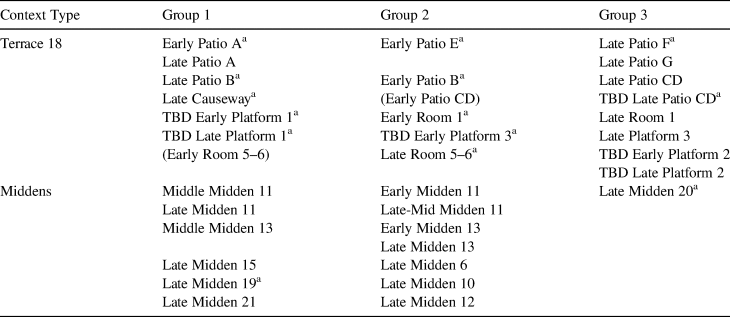
Having established a strong frequency seriation based on Huizache Incised-engraved and Tepozan Resist Polychrome, we use the discriminant functions to classify the remaining analytic units into one of the three clusters: Discriminant Groups 1–3. The analytic units included in the first discriminant analysis are given a priori group assignments, and the other analytic units are entered as ungrouped cases. This process results in the allocation of six analytic units to Discriminant Group 1, five analytic units to Discriminant Group 2, and three analytic units to Discriminant Group 3 (Figure 6, Table 3). The final three analytic units—Early Midden 7, Early Patio Group C–D, and Early Room 5–6—have zero sherds of the types being analyzed and so are subjectively assigned to discriminant groups based on the similarity of the proportions of types recovered from these units to the analytic units in each discriminant group. For example, Early Patio Group C–D is assigned to Discriminant Group 2 because it has one Romos Red-on-buff sherd and one Morones Black-on-purple sherd, and the analytic units assigned to Discriminant Group 2 have the highest proportions of Morones sherds in the collection.
Phase Assignments of Analytic Units.
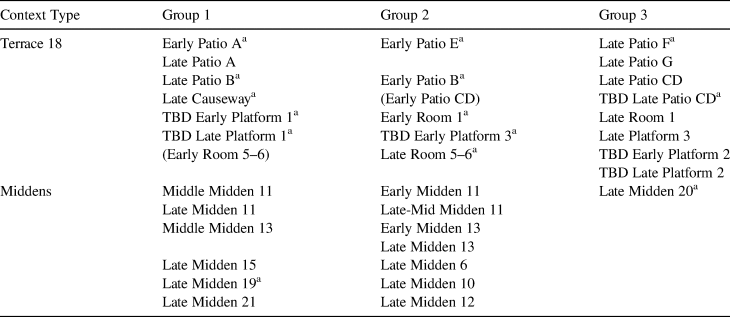
a Analytic units assigned to groups using discriminant functions (i.e., entered as unknowns).
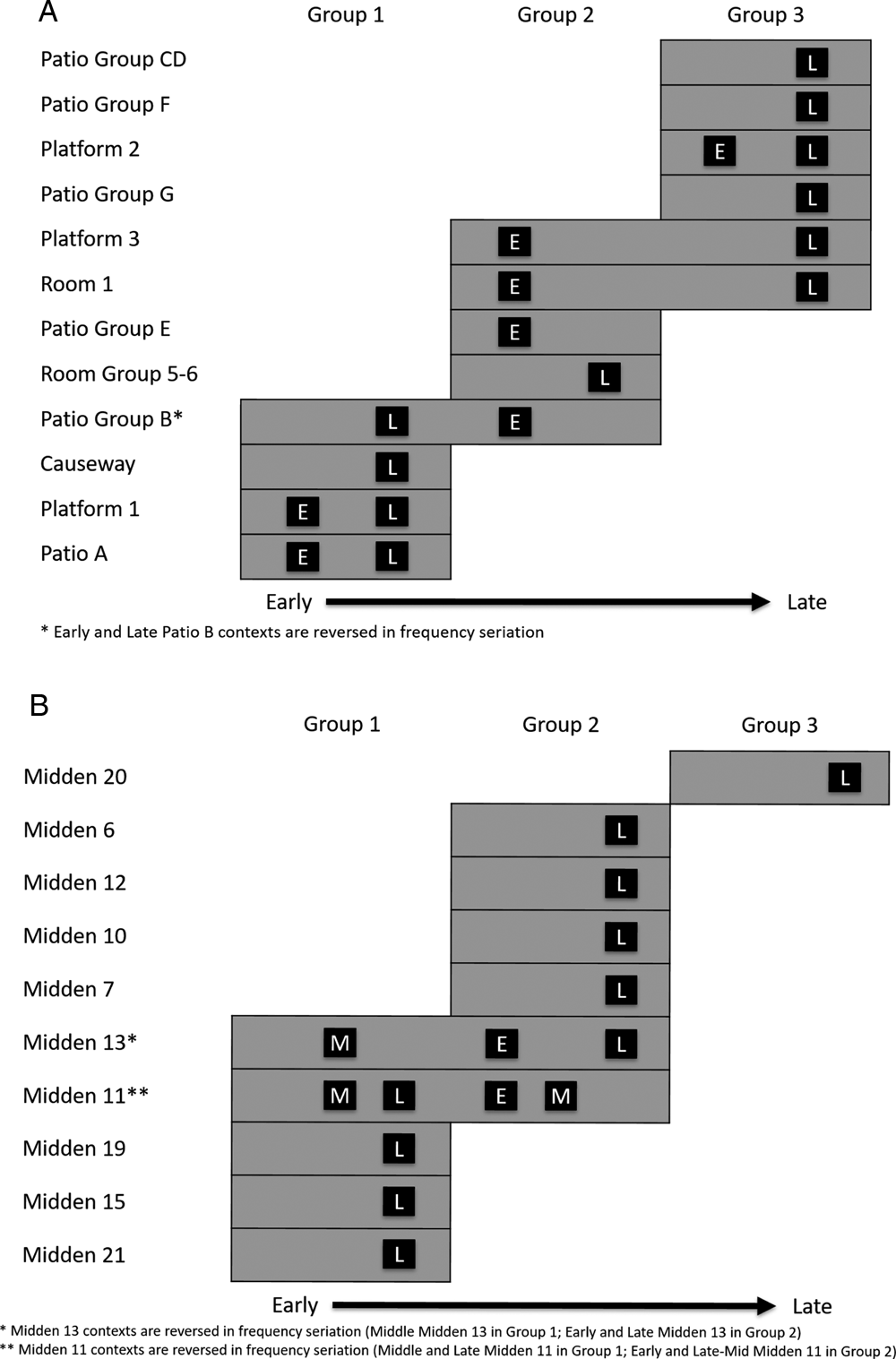
Our analysis supports a “three-phase solution” for the chronology of La Quemada. The discriminant function analysis makes a reliable distinction between materials from three groups that is independently confirmed by the site's stratigraphy with a few exceptions. Figure 7 illustrates how the intra-context analytic units are allotted across Discriminant Groups 1–3 for the Terrace 18 architectural areas and across the Midden sample; it supports the proposition that the groups represent a progression through time. Independent verification of any seriation model involves its ability to accurately reconstruct the depositional history of known stratigraphic units, as well as construction/remodeling events through time. From here forward, the Discriminant Groups are referred to as Phases 1, 2, and 3, in temporal order. We do not label them Early, Middle, and Late because of possible confusion with the use of those terms in an intra-contextual sense as described earlier.
Architectural areas of Terrace 18 (a) and midden contexts (b) ordered based on allotment of their early (E), middle (M), and late (L) analytic units to Discriminant Groups 1–3.

Discussion
Our frequency seriation quantitatively confirms temporal trends subjectively observed by other investigators (Jimenez and Darling Reference Jimenez, Andrew Darling, Foster and Gorenstein2000; Kelley and Kelley Reference Kelley and Kelley1971). For example, discriminant function analysis identifies Huizache Incised-engraved and Tepozan Resist Polychrome as the types driving the ordering of analytic units. Jimenez and Darling (Reference Jimenez, Andrew Darling, Foster and Gorenstein2000:160–167) note these two types in the definition of two ceramic complexes for La Quemada; yet, in contrast to their suggested two-phase chronology, we find strong evidence supporting a three-phase ceramic chronology. The frequency seriation also explicitly identifies deposits belonging to intervals of ceramic change, which makes possible the construction of a seriation model. Moreover, the seriation model allows undated and noncontiguous deposits to be assigned to one of three chronological phases (Table 3). Integrating this analysis with the inclusion of new dates provided by other researchers allows us to establish the chronological relationship between Terrace 18 and other parts of the site. These refinements have implications for both our understanding of diachronic social processes within the Malpaso Valley and of how La Quemada fits into the sociopolitical development of the northern frontier region.
Occupational Sequence of Terrace 18
Our understanding of the stratigraphic relationships among analytic units is strongest for the architectural areas of Terrace 18. With the exception of Patio Group B, the results of our frequency seriation both confirm the stratigraphic sequences and inform us of a new pattern in the construction and occupation of this residential terrace (Figure 7). The major components of Terrace 18 are Patio A, which includes the adjacent West Banquette walkway and the ball court, and the Causeway. Because these areas experienced high traffic, it is likely they were kept relatively clear of debris, so any materials used to fill or flatten the terrace surface during the initial construction would be early. The Phase 1 occupation of Terrace 18 seems to have been concentrated on its western side with the use of Platform 1 and Patio Group B, the latter of which continued to be used into Phase 2. During Phase 2, we see the addition of Patio Group E and Platform 3 on the eastern side of the terrace, as well as the Temple (Room 1) and a set of rooms to its south (Room Group 5–6) adjacent to Patio Group B. According to Turkon and colleagues (Reference Turkon, Manning, Griggs, Santos Ramírez, Nelson, Padilla and Wild2018:117), the construction of the Temple could not have begun until after the felling date of one of its beams ca. AD 661 ± 4 (calibrated). The Temple and Platform 3 continued to be occupied into Phase 3, whereas Patio Group E was remodeled into Patio Groups F and G, which we anticipated, based on the stratigraphic relationship of these contexts. Patio Group CD and Platform 2 also date to Phase 3 and are juxtaposed from each other across Patio A. Based on these results, the occupation of Terrace 18 appears to have started on its western edge, extended to its eastern side, and then filled in its central portion. Although it is possible that the spatial pattern of these results may be influenced by functional differences among the areas, such as the degree of emphasis on residential versus ritual deposition, the seriation results confirm many sets of known stratigraphic relations within the terrace, which validates the strength of our three-phase chronology.
Reassessing the Growth Trajectory of La Quemada
As we explained earlier, our sample of excavated middens from across La Quemada was designed to capture the variety of behaviors that occurred across the site. Similar to a catchment zone, we assume trash was deposited in the midden closest to where the materials were used, so the results of our frequency seriation help us better understand the occupational trajectory of La Quemada. Like many sites across Mesoamerica, the architecture of La Quemada was constructed or remodeled using earlier trash deposits (e.g., El Palacio in the Zacapu Basin; see Forest and Jadot Reference Forest and Jadot2018). The middens documented and mapped across the site are likely not the only ones that ever existed at La Quemada, and we can assume trash deposits were reconstituted in the construction of later terraces and structures. This stratigraphic shuffling (e.g., the identification of a floor feature within Midden 13) and the plausible order of midden deposition that our seriation model independently confirms (i.e., core middens predating those located among the residential terraces) are the reasons we are willing to accept our model, despite two stratigraphic reversals (Figure 7).
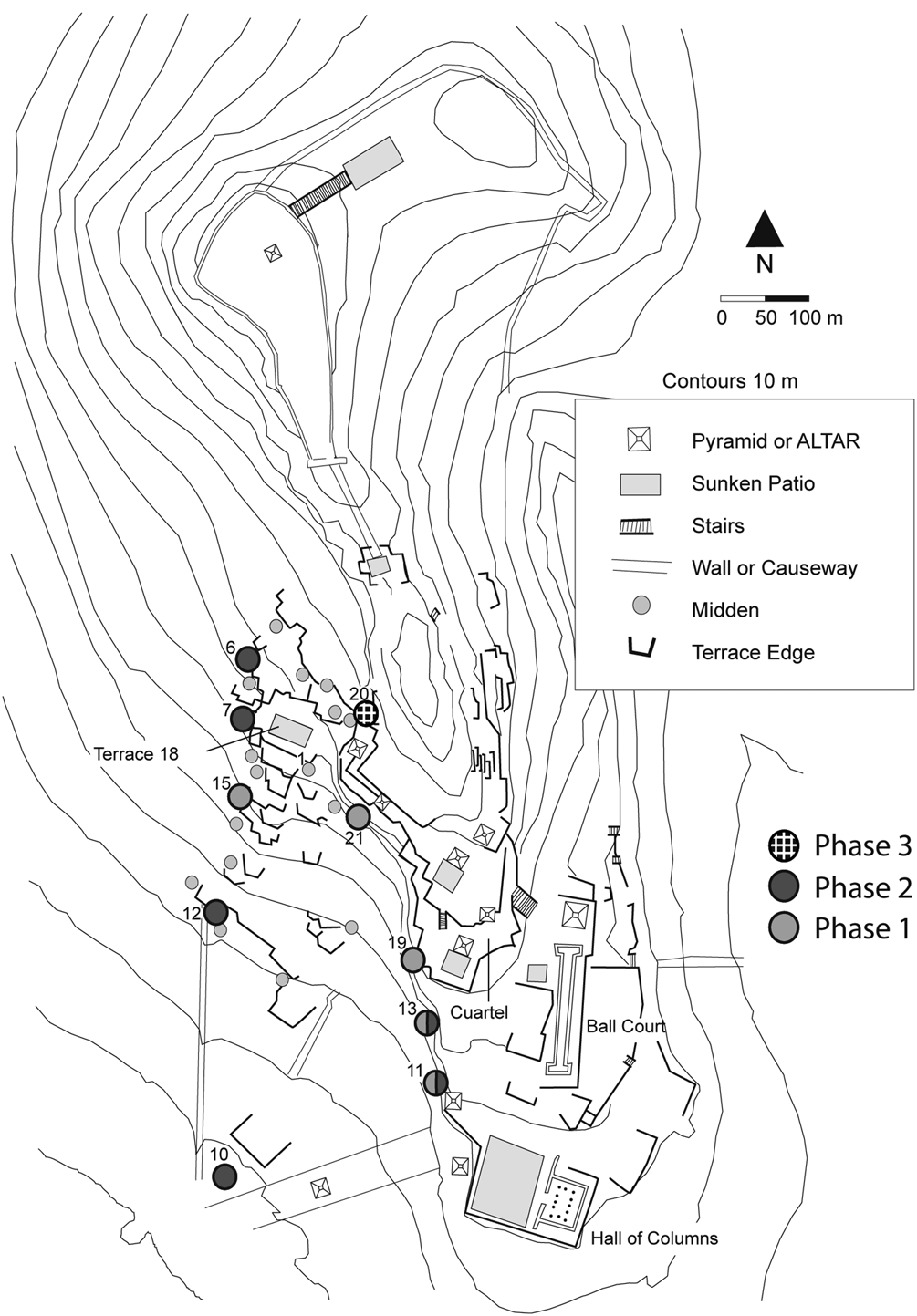
Using the probability distribution method (Kintigh Reference Kintigh1994), Nelson (Reference Nelson1997:103–104, Figure 9) concluded that the initial occupation focused on the monumental core, then expanded out in various directions including Terrace 18 in the western flank, and eventually shrank back into the core. Our frequency seriation results provide independent support for this proposition (Figure 8). The midden deposits dated to Phase 1 are all associated with the monumental core, with the exception of Midden 15, and Middens 11 and 13 represent the continued use of the monumental core into Phase 2 when the residential terraces concentrated in the western flank appear to have been occupied (Middens 6, 7, 10, and 12; see Figure 8). The dating of Midden 20 to Phase 3 may be associated with an even more restricted use of the monumental core late into the site's occupation or a nonchronological phenomenon. The relatively small sample size of Huizache and Tepozan sherds (n = 2 and n = 3, respectively) available for classifying the Late Midden 20 analytic unit may have affected the accuracy of its assignment to Phase 3. The sample from this analytic unit could justify its subjective placement in Phase 1 instead; yet the presence of five Morones sherds in this analytic unit means it also includes materials suggestive of placement in Phases 2 or 3.
Location of middens allotted to Phases 1–3. Midden 1 analytic units are too disturbed to be seriated.

Based on these results, it appears that the earliest pottery from La Quemada is associated with the monumental core. Trash from activities that took place in the southern part of the monumental core, such as the Hall of Columns and a number of terraces that no longer exist, were discarded into middens located below the southwest-facing cliff face (i.e., Middens 21, 19, 11, and 13). Turkon and colleagues (Reference Turkon, Manning, Griggs, Santos Ramírez, Nelson, Padilla and Wild2018:117) propose that “the Cuartel [on the eastern side of the monumental core] was one of the earliest constructions at La Quemada (Santos Ramírez Reference Ramírez and Antonio2014).” We cannot evaluate that suggestion with the present ceramic data, because the LQ-MVAP excavations were all on the western flank of the site. Beginning with Midden 15, additional living surfaces were built and occupied along the western flank (Middens 7, 10, 12, and 6), and materials continued to be discarded from the monumental core into Middens 11, 13, and 20. This growth trajectory pattern does call into question the coeval timing of construction events in both the Cuartel and the Temple on Terrace 18 (Turkon et al. Reference Turkon, Manning, Griggs, Santos Ramírez, Nelson, Padilla and Wild2018:117). Although the wiggle-matching dendrochronology approach has the distinct advantage of acquiring dates for specific building events, the Bayesian modeling of sets of radiocarbon dates allows for the comparison of occupation spans for different portions of the site. Clearly, additional ceramic and dendrochronological research are necessary to resolve such discrepancies.
New dates and the Bayesian modeling of radiocarbon dates encourage reinterpretation of how Terrace 18 and our excavated midden sample fit into the growth trajectory of La Quemada. Supplemental Figure 1 incorporates these new dates, collected from different parts of La Quemada by Jimenez (Jimenez and Darling Reference Jimenez, Andrew Darling, Foster and Gorenstein2000) and Lelgemann (Reference Lelgemann2000). It is important to stress that Bayesian modeling is used to predict the beginning and ending dates of a depositional sequence (Buck et al. Reference Buck, Andrés Christen and James1999). This methodological property is important here, because it allows us to focus on the question of whether different parts of the site had different occupational spans. The results of this analysis support and further refine the probability distribution model previously proposed by Nelson (Reference Nelson1997) of coeval occupation in Terrace 18 and the portion of the monumental core associated with Midden 11 that spread outward and retracted back to the core by the late ninth century. Supplemental Figure 1 shows that all parts of La Quemada came to be occupied beginning about AD 485 within approximately 100 years of the calibrated date span for Terrace 18, which reiterates Nelson's (Reference Nelson1997) model and is further supported by the coeval timing of construction events in the Cuartel and on Terrace 18 (Turkon et al. Reference Turkon, Manning, Griggs, Santos Ramírez, Nelson, Padilla and Wild2018:117). According to Supplemental Figure 1, the latest portions of the site to be occupied—until about AD 1100—were the Hall of Columns, a series of hearths near the Votive Pyramid, and the Ciudadela areas of the monumental core. Given that these dates are from hearths and not construction material, and based on ceramic and other stylistic evidence, we see these dates as representing late revisitations.
Unfortunately, we do not have ceramic counts to accompany the radiocarbon dates from other parts of the site. What we can say relative only to the sample of terrace and midden contexts we are trying to integrate is that the materials from Terrace 18 and the middens span approximately the same occupation. Furthermore, the recycling of midden materials as construction fill in places like Terrace 18 probably resulted in deposits that muddle the relatively discrete phases we would like to see, associating both early radiocarbon-dated materials and early ceramic types with later ones. This makes it difficult to assign dates to Phases 1–3, but we are convinced by Turkon and colleagues’ (Reference Turkon, Manning, Griggs, Santos Ramírez, Nelson, Padilla and Wild2018) coeval dating of a corn cob from below Terrace 18 and a post from the Temple. Together these new dates move the initial construction of Terrace 18 about a century later than had been thought and seem to affirm the compression of the occupation of La Quemada to AD 600–800.
Ongoing research related to the chronology of La Quemada involves the integration of our frequency seriation results with the dating of carefully targeted annual plant samples by Turkon and her research team (Reference Turkon, Elliott, Manning and Griggs2011, Reference Turkon, Manning, Griggs and Jiggetts-O'Neill2015, Reference Turkon, Manning, Griggs, Santos Ramírez, Nelson, Padilla and Wild2018). The narrow date ranges of radiocarbon readings for annual plants will provide more precise anchor dates for the lower and upper stratigraphic levels of Middens 7 and 11. This new avenue of collaborative research also seeks to independently test whether our three ceramic phases are accurately capturing chronological change. We also plan to expand the frequency seriation developed here to ceramic collections from other Malpaso Valley sites, which will provide a clearer picture of intra-valley demographic and social processes.
Conclusion
Before the present analysis was conducted, we already knew that La Quemada was an Epiclassic site and that the impetus for its formation likely originated within the northern frontier region. Our ability to investigate the processes involved in the formation of large social collectives (i.e., northern frontier centers and polities), such as La Quemada, was hindered by the lack of chronological precision. The recognition of such phases is important as we move toward examining finer scales of social dynamics among the inhabitants of northern frontier polities. For example, we can now begin to explore the processes involved in the development of common ideologies and networks of interaction at intrasite, intersite, and regional scales.
More directly, we can also begin to test hypotheses regarding changes in how La Quemada residents interacted with other northern frontier polities. Jimenez (Reference Jimenez2018) defines a set of Epiclassic interaction spheres based primarily on ceramic styles that may have represented different affiliations. The “pivot to the south” hypothesis postulates a shift in, or division of, the affiliation of La Quemada with neighboring polities from the Chalchihuites area in the north toward the Juchipila, Tlaltenango, and Bolaños Valleys to the south (Jimenez and Darling Reference Jimenez, Andrew Darling, Foster and Gorenstein2000). This hypothesis is thus far confirmed, given that the resist ware does appear to increase over time at La Quemada. Using Jimenez's (Reference Jimenez2018:121, Figure 5.3) interaction spheres, the “pivot south” likely signals the integration of the Malpaso Sphere with the Southern Zacatecas/Northern Jalisco Sphere, which includes the Juchipila, Tlaltenango, and Bolaños Valleys (in which Las Ventanas, El Teul, and La Florida sites, respectively, are located; see Figure 1). Nevertheless, the increase in resist ware is accompanied by stability in the red-on-buff and incised-engraved wares, implying a continuation of the association between La Quemada and the Suchil-Guadiana Sphere (i.e., Chalchihuites). In other words, refining site chronologies enhances our ability to track changes in the intensity and directionality of interactions among northern frontier polities using the material record.
Our eventual understanding of the changes in inter-polity interaction will be particularly interesting regarding the processes preceding the abandonment of La Quemada, and in turn it will have implications for the Aztatlán phenomenon. La Quemada is one of the centers that did not survive this regional transformation, which poses several questions that remain to be answered. Who in La Quemada was actually involved in the “pivot”: the site as a whole, a particular sector, or a set of households? Did La Quemada residents withdraw from intraregional interactions in the years preceding site abandonment, or did they not engage with adjacent centers throughout the occupation of the site? Answering these questions will require more analysis in applying the chronological distinctions made here to social change in La Quemada and sustained collaboration among researchers’ further chronological refinements.
Acknowledgments
This research was conducted with permission by the Consejo Nacional de Arqueología of the Instituto Nacional de Antropología e Historia of Mexico. The La Quemada-Malpaso Valley Archaeological Project fieldwork was funded by grants from the National Science Foundation, the National Endowment for the Humanities, and the Foundation for the Advancement of Mesoamerican Studies. We would like to thank Peter Jimenez, Vincent Schiavitti, and J. Andrew Darling for their assistance in creating the LQ-MVAP ceramic classification, as well as Achim Lelgemann and Jimenez for allowing us access to their radiocarbon dates from Beta Analytic Inc. In addition, we are grateful to Keith Kintigh, Angela Huster, David Abbott, Matthew Peeples, Stephanie Kulow, Katherine Dungan, Susana Ramirez, and two anonymous reviewers for helping us determine the appropriate statistical approach to our chronology problem and providing invaluable feedback that has greatly enhanced the clarity of our conclusions.
Data Availability Statement
The data used in this article can be downloaded from the Digital Archaeological Record at https://core.tdar.org/project/439221 or by contacting the corresponding author, atorvine@asu.edu.
Supplemental Material
Supplementary material for this article is available at https://doi.org/10.1017/laq.2019.106.
Supplemental Table 1. Frequencies of Ceramic Types by Analytic Unit.
Supplemental Figure 1. Bayesian modeling of start and end dates for different sectors of La Quemada (at one sigma confidence level).