Introduction
Onosma L. is a species-rich genus of Boraginaceae, tribe Lithospermeae Dumort., comprising about 150 species, although new species are still being discovered. The genus is widespread from Spain and Morocco to China, with areas of high diversity in Turkey (Anatolia), Iran and Central Asia (Riedl, Reference Riedl and Rechinger1967, Reference Riedl and Davis1979; Teppner, Reference Teppner1991, Reference Teppner1996; Khatamsaz, Reference Khatamsaz2002; Peruzzi & Passalacqua, Reference Peruzzi and Passalacqua2008; Cecchi & Selvi, Reference Cecchi and Selvi2009; Weigend et al., Reference Weigend, Gottschling, Selvi and Hilger2009; Mehrabian et al., Reference Mehrabian, Sheidai, Noormohammadi, Asrei and Mozafarian2011; Ranjbar & Almasi, Reference Ranjbar and Almasi2013). In Iran there are 51 species of Onosma, 20 of which are endemic. Since the genus was revised for Flora Iranica (Riedl, Reference Riedl and Rechinger1967; Khatamsaz, Reference Khatamsaz2002), new species have been described and there have been several new records for Iran. These include Onosma ambigens Lacaita, O. bisotunensis Attar & Hamzeh’ee, O. cornuta Riedl, O. estahbanensis Ranjbar & Almasi, O. iranshahrii Ghahr. & Attar, O. khorassanica Attar & Joharchi, O. kurdica Teppner, O. procera Boiss., O. rechingeri Riedl, O. soltanabadensis Ranjbar & Almasi, O. straussii (Riedl) Khat. and O. tschichtatschevii Popov (Teppner, Reference Teppner1980; Khatamsaz, Reference Khatamsaz1992; Ghahreman & Attar, Reference Ghahreman and Attar1996; Attar & Joharchi, Reference Attar and Joharchi2006; Attar & Hamzeh’ee, 2007; Ranjbar & Almasi, Reference Ranjbar and Almasi2013).
De Candolle (1846) segregated Onosma into two sections: (1) Aponosma DC. with dense appressed white sericeous hairs; (2) Euonosma DC. predominantly with spreading hairs. Boissier (Reference Boissier1879) divided Onosma into three sections: (1) Haplotricha, with basal leaves covered by simple setae only (haplotrichous indumentum); (2) Asterotricha, with basal leaves covered by stellate bristles (asterotrichous indumentum); (3) Heterotricha, with both simple setae and asterotrichous setae on the leaves. Riedl (Reference Riedl1962) divided the genus into two sections: Onosma sect. Onosma and Onosma sect. Protonosma Popov, plus a number of subsections and series. He included Onosma sect. Haplotricha and Onosma sect. Heterotricha in Onosma sect. Onosma subsect. Onosma and reduced Onosma sect. Asterotricha to Onosma sect. Onosma subsect. Asterotricha (Boiss.) Gürke (Riedl, Reference Riedl1962). The sectional delimitation of the genus is still not settled and the problem has been made more confusing by a lack of consensus on the correct placement of the type species of the genus. Using an informal adaptation of Boissier’s system, karyological work has shown that x = 6 and x = 8 are found in Haplotrichous Onosma as the dominant chromosome count in Europe and Asia, respectively, and x = 7 is reported for Asterotrichous Onosma in Europe. The third group, Heterotrichous Onosma, is characterised by bimodal chromosome sets 2n = 12L + 14S and 2n = 12L + 8S (L and S denote large and small chromosomes, respectively) and probably originated via hybridisation between taxa of Haplotrichous (2n = 12L) and Asterotrichous Onosma (2n = 14S) (Teppner, Reference Teppner1971, Reference Teppner1972; Vouillamoz, Reference Vouillamoz2001; Peruzzi & Passalacqua, Reference Peruzzi and Passalacqua2004, Reference Peruzzi and Passalacqua2008; Mártonfi et al., Reference Mártonfi, Mártonfiová and Kolarcik2008; Kolarčik et al., Reference Kolarčik, Zozomová-Lihova and Martonfi2010).
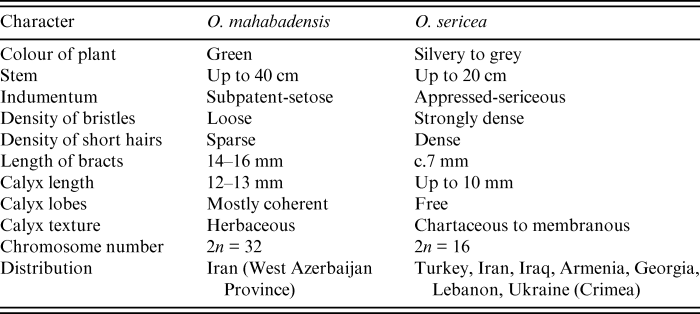
During recent floristic studies in western Iran, a species of Onosma was collected that could not be identified to an existing species. After thorough consultation of the relevant floristic literature (Boissier, Reference Boissier1879; Riedl, Reference Riedl and Rechinger1967, Reference Riedl and Davis1979; Popov, Reference Popov and Shiskin1974; Riedl et al., Reference Riedl, Binzet and Orcan2005; Binzet & Orcan, Reference Binzet and Orcan2007; Kandemir & Türkmen, Reference Kandemir and Türkmen2010; Aytaç & Türkmen, Reference Aytaç and Türkmen2011), it was concluded that our material belonged to Onosma sect. Aponosma (using the early sectional treatment by De Candolle (1846)) and was most similar to Onosma sericea Willd. After a comparison with specimens in the herbaria at B, E, G, TARI, W and WU it was decided to describe the material as a new species. Important differences between the new species and Onosma sericea are presented in Table 1.
Diagnostic morphological and cytological characters of Onosma mahabadensis and O. sericea

Material and Methods
Morphology
Plants from different populations of Onosma sect. Aponosma in Iran were collected and vouchers were preserved in BASU. These species were also studied in the field. Several other sheets have been examined from the herbaria at B, E, G, K, W and WU.
Meiotic studies
Fifteen young flower buds from at least five plants of the new taxon were collected and fixed in 96% ethanol, chloroform and propionic acid (6:3:2) for 24 hours at room temperature, and then washed and preserved in 70% ethanol at 4°C until used. Microsporocytes were prepared by squashing and stained with 2% acetocarmine. Chromosome counts were made from intact cells with well-spread metaphasic chromatids. Photographs of chromosomes were taken on an Olympus BX-51 photomicroscope at an initial magnification of 1000×.
Key to species of the Onosma sericea group in Iran
1a. Calyx with patent indumentum in basal parts; rosette leaves attenuate into the petiole O. subsericea Freyn
1b. Calyx with appressed indumentum in basal parts; rosette leaves sessile 2
2a. Stem up to 20 cm tall; indumentum strongly densely sericeous; most bracts c.7 mm long; calyx up to 10 mm, sepals free; 2n = 16 O. sericea
2b. Stem up to 40 cm tall; indumentum loosely subpatent-bristly; most bracts 14–16 mm long (lowest up to 20 mm); calyx 12–13 mm, sepals mostly coherent; 2n = 32 O. mahabadensis
Species Description
Onosma mahabadensis Ranjbar & Almasi, sp. nov. (Sect. Aponosma DC.).
Closest to Onosma sericea in habit, size and shape of leaves and colour of corolla but differing in the colour of the plant (green in Onosma mahabadensis vs. silvery to grey in O. sericea), density of indumentum (sparse vs. dense) and bract length (14–16 mm vs. c.7 mm). – Type: Iran, West Azerbaijan, 35 km from Mahabad toward Sardasht, 1605 m, 18 v 2011, Ranjbar & Almasi 25196 (holo BASU; photo W).
Perennial, subshrub to nearly herbaceous, green. Rhizome divided into several long, subterranean, slender branches with dark reddish-brown bark and sometimes a few leafy scales. Stems 30–40 cm, erect to ascending, straw-coloured when dry, with slightly retrorse subpatent bristles, 1.5–2 mm long, arising from small white, glabrous tubercles, and with very short retrorse hairs between tubercles. Usually with a number of sterile shoots at flowering time. Sterile shoots short to moderately elongated, 8–15 cm long. Rosette leaves elliptic to oblanceolate, 4–5.5 × 1–2 cm, without secondary veins, acute at the apex, sessile, sometimes semiauriculate, loosely covered adaxially with stout bristles, 1.3–1.5 mm long, arising from white, glabrous tubercles formed by 2–3 elongated rings of convex cells, 0.25–0.5 mm wide, and sparsely retrorse short hairs between the tubercles; abaxially with tiny, slender bristles on smaller tubercles and with two rows of stout, ± patent bristles along the midrib and sparsely on other parts with dense short hairs. Middle and upper stem leaves elliptic without secondary veins, 3.5–4.5 × 1–1.5 cm, indumentum similar to rosette and lower ones. Inflorescence of 2 terminal and sometimes 1–2 lateral cymes, scorpioid, elongated in fruit. Bracts lanceolate, the lowest c.20 mm long, with indumentum similar to leaves, the rest 14–16 mm, with short retrorse hairs and bristles on midrib. Pedicel 3–4 mm in flower, with dense white bristles up to 3 mm long. Calyx 12–13 mm long at anthesis, herbaceous, lobes mostly coherent, with loosely subpatent white bristles, 2–3 mm long outside and denser at the base, sparsely hairy inside. Corolla yellow, campanulate, c.16 × 11 mm at widest point below lobes, with dense pubescence outside, lobes 2–2.2 × 2–2.5 mm, acute at apex. Nectary at corolla base, lobed, glabrous. Stamens 5, wholly included, borne c.1/3 of the way up from corolla base; anthers linear, 6–7 mm long, coherent only at base, base bilobed; filaments 2–3.2 mm long, inserted 2–2.2 mm above the anther base. Style 2–3 mm longer than corolla; stigma very small, distinctly bilobed. Nutlets not seen.
Etymology. The species is named after the location, Mahabad in Iran.
Paratype. Iran, West Azerbaijan, Mahabad toward Sardasht, 30 km to Sardasht, 1500 m, 18 v 2011, Ranjbar & Almasi 31751 (para BASU).
Distribution. Onosma mahabadensis is endemic to W Iran and belongs to the Irano-Turanian floristic element.
Habitat and ecology. It has been collected in the dry-steppe zone and on stony slopes of mountainous regions at altitudes between 1500 and 1600 m near Mahabad city. Flowering May to July.
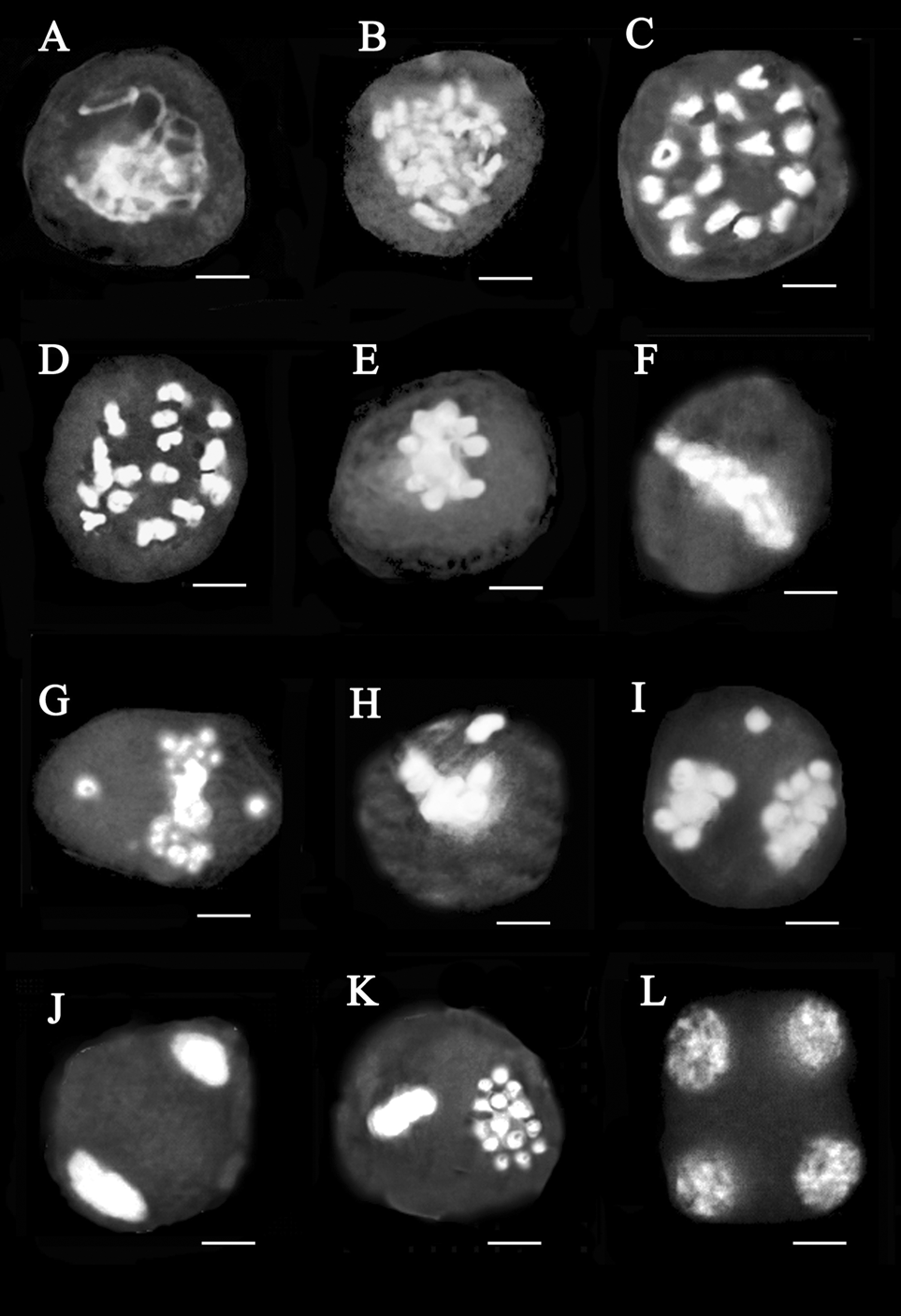
Chromosome number report. The meiotic study shows that Onosma mahabadensis is a tetraploid species with a chromosome number of 2n = 4x = 32 (Fig. 1).
Representative meiotic cells in Onosma mahabadensis. A, prophase of 25196; B, prophase of 31751; C, diakinesis of 25196; D, diakinesis of 31751; E, sticky chromosome in diakinesis of 25196; F, metaphase I of 25196; G, precocious migration of chromosomes in 25196; H, precocious migration of chromosomes in 31751; I, micronucleus in telophase I of 25196; J, telophase I of 25196; K, metaphase II of 25196; L, telophase II of 25196. Scale bars = 5 µm.
Cytogenetics
The chromosome number of Onosma mahabadensis was found to be 2n = 4x = 32 (Fig. 1). A wide range of meiotic stages were observed in anthers within the same flower. A total of 383 diakinesis/metaphase I (D/MI), 442 anaphase I/telophase I (AI/TI), 37 metaphase II (MII) and 308 anaphase II/telophase II (AII/TII) cells were analysed in both populations. The general meiotic behaviour was regular, with bivalent pairing and normal chromosome segregation at meiosis. However, some meiotic abnormalities were observed, including precocious division of centromeres and sticky chromosomes in metaphase I, laggard chromosomes in anaphase I and a micronucleus in telophase I and II. Bivalents are found in two forms: open ring chromosomes and closed rod chromosomes. Ring bivalents are usually created by metacentric and sub-metacentric chromosomes. In ring bivalents chiasmata exist in each arm of homologous chromosomes, but in rod bivalents chiasmata are formed in acrocentric or telocentric chromosomes. In this case chiasmata exist in both forms (Fig. 1C, D). Precocious division of centromeres was found in 18% of metaphase cells in the population from which Ranjbar & Almasi 25196 was collected and 10% in the one from which Ranjbar & Almasi 31751 was gathered (Fig. 1G, H). Stickiness was observed in 3.2% of cells in population 25196 and 9% in 31751 (Fig. 1E). Chromosome stickiness may be caused by genetic and environmental factors, and several agents have been reported to cause chromosome stickiness (Ranjbar et al., Reference Ranjbar, Karamian and Hajmoradi2011). The presence of a micronucleus was only found in 2% of AI/TI cells in population 25196 and 8% in 31751.
Discussion
De Candolle (1846) proposed Onosma sect. Aponosma with three species: O. sericea Willd., O. elegans Koch and O. tripartita Hochst. This section was also recognised by Popov (Reference Popov and Shiskin1974) in the Flora of the USSR.
Onosma mahabadensis is placed in Onosma sect. Aponosma due to the following characters: perennial, entire plant covered with dense appressed white sericeous hairs, simple tubercles, a calyx with short and hairy tube and 2–4 cyme inflorescences.
Stebbins (Reference Stebbins1947) classified polyploids into autopolyploids, allopolyploids, autoallopolyploids, and segmental allopolyploids. In autopolyploids, all genomes are identical and homologous chromosomes have equal opportunities to pair at meiosis with multivalents being formed. However, the maintenance of the multivalence until metaphase I will depend on its frequency and chiasma localisation. In segmental allopolyploids the genomes are not identical. As they result from hybridisation of closely related diploid species, followed by the doubling of the chromosome numbers, bivalents are formed (Utsunomiya et al., 2005; Sheidai & Jalilian, Reference Sheidai and Jalilian2006). Onosma mahabadensis is a tetraploid species with 2n = 4x = 32, consistent with the proposed base number of x = 8 for Onosma sect. Aponosma. Moreover all populations studied formed only bivalents and univalents, with no quadrivalent formation. The species can therefore be called a segmental allopolyploid.
Acknowledgements
We acknowledge the enormous help provided by Dr D. Röpert, Dr E. Haston, Dr L. Gautier, Dr O. Sida, Dr E. Vitek, Dr B. Wallnöfer and Dr W. Till during our visits to the following herbaria: B, E, G, PR, W and WU. We thank Dr D. Middleton for his comments on the nomenclature and also two anonymous reviewers who improved the overall quality of the manuscript. The field work in Iran was supported by grants from Bu-Ali Sina University.