Management Implications
Artemisia vulgaris (mugwort) was introduced into the North America more than 400 yr ago as a medicinal herb. In the last two decades, A. vulgaris has begun encroaching into new areas, including annual row crops, hayfields, pastures, and turfgrass. Historically, several approaches including chemical and mechanical control tactics have been attempted for A. vulgaris management. These tactics were mainly focused on short-term control of A. vulgaris. Once the treatments ceased, regrowth of A. vulgaris generally occurred within 1 yr after treatment. Nitrogen fertilization is known to influence weed population dynamics, increase the competitiveness of certain native plant species, and improve herbicide effectiveness. Until now, the role of nitrogen fertilization and herbicides for integrated management of A. vulgaris was not understood. This study showed that A. vulgaris can be managed with multiple fall applications of aminopyralid or glyphosate herbicides. A single application of aminopyralid at ≥122 g ae ha−1 or glyphosate at ≥1,104 g ae ha−1 controlled A. vulgaris ≥90%. However, follow-up applications were required for complete elimination of rhizomes. Artemisia vulgaris was not controlled with clopyralid, even after three fall applications at 560 g ae ha−1. Contrary to the research hypothesis, nitrogen fertilization did not influence A. vulgaris control with the tested herbicides. However, the productivity of cool-season grasses improved significantly where 62 kg N ha−1 was combined with aminopyralid at ≥122 g ae ha−1. Aminopyralid is very safe for use on established cool-season pasture grasses, but it is currently not registered for use in many states in the Northeast. However, aminopyralid may be used on grazed areas in and around rangelands, conservation reserve program, natural areas, and non-crop areas. Glyphosate, due to its nonselective nature, may be used for spot treatment of isolated A. vulgaris patches or as a broadcast treatment where complete pasture renovation is required.
Introduction
Approximately 5,000 nonnative plant species are known to exist as self-sustaining populations in the U.S. natural ecosystems (Pimentel et al. Reference Pimentel, Zuniga and Morrison2005), and each year more than 700,000 ha of wildlife habitat are being invaded (Babbitt Reference Babbitt1998). Mugwort (Artemisia vulgaris L.), a highly invasive perennial plant, was introduced from Europe into North America more than 400 yr ago as a medicinal herb (Fernald Reference Fernald1900). It has colonized a wide variety of habitats in the United States and is rapidly invading into new areas. Historically, A. vulgaris invasion was confined to roadsides, floodplains and riparian areas, rights-of-way, and turf and landscape settings (Ahrens Reference Ahrens1976; Bing Reference Bing1983; Bingham Reference Bingham1965; Henderson and Weller Reference Henderson and Weller1985; Holm et al. Reference Holm, Doll, Holm, Pancho and Herberger1997). Recently, A. vulgaris has begun encroaching into annual row crops such as corn (Zea mays L.), cotton (Gossypium hirsutum L.), and soybean [Glycine max (L.) Merr.] and pastures and hayfields (Barney and DiTommaso Reference Barney and DiTommaso2003; Bradley and Hagood Reference Bradley and Hagood2002a, Reference Bradley and Hagood2002b). The rapid spread of A. vulgaris is attributed to its extensive underground rhizome system and inconsistent control with chemical and cultural control tactics (Barney and DiTommaso Reference Barney and DiTommaso2003; Bing Reference Bing1983; Henderson and Weller Reference Henderson and Weller1985; Neal and Adkins Reference Neal and Adkins2001). Artemisia vulgaris can spread via both rhizomes and seed (Barney and DiTommaso Reference Barney and DiTommaso2003). However, rhizomes are believed to be the primary method in the northeastern United States. Production of viable seeds has also been reported (JS Aulakh, unpublished data; Barney and DiTommaso Reference Barney and DiTommaso2003). Artemisia vulgaris is also one of the 10 most troublesome weeds in the U.S. nursery industry, where it strongly interferes with the growth of ornamental plants (Ahrens Reference Ahrens1976; Henderson and Weller Reference Henderson and Weller1985; Holm et al. Reference Holm, Doll, Holm, Pancho and Herberger1997; Pridham and Bing Reference Pridham and Bing1963). Artemisia vulgaris is a serious threat to the diversity of native flora, especially early successional species (Barney and DiTommaso Reference Barney and DiTommaso2003; Holm et al. Reference Holm, Doll, Holm, Pancho and Herberger1997). Allelochemicals produced by A. vulgaris exert strong negative influence on the surrounding vegetation by inhibiting their growth and survival (Barney et al. Reference Barney, Hay and Weston2005). Allelochemicals from A. vulgaris are also known to adversely impact pasture species. LeFevre and Chappell (Reference LeFevre and Chappell1962) observed inhibition of alfalfa (Medicago sativa L.) seed germination and seedling growth with fresh and dried A. vulgaris extracts. Decaying foliage and rhizomes of A. vulgaris were shown to inhibit seedling growth of red clover (Trifolium pratense L.) (Inderjit and Foy Reference Inderjit and Foy1999; Inderjit et al. Reference Inderjit, Kauer and Foy2001).
Historically, several approaches have been used for A. vulgaris management. These include mowing (Bing Reference Bing1983; Bradley and Hagood Reference Bradley and Hagood2000, Reference Bradley and Hagood2002b), herbicides (Ahrens Reference Ahrens1976; Bingham Reference Bingham1965; Bradley and Hagood Reference Bradley and Hagood2002a), and combinations of both (Bradley and Hagood Reference Bradley and Hagood2000, Reference Bradley and Hagood2002b). Bingham (Reference Bingham1965) observed a 65% reduction in A. vulgaris rhizome biomass in mowed plots compared with nonmowed plots. Other researchers observed no control of A. vulgaris following two sequential mowings at a 5-wk interval (Bradley and Hagood Reference Bradley and Hagood2002b). Physical control methods, such as tilling, are not effective and inadvertently contribute to the spread of the plant (Klingeman et al. Reference Klingeman, Robinson and McDaniel2004; Rogerson Reference Rogerson1964). Herbicides such as aminopyralid, clopyralid, glyphosate, and picloram have provided variable (43% to 100%) control of A. vulgaris (Bingham Reference Bingham1965; Bradley and Hagood Reference Bradley and Hagood2000, Reference Bradley and Hagood2002b; Koepke-Hill et al. Reference Koepke-Hill, Armel, Klingeman, Halcomb, Vargas and Flanagan2011). However, once the treatments ceased, regrowth of A. vulgaris occurred at 1 yr after treatment with all these herbicides, except picloram and clopyralid (Bradley and Hagood Reference Bradley and Hagood2002b). This is in part attributable to A. vulgaris’s biology (Barney et al. Reference Barney, Hay and Weston2005; Inderjit and Foy Reference Inderjit and Foy1999; Inderjit et al. Reference Inderjit, Kauer and Foy2001) and in part to the absence of competitive ground cover following chemical removal of A. vulgaris. Because A. vulgaris produces viable seeds, a persistent soil seedbank may also account for A. vulgaris reinvasion (Henderson and Weller Reference Henderson and Weller1985; Holm et al. Reference Holm, Doll, Holm, Pancho and Herberger1997; Odum Reference Odum1965).
Nitrogen is an essential constituent of amino acids and chlorophyll and thus plays an important role in various biochemical and physiological processes in the plant. Crop and weed competition for available resources may vary depending upon the amount of available nitrogen in the soil (Lindquist et al. Reference Lindquist, Evans, Shapiro and Knezevic2010; Swanton et al. Reference Swanton, Nkoa and Blackshaw2015). Nitrogen fertilization also influences weed population dynamics and improves competitive ability of desirable vegetation (Anderson et al. Reference Anderson, Tanaka, Black and Schweizer1998; Beck et al. Reference Beck, Patton, Law, Weisenberger, Brosnan, Almodovar, Breeden and Kopsell2015; Kirkland and Beckie Reference Kirkland and Beckie1998; Lamoureaux and Bourdôt Reference Lamoureaux and Bourdôt2007; O’Donovan et al. Reference O’Donovan, McAndrew and Thomas1997; Tzialla et al. Reference Tzialla, Papakosta and Veresoglou2002; Van Delden et al. Reference Van Delden, Lotz, Bastiaans, Franke, Smid, Groeneveld and Kropff2002) and impacts the efficacy of multiple herbicide families (Dickson et al. Reference Dickson, Andrews, Field and Dickson1990; Sonderskov et al. Reference Sonderskov, Swanton and Kudsk2012). Greater than 15% bleaching injury to crabgrass (Digitaria spp.) was reported when mesotrione was combined with nitrogen fertilization at 12 or 25 kg ha−1 compared with no nitrogen (Beck et al. Reference Beck, Patton, Law, Weisenberger, Brosnan, Almodovar, Breeden and Kopsell2015; Elmore et al. Reference Elmore, Brosnan, Kopsell and Breeden2012). Often, lower herbicide rates have resulted in acceptable weed control when herbicides were used in conjunction with nitrogen fertilization. Sixfold lower nicosulfuron rates were needed to induce 50% growth reduction (GR50) in green foxtail [Setaria viridis (L.) P. Beauv.] when applied to plants grown in high-nitrogen (7.7 mM) compared with low-nitrogen (0.7 mM) hydroponic solutions (Cathcart et al. Reference Cathcart, Chandler and Swanton2004); the GR50 value for high-nitrogen plants treated with nicosulfuron was 0.90 g ha−1 compared with 5.15 g ha−1 for those grown in a low-nitrogen hydroponic solution. Brosnan et al. (Reference Brosnan, Thoms, McCullough, Armel, Breeden, Sorochan and Mueller2010) reported greater control of annual bluegrass (Poa annua L.) with flazasulfuron at 4 g ha−1 and two applications of nitrogen at 73 kg ha−1 compared with flazasulfuron alone at 17 g ha−1.
Despite abundant evidence of enhanced weed control, the role of nitrogen fertilization when applied with herbicides for A. vulgaris management is not well understood. Therefore, an integrated approach involving nitrogen fertilization, herbicides, and application rates was attempted for management of A. vulgaris in a permanent cool-season grassland. It was hypothesized that fall application of nitrogen would benefit cool-season grasses and improve the effectiveness of herbicides to the extent that lower herbicide rates would be required to control A. vulgaris.
Materials and Methods
A 3-yr field experiment was conducted at the Lockwood Research Farm of the Connecticut Agricultural Experiment Station in Hamden, CT (41.24°N, 72.54°W) from 2015 through 2018. The research site was a permanent grassland composed of Kentucky bluegrass (Poa pratensis L.), orchardgrass (Dactylis glomerata L.), and Timothy-grass (Phleum pratense L.). A well-established (>7-yr-old) A. vulgaris population had replaced the forage grass cover by more than 60%. The soil at the experiment site was a Yalesville well-drained, gravelly, sandy loam (coarse-loamy, mixed, active, mesic Typic Dystrochrepts) with 64% sand, 29% silt, 7% clay, 3.7% organic matter, and a pH of 5.6. Before the study, the site was mowed once in June 2015. The experiment was established in a split-split-plot design with three replications. The main plot (30 by 9 m) consisted of three rates of nitrogen at 0, 62, and 124 kg N ha−1 based upon a general recommendation of approximately 60 kg N ha−1 (Smith et al. Reference Smith, Repair, Baker and Seay2003). Subplots (9 by 9 m) included three herbicides (aminopyralid, clopyralid, and glyphosate), and the sub-subplot (3 by 9 m) was three application rates. Aminopyralid (Milestone™, Dow AgroSciences, Indianapolis, IN) rates were 61, 122, and 244 g ae ha−1, clopyralid (Stinger®, Dow AgroSciences) rates were 140, 280, and 560 g ae ha−1, and glyphosate (Roundup PowerMax®, Monsanto, St Louis, MO) rates were 552, 1,104, and 2,208 g ae ha−1. A nontreated control plot (no nitrogen and no herbicide) also was established for comparison. Each year, the entire experiment site was mowed once in late July or early August. Nitrogen was applied as urea (46% N) in the fall (late August or early September) of 2015 through 2017. Fall timing was attempted with the view that late nitrogen availability would force A. vulgaris to continue shoot growth and thereby affect the direction of photosynthate movement. Additionally, it was expected that new succulent growth would aid higher herbicide absorption and thus improve A. vulgaris control. Herbicide treatments were applied on October 23, 14, and 6 in 2015, 2016, and 2017, respectively. Herbicide solutions were prepared in deionized water and applied with a compressed CO2 sprayer fitted with four XR TeeJet® 8002 (TeeJet Technologies, Springfield, IL) nozzles delivering 187 L ha−1 at 276 kPa. A nonionic surfactant (Activator 90, Loveland Products, Greeley, CO) (0.5% v/v) was used with the aminopyralid treatments only. Data were collected periodically over the 3 yr for A. vulgaris visual control, density, and rhizome dry biomass and for grass injury and aboveground dry biomass. Artemisia vulgaris control was assessed visually on sub-subplot level using a scale ranging from 0% (no control) to 100% (complete control). Grass injury also was assessed visually on sub-subplot level using a scale ranging from 0% (no injury) to 100% (dead). Visual A. vulgaris control or grass injury estimates at 9, 21, and 33 mo after initial herbicide treatment (MAIT) were based on chlorosis, necrosis, and stunting of the treated plants compared with the plants in the nontreated control plots. Artemisia vulgaris stem density, rhizome dry biomass, and aboveground dry biomass of the cool-season grasses were sampled at 9, 21, and 33 MAIT within two randomly placed 50 by 50 cm quadrats in each sub-subplot. Rhizome biomass samples were excavated using a shovel from inside two 50 by 50 by 25 cm (length by base by height) cubes in each subplot. Artemisia vulgaris rhizomes were washed, oven-dried at 60 C for 72 h, and weighed for dry biomass.
Statistical Analysis
Data on various response variables were analyzed using generalized linear mixed model methodology using the PROC GLIMMIX procedure in SAS (v. 9.4, SAS Institute, Cary, NC). Artemisia vulgaris visual control and cool-season grass injury data were analyzed without the nontreated control values. However, A. vulgaris stem density and cool-season grass biomass data were analyzed including the nontreated controls. Because no cool-season grass injury was observed in the aminopyralid- and clopyralid-treated plots, data analysis included injury ratings from the glyphosate-treated plots only. No transformations were required for A. vulgaris visual control, stem density, grass injury, and grass biomass data. However, rhizome dry biomass data were converted into percentage of biomass reduction compared with the nontreated control (Wortman Reference Wortman2014) as
 $$\% \,{\rm{biomass}}\,{\rm{reduction}} = [(\overline C - B)/\overline C] \times 100$$
Where
 $\overline C$
is the mean rhizome dry biomass of the three nontreated control replicates, and B is the biomass in each sub-subplot. Data analyses were done using 9, 21, and 33 MAIT data. Nitrogen, herbicide, application rate, MAIT, and their interaction were treated as fixed effects, whereas replication and its interaction with fixed effect variables were treated as random effects. The factor MAIT had a repeated-measures nature that induced a covariance relationship because of the lack of rerandomization. A heterogeneous autoregressive covariance structure [ARH (1)] was used to model the covariance relationship between observations taken from the same plot at 9, 21, and 33 MAIT. Where the main effect of nitrogen and its interactions were nonsignificant (P > 0.05), data were pooled across nitrogen rates. Analyses of A. vulgaris visual control, stem density, rhizome biomass, and grass dry biomass data indicated significant three-way interactions of herbicide by application rate by MAIT. Therefore, data were regressed over individual herbicide rates by MAIT using a four-parameter log-logistic model (Seefeldt et al. Reference Seefeldt, Jensen and Fuerst1995) embedded in the drc package in R software (Knezevic et al. Reference Knezevic, Streibig and Ritz2007) as
 $$Y = c + \left\{ {d - {c \over 1} + \exp [b(\log x - \log e)]} \right\}$$
In this model (Equation 2), Y is the percentage of A. vulgaris visual control or density (stems m−2) or percentage of reduction in rhizome biomass or aboveground biomass of the cool-season grasses (kg ha−1), b is the slope of the curve, c is the lower limit, d is the upper limit, and e represents the ED50 values. ED50 and ED90 represent the herbicide rate required for 50% and 90% response, respectively (e.g., 50% control or 50% reduction in A. vulgaris stem density or 50% reduction in rhizome biomass), and x is the herbicide rate. Regression model parameters and standard errors were used for describing interaction effects for A. vulgaris visual control, stem density, rhizome biomass, and cool-season grass biomass. Means comparisons for grass injury data were made using the Adj-simulate option in PROC GLIMMIX at the 5% significance level.
Results and Discussion
Artemisia vulgaris Visual Control
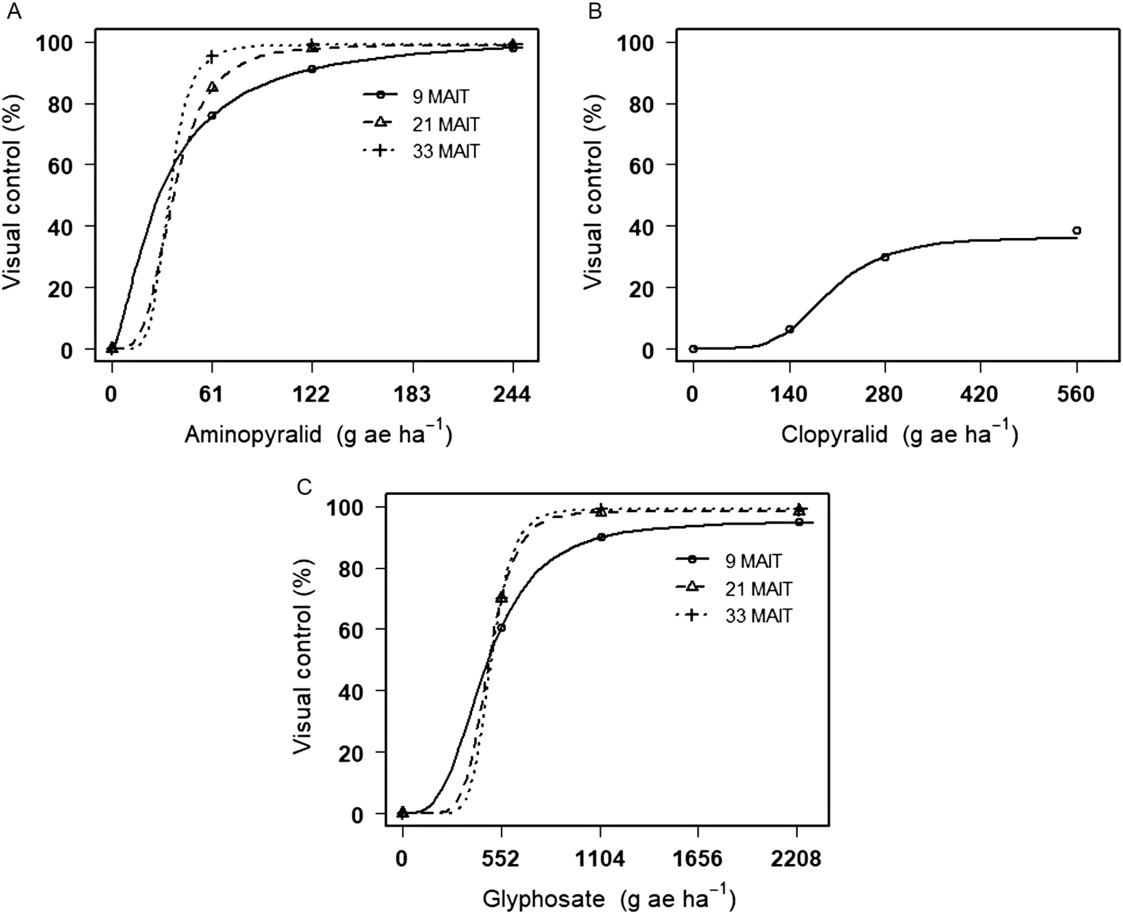
There was a significant three-way interaction of herbicide by application rate by MAIT for A. vulgaris visual control (P = 0.0003). In general, A. vulgaris was effectively controlled with all tested rates of aminopyralid and glyphosate at ≥1,104 g ae ha−1. With aminopyralid, control increased from 75% to 95% with 61 g ae ha−1, 90% to 99% with 122 g ae ha−1, and 98% to 99% with 244 g ae ha−1, from 9 to 33 MAIT, respectively (Figure 1A). Koepke-Hill et al. (Reference Koepke-Hill, Armel, Klingeman, Halcomb, Vargas and Flanagan2011) also found aminopyralid to be highly effective on A. vulgaris, with 52%, 91%, and 97% control a year following treatment with aminopyralid at 70, 140, and 280 g ae ha−1, respectively.
Artemisia vulgaris percent visual control under different rates of aminopyralid (A), clopyralid (B), and glyphosate (C) at 9, 21, and 33 mo after initial treatment (MAIT). Because the clopyralid rate by MAIT interaction was not significant, a single response curve is given for clopyralid.

Clopyralid had little effect, and there was no improvement in A. vulgaris control over time. Early symptoms of clopyralid injury included: chlorosis, curling of leaves and shoots, and necrosis. However, A. vulgaris recovered after each treatment, and only stunting injury was present at the time of visual control estimates. Averaged across MAIT, visual control was <40%, even at the highest clopyralid rate of 560 g ae ha−1 (Figure 1B). Koepke-Hill et al. (Reference Koepke-Hill, Armel, Klingeman, Halcomb, Vargas and Flanagan2011) also observed <40% control of A. vulgaris at 1 yr after treatment with clopyralid at 280 g ae ha−1. In contrast, 85% to 100% A. vulgaris control with clopyralid has been reported in studies focused on short-term control. For example, Klingeman et al. (Reference Klingeman, Armel, Wilson, Hines, Vargas and Flanagan2014) achieved ≥85% A. vulgaris control at 21 d after treatment with clopyralid at 560 g ae ha−1. Day et al. (Reference Day, Hagood and Johnson1997) also reported 85% A. vulgaris control in field corn with late POST (10- to 15-leaf corn) application of clopyralid at 300 g ae ha−1. Bradley and Hagood (Reference Bradley and Hagood2002a) obtained >80% control, 1 yr after June application of clopyralid at 280 g ae ha−1. Based upon their dose–response study, they concluded that complete control of A. vulgaris plants and rhizomes may be expected with clopyralid at rates of 4.4 kg ae ha−1. Foy (Reference Foy2001) also achieved complete A. vulgaris control at 7 wk after treatment with clopyralid at 140 g ae ha−1. Higher A. vulgaris control in these studies may be attributed to smaller A. vulgaris size (≤40 cm) at treatment application time (Bradley and Hagood Reference Bradley and Hagood2002a) or differences in assessment times (Day et al. Reference Day, Hagood and Johnson1997; Foy Reference Foy2001; Klingeman et al. Reference Klingeman, Armel, Wilson, Hines, Vargas and Flanagan2014).
Regarding glyphosate, A. vulgaris was controlled 60% at 552 g ae ha−1 and 90% or higher with ≥1,104 g ae ha−1 by 9 MAIT (Figure 1C). Regardless of glyphosate rate, there was no significant improvement in control by 21 MAT and afterward. By 33 MAIT, A. vulgaris was controlled >99% with ≥1,104 g ae ha−1. In this study, glyphosate at ≥1,104 g ae ha−1 gave ≥90% control by 9 MAIT, which is more than 74% control at 1 yr after treatment with glyphosate at 2,200 g ae ha−1 in Virginia (Bradley and Hagood Reference Bradley and Hagood2002a). However, in a greenhouse study, Foy (Reference Foy2001) found glyphosate at 1,120 g ai ha−1 only moderately effective and regrowth of A. vulgaris occurred.
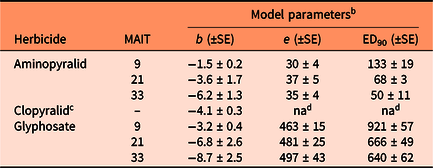
Overall, slopes of the curves indicated significant improvement in visual control estimates over time (9 MAIT vs. 21 or 33 MAIT) with different rates of aminopyralid (Table 1). The ED50 values (Table 1) for aminopyralid were similar across MAIT, because A. vulgaris visual control exceeded 50%, even with the lowest aminopyralid rate (61 g ae ha−1) at any MAIT. The ED90 values, however, were significantly lower at 21 or 33 MAIT than at 9 MAIT due to improvement in A. vulgaris control over time, particularly with aminopyralid at 61 g ae ha−1 (Table 1). There were no differences in slope values for clopyralid across MAIT. The ED50 and ED90 values are not reported, because visual control was below 40% with tested clopyralid rates. Slopes of the curves and ED50 and ED90 values for glyphosate trended similar to those of aminopyralid (Table 1).
Model parameters and standard errors for the four-parameter log-logistic model for Artemisia vulgaris visual control in relation to herbicides, application rates, and months after initial treatment. a

a Abbreviations: b is the slope of the curve; e is the effective herbicide dose (g ae ha−1) required for 50% control; ED90 is the effective herbicide dose (g ae ha−1) required for 90% control; MAIT, months after initial treatment.
b Regression parameters b, e, and ED90 were determined by using the nonlinear least-square function of the statistical software R. In the four-parameter log-logistic model, regression parameter c (the lower limit) was fixed at 0% and d (the upper limit) was fixed at 100%
c Because the clopyralid rate by MAIT interaction was not significant, data were regressed over clopyralid rates only.
d na, the model-predicted e and ED90 values were meaningless, because 50% control did not occur with any clopyralid rate tested in this study.
In this study, nitrogen fertilization did not improve herbicide efficacy for A. vulgaris control (P = 0.3821). Effect of nitrogen on herbicide performance may vary by weed species. Grekul and Bork (Reference Grekul and Bork2007) observed improvement in Canada thistle [Cirsium arvense (L.) Scop.] control in a cool-season grass pasture with selective broadleaf herbicides in combination with annual spring applications of ammonium nitrate. Conversely, application of nitrogen fertilizer did not improve control of western ironweed (Vernonia baldwinii Torr.) and coralberry (Symphoricarpos orbiculatus Moench) with 2,4-D herbicide (Peters and Stritzke Reference Peters and Stritzke1969). Typically, nitrogen is applied to cool-season grasslands in two split applications during spring and summer (Smith et al. Reference Smith, Repair, Baker and Seay2003). The reason for fall application in this study was to determine whether A. vulgaris would become more susceptible to low herbicide rates under high nitrogen conditions. Therefore, the lack of nitrogen effect on herbicide efficacy in this study may be related to A. vulgaris’s physiology or a lack of A. vulgaris response to enhanced nitrogen.
Artemisia vulgaris Density
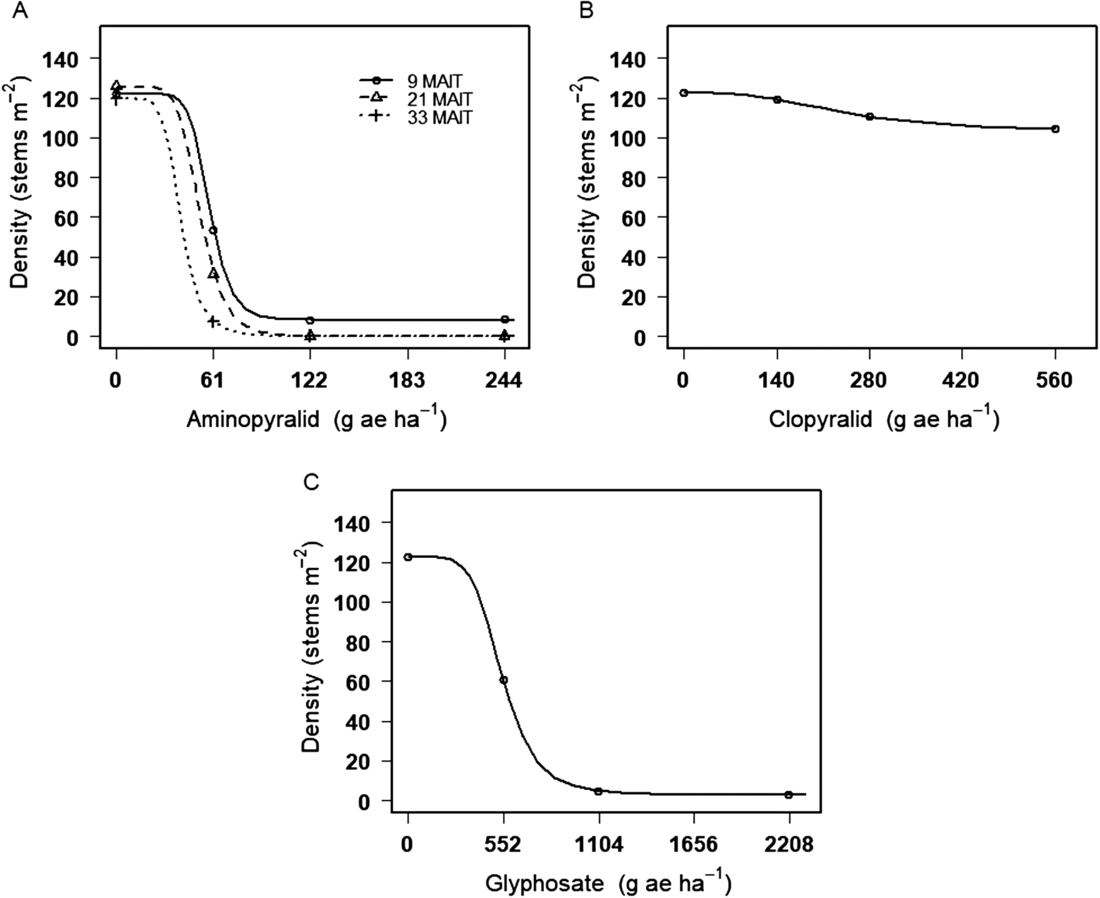
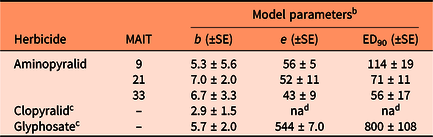
A three-way interaction of herbicide by application rate by MAIT was observed for A. vulgaris density (P < 0.0001). Density in the nontreated plots varied between 119 to 126 stems m−2 from 9 to 33 MAIT. With aminopyralid, density was reduced 57% to 94% at 61 g ae ha−1 and 98% to 100% at ≥122 g ae ha−1 from 9 to 33 MAIT, respectively (Figure 2A). Koepke-Hill et al. (Reference Koepke-Hill, Armel, Klingeman, Halcomb, Vargas and Flanagan2011) recorded 63%, 99%, and 100% reduction in A. vulgaris stem density at 1 yr following treatment with aminopyralid at 70, 140, and 280 g ae ha−1, respectively. The slope of the curve and the ED50 values were similar across MAIT (Table 2). The ED50 values were similar because density was reduced >50%, even with the lowest aminopyralid rate (61 g ae ha−1), at any MAIT. The ED90 values, however, were significantly lower at 21 or 33 MAIT than at 9 MAIT.
Artemisia vulgaris density (stems m−2) under different rates of aminopyralid (A), clopyralid (B), and glyphosate (C) at 9, 21, and 33 mo after initial treatment (MAIT). Because the clopyralid rate by MAIT and glyphosate rate by MAIT interactions were not significant, a single response curve is given for clopyralid and glyphosate.

Model parameters and standard errors for the four-parameter log-logistic model for Artemisia vulgaris density in relation to herbicides, application rates, and months after initial treatment. a

a Abbreviations: b is the slope of the curve; e is the effective herbicide dose (g ae ha−1) required for 50% reduction in density; ED90 is the effective herbicide dose (g ae ha−1) required for 90% reduction in density; MAIT, months after initial treatment.
b Regression parameters b, e, and ED90 were determined by using the nonlinear least-square function of the statistical software R. In the four-parameter log-logistic model, regression parameter c (the lower limit) was fixed at 0 and d (the upper limit) was fixed at 123, 126, and 119 stems m−2 at 9, 21, and 33 MAIT, respectively.
c Because the clopyralid rate by MAIT or glyphosate rate by MAIT interactions were not significant, data were regressed over clopyralid or glyphosate rates only.
d na, the model-predicted e and ED90 values were meaningless, because 50% reduction in density did not occur with any clopyralid rate tested in this study.
With clopyralid, A. vulgaris stem density varied with application rate but remained unchanged across MAIT. Therefore, a single response curve could be fit across MAIT (Figure 2B). Averaged across MAIT, density was only14% lower in plots treated with clopyralid at ≥280 g ae ha−1 than in the nontreated control. With clopyralid at 140 g ae ha−1, density (120 stems m−2) was not different from density for the nontreated control. A similar reduction in A. vulgaris stem density was observed by Koepke-Hill et al. (Reference Koepke-Hill, Armel, Klingeman, Halcomb, Vargas and Flanagan2011) a year following treatment with 280 g ae ha−1 of clopyralid (70 plants 0.25 m−2) compared with the nontreated control (81 plants 0.25 m−2). Because density with clopyralid was not reduced more than 15%, the ED50 and ED90 values are not reported (Table 2).
Similarly, for glyphosate, there were no significant differences in density from 9 to 33 MAIT, and a single response curve was adequate to explain differences between glyphosate rates (Figure 2C). Averaged across MAIT, stem density was reduced by 52% with 552 g ae ha−1 and ≥91% with glyphosate rates ≥1,104 g ae ha−1 compared with the nontreated control. The ED50 and ED90 values were 544 and 800 g ae ha−1 of glyphosate, respectively (Table 2).
Artemisia vulgaris stem density was not affected by nitrogen fertilization in this study (P = 0.4331). Previous researchers also reported contrasting outcomes. For example, C. arvense densities following nitrogen fertilization decreased in irrigated pastures of the United States (Thrasher et al. Reference Thrasher, Cooper and Hodgson1963), increased in pastures of the midwestern United States (Reece and Wilson Reference Reece and Wilson1983), and remained unaffected in pastures of eastern Canada (Hay and Ouellette Reference Hay and Ouellette1959).
Artemisia vulgaris Rhizome Biomass
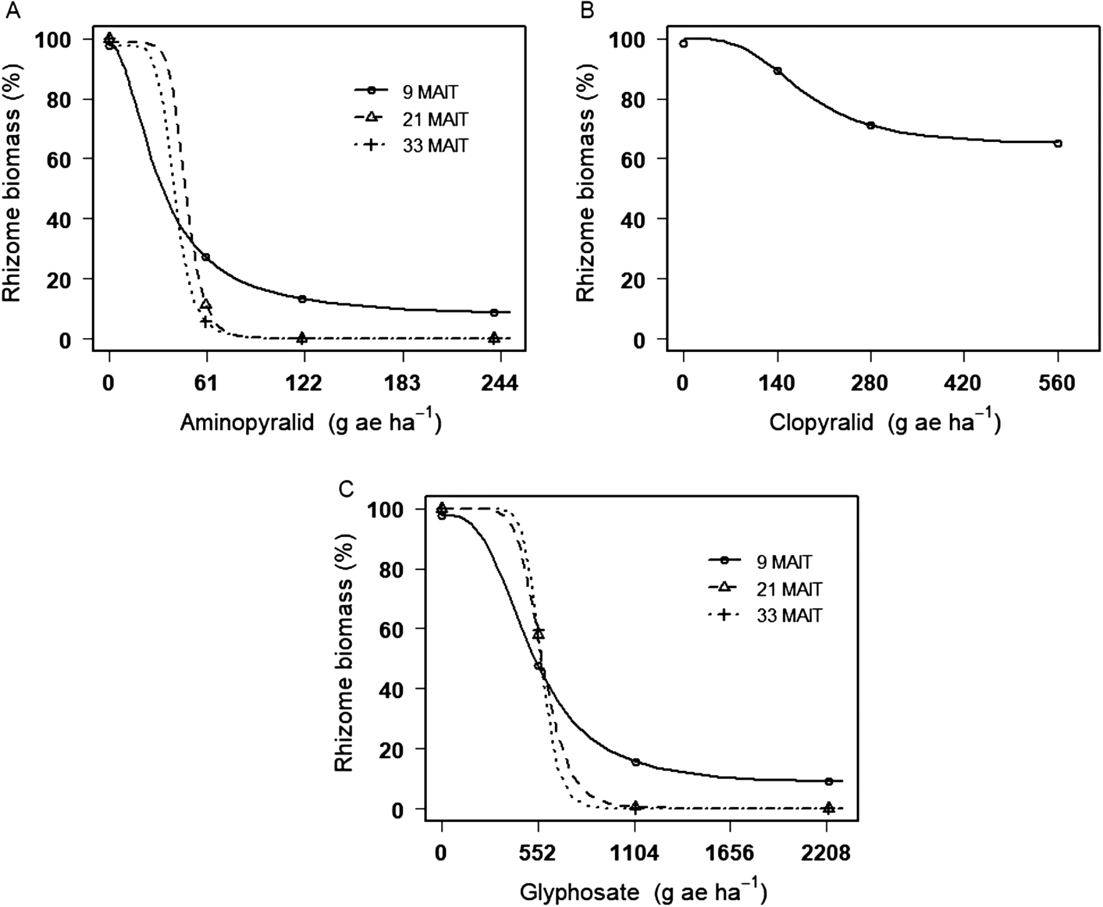
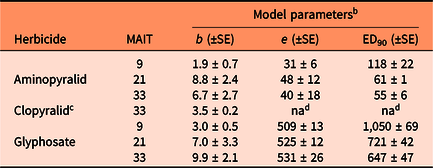
Artemisia vulgaris frequently evades control with herbicides because of its persistent rhizome system. Therefore, complete elimination of rhizomes is critical for achieving long-term control. Analysis of rhizome biomass data revealed a significant three-way interaction of herbicide by application rate by MAIT (P < 0.0001). This indicated that A. vulgaris control varied with herbicide rate and MAIT. Rhizome biomass in the nontreated plots was 448, 460, and 528 g m−2 at 9, 21, and 33 MAIT, respectively. Overall, the reduction in the rhizome biomass corresponded with the percent visual control and density data. By 9 MAIT, aminopyralid reduced rhizome biomass 73% to 91% depending upon application rate (Figure 3A), whereas the corresponding visual control estimates were slightly higher (Figure 1A). By 21 MAIT, rhizomes were completely eliminated within the sampled quadrats with aminopyralid at ≥122 g ae ha−1. By 33 MAIT, all rates of aminopyralid were similar; however, rhizomes were still not completely eliminated with aminopyralid at 61 g ae ha−1. No previous research has ever quantified reduction in A. vulgaris rhizome biomass following chemical control (Ahrens Reference Ahrens1976; Bradley and Hagood Reference Bradley and Hagood2000, Reference Bradley and Hagood2002a, Reference Bradley and Hagood2002b; Henderson and Weller Reference Henderson and Weller1985; Koepke-Hill et al. Reference Koepke-Hill, Armel, Klingeman, Halcomb, Vargas and Flanagan2011). These studies were focused on short-term A. vulgaris control with visual control assessment as the only indicator of treatment efficacy. Koepke-Hill et al. (Reference Koepke-Hill, Armel, Klingeman, Halcomb, Vargas and Flanagan2011) observed 61% to 100% reduction in A. vulgaris shoot biomass a year after treatment with aminopyralid rates ranging from 70 to 280 g ae ha−1. This level of reduction in shoot biomass corresponds with reduction in A. vulgaris rhizome biomass by aminopyralid in this study. However, reduction in rhizome biomass is a stronger indicator of long-term control in perennial weeds for which rhizomes are the primary propagules (Aulakh et al. Reference Aulakh, Enloe, Loewenstein, Price, Wehtje and Miller2014). Similar trends were seen in slopes of the curves and ED50 and ED90 values as with visual control for aminopyralid (Table 3).
Artemisia vulgaris rhizome biomass (%) reduction compared with the nontreated control with different rates of aminopyralid (A), clopyralid (B), and glyphosate (C) at 9, 21, and 33 mo after initial treatment (MAIT). Because the clopyralid rate by MAIT interaction was not significant, a single response curve is given for clopyralid. Rhizome dry biomass data were converted into percentage of biomass reduction compared with the nontreated control using the following equation.
 $\% \,{\rm{biomass}}\,{\rm{reduction}} = [(\overline C - B)/\overline C] \times 100$
, where
$\overline C$
is the mean rhizome dry biomass, and B is the biomass in each sub-subplot.

Model parameters and standard errors for the four-parameter log-logistic models for Artemisia vulgaris rhizome biomass in relation to herbicides, application rates, and months after initial treatment. a

a Abbreviations: b is the slope of the curve; e is the effective herbicide dose (g ae ha−1) required for 50% reduction in rhizome biomass; ED90 is the effective herbicide dose (g ae ha−1) required for 90% reduction in rhizome biomass; MAIT, months after initial treatment.
b Regression parameters b, e, and ED90 were determined by using the nonlinear least-square function of the statistical software R. In the four-parameter log-logistic model, regression parameter c (the lower limit) was fixed at 0% and d (the upper limit) was fixed at 100%. Rhizome dry biomass data were converted into percentage of reduction compared with the nontreated control.
c Because the clopyralid rate by MAIT interaction was not significant, data were regressed over clopyralid rates only.
d na, the model-predicted e and ED90 values were meaningless, because 50% reduction in rhizome biomass did not occur with any clopyralid rate tested in this study.
With clopyralid, reductions in rhizome biomass closely followed the visual control estimates. Rhizome biomass was reduced only 14%, 29%, and 38% with 140, 280, and 560 g ae ha−1 respectively, when compared with the nontreated control (Figure 3B). Clopyralid at 140 g ae ha−1 was not different from the nontreated control. An approximate 35% reduction in rhizome biomass occurred following initial treatment of clopyralid at ≥280 g ae ha−1. However, these levels of reduction remained constant from year to year, indicating no further improvement with the repeated clopyralid treatments. Bradley and Hagood (Reference Bradley and Hagood2002a) concluded that complete elimination of A. vulgaris rhizome biomass may be possible with clopyralid rates ≥4,400 g ae ha−1. Because 50% reduction in rhizome biomass with clopyralid was not achieved, the ED50 and ED90 values are not reported (Table 3).
With glyphosate, reduction in rhizome biomass ranged from 52% to 91% by 9 MAIT, 58% to 100% by 21 MAIT, and 60% to 100% by 33 MAIT, depending upon glyphosate rate (Figure 3C). By 21 MAIT and afterward, glyphosate at ≥1,104 g ae ha−1 resulted in complete elimination of rhizome biomass. Glyphosate at ≥1,104 g ae ha−1 and aminopyralid at ≥122 g ae ha−1 were similar in terms of elimination in rhizome biomass (mean comparisons not shown). On the contrary, glyphosate at 552 g ae ha−1 was not as effective as 61 g ae ha−1 of aminopyralid at any timing. Bradley and Hagood (Reference Bradley and Hagood2002a) suggested >4,400 g ae ha−1 of glyphosate would be required for long-term control of A. vulgaris plants and rhizomes. Although they did not quantify rhizome biomass, they based their conclusion on the absence of A. vulgaris regrowth in plots treated with 4,400 g ae ha−1 of glyphosate. Slopes of the curves and ED50 and ED90 values for glyphosate trended similar to those of the visual control data (Table 3).
Grass Injury
Nitrogen fertilization did not affect the response of cool-season grasses to herbicides. However, an herbicide by application rate interaction was highly significant (P = 0.0045). Neither aminopyralid nor clopyralid caused noticeable injury to cool-season grasses. Both aminopyralid and clopyralid are labeled for use on established desirable grasses. Aminopyralid can be applied in the spring before seeding grasses in the following fall (Halstvedt et al. Reference Halstvedt, Peterson, Becker, Lym and Moechnig2011; Lym et al. Reference Lym, Becker, Moechnig, Halstvedt and Peterson2017). Similarly, newly seeded pubescent wheatgrass [Thinopyrum intermedium (Host) Barkworth & D.R. Dewey] was not injured with clopyralid at 0.07 kg ae ha−1 (Enloe et al. Reference Enloe, DiTomaso, Orloff and Drake2005).
All rates of glyphosate tested in this study were highly injurious to established cool-season grasses. With 552 g ae ha−1 of glyphosate, injury manifested mainly as chlorosis and stunting. Averaged across nitrogen rates and MAIT, grass injury with 552 g ae ha−1 of glyphosate was around 65% compared with the nontreated control. Glyphosate at ≥1,104 g ae ha−1 resulted in complete elimination (100%) of cool-season grasses. Early symptoms included chlorosis, which was soon followed by complete tissue necrosis over a period of 4 to 5 wk (data not shown). In a previous study, glyphosate at 280 g ae ha−1 caused 30% and 40% injury in eastern gamagrass [Tripsacum dactyloides (L.) L.] and switchgrass (Panicum virgatum L.), respectively (Rankins et al. Reference Rankins, Shaw and Douglas2005). Bingham et al. (Reference Bingham, Segura and Foy1980) also observed 63% to 85% reduction in shoot dry weight in 4-mo-old P. pratensis, D. glomerata, and perennial ryegrass (Lolium perenne L.) with glyphosate at ≥280 g ae ha−1 in a greenhouse study.
Grass Biomass
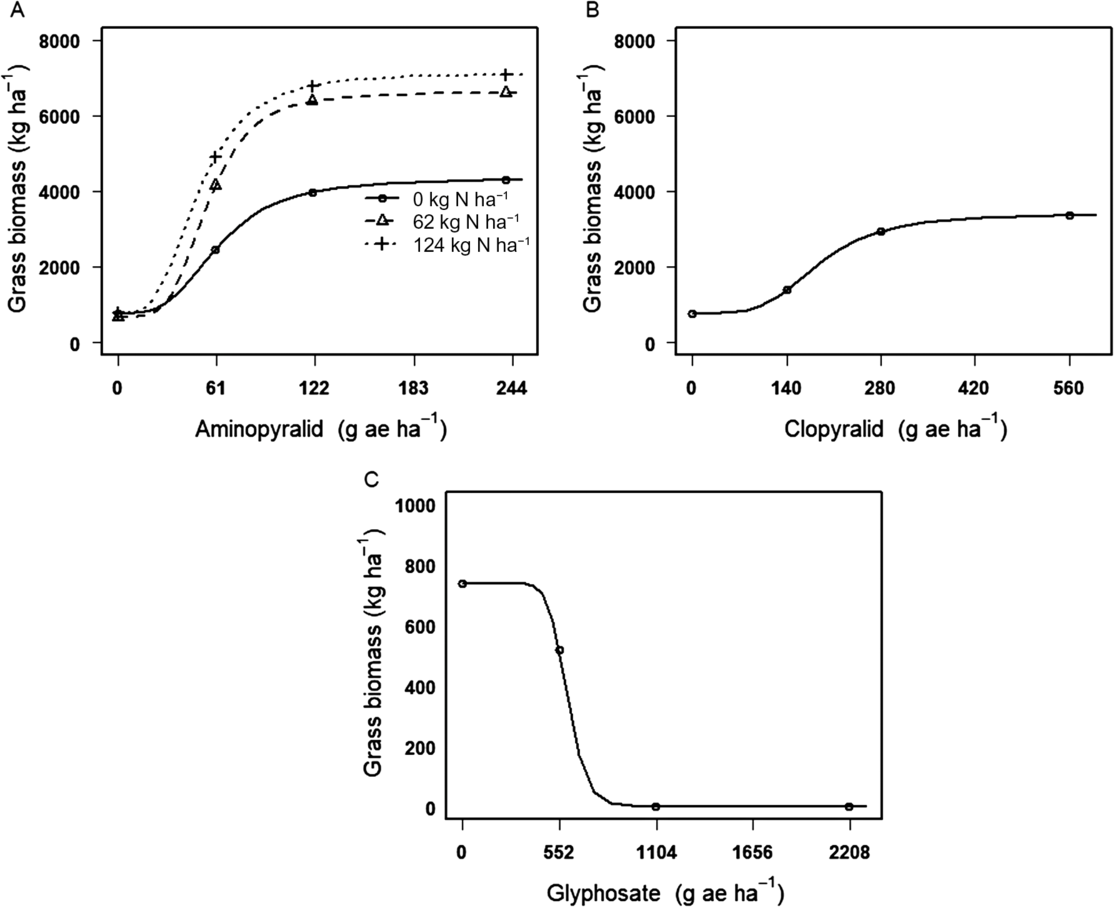
A nitrogen by herbicide by application rate interaction was significant (P = 0.0361). Grasses responded favorably to improved nitrogen and release from resource competition in plots where A. vulgaris was controlled with aminopyralid. With aminopyralid, grass biomass increased as the nitrogen rate increased from 0 to 62 kg N ha−1 (Figure 4A). Furthermore, the increase was exponential up to 122 g ae ha−1 of aminopyralid and plateaued thereafter. The combination of 244 g ae ha−1 of aminopyralid and 124 kg N ha−1 produced the highest grass biomass (7,126 kg ha−1), which was similar to 6,613 kg ha−1 with 244 g ae ha−1 of aminopyralid combined with 62 kg N ha−1 (Table 4). Regardless of nitrogen rate, grass biomass was similar with aminopyralid rates of 122 and 244 g ae ha−1, mainly due to comparable A. vulgaris control (Table 1). Observed biomass yield was lower than the yield potential of 7,000 to 12,000 kg ha−1 for cool-season grasses (Cassida and Kaatz Reference Cassida and Kaatz2019; Rayburn Reference Rayburn2014). This was perhaps due to fall application of nitrogen in this study. Late fall nitrogen fertilization encourages winter root development and early spring regrowth and may improve forage yield (Smith et al. Reference Smith, Repair, Baker and Seay2003). However, spring or summer applications are critical to produce higher forage yields (Smith et al. Reference Smith, Repair, Baker and Seay2003). Moreover, cool-season grass response to nitrogen fertilizer also varies with the grass species, application time, and environment (George et al. Reference George, Rhykerd, Noller, Dillon and Burns1973; Schmid et al. Reference Schmid, Elling, Hovin, Lueschen, Nelson, Rabas and Warner1979). The ED50 (aminopyralid rate resulting in 50% of the maximum recorded grass biomass) values indicated that less aminopyralid was required when it was combined with ≥124 kg N ha−1 (Table 4). This may be due to greater A. vulgaris control with aminopyralid at higher nitrogen levels, although an aminopyralid rate by nitrogen interaction was not significant for any of the A. vulgaris variables recorded in this study.
Cool-season grass biomass (kg ha−1) compared with the nontreated control with different rates of aminopyralid (A), clopyralid (B), and glyphosate (C) at 0, 62, and 124 kg N ha−1. Because the clopyralid rate by nitrogen and glyphosate rate by nitrogen interactions were not significant, a single response curve is given for clopyralid and glyphosate. For glyphosate, grass biomass on y axis ranges from 0 to 1,000 kg ha−1.

Model parameters and standard errors for the four-parameter log-logistic models for grass dry biomass in relation to different nitrogen and herbicide treatments. a

a Abbreviations: b is the slope of the curve; c is the lower limit (kg ha−1); d is the upper limit (kg ha−1); e is effective herbicide dose (g ae ha−1) required to produce 50% of the maximum grass biomass (7,126 kg ha−1).
b Regression parameters b, c, d, and e were determined by using the nonlinear least-square function of the statistical software R.
c Because the clopyralid rate by nitrogen or glyphosate rate by nitrogen interactions were not significant, data were regressed over clopyralid or glyphosate rates only.
d na, model-predicted e values were meaningless, because all rates of glyphosate severely injured the cool-season grasses.
With clopyralid, grass biomass was similar across different nitrogen treatments but varied significantly with the clopyralid rates (P = 0.0211). Averaged across nitrogen levels, biomass was 1,382, 3,251, and 3,577 kg ha−1 with clopyralid rates of 140, 280, and 560 g ae ha−1, respectively (Figure 4B). The ED50 value (clopyralid rate resulting in 50% of the maximum recorded grass biomass) was 463 g ae ha−1 of clopyralid (Table 4). As expected, glyphosate had an adverse effect (Figure 4C). Averaged across nitrogen levels, grass biomass decreased from approximately 740 kg ha−1 in the nontreated control to 520 kg ha−1 with 552 g ha−1 of glyphosate. No grass biomass was produced in plots treated with glyphosate rates ≥1,104 g ha−1.
In summary, nitrogen fertilization did not influence efficacy of the tested herbicides for A. vulgaris management. However, cool-season grass biomass significantly improved with increased nitrogen availability. Neither aminopyralid nor clopyralid resulted in injury to cool-season grasses. Data on stem density, rhizome biomass, and visual control revealed that A. vulgaris was completely controlled with aminopyralid at 244 g ae ha−1 by 21 MAIT. Complete A. vulgaris control was also confirmed with three annual applications of aminopyralid at 122 g ae ha−1 or glyphosate at ≥1,104 g ae ha−1 by 33 MAIT. Monitoring in subsequent years revealed no regrowth in plots where complete elimination of A. vulgaris rhizomes was achieved. Aminopyralid is currently not registered for use on cool-season grass pastures or hayfields in many states in the Northeast, likely because of its long soil persistence (half-life, 31 to 533 d) and risk of injury to sensitive crops via contaminated manure. However, many aminopyralid-containing herbicides may be used on grazed areas in and around rangelands, conservation reserve program, natural areas, and non-crop areas. Similarly, two annual applications of glyphosate at ≥1,104 g ae ha−1 resulted in ≥98% A. vulgaris visual control, reduction in rhizome biomass, and stem density by 21 MAIT. However, being a nonselective herbicide, glyphosate may perhaps be used for spot treatment of isolated A. vulgaris patches or where reseeding is the only economic alternative, especially where dense A. vulgaris infestations have significantly displaced the desirable grasses. Although, clopyralid is labeled for use on grass pastures, hayfields, and rangelands, it did not appear to provide A. vulgaris control at the rates tested in this study. This study has shown that A. vulgaris can be managed with sequential low rates of aminopyralid. Future research efforts should focus on understanding A. vulgaris response to summer nitrogen fertilization, mowing frequency, and aminopyralid rates ranging from 61 and 122 g ae ha−1.
Acknowledgments
I would like to thank Rich Cecarelli and his staff at the Connecticut Agricultural Experiment Station for their help and use of the research site at the Lockwood Research Farm in Hamden, CT. Funding for this research was provided by the U.S. Department of Agriculture–National Institute of Food and Agriculture grant project no. CONH-00817. No conflicts of interest have been declared.