Introduction
Flies of the family Tephritidae (Diptera) cause substantial economic damage to fruit crops across the world (Dyck et al., Reference Dyck, Hendrichs and Robinson2006). The most successful environmentally friendly method for reducing fruit fly infestation has been through the use of the sterile insect technique (SIT), where millions of flies are reared in a facility, irradiated so as to render them sterile, and then released into the wild. Thus, sterile flies would overwhelm their competitors and wild females mated to sterile males fail to lay viable eggs (Hendrichs et al., Reference Hendrichs, Vreysen, Enkerlin, Cayol, Dyck, Hendrichs and Robinson2005).
For the SIT to function efficiently, it is essential to produce flies that are not only competitive with the wild rivals, but also survive long enough to locate females and mate. Natural enemies can attack tephritid flies at the egg, larval, pupal, and adult stages (Yuval & Hendrichs, Reference Yuval, Hendrichs, Aluja and Norrbom2000). The number of potential predators in each of the stages is large and taxonomically diverse. For example, adult flies are attacked by spiders, mantids, lizards, assassin bugs, frogs, birds, wasps, predatory flies, and ants (Yuval & Hendrichs, Reference Yuval, Hendrichs, Aluja and Norrbom2000). Furthermore, due to the great abundance of flies at release sites, more predators are attracted simply due to the increase in the number of prey available (Dial & Vaughan, Reference Dial and Vaughan1987).
The process of mass-rearing has been shown to affect fly behaviour (e.g., Cayol, Reference Cayol, Aluja and Norrbom2000; Pérez-Staples et al., Reference Pérez-Staples, Shelly and Yuval2013). For example, mass-reared medflies (Ceratitis capitata Wiedemann) have been shown to be different from their wild counterparts in aggression, mating competitiveness, and dispersal (Briceno et al., Reference Briceño, Ramos and Eberhard1999; Eberhard, Reference Eberhard, Aluja and Norrbom2000) and it is likely that these changes in behaviour also affect their survival in the field. Furthermore, irradiation could also affect subsequent behaviour. Irradiated flies suffer minor (but consistent) negative effects on key quality control parameters such as per cent of adult emergence and flight ability (FAO/IAEA/USDA, 2003). For example, in the sweet potato weevil Cylas formicarius, irradiated weevils feigned death (an anti-predator behaviour) at lower rates than non-irradiated weevils, suggesting an increase in the risk of predation, especially immediately after release (Kuriwada et al., Reference Kuriwada, Kumano, Shiromoto and Haraguchi2010). In the Queensland fruit fly (Bactrocera tyroni Froggatt), irradiation changed the wing-vibration behaviour in the timing of pulse intervals and duration of calling and courtship (Mankin et al., Reference Mankin, Lemon, Harmer, Evans and Taylor2008), while in the Mexican fruit fly, irradiated flies had less intense calling and premating songs (Briceño et al., Reference Briceño, Hernández, Orozco and Hanson2009).
The majority of studies have focused on mating behaviour of irradiated and non-irradiated flies (Robinson et al., Reference Robinson, Cayol and Hendrichs2002), and not much attention has been paid to survival. If a sterile fly is unable to survive for a substantial length of time in the wild, then the question of its reproductive competitiveness is moot. Therefore, there is a need to test anti-predator behaviour of mass-reared flies.
There are two existing methods for the evaluation of anti-predator behaviour in tephritid flies. The first, the Startle Test, is an indirect measure of the irritability of the fly, or how readily a fly flies to the top of a box that is suddenly illuminated (Boller & Calkins, Reference Boller and Calkins1984). This flight is not in response to a sudden approach by a predator, but to the onset of light experienced by flies held previously in darkened conditions and is more a measure of flight propensity (Hendrichs et al., Reference Hendrichs, Wornoayporn, Katsoyannos and Hendrichs2007). The second, the Aspirator Test, is an indirect general measure of anti-predator behaviour, and estimates the ability of flies to escape from an observer with an aspirator (Hendrichs et al., Reference Hendrichs, Wornoayporn, Katsoyannos and Hendrichs2007). This test is based on studies of predation by wasps on adult medflies. The Aspirator Test, however, depends on the ability of observers to catch marked flies that are released into a field cage. It uses a human as a surrogate predator, which has obvious limitations such as different sensory biases and agility. Using actual predators is by far the best way of evaluating predator–prey interactions since the responses of the prey are more likely to be realistic (Lima, Reference Lima2002).
Spiders represent one of the most diverse taxa among the invertebrates and are found in almost all terrestrial habitats worldwide (Foelix, Reference Foelix1996; Herberstein & Hebets, Reference Herberstein, Hebets and Penney2013). They are known as predators of tephritids (Prokopy & Papaj, Reference Prokopy, Papaj, Aluja and Norrbom2000). Furthermore, they are ubiquitous in orchards and have been considered suitable candidates for the biological control of insect pests (Riechert & Lockley, Reference Riechert and Lockley1984). Spiders are generalist predators (with a few exceptions), but different species attack flies either by ambushing them on plants or catching them with webs as they fly between the trees. However, there are very few studies exploring the predation on mass-reared flies by spiders. For the most part, orb-web spiders captured mass-released screwworms (Diptera: Calliphoridae) close to release sites (Welch, Reference Welch1993). Gut content analysis by PCR found medfly DNA in 5% of field-collected wolf spiders; with a peak at 15% coinciding with medfly emergence (Monzó et al., Reference Monzó, Sabater-Muñoz, Urbaneja and Castañera2009).
Here, we propose a new method to assess anti-predator abilities of mass-reared tephritid flies by exploiting key behavioural attributes of both predator and prey. Tephritid flies perform a series of wing displays and lateral displacements in a variety of contexts ranging from sexual displays to intra- and inter-sexual agonistic encounters (Briceno et al., Reference Briceño, Ramos and Eberhard1999; Aluja et al., Reference Aluja, Piñero, Jácome, Díaz-Fleischer, Sivinski, Aluja and Norrbom2000). One such display, termed supination, consists of the fly bringing the wings forward, perpendicular to the long axis of the body, while the ventral surface of the wing is turned to face anterior such that the costal margin of the wing is dorsal. Supination can be asynchronous or synchronous, i.e., it can occur with both wings simultaneously or sequentially (Headrick & Goeden, Reference Headrick and Goeden1994). This display is very common among both male and female tephritid flies and has been observed during conspecific behaviours such as aggression, male displays, courtship, mating, and oviposition (Headrick & Goeden, Reference Headrick and Goeden1994; Briceno et al., Reference Briceño, Ramos and Eberhard1999). From the predator point of view, there have been studies that showed that jumping spiders are deterred by the display and appearance of some tephritid flies; up to 14 species of jumping spiders retreat from medflies when faced with a tephritid supination display (Hasson, Reference Hasson1995; Rao & Díaz-Fleischer, Reference Rao and Díaz-Fleischer2012). We propose that this reaction can be used to evaluate the effect of irradiation and mass rearing on the quality of the flies in terms of anti-predator behaviour. If the treatment affected the ability of flies to avoid predation, then there should be a measurable difference in the display characteristics as well as the success in avoiding attack from a jumping spider. Thus, we asked: do irradiation and mass rearing affect the ability of Mexican fruit flies to deter their jumping spider predators with supination displays?
Methods
Study species
The jumping spider Phidippus audax Hentz, 1845 (Araneae: Salticidae) is distributed across North America (Platnick, Reference Platnick2014). Adult females were collected from an abandoned maize plantation on the outskirts of Xalapa, Veracruz, Mexico, and were housed in small plastic boxes in the laboratory and fed crickets once a week.
The Mexican Fruit fly, Anastrepha ludens (Diptera: Tephritidae), ranges from Texas in the USA to Costa Rica in the south (Foote et al., Reference Foote, Blanc and Norrbom1993). Both the spider and fly species are known to overlap in their distributions. At the microhabitat scale, A. ludens and P. audax would have ample opportunities to interact. For example, A. ludens forms leks on the underside of leaves, where females approach the males (Aluja et al., Reference Aluja, Piñero, Jácome, Díaz-Fleischer, Sivinski, Aluja and Norrbom2000). Foliage is also visited during foraging (D.R., personal observation), where encounters with jumping spiders could be common (Greene et al., Reference Greene, Orsak and Whitman1987).
Mass-reared A. ludens were obtained from the Moscafrut factory in Metapa de Domínguez, Chiapas, México (Dominguez et al., Reference Dominguez, Artiaga-Lopez, Solis, Hernandez, Montoya, Toledo and Hernandez2010). Fruit flies were sterilized at the pupal stage 2 days before adult emergence, using a Co60 irradiator at a dose of 80 Gy. Irradiated and non-irradiated flies were shipped by air to the laboratory in Xalapa. Wild flies were obtained (as larvae) from infested oranges collected from commercial plantations around Teocelo, Veracruz, Mexico. Once adults emerged, they were housed in wooden cages (60×60×60 cm) covered in cotton mesh, and fed ad libitum with a sugar and protein mixture in a 3 : 1 ratio (yeast hydrolysate enzymatic [MP Biomedicals, Aurora, OH, USA]).
Experimental setup
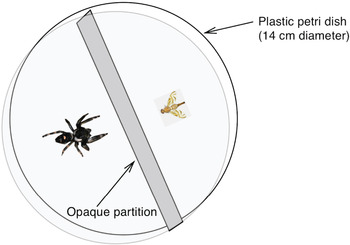
Flies were assigned to one of three treatments, irradiated, non-irradiated, or wild, and introduced into the arena first, which consisted of a small plastic Petri dish (14 cm in diameter, and 3 cm tall), with a partition in the middle (fig. 1). The partition was opaque in order to prevent the spider from seeing the fly before the experiment began. Experimental female spiders were starved for a week before testing and subsequently placed on the opposite side of the partition. The side of the partition on which the fly was placed and the order of the treatments were randomized for each trial. After a minute of acclimatization, the partition was removed and the experiment began. The trials lasted for 3 min, or until the fly was captured.
Schematic diagram illustrating the equipment used; spider and fly not to scale.

We divided each trial into spider–fly interaction bouts. We defined the start of the bout as when the spider fixated on the fly and the fly displayed to the spider. We defined the end of the bout when the fly retreated either by flying away or walking away, or when the spider attacked (successfully or unsuccessfully). A display cycle was defined as starting from the first outstretched wing pose to the next outstretched wing pose. We recorded the occurrence of spider attacks. For the flies, we recorded the occurrence and duration of supination display cycles, and retreat. Trials where there were no bouts, i.e., no movement from either spider or fly, were scored as ‘no interaction’.
For the analysis, we used data only from the first bout of each trial since in nature, after a retreat, the probability of a subsequent encounter between the same individuals is low. We excluded the ‘no interaction’ data from the fly retreat analysis. We used a Generalized Linear Model (with Binomial link function and a Tukey post hoc test) to determine if treatment affected the probability of performing a display, probability of fly retreat and probability of spider attack. We tested if display duration varied across treatments with a Generalized Linear Model (with Gaussian link function and Tukey post hoc test). All analyses were done in the statistical package R (R Core Team, 2012), using the Deducer interface (Fellows, Reference Fellows2012).
Results
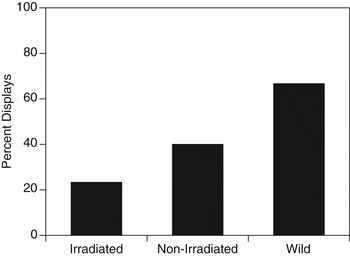
There was a significant difference between the three treatments based on their propensity to perform the supination display (χ 2=10.84, df=2, P=0.004; fig. 2). Wild flies were significantly more likely to perform a display than irradiated (z=3.24, P=0.0011) or non-irradiated flies (z=2.044, P=0.04), but there was no difference between irradiated and non-irradiated flies (z=1.3, P=0.16).
Percentage of irradiated, non-irradiated, and wild flies that displayed to spiders.

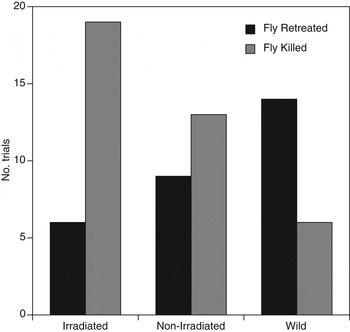
Flies from different treatments differed in their ability to avoid predation (χ 2=8.84, df=2, P=0.012; fig. 3). Wild flies were significantly more likely to retreat from the spiders than irradiated flies (z=−2.95, P=0.0031) but there was no difference in retreat between wild flies and non-irradiated flies (z=−1.86, P=0.06) or irradiated and non-irradiated flies (z=−1.23, P=0.21).
Number of trials where irradiated, non-irradiated, and wild flies were killed or retreated from spiders.

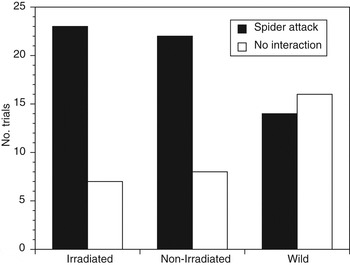
Spider attack also depended on the fly treatment (χ 2=6.87, df=2, P=0.032; fig. 4). Spiders were significantly more likely to attack irradiated (z=2.33, P=0.019) or non-irradiated flies (z=2.07, P=0.037) compared to wild flies but there was no difference in attack between irradiated and non-irradiated flies (z=0.29, P=0.76).
Number of trials where irradiated, non-irradiated, and wild flies were attacked by spiders.

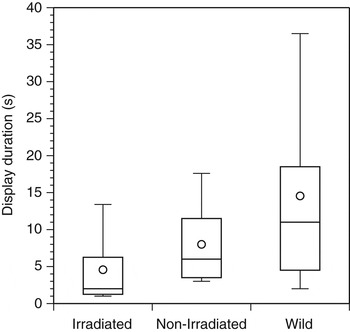
Display duration varied significantly between treatments (χ 2=6.09, df=2, P=0.047; fig. 5). Wild flies displayed longer on average than irradiated flies (z=2.20, P=0.027), but there was no difference between wild flies and non-irradiated flies (z=1.71, P=0.08) or between irradiated and non-irradiated flies (z=0.7, P=0.48).
Display duration of irradiated, non-irradiated, and wild flies. The circle in the centre is the mean, the line through the box is the median, the top of the box is the 75th percentile, and the bottom of the box is the 25th percentile. The whiskers represent the 10th and the 90th percentile, respectively.

Discussion
When confronted with a jumping spider, A. ludens performed a characteristic supination display. This display has been previously recorded in the context of aggression and predator avoidance in this species (Rao & Díaz-Fleischer, Reference Rao and Díaz-Fleischer2012). Our study shows that there was a significant difference between wild and mass-reared flies in the likelihood of performing a display, and that irradiated flies performed poorly in comparison to wild flies.
In most cases, irradiated flies did not differ in their behaviour significantly from non-irradiated flies, suggesting that the difference in behaviour is a result of mass rearing rather than irradiation per se. However, in comparison to the wild flies, the irradiated flies performed poorly suggesting that the negative effects of mass rearing were compounded by irradiation. This is clearly seen in the display duration analysis, where the wild and the non-irradiated flies displayed at similar durations, but not the irradiated flies. However, non-irradiated flies retreat at similar levels to the irradiated flies, which points to the mass-rearing treatment alone having a considerable impact on fly survival.
Jumping spiders are highly visual predators that attack their prey by stalking and capturing them. Their eyes are capable of detecting prey very efficiently, and furthermore they are also found in similar habitats as the tephritid flies. Since A. ludens is a lekking species, i.e., males defend non-resource territories (such as tree foliage), which are then approached by females, there may be a high probability of encounter between a spider and a tephritid fly. Greene et al. (Reference Greene, Orsak and Whitman1987) showed that jumping spiders were the most common predators encountered in the habitat of another tephritid, Zonosemata vittigera Coquillett. It is in this context that the display of tephritid flies function to deter predators. The supination display itself has been recently characterized in detail in A. ludens (Rao & Díaz-Fleischer, Reference Rao and Díaz-Fleischer2012), but may differ from species to species (Headrick & Goeden, Reference Headrick and Goeden1994). Many species of jumping spiders are deterred by this display (Hasson, Reference Hasson1995), and this allows us to use jumping spiders as model predators in evaluating the anti-predator behaviour of mass-reared tephritid flies.
If the supination display is considered sufficient evidence of anti-predator ability, tests can be carried out by conducting bouts between spiders and flies and determining if the rate of display changes between different mass-reared strains under question. In this study, we presented a potential test using jumping spiders that uses very simple and readily available equipment and an observer. The ease of performing this test is in contrast to the other possible method to evaluate flies (the aspirator test), which requires field cages placed outdoors and large trees to simulate orchard conditions (Hendrichs et al., Reference Hendrichs, Wornoayporn, Katsoyannos and Hendrichs2007). Since the response of the spider to the fly does not seem to depend on the species of jumping spider, any locally abundant jumping spider species of appropriate size can be used as a test species. Jumping spiders are fairly common worldwide and are easily encountered in the undergrowth. Many jumping spiders are seasonal and it is recommended that fresh (naive) adult spiders be collected from the field since it can be difficult to find suitably small prey to feed spiderlings.
The display of the fly is still not completely understood, but has been previously recorded in the contexts of aggression. In medflies, supination displays (as well as other aggressive behaviours) have been shown to be more prominent in wild flies than in mass-reared flies (Briceno et al., Reference Briceño, Ramos and Eberhard1999). In a previous study, we explored the display and anti-predator behaviour of A. ludens in detail (Rao & Díaz-Fleischer, Reference Rao and Díaz-Fleischer2012). We showed that rather than the banded patterns on the wings, the display itself is more important in deterring jumping spider attacks. Furthermore, the display is not dependent on the body condition of the flies, suggesting that the production of the display is not energetically costly. Since this display is widespread in the Tephritidae, this behaviour is a feasible candidate for assessing the quality of mass-reared and irradiated flies.
In conclusion, our study shows that wild flies are more likely to avoid predation from jumping spiders than mass-reared flies. Therefore, the survivability of SIT flies against the threat of jumping spider predation may be lower. We recommend that frequent sample bio-assays can be used to evaluate the ability of mass-reared flies in avoiding predation. We suggest that the display of the fly can be used to test for the survival capability of mass-reared tephritid flies.
Acknowledgements
We thank Jose Arredondo, Yair Contreras, Juan Cervantes and Ernesto Castañeda Barbosa for logistical support. We thank Diana Pérez-Staples and the reviewers for helpful comments on the manuscript. This study was partly funded by a CONACyT post-doctoral fellowship to DR.