Introduction
In most countries the prison population has grown in recent years. Although older prisoners continue to be a minority within this group, their numbers are increasing. In 1998 in England and Wales there were 908 prisoners over the age of 60 (2% of the total prison population). In 2008 there were 2,201 (3% of the prison population) (Home Office, 2008). This is the greatest relative increase in numbers for any age group. The “graying” of the prison population (as it has sometimes been called) has also been reported in other countries, including the U.S.A. and Canada (Uzoaba, Reference Uzoaba1998; Reimer, Reference Reimer2008). There are many factors contributing to this, including the greater proportion of older people within the general population, and harsher sentencing practice meaning that more people are serving longer custodial sentences and growing old in prison (Howse, Reference Howse2003).
The mental health of younger prisoners has been well researched (Singleton et al., Reference Singleton, Meltzer, Gatward, Coid and Deasy1997) but the level of psychiatric illness in their older counterparts is not so well known. They are likely to differ from younger prisoners, with higher levels of physical illness and organic psychiatric disorders, such as dementia. Poor physical and mental health can have a significant impact on a prisoner's rehabilitation and level of function after release (Wolff, Reference Wolff2005). A healthy, well-prepared prisoner on release is likely to cost society less than one who is ill-equipped for the stresses of the outside world, and will be less likely to reoffend (Ventura et al., Reference Ventura, Cassel, Jacoby and Huang1998). There are also legal reasons why we must understand the healthcare needs of prisoners. For example, since October 2004, the Disability Discrimination Act in the U.K. has applied to prison populations, which means that prisoners with disabilities should, within reason, be able to access equivalent services to those available in the community. This has significant implications for prison healthcare providers.
The aim of this paper is to provide a review of the existing literature relating to the contributing factors and rates of mental illness in older prisoners. In doing so it is hoped to raise the awareness of this issue and to reveal the current gaps in the research.
Demographic factors
Comparison between studies of older prisoners is hampered somewhat by different thresholds of age. In the studies reviewed, varying thresholds of 50, 55 and 60 years of age have been used to define the “older prisoner”. There are a number of reasons for having relatively low cut-off points: (i) the prison is predominantly a young man's environment so people over 50 are the relative elders of the community; (ii) it has also been argued that older prisoners show the equivalent physical age of someone ten years their senior, though the evidence for this is unclear (Gallagher, Reference Gallagher2001; Reviere and Young, Reference Reviere and Young2004; Williams et al., Reference Williams, Lindquist, Sudore, Strupp, Willmott and Walter2006); and (iii) there are practical reasons to lower the age ranges, not least so as to ensure that a reasonable number of participants are included in any research since people over the age of 65 are still a small but growing minority in prisons.
In terms of their offending history, older prisoners can be broadly divided into three categories. First, there are those who have committed an offence and been imprisoned for the first time in later life. Secondly, there are those who have spent most of their life in and out of prison and have not changed their lifestyle because of advancing years. Thirdly, there are those who committed a serious crime in their youth and have grown old in prison (Smyer et al., Reference Smyer, Gragert and Lamere1997). Contrary to what one might expect, a Canadian study showed that the first group accounted for the majority of older prisoners (72.8%), with 17.1% in the second group, and only 10.2% in the third (Uzoaba, Reference Uzoaba1998). One can speculate that prisoners in the first group are likely to adjust poorly to prison life when compared to the other two groups (Uzoaba, Reference Uzoaba1998). However, there has been no specific research that examines the different mental health needs of older prisoners in association with their offending history.
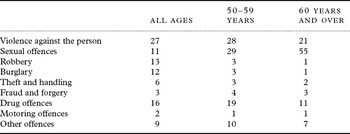
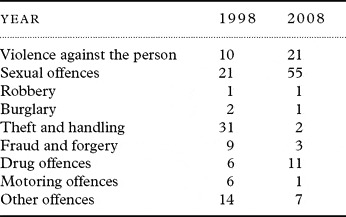
The type of offence differs in older prisoners compared to their younger counterparts (Table 1). Among older prisoners in the U.K., there are fewer robbery, burglary, and theft and handling offences, with similar rates of drug offences and violent crimes (Home Office, 2008). Sexual offences are consistently over-represented in older prisoners in the U.K., Canada and the U.S.A. (Morton, Reference Morton1992; Uzoaba, Reference Uzoaba1998) and this has become more apparent over the last ten years (Table 2). The proportionate rise of sex offences and the relative fall in theft is striking. This may reflect a number of factors, including harsher sentencing for sex offenders in the U.K. and an increased willingness to report intra-familial sex crimes that could have been committed much earlier in life. It may also be a reflection of the aging of the prison population with more prisoners in the “over 60” group being well into their late 60s and 70s. A Canadian study in 1998 found that 38.1% of all prisoners over 50 years were convicted for sexual offences and 13% for robbery. When looking at 60–64-years-olds 50.9% were convicted for sexual offences and 9.8% for robbery. Among 65–69-year-olds the figures were 54.0% and 6.3% respectively and in those over 70 the figures were 64.2% and 1.5% (Uzoaba, Reference Uzoaba1998). These figures can give the false impression of sexual deviancy in later life. In fact, the majority of sexual offences are committed by younger men, but older men are more likely to be imprisoned for these offences compared to other crimes (Fazel and Jacoby, Reference Fazel, Jacoby, Jacoby and Oppenheimer2002).
Convictions as percentage of total offences in each age group, England and Wales 2008 (Home Office, 2008)

Convictions as a percentage of total offences in the age group for prisoners aged 60 years old and above, England and Wales, 1998 and 2008 (Home Office, 2008)

The issue of gender is also worth mentioning. Across all age groups male prisoners significantly outnumber female prisoners. This is more marked for older age groups, with a total of only 55 female prisoners over the age of 60 in the U.K. in 2008 as compared to 2,146 male prisoners. Older female prisoners differ from their male counterparts in that they are more likely to have been convicted of drug offences and violent offences, with sexual offences being a rarity (Home Office, 2008). Almost all the research into the mental health of older prisoners has been carried out in all-male prisons so it is impossible to comment specifically about the needs of female prisoners. More research into this group would be desirable but will prove difficult in practice because of the small numbers.
Psychosocial factors
Older prisoners show differences in their personality when compared to their younger counterparts. In an American study, older female prisoners had lower rates of personality disorder and were less aggressive, impulsive, disinhibited and manipulative. They showed a greater desire to work and a stronger sense of propriety (Hurt and Oltmanns, Reference Hurt and Oltmanns2002). Older inmates are more likely to have been educated to a higher level and earned a higher income than younger prisoners (Arndt et al., Reference Arndt, Turvey and Flaum2002; Brown and Brozowski, Reference Brown and Brozowski2003). They are less likely to have used illicit drugs before incarceration, but are more likely to have misused alcohol (Gallagher, Reference Gallagher1990). A study in Iowa showed substance misuse problems in 71% of inmates over the age of 55. Within this group, alcohol was the primary drug of abuse in 85% of cases. However, they were significantly less likely to have received treatment for substance abuse in comparison to younger inmates (Arndt et al., Reference Arndt, Turvey and Flaum2002).
Older prisoners are also more likely to have been married or had children (Gallagher, Reference Gallagher1990; Brown and Brozowski, Reference Brown and Brozowski2003). Although the process of incarceration naturally disrupts the frequency and quality of contact with family members (Reed and Glamser, Reference Reed and Glamser1979; LaMere et al., Reference LaMere, Smyer and Gragert1996), older prisoners seem to maintain outside contact through visits and phone calls more than younger prisoners (Gallagher, Reference Gallagher1990; Bond et al., Reference Bond, Thompson and Malloy2005a). Despite this, they are relatively isolated in the prison environment, having fewer social contacts within the prison population (Bond et al., Reference Bond, Thompson and Malloy2005a) and being more likely to view a member of staff as a confidant (Gallagher, Reference Gallagher1990). Older prisoners show more interest in politics and are more likely to have religious convictions, although whether this predates incarceration or is a reaction to it is unclear (Reed and Glamser, Reference Reed and Glamser1979). In many ways, it can be said that older prisoners age in a similar way to their non-custodial peers but there has been no direct comparison to look at this. One might also speculate how the above-mentioned psychosocial factors could affect the development of mental illness but no studies have specifically examined this.
Environmental factors
As well as the intrinsic differences between younger and older prisoners, there are a number of specific problems that can be caused by putting an older person into a prison. The physical environment is usually designed with young men in mind. As a result, prisoners may have to walk long distances in order to access facilities or perform daily duties. This can be difficult for those with mobility problems and may cause them to withdraw from prison society, miss meals, etc. (HM Chief Inspector of Prisons, 2004). Sleeping arrangements, washing facilities and night sanitation systems may also be problematic for prisoners with difficulties in mobility and continence (HM Chief Inspector of Prisons, 2004). As well as the physical layout, the general regime of a prison can contribute to these issues. Prison life is based on structure and routine. The overriding duty of prison staff is to maintain the security of the prison and to ensure that routines are carried out smoothly. As a result, very little allowance is made for older prisoners who may struggle to keep up with the fast-paced timetable of day-to-day living with limited resources available in prison for those who are disabled or frail (Crawley, Reference Crawley2005; Crawley and Sparks, Reference Crawley and Sparks2005).
Other younger inmates are an additional source of potential stress within the prison environment. Although they are less prone to being deceived (Bond et al., Reference Bond, Thompson and Malloy2005b), older prisoners are more likely to be victimized by some younger inmates who take advantage of their less confrontational nature (Kerbs and Jolley, Reference Kerbs and Jolley2007). Thirty seven percent of U.K. older prisoners admitted to being victimized by other inmates and 30% felt unsafe (HM Chief Inspector of Prisons, 2004). Older inmates may also have to consider the prospect of dying in prison. This “death anxiety” is particularly pertinent in those with poor social support and physical or mental health problems (Aday, Reference Aday2005).
The physical health of older prisoners
As previously mentioned, the physical health of older prisoners is generally thought to be worse than both younger prisoners and older people in the community. Worse physical health is a contributory factor in rates of mental illness in prisoners (Koenig et al., Reference Koenig, Johnson, Bellard, Denker and Fenlon1995; Fazel et al., Reference Fazel, Hope, O Donnell, Piper and Jacoby2001b). Common diagnoses are cardiovascular problems, such as ischemic heart disease and hypertension, musculoskeletal problems, such as arthritis, respiratory problems, prostate disease and ulcers (Colsher et al., Reference Colsher, Wallace, Loeffelholz and Sales1992; Fazel et al., Reference Fazel, Hope, O Donnell, Piper and Jacoby2001a). Impairment of vision or hearing is also common, especially in those aged over 60 (Gallagher, Reference Gallagher1990; Colsher et al., Reference Colsher, Wallace, Loeffelholz and Sales1992). Frequently, older prisoners will report poor subjective health and it is not uncommon for this to have deteriorated since incarceration (Fazel et al., Reference Fazel, Hope, O Donnell, Piper and Jacoby2001a; Loeb and Steffensmeier, Reference Loeb and Steffensmeier2006). However, this is less likely if prisoners feel empowered to manage their own physical health (Loeb and Steffensmeier, Reference Loeb and Steffensmeier2006).
Shortcomings in the activities of daily living are common (Fazel et al., Reference Fazel, Hope, O Donnell, Piper and Jacoby2001a). This is especially the case in relation to prison-specific tasks, such as getting to the dining hall for meals, climbing on and off top bunks, and dropping to the floor for alarms (Williams et al., Reference Williams, Lindquist, Sudore, Strupp, Willmott and Walter2006). These impairments are associated with feelings of low mood, poor mobility, falls and worse physical health. Some of the physical and functional problems are to be expected considering the natural process of aging, but it is a concern that these problems are not always recognized. Fazel et al. observed that older prisoners reported musculoskeletal problems and hearing or eyesight problems significantly more frequently than was recorded in their prison medical notes (Fazel et al., Reference Fazel, Hope, O Donnell, Piper and Jacoby2001a). This could be because prison staff are not trained to detect physical health problems, or because prisoners do not feel they can approach anyone with their concerns, or because they fear they will be labeled as malingerers if they do so (Booth, Reference Booth1989). Whatever the reasons, it seems that older prisoners have significant health issues that may not be recognized and treated. Policy change and local innovations may be needed to address these deficiencies (Tarbuck, Reference Tarbuck2001; Rónán Collins and Bird, Reference Rónán Collins and Bird2007).
Mental illness in older offenders before sentencing
In order to understand the prevalence of mental illness among older sentenced prisoners it is important to know about their mental health before sentencing. A British study looked at inmates remanded to a South London prison on criminal charges between 1979 and 1980 (Taylor and Parrott, Reference Taylor and Parrott1988). Rates of mental illness were based on prison records. These showed that 55% of the inmates aged over 65 had active symptoms of psychiatric disorder and 60% had symptoms of physical illness. This was significantly higher than the younger age groups. Furthermore, 85.7% of those over 65 had had previous psychiatric treatment, and 14.3% of those over 65 had evidence of a psychotic disorder. This was mostly accounted for by affective psychosis with schizophrenia being rare. A third of those aged over 65 were dependent on alcohol, but none was on other substances. Personality disorder was rare but was thought to be under-recorded.
An Israeli study looked at all first-time offenders aged over 65 from January 1987 to October 1992 (Barak et al., Reference Barak, Perry and Elizur1995). Twenty-eight out of a possible 31 subjects were examined through a clinical interview and a review of previous medical records. The researchers found six subjects with anti-social personality disorder, six with dementia, one with paranoid schizophrenia, one with major depression and one with mental retardation. In a more recent study, all forensic psychiatric evaluations of those referred by court for a psychiatric assessment in Sweden from 1988 to 2000 were retrospectively examined (Fazel and Grann, Reference Fazel and Grann2002). The results showed a significantly higher prevalence of dementia (7.1%), affective psychoses (6.7%), and cerebral lesions (4.8%) in subjects older than 60, when compared to younger offenders. It also showed lower rates of schizophrenia (7.1%) and personality disorder (19.5%), and 7.6% had a depressive disorder and 19.5% had alcohol or drug problems. The varying estimates of prevalence from these three studies hinder the formation of any definitive opinion. This is most likely due to the differing methodologies used with regards to sampling and diagnostic criteria.
Mental illness in older sentenced prisoners
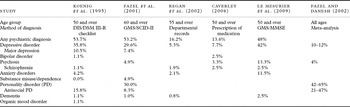
There is strikingly little research looking at the prevalence of mental illness in older sentenced prisoners and none that provides data on prisoners aged over 65. The relevant studies are summarized in Table 3. The majority of research is from the U.S.A. One study from North Carolina identified 106 prisoners over the age of 50 at a Federal Corrections Institute (Koenig et al., Reference Koenig, Johnson, Bellard, Denker and Fenlon1995). Ninety percent of subjects were evaluated using the Diagnostic Interview Schedule (DIS) and a DSM-IIIR checklist. In total, 54% of subjects had met the criteria for any mental illness over the last month and 37% had had a previous psychiatric history requiring treatment. Inmates had a significantly higher rate of major depression (11%), and anxiety disorders (4%) over the previous month when compared to a community sample. Predictive factors for mental illness were the presence of a past psychiatric history, drug and alcohol abuse, poorer subjective health, impaired social support and incarceration under determinate sentence law. Out of the 16 inmates who qualified for a psychiatric diagnosis at the time of the study, only two were prescribed psychiatric medication and three had received counseling.
Prevalence of mental illness in five studies of older prisoners compared to a systematic review of mental illness in prisoners of all ages (Fazel and Danesh, Reference Fazel and Danesh2002)

Notes: Prevalence expressed as a percentage of the age group. Where prevalence has not been stated in the original study, it has been calculated from available data. Otherwise it has been left blank.
A 2002 study examined the rates of psychiatric illness in inmates aged over 55 years within the Tennessee State prison system (Regan et al., Reference Regan, Alderson and Regan2002) and found that 19.4% were diagnosed with a mental illness. Within this group, the most common diagnoses were depressive disorders (33%), anxiety disorders (13%), schizophrenia (12%), and dementia (5%). These figures were based on data already kept by the State of Tennessee Department of Correction and could therefore be an underestimate, as mental illness may go unrecognized in prison. In 2006, Caverley (Reference Caverley2006) looked at inmates aged over 50 in the Utah State prison system. Diagnosis was based on whether or not inmates had been prescribed psychotropic medication, and it was established that 13.6% of inmates over 50 in this study had a psychiatric diagnosis. Of those diagnosed with a mental illness, 57% had a depressive disorder, 24% had psychosis or a schizophrenia spectrum disorder, and 18% had bipolar disorder. The study concludes that rates of mental illness are similar to those in the community with the exception of schizophrenia which is more prevalent in prison. However, the method of diagnosis used is again likely to lead to underestimation.
In the U.K., a study of male inmates over the age of 60 in Oxford was performed in 1999–2000 (Fazel et al., Reference Fazel, Hope, O Donnell and Jacoby2001b). Two hundred and three prisoners were assessed using a semi-structured interview, the Geriatric Mental State (GMS) schedule, and the Structured Clinical Interview for DSM-IV Axis II personality disorders (SCID-II). Depressive disorder was diagnosed in 29.6% of individuals. The risk of this increased with the presence of a previous psychiatric history and poor self-reported general health. A further 0.5% of subjects had a non-depressive psychosis, 1% had dementia, and 4.9% were currently misusing or dependent on alcohol or drugs. Thirty percent had a personality disorder, with 8.3% specifically having an antisocial personality. On reviewing the treatment in this group, it was found that only 18% of patients who might have benefited from psychotropic medication were prescribed any (Fazel et al., Reference Fazel, Hope, O Donnell and Jacoby2004). This compares unfavorably with the prisoners who had cardiovascular, endocrine and musculoskeletal disorders. They were appropriately prescribed medication in 85%, 78% and 65% of cases respectively.
Two studies have recently contributed to the understanding of mental health problems among older inmates. Murdoch et al. (Reference Murdoch, Morris and Holmes2008) interviewed 121 prisoners over the age of 55 serving a life or indeterminate sentence using the Geriatric Depression Scale (GDS) and Mini-mental State Examination (MMSE). They established that 48% of prisoners had mild depression and 3% had severe depression. Significant factors in this were increasing age, chronic illness, previous psychiatric history and lower scores on the MMSE. In a study commissioned by the National Institute for Health Research, under the recently completed Research for Patient Benefit Programme, Le Mesurier et al. (Reference Le Mesurier, Kingston, Heath and Wardle2009) interviewed 121 prisoners over the age of 50 in four prisons in the English West Midlands using the GMS, the MMSE and the SF12 self-reported health questionnaire. They found depressive disorder in 42% of prisoners interviewed, and at least one psychiatric disorder in 48%. Dementia was found in 2.5%. SF12 scores indicated poorer health in both the mental and physical component scores than comparable community studies. Forty-five men who were diagnosed in this study as having mental health problems appeared to have no record of current mental illness or treatment in their medical records.
In general these results show a wide range of prevalence estimates. The Fazel and Le Mesurier studies use more stringent diagnostic methods and show higher levels of mental illness among older prisoners. Psychosis and schizophrenia seem less prevalent. Conversely, depression appears more common in sentenced prisoners when compared to pre-trial criminals. This implies that depression develops in prison, possibly as a result of environmental factors. This is supported by the results of a government survey that found that 33% of male prisoners and 78% of female prisoners with documented mental health problems were thought to have depression as a result of trial or imprisonment (HMIP, 2004).
Discussion
This review shows that there are complex interactions between individual inmates and their environment that will affect the development of mental illness. Prevalence rates will be underestimated in studies that rely on prison records and the literature supports this fact. Most of the relevant research comes from the U.S.A. and Canada and there may be problems extrapolating these results to other countries with differing cultures and prison systems.
The current levels of service for older prisoners appear to be insufficient, with the evidence suggesting that inmates with both physical and mental illness are treated less frequently than required (Koenig et al., Reference Koenig, Johnson, Bellard, Denker and Fenlon1995; Fazel et al., Reference Fazel, Hope, O Donnell and Jacoby2001b; Le Mesurier et al., Reference Le Mesurier, Kingston, Heath and Wardle2009). The best way to address this is uncertain and a variety of measures may be required. Some countries, including the U.K., have local initiatives giving separate accommodation for older inmates (Dopson, Reference Dopson2005). One could argue that segregating older prisoners into such units removes them from both an unsuitable environment and their younger, predatory counterparts, hence reducing the risk of developing mental illness. In practice, though, this is not clear and may not be welcomed by the inmates. There is also some suggestion that older prisoners act as a stabilizing influence in units integrated with younger people (Chaiklin, Reference Chaiklin1998). Regardless of the above dilemmas, such specialized units for older prisoners do not specifically address the issue of mental health.
Access to appropriate psychiatric services relies on mental illness being detected in the first place. We know that this is suboptimal, partly because of the lack of training in staff, and partly because the prison environment is not conducive to open discussions about mental health (Rubenstein, Reference Rubenstein1982). Although it is not traditionally part of their job, correctional workers are in an excellent position to recognize illness. The role of prison staff should not be underestimated in future service development and education is a key initial intervention. This has been shown to be helpful when done in an interdisciplinary and collaborative way (Cianciolo and Zupan, Reference Cianciolo and Zupan2004). There have also been suggestions that younger prisoners could have a role in recognizing the signs of mental illness and assisting older inmates. This could be viewed as controversial though, and the choice of inmate would be have to be made very carefully.
Even when mental illness is detected, current mental health services are not best placed to care for older prisoners. General forensic units admit small numbers of older patients (Tomar et al., Reference Tomar, Treasaden and Shah2005) but the staff there lack experience in dealing with this group and the units are not designed with older people in mind. One solution is an old age psychiatry liaison service for such units (Shah, Reference Shah2006), but this does not address the issues of the unit's inappropriate design. The numbers of potential patients are insufficient to require local specialist services but regional tertiary services may be a viable solution (Yorston, Reference Yorston1999). Although forensic inpatient units may address the needs of some inmates with more severe problems, the majority of older prisoners with mental illness suffer from depression that would not necessarily warrant admission. In such cases, some kind of prison in-reach service would be appropriate but the authors are not aware of any such services with expertise in dealing with older inmates.
In conclusion, the above review reveals more questions than answers. An initial recommendation would be to increase the evidence base. More research is needed to look at the prevalence of mental illness among different groups of older prisoners. These might include prisoners with different offending histories, female prisoners and those aged over 65. A better understanding of the factors that influence the development of mental illness is also required in order to develop a preventative approach in service design. There is a need to examine the psychosocial and rehabilitation needs of older prisoners and a need to evaluate both current treatment provision and different service models. Although there are gaps in our understanding of recognizing and treating mental illness in older prisoners, the current research suggests that their mental health is a significant issue. As the older prisoner population grows, this issue is likely to become more prominent. Health and prison services need to be aware of this when planning for future provision.
Conflict of interest
None.
Description of the authors' roles
Alexander Kakoullis performed the initial literature search and wrote the first draft of the paper. Nick Le Mesurier and Paul Kingston reviewed the literature and edited the paper.