




No CrossRef data available.
Article contents
Methadone in the treatment of pain and terminal delirum in advanced cancer patients
Published online by Cambridge University Press: 13 April 2006
Abstract
Objective: This prospective study documents the use of methadone as part of an opioid rotation strategy in patients with uncontrolled pain and severe delirium admitted for terminal care to a tertiary cancer palliative care hospital.
Methods: We reviewed the treatment of 20 patients with severe pain and delirium at the end of life who's delirium did not improve 24 h or longer after starting a neuroleptic medication.
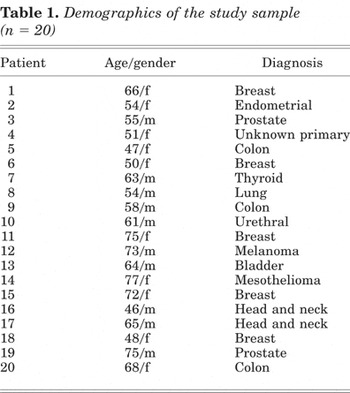
Results: Ten male and 10 female patients, 47 to 77 years old, were rotated or “switched” to methadone due to uncontrolled pain in the setting of delirium, limiting further opioid dose escalation. At 2 weeks, a total of 10 patients had expired. Of the 10 patients who were alive 2 weeks after starting methadone, 7 patients were stable on an average of 1.1 mg/h methadone, 2 patients were restarted on morphine IV and one on Percocet. The calculated average equianalgesic dose of methadone was 9% (2%–17%) of the previous morphine-equivalent dose. Of the 20 patients who were switched to methadone for what appeared to be terminal delirium, the pain control was significant in 15, moderate in 3, and unchanged in 2 patients. Average analgesia was good to excellent (average Numeric Analog Scale rating [NAS] decreased from 8.2 to 2.5). Sedation had decreased from 1.65 to 0.55 on a scale of 0 to 3. Of the 20 patients, improvement of cognitive status was significant in 9, moderate in 6, partial in 2, and none in 3 patients. The Memorial Delirium Assessment Scale (MDAS) showed improvement from an average of 23.6 prior to the switch to 10.6 3 days after. Decreased alertness on methadone was devoid of agitated features.
Significance of results: Our study suggests that methadone can be effective in the treatment of both refractory pain and what appears to be terminal delirium. Most patients in our group had at least a short-term improvement in mental status as well as significant and lasting improvement in analgesia.
Information
- Type
- ORIGINAL ARTICLES
- Information
- Copyright
- © 2005 Cambridge University Press
INTRODUCTION
Sixty percent to 90% of advanced cancer patients report pain (Ho, 1994). The American Pain Society (APS) recommends a 50% to 100% increase in opioid dose to treat moderate to severe cancer pain (Portenoy & Lesage, 1999). It is not uncommon that rapid opioid escalation may lead to the development of side effects, out of which delirium is one of the most distressing for patients and families (Yennurajalingam et al., 2005). Usually, opioid rotation is attempted in patients who are suspected to exhibit opioid-related neuropsychiatric toxicity (Estfan et al., 2005).
Delirium at the end of life is a common symptom, occurring in up to 90% of patients (Breitbart & Strout, 2000). Delirium is often multifactorial in origin and it is usually difficult, if not impossible, to find and reverse all the contributing factors (Breitbart & Strout, 2000). The patient's pain perception and reporting may be altered by delirium, causing a concern among clinicians and family members that the patient may not be able to convey the severity of the pain (Khojainova et al., 2002; Lawlor & Bruera, 2002). Sedation has become a reliable and appropriate treatment modality in terminal delirium, when relief of suffering predominates over all other considerations (Lawlor & Bruera, 2002). The choice of medication is usually based on the prevailing symptom, and the appropriate drug is titrated against the patient's report of the symptom (pain, confusion, and other). Opioid rotation is commonly used in an attempt to improve analgesia and mental status (Estfan et al., 2005). When switching opioids in cancer pain, one should be aware that 80% of patients require one switch, 44% of patients require two switches, and 20% of patients require three or more switches (Foley & Houde, 1998).
When treating terminal delirium, physicians have to decide whether to start another opioid rotation or sedate the patient, given an extremely short life expectancy. Among second line opioids, methadone is an attractive opioid analgesic because of its lack of metabolites, high oral bioavailability, low cost, and long half-life (Mercadante et al., 2001; Estfan et al., 2005).
METHODS
Procedures
This was an open label nonrandomized study, approved by the institutional Investigational Review Board (IRB).
The aim of this study was to examine opioid rotation to methadone in patients with uncontrolled pain and terminal agitated delirium admitted to a tertiary palliative care cancer hospital. Consecutive patients admitted with agitated delirium and pain were screened for the study until 20 patients were accrued. Inclusion criteria were: a verbal command of English, uncontrolled severe pain (NAS 5 or above on 0–10 scale), and delirium (Memorial Delirium Assessment Scale [MDAS] rating at or above 10). After enrollment, all patients with severe pain and delirium at the end of life who did not improve for 24 h or longer after starting a neuroleptic medication were rotated to methadone. The initial methadone dose commonly used at our institution is 10% of the parenteral morphine equivalent dose or a 10:1 ratio. For the study the suggested parenteral morphine to methadone ratio was 10:1. Clinicians were allowed to use their judgment depending on the dose of the initial opioid and to simplify methadone administration (routine and PRN methadone was dosed in increments of 5 mg). After rotation to methadone, rescue doses of methadone were freely available to patients on request.
All patients were seen daily by a physician experienced in palliative care. The patients' pain and mental status were assessed at each visit daily as a standard procedure. No patients received anticancer therapy during the course of the study. The patients' pain (NAS), level of sedation (0–3), MDAS, and opioid doses were recorded prior to rotation to methadone, daily for 3 days and then weekly for 3 weeks. Additional data collected were age, gender, cancer, and pain diagnosis.
Methadone was titrated to acceptable analgesia. Sedation without agitated delirium was not considered a reason for another opioid rotation in this group of terminally ill patients.
All patients remained in-patients until death.
Study Instruments
Demographics
Age, gender, cancer diagnosis, opioid and its dose, neuroleptic and its dose were recorded.
Numeric Analog Scale
NAS utilizes a 0–10 scale, with 0 meaning no pain and 10 meaning the worst pain the patient can imagine. NAS was recorded as reported by the patient.
Memorial Delirium Assessment Scale
The MDAS is a 10-item, 4-point clinician-rated scale (possible range, 0–30) designed to quantify the severity of delirium in medically ill patients. Items included in the MDAS reflect the diagnostic criteria for delirium in the DSM-IV, as well as symptoms of delirium from earlier or alternative classification systems (i.e., DSM-III, DSM-III-R, ICD-9). Scores of 13 or above likely reflect the presence of delirium.
Scale items assess disturbances in arousal and level of consciousness, as well as several areas of cognitive functioning (e.g., memory, attention, orientation, disturbances in thinking) and psychomotor activity. MDAS requires approximately 10 min to administer (not including additional time necessary to establish rapport, review chart records, and speak to staff/family members); it integrates behavioral observations and objective cognitive testing. When items cannot be administered, scores can be prorated from the remaining items to an equivalent 10-item score. Although the MDAS was developed prior to the publication of DSM-IV, the MDAS items were developed to be consistent with the proposed DSM-IV diagnostic criteria for delirium (Tucker & DSM-IV Organic Disorders Work Group, 1991).
Sedation
A categorical rating of the level of sedation (0–3 scale: absent, mild, moderate, severe) was used to assess sedation in this study. Sedation was recorded based on the patient's self-report. If the patient was unable to report due to sedation, level 3 sedation was recorded.
Opioid Dose
Preswitch opioid and opioid dose were recorded 24 h prior to the switch. Methadone dose was recorded on days 1, 2, and 7 and after analgesia was achieved or reverse rotation off methadone to the alternative opioid. Number of days the patient survived was recorded as well.
The average equianalgesic dose ratio of methadone to the previous morphine equivalent was calculated. Methadone dose escalation was calculated daily for the first 3 days and then weekly.
RESULTS
Twenty-seven patients admitted for end-of-life care to a tertiary palliative care hospital were referred to the study. Seven patients were excluded after their pain, delirium, or command of English were assessed formally and did not meet inclusion criteria. The patients enrolled in the study consisted of 10 males and 10 females, 47 to 77 years old, who were receiving opioids for severe cancer pain.
Patients had a variety of cancer diagnoses that included breast (5 patients), colon (3), prostate (2), and other (see Table 1).
Demographics of the study sample (n = 20)

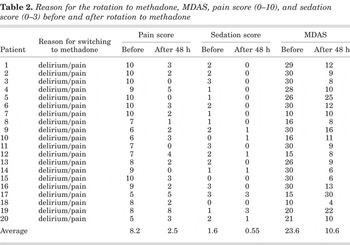
Rotation to methadone was done due to uncontrolled pain in the setting of delirium, limiting further dose escalation (Table 2). Ten patients were rotated from morphine, 5 patients from fentanyl, 2 from hydromorphone, and 3 from fentanyl/morphine and morphine/hydromorphone combinations (Table 3).
Reason for the rotation to methadone, MDAS, pain score (0–10), and sedation score (0–3) before and after rotation to methadone

Preswitch opioid and dose, methadone dose after analgesia was achieved, and days survived

Numeric Analog Scale
Of the 20 patients switched to methadone for terminal delirium, the resulting pain control was significant in 15, moderate in 3, and unchanged in 2 patients. Average analgesia was good to excellent in all patients (NAS decreased from 8.2 to 2.5; Table 2).
Memorial Delirium Assessment Scale
Of the 20 patients, improvement of cognitive status was significant in 13, moderate in 3, and unchanged in 4 patients. The MDAS improved from the average of 23.6 to 10.6.
Sedation
Sedation decreased from 1.65 to 0.55 on a scale of 0–3. Improvement in mental status was significant, but short-lived. Consecutive worsening of mental status on methadone presented as sedation devoid of agitated features.
Opioid Doses
The average dose of preswitch opioids was 9.4 mg/h in morphine equivalents (ME) (Table 3). The average starting dose of methadone was 1.2 mg/h and it reached 1.3 mg/h on day 2. One week later the 15 patients still being treated with methadone were receiving an average of 0.8 mg/h. Within the first week, 4 patients expired, 1 was changed to parenteral methadone, and 2 were rotated back to morphine because of worsening delirium and analgesic inefficacy. Of note, 1 of these 2 patients received a relatively high dose of methadone during the titration phase (morphine:methadone ratio of 3:1). At 2 weeks, a total of 10 patients expired; of the 10 patients who were alive, 7 were receiving an average of 1.1 mg/h methadone, 2 patients were restarted on morphine, and 1 patient was rotated to Percocet.
The calculated average equianalgesic dose of methadone at 2 weeks was 9% (2%–17%) of the previous morphine dose. There was no significant dose escalation of methadone after initial pain relief was achieved, and this level of analgesia was sustained.
DISCUSSION
In terminal delirium, sedation becomes a reliable and appropriate treatment modality that will provide comfort care. Opioid rotation is an alternative approach, but when switching opioids in cancer pain one should be aware that the physician may need to go through a series of opioid rotations prior to achieving an acceptable balance between analgesia and opioid-related side effects. This may be a difficult decision to make considering immediate burden of delirium and short life expectancy of the patient. Clinicians treating terminal delirium commonly have to guide the patient, family, and medical staff and need data to guide them through the decision making. Methadone is an attractive opioid analgesic without active metabolites, with high oral bioavailability, low cost, and long half-life. This study focused on the use of methadone in terminal delirium.
The bioavailability of methadone is variable (47–96%). In this study, all the calculations were done considering the bioavailability of methadone to be 50%, that is, the IV:PO methadone ratio was considered to be 1:2. This correlates with the APS recommendations (American Pain Society, 2005). A number of morphine:methadone equianalgesic dose ratios have been suggested in the literature. The original equianalgesic table was based on single dose studies that demonstrated morphine:methadone ratio as 1:1. Numerous reports in the literature suggest that the equianalgesic ratio is different when opioids are administered chronically and may be significantly influenced by the previous opioid dose and the length of time the patients were receiving the previous opioid (Table 4). The high potency of methadone in chronic use has lately been well established. In our study, we used a conservative estimate to calculate a safe and effective starting methadone dose. Based on the preliminary experience of the investigators and the latest literature, parenteral methadone is equivalent to 10% of a parenteral morphine dose (Crews et al., 1993; Lawlor et al., 1998). When switching from an initial opioid to methadone in a patient with uncontrolled pain, one may hardly suggest establishing equianalgesic doses because analgesia has not yet been achieved. Delirium that may be related to opioid neurotoxicity may further alter pain report, diminishing or exaggerating it. Thus, rather than searching for the equianalgesic dose ratio, a safe and effective starting dose of methadone should be sought.
Parenteral opioid doses equivalent to 10 mg of methadone

The calculated starting methadone dose commonly used at our institution is 10% of the parenteral morphine dose (10:1 ratio) in three divided doses (TID). It is essential to have the same dose available PRN at the frequency directed by the patient's needs (every 3–4 h as needed). Understanding the high risk of dose accumulation, a physician may administer methadone PRN as often as every 1 h only when direct clinical observation is possible. It may take 3–7 days of methadone titration before stable analgesia is achieved. Considering the long half-life and dose accumulation of methadone, if excellent analgesia occurs within 24 h and no PRN medication is needed, a 50% reduction of the total dose should be considered.
Potentially an oral dose of methadone may be double the parenteral dose. However, when switching to oral methadone, it is safer to assume that bioavailability will be high and oral dose is equivalent to parenteral. In case of low bioavailability, the dose of oral methadone may need to be titrated up or doubled.
This study suggests that in the end-of-life cancer patients with uncontrolled pain, a switch to methadone may be considered prior to initiation of sedation for terminal delirium. Started at a low dose and titrated against the pain according to the individual needs, methadone improved analgesia and offered at least short-term improvement in mental status. Started according to our recommendations and titrated against the pain according to the individual patient's need, methadone is well tolerated. The safety of methadone has been also demonstrated in the presence of chronic liver and renal disease, common at the end of life (Fainsinger et al., 1993; Mercadante, 1997). Also, the eventual worsening of the patient's mental status in this study was devoid of agitation and hyperactive delirium. Patients and their families who may be inclined to request sedation at the end of life should be educated about the possible advantages of methadone.
References
REFERENCES
American Pain Society.
(2005).
Principles of analgesic use in the treatment of acute pain and
cancer pain.
(5th ed.).
Glenview, IL:
Author.
Breitbart, W. &
Strout, D.
(2000).
Delirium in the terminally ill.
Clinical Geriatric Medicine,
16,
357–372.Google Scholar
Crews, J.C.,
Sweeney, N.J., &
Denson, D.D.
(1993).
Clinical efficacy of methadone in patients refractory to other
mu-opioid receptor agonist analgesics for management of terminal cancer
pain. Case presentations and discussion of incomplete cross-tolerance
among opioid agonist analgesics.
Cancer,
72,
2266–2272.Google Scholar
Estfan, B.,
LeGrand, S.B.,
Walsh, D.,
et al.
(2005).
Opioid rotation in cancer patients: Pros and cons.
Oncology,
19,
511–516;
discussion 516–518, 521–523, 527–528.Google Scholar
Fainsinger, R.,
Schoelle, T., &
Bruera, E.
(1993).
Methadone in the management of cancer pain: A review.
Pain,
52,
137–147.Google Scholar
Foley, K.M. &
Houde, R.W.
(1998).
Methadone in cancer pain management: Individualized dose and titrate
to effect.
Journal of Clinical Oncology,
16,
3213–3215.Google Scholar
Ho, R.C.S.
(1994).
Pain in the cancer patient.
A Cancer Journal for Clinicians,
44,
259–261.Google Scholar
Khojainova, N.,
Santiago-Palma, J.,
Kornick, C.,
et al.
(2002).
Olanzapine in the management of cancer pain.
Journal of Pain and Symptom Management,
23,
346–350.Google Scholar
Lawlor, P.G. &
Bruera, E.D.
(2002).
Delirium in patients with advanced cancer.
Hematology Oncology Clinics of North America,
16,
701–714.Google Scholar
Lawlor, P.G.,
Turner, K.S.,
Hanson, J.,
et al.
(1998).
Dose ratio between morphine and methadone in patients with cancer
pain: A retrospective study.
Cancer,
82,
1167–1173.Google Scholar
Manfredi, P.L.,
Borsook, D.,
Chandler, S.W., &
Payne, R.
(1997).
Intravenous methadone for cancer pain unrelieved by morphine and
hydromorphone: Clinical Observations.
Pain,
70,
99–101.Google Scholar
Mercadante, S.,
Casuccio, A.,
Fulfaro, F.,
et al.
(2001).
Switching from morphine to methadone to improve analgesia and
tolerability in cancer patients: A prospective study.
Journal of Clinical Oncology,
19,
2898–2904.Google Scholar
Santiago-Palma, J.,
Khojainova, N.,
Kornick, C.,
Fischberg, D.J.,
Primavera, L.H.,
Payne, R., &
Manfredi, P.
(2001).
Intravenous methadone in the management of chronic cancer pain: Safe
and effective starting doses when substituting methadone for
fentangl.
Cancer,
92,
1919–1925.Google Scholar
Tucker, G.J.
(1991).
DSM-IV: Proposals for revision of diagnostic criteria for
delirium.
International Psychogeriatrics,
3,
197–208.Google Scholar
Yennurajalingam, S.,
Braiteh, F., &
Bruera, E.
(2005).
Pain and terminal delirium research in the elderly.
Clinical Geriatric Medicine,
21,
93–119.Google Scholar
Demographics of the study sample (n = 20)
Reason for the rotation to methadone, MDAS, pain score (0–10), and sedation score (0–3) before and after rotation to methadone

Preswitch opioid and dose, methadone dose after analgesia was achieved, and days survived

Parenteral opioid doses equivalent to 10 mg of methadone
 You have
Access
- 41
- Cited by