Emotions play an important role in shaping human behavior in all domains of social life. They are expressed and felt daily in families, in friendships and social settings, in the workplace, in negotiations, in producer-customer exchanges, when attending sports or cultural events, or simply when reading books or watching movies. Reference Van Kleef1
Emotions are one of several key components of politics, Reference Jackman, Sniderman and Monroe2 particularly in the interactions between political leaders and the public. In view of the thousands of refugees from the Syrian civil war immigrating to Germany since September 2015, Chancellor Angela Merkel showed empathy, optimism, and self-reliance in her public appearances. She appealed to these feelings in her fellow citizens and encouraged them to make their own contributions to the solution of the problem. However, Merkel’s emotional appeals left the German public deeply divided in its reactions to her message. While many citizens supported Merkel’s handling of the refugee crisis and rated her leadership more positively than before, a sizeable minority of Germans rejected Merkel’s appeals, took a hostile stance toward her, and engaged in manifold protest activities against the government.
The conduct of U.S. President Donald Trump during the 2016 presidential campaign, the tone and content of his inaugural speech, and his subsequent behavior in office can serve as a master example of making use of negative emotions such as hostility, anger, and disgust. As in the German case, the reactions of the American public to Trump’s emotional messages were divided. While strengthening the enthusiastic feelings among his supporters, he simultaneously fostered aversion to him among his opponents.
As in these two specific cases, political leaders regularly use emotions in their interactions with the public. Their messages receive attention by media outlets and then are broadcast or published for the public, and thus they can shape the peoples’ political attitudes and behaviors. Since almost every household in modern society has access to electronic mass media, political information of all kinds — including the expression of emotions by leading political figures — is easily and quickly available to a broad audience. Reference Masters and Sullivan3,Reference Brader4,Reference Grabe and Bucy5,Reference Schemer6 Political leaders can try to influence their image and the support given to them by the public by expressing emotions. However, the success of these efforts cannot be taken for granted.
The question of how successful political leaders are in using emotions as instruments in the mobilization of political support has not been thoroughly investigated compared with other aspects of the political process, particularly in settings outside the United States. In line with a larger number of experimental studies conducted in the United States during the past several decades, this article examines whether and in what respects the emotions expressed by political leaders in television broadcasts change the support they receive by the German public. We analyze the impact that emotional displays can have on citizens’ assessments of politicians’ leadership qualities.
To do so, we focus on two leading political figures, Chancellor Angela Merkel and the former leader of the largest opposition party in the 18th German Bundestag, Gregor Gysi. Because of their formal positions as well as the influence they have in their parties and the broader public, Merkel and Gysi have acted as the main parliamentary adversaries in the German political system. Similar to Merkel, Gysi has been a highly relevant figure in political life for more than two decades. He shaped the course of the German socialist party, the Left (Die Linke), as parliamentary party leader from 1990 to 2000. After a short time in the state parliament and government of Berlin, he held the position of party whip again in 2005 until 2016, when he resigned, remained a member of the German Bundestag, and was elected as President of the European Left.
Merkel and Gysi are highly present on German television. This is reflected in a survey indicating that 100% of respondents knew of Merkel, while the respective figure for Gysi was 95%. 7 However, while they are both well known, their popularity levels vary greatly. Prior to the refugee crisis, Merkel’s reputation had gradually increased over the years, and she was considered the most popular German politician at the time of our study. Gysi is a much more polarizing political figure whose ratings are among the lowest of the 10 most influential politicians in Germany. 8
In the following section, we first review the existing theories and empirical research on the impact of emotions displayed by political leaders on the public’s attitudes toward them. Beginning with existing theories and findings of empirical research, we advance several hypotheses on the effect of exposure to emotions on the leader’s overall ratings and the attribution of warmth and competence to them. Reference Fiske, Cuddy and Glick9 To test these assumptions, we draw on data from an online survey experiment conducted in the spring of 2015. The experimental treatment consists of broadcast video material showing positive and negative emotional displays of Merkel and Gysi, such as joy, pride, outrage, and anger. By comparing the rates of attitude changes in the experimental groups (exposure to neutral or emotional stimuli) and the control groups (no exposure), we show whether and how emotional stimuli affect the ratings of the politicians. Finally, we put our findings and their implications into the context of existing research.
Theoretical background: Leader emotion and political attitudes
Although philosophy and psychology have dealt with the role of emotions in human life over the centuries, systematic empirical research on this topic did not develop before the second half of the twentieth century. Reference Forgas10,Reference Davidson, Scherer and Goldsmith11,Reference Lewis, Haviland-Jones and Feldman Barrett12 So far, studies in political psychology have focused primarily on exploring the intrapersonal function of emotions, Reference Brader, Marcus, Huddy, Sears and Levy13,Reference Neuman, Marcus, Cigler and MacKuen14,Reference Redlawsk15 but they have given less attention to the role of emotions in the interpersonal exchanges between individuals. 16 The theories of affective intelligence Reference Marcus17,Reference Marcus, MacKuen and Kuklinski18,Reference MacKuen, Neuman, Marcus, Crigler and MacKuen19 and motivated reasoning Reference Lodge and Taber20,Reference Lodge and Taber21,Reference Erisen, Lodge and Taber22 serve as the main starting points for empirical research examining the role of emotions and their ability to shape various kinds of political attitudes and behaviors. Over the years, broad and impressive findings have accumulated on how emotions shape the acquisition and processing of political information, political reasoning, and decision-making. In contrast, the impact of exposure to the emotions of other people, including political leaders, on the recipients’ attitudes and behavior has not been studied so thoroughly. Reference Glaser and Salovey23 Compared with other research areas on political emotions 24 and psychological studies of emotional contagion in other areas of social life, 25 little is known about how the emotions displayed by political leaders in their appearances affect their general popularity and the assessment of their specific leadership qualities. 26
Experimental studies
The first experimental studies on this subject, conducted by a research group headed by Masters and Sullivan at Dartmouth, Reference Masters and Sullivan3,Reference Lanzetta, Sullivan, Masters, McHugo, Kraus and Perloff27,Reference McHugo, Lanzetta, Sullivan, Masters and Englis28,Reference Masters, Sullivan, Lanzetta, McHugo and Englis29,Reference McHugo, Lanzetta and Bush30,Reference Sullivan and Masters31,Reference Sullivan, Masters, Lanzetta, McHugo, Englis, Plate, Schubert and Masters32,Reference Sullivan, Masters, Iyengar and McGuire33,Reference Sullivan, Masters, Somit and Peterson34,Reference Sullivan35 were strongly influenced by Ekman’s assumptions on the signaling function of a sender’s facial expressions of emotional states on the recipients’ reactions. Reference Ekman, Friesen and Ancoli36,Reference Matsumoto, Keltner, Shiota, O’Sullivan, Frank, Lewis, Haviland-Jones and Feldman Barrett37 Accordingly, most people react positively when exposed to positive emotions of others but negatively when facing expressions of others’ negative emotions:
[O]bserver subjects were empathic in their psychophysiological reaction to a model subject whose smile signalled reward and whose frown signalled punishment, but observers developed counter-empathic reactions under conditions where the model’s smile signalled punishment and his frown signalled reward. 38
When specifying this general psychological assumption to analyze the interactions between political leaders and the public, exposure to emotions such as happiness/reassurance, anger/threat, and fear/evasion was assumed to shape the public’s attitudes toward the actors expressing these emotions. Positive and negative emotions were regarded as powerful instruments of political leaders when building public support, even if strongly held predispositions toward these leaders are taken into account. Televised images of leaders, particularly their facial expressions, were considered important information-processing cues. Reference Masters, Frey and Bente39 However, scholars did not postulate a straightforward transfer from political leaders’ emotions to citizens’ attitudes. The relationship between the political leader and the recipient of the message, the nature of the emotional display, and the context in which the interaction between the leader and citizens occurred were assumed to be relevant factors intervening between the stimuli and the responses, thus leaving open somewhat the question of how people react to the leader emotions they are exposed to. 40
To summarize previous research, positive emotions displayed by political leaders (happiness/reassurance) elicited positive and decreased negative and neutral reactions among the respondents in most instances. By contrast, being exposed to messages showing anger/threat often reinforced support among partisans, while fear/evasion was rarely tested or encountered and the effects of neutral stimuli differed. Moreover, the effects varied for different political leaders, types of displays, the relationship between the political leaders and the public, and the cultural context. In many of these studies, party identification played a key role by eliciting opposite reactions to the emotional signals of a political leader among their supporters and opponents. Reference Sullivan and Masters31,41
The Dartmouth studies generated some important findings on the role of emotions in the mobilization of political support. At the same time, they left several questions unanswered, including why leaders’ emotions elicited sometimes empathic, sometimes counter-empathic, and sometimes no reactions at all. Reference Bucy and Bradley42 The most innovative follow-up studies turned to some of these problems and dealt with the mediating function of the perceived appropriateness of the leaders’ emotions on citizens’ evaluations, Reference Bucy and Bradley42,Reference Bucy43,Reference Bucy and Newhagen44,Reference Bucy45 with the role of different forms of emotional expression (facial, verbal, vocal, and gestural), Reference Grabe and Bucy5,Reference Masters, Sullivan, Lanzetta, McHugo and Englis29,Reference Bucy and Grabe46,Reference Haumer and Donsbach47,Reference Nagel, Maurer and Reinemann48,Reference Stewart and Ford Dowe49,Reference Stewart, Bucy and Mehu50 and with the impact of exposure to emotions on different aspects of the candidate image. 51,Reference Dumitrescu, Gidengil and Stolle52,53
Compared with an increasing body of knowledge on whether, how, and under what conditions exposure to emotions displayed by political leaders may affect the citizens’ attitudes toward them in the United States, not even a handful of studies examined the respective processes areas outside the United States. Only a few studies focusing on German politics have investigated the impact of leader emotions reported by media outlets and the televised display behavior of politicians on attitudes towards politics in general, Reference Schemer, Schemer, Wirth and Reinemann54 political issues, Reference Schemer6 and political leaders. 53,55,Reference Maurer, Schemer, Wirth and Reinemann56,Reference Mölders, Van Quaquebeke and Paladino57
Psychological theory and its applications
In early experimental studies, Sullivan, Masters, and their coauthors distinguished between two types of emotional exchanges between leaders and the public. The first was characterized as prompting innate, conditioned, and mimetic reactions of a recipient to the emotional expressions of a sender. The other type of reactions were thought to rest on socialization, experience, existing political predispositions, cognitive processing, and characteristics of the given situations. 38,58,59,60 Admittedly, these assumptions failed to specify clearly the conditions under which emotional expressions did or did not affect the recipients’ political attitudes and what type of reaction would occur as a result of which processes. Nevertheless, they can easily be related to social psychological theories, which deal explicitly with the role of a sender’s emotions in interpersonal exchanges. The relevant processes were described as transfer of affect, 61 affect infusion, 62,63 and mood contagion Reference Neumann and Strack64 or emotional contagion. Reference Hatfield, Cacioppo and Rapson65 This means that an actor may influence the attitudes and behaviors of other actors by exposing them to emotional displays (facial, vocal, gestural, or/and verbal). Reference Schoenewolf66 The broadest contributions in this area were published by Hatfield, Cacioppo, and Rapson Reference Hatfield, Cacioppo and Rapson65 and by Van Kleef. Reference Van Kleef1 Elfenbein elaborated on the theoretical processes of emotional contagion, Reference Elfenbein67 while Almohammad discussed in detail the relevance of this problem in politics. Reference Almohammad68
In view of the existing experimental findings, the main challenge facing the theory of emotional contagion consist of explaining under what conditions the emotions expressed by a sender elicit either contagion (empathic reactions) or counter-contagion (counter-empathic reactions) among the recipients. 60,62 Contagion means that the recipients share or mimic the emotions displayed by the sender and, moreover, develop positive or negative attitudes toward the sender, depending on the valence of the emotion they were exposed to. Counter-contagion, by contrast, describes the opposite reaction — that is, positive emotions eliciting negative reactions and vice versa. 69,70,71,72
According to these approaches, a transfer of emotions from a sender to a recipient can be conceptualized as a kind of dual-mode process. In the tradition of the primacy of affect hypothesis, Reference Zajonc73 Hatfield, Cacioppo, and Rapson characterize one of these two processes as “primitive emotional contagion.” 74 In this case, emotional signals affect the recipients’ reactions automatically and unconsciously and induce multiple processes of mimicry and stimulus-congruent evaluations of a sender. 70,75 This view corresponds largely to the concept of automatic affective contagion developed by Lodge, Taber, and others. Reference Lodge and Taber20,Reference Lodge and Taber21,Reference Erisen, Lodge and Taber22,Reference Erisen76 However, the notion of primitive emotional contagion can hardly explain why people differ in their reactions and why counter-contagion occurs.
In raising a critique of the assumption of automatic affective priming, Reference Lazarus77,Reference Lazarus78,Reference Lai, Hagoort and Casasanto79 scholars doubted whether emotional contagion always occurs in the same way. Primitive emotional contagion was seen as a specific case, coexisting with more complex processes and sometimes overlapping with them. As shown by, among others, Hatfield, Cacioppo, and Rapson, when people are exposed to emotions, they often need to recognize and decode these stimuli and make inferences about their meaning. 80 The recognition and processing of emotional stimuli may vary among the recipients and thus elicit different reactions among them. 81 Several factors account for the interpersonal variation of effects and explain why emotions lead sometimes to contagion and sometimes to counter-contagion. The most important factors are the capability of people to “infect” others with emotions, the recipients’ susceptibility to emotional appeals, the specific modes of displaying emotions, and the types of the emotions expressed by the sender. 82,83 According to Elfenbein, a shared vantage point of the sender and the recipient is the decisive factor, eventually explaining whether contagion or counter-contagion occurs. 84
Hypotheses
Based on the theory of emotional contagion and the findings of previous research, we state and examine several hypotheses. To start with, it cannot be taken for granted that the emotions displayed by political leaders in their public appearances affect the attitudes of the public at all. The resulting null hypothesis rests on the strong role of given predispositions in the evaluation of political objects. 85 In many instances, people may use shortcuts in assessing political figures, particularly party identification Reference Rahn86,Reference Bittner, Costa Lobo and Curtice87 or partisan schemata. Reference Kinder, Lau and Sears88 Once formed, these attitudes cannot easily be changed by providing new stimuli. Accordingly, political actors who are well known to the public have become objects of stable political evaluations over time. By stating that the affective tags linked to their mental representations are stored in long-term memory and activated if stimuli of the targets are encountered, the theory of motivated reasoning further supports the assumption that attitudes toward political leaders might not be susceptible to change. 89 It should be added that the kinds of treatments used in most experiments on affective contagion do not normally provide strong incentives to attitude change, since they give a very short impression of the leader in a more or less artificial experimental situation.
Research on emotional contagion in politics has yielded empirical evidence that exposure to political emotions may affect the attitudes of the audience in different ways. In many instances, positive emotions have proved to elicit positive reactions and negative emotions to prompt negative consequences for the sender. 90 The main argument of the theory refers to the spillover of emotions from the sender to the recipient that may occur either unconsciously or by inferential processes. If American and French political leaders can successfully exploit emotional appeals in their search for public support, Reference Masters and Sullivan3,Reference Sullivan35 the same should apply to other democracies such as Germany.
Emotional contagion can also be expected because a large share of the public in contemporary democratic regimes is neither deeply involved in politics nor firmly leaning toward a specific political party, especially not in a multiparty system like Germany. Thus, citizens might be susceptible to emotional appeals. Reference Neuman91,Reference Dalton92 Last but not least, the evidence of the impact of party cues as determinants of attitudes toward political leaders is less clear than stated in some contributions. Reference Lodge, McGraw and Stroh93 Thus, the most general hypotheses — those that can be disconfirmed most easily and thus the most informative ones — state an unconditional main effect of exposure to negative and positive emotional stimuli on the public.
- H1a:
-
If participants are exposed to positive emotional displays of a political leader, their support for her or him will increase.
- H1b:
-
If participants are exposed to negative emotional displays of a political leader, their support for her or him will decline.
All subsequent hypotheses can be regarded as specifying some conditions leading to emotional contagion and thus modifying the information content of the original hypotheses. Some of these modifications refer to circumstances that lead to emotional contagion or to different processes of emotional contagion (for example, party identification, decoding of the emotions), while others pertain to the kinds of attitudes that are affected by exposure to a leader’s emotions, such as warmth as opposed to competence. Moreover, these hypotheses are in part compatible with each other, but in part, they postulate contradictory effects of exposure to emotions. In the latter case, it is a matter of investigation which one of these competing assumptions can be validated empirically.
Only a few previous studies of emotional contagion in politics have devoted attention to different leadership characteristics. Reference Dumitrescu, Gidengil and Stolle52,53,94 As found in research on voter orientations to candidates for public office, people distinguish between various attributes such as competence, likeability, trustworthiness, and physical appearance. Reference Ohr, Oscarsson, Aarts, Blais and Schmitt95,Reference Lewis-Beck, Nadeau, Costa Lobo and Curtice96 Although these attributes of leadership were shown to be interrelated, some scholars have argued that they represent different personality traits that rest on different processes of attribution. This applies particularly to the groups of attributes labeled “warmth” and “competence.” Reference Fiske, Cuddy and Glick9
While the interrelationship between these leadership characteristics nourishes the expectation that they are similarly susceptible to emotional contagion, warmth and competence can also be assumed to be differently related to emotional stimuli. General ratings of political leaders can be seen as an overall evaluation that rests on general and spontaneous impressions rather than on deliberate evaluations of personality traits. Warmth is characterized as an attitude with clear affective underpinnings. Emotions and the attribution of warmth have a common basis in liking and disliking and in empathy and counter-empathy. The dimension of warmth is less relevant as a normative standard when evaluating the competence of a political leader. Ratings of competence are mainly rooted in individual perceptions and evaluations of how political leaders and their government’s actions have performed their tasks and how this has affected the living conditions of the public so far. 97,Reference Abele and Wojciszke98,99 Regarded from this perspective, two alternative hypotheses will be tested:
- H2a:
-
If participants are exposed to positive (negative) emotional displays of a political leader, their overall assessment of her or his leadership qualities will improve (decrease).
- H2b:
-
If participants are exposed to positive (negative) emotional displays of a political leader, their general rating and their assessment of her or his warmth will improve (decrease) more than the assessment of her or his competence.
As several experimental studies have shown, respondents’ identification with the party that a political leader represents makes a difference for emotional contagion. In the United States, and even more so in France, partisans of the respective political figures reacted differently to stimuli than did their opponents. Mostly, the leaders’ positive emotions improved their assessment by their partisans but not by their opponents. Moreover, while negative emotional expressions elicited positive reactions among partisans, this effect did not occur among critics. 100,101 These patterns can be explained as resulting from partisanship as a shared vantage point of the sender and recipient of an emotional message. 84 In addition, the positive impact of negative emotional expressions on the assessment of leadership quality by the senders’ partisans may also reflect the target of negative emotions. Negative emotions addressed to a common adversary of the sender and recipient may elicit positive reactions among the followers of the leader but not among other people. By contrast, if the followers believe the leader’s negative emotions are directed at them, their support for him or her will not increase. Reference Hareli, Berkovitch, Livnat and David102,103 Since the latter case will not normally occur in the relationship between political leaders and their partisans, we can state the three following hypotheses specifying the conditions of emotional contagion and counter-contagion:
- H3a:
-
If partisans are exposed to positive or negative emotional displays of a political leader, their attitudes toward her or him will become more positive.
- H3b:
-
If opponents are exposed to positive emotional displays of a political leader, their attitudes toward her or him will remain unchanged.
- H3c:
-
If opponents are exposed to negative emotional displays of a political leader, their attitudes toward her or him will become more negative.
So far, in stating our hypotheses, we have disregarded whether emotional contagion works automatically or depends on inferential processes among the recipients. As elaborated in detail by Elfenbein, 104 recognition plays a crucial role in more or less conscious forms of processing emotional stimuli and lays the groundwork for the subsequent stages of processing. Similarly, Redlawsk and Pierce emphasize the role of recipients’ cognitive and affective responses to emotional stimuli as determinants of attitudes toward the sender. Reference Redlawsk, Pierce, Arzheimer, Evans and Lewis-Beck105 This leads us to assume a conditioning or reinforcing effect of the recognition of emotional expressions; therefore, we state the following alternative hypotheses on the effect of recognition on the emotion-response relationship:
- H4a:
-
Only if the valence of a positive (negative) stimulus is recognized by the recipients will the stimulus affect their attitudes toward the politicians.
- H4b:
-
If the valence of a positive (negative) stimulus is recognized by the recipient, its impact on the attitude toward the politicians will be stronger than in the case of nonrecognition.
Finally, the studies conducted by the Dartmouth group analyzed whether and how the emotions of the sender affect the emotions of the recipient, often with positive results. Although we did not include a self-report of discrete emotions elicited among the participants in our questionnaire, we asked them whether they felt affected by the emotions they had encountered in the treatment. This rather crude measure of the intrapersonal impact of a recognized stimulus can nevertheless approximate the salience attributed to the emotions expressed by the politician. Thus, we offer the following alternative hypotheses:
- H5a:
-
Only if the valence of a positive (negative) stimulus is recognized and the recipients were affected emotionally will the stimulus affect the recipients’ attitude toward the politicians.
- H5b:
-
If the valence of a positive (negative) stimulus is recognized and if the recipients were affected emotionally by it, its impact on the attitude toward the politicians will be stronger than in the case of nonrecognition and a lacking affect.
As shown by previous research, further variables (the respondent’s mood just before receiving the treatment, Reference Forgas, Bower and Krantz106 attitudes toward the appropriateness of emotions shown by politicians in their public appearances, Reference Bucy and Newhagen44,Reference Gong and Bucy107 and gender Reference Montagne, Kessels, Frigerio, de Haan and Perrett108 ) shape attitudes toward politicians. Most of these factors are regarded as moderating the effect of the emotional expressions (independent variables) on the attitudes toward the politicians (dependent variables). Except for party identification, these variables are not the focus of this article and thus will not be included in the experimental design.
The experimental design
In this experiment, we examine the impact of exposure to political leaders’ positive and negative emotions on citizens’ assessment of those political figures. The dependent variables are the general ratings of Angela Merkel and Gregor Gysi and their evaluations as warm and competent political leaders. In this first step, exposure to positive, negative, and neutral expressions by Merkel and Gysi were used as the independent variable, as well as a no-stimuli control condition. For statistical purposes, participants exposed to emotional stimuli (positive or negative) were considered the experimental groups, while those exposed to neutral and no stimuli were the control groups. Psychological research has demonstrated that mere exposure to stimuli can enhance positive affect. Reference Zajonc109 Extensive research into the effects of candidate appearances has shown that physical appearance, Reference Rosar, Klein and Beckers110,Reference Murray and Schmitz111,Reference Murray112 as well a broad range of specific physical characteristics, Reference Armstrong and Graefe113 particularly facial features, Reference Todorov, Mandisodza, Goren and Hall114,Reference Ballew and Todorov115,Reference Mattes, Spezio, Kim, Todorov, Adolphs and Alvarez116 influence warmth and competence assessments of political candidates and even affect vote choice.
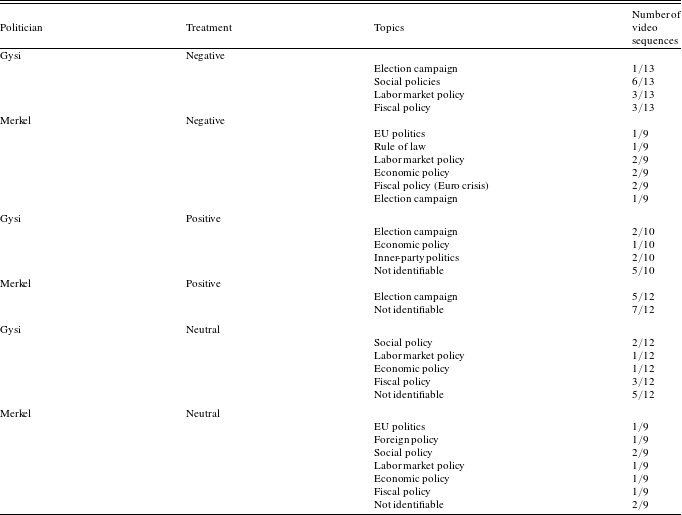
In our experimental design, the group of participants exposed to neutral stimuli performed the function of approximating the control of these personality-related effects, since they should be included in roughly the same way in all three stimulus conditions. To a certain degree, this also applies to the content of the messages communicated in the different video clips (see Table 1 in the Appendix). In the subsequent steps, party identification and cognitive (recognition) and emotional response (feeling affected) to the stimuli were included as moderating variables.
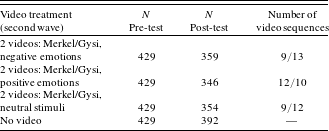
The experimental design is a pre-test/post-test comparison of the three experimental groups and the control group. The experimental treatment — administered at the beginning of the second wave (post-test) — varied among the four groups. The experimental groups received two videos showing Merkel and Gysi displaying either positive emotions or negative emotions or neutral stimuli. The control group did not receive any experimental treatment (see Table 1).
Stimulus selection
The treatment was selected based on a media content analysis of news broadcasts and political talk shows that aired on German public and private television channels between May 1, 2013 to April 30, 2014. Merkel and Gysi appeared differently in our sample of broadcasts in terms of emotional displays and airtime. Therefore, it was necessary to choose additional video sequences from broadcasts not included in our original representative media sample. These clips were selected for use as treatments only if all five researchers contributing to the project agreed on them as showing positive (joy, pride, amusement) or negative emotions (anger and outrage) or as containing neutral instead of emotional stimuli. The coding decisions were validated empirically by treatment checks (described below).
Each treatment had a length of approximately 1 minute, 30 seconds and consisted of 9 to 13 shorter sequences. All respondents in the experimental groups were exposed to two treatments: one showing clips of Merkel and one showing clips of Gysi. This amounted to a total exposure time of around 3 minutes. To present a realistic picture of the conditions given in television consumption, the video clips contained shorter sequences including sound bites, thereby showing facial, gestural, vocal, and verbal expressions of the politician’s emotions. This type of stimulus more closely resembles the images that citizens receive when consuming television broadcasts than photographs or pictures that eliminate sound, which are often used as stimulus material in experimental studies. Reference Rosenberg, Kahn and Tran117,Reference White, Kenrick and Neuberg118 On the one hand, the use of video material reproducing citizens’ daily situation in political mass communication enhances the external validity of the experimental condition. On the other one, this type of stimuli makes it largely impossible to disentangle the effects of various modalities of emotional expression — by voice, gesture, face, or content. This topic, however, is beyond the scope of our research.
The treatments presented to the participants differed in the valence of the emotions (positive, negative, and neutral stimuli). The shorter video sequences within each video clip addressed different political issues, for example, attacks on opponents as well as claims for social justice and economic progress. The positive video clips also included pride and happiness in light of electoral victories. The main topic within each video sequence was coded for the video stimuli based on categories developed by Rattinger and colleagues Reference Rattinger, Roßteutscher, Schmitt-Beck, Weßels and Wolf119 (see Appendix, Table 1).
Overview of experimental groups.

Note: The video sequences for both politicians were collected from news broadcasts, political talk shows, and televised party conventions and parliamentary debates. Hence, some video sequences show other politicians briefly or in the background.
The video clips from German news broadcasts and political talk shows were presented at the beginning of the second wave of the online survey experiment after a few initial questions. Participants were informed that the study included video clips and were asked to switch on their audio settings. A multiple-choice question ensured that all participants had the ability to identify a test sound correctly. After these precautions, the video clips were presented only once, and the rest of the questionnaire continued after the video clips. Each video clip was followed by a sequence of questions conceptualized as treatment checks, before the rest of the questionnaire continued. The order of the video clips was randomized, as was the order of the video sequences within each clip. Because of the randomization of the video clips, half of the participants in each condition first saw a video clip of Angela Merkel and shortly afterward a video clip of Gregor Gysi, or vice versa. By doing so, possible primacy and recency effects Reference Mayo and Crockett120 of the stimuli were neutralized.
Participants
The sample was drawn from an online panel of the former polling agency LINK (now Forsa), which is representative for German internet users aged 18 to 68 years. The data collection for the online survey experiment took place from March 19 to 29, 2015 for the first wave and from April 16 to 26, 2015 for the second wave, leaving at least two weeks between pre-test and post-test questionnaires. To reduce selection biases, participants could not self-select into the panel. Panelists were recruited, mostly offline through representative CATI (computer-assisted telephone interview) surveys. As a correction for sampling biases and the overrepresentation of early responders, a component of quota sampling by age and gender was applied.
To analyze heterogeneous treatment effects of subgroups such as party identifiers, we aimed to sample about 350 participants per experimental group. In all, 1,716 participants completed the questionnaire in the first wave; the original response rate was 36.8%. At this point, the respondents were randomly assigned to an experimental or control group before participants began filling out the questionnaire during the first wave. In all, 1,451 of these participants also took part in the second wave, which results in a follow-up response rate of 84.6% across all groups.
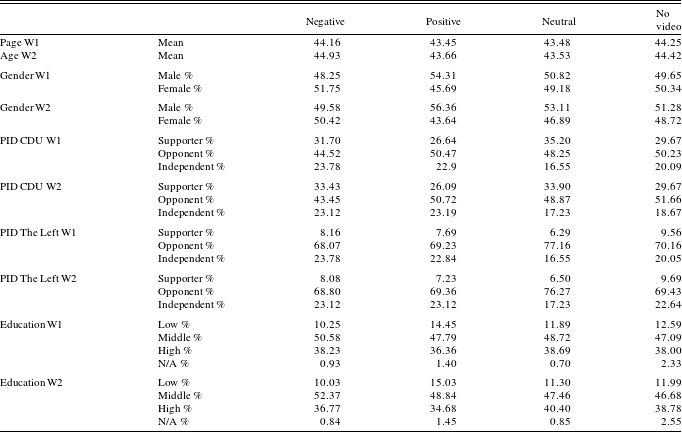
In wave 2, 52.6% of the participants were male (wave 1: 50.8%), while 37.7% had some college and had gained a general qualification for university entrance (“Abitur” or equivalent; wave 1: 37.8%). The mean age in wave 2 was 44.1 years (wave 1: 44.4 years). Among the respondents, 32.7% stated they were politically interested (wave 1: 32.2%). In wave 2, 30.8% (wave 1: 30.8%) felt close to the Christian democratic parties — the Christian Democratic Union (CDU) and the Christian Social Union (CSU) — and 7.9% in both waves leaned toward the Left Party. Since the distributions of these characteristics showed only minor deviations between the two waves, we can conclude that attrition effects were not relevant as distorting factors in the overall sample.
Because of panel attrition, sample sizes vary slightly between the experimental groups. While each experimental group had 429 participants in the first wave, the numbers ranged from 346 to 392 in the second wave. The attrition rates varied moderately und unsystematically between the four groups (see Table 2 in the Appendix for the composition of each group). Thus, there is no major concern that nonrandom attrition could distort the results of the experiment.
Measures
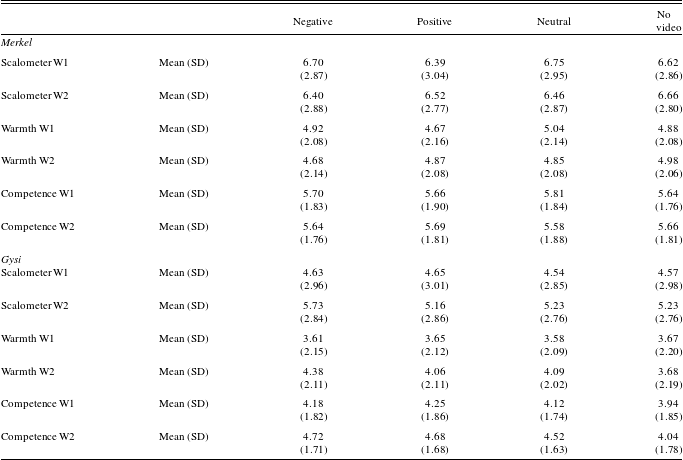
The questionnaire used a set of standard items for the measurement of attitudes toward the quality of Merkel and Gysi as political leaders. The dependent variables were operationalized as gain scores, that is, within-subject differences between measurements in the post-test and pre-test condition (see Table 3 in the Appendix for the level scores in both panel waves).
The general assessments of Merkel and Gysi were measured by this question: “Please, tell us, what do you think of some leading politicians. …Angela Merkel [Gregor Gysi]. I have a very low opinion of her [him] (
 $-5$
) …I have a very high opinion of her [him] (
 $+5$
).”
The measures of the attitudes toward Merkel’s and Gysi’s warmth and competence were constructed analogously as gain scores. Each of the two leadership characteristics was measured by two items ranging on a scale from 0 to 4 and were summarized into two single indexes ranging from 0 to 8. The index of warmth encompasses the characteristics of likeability and trustworthiness (Cronbach’s alpha
 $=0.82$
for Merkel and Gysi), while the index of competence includes items of leadership and problem-solving skills (alpha
 $=0.78$
for Merkel and alpha
 $=0.71$
for Gysi). Warmth and competence were operationalized by the following items: “To what extent do the following characteristics apply to Angela Merkel [Gregor Gysi]? She [He] is a strong political leader (C); she [he] is a likeable person (W); she [he] can solve political problems (C); she [he] is trustworthy (W). Doesn’t apply at all (0) …applies completely (4).”
Party identification was measured during the first wave using the standard German item that reflects Germany’s multiparty system: Reference Falter121 “In Germany, many people lean towards a certain political party over a long period of time, although they occasionally vote for a different party. What about you: Do you generally lean towards a political party and if so, which one?” (possible answers: CDU/CSU, Social Democratic Party [SPD], The Greens, the Left, other, none).
For the following analysis, we measure party identification as a categorical variable with three levels: partisans leaning toward the party represented by the political leader (Merkel: CDU/CSU, Gysi: the Left), nonpartisans (no party identification), and opponents feeling close to a different party (Merkel: SPD, the Greens, the Left, other; Gysi: CDU/CSU, SPD, the Greens, other).
In contrast to the previous measure of party identification, considerable variation exists in political psychology for analyzing the processing of emotional stimuli. The instruments we used in our experiment was built on the following set of questions: “What impression did Angela Merkel [Gregor Gysi] leave on you? Do you agree with the following statements? “She [he] was emotional” (answers: yes/no). If the answer was “yes,” a multiple-choice question followed: “She [he] was angry, sad, amused, proud, outraged, amused” (answers: yes/no).
In our context, the focus is on the valence of emotional displays. Therefore, recognition was coded as congruent if participants exposed to a positive stimulus recognized at least one of the following positive emotions — happiness, pride, or amusement — and no negative emotion — sadness, anger, or outrage. Congruence between negative exposure and recognition was coded analogously if participants recognized either anger or outrage within the negative treatment and no positive emotion. Congruence of neutral exposure and recognition was assumed if participants who received the neutral stimuli did not recognize any particular emotional expressions. The feeling of being emotionally affected by the stimuli was measured in the following way: “Finally, we would like to ask you regarding the video that you saw: Did the video affect you emotionally? It affected me/it did not affect me.”
Model specification
One-way analyses of variance were conducted in order to examine the influence of the experimental treatment on the assessment of the quality of Merkel and Gysi as political leaders. The experimental treatment included four different conditions (no video, neutral, positive, and negative emotional expressions). The stimulus effect is measured by comparing the mean change in the ratings of Merkel and Gysi and in the assessment of their warmth (likeability, trustworthiness) and competence (problem-solving capacity, leadership) in those four groups from the pretest to the post-test condition (
 $\unicode[STIX]{x1D6E5}\text{Y}_{2}-\text{Y}_{1}$
). In the first step, the analyses of variance included only the assessment of the three leadership characteristics as dependent and the experimental treatments as independent variables.
In view of the important role attributed to partisanship in previous experimental studies, this variable was included in the next step of the analysis. Examining the effect of this variable is relevant for several reasons. First, party identification is regarded as a stable political predisposition that accounts for a substantive degree of variation in political attitudes, among others, in the view on political leaders. Reference Abramson122 By taking party identification into account, we can examine whether partisans, opponents, and nonpartisans differ in their reaction to emotional stimuli and whether the effect of stimulus exposure on the attitudes toward political leaders persists even if political predisposition is controlled for.
The second set of moderator variables includes indicators of conscious processing of emotions. Although the recognition of emotional stimuli and the respondents’ affective reactions to them have been characterized as potentially important factors in emotional contagion, the respective effects have been rarely analyzed in experimental studies so far. Therefore, the recognition of the stimulus and the affective reaction attributed to it were also included in the experimental design. Both were conceptualized as necessary conditions and as reinforcing the effects of emotional stimuli on political attitudes. Thus, we test two different enlarged models: one using exposure to stimuli and party identification as independent and mediating variables and the other considering the effects of exposure, recognition, and perceived impact of the stimuli.
Findings
According to our core hypothesis, positive emotions displayed by political leaders should improve their ratings, while negative emotional displays should elicit less favorable attitudes toward them. As a first step of our analysis, we examine whether positive and negative emotional stimuli have an impact on participants’ general impressions and specific evaluations of Merkel and Gysi as political leaders.
Main treatment effects
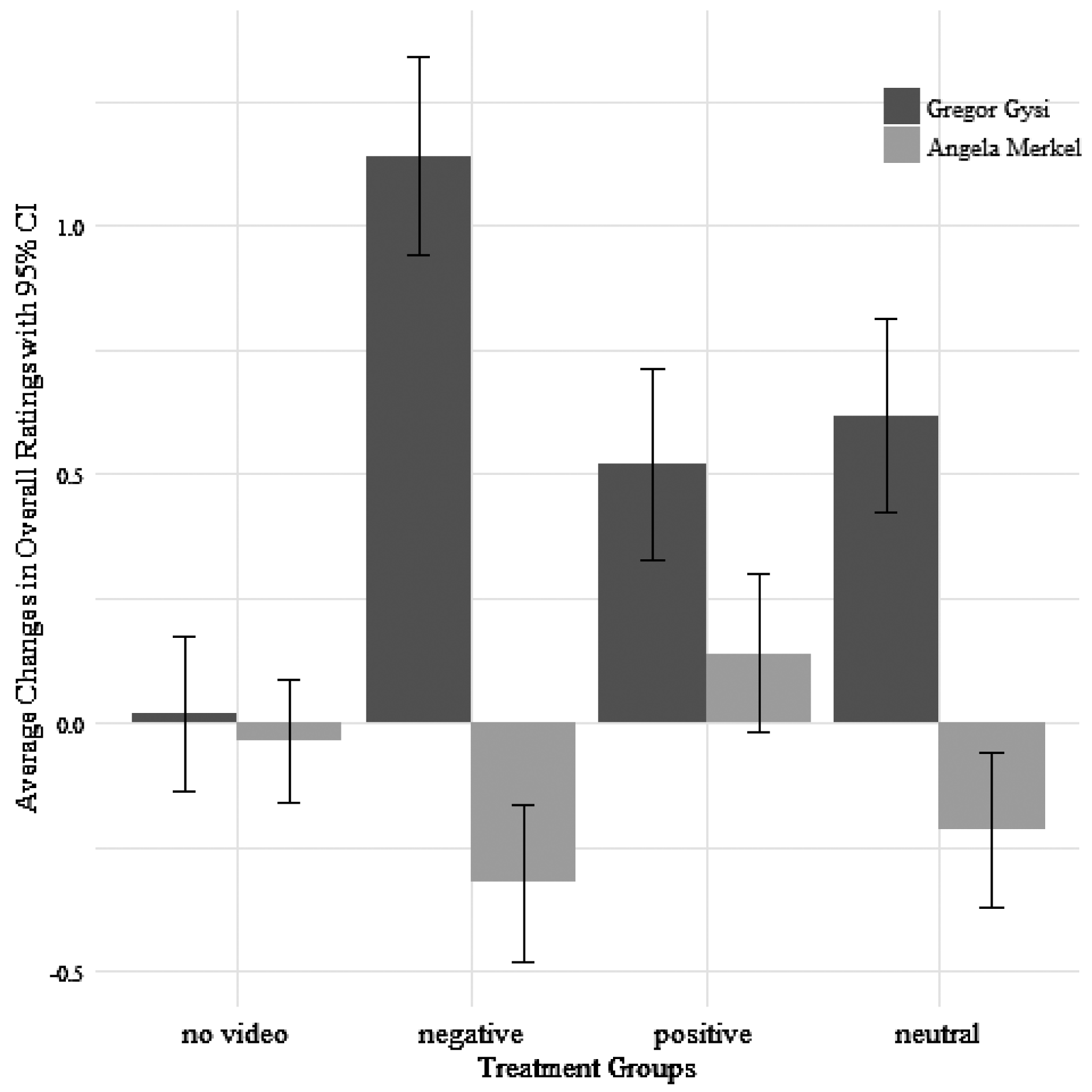
Overall ratings. The overall assessment of Merkel and Gysi was computed as a gain score between the pre-test and post-test ratings, ranging from
 $-10$
to
 $+10$
. Both effects were significant at the
 $p<0.01$
level. The effect of the experimental treatment on the evaluation of Angela Merkel yielded an
 $F$
ratio of
 $F(4,1446)=7.02$
,
 $p<0.001$
,
 $\unicode[STIX]{x1D702}^{2}=0.014$
and on the evaluation of Gregor Gysi an
 $F$
ratio of
 $F(4,1446)=24.47$
,
 $p<0.001$
,
 $\unicode[STIX]{x1D702}^{2}=0.048$
. As shown in Figure 1, positive emotions displayed by Merkel improved her general assessment, while negative emotions and neutral stimuli led to less favorable assessments. By contrast, the attitudes toward Gysi became more positive irrespective of the type of exposure.
Changes in overall ratings.

Post hoc analyses using Dunnett’s modified Tukey-Kramer multiple comparison tests indicate varying effects for both politicians. Compared with the control condition without video treatment (
 $M\,=\,-0.03$
,
 $SD\,=\,1.24$
), Merkel’s overall assessment decreased significantly among the participants who were exposed to her negative emotional expressions (
 $M\,=\,-0.32$
,
 $SD\,=\,1.52$
). The same holds true when exposure to negative stimuli is compared with the effects of the positive treatment (
 $M\,=\,0.14$
,
 $SD\,=\,1.51$
). The latter did not induce a significant change in her evaluation compared with the group that was not exposed to any kind of stimuli. Compared with the positive condition, participants who saw her neutral appearance also rated her less favorably on average (
 $M\,=\,-0.21$
,
 $SD\,=\,1.50$
).
As far as Gysi’s overall assessment is concerned, all experimental treatment conditions induced ratings that were more favorable compared with the control group without video treatment (
 $M\,=\,-0.04$
,
 $SD\,=\,1.27$
). Furthermore, his negative emotional displays induced the highest increase in his ratings (
 $M\,=\,1.14$
,
 $SD\,=\,1.93$
), and they differed significantly from the treatment groups with positive (
 $M\,=\,0.52$
,
 $SD\,=\,1.83$
) as well as neutral stimuli (
 $M\,=\,0.62$
,
 $SD\,=\,1.87$
).
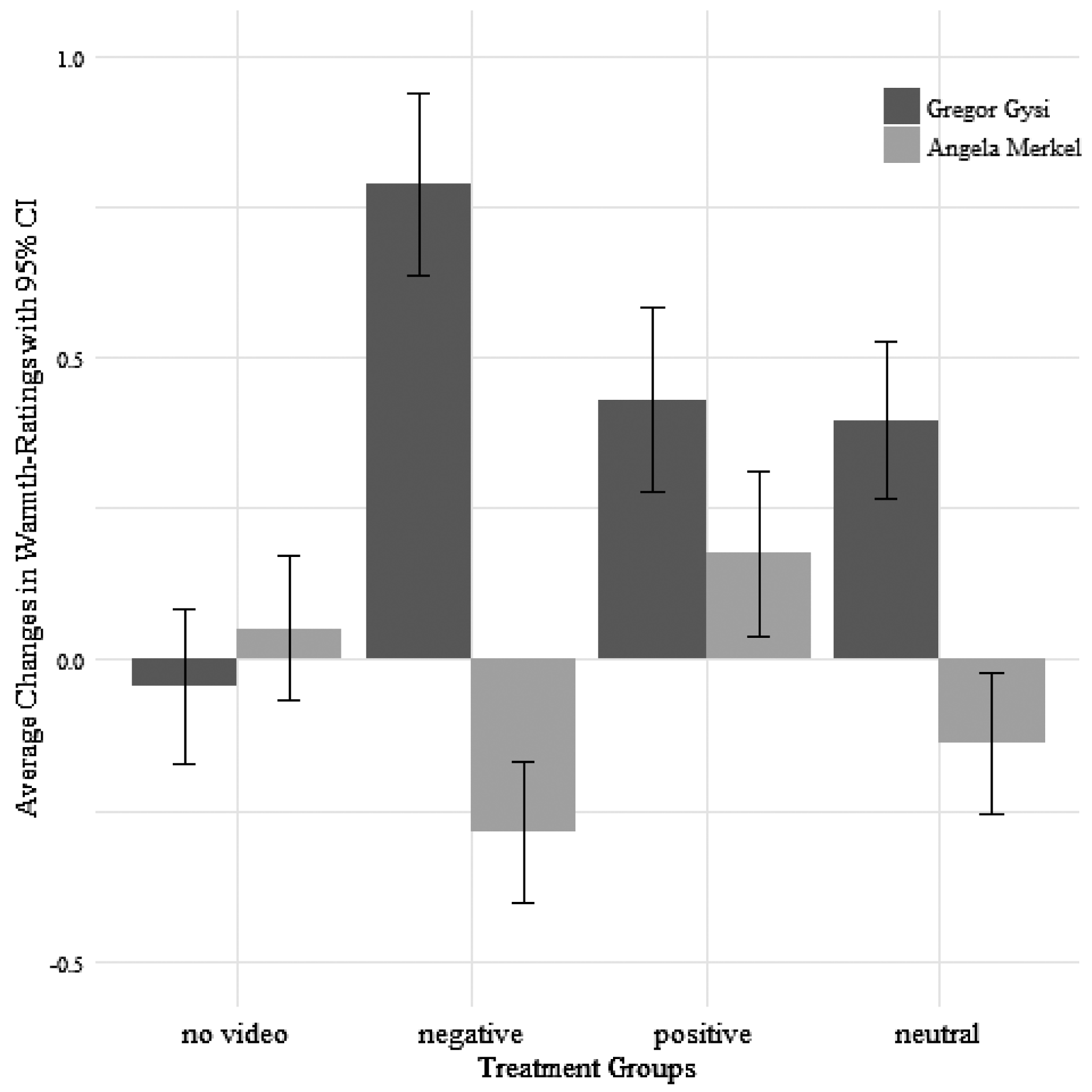
Warmth. Regarding the attribution of warmth to both politicians, a gain score between the first and second wave ranging from
 $-4$
to
 $+4$
was measured to capture the change within subjects. The effects obtained for Merkel and Gysi were significant at the
 $p<0.01$
level (Merkel
 $F(4,1445)=10.54$
,
 $p<0.001$
,
 $\unicode[STIX]{x1D702}^{2}=0.021$
; Gysi
 $F(4,1443)=23.76$
,
 $p<0.001$
,
 $\unicode[STIX]{x1D702}^{2}=0.047$
). The effects of their emotional expressions on their evaluation of warmth were small but slightly higher for Gysi than for Merkel. As observed in the general ratings, positive emotions displayed by Merkel yielded positive reactions among the participants, while negative and neutral stimuli elicited negative views of her warmth. The results obtained for the impact of the stimuli on Gysi’s view as a warm political leader parallel those reported for his general rating: regardless of the stimuli, the attitudes of participants toward Gysi increased in the video conditions, and Gysi was seen as a more likeable and trustworthy leader (see Figure 2).
The post hoc tests reveal patterns of treatment effects for both politicians that are largely similar to their overall assessments. Merkel’s negative emotional expressions resulted in lower ratings of warmth (
 $M\,=\,-0.29$
,
 $SD\,=\,1.13$
) compared with the control group without video treatment (
 $M\,=\,0.05$
,
 $SD\,=\,1.20$
) and the exposure to positive emotional stimuli (
 $M\,=\,0.18$
,
 $SD\,=\,1.28$
). Her neutral displays (
 $M\,=\,-0.14$
,
 $SD\,=\,1.13$
) also led to slightly lower ratings; however, the difference from the experimental group without video treatment was not significant. Showing positive emotions had a positive effect on the attribution of warmth to Merkel when compared with neutral displays and negative emotional expressions.
As described for the general rating, Gysi was assessed more positively by participants of all groups exposed to a stimulus compared with the control group without video (
 $M=-0.04$
,
 $SD=1.27$
). However, the effects of his negative emotional displays were again the largest by far (
 $M=0.79$
,
 $SD=1.45$
) and differed significantly from the effects of positive treatments (
 $M=0.43$
,
 $SD=1.44$
) and neutral stimuli (
 $M=0.40$
,
 $SD=1.24$
).
Changes in the assessment of warmth.

Changes in the assessment of competence.

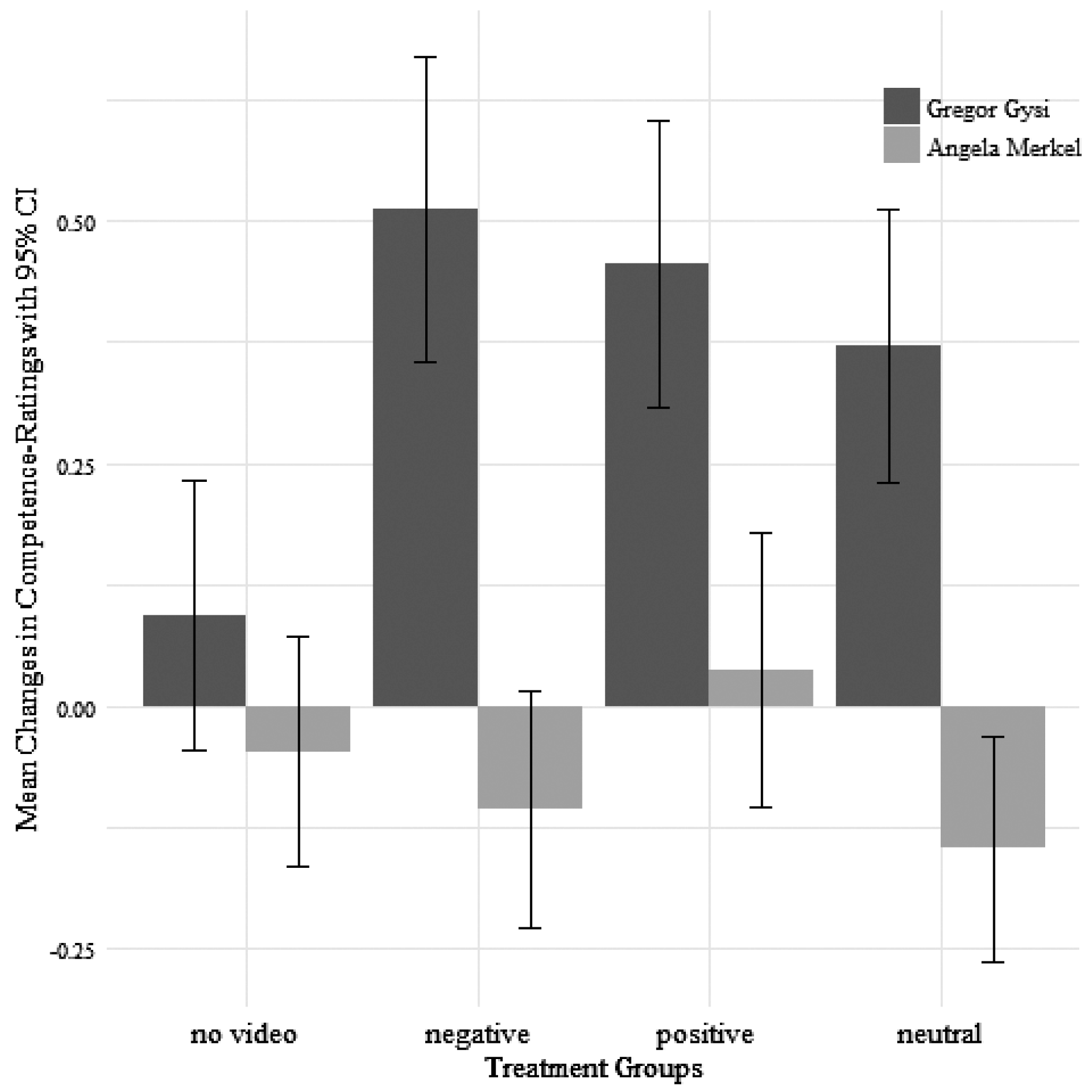
Competence. Unlike in the previously reported findings, exposure to emotional displays had only a significant effect on the assessment of Gysi’s competence (
 $F(4,1445)=6.49$
,
 $p<0.001$
,
 $\unicode[STIX]{x1D702}^{2}=0.013$
) but not on the evaluation of Merkel’s competence (
 $F(4,1446)=1.55$
,
 $p=0.20$
) (see Figure 3). While the experimental groups did not significantly differ from each other in their assessments of Merkel’s competence, positive effects of exposure occurred for Gysi. Compared with the evaluation of Gysi’s overall assessment and his warmth, emotional expressions affected the evaluation of his competence less strongly. In this instance, all three experimental groups differed significantly from the control group without video (
 $M=0.09$
,
 $SD=1.39$
). However, the treatment groups did not differ significantly from each other beyond a common exposure effect (positive treatment:
 $M=0.46$
,
 $SD=1.40$
; negative treatment:
 $M=0.51$
,
 $SD=1.52$
; neutral treatment:
 $M=0.37$
,
 $SD=1.34$
).
The results of the experiments reported so far allow for an initial assessment of the first two hypotheses. Most importantly, the null hypothesis that exposure to emotional displays of political figures does not matter for citizens’ attitudes about their quality as political leaders can be rejected in most instances. With the exception of the rating of Angela Merkel’s competence, the attitudes toward Merkel and Gysi among the participants who were exposed to an experimental treatment changed slightly but noticeably compared with the control group. Nevertheless, the pattern of change was not the same regarding the nature of the stimuli, the sources of these stimuli, and the types of political attitudes under observation.
Except for the attitudes toward Merkel’s competence as a political leader, exposure to positive emotions elicited more favorable ratings of Merkel and Gysi. This not only confirms H1a but also is in line with previous findings on the positive impact of happiness/reassurance displays on the assessment of political leaders. 123,124,125,126 As expected, showing positive emotions publicly can serve as a means of gathering support for political leaders.
Regarding the role of negative emotional expressions, the findings are less consistent, which is also in line with theory 127,128 and existing empirical evidence. 129 As indicated by the theory of emotional contagion and assumed in our hypothesis, exposure to the negative emotions of Chancellor Merkel lowered her general assessment and reduced the attribution of warmth to her as well. By contrast, negative emotional expressions did not harm Gysi’s image as a warm and competent political leader — on the contrary, they even improved his esteem with the public more strongly than expressions of positive emotions and neutral appearances. This effect pertains to the assessment of his broader leadership characteristics under observation here. Contrary to our expectations, negative emotions shown by Gysi did lead to counter-contagion in the attitudes toward him.
Although we did not state initial assumptions on the effects of neutral appearances of political leaders, it should be noticed that they obviously shaped views of Merkel and Gysi as political leaders. Regardless of whether they differed in a statistically significant way from positive and negative emotional displays, neutral stimuli elicited consistently different reactions to the two political figures. While neutral appearances of Gysi led to more positive attitudes toward him, the effects of neutral displays on the assessment of Merkel were mostly negative.
Moderating effects
Party identification. A prominent explanation why exposure to emotions of political leaders may produce different effects on attitudes toward them are political predispositions, particularly party identification. Reference Lau, Lau and Sears130 Accordingly, partisans may react positively to negative emotions expressed by politicians whose party they support, while opponents may react negatively to expressions of anger or sadness.
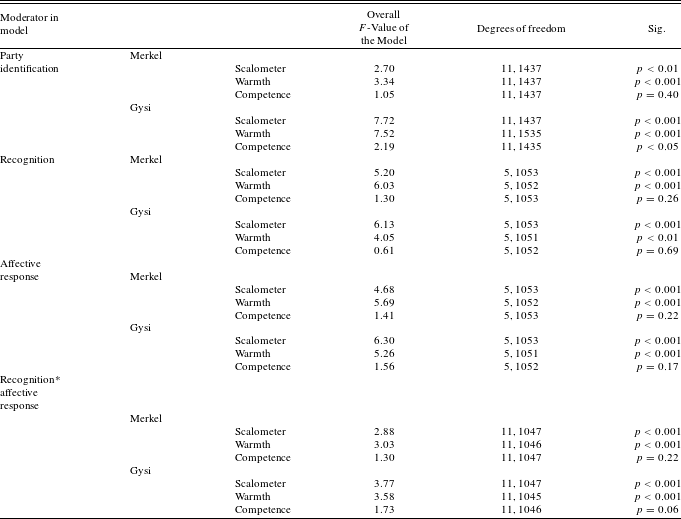
Despite previous support for the impact of party identification, this variable did not provide a statistically significant explanation for changes in the attitudes toward Merkel and Gysi in this study. None of the interactions between partisanship and the experimental treatment in the six models was statistically significant, which implies (here, at least) that partisans do not react differently to emotions displayed by political leaders representing opposite parties. Therefore, H3a–H3c about party identification are not supported by the data. An overview of the tested models can be found in the Appendix (see Table 4).
Recognition of emotions. As the above analysis has shown, exposure to positive stimuli improved the evaluations of political leaders by citizens, negative and neutral stimuli elicited different reactions to them, and the effects of the emotional displays were generally weaker than one could have expected. These results may have occurred for different reasons. Most importantly, emotional contagion is understood by most scholars as an interplay between automatic and deliberate responses to (political) stimuli. When conscious processing of emotions comes into play, recognition of the emotions and attaching a meaning or salience to them need to be considered as variables intervening between a stimulus and a response. 131,132 Thus, a mismatch between the precoded stimuli and the perceptions of the participants could account for the effects described here.
A discrepancy between the presumed valence of the emotional expressions and their recognition by the participants may indeed distort the effect of stimuli, since none of the emotions were classified in complete accord by the coders and the respondents. Negative emotions of Angela Merkel were recognized by 36% of the participants, whereas the share of positive emotions was 66%. The figures for Gysi were 67% (negative emotions) and 53% (positive emotions). As supposed, not all respondents judged the neutral stimuli as lacking emotional content. Around 61% of participants recognized Merkel’s neutral emotions “correctly,” whereas less than half of the respondents (44%) perceived Gysi’s neutral displays as being neutral.
When presenting and interpreting the subsequent findings on the role of recognition, it needs to be mentioned that the control group without a video treatment did not receive any stimuli and thus was excluded from the subsequent analyses. Since the three experimental groups differed less from each other than from the control group, excluding the latter reduces the variance between the groups and can reduce the explanatory power of the models. This seems to be the case. Including either the congruent recognition of the stimuli as an interaction with the treatment or the self-reported affective reaction into the analyses of variance did not yield statistically significant total models in most cases.
Moreover, the recognition of the expressed emotions influenced the relationship between the stimulus and the participants’ reaction in only half of the models. A significant interaction effect was observed for the overall ratings of Merkel (
 $F(2,1053)=3.96$
,
 $p<0.05$
, partial
 $\unicode[STIX]{x1D702}^{2}=0.007$
) and Gysi (
 $F(2,1053)=7.37$
,
 $p<0.001$
, partial
 $\unicode[STIX]{x1D702}^{2}=0.013$
), as well as for the assessment of Gysi’s warmth (
 $F(2,1051)=4.30$
,
 $p<0.05$
, partial
 $\unicode[STIX]{x1D702}^{2}=0.008$
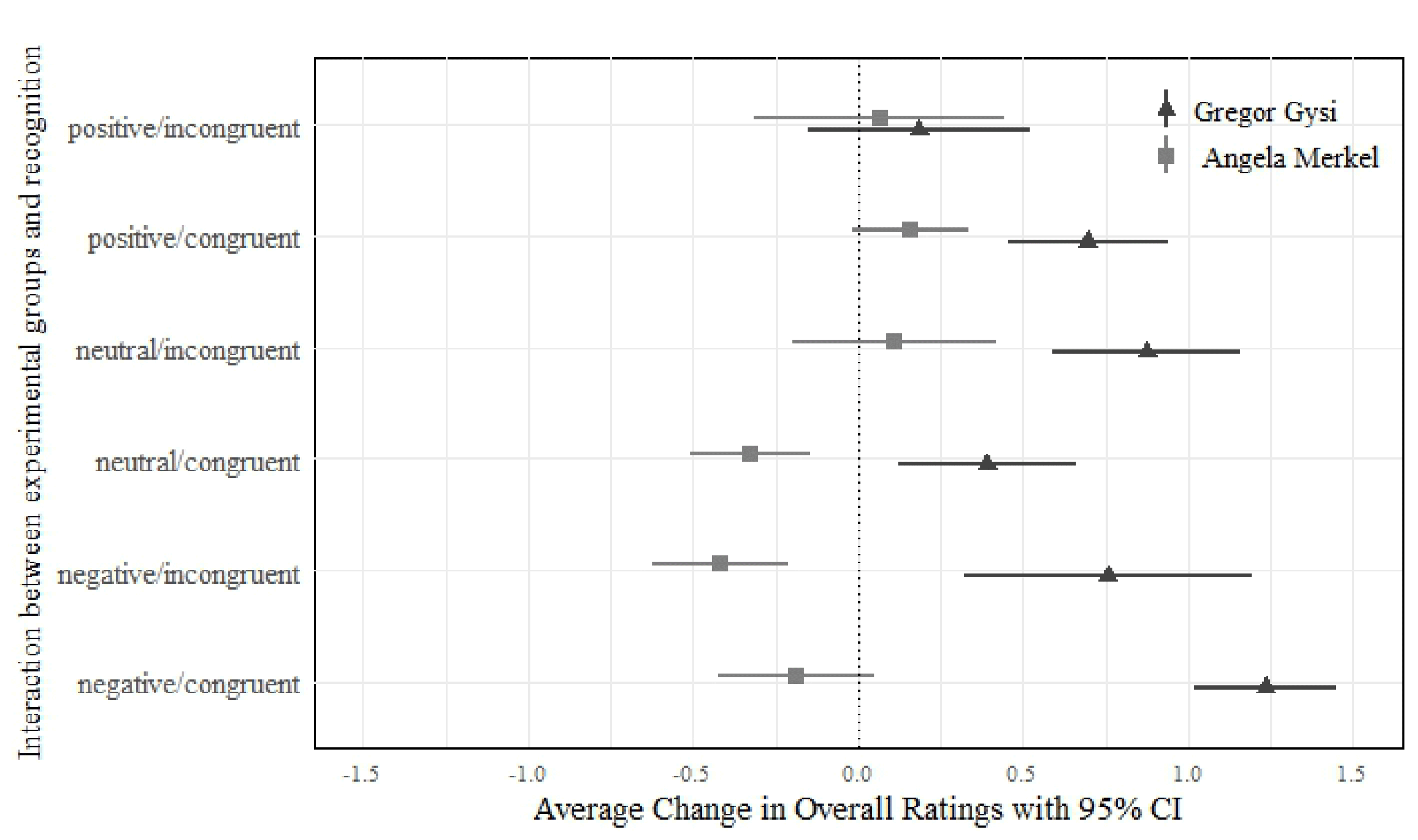
). As Figure 4 shows, stimulus-congruent recognition of emotion by the participants strengthened the effect of positive emotional displays of Merkel and Gysi in the cases mentioned earlier. The general ratings of both leaders turned more to the positive in the condition of congruent than of incongruent recognition, and more so for Merkel than for Gysi. Again, the patterns observed for negative stimuli differed for the two political leaders. As with positive stimuli, congruent recognition strengthened the process of counter-contagion induced by Gysi’s negative emotions, but the opposite effect occurred when Merkel’s negative emotions were decoded correctly instead of not having been recognized. Congruent perception of neutral messages sent by Merkel reduced her ratings (compared with incongruent ones).
Interaction between experimental treatment and stimulus recognition.

Contrary to the general rating, Merkel’s warmth and competence ratings as well as Gysi’s competence ratings were not significantly moderated by the congruent perception.
Contrary to the assumption in H4a, a stimulus-congruent recognition of emotional expressions by viewers is not a necessary condition of an impact of leaders’ emotions on their esteem among the citizens. Emotion recognition does not consistently strengthen the effect of positive or negative emotional stimuli on the evaluation of political leaders, which disconfirms H4b. The only exception was the general rating of Merkel and Gysi and of Gysi’s warmth. In this case, recognizing positive emotional expressions led to more favorable attitudes toward both political leaders. By contrast, the effect of recognition on the relationship between stimuli and reaction was inconsistent in the case of negative emotional expression and neutral displays. Thus, “accurate” perception contributes less to the explanation of the effect of stimuli on the assessment of leadership qualities than expected. Even if recognition of the stimuli is not completely irrelevant for inducing reactions, emotions seem to play a role in shaping attitudes toward political leaders. Reference Lodge and Taber20,133
Emotional reactions. We will now turn to the role of the participants’ emotional reactions to the (perceived) stimuli as a moderator variable. Under a different perspective, this point was highlighted in several experimental studies using the emotional states of the participants as dependent measures. Reference Sullivan35,134 As found in these studies, happiness/reassurance did often elicit positive emotions in respondents, while expressions of anger/threat and fear/evasion did not. Our question is different. We are interested in determining whether a strong reaction to the emotions observed in the video clips reinforced the effect of the emotional messages on the recipients’ attitudes toward the sender. A moderating effect between the treatment and the self-reported emotional reaction was not significant in any of the models.
Discussion
Since the mid-1980s, the personalization of politics and the spread of electronic mass media have brought the reactions of the public to the behavior of political leaders, including reactions to the emotions they display, into the scope of political psychology. As shown in several experimental studies conducted over the last few decades, political leaders can successfully use emotions as a means of generating public support; conversely, inappropriate emotional appearances can weaken support.
In this article, we explored the influence of emotional displays on the evaluation of two leading German politicians, Chancellor Angela Merkel and the former leader of the largest opposition party in the German Bundestag, Gregor Gysi. We distinguished between an overall summary score of the two political leaders and their more specific assessments as warm and competent political figures. In the hypotheses underlying the empirical analyses, we assumed that positive emotions shown by leaders would elicit more positive attitudes toward them, while negative emotions would have a negative impact on their public esteem. Party identification, “correct” recognition of the emotional stimuli, and feeling affected by them were considered moderator variables, explaining the reinforcement effects of emotions but also counter-empathic reactions to the stimuli.
Turning to the relationship between emotional stimuli and reactions, our findings confirm the position held by Hatfield, Cacioppo, and Rapson that different political emotions prompt different reactions. Obviously, some political leaders are more competent or successful in eliciting favorable reactions to the emotions they show, and people are differently susceptible to emotional contagion. 135
Beginning with the last point, our data show that most participants in the experiment were largely unaffected by the emotional stimuli they were exposed to. Furthermore, those who were affected the most showed weak reactions and did not react uniformly to the emotions they encountered. The weak impact of emotions on the attitudes toward Merkel and Gysi does not really come as a surprise given the fact that both have been highly prominent figures in German political life for two and a half decades. It can reasonably be assumed that German citizens had formed attitudes toward them a long time ago and that these attitudes are relatively stable and will change only under specific conditions — not including a short impression and the artificial setting of an online survey experiment.
The varying reactions to different leaders and different types of emotions need to be discussed somewhat more in detail. According to our findings, positive emotional stimuli elicited reactions that differed from those induced by negative emotions. The impact of Merkel’s emotions on the attitudes toward her quality as a political leader were not the same as those observed in the assessment of Gysi. Additionally, emotions mattered for the general rating of the leaders and the attribution of warmth to them, but a uniform impact on competence evaluations was not observed. Finally, the intervening variables partisanship and processing of emotional stimuli turned out less important to the assessment of leadership qualities than might be expected.
In view of these findings, the discussion needs to focus on the following problems that we conceive as the most relevant ones in light of theory and existing empirical evidence:
-
1. What accounts for the different effects of positive and negative emotions?
-
2. Why did viewers react differently to the emotional expressions of Merkel and Gysi?
-
3. What explains the differences in the impact of emotions on the attribution of warmth and competence?
-
4. What accounts for the irrelevance of partisanship as a variable intervening between emotional stimuli und the assessment of leadership qualities?
-
5. Why do cognitive and affective processing of the emotional stimuli not matter more as moderating variables?
Consistent with previous findings, positive emotions mostly elicited positive attitudes toward the sender, while negative emotions sometimes led to negative reactions but also to positive responses. While the growth of support as an effect of having encountered positive emotions can be explained as emotional contagion, the question remains open why negative (and neutral) emotions displayed by Merkel undermined her image as a good political leader. This finding becomes particularly puzzling since the negative emotional expressions of Gysi improved his esteem among the citizens even more strongly than positive emotional messages. To a lesser extent than negative emotions, Gysi’s neutral messages had also a positive effect on his image as a political leader. To summarize, the data on the role of Merkel’s emotional displays largely underline processes of emotional contagion, while emotions shown by Gysi induce contagion as well as counter-contagion and can also be interpreted — at least in part — as evidence of mere exposure.
Several factors may account for this astonishing variation of the effects of emotions. The most obvious are linked to the formal positions held by Merkel and Gysi and the related role expectations of the public. The assumption seems reasonable that most people expect the head of government to act as a motivator and bridge builder instead of fortifying a negative climate of opinion. This role includes spreading positive emotional appeals, fostering optimism, and emphasizing solidarity and cohesion. If the incumbent conforms to these expectations, she is rewarded with increasing support, but if she does not, she will be negatively sanctioned and lose support. This does not mean that negative emotions of an incumbent will always lead to negative reactions; Reference Hareli, Berkovitch, Livnat and David102,136 however, this negative effect did occur in our experiment. The institutional setting shaping Gysi’s behavior was clearly different. As a leader of the parliamentary opposition, he was expected to take a critical position on state affairs and particularly on the role of government. Thus, he benefited from the reaction that negative emotions may prompt positive evaluations if they are not directed at the leader’s own party and its supporters but at political adversaries. 136 Two additional factors need to be mentioned in the explanation of the effect of emotions observed for Gysi. As the leader of a left-wing party, he frequently talked about social injustice, minimum wage, education, and other social policies. Such topics may seem highly relatable and have positive connotations. Therefore, any outburst focusing on them might appeal to voters. Reference Hess and Parrott137 In contrast, Angela Merkel did not mention any of these topics in the video material. Instead, she mentioned the bureaucracy of the European Union or the shortcomings of other political parties. Hence, the anger shown by Gysi might have been more relatable given the rhetorical context than Merkel’s negative emotional displays.
Thus, the different reactions to the emotions of Merkel and Gysi that pertain to all leadership characteristics may be interpreted as reflecting the citizens’ views of appropriate behavior of the head of government and the leader of the opposition. Appropriateness has been found to be an important moderating variable of the impact of emotional expressions in previous studies. Reference Bucy and Newhagen44,138 Discrepant role expectations could also partly explain why the effects of Merkel’s neutral appearances on the attitudes toward her elicited mostly the same reactions as negative emotions, while Gysi’s neutral messages affected his image positively.
Moreover, the emotions shown by Gysi had a far stronger impact on his image as a political leader than the effects found for Merkel. At first glance, this difference can be attributed to a varying strength of existing predispositions toward the two political figures and to ceiling effects. While the first assumption is not supported by the results of a comparison between the stability of the leadership characteristics attributed to Merkel in Gysi in the control group that was not exposed to emotional appeals, the second one seems more plausible. In the pre-test condition, Merkel obtained considerably higher ratings in all respects than Gysi.
On an overall scale ranging from 0 to 10, Merkel’s mean score amounted to a high of 6.63 compared with 4.41 received by Gysi. Regarding Merkel’s and Gysi’s competence evaluations, the respective figures were 5.70 (Merkel) and 4.12 (Gysi) on a scale from 0 to 8. Among the supporters of the CDU/CSU who encompassed almost a third of the respondents, Merkel’s esteem was even higher. In other words, in view of her highly positive image among the German citizens, it was extremely difficult for Merkel to make additional gains. Gysi found himself in a more comfortable situation in this respect because the respondents had an ambivalent or neutral view on his leadership attributes at best and because the supporters of the Left Party who rated him almost as positively as observed among Merkel’s supporters made up less than 10%. Thus, ceiling effects may have played a role in the assessment of Merkel among the respondents in general and particularly in the large group of her partisans, but apart from his supporters, a ceiling effect was not a relevant factor in the evaluation of Gysi. Finally, participants perceived the emotions shown by Gysi as considerably stronger than Merkel’s.
A different role of exposure to emotions was not only observed in the comparison between Merkel and Gysi but also with respect to particular leadership characteristics. Other than the general rating and the attribution of warmth, the assessment of competence was only weakly related (Gysi) or unrelated (Merkel) to exposure to emotions. The different impact that emotions had on the assessment of the leadership qualities under observation here might stem from variations in warmth and competence ratings, which in turn could account for their varying susceptibility to the influence of emotions. Because of the common affective element entailed in the respective dispositions, warmth as an affective tag associated with a political leader is activated and made accessible when an emotional stimulus is encountered. Reference Lodge and Taber20 A similar link to affective tags does not underlie judgments of competence.
The emotional underpinning of warmth does not explain why emotions do not matter for the attribution of competence to Merkel but bear on the respective attitude toward Gysi. Probably, this difference is due to a ceiling effect in the evaluation of Merkel’s competence. 139 In the pretest condition, more than three-fourths of the participants rated Merkel’s quality as a strong political leader and her competence in solving important problems positively. Under these conditions, little room is left for improving her image by short-term effects such as emotional expressions in a television appearance. By contrast, Gysi started from a less favorable position and therefore had the opportunity to make greater gains in support through his public appearances.
While partisanship turned out to be an important moderator of the impact on exposure to emotions on viewer reactions in the United States and France, 140 this was not the case in the German setting. The most obvious explanation for this surprising finding can be attributed to the nature of party competition in Germany. Contrary to France and the United States, the distance between the two main German parties, the Christian Democrats and the Social Democrats, is rather moderate. The more extreme positions in party competition are typically held by small protest parties such as the Left or the Alternative for Germany. Consequently, many German political leaders, particularly the chancellor and the minister of foreign affairs, enjoy respect and sympathy even among many supporters of competing political parties. Based on this observation, the construct of a chancellor bonus was established in German electoral research such that the incumbent chancellor is usually more popular among voters than among party supporters. Reference Ohr, Klein, Rosar, Wessels, Schoen and Gabriel141
In this experiment, the partisans of the Social Democrats and the Greens were initially less positive in their view on Merkel than were the supporters of Christian Democrats, but nevertheless they rated her positively rather than negatively with regard to all characteristics under observation here. A similar pattern occurred for Gysi’s evaluation. Consequently, the main effects of partisanship were insignificant in the analyses of variance.
Given the emphasis put on the role of emotional experience and processing of emotions in social psychology, 131 the impact of the participants’ cognitive and affective reactions to the treatments appears surprisingly weak. First and foremost, the assumptions of recognition of emotions and affective reactions by them as necessary conditions of emotional influence was clearly disconfirmed. At first glance, this seems to support the view of emotional contagion as an automatic process, not necessarily entailing conscious processing. Reference Ksiazkiewicz, Vitriol and Farhart142 This view is underlined by findings of early experimental studies showing that the results of psychophysiological measures not only differed from those of the respondents’ self-reports but often yielded stronger reactions to the stimuli. Reference McHugo, Lanzetta and Bush30
Alternatively, some evidence exists on the relatively consistent role of perceptual factors in reinforcing stimulus effects on participant reactions. When the effects of cognitive and affective elements of processing are weaker than expected from a theoretical point of view, this could be due to insufficient treatment checks and the lack of psychophysiological measurements (and over-reliance on self reports). Apart from these methodological considerations, the role of neutral stimuli, which has been neglected in research on emotional contagion so far, deserves to be analyzed more in detail. The main differences in the reactions occurred between the three groups that were exposed to stimuli on the one hand and the unexposed control group on the other, while the group that was exposed to neutral stimuli often reacted similarly to participants encountering positive or negative stimuli. Thus, we can conclude that the processes of emotional contagion and counter-contagion as observed in the United States and France are also an element of German politics. However, the conditions underlying the role of emotions in the acquisition and loss of support for political leaders are far from obvious.
Note
The six video files used as our experimental treatment for the article are available as supplementary material on Cambridge Core.
Appendix
Topics according to the experimental treatment groups.

Descriptive statistics for experimental groups.

Descriptive statistics of the dependent variables for experimental groups.

Overview of moderation effects.