




No CrossRef data available.
Local Granaries and Central Government Disaster Relief: Moral Hazard and Intergovernmental Finance in Eighteenth- and Nineteenth-Century China
Published online by Cambridge University Press: 29 March 2004
Abstract
During the eighteenth and nineteenth centuries, the Chinese state attempted to administer famine relief partly through a nationwide institution of local granaries. This article explores regional variations in the performance of this institution to understand the reasons for its ultimate breakdown. The evidence suggests granary storage levels were systematically lower in provinces that received more frequent central government disaster relief; and an unintended consequence of disaster relief was that it modified local incentives for self-insurance and led to an incompletely resolved moral-hazard problem. China's experience provides an instructive example of the long-term dynamics present in intergovernmental policies.
Information
- Type
- ARTICLES
- Information
- Copyright
- © 2004 The Economic History Association
A prominent institution in the Qing dynasty (1644–1911) was a national system of state granaries. Some granaries were used to hold reserves for military or bureaucratic personnel, but many were also created to help smooth price shocks and food-supply fluctuations for the civilian population. Based on a far-reaching vision of the potential scope and function of the state in helping to provide social security in the event of food crises, these civilian granaries in effect accumulated local-level investments to counter food crises. The operation of the granaries, however, was uneven, and interregional shortfalls in granary stocks at times stood in contrast to the rough uniformity of the guidelines for the civilian granaries under the original plan.
This article examines regional differences in the performance of this institution. I depart from conventional interpretations of the principle of the Qing administrative system by making the conflicts of intergovernmental incentives central to the analysis. The argument of the article is as follows. Local authorities at the provincial and subprovincial levels were required to maintain granaries primarily as a reserve in the event of famine. The granaries had to be supported in significant part with local investments, but the central government could not adequately monitor the actions of local officials, who generally possessed discretionary power over a broad range of activities. At the same time, alternatives to storage existed in private markets, and the central government was also willing to provide other forms of relief, notably through tax relief. This led to a moral-hazard problem as these actions modified local incentives for self-insurance. In areas where central relief was more forthcoming, the budget constraint was more forgiving, and local officials may have had greater incentives to reduce their expenditures on granaries.
I consider the hypothesis that the evolution of the civilian granaries depended on incentives provided by market signals, state-sponsored procedures that were specifically designed to alleviate the impact of food shortages due to weather shocks and natural disasters, and a combination of the two. I use historical data on market integration and intergovernmental funding from the 1740s to the 1820s to evaluate this hypothesis. The data show that the geographical pattern of disaster-relief funding from the center was skewed and not likely to have been determined by the random occurrence of disasters. The results also show that there is a negative relationship between regional market integration and storage. After conditioning on this fact, I further find that provincial storage levels are systematically lower with a higher frequency of central government relief—empirical evidence that supports the contention that moral hazard existed on the part of local administrators and that they consciously chose to lower storage levels in the expectation of relief.
There are a number of economic and political variables that have long been regarded as being regionally important in China. First, transportation costs and market access differed across regions.1
See Needham, Science, on shipping technology in China; Watson, Transport, for Japanese estimates of Chinese transport costs; and Skinner, City, pp. 214–15, on the approximation of physical and urban boundaries via “macroregions.” On the history of commercialization during the Qing, see Wu, “Lun Qingdai” [Discourse on national markets]; and Nishijima et al., Zhonguo jingji shi [Research on the economic history of China].
See Williams and Wright, Storage, for example, for models of storage decisions.
There is virtually no data on private storage, but the analysis of grain price data alone reveals that some kind of consumption smoothing in the form of storage did take place, particularly in the inland areas of China.3
See Shiue, “Transport Costs.”
See Perkins, “Government,” for a summary of how officials viewed industry and commerce; on merchants and the Chinese bureaucracy see Mann, Local Merchants,, especially pp. 52–69; and Rowe, “State.” See specific examples of official proposals from Will, Bureaucracy, p. 305f. Source of original memorial from Jiangnan governor-general Yinjishan who sought permission to reduce storage because of adequate access to markets: Qianlong 29/4/11, Gongzhongdang archive, no. QL 17505.
Second, there were differences in regional influence. Although the Qing state was a unified government with a similar hierarchy of administrative structures within each province, certain regions were historically more significant for reasons of geography, distance to the capital or to military garrisons, agricultural productivity, and other factors.5
Perkins, Agricultural Development, pp. 174–82, discusses the basis of economic regionalism; Chi, Key Economic Areas, outlines traditional key areas. Reischauer and Fairbank, East Asia, focus rather on the question of how significant regional powers came to be unified under imperial rulers.
Another fundamental aspect of the political equation was that the central government, in Beijing, relied on local officials at the provincial and subprovincial level to implement its policies. The government was formally organized into a hierarchy of four administrative layers: the emperor, the governors and governor-generals (provincial level), the prefects (prefectural level), and the magistrates (county level). If the bureaucratic chain of command were intact, then “Qing officials” might be regarded as a single entity cooperating under a unified agenda. Numerous examples of departures from regulation in the lower ranks, however, suggest that this was not the case. In the existing literature, these cases are often cast in terms of the “corruption” or the “commitment” of various individuals.6
From Will, Wong et al., Nourish the People, p. 110: “The performance of the men on the spot was thus entirely a matter of tight control and personal authority, which, of course, fluctuated from one magistrate to another as a function of professional commitment and the quality of their private staffs.” For numerous examples of official corruption in the eighteenth century, see Park, “Corruption,” pp. 969–85.
Principal-agent theory is a useful framework for analyzing these incentives: specifically, the principal (in this case, the central government) cannot monitor the agent (the local government) at all times and lacks sufficient information about the action(s) that the agent has undertaken or will undertake. The differentiated incentives experienced at the regional level and at the hierarchical level (local or central administration) gives rise to further implications: local governments may attempt to allocate resources over which they have discretion towards public goods that have higher priority in their own jurisdictions.
The Qing system of tax remissions and central disaster aid policies was prone to the problems of moral hazard. Even though the government's policies were formally governed by a set of rigid rules, with each ranking official reporting to the authority directly above his own, in practice there was a fair amount of flexibility in day-to-day management decisions. On the one hand, reprisals awaited those officials who were caught mismanaging, but on the other hand, because deviations from regulations and deficits in the local treasury were not always discovered, public funds controlled at the local level were more fungible in practice than was formally acknowledged. In addition, although local magistrates, prefects, and provincial authorities operated under routine guidelines and regulations, they were also delegated with very general responsibilities of governance for nearly all local affairs in their jurisdiction. Under such circumstances local administrators could and did find ways to collude and to channel funds for one operation to other aspects of governance.
The degree to which government practice deviated from ideal is a topic that has generated continuing interest and research.7
The success of state projects is often used as an indicator of the effectiveness of the state in related literature. Hsiao, Rural China, pp. 153–59, for example, was concerned with the effectiveness of rural control, and his conclusion that the condition of community and charity granaries was unsatisfactory, fits with the notion that the problems could be attributed to difficulties in rural supervision. Ch'ü, Local Government, p. 157, additionally argued that the ever-normal granaries were not advantageous to the poor. Subsequent research giving larger estimates of grain stock data from Liu, “Reappraisal,” p. 318; and Will, Wong et al., Nourish the People, pp. 507–25, has led to a reappraisal of the functions of the granary system and of the eighteenth century “state's capacities” as a whole.
See, for example, Esherick and Rankin, Chinese Local Elites, pp. 44–45; and Rankin, “Managed by the People,” on the role of local elites in civilian granaries and famine relief.
See Will, Wong et al., Nourish the People, p. 93.
Previous studies have also considered civilian granaries in light of economic and political factors. Pierre-Etienne Will, R. Bin Wong, James Lee, Jean Oi, and Peter Perdue, in what is perhaps the most comprehensive study to date on the civilian granaries, primarily view the institution as an expression of the paternalistic welfare ideology of the Qing state.10
Will, Wong et al., Nourish the People.
Ibid pp. 297–98.
Skinner, City, pp. 211–49, “Regional Urbanization in Nineteenth-Century China.”
Price analysis can offer a systematic way to assess differences in the degree of market integration across subprovincial units. However, existing price studies tend to focus on a limited number of provinces or cities at a time, and there are no studies I am aware of that use empire-wide evidence on central and local patterns of disaster relief together with the price data.13
See Wang, “Secular Trend.” Chuan and Kraus, Mid-Ch'ing Rice Markets, focus on grain stocks and rice price differentials in a number of different provinces. Other analyses of grain prices include: Wang, “Food Supply,” on Fujian; Marks, “Rice Prices,” on Guangdong; essays in a volume edited by Rawski and Li, Chinese History; Chen, Wang, and Hu, “Time-Series Analysis,” on Suzhou; and Li, “Integration,” on North China.
A NATIONWIDE SYSTEM OF CIVILIAN GRANARIES
The Qing granaries were initiated by the Kangxi emperor (reign 1662–1722), based on precedents from previous dynasties. The three types of civilian granaries, the ever-normal granary (changping chang), the charity granary (yichang), and the community (shechang) granary, attempted to reach residents of urban and rural areas across an empire spanning millions of square kilometers. The granaries dealt with the problem of delays in grain shipments by holding a local stock of grain, thus tying over the crises until additional grain could arrive. The ever-normal granaries were managed by the local magistrate and primarily served those residing near the county seat. The state also hoped the ever-normal granary system could function as a buffer stock, enabling it to regulate market prices through purchases and sales. The community and charity granaries were usually located in towns or villages and supervised by local elites; overall, these granaries were relatively minor in size compared to the ever-normal granaries.
In the 1750s annual civilian stocks averaged about 1.5 billion liters of husked rice, equivalent to about 7.5 liters of rice per person, or roughly 3 percent of the consumption of an adult per year.14
Assuming population is 200 million and annual consumption per person per year is 250 liters of husked rice. Original units are in shi (Chinese bushel) of unhusked grain; 1 shi equals 103.5 liters. Granaries held unhusked grain as it spoils less easily than husked grain. Conversion rates differ across grains; unhusked rice is about twice the volume of husked rice. Source: Quanguo fensheng minshu gushu qingce [National registers of population and granary holdings arranged by province]. Reproduced in Will, Wong et al., Nourish the People, data appendix.
For more details on the size of tax revenues, see Wang, Land Taxation, p. 71; and the Appendix.
This is likely a conservative figure. Between 1736 and 1779, total grain stocks ranged between 27 and 41 million shi. Will, Wong et al. (Nourish the People, pp. 492–93) assume that 100,000 shi of grain among granaries was transferred interprovincially and an additional 100,000 shi moved intraprovincially
LOCAL INVESTMENT IN CIVILIAN GRANARIES
Consistent investments in the maintenance and upkeep of the granaries would have been critical to their long-run operation. To prevent spoilage over years of normal harvest, county officials had to sell or loan (with interest) old grain from the previous harvest and use this money to acquire fresh grain for restocking through market purchases, or, by soliciting contributions from local residents. In years when relief was needed, county officials were supposed to sell the ever-normal granary stocks at reduced prices or distribute grain to the poor. If ever-normal grain was distributed outright for famine relief, then the local administration would be reimbursed by the central government.17
Ibid., p. 148.
Contributions were revenues from the sale of imperial academy studentships and degrees; this was a central government rent collected at the county level. On the discontinuation of the use of contributions starting in the 1740s, see Will, Wong et al., Nourish the People, pp. 51–52, 439.
The central government, therefore, subsidized but did not fully back the financial requirements of the granaries. By implication, this imposed upon local leaders a portion of the overall costs of this institution, which included spoilage costs, labor costs, and capital costs for repair and maintenance of the granary, indirect costs of trying to operate the granary partly as a local lending institution during normal years, as well as some costs of emergency grain relief during famine years. This resource problem alone would have presented significant difficulties because funds were always scarce; but in addition, local governments did not face uniformly favorable incentives to invest in the civilian granaries. There are at least three reasons that account for this: the incentives of local governance, the discretionary nature of revenue sharing, and the potential for intergovernmental transfers.
First, consider the incentives of local governance. Overseeing granary operations was only one of many tasks facing the county magistrate. From the point of view of the local government, amassing a stock of civilian grain was important if it helped to prevent chaos and rebellion in the area due to food crises. In addition, there was the risk that the failure to satisfy granary guidelines would be discovered. Both problems could potentially lead to demotion and severe reprimands if not addressed adequately, but the point at which a specific local official could be judged to be in breach of his responsibilities was seldom clear cut.19
Out of more than 400 cases of corruption from all officials of all ranks between 1736 and 1799, most were never prosecuted; see Park, “Corruption,” p. 996.
Ross, “Economic Theory.”
Guidelines on the volume of grain that local managers were supposed to stock existed. They were intended to be estimates of need, assessed according to local conditions and population estimates; these were typically given in units of thousands of shi of unhusked grain—for example, 4,000 shi for a smaller county and 20,000 shi for a larger county. In 1748 the central government produced a comprehensive list of storage targets (e), and the list was adjusted three times thereafter—in 1776, 1818, and 1831.21
See the Appendix on Actual Granary Storage and Storage Targets.
The successful operation of the granaries, where success is defined as conformity to central guidelines in storage levels, was perceived by the central government to be a question of adequate regulation and control. The center's main solution for reducing the problems of moral hazard was better monitoring, and the resulting procedures reflect efforts that especially aimed to reduce the problem of asymmetric information. The practice of annual routine audits on civilian granaries, begun in 1698, was performed at every level of the hierarchy by the unit directly superior to the one being audited. Renewed efforts at special province-wide audits were instigated in 1799 after the discovery of persistent shortfalls in grain, attempts by local officials to store cash instead of grain, and intergovernmental collusion to hide nonexistent stocks.22
Will, Wong et al., Nourish the People, pp. 196, 218, 221.
Second, much of the difficulty that the central government had in ensuring that the counties would stock grain in accordance with guidelines stemmed from the fact that local officials exercised a significant amount of discretionary power over the resources that were available for funding these granaries. In the mid-eighteenth century, three-quarters of total taxes were statutory taxes and one-quarter were in nonstatutory categories.23
Wang, Land Taxation, p. 70.
Zelin, Magistrate's Tael, pp. 27–29. In Shanxi, a province that retained 30 percent of the tax locally, 65 percent of retained taxes were allocated to military uses and only 15 percent (or less than 5 percent of total taxes collected) were available for local expenses. Jiangxi province had 7 percent of total taxes available for local expenses. Moreover, these were for specific projects that were often for projects that were also of national interest, such as military supplies and postal road maintenance.
Additional details on customary fees and ritual gifts are in Hickey, “Fee-Taking,” see especially p. 394.
Nontransparency of public finances, however, was in fact a general aspect of the Qing fiscal system as a whole, and it meant that local administrators could find ways of manipulating even statutory or imperial funds to their own benefit. Thus, even when contributions were earmarked for civilian grain stocks, local officials could transfer these contributions immediately to any number of uses other than as storage for famine relief.26
Zelin, Magistrate's Tael, provides numerous examples of official skimming, and of advancing funds from one category to another. In the practice of wage contributions by officials, provincial governors appropriated the salaries granted by the central government to lower officials in order to pay for public projects; see pp. 43–45. Also see p. 83 on the practice of selling grain stocks for additional revenues.
Ibid., p. 52.
Third, the civilian granaries were only one aspect of the Qing emperors' overall approach to famine relief.28
For a survey of Qing food policy, see Feng, Zhongguo lidai minshi zhengceshi [Civilian Food Policy].
In the 1720s and 1730s the central government discouraged local officials from soliciting revenues for disaster relief; Zelin, Magistrate's Tael, p. 170.
An edict of 1728 stipulated that a 70 percent exemption of the land tax was permitted in the case of a complete harvest failure; in the case of a 90-percent harvest loss, the exemption rate was 60 percent, whereas for 80, 70, and 60 percent harvest loss, exemptions were 40, 20, and 10 percent. Source: Da Qing huidian shili [Precedents and regulations supplementing the collected statutes], juan 288, hubu [Board of Revenue], juanxu [Exemptions and relief], zaishang zhi deng [Categories of disaster].
Rates are found in an 1815 text in the Da Qing huidian shili, juan 288, hubu, juanxu, zaishang zhi deng: for harvest damages below 50 percent, payments were postponed till the next harvest. For damages 50–70 percent, payments were postponed for two years, and for 80–100 percent damages, three years. Before 1815 the terms of postponement may have been more adjustable than exemptions, see Will, Bureaucracy, p. 246.
In addition to the land and head tax, the grain tribute was another important source of central government funds that was frequently used for disaster relief. A portion of the grain tribute could be exempted from collection, or, grain already en route to the capital could be diverted to the stricken areas. Both land-tax remissions and diversions from the grain-tribute granary helped alleviate the effects of food shortages by expanding purchasing power, by keeping grain in the region, and by increasing grain supplies.
Thus, although the central government did not permit the local county government to retain a large amount of the statutory tax revenues for unspecified purposes ex-ante, statutory revenues were nevertheless an important source of revenue sharing between the central and the local government ex-post to a disaster. The mechanism of tax and grain-tribute relief suggests the terms of an implicit insurance contract between the local and center, in which the local region that experiences a normal or better harvest will pay its taxes in full, whereas the local region that cannot pay its taxes or may require additional assistance because of ruined harvests will receive remissions from the center. The moral-hazard problem, however, underscores the principal-agent problem when such terms of insurance are involved, because moral hazard arises if actions undertaken by the local administrator affect the outcome of the insurance contract.32
See Arrow, Aspects; and Mirrlees, “Optimal Structure.” See Dunstan, Conflicting Counsel, pp. 89–93 for an administrative expression of the theoretical problem, entitled “Instructions to local administrators to exhort the people and assign them tasks, to make the population's food supply sufficient,” a statement issued by the Qianlong emperor in 1744.
In summary, we should expect that the larger the deviation of storage targets from the levels implied by regional market conditions, the less likely was it that local officials would have had sufficient resources and incentives to satisfy targets. From the local administrator's point of view, granary storage was a project that had to be financed in part with resources that could also be used for other local needs, and the basic lack of transparency in local finance meant these decisions could not be adequately monitored by the center. Moreover, in some cases, additional funds for local disaster relief that took the form of exemptions on statutory (central) taxes could be obtained, thus reducing the need for local investments in stocks. The combination of incomplete top-down control and discretionary funding reinforced this moral-hazard problem.
ANALYSIS
Interprovincial Concentration of Disasters and Relief
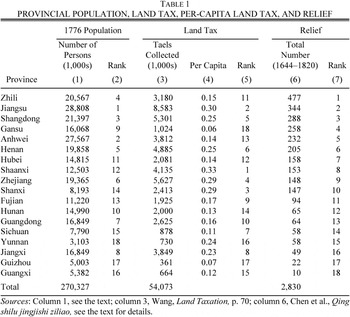
Information about natural disasters (ziran zaihai), tax exemptions, and postponements for disaster relief (juanmian huanzheng) are among the many aspects of governance that are recorded in the Da Qing lichao shilu [Veritable Records of the Qing]. The material documents motions of the court rather than requests or denied proposals. Thus, the information can be interpreted as an indicator of the relative level of central relief extended to each province. Column 6 in Table 1 provides a summary by giving the total number of separately dated entries regarding disaster relief from 1644 to 1820. According to this source, out of a total of 2,337 disaster reports collected between the years 1644 to 1820, nearly 70 percent can be attributed to droughts and floods.33
Summary of material collected in Chen et al., Qing shilu jingjishi ziliao.

In the following, I restrict my empirical analysis to the ten major rice producing provinces.34
I exclude the lesser tribute provinces Shandong and Henan, which sent not only rice, but other crops. Sichuan was excluded due to unresolved problems in its population data (see the Appendix).
Wang, Land Taxation, p. 70.
Storage techniques and costs were likely to be significantly different in the drier climate of the North relative to the central and southern areas of China, and the costs of storing different grains might be different as well. The greater the differences in climate, the less comparable storage will generally be.

Although precise data on income per capita across provinces are unavailable, it does not appear that the central government extended relief based on objective assessments of regional poverty. Rather, the concentration of relief seems heavily represented by areas traditionally considered wealthier (Jiangsu, Anhwei, and Zhejiang). It might be argued that because the richer provinces had a higher tax burden, they therefore had a greater need for relief relative to poorer provinces.37
See Wang, Land Taxation, p. 18. A very rough approximation of progressive taxation applied across provinces, with the more agriculturally productive provinces (i.e., Shandong, Henan, Anhwei, Jiangsu, Zhejiang, Jiangxi, Hubei, and Hunan) contributing more.
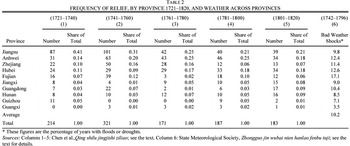
Furthermore, although relief was ostensibly linked to natural disasters, weather data from a separate source that normalizes climatic patterns in China do not generally support this proposition either. Table 2, column 6, displays the frequency with which the provinces experienced extremely bad weather (drought or flood conditions). Although some provinces had relatively good weather and rarely received relief (Guizhou, Guangxi, Hunan), a high frequency of relief does not necessarily relate to very bad weather. Overall, the rankings of weather severity do not coincide well with relief distributions.
Thus, differences in the frequency of relief across the empire are not proportional to population size, per capita tax burden, weather patterns, and general notions of income distribution. It is possible that special interests, regional favors, and security aims may indeed have been partly behind the pattern of relief. A strong hint of this is provided by Zhili, the province in which Beijing was situated. In both absolute numbers as well as in per capita terms, relief to Zhili over the Qing dynasty dominates other provinces by a factor that is not well-justified by notions of helping the poor.38
Jiangsu province surpasses Zhili over the Yongzheng period (1723–1735). In the Qianlong period (1736–1795), Gansu province surpasses Zhili in the disaster report rankings. The military presence in Gansu, and the fact that it was on the supply route to military garrisons in Central Asia may have played a role. See Perdue, “Qing State,” on the economic impacts of this activity in Gansu.
Market Integration and Civilian Grain Storage
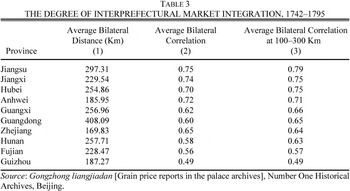
In order to examine whether the need for public aid might have depended on the ease with which a province could obtain imports of grain from outside the province after a harvest failure, I employ two different assessments to rank the strength of market integration across the provinces: price correlations and distance to major waterways. First, the bilateral price correlation between two markets is an informative means by which to compare the extent to which different markets are linked. Higher correlations suggest the presence of trade relationships, whereas low price correlations indicate their relative absence. Table 3 shows summary statistics in the bilateral relationship of rice prices between the prefectural markets within each province over the second half of the eighteenth century. Column 1 gives the average distance in kilometers between prefectures in each province; column 2 gives the average price correlation for each province. Column 3 controls for the fact that average interprefectural distances vary across provinces by giving the average of the bilateral price correlation coefficient only for those markets within each province that are between 100–300 kilometers apart (which is in the median range of interprefectural distances). Results in columns 2 and 3 are similar, and suggest that differences in market integration across the provinces are relatively stable across subsets of market distances.

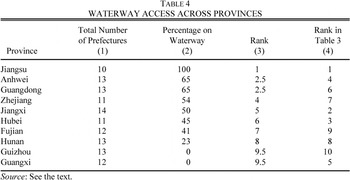
Second, waterway access was important in China for long distance and interprovincial trade. It is possible that although a province such as Fujian did not engage in very much intraprovincial trade, it nevertheless had good access to distant markets because of easy access to seafaring transport. An inspection of the number of prefectures within each province that were proximate to a major waterway is indicative of the degree to which that province had access to markets more generally. For each prefecture for which we have price data, Table 4 reports the percent of prefectures within each province that was located on the Pacific coast, the Yangzi River, or the Grand Canal.39
One may also include main tributaries, the Yuan River, the Xiang River, the Huai River, the Gan River, and the Lingnan Drainage basin, which would result in only slight alterations to the rankings in Table 4.

The rankings in columns 3 and 4 of Table 4 suggest that the three provinces within the sample with the highest market access and integration are Jiangsu, Anhwei, and Jiangxi; the three provinces with the lowest market access and integration are Guizhou, Fujian, and Hunan; and the remaining provinces, Hubei, Guangdong, Zhejiang, Guangxi are somewhere in between. With the exception of Hunan, Hubei, and Zhejiang, the quantitative results using price data are roughly in line with perceptions of market development in the historical period.40
Hunan, Hubei, and Zhejiang would be in Will, Wong et al.'s definition of the “interior” area. But here, Hunan is among the three provinces with lowest integration, and the ranking of Hubei and Zhejiang is comparable to Guangdong and Guangxi, which Will, Wong et al. include in the “border” areas that did not have easy access to grain.
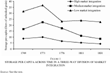
Figure 1 plots the relationship between per capita public storage and this three-way division of market integration for several years in the eighteenth and early nineteenth centuries.41
Storage per capita is computed over a five-year average around each of the four years for which population data are available. See the Appendix for sources on the population estimates.

Frequency of Central Relief and Local Grain Storage
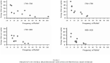
I now consider whether the frequency of relief provided by the center is associated with the patterns of per capita storage at the provincial level. I use the frequency with which the central government extended relief to indicate the geographical concentration of central government expenditures in disaster relief. Figure 2 plot the number of separate instances in relief for four 20-year periods between the years 1740 and 1820 against the public grain stocks per capita for each of the ten provinces. There is a negative correlation between the frequency of relief and provincial storage levels. The pattern is similar over time within each 20-year subperiod. A negative correlation between central government relief and local storage across regions over the long-run together with the charges of “immorality,” “abuses,” and “mismanagement” from the center point to a conflict of incentives between central and local-level administrators. In other words, some provinces systematically under stored and received aid.

Central Relief and Local Storage Conditional on Differences in Market Integration
The negative correlation between the degree of market integration and storage levels suggests that the operation of the local granaries was closely tied to the local economy; therefore, the analysis of central relief and storage needs to condition on these regional differences. To do so, consider the pattern of storage among the provinces with relatively more market integration: these are Jiangsu, Jiangxi, Hubei, Anhwei, and Guangxi according to Table 3. Among these provinces, according to Table 2, Jiangxi and Guangxi received relief relatively infrequently (“low aid”), compared to Jiangsu, Hubei, and Anhwei (“high aid”). By contrast, Guangdong, Zhejiang, Hunan, Fujian, and Guizhou may be categorized as having had relatively less market integration; out of which Hunan, Guangdong, and Guizhou are in the “low aid” group.
In addition, local granary storage levels were influenced by directives from the center. To take that into account, I therefore examine provincial storage as a function of deviations from centrally issued target storage levels. If actual stocks were higher than the required levels, then stocking decisions were probably not dictated by a singular drive to adhere to central mandates, as that constraint had already been reached. However, if actual storage was at target or somewhat below, then we cannot rule out the possibility that the mandates were binding.
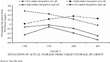
Figure 3 displays the average percentage deviations between actual and target storage across provincial groups, over the four dates when the center issued such targets.42
Deviations=[Actual storage (in the five years post target adjustment) – Target] / Target.
The sum of per capita target adjustments, calculated by taking the sum of target adjustments over 1748 to 1831 and dividing by total population increases in the corresponding period, shows that on average, per capita target increases in low-aid provinces surpassed that in high-aid provinces by a ratio of 4:1.

The pattern of target adjustments also indicates that provinces that typically did not meet their storage target saw relatively small increases in their target whereas storage targets for those provinces that were already storing above target were raised. Over the mid-eighteenth and early nineteenth centuries, it was the adjustment of central storage targets that gradually closed the gap between actual and target storage, rather than the other way around.
The pattern of deviations from storage targets suggests that local governments acted independently, stretching the limits of authority that was delegated to them by the central government. Although the central government attempted to control these local activities through direct monitoring, it is still evident that the direction in which local governments pushed the boundaries of what they were permitted to do was in line with the incentives that we have seen. In part, the actions of the central government made the problem worse than it had to be. The provision of more frequent central relief in the aftermath of a disaster to the same regions that had too low storage simply worsened the basic monitoring problem arising out of the delegation of responsibility that the center was trying at the same time to control with audits.
SUMMARY AND DISCUSSION
The specific actions undertaken by the Qing government for disaster and famine relief were disparate and varied. Among the activities not explicitly considered in this article are the use of export blockades and import enticements, cash distribution, public works projects, and soup kitchens. In addition, we do not have a complete record of all episodes of relief, let alone a single interpretation on how Qing disaster policies should be viewed. Some types of historical records, however, such as those on intergovernmental revenue redistribution may be used to gain insights about the central and local sources of funds for disaster relief. The information also has the advantage of allowing us to analyze central and local relationships with respect to relief policy systematically.
This article suggests Qing disaster relief can be usefully understood as part of its intergovernmental public finance policy, in which the central government allocated funds to local governments, and at the same time expected local government to invest locally in famine insurance, specifically, in local civilian granaries. I find that civilian granary stocking patterns are affected by two factors: different degrees of access to interregional (private) markets for grain trade and the dynamic relationship between central policy setting and the local (provincial) response. Civilian stocks were consistently lower in provinces that had relatively good market access, compared to provinces where market access was relatively bad. The inverse relationship between local storage and interregional trading possibilities supports the idea that local officials' behavior was affected by straightforward economic calculation.
I also find, however, that provinces that received central government relief more frequently were more likely to understore relative to storage targets. Regions that could expect disaster relief from the central government may have rationally reduced storage below levels that would have otherwise been chosen in the absence of this implicit insurance relationship with the center. This would be consistent with the interpretation of moral hazard in a principal-agent setting. The negative correlation between central government relief and local storage holds for regions with relatively good as well as relatively bad interregional trade possibilities, and the pattern is quite stable over the period from 1740 to 1820.
The numerous charges of local corruption with respect to storage, the repeated efforts at monitoring on the part of the central government to raise storage, and the direction of deviation between actual storage and target storage all suggest that the extent to which intergovernmental relief allocation changed local calculations on storage was an unintended consequence of relief. In addition, the regional emphasis of tax relief is evident already early on in the Qing dynasty, even though the civilian granaries were not fully established until the Qianlong reign (1736–1795), further suggesting that the central-relief and local-storage patterns were not the calculated outcome of a unified administration that extended more relief to those areas where it helped less with local storage, but the result of uncoordinated and competing actions.
It would be interesting to extend these findings on different aspects of the Qing disaster relief system to the microeconomic level and to investigate the impact of the conflict in incentives on the welfare of different groups. The grain from the civilian granaries was intended for the farmers and the poor, whereas disaster relief probably amounted to a subsidy to landowners that offset lost rent. If central relief led to reductions in local civilian storage, as implied by the cross-regional results, then the overall outcome for potential beneficiaries of the granaries in those areas could be worse than what would have occurred without the government's tax relief. The effects would be more pronounced if the poor had no means for private storage or for negotiating a share of the disaster relief through their landlords.
Like earlier writers on these topics, I find that the state's effectiveness in carrying out public projects should be considered jointly with an overall view towards the bureaucratic apparatus. The interpretation that emerges from this article, however, emphasizes a somewhat different set of factors, in particular, the role of intergovernmental fiscal relations (theory of fiscal federalism), substitution between trade and storage, and agency theory. China's experience in disaster aid provides an instructive example of the long-term dynamics present in the various elements of its institutions and intergovernmental policies. It also illustrates that it may be useful to view the evolution of some of these dynamics as being the outcome of repeated interaction among bureaucratic members with diverse preferences and resources.
Appendix 1: Data
Disaster Reports and Relief
The Da Qing lichao shilu [Veritable Records of the Qing] arranges in chronological order government communications (memorials), proclamations (edicts), and notices of the emperor's actions and events related to the court and its officials. Disaster relief was generally considered a benevolent act that testified to the generosity of the emperor. Thus, to the extent that one of the goals of official histories was to record the positive accomplishments during a certain reign, it is quite likely that items related to episodes of relief were included whenever possible.
The information compiled by Chen Zhenhan, Xiong Zhengwen, Li Chen, and Yin Hanzhang on the Veritable Records reveals a number of different characteristics of both reports of disaster, as well as the response to the disaster.44
Chen Zhenhan et al., Qing shilu jingjishi ziliao.
Although a full account of relief expenditures is impossible to reconstruct, it is likely that the frequency of relief reports closely reflects the overall concentration of relief expenditures and the relative extent to which the center became involved in aid to a province. The number of separate decisions and edicts passed by the center for aiding each province provides one indicator of the strength of linkages between the center and each provincial government.
Rice Prices
In this article, the degree of market integration is measured by the correlation of rice prices across regions. Monthly price data are available in the Gongzhong liangjiadan [Grain price reports in the palace archives]. I use a biannual series—one observation around the time of the main harvest (eighth lunar month) and the other in the early spring (second lunar month)—over the years 1742 to 1795. These consist of 20,423 price observations on “middle-grade” rice, by prefecture. Approximately 24 percent of the observations on prices for the 121 prefectures over all these years are missing. The percentage of missing data, however, is similar across prefectures, and the missing data do not appear to be systematically related to prefectural characteristics.
Weather
This study uses weather data from a compilation published by the State Meteorological Administration, which tabulates weather conditions throughout China for 120 “stations” (a regional designation equal to one or two prefectures), using historical and contemporary information on weather fluctuations.45
State Meteorological Administration, Zhongguo jin wubai nian hanlao fenbu tuji
Yao Shan-Yu, “Chronological and Seasonal Distribution”; and Zhang Peiyuan, “Extraction.”
Population
Population data are available from secondary sources compiled by John D. Durand and Ho Ping-ti.47
Durand, “Population Statistics”; and Ho Ping-ti, Studies.
Marks, “Rice Prices.”
Actual Granary Storage and Storage Targets
The original sources of the provincial-level storage data are palace memorials and Board of Revenue registers. The figures are supposed to be actual storage in the provinces as reported in the eleventh month of each year. Both these data and the official targets on granary storage are replicated by Will, Wong et al.49
Will, Wong et al., Nourish the People.
To reduce the effects of year-to-year fluctuations in the calculation of per capita storage, I average five years of storage data surrounding each of the dates of the population figures storage. Thus, for example, per capita storage in 1748 is the average annual storage from 1748–1752 divided by the population in 1748.
Tax Quota and Tribute Grain
The grain tribute and land taxation are discussed and recorded by Harold Hinton and Wang Yeh-chien, respectively.50
Hinton, Grain Tribute System; and Wang Yeh-chien, Land Taxation.
I have benefited from comments and discussions with Loren Brandt, Chen Zhenhan, Avinash Dixit, Don Fullerton, Timothy Guinnane, Wolfgang Keller, Kenneth Pomeranz, T. N. Srinivasan, Zhang Peiyuan, session participants at the 2002 Economic History Association Meetings (Private versus Public Institutions), and comments and suggestions from anonymous referees and from Knick Harley, an editor of this JOURNAL.
References
Arrow Kenneth J.
1965
Aspects of the Theory of Risk-Bearing.
Helsinki:
Yrjö Jahnssonin Säätiö.
Chen Zen-Yi,
Wang Yeh-Chien, and
Hu T. H.
(1999)
“A Time Series Analysis of Rice Prices in Suzhou during the Eighteenth Century.”
Academia Economic Papers
27,
no. 3:
311–
34.Google Scholar
Chen Zhenhan,
Xiong Zhengwen,
Li Chen, and
Yin Hanzhang.
1989
Qing shilu jingjishi ziliao
[Economic history materials from the Veritable Records],
4 volumes.
Beijing:
Beijing Daxue,
Chi Ch'ao-tin.
1963
Key Economic Areas in Chinese History.
New York:
Paragon Book Reprint Corp.
Ch'ü T'ung-Tsu.
1962
Local Government in China under the Ch'ing.
Cambridge, MA:
Harvard University Press
Chuan Han-sheng and
Richard A. Kraus.
1975
Mid-Ch'ing Rice Markets and Trade: An Essay in Price History.
Cambridge, MA:
Harvard University Press
Da Qing huidian shili
[Precedents and regulations supplementing the collected statutes of the great Qing dynasty].
1899 edition.
1986–1987
Da Qing lichao shilu
[Veritable Records of the Qing].
Zhonghua,
Dunstan Helen.
1996
Conflicting Counsels to Confuse the Age: a Documentary Study of Political Economy in Qing China, 1644–1840.
Ann Arbor:
Center for Chinese Studies, University of Michigan
Durand John D.
(1960)
“The Population Statistics of China, A.D. 2–1953.”
Population Studies
3,
no. 2:
209–
56.Google Scholar
Esherick Joseph W., and
Mary Backus Rankin, eds.
1993
Chinese Local Elites and Patterns of Dominance.
Los Angeles:
University of California Press
Feng Liutang.
1993
Zhongguo lidai minshi zhengceshi
[Civilian Food Policy in China's Historical Period].
Beijing:
Shangwu Yingshuguan
Gongzhong liangjiadan
[Grain price reports in the palace archives].
Beijing:
Number One Historical Archives.
Hickey Paul C.
(1991)
“Fee-Taking, Salary Reform, and the Structure of State Power in Late Qing China, 1909–1911”.
Modern China
17,
no. 3:
389–
417.Google Scholar
Hinton Harold.
1956
The Grain Tribute System in China (1845–1911).
Cambridge, MA:
Harvard University Press
Ho Ping-ti.
1967
Studies on the Population of China, 1368–1953,
Cambridge, MA:
Harvard University Press
Hsiao Kung-chuan.
1960
Rural China: Imperial Control in the Nineteenth Century,
Seattle:
University of Washington Press
Li Lillian M.
(2000)
“Integration and Disintegration in North China's Grain Markets, 1738– 1911.”
This JOURNAL
60,
no. 3
665–
99.Google Scholar
Liu Ts'ui-jung.
1985
“A Reappraisal of the Functions of the Granary System in Ch'ing China (1644–1911).”
Les techniques de conservation des grains à long term
3 fasc.1, Éditions du CNRS, ParisGoogle Scholar
Mann Susan.
1987
Local Merchants and the Chinese Bureaucracy, 1750–1950.
Stanford, CA:
Stanford University Press
Marks Robert B.
(1991)
“Rice Prices, Food Supply, and Market Structure in Eighteenth-Century South China.”
Late Imperial China
12,
no. 2
64–
116.Google Scholar
Mirrlees James A.
(1976)
“The Optimal Structure of Incentives and Authority within an Organization.”
Bell Journal of Economics
7,
no. 1
105–
31.Google Scholar
Needham Joseph.
1971
Science and Civilization in China,
Vol. 4, pt 3.
Cambridge:
Cambridge University Press
Nishijima Sadao,
Feng Zuozhe,
Qiu Mao, and
Li Chao.
1984
Zhongguo jingji shi yanjiu
[Research on the economic history of China],
Beijing:
Nongye chuban she
Park Nancy.
(1997)
“Corruption in Eighteenth-Century China.”
Journal of Asian Studies
56,
no. 4
967–
1005.Google Scholar
Perdue Peter C.
1992
“The Qing State and the Gansu Grain Market, 1739–1864.”
In Chinese History in Economic Perspective,
edited by Thomas G. Rawski and
Lillian M. Li,
100–
125.
Los Angeles:
University of California Press
Perkins Dwight H.
(1967)
“Government as an Obstacle to Industrialization: The Case of Nineteenth-Century China.”
This JOURNAL
27,
no. 4:
478–
92.Google Scholar
Perkins Dwight H.
1969
Agricultural Development in China 1368–1968.
Chicago:
Aldine Publishing Company
Quanguo fensheng minshu gushu qingce
[National registers of population and granary holdings arranged by province].
Beijing:
Number One Historical Archives.
Rankin Mary Backus.
(1994)
“Managed by the People: Officials, Gentry, and the Foshan Charitable Granary, 1795–1845.”
Late Imperial China
15,
no. 2
1–
52.Google Scholar
Rawski Thomas G. and
Lillian M. Li, eds.
1992
Chinese History in Economic Perspective.
Los Angeles:
University of California Press
Reischauer Edwin O., and
John K. Fairbank.
1958
East Asia: The Great Tradition.
Boston:
Houghton Mifflin
Rowe William.
(1993)
“State and Market in Mid-Qing Economic Thought: The Case of Chen Hongmou.”
Études Chinoises
7,
no. 1
7–
39.Google Scholar
Ross Stephen.
(1973)
“The Economic Theory of Agency: The Principal's Problem.”
American Economic Review
63,
no. 2
134–
39.Google Scholar
Shiue Carol H.
(2002)
“Transport Costs and the Geography of Arbitrage in Eighteenth Century China.”
American Economic Review
92,
no. 5
1406–
19.Google Scholar
Skinner G. William, ed.
1977
The City in Late Imperial China.
Stanford, CA:
Stanford University Press
State Meteorological Society.
1981
Zhongguo jin wubai nian hanlao fenbu tuji
[Collected maps of droughts and floods in China in the past five hundred years].
Beijing:
Ditu chuban she
Wang Yeh-chien.
(1972)
“The Secular Trend of Prices during the Ch'ing Period (1644–1911).”
Journal of the Institute of Chinese Studies of the Chinese University of Hong Kong
5,
no. 2
347–
68.Google Scholar
Wang Yeh-chien.
1973
Land Taxation in Imperial China, 1750–1911.
Cambridge, MA:
Harvard University Press
Wang Yeh-chien.
(1986)
“Food Supply in Eighteenth-Century Fukien.”
Late Imperial China
7,
no. 2
80–
117.Google Scholar
Watson Andrew.
1972
Transport in Transition: The Evolution of Traditional Shipping in China.
Ann Arbor:
University of Michigan
Will Pierre-Etienne.
1990
Bureaucracy and Famine in Eighteenth Century China,
transl. by Elborg Forster.
Stanford,CA:
Stanford University Press
Will Pierre-Etienne,
R. Bin Wong,
James Lee,
Jean Oi, and
Peter Perdue.
1991
Nourish the People.
Ann Arbor:
University of Michigan Press
Williams Jeffrey C., and
Brian D. Wright.
1991
Storage and Commodity Markets,
New York:
Cambridge University Press
Wu Chengming.
(1983)
“Lun Qingdai qianqi woguo de guonei shichang [A discourse on the national markets of our country in the first half of the Qing Dynasty].”
Lishi yanjiu
1
96–
106.Google Scholar
Yao Shan-Yu.
(1942)
“The Chronological and Seasonal Distribution of Floods and Droughts in Chinese History.”
Harvard Journal of Asiatic Studies
6,
273–
312.Google Scholar
Zelin Madeleine.
1984
The Magistrate's Tael, Rationalizing Fiscal Reform in Eighteenth-Century China.
Berkeley:
University of California Press
Zhang Peiyuan.
(1993)
“Extraction of Climate Information from Chinese Historical Writings.”
Late Imperial China
14,
no. 2
96–
104.Google Scholar
PROVINCIAL POPULATION, LAND TAX, PER-CAPITA LAND TAX, AND RELIEF
FREQUENCY OF RELIEF, BY PROVINCE 1721–1820, AND WEATHER ACROSS PROVINCES
THE DEGREE OF INTERPREFECTURAL MARKET INTEGRATION, 1742–1795
WATERWAY ACCESS ACROSS PROVINCES
 You have
Access
- 49
- Cited by