Subnational comparison, long familiar to Americanists from studies of U.S. states and cities,Footnote 1 emerged as early as the 1960s as an important element in the toolkit of comparative politics.Footnote 2 For many types of political phenomena, units at the subnational territorial scale offer more reliable, more precise bases for comparative analysis than traditional comparative methods based on countries as units.Footnote 3 Linz and de Miguel and Snyder, as well as scholars of urban politics, have elaborated persuasive justifications for this approach.Footnote 4 Along with experimental research and a variety of multiple methods, disaggregated analyses of subnational units have helped to narrow the gap between increasingly complex ontological approaches to political science and the empirical methods employed to investigate political realityFootnote 5. Rather than a discrete method in its own right, subnational comparison is an approach to units of analysis that enables the application of a variety of methods, both quantitative and qualitative, to variations within countries.
I offer the first systematic assessment of a distinctive variety of subnational comparison that has played a growing role in this type of research. What I will term transnational comparison extends subnational comparison to units in distinct national settings.Footnote 6 Similar to other forms of nested analysis,Footnote 7 transnational comparison employs nested comparison as part of the framework for case selection and analysis. This nested framework explicitly integrates comparison between units at a smaller scale (in this case subnational units) with comparison of the larger units within which they are located (countries). I argue that it offers a powerful, as yet underutilized, set of tools to analyze the disaggregated, spatially distributed dimensions that subnational comparison shows are critical to politics.Footnote 8 Transnational comparison is essential to realize the full potential of subnational comparison. It extends the validity of subnational analysis beyond a single country. It can take account of cross-national differences in country contexts, in interactions between national and subnational politics, and in the politics of subnational units themselves. It enhances the analytical scope as well as the statistical power of quantitative analysis. It better captures the many political, economic and social phenomena that do not map onto national borders. It can improve our understanding of politics at the national level itself. For policy and advocacy, these enhancements can improve assessments of how policies, governance arrangements, and political strategies work in context.
The key to realizing this potential is to take advantage of the various ways that nested comparative analysis can leverage national and subnational variation together in order to strengthen inference from both. I outline the main alternative strategies for nested comparison across borders, and weigh the utility of each for addressing research questions at different levels of analysis. A research program that combines complementary strategies of transnational comparison, I will argue, can best advance our understanding of politics.
From National and Subnational to Transnational Comparison
Although comparative politics has traditionally taken countries as cases,Footnote 9 subnational research has grown in recent decades to occupy a significant niche in the literature. This subnational turn is part of a more general trend away from “nationally bounded societies . . . as the natural units to study,” and from “reduc[tion of] the analytical focus to the boundaries of the nation-state.”Footnote 10 New, more disaggregated analyses have emphasized the need to untangle the operational realities of national systems, and the role of units and processes at the subnational scale in wider patterns of politics. Comparison of subnational politics has in turn led researchers back to consider how it varies between countries, and how these variations relate to national influences and conditions.
Although enabled by new data sources, the subnational turn has been part of a growing trend toward theoretical specification and testing at more calibrated scales than national aggregates permit. Similar logics to those that have fostered comparison among subnational territorial units have driven comparisons of individual behavior in different national institutional contexts, of similar parties in different national party systems, and of organized interests in the distinct policy sectors of different countries.Footnote 11 The central topic of national political regimes exemplifies the ontological challenge the subnational turn poses to the long-standing reliance on countries as the fundamental units of comparison. Postwar cross-national comparative research on democracy focused on the national level, and generally classified the United States as a democratic country.Footnote 12 Yet African Americans in the southern United States of that era experienced a regime that was authoritarian not just at the subnational level, but for all practical purposes in national politics.Footnote 13 Subnational realities like these make it impossible to capture and compare the properties of democratic regimes fully based on aggregated national units alone. The growing literature on subnational regimes, to be discussed later, demonstrates how their resilience and often their fundamental features remain closely linked to national influences and contexts. Transnational comparison offers ways to address more complex ontologies like these, to extend the validity of subnational comparison, and to analyze the many transnational influences, from foreign direct investment to colonial intervention, that differ in their spatial distribution within countries.
As research on subnational variation has proliferated, and national differences and their consequences have remained central, research in numerous domains of political science has turned to designs that encompass cases in more than one country. To obtain an overview of these trends, I adapted and extended Munck and Snyder’s classification of the frequency of alternative methods in leading journals.Footnote 14 Classifications focused on empirical articles that included territorially distributed units within countries as an element of the research design and analysis,Footnote 15 and employed direct comparison of any type of unit with at least one other unit. Samples came from five leading U.S. and European monographic series or publishers, from three premier journals of comparative politics, and from two flagship general political science journals.Footnote 16
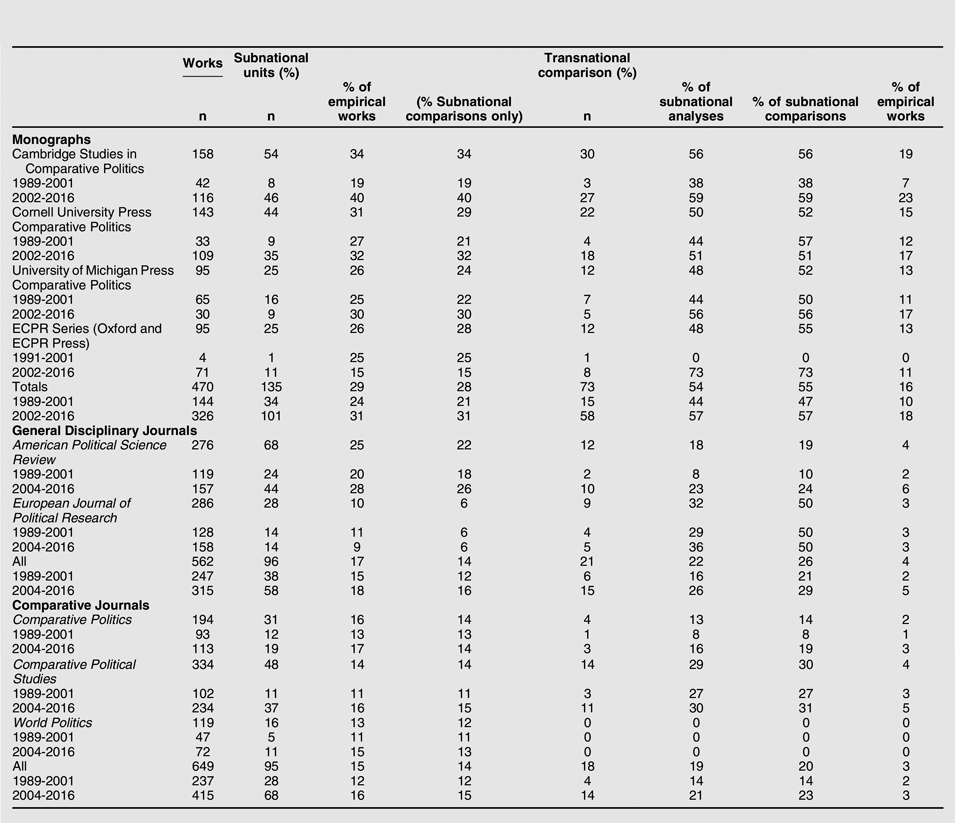
The overall sample demonstrates both a clear and convergent overall trend toward subnational analysis, and a corresponding extension of subnational comparisons across borders (refer to table 1). After 2001, 31% of empirical monographs in the subfield included comparison of territorially delimited subnational units, an increase of ten percent over 1989–2001. Well over half (57%) of monographs that analyzed subnational units, 13% more than during 1989–2001, also compared cases in more than one country. Two of the three leading journals in comparative politics manifested parallel, if less pronounced trends. After 2001, studies that included subnational territorial units increased from 11–13% to 15–17% of the total in each journal. Cross-border comparisons increased from 27% to 31% of subnational comparisons in Comparative Political Studies, and from 8% to 19% in Comparative Politics. Only in World Politics did comparisons with subnational units of analysis remain confined entirely to a single country. The parallel sample from the American Political Science Review reflected a long tradition of work on U.S. state and local politics as well as Congressional district-level studies. In 2004–2016, however, the proportion of articles in the APSR with subnational comparisons increased from 18 to 26% relative to the previous period. Transnational comparisons also grew from 8% to 23% of subnational analyses, and by a similar percentage among those that employed comparison. After 2001, 6% of all empirical articles in the APSR, a slightly larger proportion than in any of the comparative subfield journals, included transnational comparisons. At the European Journal of Political Research (EJPR) subnational units played a role in only 9-11% of empirical articles, but fully half of subnational comparative articles included cases from more than one country.
Subnational comparison in political science journals and monographs, 1989–2016

In four of the five leading monographic series and four of the five leading journals, subnational comparison has grown. Subnational analyses have illuminated a remarkable range of topics: legislator-constituent relations, policy implementation, clientelist brokerage, local and regional governance, party competition, prison governance, local public goods provision, social movement mobilization, and civil war. As comparative subnational research has grown, so has transnational comparison. Many domains of subnational work now include comparisons that cross borders.
In a global political order still dominated by nation-states, comparison between countries can be critical to rigorous subnational comparison. What transnational comparison can contribute, and when it should be undertaken, depend on a broader question that is as much ontological as it is methodological—how to address the nation-state in a nested subnational comparison.
The Nation-State as Problem and Opportunity for Subnational Comparison
Both the possibilities and the limits of subnational comparison hinge on the pervasive presence of national institutions, polities, economies, societies, and cultures in much of politics. For at least the last two centuries, no other organization has furnished more of the context for political life than countries themselves. Within a single country, subnational comparison takes advantage of this context to frame a controlled comparison. Confining the scope of comparison in this way, however, also limits its utility. Transnational comparison, by grappling directly with variation between countries as well as within them, can overcome these limitations. Despite the numerous additional challenges it poses for theory, testing, and inference, it can ultimately yield more accurate and reliable conclusions than comparison within a single country, or between whole countries.
Research on democratic regimes has increasingly reflected these challenges. As mid-twentieth-century professional political science began to grapple with the empirical reality of regimes, the centuries-old dominance of the nation-state as a form of polity made it the obvious first focus for comparative analysis. Recent comparative subnational assessments often show wide regional diversity in electoral competition, civil liberties, and democratic responsiveness. Explanations of these variations point to a variety of sources at the subnational scale, such as the suppression of electoral competition, the power and unity of regional elites, and the development of regional rentier states.Footnote 17 Horizontal dynamics like diffusion and lateral relationships among units, can influence the trajectories of subnational regimes.Footnote 18 Studies at a local scale also point to social practices within firms, communities, or even households as significant for the realities of democracy.Footnote 19 Even micro-scale effects like these can ultimately be a consequence of transnational influences, like the regional investment of colonial missionaries in education.Footnote 20
The same line of comparative scholarship that has demonstrated these disaggregated influences and outcomes has also confirmed the importance of national influences on subnational democracy. In a democratic national regime, as Gibson and Giraudy show, authoritarian regional elites can survive by gaining power within national governing coalitions, and by marginalizing local competition.Footnote 21 The spatially distributed territorial institutions of a nation-state, including federalism, local government systems, and intergovernmental finance, set much of the terms for what subnational regimes do. National differences can affect not only elites, but also the motivation and behaviors of citizens. In Gervasoni’s theory of rentier subnational regimes, for instance, citizens who owe jobs and other benefits to a subnational government that depends on national revenue tend to be “less autonomous and less demanding.”Footnote 22 In turn, subnational regimes where electoral fraud or clientelism hold sway can tilt the balance of power toward authoritarianism in a national political regime.Footnote 23 Subnational democratization can pave the way for consolidated democracy at the national level.
The trend toward disaggregated analysis in this central domain of comparative research reflects shifts under way on topics from political economy to party competition, and in both quantitative and qualitative research. Even as politics at the subnational scale has been shown to matter greatly, national factors remain a pervasive, potentially decisive influence. Although regressions of national aggregate data can rarely capture these multilevel influences sufficiently, they pose challenges even for subnational analyses. Beyond the context of national institutions and cultures, disaggregated analyses within countries must also grapple with an especially acute version of the dependence among observations that is often referred to as Galton’s problem.Footnote 24 Territorial units within a country are immersed in too many common influences, and are too interconnected to each other to be considered fully independent. Dynamics of diffusion and relationships among subnational units within a country constrain the independence of those units as cases. The problem of spatial dependency long identified by geographers represents one dimension of this problem. As Harbers and Ingram note, “Protest, democracy, voting, violence and policies” all tend to spread among spatially proximate units.Footnote 25 Although the “geo-nested analysis” they advocate can introduce geographically weighted terms to take account of this interdependence, those terms may themselves differ by country. National and subnational influences shape each other through time in ways that make each partly endogenous to the other.Footnote 26 If the constitutional rules of federalism set the terms for policymaking within subnational units today, the rules of federalism may themselves have emerged from the influences of the same subnational units.
In the study of regimes, like other domains of politics, the single-country subnational comparison recommended by Linz and de Miguel has emerged as one response to these compounded problems.Footnote 27 Restricting the analysis of variation to the units within a single country offers a way to control for the common institutions, societal conditions, and cultural influences that distinguish that country from others.Footnote 28 The literature on subnational comparison has pointed out numerous methodological advantages for this approach over one that employs the country as an aggregated unit of analysis.Footnote 29 It increases the number of observations; enables more precise concepts and measures than at the aggregated national scale; allows more attention to variables and processes that are spatially uneven within countries; permits closer attention to dynamics and relationships at the micro-level of individuals, households, firms, and communities; and ultimately offers deepened insight into the sources and dynamics of national politics. The wide, multidimensional variations among U.S. cities, states, and Congressional districts, as well as the large numbers of units, have made subnational comparison central to research on politics there. Subnational work on large, diverse developing countries like India and China has increasingly exploited similar analytical advantages.Footnote 30
At the same time, Linz and de Miguel and other exponents of subnational comparison have recommended comparison between units within different countries as an accompaniment to subnational comparison within a country.Footnote 31 The literature on subnational authoritarianism and democracy offers numerous examples of the advantages this move can bring. For researchers whose questions center on national politics, it enables comparison of how subnational and national factors interact, how national contexts influence subnational variations, and how national factors play out in similar subnational contexts. For researchers focused on subnational units themselves, it offers opportunities to replicate subnational findings from one country in another, to analyze subnational politics under different national conditions, to compare aggregate properties of subnational politics among countries, and to understand broad cross-national commonalities at the subnational scale. Transnational comparison can be indispensable to the analysis of phenomena that connect subnational settings in different countries, such as migrant networks, investment flows, and production networks. In addition to multiplying numbers of observations, moreover, transnational designs can extend comparison to types of cases in another country that are not available in the first.Footnote 32
The development of experimental methods in the social sciences has refined an increasingly sophisticated set of tools for thinking through the logics of transnational comparison. As advocates of subnational comparison have long recognized, the many resemblances among the subnational settings of different countries offer opportunities to compare national variations in matching (or similar) contexts. Rubin, elaborating on Mill’s logics of comparison, has demonstrated how a comparison of cases matched for prior similarities can approximate the controls of an experimental test.Footnote 33 A variety of software now offer statistical tools for selecting matched cases for either qualitative or quantitative comparison.Footnote 34
The related experimental technique of blocking can also strengthen inferences from transnational comparison. In a randomized block design, subjects are divided randomly into subgroups or “discrete natural blocks” subject to different conditions that might affect the results.Footnote 35 A blocked experiment administers the same test among otherwise identical samples of males and females, for instance, or among agricultural plots with different soil composition or sun exposure. By controlling for the contrasting conditions of different blocks, blocking reduces the variance to be explained to the amount within each block. Blocking by countries offers similar advantages for observational studies. Parallel regressions in paired countries, for instance, can analyze common subnational patterns in each country as well as the variations between them.Footnote 36
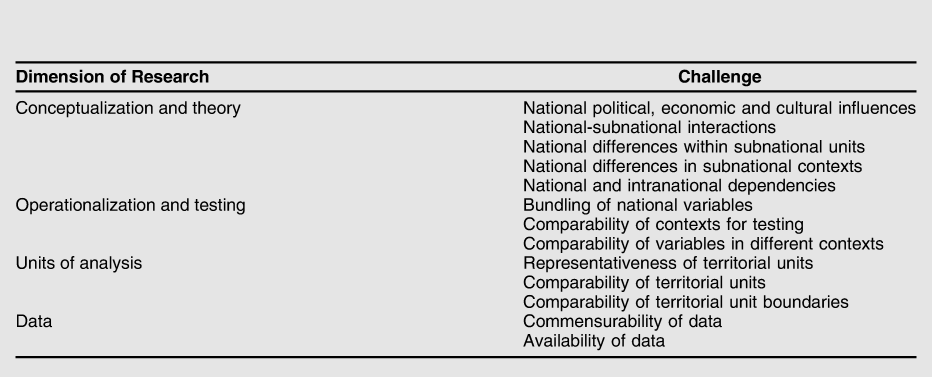
A full understanding of the advantages from transnational comparison requires recognition of the consequential challenges it poses (table 2). At a conceptual and theoretical level, nested comparison brings an added layer of analytical complexity and potential confounds to a comparative subnational design. The national settings that subnational comparison within a single country employs as a control, and that traditional comparative designs take as their main focus, serve in a transnational comparison as one component in what amounts to a multi-level framework. Along with the challenges to inference from variations within each country, the researcher must grapple with national differences in institutions, history, economies, and cultures, and often the further dimension of the international, systemic context. Galton’s problem becomes a matter of sorting out both cross-national and within- nation interdependence over time. Spatially dependent effects may also diverge between countries.
Challenges in comparison of subnational units between countries

By comparison with subnational units, countries frequently offer limited possibilities for controlled case selection and analysis. Subnational disaggregation makes hundreds or even thousands of units available to compare gradations of variation in voting behavior, income, ethnic composition, and economic conditions. A country bundles together extensive institutional, societal, and cultural commonalities that often have been reinforced over long histories. National institutions like party systems, electoral laws, interest representation, and decentralization, as country comparisons often demonstrate,Footnote 37 differ in interrelated ways. Countries therefore are less amenable than subnational units to designs built around specific variables, let alone a natural experiment with a specific treatment. Analysis of subnational differences between countries requires close attention to potential confounds.
A multilevel comparative framework also compounds the well-known problem of functional equivalence among units of analysis in different national systems.Footnote 38 Alongside equivalence among subnational units themselves, a research design that explicitly incorporates the subnational level often raises the question of the representativeness of those units relative to the national level. How does one know, for instance, that the predemocratic politics of the late nineteenth century in Hamburg and Stockholm were representative of national political tendencies in Germany, on the one hand, and Sweden on the other?Footnote 39 Treating subnational analysis as a “within-case” encompassing comparison answers this challenge by analyzing aggregate patterns among the entire universe of subnational cases in each country.Footnote 40 A comparative focus on subnational units themselves offers another way to address this issue. When the analysis focuses on individual subnational cases, inferences need not be extended to conclusions about an entire country. Comparative designs along these lines incorporate aspects of the national context into attributes of subnational cases,Footnote 41 or select cases for analysis based on combinations of variables at both levels.Footnote 42
Differences between national settings often pose further challenges for theory specification and testing. Similarities among subnational units in different countries, for instance, may be consequences of either common national influences, or of similarities at the subnational scale itself. Markedly different processes or domains of politics within two different countries may offer the most comparable equivalents for transnational theory and testing. The brokerage politics that Stokes et al. analyze for national-party rewards to marginal electoral districts, for instance, occur in diverse functional domains in different countries.Footnote 43 In Mexico, national party leaders rely on PRONASOL, an umbrella program that accounts for diverse social services and infrastructure; in India, they utilize discretionary spending in general; in Venezuela, locally targeted slots in national education programs; in Argentina, infrastructure and general budget funds. By the same token, similar subnational variations can also have strikingly different consequences in divergent national contexts. Although business representatives exert strong influence in urban decision making in both the Nordic countries and the United States, for instance, that influence is linked to corporatist representation and Social Democratic welfare state services in one setting, and predominantly neoliberal economic development agendas in the other.Footnote 44 Finally, the need for commensurate subnational data in different countries remains one of the enduring practical obstacles for comparison across borders. Only in rare cases, notably within the European Union, can researchers draw on official data and subnational unit definitions that have been reconciled between countries.
These challenges can make transnational comparison more demanding than either comparison within a single country or comparison of whole countries. As a practical matter, transnational research often requires cumulative or “spiraling” research programs.Footnote 45 Collaboration and common research protocols as well as metastudies have an especially important role to play. Overcoming the challenges has increasingly opened up new possibilities for more sophisticated, more powerful comparative designs.
Varieties of Transnational Comparative Strategies
Transnational comparison requires a more complex understanding of comparative design than the alternatives first discussed by Mill or by Teune and Przeworski.Footnote 46 Rather than focus on a single level, a nested approach to comparison requires simultaneous attention to similarity and difference among national units on the one hand, and among subnational units on the other. Political scientists have increasingly exploited this added complexity to extend development and testing of hypotheses beyond what is possible at the national scale, or within a single country. In doing so, they face a choice between several analytically distinct approaches. Each possesses distinctive advantages and disadvantages, and is better suited to addressing some questions, issues, and methods than others. Understanding the properties of each approach is critical not only to choosing among them, but to recognizing their many complementarities. Research programs that deploy more than one approach, whether within the same project or in a cumulative sequence of studies, can take the fullest advantage of this analytical toolbox.
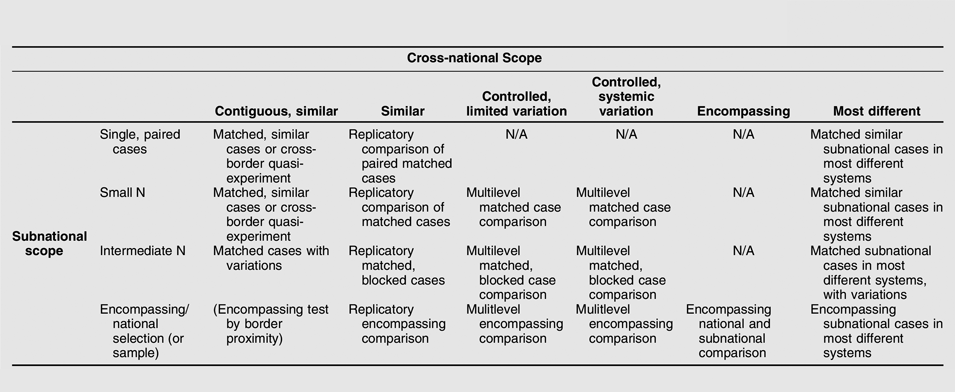
From Mill’s methods of similarity and difference, the scope of variation among cases to be compared has served as a benchmark for classification of approaches to comparison. The alternatives for transnational comparison can be mapped in a two-dimensional matrix that captures the variation between countries on one axis, and between subnational cases within countries on the other (table 3). At both the national and the subnational levels, the alternatives extend from a single case to a controlled selection of cases, and ultimately to an encompassing selection. Each type of transnational design depends on a distinctive strategy to select cases at both the national and the subnational scale. The alternative ways that national and subnational variations can combine largely transcend the divide between quantitative and qualitative research. A crucial consideration is the level of analysis in the main substantive theories of interest. Whether the main research question focuses on the subnational level, on the national level, on the relationship between levels, or on transnational actors and processes can be decisive for which cases it is best to compare.
Dimensions of case selection in transnational comparative designs

Note: Table excludes both single-country controlled comparison, and comparison in relation to transnational phenomena.
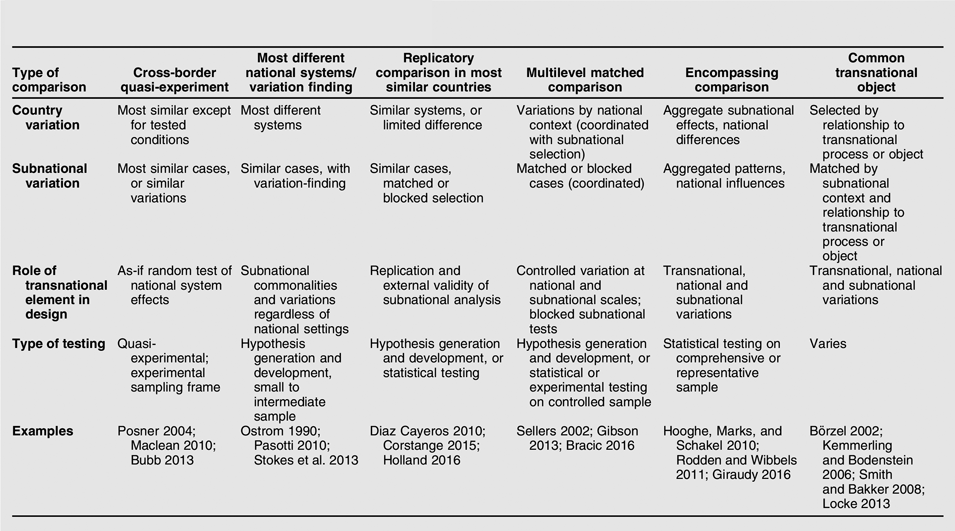
In what follows, drawing on a range of exemplary studies, I examine the distinguishing features of several distinct strategies highlighted in table 4, the uses to which they are best suited, and their limitations. I conclude with a discussion of how cumulative comparative research programs can draw on complementarities and synergies among these strategies.
Types of transnational comparative designs

Quasi-Experimental Cross-Border Designs
One well-known type of nested comparative design employs contiguous subnational settings on opposite sides of a country border to frame a controlled test of national differences.Footnote 47 By holding the conditions of regions on both sides of a border constant, a contiguous cross-border comparison can focus analysis on national differences and their consequences. When the border can be taken as an arbitrary, exogenous treatment, like a colonial border imposed from outside, it can even serve as a randomized experimental treatment. Natural experiments across borders offer opportunities for an especially rigorous form of transnational comparison, but one that remains rare. In the absence of random treatment, cross-border comparison still offers a way to limit subnational variation by matching subnational cases in different countries. Regression discontinuity designs can also analyze larger numbers of subnational cases statistically to test the difference that proximity to a country border makes.Footnote 48
Lipset employed an early comparison along these lines in his mid-century study of agrarian socialism in Saskatchewan. To analyze the difference that national political developments in Canada made, he briefly compared movements there with contemporaneous ones in North Dakota under the New Deal.Footnote 49 In Posner’s study of Chewa and Tumbuka ethnic groups in adjoining regions of Zambia and Malawi, he elaborated an explicit case for cross-border comparison as a natural experiment.Footnote 50 The presence of groups with identical ethnicities living in proximity within both countries set up a controlled test of the effects of distinct national contexts on ethnic relations. In Malawi the Chewa and Tumbuka are bitter political enemies. In neighboring Zambia, they tend to set aside their differences or even form alliances. Posner traced the difference to how the dominant position of both groups in Malawi politics makes them rivals for national power. In Zambia, where each group made up a much smaller proportion of the population, their common interests in the wider political system were more salient than their cultural differences. Relations between Chewas and Tumbukas in contiguous, similar regions with similar ratios of the two groups thus served as a natural experimental test of effects from the divergent composition of the two groups in national politics. As McCauley and Posner’s assessment of this method concludes, an as-if random border design depends not only on equal contexts on both sides, but on a border that can be taken as accidental, and on an absence of sorting across that border.Footnote 51
Even short of these conditions for a natural experiment, similar, adjacent border regions can serve as a partial control that enables comparative analysis to focus on national institutional, political and cultural differences. In Maclean’s study of social reciprocity and its sources in neighboring regions of Ghana and the Ivory Coast, for instance, cross-border divergences furnish the starting point for a historical analysis of contrasts between regional experiences of colonization and nation-building.Footnote 52 In the developed world, longstanding transnational relations across borders further confound any approximation to randomized treatment. Adjacent border regions there have nonetheless facilitated controlled selection of sites for Bracic’s comparative experiments, and helped frame Zuberi’s comparison of the difference that unions and social policies make for working conditions in U.S. and Canadian workplaces.Footnote 53
Studies of contiguous border regions like these point toward a much larger universe of possibilities for matching subnational cases between countries, along the lines of other multilevel comparative strategies. Although adjacency can help control for unobserved confounds, it does not by itself suffice to establish a match between two adjacent border regions. Similar conditions must also hold in each region, independent of diffusion or interdependencies between them.Footnote 54 To best approximate a quasi-experimental logic, cross border tests should focus on limited differences between otherwise similar countries. The national differences to be tested must be present in the two regions themselves. Although contrasts in national political culture (Posner) or in policies as implemented (Zuberi) can be tested in this way, these numerous demands have made cross-border matching a relatively rare strategy of transnational comparison.
Matched Subnational Cases in “Most Different” National Systems
A second type of transnational comparison draws on similar cases from throughout the universe of national contexts to examine a common subnational problem or process. In the terms of Przeworski and Teune,Footnote 55 this type situates “most similar case” comparison at the subnational level within a “most different” selection of national contexts. Such a comparison enables an inference that similar subnational variations are present regardless of national differences. Within such a design, controlled case selection at the subnational level also offers an opportunity for what Tilly has termed “variation-finding” comparison among subnational cases.Footnote 56 This design is particularly well-suited to theories and hypotheses focused on the subnational level itself. Useful for generating and validating hypotheses, or for synthesizing findings from a line of primary research, it is less conducive to quantitative hypothesis testing or scrutiny of national effects.
Research on subnational democracy and authoritarianism demonstrates several ways this type of comparison has been employed. Stokes et al. draw on a vast body of research from a wide range of times and places to elaborate and test a theory of clientelist brokers and their relationship with voters.Footnote 57 Alongside a large secondary literature and other data, the tests employ original surveys in selected regions of Argentina, India, and Venezuela, and historical data from Great Britain and the United States. Other comparisons in this vein, such as Sidel’s analysis of local economic sources of subnational authoritarianism,Footnote 58 take the form of metastudies that draw on secondary literature from multiple world regions. Others, such as Ostrom’s study of governance arrangements for common pool resources management,Footnote 59 or Pasotti’s comparison of political branding in matched cities of the United States (Chicago), Italy (Naples), and Colombia (Bogotà),Footnote 60 take the form of subnational case studies in highly disparate settings.
Ostrom’s Nobel Prize-winning research, focused sharply on a particular set of local participatory practices in a clearly delimited set of cases, demonstrates the potential of such a design. Drawing on an extensive research program that began with a dissertation on water management in southern California, Ostrom assembled a sample of 14 cases of common pool resource management in a stunning variety of geographic settings. The cases were located in regions around the world—Switzerland, Spain, Turkey, Sri Lanka, the Philippines, Japan—and situated as back as far as the Middle Ages in time. Case selection thus served to demonstrate the universality of the common pool resource problem and the common dilemmas inherent in arrangements to address it. Against this broad, diverse array of contexts, Ostrom’s cases also varied in the robustness of institutions to manage the resources (the dependent variable), and in the permutations of the 15 design principles that Ostrom contended were decisive for sustaining institutions for common pool resource management. In the six cases with robust arrangements, all the design principles were generally present. In the eight cases with fragile or failed institutions, various combinations of those principles were absent. Process tracing analyzed how the failure to apply those principles contributed to the fragility of common pool resource management.
In one sense, comparative studies in this vein offer the broadest empirical basis of any form of transnational design for generalized inference about theories centered at the subnational scale.Footnote 61 National contexts selected for theoretically important dimensions of difference can reinforce such an inference. For Ostrom, for instance, the central research question was whether self-governance within communities could provide an alternative to states or markets. The cases included communities beyond established national state or market orders as well as within them, and in developed as well as less developed economies. Community arrangements that predated modern states and capitalism in the North, such as the common meadows of Switzerland, and that persisted in weak states, like the water management of the colonial Philippines, reinforced the generality of the argument. So did the success of common pool arrangements in the developing country of the Philippines, and their failure in early twentieth century California.
The wide contrasts between countries that serve to define this comparative strategy can also impede inference. Other comparativists, for instance, have criticized Ostom’s analysis for leaving macro-level factors like state-building and democratization virtually unmentioned.Footnote 62 It remains difficult to see how her analysis could have incorporated controls for these differences without quickly becoming unwieldy. Although the surveys and other evidence employed in Stokes et al. employed variations within each country effectively, their analysis also served more to confirm a general model of brokerage than to test variations between countries. The need to select and analyze subnational cases in diverse, multiple, and divergent contexts poses a further challenge for this strategy. Comparisons between world regions, developed and developing countries, or historical eras must surmount compound difficulties of unit definition, variable specification and commensurable data. Most such comparisons have aimed to generate theories rather than test them fully (Ostrom, Pasotti), or have drawn on metastudies of an entire program of fully contextualized primary research (Sidel, Stokes et al.).
Replicatory Subnational Comparison in Similar National Systems
Another type of transnational comparison confronts the problem of external validity directly. Consistent with the widely recognized need for replication in political science,Footnote 63 a replicatory comparison undertakes side-by-side reproduction of a subnational case study or comparison in one or more additional countries. Replicatory tests can confirm that “the findings reflect systematic political processes rather than a country-specific luck of the draw.”Footnote 64 Different findings in a second country can help to define the scope conditions of results from the first. Replication can be extended to various levels, and in a broad sense is part of any transnational comparison. A comparison designed primarily around this aim, however, depends on both matched subnational cases within each country, and relatively similar national settings. At a minimum, it requires sufficient resemblances at both levels to assure parallel subnational tests. It can be compatible with either case studies or quantitative designs, and with limited national variations.
Studies in a variety of world regions offer recent examples of this strategy. Holland’s article on forbearance in legal enforcement in Latin America, for instance, focused on the politics of local regulatory policy toward street vendors in Santiago, Chile, and a paired comparison of local enforcement against urban squatters in Lima, Peru, and Bogotá, Colombia.Footnote 65 The resemblances among these cities made them more similar contexts for the study of local regulatory enforcement than any of them would have been to another city in their respective countries. All were “capital cities of fewer than ten million inhabitants in unitary political systems” with “roughly similar populations” and similar urban poverty rates.Footnote 66 Similar patterns of politically motivated forbearance in the distinct domains of street-vendor regulation and informal housing as well as three different countries provided decisive support for the generality of her theory.
Among comparative studies of subnational regimes, McMann’s comparison of paired regions in Russia and Kyrgyzstan employs a similar logic in what amounts to a blocked case comparison within each country.Footnote 67 In each country, she selects two adjoining regions that resemble each other in levels of development and other social and economic characteristics, but differ in their level of democracy. Parallel metrics and qualitative data collection in both pairs of regions link the higher levels of political engagement and activism in both countries to opportunities for employment beyond the reach of the state, either in private or foreign firms. Corstange’s analysis of ethnic clientelism in Lebanon and Yemen demonstrates how blocking can enhance a quantitative replicatory design.Footnote 68 His theory of ethnic monopsony predicted that dominant ethnic parties had fewer incentives than competing ethnic brokers to provide material goods for their political clienteles. His quantitative tests analyzed survey responses among matched samples of communities blocked by country. Replication confirmed the theory as a general account of clientelist politics in the Middle East, and established its relevance for the many other countries where clientelism and ethnicity dominate politics.
Replicatory transnational comparison can thus provide critical evidence that a subnational finding holds beyond the context of a particular country. It need not take the form of a full replication. More circumscribed analysis of cases in other countries can also reinforce the findings from an initial comparison within one country.Footnote 69 The persuasiveness of a replicatory design depends on the matching of subnational cases between countries, on the one hand, and the relative similarity among national settings on the other. At the least, the countries selected should share critical properties to test the theory. In McMann’s comparison of subnational democracy in Russia and Kyrgyzstan, the two countries shared legacies of post-Soviet transition in the economy and the political system as well as unconsolidated national democratic regimes. In Holland’s intercity comparison and Corstange’s comparison of ethnic influences on clientelism, the similar cultural heritages and histories of the same world region imposed a similar control. The bundled variations that typify even relatively similar countries pose potential confounds for a replicatory design. A design to test those differences explicitly introduces an analytically distinct, but sometimes complementary strategy of transnational comparison.
Multilevel Matched Comparison
This further variant employs comparison to test both national and subnational differences. Multilevel matched comparison, going beyond replication, incorporates variations between both national and subnational settings as an explicit object of comparative design. Comparison serves not just to test whether subnational findings hold in a different national setting, but to carry out a controlled examination of how both national contexts and subnational politics matter. Like replicatory subnational comparison, this design can help frame comparative field experiments, parallel subnational case studies, or quantitative analyses. Regardless of the specific method, the object of comparison is to leverage national as well as subnational variation. Multilevel matched comparison offers a design to address subnational politics in countries that differ significantly, but along dimensions that offer a tractable basis for comparative analysis. At the subnational level, it extends matching beyond paired border regions to controlled case selection in each country.Footnote 70 It is particularly well suited to examine combinations of national and subnational differences, interactions between national and subnational politics, or theories of subnational politics that hinge on national conditions.
Suggested by such early advocates of subnational comparison as O’Donnell and Linz, multilevel matched comparison found a pioneering application in Andersen’s study of policy toward declining manufacturing regions in pre-1989 Great Britain and West Germany.Footnote 71 Gibson’s analysis of how subnational authoritarian regimes survived in three federal democracies exemplifies how this type of comparison can illuminate the politics of subnational regimes.Footnote 72 Gibson developed a theory of boundary control through analysis of the case of the U.S. Solid South during Reconstruction and thereafter. The theory focused on how subnational authoritarian regimes can resist democratizing influences from the central state, on the one hand, and from local political challenges on the other. Since the theory emphasized national regimes and federal structures as well as politics within a subnational regime, tests of the theory required examination of subnational regimes in national democratic regimes with more and less centralized federal institutions. In the decentralized federal state of Argentina, and the more centralized federal state of Mexico, he selected comparable cases to analyze similarities and differences in subnational authoritarian survival. In Argentina, case studies of four regions revealed the alternative strategies subnational authoritarian regimes had employed to maintain power in the wake of national democratization. In the matched case study of Oaxaca in Mexico, similar dynamics in the early phases of national democratization gave way to democratizing pressures both from local party competition and from influences of the national state. Multilevel matched comparison enabled the analysis to focus on how both national centralization and the subnational regime strategies themselves mattered for sustaining the subnational regime.
Such a comparison often incorporates an element of replication into a multilevel analytical framework. Unlike a purely replicatory comparison, a multilevel matched design frames national differences as sources of variables to be tested. Gibson’s comparison, for instance, confirms that the general analytical framework of the theory travels well between the distinct national and historical contexts of the nineteenth-century U.S. and late twentieth-century Latin America. The monographic version of Holland’s comparison of Latin American urban politics analyzes how different national electoral systems and social policy regimes contributed to differences in forbearance.Footnote 73 Convincing multilevel comparative designs often depend on relatively circumscribed variations between countries, like the commonalities among federal democracies in Gibson’s study, or the similarities among the South American democracies in Holland’s.
The logic of blocking can also enhance multilevel matched designs. As Bracic’s recent study of attitudes toward human rights in Central Europe demonstrates, national differences can furnish one treatment in a blocked field experiment.Footnote 74 She employed trust games among randomized samples of residents in three towns as a comparative experimental test of citizen discrimination against the Roma population. As sites, she selected two matched towns near the border in Slovenia, and a third across the border in Croatia. Since Slovenia was undergoing accession to the EU, where human rights norms comprised one condition for membership, the matched settings offered a controlled test of EU norms. Blocked comparative nested designs can also strengthen inference from observational studies. Sellers’ comparison of the consequences for urban business power from the development of a postindustrial economy, for instance, employed parallel subnational comparisons among a total of eleven matched cities in three advanced industrial democracies. The country settings (France, Germany, and the United States) encompassed the principal variants of national capitalist institutions as well as local government systems.Footnote 75 Comparison revealed common variations between service and manufacturing cities in all three countries, but also divergences linked to corporatist institutions in Germany, statism in France, and liberal capitalism in the United States.
Multilevel matched comparison offers a way to fill the gap between transnational designs that depend on maximizing the similarities between countries, and those that depend on “most different” country designs. Multilevel matched comparison can leverage the greater precision of subnational comparison in ways that help to unbundle the nation-state as a unit of comparison. It also poses distinctive challenges. Finding the best units to match often necessitates comparison of the universe of available units within each country, as well as functional equivalence among units and common dimensions of subnational variation in different countries. Confounds from bundled variation at the national level pose an especially acute problem. To mitigate it, multilevel designs have usually focused more on broad systemic contrasts (regime types, capitalism, centralization) than on particular institutions. Even a successful transnational comparison of matched subnational cases, moreover, may not provide a definitive picture of how overall patterns of subnational politics compare. Since subnational authoritarian regimes were more frequent and survived longer in Argentina than in Mexico, for instance, Gibson’s matched case studies of those regimes that persisted in the two countries were more representative of the former than the latter.
Encompassing Subnational Comparison
In American politics as well as comparative politics, comprehensive coverage of all subnational units within a country has frequently been considered a benchmark for systematic case selection. In transnational comparison as well, taking all the cases offers a way to aggregate patterns of subnational politics and assess national influences on them that lies beyond the reach of nested matched comparison. Although Rokkan’s conceptual maps of Europe demonstrated its potential for qualitative hypothesis generation,Footnote 76 recent encompassing comparisons have generally employed quantitative methods in the service of hypothesis testing. Only in a few countries, such as Argentina and Mexico, has work on subnational regimes developed fully commensurate metrics for this form of comparison between countries. In other domains, such as the nationalization of party competition,Footnote 77 the operation of multilevel electoral politics,Footnote 78 local business/government relations,Footnote 79 and varieties of regional governmental authority,Footnote 80 encompassing subnational comparisons of units from increasingly large samples of countries have begun to demonstrate their value. Encompassing transnational comparison, however, introduces its own set of challenges to inference beyond those often pointed out for statistical comparisons in general. The nature of those challenges, and the means to address them, differ with the principal analytical focus of comparison.
Beyond the limits of regression that have led many methodologists to recommend case studies or quasi-experimental designs as ways to address causal mechanisms,Footnote 81 encompassing comparisons must also address the likelihood that the universe of units in each national setting will differ in ways that can confound inference. Underlying geospatial differences within countries in regional economies, urbanization patterns, and subnational regime features rarely correspond entirely. “Regions of exception” in each country may diverge in idiosyncratic ways from the main patterns of subnational variation.Footnote 82 National metropoles, global cities, and ethnic, culturally or administratively distinct regions can also skew encompassing tests. Numbers of subnational cases that differ by orders of magnitude can limit the comparability of statistical tests.Footnote 83 Heterogeneity in the definition of subnational units further complicates the possibilities for inference. Comparisons between the politics of inequality within cities, for instance, must take account of the difference between urban jurisdictions that encompass entire metropolitan regions, as in Canada, and those that remain limited to urban centers, like France and the United States.Footnote 84
The response to these challenges depends on the scale of aggregation in question. For an analysis focused on aggregate patterns of subnational variation regardless of country, heterogeneous variations in the subnational units of different countries need not pose a problem. In Abramson and Carter’s study of border claims in Europe, for instance, uniform geographic units derived from a spatial grid enabled a long-run aggregate analysis of assertions of state territorial authority across the continent.Footnote 85 In a quantitative analysis focused on variables at the subnational level, however, even the statistical models that have been developed to analyze multilevel, clustered variationFootnote 86 may be insufficient to balance the characteristics of subnational units sufficiently to approximate a quasi-experimental test. When Ritter and Conrad employed rainfall totals as an instrumental variable to test the effects of crackdowns on protest in the subnational regions of Africa,Footnote 87 they faced a challenge of this sort. To assure comparable distribution between the control and treatment groups of regional observations, they rebalanced the samples by levels of urbanization and other variables.
When the main variables of interest lie in national governments or contexts, or in interactions between subnational and national levels, the possibilities for quasi-experimental inference are more limited. One response has been to stratify encompassing analysis of subnational cases by country. Giraudy, for example, employs separate regressions of subnational regime determinants and their consequences for Argentina and for Mexico. Such an approach yields coefficients and significance tests for comparison, but only a partial account of subnational commonalities and often limited statistical power. With commensurable data, and a sufficiently large number of countries to permit statistical inference at the national level, pooled multilevel analyses offer a more encompassing alternative.Footnote 88 Without some equivalent to the representative sampling techniques developed for cross-national surveys, however, a pooled analysis also remains subject to inferential challenges from imbalanced samples as well as interdependencies and heterogeneity among the observations within countries.
Encompassing comparison is indispensable to understanding the aggregate properties of subnational units and national systems, and to testing the causes and consequences of subnational variation. The difficulties this type of comparison imposes for inference have led researchers to modify or supplement encompassing designs. To compare processes of subnational authoritarian regime maintenance, for instance, Giraudy employed paired cases of regime reproduction from above and below in both Argentina and Mexico. Corstange matched an encompassing sample of Lebanese localities to a random selection of Yemeni communities with similar patterns of urbanization and ethnic composition.Footnote 89 Other encompassing studies have restricted comparison to specific, matched type of units within each country, such as cities of a certain size, or localities within similar metropolitan regions.Footnote 90
Comparison of Relationships with Transnational Phenomena or Processes
In a final type of transnational comparison, the main focus shifts to phenomena or processes that themselves cross borders. From international organizations to production and supply networks to migrant flows to disaster relief initiatives, transnational processes and influences have increasingly been recognized as a frontier of comparative research. Lankina and Getachew’s analyses of the effects from European Union (EU) projects in Russian regions, and from British colonial legacies in post-colonial Indian states,Footnote 91 have placed such influences on the agenda for understanding subnational democracy. Transnational influences have given rise to expansive theories of a “placeless” or post-territorial society beyond the ambit of countries, or even of physical geography itself.Footnote 92 As objects of empirical research, however, processes, objects, and personal biographies that cross borders often require investigation in multiple specific physical locations.Footnote 93 Territorial unevenness within countries is characteristic of many transnational phenomena. Lankina and Getachew demonstrate how the controls for country inherent in single-country subnational designs can focus encompassing statistical analysis and case study selection on uneven effects from an external influence. Such an approach models these influences as exogenous effects to be sorted out from other, purely domestic influences. The more the transnational phenomenon itself becomes the central focus of comparison, the more comparative analysis must shift the focus to the organizations, actors and processes that transmit these influences between countries.
A transnational focus presents two distinctive additional challenges for comparative design. One of these, common to most such analyses, is to account for any relationship between transnational phenomena and the subnational social and economic settings they link. For multisite ethnographic studies of transnational migrant networks and citizenship, this has meant in-depth interviews and observation of the social and community conditions that have fostered and maintained those networks, and the effects within the communities on both sides of the border.Footnote 94 Comparative studies of foreign investment and related influences have often focused on the impacts from transnational influences within developing-country settings. In Locke’s research on transnational supply chains and their consequences for labor standards,Footnote 95 he obtained encompassing data from internal company plant audits within multiple companies. This data enabled quantitative analysis of the factors at the country, the firm, and the workplace level that contributed to more effective workplace standards in the developing countries where most plants were located. Work on the subnational impacts of the European Union illustrates the wide range of designs available to analyze transnational influences on subnational regions, from paired case studies of matched regions in a new and an established member stateFootnote 96 to quantitative analysis of the distribution of European Structural Funds in an encompassing sample.Footnote 97 With commensurate data in another post-communist country, it is also easy to imagine a replicatory study of Lankina and Getachew’s analysis of EU investment in Russian regions.
A second challenge confronts any analysis that focuses on a transnational process or phenomenon itself. Where potential research sites are not independent but connected to each other, one aim of matching cases should be to find locations that offer evidence onto how the transnational elements at the center of the analysis work. In multisite ethnographic studies of transnational migrant networks, the predominant approach to matching has paired sending localities in one country with the localities that received the same migrants in the other country.Footnote 98 As Mazzucato has pointed out, nested sampling based on matching households or individual subjects within communities that are also matched can generate a more reliable view of how these networks function.Footnote 99 In studies of transnational firms in developing countries, matching of cases has often focused on variations among the developing country settings at the receiving end of corporate investment. Locke, for instance, matched factories in multiple countries through common links to production chains of Nike, Apple, and other international firms. An alternative design for the study of transnational economic influences focuses on cities or other localities where firms locate. In a comparison of how firms with foreign ties clustered within urban regions, for instance, Tsai matched Chinese and Indian cities based on the predominance of international trading firms, high tech firms, and diasporic and cosmopolitan investment in general.Footnote 100
Complementaries Among Designs
As this taxonomy demonstrates, alternative transnational comparative designs offer several analytically distinct ways to compare subnational units in different countries (see table 2). Each alternative draws in different ways on nested comparison to strengthen the possibilities for inference from subnational cases, and to address the challenges of inference from subnational units in different national settings. Cross-border quasi-experimental comparison focuses on limited national differences as treatments. Replicatory comparison uses common patterns of subnational variation to reaffirm findings from one country in another similar country. Multilevel matched comparison draws on both national and subnational variation to test differences and similarities at both scales. Encompassing cross-national subnational comparison offers a way to analyze their aggregate consequences, and provides a basis for fuller testing. Comparison of transnational processes or objects can draw on these other forms, as well as subnational comparison within countries.
As table 3 shows, these six alternatives each entail different variations in the range of cases within and between countries, and can combine in a number of permutations. The logic of a cross-border natural experiment, a strictly replicatory comparison, or a comparison between most-different countries can be combined with a variety of subnational strategies for case selection. Although nested comparisons within encompassing samples of national cases remain rare, encompassing subnational case selection can be integrated with various other strategies of comparison between countries. In between the strategies based mainly on either similarities or differences between countries, table 3 highlights the potential of multilevel matched comparison to illuminate the vast middle range of cross-national variation. With proper attention to the inevitable confounds, subnational units can be analyzed not just among similar countries, or in search of overarching subnational commonalities. Multilevel matched comparison can also illuminate how divergent national systems affect subnational politics. Subnational cases in the developing countries of culturally distinct world regions, or even across the North-South divide, offer the prospect of a new analytical purchase on these large-scale cross-national contrasts.
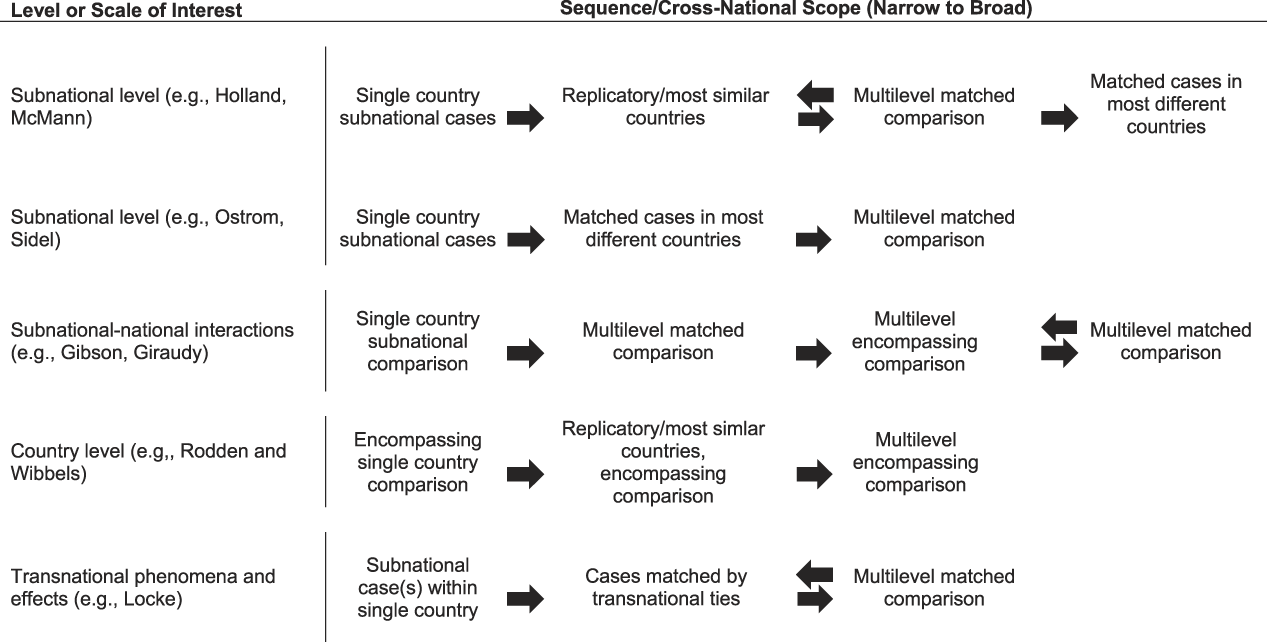
As the studies examined here also demonstrate, the most effective approaches to transnational comparison employ more than one strategy, and integrate them with other methodological tools. Although some of the strategies can directly complement each other in the same analysis, sequential programs of researchFootnote 101 can develop a division of labor that ultimately deploys multiple strategies to maximum effect. As figure 1 illustrates, the optimal sequence depends partly on what level of analysis a research program seeks primarily to analyze. For research focused primarily on the subnational level itself, either a replicatory or a most-different matched comparison could take the first step beyond subnational cases within a single country. Multilevel matched comparison, as studies like Holland’s Reference Holland2017 monograph demonstrate, can build on these initial comparisons to develop analyses of how national contexts matter. In research programs focused more on interactions between subnational and national politics, such as work on subnational authoritarian regimes in democracy, multilevel matched comparison offers a more appropriate first step. Gibson’s pioneering comparison of the United States, Argentina, and Mexico relied primarily on this strategy. Giraudy further advanced and tested the theory with a multilevel mix of encompassing comparison and matched case studies. For programs focused instead on national institutions or aggregated national patterns, such as Rodden and Wibbels’ analysis of politics in federations, encompassing comparisons can be replicated beyond a single country, then expanded to a multilevel analysis. In research on transnational production chains or migrant networks, similar sequential research programs offer a way to scale up comparisons of cases matched by transnational ties. In each of these ways, multiple strategies of nested comparison can furnish part of the larger division of labor to move a transnational research program forward.
Alternative pathways to a transnational research program: Examples
Note: Double arrows indicate complementarities between different types of comparison within the framework of the same analysis.

Conclusion: The Transnational Imperative in Subnational Research
Subnational research has directed growing attention to the territorial unevenness of politics and state-society relations, and the influences at the subnational scale itself that often drive them. Although subnational comparisons within national borders are essential to explain these aspects of politics, a full explanation demands comparative designs that address both national and subnational variations, the relationships between them, and the transnational influences and processes that increasingly play a role in both. In a variety of ways beyond the statistical power of larger numbers of cases with greater variation, transnational comparison extends the analytical reach of controlled comparison. Researchers can employ it to compare subnational politics in different national settings, to replicate subnational findings, to frame controlled tests of national political phenomena, to examine interactions between subnational and national politics, to compare aggregate effects from subnational variations, and to analyze territorially distributed phenomena that do not map squarely onto national borders.
Nested comparative designs like these add a new layer and further analytical possibilities to the traditional Millian logics of comparison. Together, they provide a necessary complement to single-country subnational comparison. Several conditions can still weigh in favor of confining the scope of disaggregated territorial comparison within a single national context: 1) the subnational variation within a country suffices to test the theory or relationships at issue; 2) background variables vary sufficiently to enable tests of alternative theories; 3) for quantitative analysis, the sample size is large enough to enable tests of statistical significance; and 4) the national setting of the subnational tests holds sufficient interest itself. In work on the largest, most territorially diverse countries, including China and India as well as the United States, these conditions continue to sustain a robust line of single-nation subnational comparisons. The practical demands that transnational research imposes, moreover, will continue to require sustained, cumulative and collaborative research programs.
Even for researchers focused on a large, diverse country like the United States, however, transnational comparison offers opportunities for additional insights into the politics of such current questions as legislative district representation, international migration, and climate change policy. The more uneven development, geographic diversity, decentralized policymaking, supranational institutions, and transnational phenomena become regular features of the political landscape, the more subnational and ultimately transnational comparison will be necessary. Along with other forms of disaggregated analysis, these approaches to research promise to extend and deepen our understanding of politics.
Supplementary Materials
Online Appendix
Monograph and Article database (Harvard Dataverse)
To view supplementary material for this article, please visit https://doi.org/10.1017/S1537592718002104