INTRODUCTION
Tuberous sclerosis (TS) is a multisystem genetic disorder with a prevalence of approximately 10/100 000 (O'Callaghan et al. Reference O'Callaghan, Shiell, Osborne and Martyn1998). TS is characterized by hamartomatous growths in multiple organs including the brain, skin, eyes, heart, lungs, and kidneys (Roach et al. Reference Roach, Gomez and Northrup1998; Roach & Sparagana, Reference Roach and Sparagana2004). The central nervous system (CNS) lesions in TS are associated with a range of neurodevelopmental problems that can give rise to substantial morbidity. Such neurodevelopmental problems include intellectual disability (ID), specific learning disabilities, epilepsies [in particular, infantile spasm (IS)] and autism spectrum disorders (ASD) (Asato & Hardan, Reference Asato and Hardan2004). Individuals with TS also show elevated rates of emotional and behavioural problems in both childhood and adulthood (Lewis et al. Reference Lewis, Thomas, Murphy and Sampson2004; Raznahan et al. Reference Raznahan, Joinson, O'Callaghan, Osborne and Bolton2006), although the brain–behaviour links for these latter disorders are poorly understood. Some groups, however, have begun to examine brain mechanisms that might account for the well-documented elevated risk of ASD in TS (Bolton et al. Reference Bolton, Park, Higgins, Griffiths and Pickles2002).
Mutations in one of two genes give rise to TS: the TSC1 gene located at 9q34 (van Slegtenhorst et al. Reference van Slegtenhorst, de Hoogt, Hermans, Nellist, Janssen, Verhoef, Lindhout, van den Ouweland, Halley, Young, Burley, Jeremiah, Woodward, Nahmias, Fox, Ekong, Osborne, Wolfe, Povey, Snell, Cheadle, Jones, Tachataki, Ravine, Sampson, Reeve, Richardson, Wilmer, Munro, Hawkins, Sepp, Ali, Ward, Green, Yates, Kwiatkowska, Henske, Short, Haines, Jozwiak and Kwiatkowski1997) and the TSC2 gene located at 16p13.3 (The European Chromosome 16 Tuberous Sclerosis Consortium, 1993). Approximately two-thirds of cases are due to new mutations, while the rest are inherited in an autosomal dominant fashion. The gene products of TSC1 (hamartin) and TSC2 (tuberin) form a complex that operates in the insulin signalling pathway to regulate cell division, and hence they function as tumour suppressors. The molecular mechanisms linking abnormalities of hamartin and tuberin function to the hamartomatous growths seen in TS are being increasingly well understood (Jozwiak, Reference Jozwiak2006). The ‘two-hit’ model for loss of heterozygosity (Knudson, Reference Knudson1971) accounts well for the variability in expressivity, and is generally supported by histochemical studies of non-CNS hamartomas in TS (Henske et al. Reference Henske, Scheithauer, Short, Wollmann, Nahmias, Hornigold, van Slegtenhorst, Welsh and Kwiatkowski1996). The suitability of this model to explain CNS hamartomas is not yet clear (Jozwiak & Jozwiak, Reference Jozwiak and Jozwiak2005).
The classical CNS lesions in TS are cortical tubers (CTs) and subependymal nodules (SENs). SENs can undergo neoplastic change to subependymal giant cell astrocytomas (Goh et al. Reference Goh, Butler and Thiele2004). CTs have been reported in 82–100% of TS sufferers, and SENs in 64–100% (Ridler et al. Reference Ridler, Suckling, Higgins, Bolton and Bullmore2004). Besides these focal lesions, less discreet dysplasias such as transmantle cortical dysplasia and hemimegalencephaly are seen in TS. More recently, neuroradiologically defined white matter linear migrational streaks and histologically identified heterotopic neuronal aggregates and disrupted cortical architecture have highlighted the importance of viewing TS, at least in part, as a neuromigrational disorder (Vinters et al. Reference Vinters, Kerfoot, Catania, Emelin, Roper and DeClue1998). A recent magnetic resonance imaging (MRI) study using whole-brain computer-assisted morphometry techniques for image analysis revealed widespread grey and white matter deficits in individuals with TS when compared to neurotypicals (Ridler et al. Reference Ridler, Bullmore, De Vries, Suckling, Barker, Meara, Williams and Bolton2001). Intriguingly, some of these deficits have been shown to correlate positively with the degree of memory impairment in this sample (Ridler et al. Reference Ridler, Suckling, Higgins, De Vries, Stephenson, Bolton and Bullmore2007). This finding has implications for our causal models of neuropsychiatric impairment in TS.
The neurodevelopmental outcome of interest in our study is ID. Rates of ID seen in TS have varied among studies, ranging between 80% (Hunt, Reference Hunt1993) and 44% (Joinson et al. Reference Joinson, O'Callaghan, Osborne, Martyn, Harris and Bolton2003). The study by Joinson et al. used an epidemiological sample and measured intellectual function using standardized tests. A bi-modal distribution of intellectual quotient (IQ) was found in TS. Specific cognitive deficits have also been reported in individuals without ID (Harrison et al. Reference Harrison, O'Callaghan, Hancock, Osborne and Bolton1999; De Vries & Bolton, Reference De Vries and Bolton1999).
How are the brain abnormalities in TS related to epilepsy and ID? Associations have been reported between the total number of CTs and both ID (not always quantified by standardized methods) (Roach et al. Reference Roach, Williams and Laster1987; Shepherd et al. Reference Shepherd, Houser and Gomez1995; Goodman et al. Reference Goodman, Lamm, Engel, Shepherd, Houser and Gomez1997; Weber et al. Reference Weber, Egelhoff, McKellop and Franz2000; Bolton et al. Reference Bolton, Park, Higgins, Griffiths and Pickles2002; O'Callaghan et al. Reference O'Callaghan, Harris, Joinson, Bolton, Noakes, Presdee, Renowden, Shiell, Martyn and Osborne2004) and varying facets of epilepsy (seizure type, age of seizure onset or quality of seizure control) (Doherty et al. Reference Doherty, Goh, Young, Erdag and Thiele1920; Roach et al. Reference Roach, Williams and Laster1987; Shepherd et al. Reference Shepherd, Houser and Gomez1995; Goodman et al. Reference Goodman, Lamm, Engel, Shepherd, Houser and Gomez1997; O'Callaghan et al. Reference O'Callaghan, Harris, Joinson, Bolton, Noakes, Presdee, Renowden, Shiell, Martyn and Osborne2004; Wong & Khong, Reference Wong and Khong2006). Evidence for a similar relationship between neurological outcome and SENs is, however, conflicting (Menor et al. Reference Menor, Marti-Bonmati, Mulas, Poyatos and Cortina1992; Hosoya et al. Reference Hosoya, Naito and Nihei1999).
The prevalence of seizures in TS has varied between studies, from 88% in clinic samples (Gomez, Reference Gomez1979) to around 78% in population samples (Webb et al. Reference Webb, Fryer and Osborne1996; Joinson et al. Reference Joinson, O'Callaghan, Osborne, Martyn, Harris and Bolton2003). Almost all individuals with ID in TS have a history of epilepsy. IS is the most common seizure type overall (Jambaque et al. Reference Jambaque, Cusmai, Curatolo, Cortesi, Perrot and Dulac1991). Although sample ascertainment and methods of measuring intellectual function vary widely, several groups have shown that epilepsy (and IS in particular) shows strong statistical associations with ID in TS (Riikonen & Simell, Reference Riikonen and Simell1990; Shepherd & Stephenson, Reference Shepherd and Stephenson1992; Hunt, Reference Hunt1993; Shepherd et al. Reference Shepherd, Houser and Gomez1995; Webb et al. Reference Webb, Fryer and Osborne1996; Jozwiak et al. Reference Jozwiak, Goodman and Lamm1998; Joinson et al. Reference Joinson, O'Callaghan, Osborne, Martyn, Harris and Bolton2003; Humphrey et al. Reference Humphrey, Williams, Pinto and Bolton2004; O'Callaghan et al. Reference O'Callaghan, Harris, Joinson, Bolton, Noakes, Presdee, Renowden, Shiell, Martyn and Osborne2004). The most recent of these studies, which used a retrospective cohort design in a large, well-characterized group of both children and adults, also found evidence that the duration of untreated IS and the quality of control of seizures after IS cessation were correlated with IQ. It is important to note, however, that the relationship between IS and ID is not deterministic, and causality has not been established.
It is clear, then, that when attempting to better understand the potential neurobiological causes for ID in TS, research must be carried out in a manner that enables epilepsy (IS in particular) and brain lesions (definitely CTs and possibly SENs) to be treated as separate risks, while allowing for their inter-relationship. To our knowledge, only one publication has done so (O'Callaghan et al. Reference O'Callaghan, Harris, Joinson, Bolton, Noakes, Presdee, Renowden, Shiell, Martyn and Osborne2004).
O'Callaghan et al. (Reference O'Callaghan, Harris, Joinson, Bolton, Noakes, Presdee, Renowden, Shiell, Martyn and Osborne2004) explored the relationship between CT count, IS history and IQ in 41 children and adults with TS. These subjects were drawn from a larger epidemiological sample of 179 cases with TS (O'Callaghan et al. Reference O'Callaghan, Shiell, Osborne and Martyn1998). The 41 subjects studied had an average IQ of 91 (range 52–130). Sixty-three per cent had a history of epilepsy, and 25% had a history of infantile spasms. Whole-brain and lobar CT numbers were rated by a neuroradiologist following standardized MR imaging, and IQ was measured by one of three different instruments: the Weschler Adult Intelligence Scale (WAIS-R), the Weschler Scale for Children (WISC-III) and Raven's Coloured Progressive Martrices. Seizure history was determined by history from subjects and informants, and by case-note review. The sole variable relating to seizures used in analyses was the dichotomous one of IS present/IS absent. Significant associations were reported between both whole-brain CT count and IS status, and IQ. Total CT count was also associated with IS status. Multivariate analyses showed that increasing total CT count and positive IS status were both independently associated with lowered IQ. These factors in combination accounted for 47% of the variance in IQ scores. When the relationships between lobar CT counts and IQ were considered using forward stepwise multiple linear regression, only occipital lobe CT count was associated with IQ. This finding is surprising as most evidence suggests that performance on tests of intelligence would be dependent on intact frontal lobe function (Duncan, Reference Duncan2005; Toga & Thompson, Reference Toga and Thompson2005). While attempting to better understand the roots of ID in TS, it is important to acknowledge the large amount of literature on the spatial distribution of neural systems underpinning performance on tests of intelligence in neurotypicals across development, a theme that we develop in our discussion later.
We hypothesized that whole-brain CT count, the presence of IS, and the age of IS onset would significantly influence IQ. We predicted that the influences of each individual factor would remain significant after multivariate analysis, and that of all lobes, frontal lobe CT status would best account for the observed variation in IQ.
METHOD
Subjects
Full details of sample ascertainment and characterization can be found in Bolton et al. (Reference Bolton, Park, Higgins, Griffiths and Pickles2002). Seventy-two subjects with TS were identified through a series of consecutive referrals to a specialist clinic at Addenbrooke's NHS Trust, Cambridge, UK (n=19), and an epidemiological study of children with TS in eastern UK (n=53). All subjects met the criteria for TS diagnosis as defined by Roach et al. (Reference Roach, Gomez and Northrup1998). Brain MRI scans were obtained from 48 of these 70 subjects. Compared to the 22 subjects for whom brain MRI scans were not available, subjects with MRI data did not have significantly different sex (χ2=1·81, p=0·180) or age (F=0·07, p=0·88) distributions. Our subsample did, however, have significantly lower IQ (Z=3·32, p=0·001). Complete MRI and seizure data were available on 47 subjects.
Assessment
Psychometric intelligence
Intellectual ability was measured on an ordered categorical scale. This scale consisted of eight consecutive IQ ‘bins’ with equal ranges. Allocation of each subject to one of these IQ categories was determined by experienced clinicians who reviewed the results of all tests of cognitive ability and adaptive behaviour available for each subject. The tests varied across subjects according to their age and/or cognitive ability. Cognitive tests included Mullens scales, Weschler scales, Raven's Coloured Matrices and the British Picture Vocabulary Test. Adaptive function was assessed using the Vineland Adaptive Behaviour Scales (VABS), or from previous clinical evaluations when VABS scores were not available.
Epilepsy and IS history
Seizure history was determined through a standardized parental history and from review of contemporaneous clinical records. A consensus best-estimate method was used in any instance where there was disagreement between the two sources of information. IS history was rated as absent, probably present, and definitely present. These latter two categories were collapsed to yield a binary variable of IS present/absent. Thus, the key variables considered in this study are the presence or absence of epilepsy, the presence or absence IS and, where relevant, the age of IS onset. Agreement between the two sources of data used was excellent for both IS presence and age of IS onset (κ=0·8 and Spearman's ρ=0·79 respectively).
Cortical tubers
Brain MRI scans that had been acquired previously for clinical purposes were used where available. Where not already available, MRI scans were acquired on a 1·5 T superconducting system (Signa, General Electric Medical Systems, Milwaukee, WI, USA) using standard dual-echo/fast spin–echo and fast FLAIR sequences. In all cases CT presence and location were determined by two radiologists (P.D.G. and N.H.) who independently rated scans while blind to clinical details, with reference to a pre-specified coding scheme based on a detailed atlas (Duvernoy, Reference Duvernoy1999). Inter-rater agreement was excellent: for total CT count, κ=0·93; temporal lobe involvement, κ=0·81; and temporal lobe CT count, κ=0·90. The variables used to reflect CT load and location were continuous variables (total cerebral CT count and individual lobar CT counts) and dichotomous variables (any tubers in a given lobe or not).
Data analysis
All analyses were conducted using SPSS version 12.0.1 (SPSS Inc., Chicago, IL, USA). All univariate analyses and multivariate analyses limited to CT variables as predictors were carried out using the complete dataset of 48 subjects. Multivariate analyses including CT and IS as predictors were carried out using 47 subjects who had complete IS and CT data.
As our IQ was measured as an ordered categorical variable, all univariate analyses were conducted using non-parametric techniques. Multivariate analyses were carried out using ordinal logistical regression, with a logit link function.
The relationships between variables of interest were also explored while treating psychometric intelligence as a dichotomous variable (ID or no ID). As the pattern of associations found in these analyses fully supported those revealed by the techniques above, we limit ourselves to reporting the results of analyses treating IQ as an ordered categorical variable, as this scale of measurement better approximates the underlying distribution of IQ.
RESULTS
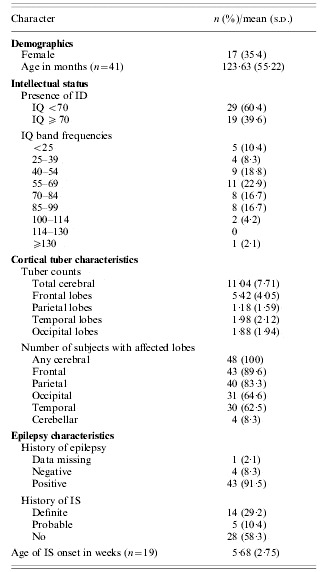
Sample characteristics (refer to Table 1)
Demographics
The total sample of 48 individuals included 17 (35·4%) females. The sample ranged in age from 2 years 6 months to 25 years, with a mean age of 10 years 3 months.
Sample characteristics (maximum n=48)

s.d., Standard deviation; IQ, intellectual quotient; ID, intellectual disability; IS, infantile spasm.
IQ
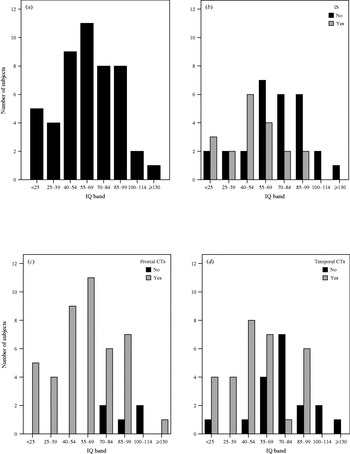
IQ in our sample ranged from <25 to >130. The median IQ band was 55–69. The ordered categories reflecting IQ distribution appeared normal on visual inspection (see Fig. 1a) and passed a Shapiro–Wilk test of normality (Z=0·12, p=0·07). Twenty-nine (60·4%) of our sample had ID, that is an IQ <70.
IQ distribution (a) overall, and by the presence of (b) a history of probable infantile spasm (IS), (c) frontal lobe cortical tuber (CT) and (d) temporal lobe CT.

Epilepsy and IS
Of the 47 individuals for whom epilepsy history was available, 43 (91·5%) had a positive history. Of these, 19 (44·2%) had a positive history of infantile spasms. The average age of IS onset was 6 months.
Cortical tubers
Total CT count ranged between 1 and 29. Mean total CT count was 11. This continuous variable appeared to be non-normally distributed on inspection, and a Shapiro–Wilk test for normality (p=0·018) supported this impression. With regard to the frequency of affected lobes (left and/or right), the frontal lobes were most commonly affected (89·6%), followed by parietal (83·3%), occipital (64·6%), temporal (62·5%) and cerebellar (8·3%) lobes. There were no significant laterality effects in lobar tuber number for all lobes where this statistic was available (frontal, parietal, occipital, temporal). A Friedman test revealed significant differences in lobar (left and right counts combined) CT counts (χ2=49·1, p<0·0001). Post-hoc analyses using the Wilcoxon signed ranks test found that total frontal lobe CT count was significantly greater than that for all other lobes. All other inter-lobar comparisons failed to reach significance. The presence of frontal (Z=3·64, p<0·001), temporal (Z=4·03, p<0·001) and occipital (Z=4·42, p<0·001) CTs was associated with higher total CT count. Lobar CT counts were all highly correlated with total CT count.
Relationships between measures of epilepsy, IS, CT and IQ considered in isolation from each other
Epilepsy, IS and IQ
A history of epilepsy was not significantly associated with IQ (p=0·08). However, as illustrated in Fig. 1b, a history of IS was significantly associated with IQ (Z=−2·49, p=0·013), and this remained true in an analysis restricted to those 43 subjects with a history of epilepsy (Z=−2·11, p=0·035). No statistically significant relationship was found, however, between the age of onset of IS and IQ (Spearman's ρ=0·25, p=0·30).
Epilepsy, IS and CTs
A history of epilepsy was strongly associated with total CT number (Z=−2·92, p=0·003). The presence of CTs in frontal (Fisher's exact p=0·002) and occipital (Fisher's exact p=0·01) lobes was associated with a history of epilepsy. Furthermore, CT counts in frontal (Z=−2·81, p=0·005) and occipital (Z=−2·43, p=0·015) lobes were significantly higher in those with a history of epilepsy.
We next determined whether, among those subjects with a history of epilepsy (n=43), IS status showed any association with CT variables. Those subjects with a history of IS did not have significantly more cerebral CTs (p=0·27). There were no cerebral lobes for which the presence or number of CTs was associated with IS. No significant relationship was found between IS age of onset and total CT count (Spearman's ρ=0·01, p=0·76).
CTs and IQ
A significant negative correlation was found between total CT count and IQ (Spearman's ρ=−0·3, p=0·04). As shown in Fig. 1c and 1d, the presence of tubers in frontal (Z=−2·71, p=0·007) and temporal (Z=−2·82, p=0·005) lobes was associated with lowered IQ. Similar associations were not found for cerebellar (p=0·07), parietal (p=0·79) or occipital (p=0·06) lobes. Unfortunately, sample sizes were too small to allow us to meaningfully explore whether IQs were significantly different between those with purely unilateral involvement of either of these lobes. When considering lobar CT count as opposed to CT presence or absence, only temporal lobe CT count showed a statistically significant correlation with IQ (Spearman's ρ=−0·42, p=0·003). This relationship was not found for frontal (p=0·074), parietal (p=0·785) or occipital (p=0·264) lobe CT number.
We also determined which of the CT variables showing statistically significant univariate associations with measures of intellectual function remained significant in a multivariate ordinal regression analysis limited to using CT variables as predictors. In a model containing total CT count, and the presence of both frontal and temporal CTs, frontal (regression coefficient=−2·43, p=0·019) and temporal (regression coefficient=1·60, p=0·018) CTs remained significant, while total CT count did not show a significant contribution to this model (p=0·41).
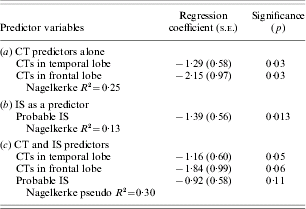
Thus the most parsimonious model for CT variables predictive of IQ (shown in Table 2a) was one including only the presence of CTs in frontal (regression coefficient=2·15, p=0·03) and temporal lobes (regression coefficient=−1·29, p=0·03), and explained 25·4% of the variance in IQ (Nagelkerke pseudo R 2).
Multivariate ordinal regression models for IQ (n=47)
IQ, Intellectual quotient; s.e., standard error; CT, cortical tuber; IS, infantile spasm.
Multivariate analyses combining CT variables and IS as predictors
The results above demonstrated that, in univariate analyses, a history of IS and the presence of CTs in frontal and temporal lobes were associated with IQ. These three variables were therefore entered into a multivariate analysis to determine which of them would still show statistically significant independent contributions to the prediction of IQ. When the probable presence of IS was added to the model containing the affectation status of both temporal and frontal lobes (Table 2c), the total variance of cognitive ability explained by the model increased to 29·7% (Nagelkerke pseudo R 2). In this model IS status was not significantly associated with IQ (p=0·11), whereas it had shown a strong association when used as a sole independent variable (p=0·01) (Table 2b). Temporal (p=0·05) and frontal (p=0·06) lobe affectation status, however, both remained at least marginally significant in this model with three independent variables.
DISCUSSION
This study demonstrated using univariate analyses that a probable history of IS, total cerebral CT number, temporal lobe CT number, and CT presence in temporal and frontal lobes were all significantly associated with IQ. The latter two of these factors remained significantly associated with IQ when controlling for total cerebral CT count. Total CT count failed to show a significant association with IQ once the presence of CTs in frontal and temporal lobes was taken into account. There was no significant relationship, however, between age of seizure onset and either CT number or IQ. Our multivariate analyses suggest that, of all the independent variables showing a relationship with IQ on univariate analyses, only temporal and frontal lobe CT presence remain marginally significant when entered together, and this model predicts close to 30% of the variance in IQ. Importantly, their inclusion renders a history of probable IS insignificant.
Limitations
There are a number of potential limitations to this study. First, there may be selection bias, in that subjects represent a relatively more intellectually disabled subset of a larger sample recruited through two specialist regional clinics. However, it is important to note that the resultant sample has rates of IS and ID that lie in between those reported in the two most recent epidemiological samples, where near-complete ascertainment is most likely (Joinson et al. Reference Joinson, O'Callaghan, Osborne, Martyn, Harris and Bolton2003; Devlin et al. Reference Devlin, Shepherd, Crawford and Morrison2006). Moreover, selection bias of this kind is unlikely to influence the inter-relationships between CT, IS and ID.
Second, although information was gathered using standardized techniques where possible, not all MRI scans were acquired using the same protocol; however, this is at worst likely to introduce random error rather than any systematic bias. In addition, we were not able to index CT load using summated volumetric variables (i.e. proportion of frontal lobe volume consisting of CT tissue) as used by some groups (Ridler et al. Reference Ridler, Suckling, Higgins, Bolton and Bullmore2004). Cognitive assessments were conducted by more than one rater, using a variety of instruments as necessitated by the wide ranges of age and intellectual ability in our sample. Final classification of subjects into IQ ‘bins’ was determined by a close review of all relevant clinical information, and conducted blind to seizure history or details of CT load. Seizure history was gathered retrospectively, although this was done blind to other clinical information, so it is unlikely that subjects were non-randomly misclassified on this variable with respect to psychometric intelligence. We did not, unfortunately, have data on medication history, quality of seizure control, or full details of seizure types other than IS.
The outcome of interest in our study was limited to ID. ID is, however, only one of the neurodevelopmental risks associated with TS. Elevated rates of emotional and behavioural problems are well recognized in TS, and known to often present a significant problem for carers (Hunt, Reference Hunt1983). However, little is known regarding the brain mechanisms that might underlie the risk for psychopathology in TS. Findings on how rates of psychopathology change with ID are inconsistent (Raznahan et al. Reference Raznahan, Joinson, O'Callaghan, Osborne and Bolton2006). This is likely to partly reflect the challenges of measuring psychopathology in the context of a complex heterogeneous neurodevelopmental disorder. Unfortunately, because of the manner in which our sample was characterized, our study was not able to examine the relationship between brain lesions in TS and psychopathology. This represents a key area for future research.
Comparison with existing TS research
The overall load and distribution of CTs found in our sample are similar to those reported by other groups (O'Callaghan et al. Reference O'Callaghan, Harris, Joinson, Bolton, Noakes, Presdee, Renowden, Shiell, Martyn and Osborne2004; Ridler et al. Reference Ridler, Suckling, Higgins, Bolton and Bullmore2004), and confirm that frontoparietal lobes are most frequently affected by CTs.
Our findings on univariate analyses are in general consistent with previous reports of the relationship between IS and IQ/developmental status (Riikonen & Simell, Reference Riikonen and Simell1990; Shepherd & Stephenson, Reference Shepherd and Stephenson1992; Hunt, Reference Hunt1993; Shepherd et al. Reference Shepherd, Houser and Gomez1995; Webb et al. Reference Webb, Fryer and Osborne1996; Jozwiak et al. Reference Jozwiak, Goodman and Lamm1998; Joinson et al. Reference Joinson, O'Callaghan, Osborne, Martyn, Harris and Bolton2003; Humphrey et al. Reference Humphrey, Williams, Pinto and Bolton2004; O'Callaghan et al. Reference O'Callaghan, Harris, Joinson, Bolton, Noakes, Presdee, Renowden, Shiell, Martyn and Osborne2004), and CT and IQ (Roach et al. Reference Roach, Williams and Laster1987; Shepherd et al. Reference Shepherd, Houser and Gomez1995; Goodman et al. Reference Goodman, Lamm, Engel, Shepherd, Houser and Gomez1997; Weber et al. Reference Weber, Egelhoff, McKellop and Franz2000; Bolton et al. Reference Bolton, Park, Higgins, Griffiths and Pickles2002; O'Callaghan et al. Reference O'Callaghan, Harris, Joinson, Bolton, Noakes, Presdee, Renowden, Shiell, Martyn and Osborne2004). In keeping with the work of other groups, almost all TS subjects with ID had a history of epilepsy.
Despite finding strong associations between a history of epilepsy and various aspects of CT load, we failed to replicate the statistically significant relationship between IS and total CT count as reported by O'Callaghan et al. (Reference O'Callaghan, Harris, Joinson, Bolton, Noakes, Presdee, Renowden, Shiell, Martyn and Osborne2004). There are no obvious reasons why two such comparable analyses should contradict each other in two groups of comparable size, other than sample differences reflected by the two subject groups having differing levels of ID. Other studies have demonstrated an association between epilepsy and CTs using a variety of scales for measuring CT number. Importantly, none of these studies used lifetime history of IS as their seizure variable of interest, but used other indices such as seizure type at seizure onset (Shepherd et al. Reference Shepherd, Houser and Gomez1995), and quality of seizure control (Roach et al. Reference Roach, Williams and Laster1987). Taken together, the findings so far generate a general pattern suggesting that epilepsy ‘goes with’ CTs in TS. Clearly, there is still more work to be done in picking this relationship apart.
In keeping with some studies (Jozwiak et al. Reference Jozwiak, Goodman and Lamm1998; Goh et al. Reference Goh, Kwiatkowski, Dorer and Thiele2005), we did not find an association between age of IS onset and ID in our sample, although this has been reported previously (Shepherd & Stephenson, Reference Shepherd and Stephenson1992; Webb et al. Reference Webb, Fryer and Osborne1996; Joinson et al. Reference Joinson, O'Callaghan, Osborne, Martyn, Harris and Bolton2003). This inconsistency may reflect the variety of scales used to measure age of seizure onset, and whether or not seizure type (i.e. IS or other) was controlled for during analyses. Those studies where age of seizure onset was measured as a continuous variable, or seizure type was included in analyses, failed to find any association between age of seizure onset and IQ.
Our findings on multivariate analysis differ from those of the only other study using a broadly comparable approach (O'Callaghan et al. Reference O'Callaghan, Harris, Joinson, Bolton, Noakes, Presdee, Renowden, Shiell, Martyn and Osborne2004). The findings of O'Callaghan et al. suggest that total CT number and IS status in combination predict IQ in TS. When CT measures were considered regionally (without controlling for total CT number), only occipital lobe CT number was found to predict IQ. Results that allow one to consider the degree to which IS status and regional CT load can predict IQ in TS are not, however, presented.
Towards a model for ID in TS
In attempting to build aetiological models it is important to distinguish statistically associated factors, risk markers and risk factors. The first identifies a mathematical phenomenon, the second identifies a proxy measure and the third refers to a factor shown to be directly causal. For example, CTs may lead directly to an increased risk of ID but could also act as markers of other aspects of disease severity (e.g. parenchymal abnormalities, anti-epileptic polypharmacy necessitated by seizure treatment resistance) that in turn sit on the causal pathway to ID. There is already, for example, evidence in TS that more radiographically subtle parenchymal brain abnormalities can be associated with neuropsychological outcome (Ridler et al. Reference Ridler, Suckling, Higgins, De Vries, Stephenson, Bolton and Bullmore2007). Similarly, while IS may lead directly to ID in TS (e.g. through disruption of connectivity in developing neural systems), they might act as a marker for a causal risk factor with which they in turn are associated, such as subclinical electrophysiological dysregulation.
What evidence is there to support one of the deductions prompted by our results, that frontotemporal involvement in TS might increase risk for ID in TS? Such studies as are available in TS that might address this issue have already been reviewed. If it is assumed, however, that regional specialization of the cerebral cortex in TS is broadly similar to that which emerges during normal brain development, then one can look to the extensive research that studies the neural underpinnings of psychometric intelligence in neurotypical individuals for answers.
Clearly, psychometric intelligence is not a unitary concept, and superficially at least, different tests appear to tap different cognitive skills. There have long been well-recognized positive correlations among scores on differing tests of intelligence at a group level. The general statistical factor accounting for such correlations, ‘g’, was first described by Spearman (Reference Spearman1927). There is great controversy as to the unitary nature of g, how it relates to other models of intelligence, if it does in fact represent a biologically reducible entity, and if so, what the relevant brain systems might be (Duncan, Reference Duncan2005; Blair, Reference Blair2006). This controversy has a bearing on our discussion. If g is not just statistically but also biologically meaningful, then it might be expected that the brain systems subserving tasks that strongly tap g would be of great importance in determining psychometric intelligence. Were such systems to be widely distributed across the brain, then in a disorder such as TS, strong regional effects in associations between brain lesions and IQ would be less likely. Alternatively, were such systems to be relatively localized, brain involvement in TS would be expected to have the regionally specific association with IQ described in our study.
Structural MRI studies support the second model in both adulthood (Thompson et al. Reference Thompson, Cannon, Narr, van Erp, Poutanen, Huttunen, Lonnqvist, Standertskjold-Nordenstam, Kaprio, Khaledy, Dail, Zoumalan and Toga2001; Haier et al. Reference Haier, Jung, Yeo, Head and Alkire2004, Reference Haier, Jung, Yeo, Head and Alkire2005) and childhood (Shaw et al. Reference Shaw, Greenstein, Lerch, Clasen, Lenroot, Gogtay, Evans, Rapoport and Giedd2006). Although whole grey matter volume and a variety of regionally specific grey matter volumes have been positively correlated with IQ cross-sectionally, it is frontal lobe grey matter volume that emerges as the structural brain measure most consistently associated with intelligence. Intriguingly, findings from twin studies suggest that cortical areas showing most volumetric heritability are the same as those showing the strongest correlations with intelligence, and that there is marked overlap in the genetic factors influencing these two traits (Toga & Thompson, Reference Toga and Thompson2005). Longitudinal data (Shaw et al. Reference Shaw, Greenstein, Lerch, Clasen, Lenroot, Gogtay, Evans, Rapoport and Giedd2006) suggest that the frontal lobes are disproportionately associated with intelligence across childhood and adolescence, and that differences in the temporal profile of dynamic changes in cortical thickness in such regions distinguish individuals of supra-normal intelligence from others. Functional MRI has also been used to investigate brain activation patterns during psychometric testing, although the wide variety of paradigms used makes it difficult to draw broad conclusions. However, in an elegant study, Duncan et al. (Reference Duncan, Seitz, Kolodny, Bor, Herzog, Ahmed, Newell and Emslie2000) used a battery of tasks with high g contrast to demonstrate that the lateral frontal regions are a key component of the brain systems underlying general intelligence.
Thus, the broader neuroscientific literature just reviewed supports our finding that involvement of frontotemporal regions is predictive of reduced IQ in TS. The majority of such work relates to the brain in adulthood, however. TS is a neurodevelopmental disorder, with recent studies identifying subtle parenchymal abnormalities that suggest disordered early neuronal migration. The non-deterministic model for cortical regionalization of cognitive functions encapsulated in the theory of ‘interactive specialisation’ (Johnson et al. Reference Johnson, Halit, Grice and Karmiloff-Smith2002) explicitly allows for the emergence of atypical patterns of regional specialization in developmental disorders of the brain. It is of particular interest, therefore, that those cortical regions underpinning psychometric intelligence in neurotypical adults are the same as those where CT presence is associated with ID among youth with TS. This implies that the plasticity that might otherwise ‘work around’ early lesions of the frontal lobes is limited in TS.
What might be the mechanisms by which CT presence in frontotemporal regions interferes with performance in tests of intelligence? The distinction between risk markers and risk factors highlighted above is of relevance to this question. CTs may be direct risk factors for ID through mechanisms such as reduction of intact grey matter volume, or interference with connectivity between key brain regions. Alternatively, frontotemporal CT presence could simply be a marker for other causal aspects of disease severity. One such scenario is that CTs may act as epileptogenic foci (Guerreiro et al. Reference Guerreiro, Andermann, Andermann, Palmini, Hwang, Hoffman, Otsubo, Bastos, Dubeau, Snipes, Olivier and Rasmussen1998), a model already proposed in relation to the biological determinants of autism in TS (Bolton et al. Reference Bolton, Park, Higgins, Griffiths and Pickles2002). Alternatively, CTs may index more subtle parenchymal neuroanatomical disturbances.
Similar consideration apply to the role of epilepsy and IS in ID. Our study supports the impression that ID is hardly ever observed in TS without epilepsy. This suggests that with respect to IQ, either epilepsy is acting as a non-causal marker of disease severity (in which case the threshold for liability to epilepsy in TS would be lower than the threshold for liability to ID) or epilepsy may causally contribute to reduction in IQ. As our sample only included four individuals without epilepsy, we did not have the power to distinguish between these two hypotheses. Turning to IS, the strong association shown between IS and ID in univariate analysis disappeared when CT measures were accounted for, possibly indicating that IS may not be a direct risk factor for ID in TS. This conclusion runs against many studies that point to the developmentally noxious effects of brain disorders associated with seizures in general (Rutter et al. Reference Rutter, Tizard, Yule, Graham and Whitmore1976; Rodenburg et al. Reference Rodenburg, Stams, Meijer, Aldenkamp and Dekovic2005; Vingerhoets, Reference Vingerhoets2006), but on closer analysis evidence directly linking the seizures in such disorders to any ID is not so strong. The classical confounders in studies of behavioural outcomes in epilepsy are the effects of underlying brain pathology, anti-epileptic medication, and the psychosocial impact of disease on development. These confounders also complicate attempts to determine epilepsy/IS–behaviour links in TS.
Clearly, much work needs to be done in building robust models of the brain mechanisms for ID in TS. Prospective study of larger samples with additional measures such as electroencephalography (EEG) recordings, composite indices of seizure severity, and wider neuropsychological assessment are needed. In such studies it will also be important to quantify the neurostructural impact of TS in a manner that recognizes the more recently described subtle neuromigrational lesions.
Building a better understanding of brain–cognition links in TS will bring us closer to ameliorating the neurodevelopmental impact of this disorder. It will also be of great importance to the study of developmental psychology, and developmental psychopathology more generally.
ACKNOWLEDGEMENTS
We thank the UK Tuberous Sclerosis Association for their support, and the children and families who so generously participated in this study.
DECLARATION OF INTEREST
None.