Introduction
Ethnicity has been a prominent focus in North American research on teenage parenthood, but not in UK research (Bonell, Reference Bonell2004). While some studies have reported higher-than-average rates of teenage pregnancy and parenthood among some minority ethnic communities in the UK (Berthoud, Reference Berthoud2001), these patterns have not been explored in depth. This article presents findings from a two-year qualitative study, carried out in two Yorkshire cities and three London boroughs. The aim was to investigate the views and experiences of young parents from a range of minority ethnic backgrounds. Interviews were carried out with young parents and with a wide range of managers and staff in support services.
Study findings relating to young parents’ own views and experiences have been reported elsewhere (Higginbottom et al., Reference Higginbottom, Mathers, Marsh, Kirkham, Owen and Serrant-Green2006). This article focuses on observations about UK policy and practice, drawing on interviews with staff and service managers (collectively referred to as ‘professionals’ below). Interviewees were asked to describe any research findings or monitoring data of which they were aware, regarding ethnicity and teenage pregnancy and parenthood. They were also invited to comment on their understanding of the needs and experiences of young parents of minority ethnic origin.
Recent studies have emphasised the need to bring the UK social and economic context into focus, for instance by considering employment patterns, family forms and social class, in relation to the social construction of teenage parenthood as a problem (Arai, Reference Arai2003a, Reference Arai2003b). Others have emphasised the ways in which young working-class mothers resist stigmatisation and pursue a ‘good mother’ identity in the face of disadvantage (McDermott and Graham, Reference McDermott and Graham2005a). However, these perspectives have not been reflected consistently in dominant policy approaches, which still frame teenage pregnancy and parenthood largely in terms of sources of risk to be reduced via initiatives directed at individual health beliefs, behaviour and engagement in education and/or employment. (SEU, 1999, 2006).
The sections below provide an overview of the background to the study, explaining its starting-points and design. This is followed by a discussion of the main findings in relation to policy and practice. The study addressed the experiences of young women who had given birth between the ages of 15 and 19, and (in some respects) their partners. Conception and birth rates among young women aged under 15 are significantly lower than those for older teenagers and have changed very little since the 1980s. For example, government figures for conceptions to young women aged 15–17 show a rate of 41.3 per 1,000 young women (Teenage Pregnancy Unit, 2007); the under 16 conception rate is 7.8 per 1,000. The experiences of young mothers aged 13 and 14, and their partners, really merit a separate discussion in their own right.
Youth, ethnic identification and health
Ethnicity, as part of social identity, takes shape through the twin processes of group identification and social categorisation by others: ‘ethnicity depends on ascription from both sides of the boundary’ (Jenkins, Reference Jenkins1997: 22). Identity is relational and also political; people may choose to emphasise or to play down specific factors, as circumstances shift. Mason (Reference Mason2000) similarly proposes the concept of ethnicity as situational: a young Briton of South Asian descent may identify him or herself as Pakistani in one context, British Asian in another and British Muslim in a third. These dynamic processes of identification are, by definition, hard to capture through formal monitoring processes.
Identity is an increasingly prominent theme in research about health and welfare. In this connection, both policy and health research initiatives have sometimes embodied an ‘untheorised’ model of ethnicity (Karlsen and Nazroo, Reference Karlsen and Nazroo2002): patterns of inequality are mapped empirically, and somewhat simplistic associations may be made between ethnic origins and specific problems or health beliefs. Moving beyond these limitations, Karlsen and Nazroo (Reference Karlsen and Nazroo2002) emphasise the need to understand the relationship between ethnicity and health both in terms of structural inequalities and of identity. They argue for a ‘multi-dimensional’ picture of ethnic identification, within which socioeconomic inequalities, perceptions of racism and minority status all interact to shape experiences of health and well-being. However, their in-depth analyses have demonstrated that class and poverty are the factors most strongly associated with health inequalities in minority ethnic communities. That is, patterns of material disadvantage linked to socioeconomic position and poor housing opportunities – sometimes compounded by the experience of racism – all contribute to the poorer health outcomes that have been documented in relation to many minority ethnic communities. The impact of racism, however, has received little research attention to date in the UK.
In this context, for young people in transition towards adulthood, issues of agency and identity remain particularly salient within a Western process of ‘sexual regulation via life-course categories’:
thus, while the postmodern life course may admit child beauty pageants and third age sky diving, which suggest that ‘one is as old as one feels’, at the same time a modernist moral regulation continues to bite hard in the area of sexual practice and to limit and constrain individual agency. (Hockey and James, Reference Hockey and James2003: 142)
In investigating the apparent over-representation of some minority ethnic groups in statistics on teenage parenthood, then, it is important both to be sensitive to any evidence of structural inequalities, and also to explore the interaction between these and individual senses of identity and processes of decision-making, both in relation to pregnancy and parenthood and also more generally.
Ethnicity and ‘early’ parenthood
McDermott and Graham (Reference McDermott and Graham2005a: 59) noted the ways in which young mothers – that is, those under the age of 20 – are ‘discursively positioned outside the boundaries of “normal” motherhood’, commonly being seen either as victims or as threats to the moral order. The authors also noted the absence of research about the experiences of young minority ethnic parents.
In contrast with the UK, Bonell's review (2004) of perspectives in quantitative research found that US studies focused heavily on the economic and welfare costs attributed to early parenthood; here, ethnicity has been a prominent theme. In particular, research has emphasised above-average rates of teenage parenthood among African Americans. Both Horowitz (Reference Horowitz1995) and Geronimus (Reference Geronimus2003) have argued that young African American parents are stigmatised in specific ways, as immoral and undeserving welfare dependents (not, in general, as victims). Challenging this view, Geronimus found that ‘fertility timing norms’ varied to reflect local family forms and economic constraints. In African American neighbourhoods where incomes were low, life-expectancy below average but social networks strong, ‘early’ childbearing had advantages (2003: 885). US data also showed African American teenage mothers having lower rates of low birth weight babies and infant mortality than older mothers, and incurring lower rather than higher costs to public services (Hotz et al., Reference Hotz, McElroy and Sanders1996). A number of common assumptions underpinning US welfare discourse and policy are therefore questionable, at best. Geronimus’ original analysis has been supported by more recent research showing a decrease in teenage births among African Americans, in parallel with increased economic well-being (Colen, Geronimus and Phipps, Reference Colen, Geronimus and Phipps2006).
In an ethnographic study of an education scheme for young mothers in the US, Horowitz (Reference Horowitz1995) explored related issues of ethnicity, status and identity. Among staff, she distinguished between those who adopted an ‘arbiter’ role and those she defined as ‘mediators’. Arbiters emphasised risk and compliance in their interactions with young mothers, and sought ways to distinguish themselves from their clients in ethnic as well as class terms, aligning themselves instead with a white, suburban middle-class lifestyle. In contrast, mediators found common ground with clients in terms of explicitly valuing the experience of motherhood; they were also more likely to describe themselves as happy living in socially and ethnically mixed neighbourhoods.
To date there has been no in-depth research in the UK to parallel the above studies. Routine data collection about teenage conceptions and births has not included ethnic origin (Low, Reference Low2002), although some survey data have been available (Berthoud, Reference Berthoud2001). Phoenix's study (1991) discussed ethnicity, noting both some important differences between the UK and the USA, and the difficulties involved in distinguishing between factors related to ‘race’ and those related to class:
it is difficult to disentangle race effects and class effects. Analyses which compare black teenage mothers and white teenage mothers may actually be using ‘race’ as a proxy for social class. (Phoenix, Reference Phoenix1991: 51)
Phoenix concluded that comparisons between ethnic groups were not appropriate within her sample; her main finding was that poverty, rather than age, was the dominant factor in the experiences of young mothers and their children. Following this, however, the 1990s saw a continuing UK research and policy focus on teenage parenthood as a discrete source of risk to health and well-being. Studies identified social class and deprivation as risk factors, noting for example that teenage women with fathers in manual occupations were nearly twice as likely to become parents as those with fathers in non-manual occupations (Hobcraft and Kiernan, Reference Hobcraft and Kiernan2001). Where referred to, ethnicity tended to be seen as a further risk factor associated with deprivation. In line with other aspects of government policy on poverty and social exclusion, support services for young parents were designed to promote ‘inclusion’ via engagement in education and/or paid employment. This emphasis has itself been criticised for devaluing forms of social participation (including those associated with parenthood itself) that are outside formal employment or education (Kidger, Reference Kidger2004). The prevailing policy assumption has been that the same measures, messages and support systems will be appropriate across the board. Reflecting long-established policy emphases on multi-culturalism (Ahmad and Bradby, Reference Ahmad and Bradby2007), some specific guidance has been available about ‘working with diversity’ (Department of Health, 2002).
Recent analyses of the long-term outcomes of teenage pregnancy have questioned some previously accepted policy assumptions. Berthoud and colleagues (Reference Berthoud, Ermisch, Francesconi, Liao, Pevalin and Robson2004) compared adult women who had had children as teenagers and those who had not, matched in socioeconomic terms. As Phoenix had found 13 years earlier, poverty and deprivation emerged as more significant than the timing of parenthood. In terms of ethnicity, researchers also found that the social and economic ‘penalties’ for early motherhood were strongest among young white women. Among young minority ethnic women, the ‘age effect’ (e.g. in terms of the prospects of living in a working family) varied between communities but was less marked in all cases; it was non-existent for Pakistani and Bangladeshi women. Their conclusions emphasised the importance of social and family norms:
when early fertility is the norm in a minority community, it does not lead to any further disadvantage beyond that experienced by the ethnic group as a whole. (Robson and Berthoud, Reference Robson and Berthoud2003: 1)
To summarise: survey analyses have suggested an over-representation of some minority ethnic groups among UK teenage parents. However, in-depth research has been lacking, both on the perspectives of young parents themselves and on the ways in which policy and professional practice may exclude, include or affect young minority ethnic parents. Recently there has been some convergence between qualitative and quantitative studies in the UK, reinforcing the messages from earlier research: poverty outweighs teenage parenthood in influencing long-term health and well-being. In relation to minority ethnic status, research suggests that family and community norms and expectations are particularly important.
About the study
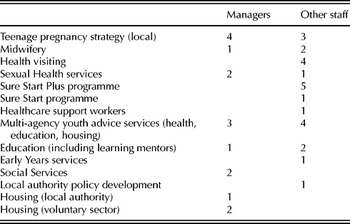
Semi-structured, in-depth telephone interviews were completed with 16 people in leadership or management roles and 25 other professional staff. This method was chosen in consultation with local services, as the most effective way to reach people who were short of time and sometimes working from several local bases. Interviews were booked in advance, and lasted between 45 minutes and an hour. In this way, researchers sought to build up rapport with interviewees and to avoid the superficiality sometimes associated with telephone rather than face-to-face contact. Participants included teenage pregnancy coordinators and a range of other staff (Table 1). In the two London boroughs, the majority were of minority ethnic origin themselves. In the two other sites, the majority were of white European origin. Interviewees were identified through the national Teenage Pregnancy Unit and through local consultations in the study sites. Where interview extracts are quoted below, staff roles are identified; locations are not given, to preserve anonymity.
Interviewees (n = 41)

Interviewees were invited to comment on policy and provision for minority ethnic young parents, as well as on their understanding of the experiences of these young parents in their own locality (particularly, although not solely, in relation to accessing support services). Interviewees used a range of terms, in describing young parents’ ethnic identity: white, Black, dual heritage, African Caribbean and Asian (or South Asian). In some instances, as interview extracts below illustrate, interviewees also referred to faith groups; this was particularly the case with reference to Muslim young parents.
Data analysis was based on the ‘Framework’ method (Ritchie and Spencer, Reference Ritchie, Spencer, Bryman and Burgess1994). This formalises the core steps in qualitative data analysis, from initial familiarisation with data through to defining themes and codes and applying these to transcripts. It has been used extensively in team-based social research. Interviews were recorded and transcribed. Research team members read the transcripts independently and compared emerging themes; themes and codes were then refined through discussion. Transcripts were coded independently and compared by three researchers. Four researchers then worked together to produce draft interpretations. Below, study findings are presented in relation to ‘inequality’, ‘identity’ and local ‘ecologies of practice’.
Ethnicity and inequality
Most interviewees described an absence of reliable, standard systems for collecting data about ethnicity; monitoring initiatives were emerging in some places but were uneven:
In terms of trying to extract specific data around ethnic groups . . . that hasn't always been collected. So when I started these [sexual health] services I was very keen to ensure that we monitored for . . . ethnicity. (Specialist development nurse)
Many staff were therefore concerned about being unable to detect potential barriers to accessing support services for minority ethnic young parents:
We don't know whether young people are from black and ethnic minorities or whether they are white . . . sometimes it will be mentioned on the referral form, but more often . . . it is not . . . knowing how many young women are out there of Pakistani or Bangladeshi origin who have children [and are] under eighteen . . . they are definitely under-represented . . . [but] I think we have got quite a lot of young women [on our caseload] who are of multiple heritage and of African-Caribbean origin. (Sure Start Plus personal adviser)
In this context, most staff avoided generalisations about specific communities and were keen to counter taken-for-granted assumptions, for instance concerning sexual activity before marriage among young women of Asian origin and/or Muslim faith:
We know that young Muslim women are sexually active and they are at risk of teenage pregnancy but I think the public at large think that it wouldn't happen. (Parent education worker)
However, many also emphasised that teenage pregnancy was rarely seen as an issue when it occurred within marriage in Muslim families:
Teenage pregnancies among Muslims are usually within marriage, and it's not usually a big deal. (Housing manager)
In this context, some questions remain impossible to answer in relation to equity and structural disadvantage: for example, whether or not local advice or accommodation services are reaching the full range of minority ethnic young parents. Staff suspected that patterns of access to sexual health, antenatal and allied support services were uneven, and that, for example, an absence of appropriate language support was a barrier for some young parents. Comprehensive information was not available to confirm or refute this, although studies of sexual health services have reported concerns about accessibility and about perceived discrimination (Connell et al., Reference Connell, McKevitt and Low2004).
With respect to young parents, then, the importance of ‘ethnicity as structure’ as defined by Karlsen and Nazroo (Reference Karlsen and Nazroo2002) remains a key area in need of further investigation. Improved routine data collection and monitoring could contribute to understanding patterns of inequality among young mothers and fathers. However, given the complexities involved in processes of ethnic identification (and therefore in any monitoring of service take-up), this is unlikely to be sufficient. In addition, while young mothers encounter universal services such as midwifery and health visiting, there is no such systematic contact with young fathers. Increased local and national consultation with young minority ethnic parents is therefore crucial, to complement improvements in routine data collection. Continuing research, including ethnographic and longitudinal dimensions and involving both fathers and mothers, is also needed.
Ethnicity as ‘identity’
In terms of identity, interviewees consistently emphasised a sense of stigmatisation among young mothers, revolving around the interaction between age, ethnicity, class and poverty (Phoenix, Reference Phoenix1991). Converging closely with young parents’ own views (Higginbottom et al., Reference Higginbottom, Mathers, Marsh, Kirkham, Owen and Serrant-Green2006), age – rather than ethnicity – was emphasised as the dominant factor in processes of stigmatisation that were seen as applying to all young parents:
Teenagers do feel quite criticised and quite stereotyped . . . I think it is a huge issue . . . a lot of teenagers who find themselves pregnant may not have had those support structures around them that other teenagers might have had. (Health visitor)
I have had several experiences of this . . . people saying ‘she got pregnant to get a house’ . . . I have heard that from some people that have got quite a lot of power and influence as well, which is worrying . . . my perception is that they tend to get very negative press. (Specialist development nurse)
However, staff also saw racism as a factor within the labour market, and commented on processes of categorisation, labelling or misrecognition within health and welfare services:
There may be some elements of racism within . . . the job market and employment . . . so obviously there may be different aspirations for young people . . . from different ethnic backgrounds. And also they may differ if . . . your dad's unemployed and you start thinking ‘well, am I going to get a job?’ (Drop-in centre advice worker)
Some of the Asian families, there's obviously traditions of having children much younger . . . I've worked with one family where [the] grandparents on both sides . . . started having babies when they were 14 or 15. So she's just following the family patterns, and they don't perceive themselves doing anything other than that . . . a lot of their difficulties were around how they were perceived rather than how they perceived themselves . . . They [professionals] sort of had to have it proved to them that she would be an adequate mother because their feeling was that . . . she was too young. But for her, that wasn't an issue at all, that's what women do at that age . . . it's normal. (Counsellor for young parents; emphasis added)
More broadly, many professionals articulated a picture of the life course which included the flexibility to start a family during the teenage years, and to return to education and/or employment later. Many were employed through Teenage Pregnancy Strategy funding, in roles designed to meet government targets for reducing teenage conception rates and increasing young mothers’ take-up of education and employment. They were aware that their own views about flexibility within the life course were sometimes at variance with government priorities:
There are vast assumptions made about . . . whether it's a bad thing to have a child under the age of 18 . . . I don't . . . necessarily agree with them. That doesn't mean that some young people don't require support in those circumstances, but the assumption that all [teenage] pregnancies are bad I think is wrong. Sorry . . . well there are issues biologically for women, aren't there? . . . Frankly having a baby at 18 is a hell of lot better for a woman's body than having a baby at 45 for a start, secondly the assumption that all young people have no support services is wrong. That's the point I was trying to make about young women, from minority ethnic communities in particular . . . who are married, in a stable relationship . . . and they want to have a baby. (‘Supporting people’ programme manager)
I think being a parent is very positive for a lot of the African Caribbean community . . . and I would say that's true from some of our young white women . . . I think that is something that is harder for the government to tackle . . . when a young woman has said, ‘well, being a mum is the best thing that has happened to me, it's helped me focus my life . . .’ It's actually won them more positive experiences. (Sure Start Plus adviser)
Going further, then, than a simple argument for flexibility and choice, some professionals saw an unplanned teenage pregnancy as a ‘turning-point’ for a young parent, followed by self-conscious steps towards greater maturity (Hosie, Reference Hosie2007). In this context, teenage pregnancy can usefully be understood as a ‘fateful moment’ (Giddens, Reference Giddens1991), prompting a review of risks, positive options and sense of identity. It can also be seen as a ‘critical moment’ within an individual young person's biography (Thomson et al., Reference Thomson, Bell, Holland, Henderson, McGrellis and Sharpe2002). Outcomes may be good, bad or mixed, depending on the context. However, Thomson et al. list ‘getting pregnant’ only under the ‘trouble’ heading in their classification of critical moments, alongside getting caught taking drugs, getting arrested and father going to jail (2002: 341). In contrast, the findings presented here suggest that for many minority ethnic young women (as for many white, working-class young women), a teenage pregnancy initially represents ‘trouble’, but also needs to be understood within the ‘relationships’ heading in the schema developed by Thomson and colleagues. Professionals’ accounts explicitly highlighted the importance of local norms and other contextual factors in shaping young mothers’ aspirations to create a family with themselves at the centre, and to carve out an independent and rewarding life. These accounts also matched closely the experiences described by young mothers and fathers in the wide range of recent qualitative studies that followed Phoenix's work (McDermott and Graham, Reference McDermott and Graham2005a, Reference McDermott and Graham2005b; Higginbottom et al., Reference Higginbottom, Mathers, Marsh, Kirkham, Owen and Serrant-Green2006; Hosie, Reference Hosie2007).
Local ‘ecologies of practice’
Many staff viewed Teenage Pregnancy Unit initiatives as prioritising pregnancy prevention targets more than support for young parents. A substantial majority saw this as a source of some tension, preferring to see support and prevention as allied policy priorities, not competing ones:
Of the total [teenage pregnancy] grant, only a very small amount actually goes to the supporting element, because it's more of a preventative strategy . . . It's difficult to do preventative work and at the same time support young parents, and get people to understand that if you don't support young parents, you are only creating more problems. So it's getting that balance right . . . support to young parents is also prevention. (Learning mentor)
In this context, the support services most valued both by staff were those offering flexible access and a non-judgmental approach, embodying the ‘mediator’ model described by Horowitz (Reference Horowitz1995). Professionals’ accounts illustrated the ways in which, within local ‘ecologies of practice’ (Stronach et al., Reference Stronach, Corbin, McNamara, Stark and Warne2002), space could be opened up to acknowledge young parents’ own priorities, sometimes displacing or challenging national policy emphases:
Access to and help with housing, benefits, health are often those big issues . . . under 16 . . . there is quite a lot of emphasis there on getting them back into college, getting them into learning. And often that is not the big issue . . . there is some pressure on me to be aware of that. That's not always important to the young people.
Q: what things are more important?
Well, them being a parent, their parenting skills, the health of their child, situations with housing or benefits, or relationships with parents and boyfriends . . .
Q: And . . . do [these issues] differ across different ethnic groups?
Not that I am particularly aware of.
Professionals consistently described ways in which they adapted their own practice to the needs of the young parents accessing their services, including the perceived needs of partners and of couples in ethnically mixed relationships:
A number of the Afro-Caribbean girls, have actually had relationships with older Asian boys and become pregnant and the pregnancy and the relationship have been um, problematic . . . simply because the families and younger peers in the main have been really hostile. (Sure Start Plus personal adviser)
Three young couples came to a group and the guys were Asian and the girls were Afro Caribbean and they attended the full sessions . . . they came back to the reunion and the dads were sat there with babies on their knee . . . it was really lovely to see that they had been able to access the service and obviously got a lot out of it. (Teacher with school-age parents)
Lastly, most staff viewed young fathers, irrespective of ethnicity, as marginalised by mainstream services:
If he turns up with his partner, in my experience quite often . . . he might be given a seat . . . but he's not spoken to or asked ‘how do you feel about having a baby?’ Because the focus is on taking the information from the mother . . . it's really hard for men . . . well, it's bad enough when they are grown, let alone when they are teenagers . . . I think it is really hard for teenage fathers who want to do the right thing. (Midwifery manager)
Some explained that this was compounded because work with fathers was not integrated within planning and target-setting processes:
We need to . . . demonstrate some links to targets that we have, which are . . . improving social and emotional well-being, the health targets which are around breast feeding, smoking cessation, birth weight and repeat pregnancies . . . we have educational targets as well – interestingly, I have to say, not for males . . . only mothers . . . which I think is a bit odd. (Sure Start Plus adviser)
Conclusion: young parents, ethnicity and ‘inclusion’
The findings illustrated above reinforce the case for a more sensitive policy approach to the wide spectrum of experiences encompassed under the ‘teenage parenthood’ umbrella. Professionals’ accounts suggested that norms, expectations and understandings about fertility, timing of parenthood and risk do differ across neighbourhoods and communities, shaped by the interaction of factors related to class, locality and ethnic identification. Teenage parents may be married, happily or unhappily (for example, in communities who hold Muslim faith), or may be unmarried but integrated into strong family and social support networks (for example, in African Caribbean families, those of multiple ethnic origin and of white working-class origin); or may judge that the perceived risk of missing out on motherhood outweighs the practical difficulties of continuing with an unplanned pregnancy (Higginbottom et al., Reference Higginbottom, Mathers, Marsh, Kirkham, Owen and Serrant-Green2006).
This study lends further weight to the point that experiences of poverty and of disengagement from education usually precede a teenage pregnancy, rather than following it (Hosie, Reference Hosie2007). Professionals’ accounts emphasised that when young women (and some men) are already in adverse circumstances, a teenage pregnancy can represent a perceived opportunity to make positive changes, provided that appropriate family or social support is available. Many saw themselves as adapting their professional practice in order to affirm and facilitate young parents’ steps in this direction, even when this required compromises over the demands of formal policy targets.
This general message is not new. However, it has had little impact at the level of public policy discourses in the UK context, where documents and political statements retain a homogenising focus on inclusion (or ‘reintegration’) via education and/or employment, rather than recognising or valuing diverse parental identities and models of the life course. There has been very little in the public domain to challenge the prevailing stigmatisation described both by young parents and by support service staff. Young parents continue to come high on the list in ministerial references to anti-social behaviour:
If you've got someone who is a teenage mum, not married, not in a stable relationship . . . here is the support we are prepared to offer you, but we do need to keep a careful watch on you . . . because all the indicators are that your type of situation can lead to problems. (Tony Blair, quoted in The Guardian, 1 September 2006, ‘We can clamp down on antisocial children before birth, says Blair’)
The recent ‘Respect Young Mums’ campaign led by the YWCA (2005) stands out as an exception to this pattern, modelling forms of publicity, user involvement and service provision which acknowledge the difficulties faced by young parents and publicly recognise their achievements and aspirations.
Geronimus (Reference Geronimus2003) has argued that negative stereotyping of young parents contributes to processes of surveillance and social control, and that in the US context, the specific stigmatisation of African American young parents reinforces a message which is really aimed at ensuring conformity among white middle-class youth. In the UK there is as yet no evidence of the ‘racialisation’ of teenage parental identities in this way. The prominent theme in many years of UK research concerns the stigmatisation of working-class young parenthood (Arai, Reference Arai2003b). Within this picture, there has, if anything, been a vacuum concerning ethnicity, both in terms of investigating patterns of structural disadvantage and in terms of understanding the ways in which age, ethnicity and parenthood inter-relate in processes of stigmatisation and identity formation.
Many managers and staff currently act as buffers, working around policy targets and funding boundaries in order to offer support and to affirm diversity in parental identities. In this sense, they operate as ‘street level bureaucrats’ (Lipsky, Reference Lipsky1980), representing a counterweight to policy and media discourses which reinforce young parents’ sense of isolation and relative disadvantage. However, as Wilkinson (Reference Wilkinson2005) has demonstrated, that sense of relative disadvantage itself can undermine long-term health and well-being. Local and national organisations need to prioritise continuing research and consultation with young parents, particularly with young minority ethnic mothers and fathers whose views and experiences have been marginalised to date. This opportunity needs to be grasped and the full range of messages from research with and about young parents needs to be acknowledged in policy statements and political commentaries. The alternative is to continue a long-established pattern in policy regarding teenage parenthood, within which support and concern are offered with one hand, but ambivalence and marginalisation are reinforced with the other.
Acknowledgements
The authors would like to thank all the participants who gave their time for interviews in the three study sites between 2002 and 2004 (Sheffield, Bradford and the London boroughs of Lambeth, Lewisham and Southwark). We also thank the other members of the research team: Matthew Griffin, Ayesha Charles and Zolesha Browne. We thank staff in the Teenage Pregnancy Unit and in the Department of Health policy research programme, which funded the study. The views expressed here are those of the authors and not necessarily those of the Department of Health or the Teenage Pregnancy Unit.