




No CrossRef data available.
Toward a Dynamic Theory of International Politics: Insights from Comparing Ancient China and Early Modern Europe
Published online by Cambridge University Press: 08 April 2004
Abstract
This article examines why international relations theories presume checks and balances but universal domination triumphed in ancient China. I argue that one should not presume the European experience as the norm and treat ancient China as a deviant case. I propose a dynamic theory of international politics that views international competition as processes of strategic interaction and that allows for alternative trajectories and endogenous transformation. Realist theories of international politics tend to focus on structural mechanisms and overlook agential strategies. At the same time, these theories focus on causal mechanisms that check attempts at domination and overlook mechanisms that facilitate domination. It is true that attempts at domination are checked by the mechanisms of balance of power and rising costs of expansion. But domination-seekers may overcome such obstacles by pursuing divide-and-conquer strategies, ruthless tactics, and self-strengthening reforms. From this strategic-interactive perspective, universal domination is no less possible than the balance of power.I would like to express my gratitude to Jack Snyder, Ira Katznelson, Charles Tilly, Thomas Bernstein, Michael Davis, and David Kang for their extensive comments on multiple drafts. I also want to thank Fiona Adamson, Bear Braumoeller, E. Bruce Brooks, Lars-Erik Cederman, Thomas Christensen, Claudio Cioffi-Revilla, Charles Cogan, Timothy Crawford, Julian Franklin, Taylor Fravel, Robert Goodin, Yoav Gortzak, A. Iain Johnston, Edward Kolodziej, Andrew Kydd, Mark Lewis, Daniel Nexon, Richard Rosecrance, Stephen Rosen, Peter Rutland, Mark Sheetz, Erik Voeten, R. Harrison Wagner, R. Bin Wong, and the editor-in-chief and two anonymous reviewers of International Organization for their thoughtful and critical comments. In addition, the Harry Frank Guggenheim Foundation, the Institute for the Study of World Politics, the Olin Institute for Strategic Studies at Harvard University, and the Center for International Security and Cooperation at Stanford University sponsored various phases of this project.
Information
- Type
- Research Article
- Information
- Copyright
- © 2004 The IO Foundation and Cambridge University Press
The field of international relations (IR) is supposed to be concerned with power politics—how it plays out, how to exercise it, and how to check it. However, theories of international politics are so focused on the European experience that the problematique of domination somehow disappears from most analyses. At the extreme, liberals and constructivists are interested in how shared norms and international institutions have increasingly tempered power politics. While realists do not think that power politics is withering away, they believe that attempts at domination are necessarily checked by countervailing mechanisms. If such bitter theoretical rivals share the view that domination is unlikely, if not impossible, then how should one understand the triumph of domination in various historical systems—including those of classical Greece, ancient Middle East, ancient China, ancient India, and classical Maya? It is beyond the capacity of any single author to study all historical international systems. This article attempts to draw some insights from comparing the early modern European system (1495–1815 a.d.) and the ancient Chinese system in the Spring and Autumn and Warring States periods (656–221 b.c.).1
While I focus on the ancient Chinese system, William Wohlforth is coordinating a project that examines various ancient international systems. For some earlier efforts, see Buzan and Little 2000; Kaufman 1997; and Watson 1992.
Many IR scholars have made passing references to the ancient Chinese system to support their claim to universality. Most notably, Kenneth Waltz suggests that “[w]e can look farther afield … to the China of the [W]arring [S]tates era … and see that where political entities of whatever sort compete freely, substantive and stylistic characteristics are similar.”2
Waltz 1986, 329–30. Others have also alluded to this ancient international system. See Holsti 1999, 284–86; Jervis 1997, 133; Levy 1983, 10; and van Evera 1998, 36–37. IR scholars who have paid more serious attention to the ancient Chinese system include Chan 1999; Johnston 1995; and Walker 1953.
I propose a dynamic theory of international politics that can accommodate alternative trajectories and endogenous transformation. Mainstream theories of international politics (neorealism, in particular) are flawed by structural determinism and unilinear thinking. A dynamic theory should examine agential strategies as well as structural mechanisms. A dynamic theory should also examine coercive mechanisms and strategies that facilitate domination as well as countervailing mechanisms and strategies that check attempts at domination. In this framework, international competition is seen as processes of strategic interaction between domination-seekers and targets of domination who use competing strategies and who are simultaneously facilitated and burdened by competing causal mechanisms. As the strategic-interactive perspective allows for multiple equilibria, it is then possible to account for both similarity in processes and differences in outcomes: while processes of strategic competition are transcendent across time and space, outcomes are sensitive to historically contingent conditions. In the following sections, I first spell out the framework of strategic interaction. I then discuss the cases of ancient China and early modern Europe and illustrate how the theoretical framework played out in these historical systems.
The Dynamics of Competing Logics
According to realist theories of international politics, “the logic of world politics”3
Snyder 1991, 125.
Ibid., 6.
Waltz 1979, 118. Walt argues that states balance against threat rather than power. Walt 1987. If powerful states seek opportunistic expansion, then power is directly translated into threat and there is no need to differentiate between power and threat.
Levy 2003, 131, 133.
The second checking mechanism is best described by Robert Gilpin, who argues that “large-scale territorial conquest and empire building [are] prohibitively expensive.”7
Gilpin 1981, 121.
Ibid., 106–7.
Boulding 1963, 245.
Gilpin 1981, 156–57.
Although realists disagree over which mechanism is more important, they tend to see both mechanisms as structural and largely immutable to human efforts. Realists essentially presume that negative feedback is the rule in international politics—that is, that any deviation from equilibrium automatically sets in motion countervailing forces to reestablish it.11
Jervis 1997, 125.
Waltz 1979, 128. Even Gilpin, who speaks of “war and change,” and Morgenthau, who argues that states are domination-seeking, believe in the restoration of equilibrium. See Gilpin 1981, 13; and Morgenthau 1973, 168.
Wendt 1992, 399.
Neoclassical realism represents a minor exception to this phenomenon.
To examine the dynamism of international politics, theories of international relations should pay more attention to strategic thinking. Thomas Schelling argues in a seminal work in 1960 that the political environment should be treated as a process of strategic interaction rather than a parametric constant.15
Although the strategic-interactive perspective came to be sidelined by Waltz's structural realism in the field of international relations, this view has persisted in other fields within political science16See, in particular, Elster 1993; and McAdam, Tarrow, and Tilly 2001.
See, for example, Arreguín-Toft 2001; Jervis 1997; Lake and Powell 1999; and Milner 1998.
Waltz 1979, 118 (emphasis added).
Waltz 1986, 343.
Lewis 1990, 118.
Jervis 1997, chap. 4.
Ibid., 125.
See, for example, Mahoney 2000; North 1990; and Pierson 2000.
Building on these insights, I argue that the “logic of world politics” should be understood as the “dynamics of competing logics.” In essence, I argue that international competition should be seen as strategic interaction between domination-seekers and targets of domination who employ competing strategies and who are simultaneously facilitated and obstructed by competing causal mechanisms. On the one hand, targets of domination are protected by the “logic of balancing,” which involves the mechanisms of balance of power and rising costs of expansion. On the other hand, domination-seekers may pursue the “logic of domination,” which involves counterbalancing strategies, “Machiavellian” tactics, and self-strengthening reforms. In this formulation, recurrent causal mechanisms are not universal laws. As Jon Elster points out, “[t]he distinctive feature of a mechanism is not that it can be universally applied to predict and control social events, but that it embodies a causal chain that is sufficiently general and precise to enable us to locate it in widely different settings.”24
Elster 1993, 5.
How does the “logic of domination” counter “the logic of balancing”? Waltzian theorists argue that balancing alliances are invariably formed against attempts at domination. However, critics of balance-of-power theory point out that effective balancing does not come about naturally or automatically. Balancing is not a “frictionless, costless activity”; rather, it involves the daunting collective-action problem.25
Wohlforth 1999, 29. See also Rosecrance 2003; and Schweller 1996.
See Christensen and Snyder 1990; Jervis 1997; Schroeder 1994; and Schweller 1994, 1996.
Schweller 1994, 92–93.
Waltz 1979, 118.
To facilitate divide-and-conquer strategies, domination-seeking states may resort to “Machiavellian” stratagems. In Machiavelli's view, international competition is a game of fraud and treachery. Thus the ambitious prince “should pay no attention to what is just or what is unjust, or to what is kind or cruel, or to what is praiseworthy or shameful.”29
Machiavelli 1994, The Discourses, Book III, chap. 41. Among IR scholars, Mearsheimer, who argues that states may “lie, cheat and use brute force [to] gain advantage over their rivals,” comes the closest to the Machiavellian tradition. Mearsheimer 1999, 7.
Lewis, trans. 1990, 124. Some historians argue that Sunzi was a not historical figure. See Brooks 1994, 59; and Lewis 1999, 604.
Lewis, trans. 1990, 124.
Ibid., 124.
Machiavelli 1994, The Prince, chap. 3.
Lewis, trans. 1990, 116.
Ivan Arreguín-Toft makes a similar observation. See Arreguín-Toft 2001.
The second countervailing mechanism of rising costs of expansion is based on the law of diminishing returns—that continued expansion of any organization should eventually face increasing marginal costs and decreasing marginal benefits.36
Gilpin 1981, 106–7.
Kaysen 1990, 49.
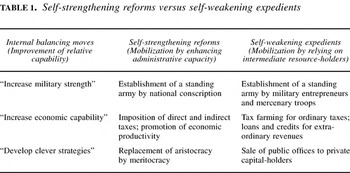
To a significant extent, the costs and benefits of war are shaped by the pursuit of self-strengthening reforms. Although the term “self-strengthening” is new to the IR literature, it has some affinity with the familiar concept of “internal balancing.” Kenneth Waltz argues that international competition compels states to make “moves to increase economic capability, to increase military strength, to develop clever strategies.”38
Waltz 1979, 118.
Gourevitch 1978, 896.
The concept of self-strengthening reforms goes beyond that of internal balancing moves. To begin with, the concept provides a theory of the state, which is necessary for a dynamic theory of international politics. Waltzian realists dismiss international analyses that look inside states as “reductionist.”41
Waltz 1979, 18–37.
Tilly 1992, 14–15.
State capacity refers to “the human and material resources the state can mobilize for its purposes and the effectiveness with which it can achieve its goals.” Wong 1997, 82.
Although neither classical nor structural realists pay much attention to state capacity, this is not the case for neoclassical realists. For instance, Christensen's concept of “national political power,” defined as “the ability of state leaders to mobilize their nation's human and material resources behind security policy initiatives,” is consistent with my conception of self-strengthening reforms. Christensen 1996, 11.
Tilly 1992, 29.
The concept of self-strengthening reforms also differs from internal balancing in that the former provides room for human creativity and historical contingency. Although international competition should compel states to increase their relative capabilities, international competition does not determine how states meet this challenge. If states mobilize additional resources of war by building up administrative capacity, then they are engaged in self-strengthening reforms. But some reform programs may be better than others, thus conferring an advantage upon those with higher administrative capacity. Moreover, as theorists of state formation have pointed out, while war may strengthen states in some cases, war may also weaken states in other cases.46
See Hui 2001; and Ertman 1997.
Kennedy 1987, 54.
Self-strengthening reforms versus self-weakening expedients

To sum up, I argue that international competition should be seen as processes of strategic interaction between domination-seekers and targets of domination. While attempts at domination are hindered by the countervailing mechanisms of balance of power and rising costs of expansion, domination-seekers may overcome them by pursuing divide-and-conquer strategies, ruthless tactics, and self-strengthening reforms. As self-strengthening reforms fundamentally shape relative capabilities and relative costs of war, they constitute the most crucial mechanism propelling the coercive transformation of an international system. In a system where self-strengthened states pursue opportunistic expansion by resorting to counterbalancing strategies and Machiavellian tactics, domination is not at all impossible. On the other hand, in a system where domination-seekers adopt self-weakening expedients instead of self-strengthening reforms, and do not ruthlessly pursue divide-and-conquer strategies and Machiavellian tactics, then conquest will be difficult and system maintenance will be more likely. Nevertheless, it is important to keep in mind that one should not push such “predictions” too far. Processes of strategic interaction allow for multiple equilibria that may be unpredictable a priori. While one can make an educated guess that the stronger side in any competition is more likely to win, actual outcomes are dependent on the strategic interplays between domination-seekers and targets, and between coercive mechanisms and countervailing mechanisms. This is another way to say that one should examine historical contexts.
Cases and Method
The term China or Zhongguo is commonly known to mean the “Middle Kingdom.” However, in the Spring and Autumn and Warring States periods, Zhongguo referred to “central states”—with zhong meaning central and guo meaning states. According to Jack Levy, an international system is composed of “states characterized by the centralization of political power within a given territory, independent from any higher secular authority and interacting in an interdependent system of security relations.”49
Levy 1983, 21.
Ibid., 21.
For sources on ancient China, see Brooks and Brooks, http://www.umass.edu/wsp; Chan 1999; Chen 1991; Gao 1995; Hsu 1997 and 1999; Hong 1975; Lewis 1990 and 1999; Lin 1992; Mu and Wu 1992; Sawyer 1994 and 1998; Sun 1999; Tian and Zang 1996; Walker 1953; Yang 1986; “Zhongguo junshishi” Editorial Board 1983–91; and “Zhongguo lidai zhanzheng nianbiao” Editorial Board 2003. Most of the events discussed are widely chronicled in sources on ancient China. Except for specific quotes or frequently less-cited pieces of information, citations for general historical events are not listed.
Lewis 1990, 47.
As I shall elaborate later, this point is overstated for European states.
I thank Bruce Brooks for this point. Personal communication, 2 June 2002. Other historians of ancient China typically date the beginning of the ancient Chinese system in 770 b.c. when the Spring and Autumn period begins. The issue of mutual awareness is analogous to what Buzan et al. call “interaction capacity.” See Buzan and Little 2000, 80–84.
It may be objected that ancient China and early modern Europe are not comparable cases. Indeed, the two systems represent extreme ends of East and West in terms of culture; they are located on different sides of the Eurasian continent in terms of space; and they are separated by more than 2,000 years in terms of time. Hence, these two systems are not amenable to the principle of maximizing underlying commonalities, which requires that researchers “test the validity of propositions by making comparisons between two situations that are identical except for one variable.”55
Jervis 1997, 73.
McAdam, Tarrow, and Tilly 2001, 81–84.
Ibid., 82–83. In the tradition of historical institutionalism, McAdam et al. focus on initial and environmental conditions in their analyses of contextualized conditions.
In examining why the two systems witnessed similar processes but reached diametrically opposite outcomes, it is important that one refrains from asking the question “Why did checks and balances fail in ancient China?” Treating ancient China as a deviant case would lead one to “take European developments as the norm” and then “search for what went wrong” in China.58
Wong 1999, 210.
Kohli and Shue 1994, 310.
For this view, see Chan et al. 2001.
Wong 1997, 93.
The Ancient Chinese System
Waltz is right to expect similar “substantive and stylistic characteristics” in the ancient Chinese system.62
Waltz 1979, 329–30.
Chu soon solicited assistance from Qin and drove away Wu's forces.
For a discussion of the balance of power as both balancing and balances, see Levy 2003.

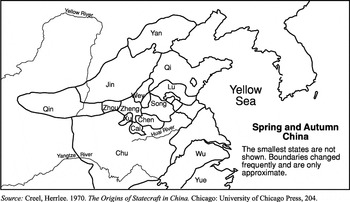
Ancient China in the middle to late Spring and Autumn period

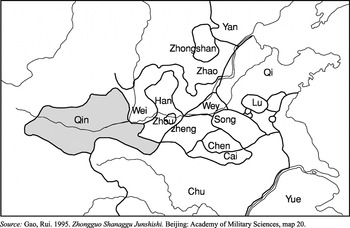
Ancient China ca. 450 b.c.

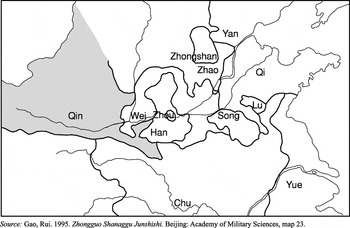
Ancient China ca. 350 b.c.
This scenario of relative stability was gradually disrupted as Qin embarked on what I call the “logic of domination” from 356 b.c. onward. Before then, however, Qin was weaker than other great powers. For centuries, Qin generally pursued a defensive foreign policy. It may even be said that Qin performed the role of the “balancer” during the rivalries between Jin and Chu from 632 to 546 b.c.—as both sides actively sought Qin's alliance—and between Chu and Wu in 505 b.c.—as Qin saved Chu from conquest by Wu. Moreover, Qin was badly beaten and lost large tracts of strategic territory on the west bank of the Yellow River to Wei (a successor state of Jin) in the period 419–385 b.c. Nevertheless, the conjuncture of early weakness and late development also carried advantages. When Qin proclaimed in the mid-fourth century b.c. that it pursued aggressive reforms and strategies merely to restore Qin's place among great powers,65
Yang 1986, 215.
This term is borrowed from Gerschenkron 1966.
Lewis 1999, 611.
Qin's self-strengthening reforms, introduced from 356 b.c. onward, were modeled on various fuguo qiangbing (rich country and strong army) programs of previous domination-seekers, especially those of Wei. But Qin's reforms surpassed others in terms of comprehensiveness and institutionalization. To “develop clever strategies,” Qin strictly applied the principle of meritocracy and completely eradicated the nobility from the administration. Most notably, Qin established an administrative hierarchy of prefectures, counties, townships, and villages that allowed the Qin court to penetrate deep into the society down to individual households. With this unprecedented capacity for direct rule, Qin could then engage in total mobilization for war. To “increase economic capability,” Qin granted lands to the entire registered male population to encourage productivity, and then taxed almost all wealth above subsistence level.68
In Qin, peasants were subject to land tax, head tax, military service, and all kinds of corvée. One account estimates that nearly two-thirds of a household's productivity were taxed. Lin 1992, 328. But there is no systematic analysis of the total tax burdens of free peasants in the historical literature. Brooks, personal communication, 15 June 2003.
While the originally weaker Qin pursued a defensive policy before 356 b.c., the self-strengthened Qin switched to an offensive policy in the post–356 b.c. period. Although Qin initiated only eleven (or 7 percent) of 161 wars involving great powers in the period 656–357 b.c., it initiated fifty-one (or 54 percent) of ninety-five wars involving great powers in the period 356–221 b.c.70
Hui forthcoming. Wars involving great powers are wars with at least one great power. Levy 1983.
As Qin's strength ascended, a hezong or balancing strategy, which called for the uniting of weaker states to resist domination, emerged in the 330s and 320s b.c. However, the neighbors of Qin's victims rarely “flock[ed] to the weaker side” as Waltz would expect.71
Waltz 1979, 127.
Mu and Wu, 1992, vol. 2, 148.
Sawyer 1994, 58–59.
By following Levy's rule of counting only wars involving great powers, I underestimate the degree of mutual aggression. Many wars that occurred after both (or all) belligerents lost their great-power status are not counted.
On top of the inherent weakness in the balance-of-power mechanism, Qin further pursued a lianheng or divide-and-conquer strategy to forestall hezong alliances from being formed and to break up already formed alliances. To divide and conquer and to minimize the costs of expansion, Qin “was never reluctant to lie in diplomatic meetings, to acquire information on other states by espionage, and to bribe key figures in the courts of other states into collaboration.”75
Hsu 1997, 5.
Johnston 1995, 249.
Lewis 1999, 591.
For instance, in 341 b.c., Qin tried to take advantage of Wei's crushing defeat by Qi and invaded Wei. As Qin's commander-in-chief was uncertain that he could defeat this formidable foe in a direct confrontation, he invited Wei's commander-in-chief to Qin's camp to negotiate a peace agreement. But Qin's commander captured Wei's commander instead and then seized territory with minimal fighting. Although Wei was originally significantly more powerful than Qin, the Qin-Wei balance of relative capabilities was reversed from then on. Three decades later in 312 b.c., Qin was still weaker than Qi and Chu, the two strongest states at the time. Even worse for Qin, these two powerful states were allied together. Qin's king then offered Chu's king 600 li of territory if the latter would break the alliance with Qi.78
One li is roughly equivalent to 0.3 mile or 0.49 kilometer. There is no agreement among historians as to whether 600 li in the historical materials referred to a total area of 600 square li or 600 li on one side. Exchanges on the Warring States Work Group, June 12–15, 2003.
Moreover, when balancing alliances were formed despite all odds, Qin would use bribery to sow discord among allies or to have competent generals removed. In 247 b.c., Qin was defeated by an alliance under the unified command of a Wei general. To arrest this setback, Qin bribed officials in the Wei court to spread the rumor that the commander-in-chief had ambitions to take over the throne. Wei's king soon dismissed the commander, and the alliance was dissolved. From then on, there was no more effective hezong alliance against Qin.
With weak balancing and strong counterbalancing, Qin's fifty-one expansionist wars in the period 356 to 221 b.c. met with only eight allied responses.79
Qin defeated or dissolved five of the anti-Qin alliances. Although three of these alliances defeated Qin, the defeats were not decisive enough to block Qin's rise to domination. On the other hand, Qin won forty-seven (or 92 percent) of the fifty-one wars involving great powers that it initiated, and three of the five wars in which it was the target.80Ibid.
Nevertheless, Zhao still had the capability to resist Qin. Unfortunately, Zhao's experience testified to the prevalence of opportunistic expansion, the weakness of the balance of power, and the effectiveness of stratagems. Although Zhao launched a military reform and established an independent cavalry in 307 b.c., it did not use its increased military strength to balance against Qin. As Qin encroached on other neighbors, Zhao pursued its own territorial ambitions, including conquest of the medium-sized state Zhongshan and expansion in the northern frontiers. When Qin planned a massive invasion of Chu in 279 b.c. and asked for a peace agreement with Zhao to avoid a rear attack, Zhao agreed despite the fact that since 284 b.c., Qin had emerged as the unmistakable threat to all states. Zhao eventually fought Qin only when Qin attacked it in 262 b.c.81
According to critics of balance-of-power theory, resistance does not constitute balancing. See Levy 2003; and Vasquez 1998.
It may be said that, after repeated defeats by Qin, other states should have increasingly understood that their survival was seriously at stake. In such a situation, IR scholars would expect Qin's targets to overcome the collective-action problem and engage in more effective balancing.82
Rosecrance 2001, 134–35.
Waltz 1979, 121.
Schroeder 2003, 121. Schroeder notes that Denmark and Norway did not balance against Hitler in 1939–40.
However, one should refrain from the determinism implied in mathematical calculation of relative capabilities. It is possible that ancient Chinese history remained open-ended for quite some time. Most notably, an anti-Qin alliance in 247 b.c. could still defeat Qin forces, and pushed them back to the Yellow River. This was the only anti-Qin alliance that enjoyed unified command. As noted above, Qin arrested such a major setback by getting rid of the commander-in-chief of allied forces. It was only after this incidence that unification became more or less inevitable.
Han feizi, cited in Goldin 2001, 152.

Ancient China ca. 257 b.c.
Waltz also argues that “states tend to emulate the successful policies of others.”87
Waltz 1979, 124.
Elster 1989, 18.
Lewis 1999, 639.
While Qin pursued a strategy of piecemeal encroachment during its rise to domination, it switched to swift conquests in 236 b.c. when the conditions for unification seemed ripe. Qin's strategist Li Si advised King Zheng that “the states now listen to Qin as if they were our prefectures and counties. Qin's strength and your honor's competence are enough to annihilate the states to build an empire. This is a rare opportunity in history. If Qin still proceeds slowly, then the states may recover and form another hezong alliance. When that happens, even your competence will not suffice for unification.”90
Mu and Wu 1992, 10.
But how did Qin swallow whole, sovereign territorial states on its march toward universal domination? This is an important question because the last effective check against domination is often the inability of conquerors to consolidate conquests. As noted above, a dynamic theory of international politics requires a theory of state formation. Qin's total conquests were significantly facilitated by its superior administrative capacity. At the same time, although other states had less centralized authority and were thus less capable of mobilizing resources and resisting Qin's stratagems, all of them had developed relatively coherent administrative and coercive apparatuses. As Niccolo Machiavelli and Max Weber observed two millennia later, impersonal, hierarchical administration—as opposed to the personal, decentralized authority of the feudal era—would facilitate wholesale takeovers.91
Machiavelli 1994, The Prince, chap. 4; and Weber 1958, 229. Note that ancient China also witnessed a feudal era in the Western Zhou period.
After unification, the mechanism of balance of power ceased to function, but that of rising costs remained in force. The First Emperor was not content with ruling only the preexisting areas of the conquered states, but sought to rule “all under heaven.” Various expansionist projects into multiple frontiers quickly pushed marginal costs of expansion to exceed marginal benefits. The subjects had to pay onerous military service, corvée, land tax, and head tax. As compliance meant hard labor, starvation, and even death, the people had little left to risk in staging rebellion. The death of the First Emperor in 209 b.c. provided a window of opportunity. Rebellions soon sprang up all over the empire. Nevertheless, the centralized bureaucratic and coercive apparatus laid down by the First Emperor significantly facilitated reimperialization. Although the Qin Dynasty collapsed in 206 b.c., the universal empire was reproduced by the Han and subsequent dynasties. Hui forthcoming.
The Early Modern European System
Knowledge of the ancient Chinese system may now be used to construct a “counterfactual Europe” so as to rethink the early modern European system. In light of the triumph of domination in ancient China, why was the multistate system preserved in early modern Europe? Bin Wong points out that “[t]he comparative historical perspective reveals an element of contingency that reflects the incompleteness of European patterns of … change.”93
Wong 1997, 87 (emphasis added).
Machiavelli 1994, The Prince, chap. 18.
Europeans did apply such nasty and brutish tactics against “uncivilized” colonial populations. One may then say that colonies provided “outlets” for Machiavellian tactics.
Some readers may find it counterintuitive that the early modern European system was in fact less “Machiavellian” than the ancient Chinese system. For realists, the European system is supposed to be a Hobbesian world of war of all against all. This view is exacerbated by cultural relativists and many constructivists who claim that non-Western cultures are far less warlike. See contributors to Chan et al. 2001. However, it is doubtful if such claims are grounded in fact. For instance, Snyder shows that many non-Western primitive cultures are in fact quite belligerent in anthropological accounts. Snyder 2002. Johnston further argues that the ancient Chinese strategic culture was characterized by “a parabellum or hard realpolitik view.” Johnston 1995, 61. As Sawyer points out, “the Warring States clearly displayed an ethos of violence and its admiration, contrary to much verbiage about China's pacific heritage and pervasive deprecation of martial values.” Sawyer 1998, 111. At the same time, more and more Europeanists have argued that the European system is in fact far from a state of war of all against all. See, for example, Schroeder 1994; Ruggie 1998; Osiander 2001. Holsti thus argues that the European system is more properly characterized as “a society of states” with shared norms while the ancient Chinese system is “a system of states” where power politics reigns supreme. Holsti 1999, 284–86. I agree that the relative prevalence of Machiavellian tactics may be explained by norms. But it may also be explained by the difference between self-strengthening reforms and self-weakening expedients. Most notably, European domination-seekers needed defeated states as allies and thus could not kill enemy soldiers en masse like Qin. For a more detailed discussion of both culture and norms, see Hui forthcoming.
Machiavelli 1994, The Prince, chap. 12.
Even more importantly, the earliest domination-seekers in Europe adopted self-weakening expedients rather than self-strengthening reforms. In ancient China, the earliest domination-seeking rulers of Chu, Qi, and Jin gradually built up their administrative capacity, expanded their armies from their own populations, promoted agricultural productivity as the basis of national wealth, and consolidated their control over conquered territories. Such early measures increasingly deepened over time, culminating in Qin's total mobilization for war in the fourth and third centuries b.c. In contrast, their counterparts in early modern Europe, France and the United Habsburgs, relied on intermediate resource-holders. To build larger armies, the French court and the Habsburg house did not improve their extractive capacities to mobilize national armies; instead, they relied on military entrepreneurs to establish mercenary armies. Although it was possible to build numerically stronger armies this way, Machiavelli had already observed that mercenary troops, as with allied forces, exhibited “cowardice” and were “useless” in terms of fighting capability.98
Ibid., chaps. 12, 13.
Black 1994, 67.
Mercenary armies were also extremely expensive in terms of costs. When the use of mercenaries was combined with the use of artillery, the costs of war became so high that both the French court and the Habsburg house were constantly on the verge of bankruptcy. Ordinary revenues only “dribbled in small amounts throughout the year”100
Kaiser 1990, 20.
For more elaborate analyses of these fiscal expedients, see Ertman 1997, chap. 3; and North and Thomas 1973, chap. 10.
Together, the use of costly mercenaries, contraction of unsustainable loans, and sale of public offices fundamentally undermined—if not negated—efforts to increase relative capabilities. Although European domination-seeking states generally could win wars against weaker neighbors, these states rarely could consolidate conquered territories. Moreover, as great powers did not have the administrative capacity to mobilize resources from their own populations, they also could not make conquests pay. Because even the most powerful states had severe difficulty mobilizing the resources of war, securing decisive victories, and consolidating conquests, international competition was significantly tempered in early modern Europe. Wars thus “repeatedly ended in restoration of either the status quo or a close approximation of it,”102
Gulick 1955, 39.
If self-weakening expedients hindered domination while self-strengthening reforms would have facilitated it, then why did European rulers adopt self-weakening expedients? It is noteworthy that Charles VII of France had embarked on nascent self-strengthening reforms before the onset of the early modern period. During the Hundred Years' War, France was so severely beaten that Charles VI accepted the king of England as his heir before he died in 1422. But the Dauphin Charles did not relinquish his claim to the throne. In his struggle to reclaim France, Charles VII established the first standing army in Europe, the Compagnies d'Ordonnance (twenty companies of heavy cavalry formed by French knights in 1445). He also imposed drastic increases in direct and indirect taxes. If France had carried forward such self-strengthening measures, then the European trajectory might have been more similar to the ancient Chinese trajectory.
However, Charles' policy package included other elements that were to have lasting consequences. France had earlier adopted mercenary forces from England. Charles created the standing cavalry, but mercenaries continued to serve in the infantry. Equally importantly, Charles adopted an earlier French practice of selling public offices.103
This leads to another question: why did such self-weakening expedients exist in Europe but not in China? See Hui forthcoming.
Brewer 1989, 24. As North puts it, because institutions involve transaction costs, there is no guarantee that international competition would discipline actors to switch from inefficient to efficient measures. North 1990, 16, 93, 99.
Kennedy 1987, 58–59.
This scenario began to change in the mid-seventeenth century, when Brandenburg-Prussia—a late developer less burdened by various self-weakening expedients of established great powers—embarked on internal balancing moves through administrative reforms. Similar to Qin in ancient China, the “little Brandenburg” that was badly exploited in the Thirty Years' War emerged a century later as the “mighty Prussia” that prevailed over Austria in 1740.106
Downing 1992, 143.
Among these earlier self-strengthening programs, Austria's reforms were the most half-hearted. This is not surprising given that Austria was split from the United Habsburgs.
International competition became further intensified in the Revolutionary era. The French Revolution overthrew not just the ancien regime, but also centuries-old self-weakening expedients. Revolutionary France could then pursue comprehensive self-strengthening reforms that were common in the late Warring States period but unprecedented in the early modern period: direct rule was installed; universal military conscription was introduced; and taxation was nationalized and rationalized. The introduction of universal military conscription, in particular, allowed France to enjoy multiple advantages of higher fighting capability, larger army size, and much lower war costs. Moreover, the revolutionary principle of meritocracy allowed Napoleon to rise to prominence. Napoleon was a genius not only on the battle front, but also on the diplomatic front. He was able to organize most of Europe for war against a single isolated foe in various instances. With coercive mechanisms and strategies that more closely resembled those in the ancient Chinese system, the Napoleonic Empire was able to sweep through the continent, conquer weaker states, and make conquests pay. At the height of its strength in 1810, Napoleonic France was on the verge of taking Europe onto the ancient-Chinese trajectory.
Nevertheless, even the Napoleonic Empire lived in the shadow of a self-weakened past. The late pursuit of self-strengthening reforms and the legacy of self-weakening expedients stacked the odds against France. First, while Qin enjoyed access to a large repertoire of coercive measures that had been accumulated through several centuries, Revolutionary and Napoleonic France had to innovate them more or less from scratch. Second, Qin's reforms and strategies were not revolutionary but merely surpassed those of other states in terms of comprehensiveness and institutionalization, thus allowing Qin not to appear too threatening for many decades. In contrast, France's revolutionary innovations made it an unmistakable threat to all, thereby triggering a stronger balance-of-power response.108
Critics of balance-of-power theory point out that balancing against Napoleonic France was very weak. See Rosecrance and Lo 1996; Schroeder 1994; and Schweller 1994. However, to the extent that Great Britain was determined to check France for even self-serving reasons, balancing was much stronger in early modern Europe than in ancient China.
Although the French Revolution brought about fiscal reforms that significantly increased national revenues, France inherited from the Old Regime crippling national debts that brought about the revolution in the first place. Most notably, when Napoleon mobilized 600,000 troops to attack Russia in 1812, he relied on allies to provide half of the troops and other resources. In contrast, when King Zheng mobilized 600,000 troops to invade Chu in 226–223 b.c., he called on only Qin's populations. The difference in extractive capacity is even more striking if one considers that France could well have had a larger population size (about 25 million) than that of all Warring States combined (about 20 million). For population estimates about ancient China, see Yang 1996, 54.
Hintze 1975, 192.
Hence, not all loans and credits are self-weakening. Britain's public credit system was very different from the old regimes' reliance on intermediate resource-holders, which did not involve enhancement of administrative capacity. There have been many studies on how the public credit system significantly enhanced Britain's relative capability. See Brewer 1989; Ertman 1997; North and Thomas 1973; and Shultz and Weingast 2003.
It may be countered that this historical comparison is also confounded by other environmental conditions, in particular, geography, military technology, and culture. With regard to geography, van Evera argues that “the geography of Western Europe, with its mountain ranges and ocean moats, is less favorable to conquest.” van Evera 1998/99, 19. However, in the areas unified by Qin, there are also significant geographical barriers—including the Qin Ranges, Taihang Mountains, Yellow River, Yangtze River, and Huai River—which facilitated the emergence and consolidation of independent states in the first place. With reference to military technology, Gilpin argues that “the imperial unification of China by Qin was due to advances in the offense over the defense.” Gilpin 1981, 61. However, it severely strains credulity to argue that cold weapons in the ancient period would favor universal domination while sophisticated artillery in the early modern period would favor the defense. As for culture, it is argued that domination was inherently easier in ancient China because Chinese states were more culturally homogeneous. However, as Fairbank points out, “it would be an error … to imagine ancient China as an embryonic nation-state. We would do better to apply the idea of culturalism and see ancient China as a complete civilization comparable to Western Christendom, within which nation-states like France and England became political subunits that shared their common European culture.” Fairbank 1992, 45. For a more in-depth discussion of these alternative explanations, see Hui forthcoming.
While balance-of-power theorists believe that it was the mechanism of balance of power that defeated France, their critics charge that it was the mechanism of overexpansion that brought about Napoleon's demise. For instance, John Vasquez argues that “[b]alancing did not defeat … Napoleon; overexpansion did.”113
Vasquez 2003, 92; see also Rosecrance and Lo 1996; Schroeder 1994, 2003; and Schweller 1994.
Conclusion and Implications
In sum, the theoretical framework of “dynamics of competing logics” provides a theory of international politics that can account for alternative trajectories and endogenous transformation. When international competition is seen as a process of strategic interaction between domination-seekers and targets of domination who employ competing strategies and are facilitated or hindered by competing causal mechanisms, the outcome of balance of power versus universal domination is not predictable a priori. While targets of domination are helped by the countervailing mechanisms of balance of power and rising costs of expansion, domination-seeking states may overcome such obstacles by self-strengthening reforms, divide-and-conquer strategies, and ruthless tactics. Self-strengthening reforms, in particular, critically shape relative capabilities and relative costs of war, thus providing the fuel for the coercive transformation of an international system.
The preceding analysis shows how the ancient Chinese trajectory unfolded according to this theoretical framework. In this system, domination-seeking rulers embarked on self-strengthening reforms right at the onset of system formation. As self-strengthening reforms allowed domination-seeking states to mobilize more resources of war, score more victories on the battlefields, and make conquests pay, their early pursuit tilted the competition toward domination-seekers. As territorial losses were common and even survival was genuinely at stake, states were compelled to constantly deepen their self-strengthening reforms and even to pursue dirty stratagems and barbaric tactics. In such an increasingly brutish and nasty world, the latecomer Qin could then achieve universal domination by pursuing the most comprehensive self-strengthening reforms and the most ruthless strategies and tactics.
In comparison, international competition was less intense for most of the early modern period. Although European rulers practiced balancing and counterbalancing, they rarely pursued ancient-Chinese-style stratagems and brutality against fellow Europeans. More importantly, the earliest domination-seekers adopted self-weakening expedients rather than self-strengthening reforms. With limited coercive capabilities and high war costs, wars were often indecisive, conquest was difficult, and the survival of sovereign states was rarely at stake. This scenario changed when Revolutionary and Napoleonic France eventually embarked on ancient-Chinese-style self-strengthening reforms and divide-and-conquer strategies. However, with the legacy of self-weakening expedients, Napoleonic France amassed much weaker coercive capabilities but faced much stronger balancing mechanisms. Paradoxically, then, it was the use of cowardly and costly mercenaries plus useless and dangerous auxiliaries as condemned by Machiavelli—that helped to deflect Europe from the Chinese trajectory.
Although Napoleonic France failed to dominate the European system, one should not overlook the fact that it came so close to succeeding against all odds. It is remarkable that even Europe, which lived in the shadow of a self-weakened past, eventually returned to the coercive trajectory. Although the ravages of the Napoleonic Wars brought about the Concert of Europe that tempered great-power competition, the Concert soon began to decay in the 1820s.114
Jervis 1982, 368.
In the postwar era, the motivation for opportunistic expansion that was common in both ancient China and modern Europe underwent significant transformation. Despite further increases in coercive capabilities, the European continent was transformed from a war zone into a peace zone. As a dynamic theory should explain both coercive and normative transformation, I will address the latter aspect in future work.
References
REFERENCES
Arreguín-Toft, Ivan.
2001.
How the Weak Win Wars: A Theory of Asymmetric Conflict.
International Security
26 (1):93–128.Google Scholar
Black, Jeremy.
1994.
European Warfare, 1660–1815.
New Haven, Conn.:
Yale University Press.
Brewer, John.
1989.
The Sinews of Power: War, Money and the English State,
1688–1783.
New York:
Knopf.
Brooks, E. Bruce.
1994.
The Present and Future Prospects of Pre-Han Text Studies.
Sino-Platonic Papers, No. 46.
Philadelphia:
Department of Oriental Studies, University of Pennsylvania.
Boulding, Kenneth E.
1963.
Conflict and Defense.
New York:
Harper and Row.
Buzan, Barry, and
Richard Little.
2000.
International Systems in World History: Remaking the Study of
International Relations.
Oxford:
Oxford University Press.
Chan, Gerald.
1999.
The Origin of the Interstate System: The Warring States in Ancient
China.
Issues and Studies
35 (1):147–66.Google Scholar
Chan, Stephen,
Peter Mandaville, and
Roland Bleiker, eds.
2001.
The Zen of International Relations: IR Theory from East to West.
New York:
Palgrave.
Chen, Enlin.
1991.
Xianqin junshi zhidu yanjiu (A Study of the Military System in the
Pre-Qin Period).
Changchun, China:
Jilin wenshi chubanshe.
Christensen, Thomas J.
1996.
Useful Adversaries.
Princeton, N.J.:
Princeton University Press.
Christensen, Thomas J., and
Jack L. Snyder.
1990.
Chain Gangs and Passed Bucks: Predicting Alliance Patterns in
Multipolarity.
International Organization
44 (2):137–68.Google Scholar
Downing, Brian.
1992.
The Military Revolution and Political Change.
Princeton, N.J.:
Princeton University Press.
Elster, Jon.
1989.
Nuts and Bolts for the Social Sciences.
New York:
Cambridge University Press.
Elster, Jon.
1993.
Political Psychology.
New York:
Cambridge University Press.
Ertman, Thomas.
1997.
Birth of the Leviathan: Building States and Regimes in Medieval and
Early Modern Europe.
New York:
Cambridge University Press.
Fairbank, John.
1992.
China: A New History.
Cambridge, Mass.:
Harvard University Press.
Gao, Rui.
1995.
Zhongguo shanggu junshishi (Military History of Ancient China).
Beijing:
Junshi kexue chubanshe.
Gerschenkron, Alexander.
1966.
Economic Backwardness in Historical Perspective: A Book of Essays.
Cambridge, Mass.:
Harvard University Press.
Gilpin, Robert G.
1981.
War and Change in World Politics.
New York:
Cambridge University Press.
Goldin, Paul R.
2001.
Han Feizi's Doctrine of Self-Interest.
Asian Philosophy
11 (3):151–59.Google Scholar
Gourevitch, Peter A.
1978.
The Second Image Reversed: the International Sources of Domestic
Politics.
International Organization
32 (4):881–912.Google Scholar
Gulick, Edward V.
1955.
Europe's Classical Balance of Power.
New York:
Norton.
Hintze, Otto.
1975.
Military Organization and the Organization of the State. In
The Historical Essays of Otto Hintze, edited by
Felix Gilbert,
178–215.
New York.:
Oxford University Press.
Hirschman, Albert.
1992.
Rival Views of Market Society and Other Recent Essays.
Cambridge, Mass.:
Harvard University Press.
Holsti, Kalevi J.
1999.
The Coming Chaos? Armed Conflict in the World's Periphery, In
International Order and the Future of World Politics, edited by
T. V. Paul and
John A. Hall,
283–310.
New York:
Cambridge University Press.
Hong, Junpei.
1975.
Chunqiu guoji gongfa (International Law in the Spring and Autumn
Period).
Taipei:
Wenshizhe chubanshe.
Hsu, Cho-yun.
1997.
War and Peace in Ancient China: The History of Chinese
Interstate/International Relations.
Occasional Paper Number 75.
Washington, D.C.:
Woodrow Wilson Center Asia Program.
Hsu, Cho-yun.
1999.
The Spring and Autumn Period. In
The Cambridge History of Ancient China: From the Origins of Civilization
to 221 B.C., edited by
Michael Loewe and
Edward L. Shaughnessy,
545–86.
New York:
Cambridge University Press.
Hui, Victoria Tin-bor.
2001.
The Emergence and Demise of Nascent Constitutional Rights:
Comparing Ancient China and Early Modern Europe.
Journal of Political Philosophy
9 (4):372–402.Google Scholar
Hui, Victoria Tin-bor.
Forthcoming.
War and State Formation in Ancient China and Early Modern Europe.
New York:
Cambridge University Press.
Jervis, Robert.
1997.
System Effects: Complexity in Political and Social Life.
Princeton, N.J.:
Princeton University Press.
Johnston, A. Iain.
1995.
Cultural Realism: Strategic Culture and Grand Strategy in Chinese
History.
Princeton, N.J.:
Princeton University Press.
Kaiser, David E.
1990.
Politics and War: European Conflict from Philip II to Hitler.
Cambridge, Mass.:
Harvard University Press.
Kaufman, Stuart J.
1997.
“The Fragmentation and Consolidation of International
Systems,”
International Organization
51 (2):173–208.Google Scholar
Kaysen, Carl.
1990.
Is War Obsolete? A Review Essay.
International Security
14 (4):42–64.Google Scholar
Kohli, Atul, and
Vivienne Shue.
1994.
State Power and Social Forces: On Political Contention and
Accommodation in the Third World. In
State Power and Social Forces: Domination and Transformation in the
Third World, edited by
Joel S. Migdal,
Atul Kohli, and
Vivien Shue,
293–326.
New York:
Cambridge University Press.
Krasner, Stephen D.
1984.
Approaches to the State: Alternative Conceptions and Historical
Dynamics.
Comparative Politics
16 (2):223–46.Google Scholar
Lake, David, and
Robert Powell, eds.
1999.
Strategic Choice and International Relations.
Princeton, N.J.:
Princeton University Press.
Levy, Jack S.
1983.
War in the Modern Great Power System, 1495–1975.
Lexington:
University Press of Kentucky.
Levy, Jack S.
2003.
Balances and Balancing: Concepts, Propositions, and Research
Design. In
Realism and the Balancing of Power: A New Debate, edited by
John A. Vasquez and
Colin Elman,
128–53.
Englewood Cliffs, N.J.:
Prentice-Hall.
Lewis, Mark E.
1990.
Sanctioned Violence in Early China.
Albany:
State University of New York Press.
Lewis, Mark E.
1999.
Warring States: The Political History. In
The Cambridge History of Ancient China: From the Origins of Civilization
to 221 B.C., edited by
Michael Loewe and
Edward L. Shaughnessy,
587–650.
New York:
Cambridge University Press.
Lin, Jianming.
1992.
Qin shi (A History of Qin).
Taipei:
Wunan Chubanshe.
Machiavelli, Niccolo.
1994.
Selected Political Writings: The Prince, Selections from the Discourses,
Letter to Vettori, translated and edited by
David Wootton.
Cambridge, Mass.:
Hackett Publishing.
Mahoney, James.
2000.
Path Dependence and Historical Sociology.
Theory and Society (29):
507–48.Google Scholar
McAdam, Doug,
Sidney Tarrow, and
Charles Tilly.
2001.
Dynamics of Contention.
New York:
Cambridge University Press.
Mearsheimer, John J.
1999.
Offensive Realism.
Paper presented at the 95th Annual Meeting of the American Political
Science Association, September, Atlanta, Ga.
Milner, Helen V.
1998.
Rationalizing Politics: The Emerging Synthesis of International,
American, and Comparative Politics.
International Organization
52 (4):759–86.Google Scholar
Morgenthau, Hans J.
1973 [1948].
Politics Among Nations: The Struggle for Power and Peace.
New York:
Knopf.
Mu, Zhongyue, and
Guoqing Wu.
1992.
Zhongguo zhanzhengshi (History of Wars in China),
multiple vols.
Beijing:
Jincheng chubanshe.
North, Douglas C.
1990.
Institutions, Institutional Change, and Economic Performance.
New York:
Cambridge University Press.
North, Douglas C., and
Robert P. Thomas.
1973.
The Rise of the Western World: A New Economic History.
New York:
Cambridge University Press.
Olson, Mancur.
1965.
The Logic of Collective Action.
Cambridge, Mass.:
Harvard University Press.
Osiander, Andreas.
2001.
Sovereignty, International Relations, and the Westphalian Myth.
International Organization
55 (2):251–87.Google Scholar
Pierson, Paul.
2000.
Path Dependence and the Study of Politics.
American Political Science Review
94 (2):251–67.Google Scholar
Roberts, Michael.
1995.
The Military Revolution, 1560–1660. In
The Military Revolution Debate: Readings on the Military
Transformation of Early Modern Europe, edited by
Clifford J. Rogers,
13–36.
Boulder, Colo.:
Westview Press.
Rosecrance, Richard.
2001.
Has Realism Become Cost-Benefit Analysis?
International Security
26 (2):132–54.Google Scholar
Rosecrance, Richard.
2003.
Is There a Balance of Power? In
Realism and the Balancing of Power: A New Debate, edited by
John A. Vasquez and
Colin Elman,
154–65.
Englewood Cliffs, N.J.:
Prentice-Hall.
Rosecrance, Richard, and
Chih-Cheng Lo.
1996.
Balancing, Stability, and War: The Mysterious Case of the
Napoleonic International System.
International Studies Quarterly
40 (4):479–500.Google Scholar
Ruggie, John G.
1998.
Constructing the World Polity: Essays on International
Institutionalization.
New York:
Routledge.
Sawyer, Ralph D., trans.
1994.
Sun Tzu: The Art of War.
Boulder:
Westview Press.
Sawyer, Ralph D., trans.
1998.
The Tao of Spycraft: Intelligence Theory and Practice in
Traditional China.
Boulder, Colo.:
Westview Press.
Schelling, Thomas C.
1960.
The Strategy of Conflict.
Cambridge, Mass.:
Harvard University Press.
Schroeder, Paul W.
1994.
Historical Reality vs. Neo-Realist Theory.
International Security
19 (1):
108–48.Google Scholar
Schroeder, Paul W.
2003.
Why Realism Does Not Work Well for International History. In
Realism and the Balancing of Power: A New Debate, edited by
John A. Vasquez and
Colin Elman,
114–27.
Englewood Cliffs, N.J.:
Prentice-Hall.
Schweller, Randall L.
1994.
Bandwagoning for Profit: Bringing the Revisionist State Back In.
International Security
19 (1):72–107.Google Scholar
Schweller, Randall L.
1996.
Neorealism's Status-Quo Bias: What Security Dilemma?
Security Studies
5 (1):90–121.Google Scholar
Shultz, Kenneth A., and
Barry R. Weingast.
2003.
The Democratic Advantage: Institutional Foundations of Financial
Power in International Competition.
International Organization
57 (1):3–42.Google Scholar
Snyder, Jack L.
1991.
Myths of Empire: Domestic Politics and International Ambition.
Ithaca, N.Y.:
Cornell University Press.
Snyder, Jack L.
2002.
Anarchy and Culture: Insights from the Anthropology of War.
International Organization
56 (1):7–45.Google Scholar
Sun, Yurong.
1999.
Gudai zhongguo guojifa yanjiu (A Study of International Law in
Ancient China).
Beijing:
Zhongguo zhengfa daxue chubanshe.
Tian, Changwu, and
Zhifei Zang.
1996.
Zhou Qin shehui jiegou yanjiu (A Study of Social Structures in the
Zhou and Qin Periods).
Xian:
Xibei University daxue chubanshe.
Tilly, Charles.
1975.
Reflections on the History of European State-Making. In
The Formation of the National States in Western Europe, edited by
Charles Tilly,
3–83.
Princeton, N.J.:
Princeton University Press.
Tilly, Charles.
1992.
Coercion, Capital, and European States, A.D. 990–1992.
Cambridge, Mass.:
Blackwell.
van Evera, Stephen.
1998/99.
Offense, Defense, and the Causes of War.
International Security
22 (4):5–43.Google Scholar
Vasquez, John A.
1998.
The New Debate on Balancing Power: A Reply to My Critics. In
Realism and the Balancing of Power: A New Debate, edited by
John A. Vasquez and
Colin Elman,
87–113.
Englewood Cliffs, N.J.:
Prentice-Hall.
Walker, Richard L.
1953.
The Multi-State System of Ancient China.
Westport, Conn.:
Greenwood Press.
Walt, Stephen M.
1987.
The Origins of Alliances.
Ithaca, N.Y.:
Cornell University Press.
Waltz, Kenneth N.
1979.
Theory of International Politics.
Reading, Mass:
Addison-Wesley.
Waltz, Kenneth N.
1986.
Reflections on Theory of International Politics:
A Response to My Critics. In
Neorealism and Its Critics, edited by
Robert O. Keohane,
322–45.
New York:
Columbia University Press.
Watson, Adam.
1992.
The Evolution of International Society.
London:
Routledge.
Weber, Max.
1958.
Bureaucracy. In
From Max Weber: Essays in Sociology, edited by
H. H. Gerth and
C. W. Mills,
196–244.
London:
Oxford University Press.
Wendt, Alexander.
1992.
Anarchy is What States Make of It: The Social Construction of Power
Politics.
International Organization
46 (2):391–425.Google Scholar
Wohlforth, William.
1999.
The Stability of a Unipolar World.
International Security
24 (1):5–41.Google Scholar
Wong, R. Bin.
1997.
China Transformed: Historical Change and the Limits of the European
Experience.
Ithaca, N.Y.:
Cornell University Press.
Wong, R. Bin.
1999.
The Political Economy of Agrarian Empire and Its Modern Legacy.
In
China and Historical Capitalism: Genealogies of Sinological
Knowledge, edited by
Gregory Blue and
Timothy Brook,
210–45.
Cambridge, N.Y.:
Cambridge University Press.
Yang, Kuan.
1986.
Zhanguo shi (History of the Warring States).
Taipei:
Gufon chubanshe.
Yang, Zihiu, ed.
1996.
Zhongguo lidai renkou tongji ziliao yanjiu (China
Historical Population Data and Relevant Studies).
Beijing:
Gaige chubanshe.
“Zhongguo junshishi” Editorial Board.
1983–91.
Zhongguo junshishi (Chinese Military History), multiple vols.
Beijing:
People's Liberation Army Press.
“Zhongguo lidai zhanzheng nianbiao” Editorial
Board.
2003.
Zhongguo lidai zhanzheng nianbiao (Chronology of Wars in China
Through Successive Dynasties).
Beijing:
People's Liberation Army Publisher.
Self-strengthening reforms versus self-weakening expedients
Ancient China in the middle to late Spring and Autumn period
Ancient China ca. 450 b.c.
Ancient China ca. 350 b.c.
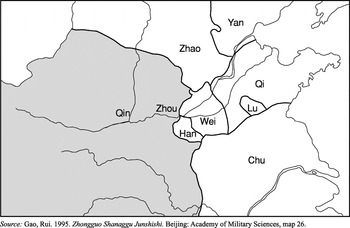
Ancient China ca. 257 b.c.
 You have
Access
- 38
- Cited by