Over the last decade, as evidenced by a rapidly growing body of literature, self-regulation has become one of the most central concepts in psychology (Baumeister, Vohs, & Tice, Reference Baumeister, Vohs and Tice2007; Denissen, van Aken, Penke, & Wood, Reference Denissen, van Aiken, Penke and Wood2013; Eisenberg, Reference Eisenberg, Oettingen and Gollwitzer2015; Moffitt et al., Reference Moffitt, Arseneault, Belsky, Dickson, Hancox, Harrington and Caspi2011). Moreover, self-regulation has been suggested to be one of the most crucial concepts for advancing our understanding of development and psychopathology (Posner & Rothbart, Reference Posner and Rothbart2000). On a daily basis people (attempt to) exert self-regulation across various domains, from interpersonal relationships to health behaviors. Several studies showed that the extent to which individuals succeed in exerting self-regulation has wide-ranging consequences for mental health (Bakker, Ormel, Verhulst, & Oldehinkel, Reference Bakker, Ormel, Verhulst and Oldehinkel2011; Moffitt et al., Reference Moffitt, Arseneault, Belsky, Dickson, Hancox, Harrington and Caspi2011; Roberts & Bogg, Reference Roberts and Bogg2004). However, much less is known on the social processes underlying these effects. Given the social consequences of self-regulation (Laceulle, Jeronimus, van Aken, & Ormel, Reference Laceulle, Jeronimus, van Aken and Ormel2015; Lüdtke, Roberts, Trautwein, & Nagy, Reference Lüdtke, Roberts, Trautwein and Nagy2011), as well as the impact of (negative) social experiences on the development of psychopathology (Auerbach, Bigda-Peyton, Eberhart, Webb, & Ho, Reference Auerbach, Bigda-Peyton, Eberhart, Webb and Ho2011; Coyne & Downey, Reference Coyne and Downey1991; Helsen, Vollebergh, & Meeus, Reference Helsen, Vollebergh and Meeus2000), it can be hypothesized that negative social experiences play an important role in (low) self-regulation driven psychopathology. Therefore, the current study aims to examine whether individual differences in negative social interactions experienced during adolescence can explain part of the long-term link between self-regulation and psychopathology. By doing so, this study extends our knowledge on self-regulation and psychopathology from the descriptive level (i.e., self-regulation and psychopathology are correlated) to the process level (i.e., what explains the effect of self-regulation on psychopathology).
Self-Regulation and Psychopathology
Self-regulation is an umbrella concept referring to the general capacity to regulate emotions, behaviors, and cognitions. Across the literature, the borders of what is and what is not self-regulation tend to be diffuse. There seems to be some agreement that self-regulation is conceptually and empirically not fully identical but related to emotion regulation, effortful control, self-control, conscientiousness, delay of gratification, executive functioning, willpower, and self-discipline (Duckworth & Kern, Reference Duckworth and Kern2011; Roberts, Chernyshenko, Stark, & Goldberg, Reference Roberts, Chernyshenko, Stark and Goldberg2005). The correlations between the various constructs are generally modest (e.g., Eisenberg et al., Reference Eisenberg, Guthrie, Fabes, Shepard, Losoya, Murphy and Reiser2000, Reference Eisenberg, Valiente, Spinrad, Cumberland, Liew, Reiser and Losoya2009). Nonetheless, they all seem to capture certain subdomains, aspects, or indicators of self-regulation by reflecting the way in which people attempt to modify their emotion reactions, encompass executive attention, and/or are able to inhibit or control a dominant response and activate a subdominant response (e.g., Eisenberg et al., Reference Eisenberg, Cumberland, Spinrad, Fabes, Shepard, Reiser and Guthrie2001; Gross, Reference Gross1998; Moffitt et al., Reference Moffitt, Arseneault, Belsky, Dickson, Hancox, Harrington and Caspi2011; Posner & Rothbart, Reference Posner and Rothbart2000). Moreover, they all tend to act in a collaborative manner when an individual engages in goal-directed behavior (Karoly, Reference Karoly1993). From this perspective, it may not be surprising that they are all investigated in the context of psychopathology. In general, individual differences in self-regulation are both concurrently and longitudinally related to an individual's risk for a wide variety of psychological problems. Links have been found for the externalizing domain, including conduct problems, delinquency, and substance use, as well as the internalizing domain, including depression, anxiety, and somatic problems (Aldao, Nolen-Hoeksema, & Schweizer, Reference Aldao, Nolen-Hoeksema and Schweizer2010; Oldehinkel, Hartman, de Winter, Veenstra, & Ormel, Reference Oldehinkel, Hartman, de Winter, Veenstra and Ormel2004; White, Jarrett, & Ollendick, Reference White, Jarrett and Ollendick2013). Although studies cover the full life span, the majority seems to have focused on children and adolescents. This may be a direct result of the steeply rising incidence rates for many psychological problems typical for the adolescent years (Bernstein, Borchardt, & Perwien, Reference Bernstein, Borchardt and Perwien1996; Hankin et al., Reference Hankin, Abramson, Moffitt, Silva, McGee and Angell1998), and the subsequent quest for understanding child and adolescent factors contributing to individual differences in the development of psychopathology.
In the adolescent literature, most consistent associations were found for the relation between self-regulation and externalizing problems (Aldao et al., Reference Aldao, Nolen-Hoeksema and Schweizer2010; Beauchaine, Gatzke-Kopp, & Mead, Reference Beauchaine, Gatzke-Kopp and Mead2007; Dawes, Tarter, & Kirisci, Reference Dawes, Tarter and Kirisci1997; Olson, Schilling, & Bates, Reference Olson, Schilling and Bates1999; Singh & Waldman, Reference Singh and Waldman2010; Young et al., Reference Young, Friedman, Miyake, Willcutt, Corley, Haberstick and Hewitt2009). For example, effortful control (i.e., reflective of behavioral inhibition and activation and cognitive control) has been repeatedly linked to externalizing problems in both children and adolescents (Eisenberg et al., Reference Eisenberg, Cumberland, Spinrad, Fabes, Shepard, Reiser and Guthrie2001; Laceulle, Ormel, Vollebergh, van Aken, & Nederhof, Reference Laceulle, Ormel, Vollebergh, van Aken and Nederhof2014; Oldehinkel et al., Reference Oldehinkel, Hartman, de Winter, Veenstra and Ormel2004). Response inhibition also has been linked to externalizing problems (Brunnekreef et al., Reference Brunnekreef, de Sonneville, Althaus, Minderaa, Oldehinkel, Verhulst and Ormel2007; Wang, Deater-Deckard, Petrill, & Thompson, Reference Wang, Deater-Deckard, Petrill and Thompson2012). Moreover, in their studies on children's externalizing behavior, Eisenberg et al. (Reference Eisenberg, Guthrie, Fabes, Shepard, Losoya, Murphy and Reiser2000, Reference Eisenberg, Cumberland, Spinrad, Fabes, Shepard, Reiser and Guthrie2001, Reference Eisenberg, Valiente, Spinrad, Cumberland, Liew, Reiser and Losoya2009) repeatedly showed that a range of self-regulatory capacities (i.e., negative emotionality, impulsivity, behavior inhibition, and attentional control) were all unique predictors of externalizing problems.
With regard to the internalizing domain, findings seem somewhat less consistent. Most studies have focused on emotion regulation, suggesting that in particular low emotion regulation capacity (Bandura, Caprara, Barbaranelli, Gerbino, & Pastorelli, Reference Bandura, Caprara, Barbaranelli, Gerbino and Pastorelli2003; Crockett, Carlo, Wolff, & Hope, Reference Crockett, Carlo, Wolff and Hope2013; Larsen et al., Reference Larsen, Vermulst, Geenen, van Middendorp, English, Gross and Engels2013) and a limited range of emotion regulation strategies (Lougheed & Hollenstein, Reference Lougheed and Hollenstein2012) are related to higher levels of internalizing problems. With regard to other indicators of self-regulation, studies are often limited to research on young children's effortful control and concurrent or subsequent internalizing problems, and findings have been rather ambiguous. Some studies found, similar to the findings on externalizing problems, a negative association between effortful control and internalizing problems (Eisenberg et al., Reference Eisenberg, Valiente, Spinrad, Cumberland, Liew, Reiser and Losoya2009). Some studies suggested that especially the cognitive aspect of effortful control, not so much its behavioral aspect, might protect against the development of internalizing problems (Eisenberg et al., Reference Eisenberg, Cumberland, Spinrad, Fabes, Shepard, Reiser and Guthrie2001, Reference Eisenberg, Valiente, Spinrad, Cumberland, Liew, Reiser and Losoya2009). This seems in line with earlier findings showing that attentional bias may be related to more internalizing problems (e.g., in a sample of high-anxious children; Vasey, El-Hag, & Daleiden, Reference Vasey, El-Hag and Daleiden1996). This is, however, in contrast to some studies in young children showing that higher levels of effortful control may also be related to more internalizing problems (Karreman, de Haas, van Tuijl, van Aken, & Deković, Reference Karreman, de Haas, van Tuijl, van Aken and Deković2010; Murray & Kochanska, Reference Murray and Kochanska2002). This was initially found in a sample of young children (Karreman et al., Reference Karreman, de Haas, van Tuijl, van Aken and Deković2010), but it may also be the case in older children or adolescents when (too much) effortful control leads to excessive control, which in turn contributes to the development of internalizing problems (Robins, John, Caspi, Moffitt, & Stouthamer-Loeber, Reference Robins, John, Caspi, Moffitt and Stouthamer-Loeber1996).
Sequences of Maladaptation: Negative Social Interactions as a Mediator in the Link Between Self-Regulation and Psychopathology
Despite the increasing focus on self-regulation in the literature, the mechanisms (and in particular the social processes) underlying the link between self-regulation and psychopathology are still largely speculative. Several studies suggest that negative social interactions might play a role in the low self-regulation–psychopathology link (Kim & Cicchetti, Reference Kim and Cicchetti2010; White et al., Reference White, Jarrett and Ollendick2013; Wills & Bantum, Reference Wills and Bantum2012). Intense social interactions are one of the hallmarks of adolescence (Furman & Buhrmester, Reference Furman and Buhrmester1992; Furman & Shomaker, Reference Furman and Shomaker2008; Lempers & Clark-Lempers, Reference Lempers and Clark-Lempers1992). Potential negative social interactions with parents, peers, or romantic partners require efforts to self-regulate behavior, cognitions, and emotions. Increasing empirical evidence provides support for the role of social relations in adolescent self-regulation and vice versa (for a review, see Farley & Kim-Spoon, Reference Farley and Kim-Spoon2014). For example, adolescents high on self-regulatory skills were more likely to have high-quality relationships than their less regulated peers (e.g., DeWall, Baumeister, & Vohs, Reference DeWall, Baumeister and Vohs2008; McKown, Gumbiner, Russo, & Lipton, Reference McKown, Gumbiner, Russo and Lipton2009). In addition, children and adolescents low on self-regulation are more likely to be involved in negative interactions (Laceulle et al., Reference Laceulle, Jeronimus, van Aken and Ormel2015; Lüdtke et al., Reference Lüdtke, Roberts, Trautwein and Nagy2011), experience more isolation and rejection (Hanish et al., Reference Hanish, Eisenberg, Fabes, Spinrad, Ryan and Schmidt2004), and exhibit more undercontrolled social behaviors (Calkins, Gill, Johnson, & Smith, Reference Calkins, Gill, Johnson and Smith1999; Cole, Zahn-Waxler, Fox, Usher, & Welsh, Reference Cole, Zahn-Waxler, Fox, Usher and Welsh1996; Hanish et al., Reference Hanish, Eisenberg, Fabes, Spinrad, Ryan and Schmidt2004).
Whereas self-regulation might initially be most important for relationships with parents, it has also been suggested to play some part in the newly developing relations with peers and romantic partners (Farley & Kim-Spoon, Reference Farley and Kim-Spoon2014). For example, low self-regulation has been related to weak social bonds and less harmonious interpersonal relationships later in life (Wright, Caspi, Moffitt, & Silva, Reference Wright, Caspi, Moffitt and Silva1999). However, regardless of the relationship context, low self-regulation may be related to negative social experiences such as conflicts and fights, and in the context of peers and romantic partners, low self-regulation may even be linked to relationship termination. These negative social interactions, in turn, may contribute to the development of psychopathology by accumulating negative outcomes. Previous research has consistently shown that negative social interactions are related to subsequent internalizing and externalizing problem behaviors. For example, in a large sample of adolescents, it was found that a lack of experienced support (in particular from parents, but to some extent also from peers) was predictive of more emotional problems some years later (Helsen et al., Reference Helsen, Vollebergh and Meeus2000). In another study, parent–adolescent conflict was associated with peer-reported externalizing problems, and friendship conflict was associated with externalizing behaviors (Ehrlich, Dykas, & Cassidy, Reference Ehrlich, Dykas and Cassidy2012). In a study on adolescents from adoptive families, it was found that parent–child conflict predicted the development of externalizing problems (i.e., conduct problems) 4 years later (Klahr, McGue, Iacono, & Burt, Reference Klahr, McGue, Iacono and Burt2011). Using the same sample as the current study, it was found that both loss of relationships and peer victimization were related to more internalizing and externalizing problems in early adolescence (Bakker, Ormel, Verhulst, & Oldehinkel, Reference Bakker, Ormel, Verhulst and Oldehinkel2010). Finally, in a meta-analysis evidence was provided that children and adolescents who experienced more conflicts with siblings, showed higher levels of both externalizing and internalizing problems (Buist, Deković, & Prinzie, Reference Buist, Deković and Prinzie2013).
Taken together, associations between self-regulation, negative social interactions, and psychopathology have consistently been found. This suggests that self-regulation might be a driving factor in developmental sequences of (mal)adaptation. It may not only have predictive value for negative interactions and psychopathology but also set in motion person–environment transactions that in the long run contribute to psychopathology. Some evidence for such transactions was provided by a study demonstrating that children with low self-regulation experienced more negative interactions that, in turn, were related to more mental health problems 1 year later (Kim & Cicchetti, Reference Kim and Cicchetti2010). Nonetheless, sequences of self-regulation, negative social interactions, and subsequent psychopathology have not been tested by means of longitudinal mediation models. The use of longitudinal mediation models is needed to move beyond the nowadays well-reported associations between self-regulation and psychopathology, self-regulation and negative social interactions, and negative social interactions and psychopathology, and to shed light on processes by which self-regulation affects developmental outcomes from a more integrative, life span perspective.
The Present Study
Responding to the increasing recognition of self-regulation as a central concept for development and psychopathology, this study aims to investigate sequences of early adolescent self-regulatory capacities, adolescents’ negative social interactions, and young adult psychopathology in order to test the hypothesis that negative social interactions explain (part of) the prospective link between self-regulation and psychopathology. Three indicators of self-regulation are included: frustration (negative affect related to interruption of ongoing tasks or goal blocking), effortful control (capacity to control attention, activation, and inhibition), and response inhibition (ability to inhibit an inappropriate, habitual response tendency). In line with previous studies, it is hypothesized that adolescent low self-regulation is related to higher levels of psychopathology several years later. Specifically, all three indicators of self-regulation are expected to predict subsequent externalizing problems. Furthermore, it is expected that in particular, high frustration and low response inhibition are related to more subsequent internalizing problems. For effortful control, findings so far are somewhat inconsistent. However, based on previous studies on the current data (Laceulle et al., Reference Laceulle, Jeronimus, van Aken and Ormel2015; Oldehinkel et al., Reference Oldehinkel, Hartman, de Winter, Veenstra and Ormel2004), higher effortful control is expected to show a modest association with fewer internalizing problems. Subsequently, the mediating role of negative social interaction in the associations between self-regulation and psychopathology will be tested. Previous literature emphasized the important role of social interaction with parents, peers, and romantic partners during adolescence. For that reason, we included negative social interactions in all these domains (Farley & Kim-Spoon, Reference Farley and Kim-Spoon2014), such as being thrown out of the parental home, being bullied among peers, and breaking up a romantic relationship. It is expected that individual differences in self-regulation are predictive of experiences of more subsequent negative social interactions, which in turn contribute to the development of internalizing and externalizing problem behaviors. In doing so, it will be analyzed whether sequences of self-regulation, negative social interactions, and psychopathology vary across indicators of self-regulation and psychopathology.
Method
Sample
The Tracking Adolescents’ Individual Lives Survey (TRAILS) is a large prospective cohort study of Dutch adolescents, who are followed biennially or triennially from 11 to at least 25 years of age. The present study involves data from the first, third, and fifth assessment waves. Children born between October 1, 1989, and September 30, 1991, were eligible for inclusion, providing they met the inclusion criteria and their schools were willing to participate (de Winter et al., Reference de Winter, Oldehinkel, Veenstra, Brunnekreef, Verhulst and Ormel2005). Over 90% of the schools, enrolling a total of 2,935 eligible children, agreed to participate in the study. Through extended efforts, 76% of these children and their parents consented to participate (Time 1 n = 2,230, mean age = 11.1 years, SD = 0.6, 50.8% girls). Subsequent data collection waves took place bi- or triennially, and had good retention rates (Time 3 81%, mean age 16.13 and Time 5 80%, mean age 22.26). Each assessment wave was approved by the Dutch Central Committee on Research Involving Human Subjects (www.ccmo.nl). Adolescents were included in the current study when they had data on all main constructs (self-regulation at age 11, psychopathology at ages 11 and 22, and negative interactions experienced between ages 11 and 22). As not all Time 3 participants participated in the life experience interview, this resulted in a total sample of 962 adolescents participating in the current study. However, no differences were found between responders and nonresponders with respect to problem behaviors and in the associations between sociodemographic variables and mental health indicators. In addition, we examined whether individuals who were interviewed about exposure to negative social interactions differed from those who were not interviewed on the questionnaire assessing frustration and effortful control at age 11 years and on internalizing and externalizing problems at ages 11 and 22. The largest effect was found for effortful control, with children with low scores on effortful control showing slightly higher attrition, F (1, 1981) = 6.63, p = .010. However, this difference was very small (partial η2 = 0.003, which can be interpreted as a negligible effect; Cohen, Reference Cohen1992). As such, our results seem not seriously biased. A detailed description of the sample selection, procedures and methods can be found elsewhere (de Winter et al., Reference de Winter, Oldehinkel, Veenstra, Brunnekreef, Verhulst and Ormel2005; Oldehinkel et al., Reference Oldehinkel, Rosmalen, Buitelaar, Hoek, Ormel, Raven and Hartman2015).
Measures
Psychopathology
Psychopathology, as rated by adolescents, was assessed using the Youth Self-Report (YSR; age 11) and the Adult Self-Report (ASR; age 22). The YSR has been widely used to assess self-report symptom dimensions (Achenbach, Reference Achenbach1991). Symptom dimensions in the internalizing domain that are covered by the YSR are anxious–depressed, withdrawn–depressed, and somatic complaints. Symptom dimensions in the externalizing domain that are covered by the YSR are aggression and delinquent behavior. At Time 5, when adolescents were 22 years old on average, the ASR replaced the YSR. Although the ASR contains slightly different items (more appropriate for older adolescents) the symptoms covered were identical to the symptoms covered by the YSR. Items were scored on a 3-point Likert scale (as 0 = not true to 2 = very or often true). Internal consistency at age 11 was 0.85 for the externalizing scale and 0.87 for the internalizing scale. At age 22 internal consistency was 0.87 for the externalizing scale and 0.93 for the internalizing scale.
Self-regulation
Self-regulation was measured at age 11 and assessed with three measures: frustration and effortful control with the parent version of the Early Adolescent Temperament Questionnaire—Revised (EATQ-R: Hartman, Reference Hartman2000; Putnam, Ellis, & Rothbart, Reference Putnam, Ellis, Rothbart, Eliasz and Angleitner2001) and response inhibition with the Amsterdam Neuropsychological Task (ANT) program (de Sonneville, Reference de Sonneville1999). All measures were coded in a way that higher scores reflected better self-regulatory capacities.
The EATQ-R is a 62-item questionnaire, based on the temperament model developed by Rothbart, Ahadi, and Evans (Reference Rothbart, Ahadi and Evans2000). For the current study, we used two scales: frustration (negative affect related to interruption of ongoing tasks or goal blocking; 5 items) and effortful control (capacity to control attention, activation, and inhibition; 11 items). Answers were rated on a 5-point Likert-type scale (1 = almost always untrue to 5 = almost always true). Eight-week test–retest stability of the parent-reported EATQ-R scales has been found to be moderate to good (Muris & Meesters, Reference Muris and Meesters2009). In the current study, internal consistency of the scales was adequate: α = 0.74 (frustration) and α = 0.86 (effortful control).
Response inhibition derived from the baseline and inhibition condition of the shifting set task of the ANT program (Brunnekreef et al., Reference Brunnekreef, de Sonneville, Althaus, Minderaa, Oldehinkel, Verhulst and Ormel2007; de Sonneville, Reference de Sonneville1999) were used to assess the ability to inhibit a prepotent response (i.e., an inappropriate, habitual response tendency). In the baseline condition of this task, participants had to copy the direction of the movement of a square (i.e., a left movement requires pressing the left mouse button and a right movement required pressing the right mouse button). In the inhibition condition, this natural and well-practiced response tendency had to be inhibited by reversing the response (i.e., a left movement required pressing the right mouse button and a right movement required pressing the left mouse button). Response inhibition was indexed by the difference in reaction times between the responses during the baseline and inhibition condition (see Brunnekreef et al., Reference Brunnekreef, de Sonneville, Althaus, Minderaa, Oldehinkel, Verhulst and Ormel2007; Oldehinkel, Hartman, Nederhof, Riese, & Ormel, Reference Oldehinkel, Hartman, Nederhof, Riese and Ormel2011, for previous use of this measure in the TRAILS study). To ease comparison with the questionnaire-based self-regulation measures, this difference was calculated in such a way that a high score represents a high ability to inhibit inappropriate responses. In addition, reaction time scores that were more than 4 SD above the mean were defined as outliers. These outliers as well as participants performing at chance level of accuracy, making 50% or more errors, were considered missing. This approach is in line with earlier work on this data (Brunnekreef et al., Reference Brunnekreef, de Sonneville, Althaus, Minderaa, Oldehinkel, Verhulst and Ormel2007) and based on Stevens (Reference Stevens2012). The total ANT lasted for about 70 min and consisted of seven tasks (Brunnekreef et al., Reference Brunnekreef, de Sonneville, Althaus, Minderaa, Oldehinkel, Verhulst and Ormel2007). Adolescents were tested individually in a separate room at their school or, if this was not possible, a nearby community center. Tasks were administered by trained undergraduate psychologists. Before each task, adolescents were shown a screenshot of relevant task characteristics and received verbal instructions, emphasizing both speed and accuracy of performance. Practice trials were run prior to the administration of the test trials to ensure that the adolescents understood the instructions.
Negative social interactions
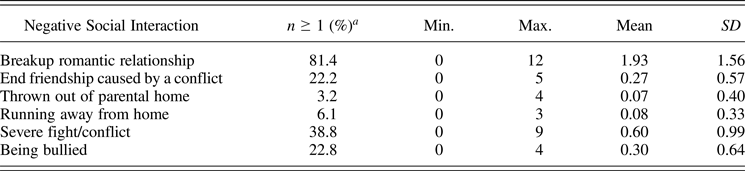
Negative social interactions were captured at ages 16 and 22 years using the Event History Calendar (EHC), a data collection method for obtaining retrospective data about life experiences and activities developed by Caspi et al. (Reference Caspi, Moffitt, Thornton, Freedman, Amell, Harrington and Silva1996). For the present study, we adapted the calendar into an interview on several life domains that lasted about 45 min. At age 16, participants were asked about experiences that occurred since baseline (i.e., between ages 11 and 16). At age 22 participants were asked about experiences that occurred since age 16 (i.e., between ages 16 and 22). Events were included in three social domains that have previously been suggested to be important in adolescence: parents, peers, and romantic partners. Events included were being thrown out of the parental home, running away from home, having a severe fight/conflict, being bullied, ending friendship caused by a conflict, and breaking up after a romantic relationship (see Table 1). Detailed data about the experiences could be collected by proceeding serially from one life domain to another and using a month-by-month horizontal timeline. For example, with regard to romantic relationships, adolescents were asked by the interviewer about the start and end dates of relationships, and about who initiated the breakup. Short-term test–retest reliability has generally been found to be reasonable to good (72%–87% in a sample of young adults; (Freedman, Thornton, Camburn, Alwin, & de Young, Reference Freedman, Thornton, Camburn, Alwin and de Young1988) and >90% in a sample of adolescents (Caspi et al., Reference Caspi, Moffitt, Thornton, Freedman, Amell, Harrington and Silva1996). Specifically, in their longitudinal–epidemiological study Caspi et al. found over 90% agreement between EHC data and data reported in the same month 3 years earlier for living arrangements, cohabitation, schooling, employment, and job training. Construct validity of the EHC was investigated in a comparative study by Belli, Shay, and Stafford (Reference Belli, Shay and Stafford2001), showing reasonable correlation coefficients between a written questionnaire and the EHC (ranging from 0.63 to 0.79).
Descriptive statistics for the six negative social interaction experiences

aThe percentage of the sample who experienced the respective interaction at least once.
For the current study, we included information on all negative social interactions adolescents experienced. There is no consensus on the optimal way to aggregate life experience measures (Monroe, Reference Monroe2008). However, previous research on social readjustment after experiencing life events showed that the impact of infrequent experiences is often larger than that of the more common experiences (Holmes & Rahe, Reference Holmes and Rahe1967; Masuda & Holmes, Reference Masuda and Holmes1978). By analogy, in the current study we used the inverse of the prevalence of the negative social interaction experiences in order to weight the likely impact of the experience. For example, when 81.4% of the participants reported the end of a romantic relationship between ages 11 and 22 the weight of this item was 0.186 ([100–81.4] / 100). The weight was multiplied by the number of times the adolescent reported the experience. For example, if an adolescent reported the end of a romantic relationship three times, the total score for this adolescent was 0.186 × 3 = 0.558. Finally, the weighted scored were aggregated into a sum score reflecting the (weighted) amount of negative social interactions an adolescent experiences. This method has been previously used in another TRAILS study and compared to a simple count variable in the context of life events and depressive symptoms, suggesting no meaningful differences between the two approached (Jeronimus, Ormel, Aleman, Penninx, & Riese, Reference Jeronimus, Ormel, Aleman, Penninx and Riese2013).
Statistical analyses
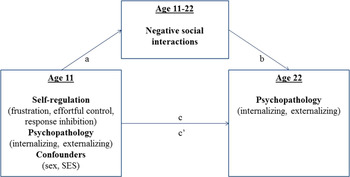
Variables were transformed into z scores for both the correlation and mediation analyses. We examined the direct effects of self-regulation on subsequent psychopathology, as well as the possible mediating role of negative social interaction, as outlined in Figure 1. Mediation analyses were performed for each of the three indicators of self-regulation. Internalizing and externalizing psychopathology were included simultaneously, taking into account the correlation between the two outcome measures (r = .65). In addition, to test the robustness of our results, multivariate mediation analyses were performed in which all indicators of self-regulation were entered simultaneously to test for (the mediation of) the independent effects of each self-regulation capacity adjusted for the effect of all other capacities. All mediation analyses were controlled for internalizing and externalizing psychopathology at age 11, sex, and socioeconomic status (SES) using indirect effect models.
(Color online) A theoretical model of how the effect of self-regulation on psychopathology is divided over direct effects and mediation via negative social interactions.
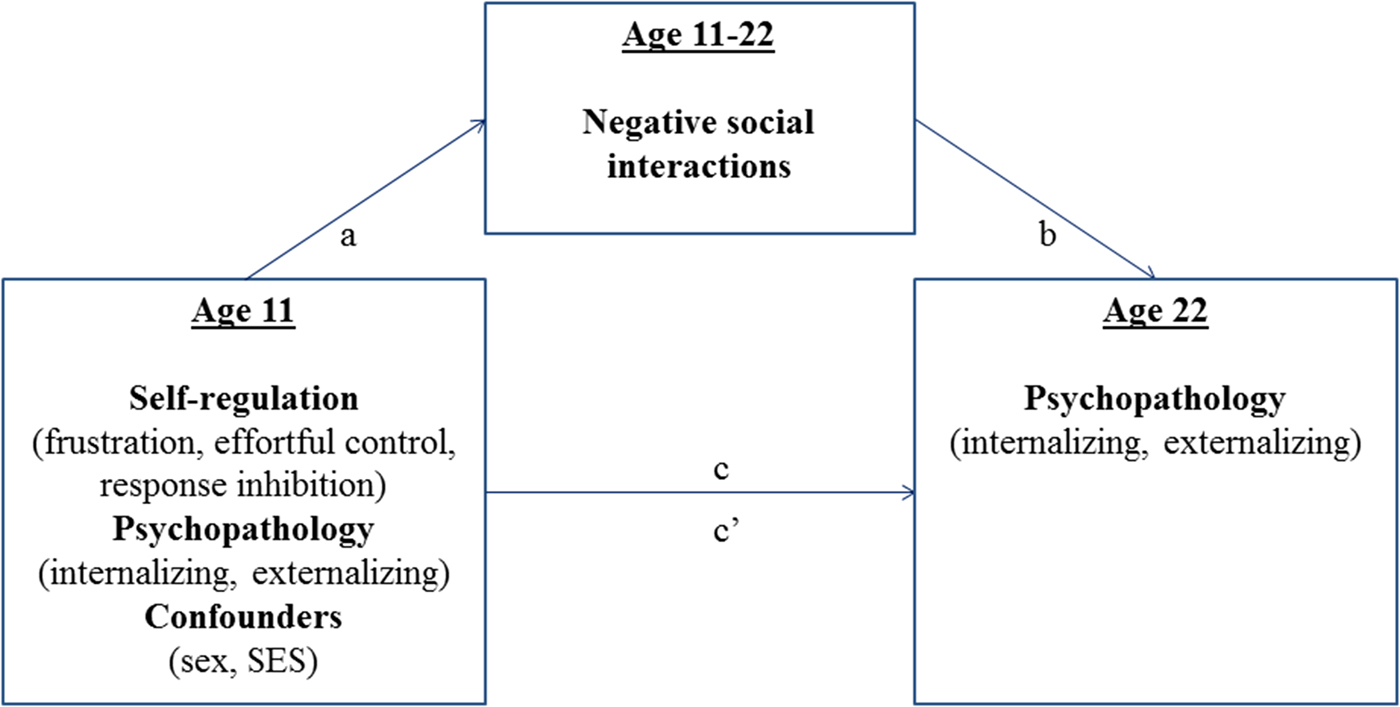
The theoretical model of the prospective association between self-regulation and psychopathology in Figure 1 shows a direct effect on psychopathology (path c) and the direct effect when the indirect path is controlled for (path c′). The relationship between self-regulation and negative social interactions are indicated through path a 1. The effect of the negative social interactions on psychopathology is figured through path b 1. The linear regression technique used in this method is known to remain valid when the dependent variable violates the “normality assumption” in a sample of our size (Li, Wong, Lamoureux, & Wong, Reference Li, Wong, Lamoureux and Wong2012). However, to ensure the robustness of our results, we bootstrapped all linear regression analyses (k = 1,000 with bias-corrected confidence intervals) to obtain asymptotic 95% confidence intervals around the indirect effects. Confidence intervals not including zero reflect significant indirect effects.
Results
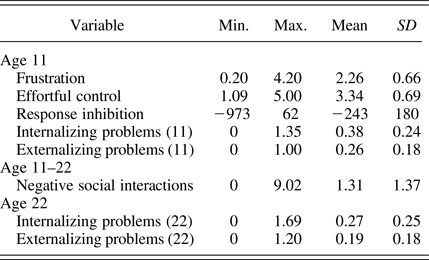
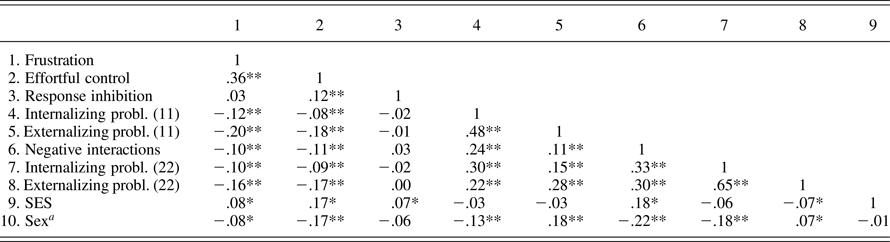
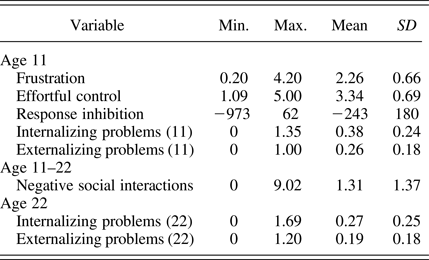
Descriptive statistics for all unstandardized study variables are reported in Table 2. Table 3 presents correlations between the self-regulation measures, internalizing and externalizing problems at ages 11 and 22, negative social interactions, sex, and SES. Significant correlations were found between all variables except the correlations with response inhibition. Most important, better self-regulation (i.e., lower frustration and higher effortful control) was related to less negative social interactions and lower levels of psychopathology (internalizing and externalizing). Response inhibition was only significantly related to effortful control and SES, showing that individuals higher on effortful control and SES also scored higher on the response inhibition task. Higher SES was related to more frustration and effortful control, higher SES, less negative social interactions, and less externalizing at Time 5. Girls scored lower than boys on frustration and externalizing problems (both at ages 11 and 19), but higher on effortful control and internalizing problems (both at ages 11 and 19). In addition, girls reported having experienced less negative social interactions.
Descriptive statistics for all unstandardized study variables
Correlations between the study variables
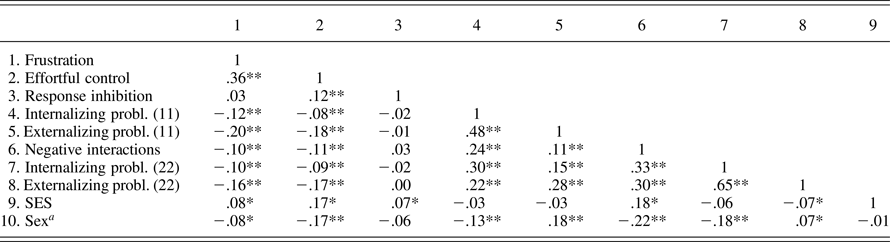
aSex is coded as follows: girls = 0, boys = 1.
*p < .05. **p < .01.
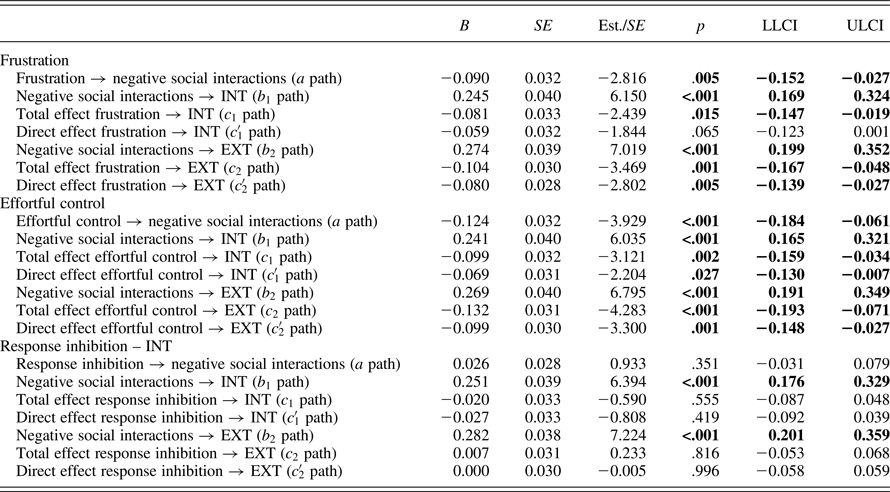
Direct and total effects
Mediation analyses (one analysis for each of the self-regulatory indicators) provided path estimates for all links presented in Figure 1. As all measures were standardized prior to the analyses, the estimates reflect standardized coefficients. All effects are controlled for sex and SES. The a paths reflect the links between the three indicators of self-regulation and negative social interactions. Path coefficients demonstrate that adolescents who scored higher on frustration and lower on effortful control (but not response inhibition) at age 11 experienced more negative social interactions than their more regulated peers. The b paths reflect the associations between negative social interactions and internalizing and externalizing problems. Findings show that adolescents who experienced more negative social interactions reported more internalizing and externalizing problems. The overlapping confidence intervals suggest that this effect was similar for externalizing and for internalizing problems. The c paths reflect the total effects (i.e., the direct + the indirect effects) of all three indicators of self-regulation on internalizing and externalizing problems. Path coefficients showed that frustration and effortful control at age 11, but not response inhibition, were related to psychopathology at age 22, even after controlling for internalizing and externalizing problems at age 11. However, after taking into account the indirect effect, the direct effects (path c′), the strength of the associations between self-regulation and psychopathology decreases. Moreover, frustration was no longer significantly related to internalizing problems when negative social experiences were included as a mediator. All path coefficients for the various associations are reported in Table 4. Model fit statistics for the various models were as follows: frustration χ2 baseline (18) = 925.95, p < .001, Akaike information criterion (AIC) = 7,187.93, Bayesian information criterion (BIC) = 7,304.38, comparative fit index (CFI) = 1.00, root mean square error of approximation (RMSEA) = 0.00; effortful control χ2 baseline (18) = 936.39, p < .001, AIC = 7,177.49, BIC = 7,293.95, CFI = 1.00, RMSEA = 0.00; response inhibition χ2 baseline (18) = 912.96, p < .001, AIC = 7,201.02, BIC = 7,317.47, CFI = 1.00, RMSEA = 0.00.
Direct and total relationships of the various associations
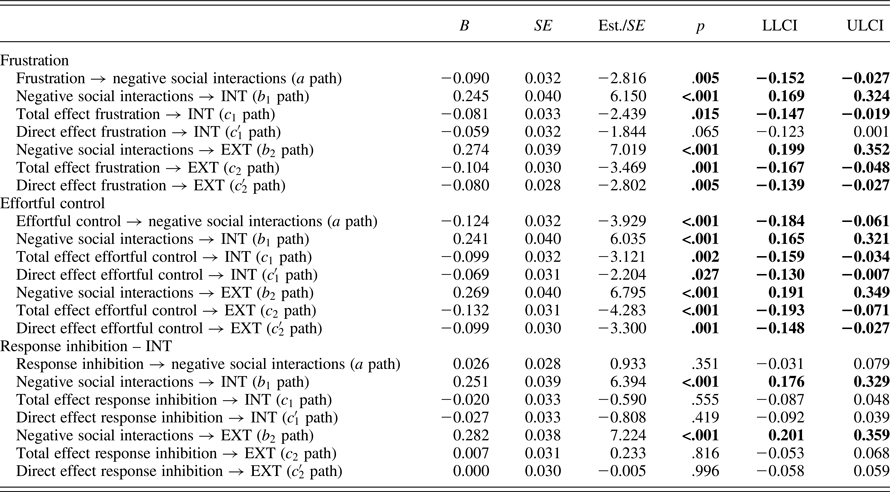
Note: INT, internalizing problems; EXT, externalizing problems. All analyses are controlled for sex, socioeconomic status, INT age 11, and EXT age 11. Bold values are significant at p < .05.
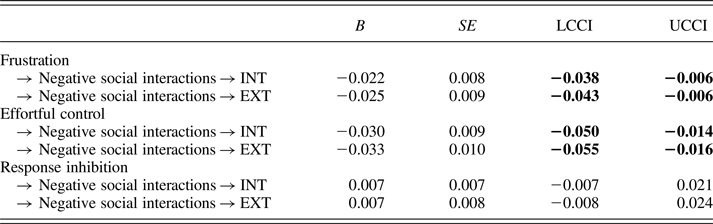
Mediation effects
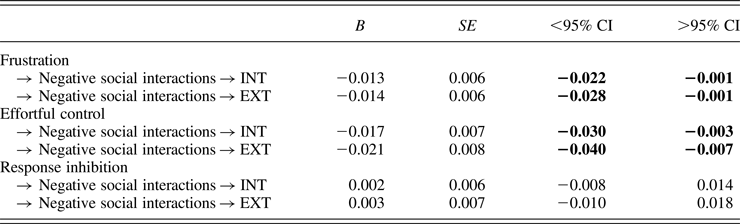
After testing the various direct and total effects, it was examined whether negative social interaction could explain part of the link between self-regulation and psychopathology. Our bootstrapped regression models (see Table 5) showed that all associations between frustration and effortful control, and both internalizing and externalizing problems, were partly mediated by negative social interactions. To further specify the mediation effects, the percentage of mediation was calculated for the various models ([ab/c] × 100). This showed that 25% of the total effect (c) of frustration on internalizing problems was accounted for by the indirect effect via negative social interactions (a × b). For frustration and externalizing problems, the mediation via negative social interactions was 21%. Twenty-eight percent of the link between effortful control and internalizing problems could be explained by negative social interactions. Finally, 23% of the association between effortful control and externalizing problems could be explained by adolescents’ experience of negative social interactions. No mediation effect for the response inhibition–psychopathology link was found. In sum, adolescents high on frustration and low on effortful control experienced more negative social interactions that, in turn, predicted more psychopathology.
Bootstrap results for indirect relationships (bias-corrected and accelerated confidence intervals)
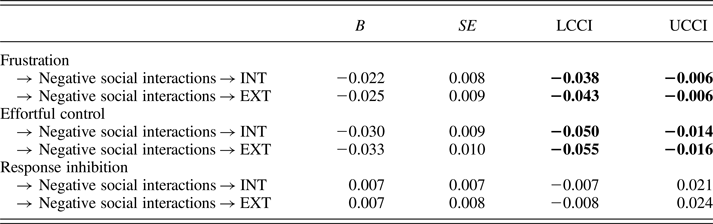
Note: INT, internalizing problems; EXT, externalizing problems. All analyses are controlled for sex, socioeconomic status, INT age 11, and EXT age 11. Bold values are significant at p < .05.
Post hoc analyses
Multivariate analyses
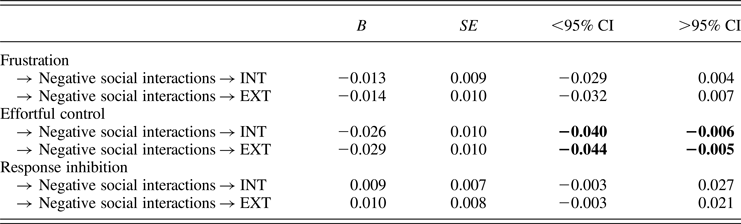
Two multivariate analyses were performed in which the three self-regulation indicators were entered simultaneously to examine the effects of self-regulatory capacities adjusted for all other capacities in the prediction of internalizing and externalizing problems. Analyses showed that only part of the associations found in the univariate analyses remained in the multivariate analyses. The indirect effects of effortful control on both internalizing and externalizing problems via negative social interactions remained when adjusting for the other two measures. In contrast, the effects of frustration did not remain significant, suggesting that these were not robust when adjusting for other traits. Effects of response inhibition remained insignificant. Model statistics are reported in Table 6.
Bootstrap results for indirect relationships adjusted for all facets of self-regulation (bias-corrected and accelerated confidence intervals)
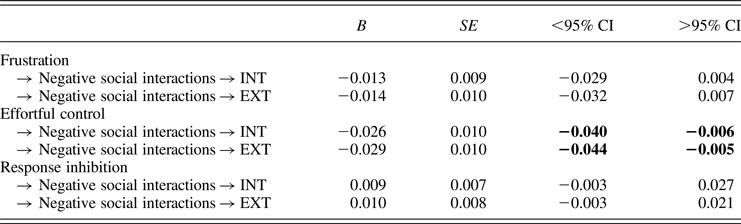
Note: INT, internalizing problems; EXT, externalizing problems. All analyses are controlled for sex, socioeconomic status, INT age 11, EXT age 11, and the two regulation indices not included as the independent variable. Bold values are significant at p < .05.
Moderated mediation
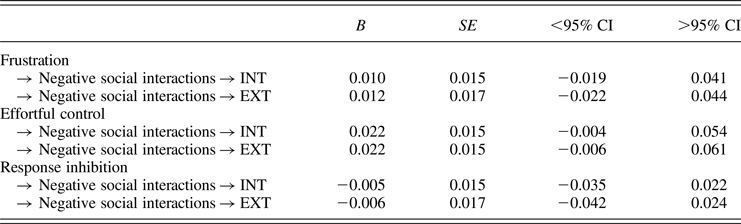
All analyses were controlled for sex of the adolescent. However, to have a closer look at possible differences between boys and girls, post hoc moderated mediation analyses were performed. Although girls scored higher on negative social experiences and internalizing problems and lower on externalizing problems than boys, the index of moderated mediation indicates that there are no significant differences between boys and girls in any of the indirect effects under study. Model statistics for the moderated mediation are reported in Table 7.
Bootstrap results for the sex-moderated mediation (bias-corrected and accelerated confidence intervals)
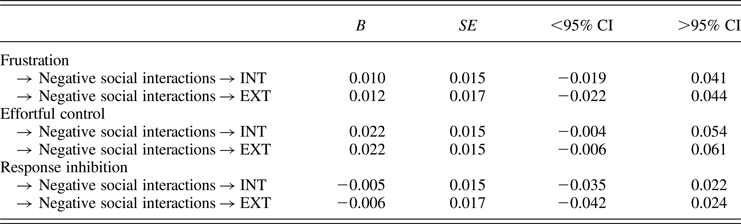
Note: INT, internalizing problems; EXT, externalizing problems. All analyses are controlled for socioeconomic status, INT age 11, EXT age 11, and the two regulation indices not included as the independent variable. Bold values are significant at p < .05.
Simple counts for negative interactions
All analyses were performed using the weighted negative interaction scores. However, to test the robustness of these findings, analyses were repeated using a simple count variable reflecting the total number of negative interactions adolescents experienced. Analyses showed that findings did not substantially differ from the findings of the analyses with the weighted scores. Model statistics are reported in Table 8.
Bootstrap results for the simple count of negative interactions mediation (bias-corrected and accelerated confidence intervals)
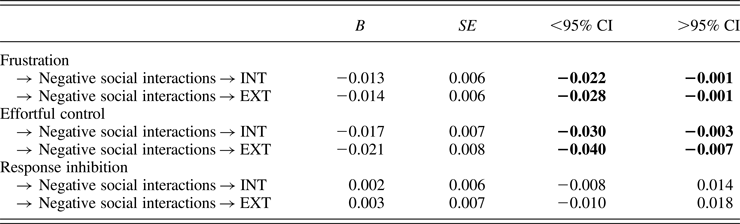
Note: INT, internalizing problems; EXT, externalizing problems. All analyses are controlled for socioeconomic status, INT age 11, EXT age 11, and the two regulation indices not included as the independent variable. Bold values are significant at p < .05.
Discussion
This study examined sequences of self-regulation, negative social interactions, and psychopathology from preadolescence to young adulthood. Findings bolster previous findings on the link between self-regulation and psychopathology, and, new to the literature, demonstrate that the longitudinal association between preadolescent self-regulatory capacities and young adult psychopathology is partly mediated by negative social interactions throughout adolescence.
Preadolescent self-regulation affects young adult psychopathology
Frustration and effortful control
The finding that adolescents who are high on frustration and low on effortful control are at risk for externalizing problems, even after controlling for initial problems, bolsters the well-established link between self-regulation and externalizing problems (Aldao et al., Reference Aldao, Nolen-Hoeksema and Schweizer2010; Eisenberg et al., Reference Eisenberg, Guthrie, Fabes, Shepard, Losoya, Murphy and Reiser2000; Oldehinkel et al., Reference Oldehinkel, Hartman, de Winter, Veenstra and Ormel2004). With regard to the associations with internalizing problems, similar links were found as for externalizing problems: both indicators were related to subsequent internalizing problems. Previous studies on internalizing problems, however, have been rather inconsistent both across and within different indicators of self-regulation. Particularly with regard to (young) children's effortful control and internalizing problems, findings are ambiguous with both low (Eisenberg et al., Reference Eisenberg, Cumberland, Spinrad, Fabes, Shepard, Reiser and Guthrie2001, Reference Eisenberg, Sadovsky, Spinrad, Fabes, Losoya, Valiente and Shepard2005, Reference Eisenberg, Valiente, Spinrad, Cumberland, Liew, Reiser and Losoya2009) and high (Karreman et al., Reference Karreman, de Haas, van Tuijl, van Aken and Deković2010; Murray & Kochanska, Reference Murray and Kochanska2002) effortful control being related to more internalizing problems.
Overall, our findings suggest that frustration and effortful control are rather general, and not so much psychopathology specific, predictors of young adult psychopathology: modest negative associations were found for both indicators, internalizing and externalizing, of psychopathology. With regard to the negative link between effortful control and internalizing problems, this finding might be somewhat surprising given the findings published so far. It should be noted, however, that previous studies showing no or even a positive link, have been based on samples with much younger children (Eisenberg et al., Reference Eisenberg, Sadovsky, Spinrad, Fabes, Losoya, Valiente and Shepard2005; Karreman et al., Reference Karreman, de Haas, van Tuijl, van Aken and Deković2010). During early adolescence, emotional instability (Branje, van Lieshout, & Gerris, Reference Branje, van Lieshout and Gerris2007), conscientiousness (Allik, Laidra, Realo, & Pullmann, Reference Allik, Laidra, Realo and Pullmann2004; Pullmann, Raudsepp, & Allik, Reference Pullmann, Raudsepp and Allik2006), and effortful control (Laceulle, Nederhof, Karreman, Ormel, & van Aken, Reference Laceulle, Nederhof, Karreman, Ormel and van Aken2012) have all been found to show a temporarily dip. This might suggest that too much self-regulation is rather unusual and, if present, not much of a risk during this developmental phase. Alternatively, it might be that the large time gap between the measurement of self-regulation and the measurement of psychopathology explains the consistency of the findings: whereas in the long run, low self-regulation might be a general risk factor, more specific associations may be found when zooming in on indicators of self-regulation and internalizing and externalizing problems within a short time frame.
Response inhibition
With regard to response inhibition, a different pattern of results was found: response inhibition was related to neither externalizing nor internalizing problems. Whereas response inhibition has previously been used in the context of self-regulation (Bunge & Wright, Reference Bunge and Wright2007; Hoffman, Schmeichel, & Baddeley, Reference Hofmann, Schmeichel and Baddeley2012; Luna Garver, Urban, Lazar, & Sweeney, Reference Luna, Garver, Urban, Lazar and Sweeney2004), the lack of a significant association may be explained by our operationalization of the concept. Previous studies have repeatedly reported that tasks can provide relatively objective information on psychological concepts, but often do not generalize well to contexts outside the lab, and to questionnaire data in particular (Dalley & Roiser, Reference Dalley and Roiser2012; Reynolds, Ortengren, Richards, & de Wit, Reference Reynolds, Ortengren, Richards and de Wit2006). More specifically, the various tasks of the ANT program (Brunnekreef et al., Reference Brunnekreef, de Sonneville, Althaus, Minderaa, Oldehinkel, Verhulst and Ormel2007; de Sonneville, Reference de Sonneville1999) may be too narrow to reflect complex traits or have substantial behavioral consequences (Boelema et al., Reference Boelema, Harakeh, van Zandvoort, Reijneveld, Verhulst, Ormel and Vollebergh2015). However, although no association was found with psychopathology, a weak but positive and significant correlation was revealed between effortful control and response inhibition. This is interesting given that effortful control has been proposed to include not only a behavioral but also a cognitive component (Eisenberg et al., Reference Eisenberg, Cumberland, Spinrad, Fabes, Shepard, Reiser and Guthrie2001). Future studies including both questionnaires and tasks for various indicators of self-regulation might distinguish meaningful effects from measurement issues.
Sequences of maladaptation: The role of negative social interactions
Whereas the findings above bolster and extend previous findings on low self-regulation and psychopathology, studying these links does not shed light on the social processes underlying low self-regulation driven psychopathology. The current study increases our understanding on this issue by examining the mediating role of negative social interactions in the regulation–psychopathology link. Results demonstrated that individual differences in frustration and effortful control but not response inhibition are related to subsequent negative social interactions, which in turn contribute to the development of internalizing and externalizing problem behaviors.
Our findings are consistent with previous work on self-regulation as well as on personality and temperament more broadly, showing that adolescents may evoke particular social interactions depending upon their individual dispositions (Furman & Buhrmester, Reference Furman and Buhrmester1992; Kandler, Bleidorn, Riemann, Angleitner, & Spinath, Reference Kandler, Bleidorn, Riemann, Angleitner and Spinath2012; Kendler & Baker, Reference Kendler and Baker2007; Laceulle et al., Reference Laceulle, Jeronimus, van Aken and Ormel2015; Scarr & McCartney, Reference Scarr and McCartney1983). Effect sizes were, however, rather modest, suggesting that other traits, such as sociability, extraversion and agreeableness, may play a (more important) role in the adolescents’ social interactions (e.g., Lüdtke et al., Reference Lüdtke, Roberts, Trautwein and Nagy2011).
The finding that adolescents who experienced more negative social interactions between ages 11 and 22 reported more internalizing and externalizing problems at age 22 is in line with previous studies (Buist et al., Reference Buist, Deković and Prinzie2013; Ehrlich et al., Reference Ehrlich, Dykas and Cassidy2012; Helsen et al., Reference Helsen, Vollebergh and Meeus2000). The magnitude of the effects was similar for internalizing and externalizing problems, whereas based on the literature, somewhat stronger effects might be hypothesized with regard to the association between negative social interactions and externalizing problems (Ehrlich et al., Reference Ehrlich, Dykas and Cassidy2012). Part of our findings might be explained by our composite measure, including a relatively broad range of experiences. Some of these might have a stronger association with externalizing problems (i.e., fights or arguments), and others with internalizing problems (i.e., being a victim of bullying). Unfortunately, we could not test these specific associations in a statistically convenient way due to the low frequencies of the individual events. Alternatively, although some experiences might in itself have a more externalizing nature (e.g., being involved in a fight), these experiences may in the long run contribute to internalizing problems. In a meta-analysis, evidence was provided that conflict was related to more externalizing as well as internalizing problems (Buist et al., Reference Buist, Deković and Prinzie2013). Relatedly, although the EHC (Caspi et al., Reference Caspi, Moffitt, Thornton, Freedman, Amell, Harrington and Silva1996) is supposed to measure major events and we weighted all events to take into account the likely impact of the negative social interactions, the frequency and intensity of the specific interactions were not taken into account in the current study. Future studies zooming in on the nature of the interactions may shed more light on this issue.
Most important, negative social interactions were found to explain a modest part of the direct association between self-regulation and psychopathology. Adolescents with high frustration and low effortful control may set in motion sequences of negative social interactions and subsequent psychopathology. These sequences were found for both indicators in the initial univariate analyses, but in the more conservative multivariate analyses, only the effects of effortful control on externalizing and internalizing problems remained significant. This suggests that the effect of frustration was accounted for by the effect of effortful control. Possibly, adolescents only evoke negative social interaction based on their low capacity to regulate feelings of frustration, if their frustration is translated into behavior (i.e., starting an argument). As such, there is mainly evidence for sequences of low effortful control, negative social interactions, and psychopathology.
In addition, whereas all analyses were controlled for sex, given the potential differences in manifestations of self-regulation, negative social interactions, and psychopathology in boys versus girls, post hoc moderated mediation analyses were performed to examine whether the mediation effects varied across sex. In line with previous literature, girls scored higher on negative social experiences and internalizing problems and lower on externalizing problems than boys (Bongers, Koot, van der Ende, & Verhulst, Reference Bongers, Koot, van der Ende and Verhulst2003), but the indirect effects did not differ for any of the associations under study. Seemingly, the pathways from self-regulation, via negative social interactions, to subsequent psychopathology, are invariant across sex.
The notion of developmental sequences has previously been described in the context of developmental cascade models. These models advocate an organizational view of development in which multiple factors are considered in the context of one another, rather than in isolation (Cicchetti & Dawson, Reference Cicchetti and Dawson2002; Cicchetti & Rogosch, Reference Cicchetti and Rogosch1996; Cicchetti & Schneider-Rosen, Reference Cicchetti, Schneider-Rosen, Rutter, Izard and Read1986). In addition, they contribute to the ongoing call of developmental psychopathology research to elucidate pathways to both adaptive and maladaptive outcomes in order to increase our understanding of the causal and probabilistic structure of the course of experiences and processes in individual lives. So far, sequences of self-regulation, negative social interactions, and psychopathology have not been tested by fully prospective mediation models in general or developmental cascade models in particular. Our findings point to the direction of a developmental cascade, by demonstrating sequences from preadolescence into young adulthood, and as such, suggesting the potential etiological role of self-regulation and negative social interaction in pathways to internalizing and externalizing problems. However, our study cannot provide a full test of cascade models, as this would require multiple waves of all constructs under study. Future research is needed to provide a more sophisticated test of cascade models. In addition, this would also allow examining the processes linking self-regulation, negative social interactions, and psychopathology in more detail. For example, insight in how self-regulation affects negative social interactions (e.g., perceptions, communication of behaviors, emotions and cognitions, [age-graded] social norms, and expectations with regard to both self-regulation and social interactions) may increase our understanding of the field (Laceulle et al., Reference Laceulle, Jeronimus, van Aken and Ormel2015). In addition, such knowledge may ultimately contribute to prevention and early intervention programs aiming at improving adolescent social relationship and preventing the development of psychopathology.
Strengths and limitations
Our findings need to be interpreted in the light of some strengths and limitations. Among the strengths of our study was our fully prospective design, use of a large sample of adolescents, data from different informants, and the inclusion of different indicators of self-regulation and both internalizing and externalizing problems. Frustration and effortful control were rated by the parents using a questionnaire and response inhibition using a neuropsychological task. Internalizing and externalizing problems were rated by adolescents themselves. Negative social interactions, finally, were captured using a semistructured and sophisticated interview method, which provided information on both the nature and the timing of the event. Retrospective self-reports of events, including negative social interactions, have inherent limitations because of response components that may be influenced by current mental state, such as cognition, appraisal, interpretation, and recall. However, this was addressed in our study by asking the participant to proceed serially from one life domain to another using a month-by-month horizontal timeline and under supervision of the interviewer (Caspi et al., Reference Caspi, Moffitt, Thornton, Freedman, Amell, Harrington and Silva1996), and the use of weighted scores to take into account the likely impact of the experience.
Despite these strengths, the study is limited in several ways. First, three indicators of self-regulation were included: frustration, effortful control, and response inhibition. These indicators each reflect aspect(s) of self-regulation, but do not cover the full construct. Moreover, for example, frustration may not only reflect self-regulation but, like emotion regulation, also capture components of emotionality and emotional experience (Thompson, Lewis, & Calkins, Reference Thompson, Lewis and Calkins2008). Probably, these are all overlapping, hard to disentangle, processes contributing to psychopathology (Cole, Martin, & Dennis, Reference Cole, Martin and Dennis2004; Eisenberg et al., Reference Eisenberg, Guthrie, Fabes, Shepard, Losoya, Murphy and Reiser2000). Similarly, our findings with regard to response inhibition seem somewhat puzzling, which is probably because the neuropsychological task measures a highly specific aspect of self-regulation (i.e., inhibition of a prepotent response) that shows only a very modest correlations with the broader temperamental aspects of self-regulation (i.e., frustration and effortful control). Consequently, to provide a more elaborate and robust differentiation between the indicators of self-regulation, other measures may be needed. These may include, but are not limited to, a wider range of indicators, as well as a combination of both task and questionnaire. Such data could contribute to a further understanding of the topic.
Second, negative social experiences were measured using the EHC, a valid and reliable way to obtain retrospective data about life experiences (Caspi et al., Reference Caspi, Moffitt, Thornton, Freedman, Amell, Harrington and Silva1996). In line with previous literature suggesting that the impact of infrequent experiences is often larger than that of the more common experiences (Masuda & Holmes, Reference Masuda and Holmes1978), we weighted the experiences based on their prevalence before aggregating them into a sum score. However, the frequency of an event does not inherently parallel the impact of the event. To test the robustness of the findings, analyses were repeated with a simple count score reflecting the total number of negative social interactions adolescents were exposed to. There were no meaningful differences between the results from these analyses and those from the analyses with the weighted score. Nonetheless, to fully capture individual differences in the impact of an event, it may be important to also capture the subjective component of the impact of the experience. High subjective experience might reflect an (initial) vulnerability to negative experiences, which may correlate with self-regulatory capacities and as such contribute to elevated levels of psychopathology. In addition, related to the measurement of negative social interaction, not all TRAILS participants participated in the interview. As such, the current study is based on a subsample of the TRAILS participants. Unfortunately, the current analyses were not compatible with sophisticated methods of dealing with missing data (such as the full information maximum likelihood procedure). Although analysis of descriptive statistics using full information maximum likelihood did not show any meaningful differences with the descriptive statistics for the subsample as included in the current manuscript (i.e., the largest difference was found for the correlations between frustration and effortful control, r = .407 in the full sample vs. .363 in the reduced sample, Δp = .128), it might be that the mediation analyses were somewhat effected by the way we handled our missing data.
Fourth and finally, an important issue is the direction of the sequences. Individuals may not only evoke negative social interactions based on their self-regulation but also the opposite might be true. Stress, including negative social interactions, has been found to be related to (nonnormative) changes in frustration and effortful control (Laceulle et al., Reference Laceulle, Nederhof, Karreman, Ormel and van Aken2012). The developmental cascade models (Cicchetti & Dawson, Reference Cicchetti and Dawson2002), but also other theoretical frameworks such as the corresponsive principle (Caspi, Roberts, & Shiner, Reference Caspi, Roberts and Shiner2005), emphasize the importance of testing such a bidirectional model. Consequently, future research including multiple waves of self-regulation, negative social interactions, and psychopathology may allow for a more detailed test of mediation and shed more light on the causal order of the various sequences. Moreover, the direction of the sequences may even be tested using experimental or intervention designs. Manipulating self-regulation in the lab or in the context of an intervention may provide support for self-regulation driven sequences of individual dispositions, negative social interactions, and psychopathology, but in addition to that, contribute to the development of low key prevention and intervention programs. Increasing evidence has provided support for self-regulation as a target for prevention and intervention (e.g., Bogg & Roberts, Reference Bogg and Roberts2013; Diamond, Barnett, Thomas, & Munro, Reference Diamond, Barnett, Thomas and Munro2007; Ursache, Blair, & Raver, Reference Ursache, Blair and Raver2012).
Conclusion
This study aimed at increasing our understanding of sequences of early adolescent self-regulatory capacities, adolescent's negative social interactions, and young adult psychopathology, using a fully prospective mediation model. All analyses were controlled for initial psychopathology, adolescent's sex, and SES. Findings replicate previous studies demonstrating (prospective) associations between self-regulation and psychopathology. Only for response inhibition, no effect was found. In addition, it was demonstrated that adolescents evoke negative social interaction based on their low self-regulation (in particular effortful control), which in turn can contribute to the development of internalizing and externalizing problems. Findings bolster and extend previous work on developmental cascade models emphasizing the importance to investigate pathways to psychopathology longitudinally and to examine risk factors in the context of one another.