

INTRODUCTION
Ancient literature considers Knossos as the home of some of the most important sculptors and architects of early Greece, starting with the legendary Daidalos. The association of Daidalos with Knossos can be traced back to Homer, who ascribed to the artist the making of the Dancing Floors of Ariadne (Iliad 18.590–2; Weitmann Reference Weitmann, Kansteiner, Lehmann and Hallof2014, 52–3, no. 18). Pausanias (9.40.3–4; cf. 7.4.5) localised both this work of Daidalos and a wooden statue of Athena (Weitmann Reference Weitmann, Kansteiner, Lehmann and Hallof2014, 41, 52–3, nos 2 and 18) at Knossos.Footnote 1 The Cretan sons of Daidalos, Dipoinos and Skyllis, allegedly worked around Greece in the early sixth century BC (Kansteiner and Lehmann Reference Kansteiner, Lehmann, Kansteiner, Lehmann and Hallof2014a), while the Knossian architects and engineers Chersiphron and Metagenes were taken to have built the Artemision of Ephesus in the mid sixth century BC (Vitruvius 10.2.11–2; Pliny, Naturalis Historia 7.125). Based on these traditions, Emanuel Löwy (Reference Löwy1909; Reference Löwy1911) argued that Cretan Early Iron Age art, particularly seventh-century BC sculpture, had considerable impact over much of Greece. Having emerged in the early twentieth century, this notion of pancretism came increasingly under attack in the post-War period (Kotsonas Reference Kotsonas, Morgan and Charalambidou2017, 15–16).
By the 1970s, scholars had developed a deeper awareness of the limitations of the textual traditions surrounding Daidalos and their archaeological correlates. As Brunilde Sismondo Ridgway (Reference Ridgway1977, 28) put it: ‘the “Daedalic question” may closely compare with the Homeric question, and the term may hide several nameless artists under one name’ (cf. Boardman Reference Boardman1961, 158–9). Likewise, Sarah Morris (Reference Morris1995, 251) observed:
Despite ancient and modern efforts to locate such a personality [i.e. Daidalos] in the archaic period and link him to veritable artists or works of art, no consistent style or setting emerges from the testimonia. The Cretan phantom of the archaic period is but a literary amalgam of prehistoric memories and early Iron Age art, yet he has given his name to a modern concept of early Greek style.
This concept has recently received a historiographic study, which has argued for the abandonment of the stylistic designation Daedalic (Aurigny Reference Aurigny2012). I remain sympathetic to the critique, but I retain the deep-rooted designations (e.g. Middle Daedalic) and the associated absolute chronology pending the development of any alternative chronological system. Additionally, I use the term Protoarchaic to refer to the seventh century BC (which is the last century of the Early Iron Age) and the term Archaic to refer to the period and style of the sixth and early fifth centuries (cf. Kotsonas Reference Kotsonas2008a, 40; Stampolidis et al. Reference Stampolidis, Papadopoulou, Lourentzatou and Fappas2018, 373).
Despite the demise of pancretism, specialists in Greek sculpture typically retain an emphasis on Crete when discussing the Daedalic style and the beginnings of Greek sculpture (e.g. D’Acunto Reference D’Acunto2000; Reference D’Acunto, Kourayos and Prost2008; Kaminski Reference Kaminski, Bol, Flashar, Maaß, Kaminski, Vorster, Kreikenbom, Karanastassis, Maderna-Lauter and Brinkmann2002; Kokkorou-Alevras Reference Kokkorou-Alevras, Morgan and Charalambidou2017). However, the possible contribution of the island to the beginnings of Greek sculpture divides scholarship. To some experts ‘the earliest Greek stone sculpture comes from Crete, which probably introduces the style [Daedalic] to the Aegean from the Near East’, judging by the quality and range of representative finds (Stewart Reference Stewart1990, 106). Accordingly, general surveys of Greek sculpture focus especially on the long-known and well-preserved Cretan sculpture from the sanctuary of Athena on the acropolis of Gortyn and from Prinias Temple A.Footnote 2 Nevertheless, Ridgway (Reference Ridgway1977, 26) argues that ‘Crete cannot claim to have been the birthplace of Greek monumental stone sculpture … whatever architectural sculpture has survived from the island seems to belong to none of the canonical Greek forms, but rather to partake of Oriental forms and ideas of decoration which did not find general acceptance elsewhere in Greece’. To Ridgway, because of its typological adherence to Near Eastern models, and its rendering in soft limestone (as opposed to marble), Cretan sculpture ‘represents a dead end rather than the beginning of the road’ of Greek sculpture.Footnote 3 These normative assumptions over the material and the typology of early Greek sculpture have not found any obvious followers.
The literature on early Greek sculpture has not been eager to re-evaluate the possible contribution of Crete to the beginnings of Greek sculpture in the light of the range of finds and original insights made in the last decades. Such developments have revised our understanding of, for example, Prinias Temple A, including the relief females on the lintel of the monument, the two sphinxes which adorned it, and the frieze of the riders, which is now reconstructed as a dado frieze on the façade (Pautasso and Rizza Reference Pautasso, Rizza and Gavrilaki2018). Previously compared to both Neo-Hittite and Egyptian monuments, Prinias Temple A has recently been associated with the Early Iron Age temple of ‘Ain Dārā in north Syria, which is renowned for its sculptured orthostats (Yalçin Reference Yalçin2020). Beyond Temple A, seventh-century sculptural finds have recently been reported from a different area on the acropolis of Prinias (Biondi Reference Biondi2020). An even more impressive new group of sculpture has emerged from the cemetery of Orthi Petra in Eleutherna. The group includes grave markers of different types, reliefs, architectural sculptures, korai and – controversially – a kouros, which date from the seventh to the beginning of the sixth century BC (Stampolidis Reference Stampolidis1990, 397–403; Reference Stampolidis2004, 234–9, nos 250–5, 257–8; Reference Stampolidis, Kokkorou-Alevras and Niemeier2012). Knossos boasts an even richer range of finds of early limestone sculpture, but these have largely been overlooked because they are known from scattered, often preliminary reports. This body of material is here treated systematically for the first time.
On the rest of Crete, seventh-century sculptures have not increased markedly in the last half century. The best-preserved pieces include the frieze from Chania (Theophanidis Reference Theophanidis1956; Boardman Reference Boardman1961, 137–8; Reference Boardman1978, 11, fig. 15; Davaras Reference Davaras1972, 53, no. 9; Adams Reference Adams1978, 11–13; Rolley Reference Rolley1994, 123–4, fig. 104; Marconi Reference Marconi2007, 3, 189, 218; Andreadaki-Vlasaki Reference Andreadaki-Vlasaki, Kapsomenos, Andreadaki-Vlasaki and Andrianakis2011, 122–4), and the statues from Onithe Goulediana (Davaras Reference Davaras1972, 15–16, 25–7, figs 16–18; Adams Reference Adams1978, 64–5) and Astritsi (Davaras Reference Davaras1972, 9–10, esp. figs 2–5; Adams Reference Adams1978, 35–7).
Seen against this rich record of the seventh century, the (assumed) paucity of sculptural finds from sixth-century Crete is striking. As observed by Andrew Stewart (Reference Stewart1990, 107), ‘the rich Cretan tradition in limestone sculpture, which continues down to ca. 600 then rapidly peters out, leaving no successor’. To Ridgway (Reference Ridgway1977, 26; see also page 22), ‘Crete seems to have rejected Archaic style per se’, which coloured her impression that the island’s Daedalic sculpture was ‘a dead end’. A recent survey confirms that, although korai and kouroi are copiously attested in the central Aegean, they remain very scarce in Crete.Footnote 4 To John Boardman (Reference Boardman1961, 159; see also p. 148), ‘the island is empty of sculpture and architecture’ in the sixth century, while Brice Erickson (Reference Erickson2010, 7) reiterated that ‘[m]onumental stone sculpture of ca. 600–400 is also almost unknown’ in Crete (see also Whitley Reference Whitley2001, 252; Reference Whitley, Raaflaub and van Wees2009, 286).
Nikolaos Kontoleon has hypothesised that the paucity of Archaic sculpture in Crete was due to the conservative socio-political regime of the island (Kontoleon Reference Kontoleon1970, 86–7; contra Ridgway Reference Ridgway1977, 26, n. 13). The idea has proven popular and has since been discussed in increasingly more nuanced terms (Lebessi Reference Lebessi1985, 218–19; Reference Lebessi2002, 294–6; Whitley Reference Whitley, Raaflaub and van Wees2009, esp. 286). Accordingly, the demise of Cretan sculpture has been taken to be symptomatic of the broader problems in the archaeological visibility of the island’s culture during the sixth century, which has been variously conceptualised as a ‘Dark Age’ (Prent Reference Prent1996–7), a ‘period of silence’ (Stampolidis Reference Stampolidis1990, 400), or the time of the ‘Archaic Gap’ (Coldstream, Huxley and Webb Reference Coldstream, Huxley and Webb1999; see also Kotsonas Reference Kotsonas2002, 37; Erickson Reference Erickson2010, 1). Traditionally, this period is associated with the near vanishing of settlements, sanctuaries and cemeteries; the disappearance of high art (Pliny [Naturalis Historia 34.19] could have proclaimed cessavit deinde ars, as observed in Kontoleon Reference Kontoleon1970, 86); poor visibility of local material culture; and a paucity of imports (Whitley Reference Whitley2001, 243–2; Kotsonas Reference Kotsonas2002; Erickson Reference Erickson2010, 1–22). The problem has attracted much specialised literature in recent years (Prent Reference Prent1996–7; Kotsonas Reference Kotsonas2002; Reference Kotsonas2022; Erickson Reference Erickson2010; Wallace Reference Wallace2010; Pilz and Seelentag Reference Pilz and Seelentag2014; Kotsonas and Pollard Reference Kotsonas and Pollardforthcoming) – including much that is focused on Knossos (Coldstream, Huxley and Webb Reference Coldstream, Huxley and Webb1999; Erickson Reference Erickson, Pilz and Seelentag2014; Trainor Reference Trainor2019, 4–5; Paizi Reference Paizi2023; Whitley Reference Whitley2023, 151–2). Major contributions include the pottery studies by Brice Erickson (Reference Erickson2010) and the fieldwork reports and related analyses on Azoria by Donald Haggis (Reference Haggis, Pilz and Seelentag2014; Haggis and Fitzsimons Reference Haggis and Fitzsimons2020). The Archaic Gap has also received extensive attention in textbooks on Greek history and archaeology (Whitley Reference Whitley2001, 243–52; Hall Reference Hall2014, 190–9). These works have questioned the historicity of the gap, have promoted socio-economic interpretations of the phenomenon and have reflected on the ways in which it has been shaped by methodological choices in fieldwork and finds research.
The recent emphasis on the Cretan Archaic Gap has inspired closer attention to the sculpture from the island. For example, Katja Sporn (Reference Sporn, Pilz and Seelentag2014, esp. 227–35) produced a comprehensive review of the considerable sculptural record from burial contexts in Archaic and Classical Crete. Likewise, Erickson compiled a list of Cretan sixth-century sculpture irrespective of find context. His list includes eight pieces, some of which he considers as possibly later in date.Footnote 5 To this list, one should add: two or three pieces from Axos (other than the well-known Axos head) (Tegou Reference Tegou, Pilz and Seelentag2014, 45–8, fig. 4; Reference Tegou, Gaignerot-Driessen and Driessen2015, 27–31, figs 1:9, 1:10 and 1:12), an inscribed statue base from Chersonesos of 550–525 BC (Jeffery Reference Jeffery1961, 314, 316, no. 20; cf. Sporn Reference Sporn, Pilz and Seelentag2014, 226), a free-standing short column with an Ionic capital from Lyktos (van Effenterre and van Effenterre Reference Effenterre and Effenterre1985; Gagarin and Perlman Reference Gagarin and Perlman2016, 486–95, no. Lyktos 1A and 1B), and a Late Archaic stone relief of a sphinx or lion from the area of the Venizeleio hospital at Knossos (Boardman Reference Boardman1962, 30, pl. 3c; on this relief see below), in addition to a few more recent finds from across the island, i.e. the torso of a hoplite of the Late Archaic period from Chania (Andreadaki-Vlasaki Reference Andreadaki-Vlasaki, Kapsomenos, Andreadaki-Vlasaki and Andrianakis2011, 124; Tzanakaki Reference Tzanakaki2016, 62, 149, 203–4, 208–9, fig. 41) and perhaps an unpublished Cycladic marble head of a kouros which was seized by the police at Malia in 2011 (Anonymous 2011) and is on display at the Archaeological Museum of Agios Nikolaos. These finds and the pieces from Knossos discussed below call into question established assumptions concerning the paucity of Archaic Cretan sculpture. Given the observation of James Whitley (Reference Whitley, Raaflaub and van Wees2009, 276) that the Cretan Archaic ‘gap is more artistic than archaeological, and more Knossian than Cretan’, the present study attacks the problem head-on with reference to both its artistic and Knossian sides.
Highlighted in ancient traditions centred on the works of Daidalos and the Daidalids, but overlooked in studies of Greek sculpture, Knossos presents a promising case study for the development of new insights into Cretan and other Greek sculpture of the Early Iron Age and the Archaic period. This is demonstrated by the art-historical, archaeological and archival study of the three pieces of sculpture published here, and through a critical review of the remarkable – but little-known – range of sculptural evidence from the site and its region, which dates from the late eighth to the fifth century BC. The exercise establishes that Knossos boasts the fullest sequence of early sculpture in Crete.
FINDSPOTS OF THE THREE SCULPTURES FROM KNOSSOS
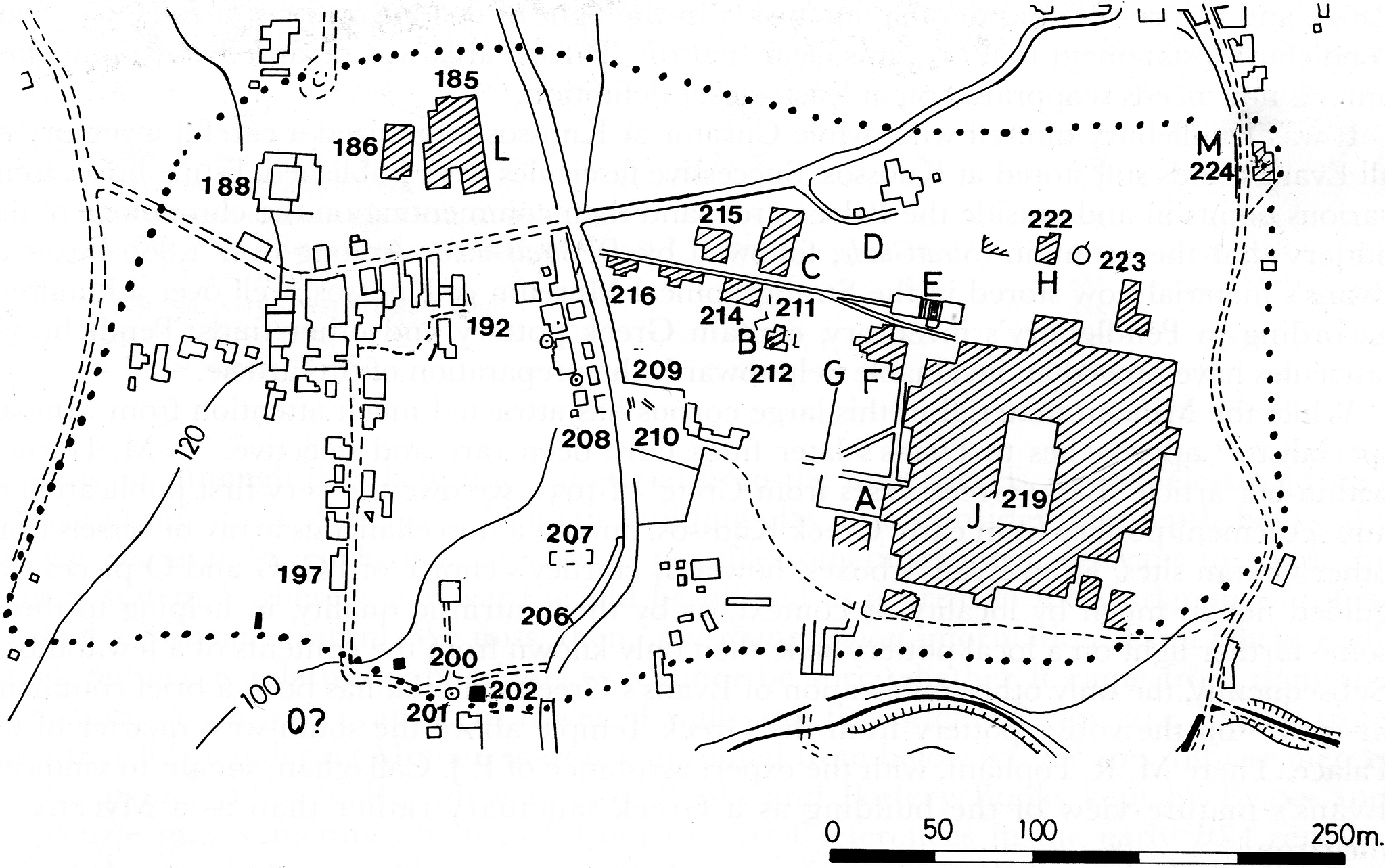
The three Knossian sculptures published here come from two different findspots located north-west of – but close to – the Bronze Age Palace of Knossos (Fig. 1). In this section I report on the discovery of the two earliest pieces, which date from 1936 and have remained overlooked. This discovery is reconstructed based on research in the archives of the British School at Athens which yielded information on find context, topography and historiography. The related archival material is equally important in conveying a certain agony over the identification of Archaic finds at Knossos at a time that pre-dates the conceptualisation of the Archaic Gap in published literature, as explained below. More detailed and accessible information is available for the discovery of the third piece, which came as recently as 2002. This piece was found in a systematic excavation (Little Palace North), the final publication of which is ongoing.
The central part of the Greek town of Knossos, with the Minoan palace on its eastern end. The numbers correspond to Hood and Smyth Reference Hood and Smyth1981. Numbers relating to the present study include 185 (Little Palace, immediately north of which is Little Palace North, where the sculpture found in 2002 came from), 186 (the Unexplored Mansion), 188 (the Stratigraphical Museum), 197 (the sanctuary of Glaukos, with the Anetaki plot immediately west of it), 207 (the site of the ‘Archaic Dig’), and especially 209 (the findspot of the two sculptures and the Archaic inscription in 1936). Reproduced with the permission of the British School at Athens.

The earliest two pieces were excavated by Richard Wyatt (Squire) Hutchinson. The brief published report by Peter Megaw reads: ‘In the vineyard north-west of the Palace of Knossos was made a chance find of a fifth-century inscription in finely cut letters and two interesting fragments of archaic architectural sculpture’.Footnote 6 A report of the same year, by Georg Karo (Reference Karo1936, 160), places the finds at the vineyard near the entrance to the archaeological site of the palace, between the guard house and the modern road. A later report by Lilian Jeffery (Reference Jeffery1949, 36) adds: ‘immediately south of the Villa Ariadne vineyard, in the small plot of ground outside the gateway which leads past the guardian’s house up to the Palace’. Lastly, the Knossos Survey places the discovery immediately north of the car park which is nowadays located outside the entrance to the archaeological site of the Palace (Hood and Smyth Reference Hood and Smyth1981, 50, no. 209), south of the modern periptero.
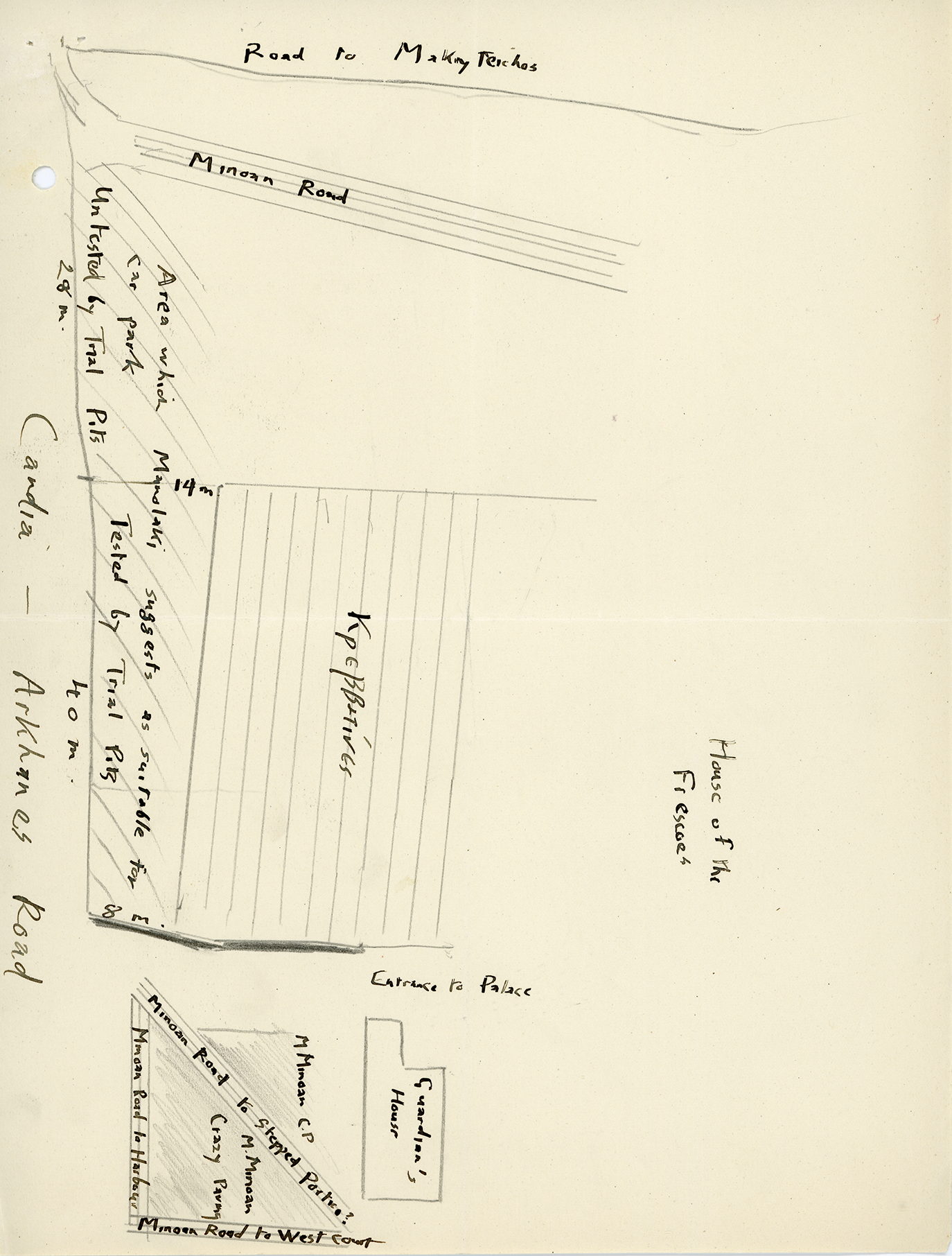
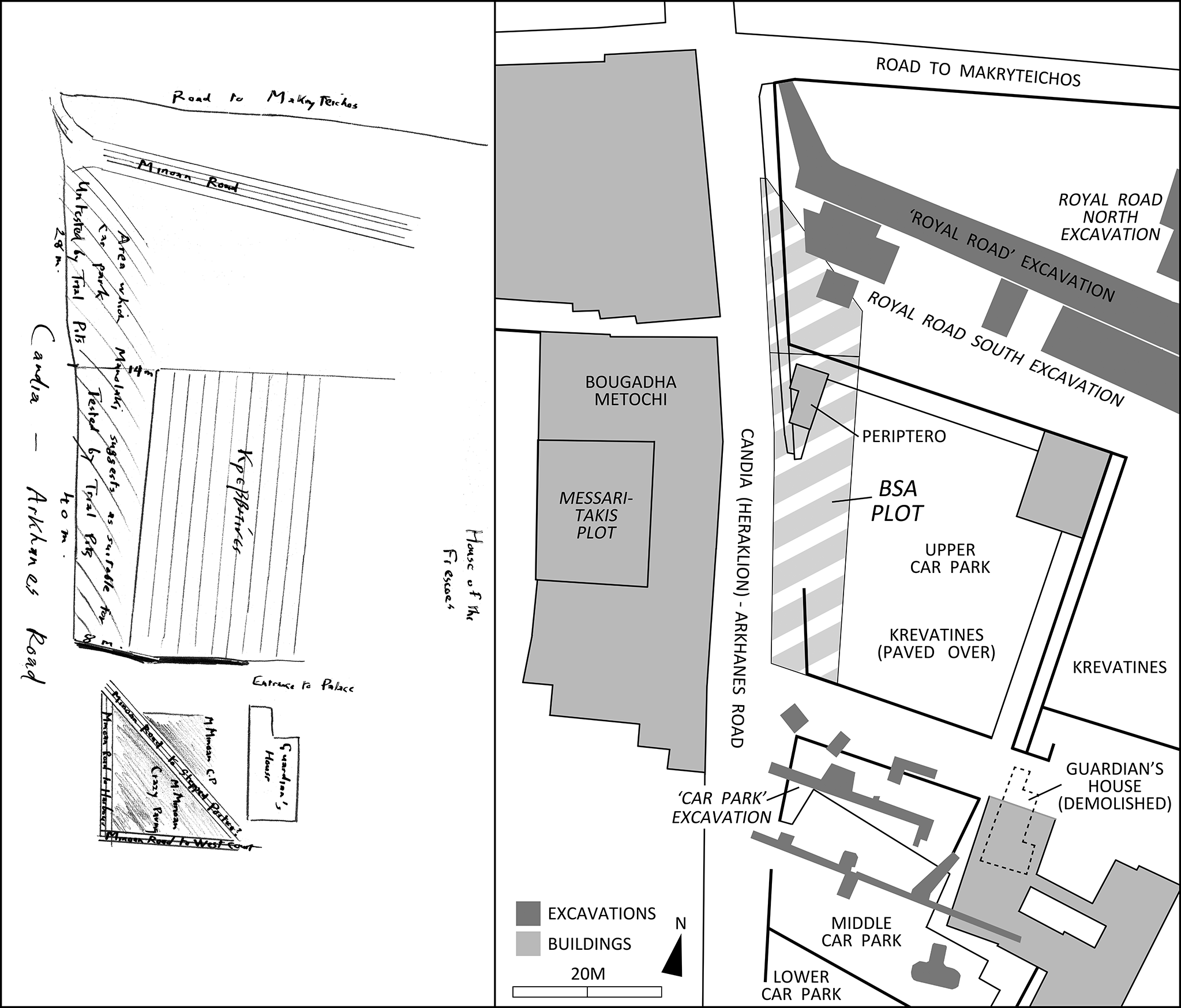
Unpublished papers by Hutchinson help flesh out the discovery of the pieces. A sketch map of the area (Fig. 2; cf. Fig. 3) locates the field he explored north of the entrance to the archaeological site of the palace and south of the Royal Road, and in between the House of the Frescoes and the modern road that runs from Heraklion (Candia) to Arkhanes. The field which is called κρεββατίνες (i.e. vines) on the sketch map had then been recently acquired by the School. Hutchinson reports:Footnote 7
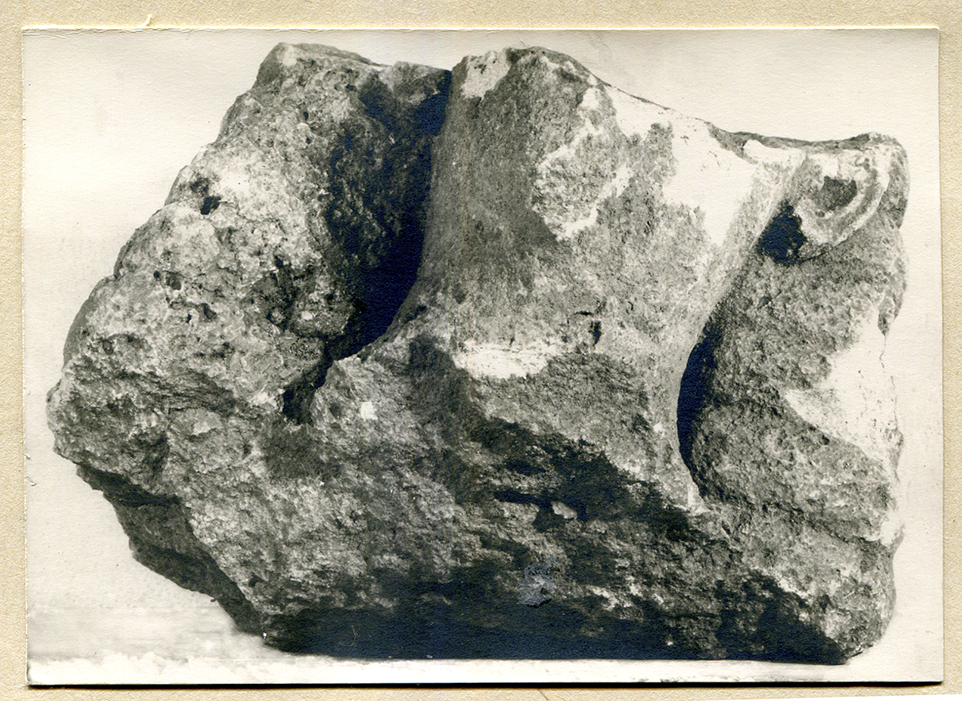
On March 19 in the SW part of the vineyard recently acquired from the Mathioudakis family there was discovered a large fragment of a Roman votive relief with a figure representing Abundantia or some other such person holding a cornucopia. … On the 21st in the same vineyard where the Roman relief was found, a most important find was recorded, the lower half of an archaic head in soft limestone date[d] perhaps 600 B.C. Three days later in the SW corner of the same vineyard a Roman cist grave was discovered with 3 successive burials. … On March 27 in the same area was discovered the waist of a figure with a slim waist enclosed in a belt and rather prominent buttocks.
Sketch map locating the field κρεββατίνες, which is the findspot of the two sculptures and the Archaic inscription in 1936 (British School at Athens Archive, Corporate Records, Knossos Correspondence, 1937, letter Hutchinson–Young, 17 February, Krevatina Sketch Plan). Reproduced with the permission of the British School at Athens.

Composite image juxtaposing the sketch map of Fig. 2 with a map of the area. By Todd Whitelaw.

Other unpublished documents of the time repeat the same information.Footnote 8
These notes suggest that the two sculptures were found out of context and without any meaningful stratigraphic associations. The same impression is confirmed by Hutchinson’s reports to Humfry Payne, who was then the Director of the British School at Athens.Footnote 9 In one of them Hutchinson notes:
The agricultural work on Mathioudakis land has produced 2 fragments of archaic sculpture and a fragment of inscription with lettering like that of the laws of [Gortyn]. I enclose a print of one of the archaic fragments and one of a Roman relief; all these come from the south west corner of Mathioudakis’ plot. I think a narrow but deep trial pit in the valley between the vines and the road might disclose whether we have an archaic temple there, but of course I shall do nothing until I here [sic] from you.Footnote 10
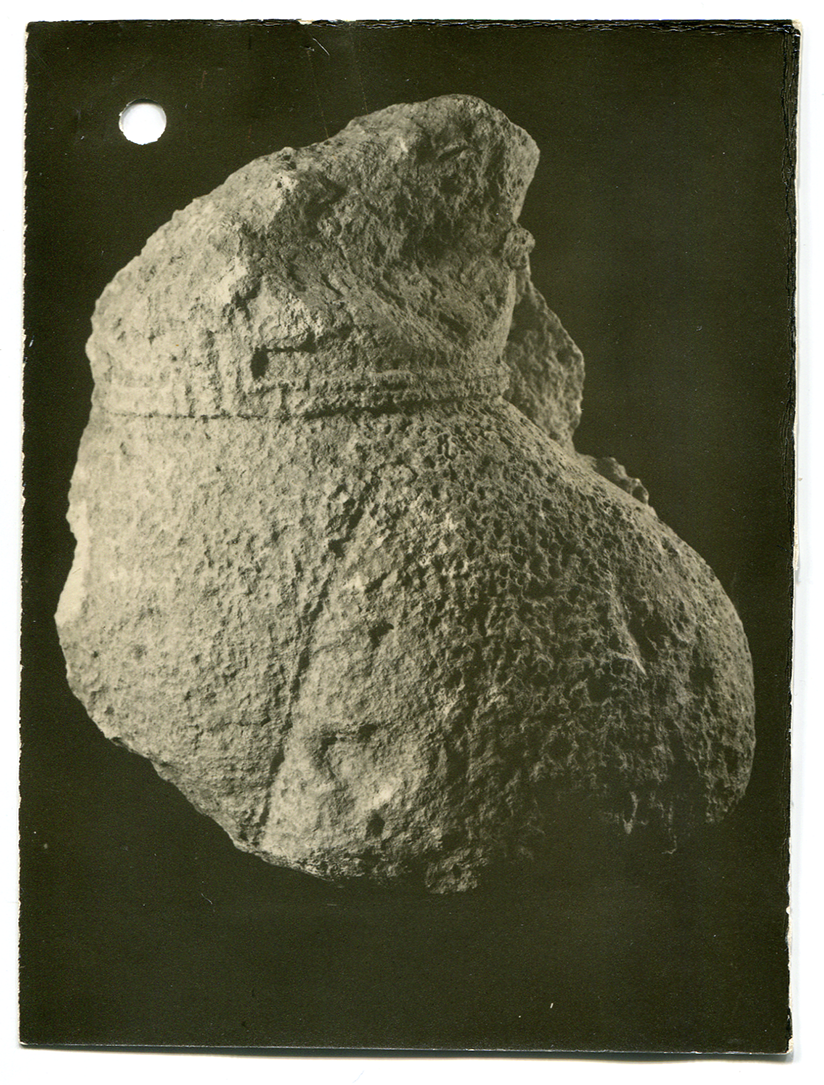
Another letter from Hutchinson to Payne has similar content: ‘You will be interested to hear that Mathioudakis vineyard is turning out Archaic fragments (+Roman). I enclose prints of the fragment of Archaic statue and the Roman relief; the other archaic piece (a waist in relief) I will have photographed and will send you a print’.Footnote 11 Photographs of the two sculptures taken near the time of discovery are held in the archives of the British School at Athens (Figs 4–5) and were instrumental to the re-discovery of the sculptures in the storerooms of the Archaeological Museum of Heraklion nearly a century later. In the same letter, Hutchinson noted that it was worth having ‘a deep trial shaft to see if there is any archaic stratum’, discussed the stakeholders that needed to be contacted over this plan, and invited Payne to supervise this work when he visited. Payne was an expert on Archaic Greek pottery and sculpture, had previously excavated and published Early Iron Age material from Knossos, and had also excavated at Eleutherna (Payne Reference Payne1927–8; Kotsonas Reference Kotsonas2008b; Mantis Reference Mantis2009). Payne could thus become the ‘Vates sacer’ who – Arthur Evans prophesised – would study ‘the remains of classical antiquity on the site of Knossos’ (Evans Reference Evans1910). But fate had it otherwise: Hutchinson’s letter closes by extending wishes to Payne for ‘speedy recovery’ (περαστικά), but Payne never recovered from the health issue he was facing and died prematurely some 20 days later (Mantis Reference Mantis2009, 89–92).
Archival photograph of the relief with the belted figure (British School at Athens Archive, Corporate Records, Knossos Excavation Reports, 1935–49, Mathioudakis bundle). Reproduced with the permission of the British School at Athens.

Archival photograph of the head with the tiered wig (British School at Athens Archive, Study Collection, Box Archaic Non Attic Statues, Folder Cretan, Knossos). Reproduced with the permission of the British School at Athens.

Following Payne’s death, Hutchinson opened a trial trench himself ‘in the hope of finding a good archaic stratum … [but n]o such stratum was found in the vineyard’.Footnote 12 Megaw’s published report notes: ‘Trial pits in the vineyard revealed a Roman stratum with a cist-grave containing three superimposed skeletons, Roman coins and pottery overlying an LM [Late Minoan] level, but no trace of an archaic stratum’.Footnote 13
Following this unsuccessful excavation, Hutchinson proposed the association of the two sculptured pieces with finds ‘on the opposite side of the road’ (Megaw Reference Megaw1936, 150), i.e. the road that connects Heraklion and Arkhanes and passes west of the Palace of Knossos. Located ‘south of the village of Knossos’ (i.e. Bougada Metochi),Footnote 14 some 150 m south from the spot of Hutchinson’s excavation (Hood and Smyth Reference Hood and Smyth1981, 50, no. 207), these finds included ‘a wall, dated by the associated pottery to the Late Geometric period’, and the human head of a clay figurine of similar date.Footnote 15 Thinking that the two limestone sculptures were originally from this location, Hutchinson remarked: ‘I think it pretty certain that they have been brought down [to the Mathioudakis vineyard] as building stones in Roman times, probably from our “archaic” site’.Footnote 16 As Megaw noted, ‘It is intended to excavate this site next year’ (Megaw Reference Megaw1936, 150). Hutchinson and Tom Dunbabin undertook the so-called ‘Archaic Dig’ in 1937 and uncovered settlement remains of varied date, but they were unsuccessful in tracing an Archaic stratum (Young Reference Young1937, 137–8; Hood and Smyth Reference Hood and Smyth1981, 50, no. 207; Kotsonas Reference Kotsonas2020, 31–2). I have argued that this agonising but failed search for an Archaic stratum is the beginning of the problem of the Archaic Gap (Kotsonas Reference Kotsonas2020, 32); the archival materials discussed above establish that this problem predates its first attestation in published literature, which is placed between 1938 and 1947 (Erickson Reference Erickson2010, 6). In any case, this failed search, the death of Payne who was invited to study Hutchinson’s finds, the outbreak of World War II, and the perennial Minoan focus of most research at Knossos cast the two sculptures into oblivion for nearly a century.
The third piece of sculpture published in this study is an Archaic head which was discovered by Eleni Hatzaki at Little Palace North in 2002 (Hatzaki in Whitley Reference Whitley2002–3, 81–2, fig. 134; Prent et al. Reference Prent, MacVeagh Thorne, Callaghan, Evely, Driessen and Knappett2022, 215, fig. 6). Targeting a narrow strip of land located immediately north of the Little Palace (Hatzaki et al. Reference Hatzaki, Prent, Coldstream, Evely and Livarda2008; Prent et al. Reference Prent, MacVeagh Thorne, Callaghan, Evely, Driessen and Knappett2022), this fieldwork revealed continuous occupation from the Minoan to the Roman period (Prent et al. Reference Prent, MacVeagh Thorne, Callaghan, Evely, Driessen and Knappett2022, 211). This includes substantial Minoan architectural remains of the Late Minoan IIIA, IIIB, and IIIC periods (Whitley Reference Whitley2002–3, 81). The Early Iron Age strata, which have already been fully published, held traces of outdoor industrial activities (including pans associated with olive oil production debris and hearth-pits with evidence for ironworking), as well as the remains of a trackway and of drains or water channels (Hatzaki et al. Reference Hatzaki, Prent, Coldstream, Evely and Livarda2008; also, Whitley Reference Whitley2002–3, 81; Prent et al. Reference Prent, MacVeagh Thorne, Callaghan, Evely, Driessen and Knappett2022, 212–14). The publication of the Archaic to Hellenistic material from the excavation is forthcoming (MacVeagh Thorne et al. Reference MacVeagh Thorne, Prent, Callaghan, Evely and Livardaforthcoming), but a preliminary report suggests that the open-air character of the site was preserved in the Archaic period and that some building activity occurred in Classical times, while the Late Hellenistic period saw terracing and the construction of a house which was destroyed at the end of the first century BC (Prent et al. Reference Prent, MacVeagh Thorne, Callaghan, Evely, Driessen and Knappett2022, 214–18; cf. Whitley Reference Whitley2002–3, 81). Major activity resumed in the second century AD with the construction of a new house which lasted until the fourth century AD (Prent et al. Reference Prent, MacVeagh Thorne, Callaghan, Evely, Driessen and Knappett2022, 218–20; also, Whitley Reference Whitley2002–3, 81). Several Roman (second century AD?) robbing pits were located in the west end of the excavated area and contained rubble and chipped stones (Whitley Reference Whitley2002–3, 81). The Archaic head came from one of these pits and was ‘wedged into a dense pile of stones next to a small Roman lime kiln’ (Prent et al. Reference Prent, MacVeagh Thorne, Callaghan, Evely, Driessen and Knappett2022, 215).
DESCRIPTION, STYLE AND DATING OF THE THREE SCULPTURES FROM KNOSSOS
All three pieces published here are made in soft limestone (poros), which is widely used for Early Iron Age to Archaic Cretan sculpture and is widely available on the island, including in the area of Knossos (Adams Reference Adams1978, 134). Limestone sculpture from Crete has been tested archaeometrically by Nikolaos Stampolidis and Vassilis Lambropoulos, but the results of this research are unpublished, except for brief references (Kotsonas Reference Kotsonas, Stampolidis, Giannikouri and Kanta2012, 180, 182; Stampolidis Reference Stampolidis, Kokkorou-Alevras and Niemeier2012, 10–11). Based on macroscopic observation, I consider that all three sculptures discussed here are made of Cretan limestone. Style corroborates the Cretan provenance of the works (see below).
Style relates to chronology, since Cretan sculpture is dated on stylistic grounds, rather than on stratigraphic evidence, which is unavailable (see, e.g., Jenkins Reference Jenkins1936; Rizza and Scrinari Reference Rizza and Scrinari1968; Davaras Reference Davaras1972; Adams Reference Adams1978). Stylistic dating applies to the entire body of Greek sculpture predating the mid sixth century BC (see, e.g., Jenkins Reference Jenkins1936; Richter Reference Richter1960, 4–5; Reference Richter1968, 17–20; Ridgway Reference Ridgway1977, 1–9; Adams Reference Adams1978), which is concerning for two main reasons. First, the emphasis on different stylistic criteria results in discrepancies in proposed chronologies. A case in point is provided by the somewhat different (by a quarter century) chronologies given for specific pieces of Cretan Daedalic sculpture in the textbooks by Stewart (Reference Stewart1990, captions for figs 26, 29, 32) and Rolley (Reference Rolley1994, captions for figs 115, 118), or the broader chronological discrepancies in the specialised studies by Davaras (Reference Davaras1972) and Adams (Reference Adams1978). Second, such dating involves hypotheses on the direction and pace of stylistic development (Ridgway Reference Ridgway1977, 9–10). In the case of Knossos, scholars seem torn between acknowledging the site’s singular role in generating stylistic change in Crete and treating it as representative of the island’s output (cf. Kotsonas Reference Kotsonas2008a, 338, with references). The textual tradition and the archaeological record which establish that Early Iron Age Knossos was a major, well-connected site (Kotsonas Reference Kotsonas2019), the rich textual tradition for Daidalos at Knossos, and the number and range of Early Iron Age to Archaic sculptures from the site (on which see below) suggest to me that this sculpture can be somewhat earlier than its comparisons from elsewhere in Crete which meet only a few – if any – of these conditions. These considerations inform my analysis of the three sculptures below, which is organised in a rough chronological sequence that promotes the discussion of stylistic associations between them.
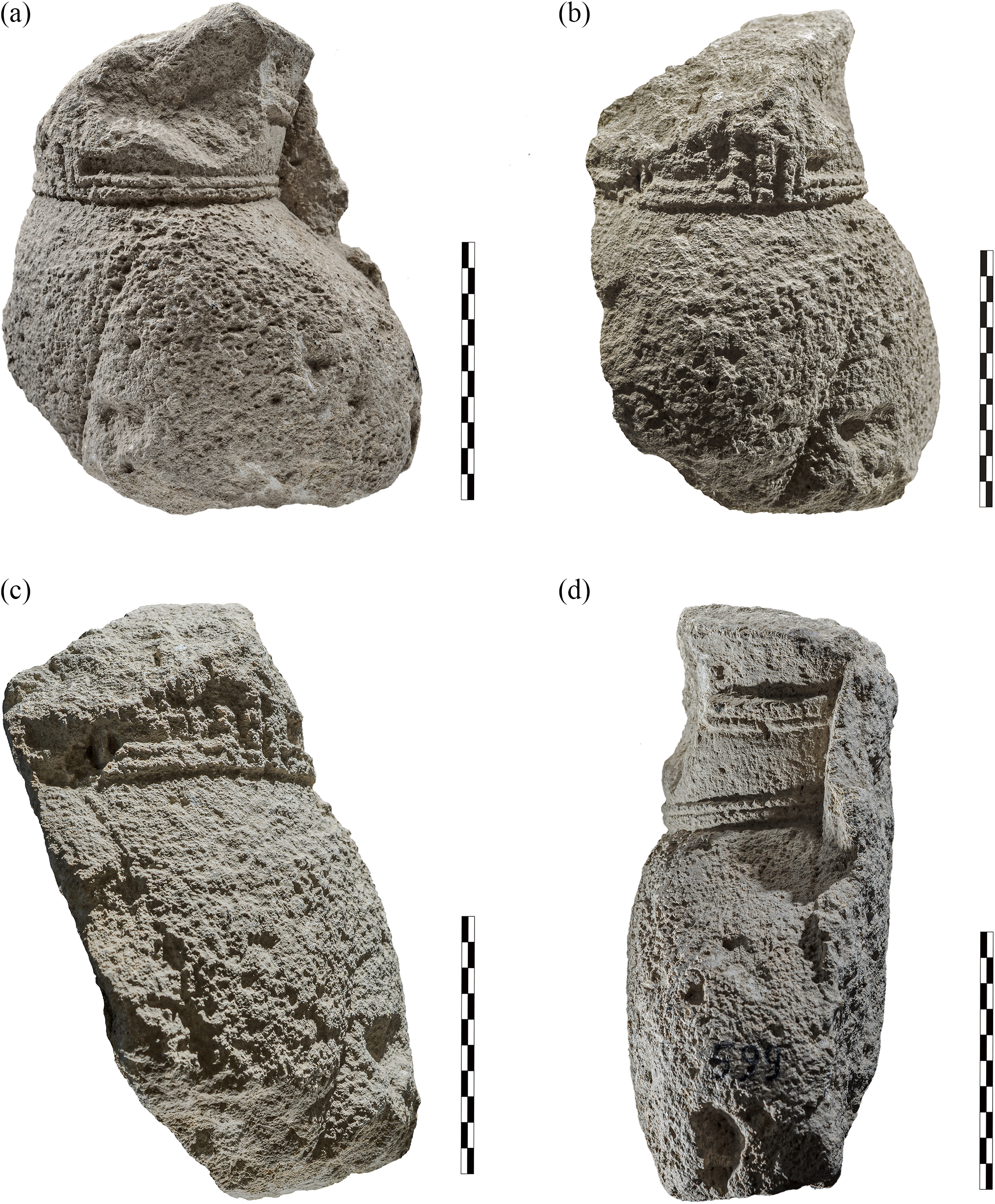
Relief with belted figure (Fig. 6)
Description
Relief showing the lower torso, the belted waist, the buttocks and the upper leg of a male figure (Archaeological Museum of Heraklion, Inventory Number: Γ599).
The relief with the belted figure. Photographs by Yannis Papadakis Ploumidis. a) front side; b) 3/4 view of the relief aligned with the buckle; c) side view of the relief, showing the front side of the figure; d) side view of the relief, showing the back side of the figure.

Height: 18.5 cm, Width: 16 cm, Maximum thickness: 8.5 cm, Diameter of the waist: c. 10 cm.
Very pale brown (10YR 8/2) Cretan limestone. Possible traces of reddish pigment on the upper leg visible by naked eye.
High relief, rising up to 6 cm from the flat surface of the slab. The slab is broken off (only a thin flat slice is preserved at the level of the waist of the sculptured figure), and its thickness is uncertain. The damage is ancient.
The relief preserves the lower torso, the narrow waist, the pubic area and the pronounced buttocks of a figure. The figure is wearing a belt and a loin cloth, and is shown in three quarters, the belt buckle being indicative of the front. The loin cloth, which is triangular and is marked by deep grooves, covers the genitals. A shallower groove along the buttocks suggests that the cloth also covered this area, but left the upper leg exposed.
The belt of the figure is broad (3.8 cm) and is flanked by pairs of horizontal ridges, above and below (the upper pair includes thicker ridges and in higher relief). The space in between the pairs (2.2–2.3 cm) could have carried painted decoration. The belt is fastened at the front: the vertical terminals (which are made up by double vertical ridges) are separated by a buckle showing a vertical row of four rings. A horizontal ridge in relief, which extends 1.2–1.5 cm from the buckle, perhaps represents its tongue. Because of the rendering of the figure in three quarters, the sculptor did not align the buckle with the pubic triangle, but moved it slightly off centre to make it more visible, perhaps in relation to the rendering of the torso.
Function, style and dating
The sculpture is a high relief which preserves a small part of the slab, and it has long been identified as such. In an unpublished report, Hutchinson wrote of ‘the belted waist and buttocks of a figure … which [together with the second piece found in 1936] seem to have come from very high reliefs, not from free-standing sculpture … in a rather poor limestone, rather soft and badly pitted’.Footnote 17 Megaw’s published report describes both finds from 1936 as ‘fragments of archaic architectural sculpture … Both fragments are cut in a soft rather badly pitted limestone and are from reliefs’ (Megaw Reference Megaw1936, 150; cf. Karo Reference Karo1936, 160–1). Other published reports by British scholars repeat this information (Benton Reference Benton1937, 41; Jeffery Reference Jeffery1949, 36, no. 9; Hood and Smyth Reference Hood and Smyth1981, 50, no. 209; Coldstream, Huxley and Webb Reference Coldstream, Huxley and Webb1999, 293).
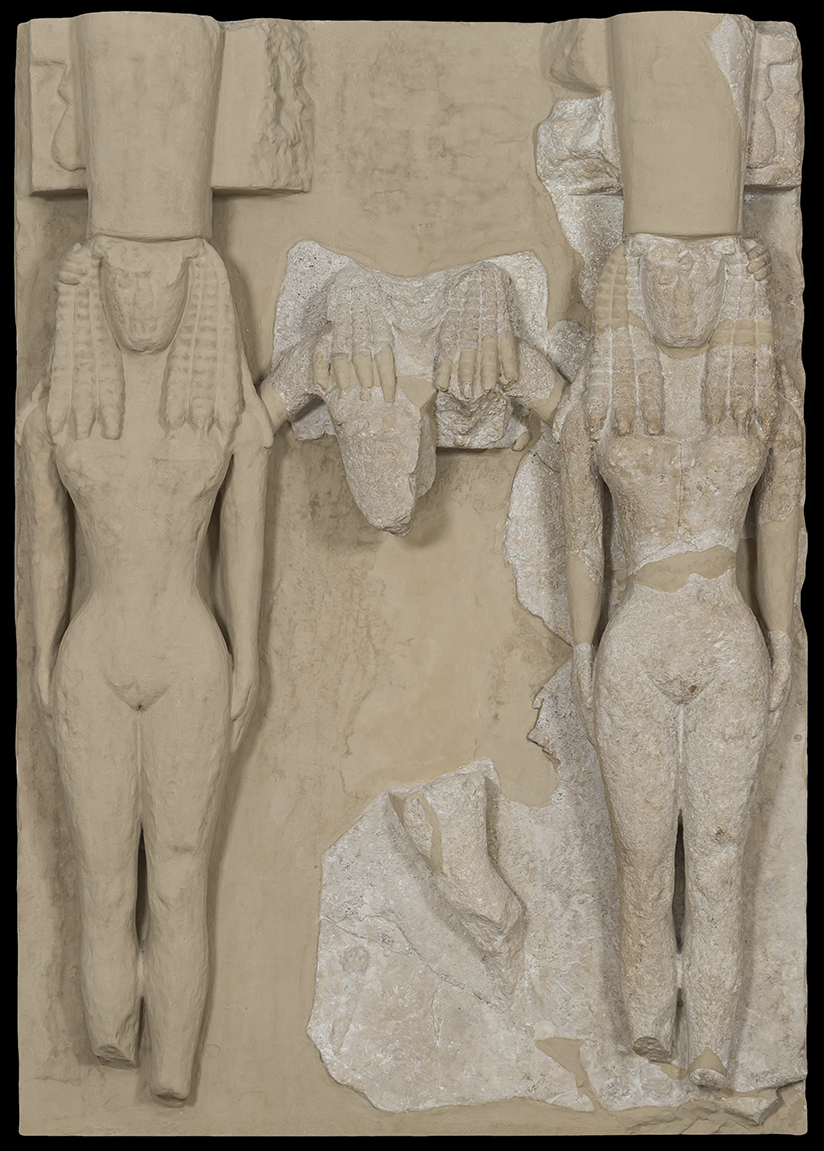
The depth of the Knossian relief recalls the two reliefs of divine triads from the sanctuary of Athena on the acropolis of Gortyn (Rizza and Scrinari Reference Rizza and Scrinari1968, 156–7, 230, 234, nos 8–9; Adams Reference Adams1978, 23, nos 8–9) (Fig. 7), and is much higher than that of the reliefs from Prinias Temple A (Pernier Reference Pernier1914; D’Acunto Reference D’Acunto1995; Pautasso and Rizza Reference Pautasso, Rizza and Gavrilaki2018). Although the preserved fragment is small, the original sculpture would have been sizeable. Indeed, the one fully preserved dimension, i.e. the waist diameter of the belted figure, is comparable to the waist diameter of the side figures on the two reliefs of the divine triads from Gortyn (Rizza and Scrinari Reference Rizza and Scrinari1968, 156–7, 230, 234, nos 8–9; Adams Reference Adams1978, 23, nos 8–9). Standing upright (perhaps unlike the figure on the Knossian relief), these Gortynian figures extend over 1 m in height, and reach c. 1.5 m if one includes the polos they are wearing. Clearly, the Knossian relief was monumental, even though its figure was much smaller than life-size.Footnote 18
The better-preserved divine triad from Gortyn. Archaeological Museum of Heraklion Γ379. © Hellenic Ministry of Culture – Archaeological Museum of Heraklion – H.O.C.R.D.

Cretan and other Greek art of the eighth and seventh centuries BC typically shows figures in profile or in frontal view, but can also show the combination of the two schemes, with the torso rendered in frontal view and the legs in profile (e.g. Blome Reference Blome1982). The latter scheme is attested on the central male figure of the best-preserved Gortyn triad, which is usually considered Late Daedalic and dated to 640–620 BC (Rizza and Scrinari Reference Rizza and Scrinari1968, 156–7, 234, no. 9; Adams Reference Adams1978, 23, no. 9; Fig. 7). Although this figure does not preserve its waist, it offers the best comparison for the figure on the Knossian relief.
Exceptionally, the waist area of the figure on the Knossian relief is rendered in three quarters. Comparisons for this rendering include, in rough chronological order: a terracotta plaque from Praisos (700 BC?) showing a belted man (athlete?) with the torso rendered in profile and the legs (which are bent) in three quarters (Demargne Reference Demargne1902, 572–3, fig. 1; Hall Dohan Reference Hall Dohan1931, 211, fig. 5, 214); a series of Middle Daedalic (670–640 BC) terracotta plaques from the acropolis of Gortyn, which show a standing, belted female figure in a long dress (Rizza and Scrinari Reference Rizza and Scrinari1968, 177, 230, 244, nos 173a–h); and a striding man holding a wreath on a seventh-century relief pithos from Lyktos (in this case the torso is in three quarters, but the legs are in profile) (Levi Reference Levi1927–9, 77, fig. 53).
On the Knossian relief Hutchinson identified ‘a man in violent motion’,Footnote 19 and Megaw ‘a running figure not unlike those on the Rethymno mitra’ (Megaw Reference Megaw1936, 150; cf. Karo Reference Karo1936, 160–1), meaning the probable dancers on either end of the mitra (Poulsen Reference Poulsen1906; Hoffmann Reference Hoffmann1972, 25, 37; Blome Reference Blome1982, 85). However, the rendering of the waist area of these dancers fits standing figures, and it is only the sharp bending of one of their legs and the rendering of their arms that indicate motion. The position of the figure on the Knossian relief can best be appreciated through a broader analysis of belted figures in Cretan art.
Belted figures are commonly found in Cretan art of especially the seventh century BC (Davaras Reference Davaras1972, 27–9, 64–5; D’Acunto Reference D’Acunto2000; Hermary Reference Hermary, Kourayos and Prost2008; Pappalardo Reference Pappalardo2019); this applies to both male and female figures, but females are typically shown standing or seated in full frontal position,Footnote 20 whereas males are rendered full frontal, striding, or in intense motion. The full frontal standing males are bronze figurines, which are belted but otherwise nude and have their genitals exposed (D’Acunto Reference D’Acunto2000, figs 5, 7–9, 18–20). Similar figures are rendered in profile on bronze cut-out plaques from the sanctuary of Syme Viannou and on two Cretan clay vessels, which mostly date from the seventh century BC.Footnote 21
More closely comparable to the piece from Knossos are specimens of Cretan relief art showing figures which: a) are belted and may wear a loin cloth or be dressed more heavily; and b) are mostly shown striding or in intense motion with their body – at least their lower body – in profile. None of these pieces is rendered in stone,Footnote 22 but the different comparisons – including the figures of the Rethymnon mitra mentioned by Megaw – are rendered on small objects made of metal and clay which date from the eighth to sixth centuries BC, but mostly to the seventh. The group includes: the central male figure on the Idaean Cave tympanon, which steps on a bull and holds a feline above his head (e.g. Blome Reference Blome1982, 15–16, pl. 3:3; Sakellarakis and Sapouna-Sakellaraki Reference Sakellarakis and Sapouna-Sakellaraki2013, pl. 20: eighth century BC); the men on numerous cut-out bronze plaques from Syme Viannou which are shown striding, kneeling or in intense motion (Lebessi Reference Lebessi1985, 23–38, 43, 52–4, nos A3, A8, A10, A17, A18, A20, A21, A24, A30, A35, A37, A39, A40, A56, Γ5, Γ7: seventh century BC); a standing master of lions on gold jewelry from Knossos (Coldstream and Catling Reference Coldstream and Catling1996, 221, no. 219.f91: 750 BC) and Eleutherna (Mitaki Reference Mitaki2019, 31–2, no. 75: before 650 BC); the winged master of winged horses on a relief pithos allegedly from Phaistos (Gjødesen Reference Gjødesen, Doeringer, Mitten and Steinberg1970, 147–9, figs 1–4: c. 660 BC, New Carlsberg Glyptotek, Copenhagen); the standing belted master of griffins which is rendered in profile on a Middle Daedalic terracotta plaque from Gortyn (Rizza and Scrinari Reference Rizza and Scrinari1968, 171, 230, 244, no. 127: 670–640 BC); the youths that grasp serpents on a bronze helmet from Afrati (Hoffmann Reference Hoffmann1972, 2–3, no. H1: late seventh century BC); and the kneeling Herakles shooting arrows at the centaurs on relief plaques from Praisos and Lato.Footnote 23
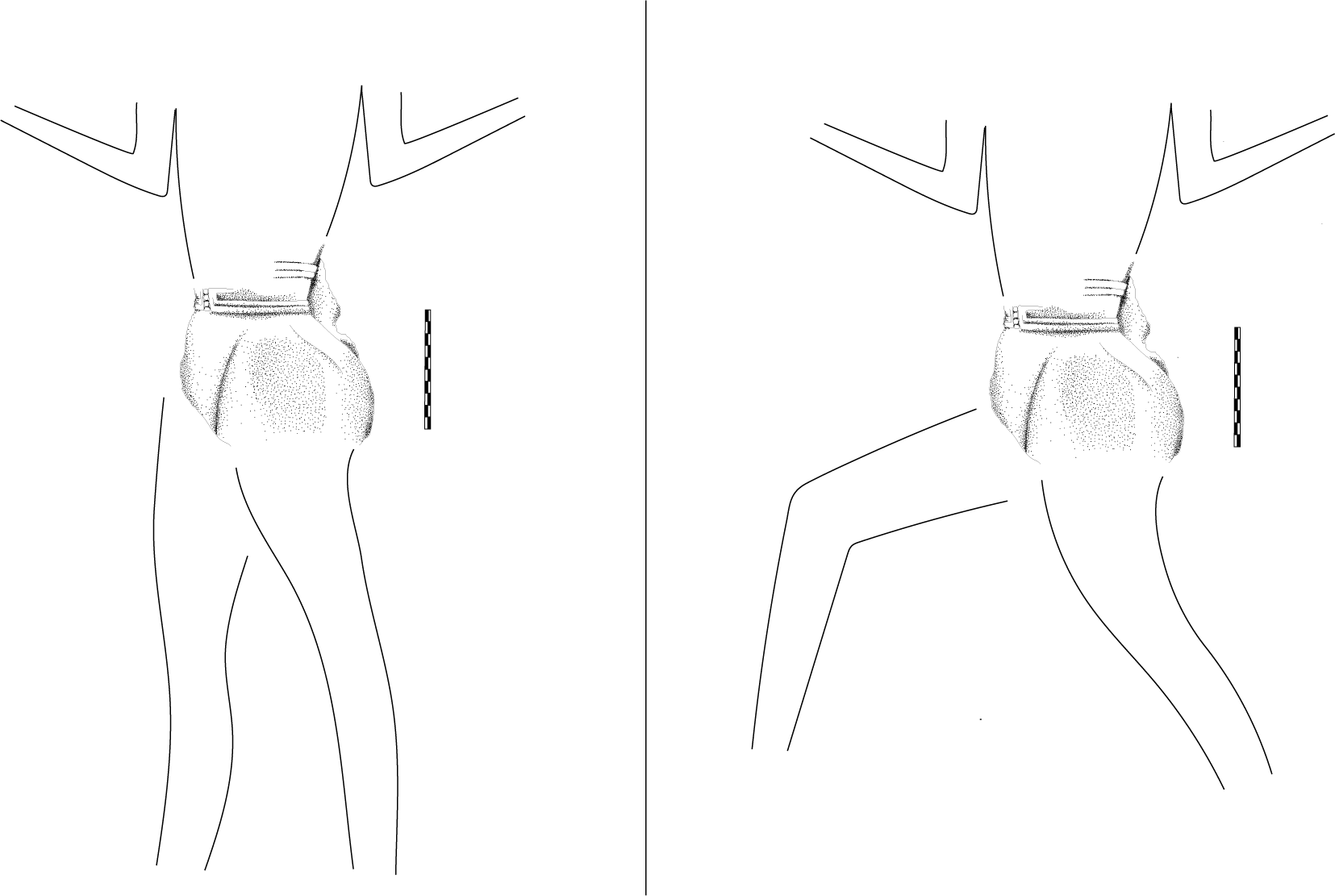
The position of the different figures mentioned ranges from proper kneeling and the Knielauf, to simply standing. Some of these figures show pronounced buttocks, which cannot be taken to be indicative of motion, as demonstrated, for example, by the Gortynian master of griffins (Rizza and Scrinari Reference Rizza and Scrinari1968, 171, 230, 244, no. 127). Accordingly, I offer two hypothetical reconstructions of the figure on the Knossian relief, the first standing and the second in motion (Fig. 8). Both reconstructions show the hands extending well beyond the body because of the lack of any evidence for the attachment of the arms/hands on the surviving part of the legs (see, e.g., Davaras Reference Davaras1972, 16, 18, figs 15–18, 23), and also because of the iconography of the comparisons mentioned above. In a similar vein, the central male figure of the best-preserved Gortyn triad has its arms extending to the shoulders of the flanking female figures (Rizza and Scrinari Reference Rizza and Scrinari1968, 156, no. 9). It remains uncertain whether the Knossian relief showed a comparable composition. However, most of the comparisons listed above show masters of animals, thus providing a strong possibility for the iconography of the relief.Footnote 24
Hypothetical reconstructions of the belted figure on the Knossian relief, by Fani Skyvalida.

The belt of the Knossian figure recalls the one on the statue from Astritsi, which is dated to 670–650 or 640–630 BC (Davaras Reference Davaras1972, 9–10, esp. figs 2–5; Adams Reference Adams1978, 35–7) (Fig. 9). In both cases, the belt is broad, with pairs of ridges on the upper and lower ends, the upper pair being more prominent. A looser comparison is provided by the bust from Eleutherna, which preserves only the upper edge of the belt that shows a rounded ridge above an incised band (Davaras Reference Davaras1972, 37–8, esp. figs 37–8; Fig. 10). The belt buckle on the Knossian relief, which shows a vertical row of four rings, recalls the standing lintel goddesses of Prinias, which present five such rings on their belts, while the seated goddesses from the same monument show four or five (Pernier Reference Pernier1914, 56–7, 60, figs 21 and 23; D’Acunto Reference D’Acunto1995, 31, 33, figs 10:1 and 12:2). Such divisions are rendered by incision on the statue of the seated goddess from the acropolis of Gortyn and on the Auxerre Lady, and they must have been highlighted in colour, as proposed on reconstructions of the two works (Kokkorou-Alevras Reference Kokkorou-Alevras2023, figs 4, 5, 12, 13, 18).
The statue from Astritsi. Archaeological Museum of Heraklion Γ407. © Hellenic Ministry of Culture – Archaeological Museum of Heraklion – H.O.C.R.D.

The Daedalic bust from Eleutherna. Archaeological Museum of Heraklion Γ47. © Hellenic Ministry of Culture – Archaeological Museum of Heraklion – H.O.C.R.D.

The vast majority of the comparisons discussed above date from the mid to the late seventh century BC, while the closest comparison for the Knossian work, which is the central figure on the better-preserved Gortyn triad, is usually dated to 640–620 BC (Rizza and Scrinari Reference Rizza and Scrinari1968, 156–7, 234, no. 9; Adams Reference Adams1978, 23, no. 9; Fig. 7). Based on these comparisons and the methodological considerations laid out above, I propose a date of 650–630 BC for the Knossian relief. This time frame is somewhat earlier than that considered by Hutchinson and Megaw. Indeed, Hutchinson dated the piece to ‘the end of the 7th century’,Footnote 25 and Megaw (Reference Megaw1936, 150) noted that ‘the fragment dates probably from the late seventh century’ (cf. Karo Reference Karo1936, 160–1). Other works by British scholars on the archaeology of Knossos accept this date or propose a slightly later one (Jeffery Reference Jeffery1949, 36, no. 9: ‘late seventh and early sixth centuries’; Hood and Smyth Reference Hood and Smyth1981, 50, no. 209: ‘Archaic’). Nevertheless, Benton (Reference Benton1937, 41) identified the pieces as Daedalic, thus approximating the date proposed here.
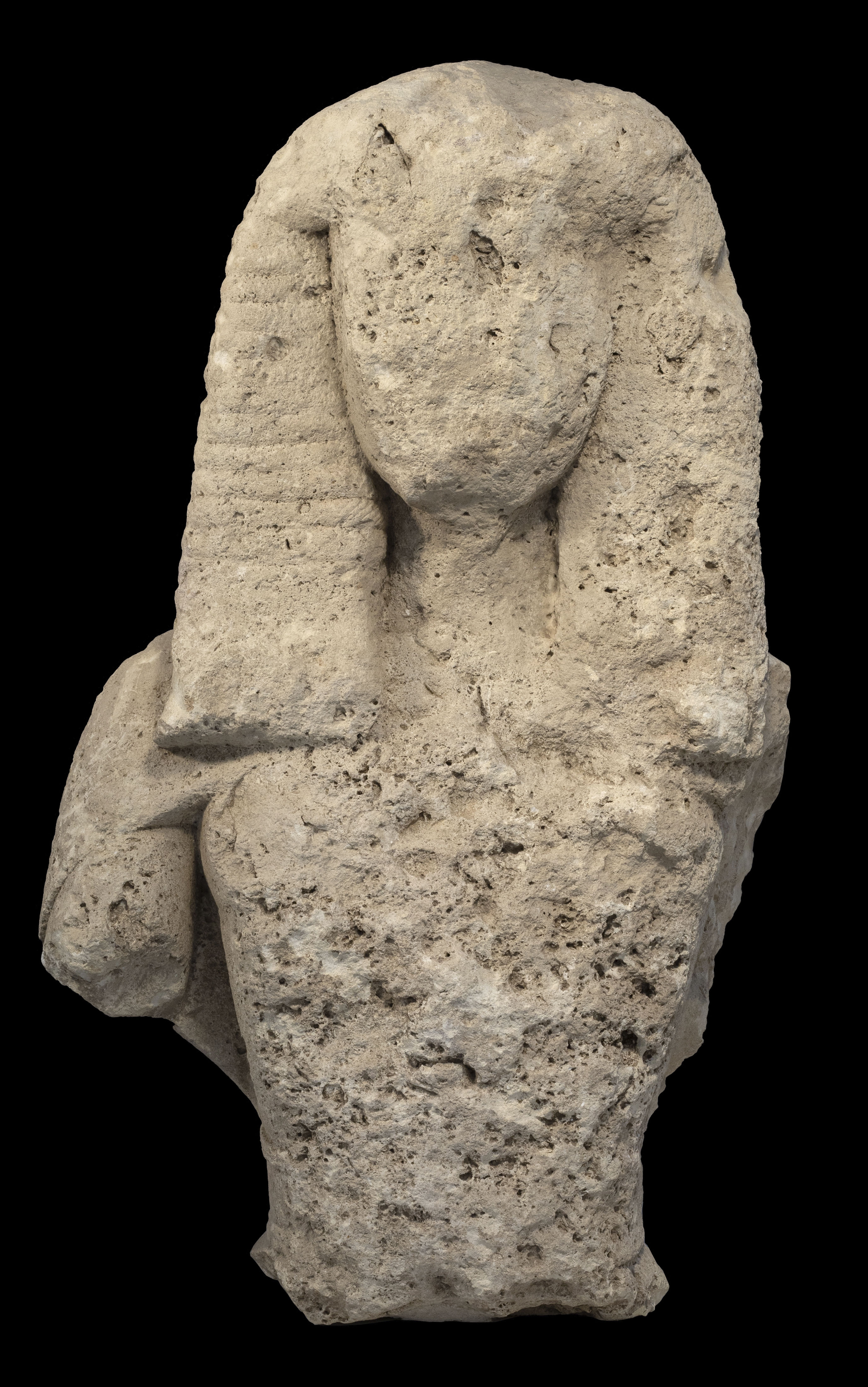
Head with tiered wig (Fig. 11)
Description
Head with tiered wig (Archaeological Museum of Heraklion, Inventory Number Γ1093).
The head with the tiered wig. Photographs by Yannis Papadakis Ploumidis. a) front side; b) 3/4 view of front side; c) left side; d) right side; e) 3/4 view of back side; f) back side.

Very pale brown (10YR 8/2) Cretan limestone.
Height: 18 cm, Width: 20 cm, Maximum depth (≃ Diameter): 19 cm.
The head is broken off along the lower neck and the lower end of the tiered wig. The upper end of the head is smooth, and this seems to be an original surface, which means the head was attached to an overlying flat surface; alternatively (but less likely), the smooth surface was created after the piece was broken off to facilitate the reuse of the stone (see below). A diagonal break along the face has destroyed it almost entirely: only the chin, most of the left ear and the lower end of the right ear are preserved (a small rounded cavity above the chin is unlikely to represent a trace of the right end of the mouth). The sides of the head, which basically consist of the layered hair, are the best-preserved parts, while the back of the head is broken off and shows a pair of very deep and roughly formed holes on the lower right side, and a pair of shallower holes on the lower central and left side (dowel holes?). The former pair is separated from the wig by a vertical ridge. Modern wear is very limited and superficial.
The head is slightly under life-size and shows a U-shaped face. It is supported by a robust neck, which is separated from the wig by deep channels. The ears stand out straight from the head. The lobe is preserved on both ears, but the left ear also preserves the helix and antihelix, which are rendered as parallel ridges separated by a groove. A battered projection is perhaps the remains of the tragus. The hair is arranged in a layered wig (Etagenperücke) which surrounds the head and preserves seven thick layers on each side. The wig does not fall down vertically forming a right angle, but turns gently towards the back.
Function, style and dating
In a letter to Payne, Hutchinson called the head a ‘fragment of Archaic statue’.Footnote 26 The piece is probably the ‘kouros’ mentioned in an unpublished report written by Sir John Myres, Chairman of the British School at the time, after a visit of his to Knossos.Footnote 27 In a more technical, unpublished report Hutchinson explained that ‘[b]oth the last named [i.e. the two sculptures found in 1936] seem to have come from very high reliefs, not from free-standing sculpture’.Footnote 28 This information was repeated in Megaw’s published report, which identifies the head as a piece of architectural sculpture in relief, and describes it as ‘the lower part of a head, slightly under life-size, with layered hair, perhaps of the early sixth century’ (Megaw Reference Megaw1936, 150). Karo (Reference Karo1936, 160–1) also called the piece a relief, and more recent studies of the archaeology of Knossos use the same term or identify the piece as architectural sculpture (Benton Reference Benton1937, 41; Jeffery Reference Jeffery1949, 36, no. 9; Hood and Smyth Reference Hood and Smyth1981, 50, no. 209).
The different scholars who have commented on the head have not given their reasons for ascribing it to a relief or identifying it as architectural sculpture. Unlike the relief with the belted figure discussed above, the head in question does not preserve any flat piece of slab. The sculpting of the wig extends well behind the ear, but this cannot be taken to show that the piece was free-standing. Indeed, the sculpting of the hair in the two Gortynian reliefs of the divine triads extends to the back of the head, and the same is attested for the Astritsi statue which was affixed against a structure (all these works date around the mid seventh century BC).Footnote 29 Nevertheless, the Knossian head preserves some positive evidence which corroborates its identification as architectural sculpture. First is the smooth upper surface of the head. This feature is attested on a Late Daedalic (?) head from Eleutherna that preserves a small hole which is taken to have facilitated the attachment of the sculpture to a surface (Stampolidis Reference Stampolidis, Kokkorou-Alevras and Niemeier2012, 3–4, fig. 6). In the case of the Knossian sculpture, a second piece of limestone could have made the upper end of the head, and – most likely – a polos worn by the figure (for females wearing a polos, cf. the divine triads from Gortyn and Knossian reliefs discussed below). Indeed, the flat upper end of the Knossian head recalls the neat breaks on the Astristi statue and the seated goddess from the acropolis of Gortyn, which have been interpreted as evidence that these statues were made up by different blocks of stone.Footnote 30 The earlier head from Amnisos may present another case for the making of a Cretan sculpture by more than one piece of limestone (Mandalaki Reference Mandalaki2019, 235; the head is discussed further below). Elsewhere in Greece, such joins between flat surfaces (i.e. butt joins), which involved the use of adhesives or dowels, were employed sparingly in the Archaic period, first on limestone sculpture and then on marble works (Jacob Reference Jacob and Palagia2019, 676).
Other evidence in support of the established identification of the Knossian piece as architectural sculpture can be identified in the two pairs of holes on the back of the head. The pair of deep holes (which are separated from the wig by a vertical ridge; Fig. 11e) recall the two very large and deep holes on the lower right part of the Astritsi statue, which are considered as dowel holes that enabled the attachment of the sculpture to a structure.Footnote 31 The possibility that the Knossian head was affixed to a monument brings to mind the case of the early sixth-century head from Axos, which preserves undeniable evidence (located on the top and the right side of the head) for attachment to a sculptured pediment, or a dado frieze, or a burial structure (Alexiou Reference Alexiou1952, 3, 4, 6, 9–10; Adams Reference Adams1978, 84–5; Tegou Reference Tegou2019). Elsewhere in Greece, dowel holes are attested on sculptures from the Archaic period (Jacob Reference Jacob and Palagia2019, 676–8). The possibility that the Knossian head was part of the superstructure of a monument and was viewed from below finds support in the form of the wig, which does not fall down vertically forming a right angle, but turns gently towards the back, conveying the impression of foreshortening. The same impression is conveyed by the grooves of the wig, which are not entirely horizontal, as is usual for tiered wigs of the seventh century, but oblique, rising slightly toward the back.
Little can be said about the style of the face, since it is battered. The layering of the hair is best matched on the statue from Astritsi, which dates to the second or third quarter of the seventh century (Davaras Reference Davaras1972, 33–8; Adams Reference Adams1978, 35–7; Fig. 9). However, the ears of the Knossian piece stand out straight from the head, along the masses of the hair, which is a feature generally associated with the Late Daedalic style (Jenkins Reference Jenkins1936, 17; Adams Reference Adams1978, 38, 40). A comparable arrangement of ears and head is found on the well-preserved bust from Eleutherna (Fig. 10) and on the Prinias lintel goddesses, which are all usually dated c. 630–620 BC.Footnote 32 The head of a bearded sphinx (?) from Eleutherna, which compares closely to the Knossian piece in showing ears that stand out straight from the head against a layered wig, has been dated tentatively to c. 650 BC (Stampolidis Reference Stampolidis, Kokkorou-Alevras and Niemeier2012, 3–5, fig. 8) or c. 630 BC (Stampolidis Reference Stampolidis2004, 237, no. 254), without justification. The earliest of the two dates, however, is unlikely on stylistic grounds, especially since the ears of Middle Daedalic pieces are typically hidden by the wig (Jenkins Reference Jenkins1936, 17; Adams Reference Adams1978, 38, 40). Conversely, the ears of Greek sculptures are connected to the head more integrally from c. 600 BC (e.g. Richter Reference Richter1960, 17, 22; Reference Richter1968, 18). Stone heads of the early sixth century are largely missing from Crete,Footnote 33 but the new way of rendering the ear is attested on a male terracotta bust from Praisos dated c. 570 BC (Forster Reference Forster1901–2, 273, 274, pl. 13:1) and on the mid sixth-century head from Little Palace North, both discussed and illustrated below.
Most of the comparisons discussed above date from the mid to the late seventh century BC. Based on these comparisons and the methodological considerations laid out above, I propose a date of 640–620 BC for the Knossian head. For the same reasons, I am sceptical about the later date proposed in unpublished reports from the time of discovery. More specifically, Hutchinson dated the head in question to ‘perhaps 600 B.C.’,Footnote 34 to ‘600 BC? or shortly after’,Footnote 35 or to ‘the early 6th century B.C.’,Footnote 36 while Megaw (Reference Megaw1936, 150) suggested that the piece is ‘perhaps of the early sixth century’. It remains unclear why the two scholars favoured an early sixth-century date given our limited understanding of Cretan sculpture of the time and the widespread identification of the tiered wig with the Daedalic style.Footnote 37 Karo thought differently and favoured an earlier, seventh-century date for the piece.Footnote 38 I agree with Karo, but I also note that a date before 640 BC is unlikely, given that earlier Daedalic works have their ears hidden completely under the wig.
Head from Little Palace North (Fig. 12)
Description
Head of a statue (Stratigraphical Museum, Knossos).Footnote 39
The head from Little Palace North. Photographs by Yannis Papadakis Ploumidis. a) front side; b) 3/4 view; c) left side; d) back side.

Height: 16–16.5 cm, Width: 15 cm, Depth: 11.5 cm.
Very pale brown (10YR 8/2) Cretan limestone. Traces of red pigment are visible by naked eye on the back of the skull and also on one side.
The head is broken off along the neck. The face is battered. The nose and right ear are almost completely lost; the mouth and right eye are very worn, but the left eye and ear are considerably better preserved. Most of the damage is ancient, but there is also recent wear.
Squarish head with slim ovoid face. Half life-size. The eyes are almond shaped, with incised contour; an arch in low relief renders the eyelid. The eyeballs were probably painted. A recess in the inner corner of the eyes indicates the lachrymal caruncle. The mouth was carved into the face, and enough of the Archaic smile survives to suggest that the lips were quite full and met at the corners. The ears are stylised and lean backward in an unnatural way. The tragus appears as a roundish excrescence, but the antitragus is not rendered. A slim horizontal line in relief perhaps indicates the antihelix. The lobe of the left ear is battered and the surrounding area is worn, but there is a circular formation that extends at the lower end of the ear and on the face, which must be the remains of a discoid earring.
A thick undifferentiated ridge in high relief, which is arching above the forehead and is separated from the crown of the head by a deep groove, represents either the forehead hair (on which curls could have been rendered in colour) or a padded headband. The groove is interrupted by a long and thin lock which extends vertically along the temples, in front of each ear. The crown of the head is smooth and preserves traces of red colour, which could have represented a skull cap. On the back of the head, below the groove, the long hair is rendered as an undifferentiated quadrangular (?) mass and falls below the nape. A trace of the collarbone area survives at the lower end of the hair mass.
Function, style and dating
The head was discovered within a central part of the settlement of Knossos. Prent et al. (Reference Prent, MacVeagh Thorne, Callaghan, Evely, Driessen and Knappett2022, 215) do not exclude a burial provenance, but all known Knossian burial sites of the first millennium BC are located at considerable distance (Hood and Smyth Reference Hood and Smyth1981), and I am inclined to think that the piece is votive, especially given the comparisons discussed below. In any case, the sculpture looks free-standing.
The preliminary description by Hatzaki (in Whitley Reference Whitley2002–3, 81) identifies the head as ‘female (?)’, but does not explain the reasoning for this suggestion. I suspect this relies on the delicate facial features and the earring. This tentative identification seems right to me. Males wearing earrings are rare in early Greek – including Cretan – art from most of the Aegean. Exceptions from Crete include an incised figure on a clay cup from Kommos (Kotsonas Reference Kotsonas2019, 599) and the Cretan or East Greek ivory youth from Samos which shows perforated ears for the inset of earrings in a different material.Footnote 40 Men with earrings are much more common on the Archaic art of East Greece, and also of Anatolia and Cyprus (Kurtz and Boardman Reference Kurtz and Boardman1986, 61–2; Smith Reference Smith2010, 181).
Based on the form and size of the work, Angeliki Lebessi (pers. comm.) suggested that the head from Little Palace North belongs to a sphinx. Free-standing sphinxes are commonly attested in Archaic Greek sculpture (Ridgway Reference Ridgway1977, 156–60), and such finds are also known from Crete. Indeed, a limestone head from Eleutherna dated to c. 650 or c. 630 BC is assigned to a male (bearded) sphinx (Stampolidis Reference Stampolidis2004, 237, no. 254; Reference Stampolidis, Kokkorou-Alevras and Niemeier2012, 3–5, fig. 8). Additionally, two sphinxes were rendered in high relief on the late seventh-century Temple A at Prinias (Pautasso and Rizza Reference Pautasso, Rizza and Gavrilaki2018, 229, fig. 11ab), while the early sixth-century limestone head from Axos has also been attributed to a sphinx attached to a monument (Alexiou Reference Alexiou1952; Adams Reference Adams1978, 84–5; Tegou Reference Tegou2019, 4, 8). Lastly, a Late Archaic stone relief of a sphinx or lion comes from Knossos (Boardman Reference Boardman1962, 30, pl. 3c), as discussed below.
The preliminary report on the head from Little Palace North noted that: ‘The head is of local poros limestone, but the style and execution suggest an artist from outside Knossos, perhaps outside Crete (Samos?)’ (Hatzaki in Whitley Reference Whitley2002–3, 81). I concur that the stone is local, but I am not convinced that the style is not. Eleni Hatzaki (pers. comm.) explained to me that the identification of the style as East Greek was proposed by the late John Boardman, who, however, could not recall his reasoning for it (pers. comm., 20 March 2019). Accordingly, it is hard to do justice to the proposal, especially since almost no piece of Archaic female statuary from Samos preserves a head (e.g. Karakasi Reference Karakasi2003, 13–34, pls 1–29). Perhaps Boardman was thinking of terracotta protomes from Samos, which show veiled women with padded headbands (as discussed below); such works, however, are not exclusive to the island and occur over much of the central Aegean (Croissant Reference Croissant1983, esp. 33–48, pls 1–4, for protomes from Samos). Connections between Crete and East Greece (especially Samos) are identifiable in stone and terracotta sculpture of the seventh century, at which time, however, the flow of influence derives from Crete (Lebessi Reference Lebessi and Stampolidis1999; Kotsonas Reference Kotsonas2008a, 278–82). A reverse flow of influence, from East Greece to Crete, has been deduced from the Late Archaic limestone bird statues from Amnisos (though this influence concerns the bases on which the birds stand) (Marinatos Reference Marinatos1953, 261–3; Adams Reference Adams1978, 89; Brize Reference Brize and Schäfer1992; Coldstream, Huxley and Webb Reference Coldstream, Huxley and Webb1999, 299–301; also see below). Ancient literature suggests that in the same period (sixth century) the Knossians Chersiphron and Metagenes (Vitruvius 10.2.11–2; Pliny, Naturalis Historia 7.125) worked together with the Samian Theodoros (Diogenes Laertius 2.1023) on the construction of the Artemision of Ephesus, and, more broadly, textual and archaeological evidence establishes the mobility of Archaic sculptors (Ridgway Reference Ridgway1977, 285–86, 296, 297). Notwithstanding this evidence, I remain sceptical over the assumed model of production which involves a Samian sculptor trained in marble working with limestone in sixth-century Crete. The dearth of Archaic sculpture on the island renders it an unlikely destination for non-Cretan sculptors (see also below). The same dearth poses challenges to drawing any hard distinction between Cretan and other Greek styles of sculpture in the sixth century.
The hairstyle of the head from Little Palace North favours a sixth-century date. In Crete, the arching ledge above the forehead, which stands out from the smooth crown of the head, is a feature that is first seen on sub-Daedalic terracottas from Axos and persists well into the sixth century (Rizza Reference Rizza1967–8, 241, 242, 244, 271, nos 102–3, figs 38–9: sub-Daedalic; and 247, 250, nos 116–18, fig. 17: Archaic). Such a ledge is also identifiable on the bust from Praisos (Fig. 13), which further recalls the Knossian head in combining a single lock (which runs behind the ear, rather than along the temples) on the side, with a mass of hair at the back of the neck.Footnote 41 The lock of the Knossian head, which extends vertically along the temples, in front of the ear, is paralleled on a female figure on a limestone stele from Kounavoi dated to 490–480 BC (Lebessi Reference Lebessi1973, 9–13, figs 1 and 5, pl. 1b). Outside Crete, such locks are attested on Greek marble sculpture of the mid sixth century, especially on male figures.Footnote 42
Clay bust from Praisos. Archaeological Museum of Heraklion Π2035. © Hellenic Ministry of Culture – Archaeological Museum of Heraklion – H.O.C.R.D.

The crown of the head is smooth and preserves traces of red pigment (but no incised or relief features). Red pigment is attested on numerous pieces of Cretan limestone sculpture (Adams Reference Adams1978, 139–40). The attestation of such pigment on the Knossian piece suggests that the head did not carry any helmet in bronze (or other material), as is hypothesised for a number of Greek statues with a smooth head crown, which date to the second half of the sixth and the first half of the fifth centuries (Schäfer Reference Schäfer1996; Schäfer et al. Reference Schäfer, Hering, Moede and Salow2003; Jacob Reference Jacob and Palagia2019, 680–1). Instead, we must assume that the painting rendered a skull cap, as is the case of the Anavyssos kouros (where the cap may have been covered by a – now lost – helmet, according to Ridgway Reference Ridgway1993, 58) or the sphinx from the North Cemetery at Corinth (Protonotariou-Deilaki Reference Protonotariou-Deilaki1973; Rolley Reference Rolley1994, 249, figs 246–7). Looser comparisons are presented by Milesian marble korai wearing a smooth veil that covers much of their head, as well as a padded headband rendered in relief; these works also preserve traces of red pigment on the head cover (Karakasi Reference Karakasi2003, 39).
The korai from Gisela Richter’s Groups III and IV (575–535 BC) present close comparisons (from East Greece and beyond) for the stylised ear (which does not render the antitragus) and the discoid earring of the Knossian head from Little Palace North (Richter Reference Richter1968, 44, 55, and cf. 53, no. 77, figs 244 and 247: Lindos, 575–550 BC; 56, nos 82–3, figs 263 and 266: Ephesus, 550 BC; 57, no. 86, figs 270–3: Delphi, 575–525 BC; 59, no. 94, fig. 291: Miletus, 550 BC; 60, no. 99, fig. 303: Sikyon, 550 BC, limestone). Comparable terracotta protomes from East Greece and elsewhere in the Aegean are widely attested in the sixth century (Croissant Reference Croissant1983), and one such piece comes from Axos (Rizza Reference Rizza1967–8, 252–3, 285, no. 129, fig. 20). Discoid earrings are worn by a female figure on a terracotta bust from Axos, which dates from the end of the seventh century, but this is clearly earlier than the Knossian head, judging by the rendering of the ear (Rizza Reference Rizza1967–8, 242–3, 282–3, no. 101, fig. 15).
The comparisons discussed above corroborate Hatzaki’s preliminary impression that ‘on stylistic grounds it [the head] clearly dates to somewhere in mid 6thCt BC’ (Hatzaki in Whitley Reference Whitley2002–3, 81). This date has been accepted by scholars (Kotsonas Reference Kotsonas2011; Paizi Reference Paizi2019, 36, which includes references to personal communication with Andrew Stewart), including Erickson (Reference Erickson2010, 7, n. 28); however, more recently, Erickson has proposed an alternative suggestion based on the preliminary but questionable identification of East Greek stylistic traits on the piece: ‘Based on what we know now, this head probably stands a better chance of being a Roman Archaizing product or a spolium from outside Crete than a genuine Knossian work of the 6th century’ (Erickson Reference Erickson, Pilz and Seelentag2014, 83). Erickson does not cite any Cretan or East Greek Archaising works of comparable style and iconography dating from the Roman period, and my search for such comparisons has proved unproductive. Also, he does not explain why a spolium from outside Crete would be imported to Knossos. The idea that the head is a Roman Archaising work is unconvincing to all the experts I have consulted. Angeliki Lebessi, who examined the piece at the Stratigraphical Museum, expressed her conviction that it is Archaic. Likewise, in personal communication (20 March 2019), Boardman commented: ‘I am not much moved by the idea of Roman archaising at Knossos’. Clemente Marconi (pers. comm., 19 February 2023) concurs that the identification of the work as Archaising is groundless. All in all, I maintain that Erickson’s ideas on the piece depend on his conviction over – and defence of – the notion of an Archaic Gap at Knossos, which is discussed below.
THE THREE KNOSSIAN SCULPTURES IN THEIR SPATIAL CONTEXT
Judging from the known find contexts, Cretan sculpture of the Protoarchaic and Archaic periods served two main roles: embellishing temples (and, perhaps, other communal buildings) and marking graves (e.g. Ridgway Reference Ridgway1977, 19–22; Stewart Reference Stewart1990, 106–7; Rolley Reference Rolley1994, 123–40; Brisart Reference Brisart2011, 290–4; Stampolidis Reference Stampolidis, Kokkorou-Alevras and Niemeier2012). Free-standing monuments are typically found in cemeteries, while relief sculpture occurs in both types of context. The three sculptures discussed here were discovered at two different findspots within a central part of the settlement of Knossos (Coldstream Reference Coldstream2000, 296–9, fig. 1; Kotsonas Reference Kotsonas2019; Trainor Reference Trainor2019; Whitley Reference Whitley2023, 137–8, 152–4), which favours their association with a temple. The two pieces discovered in 1936 have long been ascribed to a temple (see above and below), and the head from Little Palace North was probably votive (though Prent et al. [Reference Prent, MacVeagh Thorne, Callaghan, Evely, Driessen and Knappett2022, 215] do not exclude a burial provenance).
The identification of the two sculptures found in 1936 as parts of a structure goes back to the time of their discovery and is reaffirmed here. Hutchinson sought to discover the temple to which he attributed the sculptures by excavating their findspot,Footnote 43 albeit without success. Following this, he hypothesised that the pieces came from a field located on the other side of the road from Heraklion to Arkhanes, as explained above;Footnote 44 however, this hypothesis was not confirmed by the excavation of this field in 1937.
The attribution of the two pieces found by Hutchinson to architectural sculpture is accepted in secondary literature (Megaw Reference Megaw1936, 150; Coldstream, Huxley and Webb Reference Coldstream, Huxley and Webb1999, 293; Tsiligaki Reference Tsiligaki2009, 44). Benton elaborated upon this idea by connecting the two pieces to a later metope showing Herakles, Eurystheus and the boar, which was discovered out of context ‘west of the tennis court’ that once occupied the site of the Stratigraphical Museum at Knossos (Benton Reference Benton1937, 38; cf. Evans Reference Evans1910). As she noted,
The fragments of pleasing architectural sculptures of Daedalic style, which have lately come to light not far from the palace, very likely belong to the archaic temple. The Herakles’ metope enables us to add to this history, that the temple was rebuilt near the middle of the fifth century B.C. It was of the Doric order, and part of a Doric column seems to have been extant till 1934, when it was broken up by a house-builder.Footnote 45
Nevertheless, the distance which separates the findspot of the metope and the findspots of Hutchinson’s sculptures is not negligible (c. 200 m), and their chronology is different, which is why Benton’s attribution of all of them to different phases of a single structure is questionable.
Cretan temples adorned with architectural sculpture are known from the Gortyn acropolis and Prinias and date to the mid to late seventh century.Footnote 46 The two temples yielded sculpture in both high and low relief, which recalls the variation in the depth of the two Knossian reliefs. This variation and the combination of static and potentially dynamic postures seen on the Knossian pieces is paralleled on the roughly contemporary, late seventh- to early sixth-century reliefs from the temple or altar of Athena on the acropolis of Mycenae, which illustrate figures in both frontal and profile positions, static and in motion (and they have been divided into two groups on the basis of material, scale and theme) (Klein Reference Klein1997, 285–8; also, Boardman Reference Boardman1978, 14, fig. 35; Rolley Reference Rolley1994, 141–2, fig. 121; Kaltsas Reference Kaltsas2002, 37–8, no. 11; Marconi Reference Marconi2007, 5–6, 272, n. 23).
The discovery of Hutchinson’s sculptures together with one of the extremely few fragments of Archaic inscriptions known from Knossos (Jeffery Reference Jeffery1949, 35–7, no. 9, fig. 15) may shed light on their role. More recently, a fragment of another Archaic inscription was found at the village of Bougada Metochi (Fig. 1), across the street from where Hutchinson found the sculptures and the inscription, i.e. at the property of E.I. Messaritakis, at Amfipoleos Street no. 3 (Ioannidou Reference Ioannidou1973, 572, pl. 541a; Orlandos Reference Orlandos1972, 129–30, fig. 122; Oikonomaki Reference Oikonomaki2010, 688, no. 4 = SEG 27.629). Niki Oikonomaki (Reference Oikonomaki2010, 687–8, nos 2 and 4) has dated both inscriptions to the early sixth century, while Gagarin and Perlman (Reference Gagarin and Perlman2016, 472) consider that they are no earlier than the late sixth century. The spatial association between these two inscriptions, which are probably both carved on stone blocks from buildings, has previously escaped attention; however, this association is remarkable, especially because of the habit of the Cretans of the Archaic period to inscribe the walls of temples, as is exemplified by the temples of Apollo at Gortyn and Dreros (Perlman Reference Perlman, Hansen and Nielsen2004, 1158, 1152; Kotsonas Reference Kotsonas and Gavrilaki2018c, 215; Gagarin and Perlman Reference Gagarin and Perlman2016, 197–221, 263–471, esp. 199 and 263). This habit is also attested on Cretan non-cultic buildings, but – admittedly – it is not manifested on any of the two well-known Cretan temples which carry relief decoration (at Prinias and the Gortyn acropolis). Nevertheless, the ‘temple of Aphrodite’ at Axos has yielded both sculptural fragments and inscriptions carved on stone blocks (Gagarin and Perlman Reference Gagarin and Perlman2016, 148, with references).
It is tantalising to consider – but currently impossible to prove – that a Proarchaic–Archaic temple with relief decoration and inscribed walls may underlie one of the souvenir shops which lie across the street from the Palace of Knossos. However, I find it very likely that a focal point of Protoarchaic–Archaic Knossos was located in the area, given the sculptural and epigraphic finds in question. This possibility has not been addressed enough, although the spot lies c. 150 m west of the Minoan West Court and Theatral Area, which may have been used for public gatherings in the Early Iron Age (Coldstream Reference Coldstream2000, 272–9). Indeed, scholarship has generally considered that the Archaic agora of Knossos was located c. 500 m north, in the area of the Roman Civil Basilica (Fig. 14; Halbherr Reference Halbherr1893, 111; Hood and Smyth Reference Hood and Smyth1981, 42, no. 112; Coldstream Reference Coldstream2000, 298; Morgan Reference Morgan2009, esp. 45; Erickson Reference Erickson2010, 117, fig. 4:1). This assumption relies on limited epigraphic evidence, including an inscription of c. 500 BC (ICr I.8.2 = Oikonomaki Reference Oikonomaki2010, 471, no. 1; Gagarin and Perlman Reference Gagarin and Perlman2016, 472, 473, no. K2), a second little-known Archaic inscription (Cook Reference Cook1953, 126–7; Hood and Smyth Reference Hood and Smyth1981, 43, no. 118), and a double inscription of the third century BC (ICr I.8.5 and I.8.5bis). There is more evidence which supports the existence of a focal point of Archaic Knossos in the area north-west of the then-ruined Minoan Palace (cf. Tsiligaki Reference Tsiligaki2009, 19). However, these possibilities are not mutually exclusive. The spatial distribution of Archaic inscriptions in Gortyn (Perlman Reference Perlman, Hansen and Nielsen2004, 1162; Marginesu Reference Marginesu, Pilz and Seelentag2014) and Eleutherna (Kotsonas Reference Kotsonas and Gavrilaki2018c, 215, fig. 9) establishes that these sites had two or more buildings with inscriptions on their walls, located at a considerable distance from one another.
The broader urban area of Knossos, with the core area of Fig. 1 in the south and the area of the alleged Archaic civic centre in the north (Erickson Reference Erickson2010, 117, fig. 4:1). Courtesy of the Trustees of the American School of Classical Studies at Athens.

My suggestion for the existence of a monumentalised focal point of Protoarchaic–Archaic Knossos in the area north-west of the palace could be challenged on the grounds that no substantial remains from public or other structures of the early Greek period have emerged – or have been reported – from the extensive excavations in the area west of the Palace (which includes the area of the car park which lies west of the monument, the Little Palace, the Little Palace North, the Unexplored Mansion and the Stratigraphical Museum Extension). Evidence for cultic activity going back to the Archaic period has been identified at the southern end of the village of Bougada Metochi, at the shrine of Glaukos and perhaps also at the Anetaki plot, but this includes no monumental structure.Footnote 47 However, the area in question constitutes only a small segment of the Early Iron Age to Classical town (Kotsonas Reference Kotsonas2019; Trainor Reference Trainor2019), and the dearth in monumental structures of the period relates to the dire state of preservation of this phase at Knossos (which is largely shaped by the massive scale of stone robbing down to Minoan levels that took place in the Hellenistic and Roman periods), and to the methodological problems that pertain to the Archaic Gap. These conditions cannot be taken to undermine the positive – sculptural and epigraphic – evidence for the existence of at least one Protoarchaic–Archaic monument in the area in question.
THE THREE SCULPTURES IN THEIR KNOSSIAN ARTISTIC CONTEXT
Turning from the spatial to the artistic context of the three pieces published here, this section situates them within the sculptural record from Knossos and its region from the eighth to the early fifth centuries BC. My analysis proceeds chronologically and reveals a remarkable number and range of pieces which have generally been overlooked in scholarship, probably because they are largely known from brief preliminary reports and exhibition catalogues, rather than from final publications (only a few of these pieces are treated in reviews such as Adam Reference Adams1978 and Floren Reference Floren1987, 119–49). By introducing a range of stylistic comparisons, I offer original insights into the identification, dating and style of many of these pieces, and I demonstrate the exceptional range of early sculpture found at Knossos and its region, which includes the surrounding cemeteries and the harbour sites of Heraklion and Amnisos that are known to have served the Cretan metropolis for much of antiquity (Odyssey 19.188–90; Strabo 10.4.7–8; Perlman Reference Perlman, Hansen and Nielsen2004, 1165, 1169–70; Sythiakaki Reference Sythiakaki, Stefanakis, Giannopoulou and Ahiola2023).
As discussed below, the earliest sculptural pieces from Knossos and its region can be traced back to the eighth century BC. This is an exceptionally early date for stone sculpture, not only in Crete (where the limestone frieze from Chania is often treated as the earliest piece dating from c. 700 BC), but also in the rest of Greece.Footnote 48 Although the chronological primacy of the Knossian material may depend on the vicissitudes of excavation, it can be taken to relate – however indirectly – to the ancient textual tradition on the activity of Daidalos at the site.
The earliest sculptural piece from the area of Knossos is a limestone head which was found at Amnisos (Fig. 15), the Homeric port of the Cretan metropolis (Odyssey 19.188–90), and dates from the second half of the eighth century BC (Marinatos Reference Marinatos1936, 83–4, fig. 2; Boardman Reference Boardman1967, 71; Reference Boardman1978, 11, fig. 14; Davaras Reference Davaras1972, 40; Adams Reference Adams1978, 5–8; Floren Reference Floren1987, 124; Stürmer Reference Stürmer and Schäfer1992, 233, 252–3, no. D, 1. d1; Mandalaki Reference Mandalaki2019, 234–5, nos 195–6). This elongated, half life-size head is characterised by large eyes with deep sockets and protruding nose. Scholars hold that the style is Near Eastern and focus on Syrian comparisons.
The head from the sanctuary of Zeus Thenatas at Amnisos. Archaeological Museum of Heraklion Γ345. © Hellenic Ministry of Culture – Archaeological Museum of Heraklion – H.O.C.R.D.

A burial context located at Atsalenio, a southern suburb of Heraklion, north of Knossos, has produced an equally early piece of sculpture. This is a limestone rectangular parallelepiped block (79 cm tall), which is adorned with a circular cavity and two radiating grooves on the upper front side, and has been identified as a grave marker (cippus) of Phoenician type (Fig. 16; Kourou and Karetsou Reference Kourou, Karetsou, Karageorghis and Stampolidis1998; also, Stampolidis and Karetsou Reference Stampolidis and Karetsou1998, 276, no. 348). The piece was found among the stones that were blocking up the entrance of a chamber tomb last used in the late eighth century BC, a terminus ante quem for the cippus. A slightly later, early seventh-century date has been proposed for another limestone sculpture which was found out of context in a burial area north of Knossos and was identified as a Phoenician type cippus (44 cm tall) (Kourou and Grammatikaki Reference Kourou, Grammatikaki, Rolle, Schmidt and Docter1998). This limestone rectangular parallelepiped block is topped by a heart-shaped head with incised but mostly worn facial features. The identification and date of this work were questioned soon after it was published (Stampolidis and Kotsonas Reference Stampolidis, Kotsonas, Deger-Jalkotzy and Lemos2006, 352, n. 58), and have recently been revised. Indeed, the monument is now considered to be a Roman grave marker (Koursoumis Reference Koursoumis, Andreadaki-Vlasaki and and Papadopoulou2011), which is corroborated by the recent discovery of a similar Roman monument at Knossos (Roussaki, Brokalakis et al. Reference Roussaki, Brokalakis, Triantafyllidi, Chrysanthakopoulou and Pilarinou2019, 7–8, fig. 8; Roussaki, Triantafyllidi et al. Reference Roussaki, Triantafyllidi, Brokalakis, Chrysanthakopoulou, Kountrouri and Gadolou2019, 528, fig. 33). In any case, Phoenician type grave markers are also known from Eleutherna (Stampolidis Reference Stampolidis, Stampolidis and Karageorghis2003).
Cippus of Phoenician type from Atsalenio, Heraklion. By permission of the excavator Alexandra Karetsou.

Three fragmentary limestone pieces with relief decoration were found at the excavation of two tombs at Tekke, i.e. the northern part of the Knossos North Cemetery (Fig. 17; Hutchinson and Boardman Reference Hutchinson and Boardman1954, 220, 228, no. 76; Boardman Reference Boardman1967, 71, 74, nos 65–6; Adams Reference Adams1978, 9–11; Floren Reference Floren1987, 134). The best-preserved piece is an amphiglyph (10 cm broad), which preserves a profile human head wearing a polos on one side and an uncertain figure on the other (Fig. 17a; Hutchinson and Boardman Reference Hutchinson and Boardman1954, 220, 228, no. 76). The piece is dated to c. 700 BC on contextual and stylistic grounds (Hutchinson and Boardman Reference Hutchinson and Boardman1954, 220; Boardman Reference Boardman1967, 71; Adams Reference Adams1978, 10–11; Floren Reference Floren1987, 134). From the other two pieces, which come from a neighbouring tomb, one is incised with the hindquarters of a beast and a linear pattern, while the other shows a pair of human legs in high relief (Fig. 17bc; Boardman Reference Boardman1967, 71, 74, nos 65–6; with preserved heights of 4.7 cm and 7.6 cm, respectively).
Fragments of three plaques with reliefs from Knossos Tekke: a) amphiglyph preserving a profile human head wearing a polos on one side and an uncertain figure on the other (after Hutchinson and Boardman Reference Hutchinson and Boardman1954, 228, no. 76); b) plaque with incised decoration (after Boardman Reference Boardman1967, 74, no. 65); c) pair of human legs (after Boardman Reference Boardman1967, 74, no. 66). Reproduced with the permission of the British School at Athens.

A spectacular but little-known discovery regards a pair of relief pieces of architectural sculpture found at Heraklion (Fig. 18). Made of limestone, these pieces are rectangular parallelepiped blocks of very similar dimensions (their lengths are 91 and 89 cm) and are identified as a ‘lintel’ and a ‘door jamb’.Footnote 49 The ‘door jamb’ shows a female figure clad in a long, belted dress, with an epiblema (shawl) on the shoulders and a polos on the head; a guilloche overlies the figure and a running spiral underlies it (Fig. 18a). The ‘lintel’ shows a row of three bovids set between two running spirals (Fig. 18b). The pair have been dated broadly to the seventh century based on a general comparison to the stelai from Prinias (Stampolidis et al. Reference Stampolidis, Papadopoulou, Lourentzatou and Fappas2018, 307, nos 159–60; with reference to Lebessi Reference Lebessi1976) and the sculpture of Prinias Temple A (Sythiakaki Reference Sythiakaki2020, 36–7, fig. 14; Reference Sythiakaki, Stefanakis, Giannopoulou and Ahiola2023, 424). The first comparison seems unconvincing to me, unlike the second (cf. Kotsonas Reference Kotsonas2022, 142–3). However, I find that the best match for the female figure on the ‘door jamb’ from Heraklion is provided by the abovementioned amphiglyph from Knossos Tekke, of c. 700 BC (Fig. 17a). Two similar figures are identifiable on the central part of the bronze belt from Knossos Fortetsa, which dates to c. 800 BC (Brock Reference Brock1957, 134–5, 197–8, no. 1568; D’Acunto Reference D’Acunto, Niemeier, Pilz and Kaiser2013). A stylistically advanced version of the same figure is attested on Middle Daedalic (670–640 BC) terracotta plaques from the sanctuary of Athena on the acropolis of Gortyn (Rizza and Scrinari Reference Rizza and Scrinari1968, 177, 230, 244, nos 173a–h), which can be taken to provide a terminus ante quem for the figure on the ‘door jamb’ from Heraklion.
Two relief pieces of architectural sculpture found at Heraklion: a) ‘door jamb’; b) ‘lintel’. Schematic drawings by the author after Stampolidis et al. Reference Stampolidis, Papadopoulou, Lourentzatou and Fappas2018, 307, nos 159–60.

The bovids of the ‘lintel’ find no close comparison on Cretan relief art (on which see Palermo Reference Palermo1992, 46), and they seem to have been inspired by eighth-century Near Eastern bronzework with relief decoration, which was imported to Greece (Falsone Reference Falsone1985; Borell and Rittig Reference Borell and Rittig1998, 47–50, pls 3, 12, 14, 45, 69), as well as Crete (Sakellarakis and Sapouna-Sakellaraki Reference Sakellarakis and Sapouna-Sakellaraki2013, pls 37 and 46:10). The guilloche is paralleled on a piece of architecture from Eleutherna and on other Cretan art of the seventh century (Mitaki Reference Mitaki2019, 167, pl. 199e). In the light of these considerations, I date the two sculptures from Heraklion to 700–670 BC. Contextual information does not help with dating, since the pieces were found reused in a Venetian structure located north of the local Archaeological Museum (on Ariadnis Street), on which basis Vasso Sythiakaki (Reference Sythiakaki2020, 36–7; Reference Sythiakaki, Stefanakis, Giannopoulou and Ahiola2023, 423–4) attributed them to a sanctuary located on the acropolis of ancient Heraklion, the Early Iron Age and Archaic phases of which are poorly documented. Alternatively, the two blocks could have been transported to Heraklion from Knossos to be reused as building material, according to a practice which is well-known from the Venetian and Ottoman periods (Halbherr Reference Halbherr1893, 111; Kotsonas Reference Kotsonas2016, 305, with references).
Slightly later is a unique limestone figure in high relief, which was found at a burial site located within the Knossos North Cemetery on the premises of the University of Crete (Fig. 19; Stampolidis Reference Stampolidis, Stampolidis and Karetsou1998, 129–30; Stampolidis and Karetsou Reference Stampolidis and Karetsou1998, 277, no. 350). The contextual information that is available on the piece is limited, but if this was located inside a tomb (as opposed to outside/above), it would be unique for Crete. In any case, the sculpture involves a figure (29 cm tall) that is heavily worn and is clad in a long dress adorned with a guilloche and floral patterns, and is probably wearing a polos. The figure is seated on a large throne and has its feet resting on a footstool. The throne carries incised decoration: flanking the central relief figure are two much smaller, incised human figures clad in long dresses, and two griffins which face away from it. The throne is also adorned with secondary zones with spirals, meander hooks and disjointed rectilinear cables.
Enthroned figure in high relief from a tomb in the premises of the University of Crete, north of Knossos. By permission of the excavator Maria Bredaki. Copyright Hellenic Ministry of Culture.

The piece has been dated broadly to the Protoarchaic period (Stampolidis and Karetsou Reference Stampolidis and Karetsou1998, 277, no. 350) by comparison to the seated goddess from the acropolis of Gortyn (Rizza and Scrinari Reference Rizza and Scrinari1968, 156, no. 7; also, Ridgway Reference Ridgway1977, 24–5). Stampolidis (Reference Stampolidis, Stampolidis and Karetsou1998, 129–30) has reflected on the association of the sculpture with Phrygian reliefs of the Great Mother (Cybele); however, the iconographic scheme of a central figure flanked by two smaller ones with bent arms is matched on the earlier, eighth-century bronze tympanon from the Idaean Cave.Footnote 50 The dress of the side figures, which includes a central vertical band with gridding, recalls a gold cut-out sheet from the Idaean Cave, which dates to the mid seventh century (Sakellarakis and Sapouna-Sakellaraki Reference Sakellarakis and Sapouna-Sakellaraki2013, pl. 84:1). Griffins are commonly attested in Cretan art of the late eighth and seventh centuries (Kotsonas Reference Kotsonas2008a, 123–4; Kaiser Reference Kaiser2013, 188–9; Diener Reference Diener2016, 85–91), but the griffins on the Knossian sculpture recall an incised griffin on a Knossian sherd of the late eighth century in the light of its triangular, cross-hatched wing, which is inspired by metalwork (Coldstream Reference Coldstream1972, 76, 84, no. GH 25). More generally, the rendering of the mythical beasts on the Knossian sculpture recalls the rendering of incised animals on the skirts of the Prinias seated goddesses (Pernier Reference Pernier1914, 56–7, fig. 21), which are usually placed c. 630–620 BC, as noted above. However, incised animals are also rendered on the dresses of the Cretan bronze sphyrelata from Olympia, which are dated to 670 BC (Borell and Rittig Reference Borell and Rittig1998, 112–52). The disjointed rectilinear cable of the Knossian sculpture is paralleled on a local aryballos found inside an urn of the mid to late seventh century (Brock Reference Brock1957, 103, no. 1196, 159, 180, pattern 11az). In the light of these considerations, I propose a mid seventh-century date for this Knossian sculpture.
The sculptures discussed above, in addition to the two pieces found by Hutchinson, are symptomatic of the popularity of limestone sculpture that characterises central Crete (but not the east and west ends of the island) in the seventh century BC (Davaras Reference Davaras1972; Adams Reference Adams1978, 19–78). Additionally, the pair of sculptures from Heraklion and the two pieces discovered by Hutchinson are the earliest architectural sculptures known from the area of Knossos, and they manifest the investment of the local community in elaborately decorated structures during the seventh century. In the second half of the same century, the Gortyn acropolis temple and Prinias Temple A were constructed and adorned with sculpture.
The relative abundance of seventh-century sculpture at Knossos is followed by a notable demise, which has been variously attributed to the migration of Cretan artists overseas and/or to socio-political stagnation and economic decline, but this is also clearly shaped partly by the history of archaeological research on the site and the island (see above). Hatzaki observed succinctly (in Whitley Reference Whitley2002–3, 81) that the Knossian Archaic Gap is bridged by the last piece published here, i.e. the mid sixth-century head from Little Palace North. As explained above, at first, Erickson accepted the Archaic date of the piece but observed that ‘[s]ince this statue was found in a much later context, it may have been brought to Knossos at a later date’ (Erickson Reference Erickson2010, 7, n. 28). More recently, he has argued that the piece is a Roman Archaising work which is ‘not enough to postulate the existence of a local community in the 6th century’ (Erickson Reference Erickson, Pilz and Seelentag2014, 83). Erickson’s scepticism, however, is not grounded on observations centred on the sculpture itself, the style of which is generally thought to be genuinely Archaic (see above); instead, his scepticism seems to emanate from his conviction about the historical reality of the Archaic Gap at Knossos (Erickson Reference Erickson2010, esp. 115–64; Reference Erickson, Pilz and Seelentag2014), which is prone to generating circular arguments (as shown in Paizi Reference Paizi2023, with reference to pottery; also, see Whitley Reference Whitley2023, 151–2).
The head from Little Palace North is the earliest Knossian piece that shows notable correspondences to marble sculpture from elsewhere in the Aegean. This phenomenon is also observable on the latest pieces of Archaic sculpture from the site and its region, which are limited to figures of animals, whether free-standing or in relief. A case in point is provided by the two Late Archaic birds (one dated to 530–500 BC and the other to 500–480 BC) from the sanctuary of Zeus Thenatas, which stand on tall and elaborate bases and have a reconstructed height exceeding 1 m (Fig. 20; Brize Reference Brize and Schäfer1992; also see Marinatos Reference Marinatos1934, 131; 1953; Adams Reference Adams1978, 85–91, favouring a later date; Coldstream, Huxley and Webb Reference Coldstream, Huxley and Webb1999, 299–301). Likewise, a Late Archaic stone relief showing a lion or sphinx (preserved height 43 cm) comes from the area of the Venizeleio hospital, which is part of the Knossos North Cemetery, and was probably funerary (Fig. 21; Boardman Reference Boardman1962, 30, pl. 3c).
Bird statues from the sanctuary of Zeus Thenatas at Amnisos. Archaeological Museum of Heraklion Γ382 (a) and Γ381 (b). © Hellenic Ministry of Culture – Archaeological Museum of Heraklion – H.O.C.R.D.

Relief showing a lion or sphinx from the area of the Venizeleio hospital, north of Knossos (after Boardman Reference Boardman1962, 30, pl. 3c). Reproduced with the permission of the British School at Athens.

Later Knossian sculpture lies beyond the scope of this paper. However, it is worth noting briefly that Classical fifth-century pieces are poorly represented at the site, except for the abovementioned limestone metope showing Herakles and Eurystheus (Benton Reference Benton1937). Pausanias (10.15.6), however, mentions a Knossian sculptor active in the fifth century, Amphion, son of Akestor (Kansteiner and Lehmann Reference Kansteiner, Lehmann, Kansteiner, Lehmann and Hallof2014b). Amphion made a (bronze) chariot group ridden by Battos, founder of Cyrene, and the personifications of Cyrene and Libya, which was dedicated at Delphi by the people of Cyrene in commemoration of the foundation of their city.
The process of assimilation of Knossian and other Cretan sculpture to other Greek models culminated by the fourth century BC, with the appearance of Attic types of burial monuments made in marble. A case in point is provided by the stele, the lekythos and the caryatid from the probable burial area of the Venizeleio hospital (Frend and Johnston Reference Frend and Johnston1962, 216–17, esp. nos 33 and 46–7), as well as by the several rectangular stelai found at Heraklion.Footnote 51 By the Hellenistic and especially the Roman periods, marble statuary is amply attested in sanctuaries and civic contexts at Knossos (Waywell Reference Waywell and Coldstream1973; Hood and Smyth Reference Hood and Smyth1981, 40, no. 76, 41, nos 93, 97 and 99, 42, nos 109 and 112, 43, nos 113–14 and 129, 44, nos 130 and 136, 49, no. 197, 56, no. 287; Lagogianni-Georgakarakos Reference Lagogianni-Georgakarakos, Cadogan, Hatzaki and Vasilakis2004; Kotsonas Reference Kotsonas2016, 303–5, 307–18).
SUMMARY AND CONCLUSION
Crete has long been considered as the cradle of Greek sculpture. A century ago, this notion was central to the agenda of pancretism, which, however, has long been dismissed. Neither this dismissal nor any normative assumptions over the material (marble) and the typology (kouroi and korai) of early Greek sculpture have eclipsed the widely shared consensus over the formative role of the limestone and terracotta sculpture of the island for Greek sculpture. This consensus depends partly on the ever-popular literary tradition about Daidalos, and partly on the steadily increasing corpus of finds of especially seventh-century sculpture from the island. This evidence has received extensive attention in the literature, which has, however, overlooked the importance of Knossos. This importance is emphasised in the ancient tradition, and is reaffirmed by the notable number and range of finds from the site and its region, which includes the earliest pieces of sculpture from Crete and Greece. The failure of the scholarship to acknowledge the major role of Knossos in the beginnings of Greek sculpture is probably conditioned by the persisting emphasis on the Minoan antiquity of the site, and by the problems of archaeological visibility which plague its Archaic and Classical phases. This failure, however, is also because in these periods at Knossos we have not found the Vates sacer imagined by Evans.
This study has sought to address the problem and to highlight the importance of Knossos for the study of early Greek sculpture by publishing three pieces of sculpture from the site, including two mid seventh-century fragments of architectural sculpture and a head from a probably free-standing, votive work of the mid sixth century. Taken together with two recently discovered pieces from Heraklion, the two Knossian seventh-century works represent the earliest examples of architectural sculpture from Crete and are symptomatic of the exceptional investment in the sculptural decoration of temples – and perhaps other public buildings – which is manifested on the island at the time.
In Knossos, as elsewhere in Crete, the considerable sculptural corpus of the seventh century gives way to the poor and unsatisfactorily understood record of the sixth, which is one of the founding blocks of the Archaic Gap. Fieldwork and finds research in the last quarter of a century has established that ‘the gap is more artistic than archaeological, and more Knossian than Cretan’ (Whitley Reference Whitley, Raaflaub and van Wees2009, 276), but new finds from different sites on the island, including the mid sixth-century head from Little Palace North, make significant contributions toward bridging both the artistic and Knossian sides of the gap. Some of these finds, and numerous other pieces discussed above (including those found by Hutchinson in 1936) have suffered from delay in publication, which has had a limiting effect on the study of Cretan sculpture. By bringing together old and recent finds from Knossos and its region, I have established that the area boasts the earliest and most varied sequence of Early Iron Age to Archaic sculpture in Crete and deserves a prominent place in discussions of early Greek sculpture for reasons which extend beyond the tradition surrounding the phantom of Daidalos.
ACKNOWLEDGEMENTS
I am grateful to the British School at Athens and the Archaeological Museum of Heraklion for permission to publish the two sculptures from Hutchinson’s excavation. The School’s Archivist Amalia Kakissis and Todd Whitelaw provided invaluable advice on my archival research. Many thanks are due to Kleanthis Sidiropoulos for identifying the sculptures and facilitating my study at the Museum. Additionally, I am grateful to Eleni Hatzaki for permission to publish the head from Little Palace North, to Mieke Prent for sharing information on the find context, and to the Knossos Curator Kostis Christakis for facilitating my study at the Stratigraphical Museum. I also thank the numerous institutions and colleagues that kindly allowed me to reproduce illustrations, as specified in the captions. My text benefited greatly from the advice of Clemente Marconi and Todd Whitelaw, the anonymous reviewers, and the editor Peter Liddel.