Implications
The present results show that 2.5 months of long days followed by continuous light treatment stimulate testosterone secretion in Alpine male goats during the non-breeding season, in the same way that the association of long days and melatonin. Therefore, the continuous light after the long days can replace the use of melatonin implants. The use of light is a sustainable technique to induce the sexual activity of male goats during the non-breeding season.
Introduction
The natural breeding season of male goats and rams raised at temperate latitudes lasts from September to October to February to March (Lincoln and Short, Reference Lincoln and Short1980; Delgadillo and Chemineau, Reference Delgadillo, Canedo, Chemineau, Guillaume and Malpaux1992). The endocrine and reproductive seasonality is mainly controlled by variations of photoperiod: short days stimulate and long days inhibit the sexual activity (Ortavant et al., Reference Ortavant, Bocquier, Pelletier, Ravault, Thimonier and Volland-Nail1988; Delgadillo et al., Reference Delgadillo, Flores, Véliz, Hernández, Duarte, Vielma, Poindron, Chemineau and Malpaux1991; Zarazaga et al., Reference Zarazaga, Gatica, Celi, Guzmán and Malpaux2010). Thus, the manipulation of photoperiod enables to induce the sexual activity of bucks and rams during the natural sexual rest period (Chemineau et al., Reference Chemineau, Malpaux, Delgadillo, Guérin, Ravault, Thimonier and Pelletier1992; Leboeuf et al., Reference Leboeuf, Delgadillo, Manfredi, Piacère, Clément, Martin, Pellicer, Boué and de Cremoux2008; Bedos et al., Reference Bedos, Flores, Fitz-Rodríguez, Keller, Malpaux, Poindron and Delgadillo2010). Indeed, exposure of bucks or rams to 2 or 3 months of long days, followed by either natural photoperiod, artificial short days or a melatonin treatment – a hormone that mimics permanent night – stimulates their endocrine and sexual activity during the non-breeding season for about 2 months (Pellicer-Rubio et al., Reference Pellicer-Rubio, Leboeuf, Bernelas, Forgerit, Pougnard, Bonné, Senty, Breton, Brun and Chemineau2008; Zarazaga et al., Reference Zarazaga, Gatica, Celi, Guzmán and Malpaux2010; Delgadillo, Reference Delgadillo2011). Interestingly, in rams, long days followed by a continuous exposure to light, stimulates testosterone secretion during the non-breeding season (Malpaux and Chesneau, Reference Malpaux and Chesneau2006).
In subtropical latitudes, there are few studies describing the response of Alpine bucks exposed to photoperiodic treatments. In Alpine male goats raised in subtropical Mexico at 26°N, 2.5 months of long days from 1 December followed by natural photoperiod, stimulated testosterone secretion from the end of March to the end of May, during the natural sexual rest (Delgadillo and Vélez, Reference Delgadillo and Chemineau2010). During these 2 months, the plasma concentrations of testosterone in the light-treated bucks were higher than control males. Whether continuous light after long days is able to stimulate testosterone secretion in Alpine bucks raised in subtropical latitudes, as reported in rams raised in temperate latitudes (Malpaux and Chesneau, Reference Malpaux and Chesneau2006), is not known. Therefore, the aim of this study was to determine whether plasma concentrations of testosterone could be stimulated in Alpine male goats that received continuous light after 2.5 months of long days. Taken into account the results reported in rams exposed to long days followed by continuous light, we hypothesized that in the Alpine male goats raised at a subtropical latitude, this photoperiodic treatment would stimulate testosterone secretion of bucks during the non-breeding season, as the treatment consisting of long days followed by the insertion of the s.c. implants of melatonin.
Material and methods
The experimental procedures used in the current experiment were in accordance with the Official Mexican Rule for the technical specifications for the production, care and use of laboratory animals (NOM-062-ZOO-1999; SAGARPA, 2001).
Location and maintenance conditions of male goats
The study was performed in the Laguna region in the State of Coahuila, Mexico (Latitude, 26°23' N and Longitude, 104°47' W). At this latitude, day length varied from 13 h 41 min at the summer solstice to 10 h 19 min at the winter solstice. Male Alpine goats were fed alfalfa hay (18% CP) ad libitum plus 300 g/day of a commercial concentrate (14% CP; 1.7 Mcal/kg) per buck, with free access to mineral blocks and water during the whole study.
Photoperiodic treatments
A total of 15 bucks aged 3- to 4-year at the beginning of the study were used. They were divided at the beginning of the experiment into three groups (n=5 each) balanced for testicular weight. Males of the control group remained in a 3×4 m shaded open pen under natural photoperiod conditions throughout the study. Males of the two experimental groups were maintained in two separate (3×4 m each) shaded open pens. These two groups were exposed to artificial long days between 1 December and 15 February by combining natural and artificial light. Artificial light was given from 0600 to 0800 h and from 1800 to 2200 h to extend the duration of the natural day obtaining a total of 16 h of light per day. From 0800 to 1800 h males perceived only the natural photoperiod conditions. An electronic clock controlled light on and light off and light intensity was at least 300 lx at the level of the eyes of the animals. On 16 February, one group was exposed to the natural variations of photoperiod and received two s.c. melatonin ear-implants (18 mg each; Regulin-Mélovine CEVA Santé Animale, Libourne, France). These implants released melatonin for about 10 weeks and elevated daytime concentrations to about 100 pg/ml (Staples et al., Reference Staples, McPhee, Reeve and Williams1991). The other group received continuous light (24 h/day), and artificial light was given from 1800 to 0800 h.
Measurements
BW of each male was determined once a month. Testicular weight of each male was determined every 2 weeks by comparative palpation with an orchidometer (Oldham et al., Reference Oldham, Adams, Gherardi, Lindsay and McKintosh1978). The intensity of odor of each male was determined every 2 weeks as previously described by Walkden-Brown et al. (Reference Walkden-Brown, Restall, Scaramuzzi, Martin and Blackberry1997). Plasma testosterone concentrations were determined in blood samples obtained weekly from 27 January to 30 June. All blood samples were taken by jugular venipuncture. Plasma was obtained after centrifugation at 3500×g for 25 min and stored at −20°C until hormone concentrations were measured. Radioimmunoassay measured testosterone as described by Hochereau-de Reviers et al. (Reference Hochereau-De Reviers, Copin, Seck, Monet-Kuntz, Cornu, Fontaine, Perreau and Elsen1990). Sensitivity was 0.1 ng/ml, and the intra-assay CV was 7.3%.
Statistical analyses
Effects of treatments on BW, testicular weight, plasma testosterone concentrations and intensity of odor were analyzed by a two-way ANOVA with repeated measurements to test effects of photoperiod, melatonin treatment and time. When interactions between treatment and time were detected, treatment effects were examined using pairwise comparisons among treatments followed by t-test or Mann–Whitney (male odor) for 2×2 comparisons. Results were expressed as mean±SEM. Analyses were computed using the SYSTAT 10 software (Evenston, IL, USA, 2000).
Results
BW
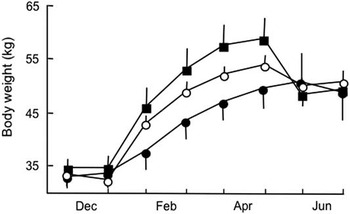
BW varied over time in males of the control and both photoperiodic-treated groups (P<0.001). A treatment×time interaction was detected for BW, indicating that photoperiodic treatment modified the timing of these changes (P<0.001). BW of both photoperiodic-treated males never differed between them at any time (P>0.05), but these two groups differed from males of the control group (P<0.001; Figure 1). In control bucks, BW increased progressively from January and peaked in May. In males from both photoperiodic-treated groups, BW also increased from January, but the highest values were registered in April, and BW decreased in May and June.
BW (mean±SEM) in three groups of Alpine male goats raised at the subtropical latitude of 26°N. The control group was exposed to natural changes in day length (●). Two experimental groups were exposed to artificial long days (16 h of light per day) between 1 December and 15 February. Then, on 16 February, one group received two subcutaneous melatonin implants (○), whereas the other one was exposed to continous light (■). BW was determined once a month.

Testicular weight
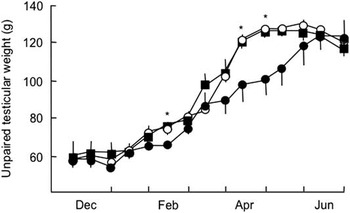
Testicular weight varied over time in males of the control and both photoperiodic-treated groups (P<0.001). A treatment×time interaction was detected for testicular weight, indicating that photoperiodic treatment modified the timing of these changes (P<0.001). Testicular weight of both photoperiodic-treated males never differed between them at any time (P>0.05), but these two groups differed from males of the control group (P<0.001; Figure 2). In control bucks, testicular weight increased progressively from January and peaked in June. In males from both photoperiodic-treated groups, testicular weight also increased from January, but peaked in April, when the values were higher than in controls (P<0.05). In June, males from the control and both photoperiodic-treated groups reached the same values (P>0.05).
Testicular weight (mean±SEM) in three groups of Alpine male goats raised at the subtropical latitude of 26°N. The control group was exposed to natural changes in day length (●). Two experimental groups were exposed to artificial long days (16 h of light per day) between 1 December and 15 February. Then, on 16 February, one group received two subcutaneous melatonin implants (○), whereas the other one was exposed to continuous light (■). Testicular weight was determined every 2 weeks. Stars indicate that both experimental groups differed from the control group (*P<0.05).

Testosterone secretion
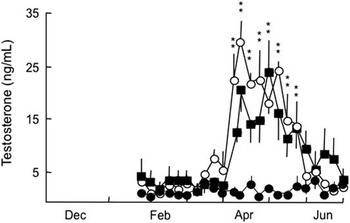
Testosterone concentrations varied over time in males of the control and both photoperiodic-treated groups (P<0.001). A treatment×time interaction was detected for plasma testosterone, indicating that the treatment modified the timing of these changes (P<0.001). Testosterone concentrations of both photoperiodic-treated males never differed between them at any time (P>0.05), but these two groups differed from males of the control group (P<0.001; Figure 3). In the control group, plasma testosterone concentrations remained low (<5 ng/ml) during the whole experiment, from January to June. In contrast, in both photoperiodic-treated groups, testosterone concentrations increased dramatically as early as April, that is, 5 to 6 weeks after the end of the long days, and remained higher than controls in April and May (P<0.01). Testosterone concentrations then decreased in June to reach the same levels as those of the control group (P>0.05).
Plasma testosterone concentrations (mean±SEM) in three groups of Alpine male goats raised at the subtropical latitude of 26°N. The control group was exposed to natural changes in day length (●). Two experimental groups were exposed to artificial long days (16 h of light per day) between 1 December and 15 February. Then, on 16 February, one group received two subcutaneous melatonin implants (○), whereas the other one was exposed to continuous light (■). Plasma testosterone concentrations were determined once a week. Stars indicate that both experimental groups differed from the control group (**P<0.01).

Male odor
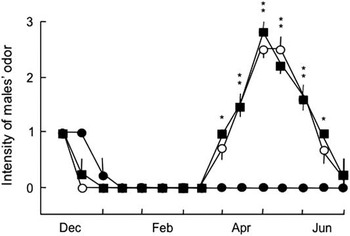
The intensity of odor varied over time in males of the control and both photoperiodic-treated groups (P<0.001). A treatment×time interaction was detected for males’ odor, indicating that the treatment modified the timing of these changes (P<0.001). Males’ odor of both photoperiodic-treated males never differed between them at any time (P>0.05), but these two groups differed from males from the control group (P<0.001; Figure 4). In control males, odor remained low during the whole experiment, from January to June. In contrast, in both photoperiodic-treated males, odor increased dramatically as early as April, and remained higher than controls from the end of March to mid-June (P<0.05).
Intensity of male odor (mean±SEM) in three groups of Alpine male goats raised at the subtropical latitude of 26°N. The control group was exposed to natural changes in day length (●). Two experimental groups were exposed to artificial long days (16 h of light by day) between 1 December and 15 February. Then, on 16 February, one group received two subcutaneous melatonin implants (○), whereas the other one was exposed to constant light (■). Intensity of male odor was determined every 2 weeks. Stars indicate that both experimental groups differed from the control group (*P<0.05; **P<0.01).

Discussion
Our results indicate that the response of Alpine male goats exposed to long days followed by continuous light, is similar to the response observed in those that received the s.c. implants of melatonin. Indeed, testicular weight, testosterone secretion and the intensity of odor of males from the two photoperiodic-treated groups, increased and decreased at the same time. Interestingly, all these three variables were higher in both photoperiodic-treated groups than in controls in April, May and/or June, months corresponding to the natural period of sexual rest. These results validate our initial hypothesis that in Alpine male goats, continuous light after a long-day treatment stimulates testosterone secretion in a similar way as the long days followed by a melatonin treatment. Therefore, continuous light could replace the implants of melatonin.
In our study, long days followed by continuous light stimulated testosterone secretion, and high plasma concentrations of this hormone were observed in April and May, during the sexual rest period. The pattern of testosterone secretion of males exposed to continuous light was similar to that of males that received the melatonin treatment after the long days. Two elements are to be taken into account to explain the similarity between our two treated groups. First, in both light-treated groups, photoperiodic treatments caused an acute and synchronized increase of testosterone secretion in April, that is, 5 to 6 weeks after the end of exposure to long days. In ewes, it is well established that the perception of long days synchronizes the onset of the breeding season (Malpaux et al., Reference Malpaux, Robinson, Wayne and Karsch1989; Woodfill et al., Reference Woodfill, Wayne, Moenter and Karsch1994). In male goats, it was recently shown that exposure to long days also timed the onset of the breeding season, and early exposure to long days advanced the increase of plasma testosterone concentrations (Ponce et al., Reference Ponce, Velázquez, Duarte, Bedos, Hernández, Keller, Chemineau and Delgadillo2014). In our study, males from the continuous light and melatonin groups were exposed to long days from 1 December, and this exposure probably timed the increase of testosterone secretion in both groups, which occurred in April. Second, the diminution of testosterone secretion observed in June in both photoperiodic-treated groups occurred most likely as a consequence of a refractoriness to continuous light or the short-day signal provided by the melatonin implants, as reported in rams (Almeida and Lincoln, Reference Almeida and Lincoln1984; Lincoln and Ebling, Reference Lincoln and Ebling1985). Indeed, it is likely that the high plasma concentrations of testosterone observed in April in our two photoperiodic-treated groups, inhibited LH release through a negative feedback action, which in turn provoked the decrease of testosterone secretion and testicular weight, as reported in rams and bucks (Pelletier and Ortavant, Reference Pelletier and Ortavant1975; Almeida and Pelletier, Reference Almeida and Pelletier1988; Delgadillo and Chemineau, Reference Delgadillo, Canedo, Chemineau, Guillaume and Malpaux1992). This hypothesis is supported by the fact that in bucks and rams exposed to monthly alternations between long and short days, testosterone plasma concentrations were much lower than in those exposed to long and short days every 2 months or kept under natural photoperiodic conditions. Therefore, it is probable that moderate levels of testosterone secretion reduced the negative feedback action of testosterone on LH secretion, allowing them to display an intense sexual behavior and spermatogenetic activity all the year round (Delgadillo and Chemineau, Reference Delgadillo, Canedo, Chemineau, Guillaume and Malpaux1992; Delgadillo et al., Reference Delgadillo, Leboeuf and Chemineau1993; Pelletier and Almeida, 1987). All together, these data suggest that in our study, high plasma testosterone concentrations observed in bucks exposed to long days followed by continuous light or a melatonin treatment enhanced the negative feedback of testosterone, inducing the reduction of LH secretion and testicular weight in June.
In our study, testicular weight of control males increased progressively from January to June. This pattern of testicular weight observed in our study is consistent with that reported in local Mexican and Alpine bucks raised at the same subtropical latitude where the present study was performed (Delgadillo et al., Reference Delgadillo, Leboeuf and Chemineau1999 and Reference Delgadillo and Vélez2002; Delgadillo and Vélez, Reference Delgadillo and Chemineau2010). In contrast, testicular weight in our control males increased earlier than in those raised under natural photoperiodic conditions at temperate latitudes, in which testicular weight increased from June to September (Delgadillo et al., Reference Delgadillo, Flores, Véliz, Hernández, Duarte, Vielma, Poindron, Chemineau and Malpaux1991). The difference of changes in testicular weight between animals kept at subtropical and temperate latitudes may not be due to the lower amplitude of photoperiod occurring in the subtropics, but more likely to the influence of live weight changes (Walkden-Brown et al., Reference Walkden-Brown, Restall, Norton, Scaramuzzi and Martin1994; Delgadillo et al., Reference Delgadillo, Leboeuf and Chemineau1999). Indeed, in our control males, the increase of live weight, which occurred from January to May, probably induced an increase of testicular weight. This hypothesis is supported by the fact that despite the progressive increase of testicular weight from January to June observed in our control males, plasma testosterone concentrations remained low in these months corresponding to sexual rest. These observations strongly suggest that in our study, the increase of testicular weight was due to the increase of live weight and independent of LH secretion, as described in bucks and rams raised under subtropical latitudes (Walkden-Brown et al., Reference Walkden-Brown, Restall, Norton, Scaramuzzi and Martin1994; Hötzel et al., Reference Hötzel, Caraty and Martin1997; Delgadillo et al., Reference Delgadillo, Leboeuf and Chemineau1999). In males from both photoperiodic-treated groups, testicular weight also increased from January, but peaked in April, that is, 2 months earlier than the controls. In these two groups, live weight increased faster than in controls probably by a direct effect of the artificial long days. In fact, exposure to artificial long days increased live weight, probably by increasing food intake, food efficiency and secretion of growth hormone (Forbes et al., Reference Forbes, Elshahat, Jones, Duncan and Boaz1979; Barenton et al., Reference Barenton, Ravault, Chabanet, Daveau, Pelletier and Ortavant1988; Gettys et al., Reference Gettys, Schanbacher and Taylor1989). Results obtained in the both photoperiodic-treated groups strongly suggest that the increase of testicular weight may have two steps to reach maximum testicular weight and testosterone secretion, as described in local bucks from subtropical Mexico (Delgadillo et al., Reference Delgadillo, Leboeuf and Chemineau1999). First, the accelerated increase of live weight probably promoted the increase of testicular weight from January to April. Indeed, the increase of testicular weight was independent of LH secretion, and as consequence, low plasma testosterone concentrations were observed in these months. Second, the perception of short days by means of the melatonin treatment (Chemineau et al., Reference Chemineau, Malpaux, Delgadillo, Guérin, Ravault, Thimonier and Pelletier1992), or the suppression of the inhibitory effect of long days by means of continuous light (Malpaux and Chesneau, Reference Malpaux and Chesneau2006), probably stimulated LH secretion, which enhanced testicular weight and testosterone secretion.
We conclude that continuous light or a melatonin treatment after long days stimulates testosterone secretion of Alpine bucks raised in subtropical latitudes. These results strongly suggest that the continuous light could replace the melatonin treatment to stimulate the sexual activity of Alpine bucks during the non-breeding season.
Acknowledgments
The authors are grateful to all members of the Centro de Investigación en Reproducción Caprina of the Universidad Autónoma Agraria Antonio Narro for their technical assistance; to Dolores López for her secretarial and administrative support. They also express their thanks to Benoît Malpaux and Matthieu Keller for their constructive comments to improve the experimental design and manuscript of the current study; to the laboratory of hormonal assay of the Station de la Reproduction et des Comportements from the INRA of Nouzilly, France, for carrying out the testosterone assays, and to E. Carrillo for his administrative support.
Conflicts of Interest
None.