Implications
This study proposes a method to evaluate the adequacy of breeding programs based on an analysis of adopted innovations, taking account of breeders’ objectives. Applied to the N’Dama breeding program in Senegal, the method shows the lack of relevance of the program to breeders’ innovation strategy, while services to be provided are missing. It highlights the role of crossbreeding in spurring other innovations and the peculiar roles of the indigenous breed for different smallholder types. The breeding program would need focusing on N’Dama’s adaptive traits as well as tailor its messages and services to each of the systems identified.
Introduction
Genetic improvement through pure-breeding of indigenous breeds is seen as a sustainable pathway to increase animal production in the Global South (Hoffmann, Reference Hoffmann2010). Indeed, the high requirements of crossbreds regarding feed and health care increasingly appears as impeding their adoption in low input systems (Leroy et al., Reference Leroy, Baumung, Boettcher, Scherf and Hoffmann2016). However, pure-breeding programs are also facing persistent constraints in their implementation, hindering their success and sustainability. Several factors of this failure have been identified, as the lack of involvement of breeders in programs’ design and implementation, often resulting in an inadequacy of programs’ objectives (Kosgey et al., Reference Kosgey, Baker, Udo and Arendonk2006; Philipsson et al., Reference Philipsson, Rege, Zonabend and Okeyo2011; Wurzinger et al., Reference Wurzinger, Sölkner and Iñiguez2011). All these constraints contribute to poor adhesion to genetic selection programs in developing countries, even though some genetic progress might be reached within experimental stations (Siddo et al., Reference Siddo, Moula, Hamadou, Issa, Marichatou, Leroy and Antoine-Moussiaux2015).
In the prospect of improving ongoing programs, evaluation methods are needed. Several methods have been developed for the economic evaluation of animal genetic resources, hence of the expected benefits of improvement programs (Drucker et al., Reference Drucker, Gomez and Anderson2001; Roosen et al., Reference Roosen, Fadlaoui and Bertaglia2005). The main drawback of most methods is their requirement of a large amount of data that are mostly lacking in developing countries (Drucker et al., Reference Drucker, Gomez and Anderson2001; Food and Agriculture Organization, 2015). Besides this lack of data, the main challenge is the need to take account of animals’ multifunctionality within farms and the diversity of main purposes across farms (Roosen et al., Reference Roosen, Fadlaoui and Bertaglia2005). The aggregate productivity model, used by Ayalew et al. (Reference Ayalew, King, Bruns and Rischkowsky2003) to evaluate a goat breeding program in Ethiopia, brings a complete overview of program’s benefits accounting for multifunctionality but is not tailored to take account of the diversity of purposes between breeders.
More centrally, one might see an important limitation of these evaluation methods in their static nature, thus their inability to take account of ongoing evolutions of systems in order to provide prospective insights for project improvement. Indeed, a breeding program must meet the long-term objectives of breeders who operate in a changing environment. Therefore, it is necessary to get an in-depth understanding of the breeders’ objectives and practices, as often duly studied, but also of their improvement strategies, and the perceived role of genetics within these.
In this context, research on innovations can play an important role in the evaluation of a breeding program, considering that the breeding program corresponds to one of these innovations to be adopted. Innovation may be defined as a change in a social environment that produces an evolution of practices (Alter, Reference Alter1999). It further appears as a co-evolution process through interactive dynamics of learning and production of knowledge (Klerkx et al., Reference Klerkx, Aarts and Leeuwis2010; Kilelu et al., Reference Kilelu, Klerkx and Leeuwis2013; Swaans and Pali, Reference Swaans and Pali2013). Generally speaking, innovation may be termed as technical vs. institutional, according to the nature of the change, or endogenous v. exogenous, according to its origin, respectively from inside or outside the community where it occurs (Vall et al., Reference Vall, Blanchard, Diallo and Lecomte2012; Schut et al., Reference Schut, van Asten, Okafor, Hicintuka, Mapatano, Nabahungu, Kagabo, Muchunguzi, Njukwe, Dontsop-Nguezet, Sartas and Vanlauwe2016). Genetic improvement, being an innovation, thus integrates a dynamic of interwoven institutional and technical innovations, to be understood in relation to the breeders’ objectives.
The hypothesis of this paper is that analyzing the wider context of innovation among smallholders should help understand the place held by animal breeding in their strategies, as well as the mutual impact between animal breeding and other innovations. Therefore, this analysis is meant to provide insights into the adequacy of the breeding program, the factors of failure, and corrective measures to be tailored. Hence, this study considers together the agricultural innovations of breeders, the motives for their adoption and livestock rearing objectives. This approach underlines the co-evolution of animal husbandry practices and animal genetic resource management.
The proposed method is here applied to the N’Dama cattle-breeding program in Senegal, which has been running for over 40 years and now faces a serious lack of ownership from its supposed beneficiaries. As such, it presents an interesting background for a case study to test the ability of the method to provide useful insights in the program improvement pathways.
The N’Dama breeding program was set up in 1972 at the Kolda zootechnical research center (CRZ), aiming at improving the meat production ability of this breed while preserving its trypanotolerance (Fall et al., Reference Fall, Diop, Sandford, Wissocq, Durkin and Trail1982). The program has then undergone various changes through its history. From 1972 to 1990, it was organized as a closed-nucleus breeding scheme. From 1991 to 1996, a test was conducted to open the nucleus to the best animals of the breeders and the milk production of dams of bulls has been added as a criterion of selection. The purpose of opening the nucleus was to increase genetic diversity and to involve breeders in the breeding effort. From 1996 to 2008, the program has been stopped. It resumed in 2008, functioning till present as an open nucleus scheme. Breeders were then also organized in a breeding cooperative (named CASE N’Dama). Currently, the program is organized on three tiers: the breeding nucleus (housed at the CRZ), the multiplication herd (kept by CASE N’Dama members) and the village herds where genetic progress has to be disseminated.
Material and methods
Overall approach
The proposed method consists of analyzing interrelationships between innovations and between innovations and breeders’ objectives. Innovations and objectives are identified and ranked through participatory approaches. Then, through classical multivariate analysis, the typology of innovators is identified to characterize the link of the identified innovator types with different genetic improvement pathways.
Study area
The study was conducted in three rural districts of Kolda in Casamance, Senegal (12°54' N, 14°57' W): Medina Elhadji, Saré Bidji and Dioulacolon. This region presents a sub-humid tropical climate, characterized by a bimodal seasonal regimen. The average annual rainfall of 1000 mm is distributed over 5 months, from June to October. The predominant economic activities are agriculture, livestock and forestry. The main livestock system is described as agro-pastoral, practicing crop-livestock integration. Animal manure is used for soil amendment and animal power is used for ploughing. In turn, crop residues such as rice straw, millet or corn stalks and cotton seeds are fed to animals. The most common cattle breed is the N’Dama taurine.
Sampling
Interviewed breeders were selected following a dual sampling approach, using first a purposive then a respondent-driven sampling. A total of 27 breeders among those who collaborated with the CRZ of Kolda were identified from the CRZ database (purposive sampling). These first respondents introduced us to breeders who had not collaborated with the CRZ (respondent-driven sampling). In total, 54 breeders were surveyed, corresponding to three groups with regards to their involvement with the CRZ breeding program: those currently participating (n=10), those who had resigned (n=17) and those who never participated (n=27). Invitations to participate mentioned that the persons making decisions regarding cattle should be interviewed. Only men presented themselves for participation, being considered in the zone as the heads of households. No woman was included in the sample since no cattle-holding woman-lead household was identified in the present study.
Data collection
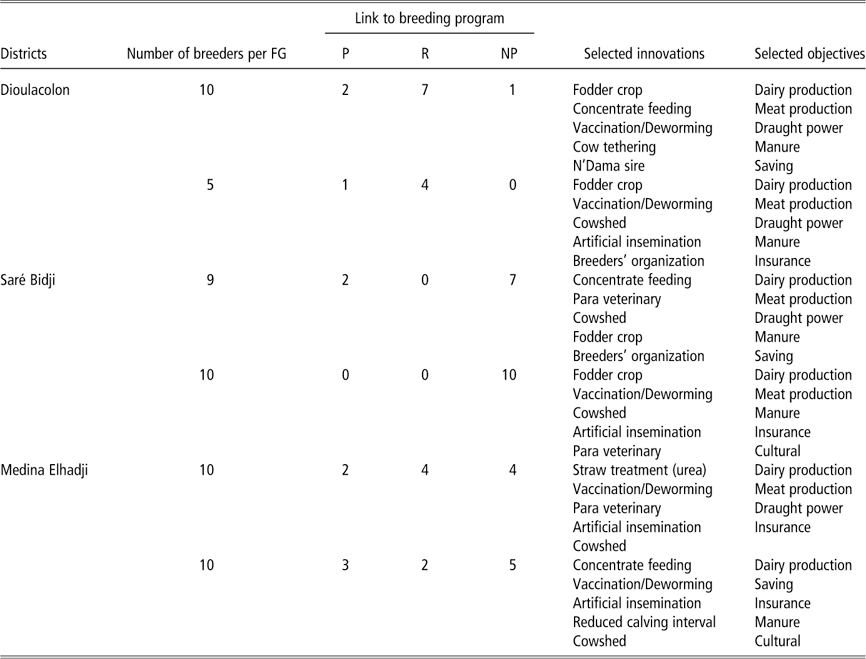
The first contact with breeders occurred through an information session on the study objectives, between September and November 2015. Between July and August 2016, Participatory Rural Appraisal (Ejlertsen et al., Reference Ejlertsen, Poole and Marshall2013) sought to establish with breeders the breeding objectives and technical and institutional innovations introduced or developed. Focus groups were first organized, followed by individual in-depth interviews. Six focus groups were carried out, that is two in each district. The composition of focus groups, in terms of a number of breeders and their link with the breeding program, are indicated in Table 1.
List of main innovations and objectives of N’Dama cattle breeders by focus groups and by districts

FG=focus group; P=current participants to the breeding program; R=breeders who resigned from the breeding program; NP=breeders who never participated to the breeding program.
The interview guide used during the focus groups consisted of three parts. In a first part, breeders were asked to list innovations they had introduced or developed by themselves, as well as to describe the reasons for these innovations. Innovations were described as ‘any change in the ways of practicing the profession of breeder’. The ‘reasons’ were understood in a wide acceptation: responsive to constraints or opportunities, or driven towards specific goals. The second part tackled livestock keeping objectives and pathways for achieving them. The considered ‘pathways’ thus expressed production activities and innovations as means to an end. In a third part, farmers were asked to agree on five present priority objectives and five innovations that they expected to present the most impact in their district for now and the next 10 years. The five innovations and five objectives agreed upon in each focus group were then ranked in individual interviews through proportional piling (with 100 counters). Each breeder of the group thus ranked innovations and objectives according to their relative importance in terms of ‘overall improvement of livelihoods, including increased incomes’.
Statistical analysis
All statistical analyses were performed with R (version 3.3.1). Citation rates of innovations and objectives were represented in histograms. Proportional piling data were subject to descriptive statistics (median, average, minimum and maximum) and used as variables for principal component analysis (PCA) and hierarchical clustering on principle components (HCPC) under the package FactoMineR. Hence, PCA and HCPC aimed at studying relationships between a set of seven breeding objectives and eleven innovations. Since breeders’ focus groups had to choose only five innovations and five objectives for individual scoring, innovations and objectives that were not scored in a group of breeders were treated as missing data. These were handled through imputation by iterative PCA (Josse and Husson, Reference Josse and Husson2012 ; Leroy et al., Reference Leroy, Boettcher, Hoffmann, Mottet, Teillard and Baumung2016) under the MissMDA package. Innovations were included as active variables, thus contributing to the construction of principal components. Hierarchical clustering on principle components was used to build a typology based on the relative importance that breeders gave to distinct innovations. The objectives were included as illustrative variables, therefore projected along PCA axes according to the innovations to which they are correlated. Chi-square or Fisher’s exact tests were conducted to evaluate dependence between so-defined clusters and categorical variables as well as between categorical variables.
Results
Technical and institutional innovations
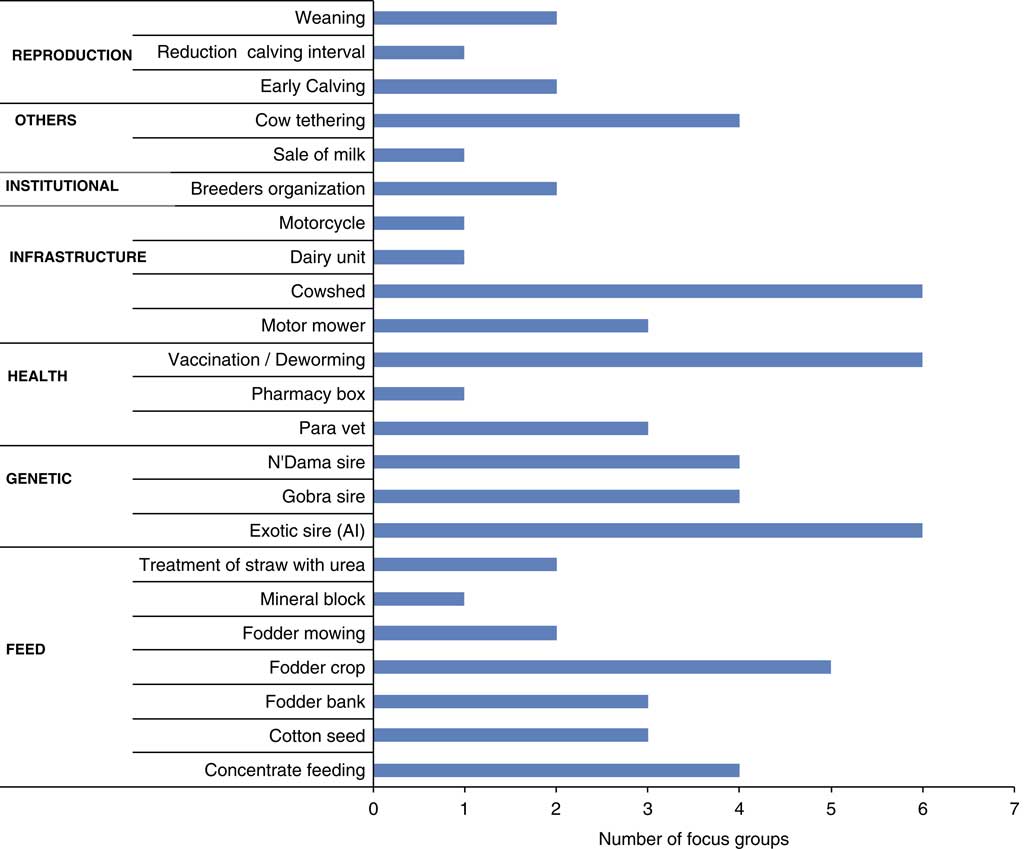
In all, 23 innovations have been cited in total, grouped into six main areas: feed, genetics, infrastructure, animal health, reproduction and institutional innovations (Figure 1). The largest group of innovations was in the area of animal feeding, with seven innovations cited, followed by infrastructure, with four innovations cited. Innovations in genetics covered the use of N’Dama sire and crossbreeding, either with the Gobra zebu (an indigenous breed) or with exotic breeds through artificial insemination. Table 1 lists the innovations and objectives selected by focus groups in each district. Only one focus group indicated the use of N’Dama sires as a key innovation to improve their livelihood, while artificial insemination (with exotic semen) was chosen by four focus groups. None of the groups indicated the use of a Gobra sire as a central innovation. Breeders’ organization was identified as an important innovation in two different areas.
(Color online) Main innovations cited in the six focus groups of N’Dama cattle breeders (number of focus groups). AI=artificial insemination.

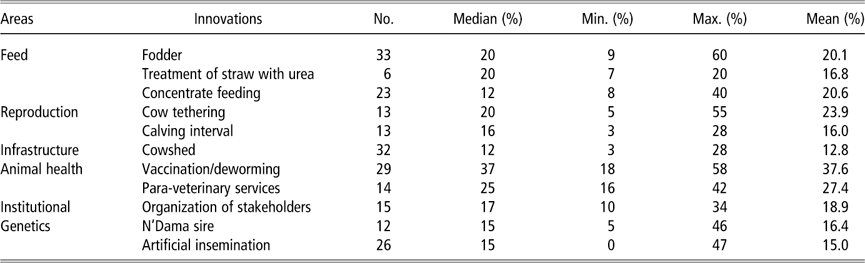
Table 2 summarizes the relative importance ascribed to innovations, as determined through proportional piling in individual interviews. Vaccination and deworming reached the highest average score (38% based on 29 notations), followed by the use of para-veterinary services (27% based on 14 notations), thus being perceived as key innovations to improve their livelihoods. Genetic innovations, that is artificial insemination with exotic breeds and N’Dama pure-breeding, reached intermediate to low scores (respectively, 15% and 16.4%).
Main areas of innovations and their relative importance according to N’Dama cattle breeders (proportional piling results in %)

No.=number of breeders; Min.=minimum; Max.=maximum.
Nineteen innovations out of the twenty-three cited were described as exogenous, introduced by research institutions or development agencies. Only four innovations were described as endogenous, that is developed by the breeders themselves. Endogenous innovations covered the management of reproduction and weaning, the use of crop residues, the selection of N’Dama sires and the use of Gobra sires. Four external organization types have been cited as having introduced exogenous innovations. Being ranked by breeders according to their influence on practices, these are first non-governmental organizations (NGOs), second the local research institution (CRZ of Kolda), third the Textile Fibers Industrial Development Corporation (SODEFITEX: State agency) and lastly the National Livestock Service (extension services).
Livestock keeping objectives and pathways
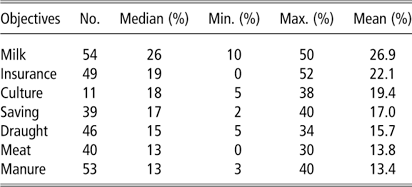
Seven livestock keeping objectives (milk, meat, insurance, savings, manure, traction and socio-cultural aspects) were considered important in focus groups (Table 1) and then quantified individually by the breeders (Table 3). Breeders considered the sale of milk and animals, as well as renting draft animals as means to improve their income. Individual interviews confirmed animals’ multifunctionality, with dairy production ranking first among objectives, at an average relative score of 27%. Meat production, although cited in the focus groups as the second income objective, ranked sixth in individual interviews with an average relative score of 14%. Alongside these objectives, insurance and savings reached average relative scores of 22% and 17%, respectively. Draught power and manure followed with average relative scores of 16% and 13%, respectively. Finally, the socio-cultural role was less shared (cited in two focus groups in two different areas) but reached significant scores with an average of 20%. This socio-cultural role corresponds to maintaining social ties with parents and building alliances through dowries and donations.
Relative importance of livestock objectives according to N’Dama cattle breeders (proportional piling results, in %)

No.=number of breeders; Min.=minimum; Max.=maximum.
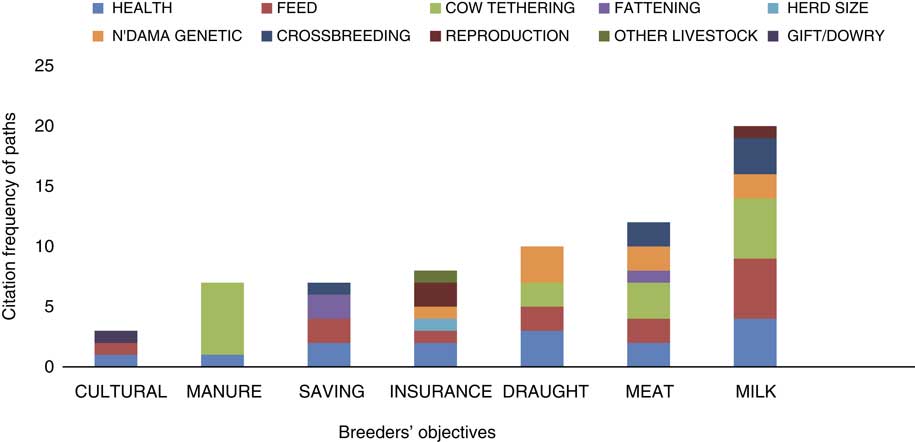
To achieve these objectives, farmers rely mainly on improvements in feed and animal health (Figure 2). N’Dama pure-breeding is mainly practiced for insurance goals (motivated by its resistance to diseases) and draught power while crossbreeding is used to increase milk and meat production, and contribute to saving. Vaccination, deworming, supplementary feeding (fodder and cotton seed) are mainly used for milk and meat production. Bovine fattening is also practiced to improve meat quality and the market value of live animals.
(Color online) N’Dama cattle breeders’ objectives and main paths to reach them (citation frequency).

The relationship between innovations and livestock objectives
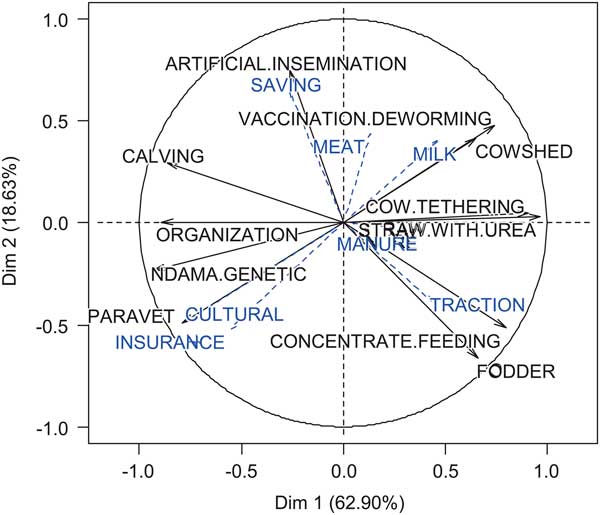
The PCA of the relative scores for eleven innovations led to retain the first two components, accounting for 81.6% of the total variance. Figure 3 represents the circle of correlations between innovations, objectives and main axes.
(Color online) Principal components analysis of relative scores obtained by proportional piling on innovations (in black) and objectives (in blue) by N’Dama cattle breeders (circle of correlation between innovations, objectives and main axes 1and 2).

Axis 1 (62.9% of total variance) has a significant correlation with all innovations and livestock objectives (P<0.001), except artificial insemination using exotic breed semen, saving and meat production objectives. The highest positive correlations were found for treatment of straw with urea (0.97) and cow tethering(0.91). This correlation was negative with the use of N’Dama breed (−0.93).
Axis 2 (18.6% of the total variance) has a significant correlation with all innovations and objectives studied (P<0.05) except for the treatment of straw with urea, cow tethering, genetic improvement of N’Dama in the pure breed as well as manure production. A strong and positive correlation appears with saving (0.65) and artificial insemination with the exotic breed (0.75).
Once interpreted, the first axis appears as opposing an intensification strategy to one of the pastoral organization. The second axis opposes innovations for milk and meat production (cowshed, artificial insemination) to crop-livestock integration (draught power, manure).
Hierarchical classification of innovators
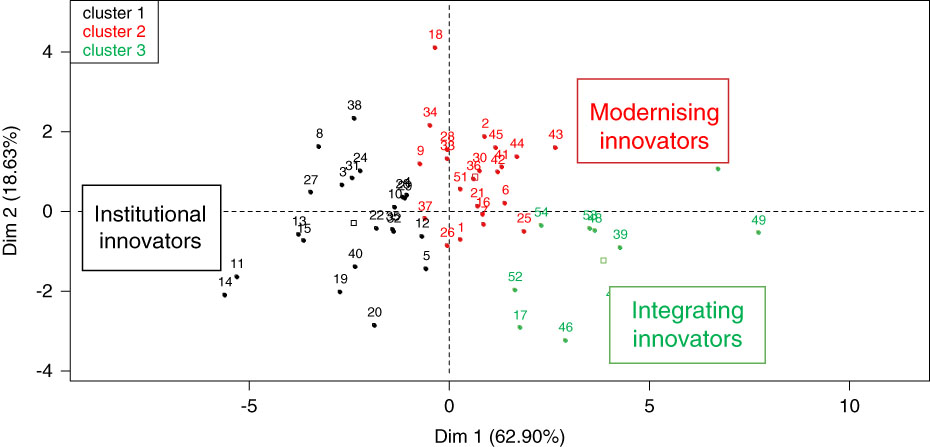
The hierarchical classification reveals three types of innovators, interpreted and termed as ‘institutional’, ‘modernizing’ and ‘integrating’ innovators (Figure 4). For all innovations, the ascribed relative importance proved statistically different between these three types of breeders (Fisher’s exact test, P<0.05) as well as between districts (Fisher’s exact test, P<0.01).
(Color online) Graphical representation of the three categories of innovators among N’Dama cattle breeders on axis 1 and 2 of the hierarchical classification on principal component analysis of innovation and objective relative scores (numbers correspond to breeders’ identifiers).

Category 1 (22 farmers, 41%) – institutional innovators
This category is well described by the modalities with negative coefficients on axis 1 (pastoral organization strategy). It is composed of all types of breeders with respect to their link with the breeding program: 50% who never participated, 32% who resigned, and 18% of current participants (χ 2 test, P=0.09). Breeders of this category are found in all districts: 36% in Medina Elhadji, 32% in Dioulacolon and 32% Saré Bidji (χ 2 test, P=0.95). In this category, a highly significant statistical link has been observed with the following innovations: N’Dama sire use, institutional innovations, para-veterinary and endogenous innovations (reduction of calving interval, early and late weaning) (P<0.001). They put forward these innovations to meet their insurance and cultural objectives.
Category 2 (22 farmers, 41%) – modernizing innovators
This category is composed of all types of breeders with respect to their link with the breeding program: 50% who had resigned, 27% who never participated and 23% present participants (χ 2 test, P=0.24). The majority of these breeders come from Medina Elhadji (50%) and Dioulacolon (36%), although this imbalance is not statistically significant (χ 2 test, P=0.11). The statistical link with this category is highly significant for the following innovations: artificial insemination with the exotic breed (P<0.05), cowshed (P<0.05), vaccination and deworming (P<0.01). The breeders present these innovations as ways to improve milk production (P<0.05). They thus present positive values on both axes 1 and 2, showing a strategy of intensification for milk and meat production, but also stating saving objectives.
Category 3 (10 farmers, 18%) – integrating innovators
This category is composed mainly of breeders who have never participated in the program (90%) and a minority of current participants (10%). This dominance of non-participants is significant as indicated by Chi-square test (P<0.001). The statistical link is highly significant for the following innovations: concentrate feeding, fodder, treatment of straw with urea, cow tethering (P<0.001). These breeders also mainly come from the district of Sare Bidji (90%). They use animals for draught power and manure production and have no particular preference for a type of breed.
Discussion
Methodological contribution to breeding program evaluation
The proposed analysis of innovations helps understanding the place of genetics within the continuous change of practices. The method focuses on practical innovations but leaves aside the social processes that foster, accompany, impede or are provoked by these innovations. Therefore, approaches focusing on social processes around innovations would be useful to develop as a complement to the present approach. The absence of women in the present sampling is obviously a result of this social dimension. This calls for in-depth investigation of women involvement in decision-making regarding innovation in cattle husbandry and household’s economic strategy. Also, the movement of the resignation of breeders from the breeding program could be partly explained through social interactions, which are yet to be investigated.
Innovations and objectives
The high number of innovations cited in focus groups (23) reflects the multiple breeding objectives as well as the multiple influences on breeders. Indeed, most innovations have proved exogenous (19 on 23). The high citation rate of innovations such as concentrate feeding, vaccination and artificial insemination was explained in focus groups by the strong governmental support, through subsidies. Such support of the government to artificial insemination is widespread in developing countries, as for example in Ethiopia (Roschinsky et al., Reference Roschinsky, Kluszczynska, Sölkner, Puskur and Wurzinger2015), illustrating the effective influence of incentivising policies on animal production practices. However, external influences alone do not explain innovation. Exogenous innovations entail, indeed, local adaptations that constitute reactive endogenous innovation but are not identified as such by livestock keepers. Often, introduced innovations are simplified by breeders whatever their origin, to adapt them to their practices, their budget and their environment (Vall et al., Reference Vall, Blanchard, Diallo and Lecomte2012). Conversely, endogenous innovations have often been the matrix for NGOs intervention aiming at their further improvement and diffusion. These innovations may then appear as exogenous for some farmers who got to learn these from NGOs. Therefore, while the weight of exogenous innovation is indeed an indication of the influence of the State or NGOs, breeders always stay at the center of the innovation process and should never be considered as passive recipients of external progress (Klerkx et al., Reference Klerkx, Aarts and Leeuwis2010).
Focus groups did not reveal major differences in the number and nature of innovations between localities (although they diverged in the overall ranking of the five most important innovations). Proportional piling made better appear variability within and between districts. The use of concentrate feeding, vaccination, building of cowshed and practice of artificial insemination with exotic breeds are deemed more important by breeders of Medina Elhadji. As Dioulacolon, this district is located in the dairy belt of Kolda and has benefited from technical assistance in the process of intensifying dairy production and adoption of exotic crossbreeding. This dynamic is a typical example of the sub-urban development of milk production, creating spots of more active genetic innovations through crossbreeding (Toure et al., Reference Toure, Moula, Kouriba, Traore, Tindano, Leroy and Antoine-Moussiaux2015). These breeders were classified here as modernizing innovators, which could also be called ‘exogenous’ innovators, as they mainly rely on introduced technology and are more likely to adopt innovations from external agents. However, the presence of institutional innovators in both districts invites to consider the diversity of potential beneficiaries in each zone and thus the diversity of objectives to be served by the N’Dama breeding program.
The fact that the objective of milk production reached the highest proportional score in this study highlights the cultural, food and income-generating roles it plays. However, the relative weakness of this score (27% on average) underlines that this production fits into an overall context of strong multifunctionality of animals. The multiple uses of milk reflects itself the multifunctionality of livestock production in Senegal (Dieye et al., Reference Dieye, Faye, Seydi and Cissé2002).
The preference for milk and meat production was more prevalent among modernizing innovators. Indeed, as illustrated by Figures 3 and 4, a strong link appears between milk and meat production objectives, the use of crossbreeding, and the improvement of husbandry practices. Thus, the use of improved N’Dama sires promoted by the breeding program does not appear relevant to modernizing innovators. These rather consider the N’Dama breed as a female basis to practice crossbreeding with Gobra sires (to produce meat) or exotic semen (to produce milk). The use of crossbreeding as a favored strategy to improve animal production is widely reported in West and East Africa (Kamuanga et al., Reference Kamuanga, Tano, Pokou, Jabbar, Swallow and Dieteren1999; Ilatsia et al., 2012). Moreover, as also analyzed by Leroy et al. (Reference Leroy, Baumung, Boettcher, Scherf and Hoffmann2016), crossbreeding appears in this study as the impetus initiating other innovations, then adopted as an adaptation to the needs of crossbred stock. Owning crossbreds has been here presented as the motivating factor to build cowsheds, which in turn has motivated and facilitated the development of feed supplementation. In this process, crossbreds thus play a key role as they appear in interviews as a symbol of modernity and motivation in itself, as also shown in Niger (Siddo, Reference Siddo2017). This dynamic of innovation played a major role in the development of the milk supply chain in Kolda (Gaulier, Reference Gaulier2005).
Other livestock functions (insurance, draught power and manure) have higher scores among institutional and integrating innovators. Similar results are found in Gambia and Mali where agro-pastoralists and pastoralists consider saving and insurance as their primary objective (Zaibet et al., Reference Zaibet, Traore, Ayantunde, Marshall, Johnson and Siegmund-Schultze2011; Traoré et al., Reference Traoré, Markemann, Reiber, Piepho and Zárate2017). Breeders’ interest in insurance and saving objectives is explained by the importance of livestock in strengthening their resilience (Wane et al., Reference Wane, Ancey and Touré2010), which may both be in support of indigenous breeds conservation. However, in the present study, while breeders cite the use of N’Dama genetic as a means to meet insurance goals, this is not the case concerning saving (Figure 2). The latter goal is mainly achieved through innovations in health, feeding and also crossbreeding. As highlighted in interviews, this points to an understanding of saving as monetary, then better served through the sale of the products of crossbreeding rather than by an increase in herd size.
Institutional changes were well identified as innovations by breeders despite their less concrete nature compared with technical innovations. These were, however, less cited in focus groups. Similarly, farmers in Central Africa consider institutional constraints as less important than technical constraints for sustainable intensive farming (Schut et al., Reference Schut, van Asten, Okafor, Hicintuka, Mapatano, Nabahungu, Kagabo, Muchunguzi, Njukwe, Dontsop-Nguezet, Sartas and Vanlauwe2016). This corroborates the present underestimation of institutional innovations by modernizing innovators. However, institutional innovations have proved important in the development of the local milk sector in Kolda in the years 2000, for example through contracts between value chain actors (Dieye, Reference Dieye2006). This importance was better perceived by the here-described institutional innovators. This may be understood since many NGOs promote pastoral breeders organizations in order to facilitate their intervention. Farmers may also recognize the benefits of these organizations in allowing for the collective purchase of inputs and achieve economies of scale (Charbonneau and Poinsot, Reference Charbonneau and Poinsot2008).
Ongoing genetic improvement strategies and demand for N’Dama sires
There appears to be a clear-cut preference for crossbreeding among modernizing innovators, which could have contributed to resignation from the program in this category. Nevertheless, the preference for the N’Dama breed among institutional innovators did not result in a better participation rate of this category. Finally, integrating innovators, despite their lack of a clear breed choice, are characterized by massive non-participation. However, N’Dama’s adaptive traits cannot be ignored in any of the three production improvement strategies. Among institutional and integrating innovators, it would fit into the goals of insurance and draught power, as also put forward in agro-pastoral systems in Mali and The Gambia (Traoré et al., Reference Traoré, Markemann, Reiber, Piepho and Zárate2017; Ejlertsen et al., Reference Ejlertsen, Poole and Marshall2013). Among modernizing innovators, while crossbreeding is the main strategy to reach production goals, this strategy obviously requires a trustful local genetic basis that can be provided by the N’Dama breeding program.
The N’Dama breeding program initially aimed at ambitious performance objectives, as classically defined (Wollny, Reference Wollny2003). However, breeders here pursuing such productivity goals do not value the N’Dama breed in this regard, then preferring a strategy of crossbreeding. This would explain the present resignation of many of the concerned breeders. On the contrary, breeders valuing the N’Dama adaptive traits did not adhere to the program, since it was initiated with a mean of milk and meat production. Interestingly, the only breeders of this group having adhered to the program remained interested in it.
Conclusion
This study proposes an analysis of the adequacy of a breeding program based on the stated importance of innovations for a diversity of breeders. The multiplicity of innovations cited reveals this diversity of potential beneficiaries of the N’Dama cattle-breeding program for various production objectives. The objectives are closely linked to innovations in each category of actors. Genetics, although considered less important than other technical innovations, makes a clear distinction between breeders according to the type of innovation they use. Indeed, many technical innovations, especially exogenous, accompany the exotic crossbreeding. The implementation of the N’Dama cattle-breeding program is justified by the adaptive traits of this breed to the sub-humid environment of southern Senegal, which can fulfill the different objectives of local breeders. To serve these objectives, the program would need to reconsider its own positioning and propose messages that are tailored to each of the three types of potential beneficiaries identified here. Breeding goals within the program would need to be re-established in a participatory process targeting the three categories of actors. The program should also gain in acceptance and relevance if it accompanies the production-oriented livestock keepers in their crossbreeding attempts, offering artificial insemination services next to the core-service of providing quality purebred N’Dama cows, and surveying the level of exotic blood in accordance with the technical ability of each client.
Acknowledgments
The authors wish to thank all participating farmers and experts. They acknowledge the support of the Senegalese Institute of Agricultural Research (ISRA) and University of Liege, Belgium.
Declaration of interest
The authors declare no potential conflict of interest associated with this research.
Ethics statement
Not applicable. No work carried out for this research was subject to the approval of an ethics committee.
Software and data repository resources
None of the data used were deposited in an official repository.