Introduction
The prehospital use of lung ultrasound (LUS) by paramedics and physicians to guide the diagnoses and treatment of patients has greatly expanded over the past several years.Reference Botker, Jacobsen, Rudolph and Knudsen1,Reference Ketelaars, Reijnders, van Geffen, Scheffer and Hoogerwerf2 Numerous studies have described the versatility of LUS in the evaluation of patients presenting with shortness of breathReference Lichtenstein and Meziere3-Reference Zanatta, Benato, De Battisti, Pirozzi, Ippolito and Cianci7 by looking for the presence or absence of A lines (a horizontal reverberation artifact suggesting well aerated lungs)Reference Liteplo, Marill and Villen4,Reference Rempell and Noble8 and B lines (a vertical artifact suggestive of interstitial edema when at least three are seen per intercostal space).Reference Lichtenstein and Meziere3,Reference Liteplo, Marill and Villen4,Reference Rempell and Noble8,Reference Volpicelli9 Additionally, looking for lung sliding (a shimmering due to the movement of parietal pleura relative to visceral pleura with lung ventilation)Reference Volpicelli, Elbarbary and Blaivas10 in conjunction with a seashoreReference Brooke, Walton, Scutt, Connolly and Jarman11 or barcode signReference Chuang and Lai12-Reference Lichtenstein14 on M-mode imaging can assist in confirming the correct location of an endotracheal tubeReference Blaivas and Tsung15-Reference Nelson, Melnick and Li18 or in evaluating for a hemodynamically-significant pneumothorax.Reference Zechner and Breitkreutz19-Reference Roline, Heegaard and Moore24 These ultrasound (US) scans can be performed rapidly,Reference Neesse, Jerrentrup and Hoffmann5,Reference Laursen, Hanselmann, Posth, Mikkelsen, Videbaek and Berg6 as obtaining the necessary images involves limited transducer movements or do not require the use of multiple sonographic planes to visualize the pleura.
Likely owing to a straightforward relationship between thoracic anatomy and what is displayed on the US screen, LUS has been effectively taught to paramedics within several hours.Reference Zanatta, Benato, De Battisti, Pirozzi, Ippolito and Cianci7,Reference Raio, Modayil and Cassara25-Reference Bhat, Johnson, Pierog, Zaia, Williams and Gharahbaghian28 However, almost all of this education has occurred in a classroom or hospital setting.Reference Pietersen, Madsen, Graumann, Konge, Nielsen and Laursen29 Challenges inherent to providing patient care outside of a hospital, including movement during transportation, limited space, and suboptimal lighting, have been observed to negatively impact LUS performance, sensitivity, and accuracy.Reference Neesse, Jerrentrup and Hoffmann5,Reference Quick, Uhlich, Ahmad, Barnes and Coughenour16,Reference Raio, Modayil and Cassara25,Reference Lyon, Walton, Bhalla and Shiver27,Reference Ketelaars, Hoogerwerf and Scheffer30 Therefore, providers should train in their unique work environment to learn how to overcome or adapt to these challenges. While authors have described the use of cadaversReference Lyon, Walton, Bhalla and Shiver27 and home-made US phantomsReference Lyon, Shiver and Walton31 to incorporate pathology into the learning experience, these solutions are rarely used in an ambulance, may not be feasible across training programs, and only demonstrate limited pathology. Furthermore, an extensive search of PubMed (National Center for Biotechnology Information, National Institutes of Health; Bethesda, Maryland USA); CINHAL (EBSCO Information Services; Ipswich, Massachusetts USA); and Google Scholar (Google Inc.; Mountain View, California USA) yielded no published prehospital use of LUS simulation software within an ambulance.
The objective of this study was to determine if various ambulance driving conditions (stationary, constant acceleration, serpentine, and start-stop) would impact paramedics’ abilities to perform LUS on a standardized patient (SP) using breath-holding to simulate lung pathology, or to perform LUS using US simulation software. Primary endpoints included the participating paramedics’: (1) time to acquiring a satisfactory simulated LUS image; and (2) accuracy of image recognition and interpretation. Secondary endpoints for the breath-holding portion included: (1) the agreement between image interpretation by paramedic versus blinded expert reviewers; and (2) the quality of captured LUS image as determined by two blinded expert reviewers. Finally, a paramedic LUS training session was evaluated by comparing pre-test to post-test scores on a 25-item assessment requiring the recognition of a clinical interpretation of prerecorded LUS images. It was hypothesized that simulated LUS exams would be performed the fastest and with the greatest quality and reviewer agreement when the ambulance was stationary.
Materials and Methods
Study Design
This prospective interventional study examining an educational intervention followed by a block-randomized simulation experience was reviewed and approved by the Stony Brook University IRB (Stony Brook, New York USA; IRB#606950). Written informed consent was obtained from all participants.
During a four-hour training session at Stony Brook University Hospital, a suburban tertiary care academic institution, paramedics spent 25 minutes completing a pre-test of 25 pre-recorded B-mode clips and M-mode still images. Paramedics identified findings (lung sliding or no lung sliding; A or B lines; or seashore or barcode sign) and selected the appropriate clinical interpretations (normal lung or interstitial fluid; well ventilated lung; or pneumothorax/misplaced endotracheal tube).Reference Lichtenstein and Meziere3,Reference Neesse, Jerrentrup and Hoffmann5,Reference Laursen, Hanselmann, Posth, Mikkelsen, Videbaek and Berg6 An emergency physician (EP) then delivered a 45-minute LUS lecture. After, paramedics rotated through skill stations utilizing portable and stationary US machines: Philips Lumify with L12-4 linear array transducer (Philips; Reedsville, Pennsylvania USA) and Mindray M7 with 7L4s linear probe (Mindray North America; Mahwah, New Jersey USA). Participants scanned a healthy SP who used breath-holding to simulate poor lung ventilation. Additionally, an US simulation system (SonoSim LiveScan, SonoSim, Inc; Santa Monica, California USA) was used to illustrate normal lung and lung pathologies. An EP facilitated each station. Each paramedic performed at least 25 supervised scans. Paramedics lastly completed a scanning proficiency practical exam, demographic questionnaire, and post-test comprised of the same questions as the pre-test, but presented in a different order. Three EPs completed the post-test for content validation.
The ambulance driving course was created using traffic cones in a large parking lot which was closed to the public. The same paramedic, who successfully completed emergency vehicle operations training, drove the ambulance through the course to simulate different driving conditions (stationary, constant acceleration, serpentine, and start-stop). Restrained participants performed LUS exams in the back of the ambulance. Pathology was block randomized according to driving condition, with 25% of scans intended to include a pathological finding. Driving conditions occurred in the same sequence. On the first run through the driving course, paramedics performed LUS exams using the US simulation software. Time from probe-to-skin contact to when the paramedic obtained a satisfactory image was recorded. The paramedics then reported the findings (A lines or B lines; lung sliding or no lung sliding) and their clinical interpretation (well ventilated normal lung; interstitial edema; or pneumothorax/unventilated lung). On the second run through the driving course, paramedics performed LUS exams scanning the second-through-fifth intercostal spaces at the mid-clavicular line bilaterally using a hand-held portable US device (Phillips Lumify with L12-4 broadband linear array transducer, Philips; Reedsville, Pennsylvania USA) while the SP simulated pathology using breath-holding. Time from probe-to-skin contact to saving a satisfactory image, findings (A lines or B lines; lung sliding or no lung sliding; seashore or barcode sign), and clinical interpretation (well ventilated lung; interstitial edema; or pneumothorax/unventilated lung) were recorded. At the end, paramedics completed a survey about their experience. The laptop required to run the simulation software was secured to a countertop in the ambulance. The screen for the Lumify system was held in the hand of the paramedic performing the scan.
Paramedics’ interpretations of the simulated images were compared to the case legend. Two blinded EPs with advanced training in point-of-care emergency US reviewed the B-mode clips and M-mode still images recorded for each hemithorax. They graded images according to a standard five-point quality assurance scale for US imaging. In the event of disagreement, images were reviewed by a third blinded EP with specialty training in point-of-care ultrasonography.
Setting
The training session and closed driving course were conducted at Stony Brook University Hospital, a suburban tertiary care teaching hospital in Stony Brook, New York.
Participants
Stony Brook University Hospital paramedics and paramedics of the surrounding community Emergency Medical Service agencies were recruited by email. The only inclusion criterion was that they had to be a currently practicing paramedic. Participants were excluded if they were unable to attend the training session. Based on the availability of instructors and time allotted for the driving course, the first 20 paramedics who responded to the emails were invited to enroll in the study.
Of note, although obtaining certification as a Nationally Registered Paramedic is not a requirement in New York state, the New York paramedic scope of practice closely mirrors that which is set forth by the National Scope of Practice Model.32,33
Data Analysis
Data generated by each participant were linked using unique identifiers. Statistical analysis was performed using SPSS Statistics Faculty Pack 25 (IBM Corporation; Armonk, New York USA). Descriptive statistics were used to assess responses on the demographic questionnaire and survey. A paired Student’s T test with P <.05 was used to compare performance on the pre-test to the post-test.
For the LUS simulation software portion, a Friedman Test (P <.05) was used to evaluate if driving conditions impacted the time needed to capture images. A Cochran’s Q test (P <.05) was used to determine if driving conditions impacted the correct interpretation of the acquired simulated images.
For the LUS simulation using SP breath-holding, a Friedman Test (P <.05) was used to evaluate if driving conditions impacted the time needed to capture images or the image quality score, as determined by two blinded expert reviewers. Post hoc analysis was performed with Wilcoxon signed-rank tests with a Bonferroni correction. A Cochran’s Q test (P <.05) was used to determine if driving conditions impacted the image interpretation agreement between paramedics and the blinded expert EP reviewers: true positive and true negative were grouped into “agree;” false positive, false negative, and technically limited were grouped into “not agree.”
Results
A total of 17 paramedics enrolled in the study and participated in the four-hour training session. Sixteen (94%) paramedics returned to participate in the driving course portion of the study. Of the 17 paramedics who enrolled, 82% (14) were males and 65% (11) were college graduates. Four (24%) reported prior US experience. The mean age was 41 years (SD = 10) with a mean of 13 years of experience as a paramedic (SD = 10).
After the training session, paramedics demonstrated a significant improvement in post-test scores compared to pre-test scores when asked to identify the findings and indicate the clinical interpretation of prerecorded LUS scans (Table 1). A physician verified the LUS procedural skill competency for each paramedic using a standardized assessment rubric.
Paramedic Performance on the Pre-Test and Post-Test

Note: Scores reflect the percentage of questions answered correctly.
Table 2 illustrates paramedic performance of LUS using simulation software in the ambulance on the driving course. There was no statistically significant difference in the time needed to obtain a simulated image during different driving conditions, χ2(3) = 2.85; P = .415. Additionally, there was no statistically significant difference in correct clinical interpretation of simulated LUS images across all driving conditions, χ2(3) = 6.63; P = .085.
Paramedic Performance of Lung Ultrasound Exams using Simulation Software during Different Driving Conditions

Note: Times are reported as median [IQR].
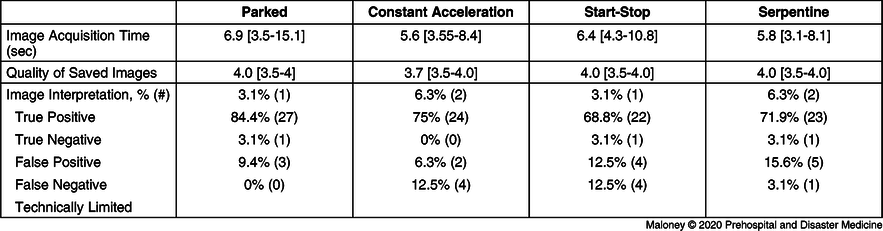
Table 3 details paramedic performance of LUS on a SP breath-holding in the ambulance on the driving course. A statistically significant difference was observed in the time needed to obtain a simulated image during different driving conditions, χ2(3) = 8.063; P = .045. Image acquisition time while parked was significantly greater than while the ambulance was driving in serpentines (Z = -2.898; P = .008). There was no statistically significant difference in the saved image quality scores across all driving conditions, χ2(3) = 5.192; P = .158. There was no statistically significant difference in agreement of image interpretation between paramedics and blinded EPs based on driving condition, χ2(3) = 2.516; P = .472.
Paramedic Performance of Lung Ultrasound Exams using Standardized Patient Breath-Holding to Simulate Pathology during Different Driving Conditions

Note: Values are reported as median [IQR] unless otherwise indicated. Quality of saved images was rated on a scale from one to five, five being the highest quality.
At the end of the driving session, paramedics unanimously agreed they were able to perform the scans comfortably while restrained. Additionally, they all agreed that the course was a beneficial use of time and that they would like to learn more about ultrasonography.
Discussion
The results of this feasibility study suggest that paramedics may be able to overcome different driving conditions when obtaining and interpreting LUS images in a simulated setting. Specifically, both normal and pathological findings were simulated with a SP via breath-holding, and with US simulation software. It is important to recognize that these results are from a single small cohort and while traveling on a closed driving course.
Paramedic LUS image acquisition times were longer when stationary as compared to the serpentine driving pattern. This was the most significant statistical difference in performance and interpretation found across the driving conditions. This could be because while pathology was block randomized, the order of driving conditions in which paramedics performed the scans remained constant (stationary, constant acceleration, serpentine, and start-stop). Improved scanning times with study progression has previously been observed.Reference Quick, Uhlich, Ahmad, Barnes and Coughenour16,Reference Snaith, Hardy and Walker34
Based on these experiences, while a healthy SP using breath-holding may not be the ideal way to simulate a pneumothorax, for a prehospital agency with limited training resources, however, it still offers opportunity for providers to practice recognizing an essential pathological finding. It would seem that this is the first paramedic LUS study to use SP breathing to simulate the presence or absence of lung sliding. Overall, a simulation software setup seems to be the most feasible option to introduce varied pathology into the unique work environment for prehospital ultrasonographers. Of note, several technical difficulties were encountered. First, the simulation software required a constant connection to the internet, which may not be possible in the many austere environments in which paramedics work. It may be helpful if software packages were stand-alone and could be downloaded entirely on a single device. Additionally, at the time of the study, SonoSim LiveScan was only able to run on a Windows platform. This was challenging as the laptop needed to run the software had to be secured to the counter of the ambulance for safety precautions. Future technology which allows for software to run on a hand-held device would lead to more training versatility. Finally, it was observed that the sensors within the SonoSim LiveScan probe seemed to confuse probe movements with movements of the ambulance, which would then cause the images displayed on the laptop screen to move in erratic directions. A possible solution for this could be a microprocessor that mounts to a surface in the ambulance that would allow for probe movement to be isolated from ambient ambulance movement.
Additionally, it appears a well-received, resource-conscious paramedic LUS training session was developed. Results indicate that paramedics were able to demonstrate LUS skill proficiency and significant improvements in recognition and interpretation of pre-recorded LUS media. Furthermore, paramedics also demonstrated the ability to recognize LUS pathology in their own acquired images.Reference Chin, Chan and Mortazavi35
Limitations
This feasibility study has several limitations, most notably the small sample size and single cohort nature. Additionally, several conflicts with paramedic work schedules led to a smaller sample size than anticipated. Finally, due to the voluntary nature of this study, a selection bias most likely exists.
Conclusion
Previous research has demonstrated the value and success of LUS in the field. However, as the use of prehospital US becomes more widespread, providers both need and deserve the opportunity to train with both normal and pathological scans in their own unique work environments. These preliminary results suggest that existing US simulation software can be used in an ambulance; however, continued improvements are needed to offer prehospital providers a more realistic learning experience.
Acknowledgement
The authors would like to thank Dr. Henry Thode, Jr. for his statistical expertise. Data from this manuscript were presented in part at the 2019 American Institute of Ultrasound in Medicine Convention, held in Orlando, Florida USA on April 7, 2019. The Lumify probes and SonoSim LiveScan Tags were graciously provided for free by sales representatives for their respective companies. Neither company had any involvement in the development of this study, nor with the analysis or reporting of data.
Conflicts of interest
none