INTRODUCTION
Endometrial cancer is the most common malignancy of the female genital tract. In the United Kingdom, 7,045 cases were diagnosed in 2006 with an incidence rate of 22.8 per 100,000 population1. It is a disease affecting primarily the postmenopausal group with occurrence peaking at 50 to 70 years of age. Various risk factors for developing endometrial cancer include increasing age, obesity, nulliparity, early menarche to late menopause, tamoxifen exposure and high oestrogen levels. Diagnosis is confirmed on hysteroscopy with endometrial curettage, biopsy or aspiration.
Endometrial cancer generally has a favourable prognosis as the majority of cases (approximately 75%) present with disease confined to the body of the uterus with disease confined to the body of the uterus often with post-menopausal vaginal bleeding as the commonest presenting complaint.
There are various histological subtypes of endometrial carcinoma with endometroid adenocarcinoma accounting for up to 90% of cases. The remaining 10% include papillary serous, clear cell and carcinosarcomas. Endometrial cancer spreads by invasion of the myometrium and lymphatics to the external and common iliac lymph nodes and the para-aortic nodes. Distant metastases are uncommon but occur more frequently in higher grade and more advanced disease.
The standard treatment for endometrial cancer is surgery with total abdominal hysterectomy and bilateral salpingo oophorectomy (TAH/BSO). The role of lymphadenectomy remains controversial. Within the United Kingdom, a routine lymphadenectomy is not performed although this is a standard practice in the United States. Node sampling is often performed if the risk of involvement is considered to be significant.
Endometrial cancer is staged using the Federation Internationale de Gynecologie et d’ObstetriqueReference Pecorelli, Benedet, Creasman and Shepherd2 (FIGO) staging system based on surgical and pathological features. Most patients present with FIGO Stage I disease and have a good prognosis with an overall 5 year survival of 75 to 90%1. The revised FIGO staging system was introduced in 2009; however, for the purposes of this study, the 1988 system will be used.
It is generally agreed that adjuvant post-operative radiotherapy improves local control in early stage endometrial cancer and contributes to a significant reduction in locoregional recurrence. Several factors influence the selection of adjuvant therapy including histology, depth of myometrial invasion, grade of tumour, lymphovascular space invasion (LVSI) and the presence of metastatic lymph nodes.
There has been much controversy around the role and type of adjuvant therapy in Stage I and Stage II endometrial cancers. Post-operative management options for early stage endometrial cancer includes a surveillance policy, adjuvant pelvic external beam radiotherapy (EBRT) and adjuvant intracavitary vaginal brachytherapy (VB) or a combination of the latter two. Whilst EBRT is designed to irradiate sites of potential micrometastatic local cancer spread, that is, the upper vagina, parametrial ligaments and primary draining lymph nodes, vaginal brachytherapy treats only the vagina with the intention of reducing vaginal recurrence rates and decreasing toxicity to the bladder and bowel.
Despite the prevalence of this disease, there are no clear consensus guidelines on the merits of these practices across the United Kingdom. Furthermore, internationally, practices vary significantly.
Three randomised trialsReference Aalders, Abeler and Kolstad3–Reference Keys, Roberts and Brunetto5 demonstrated a clear benefit in locoregional control without a survival benefit with the addition of post-operative EBRT.
Gynecologic Oncology Group (GOG 995) randomised patients with surgically treated stage IB, IC and II (occult) to observation versus pelvic EBRT. The incidence of recurrence was higher in the observation arm (12%) than in the EBRT arm (4%), p = 0.007 with the majority of pelvic relapses (70%) limited to the vagina. GOG-995 found that EBRT reduced the risk of locoregional recurrence by 58%.
The Post-operative Radiotherapy in Endometrial CarcinomaReference Creutzberg, van Putten and Koper4 (PORTEC-1) study was more selective in its eligibility criteria and included only patients with Stage IC Grade 1–2, Stage IB Grade 2–3 tumours. EBRT decreased local recurrence rates from 14% to 4% (p < 0.001). The majority of recurrences (75%) were in the vaginal vault.
Both GOG-995 and PORTEC-14 show that EBRT significantly improves pelvic control but fail to demonstrate an improvement in overall survival, governed largely by development of distant metastases. This is likely to be due to the overall favourable prognosis in this patient group and the availability of second line therapyReference Koh6. In addition, the main effect of EBRT appears to be in reducing vaginal relapse rates, hence advocating the use of a more tolerable alternative such as VB.
In 2008, the European Society for Medical OncologyReference Baekelandt and Castiglione7 (ESMO) clinical recommendations for the management of endometrial cancers classified patients according to their risk of recurrence as low, intermediate or high based on age, stage, histology and depth of myometrial invasion. They advised that for patients with Stage IIA and IIB with high-risk features pelvic EBRT and/or VB was appropriate.
Intracavitary VB delivers radiotherapy locally by treating the vaginal vault—the commonest site of locoregional recurrences, using an applicator. Methods of VB in the published trials are diverse with establishments varying in the use of high dose rate (HDR), pulsed dose rate (PDR) and low dose rate (LDR) radiotherapy in addition to the prescribed dose, fractionation and prescription point. A questionnaire survey presented at the European Society for Therapeutic Radiology and Oncology (ESTRO) in 2009 evaluating post-operative VB techniques found that even amongst treating centres, the HDR dose ranged from 15–36 Gy to 40–60 Gy for LDRReference Petric and Potter8.
Worldwide, there has been a general trend towards the increasing use of HDR and gradual decrease in LDR. The former offers a shorter treatment time and more comfort for the patient and the numbers of patients to be treated is not limited to the availability of afterloading suites.
To our knowledge, PORTEC-29 is the only multi-centre randomised Phase III trial comparing EBRT with VB. Three-year vaginal relapse rates were similar in both groups (2% EBRT vs. 0.9% VB). Pelvic recurrences were slightly higher in the VB arm (3.6% vs. 2.0%, p = 0.03) although the absolute difference was small with no difference in overall survival demonstrated.
Interestingly, Obermair et al. in 2008Reference Obermair, Cheuk and Pak10 conducted the only study comparing VB to observation alone in Stage I-IIA/Grade 1–3 patients and found that postoperative VB was not associated with a measurable reduction in the risk of recurrence when age, tumour stage and grade of differentiation were adjusted for. They proposed that differential referral for VB and a resulting selection bias was the more likely reason for this outcome.
With equivalent control rates, toxicity rates from treatment become a determining factor for treatment selection. The morbidity associated with whole pelvic radiotherapy is not insignificant. Acute and long-term side effects such as diarrhoea, small bowel obstruction, bowel damage and lower extremity lymphoedema can be seen. Although rates of Grade 3 or 4 toxicity are low, late symptoms affecting quality of life are significant as these patients often have long-term survival. PORTEC-14 reported a 25% incidence rate of complications in the EBRT group compared with 6% in the control arm. Two thirds of the complications were Grade 1 severity. Creutzberg et al. Reference Creutzberg, van Putten and Koper4 reported the rate of Grades 3 to 4 toxicity in the radiotherapy group as 2%, although 20% were noted to have long-term symptoms (mainly urgency, frequent bowel movements and abdominal cramps), which influenced quality of life. This compares with 7% and 4%, respectively, in the pelvic EBRT arm of GOG-995.
In comparison to EBRT, brachytherapy is associated with less morbidity and minimal treatment-related side effects (Grades 1–2). A retrospective review by Jolly et al.Reference Jolly, Vargas and Kumar11 found 0% rate of toxicity Grade ≥ 2 with the majority of patients experiencing no gastrointestinal toxicities.
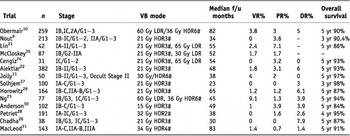
Table 1 reviews several published series from 1998 to 2008 that treated endometrial cancer with adjuvant VB. The patient populations, in terms of disease stage, were variable amongst the studies and the dose, fractionation and mode of radiotherapy used inconsistent, with LDR doses ranging from 30 to 65 Gy and HDR from 15 to 36 Gy.
Literature review on survival, recurrence rates and method of vaginal vault brachytherapy delivery

VR: Vaginal relapse rate; PR: Pelvic relapse rate; DR: Distant relapse rate, – : data not available; HDR: High dose rate, expressed as Gy where for example 21 Gy = 2100c Gy and 3# means 3 fractions of radiotherapy; LDR: Low dose rate, expressed as entire dose. E.g., 65 Gy = 6500c Gy.
Rates of local recurrence ranged from 0 to 9.1% with the majority reporting recurrence rates of less than 4%.
In summary, post-operative radiotherapy has been shown to improve disease free survival and reduce locoregional recurrence rates compared with observation alone. As the majority of locoregional failures (60–70%) occur in the vagina, which can be successfully salvaged in a high proportion of casesReference Creutzberg, van Putten and Koper12 there has been a trend in the last decade to treat with VB instead of EBRT.
The aim of this study was to determine the levels of relapse and toxicity in patients with early endometrial cancer treated with adjuvant VB in a dedicated cancer teaching hospital. Emphasis was placed on the technique of VB used and outcomes (toxicity and relapse rates), and these were compared with published studies. The data could then be used to help guide further developments in VB use in endometrial cancer.
MATERIALS AND METHODS
A database of all patients undergoing VB at Weston Park Hospital, Sheffield Teaching Hospitals Trust from October 2003 to October 2009 was reviewed.
Thirty-three patients with endometroid endometrial adenocarcinoma were included in the study.
Patients were selected for adjuvant treatment after review of histopathology and discussion at the gynaecological multi-disciplinary team meeting. Local practice during the period of this study was to offer VB to patients with Stage II disease.
Multiple patient variables including age at diagnosis, time interval from surgery to VB, FIGO stage, grade, histology, depth of myometrial invasion, LVSI, lymph node involvement and local/distant recurrence rates identified.
Patient co-morbidities were graded according to the Charlson co-morbidity indexReference Charlson, Pompei, Ales and MacKenzie13 which predicts the 1-year mortality for a range of co-morbid conditions (e.g., AIDS, diabetes etc.) graded 1, 2, 3 and 6 according to their associated mortality risk.
Treatment morbidity was recorded from the patients notes using Radiation Therapy Oncology Group (RTOG) Common Toxicity Criteria (Version 2)Reference Trotti, Byhardt and Stetz14. Toxicities were divided into vaginal, urological and bowel and graded I through IV according to severity—I being mild and IV representing severe toxicity.
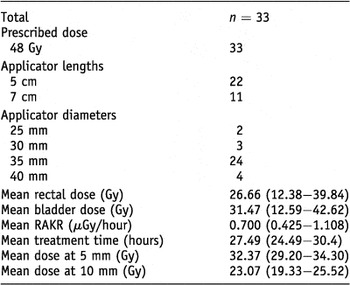
Data from the treatment planning system on mean bladder and rectal doses, applicator diameter and length and duration of treatment were obtained. The dose at 5 mm and 10 mm from the applicator surface and the Reference Air Kerma Rate (RAKR) defined by ICRU 3815 as a measure of brachytherapy source strength was also obtained (Table 3).
Patients are reviewed 6 weeks after brachytherapy treatment, then every 3 months for the 1st year, 4 months for the 2nd and 6 monthly thereafter by the gynaecologic oncologists.
All patients were given vaginal dilators, counselling and written instructions to prevent vaginal stenosis.
Vaginal brachytherapy technique
Brachytherapy was usually performed between 6 and 12 weeks after surgery allowing for wound healing. LDR is the method of brachytherapy available for use in Sheffield, with plans in place for future Pulsed Dose Rate (PDR) implementation.
LDR VB is performed using a remote afterloading device—‘Selectron’. The Selectron machine has six channels located between two treatment rooms. Six channels allow cervical treatment using three channels each to be administered to two patients simultaneously; however, in vaginal vault treatments, only a single central catheter is used in each treatment room.
In the Selectron machine, the active sources are 2.5 mm spherical pellets of Caesium-137. With 36 active pellets in the unit, arrangements of active and dummy pellets in 48 positions were programmed. Sources have equal activity of approximately 1.5 GBq, and a typical arrangement of sources produce a dose rate of 1.70 Gy/hr at the prescription point. The standard loadings aim to deliver a uniform dose of 48 Gy to the surface of the applicator, representing the vaginal mucosa, treating the upper two thirds of the vault over a treatment time of 25 to 30 hr.
The afterloading applicator is inserted in the operating theatre with the patient under anaesthesia or sedation. The position of the applicator in relation to the vagina, bladder and rectum is confirmed using two orthogonal radiographs taken in theatre aided by the use of radio-opaque rectal marker and catheter balloon. A treatment planning system is then used for dosimetric calculations.
LDR defined by the ICRU 38 (Dose and Volume Specification for Reporting Intracavitary Therapy in Gynecology 1985)15 is radiation delivered at a dose rate of up to 200c Gy per hour. However, this can vary depending on the applicator size (increasing distance from the sources to the applicator surface decreases the dose rate by the inverse square law), the loading and activity of the individual sources.
The primary endpoint measured was recurrence-free survival. Time to recurrence was calculated from the date of surgery to the time of confirmation of the first recurrence. The site of recurrence, vaginal and pelvis (locoregional), or distant, if beyond the pelvis, was reviewed. The secondary outcome was overall survival and treatment complication rates.
Statistical methods
Overall survival and recurrence-free survival were determined by Kaplan-Meier method using a statistics programme (SPSS 17.0)16. Comparison of vaginal and pelvic recurrence rates between the current study and the relevant trials was done using the Wilsons Score methodReference Newcombe17. This allows confidence intervals for the differences in outcomes to be analysed and statistical significance to be assigned.
RESULTS
Demographics
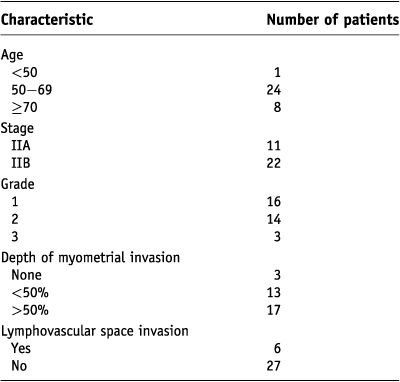
In total, 33 patients had endometroid histological subtype (79% of all endometrial cancers identified). Other histopathological subtypes identified were carcinosarcoma, papillary serous, clear cell and squamous cell cancer in reducing frequency. Patients median age at diagnosis was 63 years (range 48–77). Charlson score ranged from 0 to 2, with 58% of patient scoring 0 and 33% scoring 1. World Health Organisation’s (WHO) performance status was 0 or 1 in 94% of the patients, reflecting the general good health of patients in the study. Further patient characteristics including stage and grade of differentiation are presented in Table 2.
Characteristics of 33 patients with endometrial cancer treated with adjuvant VB
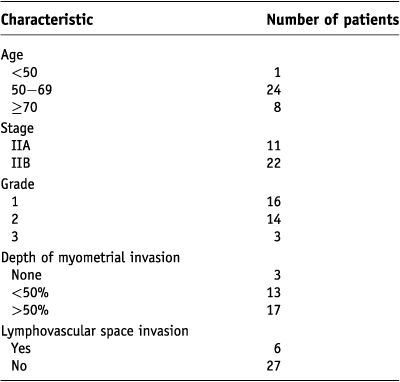
All the patients treated were FIGO Stage II disease (33% Stage IIA, 67% Stage IIB). Six patients had LVSI; five of these were in Stage IIB Grade 2 disease and one in Stage IIB Grade 3. Three patients had negative lymph node samplings.
The interval between surgery and brachytherapy insertion was 5 to 10 weeks in most patients with a median time of 8 weeks.
The median follow-up for the study was 3 years.
Treatment
All 33 patients were treated with 48 Gy prescribed to the surface of the applicator, which is standard practice in the centre studied. The mean rectal and bladder doses were well within tolerance (26.66 and 31.47 Gy, respectively). (The average dose tolerated by rectum is 60 Gy and bladder is 65 Gy given as 2 Gy per fraction; predicting a 5% complication rate at 5 years due to radiotherapyReference Emami, Lyman and Brown18.) The majority of patients were treated to a length of 5 cm and 7 cm, equating to approximately two-third the vaginal vault length. Whilst this does not treat the suburethral area, it treats the more common site for relapse (recurrence rates for vaginal apex to lower vagina is 4:1Reference Elliott, Green and Coates19) and avoids increased toxicity. Variation in the applicator diameters used reflects anatomical differences of the women in the study. Further data regarding the treatment is presented in Table 3. The mean treatment time was 27.53 hr. All patients tolerated their treatment and completed as scheduled.
Brachytherapy data

Relapses
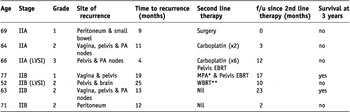
Overall, seven (21.2%) patients relapsed. Relapses occurred in four patients with Stage 2B and in three patients with Stage 2A disease. LVSI was present in two and poorly differentiated adenocarcinoma present in one. Three patients in total developed vaginal recurrences (9%) and five pelvic recurrences (15%). Six of the seven patients developed distant metastases; the site of metastases was the abdomen in two patients, the para-aortic nodes in three patients and the brain in one patient (Table 4).
Characteristics of the seven patients who developed recurrence

*MPA: Medroxyprogesterone acetate.
**WBRT: Whole brain radiotherapy (30 Gy in 10 fractions).
The median time to recurrence in all patients was 12 months (mean 12, range 4–25 months).
Five of the six patients with distant recurrences have since died of disease. One patient with brain and pelvic metastases survived 10 months after whole brain radiotherapy but declined treatment for pelvic disease. One patient with pelvic and para-aortic nodal recurrences had a good response whilst on carboplatin chemotherapy (6 cycles) but progressed very shortly after completing chemotherapy and so was treated with pelvic EBRT—20 Gy in 5 daily fractions. A third patient with vaginal, pelvic and para-aortic nodal recurrence presented with a rectovaginal and bladder fistula 1 year from brachytherapy. Although biopsies of the vault recurrence were inconclusive due to necrosis, radiological and clinical assessments were highly suspicious of metastatic disease. This patient had numerous surgical procedures to correct the fistulae, including the formation of a defunctioning colostomy, bilateral nephrostomies and ureteric embolisation. She continues to be actively followed up in the gynae-oncology clinic. Another patient presented with recurrence at the right vaginal fornix with pelvic and para-aortic nodal disease. She received carboplatin but unfortunately deteriorated after two cycles and died 3 months later. One patient with vaginal and pelvic recurrence was treated with medroxyprogesterone acetate and pelvic EBRT and was alive at the time of data collection.
The final patient presented 12 months after initial diagnosis with ascites and widespread peritoneal metastases. She was treated symptomatically with an ascitic drain but was too unwell for second-line therapy and died 2 months later.
The median survival following second-line therapy was 10 months (mean: 9.6, range: 0–23 months).
Of the three patients who developed vaginal relapses, the site of relapse was documented in two as being on the right lateral aspect of the vault, suggesting it was in the treated area. No patients presented with vaginal-only or pelvic-only disease.
Survival
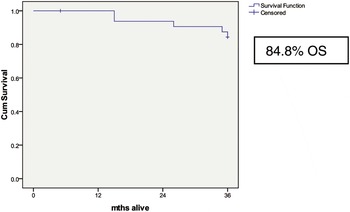
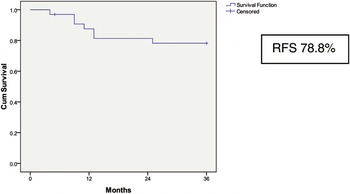
The 3-year overall survival and recurrence-free survival in this study was 84.8% and 78.8%, respectively (Figures 1 and 2). There were six deaths in total—five due to disseminated disease and one due to an unrelated cause (censored). This confirms that despite local vaginal recurrence, systemic disease dictates overall survival.
Overall survival of 33 patients treated with adjuvant vault brachytherapy.

Recurrence-free survival of 33 patients treated with adjuvant vault brachytherapy.

Toxicities
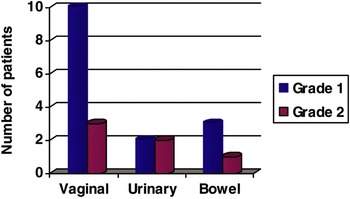
No patient required treatment cessation. The majority of patients tolerated the treatment well with minimal complications; 50% reported no ill-effects and 50% experienced Grades 1 to 2 toxicity (Figure 3). Vaginal stenosis was reported on 10 occasions—8 were of Grade 1 and 2 of Grade 2 severity. Other symptoms were reported less frequently—vaginal bleeding (8.3%), dysuria and urinary frequency (2.8%).
Grade of toxicities experienced.

The use of vaginal dilators was poorly documented with only seven (21%) patients confirmed as using the dilators regularly.
DISCUSSION
The principal aim of this study was to assess the outcomes of patients treated with adjuvant VB for endometrial cancer. The study intended to examine local practice and treatment delivery, review morbidity and relapse rates and assess whether mode of VB delivery had an impact on outcomes.
Patient group
A multivariate analysis published in 2003 evaluating independent prognostic factors in 181 patients over a 10-year period revealed that FIGO stage, tumour grade, tumour type and depth of myometrial invasion correlated significantly with overall survival and recurrence-free survivalReference Steiner, Eicher and Sagemüller20. The current study treated patients with Stage IIA and Stage IIB Grades 1 through 3. Only 3 of the 14 studies listed in the literature review in Table 1 treated similar stagesReference Jolly, Vargas and Kumar11,Reference Lin, Mutch, Rader, Powell and Grigsby21,Reference Alektiar, Venkatraman, Chi and Barakat22. The remainder of the trials had specific eligibility criteria and treated very early stage disease.
With this in mind, it is important to be aware of the limitations in comparing studies involving different patient groups and acknowledging that the higher stage patients included in this study carry an inherent increased risk of disease recurrence, regardless of the treatment given.
Treatment
Worldwide, HDR is most commonly used but the dose and fractionation in the studies listed in Table 1 using HDR ranges from 15 to 36 Gy divided in 2 to 6 weekly fractions. LDR used in the current study delivered 48 Gy. Table 1 summarises the trials using brachytherapy in the adjuvant setting and highlights the different modalities used. Four studies by Ng et al. Reference Ng, Perrin, Nicklin, Cheuk and Crandon23, Obermair et al. Reference Obermair, Cheuk and Pak10, Lin et al. Reference Lin, Mutch, Rader, Powell and Grigsby21 and CengizReference Cengiz, Singh and Grigsby24 used LDR, where the total dose delivered was much higher (60–65c Gy). Interestingly, however, McCloskey et al. Reference McCloskey, Tchabo and Malhotra25 used LDR at a much lower dose of 30 Gy. The prescription point in these studies also varied. In the current study, dose was prescribed to the surface of the applicator (hence the vaginal mucosa) treating approximately two thirds of the vault length. Lin et al. Reference Lin, Mutch, Rader, Powell and Grigsby21 prescribed 65 Gy to 5 mm depth and treated the upper one half to two thirds of the vault. In one patient, LDR brachytherapy was prescribed to the surface of the applicator. Obermair et al. Reference Obermair, Cheuk and Pak10 and Ng et al. Reference Ng, Perrin, Nicklin, Cheuk and Crandon23 both treated the upper 2 cm of the vagina, prescribing 60 Gy to the vaginal vault mucosa. McCloskey et al. Reference McCloskey, Tchabo and Malhotra25, in 12 patients, prescribed to a depth of 5 mm from the applicator surface in a single insertion. The precise dose rates used in each trial were not known.
Local practice has been influenced by outcomes from centres nationally which used a higher dose of radiation resulting in significant toxicities, particularly when new sources were used while failing to account for the increased dose rate. Consequently, local practice has been to deliver 48 Gy; a 20% reduction in the dose from the previously used 60 Gy to the surface of the applicator. At 5 mm and 10 mm distance from the applicator, the dose reduces according to the inverse square law and on average is 32.37 and 23.07 Gy, respectively (Table 5), which demonstrates the small but not insignificant doses received by tissues further away from the applicator.
A physics calculation implemented to determine the dose to the mucosa if 48 Gy was prescribed to 5 mm depth instead of applicator surface revealed that the vaginal mucosa would receive at least 67 Gy, thereby significantly increasing doses to the rectum and bladder. Where Lin et al. Reference Lin, Mutch, Rader, Powell and Grigsby21 prescribed 65 Gy to 5 mm depth, a significantly toxic dose would have been received by the vaginal mucosa and the organs at risk (bladder and rectum).
Because of varied doses prescribed to the vaginal vault, it is difficult to make direct comparisons in the outcomes of different studies. This difference in brachytherapy practices and treatment techniques was highlighted by a recent questionnaire survey presented at ESTROReference Petric and Potter8. The proportion of the vaginal vault treated and thickness and depth of the prescription varied amongst the responses with 62% of centres treating the upper third of the vault whilst only 7% treated the entire vault.
Furthermore, whilst prescription of the dose to 5 mm depth is commonly used, more centres are now adopting an individualised approach according to the patient’s dimensions as assessed by endoluminal ultrasound, EUA and histopathological findings.
Relapses
In the current study, the overall relapse rate was 21%. The vaginal, pelvic and distant relapse rates are 9%, 15% and 18%, respectively. The three vaginal recurrences occurred in association with pelvic and para-aortic node recurrences in two patients and with pelvic disease in one patient. In two patients, the site of recurrence was confirmed to be within the irradiated vault field.
A significant proportion of patients developed pelvic recurrences. The majority of these, however, occurred in conjunction with distant relapses, occurring mostly in the para-aortic nodes, which would not have been prevented by VB.
Two patients developed distant metastases only. None of the seven cases of relapse were isolated to the vagina or pelvis only.
Rates of pelvic and vaginal recurrences for the studies compared are presented in Table 1.
When relapse rates are compared to trials treating similar stage patientsReference Jolly, Vargas and Kumar11,Reference Lin, Mutch, Rader, Powell and Grigsby21,Reference Alektiar, Venkatraman, Chi and Barakat22, no statistical difference was seen for vaginal relapse rates in Lin et al. Reference Lin, Mutch, Rader, Powell and Grigsby21 and Jolly et al. Reference Jolly, Vargas and Kumar11 (95% CI: –0.04922 to 0.213063 and –0.06128 to 0.198576). There was, however, a statistical difference between vaginal relapse rates observed in the current study and that by Alektiar et al. Reference Alektiar, Venkatraman, Chi and Barakat22 (95% CI: 0.010296–0.21801) most likely to be due to the large number of patients amongst studied.
In addition, when comparing pelvic relapse rates in the current study and the above mentioned, both Jolly et al. Reference Jolly, Vargas and Kumar11 and Alektiar et al. Reference Alektiar, Venkatraman, Chi and Barakat22 demonstrate statistically different outcomes (95% CI: 0.010883–0.290047 and 0.032369–0.278724) which is not too unsurprising as pelvic recurrence rates are not affected by the addition of vault brachytherapy.
If, however, outcomes of this study are compared with the trials which used LDR (although still given at different doses and prescription pointsReference Obermair, Cheuk and Pak10,Reference Lin, Mutch, Rader, Powell and Grigsby21,Reference Ng, Perrin, Nicklin, Cheuk and Crandon23), we find that there is no statistical difference in the vaginal relapse rates seen in the current study to those in the aforementioned trials. Pelvic recurrence rates, however, seemed significantly higher in the current study, which again may be explained by the fact that higher stage patients were treated and hence more likely to develop pelvic recurrence which would not have been influenced by brachytherapy.
In addition, the dose of radiation given in this study is considered to be fairly conservative amongst the LDR treating trials. Of note, McCloskeyReference McCloskey, Tchabo and Malhotra25 reported no cases of recurrence in the 12 patients treated with LDR.
Amongst the trials reporting low vaginal and pelvic relapses, PORTEC-29, Chadha et al. Reference Chadha, Nanavati, Liu, Fanning and Jacobs26, Solhjem et al. Reference Solhjem, Petersen and Haddock27, Petriet et al. Reference Petereit, Tannehill, Grosen, Hartenbach and Schink28 and Cengiz et al. Reference Cengiz, Singh and Grigsby24 all had very specific eligibility criteria in terms of stage and grade, often treating only very early Stage I disease. HorowitzReference Petereit, Tannehill, Grosen, Hartenbach and Schink28 and AndersonReference Horowitz, Peters and Smith29 both reported low rates of vaginal relapse in more than 100 patients treated with HDR VB. Distant recurrence was significant (6.1%) in the study by HorowitzReference Petereit, Tannehill, Grosen, Hartenbach and Schink28 despite using a higher dose of radiation. Macleod et al. Reference MacLeod, Fowler and Duval30 had the longest follow-up period of patients treated with HDR VB and reported low rates of VR and PR in 143 patients.
It is worth noting that Ng et al. Reference Ng, Perrin, Nicklin, Cheuk and Crandon23, which reported a 9.1% vaginal relapse rate, demonstrated that five out of the seven relapses occurred within the middle or lower third of the vagina (outside the initial treatment field) suggesting inadequate brachytherapy coverage length may be a causative factor for high vaginal relapse ratesReference Petereit, Frederickson and Regarding31.
In the current study, most relapses (86%) were detected within 2 years of treatment, reinforcing the need for close post-treatment surveillance.
Furthermore, the significant risk of distant metastases and cancer death due to high-risk endometrial cancer has prompted the addition of systemic treatment (chemotherapy) to current therapies in an attempt to reduce recurrence and improve overall survival. To date, trials comparing chemotherapy and radiotherapy have shown no difference in overall survivalReference Anderson, Stea, Hallum, Rogoff and Childers32. The addition of chemotherapy to radiotherapy, however, has been shown in the EORTC-5599133 study to offer a survival advantage. PORTEC-334, which began recruiting in January 2009, is an international randomised Phase III trial comparing concurrent chemoradiation and adjuvant chemotherapy alone in high-risk and advanced-stage endometrial cancer. This study includes patients with histologically confirmed endometrial carcinoma, Stage IB Grade 3 and LVSI, Stage IC or IIA Grade 3, Stage IIB, Stages IIIA or IIIC and Stages IB, IC, II or III and serous or clear cell carcinoma. The outcomes of this study will no doubt have an influence on the future management of high-risk endometrial cancer patients.
Overall, caution must be observed when making comparisons between the outcomes of this study to those in the literature. Clearly, disease stage and numbers studied, in addition to the mode of treatment, will affect any conclusions drawn from these comparisons.
Toxicity
Severe (Grade 3 or 4) toxicity was not reported. The majority of the patients experienced zero or mild toxicity, mostly vaginal stenosis. Our toxicity rates are comparable to those in the literature. Of the studies reporting toxicities—Ng et al. Reference Ng, Perrin, Nicklin, Cheuk and Crandon23, Chadha et al. Reference Chadha, Nanavati, Liu, Fanning and Jacobs26, Cengiz et al. Reference Cengiz, Singh and Grigsby24, Lin et al. Reference Lin, Mutch, Rader, Powell and Grigsby21 and Solhjem et al. Reference Solhjem, Petersen and Haddock27—no Grade 3 or 4 toxicities were reported.
A retrospective analysis by Libby et al. 35 of 207 patients treated by HDR VB demonstrated that 69.6% of patients experienced no radiation-induced toxicities. Of the patients who did experience toxicities, vaginitis (10.6%) and vaginal stenosis (9.7%) were the most prevalent. Furthermore, Chong et al. Reference Libby, Sen and Schneider36 examined 173 patients treated with HDR VB and reported vaginal stenosis rates of 13%. Neither of these studies, however, specified the grade of vaginal stenosis. Assuming that the most severe grade was the one quantified, 2 patients had Grade 2 stenosis in the current study. When this is compared with the vaginal stenosis rates quoted in the Libby et al. 35 and Chong et al. Reference Libby, Sen and Schneider36, no statistical difference exits (95% CI: –0.101 to 0.103 and –0.140 to 0.073, respectively).
It is worth noting that long-term vaginal stenosis can result in sexual dysfunction and painful vaginal examinations. It can be prevented by regular intercourse or the use of vaginal dilators during or after radiotherapy. Surveys have shown this to be standard practice in the United KingdomReference Chong and Hoskin37 and guidelines from the U.K. National Gynaecological Oncology Nurse Forum recommend dilatation three times weekly for an indefinite time periodReference White and Faithfull38. Research evidence on this subject is, however, sparse due to limited methodological quality of observational studies and is often relevant to pelvic EBRT only39.
The current study highlights the importance of assessing and monitoring patients for vaginal stenosis and ensuring that adequate education and support is provided for patients to avoid severe complications.
Survival
The FIGO annual report in 2003 estimated the 5-year survival rate of endometrial cancer patients to be 76.5%Reference Lancaster40. On review of published literature, 5-year survival varies between 86% and 95%, which is comparable to the 3-year survival rate of 84.8% in the current study.
CONCLUSION
The management of uterine confined endometrial cancer has evolved over the last decade, and more evidence is available supporting the use of VB as an alternative to pelvic EBRT in the adjuvant setting. In selecting patients for treatment, it is important to be aware of the high-risk features associated with relapse— FIGO stage, depth of myometrial invasion, presence of LVSI and degree of tumour differentiation.
At the time of the writing of the manuscript, PORTEC-2 was available in Abstract form only. Patients included in the current retrospective study were treated from 2006 to 2009, and hence outcomes of the trial had not affected clinical practice.
Furthermore, PORTEC-2 had very specific entry criteria which included Stage IC, Grades 1 to 2 and age ≥60; Stage IB, Grade 3 and age ≥60; Stage IIA, Grades 1 to 2 of any age or Stage IIA, Grade 3 with <50% myometrial invasion of any age. The current study treated patients with Stage IIA and Stage IIB disease, Grades 1 through 3.
PORTEC-2 reported rates of vaginal failure 2% versus 0.9% among patients in the pelvic EBRT and VB arms, respectively. Our study reports vaginal relapse rates of 9% occurring in 3 patients with Stage IIB Grade 1, IIA Grade 2, and IIB Grade 2 with the latter two patients developing pelvic and para-aortic lymphadenopathy with vaginal relapse, hence not completely avoidable by giving EBRT.
The significant rates of relapse in the current study can be explained by a number of reasons. Firstly, Stage IIB, Grade 3 disease was included in our study in addition to patients with LVSI and greater than 50% myometrial invasion, not highlighted by PORTEC-2. Furthermore, PORTEC-2 randomised 427 patients to receive either pelvic EBRT or VB. The current study included only 33 patients in total. The rate of vaginal relapse, however, was comparable with that in the literature where similar stage patients and VB techniques were used. Furthermore, no statistical difference in toxicity was detected between the current study and the reporting trials.
Despite the limitations of the current study (small numbers and endometroid pathology specific), we conclude that among patients with low-risk Stage II endometrial endometroid adenocarcinoma, VB delivered in the way described is an effective adjuvant local treatment. However, the outcomes from landmark trials (PORTEC-29 and PORTEC-334) further evaluating the role of EBRT versus VB, and the role of adjuvant chemotherapy in high-risk endometrial cancer such as those included in the current study, will be invaluable in determining the optimal treatment for these patients and may alter current local practices locally. It is likely that the results of this study may support outcomes of PORTEC-2, advocating the use of EBRT in patients with features likely to increase their risk of local recurrence, acknowledging that as yet overall survival has not been affected by adjuvant radiotherapy practices. Suffice to say that variations in practice nationally and internationally reflect the uncertainty and lack of overall consensus on the management of these patients in whom the addition of adjuvant therapies may add morbidity without a demonstratable survival benefit.
Acknowledgement
The authors wish to acknowledge the assistance of the Sheffield Teaching Hospitals NHS Foundation Trust Research and Statistics Department and Dr. Srinivasan.