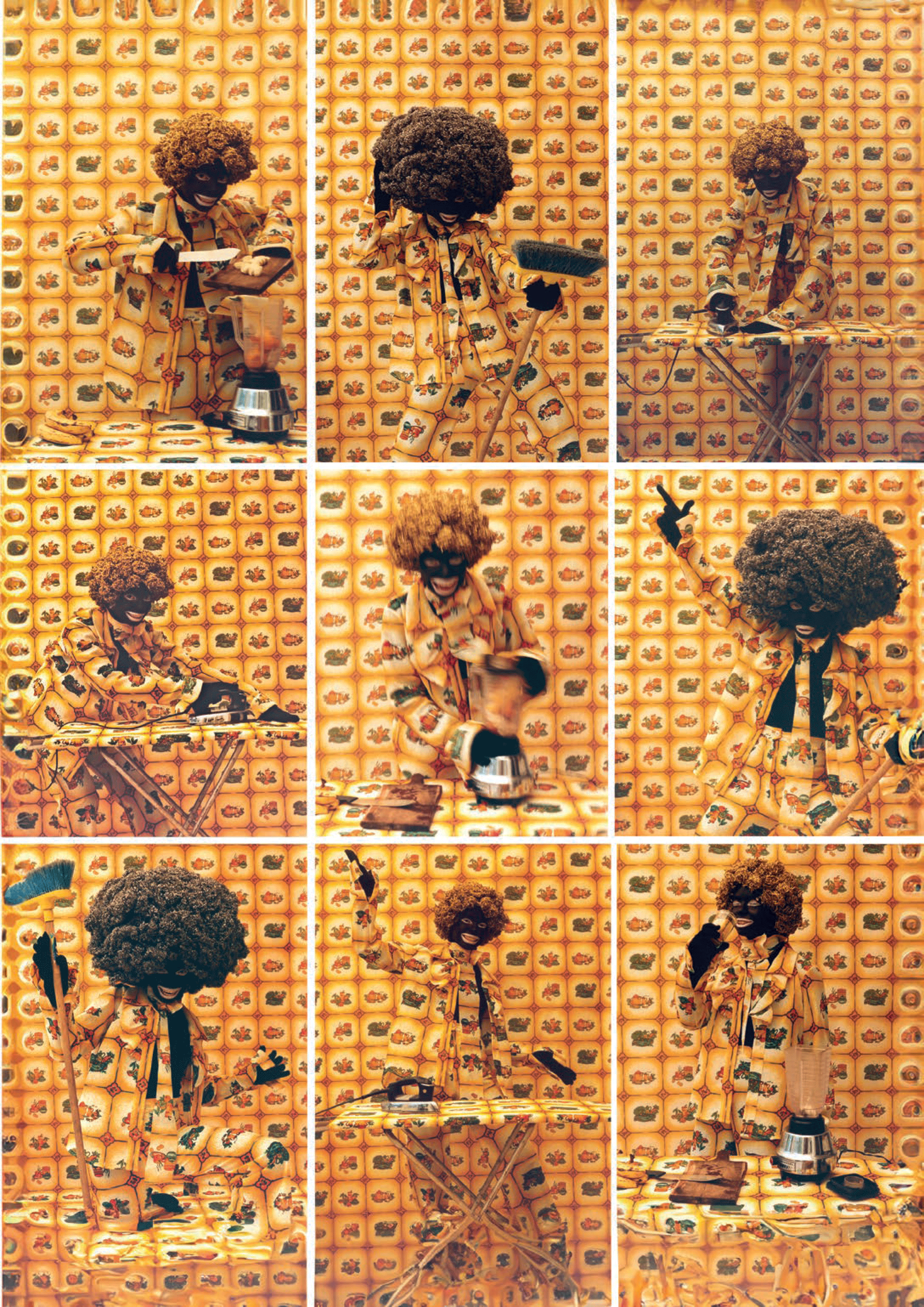
Negro utópico is an art piece featuring nine photographs of the Afro-Colombian artist Liliana Angulo in blackface. It was part of the exhibit Viaje sin mapa: Representaciones afro en el Arte contemporáneo colombiano (Journey Without a Map: Representations of Blackness in Contemporary Colombian Art), curated by Mercedes Angola and Raúl Cristancho in 2006.Footnote 1 In Negro utópico, the artist presents a series of Black self-portraits in which she wears a large Afro wig, black gloves, a suit, and a tie.
In each image, the layer of black paint on her face is so thick that her face is almost unrecognizable. Except for the black gloves, the color and pattern of the clothes and set pieces are the same as the background, which are all made from striking yellow tablecloth fabric with a fruit motif (see fig. 1). On the walls, the tablecloth pattern looks like the wallpaper of a kitchen. While the title of the series translates as “utopian Black man,” and at first glance, the images seem to show a Black man doing domestic work, it is in fact, the artist dressed in drag. Reveling in gender ambiguity, the drag performance refuses the transparency of the gender binary. Is this a negrita impersonating a Black man, or is it a Black man performing domestic chores? How might one interpret this inversion of gendered and racialized expectations of domestic work?
Liliana Angulo, Negro utópico (2001). Nine individual photographs. Dimensions: 60 × 50 cm. (Reproduced with permission of the artist)

The ambiguity in Negro utópico is further punctuated by its staging of the Black body as part object, part human, especially through the protagonist’s hair: in each image, the subject dons either a large wig made of steel wool or a smaller one made of brass pads that are used for cleaning pots and pans.Footnote 2 The series shows the subject striking three sets of poses while holding or deploying objects associated with domestic labor: a knife, blender, and cutting board, a broom, and an iron. In the first set, the subject’s steel-wool hair is golden, and they use a knife to scrape slices of banana from a cutting board into a blender.Footnote 3 In the second one, their hair is now a gigantic dark gray wig made of steel wool. In this image, the subject clutches the broom like a standing mic and poses like a rockstar, cocking their head back as if they were singing, and touches their hair with the other hand. In the third set, the subject is wearing the smaller golden wig again as they iron their tie on the ironing board. Each set concludes with the subject completing each action: first, blending the fruit, and second, drinking from the blender. Although the figure is shown with household items, some of the gestures fail to meet the expectations of a domestic servant. How does one interpret this play between objecthood and subjecthood, the performance of gender ambiguity and racial excess, the use of gestures, and the piece’s reference to a constellation of racial stereotypes, including the Black domestic servant and the Black entertainer, as well as its allusion to the politics of Black hair? And why is this piece framed as a utopia?
Elsewhere I have argued that Angulo’s use of ambiguity and her tangled racial and gendered signs are strategies of defamiliarization (Roper Reference Roper2025). I have called her performance an act of spatial drag to signal the entanglements of the racialization of space and the spatialization of race in her performance. Here, I expand on that discussion to ascertain how her deployment of blackface operates within the larger artistic articulation of a Black geography as the Colombian state has moved toward redefining the nation as multicultural. I define a Black geography as a constellation of acts of Black place-making that troubles the power of the state as arbiter of a national space and that questions and reimagines the place of blackness in the nation. I read Negro utópico within a larger Black geography because it was part of Viaje sin mapa, the first art exhibit focused on blackness in Colombian art. The exhibit serves as an exemplar of a Black geography because it was constituted by acts of Black place-making. In the 2000s, Viaje sin mapa not only put Black artists like Angulo on the map, but also intervened in processes of racial formation and countered state imaginations of a national geography through its engagement with territory, race, and space.
Because Black geographies “cut across representational systems” (Madera Reference Madera2023:55), the diverse artistic and performative gestures of Viaje sin mapa constitute an imagined geography that challenges the politics of racial essentialism and geographies of exclusion and invisibility produced by the nation-state. Here, a Black geography is constituted by these ephemeral acts of spatial enunciation wherein artists (re-)invent, reclaim, contest, or reconfigure the discursive and physical sites that blackness has been made to occupy in the national imaginary. Where scholars in global blackface studies have critiqued the limitations of the nation by tracing the travel of the blackface sign (Cole and Davis Reference Cole and Davis2013; Thelwell Reference Thelwell2020; Hoxworth Reference Hoxworth2024), I embed this blackface performance in the formation of a Black geography to consider other ways the blackface performance challenges the nation and specifically a national geography. The blackface sign intervenes in the politics of race and space and disrupts spatial imaginations of the nation. Blackface not only demarcates the politics of skin as a racial-spatial territory, but Angulo’s act of spatial drag also works to question the racial politics of space, highlighting the role of space as a mechanism of racial control that fixes blackness within certain stereotypes. As a strategy of Black place-making, I consider how the blackface sign troubles and reworks the spatial meaning assigned to the Black body. Her use of drag performance is a hermeneutic through which she illuminates the gendered and sexual politics of racial-spatial regimes of power.
Angulo’s engagement with space is important because space is central to racial formation in Colombia. State imaginations of a national geography have worked to produce geographies of exclusion and discourses of racial essentialism. Viaje sin mapa is an example of how acts of Black place-making counter the exclusionism and essentialism of the national geography and offer a means to track the artistic reimaginations of the relationship between blackness and space. Negro utópico is among the exhibit’s acts of Black place-making that engage questions of racialized dispossession, articulate a Black sense of space, challenge discourses of antiblackness, and reimagine the place of blackness in the nation. This act of spatial drag tackles the gendered and sexual politics of racial essentialism and denaturalizes the relationship between blackness and the kitchen as a site of domesticity.
Black Art in Bogotá
Astrid Liliana Angulo Cortés, who goes by Liliana Angulo in the art world, is a Black multimedia artist born in Bogotá in 1974. Angulo studied sculpture at La Universidad Nacional de Colombia in Bogotá and received an MFA from the University of Illinois in Chicago. As is typical of many Afro-Colombians from the capital, Angulo is the child of a Black migrant from the Pacific coast. Black communities in Bogotá face the challenge of forever being perceived as foreigners, or interlopers, in a largely white city; Colombia’s tri-racial configuration has historically designated Bogotá as a white or mestizo space. Angulo is part of the city’s small artistic scene, sharing company with noted Afro-Bogotán artists such as Angélica Perea, Aníbal Moreno, Wilson Borja, Mercedes Angola, and the activist group Colectivo Aguaturbia—of which Angulo is a member—and their project I.R.A. (Imaginación Radical Afro). These artists all engage the racial politics of living in the margins of Bogotá’s mostly white metropolitan space.Footnote 3 As a multimedia artist, Angulo has used video installations, photography, sculpture, and performance art since the 1990s to examine questions of race, gender, and the representation of Afro-Colombian culture in contemporary art and media. Critiquing stereotypes and valorizing Afro-Colombian traditions and culture from a Black perspective are the hallmarks of her work.
Angulo’s focus on the deconstruction of stereotypes to interrogate reductive renditions of blackness and Black womanhood is reminiscent of the work of noted Black female artists in the US such as Adrian Piper, Carrie Mae Weems, and Kara Walker. Art critic Zeca Ligiéro notes her tendency to tackle stereotypes head on, to present images that oscillate between “ambiguity and virulence,” and to generate discomfort among viewers (Ligiéro Reference Ligiéro2008). Angulo’s visual art processes focus heavily on interrogating “the physical characteristics of black people,” their representation in popular culture, mass media, and historical documents, “metaphors related to power” and the historical connotation of black skin, and different parts of the Black body and its relationship to space (Angulo Reference Angulo2008). In 2024, Angulo became the first Black woman to be named director of the Museo Nacional de Colombia. But she got her big break as an artist in 2006 when she participated in Viaje sin mapa where she presented Negro utópico, Negramenta, Un negro es un negro, and Objetos para deformar. She emerged on the scene just as the Colombian state moved away from a colorblind approach whereby the state refused to acknowledge race, conduct racial censuses of the population, or give credence to the existence of racism in the nation. Like so many other artists, Angulo’s work challenges the erasure of blackness in the national imagination. Her participation in Viaje sin mapa is important because the exhibit created an opportunity for artists to confront the spatial configurations of race that have long defined Colombia’s discourse of mestizaje—central to the state formation of a national geography.
Colombia’s National Geography
From Mestizaje to Multiculturalism
Until the 1990s, Colombia was defined by a nationalist discourse of mestizaje that proclaimed everyone is mixed, but ultimately Colombian (Paschel Reference Paschel2013; Wade Reference Wade1995:16). Mestizaje was grounded in the notion that racial mixture insulated the nation from racial discord. Because the state held a legal position of colorblindness, Colombia rarely conducted ethno-racial censuses; when it did, the population mostly identified as mixed and census takers concluded that Black, white, and Indigenous people lived in perfect harmony and ethno-racial questions were therefore unimportant (Paschel Reference Paschel2016:40). Although an “explicit derogation of blackness” was rare in Colombian mestizaje, this nationalist discourse nonetheless emphasized the mixture of European and Indigenous people while silencing or excluding blackness (Wade Reference Wade1995; Friedemann and Arocha 1986). Black Colombians were erased from popular narratives and representations of national identity (Sanders Reference Sanders2004; Paschel Reference Paschel2016). Mestizaje did not just lead to the invisibility of blackness; it was grounded in Colombia’s national geography.
A national geography is constituted by state claims to land, its establishment of external and internal borders, its spatial organization and distribution of its resources across its territory, and its spatial emplacement of its peoples. Race in Colombia has long been intertwined with geography and Afro-Colombians were rendered invisible by the spatial configuration of the country’s national discourse of mestizaje. The Colombian nation has historically been defined by a discourse of regionalism that has associated each region with a particular racial group (Friedemann Reference Friedemann1966:69; Wade Reference Wade1995). Whites and mestizos were associated with Bogotá and the Andean highlands, Indians with the Amazon lowlands, and Blacks with the coasts. Peter Wade calls this regionalism a “cultural topography of race” whereby each regional designation serves as a code and proxy for race and racial hierarchies (in Paschel Reference Paschel2016:42).Footnote 4 As Eduardo Restrepo explains, 19th-century Colombian intellectuals believed in a geography of race that enabled them to map a correlation between the characteristics of a particular place—its climates and environs—and the disposition of a particular racial group. Racial difference was quickly encoded in territory: the Andean highlands where the population is predominantly white and mestizo are held up as exemplifying “beauty and industriousness” (Paschel Reference Paschel2016:43); while the predominantly Black populations of the coasts were perceived as naturally “closer to nature” (Restrepo Reference Restrepo2007:59), savage, lazy, and hypersexual (Paschel Reference Paschel2016:43). The national geography worked to racialize and fix people “within a system of racial classification according to their geographic location” (Hawthorne and Lewis 2023:2).
In Colombia, “the production of space is (intimately) tied to the production of (racial) difference” (Hawthorne Reference Hawthorne2019:3). Colombian racial formation has long been articulated through what Katherine McKittrick identifies as the “where of race” (2006:xiv). As McKittrick explains, space is normatively understood as unwavering, secure, as “just is” rather than something we all socially produce (xi). The national geography of mestizaje imagined and reorganized the national space to naturalize racial hierarchies. As Black geographers have noted, the spatial organization of the nation not only produces geographies of racial essentialism, but also fortifies geographies of exclusion (McKittrick and Woods 2007). Historically, the Colombian government has had little influence outside of the major cities. Because state power is concentrated in Bogotá, the two coasts have long been isolated and, as a result, receive fewer resources. The unequal distribution of resources inherent to Colombia’s cultural topography of race consolidated Black erasure and marginalization. Moreover, this geographic isolation cemented the ideological distance of Afro-Colombian communities from the rest of the national polity (Sanders Reference Sanders2004:169). The language of territory elided race, disavowing its power in the organization and distributions of national resources while simultaneously bolstering the fiction of national harmony. And yet, in Colombia’s national geography, space was the means through which Black people were fixed within systems of racial essentialism and geographically and ideologically excluded from the nation.
Viaje sin mapa took place as the state moved away from its discourses of colorblindness and sought to reimagine the place of race in the nation. Between the 1980s and 2000s, Colombia, like other Latin American countries, undertook a series of multicultural reforms that recognized and guaranteed the protection of the rights of minority populations (Hooker Reference Hooker2005; Hale Reference Hale2002). In 1991, the state of Colombia adopted a new constitution that recognized the country as “multicultural” and the state officially recognized Black and Indigenous peoples as ethnic groups (Restrepo Reference Restrepo2013; Ng’weno Reference Ng’weno2007; Asher Reference Asher2009).Footnote 5 In the decade that followed, multicultural reforms opened the door to more explicit and direct engagement with racism in Colombia and to new definitions of blackness (Paschel Reference Paschel2013). The multicultural turn also led to greater attention to blackness and to notions of racial diversity in Colombian art. State and financial institutions began to sponsor art exhibitions that not only embraced the emergent discourse of national plurality but also attended to representations of blackness in Colombian art as well as the contributions of Afro-Colombian artists.Footnote 6 Viaje sin mapa thus emerged amid the reconfiguration of Colombia’s national geography. Constituted by acts of Black place-making, the exhibit proposed a Black geography that interrogated and simultaneously reimagined the place of blackness in the nation.
Viaje sin mapa
Black Place-Making After Colombia’s Multicultural Turn
Afro-Colombian artist and professor Julia Mercedes Angola and white professor Raúl Cristancho, who both worked at la Universidad Nacional de Bogotá, curated and launched Viaje sin mapa in 2006. Angulo worked as a participating artist and curatorial assistant. The exhibit included a variety of artistic genres: performance art, painting, video installation, and photography. Although not all the participating artists identified as Black, blackness was at the center of every individual work. The curators sought to juxtapose acts of Black self-representation with the ways blackness is represented and seen from an external gaze. Thus, the “Black” in Black place-making does not refer solely to participation of Black artists in Viaje sin mapa; rather it is constituted by diverse artistic and performative strategies and multiple modes of seeing and representing Black bodies that together reimagined the spatial politics of blackness. The exhibit attended to the complexity of defining blackness in Colombia: artistic reflections on Black cultural practices, histories of enslavement and realities of displacement, and Afro-Colombians’ relationship to Africa and territoriality. Thanks to the sponsorship of Colombia’s central bank, Banco de La República, the exhibition was shown in Bogotá and in cities with large Afro-Colombian populations, such as Cali, Quibdó, Pasto, and Cartagena. The exhibition curators’ mission was to initiate a dialog about what it meant to be Black in the wake of the multicultural reforms (Cristancho Álvarez Reference Cristancho Álvarez2006).
Indeed, Viaje sin mapa was the first major exhibition to center on blackness in Colombian art and to explicitly address the multicultural turn. In the exhibit’s catalog, Raúl Cristancho explains that after the constitutional changes of 1991, “es posible pensar el ser afrocolombiano en un sentido integral y de manera dinámica según la necesidad de ir redefiniendo su identidad y su imaginario (It is possible to think of the Afro-Colombian in a comprehensive sense and a dynamic way in relation to the need to redefine one’s identity and imaginary)” (Cristancho Álvarez Reference Cristancho Álvarez2006:11). While the contributions of Afro-Colombians to Colombian music, folklore, and dance were already well documented, the multicultural turn saw a critical reflection on the invisibility of blackness and Afro-Colombian artists, and the fact that few of them are formally trained (Cristancho Álvarez Reference Cristancho Álvarez2006; Angola Rossi and Sánchez Barona 2025:54). Until then, Colombia’s contemporary art scene had seldom engaged with questions of race. Angola notes that when blackness did appear, it was often subject to an exogenous gaze (Angola Rossi 2006; González Reference González2002).Footnote 7 The curators used the exhibit to start a conversation about race in artistic practice, present an archive of a previously marginalized body of work, and to locate blackness within the genealogy of Colombian art history. Viaje sin mapa thus sought to counter the state imagination of a national geography and the geographies of racial exclusion and invisibility that it had produced.
Cristancho and Angola imagined Viaje sin mapa as an artistic discovery and the exhibit’s title suggests that this was an open-ended act of Black place-making in the nation that responded to colonial legacies of geographic exploration. Their inspiration for the title came from Journey Without Maps ([1936] 1950), a book by British writer Graham Greene that chronicled his travels across Liberia and other parts of the African continent in 1935. Famous for its exploration of West Africa as an uncharted and unknown territory, Greene’s reflection on his sojourn is replete with depictions of the continent as uncivilized, riddled with disease, poverty, unsanitary conditions, and racist references to African natives ([1935] 1950). As a white British traveler, Greene’s geographic wanderings constituted a practice of spatial knowing that not only “mapped and catalogued African lands in conjunction with European imperial ventures” but also emplaced and fixed blackness within discourses of the uncivilized (Hawthorne and Lewis 2023:6). The book demonstrates the role of geography in colonial projects (Hawthorne Reference Hawthorne2019; Hawthorne and Meché 2016) and shows how “the unknowable figures in the production of space,” how space is racialized in practices of white exploration, and the role of race in place-making and geographic mapping (McKittrick and Woods 2007:4; Lipsitz Reference Lipsitz2011; Hawthorne and Lewis 2023). The Black geography that the exhibit proposed was thus one that reimagined the politics of geographic exploration, intervening in colonial logics that had served as the foundation of a national geography.
The curators appropriated the title of Journey Without Maps as a parodic critique of Greene’s racist logics, and because it captured well the project’s organizing precept: the notion of exploring an uncharted territory.
La figura del viaje sin guía se convierte en metáfora del presente proyecto que no se enfrenta a lo desconocido sino al encuentro con lo posible, en la demarcación de un territorio que sabemos que está aquí, pero cuyas coordenadas físicas o imaginadas están aún por determinar. (Cristancho Álvarez Reference Cristancho Álvarez2006:13)
(The figure of the journey without a guide becomes a metaphor for the present project that does not face the unknown, but rather [faces] the encounter with the possible in the demarcation of a territory that we know is there but whose physical or imagined coordinates are yet to be determined).
The curators imagined it as a journey that highlighted different possible coordinates of blackness in the nation. Where Greene fixed blackness within tropes of primitivism and disease and the national geography emplaced blackness in geographies of racial essentialism, the exhibit’s reimagining of blackness refused to fully define or limit the space of blackness itself. This constituted both a reversal of white colonial ideals of geographic domination and a rejection of a national geography’s tendency to fix blackness in a specific geographic location. The exploration of uncharted territory figured here as a site of potentiality and a space of Black place-making, signaling this Black geography as an “opening into multiple worlds” (Madera Reference Madera2023:50). Rejecting any essentialist notion of blackness, the exhibit sought to articulate a Black counter-space for the assertion and cohabitation of subaltern subjectivities, Black (spatial) epistemologies, and multiple forms of blackness. The metaphor of the journey signals that this mapping is a process—rather than a completed endeavor—with visual and performative acts registering a set of disparate coordinates through critical exploration. Indeed, upon entering the first room of the exhibition, visitors encountered a chronology of Black Colombian art and representations of blackness across the 20th century. The chronology in many ways captured the exhibit’s notion of a journey delineating the spaces Afro-Colombian art had occupied in the nation over time. This form of Black place-making exemplifies how a Black geography counters the spatial logics of a national geography that had rendered blackness invisible.
Given the centrality of regionalism to Colombian processes of racial formation, the curators’ attempt to map a cultural cartography of blackness within Colombian art signified an aesthetic reconfiguration of the racial space of the nation. In other words, Viaje sin mapa positioned Black art as both a medium and site of critical reflection where the social production of racial geography is laid bare. Within this process, the role of the artist is that of a racial cartographer who denaturalizes the presumed naturalness of spatial/racial difference—the “where of race”—and who upends, subverts, and tears down the racialized borders and silos of the nation. The exhibition’s open-ended approach thus made it a site for convergent practices of racial (re)mapping that sought to snatch blackness from the abyss of national invisibility and regimes of racial abjection. Where the national geography used space to fix blackness and racial meaning, the exhibit’s open-ended approach suggested that this Black geography sought to unfix racial meaning. It denaturalized any predetermined notions about the relationship between race and space. Because Black geographies comprise “myriad ways of enacting space” (Madera Reference Madera2023:55), Viaje sin mapa included a variety of artistic approaches that entailed body art, photography, painting, and object art.
Many of the exhibition’s works explored racial constructs of beauty, experiences of prejudice and discrimination, the impact of Colombia’s civil war on Black communities, Black ritual and religion, and the preservation of Afro-Colombian cultural practices. For instance, in Ciclos de lavado (Cycles of Washing), the artist Angélica Perea sought to pay homage to Afro-Colombian women who wash their clothes in the rivers of Chocó. Washday is a place of Black female sociality where women gossip and share stories. In her installation, Perea hung clothes on large wooden sticks and placed pieces of a common blue soap that Afro-Colombian women typically use to wash clothes throughout the space. The smell of soap permeated the installation. This act of Black place-making relied on the sensory recall of quotidian Black practices for all who entered the room. By tapping into the olfactory dimensions of a Black geography, Perea’s artwork points to the way Black geographies are also constituted by a set of multisensorial experiences. The artwork used smell to demonstrate the relationship between blackness and space. In the series Paisaje I and II (Countryside I and II), Estrella Murillo honored Black life on the Pacific coast by using objects and materials from home. She presented a balcony looking out to the ocean. On the floor were excerpts of Pablo Neruda’s poem paying homage to the Pacific Ocean, written with grains of sand. Here, Murillo celebrated the landscape of the Pacific coast, home to large Black communities. In Paisaje II, she recreated the scenes of Black life that one witnesses on bumpy bus rides along the Pacific coast. To capture the rough journey on public transport taken by Black people, she installed chairs with rocks on the seats. The chairs were facing wooden carvings of windows with objects such as pieces of bamboo, sticks, and heads of small brooms placed in the center of the window frames. This evoked everyday activities observed during bus rides—like a Black person sweeping the front steps of their home. As forms of Black place-making, these artworks used material objects and sensorial experiences of quotidian life to demarcate a Black sense of place.
Viaje sin mapa also mapped spaces of Black fugitivity. The photographer Fernando Mercado’s piece El rey de los Reyes (King of Kings) celebrated Black life in Palenque de San Basilio—the most famous surviving maroon community in Colombia. Palenque was declared an intangible cultural heritage site by UNESCO and is known for its distinctive preservation of African-derived cultural practices and languages. Mercado’s photograph features an Afro-Colombian man from Palenque whose face peers above large black, red, and gold boom boxes that obscure his body. The word “Rey” (king) painted on the boom box declares him Black royalty and his penetrating stare registers a Black gaze. In its engagement with Black communities in Palenque, Mercado’s photograph highlights revered spaces of black maroonage and anticolonial resistance in the exhibit’s mapping of a Black geography.
In addition, Edelmira Massa focused on Afro-Colombian folklore, religion, and cultural syncretism by depicting the Afro-diasporic deities Yemayá and Changó in two different paintings. The piece extolled Black spiritual practices and religious epistemologies. Bypassing the national geography, this act of Black place-making grounded local spirituality within the spatially extended cultural and religious practices of the African diaspora. In the documentary film Los calabazos del sol, the artists Fernando Restrepo and Marta Rodríguez focused on the impact of Colombia’s civil war on Black children from north of Chocó, highlighting internal geographies of racialized displacement. Similarly, in her piece Río, Martha Posso exhibited a series of photographs of Río Atrato, a river that has been at the center of much of the violence of Colombia’s internal war. The river features as a space of Black life, death, and dislocation. She highlighted the relationship between the environment and the precarity of Black life showcasing how the state’s geography of exclusion had led to mass displacement. These acts of Black place-making not only demonstrate how the national geography victimized Black communities but also show how Black geographies bear witness to the relationship between the environment and Black death (Noxolo Reference Noxolo2023).
Where some of the works in the exhibit enunciated a Black geography through engagements with Black material culture, sensory experiences, rituals, and relationships to the environment, other artistic pieces tackled the racial essentialism of the national geography by engaging antiblackness and racial stereotypes. The exhibit showed a video of a performance by the artist Lorena Zúñiga titled Blanco siniestro, in which she juxtaposed her partially nude body against a white canvas. Black paint stained her body and face as she wrote the following questions: “¿Me temes?” “¿Te doy asco?” “¿Te avergüenzo?” (Do you fear me? Do I disgust you? Do I embarrass you?). Zúñiga’s juxtaposition of the Black female body and the white background played with the notion that the colors black and white are opposite. The questions she posed indexed the undesirability of blackness in her country and the construction of blackness as a source of national shame. She showed how blackness lives in a national space of racial abjection. Similarly, in No todo es igual, no todo tiene la misma significación (Not everything is same, not everything means the same thing), Fabio Melecio Palacios offered a series of portraits of young Black men that reflected on the ways they are quickly judged as ugly, dangerous, and/or undesirable. Melecio Palacios tapped into the power of portraiture to bestow honor and status on his subjects and thereby intervened in visualizations of Black men as criminal (Lugo-Ortiz and Rosenthal Reference Lugo-Ortiz and Rosenthal2013). Where Zúñiga’s work confronted the space of racial abjection, Melecio Palacios’s sought to recuperate representations of Black masculinity. By confronting antiblackness and challenging perceptions of Black people, these pieces both illuminated and reimagined the place of blackness in the nation.
Viaje sin mapa presented a Black geography that challenged practices of colonial exploration and racial essentialism, environmental determinism, and spatial practices of exclusion that organize the national geography. Instead of seeking to define the spatial coordinates of blackness in the nation, it created an open-ended space with limitless possibilities. The Black artist appeared as a counter-cartographer who makes visible overlooked practices and who wields art to de-normalize the configurations of space and race contrived by the national geography. Through their artworks, participants sought to dislocate blackness from regimes of invisibility, bear witness to Black death and racialized dispossession, articulate a Black sense of place, celebrate Black fugitivity, and challenge racial stereotypes. They confronted stereotypical visualizations of the Black body to repair and relocate its place within a particular space in the nation. They delineated a Black geography through an engagement with Black material culture and sensory experience, religious practice, and the experiences of Black quotidian life. These acts are modes of Black place-making because they confront and reimagine the spatial constraints placed on blackness in the nation.
Although Angulo had presented Negro utópico prior to 2001, I see the version she presented in Viaje sin mapa and her blackface performance as part of the exhibit’s artistic gestures of Black spatial enunciation. In keeping with the exhibition’s reflection on racial stereotypes and antiblackness, Angulo also presented Objetos para deformar, Negramenta, and Un negro es un negro. Not only did each piece engage the gendered configurations of anti-Black stereotypes, the politics of Black hair, and modes of seeing the Black body, but they also involved different forms of blacking up that played with tones of Black skin. I limit my analysis to Negro utópico to consider how blackface performance points to the skin as a space of political articulation and denaturalizes the relationship between blackness and space. Negro utópico traffics in ideas of racial caricature to challenge the spatial politics of Black domesticity. Like the other artistic gestures of Viaje sin mapa, the photographs of Negro utópico challenge racial essentialism and its reliance on structures of antiblackness. As a strategy within the formulation of a Black geography, spatial drag not only reflects on the role of space in producing blackness, it also uses drag performance to question and reconfigure the racial and gendered logics that organize the kitchen as a domestic space.
Negro utópico or the Fungibility of Blackness
Laura Levin describes Negro utópico as an act of self-camouflage, “a form of art-making” in which “the subject negotiates the terms of their appearance” (2014:31). Furthermore, Levin sees Angulo’s use of blackface as “a refusal to embody a transparent racial type” (58). In Negro utópico Angulo’s refusal of transparency is enacted through the ambiguous gestures, the gender-bending, the deployment of blackface, and the out-of-placeness of the Black man in the kitchen. The black paint so overwhelms the subject’s face that it ultimately renders the Black figure opaque. In other words, this is a performance of what Daphne Brooks calls “spectacular opacity”—a cultural phenomenon where marginalized figures wield “gestures and speech, as well as material props and visual technologies […] to confound and disrupt conventional constructions of the racialized and gendered body” (2006:8). She further explains that spectacular opacity “emerges either as a product of the performer’s will, or as a visual obstacle erupting as a result of the hostile spectator’s epistemological resistance to reading alternative racial and gender representations” (8). Staging black opacity is one of multiple defamiliarizing strategies that Angulo utilizes, like other Black artists, to “contest the dominant imposition of transparency systematically willed on black figures” (8). This is especially salient for unpacking the implications of her use of an overwhelming blackface mask as a central feature of her performance of racial excess. As Tina Post explains, while blackface on white performers points to the enactment of Black skin onstage, because Black skin is already present for Black performers, blackface on Black skin is less about the embodiment of blackness than it is a critical engagement with the “idea of blackness” (2015:94). In Negro utópico the idea of blackness is articulated through the confusing mixture of Black stereotypes whose discordance render them almost illegible. Not only does the blackface mask index blackness as a surplus layer that obscures Black subjectivity, but it also functions as a strategy of defamiliarization wherein the artist stages a refusal to comply with the imperatives of gendered and racial legibility that are placed on Black bodies.Footnote 8 In Angulo’s photographic series, stereotypes appear as racial codes that do not in fact reaffirm racist constructs of blackness; rather, they stage performances of opacity that are themselves acts of refusal.
Angulo also uses impersonation to defamiliarize racial signifiers and to expose the violence of racialization. Negro utópico, for example, critically reflects on the work the Black body is made to do in processes of racialization. The black gloves, the paint on the skin, and the wig made of steel wool are the accoutrements of a racial assemblage that underscores how parody can make visible processes of racialization—the modes through which corporeal features like hair and skin are transformed into racial signifiers. In Negro utópico, the performance of racial excess indexes how racialization imbues the body with meaning. Black skin is highlighted as an overdetermined racial-spatial corporeal territory. Moreover, in rendering bodily features like hair as cleaning objects, Angulo illuminates how such processes of racialization, as forged through the slave past, disciplined and remade the Black body into merchandise or instruments of labor. This racial assemblage stages the literal transformation of the blackened body into an object. It presents a subject operating in a liminal zone between human and thing to emphasize that the production of race has been coterminous with rendering Black subjects as not quite or not fully human. As Mara Viveros explains, Angulo uses dark humor to exaggerate racist stereotypes and to underscore “the tensions and ambiguities that sustain stereotypes of gender and race, forever linking them to the history of slavery and postcolonial servitude that one often prefers to forget” (2003:49). Indeed, Angulo’s engagement with the thingification of blackness indexes the violence of a slave past so that “blackness marks simultaneously both the performance of the object and the performance of humanity” (Moten Reference Moten2003:2).
The defamiliarization of the stereotypes extends to Angulo’s engagement with the relationship between racialization and space. Angulo produced Negro utópico after witnessing a racist advertising event at a shopping mall where Black women were hired to wash a new jeans product on sale at a store (Angulo Reference Angulo2018). This experience inspired the piece’s critique of the naturalization of the Black woman as a fixture of domestic space. Angulo presents herself as an opaque negrita in drag, so consumed by the kitchen-tile pattern of their clothes, the tablecloth and object coverings, and the matching background that Giraldo Escobar describes her as a “mujer negra cocina” (kitchen Black woman), the incarnation of the kitchen (2014:108–09). This is an act of spatial drag—rejecting the presumed distinction between material body and physical space; instead redrawing and blurring the boundaries between the two (Roper Reference Roper2025). The subject’s blending with the kitchen-tile background of the photographs captures this process of spatial inscription. As a mujer negra cocina—or perhaps, given the protagonist’s gender ambiguity—a cuerpo negro cocina (Black kitchen body), they underscore the configuration of the Black female body as a literal kitchen fixture and its social disappearance.
In Negro utópico, the kitchen—a site of racial and gendered enclosure for the Black woman—signals that space is an actor in the production of racial signification, laying the coordinates of racial confinement and limitations on Black subjectivity. And because “the kitchen will travel with her when she leaves the room,” the meaning of the Black female body is never fully dislocated nor unfixed from the space of racial subordination (Lane Reference Lane2010:122). Spatial drag breaks the illusion of space as a hermetically sealed unit of racial meaning and thus indexes the racial body as bearer, transporter, and ground zero of spatial/racial coordinates.
Just as Black geographies intervene in practices of essentialism (McKittrick and Woods 2007) and Black feminist geographers have long highlighted the role of gender and sexuality in regimes of racial-spatial control (Hawthorne and Meché 2016; Noxolo Reference Noxolo2023), spatial drag challenges the role of space in essentializing race and gender. Angulo uses gender-bending as both a feature of her performance of opacity and a strategy of defamiliarization. The Black man in the kitchen disrupts the gendered expectations placed on the Black female body and the kitchen as a designated space of Black female labor. This form of defamiliarization works in two ways. First, it marks a queering of the Black female body; it denaturalizes the body’s role as a kitchen fixture and troubles the kitchen’s power as a disciplinary space of Black female domesticity, labor, and commodification. Drag performance ruptures, questions, and destabilizes dominant norms, and challenges hegemonic conventions (La Fountain-Stokes Reference La Fountain-Stokes2021:3). Although Angulo is not a drag performer and this moment of gender-bending is singular within the context of her oeuvre, her act of gender-bending, like others, denaturalizes the relationship between biology and sex and questions the social expectations of masculinity and femininity (Muñoz Reference Muñoz1999; Butler Reference Butler1990). In spatial drag, drag performance functions as a heuristic that uses the denaturalization of biology and sex to defamiliarize the conventions of race and gender and their entanglement with the organization of space. The denaturalization of gender works allegorically to denaturalize the kitchen and trouble its function in essentializing Black female domesticity.
Second, in using drag, Negro utópico doubles as a meditation on the racist imperatives placed on Black women and Black men. Acts of gender-bending entail “the refusal to signify only one thing and in only one way” (Cornejo Reference Cornejo2019:458). Angulo may have intended the piece to be a critical reflection on stereotypes of Black women, but the title “negro” instead of “negra” and the protagonist of the piece suggests that this is also a reflection on stereotypes of Black men. The placement of a Black man in the kitchen undertaking domestic chores also marks an out-of-placeness. The scenes simply do not conform to patriarchal expectations of Black masculinity and their associations with hypersexuality and athleticism. Angulo presents the spectacle of a feminized Black man, raising the specter of a queer masculinity (Roper Reference Roper2025). The queer man displaces the Black female body as a central fixture of the kitchen. Here, queer masculinity’s challenge of gender norms troubles the logics of racial power; the piece renders stereotypes of Black men and Black women strange and illegible. This is a performance of spectacular opacity that upends the racist and gendered expectations placed on the Black male/female body and that undercuts the disciplinary racial power of the space. Spatial drag thus refers to performances that queer the spatial coordinates of sites of racial and gendered containment by rendering nonnormative their gendered and racial codes. Spatial drag challenges the kitchen as a spatial signifier of Black female domesticity. It drags spatial meaning. I use “drag” here in its vernacular sense of “to mock” and “tear down” the logics of racial essentialism that are bolstered by the organization of space. The placement of the Black man in the kitchen indexes spatial drag as an exemplar of the ways bodies drag meaning from one space to another.
Furthermore, the actions of the protagonist in the images are also refusals to fulfill the mandates of a racist utopia that rely on Black servitude. In the last image, the subject’s pose subverts the expectations of servitude by serving themselves: they are seen drinking the juice they made in the blender. It is unclear for whom they were making the juice. Thus, the scene does not merely stage the fulfilment of the duties of the Black servant working in the kitchen. Instead, it suggests, this is an act of defiance, a reclaiming of space and site of racial domination. The spectacular opacity of the poses, gender, and blackface throughout the series of photos enables the piece to disrupt the racist utopia, to subtly mark a wry refusal, and to stage moments of Black autonomy. Angulo ultimately transforms the racist utopia of Negro utópico into one of those “dark points of possibility that create figurative sites for the reconfiguration of black and female bodies on display” (Brooks Reference Brooks2006:8). Acts of spatial drag dare to remake the racial politics of a place. They not only transform the stereotype into a scene of radical possibility, but they also are acts of Black place-making that destabilize racial and gender essentialisms.
I see drag as a heuristic for interpreting the function of the blackface sign as wielded by Angulo in her artwork. Where blackface is frequently understood as a signifier of essentializing tropes of blackness, within the context of this drag performance, blackface works to de-essentialize racial meaning. It operates as a signifier that displaces and troubles the spatial coordinates of racial power. And by mapping the entanglement of racial and gender play, I insist that blackface performances, like this one, enable Black people to remake space.
Located within the exhibit’s articulation of a Black geography, Angulo’s act of spatial drag challenged the colonial logics of the national geography and its systems of geographic exclusion and racial essentialism. Viaje sin mapa offered an open-ended imagination of the spaces that blackness can occupy, articulated a Black sense of place, made visible Black spatial imaginations and religious epistemologies, and unsettled racial meaning. By using blackface and drag performance, Angulo denaturalizes the relationship between blackness and space, and disrupts the racial, gendered, and sexual politics of the kitchen as a space of racial containment and control. Her blackface performance works in tandem with gender-bending to reimagine the racial and sexual politics of a space. Racial impersonation thus operates in the larger enunciations of a Black geography that troubles hegemonic imaginations of the nation.