Introduction
The treatment gap for schizophrenic disorders across 50 low- and middle-income countries has been estimated at 69% with a median treated prevalence rate of 128/1 00 000 population per year, and it rises it 89% in low-income countries, such as Kenya (Lora et al. Reference Lora, Kohn, Levav, Mcbain, Morris and Saxena2012). In Kenya 0.6% of the population report symptoms of psychosis (Jenkins et al. Reference Jenkins, Njenga, Okonji, Kigamwa, Baraza, Ayuyo, Singleton, McManus and Kiima2012). If symptoms translate to a diagnosis, then approximately 2 30 000 Kenyans are affected by psychosis. Within the public health system, the only source of specialist psychiatric care until recently was in hospitals (Kiima & Jenkins, Reference Kiima and Jenkins2010). This is comparable to other African settings, such as South Africa, where only 7% of people with severe mental disorders receive specialist mental healthcare (Williams et al. Reference Williams, Herman, Stein, Heeringa, Jackson, Moomal and Kessler2008).
In 2005, the non-governmental organization (NGO) BasicNeeds introduced its model for Mental Health and Development (MHD) to Kenya. MHD is a community-based intervention operating as a public-private partnership. It combines medical care in outpatient clinics with social support and economic opportunities through self-help groups.
In 2011 BasicNeeds invested approximately £2 million to deliver MHD across 11 countries to 39 518 people with mental illness or epilepsy and their careers (Raja et al. Reference Raja, Underhill, Shrestha, Sunder, Mannarath, Wood and Patel2012). A study conducted in rural Kenya suggests that MHD is effective at improving quality of life, clinical symptoms and functioning (Lund et al. Reference Lund, Waruguru, Kingori, Kippen Wood, Breuer, Mannarath and Raja2012). The aim of the present paper is to examine MHD's cost-effectiveness compared with usual care.
Method
Data were collected from July 2009 to May 2011 in Nyeri and Meru districts, Kenya. Using a pre-post design, measures of wellbeing, service use and economic impact were administered at baseline, 10 and 20 months. Comparison results were drawn from the literature, outside the primary setting. We reviewed prospective and retrospective cohort studies of the natural course of schizophrenia and bipolar disorder from low-income countries (Ran et al. Reference Ran, Xiang, Huang and Shan2001; Thirthalli et al. Reference Thirthalli, Venkatesh, Kishorekumar, Arunachala, Venkatasubramanian, Subbakrishna and Gangadhar2009; Haro et al. Reference Haro, Novick, Bertsch, Karagianis, Dossenbach and Jones2011) and selected one from Ethiopia (Kebede et al. Reference Kebede, Alem, Shibre, Negash, Deyassa, Beyero and Medhin2005) for being closest in context.
The Kenyan sample was 117 adults (⩾18 years) with schizophrenia-spectrum and bipolar disorders sequentially enrolled in MHD.
Intervention
MHD comprises five modules: capacity-building, community mental health, livelihoods, research, and collaboration (Raja et al. Reference Raja, Underhill, Shrestha, Sunder, Mannarath, Wood and Patel2012 ).
Non-governmental partners were CARITAS in Nyeri and a national women's organization, Maendeleo ya Wanawako, in Meru. The Ministry of Health provided psychiatric nurses and health facilities. The Ministry of Gender, Children and Social Services registered self-help groups and coordinated training in livelihood and farming practices with the Ministry of Agriculture, Livestock and Fisheries.
Activities
Consultation meetings were held for affected persons, caregivers and other stakeholders to discuss mental health symptoms and sensitize the public to mental illness and ways of addressing it. This was the first step to case-finding and mobilization.
New outpatient mental health clinics were opened, operated by a psychiatric nurse or a primary-care provider with training in mental healthcare and a community health worker (CHW), whose role was to accompany patients to the clinic, translate in case of language problems and provide aftercare support through home visits. Clinics ran daily at the district hospital and monthly in health centres and dispensaries. Users paid standard public health fees of Int$ 0.5 (Ksh 20)Footnote † per visit. The primary treatment available through these clinics was psychiatric medicines and basic counselling. Clinicians prescribed first-generation antipsychotics (fluphenazine, haloperidol, chlorpromazine) in combination with trihexyphenidyl (brand Artane) to control extra-pyramidal symptoms for schizophrenia-spectrum disorders, and carbamazepine for bipolar disorder. Tricylic antidepressants (impramine, amitriptaline) were also available to treat co-occurring mood disorders.
Home visits were made by CHWs monthly in Nyeri and quarterly in Meru to assess: (a) medication adherence and side-effects; (b) family and community integration; (c) particular needs; and (d) programme data. Patients with particular needs received additional visits.
Self-help groups were established to offer psychosocial support and be a vehicle for livelihood activities and self-advocacy. Groups averaged 15–25 people in size, met once a month and contained both users and carers, facilitated initially by a CHW. Examples of livelihood activities included drought-resistant farming and making detergent.
BasicNeeds and partners collaborated to deliver training, lasting 1–2 days in: (1) group formation and management, (2) book-keeping, (3) livelihoods, (4) advocacy, and (5) group dynamics. In addition, external training was offered on: (1) financial literacy, and (2) livelihood skills.
Mental Health Action Groups met quarterly in each district to address issues raised by users and carers, for example, rape, medicine shortages, and user fees. Action Groups had 7–10 members including lawyers, priests, a user, a carer, a youth representative and the MHD coordinator.
Usual care
In the absence of a local comparison group, ‘usual care’ was characterized by obtaining evidence from the literature, using a prospective cohort study from rural Ethiopia (Kebede et al. Reference Kebede, Alem, Shibre, Negash, Deyassa, Beyero and Medhin2005), observing the natural course of 307 individuals with schizophrenia over 4 years. At baseline, 89% of the sample were treatment-naive, and at follow-up patients had received a ‘first-generation’ neuroleptic 28% of the intervening time. Follow-up treatment was measured on a monthly basis using clinical files completed by psychiatric nurses for those attending treatment.
One- and 2-year time-frames were adopted for analysis, because outcomes in the comparison study were annual. Mean time to follow-up was 294 days (s.d. = 36) and 593 days (s.d. = 39), so costs and outcomes were annualized based on linear trends, as done elsewhere (McCrone et al. Reference Mccrone, Knapp, Proudfoot, Cavanagh, Shapiro, Ilson, Gray, Goldberg, Mann and Marks2004).
Costs
Primary analysis was undertaken from the societal perspective and secondary analysis from a health system perspective.
Government costs were drawn from WHO unit cost estimates for Kenya. In the absence of adherence data, attendance at monthly outpatient clinics was assumed to be perfect (the conservative, high-cost estimate).
NGO costs were derived from bottom-up patient-level data and top-down analysis. Costs associated with the MHD research module and national advocacy were excluded, since they do not affect clinical outcomes. Set-up costs were also excluded. Present value (December 2011) of capital costs was calculated using linear discounting with the Central Bank of Kenya interest rate of 7%.
User costs were measured with an adaptation of the Economic Status Instrument, a multiple choice and short-answer interview piloted in India (Murthy et al. Reference Murthy, Kishore Kumar, Chisholm, Thomas, Sekar and Chandrashekar2005). Baseline costs were used to estimate usual care. Direct or out-of-pocket fees included: (1) hospitalization, (2) outpatient treatment, (3) medicines, and (4) traditional healing. Resource use was measured using an intervention checklist designed for this study.
Indirect costs were aggregated from time spent in treatment and unpaid care, offset against productivity gains and losses. Productivity was valued using a variant of the human capital approach (Su et al. Reference Su, Sanon and Flessa2007); paid and unpaid productive work were valued equally at minimum wage for an unskilled agricultural worker: Int$ 98.0 (3765 Ksh) per month, full-time. This approach ensures gender equality and accounts for the non-wage economy. Productivity in the comparison was held constant at baseline levels.
Diagnosis, treatment and outcomes
Primary diagnosis was made by the treating clinician – either a psychiatric nurse or a clinical officer for health (primary-care provider) who received top-up training on identifying and treating mental disorders. Diagnoses were made at all three time periods based on clinical presentation. When diagnosis varied between time periods, the treating clinician identified the primary diagnosis after the study's completion. Individuals with co-morbid epilepsy were excluded from analysis. No information was gathered on illness onset.
At baseline, patients at the clinic received a mean of 2.4 medicines (s.d. = 0.66, range 1–4). The majority of patients (88.9%, n = 104) were prescribed an atypical antipsychotic. The most commonly prescribed antispychotic was chlorpromazine (prescribed to 70.2% of patients, n = 82), followed by injectable fluphenazine (42.7%, n = 50) and haloperidol (18%, n = 22). Those not receiving an antipsychotic were prescribed either a tricyclic (13.7%, n = 16) or carbamazepine (5.1%, n = 6).
The primary outcome was the General Health Questionnaire (GHQ-12) and the secondary outcome was the WHO Quality of Life questionnaire (WHOQOL-Bref; WHOQoL Group, 1998). Both were interview-administered, because of illiteracy.
GHQ-12 was scored from 0 to 12 with higher scores indicating worse outcome. The GHQ has been validated in this setting previously, with research from Kenya (Njenga, Reference Njenga2000; Jenkins et al. Reference Jenkins, Othieno, Okeyo, Kaseje, Aruwa, Oyugi, Bassett and Kauye2013) suggesting a cut-off of 3 (0–2 healthy, 3–12 sick). This is more conservative than literature from Nigeria (Gureje & Obikoya, Reference Gureje and Obikoya1990), but is consistent with Zambia (Chipimo & Fylkesnes, Reference Chipimo and Fylkesnes2010), and aligns with recommendations of the tool's authors (Goldberg et al. Reference Goldberg, Oldehinkel and Ormel1998). The GHQ is a general measure of emotional distress, which we considered important to report in this diagnostically heterogeneous sample. Because of the heterogeneity of the sample we chose to use this more general measure rather than disorder-specific clinical outcomes measures such as the PANSS (for schizophrenia) or PHQ-9 (for depression), as it would have been difficult to compare these outcomes within the sample.
The WHOQOL-Bref measures quality of life along four domains: physical health, mental health, social relationships, and the environment. Questions are on a Likert scale, resulting in a maximum score of 130. Domains are scored from the mean response to selected questions converted to a scale of 100. WHOQOL was used to triangulate GHQ outcomes, but not to calculate cost-effectiveness.
The comparison outcome of interest from the Kebede study was the Short-Form 36, scored on a Likert scale across eight domains, including mental health (Ware & Sherbourne, Reference Ware and Sherbourne1992). There is good correlation between SF-36 and GHQ, particularly for the mental health subscale [Spearman rank 0.73 (McCabe et al. Reference Mccabe, Thomas, Brazier and Coleman1996; Kelly et al. Reference Kelly, Dunstan, Lloyd and Fone2008)], so we converted SF-36 scores into GHQ scores.
In the rural Ethiopian cohort, mean SF-36 mental health scores increased in the first year by 9.2% for those with long-standing schizophrenia and by 18.3% for those with recent onset disorder. It increased over 2 years by 12.4% and by 20.3%, respectively. The sample had 23% recent-onset schizophrenia cases, so mean SF-36 increase overall was 11.3% in the first year and 14.2% over 2 years, translating to decreases in GHQ-12 of 1.4 and 1.7 points, respectively.
To estimate death in the comparison, we multiplied the death rate of a normal Kenyan population with the same age and sex distribution, times the standardized mortality ratio of 5.98 for schizophrenia, drawn from the same Ethiopian study (Teferra et al. Reference Teferra, Shibre, Fekadu, Medhin, Wakwoya, Alem, Kullgren and Jacobsson2011).
Statistical analysis
Data were analysed in SPSS 19 (SPSS Inc., USA).
Using the GHQ cut-off of 3, we translated scores into a binary outcome of sickness or health. With GHQ scores on the y-axis and time on the x-axis, sick days were defined as x when y = 3.
 $$x = \displaystyle{{(y - b)} \over m}\quad {\rm with}\quad m = \displaystyle{{\Delta y} \over {\Delta x}} = \displaystyle{{\Delta {\rm GHQ}} \over {\Delta {\rm time}}}.$$
In the first year:
 $$x = (3 - {\rm GHQ}_{{\rm Baseline}} ) \times \displaystyle{{365{\rm days}} \over {\left\vert {\Delta {\rm GHQ}} \right\vert}}.$$
GHQ outcomes were also used to calculate disability-adjusted life years (DALYs), a common measure of disease burden in low-income-setting studies (Rushby & Hanson, Reference Rushby and Hanson2001). The term disability in the context of DALYs is used broadly to refer to ‘any short-term or long-term loss of health’ (Salomon et al. Reference Salomon, Vos, Hogan, Gagnon, Naghavi, Mokdad, Begum, Shah, Karyana and Kosen2013), and can be understood as a synonym for morbidity, i.e. all ill health other than mortality. It is distinct from narrower definitions of disability found within the field of psychiatric and physical rehabilitation. Health is measured within the Global Burden of Disease methodology – as employed, for example, by the WHO and World Bank – on the basis of pre-established health states, each associated with a disability weight (Institute of Health Metrics and Evaluation, 2010).
Years lost to disability (YLD) were calculated using a weight of 0.689 for schizophrenia and psychosis (combining health states for acute and residual schizophrenia), and 0.480 for bipolar disorder. No age-weighting was applied, and DALYs in the second year were discounted. At 2 years, we assumed those who recovered in the first year would have been sick were it not for the intervention.
Cost-effectiveness
The incremental cost-effectiveness ratio (ICER) comparing costs (C) and effects (E) of an intervention (i) to its comparison (c) is:
 $${\rm ICER} = \displaystyle{{C_i - C_c} \over {E_i - E_c}}.$$
Ethics
The study design was approved by the Human Research Ethics Committee of the Faculty of Health Sciences (REC ref: 098/2009) at the University of Cape Town (UCT) and by the National Ethics Review Committee at the Kenya Medical Research Institute (KEMRIRES 7/3/1). Participants provided informed consent, or assent and their caregiver consented.
Results
The sample consisted of cases of schizophrenia (n = 74, 63%), bipolar disorder (n = 26, 22%) and psychosis (other) (n = 17, 15%). Mean age at baseline was 37 years (s.d. = 11). The population was 55.6% male. One third (31.7%) were educated to less than primary level, and 42.7% had primary education. There were 60.7% unemployed, and 50.4% were never married. Mean household size was n = 6, and the main source of family income for 64.0% was farming, and for 30.5% casual labour. Median household cash income was Ksh 700 (Int$ 18.5) per month.
Resource use
Most participants received the main components of the intervention – attending mental health clinics (100%), receiving a diagnosis (99%), medication (99%), counselling (97%), home visits (87%), and enrolling in a self-help group (97%).
Costs
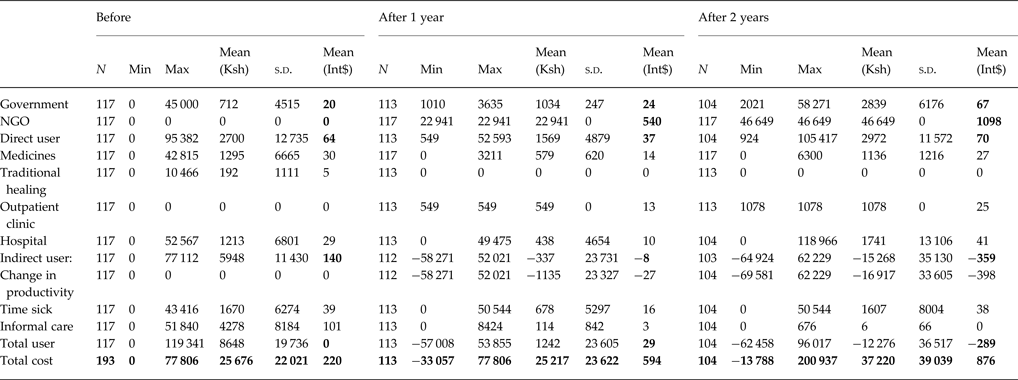
From the societal perspective, MHD cost Int$ 594 in the first year, as opposed to Int$ 220 for usual care (as measured by baseline costs). At 2 years, the intervention cost Int$ 876 v. Int$ 440 for usual care (Table 1). The difference in year 2 resulted from a return to productive work. Before the intervention, 92% of costs were borne by the service user, whereas after 2 years, users made savings of Int$ 289 (Fig. 1). Most (87% in the first year) direct costs were born by the NGO. Government costs doubled during the intervention, as coverage increased; however, they remained modest throughout at only 4–5% of total.
Who bears the costs before and after the Mental Health and Development (MHD) model. NGO, Non-governmental organization.

Costs before and after the Mental Health and Development model for people with severe mental disorders

Ksh, Kenyan shilling; NGO, non-governmental organization.
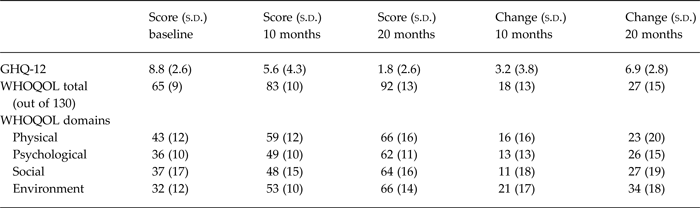
The change in WHOQOL was 18 points (13.8%) out of 130 in 10 months and 27 points (20.7%) over 20 months. Mean change across WHOQOL domains was 15.3% in 10 months and 27.5% in 20 months. Greatest change was in the environmental domain (plus 21% at 10 months and 34% at 20 months); smallest change was in the physical domain. The environmental domain covers seven questions relating to health services, physical environment, money, living conditions, transportation, access to information, and leisure.
There was high correlation between WHOQOL and GHQ-12 scores at 10 months (r 103 = −0.723, p < 0.001) and 20 months (r 95 = −0.625, p < 0.001), but less so at baseline (r 110 = −0.197, p = 0.04). Despite low baseline correlation, the change in scores remained reasonably correlated at 10 months (r 104 = −0.568, p < 0.001) and 20 months (r 94 = −0.334, p < 0.001), supporting the validity of the GHQ-12 as a measure of quality of life in this population.
Mean GHQ decreased from 8.8 (s.d. = 2.7) to 5.6 (s.d. = 4.3) and 1.8 (s.d. = 2.6) at 10 and 20 months, respectively (Table 2). Mean annualized scores were 4.6 (s.d. = 3.7) and 1.2 (s.d. = 2.5) at 1 and 2 years, respectively. Mean change in annualized GHQ was a decrease of 4.2 points (s.d. = 3.3) in the first year and 8.3 (s.d. = 3.2) over 2 years.
Mental Health and Development outcomes for schizophrenia-spectrum and bipolar disorders at 10 and 20 months

GHQ, General Health Questionnaire; WHOQOL, WHO Quality of Life questionnaire.
Mean healthy days gained in the first year of MHD was 55 (s.d. = 88), and 456 (s.d. = 202) over 2 years. Estimates for usual care were 8 healthy days (s.d. = 48) in the first year and 33 (s.d. = 128) over 2 years.
The change in DALYs between baseline and follow-up was positive in the first year but negative in the second year (0.002 and −0.173 DALYs, respectively) for those in the MHD group. This means that the health of the group as a whole deteriorated over time, despite the intervention, because of deaths. In the comparison group, health deteriorated more over 2 years, as reflected by a greater negative change in DALYs (−1.052 in the first year and −2.250 in 2 years).
Six people died during the course of study, whereas the expected mortality over 2 years of a Kenyan population with the same age, sex and disease profile was 14. One death occurred in the first 10 months and the remainder occurred thereafter. Causality was established for two cases as asthma and aggravated assault.
Six subjects (5.1%) were lost to follow-up, because they had moved (n = 4), or their whereabouts were unknown (n = 2). Those who moved did so for work (n = 2) or to marry (n = 1). There was no statistical difference in any variables studied between those lost and those retained.
Cost-effectiveness
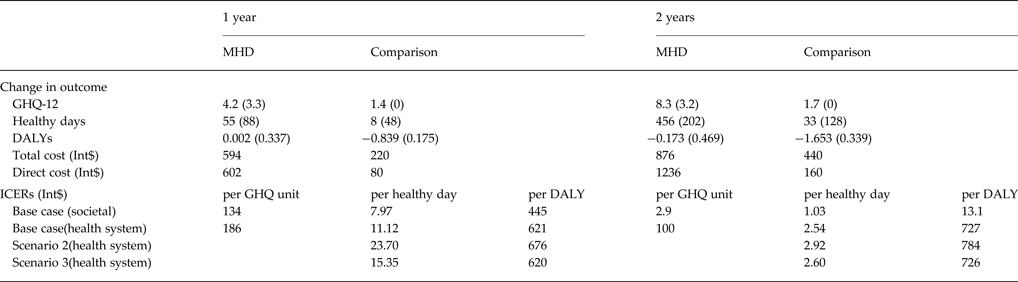
From the societal perspective, the incremental cost of MHD was Int$ 445 per DALY averted in the first year, and Int$ 13.1 over 2 years (Table 3). The health system ICER was Int$ 621 per DALY averted in the first year and Int$ 727 over 2 years. The conventional threshold for cost-effectiveness acceptability in low-income settings is per capita GDP/DALY averted (Chisholm, Reference Chisholm2005) – Int$ 1920 in Kenya in 2009 – making MHD cost-effective at 1 and 2 years, from both the societal and health system perspectives.
Summary of costs, effects and ICERs at 1 and 2 years in MHD and comparison

ICER, Incremental cost-effectiveness ratio; MHD, Mental Health and Development; GHQ, General Health Questionnaire; DALY, disability-adjusted life year.
Average cost per incremental healthy day from the societal perspective was Int$ 7.96 in the first year and decreased to Int$ 1.03 over 2 years. From the health system perspective, a healthy day cost Int$ 11.11 in the first year, and dropped to Int$ 2.54 over 2 years.
We tested sensitivity relative to: (1) comparison outcomes; (2) government costs; and (3) GHQ cut-off. Scenario 2 (the worst-case scenario) reanalysed Ethiopian comparison data according to a person-month analysis (Alem et al. Reference Alem, Kebede, Fekadu, Shibre, Fekadu, Beyero, Medhin, Negash and Kullgren2009). We multiplied the proportion in remission by percentage time in remission and applied that to days in a year, arriving at an estimate of 93 healthy days/year. In addition, cost estimates for government outpatient clinics were tripled to account for potentially longer time spent with clinicians in mental health consults than in general health. Scenario 3 adjusted the GHQ cut-off, coding anything >2 as sick, whereas previously values between 2 and 3 were healthy.
Scenarios 2 and 3 proved sensitive for healthy days in the first year, but not over 2 years. DALY results were relatively insensitive to both scenarios, as those outcomes appear driven by differences in mortality, rather than remission.
In scenario 2, MHD cost Int$ 23.70 in the first year (Table 3), but decreased to Int$ 2.92 over 2 years. The DALY ICER in the first year was Int$676, and over 2 years Int$784. The increased DALY in 2 years is driven by mortality, which is not accounted for in the same way in the healthy day outcomes.
In scenario 3, healthy days among people in MHD dropped in the first year to 25 days, and over 2 years to 404 days. Comparison outcomes fell to 1 healthy day in the first year and 7 days over 2 years. The resulting ICERs per healthy day were Int$ 15.35 in the first year and Int$ 2.60 in 2 years, while ICERs/DALY were Int$ 620 in the first year and Int$ 726 over 2 years.
Conclusions
Our findings suggest that the model for MHD achieves increasing returns over time. Positive outcomes are driven by a reduction in both morbidity and mortality.
MHD appears cost-effective from both societal and health systems perspectives. Over 2 years, the cost was approximately a dollar per healthy day (Int$ 1.03) from the societal perspective and Int$ 2.54 from the health systems perspective – less than the daily farming wage (Int$ 4.2). The incremental cost per DALY averted (year of healthy life) over 2 years was Int$ 13.1 from the societal perspective and Int$ 727 from the health systems perspective.
MHD seems to be reaching the lowest socioeconomic groups. According to census data, on average 14.7% of Central Kenyans have less than primary education, whereas twice as many (32%) had less than primary education in our sample. In addition, economic benefits to service users were substantial: before the intervention, users paid Int$ 53 in direct costs and bore Int$ 150 in indirect costs, whereas after 2 years, the average user made savings of Int$ 289, largely from return to productivity.
Despite MHD being cost-effective and equitable, the question remains whether it is affordable. MHD direct costs are borne principally (over 80%) by the NGO BasicNeeds, who were financed on this project by UK and European governments. Without this external funding, the direct costs of Int $540 per year paid by the NGO would be prohibitive to the Kenyan government. To contextualize, the government spend Int$ 15.4 per capita on health across the whole population, although the amount per capita on people with severe mental disorders is unknown. The long-term sustainability of the MHD intervention relies on continued external funding streams. Further research is necessary to determine whether the programme could be sustained if the NGO were to exit the setting, although the existing data suggest that the intervention is not self-funding. This is a familiar economic barrier in low-income country contexts (McDaid et al. 2008).
The principal limitation of this study is the absence of a control group. Although we were able to make use of another rural East African sample of people with severe mental illness, the Ethiopian sample consisted almost entirely of men and did not contain cases with bipolar disorder. A meta-analysis of studies from mostly high-income countries suggests that men with schizophrenia have almost equal recovery rates to women, with about one in seven people recovering over time (Jääskeläinen et al. Reference Jääskeläinen, Juola, Hirvonen, McGrath, Saha, Isohanni, Veijola and Miettunen2012). A literature review from low- to middle-income countries, however, suggests that there are sex differences in clinical and functional outcomes with psychotic women having poorer prognoses than their male counterparts, because of greater stigma, coercion and victimization, contributing to less help-seeking (Chandra et al. Reference Chandra, Kommu and Rudhran2012). If this is the case, then comparison outcomes from a mostly male sample would overestimate recovery, making our estimates of MHD outcomes conservative. Nonetheless, the Ethiopian context shares many similarities with that of Kenya, including long delays between onset of illness and access to treatment (Bekele et al. Reference Bekele, Flisher, Alem and Baheretebeb2009).
A further limitation of the study is the use of the GHQ as a measure of outcome. The GHQ is designed as a non-specific measure of distress, rather than a measure of psychosis or of disability. It is therefore a limited measure of disability in the narrower sense of this term, in that persons with disability can often be asymptomatic. It is best understood in this context as a measure of emotional distress (Ogundipe et al. Reference Ogundipe, Olagunju and Adeyemi2014) or a proxy for quality of life (Mosaku et al. Reference Mosaku, Fatoye, Komolafe, Lawal and Ola2006), as it has been used in other African studies. Future research of this kind could employ the WHODAS 2.0 (WHO, 2010), which focuses specifically on disability and has been used to generate utility scores for quality-adjusted life years.
In addition, we did not collect information on the duration of illness or any other measure of the stage of illness, so it was not possible to study the differences in treatment response of those with first episode v. enduring conditions. Finally, our study did not account for partial remission. This distorts outcomes in the first year, since most improvement took place above the remission threshold. Further research is needed to determine GHQ thresholds for partial remission in Africa. Despite these limitations, this exploratory study provides valuable economic analysis in a context and for a spectrum of illnesses that have not previously been subject to economic evaluation using patient-level data.
From the health system perspective, MHD appears to perform on par with HIV treatments. Highly active anti-retroviral therapy (HAART) combined with directly observed treatment, short-course (DOTS) for TB in Africa costs Int$ 596 to Int$ 1977, v. Int$ 727 to Int$ 784 (best and worst scenarios) for MHD. Furthermore, our data suggest that MHD outperforms WHO CHOICE models for bipolar disorder (Int$ 2165/DALY) (Chisholm et al. Reference Chisholm, Van Ommeren, Ayuso-Mateos and Saxena2005), and schizophrenia (Int$ 1670/DALY) (Chisholm et al. Reference Chisholm, Gureje, Saldivia, Villalón Calderón, Wickremasinghe, Mendis, Ayuso-Mateos and Saxena2008).
Internationally, MHD sits within the context of several models addressing the needs of people with mental illness, in particular, Community Based Rehabilitation (CBR; Helander, Reference Helander1993), a flagship approach for managing disability. There is considerable overlap between the five branches of CBR (health, education, livelihood, social domain, empowerment) and the MHD model, although they have different origins and objectives. What distinguishes the MHD model is the strong emphasis on economic empowerment and mobilizing local communities to bring its participants into the mainstream, originating from the field of development rather than rehabilitation.
The signature elements of MHD are the centrality of user-led advocacy, the equal emphasis on non-medical aspects of recovery (especially livelihoods), and partnership with local governments. MHD offers specialized mental health and social care in a community setting, addressing a major gap in treatment for a vulnerable population. This study suggests that MHD is cost-effective and equitable. However, its affordability relies on external funding. Nationally, the model's sustainability requires multi-sectoral participation from government, civil society and local communities – taking the clinic into the community and the community into the clinic.
Acknowledgements
The intervention was funded by the European Commission's Non-State Actor funding stream (DCI-NSAPVD/2008/156-918) and the UK Department for International Development's Civil Society Challenge Fund (CSCF 450). The authors particularly thank Erica Breuer for her contributions to cleaning the data and Annette Bauer for her insights into interpretations of productivity.
Declaration of Interest
Shoba Raja, Joyce Kingori, Milka Waruguru and Saju Mannarath are employees of BasicNeeds.