Depression is one of the most common psychological problems reported during pregnancy and the postpartum period (Lee & Chung, Reference Lee and Chung2007). The reported prevalence varies from 15% to 29.2%, in the prenatal period (e.g., Flynn, Reference Flynn2005; Goodman & Tyer-Viola, Reference Goodman and Tyer-Viola2010; Sidebottom, Hellerstedt, Harrison, & Hennrikus, Reference Sidebottom, Hellerstedt, Harrison and Hennrikus2014; Teixeira, Figueiredo, Conde, Pacheco, & Costa, Reference Teixeira, Figueiredo, Conde, Pacheco and Costa2009) and from 4.6% to 16.5% in the postnatal period (e.g., Andersson, Sundström-Poromaa, Wulff, Åström, & Bixo, Reference Andersson, Sundström-Poromaa, Wulff, Åström and Bixo2006; Felice, Saliba, Grech, & Cox, Reference Felice, Saliba, Grech and Cox2004; Segre, O’Hara, Arndt, & Stuart, Reference Segre, O’Hara, Arndt and Stuart2007). Despite several moments of assessment were used in the different studies, there is a general consent that the prevalence of depressive symptoms is higher in the prenatal period compared to the postnatal period (Andersson, et al., Reference Andersson, Sundström-Poromaa, Wulff, Åström and Bixo2006; Canário & Figueiredo, Reference Canário and Figueiredo2017; Faisal-Cury & Menezes, Reference Faisal-Cury and Menezes2012; Figueiredo & Conde, Reference Figueiredo and Conde2011; Goodman & Tyer-Viola, Reference Goodman and Tyer-Viola2010; Sidebottom, et al., Reference Sidebottom, Hellerstedt, Harrison and Hennrikus2014; Underwood, Waldie, D’Souza, Peterson, & Morton, Reference Underwood, Waldie, D’Souza, Peterson and Morton2016).
A relevant question to consider when depressive symptoms are addressed during the perinatal period is whether or not there is continuity in symptomatology from the prenatal to the postnatal period. Some studies show that women with clinically significant depressive symptoms after childbirth were already depressed during pregnancy (e.g., Heron et al., Reference Heron, O’Connor, Evans, Golding and Glover2004; Robertson, Grace, Wallington, & Stewart, Reference Robertson, Grace, Wallington and Stewart2004; Sidebottom et al., Reference Sidebottom, Hellerstedt, Harrison and Hennrikus2014; Underwood et al. Reference Underwood, Waldie, D’Souza, Peterson and Morton2016). In fact, consistent results suggest that depressive symptoms during pregnancy are the most consistent predictor of postpartum depressive symptoms (Heron, et al., Reference Heron, O’Connor, Evans, Golding and Glover2004; Kim, Hur, Kim, Oh, & Shin, Reference Kim, Hur, Kim, Oh and Shin2008; Robertson, et al., Reference Robertson, Grace, Wallington and Stewart2004) compared to other factors such as obstetric factors (Johnstone, Boyce, Hickey, Morris-Yates, & Harris Reference Johnstone, Boyce, Hickey, Morris-Yates and Harris2001; Nielsen, Videbech, Hedegaard, Dalby, & Secher, Reference Nielsen, Videbech, Hedegaard, Dalby and Secher2000). Nonetheless, perinatal outcomes, such as high number of visits to the antenatal care clinic, premature contraction, hyperemesis, episiotomy, caesarean wounds, breast pain (Josefsson, et al., Reference Josefsson, Angelsiöö, Berg, Ekström, Gunnervik, Nordin and Sydsjö2002), gestational hypertension and/or eclampsia and breastfeeding difficulties (Koutra et al., Reference Koutra, Vassilaki, Georgiou, Koutis, Bitsios, Kogevinas and Chatzi2016), also seem to be related to depressive symptoms in the postpartum period. On the other hand, evidence additionally support the association between prenatal depressive symptoms and negative perinatal outcomes, namely prematurity (Liou, Wang, & Cheng, Reference Liou, Wang and Cheng2016) and low birth weight (Alder, Fink, Bitzer, Hösli, & Holzgreve, Reference Alder, Fink, Bitzer, Hösli and Holzgreve2007).
Given this evidence on the association of prenatal depressive symptoms and perinatal health, as well as on the association of perinatal health and postnatal depressive symptoms, an important issue to explore is the potential mediation effect of the perinatal health on the association between perinatal depressive symptoms and postnatal depressive symptoms.
Considering the negative impact of both low-levels and clinically significant postpartum depression symptoms for child development (Conners-Burrow et al., Reference Conners-Burrow, McKelvey, Perry, Whiteside-Mansell, Kraleti, Mesman and Kyzer2016), it is important to clarify its determinants. In this study, we intend to analyze the association between prenatal depressive symptoms and postpartum depressive symptoms, exploring the mediation effect of perinatal health.
Method
Sample
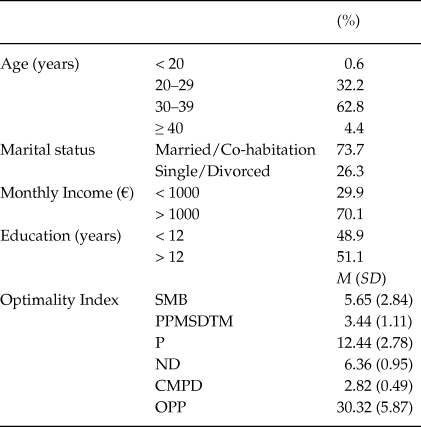
The sample included 180 pregnant women. Most participants were aged between 30 and 39 years old, were married or in a non-marital partnership, had monthly incomes higher than 1000€ and more than 12 years of education (see Table 1). Considering obstetric outcomes, 25.3% of women referred the occurrence of previous abortion, most of them were primiparous (62.8%), had a natural conception (96.7%) and a vaginal delivery with epidural (42%). The high majority of pregnant women did not signalize substances consumption (7.8% of the participants smoked, but no cases of alcohol or drug consumption were referred).
Mother’s Socio Demographics (N = 180)

Note: SMB = Social and medical background; PPMSDTM = Present pregnancy, maternal status, diagnostic and therapeutic measures; P = Parturition; NC = Neonatal condition; CMPD = Condition of the mother prior to discharge from birth facility or from provider care; OPPP = Total score of Optimality Index.
Measures
Socio-demographic questionnaire
Participants completed a self-report questionnaire composed by 43 items, developed for this study in order to collect information about age, race, nationality, marital status, professional status, education, number of children and medical and obstetric history. Information related to the consumption of substances, such as drugs and tobacco, were also collected.
Edinburgh Postnatal Depression Scale (EPDS) (Cox, Holden, & Sagovsky, Reference Cox, Holden and Sagovsky1987)
EPDS is a self-report questionnaire that consists of 10 items scored in a 0 to 3 Lickert Scale, designed to measure postpartum depression (intensity of depressive symptoms in the previous 7 days). In order to determine the prevalence of depression during the perinatal period, optimal cut-off points were established for pregnancy (≥ 9) and the postpartum period (≥ 7) (Tendais, Costa, Conde, & Figueiredo, Reference Tendais, Costa, Conde and Figueiredo2014). In the present study EPDS showed good internal consistency (α= .782 at pregnancy and α= .779 after childbirth). It has been used in several studies both with pregnant and postpartum women, namely in Portugal (Areias, Kumar, Barros, & Figueiredo, Reference Areias, Kumar, Barros and Figueiredo1996; Figueiredo & Conde, Reference Figueiredo and Conde2011; Figueiredo, Pacheco, & Costa, Reference Figueiredo, Pacheco and Costa2007; Teixeira et al., Reference Teixeira, Figueiredo, Conde, Pacheco and Costa2009; Gorman et al., 2004). The EPDS Portuguese version has shown good internal consistency (α = .85) (Figueiredo et al., Reference Figueiredo, Pacheco and Costa2007).
Optimality Index (Murphy & Fullerton, Reference Murphy and Fullerton2006)
The Optimality Index is a clinimetric instrument that provides information about five different perinatal domains computed through the sum of all the occurrences in each item: (1) The social and medical background (SMB: Marital status; ethnic minority; smoking; alcohol; drug use; pre-pregnancy body mass index; age; preexisting major chronic disease; inter-pregnancy interval between index pregnancy and previous viable birth; previous preterm delivery; previous intrauterine fetal death; previous caesarean section; previous < 5 ½ pounds at birth; other serious antepartum complications). (2) The present pregnancy, maternal status, diagnostic and therapeutic measures used (PPMSDTM: Intrauterine fetal demise; domestic violence; other serious antepartum conditions/complications; prenatal care: initiation in first trimester and minimum 5 visits; amniocentesis; nonstress test / contraction stress; medication use). (3) Parturition (P: Period of time between first digital examination following rupture of membranes and birth; amniotic fluid; induction/augmentation of labor; amniotomy; oral or injectable medication during first or second stage of labor; epidural analgesia for labor and/or birth; fetoscope; fetal heart rate abnormalities; presence of a support person during labor; non-directed pushing; delivery occurred in the place originally intended; nonsupine position at birth; presentation at birth; instrumental (vaginal) delivery; cesarean section; episiotomy; 1st or 2nd degree laceration of perineum or perineal tissue; 3rd or 4th degree extension of either and episiotomy or a 1st or 2nd degree laceration; medication during third stage of labor; skin-to-skin contact; placental retention; postpartum hemorrhage; blood transfusion; other intrapartum complications). (4) Neonatal condition (NC: Estimate of gestational age; birth weight; Apgar score at 5 minutes; transfer to high risk neonatal care setting; congenital anomalies; birth trauma or other serious medical problem; breastfeeding; perinatal death). And (5) Condition of the mother prior to discharge from birth facility or from providers care (CMPD: Fever while mother remains in the birth setting or provider diagnosis of infectious process or major complications; prescription medication for conditions newly identified in intrapartum or postpartum period; maternal mortality). The instrument provides an optimality measure in the perinatal care, so the best condition with the minimum interventions is intended, regarding the mother and the child. The concept of optimality is defined as the absence of perinatal problems and the need of apply corrective interventions. When an intervention is used, the score is considered non optimal, even if it is necessary to intervene in a specific complication. The Portuguese version resulted from a two-step translation process (translation and retroversion to Portuguese language) of the original instrument, made by the Portuguese research team.
Procedures
This longitudinal study is part of a wider project, “Contributions of Parent-Infant Psychophysiology during Dyadic Interactions to Child Development”, financed by BIAL foundation (157/12) involving 387 couples. Despite the initial sample of the project involved 387 couples, the fathers were not included in the present study and only the 180 mothers who completed all the assessments were included in the analyses. This study was evaluated and approved by the National Committee for Data Protection and by the ethics committee of the hospital.
The recruitment of the pregnant women was implemented in the main city hospital and in 13 primary care units. All mothers-to-be were contacted during a routine medical appointment at 35 weeks of gestation. Exclusion criteria were not being able to read and write in Portuguese and having fetus with congenital problems. The objectives of the study were clearly explained to eligible participants, and information regarding the study methods and procedures was provided. After the informed consent was signed, the first data collection was initiated. In the first assessment moment (35 weeks of gestation), sociodemographic and clinical data, as well as information about the use of substances (alcohol, drugs and tobacco) was collected. The Portuguese version of EPDS was also filled in at this time point in order to assess prenatal depressive symptoms. The perinatal health data were collected from medical reports during the first four days after childbirth, using the Optimality Index. Repeated measures of mothers’ depressive symptoms were obtained 2-months after childbirth using the Portuguese version of EPDS.
Data analysis
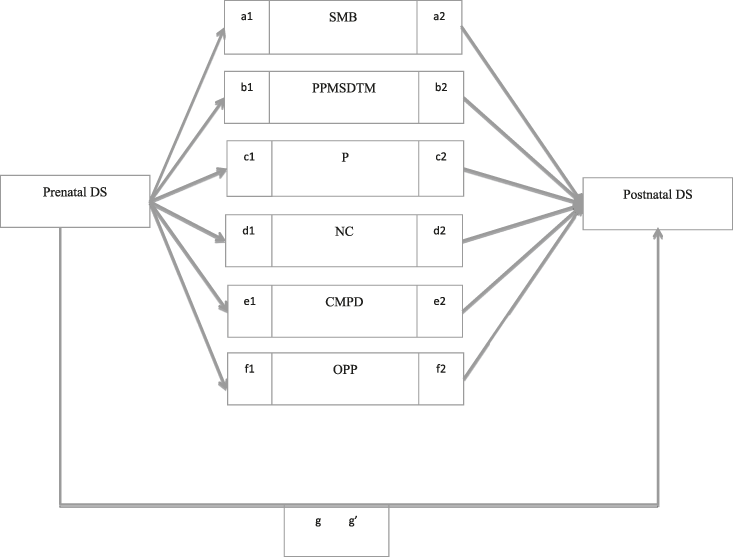
Data were analyzed using the Statistical Package for the Social Sciences (SPSS), version 20.0. Descriptive statistics were used for the sociodemographic characterization of the sample and for determining the proportion of women with clinically significant depressive symptoms during pregnancy and postpartum. Paired sample t-test was conducted to analyze differences on depressive symptoms between pregnancy and postpartum. Several separate linear regression analyses were performed to analyze the association between prenatal depressive symptoms on postpartum depressive symptoms, exploring the potential mediation effect of perinatal health. Following the premises of the Baron and Kenny (Reference Baron and Kenny1986) mediation model, four conditions were tested: (1) Variation on prenatal depressive symptoms account for variations in postnatal depressive symptoms (Path g, Figure 1); (2) variation on prenatal depressive symptoms account for variations in perinatal health (Path a1, b1, c1, d1, e1, f1, Figure 1); (3) variation in the perinatal health account for variations in postnatal depressive symptoms (Path a2, b2, c2, d2, e2, f2, Figure 1); and (4) a previously significant relation between prenatal depressive symptoms and postnatal depressive symptoms is significantly reduced or no longer significant when the perinatal health is added to the model (Path g’, Figure 1). If path g is reduced to zero, then prenatal depressive symptoms can be considered a single mediator, whereas if path g is not reduced to zero multiple mediating factors may exist (Baron & Kenny, Reference Baron and Kenny1986).
Mediation Model.
SMB = Social and medical background; PPMSDTM = Present pregnancy, maternal status, diagnostic and therapeutic measures; P = Parturition; NC = Neonatal condition; CMPD = Condition of the mother prior to discharge from birth facility or from provider care; OPPP = Total score of Optimality Index.

Results
Depressive symptoms at pregnancy and postpartum
Self-reported measures implemented during pregnancy showed similar levels of depressive symptoms at pregnancy (M = 6.07; SD = 4.17; Min = 0; Max. = 19) and postpartum (M = 5.93; SD = 3.5; Min = 0; Max. = 19) (t = .582, p = .562). Nevertheless, 25.6% of the mothers-to-be presented clinically significant depressive symptoms (EPDS > = 9), and of these, 80.4% still show clinically significant depressive symptoms at 2-months postpartum (EPDS > = 7). An incidence of 33 new cases (18.3%) were observed after childbirth, with a total prevalence of 38.9% (EPDS > = 7).
Test of Mediation Model
Condition 1: Prenatal depressive symptoms as predictor of postpartum depressive symptoms
The linear regression model showed that prenatal depressive symptoms predicted higher postpartum depressive symptoms (R 2 = .441; F = 140.609; p < .001).
Condition 2: Prenatal depressive symptoms as predictor of perinatal health
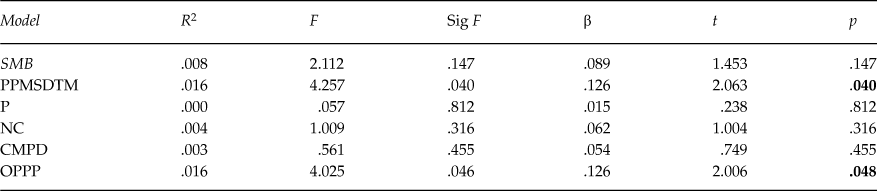
The linear regression model showed that prenatal depressive symptoms predicted two dimensions of the perinatal health: (1) PPMSDTM (R 2 = .016; F = 4.257; p = .040) and (2) OPP (R 2 = .016; F = 4.025; p = .048). (See table 2)
Prenatal Depressive Symptoms as Predictor of Perinatal Health

Note: SMB = Social and medical background; PPMSDTM = Present pregnancy, maternal status, diagnostic and therapeutic measures; P = Parturition; NC = Neonatal condition; CMPD = Condition of the mother prior to discharge from birth facility or from provider care; OPPP = Total score of Optimality Index.
Condition 3: Perinatal health as predictor of postpartum depressive symptoms
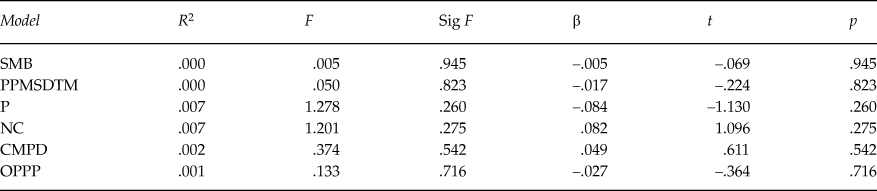
Several linear regression models were performed in order to analyze the potential predictive effect of the different domains of perinatal health, - SMB, PPMSDTM, P, ND, CMPD, OPP - on postpartum depressive symptoms. The results showed that none of the perinatal health domains predicted postpartum depressive symptoms (see Table 3). These analyses excluded perinatal health outcomes as potential mediators of the effect of prenatal depressive symptoms on postpartum depressive symptoms.
Perinatal Health as Predictor of Postpartum Depressive Symptoms

Note: SMB = Social and medical background; PPMSDTM = Present pregnancy, maternal status, diagnostic and therapeutic measures; P = Parturition; NC = Neonatal condition; CMPD = Condition of the mother prior to discharge from birth facility or from provider care; OPPP = Total score of Optimality Index.
Condition 4: Test of mediation effect
Attending to the rejection of the conditions 2 and 3, the condition 4 was not tested because the mediation effect of perinatal health was excluded by the previous conditions.
Discussion
Considering the negative impact of both low-levels and clinically significant postpartum depression symptoms on child development (Conners-Burrow et al., Reference Conners-Burrow, McKelvey, Perry, Whiteside-Mansell, Kraleti, Mesman and Kyzer2016) and, consequently, on the family functioning, it is important to identify the pathways through which different risk factors can lead to depression after childbirth. This study analyzed the association between prenatal depressive symptoms and postpartum depressive symptoms, exploring the mediation effect of perinatal health. The results show that prenatal depressive symptoms predict higher postpartum depressive symptoms. Additionally, show that, although prenatal depressive symptoms predict worse perinatal health outcomes, the association between prenatal depressive symptoms and postnatal depressive symptoms is not mediated by perinatal health.
A relevant question to consider when depressive symptoms are addressed during the perinatal period is whether or not there is continuity from the prenatal and postnatal periods. In this study, the vast majority of women with clinically significant symptoms during pregnancy had still clinically significant symptoms after childbirth which is in accordance with the idea that most cases of postpartum depression are not in fact new cases, but are actually cases of depression during pregnancy that remained untreated after childbirth. This data reinforced data from other studies (Evans, Heron, Francomb, Oke, & Golding, Reference Evans, Heron, Francomb, Oke and Golding2001), showing the importance of early screening and treating depression symptoms even during pregnancy and not only after childbirth, preventing the vulnerability trajectories on women’s mental health during the perinatal period.
Our results also show that the prevalence of prenatal clinically significant depressive symptoms is lower compared to the prevalence of postpartum clinically significant depressive symptoms. This is apparently inconsistent with previous evidence, namely our own previous findings, showing that the prevalence of clinically significant depression symptoms during pregnancy is usually higher than at postpartum (Andersson, et al., Reference Andersson, Sundström-Poromaa, Wulff, Åström and Bixo2006; Felice, et al., Reference Felice, Saliba, Grech and Cox2004; Figueiredo & Conde, Reference Figueiredo and Conde2011; Goodman & Tyer-Viola, Reference Goodman and Tyer-Viola2010; Sidebottom, et al., Reference Sidebottom, Hellerstedt, Harrison and Hennrikus2014; Teixeira et al., Reference Teixeira, Figueiredo, Conde, Pacheco and Costa2009). Nonetheless, this apparent inconsistency may be due to the use of the EPDS cut-offs recently considered to be optimal for establishing clinically significant symptoms during pregnancy (9) and the postpartum period (7), when compared to a gold-standard interview in a Portuguese sample (Tendais at al., 2014). These new EPDS cut-offs are lower in the postpartum compared to those used in other studies, which may explain this disparity. This was the first study in Portugal that has analyzed the EPDS criterion validity against a gold standard in women during pregnancy and postpartum, and our study is, as far as we know, the first using these optimal cut-offs. The studies involving mental health self-report measures should consider evidence based appropriate clinical cut-offs not only for screening but also for research purposes.
The results of this study strength the idea that one of the best predictors of postpartum depressive symptoms is the presence of depressive symptoms during pregnancy (Heron, et al., Reference Heron, O’Connor, Evans, Golding and Glover2004; Kim et al., Reference Kim, Hur, Kim, Oh and Shin2008; Robertson, et al., Reference Robertson, Grace, Wallington and Stewart2004), namely when compared to other factors such as obstetric factors (Johnstone et al., Reference Johnstone, Boyce, Hickey, Morris-Yates and Harris2001; Nielsen et al., Reference Nielsen, Videbech, Hedegaard, Dalby and Secher2000). Thus, screening depression during pregnancy should be an established aim of health facility services for an early intervention on women’s mental health preventing the negative impact of the chronicity of depression during the transition to parenthood on child development and on family environment.
On the other hand, an effect of prenatal depressive symptoms on overall perinatal health outcomes, particularly on perinatal outcomes concerning to the current pregnancy, was also found. This result supports and extends evidence on the association between prenatal depressive symptoms and negative perinatal outcomes, namely prematurity and low birth weight (Alder et al. Reference Alder, Fink, Bitzer, Hösli and Holzgreve2007). Nevertheless, none of the perinatal outcomes (namely social and medical background; present pregnancy, maternal status, diagnostic and therapeutic measures; parturition; neonatal condition; condition of the mother prior to discharge from birth facility or from provider care; global perinatal health) assessed in the present study, were significant predictors of postpartum depressive symptoms. This apparently contradicts results of previous studies showing that perinatal outcomes, such as high number of visits to the antenatal care clinic, premature contraction, hyperemesis, episiotomy, caesarean wounds, breast pain (Josefsson, et al., Reference Josefsson, Angelsiöö, Berg, Ekström, Gunnervik, Nordin and Sydsjö2002) as well as gestational hypertension and/or eclampsia and breastfeeding difficulties (Koutra et al., Reference Koutra, Vassilaki, Georgiou, Koutis, Bitsios, Kogevinas and Chatzi2016) are associated with depressive symptoms in the postpartum period. However, these perinatal health outcomes in previous studies were analyzed individually, whereas in this study, these outcomes were combined in specific domains, and analyzed globally as an index of perinatal health outcomes.
The inexistence of a predictor effect of perinatal outcomes on postpartum depressive symptoms implies that the effect of prenatal depressive symptoms on postnatal depressive symptoms is not mediated by perinatal health. This is particularly important to acknowledge, since it suggests that mothers-to-be with depressive symptoms are still at risk for postpartum depressive symptoms, even when perinatal health is not compromised. This was an unexpected result, attending to the fact that previous studies have reported an association between prenatal depressive symptoms and perinatal health (Alder et al., Reference Alder, Fink, Bitzer, Hösli and Holzgreve2007) and between perinatal health and depressive symptoms in the postpartum period (Josefsson, et al., Reference Josefsson, Angelsiöö, Berg, Ekström, Gunnervik, Nordin and Sydsjö2002). Nonetheless, those studies were conducted analyzing prenatal depressive symptoms or postnatal depressive symptoms, but not both. This study is, as far as we know, the first one reporting data from both prenatal depressive symptoms and postnatal depressive symptoms and analyzing several perinatal health outcomes, collected using reliable and extensive medical records, as mediators.
There are some limitations to point out, namely the fact that the final sample was composed of 180 mothers (out of the 387 initial mothers) that have completed all the assessment moments, and these might eventually be those with lower depressive symptoms, which may constitute a bias. On the other hand, self-reported measures for depressive symptoms were used to collect information, instead of clinical interviews. Nonetheless, when considering clinically significant symptoms for the EPDS, we have used the optimal cut-offs established for the Portuguese sample using a clinical interview. Despite these limitations, this study points out the importance of early screening for depressive symptoms during the prenatal period in order to promote women’s perinatal mental health and diminish the chronicity of depressive symptoms during the transition to parenthood and, consequently the burden for children and families. New health antenatal care policies should include women’s mental health screening as a fundamental target in order to promote, prevent and protect maternal and perinatal health.