Introduction
Despite substantial declines in smoking rates since the 1960s, cigarette smoking remains the leading cause of preventable death in the USA (Adhikari et al. Reference Adhikari, Kahende, Malarcher, Pechacek and Tong2008; Viswanath et al. Reference Viswanath, Herbst, Land, Leischow and Shields2010). From 1965 to 2011, the annual prevalence of smoking decreased more than 50% (Centers for Disease Control and Prevention, 2012); however, the rates of smoking among those with psychiatric and substance use disorders remains elevated at two to four times that of the general U.S. population (Brown et al. Reference Brown, Lewinsohn, Seeley and Wagner1996; Lewinsohn et al. Reference Lewinsohn, Rohde and Brown1999; Upadhyaya et al. Reference Upadhyaya, Deas, Brady and Kruesi2002; Ramsey et al. Reference Ramsey, Brown, Strong, Stuart, Weinstock and Myers2005; Myers & Kelly, Reference Myers and Kelly2006; Tobias et al. Reference Tobias, Templeton and Collings2008; Launiainen et al. Reference Launiainen, Broms, Keskitalo-Vuokko, Pitkäniemi, Pelander, Kaprio and Ojanperä2011). For instance, 45% of adults with an affective disorder diagnosis and 38% with an anxiety disorder diagnosis are cigarette smokers versus 21% of adults without a psychiatric diagnosis (Lawrence et al. Reference Lawrence, Mitrou and Zubrick2009).
It is challenging to separate the role of smoking cessation in mental health functioning (Hughes, Reference Hughes2008). Some research indicates that smoking cessation could result in an increase in depressive (Borrelli et al. Reference Borrelli, Niaura, Keuthen, Goldstein, DePue, Murphy and Abrams1996; Stage et al. Reference Stage, Glassman and Covey1996; Killen et al. Reference Killen, Fortmann, Schatzberg, Hayward and Varady2003; Hughes, Reference Hughes2007) or anxiety (West & Hajek, Reference West and Hajek1997; Becoña et al. Reference Becoña, Vázquez and del Carmen Mı́guez2002) symptoms, which in turn influences smokers' ability or motivation to quit (Shiffman, Reference Shiffman1982; Covey et al. Reference Covey, Glassman and Stetner1990; Hall et al. Reference Hall, Muñoz, Reus and Sees1993; Bock et al. Reference Bock, Goldstein and Marcus1996; Glassman et al. Reference Glassman, Covey, Stetner and Rivelli2001; Burgess et al. Reference Burgess, Brown, Kahler, Niaura, Abrams, Goldstein and Miller2002). Studies vary in their reports on the risk for developing major depressive disorder following smoking cessation, with ranges from 0% to about 30%, with the higher rates reported among smokers with a history of major depressive disorder (Borrelli et al. Reference Borrelli, Niaura, Keuthen, Goldstein, DePue, Murphy and Abrams1996; Covey et al. Reference Covey, Glassman and Stetner1997; Glassman et al. Reference Glassman, Covey, Stetner and Rivelli2001; Killen et al. Reference Killen, Fortmann, Schatzberg, Hayward and Varady2003; Hughes, Reference Hughes2007). On the contrary and irrespective of cessation treatment, additional studies have found that smoking cessation is seldom associated with worsening mental health functioning (Leistikow & Shipley, Reference Leistikow and Shipley1999; Tsoh et al. Reference Tsoh, Humfleet, Munoz, Reus, Hartz and Hall2000; Hall et al. Reference Hall, Tsoh, Prochaska, Eisendrath, Rossi, Redding, Rosen, Meisner, Humfleet and Gorecki2006; Klungsoyr et al. Reference Klungsoyr, Nygard, Sorensen and Sandanger2006; McFall et al. Reference McFall, Atkins, Yoshimoto, Thompson, Kanter, Malte and Saxon2006; Munafò et al. Reference Munafò, Hitsman, Rende, Metcalfe and Niaura2008; Prochaska et al. Reference Prochaska, Hall, Tsoh, Eisendrath, Rossi, Redding, Rosen, Meisner, Humfleet and Gorecki2008; Shahab & West, Reference Shahab and West2009, Reference Shahab and West2012; Hajek et al. Reference Hajek, Taylor and McRobbie2010; Torres et al. Reference Torres, Barrera, Delucchi, Penilla, Pérez-Stable and Muñoz2010; Donald et al. Reference Donald, Chartrand and Bolton2013; Mathew et al. Reference Mathew, Robinson, Norton, Cinciripini, Brown and Blalock2013). For instance, a recent study by Morissette et al. (Reference Morissette, Gulliver, Kamholz, Spiegel, Tiffany and Barlow2012) additionally found that smokers with and without anxiety disorders and/or other psychological disorders responded equally to high-risk smoking triggers during the quit process with respect to smoking urges and anxiety response; these are relevant findings given that most smokers encounter anxiety and other mental health problems. In another promising study, Shahab & West (Reference Shahab and West2012) found that a large majority of former smokers (69% of 879) considered themselves happier after they quit smoking.
Rates of cigarette smoking are even higher among those with substance use disorders, with estimates up to 80% (Kalman et al. Reference Kalman, Morissette and George2005; Lawrence et al. Reference Lawrence, Mitrou and Zubrick2009). Importantly, most people in addiction treatment want to quit smoking (Flach & Diener, Reference Flach and Diener2004) and will accept concurrent smoking cessation treatment (Seidner et al. Reference Seidner, Burling, Gaither and Thomas1996). While a number of studies suggest that cessation of cigarette smoking and other substances enhance clinical outcomes (Sobell & Sobell, Reference Sobell and Sobell1996; Stuyt, Reference Stuyt1997; Kohn et al. Reference Kohn, Tsoh and Weisner2003; Prochaska et al. Reference Prochaska, Delucchi and Hall2004a , Reference Prochaska, Rossi, Redding, Rosen, Tsoh, Humfleet, Eisendrath, Meisner and Hall b ), smokers with co-morbid substance use disorders do report smoking to cope with urges to drink alcohol or use other drugs when trying to abstain (Asher et al. Reference Asher, Martin, Rohsenow, MacKinnon, Traficante and Monti2003; Cooney et al. Reference Cooney, Cooney, Pilkey, Kranzler and Oncken2003; Rohsenow et al. Reference Rohsenow, Colby, Martin and Monti2005; Baca & Yahne, Reference Baca and Yahne2009).
Recent research indicates that smokers will lose a decade of their life but smoking cessation reduces that loss by about 90% if it occurs before the age of 40 years (Pirie et al. Reference Pirie, Peto, Reeves, Green and Beral2013). The psychological outcomes that accompany smoking cessation are not yet conclusive; they could potentially play a role in persuading quitting behaviors if benefits exist. As a result, population-based studies can help to reconcile the inconsistent empirical evidence on this topic by clarifying the mental health outcomes that are associated with smoking reduction and cessation. Our study uses two waves of data from the National Institute on Alcohol Abuse and Alcoholism's (NIAAA) National Epidemiological Study of Alcohol and Related Conditions (NESARC), allowing us to examine the relationship between cigarette smoking reduction and cessation from Wave 1 to Wave 2 and changes in the risk of three disorders that co-occur highly with smoking: mood/anxiety disorders, alcohol use disorders and drug use disorders.
Method
Data source and respondents
The analyses presented in this study utilized data from the NESARC (Grant et al. Reference Grant, Stinson, Dawson, Chou, Ruan and Pickering2004). The NESARC collected data on the prevalence of alcohol and drug use, abuse and dependence as well as associated psychiatric and other medical conditions. Under contract and supervised by the NIAAA, the US Census Bureau conducted face-to-face interviews with a multi-stage probability sample of adults ages 18 years and older that is nationally representative. The NESARC is a longitudinal survey consisting of Wave 1 (n = 430 93 81% response rate), conducted from 2001 to 2002, and a 3-year follow-up interview with 34 653 respondents (Wave 2). The Wave 2 response rate was 86.7%. Of the 8440 Wave 1 respondents who were not included in Wave 2, 3134 were not eligible for a Wave 2 interview because they were institutionalized, mentally/physically impaired, on active duty in the armed forces, deceased or deported. The remaining individuals (n = 5306) were eligible but were not re-interviewed because they refused or could not be reached or located. Wave 2 sampling weights reflect design characteristics of the NESARC and account for non-response as well as sample attrition. The weighted Wave 2 data represent the same baseline population as represented in Wave 1 (Ruan et al. Reference Ruan, Goldstein, Chou, Smith, Saha, Pickering, Dawson, Huang, Stinson and Grant2008; Chen et al. Reference Chen, Yi, Dawson, Stinson and Grant2010). The survey methods, other quality-control procedures and test–retest reliability tests have been documented in detail (Grant et al. Reference Grant, Moore, Shepard and Kaplan2003). Waves 1 and 2 of the NESARC were used for analyses.
Only Wave 1 daily smokers who reported smoking daily within the past year at Wave 1 and were re-interviewed at Wave 2 were included in the analysis (n = 6554). We excluded 1607 respondents who increased their smoking between Wave 1 and Wave 2 (i.e. average number cigarettes smoked per day increased by ⩾10%). A total of 94 respondents with missing data for amount of cigarettes smoked at either Wave 1 or Wave 2 were also excluded, resulting in 4853 respondents for analysis.
A greater percentage of those with missing data, compared with those without missing data, were male (66.2% v. 52.2%, χ 2 = 4.9, p = 0.031), and were aged 30 years or older (87.6% v. 75.8%, χ 2 = 7.1, p = 0.010). We also multiply imputed the number of cigarettes smoked daily at Wave 1 and Wave 2 for those with missing data. Due to a low percentage of respondents that had missing data and because results from multiply imputed data were similar to complete case analysis indicating no evidence of bias, we present here the complete case analysis results.
Dependent variables
All NESARC interviews utilized the NIAAA's Alcohol Use Disorder and Associated Disabilities Interview Schedule – DSM-IV Version (AUDADIS-IV; Grant et al. Reference Grant, Moore, Shepard and Kaplan2003), a structured diagnostic interview with the list of symptom questions that assesses DSM-IV disorders. A number of psychometric studies have documented the reliability and validity of the AUDADIS-IV (Grant et al. Reference Grant, Moore, Shepard and Kaplan2003). All diagnostic variables discussed below exclude symptoms due to drugs, alcohol, or medical condition.
Status at Wave 2: current (past 12 months) mood or anxiety disorders
A total of four Diagnostic and Statistical Manual of Mental Disorders, fourth edition (DSM-IV) mood disorders are assessed in the NESARC: major depression, dysthymia, mania and hypomania. The following anxiety disorders are also assessed according to DSM-IV criteria: panic (with and without agoraphobia), agoraphobia without history of panic disorder, social phobia, specific phobia and generalized anxiety disorder. In order to receive a formal DSM-IV diagnosis, respondents must endorse a requisite number of symptoms pertaining to the DSM-IV criteria for a diagnosis of interest and report the presence of social and/or occupational dysfunction associated with the disorder (Chen et al. Reference Chen, Yi, Falk, Stinson, Dawson and Grant2006). A participant was assigned a mood or anxiety disorder if they met criteria in the 12 months preceding Wave 2 assessment for any of the mood or anxiety disorders.
Status at Wave 2: current (past 12 months) DSM-IV alcohol use disorder
A diagnosis of past 12-month DSM-IV alcohol abuse was given to participants who met at least one of four criteria for alcohol abuse in the year preceding the interview, without meeting criteria for alcohol dependence. A diagnosis of past 12-month DSM-IV alcohol dependence was given to participants who met at least three of seven alcohol dependence criteria in the year preceding the interview.
Status at Wave 2: current (past 12 months) DSM-IV drug use disorder
The DSM-IV drug use disorder diagnoses assessed in the NESARC include the following drug groups: sedatives, tranquilizers, opiates (other than heroin or methadone), amphetamines, cannabis, hallucinogens, cocaine (including crack cocaine), inhalants/solvents, heroin, or other drugs. For a drug-specific abuse diagnosis, at least one of the four abuse criteria is required. To meet a drug-specific dependence diagnosis, at least three of the seven dependence criteria are required (diagnoses for cannabis, hallucinogen, or inhalant dependence do not use the withdrawal criterion) (Chen et al. Reference Chen, Yi, Falk, Stinson, Dawson and Grant2006). A participant was considered to have a diagnosis of DSM-IV drug use disorder if they met the abuse or dependence criteria in the past 12 months for any of 10 drug categories.
Independent variable of interest
The primary independent variable was percentage change in number of cigarettes per day from Wave 1 to Wave 2. All participants included in the analysis were daily smokers at Wave 1. The number of cigarettes they smoked per day at Wave 1 was reported as the usual quantity when they smoked. The average number of cigarettes per day at Wave 2 was calculated using the items assessing the usual frequency when the respondents smoked in the past year (i.e. every day, 5–6 days per week, 3–4 days per week, 1–2 days per week, 2–3 days per month, once per month or less) and the usual quantity when they smoked. The percentage reduction in number of cigarettes per day was calculated as the percentage change in daily smoking from Wave 1 to Wave 2. Percentage change in daily smoking was then categorized as follows: no or minimal (1–9%) change (reference group), 10–49% reduction, 50–99% reduction, and 100% reduction. Those who increased daily smoking by ⩾10% were excluded from analysis.
Statistical analysis
The percentage of daily smokers with the three outcomes of interest within the past 12 months at Wave 2 (mood/anxiety disorder, alcohol use disorder, drug use disorder) was examined by the amount of reduction in daily smoking from Wave 1 to Wave 2. These percentages, unadjusted for other variables, are presented in Figs 1–3. Analyses were stratified by history of the diagnosis of interest at Wave 1. We examined smokers with no lifetime history (ever in lifetime up to the time of the interview) of the specific diagnosis at Wave 1 to study the effect of change in cigarettes per day on incident cases of the diagnosis at Wave 2. We separately analysed smokers with current (within the past year) or lifetime history diagnosis at Wave 1 to study the effect of change in cigarettes per day on recurrent/persistent cases of the diagnosis at Wave 2.
Logistic regression models were used to quantify the association between percentage change in daily cigarette use from Wave 1 to Wave 2 and status of the three separate outcomes of interest at Wave 2 (Table 2). Models were stratified by status of the diagnosis of interest at Wave 1 as described above. We first examined the association in unadjusted bivariate analysis. We then used propensity score methods to adjust for potential confounding. Such methods are used in non-randomized, observational studies to balance ‘treatment’ groups on observed covariates to reduce bias and aid in causal inference (Rosenbaum & Rubin, Reference Rosenbaum and Rubin1983). We have multiple levels of our ‘treatment’ variable [i.e. percentage reduction in smoking between Wave 1 and Wave 2: no or minimal (1–9%) change (reference group), 10–49% reduction, 50–99% reduction, and 100% reduction]. Thus, we used the multiple or ‘generalized’ propensity score as suggested by Imbens (Reference Imbens2000), which is the conditional probability of receiving a particular level of the treatment given the pre-treatment variables. Baseline (Wave 1) variables that were likely to be associated with our outcomes of interest were selected for inclusion in the propensity score model (Brookhart et al. Reference Brookhart, Schneeweiss, Rothman, Glynn, Avorn and Stürmer2006). These included age, sex, race/ethnicity, education, income, marital status, employment status, private insurance, self-perceived health, number of cigarettes smoked daily, history of nicotine dependence, desire to quit smoking, conduct/personality disorder, history of alcohol use disorder, frequency of drinking, heavy drinking (i.e. ⩾5 drinks when drank), ever sought help for drinking, family history of alcoholism, history of drug disorder, frequency of drug use, ever sought help for drug use, family history of drug problems, history of mood/anxiety disorder, norm-based mental health scale (NBS8), how often felt downhearted/depressed, family history of depression, and ever sought help for mood/anxiety disorders. We also included Wave 2 survey weights as a covariate in the propensity score model, as suggested by Zanutto et al. (Reference Zanutto, Lu and Hornik2005). The above baseline variables are similar to those chosen in a propensity score model using the NESARC to examine effects of drinking to self-medicate anxiety symptoms on alcohol dependence outcomes (Crum et al. Reference Crum, La Flair, Storr, Green, Stuart, Alvanzo, Lazareck, Bolton, Robinson, Sareen and Mojtabai2013). Each of the variables chosen was significantly associated with at least one of our diagnosis outcomes of interest. Because we stratified our final analyses by history of the diagnosis of interest at Wave 1, we included interaction terms for each diagnosis of interest at Wave 1 with all other variables in the propensity score models. Due to the difficulty of matching or stratifying across multiple propensity scores (further complicated by stratifying final models by Wave 1 history of diagnoses), we used the regression adjustment method (i.e. covariance adjustment) and followed the steps outlined in Spreeuwenberg et al. (Reference Spreeuwenberg, Bartak, Croon, Hagenaars, Busschbach, Andrea, Twisk and Stijnen2010).
Although our ‘treatment’ variable (levels of smoking reduction) appears ordinal, the proportional odds assumption was not met using ordinal logistic regression. Therefore, we used multinomial logistic regression to estimate the propensity for each level of treatment given our observed variables listed above. There was considerable overlap of the distributions of the multiple propensity scores, as is recommended. We also checked for balance of the covariates among the four treatment groups after adjusting for three of the four propensity scores. Prior to adjusting for propensity scores, 23 of the covariates differed significantly among the smoking reduction groups. After adjusting for the multiple propensity scores (i.e. propensity for 10–49% smoking reduction, propensity for 50–99% reduction, and propensity for 100% smoking reduction), no covariates differed significantly among the smoking reduction groups. To estimate the effect of level of smoking reduction on Wave 2 status of the diagnoses of interest, we used logistic regression to model the likelihood of Wave 2 diagnoses as a function of level of smoking reduction and the three multiple propensity scores. Then we further adjusted for Wave 2 status of the other mood/anxiety and substance use disorders as appropriate. For example, when examining Wave 2 alcohol use disorder as an outcome, we also included the presence of drug use disorder and mood/anxiety disorder at Wave 2 (in past 12 months at Wave 2 or prior to past 12 months) as covariates in the model. Analyses were performed using SAS-callable SUDAAN version 9.0.1 (RTI International, USA), a software program that uses Taylor series linearization to adjust for design effects of complex sample surveys like the NESARC (Shah et al. Reference Shah, Branwell and Bieler2002). Wave 2 stratum, primary sampling units, and weights were applied to the models. Estimates in Table 2 with 95% confidence intervals (CIs) that do not include the null value are significant at α = 0.05.
Results
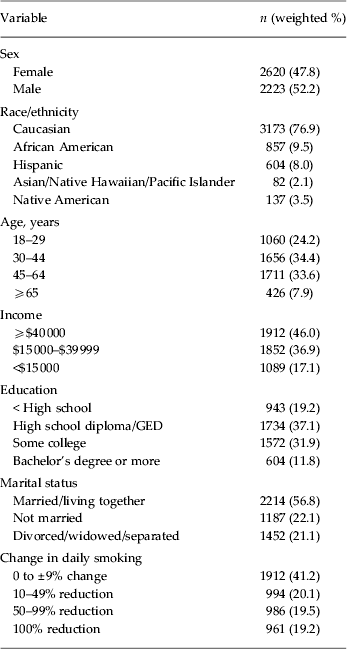
A slight majority of the daily smokers included in the analysis was male (52.2%) and a large majority was Caucasian (76.9%). Additional characteristics are presented in Table 1. The average number of cigarettes per day at Wave 1 was 18.9 (95% CI 18.5–19.3, median = 19.3, interquartile range 9.8–19.8). Of daily smokers, 41% underwent minimal or no change (±9% change) in the number of cigarettes smoked daily from Wave 1 to Wave 2, 20.1% had a 10–49% reduction in the number of cigarettes smoked daily, 19.5% had a 50–99% reduction, and 19.2% quit smoking. The quit rate was much higher for smokers who consumed fewer cigarettes at Wave 1 compared with those who consumed more cigarettes (1–5 cigarettes per day, 48.4%; 6–10 cigarettes per day, 29.0%; 11–20 cigarettes per day, 13.7%; 21–30 cigarettes per day, 13.3%; >30 cigarettes per day, 12.0%; χ 2 = 22.8, p < 0.001).
Demographics of smokers who had smoked daily in the past year at Wave 1 (n = 4853)

GED, General Educational Development.
At Wave 1, 38.8% of daily smokers had history (i.e. current or lifetime history) of mood/anxiety disorder, 50.0% had history of alcohol use disorder, and 24.2% had history of drug use disorder. Among those with history of the disorders at Wave 1, by Wave 2, 40.6% had recurrent/persistent mood/anxiety disorder, 25.1% had recurrent/persistent alcohol use disorder, and 14.8% had recurrent/persistent drug use disorder. Among the groups that did not have current or lifetime history of the diagnosis of interest at Wave 1, 14.3% had new onset of mood/anxiety disorder at Wave 2, 7.0% had new onset of alcohol use disorder at Wave 2 and 2.6% had new onset of drug use disorder at Wave 2.
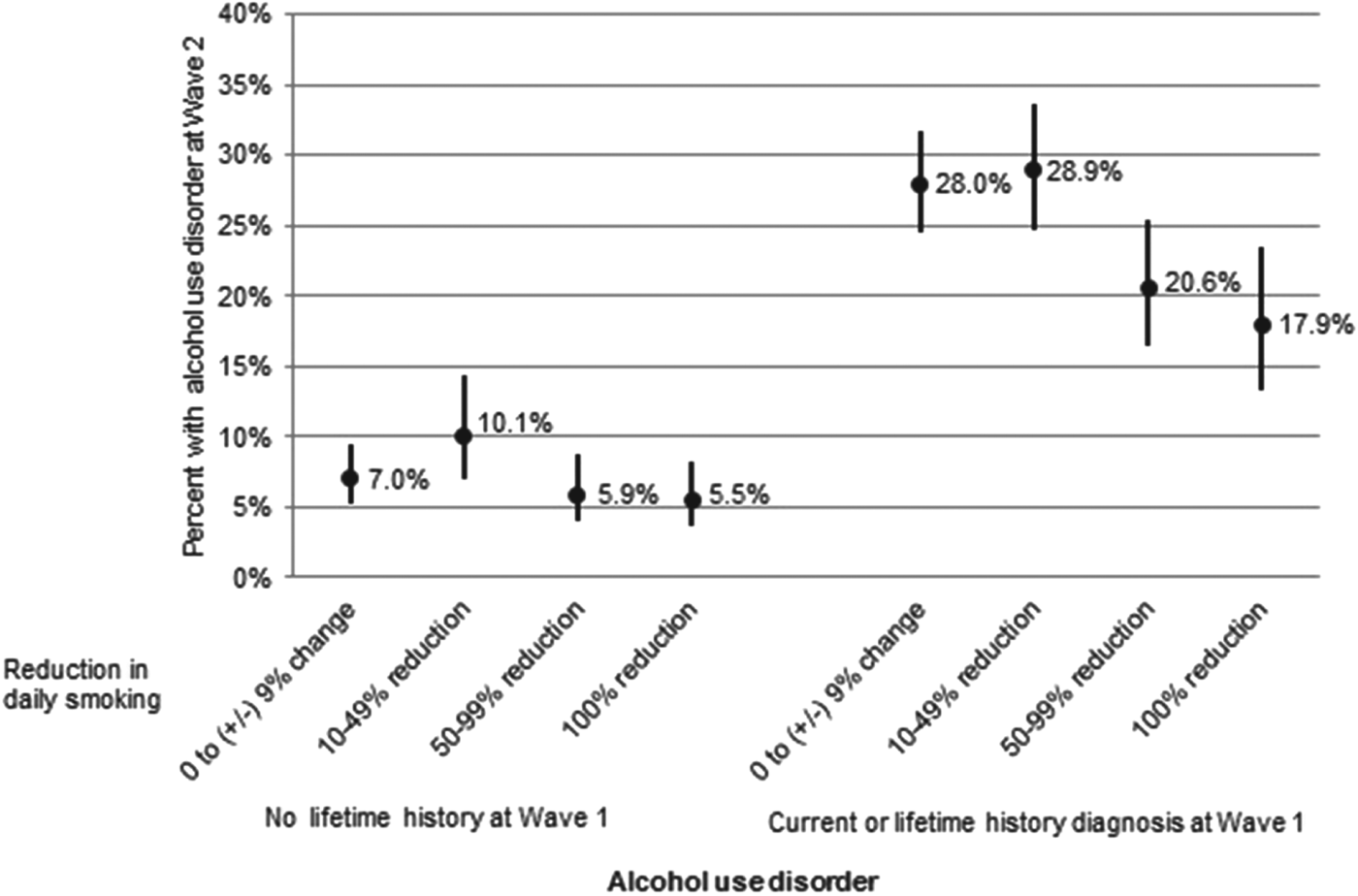
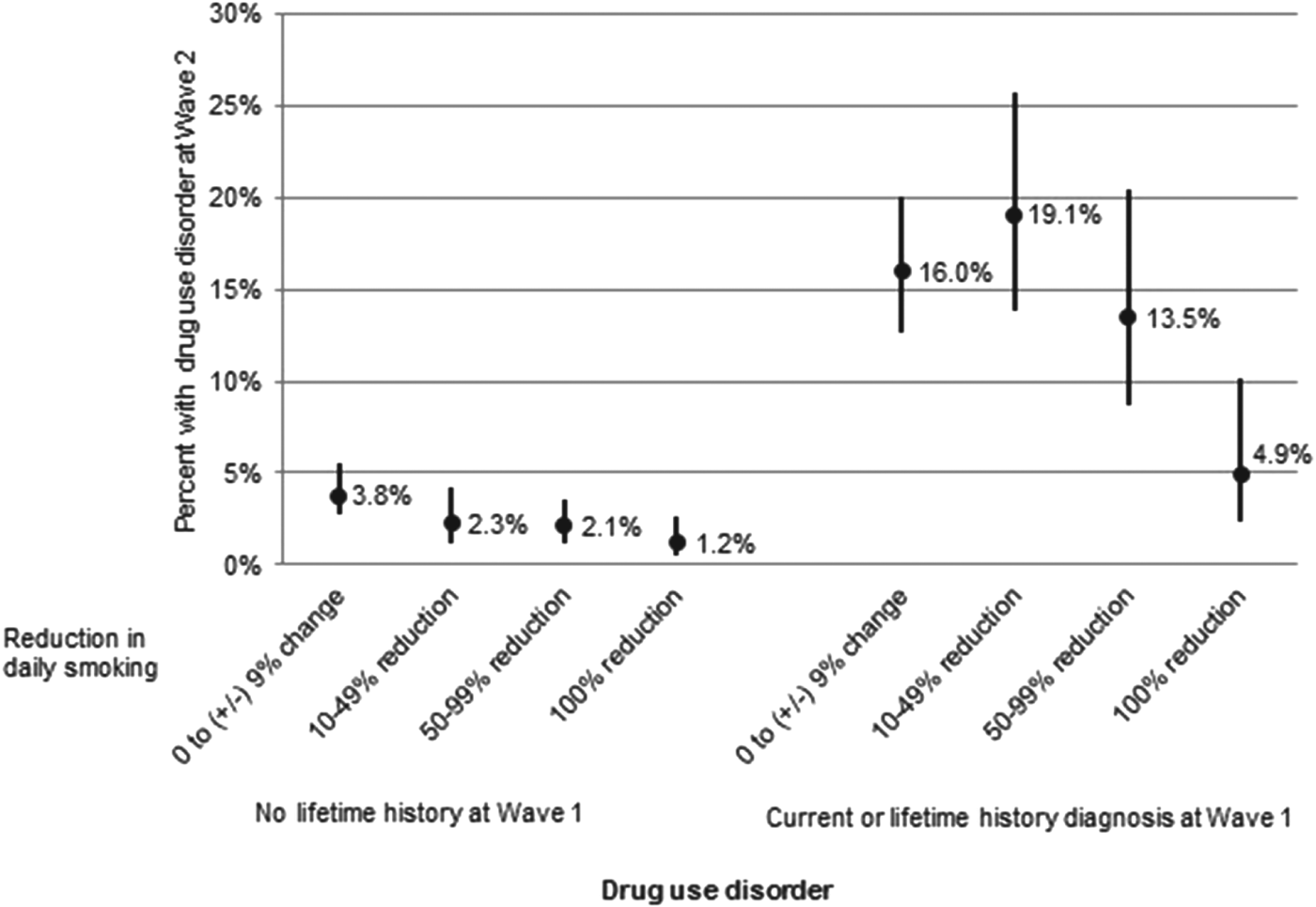
Figs. 1, 2 and 3 show the percentage of respondents with current mood/anxiety disorder, alcohol use disorder and drug use disorder at Wave 2 by change in the number of cigarettes smoked daily from Wave 1 to Wave 2, stratified by status of the diagnosis of interest at Wave 1.
Prevalence of mood/anxiety disorder within the past 12 months at Wave 2, by smoking reduction from Wave 1 to Wave 2, stratified by status of mood/anxiety disorder at Wave 1. Data are given as prevalence estimates (●), with lines representing 95% confidence intervals.

Prevalence of alcohol abuse/dependence within the past 12 months at Wave 2, by smoking reduction from Wave 1 to Wave 2, stratified by status of alcohol use disorder at Wave 1. Data are given as prevalence estimates (●), with lines representing 95% confidence intervals.

Prevalence of drug use disorder within the past 12 months at Wave 2, by smoking reduction from Wave 1 to Wave 2, stratified by status of drug use disorder at Wave 1. Data are given as prevalence estimates (●), with lines representing 95% confidence intervals.

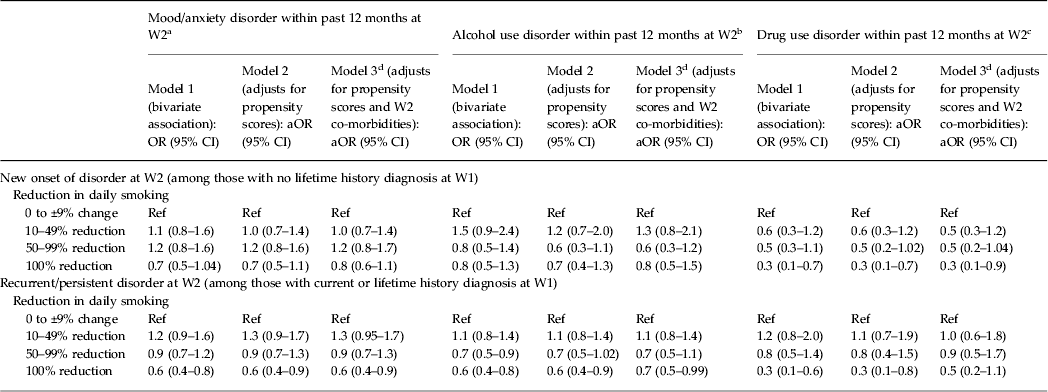
In bivariate logistic regression models (Model 1 in Table 2), among smokers with no lifetime history of the diagnosis of interest at Wave 1, those who quit smoking were much less likely to have new onset of drug use disorder at Wave 2 [odds ratio (OR) 0.3, 95% CI 0.1–0.7). Quitting smoking was not significantly associated with new onset of mood/anxiety disorder or alcohol use disorder at Wave 2. Among smokers with current or lifetime history diagnosis at Wave 1, quitting smoking was associated with a decreased likelihood of recurrent/persistent mood/anxiety disorder (OR 0.6, 95% CI 0.4–0.8), alcohol use disorder (OR 0.6, 95% CI 0.4–0.8) and drug use disorder (OR 0.3, 95% CI 0.1–0.6) at Wave 2. Reducing daily smoking by 50–99% was also associated with a decreased risk of recurrent/persistent alcohol use disorder at Wave 2 (OR 0.7, 95% CI 0.5–0.9).
Associations of smoking reduction with substance use and mood/anxiety disorders at W2

W2, Wave 2; OR, odds ratio; CI, confidence interval; aOR, adjusted odds ratio, W1, Wave 1; Ref, reference.
a Mood/anxiety disorder. No lifetime history at W1: n = 2938 (448 incident cases, 2490 with no diagnosis at W2); current or lifetime history diagnosis at W1: n = 1915 (805 recurrent/persistent cases, 1110 with no diagnosis at W2). When adjusting for propensity scores, sample sizes decreased slightly due to some missing data for included covariates. No lifetime history at W1: n = 2845; current or lifetime history diagnosis at W1: n = 1883.
b Alcohol use disorder. No lifetime history at W1: n = 2554 (183 incident cases, 2371 with no diagnosis at W2); current or lifetime history diagnosis at W1: n = 2299 (572 recurrent/persistent cases, 1727 with no diagnosis at W2). When adjusting for propensity scores, sample sizes decreased slightly due to some missing data for included covariates. No lifetime history at W1: n = 2488; current or lifetime history diagnosis at W1: n = 2240.
c Drug use disorder. No lifetime history at W1: n = 3760 (89 incident cases, 3671 with no diagnosis at W2); current or lifetime history diagnosis at W1: n = 1093 (153 recurrent/persistent cases, 940 with no diagnosis at W2). When adjusting for propensity scores, sample sizes decreased slightly due to some missing data for included covariates. No lifetime history at W1: n = 3662; current or lifetime history diagnosis at W1: n = 1066.
d Model 3 additionally adjusts for other outcome co-morbidities at W2 (e.g. the model predicting presence of alcohol use disorder at W2 adjusts for lifetime history diagnosis or past 12 months drug use disorder and mood/anxiety disorders at W2).
Models adjusting for the multiple propensity scores (i.e. propensity for 10–49%, 50–99%, and 100% smoking reduction) and additionally for Wave 2 co-morbidities are also shown in Table 2 (models 2 and 3, respectively). Among smokers with no lifetime history of the diagnosis of interest, there was no significant association between reducing smoking and new onset of mood/anxiety disorder or new onset of alcohol use disorder at Wave 2. However, quitting smoking was associated with a decreased risk of new onset of drug use disorder at Wave 2 [adjusting for propensity scores: adjusted OR (aOR) 0.3, 95% CI 0.1–0.7; further adjusting for history of alcohol and mood disorders at Wave 2: aOR 0.3, 95% CI 0.1–0.9].
Associations were more numerous between smoking reduction and decreased risk of recurrent/persistent diagnoses at Wave 2, even after adjustment for propensity scores and Wave 2 co-morbidities (models 2 and 3 in Table 2). Among smokers with current or lifetime history of diagnosis of mood/anxiety disorders at Wave 1, quitting smoking was associated with a decreased risk of recurrent/persistent mood/anxiety disorder at Wave 2 (adjusting for propensity scores: aOR 0.6, 95% CI 0.4–0.9; further adjusting for history of alcohol and drug disorders at Wave 2: aOR 0.6, 95% CI 0.4–0.9). Among smokers with current or lifetime history of diagnosis of alcohol use disorder at Wave 1, quitting smoking was associated with a decreased risk of recurrent/persistent alcohol use disorder at Wave 2 (adjusting for propensity scores: aOR 0.6, 95% CI 0.4–0.9; further adjusting for history of alcohol and mood disorders at Wave 2: aOR 0.7, 95% CI 0.5–0.99). Finally, among smokers with current or lifetime history of diagnosis of drug use disorder at Wave 1, quitting smoking was associated with a decreased risk of recurrent/persistent drug use disorder at Wave 2 after adjusting for propensity scores (aOR 0.3, 95% CI 0.1–0.8), but lost significance when additionally adjusting for Wave 2 history of alcohol use disorder and mood/anxiety disorder (but results still trended in the protective direction, aOR 0.5, 95% CI 0.2–1.1).
At Wave 1, among those with either current (within the past 12 months) or lifetime history (prior to past 12 months) diagnosis, 64.7% had a current diagnosis for mood/anxiety disorder, 33.7% had a current diagnosis for alcohol use disorder, and 23.0% had a current diagnosis for drug use disorder. To examine if there were similar associations between smoking cessation and persistent versus recurrent cases at Wave 2, we further stratified the final models by those with current diagnosis at Wave 1 (to examine persistent cases at Wave 2) versus those with lifetime history at Wave 1 (to examine recurrent cases at Wave 2). Results showed that the protective effects of smoking cessation on Wave 2 status of diagnosis appeared slightly stronger for persistent cases than recurrent cases of mood/anxiety disorder (aOR 0.5, 95% CI 0.3–0.8 and aOR 0.9, 95% CI 0.5–1.8, respectively) and alcohol use disorder (aOR 0.5, 95% CI 0.3–0.96 and aOR 0.8, 95% CI 0.4–1.4, respectively). However, CIs were wide and still overlapping between the two groups. The effects of cessation appeared similar for persistent and recurrent cases of drug disorder at Wave 2 (aOR 0.4, 95% CI 0.1–1.9 and aOR 0.4, 95% CI 0.1–1.4, respectively). It should be noted that stratifying models by current or lifetime diagnosis further decreased sample size and thus the power to find statistically significant effects. Results are not presented for smoking reduction categories because these findings were not statistically significant.
Discussion
We examined the effect of reducing or quitting smoking following a 3-year interval on the development of mood/anxiety. We found that among smokers with a prior history of a mood or anxiety disorder, smoking cessation is associated with a lower likelihood of recurrence/persistence of mood and anxiety disorders. If we interpret the smoking–mood/anxiety co-morbidity as smokers ‘treating’ their mood and anxiety disorder by smoking, our results support existing studies that found smokers are not at increased risk of mental health problems when they quit smoking (Leistikow & Shipley, Reference Leistikow and Shipley1999; Tsoh et al. Reference Tsoh, Humfleet, Munoz, Reus, Hartz and Hall2000; Hall et al. Reference Hall, Tsoh, Prochaska, Eisendrath, Rossi, Redding, Rosen, Meisner, Humfleet and Gorecki2006; Klungsoyr et al. Reference Klungsoyr, Nygard, Sorensen and Sandanger2006; McFall et al. Reference McFall, Atkins, Yoshimoto, Thompson, Kanter, Malte and Saxon2006; Munafò et al. Reference Munafò, Hitsman, Rende, Metcalfe and Niaura2008; Prochaska et al. Reference Prochaska, Hall, Tsoh, Eisendrath, Rossi, Redding, Rosen, Meisner, Humfleet and Gorecki2008; Shahab & West, Reference Shahab and West2009, Reference Shahab and West2012; Hajek et al. Reference Hajek, Taylor and McRobbie2010; Torres et al. Reference Torres, Barrera, Delucchi, Penilla, Pérez-Stable and Muñoz2010; Morissette et al. Reference Morissette, Gulliver, Kamholz, Spiegel, Tiffany and Barlow2012; Donald et al. Reference Donald, Chartrand and Bolton2013; Mathew et al. Reference Mathew, Robinson, Norton, Cinciripini, Brown and Blalock2013). Additionally, we used a nationally representative sample for generalizability and the propensity score regression adjustment approach to correct for observed differences among smokers with different levels of smoking reduction in order to support causal inferences about the mental health outcomes that follow smoking reduction.
As illustrated by our Figures and ORs, mental health status improves when smoking is reduced by 50–99%, though statistical significance is not quite reached. Given the reduction of sample size that comes with examining different levels of smoking reduction and mental health outcomes, it may be that we are underpowered to reach statistical significance with regards to the psychological outcomes that accompany smoking reduction.
We also found that among smokers with pre-existing alcohol use disorder (current or lifetime at Wave 1), a recurrence or continuation of their alcohol use disorder was less likely if they quit smoking by Wave 2. In addition, smokers with no history of pre-existing disorder (for outcome of interest) who stopped smoking during the 3 years after the initial assessment were significantly less likely to meet criteria for a past 12-months diagnosis of drug use disorder compared with smokers who continued to smoke the same amount; effects on alcohol use disorder or mood and anxiety disorders trended in the same direction but were not statistically significant. In other words, the risk of incident cases of disorders known to co-occur with smoking was significantly reduced for drug use disorders. Studies over the last 30 years consistently agree that substance use problems and cigarette consumption are correlated; up to 90% of patients in substance abuse treatment settings are smokers (Anthony & Echeagaray-Wagner, Reference Anthony and Echeagaray-Wagner2000; Dawson, Reference Dawson2000; Chiolero et al. Reference Chiolero, Wietlisbach, Ruffieux, Paccaud and Cornuz2006). Still, the combined treatment of tobacco smoking and other addiction remains modest (Schroeder & Morris, Reference Schroeder and Morris2010; Guydish et al. Reference Guydish, Passalacqua, Tajima, Chan, Chun and Bostrom2011). Despite mounting scientific evidence suggesting otherwise, cessation of both substances (whether heavy alcohol or illicit drug use) and cigarette smoking is often assumed to be too challenging (Romberger & Grant, Reference Romberger and Grant2004; Ziedonis et al. Reference Ziedonis, Guydish, Williams, Steinberg and Foulds2006). In contrast to this assumption, we found that among smokers with alcohol disorders, smoking cessation is associated with a reduction in the risk of recurrence or persistence of alcohol disorder, with evidence of no risk of relapse; findings trended near significance for drug use disorders. Likewise, smokers without a prior history of drug use disorder did not have a first onset of drug use disorder when they quit their smoking. Previous research has similarly found that former smokers have a higher mental and physical quality of life than those dependent on nicotine (Miller et al. Reference Miller, Hemenway and Rimm2000; Bonard et al. Reference Bonard, Janin-Jacquat and Michaud2001; Degenhardt & Hall, Reference Degenhardt and Hall2001; Mulder et al. Reference Mulder, Tijhuis, Smit and Kromhout2001; Hemmingsson et al. Reference Hemmingsson, Kriebel, Tynelius, Rasmussen and Lundberg2008). Thus, the current study along with previous research findings bode well for smokers who quit because it is unlikely that most smokers will spiral into drug addiction problems when they quit smoking.
A limitation of the study is the absence of information on the timing of the events of interest during the 3-year follow-up interval between assessments. Therefore, it might be that some smokers stopped drinking or using drugs (or reduced their use enough that threshold diagnosis was no longer met) before they quit smoking. The sequence of abstinence before smoking cessation would corroborate past findings that document the remission of alcohol use disorder increases the chances of smoking cessation (Breslau et al. Reference Breslau, Peterson, Schultz, Andreski and Chilcoat1996). Or, it may be that smoking cessation potentiates a reduction in concurrent substance use behaviors. Importantly, our findings give further support to the notion that persons with both alcohol or other drugs and tobacco use can quit smoking without risking an escalation of problem alcohol and drug use.
Similarly, the direction of the relationship between smoking cessation and recurrence/persistence of mood and anxiety disorders during the 3-year follow-up interval is difficult to disentangle. Existing studies have indicated that the association between cigarette smoking and psychiatric disorders is due to shared antecedent factors (Dierker et al. Reference Dierker, Avenevoli, Stolar and Merikangas2002; Ferguson et al. Reference Ferguson, Goodwin and Horwood2003; McCabe et al. Reference McCabe, Chudzik, Antony, Young, Swinson and Zolvensky2004). Related, our findings provide further evidence that smoking and mental health problems are linked. Causation can go in both directions. Specifically, persons who quit smoking may subsequently have a lower likelihood of current depression or anxiety. Conversely, those with remission of the co-morbid disorder may have an easier time quitting smoking. Specifically, individuals may have had better control of their psychiatric illness, which in turn also spontaneously triggered smoking cessation versus smoking cessation, prompting a remission of the psychiatric illness.
Other limitations should be mentioned. We used propensity scores to adjust for observed differences among smokers with different levels of smoking reduction. However, when calculating the propensity scores we were limited to the use of variables collected in the NESARC survey. Therefore, there could be unobserved confounders for which we could not control, such as life-style factors that are associated with both the likelihood of successful smoking cessation and mental health outcomes but are not included in the NESARC survey. However, the NESARC provides a rich set of baseline variables and we believe that the most important confounders are included. In addition, we relied on participants' self-report and our analyses are subject to potential biases introduced by retrospective recall and accuracy of memory. There is some attrition between assessments. Moreover, it may be that individuals under-reported recurrent cigarette smoking and/or psychiatric symptoms because of multiple assessments or interviewer rapport for the respondents that were interviewed by the same interviewer in both NESARC waves. Alternatively, we may not have the correct time-frame to truly capture major psychiatric illnesses which are episodic in nature.
The considerable strengths of this study also deserve mention. The very large sample size allowed us to estimate incident and persistent cases of disorders of interest separately. Each type of outcome has important scientific and public health implications. The longitudinal nature of the study, with a relatively short follow-up interval – 3 years – allowed us to measure change in cigarette consumption and its potential effect on conditions that tend to co-occur with it. A study of change in the purported independent variables in relation to the hypothesized outcomes offers a strong epidemiological design that brings us closer to the understanding of etiological pathways. Study findings provide new and important epidemiological insights into the association between smoking reduction, mental health problems, and alcohol and drug disorders. Contrary to the widely held assumption that smoking cessation might lead to increases in psychiatric symptoms and/or alcohol or drug use, we found no increase and instead found a significant decrease in risk of new cases of drug use disorder. Among smokers with prior co-morbid disorders, quitting was associated with reduced risk for mood/anxiety disorders and alcohol disorder. Smokers have a high prevalence of alcohol or drug use disorder and mood/anxiety disorders (Kalman et al. Reference Kalman, Morissette and George2005; Lawrence et al. Reference Lawrence, Mitrou and Zubrick2009); therefore, the finding that quitting smoking is associated with improved mental health is important news. Smokers can be more compelled to quit with new knowledge that positive behavioral and psychological outcomes can accompany smoking cessation.
Acknowledgements
This publication was made possible by grants from the National Center for Research Resources (NCRR; grants no. UL1 RR024992 and KL2 RR024994), a component of the National Institutes of Health (NIH), and NIH Roadmap for Medical Research and by grant no. K02DA021237 from the NIH. Other support includes an American Cancer Study (ACS) grant no. IRG-58-010-54, NIH Career Development Award (NIDA, no. K01DA025733) and an additional NIDA (no. R01 DA032843 awarded to P.A.C.-R.), and NIH Midcareer Investigator Awards to L.J.B. (K02 DA021237 awarded to L.J.B and no. R01 DA031288 awarded to R.A.G.).
Declaration of Interest
L.J.B. is listed as an inventor on issued US Patent no. 8,080,371, ‘Markers for Addiction’ covering the use of certain single nucleotide polymorphisms (SNPs) in determining the diagnosis, prognosis and treatment of addiction. D.H. received a grant from Nabi Biopharmaceuticals to test a nicotine immunotherapy.