Introduction
Birth weight is considered to be one of the most important determinants of child survival and health (McCormick, Reference McCormick1985; Kramer, Reference Kramer1987; Abrams & Newman, Reference Abrams and Newman1991; Abell, Reference Abell1992), and is seen as a good indicator of general health at birth (McCormick, Reference McCormick1985; Millman & Cooksey, Reference Millman and Cooksey1987) and throughout life (Barker, Reference Barker1992). Knowing an accurate weight at birth aids in the monitoring of child health and allows a better assessment of the true effects of exogenous factors on a child's chances of survival. Controlling for birth weight in statistical models of child health enables the study of postnatal influences on morbidity and mortality. However, many children in developing countries are never weighed at birth, leading to potential biases with using birth weight in statistical models. In many population health surveys such as the Demographic and Health Surveys (DHS), Multiple Indicator Cluster Surveys (MICS), Pan Arab Project for Child Development (PAPCHILD) and Reproductive Health Surveys (RHS) a question is asked to the mother regarding the size of her child at birth, which has been considered as a proxy for birth weight (Blanc & Wardlaw, Reference Blanc and Wardlaw2005). However, little analysis of this variable has been conducted. This paper investigates the determinants of a mother's perception of her baby's size and assesses whether it should be considered as a good proxy for birth weight.
Birth weight information is collected through the use of retrospective surveys in many situations (Tomeo et al., Reference Tomeo, Rich-Edwards, Michels, Berkey, Huneter, Frazier, Willett and Buka1999, p. 774), especially in large-scale, population-based health and demographic surveys. However, in many countries birth weight is not fully enumerated due to the large proportion of infants born outside of the formal health care system (Miller et al., Reference Miller, Goldman and Moreno1993). The use of only those infants with a recorded birth weight in statistical models leads to biases due to the differing characteristics of infants with and without a recorded birth weight. Infants with a recorded birth weight are more likely to be from wealthier families, born in a hospital, still be alive at the time of the survey, have higher educated parents and live in urban areas (Da Vanzo, Reference Da Vanzo1984; Moreno & Goldman, Reference Moreno and Goldman1990; Ebomoyi et al., Reference Ebomoyi, Adetoro and Wickremasinghe1991; Eggleston et al., Reference Eggleston, Tsui and Fortney2000).
One solution to the issue of missing birth weights is to use a fully enumerated proxy variable instead. An approach increasingly taken by researchers is to utilize a question posed in some surveys such as the DHS and MICS regarding the physical size of the infant at birth (ORC Macro, 2002; UNICEF, 2006). In these surveys, mothers are asked to classify the size of their newborn into one of five categories, ranging from very small to very large. There is generally a good consistency between size at birth and birth weight on an aggregate level, with the mean birth weight declining within each smaller weight category (Blanc & Wardlaw, Reference Blanc and Wardlaw2005). However, on an individual level some mothers place their child into categories that are unlikely to be correct (i.e. a baby weighing a very light amount is classified as being very large; Boerma et al., Reference Boerma, Weinstein, Rutstein and Sommerfelt1996; Mbuagbaw & Gofin, Reference Mbuagbaw and Gofin2010).
Research that has used mother's perception of size as a proxy for birth weight includes studies of air pollution in India (Ghosh, Reference Ghosh2006), birth outcomes in Kenya (Magadi et al., Reference Magadi, Madise and Diamond2001), teenage pregnancy outcomes in sub-Saharan Africa (Magadi et al., Reference Magadi, Agwanda, Obare and Taffa2007) and neonatal mortality in Brazil (Rodrigues & da Costa Leite, Reference Rodrigues and da Costa Leite1999). The responses to this question have also been used in improving the estimates of the percentage of infants with low birth weight (Boerma et al., Reference Boerma, Weinstein, Rutstein and Sommerfelt1996; Blanc & Wardlaw, Reference Blanc and Wardlaw2005) and these methods are used in individual country survey reports on birth weight, e.g. Iraq (Central Organization for Statistics and Information Technology & Kurdistan Regional Statistics Office, 2007).
A mother's perception of her baby's size is clearly not purely determined by birth weight as there are many other dimensions that a child's size can be judged on, such as length, subcutaneous fat and other size dimensions. It could also be hypothesized that influences on perception are the size of previous births in the family alongside the number of children in the vicinity, as these provide a comparison for the judgement. Currently the determinants of mother's perception are not known, even though the variable is used as a control variable in other research (e.g. Ghosh, Reference Ghosh2006; Magadi et al., Reference Magadi, Agwanda, Obare and Taffa2007). A firm knowledge about the determinants will therefore indicate whether the inclusion of perception of size as a control variable as a proxy for health at birth is warranted. The determinants of perception will also indicate social influences on mothers when assessing the health of their children. These influences may be present when parents are reporting other self-reported health indicators. As a result of this, there are a number of questions that this study seeks to answer. What is the relationship between birth weight and mother's perception of size? Are the determinants of size perception the same for infants with or without a recorded birth weight? What societal or contextual factors are also related to mother's perception of her child's size at birth?
Hypothesized conceptual framework
In the relevant surveys a mother is asked to classify a child into one of five size categories, ranging from very small to very large, a decision that is likely not to depend only on the birth weight. A number of judgements have to be considered by the mother before responding to the question, with a combination of all potential ‘dimensions’ of the newborn likely to inform the final response. Coupled with this, to place an infant into one of the five categories requires an assessment of the size against other children, as the mother must obtain a picture of the size of an average sized infant in her mind against which her own child will be compared. The construction in the mother's mind of this average sized baby may be influenced by a number of factors, including the number of infants the mother has come into contact with, either in her own family or in the local area. Further influences may be from the media. Other potential factors that may relate to the response include the gender and survival status of the child. In some societies the birth of a boy is more celebrated than that of a girl and hence a male may be perceived to be larger than an equally ‘sized’ female. It is hypothesized that infants who have died before the interview may be classified as smaller than those who have survived, either reflecting the smaller size or as a form of ‘coping strategy’ by the mother.
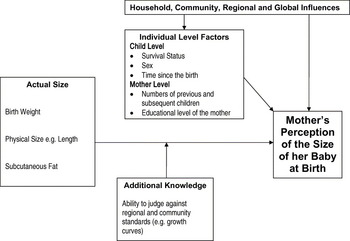
Figure 1 shows a conceptual framework for the determinants of a mother's perception of the size of her baby at birth. From this framework it is shown that there are hypothesized to be three main determinants of perceived size. The first is the actual size of the child, while the second are household, community, regional and global factors that influence the image in the mother's mind of the baby against which their child will be judged. These factors influence both the size perception and other influencing factors such as survival status. Further direct influences are the sex of the child, the number of children born to the mother before and after the child in question and the time since the birth. A final factor that needs to be taken into account is additional knowledge. This may take the form of an official health card with a comparison of the child's birth weight against a global norm. Knowing this information is likely to affect the classification of the child into the size categories.
Conceptual framework for the determination of mother's perception of the size of her baby at birth.

Data
Three different DHS were selected from Cambodia (2000), Kazakhstan (1999) and Malawi (2000). These countries were selected due to the varying proportions of missing birth weight data in each of the countries. In Cambodia only 15.9% of infants in the survey had a recorded birth weight, while in Malawi the percentage was 44.1%. The corresponding percentage in Kazakhstan was 97.1%. The percentages of children with a recorded birth weight mirror the percentages of births in the previous five years that occurred at a health facility (9.9% in Cambodia; 55.3% in Malawi; 98.0% in Kazakhstan). The selection was conducted on this criterion as birth weight is hypothesized to be one of the major determinants of size and it will be interesting to see if there are differences in the determinants between infants with and without a recorded birth weight. However, it is not claimed that these countries are a representative selection and that the results obtained will apply to all other countries.
Information about the selection of households and mothers into the surveys are given in the individual country reports and will not be described here (Academy of Preventive Medicine [Kazakhstan] & Macro International Inc., 1999; National Institute of Statistics Directorate General for Health [Cambodia] & ORC Macro, 2001; National Statistical Office (Malawi) & ORC Macro, 2001). All mothers were asked detailed questions about their births in the five years prior to the survey, including the birth weight of the infant, if known. All mothers were also asked the following question about each of the children under 5 years old:
‘When [NAME] was born, was he/she: very large, larger than average, average, smaller than average, or very small?’
The question regarding the perception of size was asked before the question was asked relating to the actual recorded birth weight.
Methods
The response variable, size of the child at birth, is clearly ordered from small to large and thus ordinal logistic regression is used. Furthermore, it is hypothesized that there are household, community and regional influences on the perception of size. To investigate these effects the use of multilevel techniques is appropriate and will identify any effects if they exist (Snijders & Bosker, Reference Snijders and Bosker1999). Simple fixed effects models were initially fitted using Stata Version 9 (StataCorp, 2005) before these were transferred to MLwiN Version 2.20 (Rasbash et al., Reference Rasbash, Healy, Browne, Cameron and Charlton2010) in order to estimate the multilevel structure.
Three different models were estimated for each country in order to elucidate the determinants of mothers' perception.
1. The first set of models restricted the dataset to only those infants with both a reported birth weight and size at birth. These models assessed the relationship between actual size (proxied by birth weight) and mother's perception of size while indicating if there are any other variables that are related to the mother's perception of her baby's size.
2. The second set of models also restricted the dataset to those infants with both a reported birth weight and a size at birth. However, this model did not include birth weight as an explanatory factor for size at birth. This model can be directly compared with the first set of models to assess the effect of removing birth weight on the parameters for the other significant explanatory variables – little change in the other parameters indicates that birth weight is independent of other factors in the determination of size perception.
3. The final set of models used the full dataset, including those without a reported birth weight. For this set of models an indicator for whether birth weight was reported for each child was included in the model. Interactions between this indicator and other explanatory variables were tested to investigate if the determinants change for those with and without a recorded birth weight.
In all countries birth weight was converted from grams to z-scores so that comparisons between countries were facilitated and also for ease of interpretation. The scores were calculated within each country in order to centre the variable on the average for each country. A number of potential explanatory variables were included in the modelling process, including marital status, maternal and paternal education, maternal age, place of delivery, urban/rural residence, region, religion, time since the birth, birth order, wealth and whether the mother was working at the time of the survey. A number of contextual variables were also defined to provide average information at a district and sampling cluster level. This contextual information was derived from the survey and included the proportion of infants born at home, the average birth weight in each sampling cluster and the average wealth. The multilevel structure investigated was the children clustered in households, within sampling clusters and then within districts. The household level was used to control for sibling effects. Only singleton infants were included in the analysis. Forward selection was used to construct each model, with a variable being included in the model if it was significant at the 5% level.
Results
Exploratory analysis
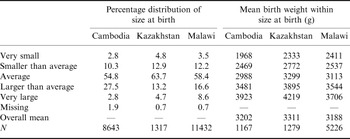
The distribution of mother's perception of size at birth is shown for Cambodia, Kazakhstan and Malawi in Table 1. If the ‘very small’ and ‘smaller than average’ categories are grouped together there are similar proportions of infants in all three countries. The average sized infant category contains the highest percentage of infants. Cambodia has a sizeable proportion of infants in the larger than average category, and a small percentage in the very large category compared with the other two countries. Also shown in Table 1 is the average birth weight in each of the perception categories. This obviously only relates to those infants with a recorded birth weight, but the mean birth weights follow the expected patterns, with those in the smallest perception group having the lowest average weight, and those in the largest group having, on average, the heaviest.
Percentage distribution and mean birth weight by size at birth

Bivariate analyses indicate that perception of size is related to the place of birth, with a greater proportion of infants classified as smaller than average or very small who were born at home compared with those who were born in a hospital. In Cambodia and Malawi, it is also seen that the size perception increases as the time since the birth increases. Thus those born between 4 and 5 years before the survey are, on average, classified as larger than those born in the year before the survey. This trend is not seen in Kazakhstan (analyses not shown).
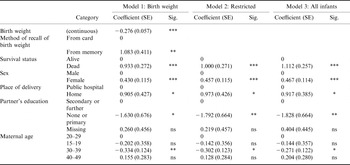
Multilevel ordinal logistic results for Kazakhstan

* p<0.05;
** p<0.01;
*** p<0.001; ns=not significant.
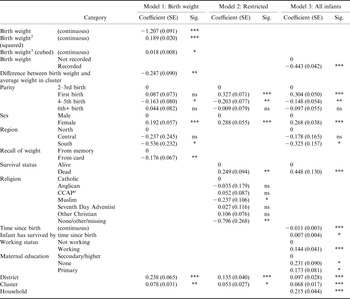
Multilevel ordinal logistic results for Malawi

a Church of Central Africa, Presbyterian.
* p<0.05;
** p<0.01;
*** p<0.001; ns=not significant.
Relationship between birth weight and mother's perception of size in Malawi.

Multilevel ordinal regression
As stated previously, three different ordinal logistic models were used for each country. The results shown give the estimated parameter values (with associated standard errors) indicating the chances of being in a smaller size category. Therefore a positive parameter indicates that the determinant is associated with a decrease in size perception, while a negative parameter indicates an increase in size perception for that determinant.
Kazakhstan. There is almost full enumeration of birth weight in the Kazakhstan survey, with only 2.9% of the infants in the survey without a recorded birth weight. Table 2 shows the results for the ordinal logistic regression studying the determinants of a mother's perception of size.
There are minimal differences between all three models for Kazakhstan. The first model, including birth weight as an explanatory variable, indicates that as birth weight increases the perception of size increases (as indicated by the negative parameter value). Female infants, those who are born at home, and those who died prior to the survey are perceived as being smaller than males, those born in a hospital and those who were still alive at the time of the survey. These variables are all known to be related to birth weight and thus the relationship with perception of size is expected. However, the relationship is seen even after controlling for birth weight, indicating that there is an effect of these variables over and above that of birth weight.
Removing birth weight from the model only changes the parameter estimates of the explanatory variables by a small amount. The estimates for survival status, gender and place of delivery are all slightly larger in Model 2 than in Model 1, although the differences are minimal. This indicates that the relationship between these three variables and mother's perception of size is not explained by birth weight and that these factors have an independent effect on mother's perception. Model 3, using all infants in the survey (both with and without a recorded birth weight), again does not differ greatly from the previous models. The indicator of whether birth weight was recorded or not was not significant (and thus not included in the final model), showing that there is no difference in perception depending on a record of birth weight being available. No variation was seen at any of the three levels in the model.
Malawi. The results for the three models for Malawi are shown in Table 3. Over half of the infants in this country do not have a recorded birth weight, and thus the differences between Models 2 and 3 will be informative regarding the similarity of determinants between those with and without a recorded birth weight.
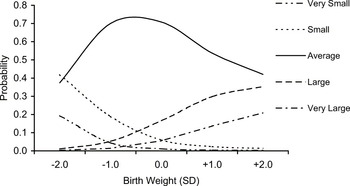
The first point to note is that the relationship between birth weight and perception of size is not linear, as can be seen in Figure 2. As birth weight increases from low levels the probability of the mother classifying her child as very small or smaller than average decreases, while the probability of a classification of larger than average or very large increases. The probability of a classification of average size is as expected, with a higher probability for infants who weigh closer to the mean birth weight being in this category.
A further interesting explanatory variable is the difference between the infant's birth weight and the average birth weight in the cluster. It is important to note that average birth weight in a cluster was calculated from the survey and therefore is subject to sampling error, especially in those clusters where few infants have a recorded birth weight. The parameter estimate indicates that if an infant has a birth weight that is heavier than the average for the cluster that they live in, then their size classification is also likely to be larger. This implies that even if a child has a light birth weight, but other children in the area are even lighter on average, then the size perception will be larger than if children in the area are heavier on average. Females are again seen to be perceived as smaller than males, even after controlling for birth weight.
The results for Model 2 show that the relationship between gender and perception of size is stronger after birth weight is removed. Thus females are perceived as smaller than males, but only part of this is due to the female infants having a lighter birth weight. Survival status is significantly related to size in this second model, but was not significant in Model 1. Smaller infants are more likely to die after birth, and thus it can be concluded that the smaller size perception of those who did die is due to the infants actually being lighter than infants who have survived and not simply due to the mother's perception.
The final model using all infants in the survey contains many additional significant explanatory variables. The indicator of whether birth weight was recorded or not in the survey is highly related to size perception, with those with a recorded birth weight being perceived as being larger than those without. There are no interactions with any other explanatory variables showing that the relationship between the other explanatory variables and perception of size is the same irrespective of whether birth weight was recorded or not. The amount of time since the birth is important, and interacts with the survival status of the child. As the length of time since the birth increases, the probability of a larger size classification also increases for infants who are alive. However, for infants who have died there is no effect of time.
Multilevel ordinal logistic results for Cambodia

* p<0.05;
** p<0.01;
*** p<0.001; ns=not significant.
Significant variation is seen at the cluster and district levels for all three models, and also at the household level for Model 3. This indicates that there are differences between these areas in the way in which infants are classified, even after taking into account the other explanatory variables. This is understandable if the raw data are studied, with some districts having many infants classified as being larger than average or very large (e.g. 46.6% of infants are in these categories in the Machinga rural district) while others have few in these categories (e.g. 10.9% in Mchinji rural).
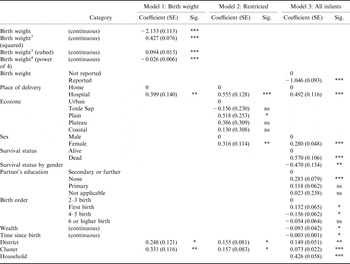
Cambodia. The results for Cambodia are shown in Table 4. Out of the three countries analysed the different models show the greatest variability in Cambodia. This is probably due to the large amount of infants without a recorded birth weight. Models 1 and 2 only utilize 16% of the infants in the survey due to the remainder not reporting a birth weight.
The relationship between birth weight and mother's perception of size is again non-linear, as shown in Model 1 for Cambodia. Only one other variable is significantly related to size after controlling for birth weight. This is the place of delivery, with those born in a hospital being reported as being smaller than those born at home.
The second model, without using birth weight as a predictor, also includes ecozone (a grouping of different states into similar ecological areas) and sex in the model. Those living in the Plain region of Cambodia and female babies are classified as smaller than those in other regions and males. Due to sex not being significant in the first model it can be concluded that mothers are assessing females as smaller than males because they are smaller, and not for any other social reason. The parameter value for place of delivery increases compared with Model 1, indicating that a proportion of the effect of the variables on size is explained by birth weight.
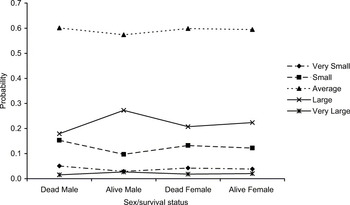
Finally, Model 3 shows that whether birth weight was reported for the child is highly significant, with infants with a reported birth weight being classified as much larger than those without. Place of delivery and gender are again significant in the same direction as previous models. However, survival status interacts with gender, indicating that the perception of size is related to both of these variables. This is shown in Fig. 3. The difference in size classification between females is small, irrespective of survival status. However, there is a difference in the perception of size for males. Boys who are still alive at the time of the interview are more likely to be classified as larger than average, while those that have died are more likely to be classified as smaller than average.
Probability of size classification by gender and survival status in Cambodia.

There is significant variation seen at the cluster and district level for all models, and also at the household level for Model 3. The greatest variation is seen for Model 1, showing that there are significant differences in the classification of size at these different levels.
Discussion
The strong relationship seen in all three countries between birth weight and mother's perception of size indicates that the actual size of the baby (proxied by birth weight) is an important determinant in the perception of size by the mother. In Cambodia and Malawi the relationship is not linear. The association is in the expected direction, with larger infants being placed in larger size categories than smaller infants. In Cambodia the relationship between birth weight and size perception is very clear. An infant who weighs 2 standard deviations below the mean birth weight in the country is most likely to be classified as smaller than average, while those who weigh 2 standard deviations above the mean birth weight are most likely to be classified as larger than average.
The differences between the models for each country show that the influence of birth weight is independent of other factors. In Cambodia and Malawi the actual samples used for the three models are very different, and thus comparisons are difficult to make between Models 2 and 3. However, in Kazakhstan, where the samples for all models are very similar, variables that are related to mother's perception for all infants are exactly the same as those that are related to mother's perception when birth weight is included, indicating the birth weight is related to size independently of other explanatory variables. There is slight attenuation of some explanatory variable parameters when including birth weight in the model compared with the model excluding birth weight. This is unsurprising, as the factors that are related to mother's perception are also related to birth weight. As an example, females are known to be lighter on average than males (Kramer, Reference Kramer1987), and thus part of the relationship between gender and mother's perception is likely to be due to the actual difference in birth weights between sexes. Including birth weight in the model controls for this and the remaining relationship between gender and mother's perception is the influence of gender on the perception of size over and above that of birth weight.
Other potential factors that may influence the perception of size are alternative aspects of actual size, such as physical size and amount of fat. These are not measured in the DHS and therefore cannot be included in the models for perception of size. It is possible that relationships between the explanatory variables and size perception would be further attenuated if these other actual size dimensions are included in the model.
It was initially thought that there would be a different relationship between explanatory variables and mothers' perception for those with and without a reported birth weight. This would have been signified by a significant interaction between the indicator of a reported birth weight and explanatory variables in the model that used all infants. However, although the indicator of a reported birth weight was seen to be highly significant in Cambodia and Malawi, no interactions were significant. The significance of the indicator of a recorded birth weight is expected, as those with a reported birth weight are known to have parents of a higher socioeconomic class and thus are likely to be larger than infants without a reported birth weight (Moreno & Goldman, Reference Moreno and Goldman1990). In effect, infants with a reported birth weight are reported to be larger than those without a reported birth weight, mainly because they are, in fact, larger.
The variation observed between the different clusters and regions in Cambodia and Malawi shows that infants in the same area are more similar to each other in size assessment than to infants in other areas. It may be argued that this also indicates the area of reference used by mothers to assess the size of their baby. If a mother only uses infants in the local area to judge the size of their child against, the expectation is that there would be no variation observed at the regional or cluster level, as each cluster or region would have a similar distribution of sizes. This is not the case, indicating that comparisons are made across the whole country. Average birth weight varies in different regions and clusters across the whole country, and as perception of size is strongly related to birth weight then mean size in the different clusters differs too, leading to the variation seen. This observation highlights that mother's perception of size is best used in nationally representative surveys. If a small area of a country is sampled then it is possible that the birth weight may be higher or lower that the country average, and thus the perception of size will be skewed in that region and the variation within that region not recorded fully.
The results from this analysis imply that there are various regional and national influences on the determination of mothers' perception of size. Furthermore, there are other factors that indicate that mother's perception is not invariant and is influenced by situational and time factors. In both Cambodia and Malawi, for the model that includes all infants, the time since the birth is significantly related to the perception of size. Expectation is that there should be no change in size classification, but it is observed that as the length of time increases, mothers are more likely to classify their babies into a larger size category. Birth weight in these countries did not decrease over the five years before the survey, as calculated from the birth weights included in the survey, and thus this result indicates that mothers do revise their size estimates upwards as time passes. It is interesting that the effect of time since the birth is not significant once birth weight is entered into the model for both countries. This may be simply due to the different samples used when birth weight is included in the model.
Conclusion
The implications of this research are clear. Birth weight is closely related to mother's perception of size, and thus perception of size can be used as a proxy for birth weight. However, the results indicate a more complicated picture than is currently considered, so care should be taken when doing this. When using mother's perception as a proxy, other variables also need to be taken into account, such as gender, survival status and place of delivery. If there are two children, one male and one female, of the same birth weight, the female is likely to be classified as smaller. This may be due to the other dimensions of size being considered, such as length, or may be due to societal influences. Birth weight could be considered to be invariant to societal pressures, but perception of size suffers from the same response biases as other survey questions.
The variation observed at the district and cluster level is encouraging, with the indication that mothers assess the size of their child against a generic country standard. Yet for Malawi there is also some evidence that some of the size judgement is also made with respect to infants in the near vicinity, as evidenced by the significant contextual factor in the regression models.
These results need to be interpreted with caution due to the limitations inherent in conducting analyses of this type. Firstly, it is assumed that the birth weight, for those reporting it in the survey, is correctly measured. There is much heaping of birth weight in these surveys (Channon et al., Reference Channon, Padmadas and McDonald2011), but smoothed distributions indicate the expected normal distribution. A further limitation of the analysis is the endogeneity between birth weight and perception of size. Those who have a recorded birth weight have an independent assessment of the size of their child, and may use this to place their child into a size category. Those without a birth weight do not have this reference point. However, the relationships between the explanatory variables and perception of size are seen to be similar for those with and without a recorded birth weight, which indicates that this does not happen. Furthermore, the question related to size perception was asked before the question for the birth weight was posed, minimizing this issue. A final point is that these data are from nationally representative surveys. The relationships found may not hold for smaller samples or more localized surveys, and mother's perception of size should be used with severe caution in the analysis of small regional surveys, or even nationwide surveys with restricted sample sizes.
In conclusion, researchers who need to have an indicator for health at birth or to control for birth weight in a location where there is not complete enumeration of birth weight can use mother's perception of size as a proxy. However, care needs to be taken due to the societal influences on the perception of size.
Acknowledgment
The author gratefully acknowledges the guidance given by Dr Sabu Padmadas and Professor John ‘Mac’ McDonald during the initial stages of this paper. Funding was obtained through the Economic and Social Research Council.