INTRODUCTION
The family Amphinomidae Lamarck, 1818 comprises conspicuous worms, sometimes referred to as fireworms due to the calcareous brittle chaetae that break easily on contact and produce a burning sensation (Rouse & Pleijel, Reference Rouse and Pleijel2001).
They are more common in littoral waters and tropics, although a few species have been recorded in polar regions and at abyssal depths (Kudenov, Reference Kudenov1993).
According to Kudenov (Reference Kudenov, Blake, Hilbig and Schott1995) and Barroso & Paiva (Reference Barroso and Paiva2007), the characters of taxonomic value regarding this family are: prostomial shape, prostomial appendages, distribution of branchiae and acicula, and chaetal types.
The genus Linopherus Quatrefages, 1865 is characterized by a transversely divided prostomium, bearing a pair of antennae and a pair of palps, caruncle small or absent, birramous parapodia with harpoon-like notochaeta and spurred neurochaeta (Barroso & Paiva, Reference Barroso and Paiva2007).
Even though the description by Quatrefages (Reference Quatrefages1865) is considered incomplete and vague, the genus Pseudeurythoe Fauvel, Reference Fauvel1932 was synonymized with Linopherus by Fauchald (Reference Fauchald1977). However, Amaral & Nonato (Reference Amaral and Nonato1994) treat them as different genera, due to uncertainty about the presence of a caruncle.
Around 19 species are recognized worldwide (WoRMS, 2015), occurring mostly in warm seas. Up to now, two species of Linopherus have been recorded in Brazil: Linopherus ambigua (Monro, Reference Monro1933) in São Paulo and Paraná states (Amaral & Nonato, Reference Amaral and Nonato1994; Rohr & Almeida, Reference Rohr and Almeida2006; Amaral et al., Reference Amaral, Nallin, Steiner, Forroni and Gomes2013); and Linopherus cf. canariensis Langerhans, Reference Langerhans1881 from Rocas Atoll – the only atoll in the South Atlantic Ocean, situated approximately 260 km away from Continental Brazil (Barroso & Paiva, Reference Barroso and Paiva2007; Paiva et al., Reference Paiva, Young and Echeverría2007; Amaral et al., Reference Amaral, Nallin, Steiner, Forroni and Gomes2013).
Linopherus canariensis co-occurs and is morphologically similar to Linopherus acarunculatus (Monro, 1937) in areas such as the Mediterranean Sea (Arias et al., Reference Arias, Barroso, Anadón and Paiva2013), leading to taxonomic confusion (Çinar, Reference Çinar2009). Species can be separated by the 1st branchiate chaetiger, the 3rd in Linopherus canariensis and the 4th in Linopherus acarunculatus.
The species Linopherus canariensis was described by Langerhans (Reference Langerhans1881), based on type material collected in the Canary Islands, from organic sediments found in intertidal flats. The aim of this paper is to describe the specimens and to discuss the invading potential of the species.
MATERIAL AND METHODS
Specimens were collected at Itaipu Beach (22°58′54″S 43°02′18″W), a subtropical sandy beach, in March and July 2011 in the intertidal area, found living as endofauna of Encope emarginata (Leske, Reference Leske1778) test fragments.
Specimens were narcotized using menthol crystals, fixed in 4% formalin and transferred to 70% alcohol for storage. They were analysed under an optic microscope CX31 and stereoscope microscope SZ51, both Olympus®, and photographed using a digital camera Sony® 13MP attached to the ocular. The software Helicon Focus 6 was used to compose the final photos and final plates were organized using Photoshop 6.0.
RESULTS
SYSTEMATICS
Order AMPHINOMIDA Lamarck, 1818
Family AMPHINOMIDAE Savigny in Lamarck, 1818
Genus Linopherus Quatrefages, 1865
Linopherus cf. canariensis Langerhans, Reference Langerhans1881
(Figures 1 & 2)
Linopherus canariensis – Langerhans, Reference Langerhans1881: Figure 14.
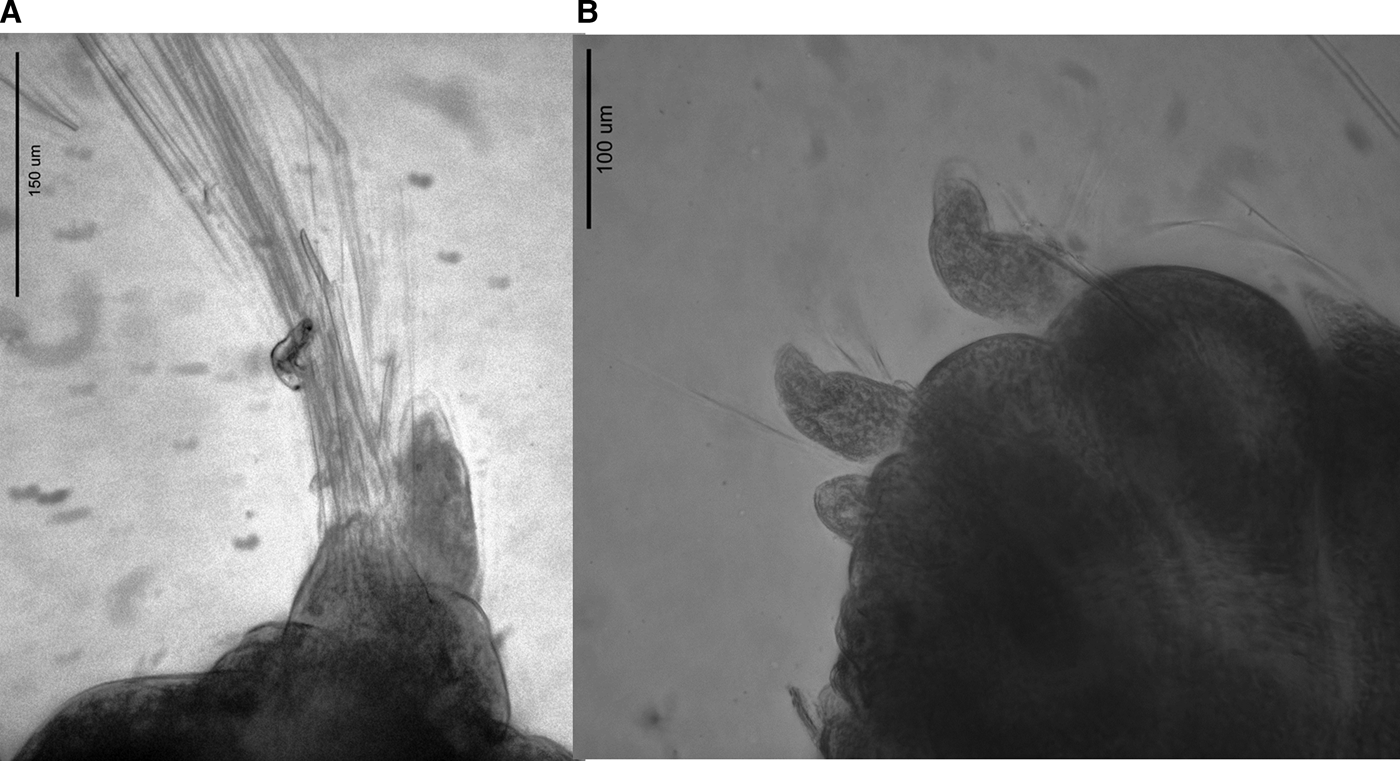
Linopherus cf. canariensis Langerhans, Reference Langerhans1881: (A) Close up of the prostomium, dorsal view; (B) Anterior end showing the branchial segments, dorsal view.

Linopherus cf. canariensis Langerhans, Reference Langerhans1881: (A) Forked denticulated neurochaeta; (B) Pigidial cirri, dorsal view.
Linopherus canariensis Núñez et al., Reference Núñez, Brito and Ocaña1991: Figure 3; Barroso & Paiva (Reference Barroso and Paiva2007): Figure 3.
Linopherus fauchaldi San Martín, Reference San Martín1986.
Type species: Amphinome incarunculata Peters, Reference Peters1854.
Type-locality: Canary Islands, Spain.
MATERIAL EXAMINED
Seven specimens. Itaipu Beach, Rio de Janeiro, Brazil (22°58′54″S 43°02′18″W). Coll. by A. Peixoto, III/2011. Eight specimens Itaipu Beach, Rio de Janeiro, Brazil. Coll. by A. Peixoto, VII/2011.
Diagnosis (according to Barroso & Paiva (Reference Barroso and Paiva2007))
Prostomium transversally divided, anterior lobe with an anterior pair of unarticulated antennae and a pair of lateral, unarticulated palps and a square-shaped posterior lobe with two pairs of eyes and a median antenna, between the first and second pair of eyes. First pair of eyes large, bigger than the second. Caruncle small or absent, sometimes sunk in the first chaetiger.
Biramous parapodia, with well-separated notopodium and neuropodium and single dorsal cirri per parapodium. Branchiae present in the notopodia, starting at chaetigers 2–3. Branchial distribution and number of branchial filaments tufts per parapodia are variable.
Chaetae long and brittle. Notochaetae ribbon-shaped capillaries and harpoon-like chaeta, neurochaeta furcated, spurred capillaries.
DESCRIPTION
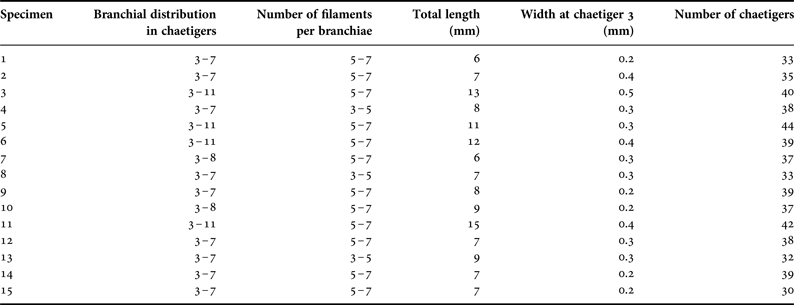
Body 6–15 mm long, 0.2–0.5 mm wide at 3rd chaetiger, 30–44 chaetigers. Specimens are reddish-orange when alive and yellowish after fixation in alcohol. Prostomium divided in anterior and posterior lobes. Rounded anterior lobe bearing a pair of unarticulated digitated antennae and a pair of unarticulated palps located laterally. Smaller square-shaped posterior lobe, bearing two pairs of eyes, the second one smaller and usually occluded by first chaetiger (Figure 1A). Median antenna shorter than the lateral ones, located between the posterior pair of eyes, partially occluded, only the tip is apparent. Caruncle absent. Very short proboscis bearing two papillae everted in one of the specimens. Branchiae present in chaetigers 3–7, with 5–7 filaments each (Figure 1B).
Biramous parapodia, dorsal and ventral cirri of similar length. Short chaetal lobes present. Notochaetae and neurochaetae simple. Notochaetae ribbon-shaped or harpoon-shaped and denticulated. Neurochaetae furcated with a long spur and coarse serrations on the longer branch, or short, furcated with a short spur and serrations (Figure 2A). Four short pigidial cirri present (Figure 2B).
VARIATION
In some specimens, branchiae were present in chaetigers 3–8 or 3–11. The number of branchial filaments also varied and some specimens have only 3–5 short filaments per branchia (Table 1).
Morphological characters of examined specimens.
DISTRIBUTION
Tropical region of Atlantic Ocean, with reports from Canary Islands, Panama, Cuba, Mexico and the Mediterranean Sea.
HABITAT
In this paper, the analysed specimens were found in interstices of organic dead Encope emarginata test fragments, which were laying on the surface of coarse sand.
DISCUSSION
Up to now, only two species of Linopherus have been recorded in Brazil: Linopherus ambigua, referred by Amaral & Nonato (Reference Amaral and Nonato1994) as Pseudoeurythoe ambigua (Monro, Reference Monro1933), recorded in the states of São Paulo and Paraná; and Linopherus cf. canariensis, referred by Paiva et al. (Reference Paiva, Young and Echeverría2007), recorded from the Rocas Atoll, Rio Grande do Norte State. These species can be separated based on the branchial distribution: present in chaetigers 3–7 in Linopherus canariensis and chaetigers 3–43 in Linopherus ambigua (Barroso & Paiva, Reference Barroso and Paiva2007; Yáñez-Rivera, Reference Yáñez-Rivera, León-González, Bastida-Zavala, Carrera-Parra, García-Garza, Peña-Rivera, Salazar-Vallejo and Solís-Weiss2009).
Linopherus canariensis from the type locality, described by Langerhans (Reference Langerhans1881) and later re-described by Núñez et al. (Reference Núñez, Brito and Ocaña1991), show only one branchial filament on the first chaetiger, while specimens collected by San Martín (Reference San Martín1986) from the type locality and Juventud Island have 2–4 filaments. In the specimens from Lake Faro (Central Mediterranean), Cosentino & Giacobbe (Reference Cosentino and Giacobbe2011) recorded 2–15 branchial filaments per branchia. Specimens examined in the present study have 5–7 filaments (sometimes 3–5 in smaller specimens). The specimens from Itaipu are slightly different from the original description (Langerhans, Reference Langerhans1881) as well as other descriptions, justifying the ‘cf.’ adoption.
Branchial distribution seems to be more variable, with branchiae present in chaetigers 2–20 (Liñero-Arana & Díaz, Reference Liñero-Arana and Díaz2010), 2–8 or 2–16 (Yánez-Rivera, Reference Yáñez-Rivera, León-González, Bastida-Zavala, Carrera-Parra, García-Garza, Peña-Rivera, Salazar-Vallejo and Solís-Weiss2009), 2–10, 2–16 or 2–20 (Salazar-Vallejo, Reference Salazar-Vallejo1997), 3–9 to 3–29 (Cosentino & Giacobbe, Reference Cosentino and Giacobbe2011) and 3–8 (San Martín, Reference San Martín1986). Branchial distribution shows some degree of variation, being of questionable value to species identification. Besides, there are evidences supporting the morphophysiological flexibility towards an increase in branchiae size and the number of branchial filaments in hypoxic conditions, as also found by Ahrens et al. (Reference Ahrens, Borda, Barroso, Paiva, Campbell, Wolf, Nugues, Rouse and Schulze2013) for Hermodice carunculata, (Pallas, Reference Pallas1766) when comparing East and West Atlantic populations.
The description of antennae and palps articulation varies in literature. While all specimens examined in this study have unarticulated palps and antennae, Fauchald (Reference Fauchald1977) described the posterior antennae in Linopherus canariensis as biarticulated, Salazar-Vallejo (Reference Salazar-Vallejo1997) and Yáñez-Rivera (Reference Yáñez-Rivera, León-González, Bastida-Zavala, Carrera-Parra, García-Garza, Peña-Rivera, Salazar-Vallejo and Solís-Weiss2009) described them as articulated, and Barroso & Paiva (Reference Barroso and Paiva2007) and Cosentino & Giacobbe (Reference Cosentino and Giacobbe2011) described them as slightly articulated. However, according to Barroso & Paiva (Reference Barroso and Paiva2007), articulation is a character that may vary according to specimen size or show intraspecific variation, being of little value to species identification.
Antennae and palps examined in our specimens are similar in shape and size to those observed by San Martín (Reference San Martín1986), Núñez et al. (Reference Núñez, Brito and Ocaña1991), Salazar-Vallejo (Reference Salazar-Vallejo1997) and Barroso & Paiva (Reference Barroso and Paiva2007), but both are shorter than those observed by Liñero-Arana & Díaz (Reference Liñero-Arana and Díaz2010).
Chaetae morphology in our specimens is very similar to those described by Núñez et al. (Reference Núñez, Brito and Ocaña1991) and Alós & Núñez (Reference Alós, Núñez, Parapar, Alós, Núñez, Moreira, López, Aguirrezabalaga, Besteiro and Martínez2012), although short neurochaetae with an enlarged basis were not observed in the examined specimens. Chaetae are also similar to those described by San Martín (Reference San Martín1986), although short neurochaetae with an enlarged base were not observed and the spur on the longer neurochaetae of the examined specimens was much longer than the ones described by the author.
None of the aforementioned studies reported the presence of ribbon-shaped notochaetae.
When comparing to the description by Barroso & Paiva (Reference Barroso and Paiva2007), neurochaetae observed in this study have a much longer spur and more spaced serrations. This is the only study to report the presence of ribbon-shaped notochaetae.
Pigidial cirri have rarely been reported in literature. San Martín (Reference San Martín1986) described the presence of two pigidial cirri, while Núñez et al. (Reference Núñez, Brito and Ocaña1991) described pigidial cirri as absent and Hutchings (Reference Hutchings, Beesley, Ross and Glasby2000) described them as absent for the whole family. Specimens examined in this study presented four pigidial cirri.
If these specimens do in fact belong to Linopherus canariensis, they could be considered an alien species in the Brazilian coast, since this species was previously recorded in the Caribbean, Cuba, Panama and in the Mediterranean Sea (Cosentino & Giacobbe, Reference Cosentino and Giacobbe2011).
The invasive potential could be explained by physiological tolerance of hypoxia and dystrophic environments, asexual reproduction, and morphological and ecological flexibility (Cosentino & Giacobbe, Reference Cosentino and Giacobbe2011). On the other hand, according to Barroso & Paiva (Reference Barroso and Paiva2007), the species is probably part of a complex, as it occurs in the Pacific, Atlantic and Indian Oceans.
Therefore, in order to clarify the real status of our Linopherus specimens described herein, we suggest that future comparisons to type material and molecular studies should be carried out.
ACKNOWLEDGEMENT
The authors would like to thank Wilson Malafaia for the English review.