Introduction
Black locust (Robinia pseudoacacia L., Fabaceae) is a North American tree species introduced in Europe in the early seventeenth century (Cierjacks et al., Reference Cierjacks, Kowarik, Joshi, Hempel, Ristow, von der Lippe and Weber2013) and used for ornamental and forestry purposes. It is currently considered of conflicting values in Europe (Dickie et al., Reference Dickie, Bennett, Burrow, Nuñez, Peltzer, Porté, Richardson, Rejmánek, Rundel and van Wilgen2014): in forestry its mature wood is a rot-proof wood reaching the same durability class as teak (Tectona grandis) (Dünisch et al., Reference Dünisch, Richter and Koch2010) and young stems from short rotation coppice are a costly but efficient energy source (Manzone et al., Reference Manzone, Bergante and Facciotto2015); but in natural areas it is considered one of the most invasive tree species worldwide (Basnou, Reference Basnou2006; Richardson and Rejmánek, Reference Richardson and Rejmánek2011) impacting local diversity and ecosystem functioning in particular as a consequence of its nitrogen-fixing capability (Cierjacks et al., Reference Cierjacks, Kowarik, Joshi, Hempel, Ristow, von der Lippe and Weber2013). Black locust is capable of sexual reproduction and it also spreads locally by asexual root-sucker production (Kurokochi et al., Reference Kurokochi, Toyama and Hogetsu2010; Cierjacks et al., Reference Cierjacks, Kowarik, Joshi, Hempel, Ristow, von der Lippe and Weber2013). However, its seeds present a physical dormancy that prevents germination when improperly broken (Cierjacks et al., Reference Cierjacks, Kowarik, Joshi, Hempel, Ristow, von der Lippe and Weber2013).
The physical dormancy of Fabaceae seeds is due to the impermeable layers of the seed coat that prevent water absorption and, thus, embryo germination (Baskin et al., Reference Baskin, Baskin and Li2000; Baskin and Baskin, Reference Baskin and Baskin2004). Under natural conditions, the disruption of the lens allows permeability and further germination. A simple pin puncture or razor cut in the seed coat would allow water absorption and often lead to nearly 100% germination rate in Fabaceae (Funes and Venier, Reference Funes and Venier2006; Bonner and Karrfalt, Reference Bonner and Karrfalt2008; Abudureheman et al., Reference Abudureheman, Liu, Zhang and Guan2014; Giuliani et al., Reference Giuliani, Lazzaro, Mariotti Lippi and Foggi2015). However, this methodology cannot be considered when numerous seeds are required and/or when dormancy must be homogeneously broken, as for forestry purposes or for research. Previous studies tested various methods to break dormancy of Fabaceae seeds (Bonner and Karrfalt, Reference Bonner and Karrfalt2008; Abudureheman et al., Reference Abudureheman, Liu, Zhang and Guan2014; Giuliani et al., Reference Giuliani, Lazzaro, Mariotti Lippi and Foggi2015). These mechanical methods were based on: (1) dry-heat treatments (testing various temperature and duration) or on manual abrasion using sandpaper; (2) water imbibition based on seed soaking in hot water following several variants regarding water temperature (40‒100°C), soaking duration (20 min to 72 h) and number of heating/cooling water cycles (1‒7); and (3) concentrated sulphuric acid treatment, testing variable concentrations or duration (10‒120 min). The latter method often resulted in high germination rates but was risky for the environment or could damage the seeds (Bonner and Karrfalt, Reference Bonner and Karrfalt2008). Thus we decided not to consider it in our search for eco-friendly methods. Specific tests on black locust seeds were proven contradictory regarding their efficiency, for example, heat being selected by some authors whereas soaking in water or acid being indicated as the most efficient by others (Singh et al., Reference Singh, Hooda and Bonner1991; Masaka and Yamada, Reference Masaka and Yamada2009; Basbag et al., Reference Basbag, Aydin and Ayzit2010; Giuliani et al., Reference Giuliani, Lazzaro, Mariotti Lippi and Foggi2015).
Considering this discrepancy in the various previous studies, our objective was to compare seed treatments of black locust to break physical dormancy reaching high germination and to find a method that allows treatment of large numbers of seeds in a short time and in a homogeneous way. The best methods were then validated on seeds from various Fabaceae species.
Material and methods
Dormancy break
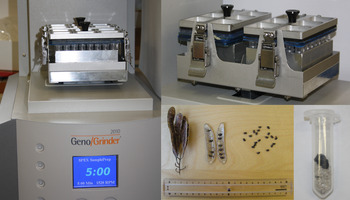
Pods were collected in early February 2015 from ten trees in each of 10 populations located in South-Western France (Gironde, Lot et Garonne), using a manual pruner. A visual sorting of the seeds was performed to remove dried, aborted or rotten seeds. Seeds were stored in paper bags in a cold room between 0 and 5°C (Bonner and Karrfalt, Reference Bonner and Karrfalt2008; Cierjacks et al., Reference Cierjacks, Kowarik, Joshi, Hempel, Ristow, von der Lippe and Weber2013). Two hundred and ten seeds from one tree of the Gabarnac population (Gironde, France) were used to test seven dormancy-breaking treatments, with 30 seeds per treatment: puncturing (P), consisting of making one pin puncture in the seed coat, using a needle; dry-heat (Basbag et al., Reference Basbag, Aydin and Ayzit2010) was applied by placing seeds in a Petri dish in an oven at 90°C for 20 and 30 min (H20, H30); imbibition by soaking in water (W) was performed in one cycle, placing seeds in nearly boiling water at 95°C (Turner and Dixon, Reference Turner and Dixon2009) and letting them cool for 15 h; finally we tested a novel sanding treatment (Fig. 1) using an automated grinder (2010 Geno/Grinder, SPEX SamplePrep, Metuchen, NJ, USA) that allows shaking of tubes controlling both intensity and duration. Five seeds were positioned in an Eppendorf tube half-filled with sand (sand for pool filtering, 5% free silica and grain size 0.8–1.4 mm; Aqua Espace Accessoires, Cadaujac, France) and agitated at 1500 r.p.m. for 5, 10 and 15 min, respectively (S5, S10, S15). Up to 96 tubes at a time can then be agitated, allowing homogeneous treatment of 480 seeds each time when using five seeds per tube.
The grinder used to break seed dormancy. The seeds and sand in the tubes are shaken homogeneously controlling both speed and duration to quickly achieve a homogeneous sanding of the seed coat. On the right, close up of the plates allowing shaking of 96 tubes at a time, with a view of the pods and seeds as collected from the pods and in the tube ready for sanding (5 seeds per tube). Photograph credits: X.P. Bouteiller and A.J. Porté.

After treatment, five seeds scarified with the same treatment were placed in a pot (QuickPot 35RW, HerkuPlast Kubern GmbH, Ering, Germany) filled with 25 g of substrate (substrate 307, Peltracom, Gent, Belgium) and covered with 6 g of substrate. The pots were then watered with 50 ml of water. During germination, each pot was watered every other day with 50 ml of water, so that the plants did not suffer from water stress. Pots were positioned in a climate chamber (Fitoclima D1200, Aralab, S. Domingos de Rana, Portugal) at 60% air relative humidity, a day/night temperature of 22/20°C and light intensity of 185 ± 45 μmol PAR m‒2 s‒1 (quantum sensor Licor Li190, Lincoln, USA) with a photoperiod of 12 h daylight/10 h darkness and two 1 h periods of gradual transitions in-between. Phenological stages of seed germination were monitored for two weeks (4–6 measurements), following five stages adapted from Glycine max (Minost, Reference Minost1997) and older R. pseudoacacia (Cierjacks et al., Reference Cierjacks, Kowarik, Joshi, Hempel, Ristow, von der Lippe and Weber2013): stage 1, radical emergence; stage 2, cotyledon emergence; stage 3, cotyledon deployment; stage 4, first whole leaf; stage 5, first compound leave (Supplementary information Fig. S1). Sometimes the cotyledons rapidly detached from the stems of young seedlings. In this case, seeds were indicated as germinated (stage 1) but since plant development would be further limited, they were recorded as germination with non-intact cotyledons. Germination rates were calculated separately based on all germination events (total germination, including germination with non-intact cotyledons) and based on healthy germination, defined as germination with intact cotyledons. Individual germination data (total and healthy germination) were analysed using a generalized linear mixed model with a binary distribution (1 germinated/0 not germinated at the end of the monitoring) and logit link function (procedure GLIMMIX, SAS9.4, SAS Institute, Cary, NC, USA) with treatment as a fixed effect, pot nested in treatment as a random effect.
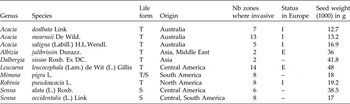
We selected nine additional species with orthodox seeds (Table 1; Supplementary information Fig. S2) to evaluate seed dormancy breaking methods. Species were selected from invasive trees and shrubs from the Fabaceae family, using the global database of invasive trees and shrubs from Rejmánek and Richardson (Reference Rejmánek and Richardson2013). Orthodoxy and seed weight information were obtained from the Royal Botanic Gardens Kew Seed Information Database (SID; version 7.1, January 2017; http://data.kew.org/sid/); species 1000-seed weight varied from 12.7 to 48 g, as we avoided big seeds that could get stuck in the tubes during sanding. Seeds were bought (Sunshine Seeds, Peter Krebs, Ahlen, Germany) and seeded in autumn 2016, following the same growing conditions as for Robinia pseudoacacia. Twenty seeds per species and treatment were treated following the control (C), puncture (P) and 5 min sanding (S5) protocols. Germination was evaluated 30 days after sowing, and individual germination data were analysed using a generalized linear mixed model with a binary distribution (1 germinated/0 not germinated at the end of the monitoring) and logit link function (procedure GLIMMIX, SAS9.4, SAS Institute) with treatment as a fixed effect, pot nested in treatment as a random effect.
Main characteristics of the species used to test the automated sanding dormancy-breaking method

Life form: T, tree; S, shrub. Number (Nb) of zones where invasive: Rejmanek and Richardson (Reference Rejmánek and Richardson2013) surveyed the literature to construct a database on invasive woody species, indicating their invasive status throughout the world which was divided into 15 geographical zones. Status in Europe: I, invasive; E, established; –, planted or not present. The status was indicated following Rejmanek and Richardson (Reference Rejmánek and Richardson2013), the DAISIE database of European alien species (DAISIE European Invasive Alien Species Gateway: http://www.europe-aliens.org/) and the CABI database (http://www.cabi.org/isc/search/?q=&types=7,19&sort=DateDesc). Seed weight (mean of 1000 seeds, g) was extracted from the Royal Botanic Gardens Kew Seed Information Database [January 2017, Seed Information Database (SID), version 7.1, available at: http://data.kew.org/sid/].
Germination curve
To evaluate the germination rate of R. pseudoacacia seeds using the best scarification method, 500 seeds (five seeds per 10 trees per 10 populations) were treated and monitored over 20 days. We then constructed a germination curve of the fraction of healthy germinated seeds [G (t)]. Several non-linear models are available from the literature [logistic, Gompertz, Weibull, log-logistic (Torres and Frutos, Reference Torres and Frutos1989; Ritz et al., Reference Ritz, Pipper and Streibig2013; Archontoulis and Miguez, Reference Archontoulis and Miguez2015)] but only the Gompertz model matched the shape of the black locust germination time curve. The model was fitted using a non-linear procedure (NLIN, SAS9.4, SAS Institute:.
 $$G\left( t \right) = D\,{\ast}\,{\rm exp}\left( { - \exp \left( { - b\left( {t - t_m} \right)} \right)} \right),$$
where parameter D is the maximum germination rate, b is the slope of the germination curve and t m is the time at the inflexion point.
Results
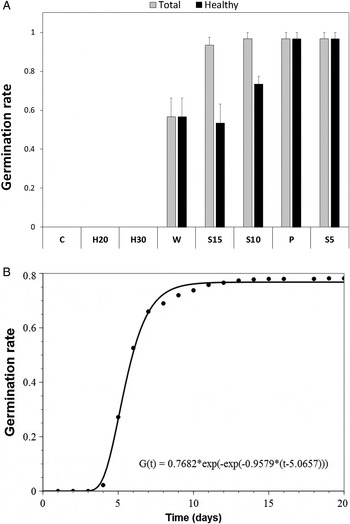
All treatments except dry-heat (H20, H30) permitted the breaking of seed dormancy of black locust (Fig. 2A). The highest germination of 97% (SE = 3.3) was reached with treatments puncture (P) and sanding of 5-min duration (S5); moreover, no damage was observed on cotyledons, thus no reduction in healthy germination was observed. Longer sanding treatments (S10, S15) induced no significant reduction per se in total germination success (97 and 93%, SE 3.3 and 4.2) but resulted in significantly lower healthy germination (maximum 73 and 53%, SE 4.2 and 9.9, Fig. 2A) due to stem emergence without cotyledons (Table 2). Water soaking (W) only resulted in moderate germination, with a total germination of 57% (SE 9.5); it was significantly lower than all effective treatments considering total germination but equivalent to long duration sanding treatments S10 and S15 when considering healthy germination.
(A) Maximum germination (total and healthy) of black locust seeds according to the dormancy-breaking treatment (C, W, S15, S10, S5, P); as no seed germinated in the dry-heat treatments (H20, H30), bars were equal to zero (no variance). For statistics, see Table 2. (B) Germination–time curve (full line, Gompertz model, P < 0.0001) fitted using healthy germination data on 500 seeds treated with the S5 sanding treatment (black circles). C, control; W, water soaking; S15, S10 and S5, automatic sanding for 15, 10 or 5 min; P, puncture.

Mixed model analysis testing for germination success (total and healthy) of black locust according to treatment (W, S15, S10, S5, P)

Analyses were performed without the dry-heat treatments which presented no germination and, thus, no variance. Treatment was considered as a fixed effect (F-test value for fixed effects) and pot (treatment) as a random effect (ChiSq in proc glimmix). d.f. represents degree of freedom. Bold font indicates statistically significant values (P < 0.05). Random effect was removed from the model when variance was estimated to be 0 (Kiernan et al., Reference Kiernan, Tao and Gibbs2012). Means with the same letter are considered not to be significantly different.
When we applied the S5 treatment to 500 seeds collected from 100 different black locust trees (Fig. 2B), the germination success was lower than during the comparative test, but still reached a healthy total germination of 78.2%; 12.8% of the seeds germinated with broken cotyledons and 9% did not germinate. Overall, the Gompertz model was accurate to fit the data although slightly underestimating maximum germination (76.8%) as a result of reaching a plateau on still slightly increasing data.
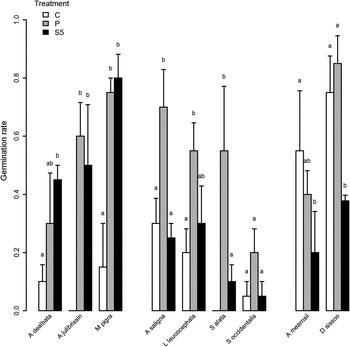
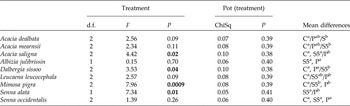
Overall, puncturing (P) proved to break the dormancy of the Fabaceae seeds we tested, while they did not germinate in the absence of the treatment (control C). Some variation was observed in the degree of efficiency of sanding (S5) according to the species, which could be related to the seed characteristics. As observed for R. pseudoacacia, sanding S5 was as efficient as the reference puncture technique (P) to break dormancy of A. dealbata, A. julibrissin and M. pigra (Fig. 3, Table 3). For a second group of species, A. saligna, L. leucocephala and S. alata, sanding was not efficient, with a low level of germination, not significantly different from the control (C). Seeds of S. occidentalis demonstrated poor germination whatever the treatment. Finally, for A. mearnsii and D. sissoo, sanding (S5) resulted in a negative effect on germination, whereas puncture was as efficient as the control, suggesting that dormancy was already broken when seeds were received.
Germination of nine Fabaceae species seeds according to the dormancy-breaking treatment (C, P, S5): Acacia dealbata, Acacia mearnsii, Acacia saligna, Albizia julibrissin, Dalbergia sissoo, Leucaena leucocephala, Mimosa pigra, Senna alata and Senna occidentalis. C, control; S5, automatic sanding for 5 min; P, puncture. Different letters indicate significantly different germination rates among the dormancy breaking treatments for each species.

Mixed model analysis testing for the germination success (total) of nine species of Fabaceae according to treatment (C, P, S5)

Treatment was considered as a fixed effect (F-test value for fixed effects) and pot (treatment) as a random effect (ChiSq in proc glimmix). d.f. represents degree of freedom (either 2 or 1 when a treatment presented no germination thus no variance). Bold font indicates statistically significant values (P < 0.05). Means with the same letter are considered not to be significantly different.
Discussion
Together with manual puncturing (P), a short-time sanding using an automated grinder for 5 min (S5) was the most efficient treatment to break physical seed dormancy in black locust. Under natural conditions or without dormancy-breaking treatment, germination of these seeds is low, ranging from 3 to 22% (Singh et al., Reference Singh, Hooda and Bonner1991; Cierjacks et al., Reference Cierjacks, Kowarik, Joshi, Hempel, Ristow, von der Lippe and Weber2013). All treatments, except dry-heat, at least doubled natural germination. The needle puncture or blade cut is frequently cited in the literature as effective in breaking physical dormancy of black locust, Fabaceae or other physically dormant seeds (Singh et al., Reference Singh, Hooda and Bonner1991; Funes and Venier, Reference Funes and Venier2006; Masaka and Yamada, Reference Masaka and Yamada2009; Cierjacks et al., Reference Cierjacks, Kowarik, Joshi, Hempel, Ristow, von der Lippe and Weber2013; Abudureheman et al., Reference Abudureheman, Liu, Zhang and Guan2014; Giuliani et al., Reference Giuliani, Lazzaro, Mariotti Lippi and Foggi2015), so that it can be used as a reference method. The absence of germination following dry-heat treatments contradicted previous studies that reported 90–94% germination (Masaka and Yamada, Reference Masaka and Yamada2009; Basbag et al., Reference Basbag, Aydin and Ayzit2010). Hot water soaking is proposed by forest managers to break physical dormancy (e.g. in France (CRPF, 2007). However, although it was indeed proved highly efficient sometimes to break physical dormancy of black locust (Singh et al., Reference Singh, Hooda and Bonner1991) or other Fabaceae species (Ventura de Souza et al., Reference Ventura de Souza, Heinig Voltolini, Santos and Silveira Paulilo2012; Abudureheman et al., Reference Abudureheman, Liu, Zhang and Guan2014), our results are in accordance with results indicating only moderate (20–50%) efficiency of breaking physical dormancy (Turner and Dixon, Reference Turner and Dixon2009; Abudureheman et al., Reference Abudureheman, Liu, Zhang and Guan2014; Giuliani et al., Reference Giuliani, Lazzaro, Mariotti Lippi and Foggi2015).
To our knowledge, automatic sanding has never been tested on physically dormant seeds. A more rough sanding in a cement mixer or similar machine is generally proposed by forest managers in both the native and invasive ranges to treat tonnes of physically dormant seeds at a time (Argel and Paton, Reference Argel, Paton, Loch and Ferguson1999; CRPF, 2007; Kimura and Islam, Reference Kimura and Islam2012); sandpaper scraping of black locust seeds has been mentioned but without indicating its efficiency (Morimoto et al., Reference Morimoto, Kominami and Koike2010; Dini-Papanastasi et al., Reference Dini-Papanastasi, Kostopoulou and Radoglou2012). However, since Fabaceae species are cropped for cattle or human food (Graham and Vance, Reference Graham and Vance2003) with many species of this family presenting seeds with physical dormancy (Baskin et al., Reference Baskin, Baskin and Li2000; Baskin and Baskin, Reference Baskin and Baskin2004; Jayasuriya et al., Reference Jayasuriya, Wijetunga, Baskin and Baskin2013), dormancy-breaking treatments of other Fabaceae species have been reported. Mechanical scarification has largely been applied using sandpaper; most of the time it resulted in the highest germination success ranging from 75 to 100%, compared with control treatments of 0 to 30% (González-Castañeda et al., Reference González-Castañeda, Angoa-Pérez, Frías-Hernández, Olalde-Portugal, Flores-Ancira, Terrones-Rincón, Van Cleemput and Dendooven2004; Alves de Oliveira et al., Reference Alves de Oliveira, Ferreira Nunes, Almeida Rocha, Fagundes Braga, Silva Pimenta and Magalhães Veloso2008; Nogueira Camargos et al., Reference Nogueira Camargos, Moreira de Carvalho, Vieira de Araújo and Linhares Magalhães2008; Ali et al., Reference Ali, Tanveer, Nadeem and Asghar2011; Barcelo Gomes et al., Reference Barcelo Gomes, Assis de Faria, Santos Cerqueira and Lima Bailão2013; Martins de Mesquita Matos et al., Reference Martins de Mesquita Matos, Oliveira Ramos, de Carvalho Cristo Martins, Vasconcelos de Oliveira and Pereira Martins2014; Campos Dayrell et al., Reference Campos Dayrell, Gonçalves-Alvim, Negreiros, Fernandes and Oliveira Silveira2015; Ferreras et al., Reference Ferreras, Funes and Galetto2015; Statwick, Reference Statwick2016). The only indication of automation was developed in the 1970s by air pulsing seeds on a rotating sandpaper-covered drum (Townsend and McGinnies, Reference Townsend and McGinnies1972, cited by Kimura and Islam, Reference Kimura and Islam2012). Using this device to break seed dormancy of two different Fabaceae species, it was, however, not efficient with 7 and 29% germination, respectively (Patanè and Gresta, Reference Patanè and Gresta2006). Using 10 Fabaceae species, we demonstrated that automated sanding can be more generally efficient in breaking physical dormancy: in four of the species a 5-min sanding was highly efficient, whereas for three of them we hypothesize that a longer period is necessary. Indeed, for A. saligna, L. leucocephala and S. alata, seed dormancy was not broken; however, seeds were still viable since they germinated with a 75–100% success when punctured and seeded again after completion of the experiment (data not shown). For these species, or other species of interest that we did not test, we suggest calibrating the automatic sanding duration until dormancy is broken. For S. occidentalis, a previous study tested a mechanical cut in the coat which resulted in 100% germination, compared with the control (Teketay, Reference Teketay1996). Our opposite result where even mechanical puncture did not allow high germination rates to be reached thus suggests that the seeds we used had lost their germination capacity. Finally, the negative impact of sanding for A. mearnsii and D. sissoo was probably related to the use of non-dormant seeds. Seed coats of A. mearnsii were already partly broken when received, with apparent white soft tissues that could have been too much damaged by sanding to allow proper development. Regarding D. sissoo, some publications indicated that seeds display no or only weak physical dormancy, allowing immediate and high levels of germination (Khan and Khan, Reference Khan and Khan1992; Murali, Reference Murali1997; Jøker, Reference Jøker2002). Thus sanding the seeds probably resulted in degrading them and preventing germination. Still, the method we propose using automated sanding allows us to treat large samples in a short time and assures homogeneity in the scarification process, as demonstrated by the dormancy-breaking treatments. The lower germination that was observed when sanding was applied to 500 seeds of R. pseudoacacia can be related to the heterogeneity of the seeds, coming from 10 different populations, compared with the test performed on one homogeneous seed sample; indeed physical dormancy breaking can present some heterogeneity related to seed origins (Masaka and Yamada, Reference Masaka and Yamada2009). When using a standard protocol, the discrepancy between total and healthy germination can then be interpreted as an indication of the proportion of unhealthy seeds with a damaged or thinner coat. Comparing studies using different protocols to break seed dormancy could be misleading, considering the high variability of their efficiency. Therefore, we propose that automated sanding be used as a standard to break dormancy of black locust seeds, and in general for Fabaceae physically dormant seeds, to allow further comparative studies of plant populations or genotypes. This standard protocol would only require to be calibrated for other species with seeds presenting a physical dormancy.
Acknowledgements
This study has been carried out with financial support from the French National Research Agency (ANR) in the frame of the Investments for the future Program (ANR-10- LABX-45) and from the University of Liège (Fonds Spéciaux pour la Recherche).
Supplementary material
S1: The five seed germination phenological stages; S2: Photographs of seeds of all species used.
To view supplementary material for this article, please visit https://doi.org/10.1017/S0960258517000150