“If the country must default, the honourable thing to do is to confess the fault at once and meet the issue frankly.” Footnote 1
Underwriters played a key role in nineteenth-century global finance. Banks in charge of underwriting sovereign debt negotiated lending conditions, floated bonds on the market, and transferred resources between final creditors and borrowing governments. Underwriters also endorsed loans; although they did not guarantee these obligations, their signatures appeared on the lending contracts. Reputation was the cornerstone of this business, and the market penalized underwriters when the bonds for which they were responsible went into default. Banks that underwrote only good debt were at the top, able to attract more and cheaper credit. Above all, that was the case for the London House of Rothschild (hereafter, Rothschilds), which, according to Flandreau and Flores, owned the default-free “brand.” Footnote 2
Nevertheless, Rothschilds had an Achilles heel: Brazil, for whose debt it was “the agent and guardian,” a role that the chief editor of the Economist characterized as “delicate and difficult” at the beginning of the twentieth century. Footnote 3 The house began underwriting the country’s bonds in the 1820s, shortly after the establishment of the Brazilian monarchic state, during a global debt boom. Footnote 4 Brazil turned out to be the only Latin American state that honored its obligations. Three decades later, its government appointed the house as Brazil’s financial agent in Europe, a role that involved a monopoly on debt issuing. The country then became an important client, accounting for 23 percent of all the Rothschilds-underwritten sovereign bonds that were floating on the London market at the century’s end. Footnote 5 This became a problem when a republican coup deposed the monarchy in 1889, initiating a period of political turmoil and unorthodox economic policy. The new administration nearly suspended payments unilaterally, and Rothschilds underwrote rescue loans to safeguard its reputation.
This bank–state relationship became extremely strong—few countries were so associated with an underwriter as Brazil was with Rothschilds, as most governments tended to switch among banks for different bond issues. Nevertheless, there is little research specifically on the involvement of Rothschilds with Brazil. Ferguson recognizes that the Brazilian business was “one of the firm’s most enduring,” but the space devoted to it in his colossal book about “the world’s banker” was limited to a few paragraphs. Footnote 6 Existing research on the Brazilian debt tends to address the involvement of Rothschilds from the country’s point of view. Summerhill assesses the factors that explain the good payment record of the monarchic state. Footnote 7 Abreu shows that Brazil was a good borrower in the long run despite the crisis that followed the fall of the monarchy. Footnote 8 Franco and Fritsch analyze the impact of economic policies on payment capacity in the 1890s, the first republican decade. Footnote 9 As will be explained later, Flandreau and Flores have an opposite approach: They study the dominant position of Rothschilds in the world’s underwriting market, which is important for understanding Brazil’s case. Footnote 10
This article complements the preceding studies by analyzing the interdependence between the bank and the state, examining it from both sides, based on primary material from archives in London and Rio de Janeiro. Footnote 11 More specifically, it shows how Rothschilds depended on the Brazilian government to maintain its reputation and how the latter depended on the former to borrow abroad, particularly during the 1890s. Primary material demonstrates that Brazil free-rode on the bank’s access to credit when politics became unstable. High officials launched policies that undermined payment capacity, but helped to stabilize the political situation without suspending payments. In loans issued in 1893 and 1895, Rothschilds threw good money after bad without effectively pressuring for fiscal consolidation. This did not change until 1898, when both parties arranged a comprehensive rescue operation, the Funding Loan, conditional on the implementation of orthodox economic policy. The bank launched the operation precisely when the country started to stabilize, so policymakers no longer needed to pursue unorthodox policies to fight wars. Brazil improved payment capacity in the following decade and the prices of Brazilian bonds increased to their full face value. The loans of the 1890s turned out to be profitable: according to Flandreau and Flores, the internal rate of return on the 1895 loan was 11.5 percent, Footnote 12 and Abreu calculates 4.8 percent for the 1898 Funding Loan. Footnote 13
The literature on relationship banking is useful for understanding this case study. Boot describes the “soft-budget constraint problem,” which happens when locked-in banks abstain from pressuring troubled borrowers to improve their financial position. Too much pressure would increase the likelihood of retaliation, including the unilateral suspension of payments. Footnote 14 Flandreau and Flores adapt this argument to the nineteenth-century sovereign debt market, arguing that repeat business between banks and states helped to enforce lending contracts. Footnote 15 Governments improved their status when associated with first-class houses, while patron banks could benefit from information asymmetry, “misrepresenting the true condition of the government.” Footnote 16 However, through the years the clients’ debt record determined the underwriter’s own reputation, which created incentives for launching rescue loans in the payment crises. Flandreau and Flores recognize the importance of the Brazilian case and point out that the Funding Loan was a “precious” example of a loan designed to solve problems from relationship banking; however, they address it in a broad perspective to develop a model applicable to the system as a whole; in their words, a detailed study of Rothschilds’ business in Brazil is “beyond [our] scope.” Footnote 17
This article narrates this important case of relationship banking. In doing so, it shows that the political and economic constraints that existed in Brazil during the 1890s shaped the government’s decisions—and, as a consequence, the actions of Rothschilds throughout the decade. Finally, it stresses the role of political instability, which explains why the crisis was so long and, despite this, why the country remained under Rothschilds’ credit umbrella. The next section describes how Rothschilds and Brazil developed their long-lasting relationship during the monarchic period (1822–1889), providing historical background. The second section describes the turmoil of the 1890s, the third analyzes the interdependence between Rothschilds and Brazil, and the fourth covers the negotiation that led to the Funding Loan.
Rothschilds and the Brazilian Empire
The London House of Rothschild emerged as an international bank during the Napoleonic Wars, when it financed the British campaign on the continent. Founder Nathan Mayer Rothschild was in an advantageous position to transfer resources across Europe because his brothers had migrated from Frankfurt, their hometown, to Paris, Vienna, and Naples, building a solid international network. Footnote 18 In the decade after the peace of 1815, the house specialized in state finance: It underwrote loans to Prussia in 1818 and 1822, Britain in 1819, Naples in 1821, Russia in 1822, Portugal in 1823, Austria in 1824, and Brazil in 1825. Footnote 19
Rothschilds became interested in Brazil soon after Dom Pedro I, the son of the Portuguese king, Dom João VI, declared the country independent in 1822. A year later, the bank drafted the contract for what would have been the first Brazilian loan, in partnership with Samuel Phillips, also from London. However, Nathan Rothschild made the loan conditional on the establishment of diplomatic relations between the new country and Britain, which would happen only if Portugal accepted the independence of its former colony. Footnote 20 Lisbon and London recognized Brazil as a sovereign state in 1825 through an arrangement in which Rothschilds was directly involved. Under the supervision of the Foreign Office, it organized the transfer of a Portuguese debt to Brazil, an arrangement that Portugal demanded in order to accept the Brazilian Empire’s sovereignty. Footnote 21
Nevertheless, Brazil borrowed abroad in 1824, before establishing diplomatic relations with Portugal and Britain. Instead of Rothschilds, three other London banks—Bazenth, Farqhuar, Crawford & Co.; Fletcher, Alexander & Co.; and Thomas Wilson & Co.—launched the loan. These houses closed their doors a few months later, amid a wave of defaults that hit the market that year, after having issued only one-third of the bonds. Rothschilds underwrote the remainder of the operation in 1825, while it was arranging the deal with Portugal. In total, the loan amounted to £3.7 million, a large figure that corresponded to 165 percent of the Brazilian tax revenue collected in 1824 and 1825. Without the conclusion of the 1824–1825 loan, it would have been difficult for the new government to honor the Portuguese debt it was about to take over, given that the government had been running a large fiscal deficit. Footnote 22 The loan was thus important in making Brazil the exception in a continent of defaulters.
Why did Rothschilds decide to underwrite Brazilian bonds? Dawson stresses the role of the Holy Alliance in that choice. Russia, Prussia, and Austria did not recognize the new Latin American republics, so Rothschilds’ business relations with those empires left only Brazil, a monarchy ruled by a member of a European royal family, as an option. Footnote 23 In addition, the country appeared to be a better bet than its neighbors. Its relatively brief war of independence did not disrupt economic activity, while the crown had amassed enough authority to crush local rebellions and maintain its territorial integrity. Footnote 24 Summerhill also argues that the constitution establishing the monarchic regime protected the property rights of public creditors. Footnote 25
However, Rothschilds had to rescue Brazil following its participation in the Cisplatine War (1825–1828), a conflict with Buenos Aires over the fate of what would later become Uruguay. The Brazilian government paid its soldiers with newly minted copper coins, which depreciated the national currency, the mil-réis, by 52 percent during the conflict, thereby increasing the cost of the debt. By 1829, servicing the sovereign debt (including both interest and amortization) required a quarter of tax revenue. Footnote 26 That same year, the state bank, Banco do Brasil, closed its doors because the domestic market refused to accept the notes it issued during the war. Footnote 27 The country would have probably joined the wave of Latin American defaults had it not borrowed £770,000 from Rothschilds in 1829. The bank underwrote and took the entire loan, in contrast to 1825, and continued to do in the following decades, selling debt on the market. The bonds were issued during rather bad conditions: The discount rate (the liquid revenue Brazil received) was only 52 percent of face value. Footnote 28 This results in a 6.79 percent risk premium (a measure of the cost of credit), which makes this lending the most expensive during the monarchy era. Footnote 29 The loan maintained the house’s default-free brand and the Brazilian bonds recovered when it became clear that the bank was backing its South American client, enabling sale of the bonds at a price considerably higher than the issuing discount. Footnote 30 This business with Brazil in the 1820s placed the country among Rothschilds’ most important clients. After launching the 1829 loan, Brazilian debt accounted for 11 percent of all the sovereign bonds the bank had underwritten so far, close to Prussia’s and Russia’s levels. Footnote 31
Political conditions deteriorated in the following two decades, and Rothschilds halted its business with Brazil. Violent riots forced Dom Pedro I to depart for Europe in 1831, leaving his six-year-old son Dom Pedro II behind. Regents in favor of political decentralization ruled the country until the prince was old enough to become emperor. Meanwhile, local groups waged wars disputing the power handed to regional authorities. Footnote 32 Politics stabilized only after the coronation of Dom Pedro II in 1841. During his forty-eight-year reign, the monarch exercised his power of appointing the parliamentary representatives in charge of forming cabinets. Footnote 33 This was the period when coffee production expanded in the states of Rio de Janeiro, Minas Gerais, and, above all, São Paulo, with exports increasing by 8 percent per year between 1850 and 1889, compared with 1 percent annually in the previous three decades. Footnote 34
Brazil was in a good position to receive the wave of capital that began to flow to Latin America in the third quarter of the nineteenth century. Footnote 35 Foreign companies, most of which were British, invested in railways, banking, and foreign trade. Footnote 36 In this context, the state received the credits that Rothschilds collected on the London Stock Exchange. Between 1850 and 1863, the house underwrote five sovereign loans at relatively low risk premiums—on average, 1.92 percent risk premium—to convert the more expensive debt contracted in the 1820s and to support the building of railways. Footnote 37 This sort of indebtedness is what Fishlow calls development borrowing, which is sustainable because it promotes economic growth and improves payment capacity. Footnote 38 The relations between Rothschilds and Brazil became so intense that the government appointed the bank its financial agent in Europe. The agreement, signed in 1854, provided it with exclusivity on sovereign debt issuing, beginning a monopoly that lasted for five decades. Footnote 39 The bankers started to advise policymakers in Rio de Janeiro, to whom they regularly reported on the condition of the debt market in London. British investors also sought guidance from Rothschilds when investing in the country. Footnote 40
Borrowing became unsustainable, however, as Brazil, Argentina, and Uruguay fought Paraguay between 1864 and 1870 in what became the largest war in South American history. The rise in expenditure resulted in a fiscal deficit that represented 69 percent of tax revenue during the conflict. Footnote 41 Rothschilds repudiated the war, criticizing its financial costs in an open letter to the Brazilian Congress in 1865. Footnote 42 The bank still underwrote a loan that same year, however, to finance beginning the campaign. The operation was the largest so far, totaling £7 million, the equivalent of 88 percent of the sovereign debt stock. Footnote 43 The loan was issued at a 5 percent interest rate and a 74 percent discount, which resulted in a 3.77 percent risk premium and made it the most expensive since the reestablishment of business with Rothschilds. Footnote 44 In the words of the bankers, “the terms of the loan at first sight may not appear quite so favourable for the Government,” given “the present state of affairs in the Brazils, [which] must be regarded politically as well as financially.” Footnote 45
Rothschilds did not underwrite other loans during the Paraguayan War, but it participated in financing the conflict after it ended. The government borrowed the equivalent of £18.8 million domestically to fight Paraguay, obligations that it converted into sovereign debt with the issuing of loans in 1871, 1886, and 1889. Footnote 46 This war-related borrowing caused a debt boom between the beginning of warfare and the end of the monarchy—that is, from 1864 to 1889, when the sovereign debt stock increased from £7.9 million to £30.4 million. Footnote 47 Levy points out that this foreign-denominated debt had lower interest rates and longer maturity than the credit contracted in mil-réis, but the conversion increased the government’s exposure to exchange rate fluctuations, with rather negative consequences in the 1890s. Footnote 48
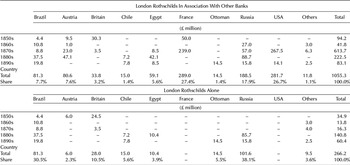
This debt boom maintained Brazil among Rothschilds’ most important clients throughout the second half of the nineteenth century. Table 1 shows that the house participated in issuing more than £1 billion in sovereign bonds between the 1850s and 1890s. The underwriting of Brazilian debt made up 8 percent of that sum, behind France, the United States, and Russia, but above Austria and Britain, two of the house’s most traditional clients. Nonetheless, this share is much larger when compared to just the bonds that the London House underwrote without partnerships: 31 percent of the total, which was close to Russia, with 38 percent. Although the bank issued Russian, French, and American debt in association with other underwriters, such as Barings and the Paris Rothschilds, Brazil was an exclusive client. The country remained the house’s only Latin American business until the establishment of relations with Chile, which remained a minor borrower.
Breakdown of sovereign bonds underwritten by London Rothschilds

Source: Calculated from London House of Rothschild, Century of Finance.
Note: “Austria” is both Austria and Hungary until 1867 and the Austro-Hungarian Empire thereafter. “Others” includes Italy, New Zealand, South Africa, and Spain.
The figure for the issuing of Brazilian bonds in the 1880s is high because of the 1889 loan, the largest and cheapest in the history of the monarchy—£18.9 million at a 1.5 percent risk premium. Footnote 49 Ironically, that operation preceded the collapse of the regime by just a few months. In November 1889, a republican coup deposed Dom Pedro II and radically changed the country’s political landscape. The following section describes how instability generated a debt crisis that forced Rothschilds to underwrite rescue loans. Table 1 demonstrates that Brazil was Rothschilds’ largest borrower in the 1890s, when the bank drastically reduced bond issues. This gives a sense of the efforts the house made to protect its default-free reputation.
Regime Change, Debt Crisis, and Rescue Loans
Contemporaries, either domestically or abroad, did not anticipate the fall of the monarchy. Rothschilds was still in the process of issuing the Empire’s best loan to date when the military deposed Dom Pedro II. The core motivation of the coup was a personal dispute involving Marshal Deodoro da Fonseca, who became the republic’s first president, and members of the cabinet. Fonseca did not intend to change the regime, but the crown fell together with its last administration. Footnote 50 For decades, the emperor had prevented conflicts from disrupting the political order, so the absence of such a unifying figure destabilized politics. Two groups rose in the absence of the monarchic institutions: the army, which had launched the 1889 coup, and the São Paulo oligarchy (the Paulistas), the richest of the country’s regional elites. The first two presidents—Fonseca (1889–1891) and Floriano Peixoto (1891–1894)—were both marshals, but São Paulo’s Partido Republicano Paulista (PRP) was the most influential group in the new Congress, which began writing a new constitution.
The army and the Paulistas diverged in relation to the relative power of the central government: The former was favored a strong presidency, whereas the latter defended the transfer of power to local authorities. In 1891, Congress approved a constitution that relocated the collection of export duties from the central to the state governments, which disproportionably favored coffee-growing São Paulo. Fonseca closed the house, leading to a violent reaction from rival navy officers. The navy mobilized gunboats and deposed the president. Once in office, the vice president, Peixoto, reopened Congress but governed by decree. Footnote 51 Peixoto faced the Federalist Revolution, a civil war in the southern state of Rio Grande do Sul, which had a long separatist history. The revolt involved landowners and fighters from neighboring Uruguay and Argentina, representing a threat to Brazil’s territorial integrity. Footnote 52 Intending to reach Rio de Janeiro, the revolutionaries marched north and almost invaded the state of São Paulo. Meanwhile, the navy revolted for the second time in less than three years, now in support of the Federalist Revolution, imposing a naval blockade on Rio de Janeiro. Footnote 53
Topik describes the political conditions of the first republican years as “chaotic,” whereas Carvalho concludes that “the survival of the new regime was in serious danger.” Footnote 54 Stakes were so high that the PRP reached a compromise with President Peixoto: The Paulistas supported the campaign against the Federalist Revolution, and the president abstained from interfering in either the upcoming election, scheduled for 1894, or the implementation of the 1891 constitution. Footnote 55 The government suppressed the navy revolt with the help of the U.S. navy and American mercenaries, and the army pushed the revolutionaries back to Rio Grande do Sul. Footnote 56 Prudente de Morais, the PRP candidate, became the first civil president and negotiated the end of the Federalist Revolution in mid-1895. Footnote 57 Nonetheless, Morais was targeted by low-ranking officers and unorganized crowds in the streets of Rio de Janeiro. Known as Jacobinos after the radicals of the French Revolution, these rioters believed that the republic needed a president such as Peixoto, an authoritarian marshal, rather than a civil leader associated with the agrarian elites such as Morais. Footnote 58 The Jacobinos also opposed the presence of British companies such as Rothschilds in the country. Footnote 59
Riots intensified as a number of military expeditions failed to defeat monarchist fanatics in Canudos, in the Bahia hinterlands. The turmoil climaxed in 1897, when tens of thousands of troops finally won the Canudos War and the government suppressed the opposition in the streets of Rio de Janeiro, following an attempt to assassinate the president. Footnote 60 Morais survived his term in office and peacefully handed over the presidency to his fellow Paulista, Manuel de Campos Sales, in 1898. With the pacification of the country, three decades commenced during which the PRP governed Brazil in association with regional parties. Later, isolated conflicts did not pose a major threat to the republican regime. Footnote 61
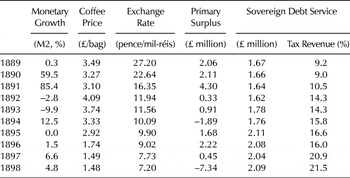
The 1890s were also turbulent with respect to economic policy. The last monarchic cabinet created a system of emission banks to provide credit to farmers hit by the 1888 abolition of slavery. Footnote 62 Rui Barbosa, the first finance minister of the republic, used this new framework to increase monetary supply in an attempt to promote economic growth. The policy resulted in a financial crash known as the Encilhamento and the sharp depreciation of the mil-réis, as shown in Table 2. Footnote 63 Inflation in the capital increased from an average of 1 percent per year in the 1880s to 25 percent in 1891, fueling civil unrest. Footnote 64 The Peixoto administration launched a tight monetary policy to address this problem, and the government momentarily contained the exchange rate depreciation. However, the government needed funds to withdraw paper money from circulation, which it lacked because the 1891 constitution had transferred taxation on exports to the states, whereas the Federalist Revolution had expanded the military budget. Footnote 65 As a result, the monetary stock increased again in 1894. The national currency depreciated even more under Morais, as falling coffee prices reduced exports, and the government continued issuing paper money, this time to finance the Canudos War.
Financial data for Brazil, 1889–1898

Sources: IBGE, Estatísticas históricas, 312, 541, 542, 591–593 for monetary growth, coffee price and exchange rate; BHMF 333/181, and Estatísticas históricas, 617 and 618 for primary surplus; Bouças, Finanças públicas, 220, for sovereign debt services.
Table 2 shows that the government did not run a sufficient primary surplus to meet the minimum required service on the sovereign debt after 1892. Footnote 66 The only exception was 1896, although the margin remained narrow. Footnote 67 The regionalization of export duties eroded federal revenues, warfare raised expenditure, and a weakened exchange rate increased the cost of the sovereign debt when measured in mil-réis. Footnote 68 The ratio between required services and taxation more than doubled during the decade—by 1898, the government needed 21.5 percent of tax revenue to meet its foreign obligations, using its own resources, a situation comparable only to the 1820s. Footnote 69
Politics were more important than foreign trade as the main driver of this debt crisis, given that the export price of coffee was high when payment capacity started to deteriorate and low when it improved, at the beginning and the end of the decade, respectively. Footnote 70 Brazil faced both a currency mismatch and a solvency problem, which were interlocked as the government could appreciate the mil-réis only once it could devote a substantial amount of tax revenue to tighten the monetary stock, rather than to sustain an expensive military budget. Footnote 71 The solvency problem was not permanent, because the country had the means to generate enough wealth for the government to pay its obligations—it ran a fiscal surplus in the 1900s. Footnote 72 The question of how long it would remain insolvent depended on the question of when the political situation would finally stabilize.
The contemporary press understood the extent of the debt crisis. In 1895, the Economist noted that “if strenuous and successful efforts [are] not made to economize in every direction, Brazil will follow some of its neighbors into the ranks of the insolvent.” Footnote 73 The crisis continued, and in 1898 the same journal concluded that a “default in the service of the foreign debt is regarded locally as only a matter of time.” Footnote 74 Similarly, the Investor’s Monthly Manual expected a “fin-de-siècle expedient of a moratorium,” and the Investor’s Review reported that “the rate of exchange barometer … points straight to national insolvency.” Footnote 75 However, the government did not “economize in every direction,” as the Economist advised, nor did it implement the “a moratorium.” It did not have to, because Rothschilds provided a credit umbrella.
Brazil borrowed £13.1 million between 1893 and 1895. Footnote 76 The first operation took place in 1893. Although officially contracted to support the building of railways, 63 percent of the loan’s net revenue financed the campaign against the Federalist Revolution. Footnote 77 In early 1895, the government took on more debt to pay for the conflict, issuing £2 million in treasury notes with maturities from nine to fifteen months. Footnote 78 Later that year, Rothschilds underwrote a second large loan to redeem the treasuries and to cover service on the sovereign debt. The 1893 and 1895 loans carried a 5 percent interest rate and were issued at 80 and 85 percent discounts, respectively, which results in 3.75 and 3.53 percent risk premiums, considerably higher than the loans of the monarchic period, which averaged 2.23 percent. Footnote 79 In contrast with earlier norms, the new contracts did not require the borrower to pay yearly amortizations. Rothschilds thus avoided imposing extra burdens on its client. Footnote 80
Rothschilds played the role of both underwriter and bondholder, similar to what had happened in 1829. The house held 9.3 percent of the 1893 loan, 23 percent of the treasury notes, and 11.6 percent of the 1895 loan. Footnote 81 In a cable to the Finance Minister Rodrigues Alves (1894–1896), the bankers justified the need to “support the markets to a large extent, in order to prevent a really serious fall in the price” of Brazilian securities. They also reported that some of “our friends” took the debt, suggesting that Rothschilds worked with its closest associates in London. Footnote 82 Nevertheless, quotations for the country’s debt collapsed in the following years. The prices of the 1893 and 1895 bonds fell as low as 44 percent and 49 percent of par in the first half of 1898, way below their respective issuing discounts of 80 and 85 percent. Footnote 83 The market reflected Brazil’s fiscal deterioration as the government engaged in unsustainable borrowing and implemented unsound policies to face the political challenges of the first republican decade.
Political Turmoil and Relationship Banking
Rothschilds understood the potential consequences of the end of the monarchic regime. A few weeks after the republican coup, a Rothschilds director informed the new finance minister that “many persons … predict [that] a possible disintegration and dismemberment of your great country might take place.” Footnote 84 However, the bank did not suspend its connection with Brazil; on the contrary, it issued the rescue loans of the 1890s. Other houses not locked into Brazil acted differently. In mid-1889, Barings and Paribas attempted to challenge the exclusivity of Rothschilds and offered a £5 million credit line to the government at 5 percent interest with a one-year maturity. Once the monarchy fell, however, Paribas noted that the syndicate did “not desire to open any credit to the newly established republican government.” Footnote 85 The syndicate made that decision one year before an Argentinean default virtually bankrupted Barings. Footnote 86 Barings and its partner, having refused to lend to Brazil before that event, certainly would not offer credit afterward. Matters were no different a decade later, when the government approached Crédit Lyonnais, hoping for a loan. The bank would not consider placing an offer, given the “gravity of [Brazil’s] financial troubles.” Footnote 87
Without Rothschilds, the new republic would have found it difficult, if not impossible, to borrow abroad. The dependence went both ways, however, for the European bank needed the South American government to maintain its reputation. One can estimate this reputational exposure according to the amount of the Brazilian bonds that Rothschilds had underwritten and were still floating on the London Stock Exchange. This corresponded to 20.7 percent of all the debt the bank was in charge of in July 1889, before the collapse of the monarchy, and 22.9 percent nine years later, the last month before floating the Funding Loan. Only Russia was more important, with roughly 50 percent. The third largest client was Austria-Hungary, which had old perpetual bonds that accounted for about 10 percent. Footnote 88 Given such exposure, a British newspaper concluded a report on Brazil with the following statement: “Rothschilds will move heaven and earth to protect the issues for which they are responsible.” Footnote 89
The bank needed to rescue Brazil because of its reputation, rather than its finances. Although Brazil had a significant share of all the debt Rothschilds had underwritten, the bank did not hold most of these obligations, which explains why it owned a relatively small Brazilian portfolio—on average, 4.9 percent of its total assets between 1889 and 1898, and never surpassing 6 percent. Even though this share is not negligible, it cannot alone explain the credit umbrella the house provided to the government. An eventual default on the Brazilian debt would not have caused its bankruptcy. Footnote 90 However, reputation was the core of the underwriting business, so a default would have had a significant effect on the house’s books in the long term. Rothschilds still tried to reduce its financial exposure, but it could not do so effectively because of the loans in the 1890s. The nominal stock of Brazilian sovereign bonds calculated at par—that is, unaffected by depreciation—fell from £1.71 million to £0.62 million between 1889 and 1893, indicating that the bankers were selling that debt—a reasonable choice, as the market value was falling. This figure then increased to £1.23 million in 1895, a consequence of that year’s lending, in which Rothschilds participated as the main creditor, as explained earlier. Footnote 91
As Brazil became dangerously unstable, the government free-rode on Rothschilds, which explains why the debt crisis was so persistent. The credit umbrella reduced the probability of a default, thereby raising incentives for high officials to implement policies that reduced payment capacity: increasing military expenditure and decentralizing taxation. The government could have serviced the sovereign debt with its own resources had it not launched either of these policies. The minimum required services on the sovereign debt totaled £9.8 million from 1893 to 1897, the beginning of the Federalist Revolution and the end of the Canudos War, respectively. Footnote 92 If the 1893 and 1895 loans are excluded, as they were necessary to finance wars and debt services, this figure falls to £7.8 million, the equivalent of 13.3 percent of tax revenues. Footnote 93 Combined, the budgets of the army and the navy accounted for an average of 23.1 percent of tax revenue from 1890 to 1892, which then increased to 36.5 percent in the following five years. Thus, war expenditure consumed an extra 13.4 percent of taxation. Footnote 94 The state could, then, have honored its foreign financial obligations without further loans had the military budget remained constant.
Similarly, had the central government continued taxing exports as it did before 1893, it would also have had sufficient resources to service the sovereign debt. Between 1890 and 1892, the government tax on exports averaged 4.9 percent. From 1893 to 1897, exports were worth £149.3 million. Applying that rate to the later period suggests that, had the government not regionalized that duty, it would have received an extra £7.2 million in export duties, which corresponds to 13.8 percent of annual tax revenue—sufficient to service the sovereign debt. Footnote 95 In strict fiscal terms, Brazil could have avoided the debt crisis.
Given the credit at hand and the severe challenges of the period, however, it was rational for policymakers to go into extra debt and push the resolution of the crisis back; the alternative would have entailed high political costs. The government needed to increase military expenditures because the Federalist Revolution threatened national integrity, whereas the resistance of the rebels in Canudos intensified riots in Rio de Janeiro, as explained previously. According to Love, the regional oligarchies, above all in São Paulo, supported the 1889 republican coup in the hope that the new regime would implement a less centralized tax system, and the 1891 constitution met such expectations. Footnote 96 Finally, unsound fiscal policy conditioned issuing paper money and exchange rate depreciation, another demand of the Paulistas, because the weak mil-réis protected the coffee sector from falling international prices. Footnote 97
Rothschilds understood the consequences of such unsound economic policies. In a cable sent before they issued the 1895 loan, the bankers wrote to Finance Minister Rodrigues Alves that they had been “watch[ing] with great regret the further decline in the exchange [rate],” which they believed was the consequence of “the large additional issue of paper money during the [Federalist] revolution, and also the considerable deficit in the Budget.” Following such a precise interpretation, the house attempted to make lending conditional on new policies. They explained to Rodrigues Alves that there was a “possible chance [that] there might be, later in the present year [1895], a large External Loan,” as long as a “substantial share” of the borrowing financed the implementation of a tight monetary policy. Rothschilds also suggested the introduction of new “import duties [that] would of course have to be raised in gold, and would have to be applied exclusively to finance the service of the External Debt and the withdrawal of paper money.” Footnote 98
The bankers did not introduce any mechanism to enforce the application of these measures, and Brazil ended up breaking the agreement. Minister Rodrigues Alves promised that the loan was going to “meet extraordinary expenses of the revolt and provide redemption of paper money,” Footnote 99 but the government resumed printing money in 1896 and 1897, during the Canudos War. Footnote 100 A few weeks after launching the 1895 loan, Rodrigues Alves informed Rothschilds that “it is not licit [for the government] to charge taxes of any sort in gold: only the Congress has the prerogative … on the matter.” Footnote 101 The government introduced a new tax on imports that was not pegged to gold, and its revenue fell vis-à-vis obligations on the sovereign debt as the exchange rate depreciated. Footnote 102 Why did Rothschilds accept such loosely defined policy conditions? Political instability appears to be the answer. While the bank and the government were negotiating the lending, Rodrigues Alves explained that “Unfortunately the South is not yet appeased. The federalists have no elements to march and their action is restricted to the border, but they will continue … disturbing the action of the government, demanding large warfare sacrifices.” Footnote 103
In other words, the minister asserted that the government was about to pacify the country, even though the war demanded “large” human and financial resources. His message was accurate in respect to the location and capability of the rebels, and therefore the prospect of victory, but it exaggerated the government’s struggle in the fighting at that stage, which was not near the level of previous years. Footnote 104 Given these pieces of information, it was rational for Rothschilds to continue supporting its client without enforcing conditions that would reduce its ability to secure national order. It appears that the bankers were waiting for the end of warfare to effectively pressure for fiscal consolidation. However, Brazil did not achieve peace before 1898, when the political situation finally stabilized. Payment capacity had deteriorated to record low levels by then. Still, Rothschilds underwrote a new loan, but this time based on well-enforced conditions that solved the debt crisis.
The Funding Loan, Political Stabilization and Rothschilds as a Power Broker
The debt crisis reached a climax in 1898. The conjunction of loose economic policies and falling coffee prices depreciated the mil-réis dreadfully, and service on the sovereign debt required the greatest proportion of tax revenue since the establishment of the republic. Footnote 105 Rothschilds rescued the country once more, but this time the bankers successfully enforced constraints on economic policy that not only prevented a turn of the century collapse but also improved payment capacity in the following decade. However, high officials needed to threaten to default in order to pressure Rothschilds to underwrite a new loan.
In a conference with the bankers, Azevedo Castro, a treasury agent, mentioned the high risk of “payment suspension” and proposed an agreement that would include a “large loan” and allow a coordinated “suspension of services.” Castro reported to Finance Minister Bernardino de Campos (1896–1898) that the directors of the house appeared to be “reticent” about the proposition, and declared themselves “very concerned about the possibility of unilateral action by Brazil.” Footnote 106 Minister Campos contacted Rothschilds directly a month later, in March 1898. The financiers communicated that it would be “impossible to issue” new bonds because “the 5% 1895 loan issued at 85 is now only 65.” Nevertheless, they considered a £5 million loan at 6 percent interest as long as the government leased the Central Railway, a state-owned line that connected Rio de Janeiro to São Paulo. Footnote 107 Rothschilds had presented this proposal to the government in the previous year, on behalf of the British company Greenwood, which, once in charge of the railway, intended to peg the railway’s tariffs to gold. Footnote 108
President Morais turned down the offer. Officially, Morais claimed that the leasing was illegal, but, in a letter to Minister Campos, he stated that his goal was to arrange a larger and cheaper lending facility without any conditions on railways. The president argued that “£5 million would not provide the necessary support for the plan of restructuration of our finances,” and that “it is possible that the Jews would change their position once they are faced with the facts, if we insinuate that we will be fatally forced to suspend payments abroad if we do not obtain the loan.” Footnote 109 The risk was genuine, and a month later the president admitted to Minister Campos that “if they insist on the impossibility of the loan it will be impossible to avoid the suspension of payments.” Footnote 110 The threat worked, and Rothschilds decided to “communicate with the Council of Foreign Bondholders” and to “use [its] best endeavor to induce them to accept the propositions contained in your message.” Footnote 111 The “proposition” was the Funding Loan: the issuing of 5 percent bonds totaling £8.6 million to replace interest payments until 1901. In other words, bondholders received the so-called funding bonds rather than cash in the following three years. Moreover, Brazil became free from debt amortization up to 1911.
The Funding Loan included a deal on economic policy that was similar to what both parties had loosely agreed in 1895. This time, the contract made the conditions explicit and included a self-enforcement mechanism. The government was supposed to burn paper money in an amount equivalent to the funding bonds the bank was going to issue until 1901. Rothschilds also required the introduction of a new duty on imports collected in gold to finance the withdrawal of monetary stock. The Rio de Janeiro branch of the London and River Plate Bank—a British rather than a Brazilian bank, and thus freer from governmental pressure—was in charge of verifying whether the government was burning paper money as agreed. Had the Brazilians failed to implement the new policies, Rothschilds would have suspended the loan, forcing the borrower to resume interest payments in cash. Footnote 112
The London bondholders and the British press received the Funding Loan coldly, but they did not repudiate the deal. Although the Corporation of Foreign Bondholders declined to endorse the operation, it did not officially characterize the scheme as a default. Footnote 113 Likewise, the Economist stated that “the bondholders have the clearest ground for protesting against [the operation because] they have neither been advised nor consulted.” In the same full-page report, however, its analyst recognized that the suspension of amortization was an appropriate measure, given that “it would, of course, be absurd to attempt to keep up the sinking-fund purchase while the Government is practically claiming its inability to meets its current expenses.” Footnote 114 He explained that the conditions placed on monetary policy would “lift” the exchange rate, making it possible for the government to “accumulate on this side a gold fund, which would be available when the payment of interest in cash is resumed.” All depended on the “engagement on the part of the Government not to make any fresh issue of paper money.” Footnote 115 The Times mentioned this point in a more amicable way, praising the agreement on monetary policy as “most important … as regards the future of Brazil.” Footnote 116
These passages suggest a reason that bondholders accepted the Funding Loan: There was a good chance that the appreciation of the exchange rate would raise the quotation of the Brazilian debt, thereby recovering the losses of the previous decade. This indeed happened: The prices of the 1893 and 1895 bonds surpassed the issuing discount in 1901, when the adoption of the tight monetary policy proved effective, and reached 100 percent of face value in 1905. The funding bonds appreciated to even higher levels, which should have been expected, given the contract’s special tax guarantees. From a first quotation of 81 percent in October 1898, the price increased to a record high of 106 percent in June 1905. Footnote 117
Rothschilds exercised its influence on the market, arranging the deal on behalf of the bondholders without consulting them. In the end, the final creditors accepted the operation and the house did not lose its default-free reputation. Rather than a default, which happens when borrowers halt service payments unilaterally, the Funding Loan was a debt re-contracting arrangement. The bank also exercised its power over Brazil when pressuring for monetary policy tightening. Nonetheless, Rothschilds did not impose it; the agreement was an example of shared policy ownership for two reasons. First, the government was able to negotiate. The bankers intially intended to carry out the paper burning at 16 pence per mil-réis, so that the money supply (M2) would be reduced by 34 percent. Minister Campos claimed that such a low rate would have caused “embarrassments to the National Treasury,” Footnote 118 and Rothschilds accepted the rate the government proposed, 18 pence, at which the money supply fell by 31 percent. Footnote 119 This was still a drastic reduction in liquidity; steep enough to explain the large fiscal deficit for 1898, but the policy would have been even more extreme had the government not negotiated. Footnote 120
Second, and most important, high officials were now more inclined to implement tight economic policy than in 1895. Political conditions enabled the return of the priorities that had guided most monarchic cabinets and the early Peixoto administration in respect to the value of the mil-réis. A few months before launching the Funding Loan, Minister Campos informed Rothschilds that exchange rate depreciation was a “bottomless pit without which Brazil would already have converted the 1890s fiscal deficits into surpluses.” Footnote 121 One could assume that the minister was only simulating an intention to change economic policy, as his predecessor had done in 1895. Nevertheless, a few months later, newly elected President Campos Sales (1898–1902) sent a cable to the minister stating the need for “persistence and effort towards good financial management” to “reestablish” Brazilian credit. Footnote 122 Campos Sales wrote from London, where he met the directors of Rothschilds to discuss the Funding Loan. Once in office, he appointed Joaquim Murtinho to head the Ministry of Finance. Murtinho was a senator who had built a political career by criticizing the loose monetary policy of the 1890s. In 1897, he joined the Morais administration as the minister of industry, trade, and railways. Footnote 123 Given his orthodox credentials, Murtinho’s political rise indicates that the government’s intention to defend the value of the national currency was sincere.
Rothschilds probably learned a lesson from the 1895 loan and introduced well-enforced conditions on the Funding Loan to prevent the government from cheating again. This is not the complete story, however, given the change in approach to economic policy within the government, which reflected the country’s pacification. There is no evidence that Rothschilds knew in 1898 that the country was in the process of stabilizing. However, its decision to enforce sound economic policy worked as a tool through which high officials such as President Campos Sales and Minister Murtinho adjusted the priorities of the government in accordance with political stabilization after the Canudos War. Once the turmoil ceased, it became more important to “reestablish” the nation’s credit (as President Campos Sales had put it) than to finance warfare. Footnote 124
Flandreau and Flores characterize the Funding Loan as a successful arrangement designed to solve problems created by relationship banking. Footnote 125 This article complements that initial study, pointing out that politics was the main driver of relations between Brazil and its patron bank. Rothschilds played the role of a power broker in favor of leaders committed to orthodox policies, who became politically stronger with the country’s pacification, and against the groups that benefited from the weak mil-réis, such as the coffee exporters. Footnote 126 Without the Funding Loan, Murtinho would not have had the same political capacity to reduce the monetary stock. His appointment, however, shows that the preferences among the ruling elite had changed in favor of fiscal consolidation.
Rothschilds was the greater winner from the Funding Loan. It did not let its client default, maintaining its reputation. In addition, the house gained £186,000 with the appreciation of the Brazilian bonds it held. Footnote 127 For Brazil, the policy change was economically severe but effective in terms of payment capacity. The tight monetary policy appreciated the mil-réis by 66 percent between 1898 and 1903. Footnote 128 The revenue from coffee exports fell in that currency, resulting in a deep recession and a spike in nonperforming loans in the sector, which led to a series of bank runs, especially in São Paulo. Footnote 129 On the other hand, the new tax on imports and the appreciation of the exchange rate reduced the cost of the sovereign debt vis-à-vis taxation. Footnote 130
Fritsch argues that high officials did not understand the full extent of the negative impacts of these measures on economic activity, Footnote 131 and Abreu documents the political opposition to the operation in Brazil. Footnote 132 Nevertheless, the policymakers had a good reason to implement orthodox policies: The strong mil-réis and sound fiscal accounts improved the country’s credit abroad, enabling further loans in the 1900s, starting even in 1901, when the Campos Sales administration borrowed £17 million to invest in railways. In total, the government issued £59 million in new bonds in the 1900s, more than doubling the sovereign debt stock, which was £44.4 million at the beginning of the decade. Footnote 133 The state of São Paulo also borrowed extensively in those years, including paying for the building up of coffee stocks, a measure it launched in 1906 to sustain the price of the staple. Footnote 134
Orthodox monetary policy was a price the Paulista coffee growers paid to make Brazil creditworthy, while the oligarchy of São Paolo state consolidated a political system in which it ruled the country in association with the elites from other important states, such as Minas Gerais. São Paulo was the key player in what became known as the Coffee and Milk Republic (after São Paulo and Minas Gerais, respectively), which lasted until 1930. Not committing to the Funding Loan in 1898 would have implied the collapse of foreign credit just at the launching of that new national order, with great economic and political costs.
Conclusion
Although Brazil was not large in relation to the international financial market, it was very important for Rothschilds, the world’s premier bank. This indirect market power enabled the country to count on a credit umbrella in the 1890s, when warfare and a new tax code created a debt crisis. The government met service payments without consolidating its fiscal accounts, avoiding implementing tight economic policies that would have jeopardized the new republican regime. Brazil free-rode on Rothschilds’ credit while politics were unstable. The bank could not allow Brazil to default, so it needed to support its client even though the government pursued unsound economic policies. Rothschilds did not introduce well-enforced conditions when civil wars were still shaking the country, most likely because this could have pressured the government to suspend payments unilaterally, ruining the house’s default-free brand.
Rothschilds pressured the government into implementing tight fiscal and monetary policies only in 1898, when Brazil was finally pacified. The exchange rate appreciated, which penalized the coffee sector, with severe consequences for the national economy. Nonetheless, orthodox policies reestablished the country’s credit, enabling a series of new loans thereafter. A default would have resulted in some sort of retaliation, most probably a financial embargo, just as São Paulo solidified its influence over the central government. The costs of suspending payments (not borrowing again) increased, and so did the incentives to consolidate fiscal accounts, whereas the cost of doing so (reducing the military budget) fell drastically. Footnote 135
It is not known to what extent the bankers knew that the government had more political leverage to accept conditions on economic policies in 1898. It could be the case that the bank chose not to wait indefinitely for the end of the turmoil and took the risk of pressing for fiscal consolidation when it underwrote the Funding Loan. The fact is, however, that the government was more willing than before to reduce monetary stock—the rise of Minister Murtinho was a clear sign. Some degree of asymmetry of information was inherent to this principal–agent relationship. If Rothschilds had inside information that did not appear in the researched archival material, it made the right calculations; if it simply bet that the government was not going to retaliate against the conditions of the Funding Loan and suspend payments in 1898, it was lucky. Most probably, the financiers took decisions based on a combination of information and chance. In the end, the house acted according to Brazil’s political conditions: It launched a rescue loan with loosely defined conditions during the turbulent mid-1890s and with well-enforced ones at the beginning of a more peaceful period.
Brazil needed Rothschilds to access credit in the 1890s, but the bank depended on Brazil to retain its place at the top of the debt underwriting business. Disregarding this interdependence between both parties leads to too simplistic a view of the relationship, which was not one in which a strong bank unilaterally imposed harsh lending conditions on a weak state. The evidence presented in this article suggests a more nuanced interpretation. It is true both that the bank held a strong position in the market and that the state was financially weak, but reputation locked the former in, thereby making the latter sufficiently powerful to combine two goals that, without Rothschild’s credit, would have been irreconcilable: maintaining the stability of the regime, while simultaneously honoring the sovereign debt. Brazil was able to force Rothschilds to use its market power to arrange the credit it needed. The bank thus waited until the political situation stabilized to enforce the adoption of sound economic policies, which the government adopted as peace altered its priorities.
Appendix
Fiscal and Trade Data for Brazil, 1889–1902