


Introduction
University students report high levels of mental health concerns (Auerbach et al., Reference Auerbach, Mortier, Bruffaerts, Alonso, Benjet, Cuijpers, Demyttenaere, Ebert, Green, Hasking, Murray, Nock, Pinder-Amaker, Sampson, Stein, Vilagut, Zaslavsky and Kessler2018), which are associated with lower academic achievement (Ding et al., Reference Ding, Lehrer, Rosenquist and Audrain-McGovern2009), higher rates of university drop-out (Ishii et al., Reference Ishii, Tachikawa, Shiratori, Hori, Aiba, Kuga and Arai2018), and lower levels of functioning in later life (Goldman-Mellor et al., Reference Goldman-Mellor, Caspi, Harrington, Hogan, Nada-Raja, Poulton and Moffitt2014). Of concern, treatment rates for mental health disorders are low among post-secondary students, with one study finding that only 25–36% of those with a mental health disorder reported receiving treatment in the previous 12 months (Bruffaerts et al., Reference Bruffaerts, Mortier, Auerbach, Alonso, Hermosillo De la Torre, Cuijpers, Demyttenaere, Ebert, Green, Hasking, Stein, Ennis, Nock, Pinder-Amaker, Sampson, Vilagut, Zaslavsky and Kessler2019). Consequently, some universities have begun to offer internet-delivered mental health interventions to address the under-treatment of mental health problems (Harrer et al., Reference Harrer, Adam, Baumeister, Cuijpers, Karyotaki, Auerbach, Kessler, Bruffaerts, Berking and Ebert2019).
One online option that has shown promising results is internet-delivered cognitive behavioural therapy (ICBT), which has been found to be as effective as traditional face-to-face CBT in the treatment of anxiety and depression when it is therapist-guided (Carlbring et al., Reference Carlbring, Andersson, Cuijpers, Riper and Hedman-Lagerlof2018). Furthermore, ICBT appears effective in both clinical and research contexts (Andersson et al., Reference Andersson, Carlbring, Titov and Lindefors2019; Etzelmueller et al., Reference Etzelmueller, Vis, Karyotaki, Baumeister, Titov, Berking, Cuijpers, Riper and Ebert2020; Harrer et al., Reference Harrer, Adam, Baumeister, Cuijpers, Karyotaki, Auerbach, Kessler, Bruffaerts, Berking and Ebert2019). ICBT consists of delivering the same material as in face-to-face CBT, but through an online program instead, typically while communicating with a therapist about once a week by email or telephone (Andersson et al., Reference Andersson, Carlbring, Titov and Lindefors2019). ICBT reduces the time therapists spend working with each client, thus increasing their capacity to assist more clients than in face-to-face therapy. Additionally, the online format allows clients to review the material where and when it is convenient for them, which may enhance treatment outcomes (Andersson et al., Reference Andersson, Carlbring, Titov and Lindefors2019). A recent meta-analysis included 48 internet interventions for post-secondary students, 35 of which were ICBT (Harrer et al., Reference Harrer, Adam, Baumeister, Cuijpers, Karyotaki, Auerbach, Kessler, Bruffaerts, Berking and Ebert2019) and found small effects for improvement in depression and anxiety. Among those developed, the UniWellbeing Course has shown promising results in treating students who show signs of stress, anxiety or depression (Dear et al., Reference Dear, Johnson, Singh, Wilkes, Brkic, Gupta, Jones, Bailey, Dudeney, Gandy, Fogliati and Titov2019; Mullin et al., Reference Mullin, Dear, Karin, Wootton, Staples, Johnston, Gandy, Fogliati and Titov2015). Implementation trials reveal high levels of satisfaction, and significant pre- to post-treatment improvements on measures of anxiety and depression that are maintained at 3-month follow-up (Dear et al., Reference Dear, Johnson, Singh, Wilkes, Brkic, Gupta, Jones, Bailey, Dudeney, Gandy, Fogliati and Titov2019; Mullin et al., Reference Mullin, Dear, Karin, Wootton, Staples, Johnston, Gandy, Fogliati and Titov2015). While results are promising, only about half of clients offered the UniWellbeing Course complete the program (Dear et al., Reference Dear, Johnson, Singh, Wilkes, Brkic, Gupta, Jones, Bailey, Dudeney, Gandy, Fogliati and Titov2019; Mullin et al., Reference Mullin, Dear, Karin, Wootton, Staples, Johnston, Gandy, Fogliati and Titov2015) and over one-third of students do not demonstrate significant gains (i.e. reduction of ≥30% of symptoms), suggesting there is room for improving the treatment.
Booster sessions have been proposed and studied as a method to improve or maintain treatment outcomes in the face-to-face literature. With booster sessions, therapists follow up with clients at some point post-treatment to provide a summary of symptom reduction strategies (Baker and Wilson, Reference Baker and Wilson1985; Whisman, Reference Whisman1990). As there is interaction with the therapist, therapists can also motivate the client to continue practising effective skills taught in treatment (Whisman, Reference Whisman1990). In a review of 30 clinical trials that included booster sessions for psychological and behavioural health concerns, Whisman (Reference Whisman1990) reported that 58% of studies found booster sessions helped maintain behavioural change (e.g. reduction of smoking, increased weight loss). He also concluded that although booster sessions may not prevent relapse entirely (e.g. of depression), they may delay the onset of relapse (Whisman, Reference Whisman1990). Others have also concluded that booster sessions may be useful in maintaining treatment benefits (Wesner et al., Reference Wesner, Gomes, Detzel, Guimarães and Heldt2015). While the benefits of booster sessions appear positive, these findings should be considered with some caution, as most studies provide limited information on the number, nature and timeline of booster sessions provided. As such, it is not possible to draw general conclusions regarding what is required to make a booster session effective (i.e. nature of, number of, and timing of booster sessions).
Research on the use of boosters following ICBT is also limited. In fact, we identified only one study that examined booster lessons following ICBT that was specific to obsessive-compulsive disorder (OCD; Andersson et al., Reference Andersson, Steneby, Karlsson, Ljótsson, Hedman, Enander, Kaldo, Andersson, Lindefors and Rück2014). In this randomized trial, ICBT alone was compared with ICBT with a 3-week booster (consisting of one lesson per week with therapist support) offered 6 months following ICBT (Andersson et al., Reference Andersson, Steneby, Karlsson, Ljótsson, Hedman, Enander, Kaldo, Andersson, Lindefors and Rück2014). Inclusion of the 3-week booster resulted in fewer relapses at 1 year follow-up and improved general functioning for 2 years after treatment. To date, no research has explored use of booster lessons following ICBT among post-secondary students. Understanding student use of a booster lesson and obtaining feedback about student preferences could help inform the use of boosters among university students in the future.
Given that there are multiple ways that booster lessons can be offered following ICBT (e.g. in terms of content, duration, timelines, degree of therapist support), this study sought to offer and evaluate one version of a booster lesson to begin to understand client use and preferences for booster lessons following ICBT. Specifically, this study examined the use of a single self-directed booster lesson offered one month after a 5-week therapist-assisted ICBT program for depression and anxiety. The booster lesson used in this study was self-directed (without therapist support) and consisted of slides reviewing the key skills and strategies from the four lessons of the ICBT course. The booster lesson also included suggestions to help students maintain motivation and employ problem solving. To evaluate the booster lesson, we explored the use of the booster lesson as well as characteristics of those who used the booster. Furthermore, a questionnaire was used to assess personal preferences for the booster lesson (e.g. timing, content, inclusion of therapist support), and self-reported motivations for using and barriers for not using the booster lesson. Moreover, the perceived quality of the booster lesson was evaluated by those who completed the booster lesson. Given the exploratory nature of this study, only two hypotheses were formulated. The first hypothesis was based on previous research in which almost 14,000 first-year students completed self-report surveys designed to examine help-seeking behaviours. Results indicated that perceived time restraints are a structural barrier to mental health treatment among students (Ebert et al., Reference Ebert, Mortier, Kaehlke, Bruffaerts, Baumeister, Auerbach, Alonso, Vilagut, Martínez, Lochner, Cuijpers, Kuechler, Green, Hasking, Lapsley, Sampson and Kessler2019). As such, we hypothesized that students would report time restraints as a factor leading to non-completion of the booster lesson. The second hypothesis was based on previous research in which 314 post-secondary students completed an online survey designed to identify students’ preferences for ICBT compared with face-to-face CBT or medication (Peynenburg et al., Reference Peynenburg, Mehta and Hadjistavropoulos2020). Results showed that students would prefer having contact with a mental health professional if they were to complete ICBT. As such, we hypothesized that there would be a preference for therapist support during the booster lesson.
Method
Participants and recruitment
This study was nested within a larger registered trial conducted through the Online Therapy Unit at the University of Regina (Peynenburg and Hadjistavropoulos, Reference Peynenburg and Hadjistavropoulos2020; NCT04264585) and made use of data specifically related to the booster lesson. As part of the registered trial, all clients received the UniWellbeing Course and then were randomly assigned to receive a booster lesson or not (factor 1) and a motivational interviewing (MI) lesson or not (factor 2). This created four conditions: (1) the UniWellbeing Course alone, (2) the UniWellbeing Course with booster, (3) the UniWellbeing Course with MI, or (4) the UniWellbeing Course with booster and MI. A total of 308 clients were randomized during the main trial period. Following the trial, to collect some additional data on the booster condition, all clients (n = 11) who applied to the UniWellbeing Course were automatically assigned to the UniWellbeing Course with booster. To maximize power, the current study collapses across the two groups who were randomized to receive the booster lesson and the post-trial clients who received the booster lesson. The decision to collapse groups was justified as no differences were found in terms of booster completion, reliable change on any outcome measure, or treatment adherence (i.e. completion of all four lessons) between those who received MI and those who did not (Peynenburg, Reference Peynenburg2022). Additional eligibility criteria for the trial included that clients had to (a) be 18 years of age or older; (b) self-report at least mild symptoms of anxiety (score ≥5 on Generalized Anxiety Disorder Scale 7-item (GAD-7); Spitzer et al., Reference Spitzer, Kroenke, Williams and Löwe2006) or depression (score ≥5 on Patient Health Questionnaire 9-item (PHQ-9); Kroenke et al., Reference Kroenke, Spitzer and Williams2001); (c) not have been hospitalized within the last year for mental health and/or suicide risk concerns; (d) not have any unmanaged alcohol or drug problems, psychosis, mania, or be at high suicide risk; (e) be enrolled as a student at a post-secondary institution (i.e. college or university) in Saskatchewan; and (f) have access to a secure computer with internet and be comfortable using technology.
Clients learned of the study in a number of ways, including a referral by their family physicians or other providers, or an online source such as email or website. Interested students began by completing an online screening form, followed by a telephone interview. If they met the above criteria, they were randomly assigned to a condition and began the intervention.
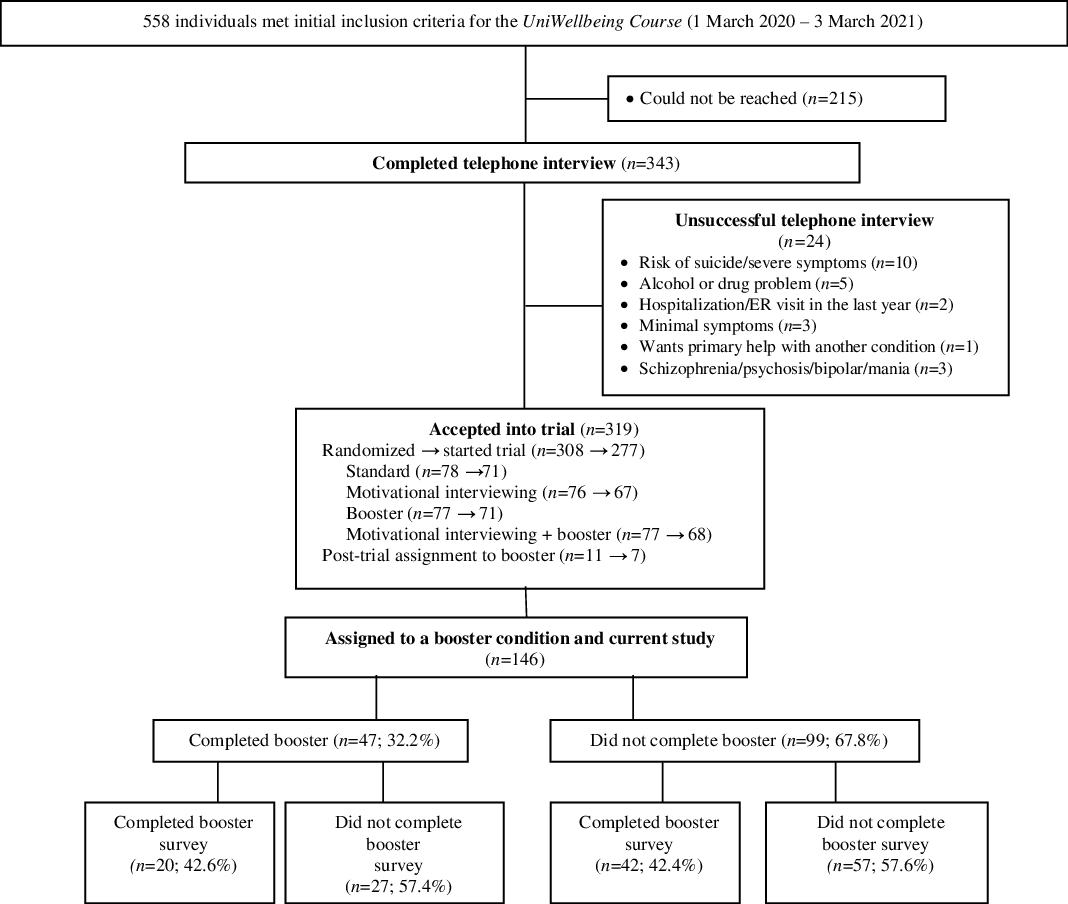
In total, 146 students were assigned to a booster lesson, invited to complete a booster survey shortly after being offered the booster lesson, and were included in this study. In total, 62 students (42.5%) completed the subsequent booster survey. While this subsample is small, it is considered within the acceptable range based on guidelines for initial qualitative research to generate a preliminary understanding of a topic, particularly when such research is not being generalized to a larger population (Boddy, Reference Boddy2016). Figure 1 includes details regarding client flow in the larger trial, inclusion in this study, completion of the booster lesson, and completion of the booster survey.
Client flow in trial and current study.

Intervention
The UniWellbeing Course is a 5-week transdiagnostic ICBT course consisting of four online lessons (i.e. psychoeducation, managing thoughts, managing physical symptoms, graded exposure, and relapse prevention) with lesson summaries, six case stories, homework activities, and additional resources (e.g. assertive communication, communication skills, emergency contact information, grief, managing beliefs, mental skills, and problem solving). Unique to this delivery of the course, two additional case stories were created (e.g. COVID-19 case story and mature student case story). Clients who were randomized to the MI conditions also received five online exercises at pre-treatment based on principles of MI (Peynenburg and Hadjistavropoulos, Reference Peynenburg and Hadjistavropoulos2020; NCT04264585). The MI exercises encouraged participants to: clarify their values, rate the importance of changing their symptoms, reflect on how they overcame a difficult experience in the past, rate their confidence in addressing their symptoms, and reflect on how their symptoms would be impacted if they did or did not complete ICBT. All clients were assigned a therapist, who contacted them through secure messaging on the treatment platform; telephone calls to clients were made in unique circumstances (e.g. elevated suicide risk).
A booster lesson was offered to clients 1 month after the end of the 5-week ICBT course. The booster lesson consisted of 55 slides divided into three parts: ‘Review’, ‘Maintaining Motivation’ and ‘Problem Solving’. In the first part of the lesson, clients were encouraged to think about what was most helpful during ICBT, what skills they continued to use, and any challenges they faced in managing their wellbeing since completing the course. A summary of the key skills and strategies from the ICBT course was provided as a review. Next, clients were asked to reflect on their values, to consider a past accomplishment (e.g. working on identifying and challenging thoughts), and to consider how they could use ICBT skills to motivate them to take action. Finally, clients were presented with information on structured problem solving to assist clients with any problems in their lives. The booster lesson included a printable guide with worksheets to assist clients in working through the content. To limit resources needed to deliver the booster lesson, clients did not receive therapist support while completing the booster lesson.
Measures
During online screening, clients were asked to provide demographic information including: age, gender, student status (full- versus part-time), relationship status, and the size of community where they reside. They also completed questions about their history of mental health conditions, help-seeking for mental health conditions, and use of medication, as well as the GAD-7 and PHQ-9. The GAD-7 consists of seven self-report items and is used to measure symptoms of anxiety using a 0 (‘not at all’) to 3 (‘nearly every day’) scale (Spitzer et al., Reference Spitzer, Kroenke, Williams and Löwe2006). The PHQ-9 consists of nine self-report items and is used to measure symptoms of depression using a 0 (‘not at all’) to 3 (‘nearly every day’) scale (Kroenke et al., Reference Kroenke, Spitzer and Williams2001).
Clients were also asked to complete an online booster evaluation survey (see Supplementary file), which was delivered to the client’s email address after they were given access to the booster lesson. The questionnaire consisted of skip logic with some questions asked if clients indicated that they had completed the booster lesson, and some questions asked regardless of whether clients had completed the booster lesson or not. All clients regardless of whether they completed the booster lesson or not, were asked to provide open-ended feedback to gather information about preferences related to the booster lesson, including both the timing of the booster and preferences for therapist support. All clients were asked about barriers to completion of the booster lesson and suggestions for improvement. In order to analyse the perceived quality of the booster lesson, clients who completed the booster lesson were asked to use a 1 (‘not at all’) to 5 (‘very’) scale to rate perceptions of how easy the content was to understand, how informative the content was, how helpful the booster was at the time they reviewed it, and whether they felt the booster lesson would help them manage symptoms of anxiety and/or depression in the future. Additionally, clients who completed the booster lesson were asked to complete rating scales and provide qualitative feedback regarding what was most and least helpful, whether there was additional content that should have been included or extra content that was unnecessary, whether the length was appropriate, and if there were any suggestions for how the booster lesson could be improved.
Data analysis
Descriptive statistics were used to describe the sample and examine the percentage of clients who completed the booster lesson. Data were screened to check for normal distribution. For variables with normal distribution, independent sample t-tests were used to compare means between clients who completed and did not complete the booster lesson. When the assumption of normality was violated, as was the case for the PHQ-9 and age, non-parametric tests were run to compare group means. Chi-square analyses were used to compare those who completed the booster evaluation survey or not, as well as those who completed the booster versus those who did not, on categorical variables. An alpha level of .01 was used for all the above analyses (i.e. ttests, non-parametric tests, and chi-square analyses) to partially control for the number of comparisons made.
Next, we analysed responses to the booster survey. We first used chi-square analyses to examine whether those who did and did not complete the booster differed in terms of preferences for therapist support and the timing of the booster lesson; again an alpha level of .01 was used. We then analysed qualitative feedback from clients about motivations for completing the booster and barriers to not completing the booster. This was followed by examining feedback from clients who completed the booster lesson including examining ratings of the booster lesson and written comments about what they found helpful and unhelpful about the booster lesson and would recommend improving. All qualitative feedback from the booster survey was analysed using conventional qualitative analysis, which has been proposed as an acceptable approach when existing literature is limited (Hsieh and Shannon, Reference Hsieh and Shannon2005). The qualitative analysis was based on recommendations by Creswell and Clark (2011). After all clients had completed the booster evaluation survey, T.P. and V.P. examined the responses and created initial categories independently based on the content. Next, T.P. and V.P. discussed and compared their individually derived categories and reached consensus on a coding category guideline document with examples for each category. The final category guidelines were reviewed and approved by H.D.H. after she reviewed the qualitative data. Finally, all responses were coded by T.P. and V.P. based on the mutually agreed-upon coding categories.
Results
Demographic and pre-treatment clinical characteristics
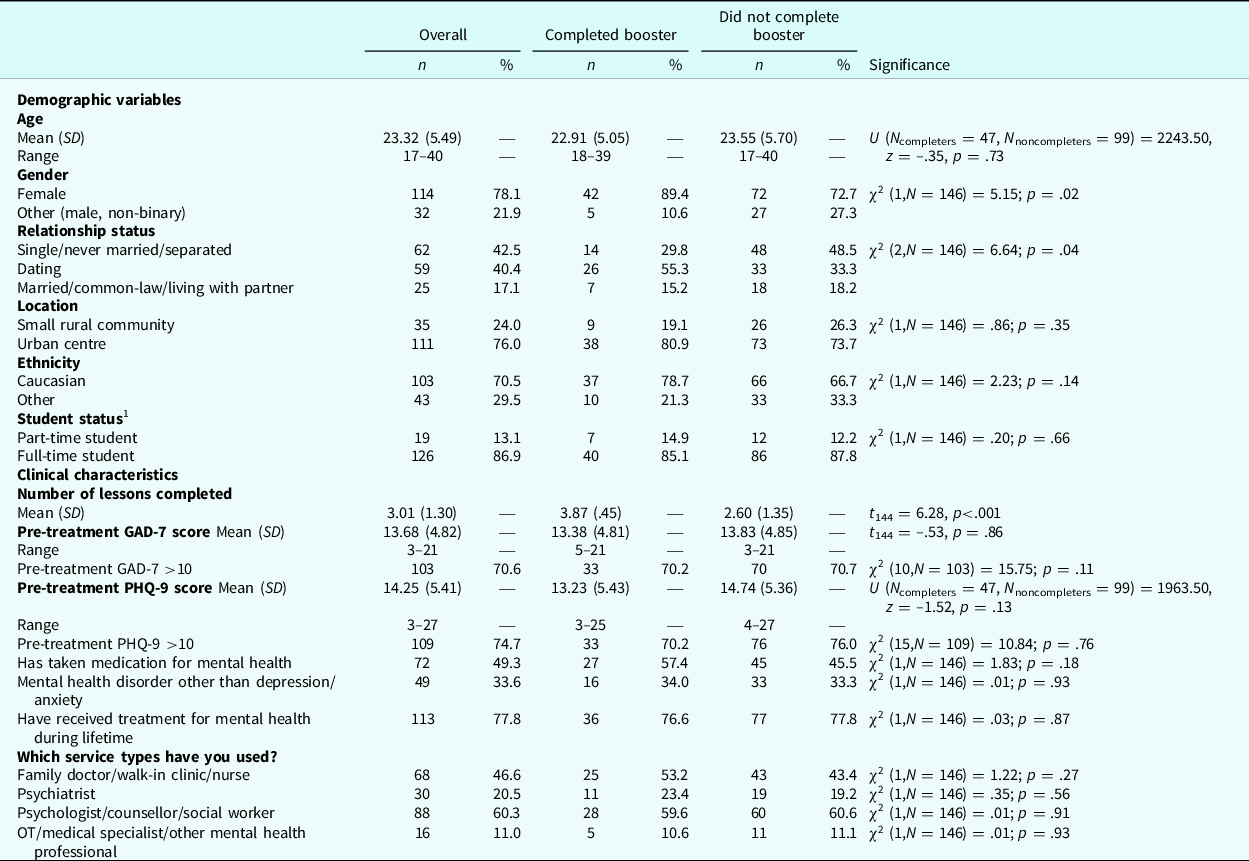
In total, 47 of the 146 (32.19%) clients who were assigned to the booster condition accessed the lesson. Table 1 includes a summary of the demographic and clinical characteristics of the overall sample, as well as those who did or did not complete the booster lesson. Only one difference between groups was present at the .01 level. Clients who completed the booster lesson accessed more lessons on average (mean = 3.87, SD = 0.45) than non-completers (mean = 2.60, SD = 1.35, t 144 = 6.23, p<.001) of the booster lesson. No other significant differences were found (p range: .02–.98).
Demographic variables and clinical characteristics

GAD-7, Generalized Anxiety Disorder Scale 7-Item; PHQ-9, Patient Health Questionnaire 9-Item; OT, occupational therapist.
1 One client did not respond to the question regarding student status.
Booster survey
Secondarily, we explored if those who completed the booster survey differed from those who did not, and did not find any significant group differences (p range: .12–.56).
Preferences for booster lesson
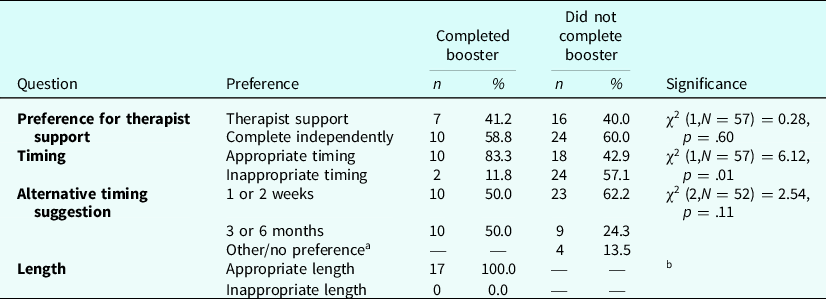
Preferences for therapist support, timing and length of the booster lesson are reported in Table 2. Among both completers and non-completers of the booster lesson, we found no differences between groups in terms of a desire for therapist support, with most clients indicating a preference for completing the booster lesson independently (n = 10, 58.8% completers; n = 24, 60.0% non-completers; see Table 2). In terms of timing of the booster, clients who completed the booster lesson were significantly more satisfied with the timing of the booster lesson (1 month after ICBT ended), with 83.3% (n = 10) of those who completed the booster feeling it was appropriate. Comparatively, only 42.9% (n = 18) of those who did not complete the booster felt the timing was appropriate (p = .01). Clients were asked to suggest an alternative time that the booster lesson could be offered, including 1 week, 2 weeks, 6 months, other, or no preference. There were no differences in opinions between groups, with the most common response being 2 weeks (n = 27, 47.4%) after completing treatment. Of the five clients (13.5%) who had suggestions outside of the provided options, a noteworthy recommendation was to offer the booster at a different time in the semester, when students are less busy. Finally, all those who completed the booster indicated that they felt the booster lesson was of an appropriate length.
Preferences regarding therapist support, timing, and length of the booster

Some participants did not respond to questions and thus sample size varies across items.
a Not included in chi-square analysis given cell size.
b Question only asked of clients who completed the booster lesson, thus no comparison is possible.
Motivation for booster completion and barriers to booster completion
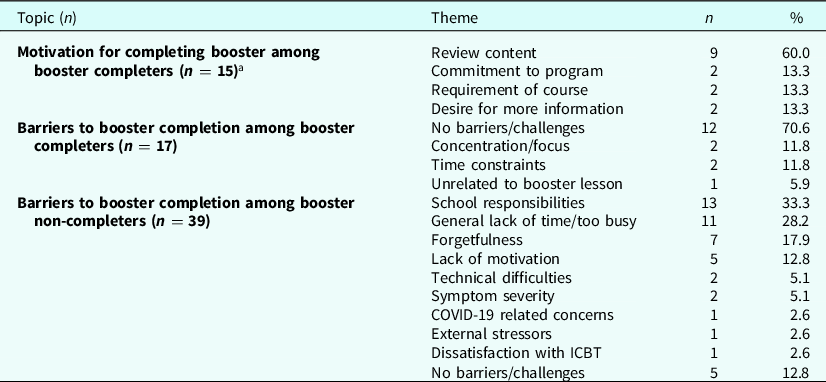
When clients who completed the booster lesson were asked why they completed the booster lesson, four themes were identified: review content, commitment to program, requirement of course, and a desire for more information (Table 3). The most common theme was that clients felt it would be a worthwhile review of the key skills and components of ICBT, with nine clients (60.0%) providing answers such as ‘I thought it would be helpful and help me to better absorb the info’ (ID60519) or ‘to keep up with everything we learned and help it stick to my memory’ (ID60498). In comparison, only five clients who completed the booster identified barriers to completing the booster, with the following themes identified: concentration/focus, time constraints, and reasons unrelated to ICBT (see Table 3).
Motivations and barriers for booster completion

Client responses could be coded into multiple categories. As such, the total is greater than the N displayed.
a Question only asked of participants who completed the booster lesson. Three participants did not provide an explanation of motivation and indicated that they had not finished the booster yet.
When clients who did not complete the booster were asked about barriers that interfered with completion of the booster lesson, a total of 10 themes were identified indicating that barriers included school responsibilities, general lack of time/too busy, forgetfulness, lack of motivation, technical difficulty, symptom severity (e.g. ‘I am a mess and my symptoms are hard to deal with’; ID60286), COVID-19 related concerns, external stressors, dissatisfaction with ICBT, and no barriers/challenges (see Table 3). The most common theme was school-related time constraints (n = 13, 33.3%), followed by a general lack of time (n = 11, 28.2%).
Perceptions of booster lesson among booster completers
Overall, client satisfaction was high among clients who actually completed the booster lesson and evaluation survey. On a scale ranging from 1 (‘not at all’) to 5 (‘very’), clients indicated that the content was easy to understand (mean = 4.75, SD = 0.45), informative (mean = 4.47, SD = 0.80), helpful (mean = 4.06, SD = 1.25), and that they thought the booster would help them manage symptoms of anxiety and/or depression in the future (mean = 3.82, SD = 1.13).
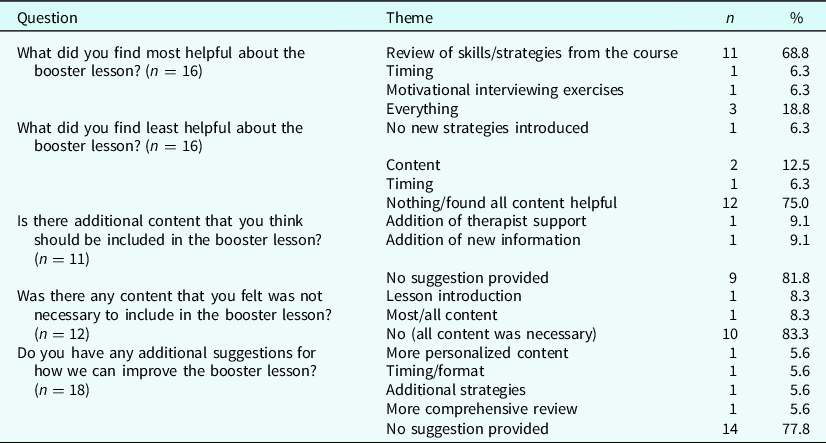
When booster completers were asked about which aspects of the booster lesson were most helpful, the following themes were identified: review of skills or strategies from the course, timing, MI exercises, and everything (Table 4). By far, the most common response (n = 11, 68.8%) was that the booster lesson provided a helpful review of key skills or strategies that were taught in ICBT. When booster completers were asked to indicate which aspects of the booster lesson were least helpful, 75.0% (n = 12) of clients reported that they could not identify any unhelpful aspects and reported that they found all content helpful. Only four clients raised concerns, which were related to content (n = 2), lack of new strategies (n = 1) and timing (n = 1) (Table 4).
Most helpful, least helpful and suggestions for booster improvement among booster completers

Only two booster completers provided responses about what additional content could be added; one client suggested that the addition of therapist support would improve the lesson and another client reported that the addition of new information would improve the lesson. When asked what information was unnecessary to include in the booster lesson, most clients (n = 10, 83.3%) felt that all information was necessary to include (Table 4). However, one client suggested that the lesson introduction did not need to be included and another client reported that most of the content was unnecessary (Table 4).
Finally, we examined suggestions of how to improve the booster among booster completers (Table 4). Most responses (n = 14, 77.8%) indicated that there were no improvements needed, and four separate suggestions were provided by the other clients: more personalized content, timing/format, additional strategies, and more comprehensive review.
Discussion
Booster sessions are often used in face-to-face CBT to maintain and improve symptoms after treatment (Gearing et al., Reference Gearing, Schwalbe, Lee and Hoagwood2013; Whisman, Reference Whisman1990). However, there is limited research on their use in ICBT generally, and no research on this topic among post-secondary students receiving ICBT. As such, this study examined utilization of a booster lesson in ICBT. We followed this by asking clients to complete a survey about preferences for booster lessons generally in terms of therapist support, timing and length, as well as motivations and barriers for booster completion. Finally, among clients who completed the booster, we assessed client satisfaction and feedback on the booster lesson. While the study was largely exploratory, we hypothesized that time restraints would be a barrier to completion of the booster lesson (Ebert et al., Reference Ebert, Mortier, Kaehlke, Bruffaerts, Baumeister, Auerbach, Alonso, Vilagut, Martínez, Lochner, Cuijpers, Kuechler, Green, Hasking, Lapsley, Sampson and Kessler2019) and that there would be a preference for therapist support during the booster lesson (Peynenburg et al., Reference Peynenburg, Mehta and Hadjistavropoulos2020). Finally, we expected to uncover additional information regarding preferences and satisfaction with our exploratory analyses.
Results indicated that a small subset (32.2%) of clients accessed the booster lesson. There were no significant differences between those who completed the booster and those who did not on background variables. Clients who accessed the booster were more likely to have completed all four lessons of the main ICBT course. Interestingly, the study of client preferences suggested that timing may have been a factor related to booster completion and non-completion. It was found that 83% of clients who completed the booster felt offering the booster lesson 1 month after course completion was appropriate, while only 42.9% of clients who did not complete the booster felt the timing was appropriate.
In terms of other notable findings from the study, preferences for the booster lesson were quite diverse. Although it was expected that most clients would prefer therapist support during the booster lesson (Peynenburg et al., Reference Peynenburg, Mehta and Hadjistavropoulos2020), roughly 60% of clients expressed a preference for completing the lesson independently. This finding is consistent with barriers identified by students in the help-seeking literature, in that most students have a preference to self-manage their symptoms (Ebert et al., Reference Ebert, Mortier, Kaehlke, Bruffaerts, Baumeister, Auerbach, Alonso, Vilagut, Martínez, Lochner, Cuijpers, Kuechler, Green, Hasking, Lapsley, Sampson and Kessler2019). Given that there is still a relatively large percentage of clients who wished to have therapist support, future research should consider offering therapist support as an option if the client indicates that this would be preferable. Client feedback regarding the timing of the booster also suggests that students may prefer greater flexibility in when the booster is delivered, as some may not have felt they needed the booster one month after treatment.
Qualitative feedback provided additional information about reasons for completion and non-completion. Overall, completers viewed the booster as a review of helpful information from the course, perceived the booster as a requirement of the treatment, or believed the booster would provide additional strategies for managing symptoms. In sum, the responses regarding client motivation suggest that satisfaction with the content of ICBT was probably an important factor when clients decided to complete the booster lesson. In terms of non-completion, the main obstacle was academic responsibilities, followed by a general lack of time and forgetfulness. The finding that a general lack of time was a significant barrier is consistent with previous research on barriers to mental health service use in students (Ebert et al., Reference Ebert, Mortier, Kaehlke, Bruffaerts, Baumeister, Auerbach, Alonso, Vilagut, Martínez, Lochner, Cuijpers, Kuechler, Green, Hasking, Lapsley, Sampson and Kessler2019) and supported our hypothesis. Other barriers experienced by non-completers, such as symptom severity, lack of motivation, external stressors, and technical difficulties, may help to explain why only a small subsample of clients chose to complete the booster lesson.
Overall, clients who completed the booster lesson reported being satisfied with the content (e.g. rated helpfulness as 4.06 out of 5), length (100.0%), and timing (83.3%) of the booster. Furthermore, a large proportion of clients (68.8%, n = 11) felt that the booster lesson provided a valuable review of skills or strategies from ICBT. Suggestions for improvement included a more detailed review of the course content or the addition of new content in the booster lesson (e.g. more personalized content or additional coping strategies). In one previous study, the inclusion of four weekly 90-minute booster sessions, each of which introduced new strategies that were not covered during group CBT for panic disorder, was useful in maintaining treatment benefits (Wesner et al., Reference Wesner, Gomes, Detzel, Guimarães and Heldt2015). These findings combined with client feedback from this study suggest that incorporating new content such as coping strategies may be an important component to include in a booster lesson.
Strengths and limitations
A primary limitation of this study is the relatively small subsample who responded to the booster survey (62 of the 146 participants). For both the booster completers and booster non-completers, approximately 58% of participants did not respond to the booster survey. It is difficult to determine whether the low response rate to the booster lesson was directly related to the booster, or to a lack of interest in taking part in research. Furthermore, high levels of satisfaction among those who completed the booster lesson must be interpreted with caution against the background of the high percentage of individuals who did not complete the survey. Additional research is warranted to ensure replicability of results, particularly with a larger and more diverse population. Until results have been replicated, findings from this study should only serve as a basis for future research. Furthermore, limited conclusions can be drawn from the qualitative analyses given that responses to the survey were brief. It is possible that open-ended survey questions are not an appropriate measure of clients’ experiences with a booster lesson. Moreover, a limitation of website usage data is that we are only able to determine who accessed the booster lesson, not the extent to which they engaged with the content. Additionally, the survey relied on self-report, which may not be an accurate account of clients’ satisfaction with the ICBT course overall.
Furthermore, the booster lesson was offered in a self-directed format, which prevents us from drawing conclusions about how clients would utilize or perceive a therapist-assisted booster lesson. Although the survey asked clients about whether they would have preferred therapist support while completing the booster lesson, future research should examine whether perceptions and preferences are different when therapist support is present during a booster lesson. Additionally, due to the timing of the booster lesson (one month after treatment), it is possible that some students did not feel as though it was necessary to utilize the booster because their symptoms had not yet worsened. Future research should investigate whether offering a booster lesson after a longer interval after treatment (such as at six months) results in greater uptake due to a recurrence of symptoms. Finally, caution should be taken when interpreting the findings from the booster survey, as the results may be influenced by a self-selection bias. It is possible that clients who were more satisfied with the booster lesson, or the ICBT course more generally, were more likely to complete the booster survey. In future studies, researchers could interview students who did or did not complete the booster to allow for a more comprehensive understanding of clients’ experiences.
Despite the limitations above, this study also has numerous strengths. As this is the first study to analyse the use of booster lessons in ICBT for treatment of depression and anxiety among university students, the findings help to generate ideas for future research on booster lessons that are informed by clients. This study provided information on the uptake of a booster lesson when it is offered in a self-guided format, including the finding that booster utilization is associated with treatment completion. Additionally, this study employed a mixed-methods design. Utilizing both methods for analysis allows for a more comprehensive understanding of factors associated with non-completion and client preferences.
Clinical implications and future directions
The findings from this study suggest that while only a small subsample of clients may utilize a booster lesson, it may be a helpful component to include in future treatment, as clients who completed the booster were highly satisfied with it. Additionally, results indicated that clients who might need the booster, namely those who have not completed the course, were the least likely to complete the booster lesson. While this finding is troublesome, it holds clinical importance. Future research can investigate strategies for therapists to ensure that clients who are most likely to need the booster will ultimately access it. Additionally, future studies can examine how to improve completion of the initial lessons. Finally, it is possible the design of this booster lesson did not meet the needs of all clients. As such, future research can explore whether there are specific factors that can be incorporated into a booster lesson that will make it more appealing to those who may not be as engaged during the initial course of treatment.
Additional important clinical insights were gained from client feedback regarding areas of improvement (e.g. greater flexibility in timing of the booster, inclusion of therapist support). This information may be used in future research to determine whether addressing these issues results in greater uptake. Additionally, promoting client satisfaction with the booster lesson may encourage other clients to utilize this resource. Uptake may be further increased by incorporating material on how to manage common barriers to treatment completion during ICBT as this would allow clients to problem solve and plan ahead before these challenges become overwhelming and prevent them from completing treatment. Future research should consider adjusting options within the booster lesson to best fit the client’s preferences or to explore if providing the booster lesson during school breaks increases booster utilization, as schoolwork demands should be at a minimum during these times. Another noteworthy insight gained from client feedback was that a lack of time interfered with booster completion. One option to address time constraints may be to redesign the booster lesson such that a client can sign up for text message or email reminders that periodically provide a brief summary of core ideas, rather than utilizing a formal review.
Future studies should ensure replicability of results using a larger and more diverse sample. Semi-structured interviews may allow for a deeper understanding of clients’ experiences with the booster lesson. In sum, this study may act as a foundation for future research on booster lessons in ICBT with university students.
Conclusions
Taken together, these findings suggest that the inclusion of a booster lesson may be used by some clients following ICBT. Unfortunately, it seems that those who complete fewer lessons, a group who could potentially benefit most from a booster lesson, are less likely to complete the booster lesson. School-related time constraints was identified as the most prominent reason for non-completion. Client preferences regarding the ideal timing and the inclusion of therapist support were highly variable, and thus future research could explore if incorporating flexibility when the booster lesson is delivered and whether support is available may increase uptake of the booster lesson.
Key practice points
-
(1) Many students may not perceive a need for a booster 1 month after treatment.
-
(2) Help students problem-solve barriers to booster completion prior to the end of treatment.
-
(3) Offer students the option to complete a booster lesson at different time points with or without therapist support after internet-delivered cognitive behaviour therapy.
Supplementary material
To view supplementary material for this article, please visit https://doi.org/10.1017/S1754470X22000265
Data availability statement
The data that support the findings of this study are available on request from the corresponding author, H.D.H. The data are not publicly available due to their containing information that could compromise the privacy of research participants.
Acknowledgements
The authors wish to acknowledge the clients, therapist, research staff, research associates, and web developers associated with the Online Therapy Unit at the University of Regina. We would also like to thank the therapists from the Saskatchewan Health Authority who delivered therapy to many of the clients within this study. We also want to acknowledge Nick Titov and Blake Dear who developed the Wellbeing Course, which informed the development of the booster lesson.
Author contributions
Taylor Patterson: Data curation (equal), Formal analysis (lead), Writing – original draft (lead), Writing – review & editing (equal); Vanessa Peynenburg: Conceptualization (equal), Data curation (equal), Investigation (lead), Methodology (equal), Project administration (lead), Supervision (equal), Writing – review & editing (equal); Heather Hadjistavropoulos: Conceptualization (equal), Funding acquisition (lead), Resources (lead), Supervision (equal), Writing – review & editing (equal).
Financial support
This research was supported by funding from the Canadian Institutes of Health Research awarded to Heather Hadjistavropoulos (reference 152917) and the Saskatchewan Ministry of Health for the Online Therapy Unit. Funding was also provided by the Saskatchewan Centre for Patient-Oriented Research to Vanessa Peynenburg (SCPOR Trainee Award).
Conflicts of interest
Heather Hadjistavropoulos is a Guest Editor of the Cognitive Behaviour Therapist special issue on ‘Advances in Digital CBT’. She was not involved in the review or editorial process for this paper, on which she is listed as an author. The authors do not have any other known competing financial interests or personal relationships that have influenced the work reported in this paper.
Ethical standards
This study was approved by the University of Regina Research Ethics Board (REB #2019-205). All authors have abided by the Ethical Principles of Psychologists and Code of Conduct set out by the Canadian Psychological Association.




Comments
No Comments have been published for this article.