Introduction
Extending the embryo culture period to the blastocyst stage in assisted reproduction has been stated to have several hypothetical benefits over transfer of cleavage stage embryos. These advantages include both higher implantation rate and live birth rate by possibly selecting high potential embryos for transfer, and consequent decrease in the number of embryos transferred, as well as better synchronization between endometrium and embryo at the time of embryo transfer (Practice Committee of the ASRM, 2018). The percentage of embryos that reach the blastocyst stage varies between different reports with the rate as high as 60–65% (Thomas et al., Reference Thomas, Sparks, Ryan and Van Voorhis2010). However, research studies were comprised of inconsistent trials and arguments on the weakness and strengths of extended culture.
Conversely, the development of in vitro fertilization (IVF) policy regarding ‘freeze-all’ options consists of elective cryopreservation of all embryos by vitrification and frozen–thawed embryo transfer. This method leads to a more physiologic endometrial hormonal environment by eliminating probable unwanted side effects on the endometrium of controlled ovarian stimulation (COH). Several studies have been performed to understand whether this almost new strategy might become the gold standard for IVF (Shin et al., Reference Shin, Jeong, Nho and Jee2018, Zaca et al., Reference Zaca, Bazzocchi, Pennetta, Bonu, Coticchio and Borini2018; Shapiro et al., Reference Shapiro, Garner, Aguirre, Nagy, Varghese and Agarwal2019). To date, this procedure has been applied for well defined groups such as high responder patients at risk of developing ovarian hyperstimulation syndrome (OHSS), and patients who waiting for genetic test results, or who are undergoing assisted reproductive technology (ART) cycles with high levels of oestrogen and progesterone (Eftekhar et al., Reference Eftekhar, Mohammadian, Yousefnejad, Molaei and Aflatoonian2012b). This retrospective study aimed to evaluate the clinical outcome of high responder patients after elective cryopreservation of all embryos by vitrification and frozen–thawed embryo transfer of either cleavage or blastocyst stage embryos.
Materials and methods
This retrospective study was performed at Yazd Reproductive Sciences Institute, Iran. This study was confirmed by the Ethics Committee of Yazd Reproductive Sciences Institute, Shahid Sadoughi University of Medical Sciences (IR.SSU.RSI.REC.1397.025).
Patient data
Information was gathered from the ART database over a 6-month period between December 2018 and July 2019. Data of 106 couples were reviewed for the study. All women had undergone their first freeze-all protocol in IVF or intracytoplasmic sperm injection (ICSI). Due to the risk of OHSS, only freeze-all cycles in patients who had more than seven good quality embryos were included in the study. The excluded cases were women aged >35 years, with a body mass index (BMI)>30 kg/m2, a history of diabetes mellitus, thyroid disease or severe endometriosis. Cycles using donated oocytes were also excluded from the study. Women were divided into two groups: group I (blastocyst group) and group II (cleavage group).
Gonadotropin-releasing hormone antagonist protocol
All participants were stimulated according to a gonadotropin-releasing hormone (GnRH) antagonist protocol. Patients received 150 IU recombinant human follicle stimulating hormone (Gonal-F) subcutaneously for 5 days. Serial transvaginal sonography was performed. GnRH antagonist (Cetrotide) (0.25 mg/daily, subcutaneously) was injected after observing mature follicles (≥14 mm). Here, 1500 IU human chorionic gonadotrophin (hCG; Pregnyl, Organon, the Netherlands) and 0.2 mg GnRH-a (Decapeptyl, 0.1 mg, subcutaneously) were used for oocyte triggering when at least two follicles with a mean diameter of 17 mm were detected.
Embryo culture
All embryos were morphologically evaluated on the second day after oocyte retrieval; blastomeres were counted and cytoplasmic fragmentation was assessed; embryos with less than 30% fragmentation were cryopreserved using a vitrification method (Eftekhar et al., Reference Eftekhar, Mohammadian, Yousefnejad, Molaei and Aflatoonian2012b). Thawing was performed at least 2 months after cryopreservation in accordance with the VitroLife protocol (VitroLife, Gothenburg, Sweden) (Fasano et al., Reference Fasano, Fontenelle, Vannin, Biramane, Devreker, Englert and Delbaere2014). Cryopreserved–thawed embryos with ≥50% intact blastomeres and no sign of injury to the zona pellucida were considered morphologically survived. All embryos from group I (blastocyst group) were transferred to sequential medium and cultured for 3 days up to the blastocyst stage. For group II patients (cleavage stage group), embryos were cultured for only 1 day. Blastocysts were considered good for transfer when at least half of the embryo’s volume was occupied by a large blastocoel, the inner cell mass was detectable and the trophectoderm was shaped in accordance with the Gardner and Schoolcraft scoring system (Gardner et al., Reference Gardner, Schoolcraft, Wagley, Schlenker, Stevens and Hesla1998).
Endometrium preparation
Endometrium preparation was the same for both groups. Oestradiol valerate (Estradiol Valerate, Aburaihan Co, Tehran, Iran) was administered orally at a dose of 6 mg per day from the second day of the menstrual cycle. Ultrasound investigation was started from day 13 to measure endometrial thickness, which was assessed as the highest diameter in the fundal region. When endometrial thickness reached >8 mm, all patients received Cyclogest Ovaginal pessaries (Cox Pharmaceuticals, Barnstaple, UK) 400 mg twice daily until menstruation or for 8 weeks after embryo transfer in women who reaches clinical pregnancy. Oestradiol and Cyclogest administration were continued until the observation of fetal heart activity by ultrasound. In both groups, embryo thawing was performed 2 days after the beginning of progesterone consumption. Embryos in the cleavage and blastocyst groups were transferred 1 day and 3 days after thawing, respectively. Two good quality embryos were transferred in each group using a Labotect catheter (Labotect, Gottingen, Germany).
Clinical outcome
Clinical pregnancy was considered as the primary outcome and defined by observing fetal heart activity via transvaginal ultrasonography 5 weeks after positive β-hCG. Secondary outcomes were chemical pregnancy that was defined as serum β-hCG > 50 IU/l, 14 and 12 days after embryo transfer in cleavage and blastocyst groups respectively. Ongoing pregnancy was defined as pregnancy taking place beyond the 12th gestational week, and spontaneous miscarriage was defined as loss of pregnancy before 20 weeks of gestation; implantation rate was defined by the number of gestational sacs per 100 transferred embryos.
Statistical analysis
We hypothesized that, in total, at least 100 cases (50 in each group) were needed to attain a 15% difference in the clinical pregnancy rate, as our primary outcome between the two groups. A power of 80% and P < 0.05 level of significance were considered for this study. Statistical analysis was carried out using Statistical Product and Service Solutions (SPSS) v.20 for Windows (SPSS Inc., Chicago. IL, USA). Between-group differences for normal or non-normal distributions were calculated using Student’s t-test and Mann–Whitney U-test respectively. Differences between non-continuous variables were compared using the chi-squared test.
Results
For this study, the data of 106 couples were reviewed: 53 couples in group I (blastocyst group) and 53 couples in group II (cleavage group). In total, 267 embryos were thawed in both groups; 96% (256 embryos: 153 in group I and 103 in group II) survived after thawing. In the blastocyst group 101/153 embryos (66%) reached the blastocyst stage; 103 embryos in the cleavage group and 101 embryos in the blastocyst group were transferred.
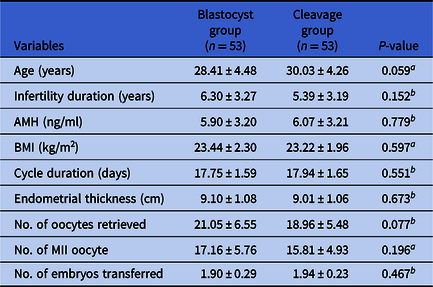
As shown in Table 1, basic data and cycle characteristics of patients were matched between the two groups. The number of retrieved oocytes, metaphase II (MII) oocytes and number of transferred embryos were similar in both groups (Table 1).
Basic data and cycle characteristics of the participants in two groups

Data are presented as mean ± standard deviation (SD).
AMH, Anti Müllerian hormone; BMI, body mass index; MII, metaphase II.
a Student’s t-test; b Mann–Whitney U-test.
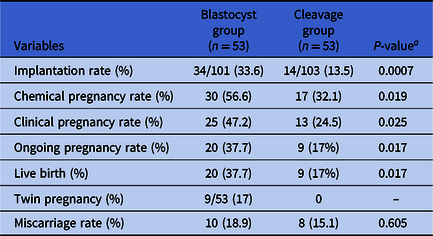
For clinical outcomes, clinical (47.2% vs. 24.5%), chemical (56.6% vs. 32.1%), and ongoing pregnancy rates (37.7% vs. 17%) as well as implantation rates (33.6% vs. 13.5%) were significantly higher in the blastocyst group compared with cleavage group (P < 0.05; Table 2). Live birth rates was significantly higher in the blastocyst group compared with cleavage transferred embryo group (37.7% vs. 17%, P < 0.05; Table 2). Only women in the blastocyst group had twin pregnancies in 17% of cycles and no significant difference was found in the miscarriage rate between the two groups.
ART outcomes in frozen embryo cycles

Data are presented as number (%)
a Chi-squared test.
Discussion
The day-3 versus day-5 embryo transfer (ET) argument has been a scientific concern for the last 2 decades. In this retrospective study, we showed a higher pregnancy rate after transfer of blastocyst stage embryos compared with cleavage stage frozen ET in women with high ovarian response. Previously, in a randomized trial, we found that blastocyst formation after thawing of cleavage stage embryos is an appropriate predictor for embryo implantation potential and pregnancy outcome in women with different responses to ovarian stimulation and undergoing IVF/ICSI (Eftekhar et al., Reference Eftekhar, Aflatoonian, Mohammadian and Tabibnejad2012a). Similarly, Mesut and colleagues showed that for thawing cycles, the extension of embryos to remain in culture to the blastocyst stage on day 5, before or after cryopreservation, resulted in higher rates of implantation, clinical pregnancy, and delivery per thawing cycle compared with day-3 transfers (Mesut et al., Reference Mesut, Ciray, Mesut, Aksoy and Bahceci2011). The current study was performed among high responder women and was similar to our research. Wu and colleagues compared the clinical outcomes between three groups of day-3 ET, day-5 single blastocyst transfer and frozen–thawed ET in high responder patients undergoing IVF/ICSI treatment (Wu et al., Reference Wu, Zhao, Liu, Li, Ma, Li, Liu and Chen2014). In contrast with our results, they reported that the clinical pregnancy rate was significantly lower in single blastocyst transfer compared with day-3 ET groups, while these two groups revealed comparable implantation rates (Wu et al., Reference Wu, Zhao, Liu, Li, Ma, Li, Liu and Chen2014). Similarly, the clinical pregnancy rate and implantation rate in frozen ET (FET) cycles were significantly higher compared with those in single blastocyst transfer cycles (Wu et al., Reference Wu, Zhao, Liu, Li, Ma, Li, Liu and Chen2014). A randomized clinical trial in women under the age of 39 did not show any significant difference in terms of implantation and pregnancy rates for fresh blastocyst stage transfer versus cleavage stage transfer (Levi-Setti et al., Reference Levi-Setti, Cirillo, Smeraldi, Morenghi, Mulazzani and Albani2018). More recently, with ongoing improvement in culture medium, ART laboratories have been able to extend embryo culture to the blastocyst stage, with increasing clinical pregnancy and live birth rates, as well as decreased multiple pregnancy rates (Papanikolaou et al., Reference Papanikolaou, Kolibianakis, Tournaye, Venetis, Fatemi, Tarlatzis and Devroey2008). To describe the clinical aspects associated with blastocyst development and pregnancy, it was found that in cycles that developed at least four excellent or high-quality blastocysts, there was a four times likelihood for an ongoing pregnancy compared with those cycles without excellent or high-quality blastocysts (Thomas et al., Reference Thomas, Sparks, Ryan and Van Voorhis2010). Other patients and cycle features that were significantly correlated with optimistic pregnancy outcome included younger female age, higher antral follicle count, and no male factor infertility (Thomas et al., Reference Thomas, Sparks, Ryan and Van Voorhis2010).
We also followed pregnant women into live birth. Recent studies have shown that live birth rates per fresh cycle were significantly lower after transferring the fresh single cleavage stage embryo, compared with a blastocyst (De Vos et al., Reference De Vos, Van Landuyt, Santos-Ribeiro, Camus, Van De Velde, Tournaye and Verheyen2016, Glujovsky et al., Reference Glujovsky, Farquhar, Quinteiro Retamar, Alvarez Sedo and Blake2016). Conversely, Carvalho and colleagues stated that blastocyst transfer was preferable compared with cleavage stage transfer in fresh ET cycles. However, for frozen–thawed cycles, cleavage or blastocyst stage embryos seemed to offer comparable implantation rates for clinical and ongoing pregnancy and live birth (Carvalho et al., Reference Carvalho, Barbosa, Bonesi, Gomes, Cabral, Barbosa, Silva, Iglesias and Nakagawa2017). Surprisingly, Zue and colleagues found that blastocyst transfer in the first IVF cycle led to significantly higher pregnancy and live birth rates compared with cleavage ET, but this result was not significant for the second IVF cycle (Zhu et al., Reference Zhu, Zhu, Wang, Wang, Wang, Yin, Zhang, Lyu and Kuang2019). Moreover, cumulative live birth rates were reported to be significantly higher in the freeze-all cycles when ET was performed at the blastocyst stage (Zaca et al., Reference Zaca, Bazzocchi, Pennetta, Bonu, Coticchio and Borini2018). Although it was declared that the probability of a live birth was increased by 17% for each extra blastocyst up to five, the odds were 2% lower for every additional blastocyst after five (Smeltzer et al., Reference Smeltzer, Acharya, Truong, Pieper and Muasher2019).
We found twin pregnancy in 17% of cycles for women in the blastocyst group and there was no twin pregnancy for women in the cleavage group. Similarly, in the Salem and colleagues’ study, multiple pregnancy rate in the day-3 ET group was 14% compared with 31% in the day-5 ET group (Salem et al., Reference Salem, Mosa, Matar and Elsamanoudy2019). Our result regarding higher twin pregnancy rate in blastocyst stage transfer was in line with the report of the National ART Surveillance System (NASS) for the USA in the year 2012. Cycles with transfer of two fresh blastocysts were categorized as one of the four groups at higher risk for multiple pregnancies (Kissin et al., Reference Kissin, Kulkarni, Mneimneh, Warner, Boulet, Crawford and Jamieson2015). Furthermore, the American Society for Reproductive Medicine (ASRM) guidelines recommended that patients under the age of 35 should be motivated to take a single ET, regardless of the embryo stage in FET cycles. However, the optimum decision should be made based on a woman’s age, the existence of high-quality euploid embryos for cryopreservation, and previous live birth after an IVF cycle (Practice Committee of the ASRM, 2017).
In the current study, the miscarriage rate was comparable between groups. Similarly, another study reported no significant difference in spontaneous miscarriage between blastocyst and cleavage stage transferred embryos in fresh cycles (Levi-Setti et al., Reference Levi-Setti, Cirillo, Smeraldi, Morenghi, Mulazzani and Albani2018). However, other studies have found lower miscarriage rates among blastocyst transfer embryos compared with cleavage transfer ones (Mesut et al., Reference Mesut, Ciray, Mesut, Aksoy and Bahceci2011, Zhu et al., Reference Zhu, Xi, Zhang, Li, Ai and Jin2013).
It seems that, following many years of research, combined data may now offer supporting evidence for the day-5 ET (Glujovsky et al., Reference Glujovsky, Farquhar, Quinteiro Retamar, Alvarez Sedo and Blake2016). Nevertheless, there are several areas that may affect the decision for autologous blastocyst transfer, especially the risk of cycle termination without any embryos available for transfer on day 5 because of increased risk of developmental arrest and the threat of epigenetic changes due to prolonged culture (Kontopoulos et al., Reference Kontopoulos, Simopoulou, Zervomanolakis, Prokopakis, Dimitropoulos, Dedoulis, Grigorakis, Agapitou, Nikitos, Rapani and Vlahos2019). The option of blastocyst stage embryo culture may have been overstated in the published literature due to the variety of the patient population. Studies have shown that, when encouraging personalized medicine, the decision to extend culture ought to be made based on both the patient’s age and the ovarian response to stimulation (Glujovsky et al., Reference Glujovsky, Farquhar, Quinteiro Retamar, Alvarez Sedo and Blake2016).
Conversely, 10 years of data analysis from a single centre showed that there was no adverse perinatal effects and congenital malformation after blastocyst transfer compared with cleavage stage transfer (Shi et al., Reference Shi, Zhang, Li, Xue, Liu, Qu, Shi and Huang2019). Furthermore, significantly higher pregnancy rates have been reported in cases of frozen–thawed ET cycles compared with fresh cycles, because of no adverse effects on the endometrial receptivity of supra-physiologic steroid levels during stimulation (Shapiro et al., Reference Shapiro, Daneshmand, Garner, Aguirre, Hudson and Thomas2011). Therefore, cryopreserved cycles provide better synchronization between the recipient’s endometrium and the embryo(s) transferred (Shapiro et al., Reference Shapiro, Daneshmand, Garner, Aguirre, Hudson and Thomas2011). Fortunately, with the application of blastocyst vitrification, FET cycles have been used more commonly in patients with no chance for ET in fresh cycles or who have had previous IVF failure. In this study we found that FET could offer satisfactory pregnancy and live birth rates as well as comparable miscarriage rates. Therefore, FET may be the preferable strategy for high responders to improve clinical outcome.
In conclusion, FET for blastocyst stage embryos was the optimum strategy for high responder patients undergoing ART cycles to increase implantation, pregnancy and live birth rates compared with patients undergoing cleavage ET. Furthermore, it seems that we should change our strategy and transfer single good quality blastocysts to reduce the risk of twin pregnancy.
Acknowledgements
The authors thank the staff of the ART laboratory as well as operating room personnel at the Yazd Reproductive Sciences Institute for their great contribution to all laboratory procedures and data collecting.
Financial support
This study was supported by funding from Yazd Reproductive Sciences Institute, Shahid Sadoughi University of Medical Sciences, Iran.
Conflict of interest
The authors declare that they have no conflict of interest.
Ethical standards
This study was approved by the Ethics Committee of Yazd Reproductive Sciences Institute, Shahid Sadoughi University of Medical Sciences (IR.SSU.RSI.REC.1397.025).