1. Introduction
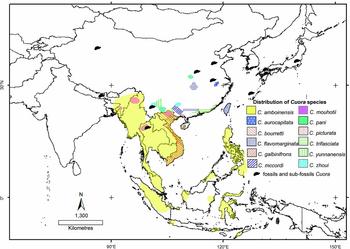
Cuora Gray, Reference Gray1855 is a living and fossil genus of Geoemydidae, which is geographically restricted to Asia. Living species of Cuora are found in both continental areas and insular regions of Southeast and East Asia (Iverson, Reference Iverson1992; Parham et al. Reference Parham, Simison, Kozak, Feldman and Shi2001) as shown in Figure 1. During the last three decades, the genus has received scientific interest in terms of systematics and taxonomy (Parham et al. Reference Parham, Stuart, Bour and Fritz2004; Stuart & Parham, Reference Stuart and Parham2004; Blanck, McCord & Le, Reference Blanck, McCord and Le2006; Spinks, Thomson & Shaffer, Reference Spinks, Thomson and Shaffer2009; Spinks et al. Reference Spinks, Thomson, Zhang, Che, Wu and Shaffer2012). Hypotheses regarding phylogenetic relationships within the genus are diverse (Yasukawa, Hirayama & Kikida, Reference Yasukawa, Hirayama and Kikida2001; Honda et al. Reference Honda, Yasukawa, Hirayama and Ota2002; Stuart & Parham, Reference Stuart and Parham2004; Spinks & Shaffer, Reference Spinks and Shaffer2007; Zhang et al. Reference Zhang, Nie, Cao and Zhang2008; Spinks, Thomson & Shaffer, Reference Spinks, Thomson and Shaffer2009; Spinks et al. Reference Spinks, Thomson, Zhang, Che, Wu and Shaffer2012). Among major findings, recent phylogenetic studies (Spinks, Thomson & Shaffer, Reference Spinks, Thomson and Shaffer2009) suggest that the genera Pyxidea Gray, Reference Gray1863 and Cistoclemmys Gray, Reference Gray1863 should be included in Cuora for the genus to be monophyletic, a position that we adopt here. In addition to uncertainties regarding the phylogeny of the genus, species delimitation hardly reaches a consensus: the number of recognized species within the genus Cuora still varies from author to author from 10 living species (Fritz & Havas, Reference Fritz and Havas2006) to 12 or 13 living species (Iverson, Reference Iverson2008; Spinks, Thomson & Shaffer, Reference Spinks, Thomson and Shaffer2009; Turtle Taxonomy Working Group, 2011). Taxonomy and systematics is rendered difficult for at least three reasons:
Distribution of living, sub-fossil and fossil Cuora species (the living distribution was compiled from Nutaphand, Reference Nutaphand1979; McCord & Iverson, Reference McCord and Iverson1991; Fong, Parham & Fu, Reference Fong, Parham and Fu2002; Bonin, Devaux & Dupre, Reference Bonin, Devaux and Dupre2006; Turtle Taxonomy Working Group, 2011; Spinks et al. Reference Spinks, Thomson, Zhang, Che, Wu and Shaffer2012).

(1) Some species have a small geographical range or are unknown in the wild. For instance, Cuora yunnanensis was considered extinct until it was recently rediscovered (Zhou & Zhao, Reference Zhou and Zhao2004; Blanck, Reference Blanck2005; He et al. Reference He, Zhou, Rao and Zhang2007); species such as C. mccordi were for a long time unknown in the wild (Zhou et al. Reference Zhou, Blanck, McCord and Li2008).
(2) The presence of nuclear mitochondrial pseudogenes has led to misinterpretations in molecular-based phylogenies (Spinks, Thomson & Shaffer, Reference Spinks, Thomson and Shaffer2009).
(3) Incomplete lineage sorting and introgression seems common between species of Cuora and between Cuora and other geoemydid genera (Stuart & Parham, Reference Stuart and Parham2007; Spinks, Thomson & Shaffer, Reference Spinks, Thomson and Shaffer2009). This complexity is well illustrated by the species C. serrata Iverson & McCord, Reference Iverson and McCord1992. This species was thought to result from hybridization in a turtle farm for the pet trade since it was not known in the wild (Parham et al. Reference Parham, Simison, Kozak, Feldman and Shi2001; Stuart & Parham, Reference Stuart and Parham2004, Reference Stuart and Parham2007). This taxon was later discovered in the wild and analysed showing that the hybridization was not necessarily driven by farming practices only (Shi et al. Reference Shi, Parham, Simison, Wang, Gong and Fu2005; Spinks, Thomson & Shaffer, Reference Spinks, Thomson and Shaffer2009).
Thanks to an increasing number of studies, the systematics of Cuora has nevertheless progressed, but problems in species delimitation still impact the way we understand it. Different genes provide different signals, possibly owing to introgression and hybridization (Spinks, Thomson & Shaffer, Reference Spinks, Thomson and Shaffer2009). Recently, Spinks et al. (Reference Spinks, Thomson, Zhang, Che, Wu and Shaffer2012) provided one of the most detailed molecular studies, which resulted in much clearer and better supported nodes within the Cuora genus.
On the other hand, the fossil record of the genus is poorly documented, especially for pre-Neolithic times. A better knowledge of fossil Cuora can certainly help form a better understanding of the systematics and evolution of the genus. Fossil Cuora have been recorded (see Fig. 1) from the Late Miocene to the Neolithic of China and Japan (Yeh, Reference Yeh1994b ; Takahashi, Otsuka & Ota, Reference Takahashi, Otsuka and Ota2008), including Cuora pitheca Yeh, Reference Yeh1981 from the Late Miocene of Lufeng, Yunnan, China; C. miyatai (Shikama, Reference Shikama1949) from the Middle Pleistocene of Oita Prefecture in Kyushu, and Tochigi and Yamaguchi prefectures in Honshu, Japan (Hirayama, Reference Hirayama2007); Cuora sp. from the Pliocene of Anhui, China (Yeh, Reference Yeh1994a ); and C. flavomarginata from the Late Pleistocene and Neolithic of China (Zhejiang, Shandong, Henan; Yeh, Reference Yeh1961, Reference Yeh1983, Reference Yeh1985a ,Reference Yeh b ; Yeh & Zhang, Reference Yeh and Zhang1994) and the Late Pleistocene of the Ryukyu Archipelago, Japan (Takahashi, Otsuka & Ota, Reference Takahashi, Otsuka and Ota2008).
In this paper, we report on a recently discovered specimen of Cuora from the late Middle – early Late Miocene of the Chiang Muan coal mine in Northern Thailand. The detailed description and systematic study of that specimen is presented here. It is assigned to a new species, Cuora chiangmuanensis sp. nov. Its morphology and phylogenetic relationships with modern taxa shed new light on the origin and evolutionary history of Asian box turtles.
2. Geological setting
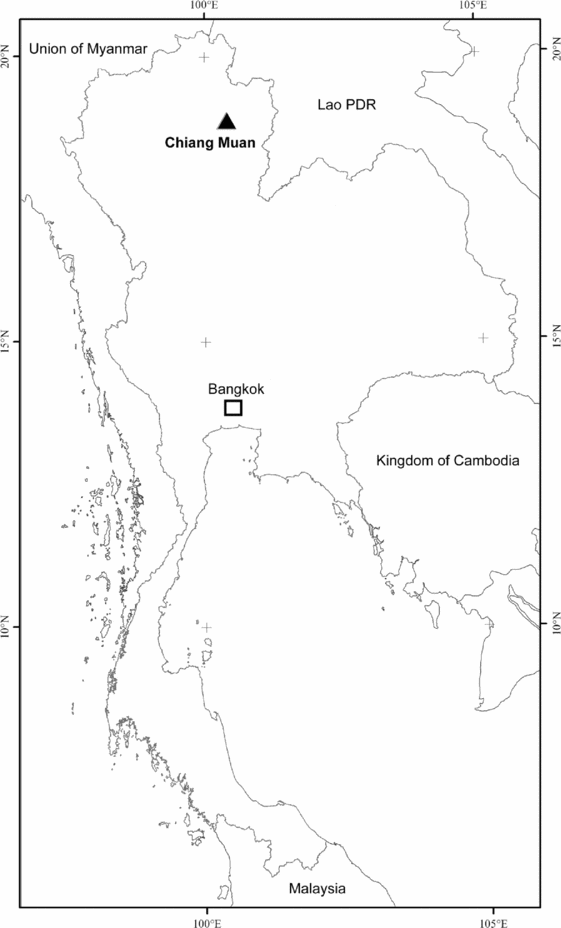
Chiang Muan coal mine is located in the Chiang Muan Basin, Tambon Ban Sra, Chiang Muan District, Phayao Province, Northern Thailand (Fig. 2). The Tertiary sedimentary rocks of the Chiang Muan coal mine consist of alternating beds of conglomerates, sandstones, mudstones, claystones and coal, which have yielded a rich vertebrate fauna. The palaeomagnetic study and mammalian fossils indicate a late Middle Miocene to an early Late Miocene age for this sequence (about 11–12 Ma, Kunimatsu et al. Reference Kunimatsu, Ratanasthien, Nakaya, Saegusa and Nagaoka2004; Pickford et al. Reference Pickford, Nakaya, Kunimatsu, Saegusa, Fukuchi and Ratanasthien2004; Silaratana et al. Reference Silaratana, Ratanasthien, Takayasu, Fyfe, Asnachinda, Kandharosa and Kusakabe2004 or 9.8–13 Ma, Suganuma et al. Reference Suganuma, Hamada, Tanaka, Okada, Nakaya, Kunimatsu, Saegusa, Nagaoka and Ratanasthien2006). The vertebrate assemblage from Chiang Muan Mine includes fishes, crocodiles, birds, mammals, snakes and turtles (Nakaya et al. Reference Nakaya, Saegusa, Kunimatsu and Ratanasthien2002; Silaratana et al. Reference Silaratana, Ratanasthien, Takayasu, Fyfe, Asnachinda, Kandharosa and Kusakabe2004). Most turtle remains are shell elements which belong to geoemydid turtles. There are at least two geoemydid turtles based on the morphology of the xiphiplastron. In addition, Nakaya et al. (Reference Nakaya, Saegusa, Kunimatsu and Ratanasthien2002) reported Testudines, fam., gen. et sp. indet. Most specimens are represented by isolated plates. The specimen of Cuora studied in this work is one of the most complete geoemydid turtle specimens. It was collected by Mr Nikorn Wongchai, a geologist of the mine at that time, from the CMu 6 level, a ligneous claystone level under the lower massive coal seam (LM).
Map showing the location of Chiang Muan coal mine in Phayao Province, Northern Thailand (indicated by black triangle).

3. Material analysed and fossil preparation
The studied specimen (Cme-1/1) is housed at the Chiang Muan Mine museum, Phayao Province, Thailand. It comprises an articulated shell and a humerus and femur as disarticulated elements, all belonging to one individual. The material is fragile and was partly embedded within lignite. The material was first prepared using a needle to remove the matrix, then cleaned using 10&lsn;% sodium hydroxide (NaOH) to allow more details of sulci and sutures to be visible. It was then rinsed in water and the surface was cleaned using a soft brush and finally dried.
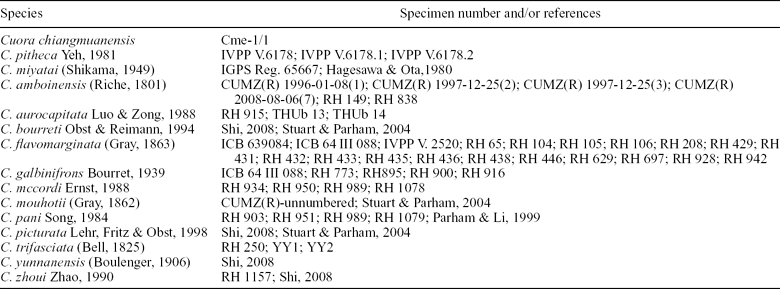
The specimens consulted for the comparison section of this study are listed in Table 1.
List of Cuora specimens in the comparison section of this study

Institutional abbreviations. CIB – Chengdu Institute of Biology, Chinese Academy of Sciences, China; Cme – Chiang Muan Mine museum; CUMZ(R) – Chulalongkorn University Museum Zoology (Reptile), Bangkok, Thailand; IVPP – Institute of Vertebrate Palaeontology and Palaeoanthropology, Chinese Academy of Sciences, Beijing, China; PRC – Palaeontological Research and Education Centre, Mahasarakham, Thailand; RH – Ren Hirayama's Collection; THUb – Teikyo Heisei University, Japan; YY – Yuichiro Yasukawa's Collection, Japan.
Anatomical abbreviations. Ab – abdominal; An – anal; C – costal; Cv – cervical; Fe – femoral; H – humerus; hyp – hypoplastron; m – marginal; n – neural; N – nuchal; p – peripheral; Pl – pleural; sp – suprapygal; V – vertebral; xi – xiphiplastron.
4. Systematic palaeontology
Order TESTUDINES Linnaeus, Reference Linnaeus1758
Suborder CRYPTODIRA Cope, Reference Cope1868
Superfamily Testudinoidea Batsch, Reference Batsch1788
Family Geoemydidae Theobald, Reference Theobald1868
Genus Cuora Gray, Reference Gray1855
Cuora chiangmuanensis sp. nov.
Etymology. The species name refers to the type locality.
Holotype. An articulated carapace and a complete posterior lobe of a plastron, a humerus and a femur (Cme-1/1).
Type locality and horizon. Chiang Muan coal mine, Tambon Ban Sra, Chiang Muan District, Phayao Province, Northern Thailand; CMu 6, ligneous claystone under lower massive coal seam (LM), late Middle or early Late Miocene.
Diagnosis. A species of Cuora of moderate size (carapace length around 20 cm); carapace oval in shape with smooth margin. It is diagnosed by the following combination of characters: absence of vertebral keel extending anteriorly; first vertebral wide anteriorly nearly reaching the second marginal; smooth posterior margin (differs from C. mouhotii and C. serrata); fully divided anal scutes (unlike C. bourreti, C. flavomargianata, C. galbinifrons and C. picturata); very small anal notch present but smaller than that of C. pitheca, C. mccordi, C. pani, C. mouhotii, C. trifasciata and C. zhoui; well-developed lips on the posterior lobe of the plastron.
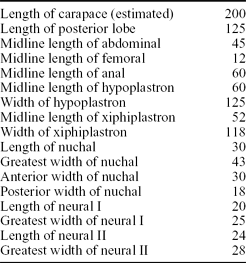
Measurements. See Table 2.
Shell measurements (in millimetres) of the holotype of Cuora chiangmuanensis sp. nov.

4.a. Description
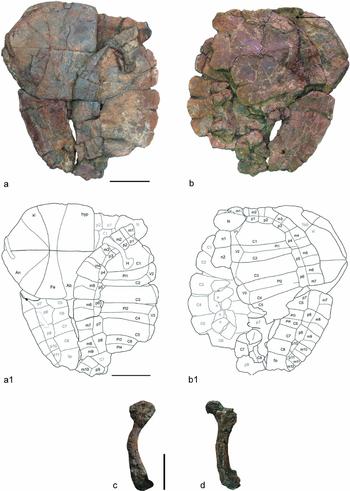
Preservation. The holotype (Cme-1/1) consists of a nearly complete carapace, the posterior half of a plastron, a left humerus and a femur. The carapace is broken into two parts along the midline and the left part of the carapace is turned over to lie on the ventral surface of the plastron. The posterior lobe of the plastron is turned 90° to the right (see Fig. 3).
Shell and limb bones of Cuora chiangmuanensis sp. nov. from Chiang Muan Mine, Phayao Province. Holotype (Cme-1/1): (a, b) carapace and plastron; (c) humerus; (d) femur. Inguinal buttress is indicated by arrow. Scale bar of shell is 5 cm and that of limb bones is 2 cm.

The shell is flattened dorso-ventrally and the anterior margin of the carapace is damaged. Sulci and sutures are well preserved except for the fifth vertebral sulcus, which cannot be observed. The preserved part of the carapace consists of the nuchal plate, the first to eleventh left and right peripheral plates, the first to fifth and distal part of the sixth to eighth left costal plates and the first to eighth right costals. The medial portions of the fifth to eighth costal plates of the right side are broken. The first and second neural plates are preserved in their original position and presented in dorsal view, while four other neural plates are disarticulated from the carapace and scattered on the visceral side of the left costal plates, presented on the internal view. Other neural plates are not preserved. The first suprapygal and pygal are missing. The second suprapygal is preserved but the anterior and left parts are missing. On the plastron, only the hypoplastra and xiphiplastra are preserved.
Carapace. (Fig. 3a, b) The shell has an oval outline. The carapace outer surface is smooth without ornamentation or growth annuli. There are no fontanelles on the carapace (Fig. 3a, b). The carapace is not sutured to the plastron. The anterior and posterior carapace margins are smooth. The vertebral keel is indistinct.
The nuchal plate is hexagonal in shape with a narrow posterior end. The anterior rim of this plate is damaged. The first and second neural plates, preserved in situ, are hexagonal with short postero-lateral sides. The first neural is as wide as it is long. The second neural is slightly wider than long and longer than the first neural. The outline of the medial margin of the costal plates suggests that the third to fifth neural plates are also wider than long and hexagonal with short postero-lateral sides (see Fig. 3a1, b1). The four scattered neurals, presented in internal view, are interpreted as the third to sixth neurals. The neural formula is, therefore, 6P,6P,6P,6P,6P,6P,?,?. The wide sixth neural with a long posterior margin indicates the presence of the seventh neural, but whether the eighth neural is present or absent is indeterminate. The presence and shape of the first suprapygal cannot be determined. As indicated by the outline of the peripherals, the eighth costals and by its preserved portions, the second suprapygal plate is probably hexagonal in shape. The pygal plate is not preserved. The first costal plate is the longest. It contacts the first peripheral plate to the anterior half of the fourth peripheral plate. The second to fourth costal plates are relatively short, slightly decreasing in length backwards. The fifth costal plate is curved posteriorly and reaches the eighth peripheral plate. There is a very short inguinal scar on the inner surface of the lateral end of the left sixth costal and seventh peripheral (see in Fig. 3a). The sixth and seventh costal plates are smaller and narrower; they are also curved posteriorly. The sixth costal plate contacts the eighth and ninth peripheral plates. The seventh costal plate contacts the ninth and tenth peripheral plates. The eighth costal plate contacts the tenth and eleventh peripheral plates. The first peripheral plate is longer than wide. The second to eleventh peripheral plates are more slender, mesio-laterally expanded and reduced in size posteriorly. The right seventh peripheral plate exhibits a distinct musk duct foramen on the ventral surface (see Fig. 3a1).
The cervical scute is incomplete. Its posterior part is rather wide. The first vertebral scute is as wide as the nuchal. It is wider anteriorly with the anterior margin more than twice its posterior margin, and nearly reaches the second marginal scute. The second and third vertebral scutes are rather narrow and hexagonal in shape with the posterior half narrower than their anterior half. The first pleural scute is long and extends posteriorly until the anterior half of the second costal plate, and contacts the anterior half of the fifth marginal scute. The second and third pleural scutes are shorter. The second pleural scute contacts the fifth and the sixth marginals, which can be observed clearly on the left side. The third pleural scute reaches the sixth to eighth marginal scutes. The fourth pleural scute is the smallest of all. It is slightly longer than wide. The pleuro-marginal sulcus is situated below the costo-peripheral suture.
Plastron. (Fig. 3a, b) Only the posterior half of the plastron is preserved. The plastral surface is smooth. The posterior border of the posterior plastral lobe is rounded. A very small anal notch is present. The hypoplastron is as long as the xiphiplatron in the midline. The anterior border of the hypoplastron corresponding to the pectoro-abdominal sulcus is straight and clearly rounded, indicating a hinge between the hyoplastra and hypoplastra. The hypo-xiphiplastral suture is slightly convex anteriorly. The abdomino-femoral sulcus is convex posteriorly. There is no constriction on the lateral borders of the xiphiplastra at the femoro-anal sulcus. The maximum length of the anal scutes is longer than the midline length of the abdominal scutes, which are both much longer than the midline length of the femoral scutes. The partial scute formula for the plastron is An > Ab > Fe. The maximum length of the anal scutes is 5.8 times greater than that of the femoral scutes. The femoro-anal sulci form a right angle between each other and oblique to the midline. This sulcus reaches the hypo-xiphiplastral suture at the midline.
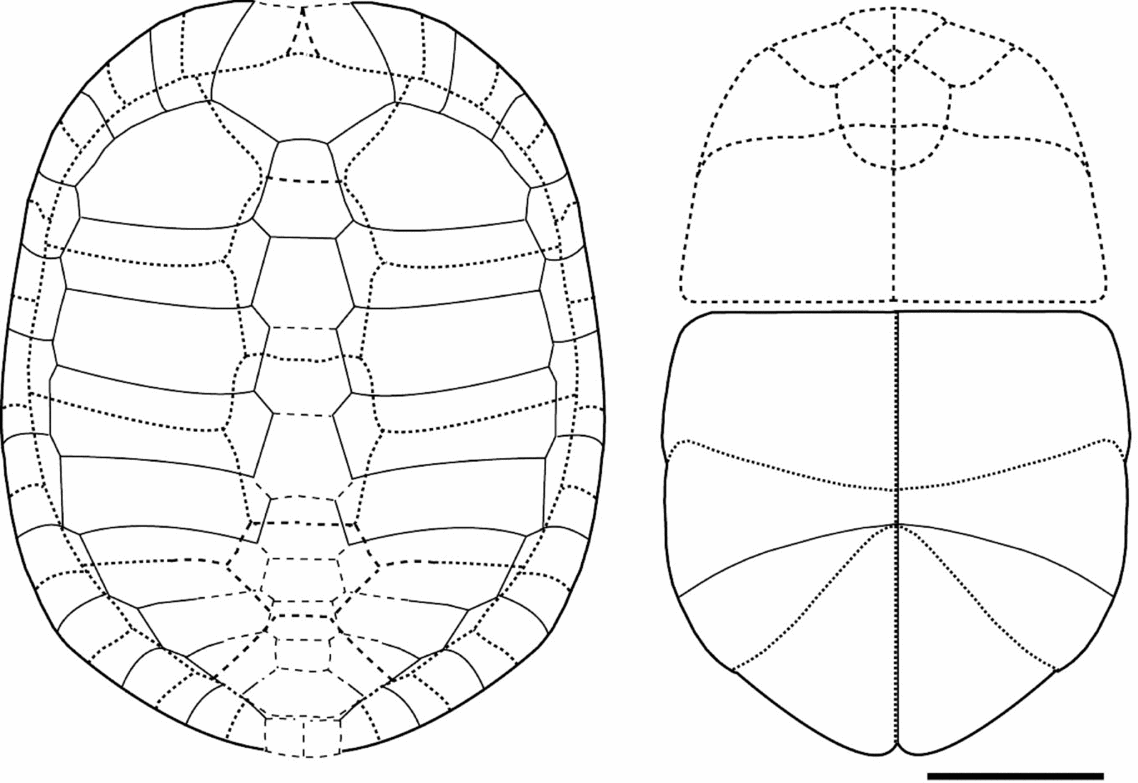
On the inner surface of the plastron, a weak inguinal buttress is preserved on the left side (see Fig. 3b). The lip is well developed; it is very wide and flat on the anterior part, and becomes narrower posteriorly. The anal lip is rather wide and thick. The reconstruction of the shell is shown in Figure 4.
Reconstruction of the shell of Cuora chiangmuanensis sp. nov. Scale bar is 5 cm.

Humerus. (Fig. 3c) The left humerus was preserved as an isolated element on the left side of the carapace (Fig. 3a). It is 4.5 cm in length. It is nearly complete but flattened, especially the proximal and distal parts. The shaft is slender and slightly curved. The caput humerus is compressed. The lateral process is not preserved. The ectepicondyle foramen is damaged; its distal part is an open groove.
Femur. (Fig. 3d) A disarticulated femur was preserved above the left side of carapace before it was removed for preparation. It is 3.5 cm in length. It is complete but compressed laterally. The shaft is slender and slightly curved. Both the trochanter minor and trochanter major are damaged. The intertrochanter fossa is deep, narrow and open.
4.b. Comparison and discussion
4.b.1. Systematic assignment
The specimen from Chiang Muan displays geoemydid synapomorphies as indicated by the presence of inguinal musk duct foramina on the seventh peripheral (Hirayama, Reference Hirayama, de Broin and Jiménez-Fuentes1985; Gaffney & Meylan, Reference Gaffney, Meylan and Benton1988; Yasukawa, Hirayama & Kikida, Reference Yasukawa, Hirayama and Kikida2001; Claude & Tong, Reference Claude and Tong2004). The presence of a distinct hinge between the hyoplastron and hypoplastron and the absence of a distinct bony bridge are known in several independent geoemydid lineages (Cuora, Cyclemys, Ptychogaster). The reduced anal notch and the regular and wide hexagonal neural plates with short postero-lateral sides seen in Cme-1/1 are diagnostic of the genus Cuora. The large size and absence of the carapacial fontanelles between the costals and peripherals indicates that this specimen belongs to an adult individual. Following Spinks, Thomson & Shaffer (Reference Spinks, Thomson and Shaffer2009) and Spinks et al. (Reference Spinks, Thomson, Zhang, Che, Wu and Shaffer2012), we consider that the genus Cuora includes 12 evolving units that could be considered as extant species: C. mccordi, C. galbinifrons, C. picturata, C. bourreti, C. trifasciata, C. amboinensis, C. mouhotii, C. yunnanensis, C. flavomarginata, C. zhoui, C. pani, C. aurocapitata, plus the hybrid C. serrata.
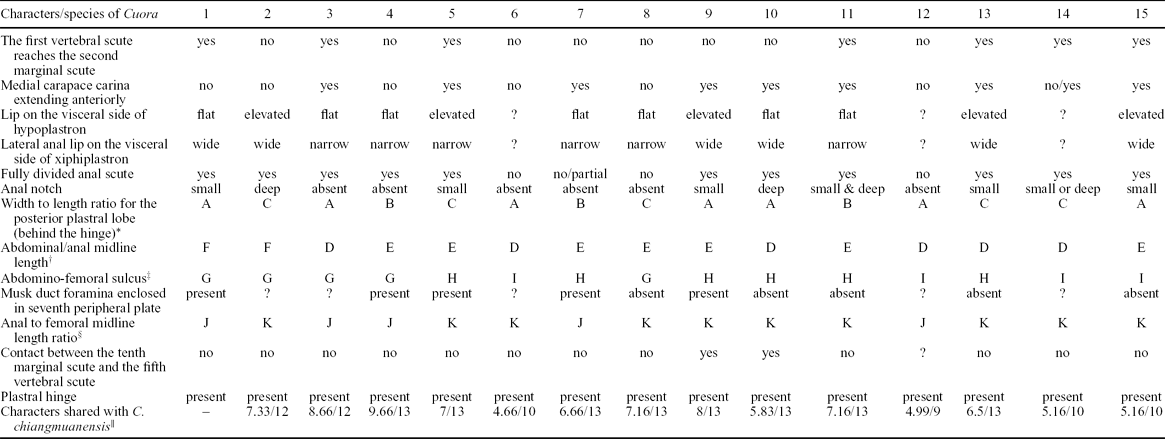
In comparison with extant species of Cuora (see Table 3), the specimen from Chiang Muan clearly differs from C. mouhotii and C. serrata by its smooth carapacial margin and its smaller anal notch. It differs from C. bourreti, C. picturata, C. flavomarginata and C. galbinifrons in the presence of an anal notch and in lacking a vertebral keel. In Cuora amboinensis, C. flavomarginata, C. bourreti and C. galbinifrons the anal notch is absent, while C. mccordi and C. pani have a larger anal notch in comparison with our specimen. The specimen from Chiang Muan differs from C. aurocapitata, C. pani, C. trifasciata, C. mouhotii, C. yunnanensis and C. zhoui in the absence of the vertebral keel; this character, however, can vary during ontogeny. In addition, C. chiangmuanensis shares with C. amboinensis, C. aurocapitata, C. galbinifrons and C. mccordi the presence of a musk duct that is a closed foramen located in the middle of the seventh peripheral plate. In other species of Cuora, the musk duct is incised in the ligamentous area. Cuora chiangmuanensis differs from C. bourreti, C. flavomarginata, C. galbinifrons and C. picturata by having fully divided anal scutes as seen in other members of Geoemydidae. It differs from C. amboinensis, C. bourreti, C. flavomarginata, C. galbinifrons and C. picturata by the presence of a very small anal notch which is, however, smaller than in C. mccordi, C. pani, C. trifasciata and C. zhoui. C. chiangmuanensis has a flat lateral lip on the posterior lobe, which is still wide on the xiphiplastral part. This is similar to C. mouhotii but different from all other Cuora species. Furthermore, the femoral scute has a very short midline length in C. chiangmuanensis as in C. amboinensis, C. flavomarginata and C. picturata, while other Cuora species have a longer femoral midline length.
Comparison of Cuora chiangmuanensis sp. nov. with extinct and living species of Cuora

1 – C. chiangmuanensis; 2 – C. pitheca; 3 – C. miyatai; 4 – C. amboinensis; 5 – C. aurocapitata; 6 – C. bourreti; 7 – C. flavomarginata; 8 – C. galbinifrons; 9 – C. mccordi; 10 – C. mouhotii; 11 – C. pani; 12 – C. picturata; 13 – C. trifasciata; 14 – C. yunnanensis; 15 – C. zhoui.
*A – wider than long; B – wider than long or longer than wide; C – longer than wide;
†D – abdominal longer than anal scute; E – abdominal longer, equal to, or shorter than anal scute; F – abdominal shorter than anal scute;
‡G – convex posteriorly; H – convex posteriorly or straight; I – straight;
§J – more than 3; K – less than 3.
∥We computed a ratio quantifying similarity between C. chiangmuanensis and other Cuora species. The denominator indicates the number of available characters, while the numerator indicates the number of similar characters. Since intermediate character states exist for multistate and ordered characters, they were given an inferior weight than if taxa differed by extreme states. Resemblance was therefore calculated so that closer states would proportionally account for more resemblances than distant states on a unit scale.
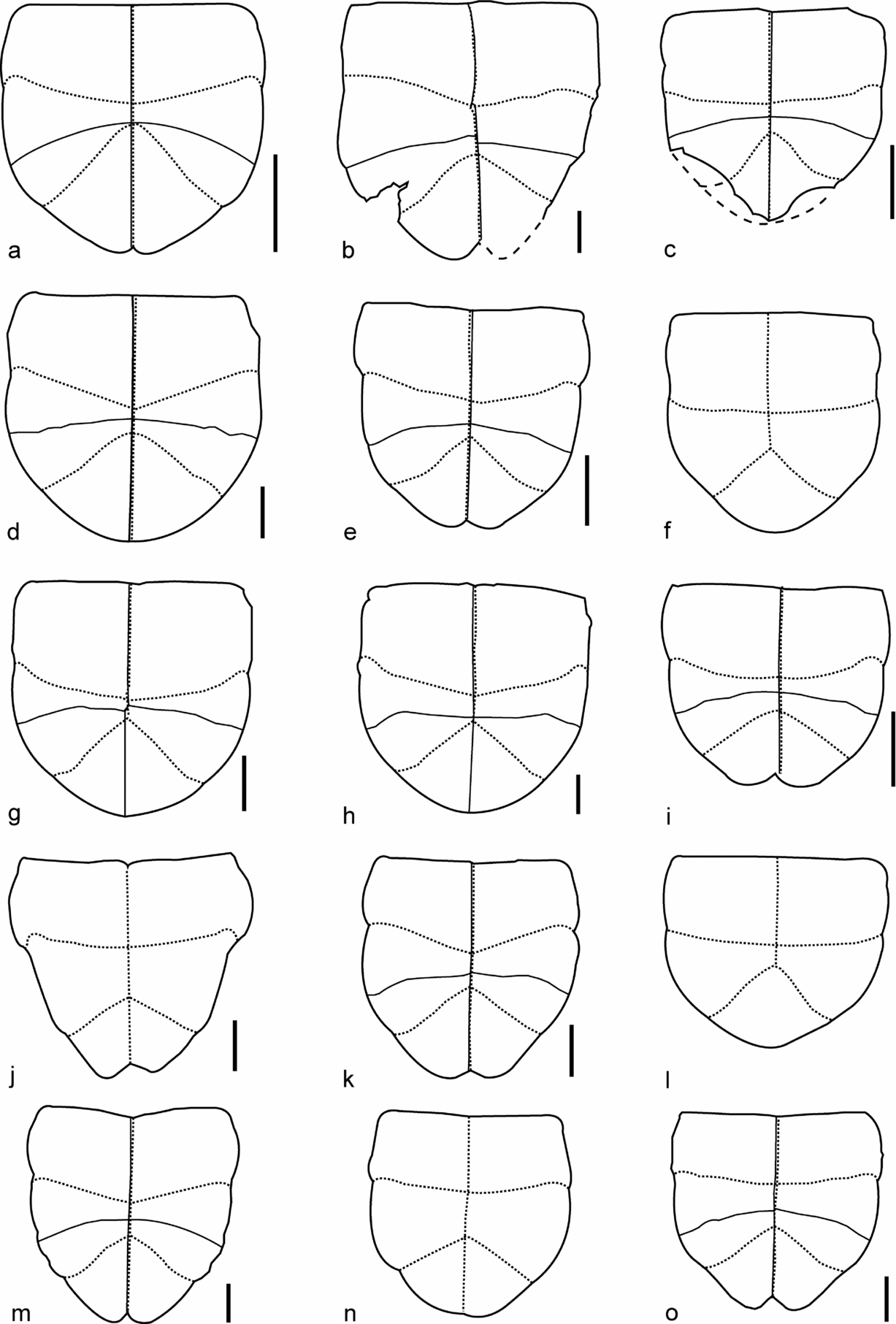
In addition to living taxa, a few fossil Cuora species have been reported: C. pitheca Yeh, Reference Yeh1981 from the Late Miocene of Lufeng, Yunnan and C. miyatai (Shikama, Reference Shikama1949) from the middle Pleistocene of Japan (Hasegawa & Ota, Reference Hasegawa and Ota1980; Yeh, Reference Yeh1981, Reference Yeh1985). Cuora chiangmuanensis differs from C. pitheca in having a trapezoid first vertebral scute which is much wider anteriorly than posteriorly, nearly reaching the second marginal scute, and in having the clearly longer than wide second vertebral. In C. pitheca, the first vertebral scute is roughly rectangular in shape, with the anterior border only slightly wider than the posterior one and reaching laterally to the mid-width of the first marginal scute; the second vertebral scute is slightly wider than long (Yeh, Reference Yeh1981, Reference Yeh1985). Cuora miyatai is similar to C. chiangmuanensis in the first vertebral scute reaching the second marginal scute. These two species differ from one another in the shape of the first vertebral scute: the anterior border of that scute is much longer than the posterior one in C. chiangmuanensis, while the anterior border is only slightly longer than the posterior one in C. miyatai. Furthermore, C. miyatai differs from C. chiangmuanensis in the second and third vertebral scutes, which are wider than long.
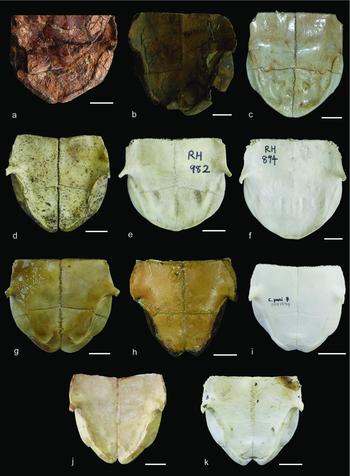
Concerning the plastron, Cuora chiangmuanensis and C. miyatai are similar in having a slightly wider than long posterior lobe, while the posterior lobe of C. pitheca is longer than wide. The abdominal is shorter than the anal scute in C. chiangmuanensis, differing from C. pitheca and C. miyatai in which the abdominal is longer than the anal scute. The ratio of anal/femoral midline length is less than three in C. pitheca, while this ratio is greater in C. chiangmuanensis and C. miyatai. In addition, C. chiangmuanensis shares with C. pitheca a wide lateral lip on the visceral surface of the posterior lobe; but the lip is flat in our specimen, while C. pitheca has a more prominent lip (IVPP V6718.2 and Yeh, Reference Yeh1985, fig. 1). Furthermore, Cuora chiangmuanensis differs from C. pitheca and C. miyatai in having a very small anal notch. The anal notch is clearly deeper in C. pitheca, and it is absent in C. miyatai (see Table 3; Figs 5, 6).
Posterior half of plastrons of Cuora in ventral view. (a) C. chiangmuanensis (Cme-1/1), (b) C. pitheca (IVPP, V.6178.2), (c) C. miyatai (IGPS Reg. 65667), (d) C. amboinensis (CUMZ(R) 1997–12–25(2)), (e) C. aurocapitata (RH 905), (f) C. bourreti (after Shi, Reference Shi2008), (g) C. flavomarginata (RH9 82), (h) C. galbinifrons (RH 916), (i) C. mccordi (RH 950), (j) C. mouhotii (CUMZ(R)-unnumbered), (k) C. pani (RH 1079), (l) C. picturata (after Shi, Reference Shi2008), (m) C. trifasciata (YY1), (n) C. yunnanensis (after Shi, Reference Shi2008) and (o) C. zhoui (RH 1157). Scale bars are 2 cm.

Posterior half of plastrons of Cuora in visceral view. (a) C. chiangmuanensis (Cme-1/1), (b) C. pitheca (IVPP, V.6178.2), (c) C. amboinensis (CUMZ(R)-1997–2–25(2)), (d) C. aurocapitata (TUTb14), (e) C. flavomarginata (RH982), (f) C. galbinifrons (RH894), (g) C. mccordi (RH989), (h) C. mouhotii (CUMZ(R)-unnumbered), (i) C. pani (RH1079), (j) C. trifasciata (YY2) and (k) C. zhoui (RH 1157). Scale bars are 2 cm.

On the basis of the comparisons given above, Cuora from Chiang Muan differs from all other Cuora species by a combination of characters (see diagnosis), particularly in the posterior half of the plastron. It is, therefore, assigned to a new species, Cuora chiangmuanensis sp. nov. Among the extant and fossil Cuora, the new species from Thailand is most similar to C. amboinensis and C. miyatai with 9.66/13 and 8.66/12 shared characters, respectively. Similarities and differences between the living and fossil taxa are summarized in Table 3 (see the method of computation in the footnote ∥ of the table).
4.b.2. Phylogenetic relationships
Although the phylogenetic relationships among Cuora species are not completely congruent among authors, the most recent molecular phylogenies (Honda et al. Reference Honda, Yasukawa, Hirayama and Ota2002; Parham et al. Reference Parham, Stuart, Bour and Fritz2004; Stuart & Parham, Reference Stuart and Parham2004; Blanck, McCord & Le, Reference Blanck, McCord and Le2006; He et al. Reference He, Zhou, Rao and Zhang2007; Iverson et al. Reference Iverson, Brown, Akre, Near, Le, Thomson, Starkey, Shaffer, Fitz Simmons, Georges and Rhodin2007; Spinks & Shaffer, Reference Spinks and Shaffer2007; Spinks, Thomson & Shaffer, Reference Spinks, Thomson and Shaffer2009) show that: (i) C. bourreti, C. galbinifrons and C. picturata form a monophyletic clade (characterized by absence of anal notch, absence of vertebral keel and fused anal scutes); (ii) C. pani and C. aurocapitata form a monophyletic clade (characterized by relatively flat shell, presence of vertebral keel and presence of small anal notch); and (iii) C. amboinensis, C. mouhotii, C. bourreti, C. galbinifrons and C. picturata tend to branch closer to each other (but not all phylogenies demonstrate this; see Spinks & Shaffer, Reference Spinks and Shaffer2007). This group, the majority of which are found in the southern range of Cuora, is characterized by at least one feature that can be interpreted as a symplesiomorphy: the first vertebral scute does not reach the second marginal (also found in C. mccordi).
Using nuclear DNA, Spinks et al. (Reference Spinks, Thomson, Zhang, Che, Wu and Shaffer2012) better resolved the phylogenetic relationships within Cuora. In this study, only the phylogenetic relationship of Cuora mouhotii with other southeastern Cuora was not well supported.
In order to determine the phylogenetic relationships of C. chiangmuanensis, a data matrix of 13 informative characters was gathered on the 12 living species and three fossil species. The tree was rooted with the help of two outgroups: Heosemys grandis (Gray, Reference Gray1860) and Mauremys sensu lato. Mauremys mutica (Cantor, Reference Cantor1842), Mauremys reevesi (Gray, Reference Gray1831) and Mauremys leprosa (Schweigger, Reference Schweigger1812) were scored for determining the states of the Mauremys sensu lato tip.
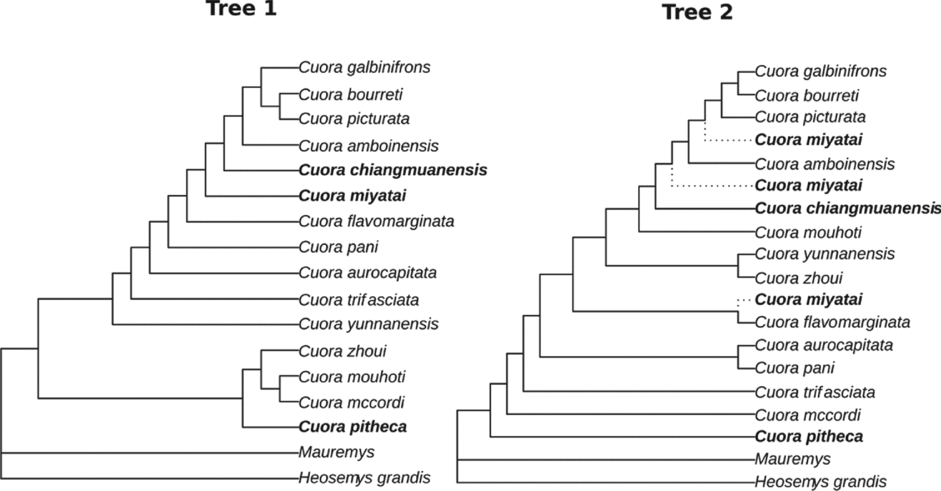
Two analyses were run, the first one using only morphological characters and the second one constraining the relationships among living taxa using a molecular scaffold based on the phylogeny obtained from the nuclear data of Spinks et al. (Reference Spinks, Thomson, Zhang, Che, Wu and Shaffer2012). In that scaffold, only nodes that received bootstrap support above 95&lsn;% were considered; therefore, Cuora mouhotii formed a polytomy with Southeast Asian Cuora (C. amboinensis, C. bourreti, C. picturata and C. galbinifrons) and the group formed by other East Asian Cuora. Character descriptions and distributions are given in Appendix 1. Polymorphic characters were interpreted as intermediate characters. Characters were ordered, and all ordered multi-state characters were scaled so that those characters did not have a disproportionate effect over the binary characters in phylogeny estimation.
Parsimony analyses were performed in PAUP 4.0 b10 (Swofford, Reference Swofford1998) using random addition sequence, and the tree bisection-reconnection branch swapping algorithm across 10&lsn;000 replicates.
While the unconstrained analysis resulted in a single tree (Fig. 7), three most parsimonious hypotheses were found in using the molecularly constrained tree, which differed in the position of Cuora miyatai, either nesting it within the Southeast Asian taxa C. chiangmuanensis, C. galbinifrons, C. bourreti, C. picturata and C. amboinensis or forming a clade with C. flavomariginata. C. chiangmuanensis always formed a clade with the living C. galbinifrons, C. bourreti, C. picturata and C. amboinensis. Cuora pitheca roots all other Cuora in the molecularly constrained tree but forms a monophyletic group with C. zhoui, C. mccordi and C. mouhotii in the unconstrained tree. One should keep in mind that rooting the tree differently may challenge the understanding of the evolutionary history of Cuora, especially regarding whether the East Asian group constitutes a plesion or a clade. Nevertheless, the major finding of our analysis is that the position of Cuora chiangmuanensis is close to the Southeast Asian group formed by C. galbinifrons, C. bourreti, C. picturata and C. amboinensis. Interestingly, C. mouhotii is sister rooting the Southeast Asian group in the molecularly constrained analysis, while it forms a basal clade with other Cuora in the unconstrained phylogeny.
Most parsimonious phylogenetic hypotheses resulting from our study. Tree 1 is based only on morphological characters, while tree 2 presents the three most parsimonious hypotheses, constrained by the molecular scaffold following Spinks et al. (Reference Spinks, Thomson, Zhang, Che, Wu and Shaffer2012).

5. Concluding remarks
An adult geoemydid turtle from the Miocene of the Chiang Muan coal mine, Northern Thailand is described as a new species of Cuora, C. chiangmuanensis, sp. nov. This is the earliest record of that genus in the Middle Miocene or early Late Miocene and it documents an important part of the evolutionary history of Asian box turtles. Based on the mammalian fauna, the age of the hitherto known oldest Cuora, C. pitheca from the Late Miocene of Lufeng, China is of 8–9 Ma (Wang & Qi, Reference Wang and Qi2005; Deng, Reference Deng2006) or even younger (7 Ma, Deng & Qi, Reference Deng and Qi2009). C. chiangmuanensis is thus likely older than C. pitheca, even if it appears more ‘derived’. This shows that the group was already diversified before the end of the Miocene.
If we consider that C. chiangmuanensis forms a monophyletic group with the extant Southeast Asian Cuora species (C. amboniensis, C. galbinifrons, C. picturata and C. bourreti) and that C. chiangmuanensis is also from this region, it is possible that C. chiangmuanensis represents the fossil link between Southeast Asian and East Asian Cuora. The systematic position of Cuora miyatai is not resolved in our study, but it is clear that it diverged from a continental group earlier than the Middle Pleistocene. While Hirayama (Reference Hirayama2007) and one of our analyses suggested it may be a close relative of C. flavomarginata, some equally parsimonious hypotheses suggest it may share a common ancestry with Southeast Asian Cuora, suggesting an alternative biogeographic origin. According to our analyses, Cuora mouhotii may either represent a member of this Southeast Asian group demonstrating a vicariant evolution within the genus or a more primitive member of Cuora (demonstrating iterative migrations). The fossil record being still scanty and molecular constraints being unavailable for the root, it would be speculative to polarize these migrations, but palaeogeography undoubtedly influenced the diversification of the genus Cuora.
Acknowledgements
This work was supported by a Science Achievement Scholarship of Thailand, Mahasarakham University Development Fund (Creative Works and Paper Presentation Scholarship), Palaeontological Research and Education Centre, Faculty of Science, Mahasarakham University and Mahasarakham University fiscal year 2012 grant. We thank the Chiang Muan Mine authorities and Nikorn Wongchai for facilities during our work; Jeremy Martin (Bristol University) for his help to prepare the specimen and improve the manuscript; Kumthorn Thirakhupt (Chulalongkorn University), Fang Zheng, Lu Li (Institute of Vertebrate Palaeontology and Palaeoanthropology), Shengquan Li, Yueying Chen, Yuezhao Wang, Jianping Jiang (Chengdu Institute of Biology), Ren Hirayama (Waseda University), Teppei Sonoda (Ibaraki University), Akio Takahashi (Okayama University of Science), Hideo Nakaya (Kagawa University) and Yuichiro Yasukawa (University of the Ryukyus) for providing comparative materials and useful data and suggestions; Eric Buffetaut (CNRS), Suravech Suteethorn, Paladej Srisuk, Arnauld Filoux (PRC), Jean Le Loeuff (Musée des Dinosaures, Espéraza) for useful suggestions and correction; and Atthiwat Wattanapituksakul (PRC) for the map of the locality. Thanks to everyone who took part in our fieldwork. We are grateful to the two anonymous reviewers who significantly improved an earlier version of this manuscript.
Appendix 1. Character definition
Characters
-
1. First vertebral scute:
-
0. does not reach the second marginal scute
-
1. polymorphic
-
2. reaches the second marginal scute
-
-
2. Medial carapace carina extending on anterior neurals:
-
0. absent
-
1. absent in some individuals
-
2. present
-
-
3. Lip on the visceral side of the hypoplastron:
-
0. elevated
-
1. flat
-
-
4. Lateral anal lip on the visceral side of the xiphiplastron:
-
0. wide
-
1. narrow
-
-
5. Fully divided anal scute:
-
0. yes
-
1. incomplete for some specimens
-
2. no
-
-
6. Anal notch:
-
0. deep
-
1. small or deep
-
2. small
-
3. absent
-
-
7. Width to length ratio for the posterior plastral lobe (behind the hinge):
-
0. wider than long
-
1. wider than long or longer than wide
-
2. longer than wide
-
-
8. Abdominal/anal midline length:
-
0. abdominal longer than anal scute
-
1. abdominal longer, equal, or shorter than anal scute
-
2. abdominal shorter than anal scute
-
-
9. Abdomino-femoral sulcus:
-
0. convex posteriorly
-
1. polymorphic
-
2. straight
-
-
10. Musk duct foramina enclosed in seventh peripheral plate:
-
0. absent
-
1. present
-
-
11. Ratio of anal/femoral midline length:
-
0. less than 3
-
1. more than 3
-
-
12. Contact between the tenth marginal scute and the fifth vertebral scute:
-
0. absent
-
1. present
-
-
13. Plastral hinge:
-
0. absent
-
1. present
-