During the past few decades, medical and surgical treatment of CHD has made rapid progress, resulting in an overall high survival rate.Reference Khairy, Ionescu-Ittu, Mackie, Abrahamowicz, Pilote and Marelli 1 Therefore, a shift in interest has taken place focussing increasingly on older children and adolescents and their ability to succeed academically and to pursue a desired job. The question arises whether there is a relationship between severity of CHD and the level of education. So far, controversial information exists about the academic achievement of CHD patients. They have been found to score worse on academic achievement tests,Reference Mulkey, Swearingen, Melguizo, Reeves, Rowell, Gibson, Holland, Bhutta and Kaiser 2 to need more supportive help,Reference Shillingford, Glanzman, Ittenbach, Clancy, Gaynor and Wernovsky 3 and to have a lower chance of completing mandatory schooling.Reference Olsen, Hjortdal, Mortensen, Christensen, Sorensen and Pedersen 4 This trend has been shown to persist into adulthood, resulting in a higher rate of early unemployment of CHD patients compared with the general populationReference Zomer, Vaartjes and Uiterwaal 5 and a lower rate of full-time employment.Reference Geyer, Norozi, Buchhorn and Wessel 6 Especially patients with complex CHD were found to have lower job participation rates.Reference Kamphuis, Vogels, Ottenkamp, Van Der Wall, Verloove-Vanhorick and Vliegen 7 The reason for these academic problems is unclear. Children and adolescents with CHD are at higher risk for neurocognitive problems, which may result in lower school achievements. In addition, the type of heart defect (cyanotic versus acyanotic) might be important.Reference Wright and Nolan 8 Van Rijen et alReference van Rijen, Utens and Roos-Hesselink 9 suggested higher rates of school absences because of physical impairments as a reason for the lower educational attainment. In addition, Crossland et alReference Crossland, Jackson, Lyall, Burn and O'Sullivan 10 showed that CHD patients were less likely to consider educational advice as being helpful.
On the other hand, there are studies that show a rather favourable outcome regarding the academic achievement of CHD patients. For example, Bygstad et alReference Bygstad, Pedersen, Pedersen and Hjortdal 11 demonstrated similar educational levels of Fallot patients and the general male population in Denmark. Moreover, a Finnish study among young adults with CHD found similar employment rates compared with the general population.Reference Nieminen, Sairanen and Tikanoja 12
Therefore, the aim of our study was to assess the academic achievement of adolescents with CHD in Switzerland, to determine possible medical and socio-demographic predictors for adverse educational outcome, and to evaluate patients’ satisfaction with their educational career.
Materials and methods
Study population
Patients were recruited from the University Childrens’ Hospital, Zurich, Switzerland. All patients currently treated at our hospital and aged between 17 and 20 years with a CHD were eligible for the study (n=326). Exclusion criteria were genetic syndromes or a disease known to be associated with learning disabilities – for example, neurofibromatosis. Information on the educational level and achievement of the general population of Zurich published through the official statistics by the government served as reference norms. 13
Classification of heart defects
CHD was categorised by the TaskForce1 classification system of the American College of Cardiology,Reference Warnes, Liberthson and Danielson 14 differentiating between three levels – simple, moderate, and severe. Patients with pacemakers were upgraded one class in the TaskForce1 classification, because the vocational choice for a patient with a pacemaker is more difficult;Reference Shea 15 therefore, we considered this an additional burden.
Questionnaire
The adolescents were asked to fill out a self-developed questionnaire focussing on their academic career, current schooling, or employment, whether or not they were able to learn a profession of their choice, and their satisfaction with their academic achievement. Socio-economic status was assessed and calculated by means of a 6-point scale considering both parental occupation and maternal education, with a possible range from 2 to 12 implying low, middle, and upper class.Reference Landolt, Vollrath and Ribi 16 This measure has proven to be a valid indicator of socio-economic status in previous Swiss studies. Non-Swiss background was noted by asking for the adolescent’s native language. The questionnaire was kept simple, consisting of a total of seven questions – five multiple choice and two open – in order to get a return rate as high as possible.
Procedure
The study was conducted according to the Declaration of Helsinki, and conformed to legal and ethical norms. Questionnaires were sent to the adolescents by mail. After the return of the questionnaires, patients were contacted by phone if answers remained unclear. After 3 months, the questionnaire was sent out for the second time to those who had not returned the questionnaire.
Level of education
The level of education was analysed for different periods in the academic career according to the Swiss schooling system. The Swiss schooling system consists of a mandatory schooling time with primary school followed by a secondary school level I that ends after 9 school years. This school level is further divided into high, middle, and low level. After mandatory schooling, adolescents go on to pursue further education – that is, secondary school level II, grades 10–13 – either as form of a “gymnasium”, which is equal to high school or college, apprenticeship, or other forms of schooling, including special schooling such as assisted apprenticeship or educational placement. In Switzerland, the majority of healthy adolescents go on to pursue an apprenticeship (78.6%), which is different from other European or Anglo-Saxon countries. Participants were asked to give information on the level of achieved mandatory schooling as well as on further education – that is, secondary school level II, grades 10–13.
Statistical analyses
Data were analysed using SPSS statistical software version 22 (SPSS Inc., Chicago, Illinois, United States of America). Comparisons of different school levels between patients with different types of heart defects as well as with control data were performed using χ2-tests. A priori selected medical and socio-demographic predictors for lower education levels were identified and analysed in a multiple logistic regression model. A p<0.05 was considered significant.
Results
Patient characteristics
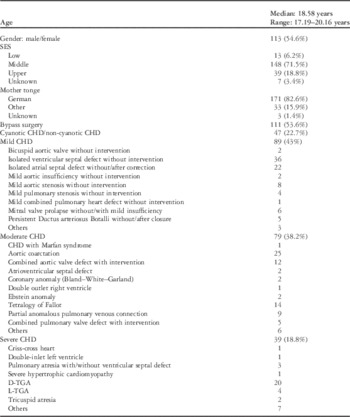
Of the 326 patients eligible for the study, a total of 207 (63.5%) returned the questionnaire. Detailed demographic and medical characteristics of the patients are provided in Table 1. Although the rate of patients answering was highest among the group with severe CHD, there was no statistically significant difference between those who responded and those who failed to respond.
Sample characteristics (n=207).

SES=socio-economic status; TGA=transposition of the great arteries
Level of education
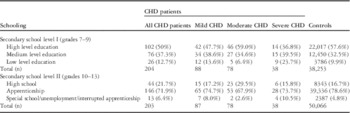
Information about their mandatory schooling (grades 7–9) was given by 204 adolescents (98.5%) and 203 (98.1%) provided details on further education (grades 10–13), as shown in Table 2. The level of education of the CHD patients was not significantly different from that of the community references (χ2=5.09; p=0.08). Similar to the reference group, girls with CHD more often attended a higher school level (grades 7–9) than boys. Of 203 patients who completed their basic education, 190 proceeded to high school or an apprenticeship. The rate of CHD patients attending high school was slightly, but not statistically significant, higher compared with the reference group (21.7 versus 16.7%; χ2=3.27; p=0.07).
Schooling of adolescents with CHD and controls.

General student population of Zurich 2006/2007 served as controls
Level of education in relation to heart disease
As shown in Table 2, the severity of CHD significantly influenced the level of schooling in grades 7–9 (χ2=10.51, p=0.03): children with more severe types of CHD were over-represented in the lower level education. Of the nine patients with severe CHD who were in lower level mandatory school (grade 7–9), seven had the diagnosis of a transposition of the great arteries, one was diagnosed with tricuspid atresia, and one had a pulmonary atresia with ventricle septal defect. In grades 10–13, however, distribution of educational levels across different types of CHD was statistically not different (χ2=3.94, p=0.13).
Employment
From the total of 207 patients, 146 (71.9%) pursued a regular apprenticeship, 13 (6.4%) had not found or interrupted an apprenticeship or attended special schooling, and 44 (21.7%) attended high school or studied at the university. Among all, four patients did not answer the question on employment status.
Career satisfaction
Satisfaction was evaluated by the patients’ statement about how content they are with their current school or employment situation; 165 of the 207 patient reports were available. Out of these, 130 patients (78.8%) regarded their profession or current school situation as their desired one, 30 responded that this was not the case, and five responded with partial satisfaction.
Predictors for adverse outcome
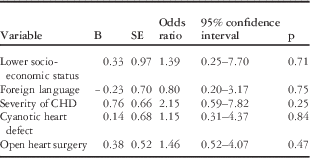
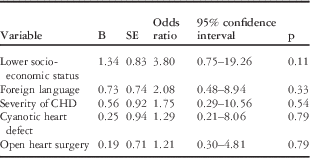
In the multiple logistic regression analysis, none of the potential medical and socio-demographic risk factors – such as socio-economic status, foreign language, severity of CHD, cyanotic heart defect, and occurrence of open heart surgery – were predictive for lower educational outcome on secondary school level I and II (see Tables 3 and 4).
Summary of logistic regression predicting low school education (secondary level 1).

Summary of logistic regression predicting low school education (secondary level 2).

Discussion
In this study, we could show that overall Swiss CHD adolescents had an academic achievement similar to that of the normal population. In line with the results of previous studies,Reference Bygstad, Pedersen, Pedersen and Hjortdal 11 , Reference Nieminen, Sairanen and Tikanoja 12 the educational profile was comparable to that of community norms; however, those with severe CHD were more likely to attend lower level education compared with adolescents with mild and moderate CHD. The reason for them to have achieved lower education might be due to neurodevelopmental impairments, which are frequently seen in these patients.Reference Bellinger, Wypij and Rivkin 17 These patients, however, did not undergo neurodevelopmental testing; thus, this hypothesis cannot be proven.
Satisfaction with schooling and academic career was also good, as most of our patients regarded their profession or their school education as being their desired one. The career chances in Switzerland seem to be widespread so that there are sufficient job possibilities and the patients can find their optimal place in society. The fact that they show rather high satisfaction might also be due to an adjustment of their standards in terms of a good coping strategy. This phenomenon is well known from quality-of-life research as the so-called response shift. This implies a change of internal standards in patients with chronic conditions by change of their internal assessment scale.Reference Sprangers and Schwartz 18 The positive evaluation of schooling and career situation in our patients is in line with studies in the adult population, where quality of life is described to be goodReference Bygstad, Pedersen, Pedersen and Hjortdal 11 and perception of career possibilities is positive, despite a somewhat higher unemployment rate;Reference van Rijen, Utens and Roos-Hesselink 9 however, in unemployed CHD patients, poorer quality of life has been demonstrated compared with employed CHD patients.Reference Vigl, Niggemeyer, Hager, Schwedler, Kropf and Bauer 19 Other studies describe a comparable employment rate between patients and controls.Reference Nieminen, Sairanen and Tikanoja 12 Considering patients with Tetralogy of Fallot, Ternestedt et alReference Ternestedt, Wall, Oddsson, Riesenfeld, Groth and Schollin 20 explained the positive educational achievement by a great amount of willpower and purposefulness representing assumingly a specific coping strategy during childhood.
Interestingly, medical or socio-economic factors such as socio-economic status, foreign language, severity of heart disease, and occurrence of open-heart surgery predicted neither adverse educational and professional outcome nor career satisfaction. In particular, the lack of an independent association between severity of CHD and outcome is interesting. Notably, other studies have shown that even for neurodevelopmental outcome, severity of CHD is not always a good predictor.Reference Schaefer, von Rhein and Knirsch 21 , Reference Majnemer, Limperopoulos, Shevell, Rohlicek, Rosenblatt and Tchervenkov 22 One might speculate that in Switzerland, a country with good medical and educational support, medical and demographic variables become less important and CHD patients from families in lower classes have comparable academic chances. The structured follow-up programmes established for CHD children in Switzerland allow for an early detection of developmental impairments and special needs leading to early introduction of treatments and therapies. These are usually covered by a special insurance that accounts for costs related to birth defects. It is also possible that the patients have an easier access to educational support as they might be regarded to need it more because of their disease.
Limitations
There are some limitations worth mentioning. The participation rate was only 68%, but there was no difference between participants and non-participants concerning severity of heart disease.
As a control group, we used the official statistics of the Canton Zurich student population because most of our patients came from this region. Some of the patients, however, came from other Swiss regions. As Zurich is an urban area, the situation in rural regions of Switzerland may be slightly different. Another limitation may be that patients coming from a lower socio-economic status background might have been under-represented as only 6.2% of the patients belonged to this group. The reference population included all children, those with genetic disorders who were in regular school as well. This could have introduced a potential bias; however, as the prevalence of these disorders is <1% in the general population,Reference Koletzko 23 we would not expect any changes of our results. Regarding unemployment rates, our study population might have been too young to face problems of unemployment. In addition, our study was a cross-sectional study. For a more detailed analysis, it would, however, be interesting to follow-up patients in a prospective long-term cohort study to determine long-term employment and career satisfaction.
Conclusions
In conclusion, academic achievement in Swiss CHD adolescents was comparable with that of healthy controls; however, those with severe CHD were more likely to attend a lower level schooling grade. Importantly, the patients showed a favourable satisfaction with their schooling and academic career, implying that appropriate support for schooling and job opportunities are provided in Switzerland. Medical or socio-demographic factors were not predictive of adverse educational outcome or poor career satisfaction.
Acknowledgements
The authors thank all the patients who participated in their study.
Financial Support
This research received no specific grant from any funding agency, commercial, or not-for-profit sectors.
Conflicts of Interest
None.
Ethical Standards
The authors assert that all procedures contributing to this work comply with the ethical standards of the relevant national guidelines and with the Helsinki Declaration.