Introduction
Body image is a multidimensional concept that encompasses both positive and negative perceptions, behaviours, and attitudes towards one's own body (Wood-Barcalow, Tylka, & Augustus-Horvath, Reference Wood-Barcalow, Tylka and Augustus-Horvath2010). A harmful aspect of body image is body dissatisfaction — the negative subjective evaluations of one's physical body, including weight, body shape, and body composition (Stice & Shaw, Reference Stice and Shaw2002). Body dissatisfaction is prevalent, with some studies documenting that approximately 66% of women in the United States reported feelings of dissatisfaction with their weight (Friedman, Reichmann, Costanzo, & Musante, Reference Friedman, Reichmann, Costanzo and Musante2002; Sypeck et al., Reference Sypeck, Gray, Etu, Ahrens, Mosimann and Wiseman2006; Wood-Barcalow et al., Reference Wood-Barcalow, Tylka and Augustus-Horvath2010). Additionally, body dissatisfaction has been implicated as a risk and maintenance factor for eating disorders (Stice & Shaw, Reference Stice and Shaw2002) and has been associated with depression (Presnell, Bearman, & Stice, Reference Presnell, Bearman and Stice2004), poor quality of life (Mond et al., Reference Mond, Mitchison, Latner, Hay, Owen and Rodgers2013), and obesity (Mond, van den Berg, Boutelle, Hannan, & Neumark-Sztainer, Reference Mond, van den Berg, Boutelle, Hannan and Neumark-Sztainer2011; Wardle & Cooke, Reference Wardle and Cooke2005).
Media, body dissatisfaction, and the thin ideal
The media has been identified as a key factor in influencing body dissatisfaction (Carels & Musher-Eizenman, Reference Carels and Musher-Eizenman2010; Grogan, Reference Grogan2016; Stice & Shaw, Reference Stice and Shaw2002). Western media, including traditional and social media, is saturated with images of ‘ideal’ female bodies — typically a thin but muscularly toned, underweight figure (MacNeill & Best, Reference MacNeill and Best2015). The consequences of exposure to ideal bodies have been greatly considered in the extant literature through the lens of social comparison theory (Festinger, Reference Festinger1954). Social comparison theory posits that humans have an innate predisposition to compare themselves to others in their immediate social environment. These comparisons can be either ‘upward’ (i.e. comparisons against another who is perceived to have a more desirable or acceptable body) or ‘downward’ (comparisons against another who is perceived to have a less desirable or acceptable body; Collins, Reference Collins1996). Thus, exposure to these ‘ideal’ and often unrealistic body images typically induces an instantaneous upward comparison (i.e. judging one's own body as less attractive or less sufficient compared with another body). Of concern, the frequency of upward comparisons is positively associated with body dissatisfaction (Myers & Crowther, Reference Myers and Crowther2009) and elevated eating disorder symptoms (Corning, Krumm, & Smitham, Reference Corning, Krumm and Smitham2006; Leahey, Crowther, & Ciesla, Reference Leahey, Crowther and Ciesla2011).
Many studies have examined the relationship between exposure to thin ‘ideal’ female body types and body dissatisfaction. Exposure to ideal bodies have been shown to induce increased negative affect (such as depression, shame, guilt, and decreased confidence), as well as significantly predicting greater disordered eating and body dissatisfaction in female viewers when compared with exposure to neutral pictures (Allison & Lee, Reference Allison and Lee2015; Friedman et al., Reference Friedman, Reichmann, Costanzo and Musante2002; Hawkins, Richards, Granley, & Stein, Reference Hawkins, Richards, Granley and Stein2004; Mills, Polivy, Herman, & Tiggemann, Reference Mills, Polivy, Herman and Tiggemann2002; Stice & Shaw, Reference Stice and Shaw1994; Yamamiya, Cash, Melnyk, Posavac, & Posavac, Reference Yamamiya, Cash, Melnyk, Posavac and Posavac2005).
Weight bias and cyberbullying
While a great number of women strive towards the thin ‘ideal’, many simultaneously reject bodies at the opposite end of the weight spectrum. This attitude often manifests as weight bias — negative attitudes towards, and beliefs about, others because of their weight (Brownell, Puhl, Schwartz, & Rudd, Reference Brownell, Puhl, Schwartz and Rudd2005). Weight bias is pervasive across much of Western society, evidenced by constant negative messages, attitudes, and discrimination towards people who are overweight or obese (Allison & Lee, Reference Allison and Lee2015; Carels & Musher-Eizenman, Reference Carels and Musher-Eizenman2010; Schwartz & Brownell, Reference Schwartz and Brownell2004). Weight bias carries consequences for individuals who are overweight or obese across their lifespan and in everyday life. For instance, overweight and obese individuals are less likely to be hired, helped after an accident, and tend to be viewed as lazier, more unattractive, and lonelier than thin people (Carels & Musher-Eizenman, Reference Carels and Musher-Eizenman2010; Cramer & Steinwert, Reference Cramer and Steinwert1998). In addition, those who internalise the weight stigma are more likely to be distressed, binge eat, show depressive symptoms, experience negative self-esteem, and experience greater body dissatisfaction (Carels & Musher-Eizenman, Reference Carels and Musher-Eizenman2010; Friedman et al., Reference Friedman, Reichmann, Costanzo and Musante2002; Schwartz & Brownell, Reference Schwartz and Brownell2004).
Furthermore, weight bias can often result in weight-based victimisation — teasing and bullying relating to one's weight (Puhl & King, Reference Puhl and King2013). Weight-based victimisation is not limited to face-to-face encounters, but perhaps occurs more frequently online through social media platforms. This avenue of bullying is known as cyberbullying — the aggressive, deliberate, and repeated harm inflicted through the use of electronic devices against a victim (Ojedokun & Idemudia, Reference Ojedokun and Idemudia2013; Patchin & Hinduja, Reference Patchin and Hinduja2010). Cyberbullying differs from traditional bullying in that (1) due to anonymity afforded by many online platforms, it is easier to engage in (Suler, Reference Suler2004), (2) it is more pervasive as, due to smart technology, a victim can be contacted at any time and in any place (Tokunaga, Reference Tokunaga2010), and (3) online comments are often permanent and can be viewed multiple times by the victim and their peers (Patchin & Hinduja, Reference Patchin and Hinduja2010). Cyberbullying may present as the most common form of weight-based bullying among overweight adolescents. Puhl, Peterson, and Luedicke (Reference Puhl, Peterson and Luedicke2013) conducted a study that examined the bullying experiences of weight-loss-treatment-seeking young people and found that 61% had received mean or embarrassing posts online, and 59% had received mean texts, e-mails, or instant messages.
An important factor in understanding the cyberbullying process is the role of bystanders — those who witness bullying. Bystanders, who, in an online space, are likely shared users of a social media application or Web site (e.g. Facebook), can either reinforce the cyberbully and thus increase the negative impact on the victim, remain passive, or intervene (Van Cleemput, Vandebosch, & Pabian, Reference Van Cleemput, Vandebosch and Pabian2014). Preliminary research shows that most online bystanders do not engage when they witness cyberbullying (Gahagan, Vaterlaus, & Frost, Reference Gahagan, Vaterlaus and Frost2016). However, in some circumstances, observing cyberbullying can encourage bystanders to participate in cyberbullying (Bastiaensens et al., Reference Bastiaensens, Vandebosch, Poels, Van Cleemput, Desmet and De Bourdeaudhuij2014, Reference Bastiaensens, Pabian, Vandebosch, Poels, Van Cleemput, DeSmet and De Bourdeaudhuij2016; Van Cleemput et al., Reference Van Cleemput, Vandebosch and Pabian2014). Bastiaensens et al. (Reference Bastiaensens, Pabian, Vandebosch, Poels, Van Cleemput, DeSmet and De Bourdeaudhuij2016) account for this behaviour through consideration of normative social influence theory (i.e. ‘conformity to a group norm brought by a desire to be liked by the group members’; Schultz, Tabanico, & Rendon, Reference Schultz, Tabanico, Rendon, Crano and Prislin2008, p. 386). In their study, they found that bystanders’ perception of friends approving of cyberbullying was associated with a higher experience of social pressure to join in, and subsequentially, higher levels of joining in cyberbullying (Bastiaensens et al., Reference Bastiaensens, Pabian, Vandebosch, Poels, Van Cleemput, DeSmet and De Bourdeaudhuij2016).
Online body-positivity content
Although the media has been discussed as a platform for disseminating images of the thin ‘ideal’ and weight bias, and the online environment presents as a fertile space for weight-based cyberbullying, there has been a recent proliferation of body-positive content on social media. Cohen, Fardouly, Newton-John, and Slater (Reference Cohen, Fardouly, Newton-John and Slater2019) highlight that body-positive Instagram hashtags elicit millions of posts and responses, including images of women proudly displaying their larger bodies with body-positive captions. This emergence of body-positive content has coincided with a theoretical shift in body image research, namely the exploration of positive body image (Tylka, Reference Tylka and Cash2012). Positive body image is a multifaceted construct that encompasses acceptance and appreciation of one's own body, and an understanding that self-worth is not significantly depend on body appearance (Tylka & Wood-Barcalow, Reference Tylka and Wood-Barcalow2015). Of note, recent research shows that positive body image is associated with a number of psychological and physical health benefits, including greater emotional, social, and psychological well-being (Swami, Weis, Barron, & Furnham, Reference Swami, Weis, Barron and Furnham2018), and physical activity and intuitive eating (Andrew, Tiggemann, & Clark, Reference Andrew, Tiggemann and Clark2016). Additionally, Cohen, Fardouly, et al. (Reference Cohen, Fardouly, Newton-John and Slater2019) examined the exposure effect of body-positive Instagram posts, compared with thin-ideal and neutral posts. They found that exposure to body-positive posts was associated with improvements in women's positive mood, body satisfaction, and body appreciation, relative to other conditions (Cohen, Fardouly, et al., Reference Cohen, Fardouly, Newton-John and Slater2019). Congruently, Betz and Ramsey (Reference Betz and Ramsey2017) found that images that encouraged body acceptance were favoured over those that idealised any specific body type. However, this study also found an increase in self-objectification irrelevant of whether participants were exposed to thin, athletic, or curvy ideals (Betz & Ramsey, Reference Betz and Ramsey2017).
Undeniably, online exposure can result in both positive and negative outcomes. With the high prevalence of weight-related cyberbullying, a greater need for understanding the role of these images and the associated comments is required. Current research has predominantly focused on the impact of body type ideals, body-positivity, and the effects of appearance-focused text paired with these images (Betz & Ramsey, Reference Betz and Ramsey2017; Cohen, Fardouly, et al., Reference Cohen, Fardouly, Newton-John and Slater2019; Prichard, McLachlan, Lavis, & Tiggemann, Reference Prichard, McLachlan, Lavis and Tiggemann2018; Slater, Varsani, & Diedrichs, Reference Slater, Varsani and Diedrichs2017; Webb, Vinoski, Bonar, Davies, & Etzel, Reference Webb, Vinoski, Bonar, Davies and Etzel2017). However, given the saturation of social media in modern society, as well as its endless interactive components, it is important to explore the implications of these images paired with personalised comments. Therefore, the present study aimed to investigate the influence of comments relating to the images of plus-size models, on commenting behaviour, social media users’ body dissatisfaction and mood. Images of plus-size models were presented on the social media site Facebook, in conjunction with either body-positive (positive condition), body-negative (negative condition), or neutral (neutral condition) comments attached to each set of images. Theoretically, it was anticipated that images of a plus-size model paired with positive comments would most closely align with typical body-positivity content (compared with the other two conditions), effectively representing user-generated body-positivity content (Cohen, Irwin, Newton-John, & Slater, Reference Cohen, Irwin, Newton-John and Slater2019). During exposure to images of plus-size models and paired comments, participants were also asked to leave an anonymous comment themselves. In this way, participants were actively encouraged to participate as bystanders to online interactions.
First, it was hypothesised (H1) that overall, participants would experience a decrease in body dissatisfaction and an increase in mood after exposure to the photos of plus-size models. Second, given that the association between exposure to body-positive content and increased mood (Cohen, Fardouly, et al., Reference Cohen, Fardouly, Newton-John and Slater2019), as well as the relationship between body-positive content, positive body image, and greater emotional, social, and psychological well-being (Swami et al., Reference Swami, Weis, Barron and Furnham2018), it was hypothesised (H2) that participants assigned to the positive condition (i.e. images were paired with positive comments about the plus-size model, most closely representing body-positive content) would experience a significantly greater decrease in body dissatisfaction and a greater increase in mood than those assigned to the negative condition and control condition. Third, as observation of cyberbullying has been shown to encourage bystanders to participate in cyberbullying themselves (Bastiaensens et al., Reference Bastiaensens, Vandebosch, Poels, Van Cleemput, Desmet and De Bourdeaudhuij2014, Reference Bastiaensens, Pabian, Vandebosch, Poels, Van Cleemput, DeSmet and De Bourdeaudhuij2016; Van Cleemput et al., Reference Van Cleemput, Vandebosch and Pabian2014), it was hypothesised (H3) that participants would leave comments more congruent with their assigned condition (i.e. participants would leave more negative comments in the negative comment condition and participants would leave more positive comments in the positive comment condition) potentially demonstrating an effort to ‘fit in’ with the other perceived viewer of the presented image.
Method
Participants
The study was comprised of 92 female university students studying at an Australian university (age ranged from 18 to 48 years old, M = 22.1, SD = 5.7). The majority of the sample identified as White/Caucasian (52%), single (65%), and reported living with friends or family (74%). The sample also comprised of women who identified as Asian (22%), Middle Eastern (13%), and African/Indigenous Australian/Other (11%). In addition, part of the sample reported to be in a relationship (11%) or married (9%). Body Mass Index (BMI) scores ranged from 18 to 42 (M = 25.62, SD = 5.73).
Materials
Profile of Mood States — Adolescents (POMS-A)
Individual differences in mood were measured using the POMS-A (Terry, Lane, Lane, & Keohane, Reference Terry, Lane, Lane and Keohane1999). These scores were used to assess whether each experimental group had equivalent mood at baseline. The POMS-A is comprised of 24 items on a five-point Likert scale (0 = ‘not at all’; 4 = ‘extremely’). The POMS measures six factors: Tension-Anxiety, Depression-Dejection, Anger-Hostility, Fatigue-Inertia, Vigour-Activity, and Confusion-Bewilderment. Total mood disturbance is the addition of all five factors minus the Vigour-Activity factor. Higher scores indicated a worse mood state. The POMS-A has been shown to display psychometric integrity when measuring mood in adolescent and adult populations (Terry, Lane, & Fogarty, Reference Terry, Lane and Fogarty2003). In the present study, Cronbach's α were 0.86 and 0.84 for the pre- and post-POMS-A, respectively.
Physical Appearance State and Trait Anxiety Scale — Weight Related (PASTAS-W)
The PASTAS-W state version was used to measure the amount of state body dissatisfaction experienced by participants before and after viewing the Facebook photos (Reed, Thompson, Brannick, & Sacco, Reference Reed, Thompson, Brannick and Sacco1991). It is comprised of a list of eight specific body parts and requires participants to rate how anxious they feel about those parts ‘right now’ on a five-point scale ranging from ‘not at all’ (0) to ‘exceptionally so’ (4). Higher scores indicate higher levels of state body dissatisfaction. In the present study, Cronbach's α were 0.92 and 0.93 for the pre- and post-PASTAS-W, respectively.
Body Mass Index (BMI)
BMI was used to ensure that participants in the different experimental groups did not have significantly higher or lower BMIs as this could influence the variable of body dissatisfaction. BMI is calculated by dividing an individual's weight in kilograms by their height in metres squared and is used to differentiate individuals into weight categories (i.e. underweight, normal weight, overweight, or obese). A higher BMI indicates a higher body mass. A stadiometer was used to calculate participants BMI without their shoes on.
Procedure
Participants were sourced via an online university recruiting system and were offered either course credit or $20AUD for participation. The study was advertised as an investigation into the effect of marketing through social media, and the true purpose of the study was not disclosed in order to ensure that participants’ bias and expectations of the study did not influence the results. The advertisements informed potential participants of the nature of the tasks that they would need to perform and what would be expected of them if they chose to participate, as well as informing participants that their responses would be anonymous.
Participants completed all measures on a computer alone in a private room. Participants first completed a demographic questionnaire, followed by the (pre-) POMS-A and (pre-) PASTAS-W to obtain a baseline measure of mood and body dissatisfaction. Participants were randomly assigned to one of the three group conditions: (1) positive comments, (2) negative comments, and (3) control. Each condition was presented with the same four Facebook photos of plus-size models and five comments on each picture. In the positive comments condition, all five comments made positive assessments of the photos (e.g. ‘she's so beautiful’). Similarly, negative comments were presented with photos in the negative comments condition (e.g. ‘she's so ugly’), and neutral comments were presented with the photos in the control condition (e.g. ‘that handbag looks practical’). These comments were taken from or inspired by real public Facebook comments.
Participants were instructed to look at the four Facebook photos and evaluate the photo, model, and outfit. They were asked to then leave a comment expressing their opinions on each photo under the other comments, which they were told were left by previous participants. Photos were displayed on screen until participants had posted a comment. Two researchers independently rated the comments to determine if they were positive, negative, or neutral in nature. This was determined by judging the comment as a whole and the overall tone and meaning of the comment, such as whether we believed the comment to be complementary in nature or not. The researchers discussed and agreed upon this method for coding before undertaking the coding process. The reliability of coding between the two researchers was 1.0.
Once participants had viewed all the photos and left comments, they were asked to complete the (post-) POMS-A and (post-) PASTAS-W again to assess whether their mood and body dissatisfaction had changed due to exposure to the photos/comments. Lastly, participants’ BMI was measured. Participants were then debriefed about the true nature of the study and the need for deception. Participants were again asked for their consent to include their data, and informed that withdrawal without consequence was also an option.
Statistical Analysis
Two between-subjects ANOVAs were conducted to assess whether there were differences between-condition groups in BMI and age, respectively. If there were any differences, the construct would be used as a control variable in main analyses. In order to examine the first two hypotheses (1) that exposure would increase mood and decrease body dissatisfaction and (2) that participants’ level of body dissatisfaction and mood change would be influenced by comment condition, two repeated measures ANOVAs with comment condition as the between-subjects factor and body dissatisfaction and mood as the repeated measures factors were employed, respectively.
Additionally, to test the hypothesis that participants would leave different types of comments (dependent on what condition they were assigned) required their comments to be coded. Each participant left one comment per photo (four comments in total). These comments were independently scored as either positive (1), negative (−1), or neutral (0) in content by two researchers (intraclass correlation coefficient = 1.0). The coding was defined as whether the comment was overall negative or positive in tone. If it was neither, it was coded as neutral. Examples of positively coded comments written by participants included ‘beautiful woman, lovely stance and elegant outfit’ and ‘love her smile and confidence!’. Examples of negatively coded comments included ‘ugly photo and outfit overall’ and ‘she should not be a model, she is not as beautiful. I don't like her outfit as well’. Examples of neutrally coded comments included ‘that looks like a pretty view, where is it?’ and ‘the location fits with the outfit’. Overall comment scores were then generated by summing all individual comment scores, with larger scores indicating a greater proportion of positive comments and lower scores indicating a greater proportion of negative comments. To examine the effect of exposure to respective photos, a between-subjects ANOVA was conducted with comment condition as the independent variable and overall comment score as the dependent variable, averaged across all four photos. Planned contrast tests were conducted to examine for differences between comment conditions (i.e. positive, negative, and control).
Post-hoc tests
To explore the interaction between BMI, mood, body dissatisfaction, and commenting behaviour, several post-hoc tests were used. To achieve this, a new binary variable labelled BMI category was constructed, consisting of two levels: (1) participants with a BMI of 25 kg/m2 or lower (underweight/healthy weight) and (2) participants with a BMI greater than 25 kg/m2 (overweight/obese). Additionally, another new binary variable indicating whether or not participants had contributed at least one negative comment on any of the photos of plus-size models was generated.
First, to explore the interaction between BMI and the exposure effect on body dissatisfaction and mood, two repeated measures ANOVAs with BMI category as the between-subjects factor and body dissatisfaction and mood as the repeated measures factors were employed, respectively. Then, an independent samples t-test comparing the BMI of those who had left at least one negative comment to those who had not left any negative comments was utilised to explore the differences in commenting behaviour between weight categories.
Results
Between-subjects ANOVA showed no significant difference in BMI between comment condition groups (F[2, 89] = 0.546, p = 0.581), nor age (F[2, 89] = .117, p = 0.889). Thus, groups were equivalent in BMI and age at baseline.
To examine the effect of exposure on body dissatisfaction (PASTAS-W) and mood (POMS-A), and the interaction of comment condition on exposure, two repeated measures ANOVAs were conducted. Results showed that there was a significant main effect of PASTAS-W score (F[1, 77] = 10.51, p = .002, ηp2 = .13), indicating that post-PASTAS-W scores (M = 10.3, SD = 7.9) were significantly lower than pre-PASTAS-W scores (M = 11.7, SD = 8.2), suggesting a decrease in body dissatisfaction. However, there was no significant interaction between PASTAS-W scores and comment condition (F[2, 76] = 2.36, p = .101), meaning that comment condition did not significantly influence change in PASTAS-W scores. Similarly, results showed that there was a significant main effect of POMS-A score (F[1, 88] = 64.07, p < .001, ηp2 = .42), indicating that post-POMS-A scores (M = 14.3, SD = 8.7) were significantly lower than pre-POMS-A scores (M = 21.3, SD = 9.2), suggesting an increase in mood. However, there was no significant interaction between POMS-A scores and comment condition (F[2, 87] = .09, p = 0.914), meaning that comment condition did not significantly influence change in POMS-A scores.
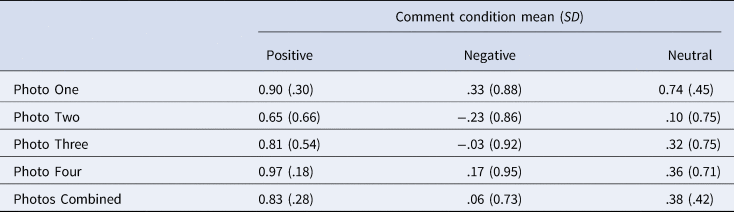
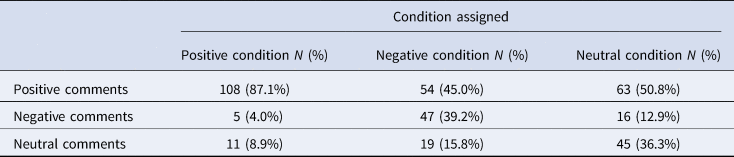
To test the hypothesis that participants would leave comments more congruent with their assigned condition (i.e. participants would leave more negative comments in the negative comment condition), a between-subjects ANOVA was conducted. Results revealed a significant effect of comment condition (F[2, 89] = 17.805, p < .001). Planned contrast tests were conducted to examine for differences between comment condition using Tukey comparisons. Taken across all photos, the positive condition was significantly higher in comment score, signifying a greater number of positive comments than the negative (p < .001) and control condition (p < .01), and the negative condition was significantly lower in comment score than the control condition (p < .05). Means and standard deviations of comment scores for each photo across all comment conditions are shown in Table 1. The frequency and percentage of comment types left by participants are presented in Table 2.
Means and Standard Deviations of Comment Score by Condition for Each Photo

Note: Comments types left by participants coded as Negative (−1), Positive (1), and Neutral (0).
Frequency and Percentage of Comment Types Left by Participants by Condition for Each Photo

Note: percentages were rounded to one decimal place. Positive condition total N = 31, negative condition N = 30, and control condition N = 31.
Post-hoc tests
Two repeated measures ANOVAs were conducted to explore the interaction between BMI and the exposure effect on body dissatisfaction and mood. Results showed the expected significant main effect of body dissatisfaction change (F[1, 79] = 9.76, p = .002, ηp2 = .15). However, the interaction between body dissatisfaction change and BMI category was non-significant (F[1, 79] = 0.82, p = .368). Similarly, the main effect of mood change was significant (F[1, 87] = 67.20, p < .001, ηp2 = .44); however, there was no significant interaction between mood change and BMI category (F[1, 79] = 3.62, p = .061). To explore the relationship between BMI and commenting behaviour, and independent samples t-test comparing the BMI of those who had left at least one negative comment to those who had not left any negative comments was conducted. Results showed that there was no significant difference in BMI (t[90] = 1.21, p = .088) when comparing participants who left at least one negative comment (M = 24.7, SD = 4.92) to those who did not (M = 26.2, SD = 6.16).
Discussion
This study aimed to examine the effects of exposure to plus-size models on body dissatisfaction and mood and investigate whether different types of social media comments attached to pictures of plus-size models would influence the type of comment the reader would leave themselves. The first hypothesis that participants would experience a decrease in body dissatisfaction and an increase in mood after exposure to photos of plus-size models was supported. All participants scored significantly lower on the PASTAS-W and POMS-A after exposure to images of plus-size models compared with their baseline scores, indicating that they experienced a reduction in body dissatisfaction and an increase in mood. Of note, the exposure effect had a greater impact for mood (ηp2 = .42) compared with body dissatisfaction (ηp2 = .13) as indicated by effect sizes. The second hypothesis that participants assigned to the positive condition would experience a significantly greater decrease in body dissatisfaction and a greater increase in mood than those assigned to the negative condition and control condition was not supported. No significant difference in body dissatisfaction or mood was observed between comment conditions. Finally, the hypothesis that participants would leave comments more congruent with their assigned comment condition was supported. Participants who were exposed to images paired with negative appraisals of the plus-size models were more likely to contribute negative comments themselves. Similarly, participants who were exposed to images paired with positive appraisals of the models were more likely to contribute positive comments. These effects were consistent when examining the results of individual photos and taken across all photos.
With regards to the first hypothesis, this finding demonstrates the expected opposite effect when compared with previous studies that have demonstrated increases in body dissatisfaction and decreases in mood after exposure to thin ‘ideal’ female body stimuli (Allison & Lee, Reference Allison and Lee2015; Friedman et al., Reference Friedman, Reichmann, Costanzo and Musante2002; Hawkins et al., Reference Hawkins, Richards, Granley and Stein2004; Mills et al., Reference Mills, Polivy, Herman and Tiggemann2002; Robinson et al., Reference Robinson, Prichard, Nikolaidis, Drummond, Drummond and Tiggemann2017; Stice & Shaw, Reference Stice and Shaw1994; Tiggemann & Zaccardo, Reference Tiggemann and Zaccardo2015; Yamamiya et al., Reference Yamamiya, Cash, Melnyk, Posavac and Posavac2005). Social comparison theory (Festinger, Reference Festinger1954) provides a potential explanation for this result: exposure to images of plus-size models may have induced downward comparisons (i.e. participants comparing their bodies to a body higher in body fat percentage — a body traditionally classified as ‘un-ideal’, thus having a positive self-appraisal of their body). Prior research has shown consistent links between higher mood and downward comparisons (Aspinwall & Taylor, Reference Aspinwall and Taylor1993; Lyubomirsky & Ross, Reference Lyubomirsky and Ross1997; Wills, Reference Wills1981) and demonstrated a causal relationship (i.e. downwards comparisons inducing improvement in mood states; Gibbons & Gerrard, Reference Gibbons and Gerrard1989). Downward comparisons have also been shown to decrease body and weight dissatisfaction, anxiety about appearance, and desire to lose weight (Lew, Mann, Myers, Taylor, & Bower, Reference Lew, Mann, Myers, Taylor and Bower2007). To complement these findings, a post-hoc analysis exploring the interaction between this exposure effect and participants’ BMI was undertaken. However, results showed that participants’ BMI did not impact how much their body dissatisfaction decreased, nor how much their mood increased after exposure. Of note, there was a non-significant trend (p = .061), showing that underweight/healthy weight participants displayed a greater increase in mood due to exposure. This trend possibly reflects a greater magnitude of difference between the bodies of underweight and healthy weight participants compared with the plus-size models, and thus a greater degree of downwards comparison compared with that experienced by overweight and obese participants (Festinger, Reference Festinger1954).
With regards to the second hypothesis, our results were inconsistent with past studies that have demonstrated relationships between body-positive content and increased mood and psychological well-being (Cohen, Fardouly, et al., Reference Cohen, Fardouly, Newton-John and Slater2019; Swami et al., Reference Swami, Weis, Barron and Furnham2018). This finding may be accounted for by the lack of salience of the comment content, or the lack of attention given to the comment by participants. This result was similar to that of Prichard et al. (Reference Prichard, McLachlan, Lavis and Tiggemann2018) who conducted a study were they exposed female participants to ‘fitspiration’-inspired images of women. In some conditions, images were accompanied by appearance-focused text. Despite finding inverse exposure effects compared with the present study (i.e. increase in body dissatisfaction and decrease in mood), no effect of text presence was observed. Prichard et al. (Reference Prichard, McLachlan, Lavis and Tiggemann2018) offer that this lack of effect may be accounted for by an overall focus on appearance and thinness within the task. Similarly, as our task prompted participants to appraise the images and leave comments, the overall focus for participants was likely the appearance of the plus-size. However, an alternate explanation is apparent through considering social comparison theory (Festinger, Reference Festinger1954). It may be that downward comparisons were, in fact, enhanced by negative comments, meaning that participants in the negative comment condition experienced a greater increase in mood and decreases in body dissatisfaction than we initially expected, thus undermining potential between-condition differences.
With regards to the third hypothesis, in relation to comments in the negative condition, results are consistent with prior studies that show the witnessing of cyberbullying can encourage bystanders to join in (Bastiaensens et al., Reference Bastiaensens, Vandebosch, Poels, Van Cleemput, Desmet and De Bourdeaudhuij2014, Reference Bastiaensens, Pabian, Vandebosch, Poels, Van Cleemput, DeSmet and De Bourdeaudhuij2016; Van Cleemput et al., Reference Van Cleemput, Vandebosch and Pabian2014). Through the lens of normative social influence theory (Schultz et al., Reference Schultz, Tabanico, Rendon, Crano and Prislin2008), this result may reflect that participants were attempting to conform to the comment paired with the plus-size model image. Alternatively, exposure to the negative comments may have made participants feel more comfortable expressing their honest (negative) opinion about the image of the plus-size model, as opposed to participants in other conditions, who may have resisted in contributing their true opinion about the images out of fear of negative evaluation.
This behavioural result, although not directly emulating an incident of cyberbullying, shows that the presence of negative body-related comments aimed at an image increases the likelihood of more negative comments. When generalising this result to social media, it might mean that bystanders may be more likely to join in and contribute their own negative comments when observing weight-based bullying, ultimately resulting in a greater stream of negative comments. This is a notable finding as the relationship between quantity of bullying and adverse outcomes is clear in the extant literature, with prior research finding that repeated and chronic abuse of bullying victims can lead to significantly more negative outcomes including higher levels of anxiety (Campbell, Spears, Slee, Butler, & Kift, Reference Campbell, Spears, Slee, Butler and Kift2012), depression (Bonanno & Hymel, Reference Bonanno and Hymel2013), and suicidal ideation (Gini & Espelage, Reference Gini and Espelage2014).
An examination of the commenting behaviour of participants provides another notable result. Overall, 4% of participants left a negative comment relating to the appearance of a model in the positive condition, and 13% of participants left a negative comment relating to the appearance of the model in the neutral condition. These results cannot be accounted for by the influence of another user's negative comment and could reflect the weight biases of a small number of individuals in our sample. That is, when participants did not have either positive or negative peer comments as a guideline, their commenting behaviour may have been more directly driven by anti-fat attitudes. However, the majority of comments left across positive (87%), negative (45%), and neutral (50%) conditions were positive. This is an encouraging result that evidences that participants in our sample were far more likely to contribute affirming, body-positive comments, echoing the sentiment of the body-positive movement (Cwynar-Horta, Reference Cwynar-Horta2016; Sastre, Reference Sastre2014), and suggesting a low presence of weight stigma in our sample.
To further explore the commenting behaviour if our participants, a post-hoc examination of BMI and commenting behaviour, were performed. Results showed that there was no significant difference in BMI between participants who left at least one negative comment and participants who did not. Although, on average, those who made at least one negative comment were in the healthy weight BMI range (BMI = less or equal to 25 kg/m2) and those who did not make a negative comment were on average in the overweight range (BMI = greater than 25 kg/m2), the difference in BMI between the groups was minimal (1.5 kg/m2). Thus, our results suggest that the BMI category did not impact the likelihood of leaving negative comments on plus-size models.
Limitations of the study are noted. First, our study employed a W.E.I.R.D (i.e. Western, educated, industrialised, rich, and democratic) sample (Henrich, Heine, & Norenzayan, Reference Henrich, Heine and Norenzayan2010). This may limit the generalizability of findings to Western society as past studies have emphasised differences in body ideals across cultures (e.g. Furnham & Baguma, Reference Furnham and Baguma1994). Thus, our characterisation of Western plus-size models as typically ‘un-ideal’ would be potentially confounded. However, when examining cross-cultural patterns of body size ideals, Swami (Reference Swami2015) observed that there was now little difference in body ideals between Western and non-Western populations and that both Westernisation and modernisation have brought cultural changes that promote a thin ideal. Second, as outcome variables were only tested directly before and after exposure, we cannot speak to the permanency of our observed effect (i.e. reduction in body dissatisfaction and increase in mood). Third, our study did not include a neutral image control group (i.e. a condition in which participants were exposed to a neutral image such as a non-body-related image). This limits the certainty to which the increase in mood and body dissatisfaction can be directly attributed to the reported exposure effect. Fourth, as participants were exposed to images of plus-size models, aspects of the models’ body image may have met criteria for the Western ‘ideal’. Additionally, the BMI of participants ranged from 18 to 42, meaning that some participants may have been exposed to bodies with less body fat than themselves. Therefore, it is possible that some participants may have made upward as opposed to downward body comparisons. Fifth, participants were required to leave comments on images. This is not representative of how people interact with social media in real life; therefore, the ecological validity of our results may be limited. Sixth, we did not formally record whether participants predicted the true nature of the study. Although the true purpose of the study was disguised, participants commenting behaviour may still have been impacted by social desirability (DeMaio, Reference DeMaio1984).
Future studies should seek to replicate this procedure with male models and participants, and within sexual minority groups. For men, body dissatisfaction is prevalent and increasing (Frederick et al., Reference Frederick, Buchanan, Sadehgi-Azar, Peplau, Haselton, Berezovskaya and Lipinski2007; Talbot, Cass, & Smith, Reference Talbot, Cass and Smith2019; Watkins, Christie, & Chally, Reference Watkins, Christie and Chally2008). Furthermore, sexual minorities report significant and often higher body dissatisfaction than heterosexual participants (Frederick & Essayli, Reference Frederick and Essayli2016; Talbot, Smith, Cass, & Griffiths, Reference Talbot, Smith, Cass and Griffiths2019; Watson, Grotewiel, Farrell, Marshik, & Schneider, Reference Watson, Grotewiel, Farrell, Marshik and Schneider2015). Therefore, it would be worth examining our demonstrated exposure effect in heterosexual and sexual minority groups separately. Additionally, the longevity of the exposure effect should be examined.
The present study demonstrated that exposure to images of plus-size models increased women's mood and decreased body dissatisfaction, irrespective of the comments associated with the images. Furthermore, exposure to positive comments increased the likelihood of a participant to leave a positive comment, and exposure to negative comments increased the likelihood of participants to leave negative comments. Of note, although a small percentage of participants left negative comments, the majority left positive, affirming comments across all conditions. Our results highlight the potential benefits of propagating body-positive images on social media and potentially evidence the high rate of body acceptance in Australian undergraduate students.