


Kevin Clarke and Randall Stone (Reference Clarke and Stone2008) portray their issues with our book The Logic of Political Survival (Bueno de Mesquita et al. Reference Bueno de Mesquita, Smith, Siverson and Morrow2003) (henceforth, LPS) as purely methodological. They offer two critiques. They contend that our residualization of the Polity democracy-autocracy variable (Democracy) leads to omitted variable bias. We accept this criticism as correct. They also claim that when the error of residualization is corrected, the evidence does not support our theory. We reject this criticism. We offer new tests that show that the size of the winning coalitions predicts the provision of public goods and private benefits, even when appropriate controls are included for elements of democracy outside the size of the winning coalition. After summarizing the selectorate theory, we examine each of these critiques in turn.Footnote 1
SUMMARY OF SELECTORATE THEORY
All political systems have two institutional characteristics that describe how they retain and select leaders. The selectorate is the set of people in the polity who can take part in choosing a leader. The winning coalition is the quantity of selectors whose support the leader must retain to remain in office. We refer to the sizes of these sets as S and W, respectively. The support coalition is the set of those selectors who support the current leader.Footnote 2 If the size of this coalition falls below W, then the leader is vulnerable to being removed and replaced by a challenger who can create a coalition of her own of at least size W from the selectorate.
Democracies have large selectorates and large winning coalitions, although the exact size of each varies with the extent of suffrage and the precise rules by which leaders are elected. One-party autocracies have smaller winning coalitions than democracies; their selectorates may be large. Monarchies and military juntas have both small selectorates and small winning coalitions.
Leaders hold the loyalty of their winning coalition by producing public goods and private benefits through state policy. Public goods, such as personal freedoms, effective economic policies, and national security, benefit everyone in a society. Private benefits, such as grants of monopolies, access to scarce hard currency, and direct payments, can be targeted at the leader's essential supporters. All polities produce both; it is the mix of the two that varies with selection institutions. As the size of W increases, leaders will shift that mix away from private benefits and toward public goods. A larger winning coalition means more supporters to please, spreading out private benefits, and making public goods a more efficient way for the leader to retain the support of his support coalition.
Autocrats are more likely to survive in office in the face of failed national policies than are leaders answering to a large winning coalition. Their supporters are loyal out of the fear of losing private benefits received as members of the support coalition. Supporters in a system with a large winning coalition have few consequences from defecting to a challenger because they will still benefit from the public goods produced in such a system. Leaders who answer to a large winning coalition experience relatively short tenures in office, even though they tend to produce successful public policies. Democratic politics in our theory is a competition in competence to produce public goods; autocratic politics centers on the purchase of the loyalty of key supporters.
The patterns we describe are not absolutes; they are central tendencies. Some supporters in a system with a large winning coalition receive private benefits. Leaders who answer to a small winning coalition provide some public goods. All else equal, though, large winning coalitions induce leaders to shift public policy away from private benefits and toward the provision of public goods. This is the central proposition we test without resorting to residualization.
SEPARATING THE EFFECTS OF W AND DEMOCRACY
Clarke and Stone (Reference Clarke and Stone2008) demonstrate that residualizing control variables—in the present case WS:DemRes— introduces omitted variable bias. They run parallel analyses to those in LPS that include Polity's Democracy as a control variable instead of the residualized variable.Footnote 3 A large proportion of the variance in Democracy is the larger size of the winning coalition in such systems. Furthermore, both Democracy and W are constructed from some of the same indicators. Including both in one regression makes it difficult to judge the separate effects of either. Neither here nor in LPS do we argue that selectorate theory explains all effects of democracy. Any test of selectorate theory against a measure of democracy must parse out elements of democracy that lie outside that theory from those within it. That was, as stated in LPS, our intention in residualizing Polity's Democracy-Autocracy variable (WS:DemRes), thereby separating “the portion or characteristics of a country's degree of democracy or autocracy not endogenous to W and S. Tests including WS:DemRes allow us to separate the effects of selection institutions from other aspects of democracy or autocracy, thereby facilitating an evaluation of the independent effects of these different aspects of political institutions” (Bueno de Mesquita et al. Reference Bueno de Mesquita, Smith, Siverson and Morrow2003, 137). Clarke and Stone do not reference that this was the theoretical motivation behind residualization. We agree that residualization was the wrong methodological solution. That, however, does not obviate the theoretical requirement that we find a way to test the separate impact of features of democracy inside our theory (i.e., selection institutions) from those outside it. That is what we do here.
Clarke and Stone (Reference Clarke and Stone2008) write as if our theory is an explanation for why democracy works. It is not, being both more and less. It is more because the size of the coalition varies, even within the groups of autocracies and democracies. Military dictatorships and traditional oligarchies have smaller winning coalitions than single-party autocracies. The expansion of suffrage brought about a vast expansion in the sizes of winning coalitions in established democracies. The crude measures we used in LPS allow us to test some of the variation across autocracies, but not generally variation in coalition size in democracies over time. It is less than an explanation for democracy because important features of democracies are ignored by selectorate theory. The theory assumes that the leader alone can decide on state policy and implement it without problem (Bueno de Mesquita et al. Reference Bueno de Mesquita, Smith, Siverson and Morrow2003, 74). Division and separation of power—a central element of many democracies—is not in our theory (Bueno de Mesquita et al. Reference Bueno de Mesquita, Smith, Siverson and Morrow2003, 34–35). Our theory treats features that others see as necessary for democracy to function, such as a free press, as public goods that are provided by leaders who answer to a large winning coalition, but not provided by those who answer to a small one.
Separating the effects of the size of the winning coalition from the effects of other elements of democracy is a difficult task. From the view of our theory, any summary measure of democracy, including the Polity measure, includes both the size of the winning coalition and all other features of democracy that lie outside our theory. Indeed, we calculate our crude measure of W from three of the four indicators used in the calculation of the Polity democracy-autocracy score, although we assess these components differently than the process employed by Polity to generate their scale, as explained in LPS (Bueno de Mesquita et al. Reference Bueno de Mesquita, Smith, Siverson and Morrow2003, 133–36).
Adding a measure of democracy to a regression analysis with the measure of the size of the winning coalition, as Clarke and Stone (Reference Clarke and Stone2008) do, misspecifies the model in the fashion Clarke (Reference Clarke2005) has decried elsewhere. More specifically, including Democracy in an equation with W fails to separate out the effects of W from the other features of democracy. Instead, it provides an equation with two measures of W where one, Democracy, is compounded with factors outside our theory and the other, W, is measured crudely at best. From the perspective of our theory, one cannot estimate the effect of W by examining just the coefficient of our measure in a regression that includes Democracy as well because all but one element in the estimation of W is also used by Polity to estimate Democracy.Footnote 4 By including, in essence, two equivalent variables in their reanalysis of the results in LPS, Clarke and Stone's analysis obscures rather than clarifies the effects of W compared to other elements of democracy outside it.
There is another, better way to try to separate the effects of W from other properties of democracy besides the residualization approach we took in LPS or the equally misguided approach taken by Clarke and Stone (Reference Clarke and Stone2008). Here, we show that the size of the winning coalition, the principle explanatory variable in our theory, continues to have substantial effects on a wide range of public policies, even when including features of democracy that are outside our theory.
The 21-point scale of Polity's Democracy measure relies on the following five component scores (Marshall and Jaggers Reference Marshall and Jaggers2007):
1. Competitiveness of Executive Recruitment (XRCOMP): a three-point scale about whether subordinates have the opportunity to compete to be the chief executive.
2. Openness of Executive Recruitment (XROPEN): a four-point scale on how the selection of the chief executive is open to anyone in the population as opposed to hereditary selection.
3. Executive Constraints (Decision Rules) (XCONST): a seven-point scale measuring the degree of institutionalized constraints on the power of the chief executive to determine policy. “The concern is therefore with the checks and balances between the various parts of the decision-making process” (Marshall and Jaggers Reference Marshall and Jaggers2007, 23).
4. Regulation of Participation (PARREG): a five-point scale concerning whether there are “binding rules on when, whether, and how political preferences are expressed” (Marshall and Jaggers Reference Marshall and Jaggers2007, 24).
5. Competitiveness of Political Competition (PARCOMP): a five-point scale assessing the ability for “alternative preferences for policy and leadership [to be] pursued in the political arena” (Marshall and Jaggers Reference Marshall and Jaggers2007, 25).
We lack the space to fully describe how Polity combines these five indicators to calculate its measures of democracy and autocracy; for full details, see www.systemicpeace.org/polity/polity4.htm. Again, we note that Clarke and Stone (Reference Clarke and Stone2008) use Polity Democracy minus Polity Autocracy as their control variable for democracy.
We use three of the Polity components in our measure of W, XRCOMP, XROPEN, and PARCOMP, and an indicator of the nature of the regime from Arthur Banks (Reference Banks1996). Specifically, we award W one point if the regime is not a military or military-civilian regime as coded by Banks (Reference Banks1996) because military regimes typically rely on very few people to remain in power. We award W one point if XRCOMP is greater than or equal to 2, meaning that the chief executive is not selected by heredity or by designation of a small group. We award W another point if XROPEN is greater than 2, meaning that the chief executive position is selected through an open political process rather than heredity or designation by a monarch or by a very small body. We award W another point if PARCOMP equals 5, meaning that “relatively stable and enduring political groups regularly compete for political influence and positions with little use of coercion” (Marshall and Jaggers Reference Marshall and Jaggers2007, 25). W then is a five-point scale (from 0 to 4) which we normalize so its smallest value is 0 and its greatest is 1. This scale allows us to compare a wide range of political systems, but it is not a perfect measure of the concept of the size of the winning coalition. The scale is ordinal; leaders of systems with higher values must hold the loyalty of more supporters to continue in office. Obviously, there is much variation in the size of winning coalitions that this measure does not tap, such as changes in suffrage in democracies. We do not simply use the full range of the Polity indicators because we believe that most of the variation there does not reflect a different size of winning coalition needed to hold power. For example, we do not believe that there are systematically smaller winning coalitions between systems where political competition occurs between factional groups and transitional systems where stable political groups that compete openly for office are not yet fully established.
Because Polity Democracy and our W measure are calculated from most of the same indicators, including both in a regression equation effectively puts the same variables in twice, albeit in different combinations. The Polity Democracy measure includes features of political systems outside the size of the winning coalition, the constraints on the chief executive in particular, while our measure of W, we admit, is noisy. Including both, as Clarke and Stone (Reference Clarke and Stone2008) do, confounds rather than separates the effects of the size of the winning coalition from that of features of democracy that lie outside it. For example, their Table 1 includes both W and Polity Democracy in an estimate of Government Expenditures. They report estimated coefficients of −4.47 for W and 2.83 for Democracy. Given that both of these variables are constructed primarily from the same indicators, which coefficient of the two gives the estimate of the effect of the size of the winning coalition on expenditures?
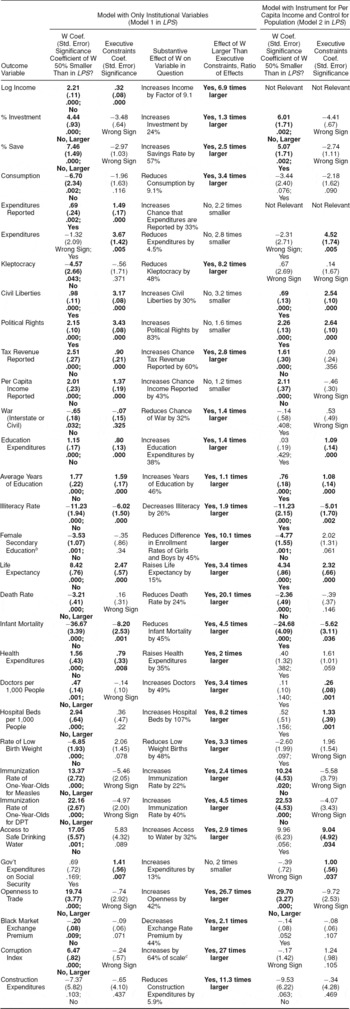
Results of Analyses Testing Size of Winning Coalition Against Executive Constraintsa

a To conserve space, we do not report the constant terms or the summary statistics for the regressions; full details are available at http://politics.as.nyu.edu/object/datapage.html. The table shows the one-tailed significance for W and for Executive Constraints because we have directional hypotheses for these variables. Results reported in bold for W or for Executive Constraints are significant at least at the .05 level and have the predicted sign.
b The theory indicates that coalition size should have opposite effects on enrollment rates of females in secondary school based on whether they are under- or overenrolled relative to boys. In LPS, we tested both the overall effect and separate regressions for states where boys were under- and overenrolled relative to girls. Here we present a superior test: the absolute value of the difference in enrollment rates from one-half. Analyses that parallel those in LPS produce similar results and can be found at http://politics.as.nyu.edu/object/datapage.html.
c On the Transparency International Corruption Scale, higher values are associated with lower corruption.
The predicted score when W = 0 and other values are set to their means is close to 0, the lowest score possible. We then report the movement up the scale toward less corruption when W = 1.
We would still like to separate out the effects of the size of the winning coalition on the provision of public goods and private benefits from other features of political systems commonly associated with democracy. This was the intention behind our residualization of Polity Democracy in LPS (Bueno de Mesquita et al. Reference Bueno de Mesquita, Smith, Siverson and Morrow2003, 137). We accept that these tests were inadequate, but there is another way to separate out the effects of W from elements of democracy outside it. Constraints on executive power, the checks and balances we associate with diffusion of power in a democracy, play no role in our theory. The leader can set policy entirely on her own, subject only to the threat of removal if her support coalition falls below the size of the winning coalition in her system. We do not use the fourth Polity component—executive constraints (XCONST)—because our theory says nothing about the effects of constraints on the chief executive. We can, therefore, try to separate the effects of division of power and other restraints on the executive from the effects of the size of the winning coalition by including the Polity indicator XCONST in our analyses as a control variable for the elements of democracy outside the size of the winning coalition. We normalize XCONST to fall between 0 and 1 to make its range comparable to our measure of W.Footnote 5 We then estimate increasingly demanding models that predict the 31 different public goods and private benefits we studied in Chapters 4 and 5 of LPS and that Clarke and Stone (Reference Clarke and Stone2008) reanalyze.Footnote 6
We reestimate our results three ways. First, we assess the effects of coalition size and executive constraints with fixed effects for the region and year. This specification matches Model 1 in the tables in Chapters 4 and 5 of LPS, adding XCONST as a control of features of democracy outside W. Second, we have also run specifications that parallel Clarke and Stone (Reference Clarke and Stone2008), except that XCONST replaces Democracy as a control variable and we also include controls for population size and log of per capita income.Footnote 7 As we will see, W has a large effect on income. Third, we examine the effects of institutions controlling for per capita income using two-stage least squares to create instruments for per capita income. Because income depends on W, we use the instrumental variables to separate income effects that cannot be attributed to institutions from institutional effects.Footnote 8 These specifications match Model 2 in the tables in Chapters 4 and 5 of LPS. Table 1 reports the coefficients, standard errors, significance level for W and XCONST, and the substantive effect of W for each public good and private benefit based on the first model. The first column also reports whether the coefficient for W is less than 50% of its size as reported for Model 1 in LPS. The third numeric column reports the substantive effect on the dependent variable of moving from a system with the smallest winning coalition (W = 0) to the largest (W = 1). The fourth column reports whether coalition size has a larger effect than executive constraint, as well as the ratio of the larger to smaller coefficient.Footnote 9 Columns 5 and 6 show the results controlling for per capita income and population. The remaining two columns show the results of the third analysis using instruments for per capita income.
These results are important in a number of ways. In 28 of 31 analyses of the first model, the effect of W is statistically significant at the .05 level or better, in the direction predicted by the theory, and generally with a large substantive effect. The first column shows that in most cases, the estimated effects are smaller than in LPS, meaning that residualization did inflate some of our estimates. In 19 of these cases, the decline was less than 50%, and in 4 cases, the estimated effect was larger. Contrary to Clarke and Stone's (Reference Clarke and Stone2008) theoretically inappropriate specification, the effects of W remain both in the theoretically predicted direction and strong when we control for elements of democracy or, more precisely, of governance, outside our theory.
Executive constraints, in contrast, are significant at the .05 level in the predicted direction just 15 times out of 31 opportunities, and are in the wrong direction ten times. The elements of democracy outside our theory do not predict the provision of public goods and private benefits as consistently or as well as the size of the winning coalition does.
The fourth column of Table 1 compares the estimated effect of the size of the winning coalition with that of executive constraints. How much does each raise public goods or lower private benefits? In 25 of 31 analyses, W produces a bigger change in the levels of these public goods and private benefits than executive constraints do. In 20 of these cases, the effect of W is more than double that of executive constraints. In fact, the median ratio of the coefficient for W divided by the coefficient for executive constraints is greater than 3 and the average exceeds 7, indicating that the impact of coalition size is substantively much larger than the effect of executive constraints. The size of the winning coalition, contrary to the conclusion reached by Clarke and Stone (Reference Clarke and Stone2008), has a much bigger impact on the provision of public goods and the limitation of private benefits than do other elements of democracy.
In LPS, we also residualized the logarithm of per capita income when we included it in analyses as a control variable. We have run analyses that include log(income) as a control variable along with executive constraints. Much like Clarke and Stone's (Reference Clarke and Stone2008) analyses, the effect of W is reduced in these specifications. According to our theory and the results in the first row of Table 1, W has a profound effect on per capita income in a country. Entering log(income) into a regression with W makes it difficult to assess the indirect effect that W has on the outcome variables through increases in log(income). Our theory addresses the full effects of W, both direct and indirect on public goods and private benefits. To correct this improper control, we use instrumental variables for per capita income. The last two columns of Table 1 present these results for W and executive constraints. In summary, W is in the theoretically predicted direction in 25 of the 29 analyses and statistically significant at the .05 level in 15 cases.
We also note Clarke and Stone's (Reference Clarke and Stone2008) reference to analyses they conducted with Powell's (Reference Powell2000) votegov measure. According to our theory, there should be no relationship between votegov and the provision of public goods and private benefits, and that is what Clarke and Stone find. We provide a full discussion at http://politics.as.nyu.edu/object/datapage.html.
These tests robustly reinforce the contention in our book that if our theory is borne out, “the results will suggest subtle differences between policies aimed at promoting democracy and policies oriented toward promoting specific institutional configurations that are conducive to what most people think of as good government—that is, peace and prosperity” (Bueno de Mesquita et al. Reference Bueno de Mesquita, Smith, Siverson and Morrow2003, 137).
CONCLUSION
In this brief response, we have shown that although Clarke and Stone's (Reference Clarke and Stone2008) concern about our use of residualization in LPS is correct, the effects of W remain strong and in the direction predicted by selectorate theory when residualization is replaced by the one element of Polity's Democracy variable that is not included in our estimation of W. The size of the winning coalition predicts the provision of public goods and private benefits more strongly than other elements of democracy. This is not to say that there is not wide range for improvement in the selectorate theory and tests of it. We understand, as we stated in The Logic of Political Survival, that our measures are crude. We are working on more sensitive, contextual, and, we believe, accurate measures of the sizes of the winning coalition and selectorate in a variety of political systems. We have, in fact, recently completed a pilot study of what we believe is an improved, more nuanced set of measures based on expert surveys. In the meantime, even with crude measures, we find the results reported in our book are robust when tested against improved specifications.



Comments
No Comments have been published for this article.