

I. Introduction: Making Good Policy with Bad Law
Medicaid, the source of health insurance for America’s low-income individuals and children, has historically been the nation’s biggest health program, with (until declines from recent unwinding) more beneficiaries than Medicare and the VA combined.Footnote 1 It also is the nation’s most diverse program because it offers different benefits, serves different populations, and implements different care strategies across its independent programs in the fifty-three states and territories. Such a large and diverse program necessarily reflects a wide array of objectives, motivations, and political compromises. Specifying a common set of objectives for Medicaid, therefore, borders on hubris. Yet the Social Security Act requires it, and a federal appellate court ventured to do so yet failed badly in its attempt. Hence, while this article would ideally avoid defining the specific objectives of Medicaid, the statutory structure of Medicaid, combined with recent failures of judicial interpretation, make it necessary to address this question.
Articulating the “objectives of Medicaid” was the central legal question in Gresham v. Azar,Footnote 2 a case involving a challenge to Kentucky and Arkansas laws instituting work requirements for Medicaid benefits. Residents from both states sued the Trump administration to block the program, arguing that the requirements were contrary to the Medicaid statute. The D.C. Circuit agreed, holding that “the objective of Medicaid was to furnish medical assistance.”Footnote 3 Even though the Secretary of Health and Human Services determined that the work requirements were “likely to assist in improving health outcomes,” the court concluded that “better health outcomes as [an] objective of Medicaid … lacks textual support. Indeed, the statute makes no mention of that objective.”Footnote 4
Gresham v. Azar amounts to good policy but bad law. It is good policy because the claim that work requirements improve health outcomes was not founded on any serious science. In fact, all evidence concludes that work requirements both fail to bring more people into the workforce and harm existing beneficiaries.Footnote 5 However, it is bad law because Medicaid has repeatedly relied, and should increasingly rely, on health interventions that do not centrally furnish medical assistance. Public health research has reached two consensus opinions: first, that “social determinants of health” are more significant in predicting health outcomes than any medical or genetic factors, and second, that interventions that address social and environmental health determinants can be more effective in improving health than furnishing traditional medical care.Footnote 6 Therefore, since these social interventions tend to be equally effective and less costly than many traditional medical services, they have become critical components of modern Medicaid programs.Footnote 7 This is especially true given that Medicaid constitutes more of state budgets than any other program, making states under budget pressures increasingly reliant on innovative, nonmedical interventions to serve their Medicaid populations.Footnote 8
For these reasons, a legal and policy case must be made to bolster Medicaid’s provision of services beyond just medical assistance.Footnote 9 This paper establishes, first, that Medicaid’s statutory language does support the promotion of better health outcomes as one of the program’s objectives; second, that Medicaid, in fact, increasingly provides services that are not “medical assistance” and has been since 2000; and third — and most importantly — that nonmedical assistance will be increasingly central to the future of health care delivery, especially for Medicaid patients who by definition suffer from both medical and economic hardship.
We write as a second Trump administration has initiated vast Medicaid reforms that include reconsidering work requirements.Footnote 10 For this reason alone, both the policy questions and legal issues encountered in Gresham v. Azar are likely to be revisited.Footnote 11 More important, the case’s central question looms over both the entire Medicaid program and the future of health care delivery to the poor. While many nonmedical interventions — such as nutritional support and housing assistance — improve health outcomes, many others — such as work requirements — do not.Footnote 12 The challenge at the center of Gresham is providing a Medicaid framework that offers policymakers the flexibility they need to pursue, improve upon, and experiment with health care services that do not rely on medical assistance while prohibiting interventions that are without empirical support and may do harm.Footnote 13
American health policy has always been burdened with political ideologies that cloud policy judgments and deter wise policymaking. Though Medicaid certainly has room for improvement — the program is far from delivering the care and support that beneficiaries deserve and requireFootnote 14 — the process of learning from innovative policies and improving the program’s offerings cannot be hijacked for ideological purposes. The article therefore identifies key features in Medicaid’s statutory and regulatory framework that can guide responsible implementation and innovation of Medicaid’s nonmedical offerings while shielding the program from those hostile to either empirical realities or the original motivations of the Medicaid.
II. Medicaid Demonstrations and the Problem of Work Requirements
Medicaid was established alongside Medicare in the Social Security Amendments of 1965 as a health insurance program for low-income families,Footnote 15 and was later expanded to include children, parents, pregnant women, the poor aged, blind and disabled individuals, and low-income working age adults.Footnote 16 Like Medicare, Medicaid is an entitlement program that bestows upon eligible individuals the statutory rights to receive medical services defined in the statute.Footnote 17 Unlike Medicare, however, Medicaid is the product of cooperative federalism, in which federal funds match state contributions to a state-led program.Footnote 18 It was never intended to be a widespread system of social insurance like Medicare but instead designed to meet the particular health demands of the needy.Footnote 19
This section offers a brief window into the central mechanisms of Medicaid policy. Because understanding the challenges and opportunities for Medicaid requires first understanding its budgetary and legal structure, we begin with the basics of Medicaid’s financing and statutory framework. We then document a central feature of modern Medicaid policy — the Section 1115 demonstration authority — and illustrate not just its key prominence in Medicaid policy (across Democratic and Republican administrations), and the formulation of 21st Century health policy, but also its role in expanding the array of services that Medicaid offers. The discussion of Section 1115 demonstrations then leads into a discussion of Arkansas and Kentucky’s introduction of work requirements, their request for approval from the Trump administration, and the collective efforts to push Medicaid policy where it ought not to go.
A. Medicaid’s Statutory and Administrative Structure
Although Medicaid was originally designed as a medical assistance supplement for poor families and others who received cash welfare assistance, it has evolved into a standalone health insurance program for the many Americans who cannot afford commercial insurance.Footnote 20 In combination with its offshoot Children’s Health Insurance Program (CHIP), Medicaid now covers over seventy-nine million Americans, more than Medicare or any single private insurer. Medicaid plays a integral role in child and maternal health, covering more than thirty percent of all children and over forty percent of births.Footnote 21 Medicaid also plays a central role in the nation’s safety net, covering nine million persons with disabilities, six million poor Medicare beneficiaries, half of all mental health expenditures, and more than sixty percent of people living in nursing homes.Footnote 22 More recently, Medicaid’s expansion was a signature instrument in the Affordable Care Act (ACA), as states were encouraged to enlarge Medicaid eligibility to achieve the ACA’s objective of one hundred percent insurance coverage.Footnote 23
Two distinctive features of Medicaid bear emphasis: the way it is financed and the populations it serves. Both features set the backdrop for understanding the policy environment in which Medicaid waivers arise, the particular pressures surrounding the Gresham v. Azar dispute, and the foundational challenges for the program.
Medicaid is jointly financed by the federal government and the states, with individual states determining their individual Medicaid budgets and the federal government matching state contributions.Footnote 24 In accordance with broad federal guidelines, states have significant flexibility in determining the parameters of their state’s Medicaid coverage, including what populations and services to cover, how to deliver care, and how much to reimburse providers.Footnote 25 But even though the federal government pays for the majority of Medicaid’s costs and federal matching dollars are guaranteed without a cap for qualifying state expenditures, Medicaid still imposes significant strain on state budgets.Footnote 26 State Medicaid budgets consume the largest portion of most states’ budgets, approximately equal to state spending on elementary and secondary education combined (see Figure 1).Footnote 27
Average Percent of State Budgets Consumed by Largest Programs for Fiscal Year 2025Footnote 28

1. Medicaid is Typically States’ Largest Budget Item
As an entitlement program, Medicaid is legally required to serve all individuals who meet the criteria for eligibility.Footnote 29 During economic downturns, many individuals and families affected by unemployment, loss of job-based health coverage, and declining income become eligible for Medicaid; the program necessarily expands to cover these newly-eligible individuals without enrollment caps or waiting lists.Footnote 30 Macroeconomic fluctuations thus amplify the fiscal burdens associated with Medicaid, as it operates as a counter-cyclical program with increased demand during economic downturns and recessions. For instance, it is estimated that, for every one percentage point increase in the unemployment rate, Medicaid enrollment grows by one million (see Figure 2).Footnote 31 Consequently, Medicaid enrollment surges tend to occur when state revenues decline, and escalating demands on Medicaid can precipitate substantial fiscal distress for the state.Footnote 32 During the Great Recession of 2007–2009 and its aftermath, more than ten million additional people — roughly half of them being children — enrolled in Medicaid.Footnote 33 Medicaid similarly plays a signature role during public health emergencies, and during the Covid pandemic, Medicaid rolls swelled and triggered Congress to rely on Medicaid to stabilize coverage for the duration of the federal public health emergency declaration.Footnote 34
Percent Change in Medicaid Spending and Enrollment, Fiscal Years 1998-2026Footnote 35
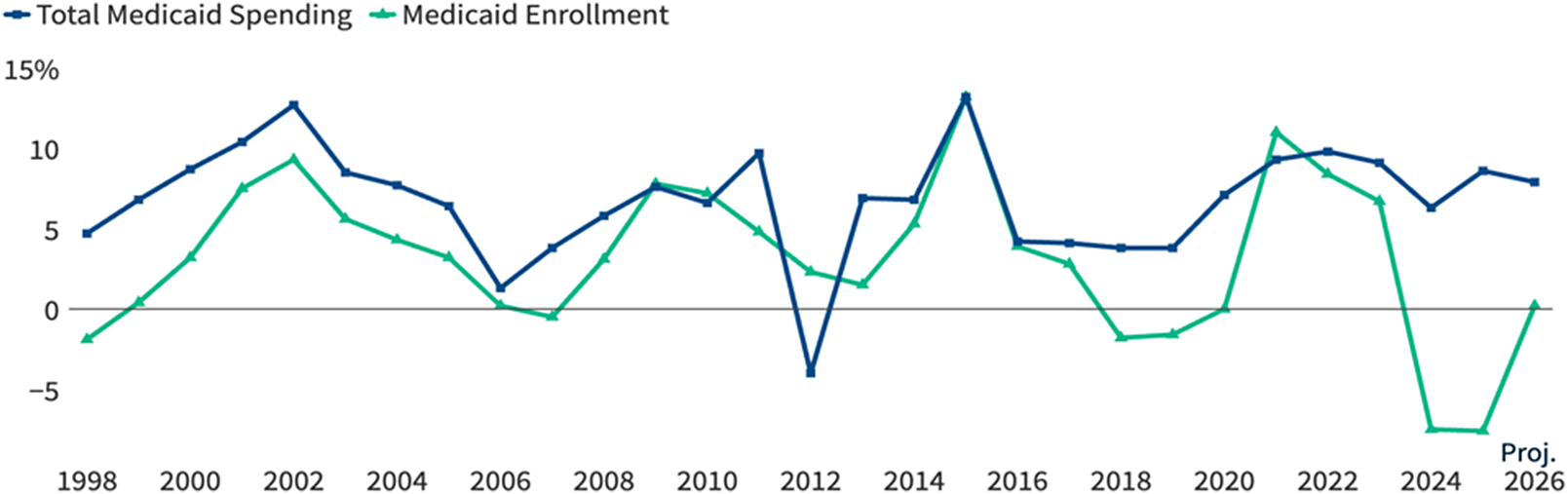
Figure 2. Long description
The x-axis represents fiscal years from 1998 to 2026, with the final three years marked as Proj. for projected. The y-axis measures percent change from negative 5 percent to 15 percent.
* Total Medicaid Spending (dark blue line with square markers): Starts at approximately 5 percent in 1998, peaks at nearly 13 percent in 2002, and fluctuates significantly. It reaches a notable low of negative 4 percent in 2012 before spiking to 13 percent in 2015. From 2021 to 2026, it remains positive, fluctuating between 6 percent and 10 percent.
* Medicaid Enrollment (teal line with triangle markers): Starts at negative 2 percent in 1998, peaks at 9 percent in 2002, and generally follows the spending trend with less volatility until 2021. In 2021, enrollment peaks at 11 percent, then drops sharply to negative 7 percent in 2024 and 2025, before returning to 0 percent in 2026.
The two lines often move in tandem, though spending typically remains higher than enrollment, except for a brief period around 2010 and a significant divergence starting in 2023 where enrollment drops sharply while spending remains high.
2. Medicaid is Counter-Cyclical
The second distinctive feature of the Medicaid program is the populations it serves. Medicaid targets individuals whose basic characteristics — deeply impoverished, medically vulnerable, and unable to access or obtain medically necessary care — require assistance that is not offered in a standard insurance product. Overwhelming evidence documents the manifold health disparities across economic class: compared with affluent adults, poor adults are nearly five times as likely to report being in poor or only fair health, suffer from higher mortality rates, and are significantly more likely to suffer from chronic illnesses.Footnote 36 As an illustration, both diabetes (a major cause of severe illness, disability, and premature death) and coronary health disease (the leading cause of death in the United States) are more common among poor adults than among the most affluent.Footnote 37 These health disparities persist after nearly six decades of Medicaid and annual spending that reached $931.7 billion in 2024.Footnote 38
One prominent reason that health disparities persist across socioeconomic status despite Medicaid’s offering of health insurance is that, on a very fundamental level, health insurance is not the primary driver of health disparities.Footnote 39 Scholars have increasingly observed that differentials in access to health care do not come close to fully explaining the marked inequality in health outcomes, as health disparities have been shown to persist even under conditions of equal access to health care.Footnote 40 For example, the famous Whitehall studies observed health differences across class and income among civil servants in England and Wales even though all of the subjects enjoyed equal medical insurance coverage under Britain’s National Health Service.Footnote 41 In addition, the Rand Health Insurance Experiment (HIE) found that while lower copayments for health care led to higher utilization of health care services, those increases in utilization did not measurably improve health outcomes, save for the sick poor.Footnote 42
For these reasons, Medicaid policymakers have increasingly recognized the limits of providing beneficiaries solely with traditional health insurance. To be sure, access to medical care remains essential to treat many sources of poor health, particularly after diseases develop. Studies that examined the impact of medical care on Medicaid beneficiaries found many positive benefits, including reduced racial health disparities between patients from lower- and higher-income communities,Footnote 43 decreased mortality,Footnote 44 and increased use of gynecologicalFootnote 45 and pediatric preventative care.Footnote 46 But many major diseases develop as a result of factors that are not addressed by increasing access to medical care. Hence, certain health disparities have persisted despite increased access to care, in part because of differences in key health-related risk factors. For example, although the prevalence of high cholesterol and smoking, both important cardiovascular disease risk factors, decreased overall during the past three decades, the decrease was smallest among adults in lower-income groups.Footnote 47 Diabetes follows a similar trend.Footnote 48
Perhaps it is because these health disparities persist in spite of Medicaid’s sweeping coverage that policymakers have come to the conclusion that Medicaid, in addition to improving access to care, must also address underlying social factors that increase the likelihood of poor health among low-income populations. At the same time, state budget constraints (as well as political realities) prevent Medicaid from serving as a vehicle to meaningfully mitigate economic inequality.Footnote 49 These twin realities — the need to balance budgets and the realistic limits of what traditional health care can do — has compelled a growing number of states to pursue Medicaid waivers.
B. Medicaid Demonstrations: Purpose and Process
Section 1115 of the Social Security Act predates the Medicaid program, as Congress passed it as part of the Public Welfare Amendments of 1962 to improve state-based public assistance programs.Footnote 50 When President Kennedy signed it into law, he described it as an opportunity for “‘imaginative’ solutions to problems in welfare programs” that would “help make our welfare programs more flexible and adaptable to local needs.”Footnote 51 Accordingly, the statute promised funding for “any experimental, pilot, or demonstration project which, in the judgment of the Secretary, is likely to assist in promoting the objectives” of the welfare programs.Footnote 52
When Congress created Medicaid three years later, it made Section 1115 applicable to that program as well.Footnote 53 In the same spirit of experimentation articulated by President Kennedy, Section 1115 allows states to depart from otherwise mandatory requirements of the Medicaid Act to implement pilot or demonstration projects that take a “novel approach” to program administration,Footnote 54 so long as the project satisfies Section 1115 statutory requirement to “assist in promoting the objectives” of the Medicaid program.Footnote 55
Section 1115 was immediately attractive to states looking to take advantage of the section’s flexibility and broad authority. Approximately fifty demonstrations, including small experiments with managed care, were approved from Medicaid’s founding through 1992.Footnote 56 An uptick in demonstration applications and approvals was prompted by the “Clinton Administration’s relaxation of cost-neutrality requirements in 1994,”Footnote 57 and an additional surge in 1115 demonstrations came when the George W. Bush administration issued the Health Insurance Flexibility and Accountability Demonstration Initiative (HIFA), which allowed states “to expand coverage to formerly ineligible populations.”Footnote 58
These expanded authorities, the broad programmatic successes, and the twin pressures of budgetary constraints and exposed limitations of traditional health insurance, have made Section 1115 demonstrations a bipartisan staple of Medicaid policy. As of January 2025, sixty-six demonstrations have been approved across forty-seven states, with thirty-four additional demonstration applications pending across twenty-seven more.Footnote 59 Most demonstrations modify Medicaid rules concerning eligibility and benefits, and a growing number supplement health care delivery mechanisms to include interventions addressing social determinants of health, such as housing, nutrition, and employment.Footnote 60
The crux of Section 1115 policy is now the approval process, which begins with a state demonstration application and culminates with the issuance of a waiver from the Secretary of Health and Human Services.Footnote 61 State applications involve, foremost, a comprehensive program description of the proposed demonstration project, including the goals and objectives to be implemented and a detailed estimate of the demonstration’s impact.Footnote 62 The essence of the application is a request that the federal government permit the state to deviate from standard Medicaid program requirements if the state offers a strong rationale behind the demonstration project, with much of the action lying in the Secretary’s waiver of Medicaid’s general requirements.Footnote 63 Implicit in the Medicaid program and its Section 1115 authority is a recognition that experimentation, innovation, and structured learning are important parts of developing good policy, that there is room for improvement beyond Medicaid’s general requirements, and, critically, that any such proposed improvement must be built atop a foundation of solid theory and preliminary evidence.
C. The Rise of Medicaid Work Requirements
Although work requirements have had a periodic presence in federal cash assistance programs, the first Trump administration was the first to encourage states to condition Medicaid coverage on work requirements. In January 2018, the administration issued guidance inviting states to propose Section 1115 demonstrations that impose work requirements as a condition of Medicaid eligibility for non-elderly, non-pregnant, nondisabled adult beneficiaries.Footnote 64 The next day, the Secretary of Health and Human Services issued a waiver to Kentucky’s Section 1115 demonstration application, the first to impose Medicaid work requirements; on March 5, 2018, the Secretary again approved a similar Arkansas Section 1115 application with work requirements.Footnote 65
The Kentucky HEALTH demonstration proposed requiring nonelderly, nonexempt adults to participate in community engagement for eighty hours a month, which included employment, job searching, volunteering, school, caretaking of family members, and participating in treatment for substance use disorders.Footnote 66 The “Arkansas Works” program similarly required beneficiaries aged nineteen to forty-nine to “work or engage in specified educational, job training, or job search activities for at least 80 hours per month,” and to document such activities.Footnote 67 Nonexempt beneficiaries who failed to meet the work requirements for any three months during a plan year would be disenrolled and prohibited from re-enrolling until the following plan year.Footnote 68
In approving the Section 1115 applications, the Secretary concluded that the work requirements would fulfill three objectives: they would improve health outcomes, address “behavioral and social factors that influence health outcomes,” and incentivize “beneficiaries to engage in their own healthcare and achieve better health outcomes.”Footnote 69 Specifically, the Secretary stated that the demonstration’s community engagement requirements would “encourage beneficiaries to obtain and maintain employment or undertake other community engagement activities that research has shown to be correlated with improved health and wellness.”Footnote 70
Residents of both states promptly brought suit to enjoin the work requirements — Kentuckians in Stewart v. Azar Footnote 71 and Arkansans in a parallel action in Gresham v. Azar. Footnote 72 Both suits came before Judge Boasberg in the U.S. District Court for the District of Columbia, and both plaintiffs argued that the Secretary’s approval of the demonstrations was arbitrary and capricious, violating of the Administrative Procedures Act.Footnote 73 The chief objection was that the purpose of the Medicaid Act is to provide coverage and care to the most vulnerable, and the Secretary failed to consider adequately the impact of his waivers on Medicaid coverage.Footnote 74
Judge Boasberg issued Stewart v. Azar in 2018 and then cited to Stewart when resting his 2019 decision in Gresham v. Azar on the same reasoning.Footnote 75 In both cases, he followed Section 1115’s requirement that the Secretary may issue a waiver for a Medicaid demonstration project if it is “likely to assist in promoting the objectives” of the Medicaid program,Footnote 76 before turning (as the parties agreed he should)Footnote 77 to 42 U.S.C. § 1396-1, Medicaid’s appropriations authority, to determine Medicaid’s objectives.Footnote 78 Noting that Section 1396-1 identifies “medical assistance” as an objective of Medicaid,Footnote 79 and contrasting this objective with the Secretary’s justification, which instead focused heavily on how work requirements promoted beneficiaries’ health outcomes. Judge Boasberg ultimately concluded:
[T]he Secretary never adequately considered whether [the demonstration] would in fact help the state furnish medical assistance to its citizens, a central objective of Medicaid. This signal omission renders his determination arbitrary and capricious.Footnote 80
In a consolidated appeal,Footnote 81 the D.C. Circuit affirmed Judge Boasberg’s opinions.Footnote 82 It concluded that “the district court is indisputably correct that the principal objective of Medicaid is providing health care coverage,”Footnote 83 and that the Secretary instead identified “three alternative objectives [that] all point to better health outcomes, [which] lacks textual support.”Footnote 84 It then closed with sweeping language:
[T]he alternative objectives of better health outcomes and beneficiary independence are not consistent with Medicaid. The text of the statute includes one primary purpose, which is providing health care coverage without any restriction geared to healthy outcomes, financial independence or transition to commercial coverage.Footnote 85
This is a remarkable legal conclusion. On a foundational level, it strains credulity that the nation’s largest health insurance program does not contain an objective to improve the population’s health. It is like claiming that the food stamps program aims to purchase food yet rejecting nourishment as a program objective.
A more sympathetic interpretation of the circuit court’s ruling is that it simply amounted to a critique of the Secretary’s incomplete assessment.Footnote 86 Professor Sara Rosenbaum, for example, interpreted Gresham as having voided a demonstration waiver without making any broader conclusion about the Medicaid program.Footnote 87 It is true, as we detail below (and as Professor Rosenbaum emphasized), that the Secretary’s suggestion that work requirements improve health outcomes rested on flimsy evidence, that the Secretary’s review was deservedly deemed to be arbitrary and capricious because it failed to consider loss of insurance coverage as a factor in reviewing the demonstration project, and that subsequent studies indeed confirmed that the state’s work requirements caused many beneficiaries to lose coverage and suffer harm to their health.Footnote 88 Professor Rosenbaum plausibly reads Gresham as an appropriate check on the unsupported use of Section 1115 experimentation, an expedient reaction to a cynical attempt to undermine Medicaid expansion, and perhaps an instance of a court overstepping its reading of what the Medicaid statute permits.Footnote 89
Yet even if the Gresham court was highly focused on the particular waivers in the dispute at hand, its failure to think of the long term implications for Medicaid constitutes a concerning oversight.Footnote 90 At best, the court’s dismissiveness of Medicaid’s “alternative objectives” should be relegated to dicta, but it is hard to overlook the court’s deep misunderstanding of both Medicaid and modern health care. Nonmedical interventions are central to good population health policy, and accordingly nonmedical interventions are increasingly supplementing and replacing traditional medical services.Footnote 91 This is especially true in Medicaid programming, which is why many (if not most) approved Section 1115 demonstrations have scaled back reliance on traditional medical services by incorporating nonmedical interventions.Footnote 92 The primary, and perhaps exclusive, justification for using Medicaid dollars in these demonstration projects is that they improve health outcomes, yet the circuit court’s selective reading of the vast Medicaid statutes shows a particular disregard for the program’s lodestar.
III. More than Medicine, Better than Work Requirements
While courts focus their attention on statutory construction, health care policy makers focus on what works. And for the past several decades, few insights have been as instrumental (and provocative) as the increasing recognition that social and environmental factors have outsized influence in determining health outcomes. Though genetics and access to efficacious medical care remain important determinants of health, new research reveals that other factors — including education, social networks, health behaviors, economic opportunities, and environmental circumstances — are even more consequential.Footnote 93
Though its impact has not yet fully permeated through our scientific and public institutions, this research into the so-called social determinants of health (“SDH”) has transformed our understanding of health policy. Pragmatically speaking, it highlights both the limits of modern medicine and the need to supplement traditional health care delivery with nonmedical interventions.Footnote 94
Federal policymakers, on a conceptual level, have already acknowledged that improving health outcomes and reducing health disparities will rely on harnessing nonmedical strategies,Footnote 95 making it unsurprising that many state Medicaid programs — relying on Section 1115 demonstrations — have pursued initiatives that target SDH as a pathway to better health.Footnote 96 Given the growing costs of traditional medical care and the strains those costs place on state budgets, these demonstration projects also provide a pathway for using Medicaid funding more effectively.Footnote 97 Though SDH projects represent a very small percentage of state Medicaid spending,Footnote 98 their returns on investment in health, plus their capacity to close the gap in health disparities, suggest they will play prominent roles not just at the core of Medicaid policy but also in the broader U.S. health sector.
This section summarizes some of the research illustrating the significance that SDH have in shaping health care outcomes and some specific SDH-based interventions that have been shown to improve population health. It then documents that several Medicaid programs — despite the holding in Gresham v. Azar — have already implemented nonmedical interventions and have met success in doing so. This section closes by documenting how the work requirements implemented in state Medicaid programs both failed to achieve their stated objectives and underserved Medicaid beneficiaries. The takeaway is straightforward: nonmedical assistance is both already part of the Medicaid program and is destined to play an increasingly central role in Medicaid (and American health care more generally). What distinguishes work requirements from these other nonmedical interventions is, simply, that they do not work.Footnote 99 Hence, the law of Medicaid should not distinguish between medical and nonmedical interventions but instead between efficacious interventions and those that harm the public.
A. Nonmedical Assistance That Promotes Health: Theory and Practice
Among the first to rigorously demonstrate the limits of medical care was the Scottish physician Thomas McKeown, who studied death records for England and Wales from the mid-19th century through the early 1970s.Footnote 100 McKeown found that mortality from multiple causes had sharply fallen in the decades before antibiotics, intensive care units, and other signature innovations of modern medical care became widely available.Footnote 101 He instead attributed dramatic increases in life expectancy to improved living conditions, including nutrition, sanitation, and clean water.Footnote 102 Similar findings were described in the United Kingdom’s famous Whitehall studies, which documented that despite the creation of the National Health Service in 1948 and the universal availability of medical care, disparities in health across social classes continued to grow.Footnote 103
The field became more formalized in 1999 when two prominent researchers, Michael Marmot and Richard Wilkinson, gathered the growing scientific evidence on SDH, illustrating the predictive power of social factors on health outcomes. Their book, Social Determinants of Health, distilled the cumulative research into some foundational tenets: (1) differences in health across population groups are primarily due to differences in social characteristics, not differences in access to health care; (2) when individuals change social and cultural environments, their disease risks change as well; (3) health disparities are not a result of poverty alone, but rather a health gradient spans “across the entire socioeconomic spectrum—as one moves down the social hierarchy, life expectancy gets shorter and mortality rates are higher”; (4) the health gradient can change, and change quickly, with interventions; and (5) health status is not a consequence of individual decisions but instead is determined by social setting. In essence Marmot and Wilkinson found that “health does not determine social position, rather, social position determines health.”Footnote 104 In 2005, Marmot led a World Health Organization (WHO) commission on SDH, leading to a 2008 report summarizing the “various ways in which material disadvantage combines with the effects of insecurity, anxiety, and lack of social integration to affect the health of those at progressively lower levels of socio-economic status.”Footnote 105
Marmot & Wilkinson’s conclusions have penetrated all layers of medical science, and it is now widely accepted that social and nonmedical factors significantly influence health outcomes. Moreover, numerous studies have shown that these causal pathways occur across diverse settings and populations, and biological research has shown that social factors influence health through multiple physiological and behavioral pathways.Footnote 106 Additional convincing evidence of SDH’s causal impact on health came in a large meta-analysis in 2011, which concluded that the number of U.S. deaths in 2000 attributable to social factors was roughly equivalent to those attributable to myocardial infarction, cerebrovascular disease, and lung cancer.Footnote 107
Establishing causal rather than correlative relationships is always more demanding. It is especially difficult to measure the influence of specific social and environmental drivers of health, as the causal pathways are complex and the impacts accumulate over many years.Footnote 108 Accordingly, definitive evidence for the efficacy of interventions that target specific SDH does not match the robustness of the research that has assessed the overarching role of environmental influences. Nonetheless, there is adequate research to conclude that specific SDH factors affect health outcomes and, critically, to understand which interventions that address those factors could improve health. This research offers alternatives to traditional medical interventions and suggests policies that could replace individualized medical services with population-wide investments in health.
Nutritional Support. Suboptimal nutrition is a leading cause of illness, predominantly diet-related chronic diseases, with adults who consume low-quality diets or have increased diet-related comorbidities experiencing poorer physical and mental health.Footnote 109 Food-insecure individuals, including those with inconsistent access to food or inadequate food quality, also tend to use health care services more frequently and incur significantly higher health care costs than their food-secure counterparts.Footnote 110 Compared to those with access to adequate nutrition, annual health care expenditures are on average $1,800 more for people with food insecurity, primarily driven by higher inpatient admissions and higher emergency department (ED) utilization.Footnote 111
Unsurprisingly, food assistance programs that mitigate malnutrition also mitigate its harmful effects. For example, the Supplemental Nutrition Assistance Program (SNAP), which provides food benefits to low-income families, is associated with lower health care costs, lower health care utilization, and improved health outcomes.Footnote 112 Because most studies of food assistance programs compare individuals who have enrolled in a given program versus those who have not, causal conclusions are confounded by selection effects. Nonetheless, peer-reviewed studies suggest that nutritional interventions, particularly medically tailored meals and prescriptions for produce, provide significant health benefits, including reduced food insecurity and increased fruit and vegetable intake.Footnote 113 These interventions have also shown improvements in disease management, self-reported health status, glucose control, blood pressure, and body mass index, with some interventions being linked to decreased health care utilization and mortality for high-risk patients.Footnote 114 One study conducted in Massachusetts from 2015 to 2017 showed that food-insecure individuals with diabetes who received home delivery of medically tailored meals for twelve weeks exhibited substantially improved diet quality, reduced food insecurity, reduced hypoglycemia, and improved mental health.Footnote 115 Observational studies also show that reducing food insecurity was associated with fewer emergency department visits, inpatient hospitalizations, and nursing home stays, thereby also lowering health care spending.Footnote 116
For these reasons, some health systems and health insurers have invested in increasing food access to community members and subscribers through new programs, such as establishing “food pharmacies” that store and dispense health food at health care settings, instituting food prescription programs in which physicians prescribe diets that are then subsidized through community partners, or by providing home-delivered meals.Footnote 117 These programs have been associated with lowered health care costs and health care utilization, thus offering models for policymakers aiming to incorporate nutrition into formal health care delivery.Footnote 118 There is sufficient evidence that nutrition assistance programs should be a staple of health policy.
Improved Housing. Access to safe and affordable housing is a profound determinant of health. Physical housing deficiencies compromise indoor environmental quality and are associated with both childhood and adult diseases.Footnote 119 Specifically, housing with lead and other neurotoxins has been associated with cognitive delays among children; housing with poor indoor air quality, pest infestation, and excess dampness and mold cause allergies and asthma; housing with structural deficiencies cause accidents and physical injuries attributable to structural and maintenance defects; and housing insecurity is associated with hypertension and other psychological consequences associated with stress.Footnote 120 “The health effects of homelessness and housing instability are wide-ranging, with increased morbidity and mortality, more frequent emergency department visits, longer inpatient hospitalizations, and excess medical expenses compared to the general population.”Footnote 121
Accordingly, interventions to improve housing, especially those related to warmth and energy efficiency, consistently improve general health, respiratory health, and mental health. A systematic review spanning more than 200 years of housing intervention studies indicates that physical improvements in housing generally lead to positive health effects.Footnote 122 The Community Preventive Services Task Force (CPSTF), which provides guidance on available scientific evidence about community-based health promotion and disease prevention interventions, asserts that tenant-based voucher programs improve health and health-related outcomes.Footnote 123 These health benefits are especially pronounced when housing supports are provided to individuals with chronic health conditions, including behavioral health conditions, and have been shown to reduce inpatient, emergency department (ED), and long-term care utilization, and in some cases improve health outcomes or reduced overall costs.Footnote 124 Permanent supportive housing (PSH), a model which pairs affordable housing assistance with voluntary supportive services, has also been shown to improve the health benefits of stable housing.Footnote 125
Interventions ensuring housing safety also positively impact health. A study comparing publicly insured children across three housing types — redeveloped public housing (distressed urban housing rebuilt into lower-density, townhome-style communities), non-redeveloped public housing, and nonpublic housing — found that children in non-redeveloped public housing were thirty-nine percent more likely to have repeat acute care visits within a year unrelated to their initial visit, while children in redeveloped and nonpublic housing showed no such difference.Footnote 126 Fixing housing issues related to health impacts can also improve outcomes. Healthy home environment assessments, which use home visitors to assess and remediate environmental health risks within the home, lead to decreased use of urgent care and improved health outcomes.Footnote 127 A review by the CPSTF found such interventions resulted in a median reduction of twenty-one symptoms days per year and 0.57 asthma acute care visits per year among children and adolescents.Footnote 128
Providing Transportation. Lack of transportation is a frequent barrier to accessing health care, with an estimated 5.8 million people in the United States delaying medical care due to transportation issues annually.Footnote 129 Some uses of non-emergency medical transportation (NEMT) have mitigated these access barriers and proven themselves to be cost-effective by increasing preventive and outpatient care and thus decreasing more expensive care.Footnote 130 In a 2018 multistate survey of Medicaid beneficiaries with chronic illnesses who used NEMT to attend medical appointments, fifty-eight percent of respondents indicated that they would have missed all treatment appointments absent the availability of NEMT.Footnote 131 Study authors thus estimated that Medicaid-provided NEMT saved the program $3,423 for dialysis patients with smaller amounts for less ill patients.Footnote 132 Another cost-benefit study found that NEMT was cost effective for all twelve of the medical conditions analyzed and was cost-saving for four conditions (prenatal care, asthma, congestive heart failure, and diabetes).Footnote 133
Investments in safe, affordable, and broadly available transportation can lead to other health benefits as well. Access to public transportation is associated with positive health behaviors, access to healthy food, improvements in mental health, and increases in physical activity.Footnote 134 The cost-effectiveness of such interventions, the associated health benefits caused, and the tradeoffs involved in having health dollars directed to improving transportation are ripe topics for future research.
Addressing Substance Use Disorder and Mental Health. Benefits from SDH interventions can be measured not just across specific interventions but also across particular patient communities. One Medicaid population for whom SDH interventions are especially potent is those suffering from substance use disorders (SUD) and mental health illnesses (collectively referred to as those requiring behavioral health care). An estimated twenty-one percent of Medicaid recipients have mild, moderate, or severe SUD, compared to sixteen percent of commercially insured,Footnote 135 which makes Medicaid the single largest payer of behavioral health services in the country.Footnote 136
The traditional care plan for such patients is to provide needed services by behavioral health care specialists, but the need for such care overwhelmingly outstrips supply, and the quality, availability, and effectiveness of these specialists varies widely by state.Footnote 137 The U.S. health care system is grossly unprepared to adequately care for these patients. The intersection of social disadvantage, isolation, and pain requires focused clinical attention that is difficult to deliver in primary care settings,Footnote 138 and many providers — especially in rural communities — simply fail to offer patients the regular follow-up and high-contact care that recovery requires.Footnote 139 By 2030, the United States is projected to have a shortage of between five and ten thousand psychiatrists, according to a 2018 analysis by the Health Resources and Services Administration (HRSA).Footnote 140 HRSA predicts shortages in most states for many other behavioral health workers, including psychologists, social workers, and addiction counselors.Footnote 141
Given the shortage of traditional providers, many health care institutions have implemented peer recovery support services (PRSS), administered by supervised treatment teams, for patients suffering from SUD and co-occurring psychological disorders.Footnote 142 PRSS are peer-driven mentoring, education, and support services that are delivered by non-physicians, such as individuals who have previously experienced SUD and recovery.Footnote 143 These peer supports can help patients enter residential programs, engage with community-based recovery programs, and utilize other services that vary in intensity.Footnote 144
PRSS services illustrate the alternatives to traditional medical regimens and the care offered by medical professionals in medical settings. PRSS rely on community health workers — trusted community members who lack medical training — and are delivered in a variety of clinical and community settings.Footnote 145 Employing community health workers and nonmedical facilities increases access to preventative services, facilitates system navigation, and provides care coordination for chronic disease management.Footnote 146 Evaluations of peer support programs reveal they reduce substance use and relapse rates, improve relationships with treatment providers, increase treatment retention, and enhance treatment satisfaction.Footnote 147 Additionally, peer-led interventions are effective even when the contact with peers is limited. Researchers found significant reductions in substance use at a six-month follow-up from just a single-session peer-led intervention for individuals presenting to a hospital-based, walk-in clinic.Footnote 148
Some managed care organizations, partnering with state Medicaid programs, health care providers, and the other health care organizations, are exploring additional strategies to integrate community health workers into delivering care for a range of offerings, including chronic disease management, counseling, and non-health care supportive services.Footnote 149 Their success has caught the attention of some leading policy think tanks.Footnote 150 Families USA recently issued a series of policy briefs documenting the value of community health workers and concluded that community health workers can be “a game changer.”Footnote 151
B. State Medicaid Innovations and the Origins of a Broader Health care Policy
The research above on the power of social factors in determining health outcomes and the potential to improve population health by addressing these factors has not been lost on Medicaid policymakers. Social inequalities in health tend to be larger in the United States than in many other industrialized countries, and several states have already instituted SDH-based interventions in their Medicaid programs.Footnote 152 Even while the Gresham court’s decree says that Medicaid can pay only for medical assistance, the reality on the ground is that nonmedical strategies are growing in prominence in state health policy. The success of these programs suggests that nonmedical interventions are likely to become the foundation for a broader health care policy
Each of the SDH interventions described in the prior section — nutrition, housing, transportation, peer support services, and community health workers — have been incorporated into Medicaid programming though Section 1115 demonstrations. States have been experimenting with Section 1115 demonstrations to offer food support since the 2010s, largely as targeted treatments for specific populations rather than as a broader anti-poverty measure.Footnote 153 These Section 1115 nutrition demonstrations embraced the language of health care delivery by providing support to those for whom it was a “medical necessity.” Other Section 1115 projects provided nutrition counseling, home-delivered meals, pantry stocking, and nutrition prescriptions, with nutrition services frequently tailored to specific health risks or medical conditions, such as diabetes.Footnote 154 Section 1115 projects in Massachusetts and New York additionally provided meal and nutrition support to an entire household that included a high-risk child or pregnant individual.Footnote 155
Similarly, several states have already used Medicaid funds to provide certain housing supports. These funds support a wide variety of programs, including housing transition and navigation services, tenancy sustaining services (e.g., tenant rights education, eviction prevention), one-time transition and moving costs, home remediations, and home accessibility modifications.Footnote 156 Some states additionally provide room and board assistance, housing for recuperative care, and short-term housing and utility assistance.Footnote 157 A recent Section 1115 waiver allowed Vermont to establish its Supportive Housing Assistance Pilot, an especially comprehensive program that helps beneficiaries locate and apply for housing, develop living skills, obtain eviction protection services, and receive assistance for security and utility deposits.Footnote 158
States have been especially eager to develop nonmedical assistance to individuals struggling with alcohol and drug addiction. Many interventions specifically invest in building a nonmedical workforce that can offer adequate peer support and behavioral health care. For example, Montana’s Healing and Ending Addiction through Recovery and Treatment (HEART) Section 1115 demonstration allowed the state to provide a continuum of behavioral health offerings, including cost-effective care in community-based settings.Footnote 159 Alabama’s 1115 demonstration, called Institutions for Mental Disease Waiver for Serious Mental Illness, offers mental health services and provides coordinated nonmedical wraparound services for Medicaid beneficiaries with serious mental illnesses.Footnote 160 And Maine’s Substance Use Disorder Care Initiative demonstration project includes “daily living skills development, community integration, and housing support services to eligible parents with a SUD.”Footnote 161
The bipartisan support for Section 1115 demonstrations, and their emphasis on pursuing nonmedical interventions, has been especially pronounced in recent years. A major success story is North Carolina’s demonstration waiver, which was approved during the first Trump administration and continued until 2024.Footnote 162 One aspect of that Demonstration Waiver is North Carolina’s Healthy Opportunities Pilots (abbreviated as the ‘Pilots’ or ‘HOP’).Footnote 163 These are pilot projects that offered a variety of nonmedical interventions whose efficacy were subsequently tested empirically. An interim evaluation issued in July 2024 reported that participation in HOP reduced enrollees’ total number of social needs across the housing, food, and transportation domains.Footnote 164 HOP participation was also associated with decreased emergency department utilization (an estimated reduction of six emergency department visits per 1000 member months) and reduced inpatient hospitalizations for non-pregnant adults by two admissions per month per 1000 beneficiaries.Footnote 165 Receipt of HOP services also lowered the total cost of care service (even including the cost of HOP services) by an average of eighty-five dollars per HOP participant per month.Footnote 166
These demonstration projects illustrate how enshrined and fully embedded nonmedical services already are in the Medicaid program, begging the question of why a court would even consider limiting Medicaid dollars to “medical assistance.” The answer might lie in how cavalier some Medicaid policymakers were in instituting job requirements, how untethered they were to empirical realities, and how fearful the courts and litigants were in what the Medicaid program would become. However, Section 1115 has its own solution to these programs. Rather than erecting rigid constraints on what Medicaid can offer, a better approach is to require demonstration projects to commit to evaluations of the effectiveness of these programs.
C. The Failure of Work Requirements
Given the increased prevalence and success of nonmedical interventions in Medicaid programs, Medicaid law should not be, in principle, against work requirements just as it should not be averse to housing support programs. However, work requirements should be prohibited from Medicaid programs, but for the same reason snake oil, biofield therapy,Footnote 167 and ReikiFootnote 168 are. Because they don’t work.
The results from studies analyzing work requirements are clear: work requirements fail to improve workforce participation, community engagement, and health outcomes, instead causing a reduction in Medicaid coverage. In short, they not only fail to achieve their stated objectives, but they also undermine other Medicaid objectives.
Much of the evidence comes from Arkansas, where despite the state’s lack of the required evaluation and reporting plan, outside researchers were able to collect data on changes in employment and coverage.Footnote 169 After the eighty-hour-per-month work requirement came into effect for Medicaid beneficiaries aged thirty to forty-nine years, approximately 18,000 adults lost their Medicaid benefits, with many of them becoming uninsured.Footnote 170 Qualitative research and telephone surveys revealed that one reason for the policy’s failure was its complexity. Nearly one-third of respondents aged thirty to forty-nine were not aware of or were confused about the Arkansas work requirement, losing coverage because of confusion and red tape, with respondents aged nineteen to twenty-nine lacking a high school diploma reporting even higher levels of confusion.Footnote 171 Meanwhile, approximately ninety-five percent of beneficiaries were already meeting the policy requirements prior to implementation, and the policy did not increase community engagement.Footnote 172 Ultimately, the lone effect of Arkansas’ work requirements was to exacerbate administrative hurdles to maintaining coverage, leading only to coverage losses without corresponding improvements in work or work-related coverage.
Similar results come from New Hampshire and Georgia. In June 2019, New Hampshire became the second state that required Medicaid beneficiaries to comply with work requirements in its Medicaid expansion program, and despite program leaders’ confidence that they would avoid Arkansas’ failures (New Hampshire officials repeatedly remarked, “We are doing things differently in New Hampshire,” and “We are not Arkansas, we can do better”), the program similarly failed.Footnote 173 Beneficiaries were confused by the new rules and unsure about how to comply. Within one month, an estimated 17,000 enrollees — approximately one-third of the program’s total enrollment — were found to be noncompliant and about to lose Medicaid coverage.Footnote 174 The state’s Medicaid administrator decided to suspend the work requirement for three months, citing the agency’s difficulty reaching program beneficiaries, and shortly thereafter, the program was halted by a federal district court.Footnote 175
And in July 2023, Georgia instituted a Medicaid expansion under Section 1115 that offered insurance only to individuals below the federal poverty level that could produce documentation that they are working, in school, or participating in other activities.Footnote 176 However, despite projecting that 100,000 people would enroll in the first year, barely 5,000 people enrolled a year after launching the program (meanwhile, 445,000 individuals were estimated to be eligible if Georgia had expanded Medicaid with the conventional approach under ACA).Footnote 177 Additionally, more than ninety percent of the program’s costs were consumed by administrative expenses, not medical care.Footnote 178
These findings are consistent with similar studies examining work requirements related to the SNAP program.Footnote 179 The introduction of work requirements to Virginia’s SNAP program reduced overall participation among able-bodied adults without dependents (ABAWDs) by fifty-three percent within eighteen months while having negligible effects on employment.Footnote 180 A similar quasi-experimental study of ABAWDs found that work requirements reduced SNAP participation by seven to thirty-two percentage points within twelve months without finding any evidence of improved employment or annual earnings.Footnote 181 Furthermore, a California study reinforced this conclusion from the opposite direction, finding that removing a work requirement for public benefits resulted in negligible exit from the labor force.Footnote 182 These studies all clearly prove that when food assistance is contingent on employment, it fails to stimulate participation in the labor force while markedly reducing participation in the assistance program.Footnote 183
Moreover, these twin results — that work requirements both do not lead to more labor force participation and instead lead to a loss in Medicaid benefits — are interrelated. An Ohio study found that eighty-three percent of its surveyed Medicaid enrollees reported that getting insurance through Medicaid made it easier to work.Footnote 184 And a study of Connecticut work requirements found that the most likely to lose benefits were individuals with the lowest incomes and who suffered from poor health.Footnote 185 For example, individuals with diabetes were nearly twice as likely to lose benefits, households with the lowest incomes were twice as likely, and older beneficiaries (aged forty to forty-nine years) with multiple comorbidities were more than five times as likely.Footnote 186
More fundamentally, and in direct contrast to the assertions of Secretary Azar, instituting Medicaid work requirements likely leads to worse health outcomes. Assessments of Arkansas’ work requirements did not include measurements of health outcomes, but other research suggests that a loss of insurance coverage, especially among Medicaid beneficiaries, is strongly associated with declines in health status. A qualitative study examining Georgia’s Medicaid work requirements found that losing coverage because of work requirements forced delays in obtaining necessary medical care and led to heightened psychological and financial stress.Footnote 187 This comports with other findings from SNAP work requirements, which not only led to a loss in insurance coverageFootnote 188 but also led to long term deteriorations in health status.Footnote 189
With this empirical record, showing that, first, Medicaid work requirements (like many other work requirements) lead to a loss of health insurance, and second, that loss of insurance from work requirements leads to poorer health, no Secretary of Health and Human Services could reasonably conclude that a Section 1115 demonstration project “promotes the objectives” of the Medicaid program (it is also worth noting that Medicaid work requirements failed to achieve its ancillary objectives of increasing employment and community participation).Footnote 190 Any conclusion that work requirements improve health would be arbitrary and capricious — not because the Secretary applied the wrong criteria, as the Gresham court ruled, but because it would lack reasonable evidentiary support.Footnote 191
IV. Improving Medicaid While Adhering to the “Objectives of the Program”
Perhaps Gresham v. Azar deserves credit for bringing an end to Arkansas’ destructive Medicaid work requirements, but the opinion’s language leaves behind some deeply problematic elements. It misunderstood Medicaid’s current realities, failed to recognize the importance of nonmedical interventions in state health programs, and endorsed a narrow and counterproductive view of Medicaid itself by suggesting that the program’s objectives were limited to providing medical assistance.Footnote 192 This section additionally argues that Gresham got the law of Medicaid wrong as well by misinterpreting 42 U.S.C. § 1396-1 and other case law that surrounds the Medicaid program.
The current challenge is to place Medicaid policy on firm legal footing so it can embrace the necessary benefits of nonmedical interventions without inviting misguided initiatives harm beneficiaries. This means vindicating Congress’ original charge to pursue policy experiments, including incorporating valuable nonmedical interventions, while sustaining a commitment to what works. This section offers an alternative to the law of Gresham v. Azar. It first offers a textual and case law understanding of the Medicaid statute that does allow — and perhaps encourages — Medicaid to pay for nonmedical interventions that promote health. Second, it digs into the regulatory framework of Medicaid to offer empirical, rather than semantic, limitations to Medicaid demonstrations. These regulations require Medicaid policymakers to rigorously evaluate the efficacy of Section 1115 demonstrations so that only those that prove to be efficacious will overcome standard legal hurdles.
A. Gresham v. Azar and Medicaid’s Statutory Objectives
Recall that the question in Gresham v. Azar is whether the Secretary of Health and Human Services transgressed Section 1115 in awarding waivers for the Arkansas work requirements demonstrations.Footnote 193 Section 1115 permits the Secretary of HHS to approve a Medicaid demonstration project when it “is likely to assist in promoting the objectives” of the program,Footnote 194 and in assessing the objectives of Medicaid, the circuit court looked to 42 U.S.C. § 1396-1Footnote 195 and concluded that the program’s primary objective is to furnish medical assistance.Footnote 196
Even though the D.C. Circuit affirmed the district court’s ruling, and even though it claimed to rest its decision on prior opinions by the First, Third, Fourth, Sixth, and Ninth Circuits, and (most important) — even though it pledged fidelity to textualism, the court significantly deviated from prior law, and in doing so mischaracterized the Medicaid program.Footnote 197 In fact, the statute, the district court, and the surrounding case law offer a very different set of Medicaid objectives than the circuit court’s simplistic assessment.
First, the statute is not nearly as rigid as the Gresham court suggested. A complete consideration §1396-1 should begin with the statute’s complete wording:
For the purpose of enabling each State, as far as practicable under the conditions in such State, to furnish (1) medical assistance on behalf of families with dependent children and of aged, blind, or disabled individuals, whose income and resources are insufficient to meet the costs of necessary medical services, and (2) rehabilitation and other services to help such families and individuals attain or retain capability for independence or self-care, there is hereby authorized to be appropriated for each fiscal year a sum sufficient to carry out the purposes of this subchapter.Footnote 198
In Gresham, the circuit court heeded carefully to the features of (1) but paid remarkably little attention to (2). It offered a nearly full citation to the statute, but as if following a selective reading, the paragraph following that citation focuses on the definition of “medical assistance,” forsaking analysis of the remainder of the statute.Footnote 199 Thereafter, the court never looked backward. The remainder of the opinion described furnishing medical assistance as Medicaid’s “primary” or “principal” objective and eventually asserted that “the statute includes one primary purpose.”Footnote 200
In contrast, the district court recognized the multiple components of §1396-1, and this recognition led to a ruling that was very different from the circuit court’s. Judge Boasberg carefully observed, “[b]y its terms, the statute thus identifies two related objectives: allowing states, as far as practicable, to furnish (1) medical assistance and (2) rehabilitation and other services designed to help individuals retain a capacity for independence.”Footnote 201 The plain meaning of the statute readily supports allowing the Medicaid program to provide nonmedical interventions that enhance health, capacity and self-reliance — the defendants vociferously argued as much.Footnote 202 For this reason, and perhaps knowing that Medicaid already offered services such as transportation, housing support, and social interventions, Judge Boasberg concluded, unlike the circuit court, that medical assistance is only “a central objective of Medicaid,” and that §1396-1 “identifies at least one purpose of Medicaid.”Footnote 203 Providing medical assistance was never described as an exclusive goal in the decision, and more importantly, nothing in either of Judge Boasberg’s district court opinions suggests that improving health outcomes is not among Medicaid’s objectives.
The district court’s characterization of the Medicaid statute is consistent — whereas the circuit court’s characterization is quite inconsistent — with prior case law, reading Medicaid’s objectives much more expansively. This begins with the Supreme Court, which in Alexander v. Choate Footnote 204 offered a holistic understanding of Medicaid’s objectives, ruling that the Medicaid Act “gives the States substantial discretion to choose the proper mix of amount, scope, and duration limitations on coverage, as long as care and services are provided in ‘the best interests of the recipients.’”Footnote 205 This statutory prioritization of “the best interests of the recipients” was echoed by the First Circuit in Pharm. Rsch. & Mfrs. of Am. v. Concannon,Footnote 206 a case that was selectively cited by the Gresham court. In Concannon, the First Circuit instructed reading the “structure and purpose of the federal statute as a whole”Footnote 207 before concluding that:
The primary purpose of Medicaid is to enable states to provide medical services to those whose income and resources are insufficient to meet the costs of necessary medical services. Congress expressly intended that the provision of medical services be administered by the state in a manner consistent with simplicity of administration and the best interests of the recipients.Footnote 208
The Gresham court only cited the first sentence, not the second.Footnote 209 Had it focused on “the best interests of the recipients,” the court could not dispute that improving health outcomes was outside the Medicaid program’s objectives. But even the court’s focus on the first sentence is errant. That sentence emphasizes not merely providing medical services but providing medical services to those who cannot afford such services. Thus, denying medical services to the needy could be contrary to the statute, whereas offering nonmedical services is not.Footnote 210 The court relied on a similarly selective citation of the Sixth Circuit’s Price v. Medicaid Dir., which references 42 U.S.C. § 1396-1 to conclude that Medicaid’s purpose is “paying the medical costs of people whose income and resources are insufficient to meet the costs of necessary medical services.”Footnote 211
In sum, the legal authorities — both statute and case law — cited by the Gresham court did not support a conclusion that “better health outcomes and beneficiary independence are not consistent with Medicaid.”Footnote 212 The text of the statute may indicate that among the program’s chief objectives is to provide medical assistance, but nothing in the statute indicates that Medicaid cannot offer additional forms of assistance. The surrounding case law embraces this broader view of the Medicaid statute and recognizes that both the best interests of beneficiaries and the need to support the indigent are, at the very least, also central objectives of the Medicaid program. Put more bluntly: these authorities confirm that promoting health outcomes is indeed an objective of the Medicaid program.
The district court, in alignment with the lion’s share of statutory and judicial authorities, recognized these varied Medicaid objectives and based its rejection of the Secretary’s approval on his failure to consider the demonstrations’ impact on Medicaid coverage.Footnote 213 This was a narrower and more careful conclusion, one that focused attention on the consequences of the demonstration projects rather than a semantic construction of the sprawling program. This approach also offers a clean answer to why work requirements demonstrations cannot be approved. Their fatal flaw is that they threaten to remove the provision of health coverage, which all judicial authorities agree is a foundational objective of the program. Tellingly, a December 2024 advisory opinion issued by the HHS General Counsel (OGC) offered the same analysis in concluding that approving work requirement demonstrations are contrary to the Medicaid statute.Footnote 214
Accordingly, the district court’s approach — as well as the 2024 OGC advisory opinion — not only captures an accurate description of the law of Medicaid, but it also offers a framework with which to assess other Section 1115 demonstrations. The legal analysis should not scrutinize Medicaid’s particular objectives, since the Medicaid statute embodies many, but whether the state’s demonstration application and the Secretary’s approval reflect adequate consideration and sufficient evidence that the demonstration will advance one of those objectives. As modern health care delivery learns from and incorporates the lessons of social determinants of health, and as Medicaid programs evolve alongside it, the legal and policy question surrounding Medicaid waivers should both focus on the efficacy of the demonstration project.
B. A Path Forward: Medicaid Waivers and the Centrality of Social Science
The law of Medicaid waivers, therefore, is not just the law of statutory construction. It is also the law of good policy making. Medicaid waivers may not be issued if the proposed demonstration is likely to impede the program’s delivery of health care, advancement of the capability or independence of beneficiaries, or promotion of the best interests of Medicaid recipients. This is not a wide-open loophole for any imagined health policy, but rather, it is an invitation to develop health policies that can be proven to have efficacious outcomes.
This question of efficacy — whether a particular intervention actually helps Medicaid beneficiaries — is baked into the law controlling Section 1115 demonstrations. Since, by definition, every Section 1115 project contains some experimentation, the impact and contribution of each to Medicaid program objectives is partly uncertain. Accordingly, and reflective of spirit of “imaginative” solutions to difficult social policy challenges,Footnote 215 Section 1115 requires states to evaluate each of their approved demonstration projects — explicitly requiring such evaluations upon renewal requests and making any such renewal contingent on a rigorous evaluation — so policymakers can learn from their impact.Footnote 216 The instruction to assess pilots might also be ethically compelled, as exposing beneficiaries to the potential risks and benefits of experimental programs should obligate timely, rigorous evaluations of whether these programs are producing the intended effects.Footnote 217 This is Medicaid’s balance: the program embraces departures from Medicaid’s guaranteed services so long as they rest on a scientific basis and are proven to benefit recipients.Footnote 218
The regulations implementing Section 1115 specify how to implement demonstration projects with scientific rigor, offering specifications for program evaluation, including identifying hypotheses, data sources, and assessment strategies.Footnote 219 They also require articulating evaluation designs and reports when states either apply for new demonstrations or ask for extensions of existing demonstrations.Footnote 220 The Centers for Medicare & Medicaid Services (CMS) specifies detailed requirements for the content and timing of evaluation designs, including interim evaluations, monitoring obligations, and final summary reports,Footnote 221 and the agency emphasizes that evaluations must be “rigorous” and “incorporate baseline and comparison group assessments, as well as statistical significance testing.”Footnote 222 The rules emphasize that simply reporting descriptive outcomes is insufficient, and that an evaluation must include “[a] description of how the effects of the demonstration will be isolated from those other changes occurring in the State at the same time through the use of comparison or control groups to identify the impact of significant aspects of the demonstration.”Footnote 223
Unfortunately, few states adhere to these obligations, and most have instead been remiss in offering either rigorous or timely evaluations of demonstration projects. A 2019 Government Accountability Office (GAO) report found that few demonstration projects were followed by meaningful evaluations, leaving Medicaid policymakers with few conclusive results to improve policy adoption.Footnote 224 Additionally, federal officials have not been making evaluation results public, thus denying the opportunity for the broader policy community to learn from demonstrations.Footnote 225 As a result, Medicaid’s Section 1115 waiver process has been criticized by both right- and left-leaning policy experts. Chris Pope of the Manhattan Institute remarked that
[e]valuations are methodologically slipshod and pro forma; they usually do not identify appropriate counterfactuals, quantify costs, establish a well-constructed control group, or fully assess what had previously been promised… . Even if evaluations were rigorous, their use would be limited because they are not undertaken until the waiver term is completed—by which time it has typically already been renewed.Footnote 226
And Sara Rosenbaum commented that recent Medicaid demonstration projects have lacked “each and every one” of the elements required to assess the efficacy of new policies.Footnote 227
It is worth emphasizing that the designers of the Kentucky HEALTH demonstration waiver were apparently committed to evaluating the specified purpose program, and that its Section 1115 waiver application included a model evaluation plan that serves as a useful guide for how to plan, execute, and evaluate all Medicaid demonstration waivers.Footnote 228 The Kentucky HEALTH evaluation plan, which was made public, utilized a randomized controlled trial, identified outcome variables, and included a detailed data plan.Footnote 229 This rigorous evaluation of the Kentucky HEALTH work requirements demonstration was approved in 2018 but was never implemented because the program was terminated before the program began.Footnote 230 Nonetheless, program designers deserve credit for constructing effective evaluation designs and offer a model for how other states should conduct Section 1115 evaluations.
Several forces, in addition to simple inattention or limited resources, may be responsible for the absence of rigorous evaluations of demonstration projects even as Medicaid waivers have become increasingly prevalent. One problem is that even as policymakers and public health experts recognize the outsized impact of environmental and social factors in determining health outcomes and driving health disparities, experts have been less effective in formulating interventions at scale that meaningfully counteract those environmental forces. Even some heralded programs that met widespread acclaim among academics and the policy press have failed to survive more rigorous testing.Footnote 231
Another fraught and perhaps inevitable problem plaguing Section 1115 Medicaid waivers is its growing politicization. Some demonstration projects in 2017–2020 promoted the theory that self-sufficiency promoted good health, and thus the Medicaid program itself, as a safety net, might be harmful to one’s health.Footnote 232 Rather than using Section 1115 waivers to adjust the deferral program to local conditions, as President Kennedy originally envisioned, this policy approach has Section 1115 transform the entire program. Some critics decried that the motivations were nefarious: instead of using Section 1115 to identify the program’s shortcomings and find improvements, Section 1115 policy became a means to identify the program’s shortcomings to end the program.Footnote 233
Some health policy experts have recommended strategies to improve evaluation design and reporting. Kristin Underhill and colleagues suggest that the priority should be to improve experimental designs.Footnote 234 Since Section 1115 demonstrations rely on experimentalism, they argue, the effect of policy experiments can only be inferred from randomized controlled trials, the gold standard in science and social policy.Footnote 235 Even demonstration projects that build atop programs that were proven to be effective outside the Medicaid context require evaluation once incorporated into Medicaid programs. Many proposed demonstrations are based on parallel programs whose effectiveness is supported by strong empirical evidence, but since they have never previously been implemented in Medicaid programs, their effects on beneficiaries’ health are unknown.Footnote 236 Other demonstration proposals, as with some states’ work requirements, were supported with wholly inadequate empirical support or a credible evaluation plan in place.Footnote 237
One demonstration project that did employ randomization — and illustrates that controlled trials are feasible in even the largest initiatives — was the Oregon Health Insurance Experiment, which featured significant expansions of benefits to targeted populations.Footnote 238 The research trial was aided by the nature of the project, however. In offering generous benefits within a budget constraint, Oregon policy makers decided to expand benefits through a lottery, thus allowing researchers to examine the impact of expanded coverage within a randomized study.Footnote 239 The research that followed the Oregon Health Insurance Experiment was both rigorous and informative regarding the benefits and limits of expanding Medicaid coverage to new populations.Footnote 240 It is reasonable to ask states to adjust initiatives to make rigorous evaluations feasible.
Randomized controlled trials can be controversial in evaluating social policy (why, for example, should chance determine who obtains Medicaid benefits?), and they are often impossible to conduct. Moreover, even non-randomized evaluation designs face numerous hurdles to implementation, including limits in funding, personnel, and capacity to secure appropriate comparison groups.Footnote 241 Nonetheless, CMS guidance offers several strategies that can gather high caliber data and yield meaningful quantitative analyses, such as including prespecified hypotheses, targeting sample sizes that provide adequate statistical power, and qualitative methods that document beneficiaries’ and providers’ experiences with new programs.Footnote 242 Combining these insights can help explain key findings, illuminate unanticipated effects, and clarify self-reported outcomes such as quality of life.Footnote 243
The bottom line is that rigorous evaluations of Medicaid demonstrations are not optional, but rather, required by statute and the clear instructions in the implementing regulations.Footnote 244 Nor are evaluations mere appendages to Medicaid demonstrations, but instead they reflect Section 1115’s prime directives to experiment, learn, and improve social policy according to scientific methods and empirical research. If the Medicaid statute, contrary to the reading by the Gresham court, embodies a variety of objectives, and if Medicaid demonstrations are designed to encourage broad and creative uses of Medicaid dollars, then the program’s guardrails are the evaluations that determine whether programmatic experiments promote the health and welfare of program beneficiaries. The nation’s health care delivery system has enormous room for improvement, and the pathways for improvement are complicated,Footnote 245 but the ambiguity of the statute and the complexity of evaluations do not change either the meaning of Medicaid’s statute or the work needed to improve the nation’s health. Social science has proven to be up to the task, and the remaining factor is the commitment of policymakers to invest in and trust the findings of rigorous science.
V. Conclusion: Medicaid Policy in an Age of Scientific Skepticism
This article critically revisits a seminal case and its articulation of Medicaid’s objectives. In reviewing the D.C. Circuit’s conclusion in Gresham v. Azar that the “the primary objective of Medicaid is to provide access to medical care”Footnote 246 and the “alternative objectives of better health outcomes and beneficiary independence are not consistent with Medicaid,”Footnote 247 this article concludes that the relevant statute, prior case law, and programmatic realities all point to the contrary. The law of Medicaid not only articulates objectives that include advancing the health and welfare of program recipients, but the current state of the program, like the current state of health care delivery, relies heavily on nonmedical interventions to achieve those objectives. The article therefore aims to adjust current law to meet the scientific and administrative demands of running the nation’s most important health program. The health services research documented in Section III represent a critical advancement in modern health care delivery, and the successful Medicaid demonstration projects described in that same section reflect efforts to apply that science to a critical and budget constrained program.
This article also aims to place the law of Medicaid waivers on a foundation that enables the program to pursue creative experiments that are tethered to the welfare of its beneficiaries. Since Medicaid waivers constitute a departure from the statute’s guarantees, courts appropriately subject waiver approvals to the scrutiny that Section 1115 requires. But instead of relying on semantic interpretations of Section 1115, an approach that had the Gresham court articulating partial objectives, this article encourages courts to apply the statute’s detailed requirements for rigorous empirical evaluations. This not only restores the original intention behind Section 1115, enabling it to stimulate collective learning from thoughtful policy experimentation, but it allows Medicaid policy makers to focus on what they all undoubtedly believe to be their true duty: to improve the health and independence of beneficiaries to enable them to live a life of capability.
For this reason, this article does not revisit the Gresham court’s termination of the work requirements demonstrations. However, one interprets Medicaid’s objectives, work requirements do not achieve those objectives. We know this not from theory or ideology but from experience and research.
We recognize that we write not only at a time when an incoming administration may try to reinstate Medicaid work requirements, but also at a time when prevailing social and political trends resist the authority of experts, the capacity of empirical research, and common agreement on scientific truths. These headwinds, and perhaps a judiciary that feels more comfortable maneuvering around statutory language than scrutinizing the rigor of program evaluations, may resist a template in which research trumps ideology. But parsimonious judicial theories should not hide the hard work needed to make good social policy. If the nation is to benefit from the immensely valuable and potentially transformative insights from the social determinants of health, it needs state Medicaid directors, the Secretary of HHS, and the federal judiciary to all be up to the task.
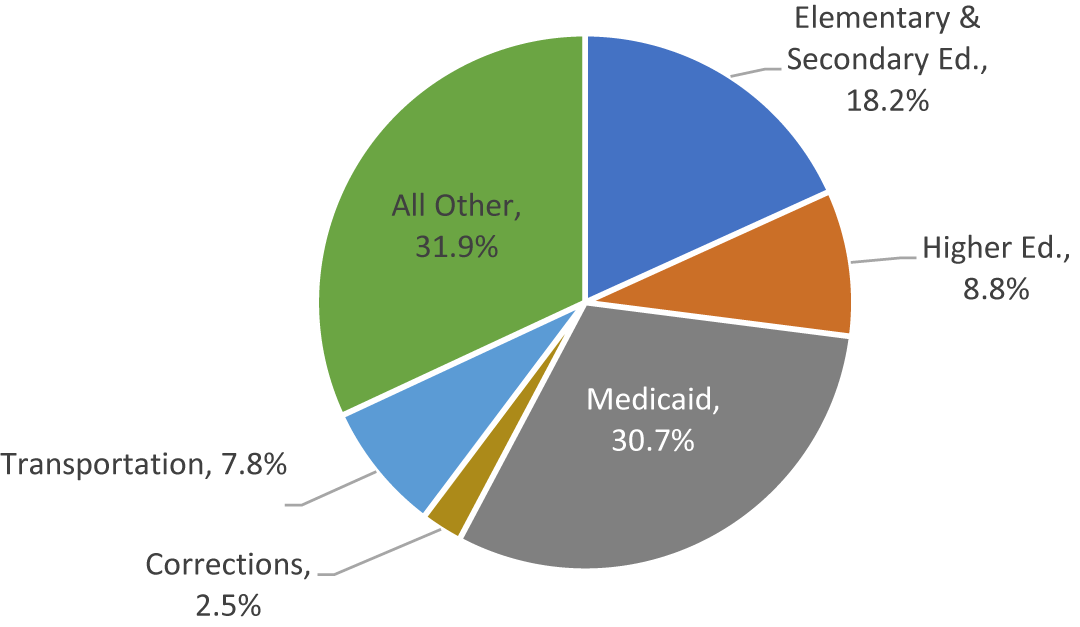
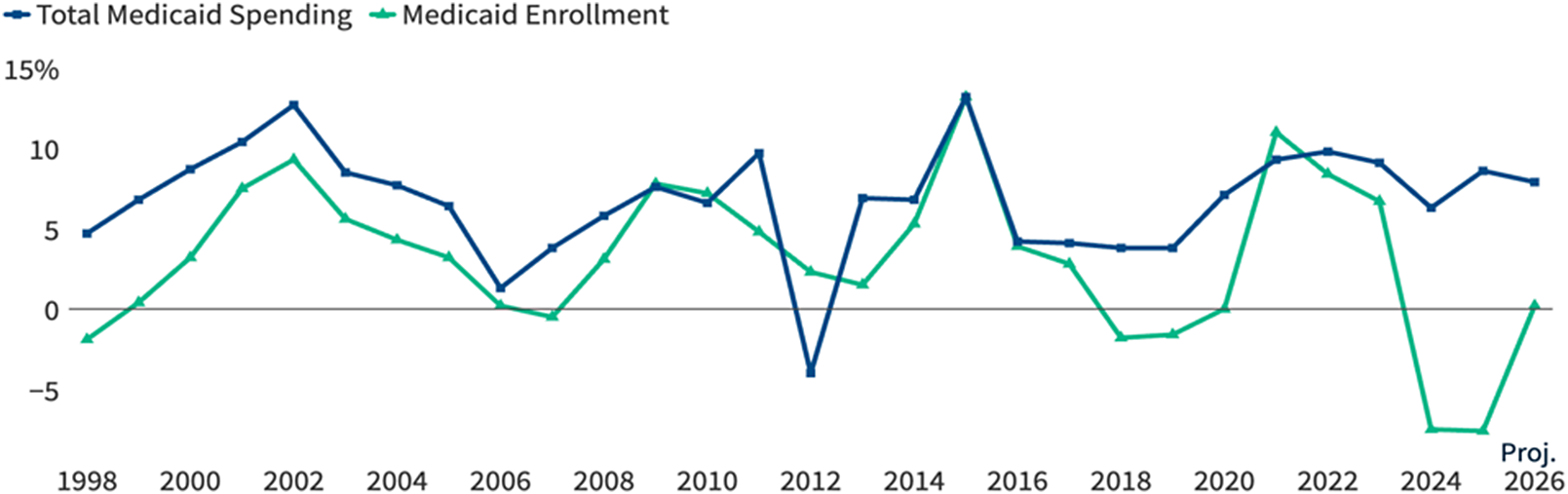

 Open access

