Introduction
Illiteracy is defined by the inability to read or write a simple message. Fourteen percent of the world’s population is illiterate (UNESCO, 2017) with gender and age disparity, older women having the highest rates (ibid). Among Arab countries, Lebanon has the highest percentage of older people (United Nations, 2018). In 2018, the rate of illiteracy among Lebanese persons aged 65 years and older was 40% of women and 15% of men (UNESCO, 2018), with higher prevalence in rural regions (59% of women and 30% of men) (Boulos et al., Reference Boulos, Salameh and Barberger-Gateau2013).
Low educational level and illiteracy are major risk factors for cognitive impairment (Arce et al., Reference Arce, Vonk, Felix, Avila, Zahodone, Dalchand, Frazer, Martinez, Shouel and Manly2019; Kaup et al., Reference Kaup, Simonsick, Harris, Satterfield, Metti, Ayonayon, Rubin and Yaffe2014). Commonly used cognitive screening tests such as the Mini-Mental State Examination (MMSE) (Folstein et al., Reference Folstein, Folstein and McHugh1975) or the Montreal Cognitive Assessment (Nasreddine et al., Reference Nasreddine, Phillips, Bedirian, Charbonneau, Whitehead, Collin, Cummings and Chertkow2005) require reading, writing, and arithmetic skills.
Among the few available tests to evaluate cognitive functions among illiterates, we selected the Test of Nine Images 93 (TNI93), a memory test developed by Dessi et al. (Reference Dessi, Maillet, Metivet, Michault, Le Clésiau, Ergis and Belin2009) for illiterate and low-educated individuals. It was validated in the French population by Maillet et al. (Reference Maillet, Matharan, Le Clésiau, Bailon, Pérès, Amieva and Belin2016). The TNI93 assesses episodic memory, which is often the first function affected in Alzheimer’s disease. In addition, the TNI93 spatial recall (SR) test explores working memory, a component of executive functioning (Dessi et al., Reference Dessi, Maillet, Metivet, Michault, Le Clésiau, Ergis and Belin2009). The absence of a significant effect of education level on the TNI93, as per previous studies (Dessi et al., Reference Dessi, Maillet, Metivet, Michault, Le Clésiau, Ergis and Belin2009; Maillet et al., Reference Maillet, Matharan, Le Clésiau, Bailon, Pérès, Amieva and Belin2016), makes it a valuable tool for the screening of dementia in illiterate individuals.
The GTD-USJ conducted a national survey of 1342 older participants to validate and establish normative data for dementia screening instruments for the Lebanese population (El-Hayeck et al., Reference El-Hayeck, Baddoura, Wehbé, Bassil, Koussa, Abou Khaled, Richa, Khoury, Alameddine and Sellal2019). It provided a validated Arabic version of the Mini-Mental State Examination [A-MMSE (GTD-USJ)] to screen for cognitive impairment in literate older Lebanese participants (El-Hayeck et al., Reference El-Hayeck, Baddoura, Wehbé, Bassil, Koussa, Abou Khaled, Richa, Khoury, Alameddine and Sellal2019).
The current study’s objective was to validate an adapted Arabic version of the TNI93, the A-TNI93 (GTD-USJ), to screen for cognitive impairment among illiterate Lebanese participants and establish normative data.
Method
The authors conducted a national cross-sectional survey of Lebanese community-dwellers aged 55 years and older. Participants were recruited with the support of the Lebanese Ministry of Social Affairs through their 77 medico-social centers (MSC) distributed across 25 Cazas (departments) of Lebanon. The authors adopted the same design and methodology used in a previous publication validating the MMSE in literate individuals (please refer to El-Hayeck et al., Reference El-Hayeck, Baddoura, Wehbé, Bassil, Koussa, Abou Khaled, Richa, Khoury, Alameddine and Sellal2019 for further details).
In this paper, we present data on the illiterate population. An individual was considered illiterate if they did not go to school as a child or if they were unable to read or write. Participants were excluded if they did not speak Arabic, had hearing or vision problems, showed slurred or incomprehensible speech limiting test performance, had a motor disability preventing them from attending clinical cognitive evaluations, or had no reliable informant to accompany them to the clinical evaluation.
The study protocol was approved by the ethics committee of Saint Joseph University of Beirut.
Sample size
As we planned to establish normative data by gender and age, three age groups (55 to 64 years, 65 to 74 years, 75 years, and over) were identified, yielding six subgroups. A minimum of 50 participants per subgroup was required for an adequate assessment of TNI93 scores distribution (Elias et al., Reference Elias, Elias, D’Agostino, Silbershatz and Wolf1997). Thus, a target sample of 300 participants was set. Size, age, and gender distribution of the study sample by Muhafaza (province, each Muhafaza contained several Cazas) was selected based on the last two relatively demographic surveys endorsed by the Lebanese Ministry of Social Affairs (2001, 2007).
The screening instrument and its adaptation
The TNI93 is an episodic memory test derived from the Memory Impairment Screen test (MIS test; Buschke et al., Reference Buschke, Kuslansky, Katz, Stewart, Sliwinski, Eckholdt and Lipton1999). It is based on the recall of nine images. The TNI93 includes a first phase of encoding with an immediate cued recall (CR), which makes it possible to control for encoding, and a second phase of free and CR. These two phases are separated by an interference test. A SR test is performed at the end.
The material in the original version of TNI93 (Dessi et al., Reference Dessi, Maillet, Metivet, Michault, Le Clésiau, Ergis and Belin2009) consisted of a board in A4 format with nine images (Duck – Bike – Guitar – Carrot – Ear – Chair – Grape – Shoe – Fork) placed in nine boxes in a 3 x 3 layout. Each item comes from a different semantic category (animal, means of transportation, musical instrument, vegetable, body part, furniture, fruit, clothing, kitchen ustensil).
The procedure for administering the TNI93 was as follows (Dessi et al., Reference Dessi, Maillet, Metivet, Michault, Le Clésiau, Ergis and Belin2009): the participant is informed that they will have to remember the name and position of nine images on a board, which is then presented to the examinee. The examiner prompts the participant to name each of the nine images by using the semantic category (e.g., “What is the name of the animal?” etc.). During the immediate recall phase the examiner hides the board and repeats the same questions (e.g., “What was the name of the animal?” etc.). If one or more items are not recalled, the examiner shows the board with the same encoding procedure again, and a third time is possible if needed. The number of attempts to correctly encode the nine items, errors, and intrusions are recorded by the examiner. After completing an interference test for approximately 20 s (counting backward by threes from 40), a free recall (FR) test is administered over a 2-min period. For images not recalled, and only for those, the name of the category of not recalled items is given as a measure of CR. A SR test is finally performed. The subject has before them an A4 sheet with nine empty boxes. The examiner shows the same images, one by one in the following order (Chair – Shoe – Duck – Carrot – Guitar – Bike – Fork – Ear – Grape) and asks for the position of each image on the original board. The total duration of the TNI93 is approximately 10 to 15 min. The scores collected are the number of images recalled spontaneously (FR), the number of images recalled using the categorical cues (CR), the total recall (TR), which is the sum of FR and CR, and the number of correct SR.
The adaptation of the TNI93 into the A-TNI93 (GTD-USJ) was completed by the GTD-USJ, the same working group that translated, adapted, and validated the MMSE in literate individuals (El-Hayeck et al., Reference El-Hayeck, Baddoura, Wehbé, Bassil, Koussa, Abou Khaled, Richa, Khoury, Alameddine and Sellal2019). Three images were changed to make the A-TNI93 (GTD-USJ) more compatible with the Lebanese sociocultural context. The image of the duck was replaced by a rooster because raising poultry is more common than raising ducks in the rural areas of Lebanon. The guitar was replaced by an Arab musical instrument with plucked strings called “the Oud.” Finally, the shoes were replaced by socks because, in Lebanese, shoes have a much lower typicality index than socks in the semantic class of clothes. The final set of stimuli were compared to the original set in terms of typicality index, and both sets were similarly distributed, with a typicality index ranging from 1 to 26 (mean = 8.22, SD = 8.56) in the original version (Dubois & Poitou, Reference Dubois and Poitou2002; Leger et al., Reference Leger, Boumlak and Tijus2008) and from 1 to 27 (mean = 8.33, SD = 8.45) for the adapted version (El-Hayeck, Reference El-Hayeck2014). Instructions of the original version were maintained.
Diagnostic reference instrument: the Clinical Dementia Rating questionnaire
Participants’ cognitive status was assessed using an Arabic version of the Clinical Dementia Rating (CDR; Karam et al., Reference Karam, Khandakji, Sahakian, Dandan and Karam2018; Morris, Reference Morris1993). Subjects were divided into the following categories depending on their scores: zero for no dementia and 0.5, 1, 2, and 3 for questionable, mild, moderate, and severe dementia, respectively. A score ≥1 was considered as diagnostic of dementia.
Data collection
A team consisting of three geriatricians, two psychiatrists, and one neurologist were directly involved in training 81 interviewers (nurses or social workers) to administer the questionnaires in all 77 MSC across all Cazas between July 2014 and 2016.
The following questionnaires were administered during home visits after obtaining oral informed consent from participants and their caregivers: A-TNI93 (GTD-USJ), an Arabic version of the 15-item Geriatric Depression Scale (GDS-15) validated in the Lebanese population (Chaaya et al., Reference Chaaya, Sibai, Roueiheb, Chemaitelly, Chahine, Al-Amin and Mahfoud2008); a modified version of A-MMSE (GTD-USJ) adapted for illiterate people, which included the same questions as the A-MMSE (GTD-USJ) (El-Hayeck et al., Reference El-Hayeck, Baddoura, Wehbé, Bassil, Koussa, Abou Khaled, Richa, Khoury, Alameddine and Sellal2019), omitting two questions (read “close your eyes” and write a sentence) and thus yielding a total score of 28 instead of 30, the four instrumental activities of daily living (4-IADL; Barberger-Gateau et al., Reference Barberger-Gateau, Commenges, Gagnon, Letenneur, Sauvel and Dartigues1992), RAPA1 scale evaluating physical activity levels (Topolski et al., Reference Topolski, LoGerfo, Patrick, Williams, Walwick and Patrick2006) and self-perceived level of physical activity as compared to their peers (“Compared to other people your own age, do you think you are…” with three response options: more active, about as active, or less active; Gill et al., Reference Gill, Jones, Zou and Speechley2012). The interviewers also collected sociodemographic and medical data of the participants, including current medications.
Participants with an A-TNI93(GTD-USJ) FR score ≥8 were considered cognitively normal based on previous literature (Dessi et al., Reference Dessi, Maillet, Metivet, Michault, Le Clésiau, Ergis and Belin2009; Maillet et al., Reference Maillet, Matharan, Le Clésiau, Bailon, Pérès, Amieva and Belin2016) and were not offered further medical evaluation. Participants with an A-TNI93 (GTD-USJ) FR score <8 were invited for further medical evaluation, namely with the CDR.
The CDR assessment was administered within the MSC by a trained physician who was blinded to the scores of the A-TNI93 (GTD-USJ).
Intra-rater reliability of the A-TNI93 (GTD-USJ) was evaluated among 22 participants who were administered the test twice by the same interviewer within a period of 3 to 102 days between the two tests (mean = 18 days).
Inter-rater reliability of the A-TNI93 (GTD-USJ) was evaluated among 19 participants who were tested twice, first by an interviewer and second by a physician, at the end of the medical evaluation, and within a period of 24 to 730 days (mean = 210 days).
Normative data reference population
To establish normative data, participants with conditions potentially interfering with cognitive performance were excluded (e.g., psychiatric disorders, epilepsy, head trauma with loss of consciousness, history of brain surgery, high alcohol intake, psychotropic drug usage (e.g., neuroleptics, antidepressants, benzodiazepines, anti-convulsive drugs), depression (GDS-15 scores ≥ 8), and those with clinically documented dementia [CDR ≥ 1]).
Statistical analysis
Convergent validity of the A-TNI93 (GTD-USJ) was tested using the CDR as the gold standard assessment instrument for cognitive impairment. Sensitivity, specificity, and area under the curve with a receiver operating characteristic (ROC) analysis, and positive and negative predictive values were calculated. Intra-rater and inter-rater reproducibility were evaluated using the Bland–Altman test and correlation coefficient estimations.
The effect of sociodemographic variables on A-TNI93 (GTD-USJ) scores was assessed using linear regression modeling.
Normative data were reported as percentiles.
Statistical analyses were performed using STATA software version 13.0, with a significance level set at p < 0.05.
Results
Sample characteristics
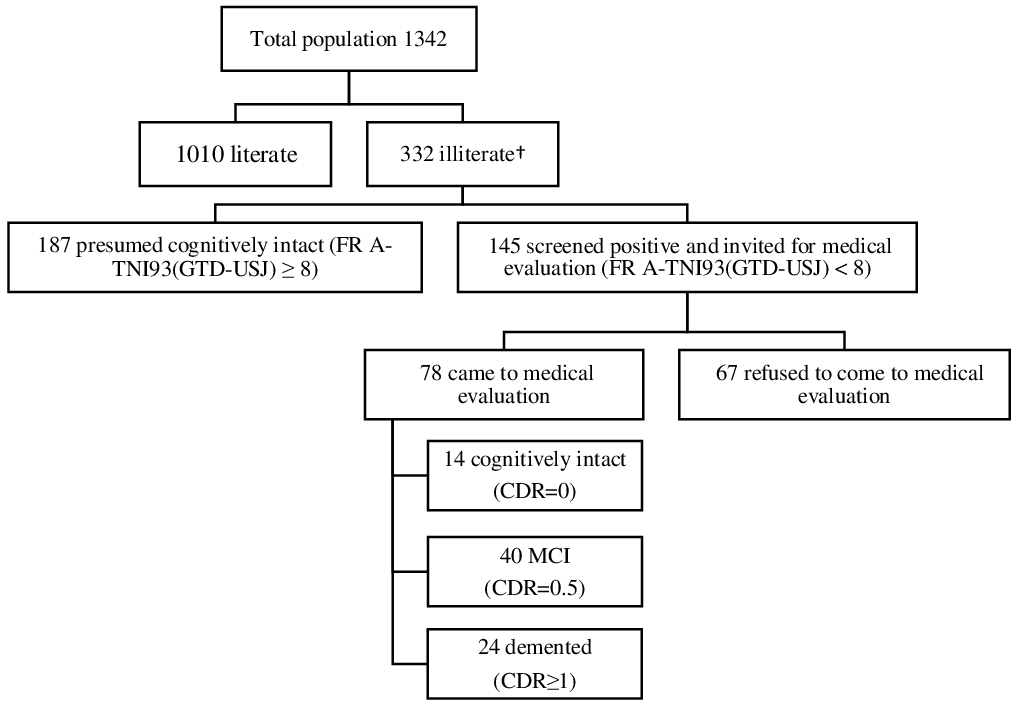
The study sample included 332 illiterate participants. Figure 1 shows the flow chart summarizing subjects selection using the A-TNI93 (GTD-USJ) followed by the CDR. Participants with a FR score ≥8 were deemed cognitively normal. 145 subjects were called for medical evaluation using the CDR (having a FR score < 8), however, only 78 attended the appointment. There were no statistically significant differences between those who participated in the clinical evaluation compared to those who did not attend regarding age, FR, TR, and SR scoring, with the exception of gender, as more females (65.2%) attended the medical evaluation compared to males (43.4%; p-value <0.009).
Flow chart summarizing the selection of the participants retained for analysis from the initial sample of 1,342 participants. †Illiterate: did not go to school as a child or do not know how to write or read. FR = free recall; MCI = mild cognitive impairment; CDR = Clinical Dementia Rating.

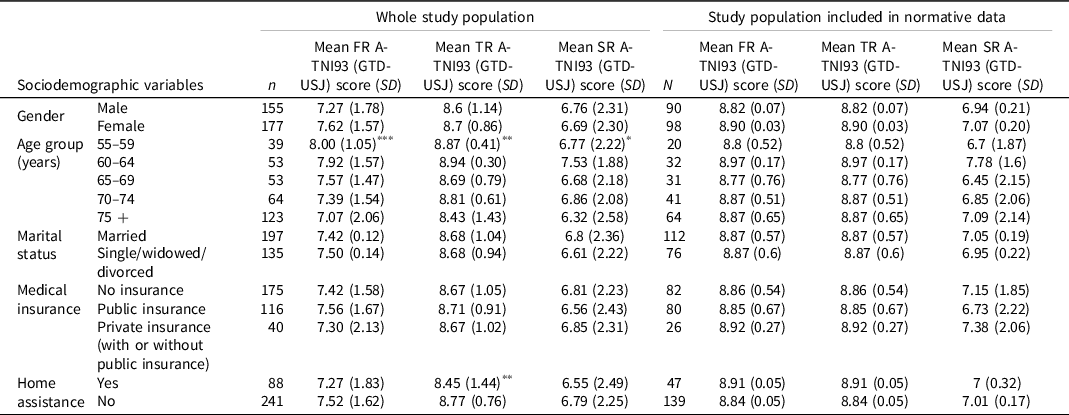
The sociodemographic characteristics of the study population are presented in Table 1. Age significantly influenced cognitive status as evaluated by the FR, TR, and SR scores. The need for home assistance was significantly associated with lower TR scores.
Univariate analysis of sociodemographic characteristics and mean FR & TR & SR A-TNI93 (GTD-USJ) scores of the whole study population (n = 332) and of the study sample included in normative data (n = 188)

FR, free recall; TR, total recall; SR, spatial recall; n, number of observations; SD, standard deviation.
* p < 0.05.
** p < 0.01.
*** p < 0.005.
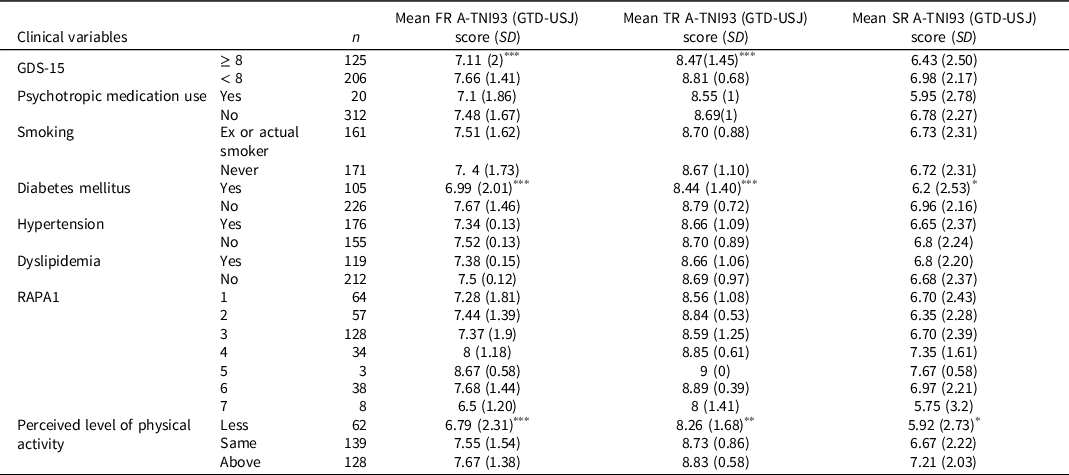
The clinical characteristics of the study population are summarized in Table 2. Depression (as evaluated by the GDS-15) significantly affected the FR and TR scores. Diabetes and perceived level of physical activity significantly affected the FR, TR, and SR scores.
Univariate analysis of clinical variables and mean FR & TR & SR A-TNI93 (GTD-USJ) scores of study population (n = 332)

FR, free recall; TR, total recall; SR, spatial recall; GDS-15, 15-item Geriatric Depression Scale; RAPA1, rapid assessment of physical activity; n, number of observations; SD, standard deviation.
* p < 0.05.
** p < 0.01.
*** p < 0.005.
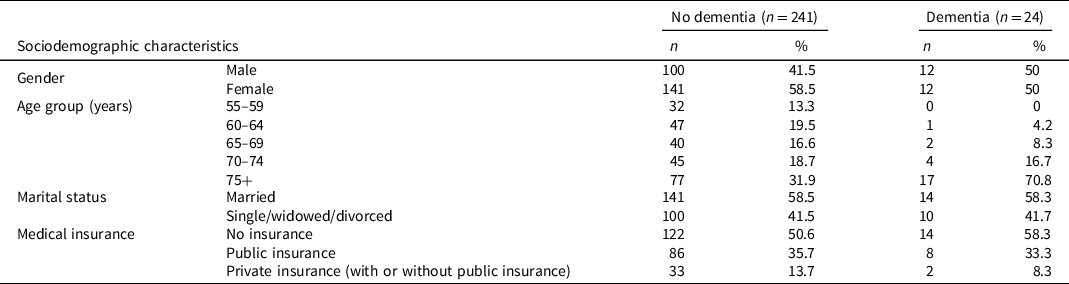
Table 3 summarizes the distribution of sociodemographic variables by dementia status.
Sociodemographic characteristics in participants diagnosed with dementia compared to participants with no dementia (n = 265 a )

n, number of observations.
a 67 refused to come to medical consultation.
The prevalence of dementia in our population was 7.23 % (24 out of 332; 95% CI: 4.44–10.1). This number may be an underestimation; assuming an equivalent proportion of persons with dementia among those who did not attend medical evaluation compared to those who did, the prevalence is projected to be 13.55% (45 out of 332; 95% CI: 9.87–17.24).
Participants with dementia had significantly lower FR, TR, and SR scores compared to cognitively normal participants (5.21 ± 1.77 vs. 8.1 ± 1.17, p < 0.0001), (7.67 ± 1.8 vs. 8.91 ± 0.36, p < 0.0001), (5.29 ± 2.03 vs. 7.15 ± 3.07, p = 0.0001), respectively.
There was a statistically significant negative correlation between cognitive status as evaluated by the CDR and both FR and TR scores such that a decrease in FR or TR scores were associated with an increase in CDR score. In the CDR = 0 group, mean FR and TR scores were 6.64 and 8.71. In the CDR = 0.5 group, mean FR, and TR scores were 6.22 and 8.62. In the CDR = 1, and 2, and 3 group, mean FR and TR scores were 5.21, and 7.66 (p < 0.0001; and p = 0.0036). Mean SR score, however, did not significantly differ across CDR score groups: 5.71 in group 0, 6.12 in group 0.5, and 5.29 in group 1, and 2, and 3 (p = 0.428).
Validity of A-TNI93 (GTD-USJ)
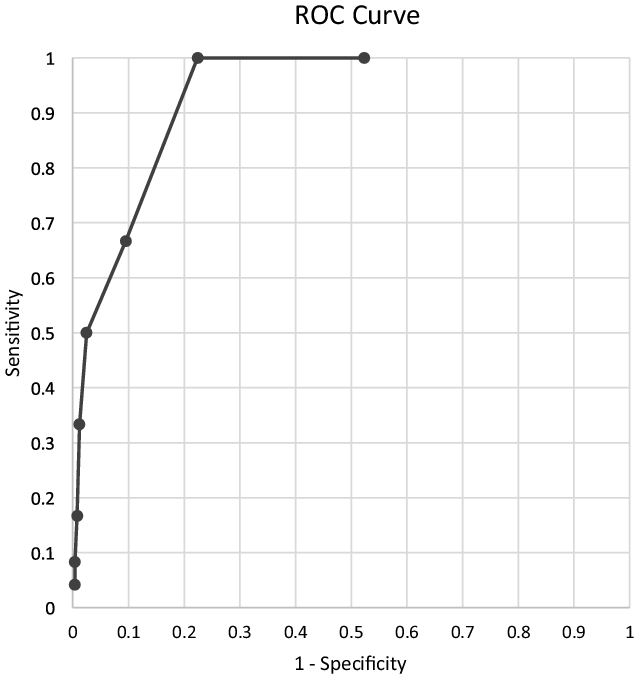
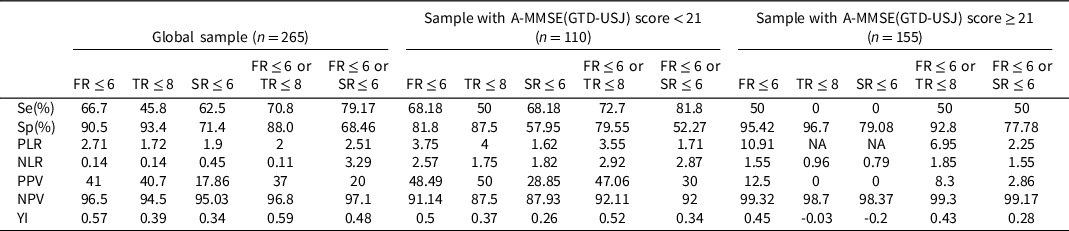
The total number of participants used for analysis was 265. 201 participants who were cognitively normal (FR ≥ 8 or CDR = 0), 40 had MCI, and 24 had dementia (Figure 1). The A-TNI93 (GTD-USJ) FR score ROC curve to screen for dementia is shown in Figure 2. The area under the ROC curve was 0.93 (95% CI: 0.90–0.96). The cutoff point of six yielded a sensitivity of 66.7% and a specificity of 90.5% to screen for dementia (Figure 2 and Table 4).
Receiver operating characteristic (ROC) curve for FR A-TNI93 (GTD-USJ). Area under ROC curve = 0.93 (95% confidence interval (CI) = 0.90–0.96).

Sensitivity, specificity, positive and negative likelihood ratio, positive and negative predictive value of A-TNI93 (GTD-USJ) scores for the detection of dementia in global sample and in samples with MMSE scores < or ≥ 21

FR, free recall; TR, total recall; SR, spatial recall; Se, sensitivity; Sp, specificity; PLR, positive likelihood ratio; NLR, negative likelihood ratio; PPV, positive predictive value; NPV, negative predictive value; YI, youden index; NA, not applicable; n, number of observations.
Case detection using a combination of FR ≤ 6 or TR ≤ 8 had a sensitivity of 70.8% and a specificity of 88% with an area under the ROC curve of 0.794 (95% CI: 0.745–0.842). Combination of FR ≤ 6 or SR ≤ 6 provided a sensitivity of 79.17% and a specificity of 68.46% with an area under the ROC curve of 0.738 (95% CI: 0.693–0.783).
Mean, SD, and median A-MMSE (GTD-USJ) scores of the 265 participants were 21.28 (SD = 3.78) and 21, respectively. Only two of 24 illiterate participants with dementia had an A-MMSE (GTD-USJ) score ≥ 21. Among those with an A-MMSE (GTD-USJ) score <21, the A-TNI93 (GTD-USJ) scores of FR ≤ 6 or TR ≤ 8 had a sensitivity of 72.7% and a specificity of 79.5% (Table 4). In those with an MMSE score ≥21, the same A-TNI93 (GTD-USJ) thresholds showed lower sensitivity (50%) but higher specificity (92.8%).
Compared to FR, using SR did not improve sensitivity or specificity in either the whole study sample or in the subsample with A-MMSE (GTD-USJ) score <21. Compared to taking either FR ≤ 6 or TR ≤ 8, taking either of FR ≤ 6 or SR ≤ 6 showed increased sensitivity but decreased specificity in the global sample and the subsample with A-MMSE (GTD-USJ) score <21 (Table 4).
Reliability of A-TNI93 (GTD-USJ) scoring
Intra-rater test-retest mean correlation was acceptable (coefficient: 0.63). The Bland–Altman test showed a mean difference in scores between the two measurements of 0.14 (95% CI –-0.59–0.86), with a nonsignificant Pitman test (p = 0.48). The concordance limits were between –3.15 and 3.42.
Inter-rater test-retest mean correlation was low (coefficient: 0.29). The Bland–Altman test showed a mean difference in scores between the two measurements of -0.95 (95% CI 1.92–0.023) with a nonsignificant Pitman test (p = 0.33). The concordance limits were between –4.97 and 3.08.
Normative data of A-TNI93 (GTD-USJ)
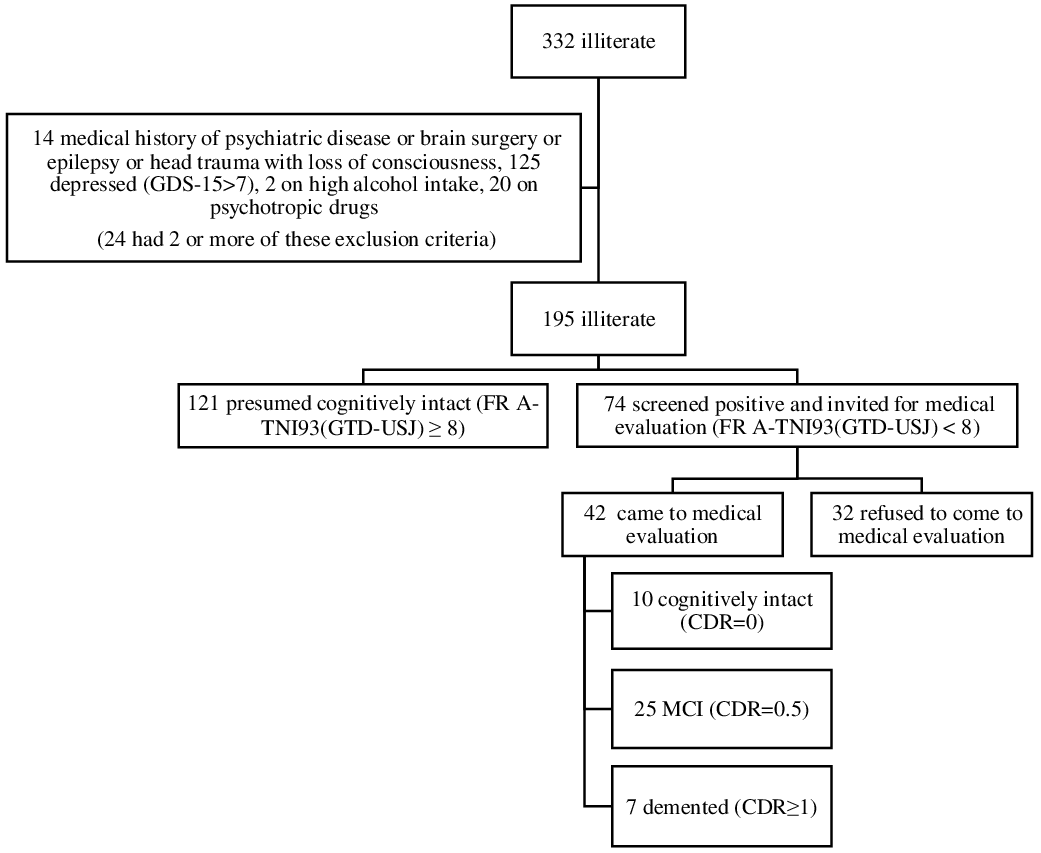
The study excluded 137 out of 332 participants who had conditions likely to interfere with cognitive performance, and seven having documented dementia diagnoses (Figure 3). Thirty-two participants who screened positive for dementia during the current study did not attend the follow-up medical evaluation (Figure 3). No significant differences were found between those who did and those who did not come to the medical evaluation with respect to sociodemographic characteristics (age and gender), diabetes prevalence, mean FR, or 4-IADL scores. The final sample included in the normative data consisted of 188 participants (121 presumed cognitively intact (FR ≥ 8), 10 cognitively intact (CDR = 0), 25 MCI (CDR = 0.5), and 32 who refused the medical evaluation) (Figure 3). Sociodemographic characteristics are reported in Table 1. Mean FR score was 7.8 (median = 8, SD = 1.3).
Selection of participants included in the normative data. FR = free recall; GDS-15 = 15-item Geriatric Depression Scale; MCI = mild cognitive impairment; CDR = clinical dementia rating.

The FR, TR, and SR scores were not associated with sociodemographic variables either in univariate analysis (Table 1), or in stepwise multiple linear regression. The distribution of FR, TR, and SR scores is presented in Table 5.
Distribution of the FR & TR & SR A-TNI93 (GTD-USJ) scores in the study sample included in normative data (n = 188)

FR, free recall; TR, total recall; SR, spatial recall; n, number of observations; SD, standard deviation.
Discussion
Our study is the first to validate an adapted Arabic version of TNI93 to screen for dementia in an illiterate Lebanese population, over the age of 55 years, with normative data. Screening properties with a threshold of 6 for FR (FR ≤ 6) were as follows: sensitivity 66.7%, specificity 90.5% with a PPV of 41%, and negative predictive value (NPV) of 96.5%. Our results are similar to those of Maillet et al. (Reference Maillet, Matharan, Le Clésiau, Bailon, Pérès, Amieva and Belin2016), who also reported that a FR < 6 had the best combination of sensitivity (68%) and specificity (86%) with a PPV of 32% and NPV of 96%. Using either FR ≤ 6 or TR score ≤ 8 yielded better sensitivity (70.8%) and NPV (96.8%) but lower specificity (88%) and positive predictive value (37%), consistent with Maillet’s et al. (Reference Maillet, Matharan, Le Clésiau, Bailon, Pérès, Amieva and Belin2016) findings [10]. Combining FR and SR scores did not improve screening performance. Considering pairs of scores from the A-TNI93 (GTD-USJ) with the A-MMSE (GTD-USJ) yielded higher sensitivity and positive predictive value but lower specificity and NPV. Additionally, it takes a significantly longer time to perform both tests. Thus, we consider using the A-TNI93 (GTD-USJ) alone to be sufficient for the screening of dementia in illiterate individuals.
For normative data, the 5th percentile of the FR and TR scores were five and eight, respectively, compared to six and nine in the study by Dessi et al. (Reference Dessi, Maillet, Metivet, Michault, Le Clésiau, Ergis and Belin2009). This difference may be explained by the fact that we did not exclude participants potentially having major cognitive impairment.
A-TNI93 (GTD-USJ) scores declined with age in the whole study population but not within the normative group. In the normative data of Dessi et al. (Reference Dessi, Maillet, Metivet, Michault, Le Clésiau, Ergis and Belin2009), there was no evidence of age effect, whereas, in the study of Maillet et al. (Reference Maillet, Matharan, Le Clésiau, Bailon, Pérès, Amieva and Belin2016), both FR and TR scores decreased with age in their population-based cohort.
Gender may affect A-TNI93 (GTD-USJ) performances. In both the whole study population and normative data, women had slightly higher FR scores, although differences were not statistically significant 7.62 ± 1.57 versus 7.27 ± 1.78 (p = 0.06) and 7.93 ± 0.11 versus 7.60 ± 0.15 (p = 0.08), respectively. In Dessi’s et al. (Reference Dessi, Maillet, Metivet, Michault, Le Clésiau, Ergis and Belin2009), and Maillet’s et al. (Reference Maillet, Matharan, Le Clésiau, Bailon, Pérès, Amieva and Belin2016) studies, women also had higher FR scores: 7.86 ± 1.04 versus 7.64 ± 1.00 (p = 0.04) and 7.13 ± 1.88 versus 6.66 ± 1.82 (p = 0.002) respectively.
To date, three case-control studies reported data on Arabic adaptation of three different screening/diagnostic tools for dementia: the 10/66 Dementia Research Group (DRG; Phung et al., Reference Phung, Chaaya, Waldemar, Atweh, Asmar, Ghusn, Karam, Sawaya, Khoury, Zeinaty, Salman, Hammoud, Radwan, Bassil and Prince2014), the Rowland Universal Dementia Assessment Scale (A-RUDAS; Chaaya et al., Reference Chaaya, Phung, El Asmar, Atweh, Ghusn, Khoury, Prince, Nielsen and Waldemar2016), and the 16-item Informant Questionnaire on Cognitive Decline for the Elderly (IQCODE; Phung et al., Reference Phung, Chaaya, Asmar, Atweh, Ghusn, Khoury, Prince and Waldemar2015). As expected from a case-control design, these studies reported relatively high sensitivities and specificities: 92% and 95% for the Arabic version of the 10/66 DRG (Phung et al., Reference Phung, Chaaya, Waldemar, Atweh, Asmar, Ghusn, Karam, Sawaya, Khoury, Zeinaty, Salman, Hammoud, Radwan, Bassil and Prince2014), 83% and 85% for the A-RUDAS (Chaaya et al., Reference Chaaya, Phung, El Asmar, Atweh, Ghusn, Khoury, Prince, Nielsen and Waldemar2016) and 92.5% and 94.4% for the IQCODE (Phung et al., Reference Phung, Chaaya, Asmar, Atweh, Ghusn, Khoury, Prince and Waldemar2015). However, these tools are not without their own drawbacks. For instance, the 10/66 DRG requires a long administration time (between 70 and 100 min). Both the 10/66 DRG and the IQCODE require the presence of an informant. Although the A-RUDAS is easy to administer, the area under the ROC curve of 0.84 (Chaaya et al., Reference Chaaya, Phung, El Asmar, Atweh, Ghusn, Khoury, Prince, Nielsen and Waldemar2016) was found to be lower than what we report with the A-TNI93 (GTD-USJ). Additionally, the visuoconstruction and praxis items of the A-RUDAS can be quite challenging to those with no formal education (Chaaya et al., Reference Chaaya, Phung, El Asmar, Atweh, Ghusn, Khoury, Prince, Nielsen and Waldemar2016). Overall, the A-TNI93 (GTD-USJ) remains a simple, user-friendly, and valid tool to screen for dementia among illiterate elderly with no need for an informant.
In the present study, the estimated prevalence of dementia was 13.55% (95% CI: 9.87–17.24). These findings are consistent with Phung et al. (Reference Phung, Chaaya, Prince, Atweh, El Asmar, Karam, Khoury, Ghandour, Nielsen and Waldemar2017), who found a prevalence of dementia of 15.8% among Lebanese participants over 65 years old, with no formal education. The slight difference in prevalence rates between the two studies could be explained by the fact that the present study included younger participants (over 55) than Phung et al. (Reference Phung, Chaaya, Prince, Atweh, El Asmar, Karam, Khoury, Ghandour, Nielsen and Waldemar2017).
We acknowledge some limitations to the present study. First, the study sample may not be random since no updated database of the Lebanese population was available for random selection. Second, individuals who declined participation may have different sociodemographic characteristics from participants with the potential for selection bias if their declined participation was due to their cognitive status. Third, a FR score of eight was used to determine the participants who needed consultation before establishing the validity and reliability of the A-TNI93 (GTD-USJ). A FR score greater than six was reported to correspond to normal cognitive status by Dessi et al. (Reference Dessi, Maillet, Metivet, Michault, Le Clésiau, Ergis and Belin2009). A mean FR score of 2.59 (SD = 0.61) corresponded to dementia cases in the study by Maillet et al. (Reference Maillet, Matharan, Le Clésiau, Bailon, Pérès, Amieva and Belin2016). Thus, we believe that the occurrence of dementia cases among participants with a FR greater than or equal to eight would be unlikely. Fourth, 46% of individuals who were recommended for a medical evaluation did not attend the evaluation. Although, similar response rates have been reported in studies in Japan (54%; Sakuma et al., Reference Sakuma, Ura, Miyamae, Inagaki, Ito, Niikawa, Ijuin, Okamura, Sugiyama and Awata2017) and in the USA (48%; Boustani et al., Reference Boustani, Perkins, Fox, Unverzagt, Austrom, Fultz, Hui, Callahan and Hendrie2006). However, this has the potential to have biased the results should refusal of medical evaluation be linked to cognitive status, although the current study showed no differences between groups related to age, FR, TR, and SR scoring. Fifth, the CDR is sensitive to Alzheimer’s disease but often fails to detect frontotemporal dementia. Sixth, we did not reach the target of 50 participants per group based on age and gender. Seventh, the relatively low inter-rater reproducibility of the A-TNI93 (GTD-USJ) suggests that it requires more training than other tests such as the A-MMSE (GTD-USJ) (El-Hayeck et al., Reference El-Hayeck, Baddoura, Wehbé, Bassil, Koussa, Abou Khaled, Richa, Khoury, Alameddine and Sellal2019) before implementation. Thus in light of the fourth, fifth, and sixth limitations, our normative data would be considered preliminary.
Additionally, the TNI93 does not evaluate all cognitive functions, nor does it provide information about the etiology of cognitive decline. Therefore, it does not replace appropriate neuropsychological assessment and clinical judgment.
In conclusion, the A-TNI93 (GTD-USJ) is a valid tool to assess cognition among illiterate Lebanese people aged 55 years and older. Using a threshold of six for FR score or eight for TR score provides a sensitivity of 70.8% and a specificity of 88% for dementia case detection. A future study with a larger sample is needed in order to provide more accurate normative data and to further assess the validity of this instrument as a screening tool for cognitive impairment among illiterate Lebanese older adults.
Acknowledgments
We are thankful to the participants and their caregivers, as well as the interviewers and the collaborating staff of the Lebanese Ministry of Social Affairs who facilitated data collection, in particular Mrs. Fernande Bou Haidar, Mrs. Marie Elias, Mrs. Samar Sleilaty, and Mrs. Souheir El-Ghali. We are thankful to the International Neuropsychological Society’s Global Engagement Committee Research Editing and Consulting Program, as well as Dr. Shelley Peery and Dr. Laura Gramling for English proofreading of the manuscript. A-TNI93 (GTD-USJ) is available upon request from the authors.
Authors contribution
Rita El-Hayeck has participated in the conception and design of the study, training of the interviewers, data acquisition and collection, statistical analysis and in drafting the manuscript. Rafic Baddoura has participated in the design of the study, statistical analysis and reviewing the manuscript for intellectual content. Amin Wehbé and Nazem Bassil have participated in training of the interviewers and in data acquisition. Salam Koussa has participated in the design of the study. Karine Bou Khaled has participated in the design of the study, in training of the interviewers and in data acquisition. Sami Richa has participated in the design of the study and in training of the interviewers. Rita Khoury has participated in training of the interviewers, in data acquisition and in reviewing the manuscript for intellectual content. Abbas Alameddine has participated in data acquisition. François Sellal has participated in the conception and the design of the study and in reviewing the manuscript for intellectual content.
Financial support
This work was supported by the Research Council of Saint Joseph University of Beirut (grant number: FM-224).
Conflict of interest
None.