Introduction
Since schizophrenia remains one of the most severe mental disorders, efforts at preventing the development of psychosis are crucial (Correll et al. Reference Correll, Hauser, Auther and Cornblatt2010; Fusar-Poli et al. Reference Fusar-Poli, Borgwardt, Bechdolf, Addington, Riecher-Rössler, Schultze-Lutter, Keshavan, Wood, Ruhrmann, Seidman, Valmaggia, Cannon, Velthorst, De Haan, Cornblatt, Bonoldi, Birchwood, McGlashan, Carpenter, McGorry, Klosterkötter, McGuire and Yung2013). Based on prospective studies in clinical high-risk samples (Fusar-Poli et al. Reference Fusar-Poli, Bonoldi, Yung, Borgwardt, Kempton, Valmaggia, Barale, Caverzasi and Mcguire2012; Schultze-Lutter et al. Reference Schultze-Lutter, Michel, Schmidt, Schimmelmann, Maric, Salokangas, Riecher-Rössler, van der Gaag, Nordentoft, Raballo, Meneghelli, Marshall, Morrison, Ruhrmann and Klosterkötter2015), the Attenuated Psychosis Syndrome (APS) was included in DSM-5 as a condition for further study as well as an already codable condition under the ‘Other specified psychosis disorder’ category. However, data for the APS criteria, which define ‘attenuated psychosis’ as subthreshold delusions, hallucinations and disorganized speech/thought (APA, 2013), originate mostly from adult or age-mixed, help-seeking samples. This is problematic because developmental aspects may strongly influence experience and expression of attenuated positive symptoms during adolescence (Schimmelmann et al. Reference Schimmelmann, Walger and Schultze-Lutter2013). Further studies in the general population and across different age groups have been demanded and first findings revealed a prevalence of the research-defined attenuated positive symptoms syndrome (APSS) as high as 7.7% in 11- to 13-year-old school-age children (n = 212) (Kelleher et al. Reference Kelleher, Murtagh, Molloy, Roddy, Clarke, Harley and Cannon2012). Conversely, in a sample aged 16–40 years (n = 1229) (Schultze-Lutter et al. Reference Schultze-Lutter, Michel, Ruhrmann and Schimmelmann2013) only 0.4% met APSS criteria. These data in the general population, albeit collected in different countries by different researchers, suggest the possibility of an age-related decline of the prevalence of APSS in the general population.
In psychiatrically ill adolescents, first studies showed a prevalence of APSS as high as 31.7% in mainly outpatients (Lindgren et al. Reference Lindgren, Manninen, Kalska, Mustonen, Laajasalo, Moilanen, Huttunen, Cannon, Suvisaari and Therman2014) without predicting the onset of psychoses 1 year later, and a prevalence of 23.6% in inpatients (Gerstenberg et al. Reference Gerstenberg, Hauser, Al-Jadiri, Sheridan, Kishimoto, Borenstein, Vernal, David, Saito, Landers, Carella, Singh, Carbon, Jiménez-Fernández, Birnbaum, Auther, Carrión, Cornblatt, Kane, Walitza and Correll2015), further questioning the validity of current high-risk criteria in children and adolescents (Schimmelmann & Schultze-Lutter, Reference Schimmelmann and Schultze-Lutter2012; Schimmelmann et al. Reference Schimmelmann, Walger and Schultze-Lutter2013).
In help-seeking individuals at clinical high risk for psychosis, a recent meta-analysis further reported age-related effects regarding the transition to psychosis (Schultze-Lutter et al. Reference Schultze-Lutter, Michel, Schmidt, Schimmelmann, Maric, Salokangas, Riecher-Rössler, van der Gaag, Nordentoft, Raballo, Meneghelli, Marshall, Morrison, Ruhrmann and Klosterkötter2015). Namely, lower transition rates occurred in samples of almost entirely minors compared to mixed samples and adults (Schultze-Lutter et al. Reference Schultze-Lutter, Michel, Schmidt, Schimmelmann, Maric, Salokangas, Riecher-Rössler, van der Gaag, Nordentoft, Raballo, Meneghelli, Marshall, Morrison, Ruhrmann and Klosterkötter2015).
In adults and mixed samples, the additional detection of basic symptom (BS) criteria, particularly of a cluster of subtle cognitive disturbances (COGDIS), may help identify individuals at true risk for psychosis (Ruhrmann et al. Reference Ruhrmann, Schultze-Lutter, Salokangas, Heinimaa, Linszen, Dingemans, Birchwood, Patterson, Juckel, Heinz, Morrison, Lewis, von Reventlow, Klosterkötter and Article2010; Schultze-Lutter et al. Reference Schultze-Lutter, Klosterkötter and Ruhrmann2014). Basic symptoms preceded, but also co-occurred with attenuated positive symptoms, and the presence of both, COGDIS and APSS, may increase predictive power for conversion to psychosis (Ruhrmann et al. Reference Ruhrmann, Schultze-Lutter, Salokangas, Heinimaa, Linszen, Dingemans, Birchwood, Patterson, Juckel, Heinz, Morrison, Lewis, von Reventlow, Klosterkötter and Article2010; Schultze-Lutter et al. Reference Schultze-Lutter, Klosterkötter and Ruhrmann2014).
Taken together, data about the age-related distribution of APSS within one study population are sparse, and little is known about the combined prevalence of APSS and BS criteria across different age groups. Therefore, in the present study, a broad age range was chosen to allow the investigation of age-specific aspects of help-seeking individuals meeting APSS and/or BS criteria.
We aimed to analyze the age-specific distribution of APSS and BS criteria, especially COGDIS, as well as of their combination. Based on prior literature (Kelleher et al. Reference Kelleher, Murtagh, Molloy, Roddy, Clarke, Harley and Cannon2012; Schultze-Lutter et al. Reference Schultze-Lutter, Michel, Ruhrmann and Schimmelmann2013; Lindgren et al. Reference Lindgren, Manninen, Kalska, Mustonen, Laajasalo, Moilanen, Huttunen, Cannon, Suvisaari and Therman2014), we hypothesized that (1) APSS would be more frequent in adolescents than in adults, and (2) APSS with co-occurring BS criteria, a likely more specific risk constellation, would conversely be less frequent among youth with APSS than in adults with APSS.
Material and method
Setting and participants
As part of an on-going, longitudinal early recognition project for schizophrenia- and bipolar-spectrum disorders (http://www.zinep.ch), individuals were recruited in the Swiss region of Zurich, a 1.4 million people catchment area. The study was approved by the local ethics committee (E63/2009) and complies with the Declaration of Helsinki. Legal guardians of minors and adult participants were asked to give written informed consent, minors to provide written assent. The sample was accrued from April 2010 to July 2012. Potential participants had either learned about the study from a project website, flyers, newspaper advertisements, or were referred by general practitioners, counseling services, psychiatrists, or psychologists. Study design, inclusion, and exclusion criteria were previously described (Metzler et al. Reference Metzler, Dvorsky, Wyss, Müller, Traber-Walker, Walitza, Theodoridou, Rössler and Heekeren2014; Theodoridou et al. Reference Theodoridou, Heekeren, Dvorsky, Metzler, Franscini, Haker, Kawohl, Rüsch, Walitza and Rössler2014).
In brief, inclusion criteria for the initial sample were: individuals aged 13–35 years, sufficient German speaking ability, meeting at least one of the following at-risk criteria (1) a risk syndrome as defined by the Structured Interview of Prodromal Syndromes and the corresponding Scale for Prodromal Syndromes (SIPS/SOPS) (McGlashan et al. Reference McGlashan, Walsh and Woods2010), and/or (2) an at-risk state according to BS criteria [i.e. criteria for cognitive-perceptive symptoms (COPER) and/or cognitive disturbances (COGDIS)] as defined by the Schizophrenia Proneness Instrument (Schultze-Lutter, Reference Schultze-Lutter2007; Schultze-Lutter & Koch, Reference Schultze-Lutter and Koch2010) and/or (3) a potential risk for bipolar spectrum disorders, as defined by a score of either ⩾14/32 hypomanic symptoms as assessed with the Hypomania Checklist (Angst et al. Reference Angst, Adolfsson, Benazzi, Gamma, Hantouche, Meyer, Skeppar, Vieta and Scott2005), or a score of ⩾12 on the Hamilton Depression Rating Scale (HAMD, Hamilton, Reference Hamilton1960). Exclusion criteria were: (1) estimated premorbid IQ < 80, (2) meeting DSM-IV criteria for current substance dependence, any psychotic disorder confirmed by research diagnostic interviews, and/or a medical condition known to affect the brain, and for the present analysis (3) not fulfilling APSS or BS criteria.
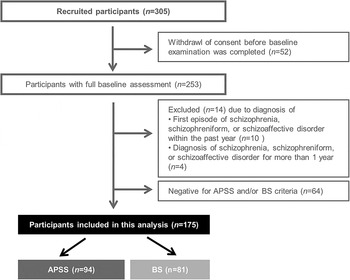
Of 305 recruited participants, 52 (17.0%) withdrew their consent before full baseline assessments, 14 (4.6%) were excluded due to a confirmed diagnosis of schizophrenia or schizoaffective disorder, and 64 (21.0%) did not fulfill APSS and/or BS criteria (Fig. 1). The remaining 175 participants were grouped into APSS v. BS and compared on demographic, diagnostic, symptom, and treatment variables.
Recruitment, analyzed sample and group composition. APSS, Attenuated positive symptoms syndrome; BS, basic symptom criteria.

Procedures
Demographic, past psychiatric illness and treatment information was obtained from participants and, in case of minors, augmented by information from guardians. DSM-IV Axis I diagnoses were screened with the Mini International Neuropsychiatric Interview (MINI/MINI-KID; Lecrubier et al. Reference Lecrubier, Sheehan, Weiller, Amorim, Bonora, Harnett Sheehan, Janavs and Dunbar1997; Sheehan et al. Reference Sheehan, Sheehan, Shytle, Janavs, Bannon, Rogers, Milo, Stock and Wilkinson2010). The presence and severity of positive, negative, disorganized, and general symptoms, including attenuated levels, were assessed with the SIPS and rated using the companion SOPS (McGlashan et al. Reference McGlashan, Walsh and Woods2010). BS criteria were assessed with the Schizophrenia Proneness Instrument – Adult or Child and Youth version, and risk criteria for COGDIS and COPER were coded (Schultze-Lutter, Reference Schultze-Lutter2007).
Severity of positive symptoms was assessed using the Positive and Negative Syndrome Scale (PANSS; Kay et al. Reference Kay, Fiszbein and Opler1987), depressive symptoms with the HAMD (Hamilton, Reference Hamilton1960); frequency of lifetime hypomanic symptoms with the Hypomania Checklist, and anxiety with the Beck Anxiety Inventory (BAI; Beck et al. Reference Beck, Epstein, Brown and Steer1988). Lifetime suicidality was detected with the MINI/MINI-KID and current suicidality was defined by a score ⩾2 (0–4) on the HAMD suicidality question. Illness severity was rated using the Clinical Global Impressions – Severity scale (CGI-S; Guy, Reference Guy1976). The Global Assessment of Functioning scale (GAF; Hall, Reference Hall1995) was used to assess current and, highest functioning in the past year, and decline within the past year. IQ was estimated with a word recognition test for adults [Mehrfachwahl-Wortschatz-Intelligenztest (MWT-B; Lehrl et al. Reference Lehrl, Triebig and Fischer1995)] or a test of receptive vocabulary for minors [Peabody Picture Vocabulary Test (PPVT; Dunn et al. Reference Dunn, Dunn, Bulheller and Häcker1965)]. All semi-structured interviews and cognitive testing were administered by experienced and extensively trained psychologists and psychiatrists.
Statistical analysis
Descriptive statistics were provided for socio-demographic and clinical characteristics. To assess group differences, χ2 statistics for categorical variables (or Fisher's exact test whenever ⩾1 cell weights were ⩽5) were used. Continuous outcomes that were normally distributed were analyzed using t tests and analysis of variance. Continuous outcomes that were not normally distributed were analyzed using the non-parametric Mann–Whitney U test.
Moreover, ordinal logistic regressions using a proportional odds model were performed to examine the relationship between APSS status and the three age groups (1) adolescents (13–17 years, n = 66), (2) young adults (18–22 years, n = 52), and (3) adults (23–35 years, n = 57). Odds ratio (OR) estimates and their 95% confidence intervals (CIs) were reported. Finally, associations between APSS status and psychopathology were assessed. Group comparisons were performed using t tests for two-group comparisons (APSS v. BS). All analyses were conducted using STATA/SE 12 (Stata Statistical Software: Stata/SE v. 12.0 for Windows; Stata Corporation, USA); all tests were two-sided.
Results
Age-related aspects of APSS and BS prevalences
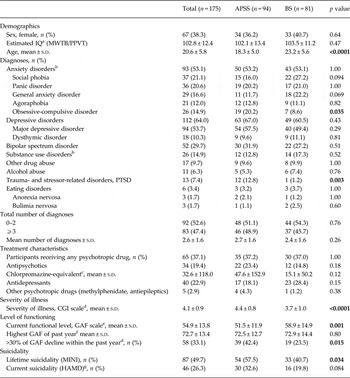
Of 175 non-psychotic individuals (age = 20.6 ± 5.8 years, age range = 13–35, female = 38.3%), 94 (53.7%) fulfilled APSS criteria (Table 1). Compared to BS criteria, APSS status was associated with younger age (23.2 ± 5.6 v. 18.3 ± 5.0, p < 0.0001).
Baseline demographics, treatment, diagnostic, and functional characteristics

APSS, Attenuated positive symptoms syndrome; BS, basic symptom criteria; MWTB, Multiple Choice Vocabulary Intelligence Test (Mehrfachwahl-Wortschatz-Intelligenztest); PPVT, Peabody Picture Vocabulary Test; PTSD, post-traumatic stress disorder; CGI, Clinical Global Impression; GAF, Global Assessment of Functioning; MINI, Mini International Neuropsychiatric Interview; HAMD, Hamilton Depression Scale;
Bolded p values <0.05, data available for a166, c173, d170, e167, f168 and g172 participants; bthe total number of participants in each main diagnostic category can be smaller than the sum of the individual diagnoses due to co-morbidity.
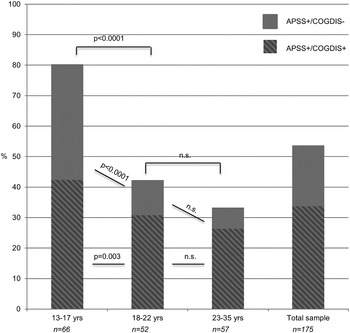
In ordinal regression models, compared to BS criteria, APSS status was negatively associated with age, with prevalences ranging from 80.3% in adolescents to 33.3% in adults (OR 0.21, 95% CI 0.11–0.37, p < 0.001).
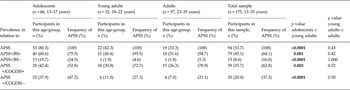
Within APSS+ individuals, fewer adolescents fulfilled combined risk criteria of APSS+/BS+ 75.5% compared to the older age groups (APSS+/BS+ in young adults 95.5%, in adults 94.7%) (Table 2, Fig. 2).
Age-group specific distribution of the risk criteria attenuated positive symptoms syndrome (APSS) and cognitive disturbances (COGDIS). Each column represents the group-specific proportional prevalence of APSS: in adolescents, young adults, adults, and in the total sample. Within APSS+ individuals, the prevalence of the combined risk criteria APSS+/COGDIS+ is represented at the bottom, striped part of the column. To assess group differences, χ2 statistics for categorical variables were used; significant p values between adolescents (13–17 years) and young adults (18–22 years), n.s., non-significant p values between the two adult groups.

Age-group specific distribution of attenuated positive symptoms syndrome (APSS) and basic symptom criteria (BS)

COGDIS, Cognitive disturbances.
Bolded p values <0.05.
Similarly, fewer adolescents fulfilled combined risk criteria of APSS+/COGDIS+ (52.8% v. 72.7% in young adults, and 78.9% in adults) (Table 2, Fig. 2). Accordingly, significantly more adolescents meet APSS+/BS− (24.5% v. 4.6% in young adults and 5.3% in adults) or APSS+/COGDIS− (47.2% v. 27.3% in young adults and 21.1% in adults) criteria (Table 2, Fig. 2). All differences were significant comparing adolescents to young adults (p < 0.0001–0.003), whereas no differences between the two adult groups were found.
APSS v. BS: diagnostic and treatment characteristics, illness severity, functioning and suicidality
APSS status was associated with a higher frequency of obsessive compulsive disorder (8.6% v. 20.2%, p = 0.035) and post-traumatic stress disorder (12.8% v. 1.2%, p = 0.003) (Table 1). In the adolescent subgroup, conduct disorder was more frequent in the BS group (38.5% v. 9.4%, p = 0.020) (Supplementary Table S2).
Treatment characteristics did not differ between the groups. However, APSS status was associated with higher CGI-Severity, poorer current GAF, and lifetime suicidality (Table 1). Additionally, a decline of ⩾30% was more frequent in APSS compared to BS (42.4% v. 23.5%, p = 0.015) groups. In contrast, current suicidality did not differ between the groups (Table 1).
Psychopathology in APSS v. BS groups
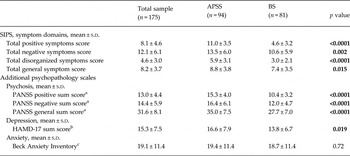
In addition to the group-defining SIPS positive scores, the SIPS negative, disorganized and general symptom total scores were significantly higher in the APSS than BS group. Similarly, the PANSS positive, negative and general and depressive sum scores were significantly higher in the APSS v. BS group (p < 0.0001–0.015), whereas anxiety sum scores did not differ significantly (Table 3).
Severity of symptom domains assessed with the Structured Interview of Prodromal Syndromes (SIPS) and additional psychopathology scales

APSS, Attenuated positive symptoms syndrome; BS, basic symptom criteria; PANSS, Positive and Negative Syndrome Scale; HAMD, Hamilton Depression Scale.
Bolded p values <0.05.
Discussion
Assessing the age-specific distribution of APSS and BS we found that (1) APSS status was associated with younger age and an age-related differences in prevalences of APSS, ranging from 80.3% in 13- to 17-year-old adolescents to 33.3% in 23- to 35-year-olds, and (2) in adolescents compared with adults, the proportion of co-occurring APSS and BS or the COGDIS risk criterion alone was lowest, whereas the proportion of APSS without BS or COGDIS was highest.
Comparing our overall APSS prevalence of 53.7% to previous studies, our specific sampling strategy, which involved including also participants reporting BS and/or hypomanic symptoms, requires consideration. In clinical high-risk groups of ‘The European Prediction of Psychosis Study’ (Klosterkötter et al. Reference Klosterkötter, Ruhrmann, Schultze-Lutter, Salokangas, Linszen, Birchwood, Juckel, Morrison, Vázquèz-Barquero, Hambrecht and VON Reventlow2005) and the ‘North American Prodrome Longitudinal Study’ (NAPLS; Addington et al. Reference Addington, Cadenhead, Cannon, Cornblatt, McGlashan, Perkins, Seidman, Tsuang, Walker, Woods and Heinssen2007) the prevalence of APSS was 81.6%, and 94.3%, respectively, but decreased to 50.4% in NAPLS when considering all help-seeking individuals. Therefore, the APSS prevalence in our sample is intermediate between high prevalences in at-risk samples ascertained in early recognition centers and lower prevalences of 31.7% (Lindgren et al. Reference Lindgren, Manninen, Kalska, Mustonen, Laajasalo, Moilanen, Huttunen, Cannon, Suvisaari and Therman2014) in unselected adolescent psychiatric outpatients, or 28.3% (Gaudiano & Zimmerman, Reference Gaudiano and Zimmerman2013) in unselected adult psychiatric outpatients.
Finding significantly more frequent APSS status in adolescents than adults, we assessed the co-occurrence of APSS+/BS+ or APSS+/COGDIS+, both proposed as more specific risk constellations for psychosis (Ruhrmann et al. Reference Ruhrmann, Schultze-Lutter, Salokangas, Heinimaa, Linszen, Dingemans, Birchwood, Patterson, Juckel, Heinz, Morrison, Lewis, von Reventlow, Klosterkötter and Article2010; Schultze-Lutter et al. Reference Schultze-Lutter, Klosterkötter and Ruhrmann2014). Interestingly, our results showed that the ratio of APSS+/COGDIS+ to APSS+/COGDIS− was almost 1:1 (52.8% v. 47.2%) in adolescents, whereas in both adult groups, the proportion rose to approximately 3:1 pointing to possibly more non-specific/transient attenuated positive symptoms in adolescents. While we cannot draw further conclusions from our cross-sectional data, this hypothesis is supported by first naturalistic longitudinal studies focusing explicitly on help-seeking adolescents (12–18 years). These studies yielded transition rates of only 7.1–15.6% (Ziermans et al. Reference Ziermans, Schothorst, Sprong and van Engeland2011; Welsh & Tiffin, Reference Welsh and Tiffin2014) at 24 months, which are much lower than the 2-year transition rate of 29% in mainly adult samples (Fusar-Poli et al. Reference Fusar-Poli, Bonoldi, Yung, Borgwardt, Kempton, Valmaggia, Barale, Caverzasi and Mcguire2012). Notably, the clinical high-risk state in an unselected adolescent sample with first mental health contact was not predictive for transition to psychosis at 1 year, but for psychiatric hospitalization within a follow-up of up to 8.9 years (Lindgren et al. Reference Lindgren, Manninen, Kalska, Mustonen, Laajasalo, Moilanen, Huttunen, Cannon, Suvisaari and Therman2014). Our data may also indicate that the risk-orientated approach of combining APSS with COGDIS may account better for developmental characteristics during adolescence since in our sample the overall prevalence decreased from 80.3% (APSS) to 42.4% (APSS+/COGDIS+). Although the two adult groups still showed lower prevalences of APSS+/COGDIS+, the age-related difference was less pronounced than for the other risk profiles. However, to confirm the greater specificity for true psychosis risk of APSS+/COGDIS+ in adolescents, longitudinal studies in youth are required.
Partly, the high frequency of APSS+/COGDIS− may be related to psychiatric co-morbidities that often emerge during adolescence, complicating diagnostic and treatment approaches of patients with attenuated positive symptoms (Welsh & Tiffin, Reference Welsh and Tiffin2012). Furthermore, in adolescents, it may be particularly difficult to differentiate obsessions and post-traumatic stress-related aberrations in thinking and perceptions from APSS. In this context the utility of the DSM-5 APS diagnosis within the psychosis spectrum may be questioned, especially for 13- to 17-year-olds (Yang et al. Reference Yang, Wonpat-Borja, Opler and Corcoran2010; Arango, Reference Arango2011). Subsequently, concerns have been raised about premature labeling, stigma and potentially harming treatment strategies, such as an increased use of antipsychotics in young, treatment-naive individuals reporting attenuated positive symptoms (Corcoran et al. Reference Corcoran, First and Cornblatt2010; Arango, Reference Arango2011; Yung et al. Reference Yung, Woods, Ruhrmann, Addington, Schultze-Lutter, Cornblatt, Amminger, Bechdolf, Birchwood, Borgwardt, Cannon, de Haan, French, Fusar-Poli, Keshavan, Klosterkötter, Kwon, McGorry, McGuire, Mizuno, Morrison, Riecher-Rössler, Salokangas, Seidman, Suzuki, Valmaggia, van der Gaag, Wood and McGlashan2012; Fusar-Poli et al. Reference Fusar-Poli, Borgwardt, Bechdolf, Addington, Riecher-Rössler, Schultze-Lutter, Keshavan, Wood, Ruhrmann, Seidman, Valmaggia, Cannon, Velthorst, De Haan, Cornblatt, Bonoldi, Birchwood, McGlashan, Carpenter, McGorry, Klosterkötter, McGuire and Yung2013).
Our frequency of 19.4% of patients receiving antipsychotics at study entry corresponds to the rates reported in the NAPLS 1 (24.3%) and 2 (17.6%) studies (Woods et al. Reference Woods, Addington, Bearden, Cadenhead, Cannon, Cornblatt, Mathalon, Perkins, Seidman, Tsuang, Walker and McGlashan2013). Interestingly, treatment characteristics, explicitly antipsychotic medication use and chlorpromazine equivalents did not differ between APSS and BS groups. Clinical decision-making was independent of research assessment, but even though APSS status was associated with a higher degree of symptomatology and overall impairment compared to BS, use and dosage of antipsychotics was similar in both groups. Likewise, in a sample of non-psychotic adolescent inpatients, there was no significant association between antipsychotic medication and severity of attenuated psychotic symptoms and no difference between antipsychotic prescription in APSS and non-APSS youth (Gerstenberg et al. Reference Gerstenberg, Hauser, Al-Jadiri, Sheridan, Kishimoto, Borenstein, Vernal, David, Saito, Landers, Carella, Singh, Carbon, Jiménez-Fernández, Birnbaum, Auther, Carrión, Cornblatt, Kane, Walitza and Correll2015). Thus, it remains to be shown if awareness of APSS or the APS diagnosis itself may result in more frequent antipsychotic prescribing to youth or adults fulfilling these criteria.
Irrespective of age, APSS status was associated with suicidality and more clinical impairment, pointing to the close link between APSS and clinical need. Moreover, this finding raises at least the possibility that one reason for lower APSS status in adulthood, assessed cross-sectionally, could be a result of completed suicide in youth, requiring further study. For example, in a longitudinal study of general population adolescents, the risk for suicide attempt was associated with attenuated and/or frank psychotic symptoms. Within 1 year, 34% of the adolescents reported at least one suicide attempt compared to 13% of participants with psychopathology without psychotic symptoms, and 4% in the general population (Kelleher et al. Reference Kelleher, Corcoran, Keeley, Wigman, Devlin, Ramsay, Wasserman, Carli, Sarchiapone, Hoven, Wasserman and Cannon2013). The association of APSS with more clinical and/or functional impairment was also shown in selected at-risk populations, inpatients, outpatients and the general population (Addington & Heinssen, Reference Addington and Heinssen2012; Kelleher et al. Reference Kelleher, Murtagh, Molloy, Roddy, Clarke, Harley and Cannon2012; Lindgren et al. Reference Lindgren, Manninen, Kalska, Mustonen, Laajasalo, Moilanen, Huttunen, Cannon, Suvisaari and Therman2014; Schultze-Lutter et al. Reference Schimmelmann and Schultze-Lutter2013; Gerstenberg et al. Reference Gerstenberg, Hauser, Al-Jadiri, Sheridan, Kishimoto, Borenstein, Vernal, David, Saito, Landers, Carella, Singh, Carbon, Jiménez-Fernández, Birnbaum, Auther, Carrión, Cornblatt, Kane, Walitza and Correll2015). We acknowledge several limitations of this study. Although we recruited a large sample of 13- to 35-year-old individuals with a broad range of symptomatology, sample sizes in the age subgroubs were modest, the naturalistic design allowed for psychotropic medication treatment. The cross-sectional data limit further conclusions, especially concerning the predictive value of APSS with or without BS across the different age groups. Furthermore, since help-seeking behavior in adolescents is also influenced by caretakers, social services and/or general practitioners, we cannot exclude that the sample of adolescents may have differed regarding psychopathology from adults. However, our total sample consisted of self-referrals, out-, and inpatients screened for at-risk criteria. Comparing our APSS prevalence of 80.3% in adolescents to 31.7% APSS in an unselected sample of adolescent psychiatric patients (Lindgren et al. Reference Lindgren, Manninen, Kalska, Mustonen, Laajasalo, Moilanen, Huttunen, Cannon, Suvisaari and Therman2014), the frequency in our enriched sample still seems reasonable. In conclusion, the possibly transient character of attenuated positive symptoms, especially during adolescence, when APSS might occur in the context of various emerging mental diseases, is underlined by the age-specific differences of the prevalence of APSS in our sample and the proportional decrease of APSS+/COGDIS− in adults. More prospective studies in different age groups and large and clearly defined or generalizable samples followed long enough are required. Such studies might clarify the predictive value of APSS with and without other risk indicators, shed further light on the impact of APSS on suicidality and clinical impairment, and pave the way to identify the individual relevance of APSS and start targeted treatment.
Supplementary material
For supplementary material accompanying this paper visit http://dx.doi.org/10.1017/S0033291715002627.
Acknowledgements
This work was supported by the Zürich Impulse Program for the Sustainable Development of Mental Health Services (http://www.zinep.ch). Beyond funding, this foundation had no further role in the experimental design; collection, analysis, and interpretation of data; the writing of this report; or the decision to submit this paper for publication.
Declaration of Interest
Dr Correll has been a consultant and/or advisor to or has received honoraria from: Actavia, AbbVie, Alkermes, Bristol-Myers Squibb, Eli Lilly, Genentech, Gerson Lehrman Group, IntraCellular Therapies, Janssen/J&J, Lundbeck, MedAvante, Medscape, Otsuka, Pfizer, ProPhase, Reviva, Roche, Sunovion, Supernus, and Takeda. He has received grant support from BMS, Otsuka, and Takeda. Dr Walitza has received lecture honoraria from AstraZeneca, Eli Lilly, and Janssen Cilag in the last five years. Dr Rössler has served as a consultant or received honoraria from Eli Lilly Suisse, Janssen-Cilag, Interpharma, FOMF, Med-Update, SVA Sozialversicherungsanstalt Schweiz, I3G, and IVP Networks during the last 5 years.
Drs Gerstenberg, Theodoridou, Franscini, Wotruba, Metzler, Müller, Dvorsky, Heekeren and Ms. Traber-Walker have no conflicts of interest to report.