Griffith Taylor and Antarctica's shifting scientific, cultural, and political meanings
Griffith Taylor, a member of Robert Falcon Scott's scientific team on the British Antarctic Expedition (BAE) of 1910–1913 had a remarkable capacity to appear in the right place at the right time. His opportunity to conduct research in Antarctica arose as a result of the scholarship he secured in 1907 to undertake a research degree at the University of Cambridge. Through his participation in the Sedgwick Club for geologists and his calculated cultivation of contacts with senior Cambridge scientists he came to Scott's attention. Scott's first choice was Douglas Mawson, who turned him down and recommended Taylor, a fellow Australian, in his stead. Taylor later quipped that his invitation to join the expedition made him feel as if he had been ‘pushed out into the cold’ (Taylor Reference Taylor1916: 3).
Over the remainder of his life, which ended in Sydney in 1963 shortly before his eighty-third birthday, Taylor found numerous ways to exploit his relatively brief Antarctic encounter. The final publication of his career, which spanned a great range of fields, including meteorology, anthropology, ecology, and history, reviewed his 1914 prediction of an Antarctic crustal downfold. Taylor opened his article in typical self-referential fashion: ‘[t]he writer's research life has coincided fairly closely with the vast discoveries made in this century since he first joined the Scott Expedition’ (Taylor Reference Taylor1963b: 191). But there were further parallels between Taylor's personal life and career and the changing identity of Antarctica over the first half of the twentieth century. His association with Antarctica was initially personal, patriotic and professional, and was little different from the ambitions and sentiments expressed by the other members of the BAE's science team. Thereafter, as Antarctic exploration proceeded over the twentieth century Taylor kept pace, as a teacher, public lecturer, popular science writer and finally as a political commentator. Although his scientific interest in Antarctic geoscience never waned what waxed toward the end of his life was his attention to Antarctic geopolitics.
Popular and scholarly writing about science, character and manliness has made Scott and the men of the polar party prime subjects for debate, with commentators bitterly divided in their assessments (Jones Reference Jones2007). The centenary of the Terra Nova expedition will undoubtedly unleash a new round of scrutiny. In comparison relatively little is known about the BAE's secondary players, other than Apsley Cherry-Garrard (Wheeler Reference Wheeler2001). Compared to his trials and those endured by the other parties, Griffith Taylor's Antarctic ‘push’ into the cold was relatively uneventful. He led the western geological party (WGP) and faced only one major test when the Terra Nova failed to return at the appointed time after he completed his second journey in January 1912. His sole near fatal incident was a self induced folly involving a bicycle trip from Hut Point to Glacial Tongue, where Charles Wright, a fellow Cambridge scholar, saved Taylor before he succumbed to fatigue. No heroic triumphs or great tragedies lie in his Antarctic story. Yet a figure ill suited for a study of tragic heroism can suit alternative analytical purposes. Taylor's changing perspectives on Antarctic issues, inspired by the BAE, subsequent expeditions, international competition and co-operative ventures, culminating in the Antarctic Treaty, tracked wider shifts in Antarctica's scientific, cultural and political meanings over the twentieth century. From a proud ‘Britisher’ and Australian patriot in the 1910s he became an internationalist with a global perspective that chimed with the ideals of International Geophysical Year (IGY). Taylor began his association with Antarctica as a geologist; he ended it far more concerned about the politics of polar science and convinced that scientists could lead the world to peace.
Although Taylor ultimately eschewed a nationalist orientation toward Antarctica, his support for Antarctica's supranational governance was no more clear cut than that of the international diplomatic community (Beck Reference Beck1986; Dodds Reference Dodds1997; Naylor and others Reference Naylor, Siegert, Dean and Turchetti2008b). Taylor appointed himself a scientific ambassador by the end of his life, implying that he had always led a pure ‘research life’, yet his pronouncements on Antarctica provide ample proof that ambition, patriotism, and personal allegiances were always at play, no less in his own life than in international politics. Taylor's politicisation overlay enduring emotional bonds to Antarctica and to ‘Antarctickers’, among whom he numbered his life long friends, Douglas Mawson and Frank Debenham, his brothers-in-law Charles Seymour Wright and Raymond Priestley, and his wife Doris, whom he nominated an ‘honorary Antarcticker’ to recognise her status as Priestley's younger sister. Taylor also attracted and maintained a larger family of associates, men like Charles Laseron and other members of Mawson's first expedition, along with a growing cohort of younger Antarctic scientists and scholars, including Paul Siple, who first contacted Taylor as a potential doctoral supervisor in the mid 1930s, and Troy L. Péwé and Philip Law, who befriended Taylor in his old age, updating him on breaking research findings. No less personal for Taylor was the intensity of public interest in Antarctica, which dipped in the interwar years then resumed during the cold war. In the 1950s, just after he retired from academia and moved from Canada back to Australia, print, radio and television producers sought him out as one of the last surviving members of the Scott expedition. The elderly man they interviewed was sharp witted, articulate and raring to tell his story (Taylor Reference Taylor1956). These later life publicity opportunities allowed Taylor to proclaim Antarctica's special status as a field for disinterested scientific research and to maintain his personal investment in Antarctica. Griffith Taylor's Antarctica, an amalgam of sentiment and science, rivalry and cooperation, imperialism and internationalism, popular culture and global politics, was the twentieth century's Antarctica.
British science and the scientific ‘Britisher’ in Antarctica
Taylor's claim in his 1916 memoir, that he had never considered exploring Antarctica before he received his invitation to join the BAE, was surely disingenuous. When he entered the University of Sydney in 1899 he studied under the esteemed geologist Sir Edgeworth David, arguably the greatest influence on Australian Antarctic activity in the early twentieth century (Kriwoken and others Reference Kriwoken, Jabour and Hemmings2007). In 1902 Scott's Discovery expedition captured David's and his students' interest and in 1907 the professor along with Taylor's fellow geology student, Douglas Mawson, joined Shackleton's Nimrod expedition, and advanced understanding of Antarctic geology, glaciology and geomagnetics. Taylor was surrounded by Antarctic research and researchers even before he left for Cambridge, so the opportunity to join Scott in 1910 brought with it a personal challenge to match Mawson in science if not in strength. Since he knew he was Scott's second choice, lean and inexperienced, Taylor voyaged south under a shadow cast by his mentor's and his rival's scientific achievements and their capacity to endure polar conditions. What could he possibly do to outshine them?
Numerous national governments were looking southward and asking the same question in the early twentieth century. International competition over Antarctica was severe by 1910, heightened by bids over the southern ocean's marine resources as well as attempts to discover the pole. These contests were waged in the name of nations and empires but they were won and lost by individuals, an exclusively masculine and largely European cast of competitors, willing to endure hardship for King, country and manly glory. These great white heroes were manufactured on the white continent and marketed by the metropolitan press to the world (Riffenburgh Reference Riffenburgh1994). Like other explorers in this ‘heroic’ era of exploration Taylor took for granted his membership in this ‘new kind of imperial theatre with all its colonial and scientific trappings’ (Bloom Reference Bloom1993: 3). English by birth and Australian by upbringing he joined Terra Nova as a self-declared ‘Britisher’, who shared with his fellow expedition members ‘the desire for empire with a presumably disinterested moral and scientific imagination’ (Bloom Reference Bloom1993: 3). Although Taylor's fellow scientists dubbed him ‘Keir Hardie’ after the sometime leader of the British Labour Party and female suffrage supporter, Taylor was a liberal in the English mould, loyal to His Majesty and secure in the noble character and scientific aims of the BAE (Jones Reference Jones2003).
Taylor was impressed that Scott, whom he often compared favourably with Shackleton, was a leader who supported science and expressed interest in the work of scientists. This meant he could focus on his research and overlook ‘the Owner's’ intent to claim the geographic pole for Britain, a goal of negligible scientific import but enormous patriotic pride. Taylor respected his leader, even more so after Scott selected him, rather than Herbert Ponting, to lead the WGP. Taylor became the expedition's chief geologist, slightly older than Frank Debenham although less experienced than Raymond Priestley, an Antarctic veteran. Scott assigned the WGP to study the geology of the McMurdo Sound region near the Koettlitz Glacier and to address the broad question: ‘[h]ow has the land surface been affected by the flow of glaciers, by the action of wind, frost, water, and ice?’ (Taylor Reference Taylor1916: 120). Scott considered Taylor an impressive scientist: ‘[h]is intellect is omnivorous and versatile. His mind is unceasingly active, his grasp wide’ (Scott Reference Scott2003: 205). In one entry Scott described Taylor's lectures on physiography and glaciology as ‘fascinating’. And the Captain did more than listen. When he challenged Taylor (for example, on the distinction between the terms ‘glaciated’ and ‘glacierised’) it was possible for a grateful chief geologist to believe that his leader was no mere pole bagger.
When it came to scientific exploration Taylor indulged in his own brand of ‘bagging’. If Bloom overstates the degree to which ‘the difficulty of life in desolate and freezing regions provided the ideal mythic site where men could show themselves as heroes capable of superhuman feats’ Taylor's personal scramble for ownership of his findings bears out her general point (Bloom Reference Bloom1993: 6). Taylor was a member of a scientific team, sponsored in part by the British government, and he travelled in the grand masculine tradition of scientific discovery, with its recognised rights of naming (Seed Reference Seed1995). This genre of lexical theatre was literally personal yet directed toward a public audience of fellow scientists and map readers. As the WGP's leader he bestowed names on every physical discovery, saving ‘Taylor’ for the geologically rich dry valley and a previously undefined glacier, noteworthy because of its exposed bed. Ultimate naming authority lay with the captain, who endorsed Taylor's request that his name mark these significant sites. Scott's decision brought Taylor unalloyed delight: ‘I became a cartographic entity!’ (Taylor Reference Taylor1916: 280). Despite his willingness, decades later, to suggest that Australia cede its national claims in Antarctica he never loosened his grip on his dry valley, his glacier.
If such naming practices were venal they nevertheless signified sites where pioneering scientific research, in Taylor's case principally in the fields of polar meteorology and geoscience, had occurred. His return to Australia in 1912 meant resuming his duties with the Commonwealth Bureau of Meteorology (CBM) and exploring in further detail the impact of Antarctic anticyclones on the climate of Australia. Armed with his and BAE chief meteorologist George Simpson's Antarctic data he developed scientifically solid but politically unpalatable arguments against settlement plans in regions of the country that were predictably arid (Taylor and others Reference Taylor, Hunt and Quayle1913). Although Taylor's comments on settlement policies made him an increasingly controversial public figure the geoscientific research he published over the 1910s and early 1920s remained well respected, within and beyond Australia. Taylor added to his official CBM Bulletins with textbooks (including five chapters contributed to a volume of the Oxford Survey of the British Empire on Australasia) and his chapters in Scott's Last Expedition (Herbertson Reference Herbertson1914; Taylor Reference Taylor and Huxley1913a; Taylor Reference Taylor and Huxley1913b). After he revised his expedition field notes he submitted his study to the University of Sydney in 1916 as his doctoral thesis entitled ‘The facies of the Southern Antarctic littoral’. Six years later the British Museum produced a lavish revised edition of his thesis, including 171 maps and diagrams. The book remained a standard geomorphological reference text for decades, with his hypothesis of headward glacial erosion and his downfold prediction inspiring ongoing engagement (Adie Reference Adie1977; Cotton Reference Cotton1940; Hanley Reference Hanley1980).
Although these contributions were far from paradigm shifting, the stature of his research was formally recognised, first with the Polar Medal, which he received along with fellow members of the Terra Nova expedition in 1913, then a decade later with the Livingstone Centenary Medal, awarded to Taylor by the American Geographical Society to acknowledge his contributions to exploration and southern hemisphere research. After his return to Australia in March 1912 Taylor's polar field research, unlike that of his fellow expedition scientists came to an end. This did not spell an end to his polar publishing, however. It simply meant that his subsequent publications consisted of reflections on and reassessments of his original findings on which later scientists could and did build.
Recycling and reproducing Antarctica
In 1919 Taylor left the CBM to head Australia's first department of geography at the University of Sydney where he branched out intellectually and began to teach and publish in the fields of anthropology and history. But his Antarctic lecturing and writing was too rewarding a sideline to drop. These activities allowed him to maintain his polar profile and they also earned him a steady side stream of income to supplement his academic salary (Strange and Bashford Reference Strange and Bashford2008). He devised a variety of ways to present his polar experiences for a wide range of audiences. His With Scott had contributed to the tradition of lengthy expedition accounts written for a popular audience, but Taylor surpassed his fellow expedition members through the volume of his writing, his vernacular style and his capacity to judge and jump on waves of public interest. Well before he boarded Terra Nova Taylor had made arrangements to write dispatches for The Argus of Melbourne. In April 1911 his lively accounts reached Melbourne. ‘Terrible Gale Blows. Exciting Experiences’, ‘Fixing up the Sledges. Entering the Icepack’, ‘Attacked by Killers. Hazardous Iceberg Climbing’. He also outdid his fellow hut mates by providing more than his share of prose and poetry for the South Polar Times. The editor, Cherry-Garrard, later described him as ‘a demon note-taker’, a ‘greedy scientist with a fluent pen’ (Cherry-Garrard Reference Cherry-Garrard2004: 317, 316). Taylor provided his reports for Scott and he wrote faithfully in his diary, amassing detail for his memoir. Leonard Huxley, who had edited Scott's Last Expedition, agreed to publish With Scott, having judged that Taylor was one of the more accessible writers. He also recognised an authorial weakness: ‘[g]ive me leave to use my editorial judgement in . . . trimming the pages where your pen has run away with you in sheer exuberance of spirit’ (Huxley Reference Huxley1914).
After Taylor's Antarctic memoir appeared in 1916 there were no further restraints on his polar publishing, nor was there a limit on the number of popular lectures he delivered on the subject. Although every BAE survivor, particularly officers and scientists exploited lucrative public speaking engagements Taylor was one of the expedition's canniest and most active self publicists. Having wisely negotiated with Herbert Ponting, the BAE's photographer, to use a selection of his pictures for lantern slides, Taylor could effectively market himself as ‘a man who was there’ with stunning images to prove it. Fortuitously Taylor appeared in Ponting's most impressive image. Perched at Charles Wright's left, Taylor is a dwarfed figure encapsulated in an upturned iceberg, with the Terra Nova framed neatly in the distance. Although Taylor consistently emphasised the BAE's scientific contributions over the polar party's loss Ponting's pictures and the tragic tale were crucial to his self promotion. An article or talk from a polar scientist was one thing; an illustrated lecture from a survivor of the Scott expedition was quite another.
When Taylor delivered lectures and public talks he often began with a rhetorical question. ‘Why explore the Antarctic?’ His answer always combined the latest scientific updates with a measure of boasting over the Scott expedition's and his own accomplishments. In a 1930 article that bore the question as its title he began, as always, by recognising that he had participated in ‘one of the best-known of polar adventures’ in which the polar party members had ‘so tragically lost their lives’ (Taylor Reference Taylor1930b: 625). He then listed ‘the four magnets which draw explorers to the poles. These are Adventure, Fame, Potential Resources and Science’. The first three were shiny lures of low value compared to the ‘fourth inducement, the advance of science’ (Taylor Reference Taylor1930b: 625). Early Antarctic research had enhanced the understanding of evolutionary biology, climatology and geomorphology, and more than enough science had been conducted on his own expedition to indicate the potential fruitfulness of further research. Taylor's concluding plea was a forecast for the IGY.
Shall we not do well to subsidize on an international scale well-found expeditions to the South Polar regions? They must maintain permanent headquarters in that distant Antarctic Continent where alone we can find the key to so many important problems in the realm of science (Taylor Reference Taylor1930b: 636).
Tellingly, he called for an international response to the challenge. Already, by 1930, Taylor saw the wisdom of a collective scientific endeavour over a rehearsal of a British led mission.
Taylor's move from Australia to the United States in 1928 helped induce this shift. In another stroke of fortunate timing he arrived at the University of Chicago, where he had been appointed by the department of Geography to teach on environment and race as well as polar studies, just as Richard Byrd's pioneering aerial reconnaissance of Antarctica was underway. Having recently published an article on Antarctic-Australia weather patterns in the authoritative Problems of Polar Research (Taylor Reference Taylor1928) Taylor's reputation as a polar scientist had preceded him. W.H. Hobbs, director of Ann Arbor's Geological Laboratory and polar specialist, was anxious to make contact but so were American publishers searching for ways to exploit the public interest Byrd's expedition had generated in the US (Glasberg Reference Glasberg2008). One week after Taylor arrived in Chicago in January 1929 Appleton publishers contacted him to write a short book on polar exploration. The result, Antarctic adventure and research appeared in 1930. Similarly when The New York Times looked for an expert to analyse the geological discoveries made over the course of Byrd's first expedition the editor contacted Taylor, who promptly provided an article illustrated with a block diagram. He was proactive as well, publishing revised versions of the same article in Science Newsletter, Current History, Daily Science News Bulletin and Literary Digest. These publicity ventures quickly established Taylor as one of the country's foremost Antarctic commentators with a pedagogic capacity to explain polar science through maps and diagrams and a speaking and writing style that never reached Apsley-Garrard's lyricism, though it suited north American lay audiences, punchy and spiked with humour. His popular journalism left his scientific expertise undented, and Thomas Poulter, senior scientist on Byrd's second expedition, asked Taylor to join his honorary scientific staff (Poulter Reference Poulter1933). When science, royalties and speaking fees beckoned, the loyal Britisher and Australian expatriate could set aside his cultural roots.
Interwar ambivalence and contested claims
Although recent scholarship has stressed Antarctica's significant role in global politics since the late eighteenth century (Collis and Dodds Reference Collis and Dodds2008) it took Taylor until the mid twentieth century to look critically at the politics of exploration and the problems that conflicting national claims posed, not just to research but to global political stability. In the interwar period he was preoccupied with political issues of a different order. Over the 1930s, even as the British government handed over the British sector to the Commonwealth of Australia in 1933, Australia's national interests in Antarctica were of minor concern to Taylor and his publications on Antarctica all but stopped (only one after Antarctic adventure, a chapter published in Regionale Geologie der Erde in 1940). During his tenure at the University of Chicago Taylor taught polar geography but he devoted far more attention to writing Environment and nation (1936) the sequel to his 1927 magnum opus, Environment and race. When he moved to Toronto in 1935 to take up an invitation to head Canada's first department of geography he immediately spoke out against Nazi racial theory and geopolitics. Like most interwar intellectuals, his eyes were directed to the world's most crowded regions and most bellicose nations. Antarctica seemed very far away.
As international tensions tipped the world towards war, however, Antarctica began to drift closer to Taylor again. His continuing friendships with Frank Debenham, the Scott Polar Research Institute's Director, as well as with Sir Douglas Mawson gave him an insider's view of the international disputes that erupted as Norway, Argentina, Britain and Chile each claimed their own territory, some of it overlapping. Although he was evidently unaware of the German government's menacing Antarctic expedition in 1938–1939 and the British government's wartime covert manoeuvres in Operation Tabarin, he began to observe these disputes more closely by the war's end. Rather than dissolve into cynicism, despondent over the state of civilisation, Taylor's idealism blossomed, and he made it his mission to find a role for geographic knowledge to help avert the world from war. This was a conviction he called ‘geopacifics’, which he defined as an antidote against world wide Nazi geopolitics: ‘it is a geography for peace’ (Sydney Daily Telegraph 17 April 1948). But just as the IGY spelled a reformulation of Antarctic geopolitics, Taylor's high minded creed overlaid his lingering patriotic sentiments and his personal claims on the continent.
As the founding professor of geography at the University of Toronto, Taylor had had to familiarise himself with Canadian geography, including its polar regions, but exploring the Yukon and Mackenzie deltas in 1944 marked the northern reach of his Canadian field trips. Despite working in Canada for sixteen years the North Pole's pull never matched the South's. One reason was renewed popular interest in the Scott expedition, inspired by the idealism and sacrifices of the allied cause. The costs of victory and gratitude for heroic sacrifices provided the perfect context for Scott to be reintroduced as a symbol of patriotic stoicism (Jones Reference Jones2003). British director Michael Balcon's Scott of the Antarctic accomplished this cultural reworking by constructing noble characters innocent of British imperial design (Dodds Reference Dodds2002b; MacKenzie Reference MacKenzie1984). In 1947, when Balcon wrote to Taylor to request his permission to use excerpts from With Scott for his script he agreed and eagerly awaited the Toronto opening after its premier at a royal command performance. The film's appearance sent Taylor and his Terra Nova associates into a round of reminiscing. His backward glance at Antarctica extended after he retired in 1951 and moved back to Sydney, where he met Horton Moyes and developed a close friendship with Charles Laseron. While other men of their generation resumed contact and solidified friendships over shared war memories, Taylor, who never fought, returned in old age to one of the twentieth century's great adventures, which grew ever more amazing with the passage of time.
Post-war internationalism and idealism
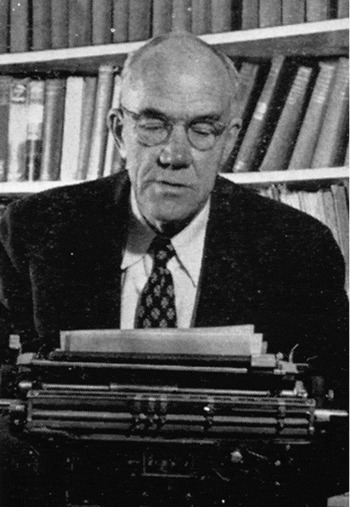
Taylor could easily have settled in his seventies into a nostalgic frame of mind with regard to Antarctica but national and international politics in the 1950s made it difficult for him to do so (Fig. 1). Australia had emerged from the war as a negligible player in the cold war yet its substantial Antarctica territory (AAT) provided an enormous stage for national self assertion in a period of renewed international rivalry. When post war Australians considered their country's colonial ambitions and responsibilities most thought of Papua New Guinea, over which Australia had been assigned trusteeship in 1945; few realised that its ‘southern dependency’ was far larger, as Taylor proudly informed readers of The Australian Outlook. He claimed that Australia had shown its enlightened stewardship of the continent through its scientific contributions beginning with Louis Bernacchi's landing in 1899. He had contributed as well, by analysing the consistency in the build of Antarctica and Australia: ‘[t]hus we can say that in the far south Australia owns “an ice-clad twin” of the same size and structure as our own continent – but with few other similarities’ (Taylor Reference Taylor1954: 104).
Griffith Taylor in approximately 1950. Photograph from Taylor Reference Taylor1958a.

Through his enduring professional and personal ties Taylor was a close observer of Australian efforts to secure its claim. On the heels of the US's Operation Highjump (1946–1947) the commonwealth government pushed ahead quickly with plans to establish permanent footholds in the AAT for meteorological and scientific research, beginning with sub-Antarctic stations at Atlas Cove, Heard Island in 1947 (Collis and Stevens Reference Collis and Stevens2007). Subsequent efforts were co-ordinated through the Australian National Antarctic Research Expedition (ANARE) on which Douglas Mawson served as chief advisor. Once Australia's first permanent research station south of the Antarctic Circle was established on the coast of MacRobertson Land in 1954 Mawson's name fittingly marked it. In anticipation of the historic event the organiser of the annual meeting of the Australian and New Zealand Association for the Advancement of Science (ANZAAS) asked Taylor to chair a public lecture that Mawson was scheduled to deliver on ‘Australian exploration in Antarctica’. Appearing at Mawson's side cast Taylor in his shadow again yet it also brought him to the head table as a significant contributor to Australia's polar history. On this account the ANARE honoured Taylor in 1957 by naming an aurora and weather study station, fifty miles west of Mawson, after him. Two years later the head of ANARE, Philip Law informed him that a fire had destroyed Taylor station. Fortunately a penguin rookery that also bore his name had survived. Membership in the BAE clearly provided Taylor government sponsored retirement benefits, even if they were vulnerable to Antarctic hazards.
These personal and national claiming rituals occurred as international disputes over Antarctica veered toward open conflict in the 1950s. When George Simpson, the BAE's chief meteorologist, first heard about the establishment of Taylor station and rookery he wrote to Taylor: ‘I congratulate you on the honour of having your name on the map of Antarctica – will it stay there when the Russians take over the whole of the Continent?’(Simpson Reference Simpson1959). The joke probably fell flat, since Taylor had just experienced a personal brush with contested Antarctic claims. In 1955 Mawson had discovered through his work with the ANARE that the name ‘Taylor’ had been removed from his glacier by Norwegian cartographers and that ANARE had subsequently adopted their revised maps. Although Mawson reassured his friend that Philip Law would restore his name Taylor felt wounded: ‘[t]here are hundreds of unnamed glaciers, so why couldn't they give the supplanter's name to one of those’ (Taylor Reference Taylor1958c). Russian supplanters posed a greater threat than Norwegian cartographers, however, since the Soviets had begun to set up bases in Antarctica in 1955, prompting British and US surveillance and counter manoeuvres. Taylor needed no inside informant to alert him to the atomic arms race and the appeal of Antarctica as a potential weapons testing ground that would leave Australia and New Zealand vulnerable to possible Soviet missile strikes. Under the circumstances adopting an Australian nationalist or an anti-Soviet stance would have been understandable; instead he took an internationalist position that distinguished him from most Australians as well as his fellow polar veterans (Turchetti and others Reference Turchetti, Naylor, Dean and Siegert2008).
None of Taylor's polar colleagues had pursued a purely academic career, as he had done. His closest Antarctic friends, Mawson, Priestley, Wright, and Debenham, had all played direct roles in government agencies and institutions devoted specifically to Antarctic research and military strategy. During the war the Scott Polar Research Institute had housed a branch of the Admiralty's naval intelligence division while Debenham was director, and Charles Wright, who had lectured at Canada's Pacific Naval Academy returned to Antarctica in 1960 to work for the US Pacific Naval Laboratory at McMurdo Sound. When Priestley returned to Antarctica in 1959 it was to accompany Prince Phillip and an official British delegation, hardly a comfortable position from which to utter critical remarks about imperialism in the south polar region (Dodds Reference Dodds2002a). And Mawson had served the British and Australian governments for decades and played an instrumental role in the establishment of the AAT. Thus Taylor's brothers-in-law and closest polar associates were beholden to governments and to national interests while Taylor, one step removed from the civilian-military nexus, had the latitude to develop his own opinions (Korsmo and Sfraga Reference Korsmo and Sfraga2003). So when Sir Edmund Hillary came calling on the Taylors in 1959, after completing the Commonwealth Trans-Antarctic Expedition, the famous explorer was welcome, but Taylor refused an invitation from a Sydney television station to comment on the film of the expedition, sponsored by British Petroleum and an overt propaganda piece (Dodds Reference Dodds2002b). As he confided to a fellow geographer he had little respect for a mission that was more a British publicity stunt than a proper scientific expedition: ‘I had a great deal of newspaper controversy in my youth – I refrained’ (Taylor Reference Taylor1958b).
Taylor found that his orientation to Antarctica aligned more closely to that of the non-governmental Special Committee on Antarctic Research (SCAR) than to any national government's, including his own. Established in 1958 to further the IGY's contribution to co-operative scientific work in Antarctica SCAR's broad objective was to research Antarctica's role in the earth system (Kaplan Reference Kaplan1954). One of its branches, geography and glaciology, was Taylor's special interest (Taylor Reference Taylor1958a). After his election (nominated by Mawson) as a fellow of the Australian Academy of Science (AAS) in 1954, Taylor became affiliated with the International Council of Scientific Unions, of which SCAR was a body. The AAS anticipated SCAR's establishment when it struck the Australian National Committee on Antarctic Research (ANCAR) in 1957, just as international polar science teams began their work under the auspices of the 1957–1958 IGY. As an active ANCAR member Taylor received regular research reports which raised his hope that scientists might confirm his prediction of a broad deep depression in the crust that linked the Ross and Weddell seas and separated the American side from the great horst on the Australian flank of Antarctica. He had reason to be hopeful. One of IGY's primary objectives, and arguably its greatest accomplishment, was to measure the thickness of the Antarctic ice sheet with seismological signalling and airborne sounding surveys. For the first time new technologies made it possible to map subglacial topography, and the resulting geophysical and glaciological data lent credibility to Taylor's 1914 hypothesis. Whereas scientists had previously estimated the thickness to be from 600 to 1200 m new data confirmed measurements of up to 4000 m in west Antarctica (Naylor and others Reference Naylor, Dean and Siegert2008a, Reference Naylor, Siegert, Dean and Turchetti2008b: 589; Taylor Reference Taylor1960). Just as importantly Taylor welcomed the collaborative commitment of IGY scientists to share data between nations otherwise divided by political differences and rival ambitions. At this moment in the twentieth century geomorphology and geopacifics met, not just in Taylor's mind but evidently on the world stage as well (Baker Reference Baker1982; Summerhayes Reference Summerhayes2008). Antarctica might become a missile testing site and launching pad or, as the IGY's accomplishments suggested, the continent might be preserved for peaceful scientific purposes under supranational governance.
An international community of scientists advanced the second option and Taylor sided with them. As cold war combatants continued to issue threats, upheld with growing nuclear arsenals, the collaborative endeavours of polar scientists provided momentum for international diplomacy. One outcome of the IGY and its domination by US exploratory programmes was the US led proposal for the twelve participating nations to work toward a treaty, designed to set the continent aside for peaceful research purposes and to set it apart from all future political claims and military activities. US strategic interests dominated negotiations and rivalries and distrust permeated the IGY in the lead up to the Antarctic Treaty, as recent scholarship stresses (Naylor and others Reference Naylor, Siegert, Dean and Turchetti2008b; Barnes and Farish Reference Barnes and Farish2006). In contrast Taylor viewed these moves as an historic participant and all that he saw was the realisation of his scientific idealism: science had proved its capacity to lead where politicians had failed. At the same time his adoption of scientific internationalism came at no cost to his personal stature. Early in 1959 Taylor received an invitation ‘as one who has firsthand knowledge of scientific work in Antarctica under the conditions of 50 years ago’ to speak at SCAR's first Australian meeting in Canberra in March; a month later he and Debenham received honorary doctoral degrees from the University of Sydney in recognition of their contributions to polar exploration. Taylor used his acceptance speech to press his message that geographers ought to play an active role in promoting peace. Buoyed by a banner year of professional and personal recognition and emboldened by the signing of the treaty at the close of 1959 he could afford to be broadminded. Just as the Antarctic Treaty's signatories were permitted to continue to claim their territorial sovereignty Taylor could promote IGY ideals while coveting his prior claims.
A new generation of Australian geographers was as warm as Antarctic researchers toward the retiree in the 1950s. Many geographers felt an obligation to honour the discipline's founder, and one of his former students (Adelaide geographer Ann Marshall) nominated Taylor in this spirit in 1958 as the first president of the Institute of Australian Geographers. As he worked on his presidential address for the new organisation his anxiety over Antarctica crowded his thoughts. His talk, entitled ‘Geographers and world peace, a plea for geopacifics’, was a rambling overview of his career, followed by his conclusion that ‘nationalism is outmoded’. Although he had expressed this belief since his Chicago days in the 1930s he attempted to convince younger geographers that the formation of the United Nations signalled a new era of opportunity. Those who remained doubtful had only to look at ‘the remarkable example of IGY in Antarctica as illustrating practical inter-nationalism.’ More boldly he concluded: ‘I would even advocate that we consider handing over two and a half million square miles of our territory to The United Nations’ (Taylor Reference Taylor1963a: 17). So deep were Taylor's convictions that he sent a copy of his address to prime minister Robert Menzies, a bold move considering that Menzies had rejected a similar proposal mooted in 1958.
Taylor received a polite letter of receipt from the prime minister but that was all. Even though Taylor argued that Australia ought to administer the AAT his call to relinquish sovereignty caused political concern. The prominent Melbourne seismologist K.E. Bullen criticised Taylor's presidential address and published an editorial that cautioned against handing the AAT over to the U.N. and painted Taylor's opinion as naive. The Soviet's establishment of a large base at Mirny in Australian territory during the IGY had surely ‘carried a warning which was not lost on the Commonwealth Government’, Bullen emphasised, and thus it was necessary to protect Australia from such ‘a real menace to her national security’ (Sydney Morning Herald 29 January 1960). Taylor chastised Bullen for his editorial and accused him of valuing scientific research in Antarctica above world peace. For Taylor every scientist ought to support internationalism, ‘the sole route to world peace’ (Taylor Reference Taylor1963a: 17). These claims aligned with prime minister Jawaharlal Nehru's post-colonial critique of imperialism in Antarctica, and the Indian position, argued unsuccessfully before the UN in 1956 and 1958, that Antarctica become res communis, a land jointly managed but owned by none (Collis and Dodds Reference Collis and Dodds2008; Dodds Reference Dodds2006). Thus by 1960 Taylor was prepared to publicly advocate enlightened politics over science as well as nationalism.
But what of his countervailing sentiments? His Antarctic geosyncline hypothesis was still an open issue, and his anticipation of a knighthood to recognise his scientific contributions remained unfulfilled. On the first matter he believed that findings published in a special issue on Antarctica in Scientific American in 1962 confirmed his hypothesis ‘to a considerable degree’, though he conceded that he had failed to predict the presence of inland seas (Taylor Reference Taylor1963b: 190). Reports from the Neuberg geophysical-glaciological reconnaissance of the Filchner-Ronne ice shelf area, based on gravity and magnetic altitude measurements of rock below ice, were especially gratifying, since they referred expressly to Taylor's BAE research. In a 1960 article on the ‘Structure of Antarctica’ Taylor quoted from those reports and reprinted his crustal downfold prediction map, first published in 1914, ‘since it appears to me to forecast remarkably closely the findings of scientists in the Geophysical Year’ (Taylor Reference Taylor1960: 229). While it took three years and an indulgent editor for Taylor to find a journal willing to publish his speech on geographers and world peace (Taylor Reference Taylor1963a) he could still publish commentary on post-IGY research in scientific journals. In his eighties Taylor, the Antarctic scientist of the ‘heroic age’ continued to appear in the Geographical Journal and the Australian Journal of Science.
Taylor's dream of knighthood remained just that, however. From his student days at Sydney and Cambridge he was surrounded by men knighted for their contributions to science, and his appointment to the BAE had given him reason to anticipate the honour as well. A remarkable number of his closest associates were knighted over his lifetime, beginning with Edgeworth David then Mawson, Simpson, Wright, and Priestley. In a 1962 ABC radio interview, meant to commemorate the fiftieth anniversary of Scott's death, Taylor diverted attention to the scientists who had made the BAE unique: ‘I do think looking back fifty years on our expedition it was rather outstanding’ since the men were of ‘a pretty decent standard, if I may say so without egotism’. Several were ‘science knights, you might say’. Taylor was a notable exception. Forty years of lobbying and self-promotion failed to produce a science knighthood for Taylor, despite a late effort co-ordinated by the New South Wales Geographical Society. This was one of the costs of remaining aloof from government military service. Although he had supported the war effort as a weather instructor for pilots in World War I and as a military geography teacher at the University of Toronto during the World War II he never donned a uniform nor did he provide strategic advice for governments. Espousing his creed of geopacifics, and indulging in criticism of British and Australian Antarctic territorial objectives did not help his cause, even if his proposals were not taken seriously.
Antarctic echoes
Two years before Taylor died in 1963 the bicycle he rode in Antarctica was discovered in the course of heritage preservation work conducted on the Ross Sea huts. New Zealand Antarctic historian Lester Quartermain informed Taylor that the rusted remains would be preserved and left in the Cape Evans hut (Anon. 2002). Joseph Powell has used Taylor's perilous Turk's Head ride as a metaphor for his post-BAE career, as a geographer who ‘ventured into the hazardous realms of theory and speculation’ (Powell Reference Powell1993: 41). Taylor certainly took risks, some of them foolish; more often he took full professional, economic and personal advantage of opportunities, especially those that Antarctica provided him, from 1909 when he received his initial invitation to join the BAE, to the last year of life when he published his response to the latest findings on Antarctica's build. Compared to his speculative forays into anthropology and history, which disciplinary experts dismissed in his own time, his meteorological, geological and glaciological research was well respected by experts in geomorphology, glaciology and meteorology. His scientific work has also fared far better in light of subsequent research, and it has inspired a reassessment of his hypothesis concerning cirque erosion as recently as 1997 (Pickard Reference Pickard1997). More significantly the data he and other scientists compiled in the BAE provides evidence for contemporary comparative analysis. Had he lived to conduct internet searches on Taylor Glacier and Taylor Dry Valley he would have found websites on global warming and rising sea levels, dramatised with pictures to document retreating glaciers. Although Taylor's research in Antarctica ended in 1912, the most recent International Polar Year (IPY) has made it newly significant. The IGY of 1957–1958 was conducted amidst the chill of the cold war; the 2007–2009 IPY was conducted in the light of global environmental change, the evaluation of which relies in part upon the data Taylor produced and recorded.
Had imperial ambitions and international rivalry in the early twentieth century not driven Scott toward the pole Taylor would never have made these contributions. In spite of this Taylor felt himself above such base motivations even as he profited from them. Wilfully blind to the US dominated strategic objectives and military implications of mid century polar scientific expeditions (Barnes and Farish Reference Barnes and Farish2006; Doel Reference Doel2003), and uncritical of those on which Mawson and his other close Antarctic associates participated, he endorsed any expedition that seemed driven by scientific goals, leaving aside their overt and underlying political agendas. The studied idealism of the IGY found parallels in Taylor's perspective on polar science. Belief in professional co-operation and open information exchange for peaceful purposes was powerfully appealing in the mid 1950s, by which point the alternative of global nuclear destruction was a credible prediction. If the cessation of global rivalries was a fiction, crystallised in the Antarctic Treaty's compromises, it was a useful fiction, which in Taylor's case provided a basis for promoting Antarctica's supranational governance as well as a platform on which he built his identity as an elder statesman of science. It was a different kind of heroism for a man who pursued the silver lining.
Taylor's approach to Antarctica from the 1910s to the 1950s, a shifting mix of exploration, political strategy, scientific competition, self advancement and naïve idealism manifested equally in the twentieth century's expeditions, international rivalries and diplomatic manoeuvres. This observation does not undermine Naylor's argument, that the IGY's peaceful international science failed to supplant geopolitical competition (Naylor and others Reference Naylor, Dean and Siegert2008a: 591); rather, it draws attention to the role that individuals, and not just national governments, have played in the fraught pursuit and imaginings of Antarctica.
Acknowledgements
Many colleagues contributed to this paper. For her intellectual advice and critical perspective I am indebted to Alison Bashford. Tina Loo's research input and personal Antarctic experiences were most valuable. For his friendship and Antarctic expertise I thank Tom Griffiths. This paper has also benefitted from comments provided by Marie Sanderson and Simon Naylor.