

BACKGROUND AND AIMS
The development of the financial systemsFootnote 1 of a country is positively correlated with growth of GDP per capita, and also appears to make a positive impact on poverty, including growth in incomes and more rapid decrease in poverty rates (Beck et al. Reference Beck, Ash and Levine2004; Demirguc-Kunt et al. Reference Demirguc-Kunt, Beck and Honohan2008). Given the positive effects of financial deepening, analytic attention has turned to issues of financial outreach and inclusion, often referred to as ‘access to financial services’. This includes access to credit (including micro-credit), the means and motivation to make regular savings, and the ability to receive payments including remittances and social protection cash transfers, and to make payments to others (Claessens Reference Claessens2006). Understanding the barriers to access to financial services is an emerging topic in the development literature (WBER 2008). For Claessens (Reference Claessens2006: 211), access refers to ‘the availability of a supply of reasonable quality financial services at reasonable costs, where reasonable quality and reasonable cost have to be defined relative to some objective standard’. A key debate within the literature concerns the relative importance of supply- and demand-side factors in stimulating access to affordable services that can fulfil the needs of the poor. Such needs are diverse – arranging purchases, sales, advances, loans and transfers – and support equally diverse strategies for sustaining livelihoods, including lifecycle and investment issues (education, marriage, homebuilding, investment in micro-enterprise, etc) which tend to require the accumulation of lump sums, and recurrent or emergency spending (which may require regular or rapid transfers of large or small amounts of cash) (Collins et al. Reference Collins, Morduch, Rutherford and Ruthven2009).
Mobile finance (m-finance) is a supply-side innovation that can potentially support the needs of the poor through outreach and greater financial inclusion, understood as ‘enhancing poor people's freedoms by offering services that are useful for managing their lives and livelihoods, and that richer people already take for granted’ (Niño-Zarazúa & Copestake Reference Niño-Zarazúa and Copestake2009: 2). M-finance is an umbrella term that incorporates mobile cash transfers (m-transfers) and payments (m-payments), financial transactions undertaken using mobile devices such as a mobile phone.Footnote 2 Mobile banking (m-banking) includes m-payments and m-transfers, but involves access by mobile devices to a broader range of banking services, such as account-based savings, credit or transaction products offered by banks (Porteous Reference Porteous2007). The potential for m-finance is particularly strong in sub-Saharan Africa (SSA), due to the rapid expansion of mobile phone networks, which even in the poorest countries are close to creating a universal access infrastructure for data as well as voice transmission, providing a platform for a wide range of new services.Footnote 3 Most notable is M-PESA (meaning mobile money), operated by Safaricom in Kenya, which, since its inception in 2007 as a largely donor-driven financial services development project,Footnote 4 has achieved a remarkable degree of market penetration, attracting a customer base of about 9 million users and 17,000 service delivery agents over a three year period, and achieving significant penetration into segments of the population previously excluded from formal financial service provision (Safaricom 2010).
Against this backdrop of rapid expansion of m-finance services,Footnote 5 two significant research issues have arisen (Duncombe & Boateng Reference Duncombe and Boateng2009). First, although some evidence of greater financial inclusion is starting to emerge, it is still uncertain how, and to what degree, expanded market penetration for m-finance technologies can go further to address the financial needs of the unbanked.Footnote 6 Second, it has been suggested that the market success of M-PESA has rested on a complex and relatively unique combination of factors that may not be replicated in other country contexts (Mas & Morawczynski Reference Mas and Morawczynski2009). The rollout of M-PESA in Tanzania, for example, was much slower, reaching only 280,000 users and attracting 1,000 retail agents in the first fourteen months of operation (Camner et al. Reference Camner, Sjoblom and Pulver2009). This paper seeks to provide fresh insights into these two questions, as well as addressing the potential for m-finance more broadly, by building an evidence-based exploratory framework. It is set out as follows. The first section outlines diverging conceptual approaches that can assist in gauging the potential for m-finance technologies, synthesising market and user perspectives. The second section expands on these perspectives by considering a range of evidence from a single country case, Uganda. On the basis of the case analysis, the final section suggests a contextual lifecycle framework that incorporates both market and user perspectives. The conclusion presents key findings from the analysis, and the applicability of the framework is discussed in relation to the need for future research in this area.
CONCEPTUAL APPROACHES TO M-FINANCE
Market perspectives
Studies from SSA have tended to be narrowly focused on specific m-finance initiatives, for example on the design and early adoption of the WIZZIT cellphone bank in South AfricaFootnote 7 and M-PESA in Kenya (Morawczynski & Pickens Reference Morawczynski and Pickens2009; Williams & Torma Reference Williams, Torma and Coyle2007). Much of the literature seeks to predict market development by modelling patterns of supply and demand for m-finance services. This is not surprising, given that the mobile phone industry (which is the key innovating sector for m-finance) is strongly market-driven, and has been instrumental in supporting early research initiatives.Footnote 8 Much of this research has embodied the theme of ‘transition’ from reliance on informal financial systems to greater participation in, and reliance on, formal provision (i.e. greater financial inclusion). Knight-John et al. (Reference Knight-John, Zaindeen and Khan2005) explain inclusion/exclusion by making use of the theory of the marginal customer – one who gets excluded from transactions under a given market setting or a particular configuration of supply and demand conditions. Here, early mobile innovations (pre-paid market options and airtime transfer of small denominations) were used to confirm the ‘bottom of the pyramid’ economics of Prahalad (Reference Prahalad2005), purporting to show that market innovations can be inclusive of the poor. Williams & Torma (Reference Williams, Torma and Coyle2007) modelled increased take-up of banking opportunities for the unbanked, moving from informal to formal systems, drawing evidence from WIZZIT. The model suggests a relationship between uptake of m-banking services and increased levels of income and ownership of mobile phones, but questions whether willingness to pay is a result of price insensitivity given the attraction of security and convenience, or a reflection of the exploitation of market power and the extraction of economic rents by the service providers.
Building upon this literature is the ‘market access frontier’ (Claessens Reference Claessens2006; Honohan & King Reference Honohan and King2009; Porteous Reference Porteous2005, Reference Porteous2007). This models the development of a market over time within an environment where the majority lack access to formal banking services. Users and non-users of a service within a particular market are segmented according to those who currently access and use the service, and those who can potentially access but have not yet used it. This is the current access frontier, which includes those who are voluntarily excluded (i.e. who choose not to use the service). The future access frontier is defined as those who are likely to have access within 3–5 years. The remainder are defined as a grouping beyond the reach of foreseeable market solutions – the involuntarily excluded (i.e. too poor, ineligible or discriminated against for some reason). Access is defined as a multi-dimensional construct incorporating supply-side elements covering geographical availability, access costs (including opportunity costs) and the characteristics of the service offered. Actual usage is less clearly defined but relates to patterns of consumption and is seen to be determined by a combination of supply and demand-related factors.
Market modelling has gained considerable credence due to incorporation as a key analytical tool in National FinScope surveys – large-scale repeat financial access surveys which have been conducted in seven SSA countries during the past five years. At present, repeat studies incorporating time series data are available for two countries, South Africa and Kenya. Taking Kenya as an example, there is evidence of a shift in the access frontier towards greater inclusion of the unbanked into formal provision. Usage of non-bank financial institutions increased from 7·5% of the surveyed population in 2006 to 17·9% in 2009, while the proportion of the population using informal financial services and those excluded decreased markedly, a shift that was largely attributed to M-PESA. In this respect, market modelling has been a useful tool for segmenting populations into categories of included and excluded across an access frontier, and then measuring changes over time, but it is primarily descriptive, and has limited explanatory power. Usage is also likely to have more complex explanations than those merely defined by the interplay of supply and demand-related factors, which are explored in the following section.
User perspectives
It may be of more interest, therefore, to identify factors that either encourage or prevent usage of financial services in a given service provision context (Honohan & King Reference Honohan and King2009). In this way, greater insight can be gained into the relationships between the existing financial practices of the unbanked and access to, and usage of, m-finance services. However, the literature has elicited few studies of user perception, choice and experience. A recent ethnographic study of M-PESA users classified as poor has cast some light (Morawczynski & Pickens Reference Morawczynski and Pickens2009). Such users chose to access M-PESA because it was affordable, convenient and more secure than pre-existing money transfer options such as via the post office or bus drivers. Senders were predominantly male and young, and recipients female, and usage was dominated by recurrent transfers to relatives for income support, while larger lump sums were transferred less frequently to buy farm inputs or pay school fees. There was also evidence of M-PESA accounts being used as a temporary store for small amounts of savings. Thus, from amongst the small number of users researched in detail, M-PESA was considered to have brought about changes in financial and social behaviour – the most significant being more frequent remittances of smaller amounts, a reduction in journeys to visit relatives, and changes in saving habits.Footnote 9 Hughes & Lonie (Reference Hughes and Lonie2007) and Vaughan (Reference Vaughan and Coyle2007) identified three key reasons why M-PESA appealed to a new category of previously unbanked users in Kenya. First, it was created as an initiative to address the specific needs of the less well off (the design and development phase being partly funded by the DfID Financial Deepening Challenge Fund), so the system needed to incorporate low transaction costs and a novel account mechanism from the start. Second, the functionality was initially restricted to a single money transfer service via a simplified text-based user interface using basic entry level mobile phones, thus attracting the mass of phone users. Third, it utilised a network of existing agents to facilitate cash-in and cash-out services that were licensed to act on behalf of an institution, Safaricom, that is largely trusted across Kenyan society and perceived to be financially independent.
Apart from valuable studies of M-PESA, there is little primary evidence from SSA that can aid conceptualisation of the user experience. Research conducted by Donner (Reference Donner2007) provides some interesting insights, arguing that financial transactions facilitated via mobile phones are likely to strongly reflect existing social and cultural patterns of financial behaviour. Thus, M-PESA has been appropriated in accordance with patterns of domestic remittance, amplifying and improving existing transactional relationships rather than creating new ones. Maurer (Reference Maurer2010) draws on economic anthropology to take this view a step further, suggesting that an understanding of existing financial behaviour can be translated into design principles that can enhance m-finance products for the poor. This research suggests that a broader range of m-finance services (covering credit/debit accounts, savings and insurance) can be appropriate to the needs of the poor if they are carefully designed to map onto pre-existing, and socio-culturally entrenched, financial practices and norms. However, there is also evidence that, as well as reinforcing existing social norms, m-finance technologies are creating changes to social behaviour and stimulating user innovation. This is emphasised in the action research of Chipchase & Tulusan (Reference Chipchase and Tulusan2007), who identified how airtime transfer was appropriated by users as an informal financial transaction mechanism. The use of M-PESA as a savings tool by users also falls into this category, as this was not the purpose for which M-PESA was originally designed.
Other influential studies that have defined a user perspective include Brown et al. (Reference Brown, Cajee, Davies and Stroebel2003) and Benamati & Serva (Reference Benamati and Serva2007), who investigated early adoption of m-banking in South Africa, suggesting that uptake was influenced by a wide range of non-price factors, identifying risk aversion and the level of trust exhibited by potential users as key factors. As with any banking institution, m-finance clients are being asked to place their money in the trust of others. The need to build trust amongst users can be seen as a constraint in two respects. First, trust in technological systems – in the less conspicuous software designs, network architectures and operational models that lie behind the hardware interface of the mobile handset, and which underpin m-payment applications. Second, trust in the organisational systems that are offering services, which for agent-based services are located at two different levels – those of the agent and of the financial service provider. This has been illustrated in the workings of M-PESA, where Morawczynski & Miscione (Reference Morawczynski and Miscione2008) identified a multitude of problems in cementing trust between individual users and the plethora of M-PESA agents. These problems, however, were largely overcome by the high levels of trust in the management and integrity of the system as a whole – a direct result of the trusted position of Safaricom in Kenyan society – and in particular the trust invested in the owner of the company who is a Kenyan national of high standing.
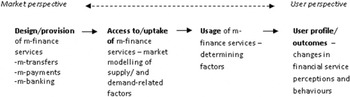
This review of the literature suggests that market modelling, while important, is an insufficient basis for understanding the potential of m-finance for financial inclusion. Thus, the following preliminary framework (Figure 1) synthesises market and user perspectives by modelling four key stages of development for m-finance initiatives: (a) the design and provision of new services which tend to be strongly market-driven; (b) factors (both supply- and demand-related) that influence access and uptake of those services; (c) factors that influence the extent and form of usage of services; (d) user profiles and outcomes in terms of changes in financial service perception and behaviour that are apparent due to service use.
M-finance lifecycle framework

The case analysis that follows builds the market and user perspectives set out in the previous section into a more focussed and evidence-based exploratory framework. Uganda has been chosen as a case country for three main reasons. First, it offers a wide range of documented research and experience concerning financial service provision in poor communities, which provides a detailed picture of the current user context for the introduction of m-finance services. Second, a growing body of research in Uganda examines the role of mobile networks in the provision of services – including financial services – to poor communities. Third, a range of new m-finance services has recently been introduced into Uganda by mobile and banking service providers, offering some insight into early adoption and usage patterns.Footnote 10
UGANDA CASE ANALYSIS
Design/provision
Since their introduction in 2009, m-finance services have grown rapidly. MTN's mobile money service was established in March 2009. In the first year it attracted 890,000 users (16% of the MTN subscriber base in Uganda), and transferred more than USH590 billion (US$245 million) through 1,500 agents established throughout the country. More recent figures indicate a doubling to two million registered users with a through put of USH1 trillion (US$479 million). Later entrants to the market (e.g. Zain's ZAP and UTL's m-Sente) offer slightly differentiated services and have captured smaller shares. In each case, mobile operators partner commercial banks and other financial service institutions and merchants (MTN with Stanbic Bank, Zain with Standard Chartered Bank, and UTL with DFCU). These partnership arrangements form part of the commercial strategy of each provider, and are also required to comply with Uganda's financial service regulations.Footnote 11 Uganda has a highly competitive market environment for the delivery of financial services (Wright & Rippey Reference Wright and Rippey2003) and the emerging market for m-finance has reflected this, providing a significant choice of m-finance service providers within a market that is still incipient and relatively small. Choice in the market has brought advantages of product innovation leading to differentiated services, competitive pricing, and rapid service penetration, but also disadvantages, primarily those arising from the lack of interoperability between competing service providers. For example, for m-transfers, this means that a user of a particular mobile money service is unable to connect with and send money to a user of a different service over the same network. It also means that service agents and merchant networks are unable to collaborate in order to simplify the user experience. Thus, it is common for users to be confronted with a confusing array of outlets (often concentrated in the same or adjoining premises), rather than a single point of service that can manage transactions between competing service providers.
Access
In the first instance, use of m-finance services requires access to a mobile phone network. International Telecommunication Union data (ITU 2009) suggest that there were roughly 4·2 million mobile phone owners in Uganda (with a population size of 30·88 million) in 2007. However, per capita subscription data considerably underestimate subscriptions among the economically active population aged 15–64 (50% of Uganda's population is under fifteen years old). Subscription figures also underestimate overall access, due to mobile phones often being shared (with family, friends or neighbours), and their availability at public access points (e.g. Village Information Centres) (Heeks Reference Heeks2009; James & Versteeg Reference James and Versteeg2007). Personal phone ownership appears to be increasingly preferred to shared use as a larger proportion of the population gain personal access, and the costs of access fall (Scott et al. Reference Scott, Ndiwalana, Sumner, Batchelor, Bahadur and Mulira2008). While personal ownership may seem advantageous for all, Burrell (Reference Burrell2010) points out that some women in Uganda are denied access within male-headed households, and women can remain more dependent on public or other forms of shared provision. Significantly, however, access to mobile phones far exceeds all other channels for accessing formal financial services. The Uganda National Household Survey (UNHS 2006) provides details of access to financial services at a community (LC1) level.Footnote 12 Only 0·4% of communities reported access to a bank branch office in their community, 4·3% a micro-credit institution or savings and credit co-operative (SACCO), and 1·1% a post office. This compares with 48·5% of communities reporting the availability of a mobile telephone service in their village (a figure that is likely to have risen considerably since the time of the UNHS). This places mobiles in a strong competitive position to serve the unbanked.
A second factor relates to the availability of a service agent network. Due to low transaction charges, market development for m-finance is driven by the need for volume. In order to generate a large volume of transactions, the operator needs to rapidly put in place an extensive country-wide service agent network. Agents in turn will be stimulated to sign up (requiring an initial investment on their part) if they believe there will be sufficient local demand for the service. The key role of agents is to manage the logistics and risks associated with availability and payment of cash, and to build networks that can handle cash as well as interface effectively with clients (Mas & Radcliffe Reference Mas and Radcliffe2010). Remuneration for the retail network is critical for incentivising agents, but commissions on mobile money services tend to be smaller, and the very small transactions favoured by the poor may not be commercially viable. Agents also play an important role in providing support services, and the form of consumer education needed to overcome the many additional access and usage constraints (including use of appropriate languages) that the unbanked face. The availability of agents and their ability to provide support services has been identified as a key constraint in Uganda, where the number of agents established by MTN is still one tenth of those established by M-PESA in Kenya (Heyer & Mas Reference Heyer and Mas2009).
The third critical factor is that of price vs affordability. Economic rationality suggests that as the price of mobile network access and m-finance service fees falls (in comparison with alternatives), a greater proportion of the banked will switch or make complementary use of m-finance. Mobile phone subscriptions and call charges have fallen significantly due to competition between the five established network providers (MTN, Orange, Zain, Warid and UTL), and the average cost of calls per minute (off-peak=US$0.20) stands at the lower end of the range for SSA countries and on a par with South Africa. However, while mobile phone network coverage reaches over 80% of Uganda's population, overall mobile penetration is much lower, and despite falling prices there is still a significant affordability gap. This is illustrated when the cost of a hundred minutes of use is considered as a percentage of gross national income (GNI) per capita. In Uganda this figure stood at 6·3% in 2007, compared with only 0·54% for South Africa.Footnote 13 M-finance may draw the unbanked into mobile phone ownership and service use for the first time, but continued participation will be highly price-sensitive due to very limited disposable income. While service feesFootnote 14 for mobile money services (such as via MTN) in Uganda appear low, regular usage also entails further costs, particularly for those in rural areas, who need to use public transport or go on foot to access geographically limited agent networks.Footnote 15
Usage
Evidence on usage is limited, but about half of the respondents to the survey conducted by Ndiwalana et al. (Reference Ndiwalana, Morawczynski and Popov2010) had both sent and received mobile money, with 25% having only sent or received.Footnote 16 The frequency of transfers for the majority was once a month or once a week, with fewer than 5% reporting regular daily transfers. The transfers were dominated by domestic remittances to immediate or extended family members, with a smaller number using money transfer to pay for goods and services.Footnote 17 As in the case of M-PESA, early demand for m-finance services in Uganda has been driven by cash transfers for domestic remittance due to advantages over alternative channels (banks and post offices – which lack a sufficient agent network) and informal mechanisms (family & friends and bus companies – which are not always trusted and lack speed).
While this limited survey indicates patterns of usage in the capital city, the scope countrywide is still uncertain. In terms of potential, the national survey of FinScope (2007) reported that 28% of Ugandan households gain income from personal monetary transfers, with the Western and Eastern Regions showing the highest incidence, and the Northern Region the lowest. With only 10% using formal means (banks, post offices or specialist companies such as Western Union) to facilitate transfers, that leaves over 90% of transfers in the form of cash (which was also the preferred method for 86% of those receiving money from outside Uganda), which creates a significant pool of untapped demand. However, evidence also suggests that most households do not receive remittances, and would find no benefit from current m-finance applications. The FinScope national study suggested that as many as 64% of households reported no instances of remitting money (either formally or informally). The slightly earlier UNHS (2006) reported a lower figure, with 41·4% of all households in Uganda having received at least one remittance from a domestic source in the year preceding the survey.Footnote 18
Remittances have played an important role in the early stages of m-finance evolution, but other forms of transaction may play a greater role in sustaining service provision in the future. These are predominantly: (a) airtime purchases which can be facilitated via mobile money at a cheaper cost than by conventional means; and (b) a plethora of other types of payments which include those for transport (buses, taxis, matatu, boda-boda), hospital/medical bills, school fees, utilities, etc. – in fact any form of payment that is normally made by cash means. UNHS (2006) data suggest that cash payments are far more frequent than cash transfers countrywide. This is particularly the case for the majority of the unbanked who live in rural areas (58% of households), for whom payment methods for goods and services, and the frequency of transactions, vary according to the nature of their livelihood. Frequent payments were reported by those running non-agricultural micro-enterprises (with 63% reporting daily transactions and 13% weekly). This is greater than for domestic remittances (with only 16% reporting daily transfers, 10% weekly and 16% monthly). The survey by Ndiwalana et al. (Reference Ndiwalana, Morawczynski and Popov2010) shows that m-payments are incipient at this stage, having been taken up by only a minority of (better-off) users in areas where banks/merchants are participating in early initiatives – such as cable television, private school fees and some other goods and services, with speed (avoidance of queuing) and lower cost (compared with other payment methods offered) stated as the main benefits.
The second area of incipient demand for m-finance is account-based services for credit, savings and associated transactions, which create potential for m-payment and m-transfer services to develop into a formal banking channel. FinScope (2007) data suggest a high potential demand for micro-savings products (71% of all adults in Uganda were able to save, whereas only 33% claimed to be borrowing). Anecdotal evidence suggests that mobile money accounts are already being used as a short-term savings vehicle in the same way that airtime can be accumulated and used to make payments which are then reconverted to cash by informal agents (Chipchase & Tulusan Reference Chipchase and Tulusan2007; Duncombe Reference Duncombe2009). In fact it is this type of informal user-innovation that has stimulated providers to recognise the latent demand for micro-savings and plan service design accordingly. For example, ZAIN's ZAP service moves beyond money transfer as the primary service offered and promotes multiple services that encourage retention of e-money as either short or longer term savings, thus providing options for users to retain their balances rather than instantly convert them back into cash. Like M-KESHOFootnote 19 in Kenya, ZAP serves as an ‘e-wallet’ and can be linked to the accounts of partnering banks and other financial institutions such as micro-finance institutions (MFIs), thus facilitating access to m-banking and other over-the-counter services.
User profile, perceptions and capability
The affordability gap already noted suggests that the socio-economic profile of the potential user will be strongly correlated with actual ability to access and use the services offered. There is no reliable data from Uganda that differentiate patterns of financial service access and use according to poverty level, and there is little research on how the cash economy operates amongst the financially un-served majority. Income data from 2006 indicate that 40% of all Ugandan households were in the lowest income class, earning less than USH50,000 ($22.2US) a month, while a further 21·5% were in the next lowest income class – USH50,000–100,000 ($22.2–44·4US) a month. This suggests that most households in Uganda may be too poor to have much need for formal financial services. A further socio-economic constraint is suggested by UNHS (2006) reporting ownership of household assets by wealth quintiles, with ownership of mobile phones ranging from 1·1% in the lowest quintile to 8·2% for the middle and 51·9% for the top quintiles. Interestingly, these figures are mirrored by the proportion of households reporting savings accounts with a formal financial institution (1% lowest, 8·1% middle, 44·3% highest). Household data also note a gender divide in mobile ownership, with 8·1% of male-headed households owning a phone compared with 5·2% of female, while FinScope (2007) reported that 37% of rural households have access to a mobile phone compared with 58% for urban. Surveys, therefore, indicate high rates of ownership and access to mobiles, but equally high degrees of inequality according to socio-economic status, gender and location.
Socio-economic profile may also be a determinant of financial behaviour and perception of m-finance. Research conducted by Johnson and Niño-Zarazúa (Reference Johnson and Niño-Zarazúa2007) shows that the key factors determining financial sector participation are formal sector employment (implying higher and more regular income), and an educational level beyond primary standard 6.Footnote 20 Other factors correlate strongly as proxy indicators for gender, age and poverty levels, such as ownership of assets like a TV, bicycle, telephone or car. In line with cross-country research carried out by Honohan & King (Reference Honohan and King2009), mobile phone ownership is found to be the most significant of all the assets measured; thus the study concludes that ‘those with a mobile phone are more likely to have a formal sector bank account by a factor of three’ (Johnson & Niño-Zarazúa Reference Johnson and Niño-Zarazúa2007: 6). The most significant barrier to entry to the formal and semi-formal sectors is stated as the fees and charges levied by banks.
Thus, existing or potential users will perceive the utility of m-finance from within their own financial services context. Those who already access formal financial services may have little difficulty in making effective use of an additional channel or suite of services. For the unbanked majority, use of m-finance may require more fundamental transformation in perception and financial behaviour. The way in which the unbanked majority obtain information and assimilate knowledge concerning finance is under-researched in Uganda. Johnson & Niño-Zarazúa (2007) indicate that general education is the single most important factor that determines financial literacy among the population. In relation to the operation of semi-formal services, Asiimwe (Reference Asiimwe2007: 5) observes that ‘on the one hand, consumers are lacking information and good money management skills and thus are constrained in their ability to make informed choices. On the other hand, most MFIs have a capacity gap to direct the consumers on how best to access their services and to develop/deliver market-driven products respectively.’
Evidence suggests that the main source of financial knowledge (for those not educated beyond primary standard 6) is local informal networks – friends, family and community-based organisations such as savings and loans associations (SLAs). For this reason there has been considerable effort in Uganda to deliver consumer education for financial services at the community level. For example, a Consumer Financial Education Programme (CFEP) has been created on the premise that service providers do not tend to offer independent advice, and consumer education towards the building of financial literacy should be considered a public good. Lack of financial literacy amongst the unbanked is also a constraint on assimilating the required skills to interact effectively with mobile phones and m-payment applications (e.g. sending and receiving texts, loading and transferring credits, or making use of money transfer services). Lack of literacy skills has been mentioned as a reason for lack of use of text-based services in Uganda, where only 10% of the poorest use SMS compared with 82% of the richest (Scott et al. Reference Scott, Ndiwalana, Sumner, Batchelor, Bahadur and Mulira2008). Operator phone services are preferred to public (non-operator) run phones, with key barriers identified as lack of confidence in the use of SMS and lack of menus in local languages.
This capability constraint is concomitant with particularly low levels of trust in existing formal sector financial service providers amongst the unbanked in Uganda (FinScope (2007). On the other hand, survey data suggest that 84% of Ugandans have a good level of trust in informal sector institutions – higher than any other SSA country surveyed (Lwanga-Ntale et al. Reference Lwanga-Ntale, Namuddu and Onapa2008). The extent of participation in informal financial services is quite high in Uganda (but only half that of Kenya). Informal groups in Uganda represent an important financial coping mechanism for the unbanked and have an important social function – holding regular meetings and acting as a focal point in the community – providing social support in times of crisis or need.Footnote 21 As in Kenya, informal sector participants seem to offer the greatest potential for expansion of m-finance into underserved areas. Research suggests that the barriers to affordability of phone ownership are lower in this group, and financial literacy is likely to be higher due to group participation. Johnson and Niño-Zarazúa (Reference Johnson and Niño-Zarazúa2007) show that ‘6–8% of the [total Ugandan] population have the characteristics of the formally included, but are excluded. They represent a group to whom m-finance could be most easily extended.’ Evidence of dissatisfaction with the operation of informal groups may also be a spur for some participants to migrate to new affordable formal sector services delivered by mobile phone via local agents, although it is likely that many existing participants will also elect to continue to participate in their local groups.
RECONCEPTUALISATION OF M-FINANCE
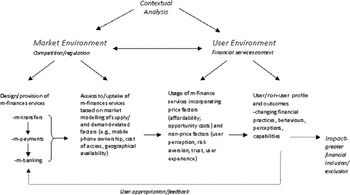
The exploratory framework (Fig. 2) builds on the lifecycle model set out earlier and specifies the key influencing factors identified in the case analysis that determine potential for m-finance. The importance of market mechanisms for provision of, and access to, new services is modelled in the left-hand portion of the diagram, but equal weighting is given to the incorporation of an understanding of usage and the user environment. The framework also suggests a dynamic-temporal element moving through the lifecycle from design to access, usage and outcome, as well as an understanding of user appropriation – what can be learned from how users adapt services, and make technology ‘their own’ in relation to their particular needs (Maurer Reference Maurer2010; Sey Reference Sey2011). Further, the potential for m-finance will be conditioned by adding to or reshaping the driving forces that govern design/provision and access, while simultaneously acting on or ameliorating the factors that condition or constrain usage (Lewin Reference Lewin1951).
Framework for assessing potential for m-finance

Crucially, two sets of additional contextual factors also come into play: first, factors that are linked to the market environment (i.e. the extent of competition, and the degree and form of market regulation); and second, factors linked to the user environment (i.e. the existing financial services context of users and non-users of m-finance services). Reconceptualisation according to the framework provides for fresh insight over and above the simple market modelling that has dominated analysis of m-finance to date. There are three key elements to this.
First, context analysis provides for a deeper understanding of the factors that differentiate user environments where financial service usage patterns tend to be quite country-specific. For example, in Uganda, multiple usage of formal and informal financial services is common.Footnote 22 Data suggest that of those who participated in informal financial groups, excluding accumulating credit and savings associations (ASCAs), 19% also used commercial banks. FinScope (2007) data suggest still higher degrees of overlap, reporting that 57% of the banked population also participate in informal groups. A lesser number (2·5%), however, made use of MFIs or SACCOs, which have low levels of use in Uganda compared with other countries in SSA (Johnson & Niño-Zarazúa Reference Johnson and Niño-Zarazúa2007). A high degree of switchingFootnote 23 between financial service providers is also apparent, depending upon the service benefits that they offer (FinScope 2007). Thus, early adopters of m-finance are already likely to be users of formal and/or informal financial services. This is confirmed in research conducted by Ndiwalana et al. (Reference Ndiwalana, Morawczynski and Popov2010), who found that 71% of a sample of urban users of mobile money services already had bank accounts, and were making complementary use of mobile money because the particular cash transfer service on offer was not available through traditional banking channels, or because the cost of existing services (via Western Union, for example) was too high. This suggests that early adoption of m-finance is primarily ‘additional’ to the mix of pre-existing financial services that the banked population already access.Footnote 24 However, the same authors also point to a significant minority (about 30%) of unbanked users of mobile money, but currently there is no research from Uganda that analyses their characteristics as a distinct group. We do know, however, that unbanked households have a broad range of financial needs, which generate divergent financial service requirements. This user context is characterised by small transactions which involve high levels of insecurity, which fosters strategies of diversification and risk spreading, and the way in which the poor manage risk is usually fungible,Footnote 25 embodying a complex set of interactions and responses across a broad portfolio of financial service settings (Collins et al. Reference Collins, Morduch, Rutherford and Ruthven2009).
Second, fresh insight via a user perspective places a more critical lens on m-finance, for two main reasons. First, as profit-seeking enterprises, mobile phone service providers are driven by the need to attract and retain customers, and increase key performance indicators such as average revenue per user (ARPU) and market share. Services such as M-PESA and MMT are value added services (VASs) for telephony providers, and they are thus important marketing tools that help sustain core business and drive revenues through mass consumption based on extracting small transaction fees from low-income clients.Footnote 26 Used in isolation, market modelling quite overtly represents a top-down perspective that serves this market (or marketing) knowledge requirement of the mobile phone industry, while excluding a well-defined user or needs-based enquiry. Market modelling is also questionable in the way it views users as ‘passive consumers’ of market-driven services. This negates the often complex processes of user appropriation of new technologies which involve both adaptation and modification, arising from within poor communities themselves (Bar & Riis Reference Bar and Riis2000; Sey Reference Sey2011). Beeping (calling another user or network participant and hanging up before they answer – prompting a return call) and the widespread use of the phone as a store of value (accumulating call credit or a balance in a mobile money transfer account) are examples of this (Chipchase & Tulusan Reference Chipchase and Tulusan2007; Donner Reference Donner2007). In fact, it is this type of user innovation that has stimulated service providers together with donors and community-based organisations to take an active interest in developing applications to exploit the changes in financial practices and behaviours that the poor themselves are making (Maurer Reference Maurer2010). Thus, the framework incorporates both user interests and innovative capacity.
Third, the market environment for m-finance is heavily influenced by the context for competition and regulation,Footnote 27 which varies considerably between the country jurisdictions of SSA (Heyer & Mas Reference Heyer and Mas2009). Differing approaches to policy and regulation include those that impinge on bank licensing and ability of banks to outsource to mobile operators, licensing of agents to open accounts and handle cash, know your customer regulations (that prevent money laundering) for low-balance accounts, and consumer protection and security (CGAP 2008a, 2008b). Diverse regulatory environments also directly affect the user experience due to rules governing account opening procedures, user identification, ease of use (user interface), transaction processes at retail agents, and customer care – key factors that also influence user perception and enhance or diminish trust. Government policy also plays a wide role, controlling the rate at which mobile devices, call rates and value added services are taxed, thus influencing market prices. In many SSA countries, high-taxation environments keep overall charges of mobile phone services high, with a regressive effect for the poor and those on low incomes. For example, Uganda has a 12% excise duty on mobile phone services, in addition to a standard VAT rate of 18%, which puts it in the top ten of global markets with the highest taxes on mobile telephony, along with other less developed countries in sub-Saharan Africa (e.g. Zambia, Tanzania and Kenya).Footnote 28 Government also plays a lead role in the broader policy arena which governs decisions over capital investment in new technologies and infrastructure, not only for new mobile phone technologies, such as third-generation networks and broadband, but also the complementary investments in the electrical and transport infrastructure that are required to attain the potential benefits offered by further expansion of financial services to the unbanked.

The introduction highlighted two key research issues that exercise the minds of policy makers and practitioners alike in SSA. The first is whether expansion of m-finance can lead to greater financial inclusion for the unbanked. The evidence from Uganda concerning actual access and usage of m-finance services is very limited at this stage, and there is no firm basis on which future potential can be predicted. It is clear that market availability of m-transfers and m-payments and (eventually) other m-banking services will continue to expand, increasing the availability and choice of financial products and services offered. However, as Claessens (Reference Claessens2006) shows, the key issue remains whether, and to what extent, availability and choice within an emerging competitive environment for m-finance services will actually translate into increased access and usage, particularly for those sections of the population currently underserved. M-finance services offered by network service providers in Uganda tend to be aimed at the ‘can reach now’ market segment comprising the proportion of the population already banked. Generally speaking, the main thrust and strategy of service providers is to encourage new customers through switching, selling more services to existing customers (thus increasing ARPU) or retaining valued customers, rather than addressing less well-off market segments. Thus, the benefits of m-finance are more likely to accrue to those who exhibit higher socio-economic profile (being non-poor, in employment with higher income) and status (being an adult male who is more highly educated and residing in an urban area). This indicates the multiple factors that contribute to an entrenched financial and digital divide, and the evidence from Uganda suggests that m-finance has got some way to go before it can address the financial needs of the poor, and certainly the poorest.
M-finance services based on networks of private agents are bringing significant and rapid change to a financial landscape that was previously dominated by informal groups and practices, which historically have tended to be inhibited by their small size, lack of financial service network integration, and weak financial, technological and skill-based resources. Those who are denied access to evolving m-finance services (i.e. the non-users) will continue to rely on more expensive and less reliable options, while potentially being cut off from the benefits of emerging financial systems. M-finance tends to be more suited to individualisation of phone ownership and use, which as suggested by Burrell (Reference Burrell2010) benefits male rather than female financial service recipients. Women may also face greater barriers of trust in m-finance services such as fear of losing a mobile phone or security issues concerning the theft of identity. At present there is little understanding or research that addresses how m-finance is impacting on the interface between formal and informal service provision at the community level. Evidence from Uganda suggests complexity and overlap of financial service provision, and from a conceptual standpoint, this tends to undermine the simplicity of the ‘included-excluded’ construct suggested through simple market modelling. Rather, financial inclusion should be viewed as a relative term, and its precise definition and understanding will be subject to societal and contextual factors, as well as variations of individual or group perception. Thus, Lederle (Reference Lederle2009: 2) suggests that ‘careful evaluation needs to be made between unconstrained choices and those that are influenced by institutional and individual barriers, which can be apparent but also more subtle, such as an individual's decision not to use mainstream banking services out of mistrust of mainstream financial institutions’. Potential for m-finance cannot be seen merely as a numbers game, which presumes that because previously ‘unbanked’ users are taking up m-payments they can be counted as banked, and are moving on a path towards greater financial inclusion. Instead of seeing generic ‘m-applications’ as a solution to the financial needs of the poor, the accessing of specific services via a mobile phone should be viewed as a potentially valuable element of what constitutes a more complex and extensive portfolio of financial service provision and use, and as suggested previously, the complexities that underlie the financial needs of the poor should drive consideration of application design that could be tailored to those needs.
The suggested framework also points to the need for contextual analysis, and this perspective informs the second question outlined in the introduction – whether the market success of M-PESA in Kenya can be replicated in other countries such as Uganda. We know that early adoption of m-transfers in Kenya was built on latent demand for secure cash remittances from urban to rural areas. We also know that the degree and pattern of urban migration has been identified as a key factor in determining demand for domestic remittances (Page & Plaza Reference Page and Plaza2006; Ratan Reference Ratan2008). Thus countries such as Kenya, with mid-range urbanisation ratios, as well as the required family and cultural ties, have exhibited greater domestic remittance and greater propensity for m-transfers. Other contextual factors may drive demand from the unbanked for other services such as m-payments. For example, payments from the sale of farmers' crops are likely to be seasonal, comprising less frequent lump sums, while other activities (including smallholding, fishing and micro-enterprise) may provide for more regular daily or weekly transactions that are suited to m-finance applications, thus differentiating demand between groups depending upon the socio-economic basis of their livelihood and their transactional needs. Therefore, potential for replication is likely to be conditioned by market and user environment factors that differ considerably between countries.
It is important, therefore, that potential for m-finance should be viewed through a contextual lens. This is supported in the literature, where Heyer & Mas (Reference Heyer and Mas2009) outline the difficulties of identifying common explanatory factors across countries for m-finance initiatives which are at an early stage of development. Camner et al. (Reference Camner, Sjoblom and Pulver2009) recognise the extreme differences between socio-economic, demographic, geographic and political environments across SSA countries, which call for an understanding of differing political and regulatory contexts; and Honohan & King (Reference Honohan and King2009) show the difficulties of comparing cross-country data sources on financial access, and the dangers of transferring conclusions from one country to the next. Defining research questions more narrowly may provide more scope for meaningful comparison, identifying common factors that correlate for specific applications – for example, urbanisation ratios correlated with take-up of m-transfers, or the proportion of the unbanked who are mobile phone owners as an indicator of potential for account-based services such as can be modelled with the access frontier methodology. These may provide for well-focused hypotheses that can be tested by econometric means, but they ignore the influence of the diverse regulatory and user environments, as well as a complexity of factors that condition take-up and use of differentiated m-finance offerings by diverse sections of the populace who have different needs and motivations.
In summary, simple market modelling that pictures populations moving from ‘informal to formal’ or ‘unbanked to banked’ is an insufficient basis on which to assess m-finance potential. Rather, this paper argues that the perception, behaviour and capability of users, and forms of user appropriation, should be a paramount concern. Potential for m-finance should be considered within a deeper understanding of a specified financial services context and an appreciation of a defined market, regulatory and policy environment. M-finance thus needs to be re-examined and re-conceptualised in accordance with a contextualised analysis that fully incorporates the user experience and environment.
Finally, some suggestions can be made where application of the exploratory framework can guide future research. In the first instance, there is a need to more accurately define the extent and pattern of mobile phone ownership and use amongst the financially excluded. Penetration is likely to have risen in recent years, possibly quite considerably, and this rise will probably continue. There is need to address the take-up of m-finance applications that move beyond m-transfers to encompass m-payments and account-based services, thus addressing a broader range of financial needs. One key question is whether availability of m-finance services will tend to reinforce and widen current inequities of access and usage, or whether it can be used to ameliorate them. Another emerging area of interest is how m-finance can facilitate other services directed at the poor such as social cash transfersFootnote 29 or micro-insurance, where the ability of m-payment systems to reduce transaction costs could be an important factor for enhancing their reach and sustainability (Devereux & Vincent Reference Devereux and Vincent2010; Vincent & Freeland Reference Vincent and Freeland2008). If mobile networks are to support the financial needs of poor and marginalised groups, it will be necessary to enable access to services for those who do not own phones, or lack access within their immediate vicinity. This will require research into more innovative and intermediated solutions, and effective participation and inclusion of appropriate community-based groups in m-finance initiatives.