Introduction
Every year, 2.5 million infants die in the first month of life (UNICEF, 2018), with the vast majority of these neonatal deaths occurring in low- and middle-income countries (World Health Organization, 2019). In Ghana, the under-five mortality rate is 48 per 1000 live births, with 50% of these occurring in the first month of life and 73% within the first year (UNICEF, 2020). As of 2015, the three leading causes of neonatal mortality in Ghana were prematurity (28.8%), birth asphyxia or birth trauma (28.3%), and sepsis (18.9%) (World Health Organization, 2015). Nationally, there is an increasing trend towards hospital-based care for pregnant women, with institutional deliveries increasing from 54% in 2007 to 79% in 2017, but wide variation remains between urban (90%) and rural (68%) regions as well as between women with no education (61%) and highly educated women (98%) (World Bank, 2017). Of women choosing not to deliver at a health care facility, 27% cite reasons related to it being ‘unnecessary’ or ‘not permitted’, or better service being ‘available at home’.
Like many regions in Africa, Ghana’s allopathic medical system is complimented by an expansive network of traditional healers and traditional birth attendants (TBAs) that provide medical care to women and their infants during the peripartum period. One reason for the continued use of traditional healers is their accessibility relative to allopathic providers, especially in rural communities. The ratio of traditional healers to the population in Ghana is 1:200 (Abdullahi, Reference Abdullahi2011), whereas the ratio of medical doctors to the population is 1:8098 (Ghana Ministry of Health, 2017). An ongoing reliance on traditional healers is also related, in part, to the belief in an array of newborn conditions that can only be managed by these providers. One such type of newborn sickness is called Asram. The specific characteristics of Asram vary by region and ethic group throughout Ghana, but Asram is uniformly thought to have a spiritual cause, therefore making it ‘not for hospital’ and unlikely to benefit from allopathic medicine (Bazzano et al., Reference Bazzano, Kirkwood, Tawiah-Agyemang, Owusu-Agyei and Adongo2008; Bell et al., Reference Bell, Arku, Bakari, Oppong, Youngblood, Adanu and Moyer2020; Dako-Gyeke et al., Reference Dako-Gyeke, Aikins, Aryeetey, Mccough and Adongo2013). A growing body of literature describes the existence of Asram in Ghana, similar spiritual diseases in other cultures and the impact of such conditions on care-seeking behaviour in low-resource settings.
In Ghana, pregnant women and their newborns are thought to be uniquely susceptible to a class of spiritual diseases collectively called Asram, and a belief in the negative effects of Asram is pervasive across ethnic groups (Okyere et al., Reference Okyere, Tawiah-Agyemang, Manu, Deganus, Kirkwood and Hill2010). Researchers have documented more than a dozen reported subtypes of Asram, classified either by symptomatology or presumed cause, emphasizing that Asram subtypes have different levels of severity but that any type of Asram can be fatal if left untreated (Okyere et al., Reference Okyere, Tawiah-Agyemang, Manu, Deganus, Kirkwood and Hill2010). The co-existence of Asram with other conditions is unclear, with some reports citing a belief that any new symptom that develops during the illness period can be attributed to the disease (Bazzano et al., Reference Bazzano, Kirkwood, Tawiah-Agyemang, Owusu-Agyei and Adongo2008). While some Ghanaian women believe that administering traditional and modern medicine concomitantly is dangerous, others perceive the newborn as being vulnerable to other illnesses at the same time as Asram, and can therefore benefit from modern medicine for non-Asram conditions alongside traditional medicine (Bazzano et al., Reference Bazzano, Kirkwood, Tawiah-Agyemang, Owusu-Agyei and Adongo2008; Okyere et al., Reference Okyere, Tawiah-Agyemang, Manu, Deganus, Kirkwood and Hill2010).
The recognition that a child is ill and the subsequent seeking of appropriate care in a timely manner is impacted in suspected Asram cases, as they are considered unable to be treated in modern health facilities by allopathic providers (Bazzano et al., Reference Bazzano, Kirkwood, Tawiah-Agyemang, Owusu-Agyei and Adongo2008; Okyere et al., Reference Okyere, Tawiah-Agyemang, Manu, Deganus, Kirkwood and Hill2010; Farnes et al., Reference Farnes, Beckstrand and Callister2011). In many regions in Ghana, pregnant women are thought to be especially vulnerable and at greater risk for spiritual threats (Farnes et al., Reference Farnes, Beckstrand and Callister2011; Dako-Gyeke et al., Reference Dako-Gyeke, Aikins, Aryeetey, Mccough and Adongo2013), leading many to simultaneously seek routine antenatal care by medical providers and spiritual protection from traditional providers (Farnes et al., Reference Farnes, Beckstrand and Callister2011). Following delivery, the highest level of newborn care available worldwide is found in Neonatal Intensive Care Units (NICUs), which are designed to treat very ill or premature infants. Colloquially in Ghana the term NICU refers to any specialized level of newborn care beyond normal newborn care and includes infants in intensive care, high-dependency care and standard care. Common conditions for which a baby would be admitted to an NICU in Ghana include poor feeding, difficulty breathing, sepsis, seizures, hyperbilirubinaemia and congenital anomalies, amongst many others. The physical presentations of these disorders overlap with those described in Asram and the belief that Asram can cause severe illness has implications on neonatal intensive care in Ghana.
Prior work has shown that even amongst women who utilize allopathic services for maternal pregnancy complications, there is a prevalent belief in Asram as a cause for neonatal disease (Bell et al., Reference Bell, Arku, Bakari, Oppong, Youngblood, Adanu and Moyer2020). Similarly, the need for spiritual protection during pregnancy is expressed by pregnant women as well as Ghanaian health care providers (Dako-Gyeke et al., Reference Dako-Gyeke, Aikins, Aryeetey, Mccough and Adongo2013). No study has yet to explore the perspective of allopathic newborn care providers on the belief in Asram and the way in which this belief in Ghana impacts care in tertiary centres, including NICUs. Through this qualitative study the research team sought to elucidate the perspectives of health care providers, aiming to describe how medical providers conceptualize traditional approaches to Asram and the implications of these traditional care patterns on the provision of high-level, allopathic neonatal care.
Methods
This qualitative study explored how neonatal health care providers in and around Kumasi, Ghana, conceptualize Asram and navigate the gap between traditional medical beliefs and modern health practices in order to optimally care for the maternal–child health needs of their community. The study methodology and reporting were guided by the consolidated criteria for reporting qualitative research (COREQ) (Tong et al., Reference Tong, Sainsbury and Craig2007).
Study context
Qualitative interviews took place in two hospitals in Kumasi, Ghana. The first, a tertiary care centre with 14,000 deliveries a year (Gold et al., Reference Gold, Abdul-Mumin, Boggs, Opare-Addo and Lieberman2014), serves as a referral centre for most of middle and northern Ghana and is associated with the local university. The second hospital is a community-based district hospital serving the urban and rural areas surrounding Kumasi, which refers its critical patients to the tertiary care centre in this study. Both centres are staffed by nurses, midwives, medical trainees and supervising pediatricians, with the tertiary care centre also containing providers with focused neonatology training.
Research participants
Providers at the participating study sites were purposefully selected for participation, seeking a broad range of health care professionals, specialties and years in practice to ensure a maximally diverse sample. Inclusion criteria were ability to converse in English and experience of at least 1 month working with newborn infants. Interviews were conducted until thematic saturation had been reached.
Data collection and interview guide
Interviews at both sites were conducted in English by the lead researcher (SR), audio-recorded and transcribed verbatim. Interviews were conducted privately or in groups of two at the interviewees’ request. Data were collected for 2 weeks in July–August 2018 and each interview took approximately 30 minutes to complete. Participants were offered a small gift, worth approximately 3US$, following completion of the interview.
Interview guide
Participants were asked a series of questions consisting of open-ended and short-answer responses, with follow-up probes when appropriate. The original purpose of the interviews was to understand providers’ perceptions of neonatal care and decision-making for premature newborns, and thus participants were not initially asked about Asram. However, the topic arose organically in so many of the first interviews prompts were added about Asram if the topic of ‘traditional’, ‘rural’ or ‘alternative’ treatments was brought up. All providers who shared insights into Asram were specifically asked about its impact on their role as a medical provider in a health centre.
Analysis
Potential identifiers were removed from transcripts, and each was entered into nVIVO 10.0 qualitative software. Interviews were coded using the Attride-Stirling Qualitative Methodology Framework (Attride-Stirling, Reference Attride-Stirling2001). The research team met regularly throughout the analysis phase to identify initial themes arising from health care provider responses. The researchers SR and CM developed the initial code book following interview transcription. Initial coding was performed by SR and SK, with intercoder discrepancy discussed amongst the research team and resolved by consensus, with CM determining final codes if disagreements remained. Pursuant to the Attride-Sterling Framework, basic themes were grouped into organizing themes which were then combined to a more global theme (Attride-Stirling, Reference Attride-Stirling2001).
Results
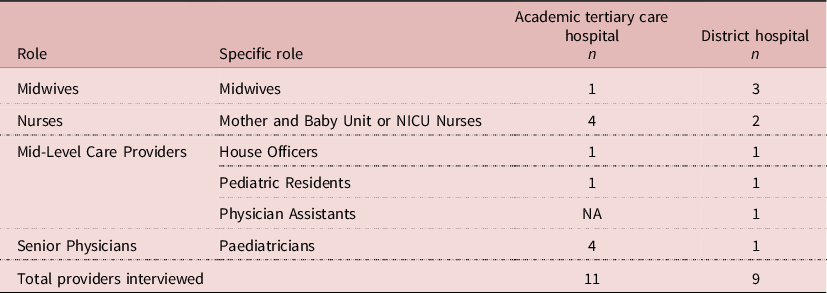
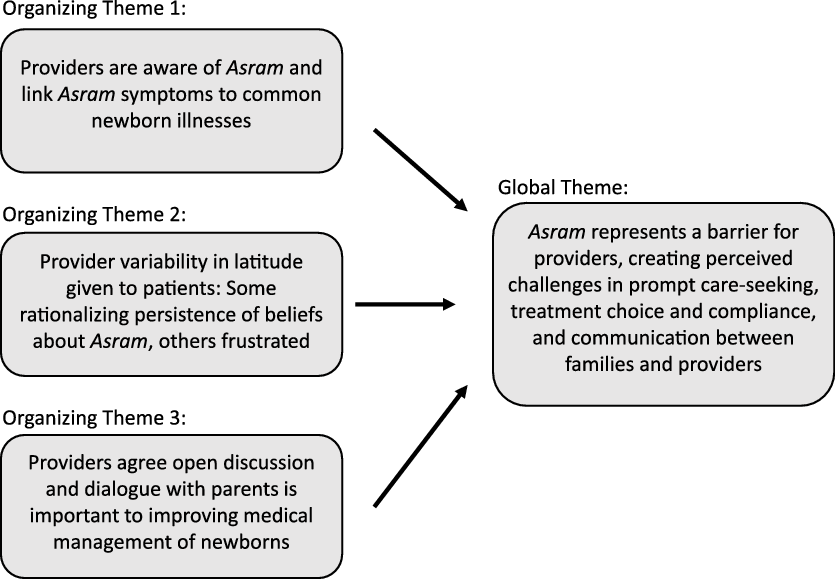
A total of 20 Ghanaian health care providers participated in the study interviews. Of these, eleven were from the tertiary care hospital and nine from the district hospital (see Table 1). Figure 1 illustrates the conceptual framework that emerged from the data. The left-hand portion of the figure shows the organizing themes that emerged related to causes of newborn illness. First, though providers did not believe in Asram themselves, they were universally aware of these traditional beliefs as a primary cause of newborn illness and linked practices related to Asram and its traditional medicine treatments to known neonatal conditions. Second, providers varied in the amount of latitude they gave patients with regard to Asram, with some rationalizing why these beliefs have persisted in Ghanaian society and others frustrated with the persistence of potentially harmful traditional health practices to prevent or treat Asram. Finally, open discussion and dialogue with patients about Asram was important to prevent delays in care and enable providers to manage critical newborn illness. The one global theme that emerged was that Asram represents a barrier for providers, creating perceived challenges in prompt care-seeking, treatment compliance and patient–provider communication.
Participant demographics

Conceptual framework: three organizing themes contribute to the global theme of Asram representing a barrier for providers at newborn care centres in Ghana.

Provider awareness and belief in Asram and traditional practices
All nine providers at the district hospital discussed traditional medicine during their interview. At the tertiary care hospital, nine of the eleven interviewed providers mentioned either traditional practices or Asram specifically. Nearly all providers brought up traditional medicine in the context of neonatal conditions that warrant NICU treatment.
Providers across professions emphasized that although they knew about Asram, they did not personally believe in it or other forms of traditional medicine. Physicians were the most adamant about disagreeing with these beliefs, with many noting the role of higher-education in abandoning them.
Most of it has to do with people who do not have much education. People in the low socioeconomic class, people in a very rural area. People who have not been to school much might believe this. People who live in rural areas, who don’t believe much in the new knowledge that we have. (House Officer)
Many correlated Asram subtypes with common neonatal conditions that had defined physiological explanations.
Convulsions, the baby’s skin being yellow, a baby with a big head. Also a premature baby or a very small baby is Asram. And if they see a baby with green … it is Asram. A baby who is not feeding well is Asram. (Senior Physician)
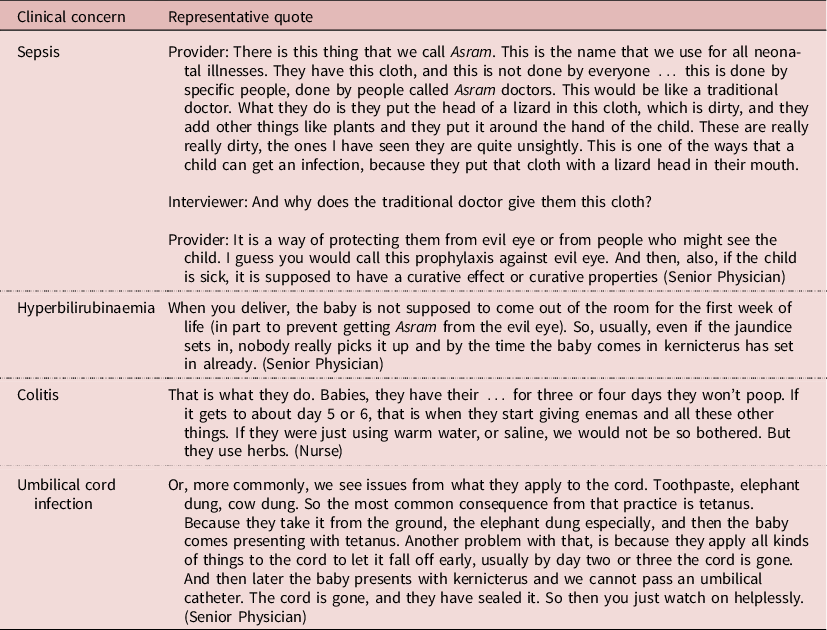
Physicians at both study sites described how the belief in Asram as a cause for newborn disease contributed to infant mortality. This included both the potential dangers of traditional practices to prevent or treat Asram as well as the failure to appropriately recognize and treat life-threatening physiological signs. Some expressed frustration that appropriate care-seeking is delayed when mothers first take their infants to local healers. Providers offered specific examples of attributing clinical illness to Asram and the potential associated harm (Table 2).
Clinical concerns related to Asram and traditional medicine treatments

Rationalization versus frustration
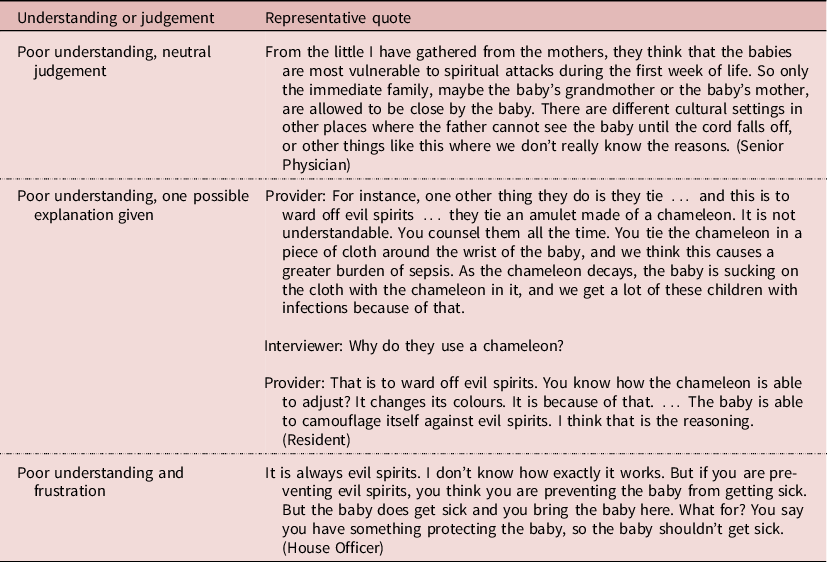
The second theme that emerged from the data was that providers varied in the amount of latitude they gave patients with regard to Asram, with some rationalizing why these beliefs have persisted in Ghanaian society and others frustrated with the persistence of potentially harmful prevention and treatment strategies. Providers varied in the degree to which they claimed to understand both the nuances of Asram itself and the reasoning beyond the associated belief practices. Table 3 illustrates a range of provider descriptions.
Provider understanding and relative judgement regarding Asram and traditional treatments

While no providers reported believing in spiritual causes of newborn illness, several explained how these beliefs were taught during their upbringing. Some were informally taught by their mothers and grandmothers, while others learned about traditional medical practices more formally.
It is cultural. It has been there since we were born. We learn it at school. It is traditional practices. (House Officer)
Overall, providers described a long-standing cultural belief in ‘evil eye’, which is typically seen as the source of Asram. ‘Evil eye’ was described as coming from strangers, acquaintances, friends and family, who were unaware they possessed the ‘evil eye’ but none-the-less caused significant illness for the infant.
They are concerned about evil eyes. We have this belief that if another person comes to see the baby then the child will get sick because the other person, some way through some evil means is giving a disease to the child. (Senior Physician)
Many providers described that because of Asram beliefs, families in Ghana take their infants to a spiritual healer first, and only present to the hospital if traditional approaches have failed to cure the child. Some noted that at times infants would be so sick when they were finally brought to the hospital, that they were beyond saving. If the child then died in the hospital, this would reinforce the message to families that these illnesses, including Asram, cannot be cured by doctors and hospitals.
Because the [newborn] mortality is high they will say, ‘I went to the hospital and they couldn’t do it. The baby died. So it is Asram.’ And then they will think, ‘next time, I won’t go to the hospital, I will go to an Asram doctor.’ (Senior Physician)
Overlaid upon this traditional explanation was an acknowledgment that modern Ghanaian health care is expensive, and families must pay out-of-pocket for much of the treatment offered. Attributing severe newborn illness and death to a spiritual cause was financially protective since it could serve as a justification for exiting allopathic medical care.
[You] have families saying things like, ‘we don’t believe this is a hospital illness and we want to take the baby home’, but you suspect that behind it is the bill. It is not so much that they disagree with the hospital, as it is just that they think it will be cheaper to take them to a spiritual healer or something. (Senior Physician)
Finally, while many providers expressed limited understanding of traditional medicine, a few suggested that beliefs surrounding Asram and the spiritual causes of newborn death might have emerged from the high rate of neonatal death in the region.
There is quite a bit of missed asphyxia, quite a number of babies who are said to be well and who will go home and then present on day two with a seizure … I think … historically very high neonatal mortality rates made people very paranoid. But instead of attributing it to sickness and bringing the baby to the hospital, they attributed it to all sorts of spiritual forces … So, I think it is largely driven by deaths of the newborn. (Senior Physician)
The need for open dialogue to improve care
Expanding upon the potential dangers of traditional approaches to Asram, several providers emphasized how knowing what traditional treatments have been administered can be crucial in early medical decision-making. Several physicians noted that mothers were sometimes reluctant to reveal this history out of fear of judgement from the medical professionals or personal feelings of guilt. This hesitation often led to clinical set-backs due to not knowing what traditional treatments had been provided, which was especially true for herbal preparations either placed into an infant’s nose or given as an enema, as these can lead to local inflammation, irritation or infection.
This baby was perfectly well and then came back in severe respiratory distress, and we only find out later about the herbal inhalation treatments. And you know, sometimes the mothers are afraid to tell us what really happened at home. Especially when it comes to them thinking it could be their fault. (House officer)
All providers emphasized the importance of education related to Asram and the management of newborn illness, noting the need to educate every mother, not just those they expected to seek traditional treatments. When counselling mothers, providers highlighted risk factors for potentially serious conditions, and indications regarding when to bring the infant back to the hospital.
For every woman going home with a preterm baby I say, ‘Please, your baby does not have Asram. Your baby was born before term … She doesn’t need any Asram drug.’ Because if you don’t tell them that, they will still go and do it. And it doesn’t matter the education level of the person. You can be surprised. We had nutritionists who went and used Asram drugs. (Senior Physician)
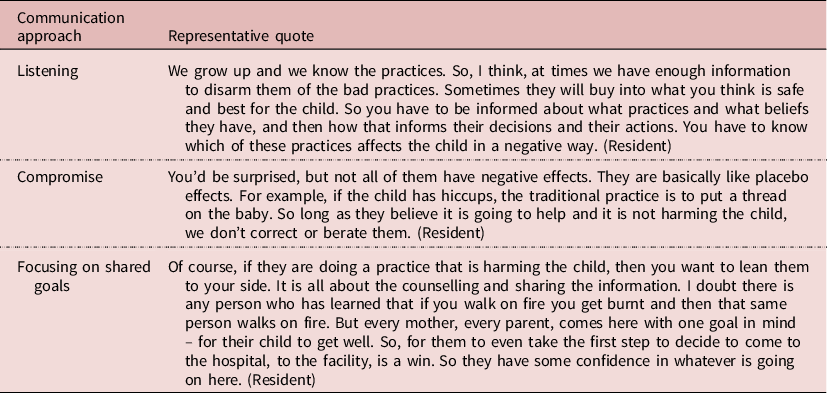
Providers explained how a more thorough understanding of traditional approaches to newborn illness allowed them to empathize with and advise their patients. Listening, compromise and focusing on the common goal of healing the child were specific approaches providers described as helpful in building families’ trust. Physicians and nurses alike said they tried to educate parents without attributing blame, focusing on specific practices that are harmful without dismissing all traditional beliefs (Table 4).
Empathetic communication approaches to discussing Asram beliefs with parents

Similarly, many providers described their approach of including the infants’ grandmothers in education efforts, underscoring the role of the grandmother in decision-making around newborn health. In Ghanaian culture, the grandmother has the final say, with many women being hesitant to go against the grandmother’s wishes, even if they ‘know better’(Gupta et al., Reference Gupta, Aborigo, Adongo, Rominski, Hodgson, Engmann and Moyer2015).
So the problem is trying to balance that, even though the mother is aware of the consequences, she can’t really go against her mother-in-law. So the gap is trying to get the older folks at home to appreciate the dangers of some of the practices that they do have. (Senior Physician)
Some female health care providers shared personal experience with this pressure arising from the family dynamic. Fear of abandonment by their husband’s family and inability to care for themselves and their child alone factored into the internal risk-calculation for whether or not to allow traditional treatments despite ‘knowing better’.
Some of the in-laws are aggressive, or stubborn, I don’t know the best way to say it. They will tell you what they want you to do, and if you don’t do it they leave you. It’s true. It happened to me, when I had my baby. At the time the baby was not poopooing, he was having colic pain and straining and all day. My husband’s mother wanted to give an enema. I didn’t agree, but she said if we didn’t that she would leave me alone and go. It is not easy. Sometimes, when you have in-laws like that, what can you do? (Nurse)
Finally, a few physicians commented on the need to educate hospital staff as well as families. Because of how long-standing traditional medical beliefs are within Ghanaian culture, many non-physician care providers within the newborn setting retained a belief in Asram. Physicians expressed frustration at this belief persistence when it extended into nurses advising families away from allopathic treatments.
Let’s say you have a nurse who doesn’t understand [the pathophysiology of disease], and she sees a patient and she will advise the patient, ‘this disease I think is spiritual’ and she will tell them to see a pastor. She doesn’t understand what she is doing. It makes our jobs harder, as doctors. People more easily believe the spiritual part compared to the medical part. (House Officer)
Discussion
This is the first study to examine the prevailing attitudes of neonatal providers at tertiary care centres in sub-Saharan Africa regarding the impact of traditional medicine on newborn health care. This work builds upon the literature from the past few decades describing presentations and beliefs surrounding Asram. While some care-seeking practices have changed in recent years, the core literature on Asram continues to reflect long-standing beliefs and provides context to the new information provided in this study of Ghanian medical providers. Health providers were aware of Asram and many linked Asram to common newborn illnesses. A minority of providers described understanding the persistence of these traditional beliefs, citing both logistical factors such as access to care, cost and historically high neonatal mortality, as well as cultural aspects such as respecting long-standing traditions. Most providers, however, expressed frustration with the persistence of these beliefs due primarily to the potential harm that they cause. Providers highlighted how both delays in care and the administration of dangerous traditional treatments can lead to significant neonatal morbidity and mortality. All providers emphasized the importance of open dialogue with parents and extended family with a goal of shared understanding and improved patient care.
A consistent finding in the literature exploring health care beliefs in Ghana is that confidence in different types of health care professionals is issue-specific (Bazzano et al., Reference Bazzano, Kirkwood, Tawiah-Agyemang, Owusu-Agyei and Adongo2008; Farnes et al., Reference Farnes, Beckstrand and Callister2011; Dako-Gyeke et al., Reference Dako-Gyeke, Aikins, Aryeetey, Mccough and Adongo2013; Hill et al., Reference Hill, Hess, Aborigo, Adongo, Hodgson, Engmann and Moyer2014), with many families concurrently using biomedical care and forms of traditional medicine, including herbalists and TBAs (Dako-Gyeke et al., Reference Dako-Gyeke, Aikins, Aryeetey, Mccough and Adongo2013). Families may seek a diagnosis from the modern health centre and treatment from traditional healers (Tabi et al., Reference Tabi, Powell and Hodnicki2006) or they may seek a preliminary evaluation from the local healer before deciding whether or not to proceed to the hospital. As described in the interviews, this preferential care-seeking from traditional healers leads to delayed presentation to the hospital, sometimes so much so that the physicians are unable to save the infant from what may have otherwise been a curable condition. This reality causes the tertiary care providers significant distress as they feel obstructed in their ability to access and treat sick newborns.
Due to this concern about delayed interventions, many Ghanaian nurses and doctors have emphasized the importance of newborn ‘danger signs’, referring to new symptoms or changes in behaviour that could be attributed to a severe, but potentially treatable, medical condition. Danger signs are reported in up to two-thirds of historical Asram case descriptions (Hill et al., Reference Hill, Kendall, Arthur, Kirkwood and Adjei2003) and while there is improving recognition of perinatal danger signs, a poor level of understanding of causation and appropriate interventions remains (Engmann et al., Reference Engmann, Adongo, Aborigo, Gupta, Logonia and Affah2013). In this study, the majority of providers expressed concern that mothers may not be able to recognize these same danger signs in their infants or may be falsely attributing such signs to Asram and therefore not seeking treatment.
A key strength of this study is the exploration of health provider perceptions of spiritual illness and their devised approaches towards working effectively with families who retain strong traditional beliefs. Providers within this study recognized the importance of open communication with patient families, refraining from judgement in the moment in order to provide necessary care. Several clinicians emphasized the need to get a thorough medical history, including any herbal and alternative treatments. They noted that even when asked, many women will not immediately disclose prior traditional treatments, a finding that has been shown in prior work as well (Farnes et al., Reference Farnes, Beckstrand and Callister2011). This lack of disclosure can have life-threatening consequences, such as failure to attribute an infant’s symptoms to a side-effect of a herbal treatment. Regardless of how clinicians in this study personally viewed beliefs in Asram they uniformly recognized the importance of bridging cultural and social gaps, connecting with their patients, eliciting trust and gathering a complete patient history in order to provide optimal care for the sick newborn. Empathetic communication in exploring patients’ health beliefs is key to building trust in the therapeutic relationship; awareness of health beliefs may help clinicians support patients in understanding their medical conditions and tailor treatment choices to be acceptable to patients’ expectations and needs (Kennedy et al., Reference Kennedy, Rehman, Johnson, Magee, Leonard and Katzmarzyk2017).
Methodological limitations to this study include the short time-frame during which it was conducted, which limited the total number of interviews conducted, the focused setting of two NICUs within the same city, and the potential bias associated with having interviews facilitated by a visiting physician rather than someone from the community. The impact of the interviewer is probably lower in this study of clinicians than in studies of rural health workers or families, as many of the neonatal providers in this study trained abroad and viewed themselves as part of a larger medical community. Limiting the study to Kumasi, the second largest city in Ghana, may have impacted the accuracy of provider descriptions of Asram, however the focus of this project was to explore the perspective of these highly trained providers who work amidst the larger backdrop of Ghanaian cultural beliefs. Finally, the overarching study from which this paper draws was designed to explore provider perspectives about NICU care in Ghana, not explicitly to address viewpoints on traditional medicine or Asram. While having the opportunity to learn about how traditional medicine impacts and influences Ghanaian medical professionals was a welcomed facet of the qualitative results, had the intention been to specifically address this issue the semi-structured interviews may have been designed differently to target specific aspects of traditional medical practice.
The defining aspect of this study is the introduction of a novel perspective into the ongoing discussion of traditional medicine and Asram. The focus on educated allopathic medical providers adds a new viewpoint to the developing narrative surrounding traditional medicine, care-seeking and health care in Ghana. This study included medical professionals in diverse roles and was split between a community hospital and a central referral centre, which allowed a balanced perspective of medical staff in Kumasi. Overall this work reinforces earlier work while exploring Asram through a novel lens.
This work has several implications for future newborn care in Ghana. First, the providers in the study expressed a duty to continue counselling the mothers and other family members about newborn disease, including danger signs, viewing severe cases or delayed presentations as opportunities to educate and change behaviour. Historically older women and grandmothers determined the type of treatment an infant receives due to their authority in the community (Bazzano et al., Reference Bazzano, Kirkwood, Tawiah-Agyemang, Owusu-Agyei and Adongo2008) and there is a breadth of literature featuring the benefit of incorporating extended family into perinatal care discussions (Ganle & Dery, Reference Ganle and Dery2015; Gupta et al., Reference Gupta, Aborigo, Adongo, Rominski, Hodgson, Engmann and Moyer2015; Ganle et al., Reference Ganle, Dery, Manu and Obeng2016; Sumankuuro et al., Reference Sumankuuro, Mahama, Crockett, Wang and Young2019). As attitudes continue to shift and evolve in Ghana, tertiary care providers are likely to find themselves confronting longstanding beliefs reinforcing the idea that healers and knowledgeable elders are key to identifying and treating Asram (Okyere et al., Reference Okyere, Tawiah-Agyemang, Manu, Deganus, Kirkwood and Hill2010), and may experience some hurdles to widespread acceptance of hospital-based treatment for newborn conditions. Providers may benefit from easier access to mothers and their immediate support system during NICU admissions, allowing for family-inclusive counselling.
Second, this work demonstrates the importance of understanding how families elect to use traditional healers or allopathic health facilities for newborn ailments. Data suggest a trend away from traditional practices, but variation remains between urban and rural areas, between ethnic groups and based on socioeconomic status. As Ghana aims to increase access to high-quality and culturally appropriate health care, it will be important to facilitate a holistic integration of health care modalities, allowing for a complete discussion of risks and benefits of various treatment approaches with patients. In parallel, it will be important to ask both patients and older relatives about spiritual beliefs and cultural practices so that these beliefs can be respected while mitigating risks associated with some traditional treatments.
Considering an integrated or blended approach to care also has advantages in terms of access. Traditional medicine offers an existing care infrastructure with tremendous potential (Krah et al., Reference Krah, De Kruijf and Ragno2018) that could be utilized for uniform messaging regarding danger signs and when families should seek treatment at an allopathic medical facility. One suggested approach is to teach mothers, grandmothers and other family members to recognize danger signs and go to the hospital when dangers signs are present, even if the infant is thought to have Asram. Inviting local healers and village elders to participate in planning of health interventions would be central to this approach (Okyere et al., Reference Okyere, Tawiah-Agyemang, Manu, Deganus, Kirkwood and Hill2010). The belief amongst parents and caregivers that newborns can simultaneously suffer from Asram and other ailments may offer an opening for improved care-seeking, along with an emerging awareness that newborn danger signs can be managed in tertiary settings. Specific to neonates, there is some evidence that a shift in attribution of newborn illness away from spiritual causes is underway, with a 2013 study showing that in certain districts of Ghana only 7% of women now hold these beliefs (Gold et al., Reference Gold, Jayasuriya, Silver, Spangenberg, Wobil and Moyer2013), perhaps evidence that targeted educational campaigns are starting to have a regional effect. Since these traditional beliefs are typical reported at higher rates, especially in rural areas, wider efforts will be needed to see a national change in health behaviour towards the use of health-centre-based care, either alone or in tandem with traditional modalities. Importantly, any partnership between traditional providers and allopathic medicine should be balanced and non-hierarchical, with an emphasis on mutual respect and exchange of ideas (Krah et al., Reference Krah, De Kruijf and Ragno2018). Ghanaian tertiary care providers and their global partners need to recognize the role of traditional medicine in society and partner with these existing system to provide complete care for mothers and infants.
In conclusion, this research adds a new perspective to the evolving understanding of the complex health-seeking patterns of mothers and infants in Ghana and how these problems are managed by medical professionals. This study has shown that Ghanaian medical providers are aware of Asram and map many charactersitics of Asram to known allopathic newborn illnesses. Providers vary in the latidude they give to families surrounding traditional beliefs and practices, with the majority of providers expressing frustration in the persistence of practices that lead to harm or delays in care. Despite viewing Asram as a barrier to timely and appropirate medical care, providers emphasized the importance of counselling and education of families about safe and effective newborn care.
This study suggests that programmatic initiatives in Ghana need to include an understanding of the socio-cultural context in which pregnant women operate, including an understanding of the role of traditional healers. The focus should be on open communication, education and timely entrance into higher-level care when needed. A solid understanding of the pluralistic care-seeking patters prevalent in the community could have impactful public health benefits in Kumasi and throughout Ghana. Allopathic medical providers will have a key role to play in family education and in engaging the broader health community around newborn care.
Funding
This research received no specific grant from any funding agency, commercial entity or not-for-profit organization.
Conflicts of Interest
The authors have no conflicts of interest relevant to this article to disclose.
Ethical Approval
Ethical clearance was obtained from the institutional review boards at the University of Michigan (HUM00139420) and the Kwame Nkrumah University of Science and Technology in Kumasi, Ghana (Ref.: CHRPE/AP/193/18). Each participant was taken through a verbal consent process, which included explicit permission to audio-record the interview.