


Introduction
A significant proportion of young children experience anxiety disorders, with estimated prevalence rates between 3 and 4% (Ford, Goodman and Meltzer, Reference Ford, Goodman and Meltzer2003; Muris, Merckelbach, Mayer and Prins, Reference Muris, Merckelbach, Mayer and Prins2000). These have a detrimental impact on school attendance, adult functioning and emotional well-being (Velting and Albano, Reference Velting and Albano2001; Weissman et al., Reference Weissman, Wolk, Wickramaratne, Goldstein, Adams and Greenwald1999; Wittchen, Kessler, Pfister, Hofler and Lieb, Reference Wittchen, Kessler, Pfister, Hofler and Lieb2000). A large number of children also experience subclinical anxiety, with estimated prevalence of 4 to 9% (Muris et al., Reference Muris, Merckelbach, Mayer and Prins2000; Bell-Dolan, Last and Strauss, Reference Bell-Dolan, Last and Strauss1990). Although less severe, this can also interfere significantly with daily life. Approximately 6% of children aged 7 to 10 years experience symptoms of anxiety and some impairment as a result (Ravens-Sieberer, Erhart, Gosch and Wille, Reference Ravens-Sieberer, Erhart, Gosch and Wille2008).
Meta-analyses of child and adolescent psychotherapy for anxiety disorders demonstrate effect sizes of .7 to .8 (Weisz, Reference Weisz, Dobson and Craig1998). Larger effect sizes have been obtained for treatments involving behavioural components, such as cognitive behavioural therapy (CBT) (Weisz, Reference Weisz, Dobson and Craig1998), with improvements being well maintained (In-Albon and Schneider, Reference In-Albon and Schneider2007). A review paper summarizing evidence from the National Institute for Health and Clinical Excellence clinical guidelines and high-quality systematic reviews for the use of CBT to treat children and adolescents with mental health problems concludes that some of the best evidence for the potential of CBT in young people is in the treatment of anxiety disorders (Muñoz-Solomando, Kendall and Whittington, Reference Muñoz-Solomando, Kendall and Whittington2008). However, this is an area of debate. A recent meta-analysis of treatment for anxious and depressed children has suggested that the supposed critical ingredients of CBT “are not specifically ameliorative” (Spielmans, Pasek and McFall, Reference Spielmans, Pasek and McFall2007, p. 642).
When working with children, CBT typically draws heavily on behavioural strategies, although cognitive techniques are also applied, particularly with older children (e.g. Stallard, Reference Stallard2008). Age has been found to moderate the effect of CBT (Durlak, Fuhrman and Lampman, Reference Durlak, Furnham and Lampman1991), and some have suggested that young children may not have the ability to perform the cognitive tasks that may be needed for CBT to be successful (Reinecke, Dattilio and Freeman, Reference Reinecke, Dattilio and Freeman1996).
It has also been reported that some of the cognitive biases identified in children (which may be targeted in CBT) may be developmentally linked. Leitenberg, Yost and Carroll-Wilson (Reference Leitenberg, Yost and Carroll-Wilson1986) found that, in general, young non-anxious children tend to endorse “catastrophization” biases (i.e. predicting the worst when this is unrealistic) and “personalization” biases (i.e. relating external events to oneself in the absence of evidence) more than older children.
The core cognitive skills required to participate in the cognitive components of CBT for anxiety include the ability to: access and communicate thoughts; generate alternative attributions; display emotional awareness; link situations, thoughts and feelings (Stallard, Reference Stallard2002); engage in collaborative empiricism; quantify and track changes in one's own feelings; and be able to self-report reliably (Dagnan and Chadwick, Reference Dagnan, Chadwick, Kroese, Dagnan and Loumidis1997). Stallard (Reference Stallard2002) proposes that children aged 7 years and above may be able to engage in CBT. However, some studies suggest that children as young as 5 may have some of these skills, although they seem to be correlated with Intelligence Quotient (IQ) (Doherr, Reynolds, Wetherly and Evans, Reference Doherr, Reynolds, Wetherly and Evans2005; Quakley, Reynolds and Coker, Reference Quakley, Reynolds and Coker2004).
In general, few studies have investigated ability to participate in, and benefit from, CBT in young children. Doherr et al. (Reference Doherr, Reynolds, Wetherly and Evans2005) investigated three skills in non-distressed children aged 5 to 7 years, namely generating alternative attributions, identifying emotions, and connecting thoughts and feelings. A score of Cognitive Therapy Ability (CTA) was then computed. Doherr et al. (Reference Doherr, Reynolds, Wetherly and Evans2005) found most children were able to complete the relevant tasks, with no impact of gender, and after controlling for the significant association between IQ and CTA (r = .43, p<.01), age did not predict CTA.
Reynolds, Girling, Coker and Eastwood (Reference Reynolds, Girling, Coker and Eastwood2006) extended these findings to 6–7 year old children deemed to be “at risk” for mental health problems on the Strengths and Difficulties Questionnaire. They found that children were able to discriminate thoughts from feelings and behaviours, another skill thought to be a basic component of CBT, although they performed less well than children deemed “low risk”. Quakley et al. (Reference Quakley, Reynolds and Coker2004) confirmed that young children (aged 4–7 years) could discriminate thoughts, feelings and behaviours and, of particular interest to clinicians, that this ability could be enhanced by using simple cues (their study used characters and pictorial representations of thoughts, feelings and behaviours to help the children differentiate these experiences).
Overall, these studies indicate that young children aged between 4 and 7 years may possess some of the skills required for CBT, particularly for the cognitive component. Whether young children with mental health problems share these abilities is still unclear. Indeed, Reynolds et al. (Reference Reynolds, Girling, Coker and Eastwood2006) caution that children “at risk” of mental health problems may need extra help before engaging in CBT. However, it is important to confirm their findings using different samples and different tests of cognitive therapy ability. The alternative attributions task devised by Doherr et al. (Reference Doherr, Reynolds, Wetherly and Evans2005) has not been investigated in an at risk group, and will be employed here with children who score highly, compared with those who have low scores, on a measure of anxiety disorder related symptoms.
Existing studies contain some additional unanswered questions. It is unclear whether young children can demonstrate cognitive therapy skills in relation to their own life (as opposed to another's life). Previous studies have used fictional scenarios relating to other children (Doherr et al., Reference Doherr, Reynolds, Wetherly and Evans2005; Quakely et al., Reference Quakley, Reynolds and Coker2004; Reynolds et al., Reference Reynolds, Girling, Coker and Eastwood2006). However, use of scenarios relevant to their own life is of particular importance as self-referent scenarios are the area where biased processing seems most evident in anxiety disorders in adults (Amir, Foa and Coles, Reference Amir, Foa and Coles1998; Butler and Mathews, Reference Butler and Mathews1983), and self-referent (and negative) cognitions are often the main targets of treatment. It is thus important to discover if children can generate alternatives in self-referent negative situations compared with, for example, other referent and positive situations (although the interpretation of positive events is also acknowledged as important).
Previous studies have examined the role of IQ in cognitive therapy ability (e.g. Doherr et al., Reference Doherr, Reynolds, Wetherly and Evans2005). However, given the aforementioned skills CBT is thought to require, it seems likely that developmental level, and not just IQ, would be an important factor in determining a child's ability to engage in CBT. One would predict that below a certain developmental level, regardless of IQ, these skills would not be possible. For example, the transition to school marks a significant change in metacognition where children begin to notice their own self-talk (Flavell, Green, Flavell and Grossman, Reference Flavell, Green, Flavell and Grossman1997). Furthermore, given that CBT is frequently being used successfully with adults with learning disabilities (Kroese, Dagnan and Loumidis, Reference Kroese, Dagnan and Loumidis1997), this further highlights that factors other than IQ are likely to be influential.
Consequently, this study chose to investigate the role of developmental level in ability to engage in a skill central to CBT, as well as IQ. The Adaptive Behaviour Assessment System (ABAS; Harrison and Oakland, Reference Harrison and Oakland2003) measures developmental level across several dimensions relevant to children's functioning, and it is possible that this is more closely related to cognitive therapy ability than IQ, especially where younger children are concerned.
Previous studies in this area have included children developmentally and chronologically from a wide age range. A particularly interesting age is 6–7 years, towards the end of the middle childhood transition from preschool to school, which is an age at which children are likely to have developed concrete operational thinking, greater use of executive capacities, a global judgement of self-worth, and when consolidation of peer rejection and acceptance that persists into adolescence and adulthood takes place (e.g. Bee and Boyd, Reference Bee and Boyd2009). It might be hypothesized that the majority of children at this age have many of the potential skills to generate alternative attributions successfully, thus any differences are most likely to be due to, for example, anxiety status.
Finally, given the findings of Leitenberg et al. (Reference Leitenberg, Yost and Carroll-Wilson1986) it is important to investigate whether young anxious children demonstrate the same negative content and biases that are typical of anxious adults. If all young children, anxious or otherwise, tend to display “catastrophizing” biases for example, then this raises questions about the mechanism of change in CBT, and the utility of targeting these in therapy for anxious children.
Three hypotheses were tested in the current study: 1) that children with higher levels of anxiety would generate fewer alternative attributions than children with lower levels of anxiety for negatively valenced self-referent scenarios, but not for positive or other-referent scenarios; 2) that highly anxious children's initial and alternative attributions would be more negative, and reflect more cognitive distortions (such as catastrophizing, personalizing) than those of low-anxious children; 3) that children with higher IQ and developmental level (as measured by adaptive behaviour) would be able to generate more alternative attributions than children with lower IQ and developmental level.
Method
Participants
Twenty-seven state primary schools across Oxfordshire were invited to take part in the study, and 10 agreed and participated. The inclusion criteria were children aged 6 or 7 years who had English as their first language. The exclusion criteria were the presence of a significant learning disability or a diagnosis of Asperger's Syndrome or Attention Deficit Hyperactivity Disorder (ADHD), as the latter tends to result in inflated scores on anxiety measures (Perrin and Last, Reference Perrin and Last1992). Children who had received CBT were also excluded as this may have affected their ability to generate alternative attributions.
The parents of 340 children were approached, and consent was given for 110 children (a 32.4% response rate). Consequently, 110 children were screened for anxious symptoms (see below), of whom 60 (high and low scorers) took part in the study. Power calculations indicated that with 80% power and a 5% significance level a sample of 60 would be capable of detecting a significant difference between the high and low anxiety groups in number of alternative attributions, and uncovering any significant associations between alternative attributions, IQ and developmental level.
Design
A mixed between and within groups design was planned to test the first two hypotheses. For hypothesis 1, the dependent variable was the total number of alternative attributions the child generated, which had four levels (see Measures), and hence also represented the within-subjects factor. The independent variable and between-subjects factor was the child's anxiety status, categorized as either “high” or “low”. For hypothesis 2, the dependent variable was replaced by type of distortion, with negative responses coded into examples of catastrophizing, overgeneralizing (i.e. treating many situations as similar when they are not), personalizing or selective abstraction (i.e. focusing on one feature and ignoring other equally or more relevant features). For hypothesis 3, the design was correlational with associations between alternative attributions and IQ and developmental level being assessed separately in high and low anxious groups.
Measures
Demographics. Parents were asked to provide information on their child's age, year of education, any psychiatric diagnosis and/or treatment they had received for psychological problems. They were also asked whether their child had a formal statement of special educational needs, or was receiving extra educational support by being under School Action or School Action Plus. Information was collected from the school on whether it was involved in an emotional literacy or similar programme, in case these might affect children's performance on the experimental tasks (as per Doherr et al., Reference Doherr, Reynolds, Wetherly and Evans2005).
Revised Children's Manifest Anxiety Scale (RCMAS; Reynolds and Richmond, Reference Reynolds and Richmond1978). This 37-item self-report measure assesses degree of general anxiety in children aged 6 to 19 years and demonstrates good reliability and validity (Reynolds, Bradley and Steele, Reference Reynolds, Bradley and Steele1980), including stability over time (.98 over a 3-week interval; Pela and Reynolds, Reference Pela and Reynolds1982) and independence from IQ (Reynolds, Reference Reynolds1982). The Total Anxiety (28 items) and Lie scale scores (9 items; to match groups for social desirability) were used in the current study. The Total Anxiety score is converted to a T-score with a mean of 50 and standard deviation of 10. Mertin, Dibnah, Crosbie and Bulkley (Reference Mertin, Dibnah, Crosbie and Bulkley2001) found that British children scored significantly lower than the American normative sample. They provided norms for children aged 8–12 years, reporting the mean for 8-year-old girls as 13.69 (SD = 6.53) and boys as 11.13 (SD = 5.62), and recommended administering the measure as a structured interview. Stallard, Velleman, Langsford and Baldwin (Reference Stallard, Velleman, Langsford and Baldwin2001) recommend using a cut-off of 19 to detect clinically significant levels of anxiety.
Alternative Attributions measure (AA – see Appendix I; based on Doherr et al., Reference Doherr, Reynolds, Wetherly and Evans2005). This measure was developed for the current study, based on Doherr et al. (Reference Doherr, Reynolds, Wetherly and Evans2005). It consisted of 12 brief ambiguous social scenarios to which the child was prompted to generate as many attributions as they could. Doherr et al. (Reference Doherr, Reynolds, Wetherly and Evans2005) proposed that the task represents an analogue of an important aspect of CBT (ability to think of alternative interpretations for situations). Social scenarios were used as they are likely to be the most open to bias, often being inherently ambiguous (Leitenberg et al., Reference Leitenberg, Yost and Carroll-Wilson1986), and to allow comparison with adult studies (e.g. Amir et al., Reference Amir, Foa and Coles1998; Butler and Mathews, Reference Butler and Mathews1983). Items pertaining to “self-referent” as well as “other-referent” scenarios were included, which were further split into scenarios that had relatively positive or relatively negative outcome, with valence determined by peer review, and scenarios being subsequently modified until inter rater reliability was 100%. This resulted in 4 subscales, as follows: AA-A Other-referent negative, AA-B- Other-referent positive, AA-C-Self-referent negative, AA-D- Self-referent positive. A sample scenario, as it would be administered, for the “self-referent positive” subscale is presented below:
Researcher: Your teacher asks you to sing in the choir for the Christmas carol concert. Why do you think she asks you? (from subscale AA-D)
[Child answers].
Researcher: That's one reason, well done. What other reasons might there be? (The latter question being repeated until no further answers are given)
Each scenario was scored as the number of alternative attributions made by the child, so did not include their first response. The total number of alternative attributions was calculated, as well as the total number for each individual subscale. In order for a response to be counted, the answer had to cover a different topic from the previous attribution, could not just be a change of syntax, and needed to be logically related to the content of the scenario. It was hoped it would also be possible to categorize responses using the framework of Beck's cognitive biases (Beck, Reference Beck1963; Beck, Emery and Greenberg, Reference Beck, Emery and Greenberg1985). All participants were assessed by a psychology researcher with extensive experience of interviewing and assessing young children, and who had been appropriately trained in the administration of all measures.
Inter rater reliability was calculated for the total number of alternative attributions, using the above criteria, and examining all four types of scenario (AA-A, AA-B, AA-C and AA-D), and type of cognitive bias. Brief instructions, with examples, were written to assist the primary coder and to enable inter rater reliability to be calculated, defining and illustrating what constituted a valid alternative attribution as opposed to, for example, a restatement or change of syntax, and for each type of cognitive bias coded. Twenty-five per cent of the data was coded by a second rater.
Wechsler Abbreviated Scale of Intelligence UK (WASIUK; Wechsler, Reference Wechsler1999). The WASIUK is a widely used measure for estimating general cognitive functioning in individuals aged 6 to 89 years, and has a good psychometric profile. The short form (Vocabulary and Matrix Reasoning subscales) was used in this study. This provides a Full Scale IQ (FSIQ) score that adequately estimates performance on the full WISC-IIIUK and WPPSIUK (Wechsler, Reference Wechsler1992, Reference Wechsler1990). Although the scores from the short form cannot be considered to truly reflect Verbal and Performance IQs separately, they were used as proxy measures for this study.
Adaptive Behaviour Assessment System – 2nd edition (ABAS-II; Harrison and Oakland, Reference Harrison and Oakland2003). The ABAS-II is a measure of an individual's adaptive skills, or social functioning, from birth to 89 years, and was used to give an approximation of each child's developmental level. Studies have found that children diagnosed with emotional problems score lower on the ABAS-II compared to non-emotionally distressed children (Harrison and Oakland, Reference Harrison and Oakland2003). It has been found to have good reliability and validity, being a separate but related concept to intelligence (Harrison and Oakland, Reference Harrison and Oakland2003). The teacher-scored version was used in the current study. The ABAS-II provides an age-scaled standardized score termed the General Adaptive Composite (GAC), which is derived from nine subscales: Communication; Community Use; Functional Academics; School Living, Health and Safety; Leisure; Self-Care; Self-Direction; and Social. However, due to the study's interest in comparing skill level within the sample, absolute non-age scaled scores were used.
Procedure
Recruitment. Details of all primary schools in the local area were obtained from the County Council website and 27 of these schools were contacted by letter. Meetings were arranged with the Head Teachers of each of the 10 schools that agreed to participate. Packs containing a parent information sheet, consent form, demographics sheet and return envelope were then distributed to each school to be given out to children during class time. The children were asked to take the pack home to their parents, and the parents were instructed to return the reply to school for collection by the researcher.
Screening. All the children whose parents consented to their participation (n = 110) were screened by the researcher for anxiety using the RCMAS. This was done during class time in a quiet location individually with each child.
Sample selection. Once all the children had been screened with the RCMAS, the 30 most and least anxious children in the sample were identified, based on ranked scores, to form the two study groups (“low” and “high” anxiety). It had been agreed with the Head Teachers that no more than five children from each class would be involved in the investigative phase in order to minimize teacher burden and class disruption. The dataset required minimal manipulation to ensure this was achieved.
Testing. Each child in the two groups completed the Alternative Attributions measure and the WASI UK short version. This session lasted approximately 40 minutes and the two measures were administered in a counterbalanced order to control for fatigue effects. In addition, the order of presentation of the Alternative Attributions subscales was also counterbalanced to control for fatigue and practice effects. The following introduction was used for the Alternative Attributions measure (based on the instructions used by Butler and Mathews, Reference Butler and Mathews1983):
We are going to talk about some situations where it is not quite clear what is happening. We will read them together and then I'd like you to tell me the first answer that comes into your head, without thinking too long about it. There are no right or wrong answers. Does that make sense to you?
In parallel with the above testing, class teachers were sent an ABAS-II to complete for each child.
Ethical considerations
Ethical approval was granted by Oxford Research Ethics Committee A. In addition, the Department of Education for Oxfordshire reviewed the study and provided management approval, thereby giving permission for schools to be contacted, and several schools also sought clearance from their Board of Governors before parents were approached. Consent was obtained from parents, prior to seeking assent from each child.
Results
Reliability of Alternative Attribution coding
Each valid response on the Alternative Attributions measure was categorized as positive, negative or neutral towards the referent (see Bogels and Zigerman, Reference Bogels and Zigerman2000, p. 208). Inter rater reliability for this process was .93 (kappa; Cohen, Reference Cohen1960), indicating very good agreement between raters (Altman, Reference Altman1991).
Negative responses were further categorized according to whether or not they reflected catastrophizing, overgeneralizing, personalizing, or selective abstraction biases, using the definitions provided by Leitenberg et al. (Reference Leitenberg, Yost and Carroll-Wilson1986, p. 529), which correspond closely to the “thinking errors” described by Beck (e.g. Beck et al., Reference Beck, Emery and Greenberg1985). Overall, inter rater reliability for these biases was poor, as the categories did not seem to be mutually exclusive. However, there was good agreement for “personalizing” where kappa was .72 (Altman, Reference Altman1991). Consequently only data relating to the personalizing bias will be reported.
Demographic and descriptive data
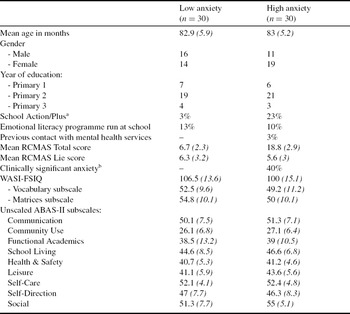
The demographic characteristics of the sample and their scores on the descriptive measures can be seen in Table 1. Analyses were undertaken to determine whether the data met the assumptions of normality and homogeneity of variance required for parametric analysis. The data from subscale AA-C were found to be skewed for the low anxiety group (KS = 1.88, p < .002). Therefore, all data from the Alternative Attributions measure were transformed using a natural logarithmic function, which resulted in a satisfactory distribution for subscale AA-C (KS = 1.36, p = .051) and allowed for parametric analysis using data from this measure. For the remaining data, if the assumptions were not met, non-parametric analyses were used as indicated in the text.
Demographic data and mean scores on descriptive measures for the high and low anxiety groups

Notes: Standard deviations in parentheses; aSchool Action/Plus indicates child has emotional or learning difficulties that have been formally recognized by the school; b using Stallard et al's (2001) recommended cut-off; RCMAS = Revised Children's Manifest Anxiety Scale; WASI-FSIQ = Wechsler Abbreviated Scale of Intelligence – Full-scale IQ; ABAS-II = Adapted Behaviour Assessment System-II
There were no significant differences between the low and high anxiety groups in age (U = 441.5, N1 = 30, N2 = 30, p = .9), gender (X2 = 1.68, p = .19) or Lie scale scores on the RCMAS (U = 381.5, N1 = 30, N2 = 30, p = .303). As expected, there was a significant difference for the total score on the RCMAS (U = <.001, N1 = 30, N2 = 30, p = <.001) with the high anxious group scoring higher than the low anxious group. There was also a trend for the low anxiety group to have a slightly higher FSIQ than the high anxiety group (t = 1.81, df = 58, p = .076).
Alternative attributions, reference and anxiety
A one-way ANOVA revealed that the ability to generate alternative attributions was not dependent on which school the child attended (F = 1.024, df = 9,50, p < .434). A 2 (anxiety group) × 2 (referent) × 2 (valence) mixed factorial ANOVA revealed that there was no significant main effect of anxiety status on the number of alternative attributions generated (F = .19(1,58), p<.688). However, there was a significant main effect such that both high and low anxious children were less able to generate alternative attributions for scenarios that were self-referent (AA-C and AA-D) than other referent (AA-A and AA-B) (F = 8.22(1,59), p = .006). This was modified by a significant interaction between valence (positive vs negative) and reference (self vs other) (F = 10.812(1,58), p = .002), such that both the high and low anxious groups were less able to generate alternative attributions for scenarios that were negatively valenced and that referred to the self (AA-C) than the other forms (AA-A: t = 4.282, df = 59, p<.001); (AA-B: t = 3.347, df = 59, p = .001); (AA-D: t = 3.522, df = 59, p = .001). This interaction is illustrated in Figure 1.
The interaction effect of valence and referent on the Alternative Attributions measure (AA) for the sample as a whole

The first hypothesis was therefore partly supported as there was a differential effect of both the referent and the valence of the scenarios on the ability to generate alternative attributions. However, this effect was not specific to the high anxiety group.
Cognitive biases
Both groups showed a higher proportion of negative responses on the self-referent negative subscale (AA-C; low anxious group 55%, high anxious group 35%) compared to the negative responses on the other-referent negative subscale (AA-D; low anxious group 33%, high anxious group 21%). This was found in both the alternative attributions (percentages above), and the initial attributions generated.
Results from the cognitive bias coding procedure found that the “personalizing” bias was present in a high proportion of the negative responses, approximately 70% overall. Visual inspection of the data suggested that a higher rate was seen in responses to the self-referent negative subscale (AA-C) than to the other-referent negative subscale (AA-A) in both the high and low anxious groups (high anxious group, AA-C = 84%, AA-A = 56%; low anxious group, AA-C = 89%, AA-A = 52%).
Alternative attributions, IQ and developmental level
Correlations were executed to determine the relationship between participants’ ability on the Alternative Attributions measure and IQ and adaptive behaviour. Although there was no main effect of anxiety status in the analyses reported above, it was not thought to be acceptable to investigate the predictors as if the whole sample represented one homogeneous group, and therefore separate analyses were performed for each group, including for the Total AAs score, and for each of the subscales. The analyses were treated as exploratory, thus Bonferroni corrections were not applied to the coefficients obtained.
Low anxiety group
Score on the vocabulary test of the WASI was correlated significantly with total number of alternative attributions (rho = .478, p = .008), and with number of alternative attributions generated on the self-referent positive subscale (rho = .573, p = .001), and self-referent negative subscale (rho = .45, p = .013). There were no other significant associations, and no significant associations between the matrices test of the WASI and any of the Alternative Attributions measure scores. The majority of the ABAS subscales were not significantly correlated with the number of alternative attributions generated, with the exception of the self-referent positive subscale and Communication (rho = .403, p = .027) and other-referent negative subscale and Self-care (rho = .440, p = .019).
High anxiety group
Score on the vocabulary subscale of the WASI was significantly correlated with the total number of alternative attributions (rho = .472, p = .008), as well as both the negative (rho = .499, p = .005) and positive (rho = .427, p = 0.19) self-referent alternative attributions, and the other-referent alternative attributions (rho = .435, p = .016). There were no significant correlations between the number of alternative attributions generated and the matrices subscale of the WASI.
All of the ABAS subscales were significantly correlated with the total number of alternative attributions generated (range of correlations rho = .396 to .58), except the Social and Health and Safety subscales. The individual subscales of the Alternative Attributions measure showed a similar pattern. The number of alternative attributions generated for scenarios relating to self and other (both positive and negative) was significantly associated with at least three out of the nine ABAS subscales (range of correlations rho = .363 to .603), with the exception of the Social and Health and Safety subscales, for which few correlations were significant. Regarding scores on the self-referent negative subscale in particular, out of IQ and all the ABAS subscales, the strongest association was found to be with the Functional Academics subscale (rho = .469, p = .009).
Discussion
There were variable levels of support for the hypotheses. There was an effect of valence and reference, in that fewer alternative attributions were generated in response to self-referent negative scenarios compared to the other three scenarios. This provided partial support for the first hypothesis and is similar to Amir et al.'s (Reference Amir, Foa and Coles1998) findings with adult samples. However, contrary to predictions, the high anxious group compared to the group low in anxiety did not show reduced ability on this task. Overall, inspection of the mean scores indicates that both groups were able to generate a number of alternative attributions for all four types of scenario.
The findings suggest that both high and low anxious children possess a skill thought to be important in CBT, namely the ability to generate alternative attributions in ambiguous social scenarios. Previous work has shown that “at risk” children perform less well than children at “low risk” of mental health problems (Reynolds et al., Reference Reynolds, Girling, Coker and Eastwood2006). The current study did not find this. One possibility is that performance across cognitive therapy ability tasks is variable. The present study used a different task from that employed by Reynolds et al. (Reference Reynolds, Girling, Coker and Eastwood2006), and it is possible that our high anxious children would perform less well than the low anxious, for example, on discrimination of thoughts, feelings and behaviours. Commonsense suggests that it is unlikely that all the skills necessary for CBT are equivalent in demand or ability required. Alternatively, it may be that the differences between the findings of the present study and Reynolds et al. (Reference Reynolds, Girling, Coker and Eastwood2006) stem from sampling differences. This study excluded any children with ADHD, whereas they were included in Reynolds et al. (Reference Reynolds, Girling, Coker and Eastwood2006). More research using a range of tasks and different groups of children, particularly those at risk, but also clinical samples, is needed.
Although both groups generated fewer alternatives in the self-referent negative condition, the mean scores showed that most children could find between two and three alternatives when presented with this scenario. Ability in this scenario is of particular interest given that self-referent negative cognitions are likely to be an important focus of any CBT for anxiety. While previous studies have shown that young children possess this ability in relation to scenarios involving others, the current study is, to the best of our knowledge, the first to indicate that they possess it in relation to self, including in negative situations. This finding therefore lends particular weight to the argument that young children can take part in, and potentially benefit from, CBT, including when it is focused specifically on any problematic, negative cognitions (relevant to anxiety) that they may experience themselves.
The findings provide partial support for the importance of IQ in CBT ability, and extend this to developmental level. However, the correlational analyses suggest that these factors are most important for children high in anxiety, with developmental level being particularly relevant. This needs to be explored in a clinical group to further clarify the picture as it appears that it is those who are most likely to be in need of CBT who may be least likely to have the requisite skills if they also have relatively lower IQ and/or are at a lower level of development.
Type of bias was difficult to study because it was hard to gain adequate inter rater reliability in some categories. Personalizing bias was very common in both groups, but was more common in responses to self-referent negative scenarios than other-referent negative scenarios. This is consistent with the findings of Leitenberg et al. (Reference Leitenberg, Yost and Carroll-Wilson1986), indicating a developmental process may be important, but also shows that bias has some relationship to reference. Leitenberg et al. suggest that it reflects an egocentric view of the world common in early childhood, and our findings are consistent with this.
The current findings highlight the complexity of applying CBT to young children. The interaction of CBT, the skills it involves, the child's clinical presentation and developmental level has not received much attention. Children of this age do appear to have some of the key skills needed to take part in CBT, including ability to generate alternative attributions when scenarios are negative and involve themselves. Their ability in these specific situations is a novel finding. At least some of these skills may be unaffected by mental health problems or symptoms. However, there may also be some important developmental differences in these skills, which therapists working with anxious children need to consider. In particular, those who are most anxious may be less able to use these skills if they are at an earlier developmental level. There may also be some developmental differences in the type and nature of the biases young children show; personalization in particular may be very common in young children, and not necessarily a correlate of psychopathology. Other biases, however, may be more clearly linked to symptoms (Leitenberg et al., Reference Leitenberg, Yost and Carroll-Wilson1986).
It is important to learn more about cognitive therapy ability and skills in order to make sure children are ready to engage in CBT and, when delivering CBT, to take account of any developmental trends. The picture is likely to be complex – different tasks may be more or less affected by developmental level or IQ. In addition, the type and nature of clinical symptoms may affect task ability, as an integral part of the psychopathology. At least some of the biases often associated with adult anxiety may be part of a normal developmental trajectory in children, and not necessarily inherently pathological. The need for a developmental perspective in research and clinical practice is perhaps more vital than many have assumed. This is likely to have implications for our understanding and conceptualization of child anxiety, as well as its treatment.
Acknowledgements
We would like to thank all the parents, pupils and schools across Oxfordshire that made this study possible.
Appendix: Alternative Attributions (AAs) Measure
“We are going to talk about some situations where it is not quite clear what is happening. We will read them together and then I'd like you to tell me the first thing/answer that comes into your head, without thinking too long about it. There are no right or wrong answers. Does that make sense to you?”
A. Other-referent negative (questions tend towards more unpleasant attributions)
1. In the playground Laura shouts “hello” at her friend, but her friend just runs past without saying hello back.
▫ Why do you think her friend ran past without saying hello back?
2. Ben asks for an action man for his birthday, but his parents give him something else.
▫ Why do you think. . ..?
3. Jill asks her friend to tea but she does not turn up.
▫ Why do you think. . ..?
B. Other-referent positive (questions tend towards more pleasant attributions)
1. The teacher always asks Karen to answer questions in class.
▫ Why do you think. . ..?
2. Peter's parents let him go round and play with a friend straight after school
▫ As above. . .
3. Katie is in the play park and falls off her swing. Her friend John runs over towards her.
C. Self-referent negative (questions tend towards more unpleasant attributions)
1. It is your first day back at school after the summer holidays; as you walk into the class all the other children stare at you.
2. You are at a party and no one comes over to talk to you.
3. Two of your classmates are giggling and whispering behind you in assembly.
D. Self-referent positive (questions tend towards more pleasant attributions)
1. A girl/boy in your class asks you if you'd like to go to the cinema with them.
2. Your teacher asks you to sing in the choir for the Christmas carol concert.
3. You are having a birthday party and all the people you invited turn up.




Comments
No Comments have been published for this article.