IntroductionFootnote 1
This article provides a long-term analysis of the changing labor relations in Zimbabwe from c. 1900 to 2000, by comparing demographics and labor relations at three cross sections: 1904, 1951, and 2002. The major focus of the article will be the causes and consequences of the changing labor dynamics over this period, the examination of which will be fully embedded in the social, political and economic circumstances of the time. The process of defining the labor roles for an entire population comes up against particular dilemmas in southern Africa, and to an extent, Africa as a whole. The lack of written records before the arrival of the European powers, the problems of the colonial archive, especially with concerns to material relating to “native affairs” and the paucity of census data are common issues across Africa, and the Zimbabwean case is no different. Nevertheless, this article provides population breakdowns (based on calculation and considered estimates) at the three cross sections in order to facilitate comparison and long-term analysis. By exploring the continuities and shifts of labor relations over this period, it is hoped that the article provides a comprehensive account of the rapid and radical changes Zimbabwe underwent during the twentieth century and the impacts these have had on the peoples and economies within the southern African nation.
This article is divided into three main sections. The first is a brief historical background of Zimbabwe, focusing on the political and economic organization of the country since the establishment of settler rule in 1890. The second section provides a short survey of the sources used to obtain the statistical data for each of the cross-sections, accompanied by a critical reflection on the conditions of production of these source materials, their limitations and the challenges they pose to a study of this type. The third section examines the labor relations and dynamics in the long-term perspective. It provides a comprehensive breakdown of the total population, the economically active population (EAP) and what work was undertaken by the various populations of Zimbabwe in 1904, 1951, and 2002. The data provided in this section offers the opportunity to examine the shifts and continuities in labor relations in Zimbabwe over the course of the twentieth century.
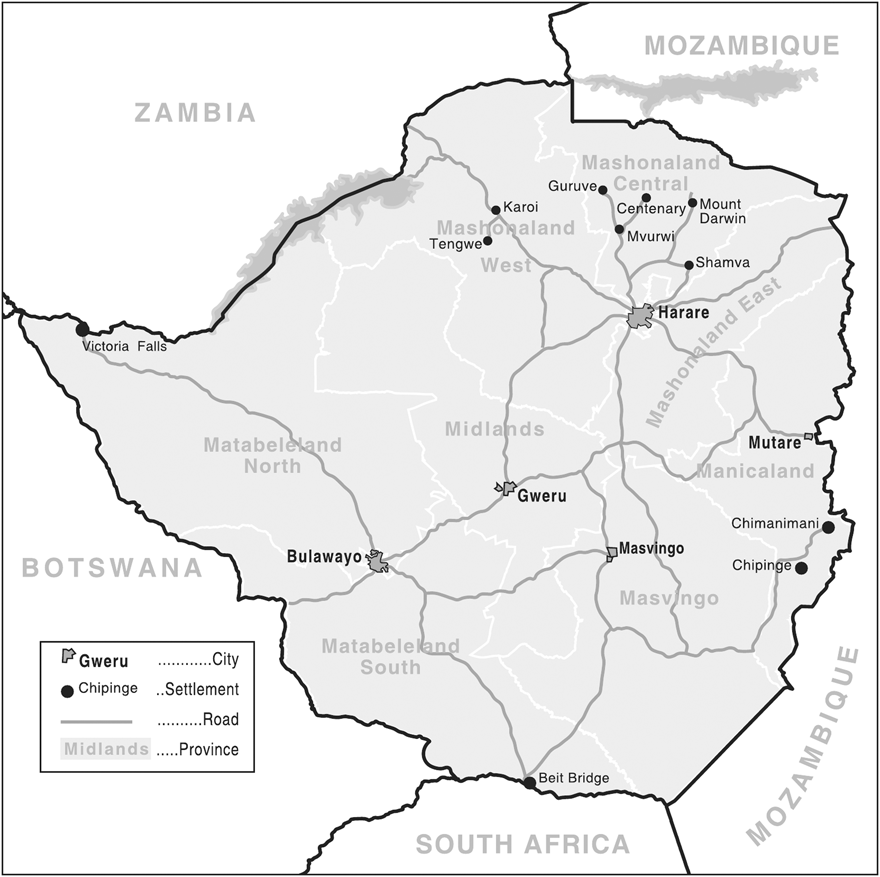
Map of Zimbabwe, showing provincial breakdowns and major cities

Historical Background
The arrival of white settlers on the Zimbabwean plateau in 1890 marked the beginning of colonial occupation of Zimbabwe. Within the area now known as Zimbabwe, the settlers came into increasing contact with the two main population groups, the Shona and the Ndebele. The “Shona” are to be found across Zimbabwe and Mozambique. The term Shona represents a collection of people, made up of a number of groups (Korekore, Zezuru, Karanga, Kalanga, Manyika, Ndau, and Rozvi), who “speak different, but mutually intelligible, dialects.”Footnote 2 They dominated the middle and high veld areas of Zimbabwe (from north-west to south-east of country). The Shona were mainly agriculturalists, growing a wide variety of crops. Millet and sorghum were widely grown, and later maize. Livestock were also kept and included cattle, goats, sheep, dogs and fowl. The Ndebele settled around Bulawayo in 1838 having moved up from South Africa and were also agriculturalists, but had large herds of cattle and were heavily involved in regional trade.
The expanding European presence concomitant with various settler transgressions such as forced labor, looting and rape provided the touch paper for Shona and Ndebele uprisings in 1893 and 1896.Footnote 3 The brutal pacification of these revolts paved the way for increasing settler presence, much of which was directed towards farming and land occupation. The settlers who came to farm in Southern Rhodesia (as the colony was named) faced a tough task. Conditions were unforgiving and unfamiliar, and far from being the dominant group, white settler farmers faced competition from black farmers keen to exploit the opportunities of the new markets created by colonialism.Footnote 4 By 1900, the conquest and pacification of Southern Rhodesia was complete. White controlled urban centers were established to effect colonial rule (in particular Salisbury, now Harare, in the north, and Bulawayo in the south). At the same time, successful strategies of extracting labor that had been used elsewhere in Africa were put into place: African access to land was restricted in order to undercut agricultural production and the ability to exploit the commons; taxation was introduced so that black populations were forced to sell their labor; “Native Reserves” were created in order to separate the races and create a dependent, labor providing black population.Footnote 5 These were long term measures and by the 1930s “poverty and lack of economic opportunities forced Zimbabweans (as opposed to foreign) blacks [sic] into the white farms, factories and mines on a large scale.”Footnote 6 At this point the notorious Land Apportionment Act of 1930 cemented and increased the size of the European land holdings to forty nine million acres, or fifty percent of the country.Footnote 7 Up to this point, the labor supply for white farms and mines was supplemented by the recruitment of “foreign” African labor, from neighboring areas now known as Mozambique, Malawi and Zambia. Just as many Zimbabweans migrated to work on the gold and diamond mines in South Africa, so the new employment opportunities in Zimbabwe attracted laborers from further north and inland.Footnote 8
In 1953 Britain decided to form the Federation of the Rhodesia and Nyasaland by joining Southern Rhodesia, Northern Rhodesia (Zambia) and Nyasaland (Malawi) under administrative rule. The black populations in all three territories, but particularly Nyasaland and Northern Rhodesia, vehemently opposed this move.Footnote 9 The whole setup largely benefited the more industrial economy of Southern Rhodesia and continuing black opposition in the northern two territories saw the Federation dissolve in 1963. Agriculture was still very important to the Southern Rhodesian economy and the industry had witnessed massive growth after the Second World War.
With the dissolution of the Federation, continuing disagreements about the political future of the colony between the domestic leaders of Rhodesia and the British led to the Unilateral Declaration of Independence (UDI) in 1965. This move was disastrous for the Rhodesian economy, which suffered from the trade sanctions enforced by Britain and the United Nations in the late 1960s.Footnote 10 The tobacco industry was particularly affected by these actions, but the other agricultural sectors were also severely affected as markets evaporated and trade restrictions resulted in increased production costs as well as input shortages.Footnote 11
These setbacks were compounded by a protracted and bloody liberation war (1965–1979) fought between the settlers and the black nationalist movements of ZANU (Zimbabwe African National Union) and ZAPU (Zimbabwe African People’s Union). However, the international isolation forced Rhodesia to expand its own manufacturing industry, which meant, that after the war, Rhodesia was one of the few economies in Africa where manufacturing and industry was of comparable importance to the economy as mining and agriculture. After independence in 1980, the Zimbabwean economy began to recover. Economic growth averaged twelve percent from 1980–1982. But the honeymoon did not last long. Employment creation remained slow, with only 10,000 new jobs created annually in the first decade of independence. There was little or no structural or radical reform of the economy and so most of the gains that were made remained in the hands of the elite or foreign-owned companies.Footnote 12
Failing economic fortunes led to the adoption of the IMF/WB Economic Structural Adjustment Program (ESAP) in 1991, the effects of which were disastrous. Public spending (schools, hospitals, food and fuel subsidies) was cut which impacted negatively on the poor. Economic growth fell from 4 percent to 0.9 percent and, as many industries and business closed, large numbers of workers were retrenched. Unemployment shot up from 32 percent in 1990 to 44 percent in 1993. Many hardships were also felt in the rural areas, because there was a “de-industrialisation of the agro-industrial sector, and rural poverty intensified as a result of ESAP’s adverse effects on the agricultural output of the poor.”Footnote 13 The deepening economic crisis after 1998 forced many rural and urban poor out of the formal economy and into the informal one. The controversial fast-track land reform program, initiated in 2000, which saw almost all of the land held by white farmers given to poor black peasants (as well as a large number of the political elite) provided many urban and rural poor with the potential of an alternative form of livelihood to buffer themselves against the dramatically worsening economic situation in the country.
In order to trace the specific shifts in labor relations across the twentieth century accurate population and working population totals need to be calculated, particularly for the earlier dates. The next section briefly discusses the sources used to map the demographics and some of the difficulties encountered in using those sources.
Sources and Data
The sources used to extrapolate the total population at the 1904 cross section were the 1904 European and African censuses.Footnote 14 However, while the European populations were accurately enumerated, the “Native” censuses were not actually censuses at all. African population figures were estimated by the Ministry of Native Affairs based on the number of taxable men per village. Village headmen provided estimates of the number of men over the age of fifteen (which was the official working, and hence taxable, age) to the Native Commissioner’s Office on a yearly basis. The number of African women and children were calculated from these estimates by assuming that for every taxable man there were three or four women and children (depending on discretion of the District Commissioner). Such estimates were likely to be underestimates of population because they excluded the elderly or misjudged the number of women and children. Some posit that the figures of these censuses are low by 20 percent.Footnote 15 Providing a comprehensive demographic breakdown for the 1904 cross section is the most problematic because of the paucity and nature of the data available. The lack of African written records, the limited nature of the colonial state to undertake comprehensive census returns, and the problematic nature of the colonial archive and its information on “native affairs” all contribute to the difficulty in estimating population sizes. The first comprehensive African census was only conducted in 1962, which means the 1951 cross section suffers from many of the same problems. Adjustments to population totals for the African population are made accordingly and are outlined in the discussion of labor relations below.
For 1951 there is a wide range of census data available. National censuses had been carried out every ten years from 1921 to 1962. The European populations were accurately enumerated, but the figures supplied for the African population were still based on estimates. Like the 1904 census, research suggests that the 1951 population estimate for women and children was 17 percent below the real figures.Footnote 16 Furthermore, in 1951 there are census records of Africans, Europeans, coloureds and Asiatics in employment.Footnote 17 While these censuses contain accurate information on formal employment, they contain little data on reciprocal forms of labour, particularly in subsistence agriculture. This gap will be discussed in detail below.
The 2002 cross section predominantly relies on the national census of 2002, compiled by the Central Statistics Office (CSO).Footnote 18 While the census data presented in this report is fairly accurate, there are reasons to be cautious of some of the figures supplied. As the overview section noted, after 1997 Zimbabwe entered into a sustained period of political, economic and social crisis. By 2001, when the census counting took place, the state’s ability to undertake such a massive and expensive program would have been seriously curtailed. Furthermore, there would certainly have been some counting anomalies in many rural areas as large population movements were happening from 2000 onwards (due to the land reform program), which may have resulted in overcounting or undercounting in some areas. Plus, it is likely that there was a certain degree of undercounting in the urban areas, as that is where the opposition party had most of it support and the ruling ZANU-PF may have tried to undercut that to some extent. To buffer the data from the 2002 census, this article will also consult the 2000 Compendium of Statistics, also compiled by the CSO.Footnote 19 This Compendium contains detailed quantitative data on all major industries, population, employment and earnings. Much of the information contained in the Compendium is collated from other CSO activities more focused on economic and occupational data, including the Quarterly Digest of Statistics, and data compiled in the 1997 Inter-Censal Demographic Survey, the 1999 Indicator Monitoring Labourforce Survey, and the 1999 Child Labour Survey.
Labor Relations during Colonial Rule and Post-Independence
Calculating accurate total population figures is important as it offers the start point for investigating the labor relations of the whole population in more detail. Thus the population figures presented in the official census from 1904, 1951, and 2002 will be used as a basis for constructing a more detailed breakdown of the total population, the economically active population (EAP) and the labor relations present at those cross sections.
In 1904, the European population (including Asiatics and coloureds) was just over 12,500. In 1901, the African population was estimated at 500,000 in the official census. In 1904 it was estimated at 590,000, and in 1911 it was estimated at 740,000. This sharp rise in population over this period is probably due to better tax records and the extending reach of the colonial state than a dramatic increase in population. David Beach, a historian who has done the most work on the history of Zimbabwean population trends, has noted that the initial reasons for enumerating the population was the collection of tax and labor, so it is not surprising that the populations for each district tended to show a “steep rise in the first decade, as more and more villages and individuals were added to the tax registers, especially in the larger and more remote districts.”Footnote 20
It is likely that the population was much more stable than these figures show. Beach has posited that from the mid-nineteenth century, the Shona population was held in check by a number of factors and was remarkably stable. For example, there was no massive de-population due to the slave trade, no loss of population due to the arrival of the Ndebele (and only an increase of c. 20,000 people, the total population of the Ndebele mid-nineteenth century), the colonial impact was very light, especially early on, and movements of people from district to district, or to urban centers were “surprisingly limited up to 1922.”Footnote 21 For Beach, Zimbabwe was a very “healthy part of Africa,” and “what is surprising about the pre-colonial and early colonial population is not that it rose after 1900, but that it did not rise higher before then.”Footnote 22 Based on Beach’s insights, I estimate the black population at 1904 to be c. 700,000 people, which is roughly 20 percent higher than the official census estimate.Footnote 23 The total population at the 1904 cross section, including white and black populations, is, by these calculations, c. 712,000 (650,000 Shona, 50,000 Ndebele, 12,000 whites).
The EAP of the small settler population was recorded in the census of 1904. White males working in the colony a very small proportion of the total EAP, only 1 percent, and were mainly involved in agriculture, mining, transport, and the civil service.Footnote 24 These whites were wage earners (labor relation 14), self-employed (labor relation 12) and employers (labor relation 13). However, their numbers are so small that they are not statistically relevant once the forms of African labor are included.
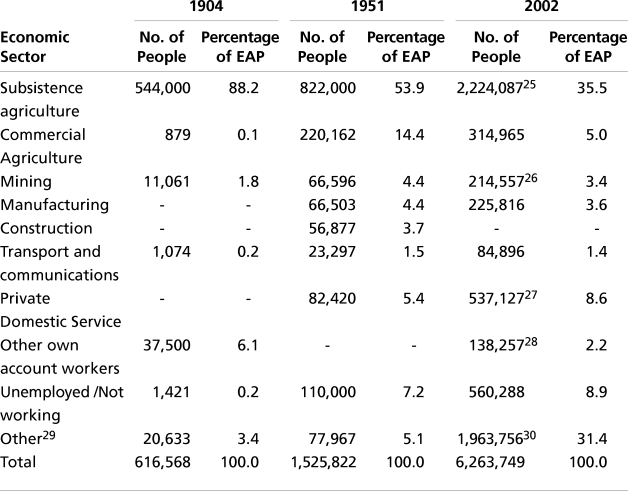
Employment by economic sector for the entire population in Zimbabwe: 1904, 1951, and 2002

In 1904 formal wage earning Africans were 4.5 percent of EAP in the colony, working in agriculture, mining, transport and other activities (see Table 1 for employment per economic sector). There is no gender breakdown of this figure provided, but the majority would have been men, working as laborers on the mines and in agriculture. The number of Africans formally employed does not include types of reciprocal labor that would have certainly been a part of everyday life for much of the population. As an agriculturalist society, most Shona were involved in growing crops in one form or another. In terms of labor division, men mostly did heavy work and protected the fields, as well as most of the hunting and herding. Women and children weeded and tended fields, while the harvesting and clearing was done by all. Beach noted that, “most of the work was done by and for the individual household, and, more importantly, the produce was kept by the household.”Footnote 31 There were other activities undertaken, such iron working, salt trading, weaving and potting, but none of these activities involved a trade system or network on a scale to support specialized communities.
The Ndebele were also involved in regional trade, the main exchange item being tobacco they grew themselves. They also traded cattle and other goods for grain with the Shona in times of drought. Mostly, however, the Ndebele were basically agriculturalists like the Shona. Cattle were more important to the Ndebele than the Shona (indeed, by 1890 the Ndebele herd was estimated at 250,000), but the importance of cattle in Ndebele society has often been exaggerated. Ndebele land tenure was not “fundamentally different from that of the Shona.”Footnote 32 Most Ndebele settlements were small-scale ones, numbering from about fifty to two-hundred people. Villages were “collected together into clusters and the outlying political unit of the state was (…) the partially decentralized chieftaincy.”Footnote 33 Labor divisions were similar to those of the Shona. The Shona and the Ndebele had a bride price marriage system, whereby the bridegroom and his family would “pay” the bride’s family. This is known as roora in Shona, and amalobolo in Ndebele.Footnote 34 The idea behind bride price system “was that the wife’s lineage should receive compensation for the loss of presence of the girl, especially her labour.”Footnote 35 When a marriage was arranged the husband and his family usually paid the wife’s family with cattle or other goods in compensation and is indicative of how important a woman’s labor was in running the household and producing food.
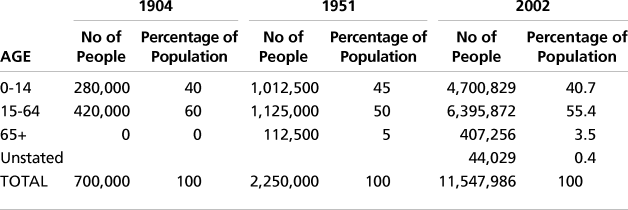
In order to identify the total EAP, it is necessary to calculate the gender and age distribution of the black population. With a total estimated population of 700,000, it is assumed that 200,000 (28.5 percent of total population) of these would have been men over the age of 15 years.Footnote 36 The ratio of women to men seems to have favored women, probably not from birth but certainly in the adult population, which is probably an indication of the higher mortality rate of African men. As such a ratio of 100 adult men to 110 adult women will be used. This gives a female population of 220,000 (31.5 percent of total population) over the age of 15 years.
The population under the age of 15 was c. 280,000 (40 percent of total population) and probably a much more even split between male and female (see Table 2). Children too would have worked and produced for the household. It would seem that from the age of 5 or 6 children would have been involved in tending fields, collecting and harvesting and herding livestock. I will estimate that 75 percent of population under 15 was involved in reciprocal labor for the household. This represents 210,000 people (30 percent of total population, 34.5 percent of EAP).
Age distribution of the African population in Zimbabwe: 1904, 1951, and 2002
The age group 15–64 would also have mostly been mostly economically active, except for those that could not/did not need to work (for various reasons such as health, disability, and title). This would have been a very small percentage that is will estimated to be only c. 5 percent of the total population. The total EAP between 15–64 years of age then would have been 57 percent of total population. The number of elderly people (those not able to work because of old age) has not been included here because it is thought that that population would have been so small it is not statistically relevant. Early nineteenth century life expectancies for the African population seem to range between 20–25 years, rising to 35 years in 1950.Footnote 37 Indeed, the notion of “too old to work” does not apply to the Zimbabwean example at 1904, and the harsh reality of the peasant/subsistence lifestyle was that most people would have worked up until, or very close to, death.
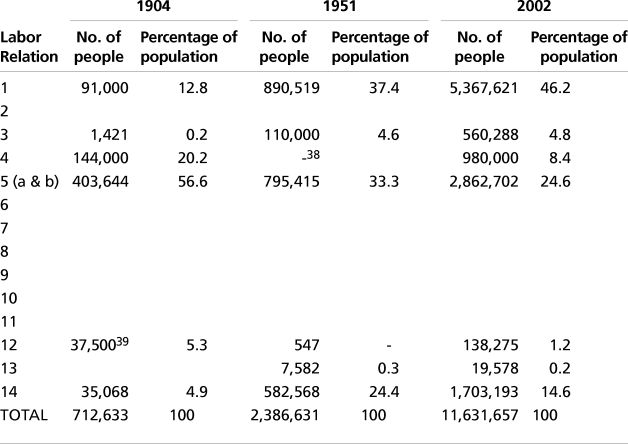
The total African EAP then was c. 609,000 (87 percent of the total population; see Table 3 for full breakdown of labor relations). The vast majority of the African EAP would have been involved in agricultural and pastoral production for the household. I would estimate that 90 percent of the adult EAP outside of waged employment was involved in subsistence agriculture and household production (labor relations 4, 5a and 5b), and 5 percent in other activities such as production for trade (labor relation 12). All children economically active I have treated as kin labor (labor relations 5a and 5b), and working for the household and in subsistence agriculture.
Labour relations for the entire population in Zimbabwe: 1904, 1951, and 2002
For women, subsistence agriculture and production for the household (labor relations 5a and 5b) would have been their primary forms of work. From the population estimates outlined above, females under the age of 15 involved in subsistence agriculture (tending fields, collecting water, sowing, harvesting) and tending to the household made up 17 percent of the EAP. The number of adult women working for the home and in subsistence agriculture constituted 30 percent of the EAP. Some women would also have undertaken activities such as bead making, weaving and pottery production, both for home use and trade. I have put this figure at 10 percent of economically active women working outside of waged-employment, but as Beach has observed above, none of these activities were large enough to support specialized communities or economies, so these women would most likely have performed these roles and assisted with subsistence/household labor.Footnote 40 Males under 15 would have also assisted in agriculture and running the household (17 percent of EAP, labor relation 5a). The number of men over 15 years of age involved in subsistence agriculture was 20 percent of EAP (labor relation 4). Another 10 percent of economically active men outside of waged employment would have produced items for trade (iron working, salt trading) or undertaken migratory labor to mines in South Africa (labor relation 12).
The large number of men and women working in subsistence agriculture and producing for the household illustrates why colonial enterprises consistently complained about the lack of labor to complete projects.Footnote 41 This is because the African populations were still largely economically independent from the colonial state and able to pursue their own activities.Footnote 42 Subsistence agriculture was both the dominant labor relation, but also provided enough for the local populations (issues of drought, pestilence and disease withstanding). Indeed, as noted already, much of the surplus of this activity was traded with the new settler population who found farming difficult and relied on these populations for much of their food needs.Footnote 43
By 1951 there are noticeable changes to the labor relations in the country, but still clear continuities too. At this point the population would have been in the region of c. 2,400,000, once adjusted for the underestimation of the Africa population in the official censuses.Footnote 44 The African population in 1951 census was estimated at 2,000,000. I have revised this figure up to c. 2,250,000. This is in line with other estimates about population at this time and conforms to regional population estimates.Footnote 45 The female population accounted for 52 percent (1,080,000) of the total African population. The population under the age of 15 was approximately 45 percent (1,012,500) of the total.Footnote 46 While most of the population still resided in rural areas, it is estimated that 9 percent (200,000) Africans now lived in urban areas, still with strong connections to rural homelands, however. This urban population was mostly male too, a typical result of the systems of migrant labor enforced in southern Africa.Footnote 47 The white population had also expanded rapidly. By 1951 the total white population was 135,596 (5.6 percent of total population).
The 1951 census supplies data on the economically active populations. Europeans accounted for only 4 percent of the total EAP. The racial bias of the colonial state ensured that most white men of working age were in employment in some form or another. Whites dominated all sectors of the economy, both in terms of ownership and position with particular industries, as reflected by wage differentials.Footnote 48 In 1951 whites, both urban and rural, were benefiting disproportionately from the racially skewed policies in place.Footnote 49
According to the 1951 census, the African EAP was 530,000 (488,000 men, 42,000 women, labor relation 14). These were only formal wage earners, which was the only consideration for economic activity in the 1951 census. Agriculture and forestry was the largest employer with over 210,000 Africans working in this sector, followed by private domestic service (67,000), mining (64,000), and manufacturing (56,000). Agriculture and mining accounted for over 52 percent of formal jobs in the colony at this time.
This formal employment figure of Africans working in the colony is certainly an underestimate of the whole EAP, as it does not include those who were involved in subsistence agriculture. At this point the population of the “Native Reserves” was over 50 percent of total population, and the per-capita land area reduced to half that of 1931 (from 19ha to 9ha).Footnote 50 Apart from the reserves, another 12 percent of Africans remained on white owned land (as laborers, tenants or share croppers), and approximately 22 percent lived in other rural areas (including native purchase areas, unreserved land, crown land).Footnote 51 Most of these people would have been involved in some form of subsistence agriculture and/or supporting the household (labor relations 4, 5a and 5b).Footnote 52 As with the 1904 cross section, I have estimated that the majority of people over the age of 15 would have been economically active (with a small deduction for those who could not work, were not expected to work and who were too old). This was approximately 50 percent of the population.
As with 1904, many under the age of 15 would have provided labor for the household. Approximately 45 percent of the African population was below 15 years of age. Most of the children under 15 would have lived in rural areas and would have assisted with domestic agricultural production. By 1951 massive urbanization had not yet taken place in Zimbabwe and there was not a large population of young, urban unemployed. However, because of the paucity of agricultural prospects in the reserves, many young would not have been involved in agriculture as they would have been in 1904. The exact figure is hard to pin down, but I would estimate that no more than 50 percent of the population between 5–14 years of age would have been working for some part of the year in agriculture production. This works out to about 334,000 categorized under labor relation 5a and 5b (65 percent of total population under 15 is over 5 and of working age [668,000], and then 50 percent of this figure working in agriculture). Thus, the total African EAP, including children and adults, was 1,459,000 people, or 60 percent of the total population (see Table 3 for full break down of labor relations).
By 1951 there were noticeable changes in the complexion of Southern Rhodesia’s economy. The period between the 1923, when the settler population chose to be a self-governing colony, rather than join the Union of South Africa, and the end of the Second World War saw the consolidation of the settler state. Over this period, “the cumulative impact of legislation, agricultural practices, and enhanced security of livelihood for the whites in fact provided a framework for economic and social relations which the post-war years merely embellished and strengthened.”Footnote 53 While Africans were forced into the reserves, their political and economic liberties were undermined in order to serve the small settler community. The increase in white immigrants (from 80,000 in 1946 to 135,000 in 1951) resulted in the further displacement of rural African communities, as land was given to the new white settlers.Footnote 54 This process, combined with stricter implementation of the 1930 Land Apportionment Act, resulted in the complete destruction of African peasant agriculture, undermining many forms of African self-sufficiency and creating the labor force needed by the colonial economy.Footnote 55 This in turn led to higher rates of urbanization, as African populations (mainly men) headed to urban centers to find employment and more stable futures. The African population of Salisbury increased from 22,000 in 1936 to 75,000 in 1951.Footnote 56
While the manufacturing and industrial base expanded during World War Two, the scope of this expansion has often been over exaggerated. Phimister and Raftopoulos have noted that the industrialization that did occur was limited in scale and confined to the two main urban centers of Salisbury and Bulawayo. In 1948 there were 473 industrial establishments employing only 41,000 people.Footnote 57 This evidence confirms “manufacturing was not as labor intensive as planners had previously assumed. Far more people were employed in the booming commercial agricultural sector than in the factories of Salisbury and Bulawayo.”Footnote 58 In line with this assessment, and as pointed out earlier, agriculture and mining were still the largest commercial employers in the colony (see Table 1 for employment per industry).Footnote 59
Most of the rural population and many of those who had formal employment would also have attempted to engage in some form of subsistence agriculture. As a result, many people would have had two labor relations: label 14 (for urban industrial work, waged mining and commercial agricultural labor) and label 4 or 5a/5b (for self-subsistence/household labor in the rural areas). Some people may even have had three or four labor relations (they may have employed people to work on their land, or may have sold surplus produce). This situation was a direct result of the migrant labor system established deliberately in the colony. However, by the end of the 1940s, there was a tension in the colonial administrations thinking towards the African population:
In the immediate post-war period, the Southern Rhodesian government clearly was re-thinking its position vis-a-vis black cultivators in the context of both the deterioration of the reserves and the rise of manufacturing. Its most senior civil servants explicitly made the link between the two. Once “a final allocation of land [has been carried out]” wrote the Chief Native Commissioner in 1947, “the Native will either become a peasant farmer only (…) or become an industrialised worker with his tentacles pulled out of the soil.”Footnote 60
In order to modernize the economy and develop its industrial capacities, the colonial administration sought to end the migrant system and create permanent populations in the urban and European areas. As one official, in an explanatory note attached to the draft Good Husbandry Bill in 1948 stated, “the time has now come when all indigenous Natives can no longer continue to maintain a dual existence of part-time employment in the European areas and part-time farming in the Native Reserves for (…) the economy of the colony [cannot] afford to offer satisfactory conditions in both areas for the dual mode of life.”Footnote 61 Part of the Good Husbandry Bill sought to limit the number of peasant farmers in the reserves, the logical result of which would have forced larger numbers to permanently leave their rural homes to find accommodation and livelihoods in urban areas and on European controlled mines or farms.
However, as noted above, industry and manufacturing failed to expand as rapidly as expected and by 1951 this practice of formal employment mixed with subsistence agriculture was still very much in effect. The total numbers are hard to assert with absolute certainty, but I would tentatively put forward that possibly 60 percent of the formal workforce would also have been involved in subsistence agriculture. This gives a figure of approximately 318,000 men who had two labor relations, labor relation 14, and labor relation 4.
Considering the number of people involved in migratory and rural subsistence labor, the preoccupation with urban labor issues by Zimbabwe’s historians is surprising and misplaced.Footnote 62 The General Strike of 1948, and the growing visibility and influence of the urban African middle and working classes (and the availability of sources) go some way to explaining this fascination in the literature. However, the dominance of urban labor issues over other forms of rural labor relations is problematic, with little scope given to urban/rural connections, the impact of rural concerns on the consciousness of urban workers or migrants, and the shifting labor patterns in the communal and other rural areas. The rural connections of the urban African populations is neither a new or debatable concept, yet the failure to really explore it in any detail makes “the current landscape of southern African historiography all the more curious.”Footnote 63 Since 1948 there has been a great deal of debate about the strength, unity and potential of the labor movement in Zimbabwe, much of which has been underpinned by problematic understandings of the nature of labor relations, namely the exaggerated influence of secondary industry. The “development of secondary industry and the related growth of colonial Zimbabwe’s urban areas were both relatively large by the modest standards of Sub-Sahara African, the scale was small in absolute terms.”Footnote 64
As this paper reveals, most employed men were involved in migration of some sort and retained kin connections in the rural areas. Illustrative of this is that in 1956 only 16 percent of African men who resided in urban areas were accompanied by their families.Footnote 65 With such large numbers in migrant roles, more needs to be done to interrogate the interaction and dynamics of urban and rural work. Phimister and Raftopoulos have convincingly argued that parochial concerns were more important than national issues during the 1948 demonstrations. As such, while there is no doubt the dissatisfaction of urban workers with regards to the low levels of pay and poor standard of urban living conditions were major factors in the demonstrations, questions remain over the unity of action, the role of the strike leaders, and the notion of a country-wide general strike.Footnote 66 Furthermore, what role did discontent about events and happenings in the rural areas and the working lives of those left behind affect the outpouring of dissatisfaction at this stage? This becomes a crucial question with the introduction of the Native Land Husbandry Act (NLHA) in 1951, which sought to restructure African agricultural practices, even if its implementation and impact was uneven and contested.Footnote 67
The vast majority of the rural African EAP would have still be involved in agriculture, possibly as much as 90 percent, just as in 1904. After making concessions for those with two labor relations, those in other employment or not working, the total rural adult population estimated to have engaged solely in subsistence agriculture (labor relation 5a) was c. 355,000.Footnote 68 These were mostly women in the rural areas looking after the homestead while the men were working in other areas of the migrant economy. The estimated number of children below 15 years of age who would have assisted in agricultural work is 334,000 (labor relation 5a). Thus the total population involved in subsistence agriculture, including those with two labor relations was just over one million people, or nearly 50 percent of the population. With these numbers in mind, the state’s intervention into land allocation and management through the NLHA is crucial to this period. The Good Husbandry Bill mentioned above was the precursor to the NLHA, which went even further to try and make a final allocation of land in the rural areas and divorce the urban populations from their rural connections. The NLHA was unevenly implemented and revealed the limits of the state’s capacity. However, the Act did produced a wide range of responses and ‘created a diverse constituency for African nationalism’.Footnote 69 There were class elements to this resistance, whereby the “reserve entrepreneurs,” the upper 30 percent of peasant producers, seeking to protect their interests, were at the frontline of resistance and largely came through the NLHA intact.Footnote 70 But some resistance also cut across class lines, as labor migrants, who feared exclusions from land back home became vocal opponents of the Act, especially with the economic downturn and loss of jobs in the late 1950s. Ultimately the NLHA totally failed to create “farmers” and “workers” and was scrapped in 1962, but not without awakening the political imagination of many rural constituencies.
By 2002, the population of Zimbabwe had grown dramatically. The total population in 2002 was just under 12 million. Of this 86 percent were Shona and 14 percent Ndebele. The white population was only 46,000 (down from nearly 232,000 in 1979 and 80,000 in 1990).Footnote 71 As in 1951, women constituted more than half of the population (51.56 percent). The population under 15 years of age was 40 percent of total population. Those over 65 years of age now represented 3.6 percent of the population. By 2002, 35 percent of people lived in urban areas.
The 2002 census recorded the EAP at 4,839,511 (41 percent of total population). Of these 88 percent were employed and 12 percent were unemployed. Usefully for this article, the 2002 census enumerated those involved in subsistence agriculture and those who were “own account workers” in the informal economy. Activities in the largely untaxed informal economy include, but are not limited to, road side vending, cross border trading, artisanal mining, and unregulated home businesses, such as hairdressers and the like. Due to the economic crisis in Zimbabwe after 1997, formal employment fell from 1.4 million in 1998 to 998,000 in 2004, meaning less than a fifth of the EAP was formally employed.Footnote 72 The informal economy boomed and is estimated to have been worth US$ 4.2 billion (almost 60 percent of GNP) in 2000. By 2004, eighty percent of all jobs were in the informal sector.Footnote 73 Thus the listing and enumeration of “own account workers” is a useful one for this project.
All those involved in communal/subsistence agriculture (situated in the Communal Lands, the old Native Reserves, and newly resettled land) were included in this figure. Over 47 percent (two million people) of those defined as “employed” were listed as communal farmers (subsistence farmers that I have put in labor relation 4 for men and heads of households, and 5a for women largely working for the household. Some of there would have sold surplus and could be put in labor relation 12). As the Compendium explained, “Communal farm workers are also part of the labor force. They are however, treated separately (…) because of their depressing effect on the unemployment rate, yet some of them are discouraged job seekers who are available for other work.”Footnote 74 What this indicates is that many communal and subsistence farmers would prefer alternative forms of employment (and may indeed have the skills and education to undertake such activities), but because of the poor state of the Zimbabwean economy at this time, they had little alternative but to reside in the rural areas and try subsistence agriculture to provide for themselves and their families. This indicates a form of underemployment.
The EAP figure quoted in the 2002 census did not include children under the age of 15 or those listed as homemakers. The census stated that 70,000 children between the ages of 10–14 were working (mostly family workers).Footnote 75 In 2002 there were over 1,500,000 children between the ages of 10–14 and 70,000 represents just 4.5 percent of this total. Children under 10 were not asked to provide information on employment or work, as it was assumed none did so. However, the 1999 Child Labour Survey estimated that 20.7 percent of children between the ages of 5–17 were economically active (any activity and no time period per day specified) or working for the household (defined as housekeeping activities for at least five hours per day). The population aged 5–14 numbered three million in 2002 and 20 percent of this figure is 609,000 (9.7 percent of EAP). I will use this figure for people aged 5–14 who were economically active. I have estimated that 80 percent of children who were working worked unpaid for the household, while 15 percent were paid employees in various sectors and five percent were own account workers.Footnote 76
The total EAP at 2002 was roughly 6,260,000 (54 percent of total population, see Table 3 for breakdown of labor relations), including children between aged 5–14 (609,000), homemakers (815,000), and the EAP over 15 years of age (4,839,511). There are no racial breakdowns of employment in the 2002 census. However, the small white, coloured and Asiatic populations that remained would still have mostly been in positions of ownership and superiority.
The 2002 census captured comprehensive records of economic activity. Mining and construction employed over 200,000 people (3 percent of EAP, labor relation 14), as did manufacturing (mostly men). The service industry employed over 550,000 people (8.7 percent of EAP, labor relation 14), mostly as private domestic workers or in the tourist industry. Most of these employees were women (over 60 percent; see Table 1 for employment per industry). As with 1904 and 1951, subsistence agriculture dominated the labor relations of the country. The economic downturn in the 1990s increased the importance of communal/subsistence agriculture, as the economy was unable to provide alternative futures for much of the labor force. Over 2.2 million people (35 percent of EAP) were involved in agriculture. Of these nearly two million people (32 percent of EAP) undertook communal agriculture, labor relation 4 and 5a, and 300,000 people (4.7 percent of EAP) were employed as waged labor on commercial operations, labor relation 14. Those in communal agriculture would mostly have been producing for the household, and children in these communal areas would also have been working for the household.
The urban population in 2002 was over four million (35 percent of total population) and half of this population were urban-born and had no rural home to return to. The connection to the countryside, as the colonial officials in 1948 hoped, had been severed for many and, as formal employment and living standards fell, the lack of alternative livelihoods caused extreme hardships for this group. The crippling economic situation at the end of the millennium placed severe pressures on workers. Wages, as a percentage of GDP, fell from 54 percent in 1987, to 39 percent in 1997. Real wages fell, inflation soared and poverty levels increased from 40 percent in 1990 to 63 percent in 1996.Footnote 77 For those that still had rural linkages, “the loss of formal-labour remittances to rural households severely impacted on the capacity of rural-urban linkages to be maintained, and thus affected the food security of both rural and urban families.”Footnote 78
While the face of Zimbabwean politics had changed massively by 2000, workers still faced many of the same dilemmas they did in 1951. Problematic migrant labor lifestyles, a lack of employment opportunities and repressive state machinery all served to undermine the position of rural and urban workers. Subsistence and small scale agriculture, as well as commercial agriculture, provided livelihoods for the vast majority of the Zimbabwean population. The upheavals of the fast-track land reform program and the systematic destruction of commercial agriculture, ostensibly in favor of small-scale production, disrupted the livelihoods of massive sections of the Zimbabwean population. The uncertainty over land issues, the lack of financial and other support for new farmers and the continuing political crisis means that the future of small-scale agriculture is far from certain.
After 2000 the predominant form of agriculture is small-scale, relies mainly on household labor, and produces for the household and market if yield allows. Some authors, supporters of the Government’s land redistribution program, point to the improvements in livelihood for these new farmers.Footnote 79 They argue that, while formal employment fell, many peasant and rural poor were able to secure better livelihoods because of access to land. Certainly there seem to be impressive gains being made by small-scale producers focusing on cash crops such as tobacco. However, tobacco can only be grown in some areas and not all those growing it are successful. More importantly, many of those who have land and are attempting various forms of subsistence agriculture are struggling because they lack support from the state and are hampered by worsening economic fortunes and other irregularities. Matondi has shown that many new farmers continue to live on or below the breadline and often have to revert to forms of reciprocal labor to survive.Footnote 80 The high levels of migration from Zimbabwe, and the large number of economic refugees in neighboring countries, would seem to confirm that rural livelihoods remain unstable, with many choosing to brave unfavorable conditions in places like South Africa to earn a living than remain on the land.Footnote 81
Conclusion
As this article has shown, there are a number of important ways in which labor relations in Zimbabwe have shifted from 1904 to 2002. Key among these has been the development of an urban population with no rural connections whose future is incredibly uncertain given the levels of unemployment and poverty currently at play. The urban population increased from c. 10 percent of the population in 1950 to over 35 percent in 2002. However, while those in waged-labor rose from 5 percent in 1900 to 25 percent in 1951, this then fell to 14 percent in 2002. The process of industrialization and the increase in manufacturing that looked fairly robust in the 1950s faltered in the second half of the century, and particular after 2000 when the Zimbabwean economy entered into a sustained period of crisis and collapse. Unemployment became a notable feature of labor relations, as did those seeking a livelihood in the informal economy.
Subsistence agriculture has remained a key labor relation in Zimbabwe throughout this period. Accounting for almost 90 percent of work undertaken in 1904, this percentage fell to 54 percent in 1951 and 35 percent in 2002. This shift is accounted for by growing rates of urbanization, alternative forms of livelihood available and the shift in attitudes towards child labor. Nevertheless 35 percent of the EAP working in subsistence agriculture is a significant proportion of the population and illustrates how important this form of livelihood was to Zimbabweans in 2002. Another continuity is that the legacy of the migrant labor migration still permeates the region. The histories of colonial conquest and land acquisition that have been essential in creating labor supplies for mining and agricultural industries, have an enduring impact on the present realities of southern Africa. Intertwined in this process is the creation of “reserves” and “communal areas” where African populations, herded together, struggled to eek a living from the land. The continuing importance of small-scale and peasant agriculture is obvious in the Zimbabwean situation, and the success of this group, despite the challenges faced, is impressive. Considering the present reality of land tenure in Zimbabwe and the importance placed on small-scale farming, this is a situation which is likely to continue and needs to be monitored in order to track the effects this has on labor relations in the country as the twenty-first century progresses.
Rory Pilossof is a post-doctoral fellow at the University of the Free State, Bloemfontein. He is a historian of southern Africa whose main research interests are land and its control, identity and belonging, and the white settler state and its interactions with African nationalism. E-mail: rorypilossof@gmail.com